




Silent objects
The kind and quantity of objects museums choose to display are closely connected to ongoing, global efforts by these institutions to democratise and diversify the values they (re)present. The traditional model of museums as static and didactic places of preservation and presentation are being challenged to an unprecedented degree (see e.g. Brown & Mairesse Reference Brown and Mairesse2018) and there are calls for more representative co-curation, collaboration and engagement with visitors and communities of stakeholders (e.g. Barnes & McPherson Reference Barnes and McPherson2019). Many cultural institutions (including the British Museum, London, UK) face urgent, recurrent and high-profile requests for the restitution and repatriation of iconic objects currently held in their collections. The question of how or why the icons of museum collections are displayed and contextualised has never been more relevant or important.
Recent museological (and wider) discussions focused on the presentation of alternative narratives about the past, and on the democratisation and decolonisation of displays—usually conducted in relation to relatively recent periods—are important issues to consider in relation to deep history as well (cf. Elliott & Warren Reference Elliott and Warren2023). In this debate article we advocate for the importance of “silent objects”, a concept developed at a global scale by Monti and Keene (Reference Monti and Keene2013: 1–4), for reimagining how European prehistoric objects can be better presented to public audiences. Silent objects are alternatives to the conspicuous icons of most museum displays and marketing. They are the unnoticed or usually undisplayed objects that, if shown to maximum advantage and in the appropriate context, can provide greater “richness and depth” and thus avoid giving a “false image of the collections and an incomplete or erroneous view of the past” (Monti & Keene Reference Monti and Keene2013: 1).
Recent research on the history of acquisition at the British Museum has shown that finds from archaeological excavations in Britain (primarily England) represent around one-third of the entire collections database, approximately 1.5 million objects (MacDonald Reference MacDonald2022: 5). The vast majority of these were excavated and acquired between the 1960s and 1990s, a time of expanding awareness of the analytical and scientific potential of the archaeological record linked to the rise of ‘new archaeology’ (Clarke Reference Clarke1973). Before this, the retention and preservation of archaeological material was far less complete. Most European national museums contain a nucleus of prehistoric objects gathered by nineteenth- and early-twentieth-century antiquarians, archaeologists, collectors and curators (Amkreutz Reference Amkreutz2020). These collections are typically composed of relatively small, visually striking and durable artefacts perceived to have strong cultural, social or ethnic signification during prehistory. Somewhat paradoxically, between the mid-nineteenth and mid-twentieth centuries there was a policy of near total display of those objects which were in collections in most UK museums (Figure 1). In contrast, from the 1970s onwards there was a process of ‘iconification’ as the most remarkable and extraordinary objects were asked to stand for whole periods and geographies (Figure 2)—an approach that arguably reached its zenith with the hugely impactful BBC radio series A History of the World in 100 Objects (MacGregor Reference MacGregor2010).
Later prehistoric objects on display in the British Museum in the early twentieth century (photograph © The Trustees of the British Museum. Shared under a Creative Commons Attribution-NonCommercial-ShareAlike 4.0 International (CC BY-NC-SA 4.0) licence).

Neolithic and Bronze Age objects on display in Gallery 51 at the British Museum today (photograph © The Trustees of the British Museum. Shared under a Creative Commons Attribution-NonCommercial-ShareAlike 4.0 International (CC BY-NC-SA 4.0) licence).

The popular appeal of exceptional artefacts cannot be questioned, nor can the way in which they successfully illustrate the skill and sophistication of (pre)historic communities. However, the limited focus on singular, exemplar objects that has developed in most UK museum displays in recent years has created a schism between storeroom and gallery and has had a narrowing effect on storytelling (Merriman & Swain Reference Merriman and Swain1999). The inversely proportional relationship between display and ‘reserve’ collections reflects the dizzying quantity of things excavated in the UK—many of which lack straightforward stories or aesthetic appeal—as a direct result of new excavation methods from the 1970s and new planning legislation from the 1990s onwards. At the same time, the pessimism that followed the collapse of culture history's overly simplified grand narratives which equated types of material culture with certain groups and societies (Roberts & Vander Linden Reference Roberts and Linden2011: 2–3) was replaced by a newfound confidence in prehistorians’ ability to identify the material symbols of social and political ideologies (e.g. Bradley Reference Bradley1984).
The resulting icon-oriented approach to display has had significant curatorial consequences. Firstly, while single objects can have many layers of meaning (Cooper et al. Reference Cooper, Garrow, Gibson, Giles and Wilkin2021: 135–43), they are more limited in what they can convey about complex processes (e.g. an axe displayed simply as a token of lifestyle or identity, rather than as one object of many tools used in large-scale prehistoric landscape change) (cf. Holdaway & Douglass Reference Holdaway and Douglass2012). Secondly, singular objects can be useful for expressing personal, human stories—something our preliminary qualitative evaluation work identified as critical to conveying prehistory to a wider audience (TWResearch 2020)—but an object displayed as a ‘symbol of power’ can equally have a reductive effect, introducing anachronistic and individualistic attitudes to personhood, identity and hierarchy that may have been of little relevance to prehistoric communities (Brück Reference Brück2004; Fowler Reference Fowler2013). An exclusive focus on singular, spectacular items can also lead to an active denial of the rich material ‘stories’ that people in the past created through their engagement with dynamic and multiple-object assemblages and landscapes. Thirdly, iconic things tend to be skilfully made from precious substances; this is not representative of the ‘missing majority’ of (organic) prehistoric materials (Hurcombe Reference Hurcombe2014) and the entangled and interdependent qualities that make many objects difficult to understand or display on their own (cf. Hodder Reference Hodder2012).
From symbols of power to alternative icons
The Arts and Humanities Research Council-funded Icons in context: rethinking symbols of power at the time of Stonehenge project (2021–2023) sought to explore an alternative approach that deviates from (the same group of) trusted exemplar or iconic objects to represent Neolithic/Bronze Age society in Britain and beyond. The World of Stonehenge (WoS) exhibition held at the British Museum from 17 February–17 July 2022 provided an ideal research arena (Garrow & Wilkin Reference Garrow and Wilkin2022; Scarre Reference Scarre2022). It was the first large-scale attempt to exhibit this period and subject since Symbols of Power at the Time of Stonehenge, held at the National Museum of Antiquities of Scotland (now the National Museum of Scotland) in Edinburgh in 1985. Symbols of Power (SoP) presented prehistoric objects in an artistic, glamorous light, enshrined in the evocative catalogue photography (Clarke et al. Reference Clarke, Cowie and Foxon1985). It also foregrounded a particular social and political reading of the (mostly spectacular) objects on display, presenting them as ideological symbols of authority, status and hierarchy.
The museological impact of SoP has been considerable, inspiring displays and influencing the presentation of ‘difficult’ or more esoteric subjects such as prehistory to public audiences. The SoP approach continues to be heavily criticised for offering an elitist, top-down and ideologically distorted perspective of the evidence for prehistoric social (hierarchical) organisation (e.g. Brück Reference Brück2004; Fowler Reference Fowler2013: 81–91; Jones & Díaz-Guardamino Reference Jones and Díaz-Guardamino2019: 5–9). Other contemporary publications with broadly similar neo-Marxist theoretical approaches (e.g. Bradley Reference Bradley1984) are no longer critiqued as if still current. Instead, they are understood to have contributed to the theoretical and historical development of prehistoric archaeology.
The enduring relevance of SoP is arguably the result of two factors. First, the remarkably vivid and well-composed colour images of Neolithic and Bronze Age artefacts in the glossy exhibition catalogue (Clarke et al. Reference Clarke, Cowie and Foxon1985). As one contemporary reviewer noted, they “demonstrate without the need for words why prestige objects are regarded as such by archaeologists” (Shennan Reference Shennan1986: 337). On the same page, Shennan also wryly noted that the same aesthetics have the quality of “a coffee table book for the bourgeoisie”. The visual qualities of the book, allied with the broadly Marxist message of its text (which sought to reveal ideology and power relations through material culture), created a contradictory conceptual blend, one that was at times gratingly anachronistic and overly simplistic in the contemporary parallels it sought to draw.
The second reason for the continued influence of the SoP approach is the regrettable gap that has emerged between prehistoric research and its presentation to the public, particularly within UK museums (cf. McDowall Reference McDowall2023). There have been important developments in display approaches in the intervening years, pushed forward by the successful elements of recently revised permanent galleries in local and national museums (McDowall Reference McDowall2023: 722–24), but no large-scale temporary exhibition with major loans had been organised in the UK since SoP. In planning a new ‘blockbuster’ exhibition there was an opportunity—an obligation even—to reconsider what (and how) we should display, write and think about this period.
In contrast to SoP, the WoS exhibition sought to convey the importance of environmental and cosmological factors and the mobility of both artefacts and people during the Neolithic and the Bronze Age (Garrow & Wilkin Reference Garrow and Wilkin2022), concepts that have matured and grown in both the public consciousness and archaeological discourse since the 1980s (e.g. Bell Reference Bell2020; Johnston Reference Johnston2020; Parracho Silva Reference Parracho Silva2024). The shift away from considering artefacts as indicative of social and political status towards a greater focus on the connected and embedded character of people in their world is part of a wider theoretical shift in prehistoric studies that stresses the importance of relationality (e.g. Hodder Reference Hodder2012; Fowler Reference Fowler2013; Brück Reference Brück2019). In a broader museological context, these concerns fit well with the increased efforts to develop diversity, connectivity and inclusivity within museum spaces and exhibition narratives and programmes (cf. Barnes & McPherson Reference Barnes and McPherson2019).
The flow and narrative of WoS was designed around landscape zones and the course of the sun during the day and year (Figure 3). These gave the exhibition a more embodied, elemental and cyclical character rather than the socially and politically defined categorisation of the SoP exhibition. It also sought to emphasise everyday lives in deep history and bring audiences into dialogue with people ‘like themselves’; concepts that WoS pre- and post-exhibition evaluations highlighted as significant for audiences (research companies were TWResearch 2020 and Morris Hargreaves McIntyre 2022), in agreement with the recent findings of a large-scale survey of prehistory displays across England (McDowall Reference McDowall2023). While traditional, impressive, iconic objects certainly were a feature of WoS, we also included several ‘alternative icons’—singular, organic objects and more ‘everyday’ assemblages (Table 1, Figure 4).
Ground plan of The World of Stonehenge exhibition (figure by Craig Williams).

The qualities of traditional and alternative icons.

Icons (top row) and alternative icons (bottom row) in the WoS exhibition: Nebra Sky Disc; Oxborough dirk; Mold Gold Cape; Windy Harbour leaf; Must Farm thread on dowels; White Horse Hill cattle hair bracelet with tin studs (note: objects are not to scale) (photographs by State Office for Heritage Management and Archaeology, Saxony-Anhalt/Juraj Lipták; Trustees of the British Museum (CC BY-NC-SA 4.0); Oxford Archaeology; Cambridge Archaeological Unit; Plymouth Museum).

A key aspect of alternative icons and assemblages is their entangled relationship with other objects, which can prove challenging to display, and with the environment and natural world. Two examples from WoS illustrate our attempts to highlight this important quality.
The first landscape zone (Forest, entitled ‘Working with Nature’) explored the transformations of the British landscape from the start of the Neolithic. A 6000-year-old elm leaf from recent excavations by Oxford Archaeology at Windy Harbour, Lancashire, was presented as an emblem for the fragility of the natural world. Strictly an ecofact (one of many recovered from waterlogged contexts at the site), it was presented singularly as a precious, alternative icon (Figure 4), its display only possible thanks to advances in conservation and excavation approaches and methods over the past few decades. Windy Harbour was a particularly apposite findspot, being a site of Mesolithic-Neolithic transition (Fraser Brown pers. comm.); the elm decline has long been synonymous with the arrival of a farming way of life in Britain (Bell Reference Bell2020: 115).
For many visitors, the leaf was a highlight, inspiring awe and wonder:
I was absolutely blown away by all the jewellery but the best thing in the whole exhibition was the tiny 6000-year-old elm leaf. How amazing that something like that can still exist. Awesome (adult visitor).
The poignancy of the leaf and its remarkable survival was further enhanced by its juxtaposition with a vertical ‘axe wall’ display of 89 stone axeheads of Mesolithic to Early Bronze Age date, intended to evoke the scale of transformation associated with Neolithic land clearance (Figure 5).
The ‘axe wall’ in the WoS exhibition (photograph © The Trustees of the British Museum. Shared under a Creative Commons Attribution-NonCommercial-ShareAlike 4.0 International (CC BY-NC-SA 4.0) licence).

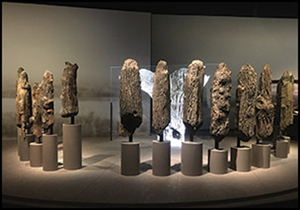
Although the exhibition narrative of WoS was framed around the rise and fall of Stonehenge, with key objects from the monument and its landscape woven throughout, it also sought to subvert the monument's iconic status by highlighting other, less famous, contemporary sites. The Early Bronze Age timber monument known as ‘Seahenge’ (Holme-next-the-Sea, Norfolk) was discovered in 1998 (Brennand et al. Reference Brennand2003) (Figure 6). The decision to present Seahenge at the heart of WoS was a direct result of the Icons in Context project agenda. It is a refreshing alternative to Stonehenge: interpreted as a small-scale community gathering locale rather than a place of large-scale ‘elite’ display; an organic monument that serves to remind us of what is missing elsewhere and to throw the symbolic significance of stone-built monuments into relief. However, the monument as conserved today lacks the vivid immediacy captured by photographs taken when the circle first, miraculously, surfaced on the Norfolk coastline and the important central tree-stump could not be moved from its current location at Lynn Museum. To compensate for these limitations, a commissioned sound-piece called half/life was composed by Rose Ferraby and Rob St John (Ferraby Reference Ferraby2022). An impressive 92 per cent of visitors felt this enhanced the display (British Museum 2022). Qualitative evaluation revealed interest and attraction at levels usually associated with iconic objects:
Marvelled by it, more interesting than Stonehenge (adult visitor).
Moving, humbling … the soundscape provides an emotional connection to the past beyond what is offered by the rational content descriptions [labels] (adult visitor).
The Seahenge display in the WoS exhibition (photograph by Rose Ferraby).

From these reactions we surmise that successful alternative icons are about more than changing approaches to the selection and written interpretation of objects. To offer alternative visions of past worlds requires emotional and embodied qualities that act on a visitor in ways that are not text-based or didactic but rather aesthetic, visual and atmospheric (cf. Wang Reference Wang2023). Alternative icons require alternative ways of contextualising objects.
Alternative icons in action
To assess the performance of other alternative icons in WoS we commissioned further, targeted evaluation. Five alternative objects were paired with relevant, contemporary iconic things in close proximity (Table 2) (see Morris Hargreaves McIntyre 2022: 51–73 for data and analysis). We hypothesised that while the alternative icons may not be as eye-catching or immediately striking as their paired objects, the stories behind them might elicit a different kind of emotional and intellectual response. This was tested through 68 exhibition visitor observations, 51 five-minute vox pop interviews and one accompanied visit involving 10 participants. Most participants wanted a balance of traditional ‘shiny’ iconic objects and alternative icons (31 of 41 respondents to this question) (Morris Hargreaves McIntyre 2022: 72–3). One vox pop respondent commented:
If it's just a beautiful thing I think you can only get so interested by it. I think you need to know the story of it … (adult visitor).
Comparison between traditional and alternative icons in the WoS exhibition.

There was also a desire for a balance between storytelling and evidence of skill, craft and ingenuity. Intriguingly, it was when objects (or assemblages) combined both elements that they had special potency. We suspect this reflects something important about Neolithic and Bronze Age objects in the past as much as in the present.
Overall, vox pop respondents specifically recalled the traditional objects more often than our alternative icons: 71 mentions compared to 47. This reflects the particularly poor performance of Neolithic bone, flint and pottery assemblages from the wider Stonehenge landscape. However, combined average view times indicate that visitors favoured our alternative icons (6 minutes 24 seconds compared with 5 minutes 27 seconds). It was also notable that the mostly organic grave goods from Whitehorse Hill, Dartmoor, were specifically recalled by twice as many respondents as the goldwork from Bush Barrow near Stonehenge; the former also had a considerably longer average view time (1 minute 26 seconds compared with 33 seconds) (Morris Hargreaves McIntyre 2022: 57–8).
The poor performance of some alternative icons, most notably high-density, mixed material assemblages (e.g. finds from Coneybury and Durrington Walls), was probably due to the absence of more visually arresting elements (including organics) and deficiencies in the way they were displayed. More experimental or daring display techniques (e.g. novel mounting and juxtaposition of unexpected objects and/or design elements) would probably have produced better results (Monti & Keene Reference Monti and Keene2013: 259, 265–6). Displays could also be enhanced by borrowing more fully from related fields, including contemporary art, and drawing upon the often-beguiling appearance of archaeological deposits and features in situ (e.g. Pollard Reference Pollard2001).
Museum futures
A cultural sea-change in attitudes to who and what museums are for, combined with a growing recognition of the importance of the relationships between the range of things represented by site assemblages and the profusion of archaeological collections in the UK and beyond, means that curators face a daunting challenge. More needs to be done to display archaeological assemblages meaningfully and showcase alternative kinds of material culture. Debates around decolonisation and the democratisation of display have been driving many of these changes; while these are usually conducted in relation to more recent periods, these discussions are certainly relevant to the deeper past. Anachronistic attitudes to power and status have influenced approaches to the display of prehistory for too long. Monti and Keene (Reference Monti and Keene2013) have highlighted the potential for ‘silent objects’, including those that require high-density displays, to tell new stories if the right interpretative balance is struck between overview and example, social context and personal stories. This approach is more representative of current academic understandings concerned with the relational qualities of society, politics and personhood during the fourth to second millennia BC in much of Europe.
As our case studies from the WoS exhibition have shown, enacting a shift in the narrative and design style (and tropes) we employ will be challenging but it is essential. Museums today are perhaps unhealthily dependent on iconic objects for marketing and to appeal to audiences. The growth of museum and media interest in acquisitions and exhibits of ‘treasure’ (inevitably made of precious metals) found by metal-detectorists is one expression of this trend (Williams et al. Reference Williams, Reavill and Clague2022). Museums across the world face difficult financial circumstances and there are justified concerns that populism related to visitor targets is overtaking effective, research-led storytelling (Sindbæk Reference Sindbæk2022) and creating predictable and repetitive exhibits. A middle way is possible: alternative icons and archaeologically rich assemblages can provide immersive displays and storytelling that break away from established tropes and stereotypes, presenting different visions of the past while also fostering, and entertaining, large audiences.
We believe that museums in the UK and globally can better engage public audiences and address ethical, environmental and economic challenges by rethinking the types of ‘icons’ they choose to present. Calls for greater inclusivity, decolonisation and democratisation are likely to be even more pressing in coming years and it is vital that prehistorians confront and transform their practice through engagement with these debates as well. The alternative approaches we have proposed allow museums to offer fuller and more representative visions of past worlds.
Acknowledgements
Our thanks to Natalie Buy, Jill Cook, Alice Low, Kayte McSweeney, Jill Maggs, Jennifer Wexler and Craig Williams, and to Sophia Adams, Alanna Cant, Anwen Cooper, Stuart Frost, Thomas Kiely and two anonymous reviewers for helpful comments on earlier drafts of this article, although all faults remain our own.
Funding statement
The research for this article was funded by the Arts and Humanities Research Council project Icons in context: rethinking symbols of power at the time of Stonehenge (AH/T007265/1). This article is made Open Access through the support of a UKRI Open Access Block Grant.


 Open access

