

For Andrew Monroe [pseud.] (1894-1971), report cards made the difference between incarceration and freedom.Footnote 1 Andrew was a street kid. He grew up in a variety of Colorado towns and the railroad tracks were his playground. He ran away from school, ran away from his mother, and tended to take things that were not his. In 1906, a judge sentenced Andrew to the State Industrial School for Boys, partially on the basis of information from school report cards. By April 1910, Andrew had been institutionalized for nearly four years at the Industrial School, and report cards were still keeping him from freedom. His misbehavior at the reform school, as well as his repeated attempts at escape, were all documented on periodic report cards submitted to the parole board. Given the information on the reports, Andrew would most likely have been incarcerated for another six years, or until he turned twenty-one years old. But on April 11, 1910, Andrew did what he had done three times before. He snuck out the Industrial School, made his way to the tracks near Golden, Colorado, and hopped on a train heading east.
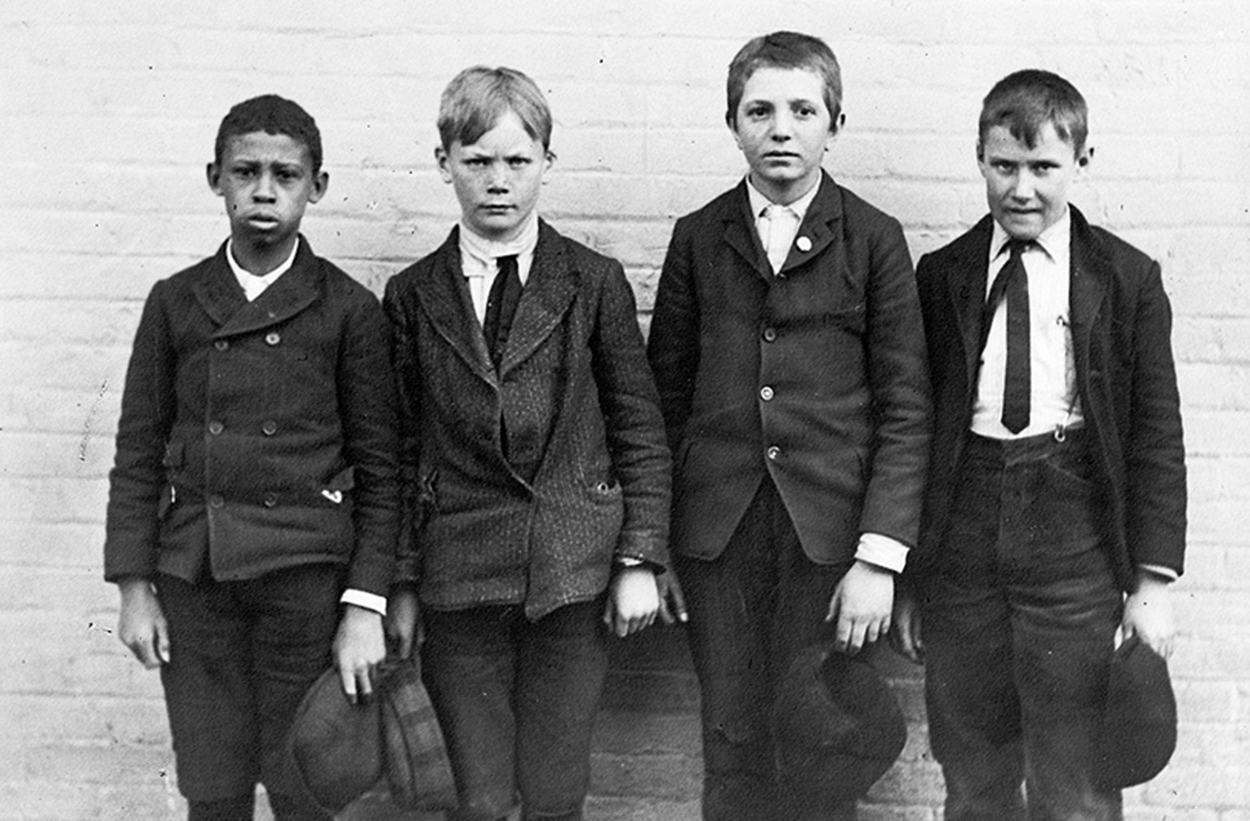
Truant boys, appearing before one of Colorado's juvenile courts, around the same time that Andrew Monroe was sentenced as a twelve-year-old, c. 1906. Credit: Truant Boys, c. 1900-1910, Harry H. Buckwalter Collection, CHS-B1044 (Stephen H. Hart Research Center, History Colorado Museum, Denver, CO).Footnote 160
Andrew Monroe's life—and the long-term impact that report cards played in that life—serves as a case study for broader insights into systems of juvenile corrections in the early twentieth century.Footnote 2 I am defining report cards as the systematic communication from the school to guardians, detailing a student's attendance, academic performance, and/or personal conduct.
Early references to report cards appeared in the education journals of the 1830s and 1840s. In the antebellum period, schoolmasters experimented with ways to enlist the cooperation of parents who were quick to take the side of their children in disciplinary disputes.Footnote 3 In other words, the report card was born as a teacher initiative in an era of common school expansion to co-opt parental support. After the Civil War, superintendents and principals mandated the use of report cards, an evolution that coincided with the increasing centralization of control over schools.Footnote 4 The report card appeared in Colorado in the 1870s, a decade marked by school growth and centralization.Footnote 5 In towns like Georgetown and Boulder, newspapers announced the distribution of report cards, reminding parents to review their child's “scholarship and deportment.”Footnote 6 Report cards from 1882, 1890, and 1893 have survived in a variety of Colorado archives.Footnote 7 By Andrew Monroe's birth, report cards were an accepted ritual of the academic calendar.Footnote 8 Teachers and principals no longer had to explain their function to the public. In fact, parents increasingly demanded more information on report cards.Footnote 9
In the early 1900s, as Andrew entered school, teachers began submitting those same report cards to probation officers and judges, who relied on teachers for surveillance of their probationers.Footnote 10 Within the context of reform schools, teachers and “company commanders” submitted their report cards to parole boards within the state's juvenile corrections system. However, the performance areas designated in the reports remained consistent, whether the intended audience was a parent, probation officer, judge, or parole board: attendance, scholarship, and deportment.
This study of Andrew Monroe and his experiences with school reports extends recent scholarship on the history of juvenile corrections in the United States.Footnote 11 For instance, Ethan Hutt's research on the evolution of compulsory education before late nineteenth and early twentieth century courts reveals that by the first few decades of the twentieth century, judges deemed “education as being synonymous with attendance at school.”Footnote 12 Meanwhile, Tamara Myers documents the importance of “surveillance and regulation” in the new “disciplinary apparatus” of the Progressive Era.Footnote 13 As Julia Grant points out, the nearly insurmountable task of “corralling the boys of the streets into schools” was a far more challenging endeavor than reformers had anticipated.Footnote 14
This article argues that the report card was the most important tool that child-savers employed to do that corralling, an overlooked detail in a process that “proved more difficult than reformers had envisioned,” as Grant writes.Footnote 15 As the following discussion shows, the report card—written by teachers and school administrators then submitted to court officers and judges—was the lynchpin of the system that Myers describes.
By recovering Monroe's entire life history up to his death in 1971, this study also extends the work of scholars who have centered the narratives of children in their histories of juvenile corrections. In his study of race and juvenile justice in Texas, William S. Bush relies on the documentation of boys like Jimmy Jones, who fled reform school, was attacked by guard dogs, received “forty licks” for his insubordination, and then had to navigate a system of peer informants.Footnote 16 However, because of a lack of primary sources, none of Bush's case studies extend into adulthood, beyond the confines of the juvenile correction system. Most recently, Tera Eva Agyepong shows how the discourse of racism, combined with systems of surveillance, shaped the lives of African American children in Chicago's juvenile justice system.Footnote 17 However, like Bush, Agyepong does not trace the impact of juvenile corrections onto the former “delinquents” after they left the correctional system. Meanwhile, in the epilogue of Miroslava Chávez-García's book on juvenile justice in California, the author employs oral history to reflect on the long-term impact of reform school. One of her subjects, Frank Aguirre, recalled his time at reform school with a mix of nostalgia and disdain. He was grateful that the school taught him “self-restraint” while at the same time admitting that he “felt emotionally raped.”Footnote 18
Monroe, unlike the examples in Agyepong's and Chávez-García's studies, was a native-born White, a child for whom the system of juvenile corrections was the intended beneficiary.Footnote 19 Society gave Monroe second chances, and most boys who had their reports submitted to juvenile courts avoided incarceration. Yet Monroe refused to comply with the system as a minor, and he grew into an adult who hurt people both physically and psychologically. Monroe's life ultimately reveals a paradox of Foucauldian disciplinary power.Footnote 20 In his resistance to the labels imposed on him by reports, Monroe inadvertently reinforced those labels. He was a delinquent, and the more he fought back, the more authorities documented his delinquency. This was a self-fulfilling cycle that led to tragic long-term consequences for boys like Andrew Monroe.Footnote 21
The Report Card and Early Juvenile Courts
Judge Ben B. Lindsey (see Figure 2), of Arapahoe County, Colorado, created the juvenile court system before which Andrew Monroe eventually appeared. On a typical Saturday in the early 1900s, about two hundred children and adolescents, most of them boys, would crowd into Judge Lindsey's courtroom. For an entire afternoon, the children on probation would stand and read their reports, written by their classroom teachers. These report cards were essential to Judge Lindsey's new and innovative juvenile court. The county government could not afford to hire truant officers, so Lindsey enlisted teachers to serve as his probation surveillance system. According to Lindsey, most of the teachers’ reports were positive. However, a series of negative report cards from teachers, documenting a child's insolence, truancy, or misbehavior, could result in a child being sent to reform school.Footnote 22
Judge Ben Lindsey and boys in juvenile court, c. 1913. Credit: Mrs. Ben B. Lindsey Collection, LOT 5650 (Library of Congress, Washington, DC).

By the early 1900s, the middle-class elite of industrialized urban centers like Denver struggled to manage the perceived threat of the working-class and largely immigrant labor force.Footnote 23 In response, municipal and state governments created new institutions such as juvenile courts, which were a continuation of the existing trends among middle-class “child-savers.”Footnote 24 Before the 1890s, children typically appeared in the same criminal courts as adults.Footnote 25 But at the end of the century, judicial systems were being reformed in deference to the findings of scientific experts.Footnote 26 In 1899, the Illinois legislature created the Cook County Juvenile Court, which claimed to be the first of its kind in the United States.Footnote 27 Other cities followed, with the stated goal to “personalize the justice system” around the needs of the minors.Footnote 28
In 1901, Lindsey used a loophole in Colorado's statutes to unilaterally create a juvenile court.Footnote 29 In contrast to the Illinois precedent, Judge Lindsey emphasized informality.Footnote 30 He refused to call a juvenile a criminal and instead used the phrase a juvenile disorderly person.Footnote 31 Lindsey told one reporter, “We don't try cases. We hear the boys’ stories.”Footnote 32 The Denver press praised Lindsey as a progressive hero, affectionately calling him “Little Ben” (he stood five feet four and weighed less than one hundred pounds).Footnote 33 Lindsey believed that, through encouragement and empathy, disorderly juveniles could change their habits and reform themselves without the use of coercive force.Footnote 34
A bit of a paradox lay at the heart of Lindsey's court. Claiming to be informal and empathetic, Lindsey even described the process within his juvenile court as “elastic” at one point. When he published a blank sample of report cards in 1905, however, the reports were brief and lacked any space for nuance, indicating that he relied on a formulaic system of teacher reports. (see Figure 3).Footnote 35 In one column, teachers rated the probationer's conduct with one-word answers: good, fair, or poor. In the next column, Lindsey asked teachers to report on the child's attendance. On the back of the card, teachers could choose from a series of binary characteristics: “Unruly or obedient?” and “Stubborn or yielding?” and “Untruthful or truthful?” These rigid and somewhat simplistic categories provided the evidence for determining whether a child ended up in reform school.Footnote 36 As Lindsey wrote, the teachers’ reports were “the eye of the juvenile court.”Footnote 37
A sample of the school report card used in Judge Ben B. Lindsey's court. Credit: Ben B. Lindsey, The Juvenile Court Laws of the State of Colorado (Denver, CO: Juvenile Improvement Association of Denver, 1905), 70-71.

Juvenile Courts and Systems of Teacher Reporting
Ben Lindsey became one of several voices nationwide promoting the use of report cards in juvenile courts. He was featured in progressive journals like the nationally distributed Juvenile Record, where he emphasized that for his system to work, “the report must be made by [the probationer's] teacher and principal . . . detailing school attendance and conduct.”Footnote 38 Articles about and by Lindsey appeared for wider audiences in the New York Times and the Atlanta Constitution.Footnote 39 In multiple trips, he traveled to locations as distant as California, Boston, and Mississippi.Footnote 40 It did not take long for other cities to adopt Lindsey's approach. In 1902, Buffalo's teachers began returning report cards to probation officers.Footnote 41 By 1905, a Kentucky court was using report cards.Footnote 42 Then, in 1908, a judge in Los Angeles adopted the practice.Footnote 43 In 1912, New York City was using customized school reports in order to “know the quality of mind of each offender,” as one judge explained.Footnote 44 In Cleveland, a probation officer wrote that “much of the success of our work is due to the hearty cooperation given by principals and teachers” who “furnish intelligence” through “report cards which pass weekly between the individual teacher and the probation officer.”Footnote 45 State laws in Massachusetts (1906), Nebraska (1906), and Idaho (1907) expressly required school authorities to make reports to juvenile court judges.Footnote 46
Each year, report cards also led to incarceration. Report cards in Chicago documented one child's 213 absences in just two years, described another child as “the worst boy in school,” reported that one boy had taken money from a teacher's purse, and alleged that another boy had beaten a teacher with a stick.Footnote 47 All of these children ended up in reform school. In New York, a teacher's report of delinquency led police officers to arrive at school “with a bench warrant.”Footnote 48 The power of the report card began to concern some progressives. Juvenile Record captured a court scene in Detroit where a judge scolded a probationer: “I am mad at you. . . . Your report says, ‘Bad, bad, bad.’” As the child was threatened with reform school, the boy's mother burst into tears.Footnote 49 Critics of the new system recognized that too much power rested with the discretion of teachers. One probation officer in Chicago indicated that teachers could be unfair and that they held deep prejudices toward some children. At times, the officer would “get the boy a transfer to another school.”Footnote 50
In 1903, Judge Ben B. Lindsey successfully lobbied his home state, Colorado, to legally mandate his juvenile court system.Footnote 51 Across Colorado, judges adopted the same pattern of juvenile justice.Footnote 52 First, minors below the age of sixteen would appear before the judge, and if they were found guilty, the judge would commute their sentences to the State Industrial School. Second, the juveniles would be ordered to attend their local public school during the probationary period. Finally, each probationer would be required to appear periodically before the court with written school reports.Footnote 53 Girls were subject to both the standard practice of school reports and extra scrutiny into their sex lives. In 1909, a sixteen-year-old girl was sentenced to the State Industrial School for Girls because of her “unusual fondness for men, both married and single.”Footnote 54 Five years later in Boulder, a newspaper reported on a thirteen-year-old girl's appearance before the juvenile court that led to “a confession that involved at least fifteen boys and men.”Footnote 55
Andrew Monroe's Colorado: Glenwood Springs, Railroad Tracks, and Juvenile Detention
Andrew was born in 1894 in Greeley, Colorado.Footnote 56 His father was an aspiring photographer from New York and his mother was a palm reader from Illinois. These were not typical jobs for a family living in Greeley. The town was established in 1870 on the edge of the dry northern grasslands and the Cache la Poudre River, all within sight of the Rocky Mountains.Footnote 57 Greeley was originally a utopian temperance settlement in which early colonists paid $150 to join the Union Colony. This payment entitled colonists to about ten acres near the town.Footnote 58 By the time that baby Andrew was born, Greeley had prospered as a result of the railroad construction boom. Tracks connected the Great Plains to urban centers like Denver and beyond, to the mines and smelter towns in the Rockies.Footnote 59 Greeley had established itself as the potato capital of Colorado, surviving a decades-long water-rights legal battle with nearby Fort Collins, periodic drought, locusts, floods, and a blizzard.Footnote 60
The family did not last long in Greeley. By 1900, the Monroes had moved to Glenwood Springs, Colorado's first resort town on the western slope (see Figure 4).Footnote 61 Nearly twenty years earlier, the US Army forced the Ute people onto increasingly smaller reservations, which opened the western slope to land speculators, cattle ranchers, and miners.Footnote 62 The railroads that snaked their way through the narrow canyons carried iron ore and silver to smelting plants, as well as tourists to Glenwood Springs.Footnote 63 In the late 1880s, investors from Denver had constructed Hotel Colorado, a massive Villa de Medici. By the time the Monroes arrived, there were 1,350 permanent residences, twenty-one saloons, and over fifty prostitutes.Footnote 64 All of these factors made Glenwood Springs an attractive choice for the Monroes. There were tourists in the town with disposable income to purchase photographs.Footnote 65 There was also work for Ervilla, Andrew's mother. Glenwood Springs was the headquarters of Al G. Barnes's traveling circus, and Barnes employed fortune tellers.Footnote 66 Included in the records of the circus is the name “Candy” Monroe, perhaps Andrew's mother who may have adopted Candy as a stage name.Footnote 67
Glenwood Springs, c. 1900. Credit: Harry H. Buckwalter Collection, CHS-B219 (Stephen H. Hart Research Center, History Colorado Museum, Denver, CO).

Glenwood Springs was where Andrew spent his formative years. The town was also where the Monroe marriage dissolved. By 1902, Daniel Monroe, Andrew's father, had built a photography studio on the corner of Cooper Avenue and Ninth Street, a block away from the heart of town.Footnote 68 At some point, Daniel may have stopped running a legitimate business, instead swindling investors of their money and engaging in fraud. One business partner confronted Daniel at the railroad depot in July 1902. The two men threw punches.Footnote 69 Daniel fled town, abandoning both his family and his investors. Sometime in 1903, Daniel ended up in Nebraska and in the process filed for divorce from Ervilla.Footnote 70 Then, for some reason, Daniel returned to Glenwood Springs in October 1903, fifteen months after first leaving. Ervilla did not welcome him home. The estranged couple confronted one another in front of their children, and Ervilla called for the police.Footnote 71 Daniel then spent several weeks in jail, and he was only released so that he could financially support his estranged family.Footnote 72 A year later, Daniel had once again abandoned the family and traveled to Yuma, Colorado, where he established a photography tent.Footnote 73 By 1906, Andrew reported that he was unaware of his father's whereabouts or even his father's profession.Footnote 74
Andrew Monroe and the Glenwood Springs’ Court
In the early 1900s, the Glenwood Springs newspapers warned of a crime wave. Coal miners drank excessively, fought, and sometimes shot each other.Footnote 75 Con artists and hucksters, loitering in the town's many saloons, swindled visitors.Footnote 76 Bootlegging was ubiquitous and banks were occasionally robbed.Footnote 77 In January 1906, the town council called for a squad of night police to be hired.Footnote 78 In March 1906, a boy accidentally shot himself.Footnote 79 One of the local newspapers also reported the problem of children “doing all sorts of mischief” along the town's railroad tracks, “crawling through box cars” and “boarding running trains.”Footnote 80 More than likely, Andrew Monroe was one of these boys on the tracks, developing a skill set that would later be essential in his escapes from reform school.Footnote 81
The Monroe family members were no strangers to the legal system. When Andrew was eight years old, Ervilla Monroe appeared before the county commissioners requesting financial assistance. She was behind on rent, and she had four children who needed to be kept warm in the winter. The commissioners granted her an allowance of $15 per month to help.Footnote 82 Later that summer, Andrew's older brother, Willard, destroyed a neighbor's garden. The sheriff was called, and Ervilla promised to keep a closer watch on her boys.Footnote 83 In July 1903, a month after his brother's arrest, Andrew and two friends hopped on a train and traveled twenty miles south to the town of Rifle to watch a shooting competition. As the three boys walked over a bridge that spanned the Colorado River, the youngest of the group, Willie McKissack, fell into the rushing water. He was never seen again.Footnote 84 Instead of running for help, Andrew convinced his surviving companion to keep Willie's drowning a secret. Andrew believed that they would be blamed for the boy's death, and he maintained his silence the next day when police questioned him. Only after Andrew's companion confessed did the truth emerge.Footnote 85 The incident provided a window into the eight-year-old's views of authority; to young Andrew, adults could not be trusted.
Trouble continued for the Monroe family. In 1905, when Andrew was ten, he and Willard wandered into the surrounding woods. When darkness came, the Monroe boys were unaccounted for, and a search party was mobilized. Andrew and Willard were not found until the next morning.Footnote 86 In August 1906, Ervilla deserted her children, perhaps leaving them to join Al G. Barnes's traveling circus as a fortune teller.Footnote 87 Andrew thus began living with a foster family, whose patriarch was a barber. Andrew spent his afternoons after school selling fruit at the train station and “doing odd jobs” around the shop. The barber described him as a “bright boy.”Footnote 88
Andrew may have been bright, but he also tended to run away from authority. Records mention that he ran away from school, ran away from his mother, and ran away from the barber.Footnote 89 Sometime in September 1906, Andrew snuck away once again to the railroad tracks, where he stole a handcar. Twelve-year-old Andrew started to trek down the westward slope but was caught several miles out of town (see Figure 5).Footnote 90 In short, he not only disobeyed court orders by running away from school, but also committed larceny by stealing the handcar. The county judge—following the process established by Judge Ben Lindsey that considered school reports—labeled Andrew “truant” and reinstated Andrew's sentence to the State Industrial School for Boys.Footnote 91
The railroad tracks down river from Glenwood Springs, c. 1930. Credit: D&RGW train, engine number 1703, engine type 4-8-4, c. 1930, Western History Collection, OP-10398 (Denver Public Library, Denver, CO).

Reform Schools, the Parole Process, and Report Cards
Colorado's State Industrial School for Boys was typical of the era. By 1910, when Monroe was sentenced, nearly every state had some form of government-sponsored reform school.Footnote 92 Some children attended the reform schools voluntarily.Footnote 93 More typically, the minors incarcerated were guilty of “status offenses,” or crimes that only applied to children. These included offenses like incorrigibility, truancy, and behaving in a manner that was “beyond control.”Footnote 94 Industrial schools employed a mix of military discipline, vocational training, and academics in their efforts to reform children. The State Industrial School of Michigan declared that military drills would teach “immediate obedience to orders” to “correct a boy's habits and make him a useful citizen.”Footnote 95 In Georgia, the industrial school paroled students once they were deemed “good citizens,” both from “a humane standpoint” and “an economic standpoint.”Footnote 96 Alabama's industrial school would only parole a boy once he had acquired a trade such as tailoring or woodworking, where a boy could make an “honest living.”Footnote 97
Truant boys, c. 1906. Credit: Harry H. Buckwalter Collection, CHS-B1044 (Stephen H. Hart Research Center, History Colorado Museum, Denver, CO).

Report cards were the means through which school officials communicated to parole boards or superintendents. Since reforming institutions tended to be large, there was a desire for a standardization of the paroling process.Footnote 98 Industrial schools therefore relied on point-based systems recorded by either parole officers, industrial schoolteachers, or company commanders. The juvenile's report card, in other words, became more important than ever before. At the Lyman School, one of Massachusetts's oldest industrial schools, boys would be free once they obtained five thousand “credits.” The Lyman School's report cards reduced the inmates to single phrases like “doing well,” “doubtful,” and “doing badly.”Footnote 99 When boys arrived at the State Industrial School of Nebraska, they were automatically given a number of demerits. Each day, the boy had an opportunity to cancel a few demerits with good behavior or add to his total with misbehavior. Once the total number of demerits dwindled to zero, the boy gained his freedom.Footnote 100 In New York, 924 boys appeared before the parole board in a single year. A juvenile obtained liberty when “the required number of reports” were submitted to the parole board without any blemishes.Footnote 101
Even decentralized reform schools with just a few dozen inmates relied on systematic reporting. That was the case at the Virginia Home and Industrial School for Girls, located in the farming community of Bon Air. Despite there being only thirty girls at the school, the superintendent relied on periodic merit reports in her decision to release a minor.Footnote 102 Meanwhile, the reporting system at the State Industrial School in Topeka, Kansas, was the subject of an investigation.Footnote 103 The governor's office was concerned with the arbitrariness of the parole process and concluded that too much power lay in the hands of company commanders. They were “decent, well-intentioned,” but they were also “$40 men,” meaning that the meager monthly salary attracted failed farmers and day laborers, men who were “lacking in mental acuteness.”Footnote 104 These were the employees filling out the ubiquitous weekly report cards that carried so much power to dictate an adolescent's future.
Andrew Monroe's Life at the State Industrial School for Boys
Andrew was twelve years old when he arrived at the State Industrial School for Boys (see Figure 7) on October 2, 1906. He was four feet, eight inches tall and he weighed just eighty pounds. His body was riddled with an unusual number of scars: on both elbows, on his abdomen, on his right shoulder and right knee. Perhaps the scars had been accumulated over years of unregulated mischief-making along Garfield County's railroad tracks, or perhaps at the hands of parental discipline. An official at the Industrial School wrote that young Andrew had already “bummed trains all over the country.”Footnote 105 The skill of train hopping would be put to practical use during his many escapes in the coming years.
State Industrial School for Boys, Golden, Colorado, c. 1910. Credit: Western History Collection, MCC-608 (Denver Public Library, Denver, CO).

By the time Andrew arrived, the State Industrial School had existed for just over twenty-four years. In a typical year, about 850 boys would appear before Colorado's juvenile courts, and of those, about 150 would be sent to the State Industrial School.Footnote 106 The average length of stay at the school was seventeen months. Andrew was one of approximately 350 boys enrolled at the time, overseen by thirty-four teachers and officers. The stated goal was to ensure that “pupils are enabled to realize the uplifting influence of discipline and rightly directed industry.”Footnote 107 The campus was nestled on sixty-four acres among the foothills of the Rocky Mountains, and Lookout Mountain rose two thousand feet above the school.Footnote 108 Golden's railroad depot was less than two miles away, and Denver was another fifteen miles to the east, also accessible by rail.Footnote 109
The boys were divided into six companies, A through F, with each company consisting of between forty and seventy pupils.Footnote 110 They wore military-style khaki uniforms and were overseen by “company commanders.” Andrew was assigned to Company B, also known as “Mr. Davis’ boys.”Footnote 111 Four years before Andrew's arrival, the school underwent an investigation for excessive use of corporal punishment. The investigatory committee concluded that whippings were being “administered upon too slight provocation.”Footnote 112 One boy was whipped so hard that he could not sleep on his back, and the investigation recommended that the superintendent resign for his inability to “control his fellow officers.”Footnote 113 Later, another investigation discovered that a boy was handcuffed to a basement table and fed only bread and water for four days.Footnote 114
In a typical day, company commanders would wake the pupils up at 5:40 a.m. The morning would consist of military drills and industrial schooling. Academic work began after lunch and lasted until 4:30 p.m. Before supper, there was time for recess and sports on the parade ground, which was flanked by barracks, the dining hall, and academic classrooms. At 6:00 p.m., supper was served, and the evening concluded with a chapel service.Footnote 115 Judge Ben B. Lindsey made the trip out from Denver to give a chapel talk, at which Andrew was present.Footnote 116 Sports were part of the daily experience at the reform school. The State Industrial School for Boys had an excellent baseball team, going undefeated in 1910 and even playing semi-professional teams.Footnote 117 The school band offered a concert to Golden residents in the spring.Footnote 118 Andrew, however, was not listed on the roster of any sports team during his time at the State Industrial School nor in any musical group. Families visited nearly every week, but from 1906 through the end of 1909, there was no record of any family member visiting Andrew.
The main emphasis at the Industrial School was on learning discipline through manual labor. On any given day, boys hauled coal from Golden's train station, herded livestock, raked gravel from the school's parade ground, or dug sewer lines.Footnote 119 The boys did not always comply. There were instances of “mutiny” and a number of boys received demerits because they “took part in strikes.”Footnote 120 Perhaps the most common form of resistance was running away, and there were plenty of opportunities. Boys went to Golden unescorted for doctor's appointments; they were allowed to leave to attend funerals, and the superintendent even sent one boy to “run errands” in Denver.Footnote 121 On the other hand, there was a distinction between running away, where the boy was captured within a week, and an escape, where a boy was still unaccounted for by the end of the calendar year. From November 1908 through November 1910, only four pupils had escaped.Footnote 122 The typical reward for an escapee was between $20 and $25.Footnote 123 In 1910, nineteen-year-old Sidney Maxwell stole the superintendent's horse to make his getaway. He rode the horse across the Great Plains and into Kansas, before being caught nearly 450 miles away.Footnote 124 A few years later, fifteen-year-old Fred Palario fled to Denver. When caught, Fred explained that he only wanted to “play a couple of games of pool and have a pack of cigarettes.”Footnote 125 Later, three boys attempted to break their friend out by driving a stolen car onto campus. One boy was shot in the leg as a result.Footnote 126
Boys and teacher in classroom at the Industrial School for Boys, Colorado, c. 1910-1915. Credit: Mrs. Ben B. Lindsey Collection, LOT 5651 (Library of Congress, Washington, DC).

To be paroled, boys at the State Industrial School needed to earn twelve “badges.” Each badge represented a month's worth of obedience and hard work.Footnote 127 At the end of each month, teachers and company commanders gathered to “sort demerits” on their pupils’ report cards and then submit those report cards to the parole board.Footnote 128 Demerits were issued for a range of behaviors: “disobedience,” “destruction,” “poor working,” “scheming,” and “theft.”Footnote 129 Boys with positive report cards would be publicly recognized on an honor roll each month. The list of names included between 20 percent and 25 percent of the total student population.Footnote 130 Each year, the student with the best grades and deportment score on his report cards received a “$10 gold piece.”Footnote 131 Andrew's name never appeared on any honor roll.
More than honors, however, the scores on the report card revealed the amount of time that a pupil spent at the State Industrial School. As an example, the parole board chronicled how one pupil began as “lazy, disobedient and impudent.” Six months later, the parole board wrote, “conduct - much improved,” followed by “good reports” and “paroled.”Footnote 132 Almost always, the word “paroled” was only preceded by several months of “good reports.”Footnote 133 Attempting to escape, on the other hand, not only prevented a boy from gaining a new badge, but also resulted in the parole board removing badges and extending the incarceration time by months.Footnote 134 Card number 2279 documents Andrew Monroe's repeated attempts to flee the State Industrial School, reporting his efforts to the parole board. This report card, in essence, added years to Andrew's incarceration.Footnote 135
Andrew first ran away with another boy on October 22, 1907, just over a year into his sentence. He used an exit from the school's hospital ward to flee, although he was quickly caught. Andrew's second attempt came in November 1908. This time he was more successful, making his way to Laramie, Wyoming, over 130 miles to the north. In the process of escaping, Andrew suffered a severe case of frostbite. Winter temperatures in Laramie average between 13 degrees and 32 degrees Fahrenheit, occasionally dipping as low as -4 degrees.Footnote 136 As the fourteen-year-old Andrew struggled to find shelter in Wyoming, the tissues on his fingers and toes began to freeze. Within forty-eight hours, the ice particles in Andrew's extremities would have caused blistering, swelling, and throbbing pains that probably lasted for weeks.Footnote 137 Eventually, the tissue died, turned black, shriveled, and hardened.Footnote 138 The result was the amputation of Andrew's pinkie finger, two toes on his right foot, and a toe on his left foot.Footnote 139
Andrew hid in Wyoming a few winter months before being caught. The authorities returned him to the State Industrial School, hobbled by a limp and limited in the amount of labor he could perform with his missing finger and toes. Andrew did not repeat the mistake of escaping in the winter. In May 1909, six months after his reincarceration, Andrew escaped once again while “doing field work.” This time, he traveled south, presumably by rail, making it to the New Mexico border before being caught and returned in August 1909. By April 1910, Andrew had probably given up on being paroled through legal means. His history of escape and his lack of academic success were all documented on his monthly report cards, and each report would have added at least a month to his incarceration. Then, on April 11, 1910, Andrew slipped away from the State Industrial School for the final time and hopped on a train bound for St. Louis.Footnote 140
Andrew Monroe's Life After the State Industrial School
In November 1912, Andrew Monroe was eighteen years old.Footnote 141 By then, he had made his way to Des Moines, Iowa, and found work in a tannery that specialized in manufacturing gloves. His salary rose from $6 to $17 a week, and the owners of the factory regarded him as “one of the best factory employees.”Footnote 142 He was even furthering his education at night school.Footnote 143 Monroe married the daughter of a businessman, and in early November his wife gave birth to their son.Footnote 144 Then, somehow, authorities at the State Industrial School in Golden discovered his whereabouts. Local business leaders, led by Monroe's employer, mobilized a letter-writing campaign to lobby for his pardon.Footnote 145 The press labeled Andrew a real-life “Jean Valjean,” comparing him to the self-reforming character in Victor Hugo's well-known novel, Les Miserables. Footnote 146 As a result, the superintendent of the industrial school and the governor conceded to the public and granted Monroe a full pardon.Footnote 147 The superintendent even paid for Monroe's train ticket back to Denver, shaking hands with Andrew in person and telling his former pupil that he was proud of him. Monroe's story seemed to be having a happy ending.
The positive news did not last long. Rachel, Monroe's wife, discovered his criminal past through newspaper reports, and their relationship changed to one increasingly characterized by mistrust. Monroe began to “stay out late at nights and grew abusive.”Footnote 148 In June 1913, just seven months after receiving his pardon, Monroe assaulted Rachel. Their argument began when Monroe accused his young wife of “neglect of their eight months old child.”Footnote 149 He admitted to choking her in a fit of anger, and Rachel responded by pressing charges of assault and battery.Footnote 150 Monroe, for his part, blamed the turn of events on the long memory of the law. “My wife turned against me and I lost my job,” Andrew told a reporter. “The home is busted and what is to become of me?” He then added, “Once you've been in [reform school], the world will find it out and remind you of it.”Footnote 151
Conclusion: An Unmarked Grave and Unintended Consequences
Monroe's life continued to unravel after he was arrested for beating his wife. In 1916, at the age of twenty-two, Monroe stole a car in Denver and drove it across Colorado and most of Nebraska.Footnote 152 After being incarcerated for the stolen car, Andrew was arrested for a third time as an adult in 1918 for “receiving and concealing stolen property.”Footnote 153 By the 1930s, Andrew had remarried, and then abandoned his second wife and child. His estranged second wife wrote that Monroe “had babies all over the country” and that “he had no heart or principle.”Footnote 154 Monroe spent the 1940s working on the docks of Port Arthur, Texas, loading and unloading freight.Footnote 155 In 1965, at the age of seventy-one, Monroe retired and moved back to his place of birth: Greeley, Colorado.Footnote 156 He died in January 1971, at the age of seventy-seven.Footnote 157 No family members attended Monroe's funeral. Categorized as a “welfare case,” Monroe is buried in an unmarked grave at Greeley's Sunset Memorial Gardens.Footnote 158
Boys playing on the parade ground at the Industrial School for Boys, c. 1910. Credit: Colorado State Industrial School Collection, 2012.062.013 (Golden History Museum and Park, Golden, CO).

Young Andrew's resistance to juvenile corrections serves a broader historical purpose. His life lays bare the true reason behind relics of educational bookkeeping like report cards, which reduced Andrew to simplistic categories like “stubborn,” “unyielding,” and “disobedient.” Report cards were about control. When children like Andrew went to such extraordinary lengths to reject those attempts at control, they highlighted the essence of the system. Even Judge Ben Lindsey—the creator of that system—recognized the flaws of building a juvenile court around teacher reports. In 1912, Lindsey wrote about his concern that teachers were too quick to use the power of their reports to threaten unruly pupils. Lindsey concluded that controlling children through surveillance and threats sometimes leads to “storing up possibilities of a criminal” in children.Footnote 159 Lindsey recognized that as an unintended consequence of the reductionist report card, some children would be unable to escape their labels. In the end, Andrew Monroe's life was one of those tragic—albeit unintended—consequences.
Wade H. Morris teaches history at United World College East Africa in Moshi, Tanzania. He earned his PhD from Georgia State University. The author would like to thank Chara Bohan, Nick Boke, and Susan Ehtesham-Zadeh for their years of mentorship and Kim Tolley, Wayne Urban, and the anonymous reviewers for their insightful feedback on early versions of this manuscript. Georgia State University's Provost Dissertation Fellowship supported the research for this article.


 Open access

