

Introduction
Since subjective well-being gained prominence as a research topic in the early 1990s, in-depth studies across various disciplines, including psychology and economics, have significantly enriched our understanding of what promotes happiness.
Recognising the importance of happiness, significant literature has investigated its causes, revealing key determinants including economic factors (Barros et al., Reference Barros, Dieguez and Nunes2023; Gedikli et al., Reference Gedikli, Miraglia, Connolly, Bryan and Watson2023), social factors (Stéphane and Noumba, Reference Stéphane and Noumba2024; Kumari et al., Reference Kumari, Sahu, Sahoo and Kumar2022), and institutional factors (Bromo et al., Reference Bromo, Pacek and Radcliff2024; Ndoya et al., Reference Ndoya, Belomo, Okere and Talla2024). Despite these diverse determinants, the present contribution focuses specifically on one key factor: institutions. Building on North’s (Reference North1991) seminal definition of institutions as humanly devised constraints designed to structure political, economic, and social interactions (encompassing both informal constraints and formal rules), this study deepens the analysis with a focus on political constraints and their impact on happiness.
The literature offers different definitions of political constraints. Kreft (Reference Kreft2003) distinguishes between self-imposed limits on political actors, such as constitutional rules and electoral systems, and government-imposed restrictions on economic actors. Building on the former, subsequent work conceptualises political constraints through an index capturing the number and strength of veto points that limit policy change (Bjørnskov et al., Reference Bjørnskov, Dreher and Fischer2010; Henisz, Reference Henisz2002). This measure reflects the extent to which institutional structures restrict leaders’ ability to pursue self-interested policies. By assessing the likelihood that such policies are blocked, it provides a dynamic indicator of institutional strength and accountability, shaping how political preferences translate into public policy and, ultimately, citizens’ well-being.
Before moving further, it is worth noting that the effectiveness of political constraints cannot be the same everywhere and may vary depending on levels of economic development and institutional maturity. In contexts characterised by weaker state capacity and lower levels of democratic consolidation, formal constraints on executive power may function imperfectly. Therefore, rather than assuming institutional equivalence across countries or relying solely on countries where political constraints are effective and more efficient, such as developed countries, this study takes a broader approach by analysing the relationship between political constraints and citizens’ happiness in a larger sample that includes countries at all levels of development.
This paper addresses gaps in the literature on political institutions and well-being. Existing research is often case-specific and typically measures institutions through democracy indicators, limiting broader generalisation (Berggren and Bjørnskov, Reference Berggren, Bjørnskov and Zimmermann2020). Moreover, no study has directly examined the impact of political constraints on happiness. We fill this gap by focusing specifically on political constraints and their relationship with happiness.
We investigate whether individuals are happier in countries with stronger political constraints and through which mechanisms this occurs. First, we assess the direct relationship, given mixed empirical findings on institutions and happiness. Second, we explore transmission channels, arguing that political constraints shape outcomes that ultimately influence well-being.
Using entropy balancing on a sample of 125 countries across all income levels, we find that political constraints have a positive and robust effect on happiness. This relationship operates through greater political and economic freedom, stronger rule of law and control of corruption, and lower inequality and unemployment.
The rest of this paper is organised as follows: the next section lays out the theoretical framework; Section 3 details the data and methodology; Sections 4 to 7 present the baseline results, robustness checks, heterogeneity analysis, and transmission channel analysis, respectively; and Section 8 concludes.
Theoretical background and hypotheses
Theoretical link between political constraints and happiness
This section examines three key theoretical perspectives to clarify the complex relationship between political constraints and happiness.
Public choice theory and the role of political incentives
Public choice theory provides a valuable lens for conceiving decision-makers as rational, utility-maximising actors whose behaviour is primarily influenced by self-interest rather than altruism. Politicians desire re-election, bureaucrats seek financial expansion, and interest groups exert pressure for special treatment. Without adequate institutional restrictions, such incentive structures lead to rent-seeking, policy capture, and wasteful allocation of public resources (Buchanan and Tullock, Reference Buchanan and Tullock2003; Mueller, Reference Mueller, Rowley and Schneider2008). According to Farber (Reference Farber and Parisi2017), public law serves as a collection of institutional solutions intended to handle the difficulties associated with rational people acting collectively. Such institutions can promote collaboration and logical group decision-making by designing incentives, but they may also give subgroups the chance to make money at the expense of the public. The main takeaway is that political institutions are important because they influence the incentives and limitations that political players face. The welfare of the group is undermined when elites have few barriers against opportunism and rent-seeking due to weak or nonexistent procedures, including independent oversight, electoral accountability, and the division of powers. Strong political constraints, on the other hand, act as external commitment tools that strengthen the legitimacy of policy pledges, discipline power, and realign political incentives with the public good. Such restrictions promote governance conditions that eventually enable greater levels of public trust and happiness by reducing arbitrary decision-making, enhancing transparency, and reducing clientelism and corruption (Acemoglu and Robinson, Reference Acemoglu and Robinson2016).
Social welfare theory and the pursuit of collective well-being
A normative framework for assessing institutions and policies according to how they contribute to the overall well-being is provided by social welfare theory (Immergut, Reference Immergut, Castles, Leibfried, Lewis, Obinger and Pierson2010). To ensure that policies represent the preferences of the majority, including everyone, it highlights that institutional design should strive for fairness, equity, and inclusivity in addition to economic efficiency. Fleurbaey and Maniquet (Reference Fleurbaey and Maniquet2011) expand on this strategy by emphasising that social well-being requires equitable distribution of opportunities and resources and cannot be boiled down to aggregate efficiency alone. In this sense, political institutions play a crucial role in evaluating whether results are the result of personal accountability or long-standing advantages associated with power imbalances. Political constraints improve the effectiveness and equity of public decision-making when they prevent corruption, clientelism, and rent-seeking. Since people value fair processes as well as fair outcomes, fairness directly fosters legitimacy and indirectly improves happiness. Mechanisms like voice, accountability, and discussion are operationalised by political restrictions. These factors, when incorporated into the political system, raise the possibility that governments will successfully provide public goods, defend civil rights, and ensure crucial elements of societal well-being.
Institutional theory and the mechanisms of horizontal accountability
The broader literature on horizontal accountability and governance provides a useful lens for theorising the link between political constraints and well-being. Since the seminal contributions of Adserà et al. (Reference Adsera, Boix and Payne2003) and Rothstein and Teorell (Reference Rothstein and Teorell2008), the quality of governance has been widely recognised as a key determinant of societal outcomes. In this perspective, political constraints are viewed as a central mechanism for safeguarding governance quality by limiting executive discretion and reducing opportunities for rent-seeking.
Furthermore, judicial and political checks and balances serve as accountability mechanisms that enhance institutional credibility (Keefer and Stasavage, Reference Keefer and Stasavage2003; Weingast, Reference Weingast1997). The presence of independent courts and actors endowed with legislative veto power promotes greater policy stability and accountability (Feld and Voigt, Reference Feld and Voigt2003), with implications that extend beyond economic performance to broader societal outcomes. Indeed, Bernauer and Vatter (Reference Bernauer and Vatter2012) show that the design of political institutions significantly shapes citizens’ satisfaction with and trust in democracy, suggesting that consensual systems with strong checks and balances can act as a buffer for citizens – particularly those belonging to political minorities.
Nevertheless, the literature cautions that the effects of such institutions on well-being are neither uniform nor firmly established. While some scholars argue that institutional rules exert a direct influence on social outcomes (Persson and Tabellini, Reference Persson and Tabellini2004), others contend that their effectiveness is conditional on governance quality and, more specifically, on the degree of democratic consolidation (Charron and Lapuente, Reference Charron and Lapuente2010). In contexts of weak state capacity, political constraints may generate institutional paralysis rather than prosperity. Our analysis contributes to this debate by examining whether horizontal accountability mechanisms translate into improved governance and, in turn, into welfare gains.
In summary, these three theoretical frameworks provide a multi-dimensional understanding of how political constraints influence human well-being. Together, these theories argue that the positive influence of political constraints on happiness is not only a byproduct of economic stability but a result of a more predictable, inclusive, and accountable relationship between the state and its population.
Hypothesis 1. Political constraints are positively associated with happiness.
Linking political constraints and happiness
Political-institutional mechanisms
Political freedom. Citizens’ ability to participate in public decision-making is reflected in political freedom, which includes civil liberties, political rights, and participation (Roll and Talbott, Reference Roll and Talbott2003). Free speech, competitive elections, and civic engagement are all supported by strong political constraints like the separation of powers and independent oversight, all of which promote legitimacy, empowerment, and satisfaction. While Bavetta et al. (Reference Bavetta, Patti, Miller and Navarra2017) suggest that active participation in the political process fosters autonomy and happiness, this relationship is often contingent. Consequently, as Anderson and Guillory (Reference Anderson and Guillory1997) noted, the ‘well-being dividend’ of political freedom may depend on whether the institutional design protects the interests of both winners and losers in the political arena.
Rule of law. Since the rule of law usually refers to the extent to which agents believe in and follow societal laws, political constraints are one of its important factors, as they limit political elites’ ability to behave arbitrarily or circumvent legal frameworks (Weingast, Reference Weingast1997). By institutionalising horizontal accountability, for example, these limits ensure that the law is enforced impartially, which is a critical component of ‘quality of government’ (Rothstein and Teorell, Reference Rothstein and Teorell2008).
Consequently, a strong rule of law improves happiness by minimising ambiguity and corruption (Alt and Lassen, Reference Alt and Lassen2008). When citizens view the legal system to be fair and predictable, they feel more secure and trust their institutions (Feld and Voigt, Reference Feld and Voigt2003). However, the literature suggests that this relationship is not a given; in developing countries with limited state capacity, the formal presence of political constraints may not always translate into a functional rule of law if the underlying administrative institutions are weak (Besley and Persson, Reference Besley and Persson2011). Thus, we assume that the rule of law is an important, if contingent, avenue via which institutional checks influence happiness.
Hypothesis 2a. Political constraints are positively associated with citizens’ happiness through greater political freedom.
Hypothesis 2b. Political constraints are positively associated with citizens’ happiness through stronger rule of law.
Governance quality and fairness
Control of corruption. Controlling corruption demonstrates political institutions’ ability to limit the misuse of public power for private gain (Bjørnskov, Reference Bjørnskov2010). Political constraints function as a mechanism of horizontal accountability, allowing independent bodies to detect and punish rent-seeking behaviour (Alt and Lassen, Reference Alt and Lassen2008). By increasing the political cost of corruption, these constraints reduce elite capture and foster a more impartial administrative environment. While much of the literature, including the works of Li and An (Reference Li and An2020), demonstrates that reduced corruption significantly boosts subjective well-being, this effect may be moderated by the transparency of the political system (Adserà et al., Reference Adsera, Boix and Payne2003). Thus, we argue that political limitations offer the institutional checks required to reduce the ‘unhappiness tax’ imposed by systemic corruption.
Income inequality. The impact of political constraints on income inequality is more contentious in the literature. On the one hand, stringent constraints can prevent elites from dominating the policy process, eventually resulting in more equitable resource allocation (Acemoglu and Robinson, Reference Acemoglu and Robinson2006). However, the literature on this inclusive policy argument is far from conclusive. In some contexts, several veto players may safeguard the status quo, making redistributive reforms more difficult to adopt (Tsebelis, Reference Tsebelis2002).
On the other hand, the income inequality-happiness nexus is empirically complex. While relative deprivation theory predicts that inequality affects well-being (Knight et al., Reference Knight, Song and Gunatilaka2009), other research suggests that this link may be nonlinear or dependent on economic progress (Wang et al., Reference Wang, Pan and Luo2015). We examine this channel to see if political limitations provide a stable and inclusive society that can buffer the negative psychological effects of economic imbalance.
Hypothesis 3a. Political constraints are positively associated with citizens’ happiness through better control of corruption.
Hypothesis 3b. Political constraints are positively associated with citizens’ happiness through lower income inequality.
Economic mechanisms
Economic freedom. Economic freedom refers to an individual’s ability to seek economic opportunities independently. It is essential for human dignity, autonomy, and personal empowerment (Miller et al., Reference Miller, Kim and Roberts2022). Political constraints are important for safeguarding this freedom, since they serve as commitment devices that protect property rights and ensure monetary policy stability (Keefer and Stasavage, Reference Keefer and Stasavage2003).
When governments operate under binding constraints, they are less inclined to market distortions arising from favouritism or erratic regulatory interventions (Persson and Tabellini, Reference Persson and Tabellini2004). Such institutional predictability allows economic freedom to coexist with political freedom, reinforcing institutional trust and individual autonomy (Hall and Lawson, Reference Hall and Lawson2014). Empirical studies consistently document a positive association between economic freedom and happiness (Sirbu et al., Reference Sirbu, Iacobuţă-Mihăiță, Asandului and Brezuleanu2023), although these effects are often conditional on the rule of law and the state’s capacity to enforce contracts impartially.
Labour market stability and employment. Political constraints can influence well-being through their effects on the labour market, extending beyond the role of general economic freedom. By limiting executive discretion and reducing policy arbitrariness, institutional stability fosters a predictable environment that encourages long-term investment. Such investment, in turn, constitutes a key driver of job creation and employment.
In the happiness literature, labour market participation is an important determinant of life satisfaction, as employment provides not only income but also social inclusion and economic security. In the same vein, as unemployment is widely recognised in the literature as one of the biggest detractors from happiness (Chen and Hou, Reference Chen and Hou2019), political constraints may indirectly protect employment levels by creating the structural underpinnings for economic growth and averting abrupt, predatory policy changes that could destabilise the labour market. However, as Aghion et al., (Reference Aghion and Schankerman2004) suggest, the design of political institutions may affect labour market flexibility, implying that the employment effects of political constraints are ultimately an empirical question rather than a well-established theoretical certainty.
Hypothesis 4a. Political constraints are positively associated with citizens’ happiness through greater economic freedom.
Hypothesis 4b. Political constraints are positively associated with citizens’ happiness through lower unemployment.
Data and methodology
Data
To achieve an empirical estimation of the impact of political constraints on happiness, we use data collected from 125 across all income levelsFootnote 1 , over the period 2006–2021. The choice of the sample and the study’s period are dictated by the availability of the data.
The dependent variable is national happiness, drawn from the World Happiness Report. The World Happiness Report is the benchmark of states’ global happiness in the world. It ranks 155 countries according to their level of happiness. Three thousand people, randomly chosen from each nation, participated in this survey. Additionally, respondents are asked to place their worst possible life (range at 0) and best possible life (range at 10) on a ladder. Similarly, they answer the question, ‘All things considered, how satisfied are you with your life at this moment?’ and are asked to rate their current lives on a scale of ‘0 to 10’. The average scores that each responder provided regarding how they would rate their lives are then referred to as the national happiness score.
The main interest variable is the political constraints index, drawn from Henisz (Reference Henisz2002) and constructed based on a spatial model of political interaction. This index incorporates three main pieces of information: (i) the total number of autonomous branches of government, including the legislative branches (upper, lower, and executive), each having veto power over changes to public policy; (ii) the degree of party alignment within each body of government, as determined by how much a single party or group of parties controls each branch; and (iii) the degree of preference heterogeneity within each legislative branch, as determined by legislative fractionalisation. When the number of actors with independent veto power increases, the level of political constraints increases. Index scores range from 0 to 1, with higher scores indicating greater political constraints.
For control variables, based on the literature on subjective well-being, we include real GDP per capita, adjusted by purchasing power parities, to fairly compare living standards and economic well-being across nations. The choice of this variable is based on the overwhelming evidence that economic development has a significant impact on the quality of life (Stutzer and Frey, Reference Stutzer and Frey2010). Because unemployment is associated with increased economic and financial uncertainty, we also include the unemployment rate. Happiness may therefore be hampered by a high level of unemployment (Chen and Hou, Reference Chen and Hou2019). Moreover, sustained inflation leads to lasting constraints on households’ consumption capacity, thereby negatively affecting overall life satisfaction (Frey, Reference Frey and Frey2018); accordingly, we include inflation. Education has often been connected to happiness, although the extent of this association is debatable. Araki (Reference Araki2022) demonstrates that, while higher educational attainment is favourably associated with happiness, this effect fades if labour market outcomes such as income and profession are considered. Indeed, education at the societal level, particularly skill dissemination, appears to have a significant impact on well-being, even after correcting for macroeconomic variables. We also include total natural resource rent. As demonstrated by Slesman (Reference Slesman2022), the real impact of natural resources on subjective well-being is still scarce. Indeed, natural resources appear to be neither a curse nor a blessing in subjective well-being. Finally, following Bjørnskov and Ming-Chang (Reference Bjørnskov and Ming-Chang2015), to account for broader institutional variations, we include additional political-institution indicators, capturing horizontal accountability, government quality, and democracy.
Descriptive statistics are reported in Table A.2 in the online Appendix. They were computed for time-varying variables, using observations over the period 2006–2021. As can be seen in Table A.2, there are some heterogeneities in the political constraints index. For example, over the period 2006–2021, the mean of political constraints is 0.29, and the standard deviation is 0.23. The index ranged from 0 to 0.72. During the same period, the average of the happiness index is 5.53 with a standard deviation of 1.13 and varies from 2.18 to 8.02. Figure A.1 in the online Appendix exhibits a positive correlation between political constraints and happiness. However, since correlation does not necessarily imply causation, the relationship is tested empirically.
Methodology
Our aim is to examine the causal effect of political constraints on happiness, using the entropy balancing for continuous treatment (EBCT) method. In doing so, we rely on the EBCT’s outcomes framework from Tübbicke (Reference Tübbicke2022), inspired by Hainmueller (Reference Hainmueller2012) for binary treatments.
The entropy balancing (EB) method has been increasingly used in development research as a re-weighting strategy that maintains covariate balance between treated and control groups while preserving the whole sample (Hainmueller, Reference Hainmueller2012). EB applies balanced constraints to covariates’ distributions, decreasing model dependence and boosting finite-sample performance. Recent studies used EB to address selection biases, endogeneity and increase causal comparability in cross-country and panel studies (Apeti and Edoh, Reference Apeti and Edoh2023; Bambe et al., Reference Bambe, Combes, Kaba and Minea2024; Gasmi et al., Reference Gasmi, Kouakou and Sanni2025; Kouakou, Reference Kouakou2025; Ndoya et al., Reference Ndoya, Belomo, Okere and Talla2024; etc.). In the context of this study, the EB method allows us to account for systematic differences across countries with varying levels of political constraints, while helping to handle potential confounding and selection bias.
Before discussing the implementation of the EBCT method, it’s helpful to make clear what it does in our identification framework. The need to reduce model dependency and the possibility of functional form misspecification are what drive the use of EB. Our main identification strategy is based on the conditional independence assumption. This means that we assume political constraints don’t affect possible happiness outcomes based on observed covariates. However, we know that this assumption only works for observable dimensions. In this context, EBCT is a strict step that comes before processing. Traditional fixed effects models consider time-invariant unobserved heterogeneity; however, they generally depend on robust parametric assumptions concerning the linear relationship among covariates. EBCT relaxes these assumptions by constructing weights that balance the first three moments (mean, variance, and skewness) of the observed covariate distributions across the whole range of the political constraints index. This re-weighting makes sure that our estimates are not affected by a lack of overlap or an imbalance in the covariates.
We stress that EBCT is not meant to deal with unobserved time-varying confounders, and it does not create exogeneity where it does not exist. Instead, it acts as an approach that reduces the bias that comes from observable selection and makes the comparison clearer. By pre-balancing the data, we ensure that our subsequent parametric estimations (OLS and System Generalized Method of Moments (GMM)) are conducted on a sample in which the effects of observable confounders have been non-parametrically neutralised.
Importantly, all covariates used in the entropy balancing procedure are lagged by one period relative to the treatment variable to ensure proper temporal ordering. This lag structure guarantees that the matching variables are predetermined and cannot be affected by contemporaneous changes in political constraints, thereby avoiding post-treatment bias. The selection of lagged covariates is guided by the literature identifying them as potential confounders jointly correlated with political institutions and citizens’ happiness.
The following is the formulation of the optimisation problem: $\mathop {\min }\limits_{{w_i}} \sum\limits_{i = 1}^N {{w_i}\log \left( {{w_i}/{q_i}} \right)}$
Subject to: $\sum\limits_{i = 1}^N {{w_i}{x_{ik}}} = \sum\limits_{i = 1}^N {{q_i}{x_{ik}}} \,\,\,\,\,\,\,\,\,\,\,\forall k$
Where w i are the weights assigned to each observation i; q i are the based weights (typically set to 1/N); and x ik is the value of covariate k for observation i.
This optimisation ensures that the weighted means of the covariates are equal across all treatment levels. The continuous treatment effects are estimated by running a weighted regression of happiness on political constraints, using the EBCT weights. We therefore estimate the following panel model: ${\it{{Happines}s_{i,t}}}={\it{\alpha _{0}+\alpha _{1}\it{POLCO}N_{i,t}}}+\alpha _{2}X_{i,t}+\varphi _{i}+\gamma _{t}+v_{i,t}$
Where Happiness i, t is the happiness level of country i at the date t. POLCON i, t is the indicator of political constraints, X i, t is the vector of control variables, φ i the unobserved country fixed effects, γ t the time fixed effects, and v i, t the error term.
The implementation of EBCT offers several advantages as a pre-processing technique compared to traditional re-weighting methods. Its primary strength lies in reducing model dependence and functional form misspecification bias by avoiding the need to specify a parametric model for the treatment assignment. By achieving balance across the first three moments of the covariate distribution, EBCT ensures that subsequent parametric estimations are more robust to non-linearities in the data. Furthermore, as a flexible re-weighting approach, it minimises information loss compared to traditional matching methods that may discard non-overlapping observations. However, EBCT has some limitations. Firstly, as a method predicated on the conditional independence assumption, it solely tackles imbalances in observed covariates while neglecting unobserved time-varying confounders. Secondly, even though EBCT improves global balance, there may still be a lot of cross-country heterogeneity. If the relationship between variables changes a lot from one unit to the next, a weighted average effect may hide important structural differences. Lastly, because it is a non-parametric weighting method that focuses on balance rather than model efficiency, it may not be as efficient in the long run as a perfectly specified parametric model, especially in small samples where the weight variance can be high.
Before deeply discussing the results, it is worth noting that although our study shows a strong and statistically significant relationship between political constraints and citizens’ happiness, we do not claim that the estimated coefficients reflect a wholly causal influence. As emphasised by Hayo and Voigt (Reference Hayo and Voigt2013), institutional variables are likely to be endogenous: they may evolve alongside economic development, cultural features, or citizen preferences, as well as be influenced by unobserved historical or political events. These factors could impact both institutional design and well-being, challenging thereby the premise of exogenous political constraints. To mitigate these concerns, we rely on a diverse set of controls, country-and year-fixed effects, and entropy balancing to improve covariate balance across different levels of political constraints. While these strategies lower the possibility of confounding, they do not fully eliminate endogeneity. Our findings should be understood as demonstrating a significant and consistent empirical relationship rather than a conclusive causal effect.
Baseline results
Balancing quality
We first assess the performance of the EB method through the analysis of the balancing quality. As discussed by Tubbicke (Reference Tübbicke2022), the balancing quality of the EB method is obtained after a weighted regression of the treatment variable (political constraints) on the covariates.
The results of the balancing quality are reported in Table A.3 in the online appendix, and the R-squared, F-statistics, and the P-value associated with them are used for balancing statistics before and after the EB weighting. Indeed, the R-squared before the weighting is equal to 0.226, meaning that the covariates explain about 23% of the variance in the treatment variable. Regarding the F-statistic, the p-value is 0.003, providing strong evidence at the 1% significance level to reject the null hypothesis that the covariates, overall, have no significant effect on the treatment variable. This implies that before the weighting, achieving a certain level of political constraints, whether high, low, or medium, is not random. It is determined by countries’ characteristics, resulting in a self-selection into different levels or intensities of political constraints. This self-selection makes political constraints endogenous, as many of these characteristics may also impact happiness.
After the EB weighting, the R-squared is null, indicating that the covariates no longer induce differences in the treatment variable, as expected. In the same vein, the F-statistic is equal to 0, and the p-value in the F-test is 1, which means that we fail to reject the null hypothesis; indeed, the covariates do not have a significant effect on the treatment variable, overall. This supports the results from the R-squared. The balancing property is upheld. These findings highlight the effectiveness of EB in estimating the effect of political constraints, as the influence of countries’ characteristics observed before weighting has disappeared.
Results of the treatment effect estimates
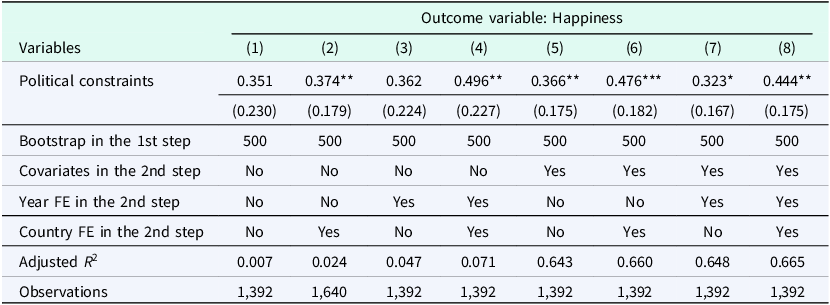
Once the satisfaction of the balancing quality is completed, it leads to a good interpretation of the treatment effect. Weights obtained in the first step of EB are used in a second step to estimate the effect of political constraints on happiness in applying the weighted least squares regression, with r = 2. The results are presented in Table 1. To check the sensitivity of our results, we perform the same regressions with r = 1 and r = 3. The results are reported in Tables A.4 and A.5 in the online Appendix.
Baseline results of the impact of political constraints on happiness

Notes: Heteroskedasticity-robust (Huber–White) standard errors are reported in parentheses. (***; **; *) indicate statistical significance at the 1%, 5%, and 10% levels, respectively. All covariates are lagged by one period, relative to the treatment variable.
Columns (1) to (4) in Table 1 present the estimates of the treatment effect without covariates. Column (1) excludes both year and country fixed effects; Column (2) includes only country fixed effects; Column (3) includes only year-fixed effects; and Column (4) includes both. Columns (5) to (8) repeat this sequence after adding the matching covariates used in the first step of the EB procedure. Year fixed effects control for global shocks and common macroeconomic dynamics, while country fixed effects capture time-invariant differences across countries, including institutional and geographic characteristics. Among these specifications, Column (8) – which includes both the full set of controls and country-and year-fixed effects – constitutes our preferred specification, as it provides the most rigorous adjustment for confounding factors and unobserved heterogeneity.
Overall, the results presented in Table 1 show that political constraints are positively and significantly associated with happiness, regardless of the model specification. The magnitude of the estimated coefficient indicates that political constraints exert a statistically significant, though modest, impact on happiness. A one-standard-deviation increase in political constraints (0.233) is associated with an approximate 0.10-unit increase in happiness, which corresponds to a standardised effect of 0.092 standard deviations.
While this standardised effect size is modest in absolute magnitude, its broader societal relevance becomes clearer when contextualised within established benchmarks in the subjective well-being literature. While individual-level shocks, such as unemployment, typically yield larger coefficients in micro-level regressions, macro-institutional variables are generally associated with similarly incremental but persistent population-level impacts (Kundu et al., Reference Kundu, Kundu and Chettri2024). For instance, while macroeconomic shocks like financial crises exert acute negative effects (Ko et al., Reference Ko, Leung and Chen2025), the modest standardised effect of political constraints (0.092) is comparable in scale to the broad impacts typically assigned to income and education in aggregate cross-country analyses (Barrington-Leigh, Reference Barrington-Leigh2024; Huang et al., Reference Huang, Ding, Han, Li and Zhu2024). Thus, while the individual effect size is small, such macro-structural shifts can remain socially meaningful because they apply uniformly across the whole population.
More specifically, the positive effect of political constraints on happiness can be explained by at least three reasons. First, political constraints can lead to the implementation of more inclusive policies, leading to the improvement of the lives and well-being of citizens. Second, political constraints are generally a source of democracy, strengthening citizens’ commitment to the development process while enabling them to feel that they have a say in the decisions that affect their lives. This sense of control and participation can be a source of satisfaction and contribute to happiness. Third, political constraints can improve governance quality and provide individuals with a sense of stability and predictability; knowing what to anticipate and feeling confident in their rights and freedoms helps overall well-being. Our results are consistent with the works of Bergren and Bjornskov (Reference Berggren, Bjørnskov and Zimmermann2020) and Ndoya et al. (Reference Ndoya, Belomo, Okere and Talla2024), showing a positive association between political institutions and happiness.
Overview of the dose-response function (DRF)
The DRF reflects the response of happiness to different intensities (levels) of political constraints. Figure A.2 in the online Appendix illustrates a positive relationship between political constraints and citizens’ happiness.
This DRF shows a non-linear relationship with increasing returns at higher levels of treatment. Initial improvements in political constraints lead to only small gains in well-being. However, the curve becomes steeper after reaching certain mid-range values of political constraints. This non-parametric shape reflects a statistical trend rather than a formally measured threshold. Nonetheless, this shift aligns with political-economy research that suggests institutional checks need a basic level of actual power or effective implementation to significantly affect citizen well-being. Below these levels, constraints may be seen as mere formal institutions with no real ability to provide the stability or predictability necessary for life satisfaction (North et al., Reference North, Wallis and Weingast2009).
Robustness checks
Our estimates show that political constraints are positively and significantly associated with happiness. This section aims to test the robustness of the baseline results through a variety of analyses. First, we test the sensitivity of our core finding to potential omitted variables by including four additional controls. Second, we run a stability test to check if the results are attributable to unobserved confounders. Third, we investigate alternative measures of happiness. Fourth, we estimate the effect of political constraints on happiness using alternative estimation methods.
Stability test for unobserved confounders
Although the baseline specification yields consistent and stable results, concerns may remain regarding the role of unobserved confounders. Consequently, we complement the main analysis with a coefficient stability test.
We assess the sensitivity of our results to unobserved confounders using the coefficient stability test proposed by Oster (Reference Oster2019). This approach evaluates whether omitted variables could plausibly overturn the estimated effect by comparing changes in coefficients and R-squared values between specifications with and without controls.
The test indicates that selection on unobserved factors would have to be at least fourteen times stronger than selection on observed covariates to eliminate the estimated effect of political constraints. Moreover, bias-adjusted coefficient bounds – computed under proportional selection and a maximum R-squared of 0.8 – safely exclude zero (see Column 2 of Table A.6 in the online Appendix). These findings suggest that the positive association between political constraints and happiness is unlikely to be driven by unobserved confounders.
Alternative measures of political constraints
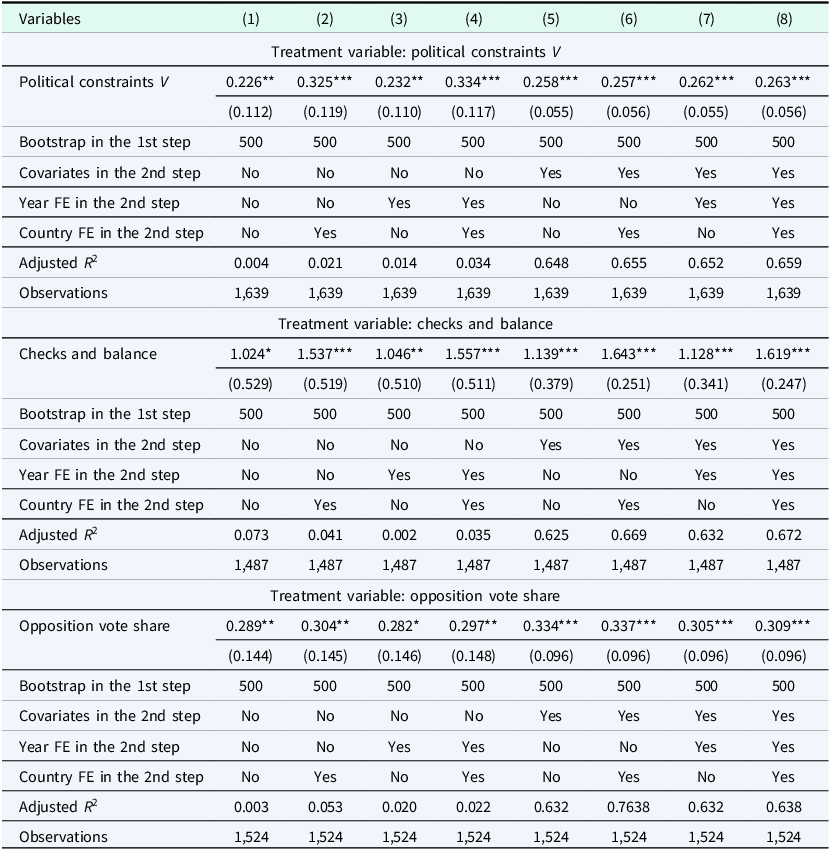
The baseline analysis employed the Political Constraints Index developed by Henisz (Reference Henisz2002). In this section, we consider three alternative measures of political constraints. First, the Extended Political Constraints Index (Political Constraints V), which builds on Henisz (Reference Henisz2002) by incorporating two additional veto points: the judiciary and sub-federal entities. Second, the Checks and Balances Index from the Database of Political Institutions (DPI) 2020 (Cruz et al., Reference Cruz, Keefer and Scartascini2021), which captures the strength of checks and balances within the political system. Third, the opposition vote share, also from DPI 2020, measures the total percentage of votes received by non-governing parties in the most recent elections. A higher opposition vote share reflects a more balanced political landscape, where the opposition can exert greater pressure on the government, thereby constraining executive power and enhancing responsiveness to public demands. The results are reported in Table 2 and confirm the positive and significant relationship between political constraints and citizen happiness across all specifications.
Robustness checks: alternative measure of political constraints

Notes: Heteroskedasticity-robust (Huber–White) standard errors are reported in parentheses. (***; **; *) indicate statistical significance at the 1%, 5%, and 10% levels, respectively. All covariates are lagged by one period, relative to the treatment variable.
Alternative estimation methods
In this section, we assess the robustness of our main findings using alternative regression strategies by adopting a General-to-Specific (GTS) modelling framework. This approach addresses potential omitted variable bias by starting from a General Unrestricted Model (GUM) that incorporates the full suite of theoretically relevant covariates simultaneously (Hendry, Reference Hendry2024). We first estimate this specification using Ordinary Least Squares (OLS) with country-and year-fixed effects to account for unobserved heterogeneity.
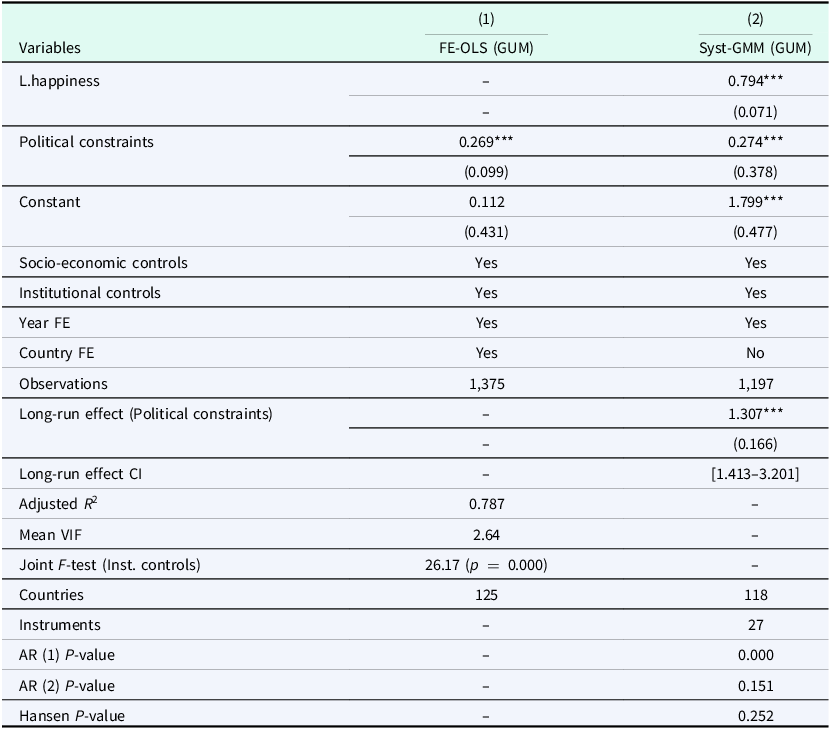
Table 3 reports the results following this GTS approach. Column 1 presents the estimates from the FE-OLS GUM, which includes the comprehensive set of economic and institutional controls. We find that political constraints exert a positive and statistically significant effect on happiness, even when controlling for the broader institutional environment.
Robustness check: alternative regression methods

Notes: For FE-OLS, heteroskedasticity-robust (Huber–White) standard errors are reported in parentheses. For Syst-GMM, two-step system GMM estimates are reported, with heteroskedasticity-robust two-step standard errors corrected using the Windmeijer (Reference Windmeijer2005) finite-sample adjustment and shown in brackets. ***, **, and * denote statistical significance at the 1%, 5%, and 10% levels, respectively. L denotes the lag operator. Socio-economic controls include GDP per capita PPP, inflation, pop growth, education, and natural resources. Institutional controls include political stability, democracy, and legal equality.
Diagnostic tests confirm the econometric rigour of this specification. First, the mean Variance Inflation Factor (VIF) is 2.64, well below the conservative threshold of 5, indicating that the simultaneous inclusion of multiple institutional variables does not compromise the precision of our estimates through multicollinearity. Second, an F-test for the joint significance of the institutional controls (political stability, democracy, and legal equality) yields a p-value of 0.000. This confirms that these variables are jointly essential to the model’s explanatory power and that their exclusion, as would occur in a more parsimonious or bivariate specification, would lead to significant specification error.
Second, we employ the two-step System GMM estimator (Blundell and Bond, Reference Blundell and Bond1998) to validate the consistency of our findings within a dynamic framework. This choice is driven by two principal considerations: firstly, the necessity to account for the persistence of happiness through the incorporation of a lagged dependent variable; and secondly, to mitigate concerns about simultaneity and dynamic feedback between political constraints and happiness. The System GMM estimator treats both the lagged dependent variable and political constraints as endogenous, using internal lags as instruments.
However, we emphasise that internal-instrument GMM is not our primary strategy for identification, as it cannot fully resolve endogeneity if political constraints evolve alongside persistent, unobserved macro-institutional or cultural trends. Instead, our primary identification strategy relies on the EBCT framework discussed in Section Data and Methodology. The GMM framework is leveraged here solely to ensure that our core baseline insights remain robust when accounting for the short-run dynamic feedback loops and serial correlation in the error process.
Table 3, Column 2, reports these results. Because our model is dynamic, the coefficients represent short-run effects. To fully address the implications of our results, we also calculate the long-run effects. The estimated short-run effect of political constraints is positive and significant (β = 0.27, p < 0.05). Using the Delta method, the calculated long-run effectFootnote 2 is notably larger at 1.31 (with a 95% confidence of 1.41 to 3.20 and a p-value of 0.01).
This substantial long-run multiplier is driven by the high degree of temporal persistence of national happiness (L.Happiness = 0.79, p < 0.01). In substance, this indicates that the institutionalisation of political constraints yields cumulative benefits for happiness that accrue slowly over time. While the immediate policy shock of political constraints has a modest concurrent impact, institutional changes may take years to alter social trust, economic stability and daily citizens’ happiness (Devine and Valgarðsson, Reference Devine and Valgarðsson2024; Kaasa and Andriani, Reference Kaasa and Andriani2022).
Crucially, the GMM GUM satisfies all post-estimation requirements: the Hansen test for over-identifying restrictions and the AR (2) test for second-order serial correlation confirm the validity of our instrument set within the full model context.
Overall, the use of alternative estimation methods corroborates our baseline findings: political constraints exert a positive and significant effect on happiness, regardless of whether the specification is static or dynamic.
Heterogeneity analysis
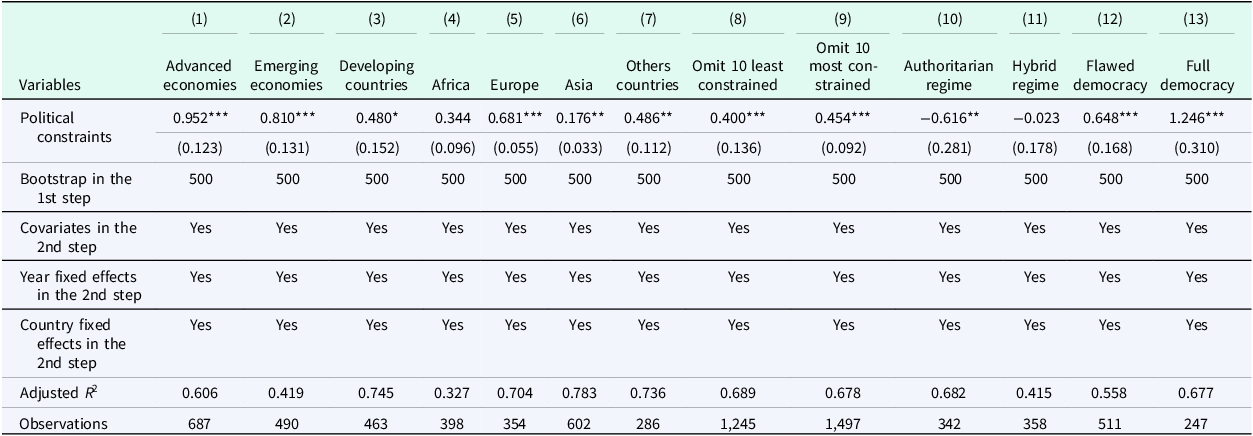
Building on the baseline results that political constraints are positively associated with citizens’ happiness, this section explores the heterogeneity of the effect by restricting the sample along several dimensions, including development level, regional grouping, the treatment of outliers, and regime type.
Heterogeneity by development level
In this sub-section, we examine whether the impact of political constraints on happiness varies by development level. Following the IMF classification, we categorise countries into (i) advanced economies, (ii) emerging economies, and (iii) developing countries. The findings in Table 4 (columns 1–3) demonstrate that although the relationship between political constraints and happiness remains positive and significant across all groups, a clear gradient emerges: the magnitude of the effect is largest for advanced economies and smallest for developing countries.
Heterogeneity analysis

Notes: Heteroskedasticity-robust (Huber–White) standard errors are reported in parentheses. (***; **; *) indicate statistical significance at the 1%, 5%, and 10% levels, respectively. All covariates are lagged by one period, relative to the treatment variable.
This variation implies that the efficacy of political constraints may be contingent upon the broader institutional environment. In advanced economies, well-developed legal frameworks and high levels of state capacity may serve as complementing institutions, ensuring that constraints on executive power translate successfully into transparent governance, with positive implications for citizens’ well-being. In developing countries, however, institutional frictions may have a lower marginal impact, as political constraints may lead to policy gridlock if not supported by strong administrative capacity (North, Reference North1991).
Heterogeneity by region
In this sub-section, we check whether the relationship between political constraints and happiness differs across geographical regions. We rely on Avom and Ndoya (Reference Avom and Ndoya2024) and group countries into four regions: Africa, Europe, Asia, and other regions. The results in Table 4 (columns 4–7) indicate that while political constraints exert a positive influence on happiness across all regions, the effect is most pronounced within Europe.
This regional variation can be explained by the fact that in regions with a longer history of institutional stability such as Europe, political constraints are likely integrated into a broader system of checks and balances and accountability. These overlapping institutions ensure that constraints on the executive, for example, lead to effective improvements in public service delivery and civil liberties. In contrast, in regions with more nascent democratic institutions and less effective, such as Africa, the effect of political constraints, although positive, may be weaker and attenuated by lower levels of institutional trust or less efficient administrative mechanisms. Consequently, the well-being dividend of political constraints may appear to be highest where they are embedded in mature institutional frameworks.
Excluding outliers
A potential concern is that the baseline findings may be driven by extreme observations, as suggested in Figure A.1. To address this, we re-estimate the model after excluding the ten countries with the highest and lowest levels of political constraints. The results, reported in Table 4 (columns 8–9), demonstrate that the positive and significant effect of political constraints on happiness remains robust to the exclusion of outliers, indicating that the baseline findings are not attributable to extreme cases.
Heterogeneity by political regime
Finally, we investigate whether the link between political constraints and happiness differs across different types of political regimes. The nature of regime structures may shape how political constraints operate: in democracies, they are hypothesised to improve accountability and representation, while in autocracies, they may serve largely to restrain the concentration of power. Examining this dimension allows us to determine whether the statistical association between political constraints and citizens’ happiness is regime-dependent or universal.
Following Prati (Reference Prati2022), we classify political regimes into four categories: authoritarian regimes, hybrid regimes, flawed democracies, and full democracies. The results reported in Table 4 (columns 10–13) indicate that political constraints are negatively and significantly associated with happiness in authoritarian and hybrid regimes, whereas the effect is positive and significant in democracies, with a stronger magnitude in full democracies. While our empirical model identifies these robust patterns of association rather than isolating the underlying institutional mechanisms, this divergence is theoretically consistent with literature suggesting that in the authoritarian and hybrid regimes, political constraints often arise from power struggles among elites rather than genuine accountability mechanisms, a dynamic that can compromise political efficiency and stability. Conversely, in democratic contexts, these positive coefficients are suggestive of a framework where constraints strengthen checks and balance, enhance government responsiveness, and ultimately foster greater citizens’ happiness (Brown and Brik, Reference Brown and Brik2024; Stephenson and Nzelibe, Reference Stephenson and Nzelibe2010).
Channels
This section seeks to shed light on the potential transmission pathways underlying our main findings. Building on the discussion in the literature review, we examine the relevance of six associated channels, grouped into three categories: political–institutional, governance and fairness, and economic. To do so, we rely on Apeti and Edoh (Reference Apeti and Edoh2023) and adopt a two-step approach.
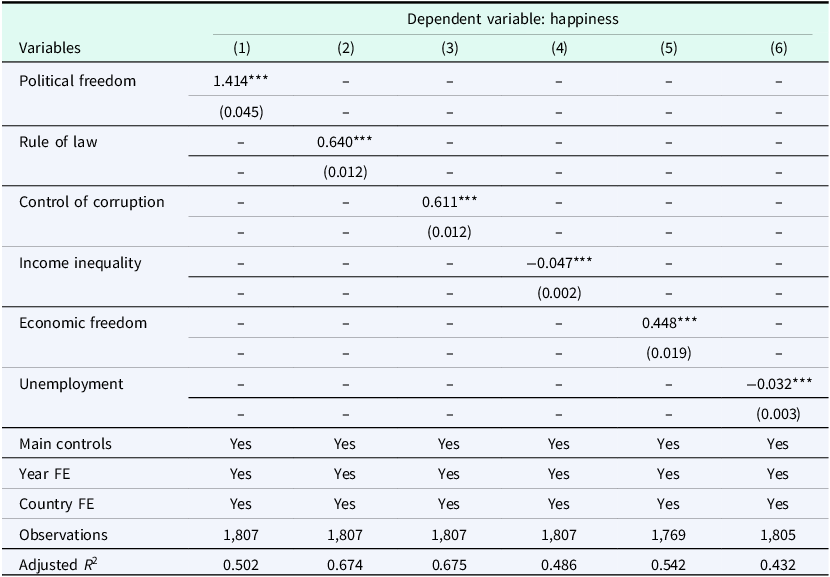
First, we test the relevance of our channels to happiness, using the FE-OLS method. This strategy seeks to determine whether there is a correlation between happiness and all channels before testing them. The results of this exercise reported in Table 5 suggest that political freedom, rule of law, control of corruption, income inequality, economic freedom, and employment are highly correlated with happiness. As a result, they represent potentially key transmission pathways in the political constraints-happiness nexus.
Correlation between happiness and the channels

Notes: The estimates are based on FE-OLS. Heteroskedasticity-robust (Huber–White) standard errors are reported in parentheses. (***; **; *) indicate statistical significance at the 1%, 5%, and 10% levels, respectively.
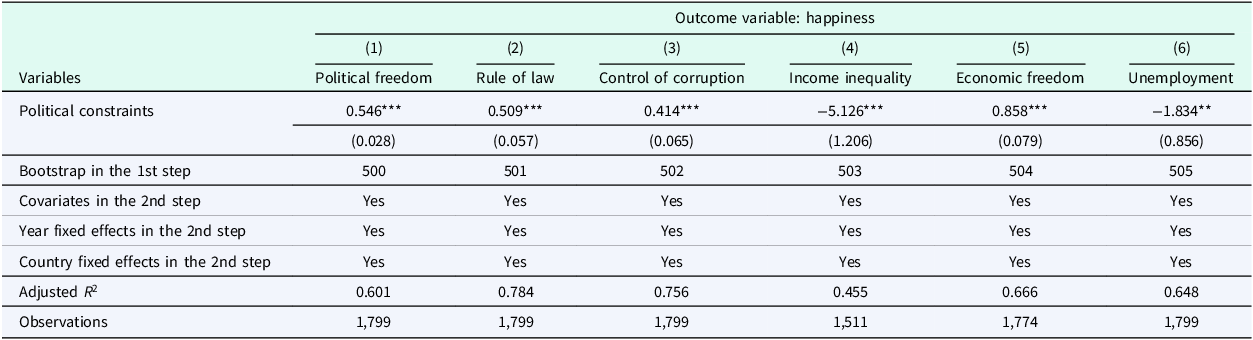
Second, to determine whether our channels are connected to political constraints, we estimate an EBCT model, following the same steps as in the baseline analysis and employing the same set of covariates. The results reported in Table 6 show that political constraints are positively and significantly associated with political freedom, rule of law, control of corruption, and economic freedom, while they are negatively and significantly associated with income inequality and unemployment.
Transmission channels’ estimates

Notes: Heteroskedasticity-robust (Huber–White) standard errors are reported in parentheses. (***; **; *) indicate statistical significance at the 1%, 5%, and 10% levels, respectively. All covariates are lagged by one period, relative to the treatment variable.
To sum up, these empirical findings show that the positive association between political constraints and happiness operates through multifaceted channels, including strengthened political and economic freedoms, enhanced horizontal accountability via the rule of law, improved control of corruption, and reduced socio-economic volatility via lower income inequality and unemployment.
Concluding remarks, policy implications, and extensions
Citizens’ quality of life is profoundly influenced by the public decisions made by legislatures, executives, and administrative agencies. These decisions define the nature and quality of public policy, which ultimately affect individuals’ well-being. This paper investigates the impact of political constraints on happiness using a sample of 125 countries across all income levels over 2006–2021, applying the EBCT method.
The findings show that political constraints positively and significantly influence citizens’ happiness. This finding stands up to a wide range of robustness tests, with the magnitude of the effect varying by development level, geographical region, and political regime. The impact of political constraints on happiness is particularly pronounced in developed and democratic countries. Six main channels – political freedom, rule of law, corruption control, income inequality, economic freedom, and unemployment – help explain this relationship, supporting theories of social welfare, public choice, and institutions.
Our findings suggest several policy implications: strengthening the political-institutional framework, enhancing transparency, anti-corruption measures, and citizen participation; and pursuing efficient and equitable economic reforms. Importantly, political constraints promote happiness primarily in democratic settings, whereas in authoritarian regimes they may reflect elite competition rather than accountability, highlighting the need to tailor reforms to regime type.
Future studies could examine the long-term dynamics of the relationship, explore additional institutional features such as electoral systems, and further investigate why constraints appear to reduce happiness in authoritarian contexts.
Supplementary material
The supplementary material for this article can be found at https://doi.org/10.1017/S1744137426100678.



 Open access

