




On Wednesday, 17 January 1968, guided by six jets of the Cambodian Air Force, an Iljušin-18 aircraft carrying Yugoslavia’s president, Josip Broz Tito, touched the ground at Pochentong airport near Cambodia’s capital city Phnom Penh.Footnote 1 Disembarking at exactly 4 p.m. local time and under the impression of twenty-one gun salutes and the sound of the Yugoslav anthem over the airstrip, Tito, his wife Jovanka, and his entourage, which included some of the state’s highest representatives,Footnote 2 were met by President and Prince Norodom Sihanouk, other members of the royal family and the state’s highest officials, who had for two months prepared an opulent reception. The city’s main boulevard was, for the twelve kilometres from the airport to the Royal Palace, decorated with hundreds and thousands of Cambodian and Yugoslav flags; both modern and traditional orchestras played on temporarily installed stands along the road or on the pavements, as an estimated 300,000 flocked to the streets of Phnom Penh to follow their leader’s call on the radioFootnote 3 to welcome the Yugoslav delegation to their country, while potential protestors or even conspirators of Cambodian and Chinese nationality were arrested before the visitors had even arrived.Footnote 4
The front pages of both Yugoslavia’s and Cambodia’s newspapers were dominated by this unprecedented six-day visit of Tito to the Southeast Asian kingdom. The leaders of both countries were thereby keen to control the messages conveyed in the papers. On the one hand, Tito’s visit to Cambodia enabled Yugoslavia to visibly project its leadership role in the non-aligned movement (NAM), while, on the other hand, it gave Sihanouk an influential partner’s public backing that helped reaffirm Cambodia’s declared policy of neutrality and non-alignment as the American–Vietnam War’s spillover intensified. Tito was accompanied by journalists in service of the state’s news agency Tanjug or of the Socialist Alliance of Working People in Yugoslavia’s official newspaper Borba, who reported about the president’s journeys around the world in a manner that was close to the state’s official narratives about its role in the world. In Phnom Penh, Tito met up with the Yugoslav journalists right after the first bilateral meeting between the two heads of state. He thereby ensured he was able to get his idea and wording of a ‘dialogue of two statesmen in an atmosphere of full understanding and openness’Footnote 5 into the newspapers, where the visited prince would underscore the ‘eminent place that Yugoslavia would take in within our large family of the non-aligned’.Footnote 6 Sihanouk, on the other hand, approached the Yugoslav journalists already on the airstrip, introduced himself as a man of many talents, which included journalism, and addressed them as ‘like-minded colleagues’,Footnote 7 while also thanking the editorial offices in Belgrade, Zagreb and Ljubljana for their numerous articles on Cambodia’s ‘policy of independence and authentic neutrality, the myth of Cambodia as a “sanctuary” of Vietnamese resistance, [and] the myth of [the country’s] borders being “undefined or legally undefined”’.Footnote 8 To what extent Sihanouk was following foreign news coverage of his country can be seen in the French-language journal Le Sangkum, in which he, among others, published letters to journalists and editors writing about Cambodia around the world. Regarding the Yugoslav reporting surrounding Tito’s visit, he therefore addressed Borba journalist R. Jović’s article, with a cliché-loaded title of ‘The Khmer Smile’, and sought to set straight an unfavourable comparison with Thailand’s development.Footnote 9
Whether through newspapers organisationally close to the government or simply in the hands of the regent himself, both Tito and Sihanouk closely monitored the journalistic production about their countries. As avid amateur photographers, they however also shared an interest in visually reinforcing these narratives and oversaw the production of a substantial visual compendium that was supposed to represent their country’s role in the world as well as their personal leadership for the development of their respective countries. This paper, against the backdrop of Yugoslav photographic production on Cambodia, discusses how the Yugoslav state utilised photography to convey domestic and international messages on ideas about leadership and global relevance, as well as non-aligned cooperation and relationships between south-eastern Europe and Asia. It explores a twofold manifestation of photographic practices that connects a government-controlled realm of state photography to private travel photography. After an introduction to Yugoslav–Cambodian relations and a discussion of the relationship between photography and the NAM, the article first analyses the modes of representation in the official presidential photographs taken on the occasion of official Yugoslav–Cambodian meetings and kept in the collections of the Museum of Yugoslavia. It then, second, follows the journalist and (travel) writer Nada Marinković to Cambodia by exploring her book Stanice u vremenu (1966) and her personal photo collection at the Historical Archives of Belgrade.
Yugoslavia and Cambodia in the Non-Aligned World
In the bipolar world of the Cold War, the need to navigate politics between the interests of Moscow and Washington, DC, was a necessity for many countries that were not formally aligned with (or against) either of the two blocs. Among these countries, and thereby in world politics in the second half of the short twentieth century in general, Yugoslavia had a special role. It was a socialist country that had however broken with the Soviet Union in the Tito–Stalin split of 1948. One expression of the ensuing years, where Yugoslavia sought new directions of economic, cultural and political cooperation beyond the states of the Warsaw pact, was its development into a leading player in the NAM, which was established in Belgrade in 1961 (based on the principles against (neo)colonialism and for African–Asian cooperation as agreed at the 1955 Bandung Conference). The history of the NAM has over the past fifteen years been at the centre of attention of an increasing number of scholarly works.Footnote 10 The historical relationship between the Soviet Union and the socialist countries of (South-)Eastern Europe, on the one hand, and the countries of the Global South, often members of the NAM, on the other, has also been addressed by a number of recent studies.Footnote 11 Both are expressions of an ambition to write global histories or histories of globalisation processes that are not centred on the West.Footnote 12 As both a socialist country and a central member of the NAM, the role of Yugoslavia has thereby been explored particularly prominently.Footnote 13 Among others, explored themes have expanded to conflicting visions of non-alignment between Yugoslavia and other NAM members,Footnote 14 the Yugoslav influence on the conceptual foundations of the NAM between the Bandung and Belgrade conferences,Footnote 15 Yugoslavia’s military aid to non-aligned countries,Footnote 16 racialised international hierarchies in the NAMFootnote 17 or the (non-)importance of economic relations between Yugoslavia and NAM countries.Footnote 18
Within the processes of establishing and developing the NAM, Yugoslavia intensified its relations with states in what is today termed the Global South, one of which was Cambodia. The Southeast Asian Kingdom of Cambodia had won independence in 1953 after almost a century of French colonial rule and was ruled by Prince Norodom Sihanouk during what would become known as the country’s Sangkum era (1955–70).Footnote 19 Sihanouk had abdicated from the throne in 1955 in favour of his father to directly enter day-to-day politics and consolidate power through contentious elections that effectively sidelined rival parties. His Sangkum party operated as a centralised, personalist system that pledged to resist global imperialism while safeguarding and modernising the newly independent Cambodian nation-state. A key term in the party’s vision to achieve these goals was ‘neutrality’, as it believed that a neutral foreign policy would help simultaneously protect the country from external threats and secure a broad range of external help. The prominence of the term ‘neutrality’ in the Sangkum’s political strategies is well illustrated by an official communiqué from 1961 that explained the party’s economic policy, whose name translates as ‘socialist’, as differing profoundly from Marxist socialism or communism and as aiming to stay outside power blocs, instead pursuing a balanced adaptation of both capitalism and communism in organising the country.Footnote 20 In foreign policy, Sihanouk’s Cambodia likewise sought to avoid alignment with any power bloc, and Sangkum press releases portrayed the 1955 Bandung Conference and the NAM as the beginnings of a ‘new moral international’ world order towards a ‘global rebalance’.Footnote 21
The shared interests in neutrality and non-alignment fostered an unlikely partnership between the kingdom in south-eastern Asia and the socialist republic in south-eastern Europe – a partnership about which Cambodianist Ron Leonhardt writes that ‘Cambodian–Yugoslav relations during the Sangkum era could fill the pages of an entire dissertation by itself’.Footnote 22 The beginnings of bilateral relations between Yugoslavia and Cambodia can be dated top the mid-1950s, that is, shortly after the latter had become an independent kingdom in 1953, and off a first visit of Sihanouk to Yugoslavia in July 1956 on the occasion of the Brioni Meeting.Footnote 23 Based on Yugoslavia’s ‘kind of symbolic resonance and affective affinity with struggles in the Global South against colonialism’Footnote 24 and as put on display in propaganda brochures accompanying Tito’s visits to African and Asian states,Footnote 25 the idea of a global role for Yugoslavia resonated with Cambodia’s emancipation process from French colonial rule and the country’s search for allies in the complex waters of Mainland Southeast Asia (Indochina) during the American–Vietnam War (1955–75). A letter by the minister of foreign affairs, Koča Popović, from April 1957, in which he reports on the Cambodian suggestion to elevate the status of the Yugoslav mission to the country to an embassy, summarises why the state would follow by pointing out how Cambodia has repeatedly expressed its sympathy for Yugoslavia and its politics, how it could use support in affirming its international status against the immense pressure of bloc politics and how it would neither come with additional costs nor cause repercussions to the relations to other states in Asia.Footnote 26 This letter combines the idea of mutual understanding and cooperation – an idea that was upheld throughout the Sangkum era and personally embodied through the regular visitsFootnote 27 of Sihanouk to Yugoslavia and Tito’s 1968 visit to Cambodia – with the Yugoslav self-vision as a globally relevant political alternative within the NAM, and also pragmatics as the backbone of diplomatic relations.
Throughout the years of relations with Cambodia as a kingdom under Sihanouk, the Khmer Republic after the coup of Marshal Lon Nol and the Khmer Rouge’s Kampuchea, Belgrade’s policy towards Phnom Penh was flexible as it was primarily informed by the vision of a globally connected Yugoslavia and its absolute stance against any foreign interventions in the domestic politics of a sovereign country. Working off the seemingly close personal relationship between Sihanouk and Tito as well as Yugoslavia’s official position towards Lon Nol’s Khmer Republic as an American ‘puppet regime’ that had to be installed as the ‘independent and non-aligned Cambodia was an obstacle to the military–political plans of American imperialism’,Footnote 28 Tito leaned towards cooperating with the anti-republic coalitionFootnote 29 and consequently welcomed to Belgrade in 1974 some of the most powerful officials of the Khmer Rouge in Ieng Sary and Khieu Samphan, later also known as brothers No. 3 and 4 respectively in ‘(Democratic) Kampuchea’. This is most striking throughout the years of the eventual Khmer Rouge’s rule (1975–9), when Yugoslavia was one of the few countries that maintained relations with Cambodia, which in turn categorised Yugoslavia as a friendly, supporting country.Footnote 30 Ambassadors Milorad Mijović and Mihailo Lompar represented one of only eight states that continued operating an embassy in Phnom Penh after the Khmer Rouge had all but depopulated the capital city and driven almost all foreign citizens from the country. Yugoslavia maintained an accommodating policy towards the Khmer Rouge in the form of opened trade missions in Belgrade, promises for two billion US dollars in aid and shipments of 1,300 tonnes of tractors and other equipment,Footnote 31 despite better knowledge about the Khmer Rouge’s terror regime and against global criticism for not reconsidering its principles that all foreign interventions in the domestic politics of a NAM-member should be rejected.Footnote 32
Non-aligned relations between Yugoslavia and Cambodia were, however, much more than bilateral diplomacy, and the meetings between Tito and Sihanouk extend to the manifold expressions of and implications for ‘social, cultural, political, and economic imaginaries’.Footnote 33 Beginning with a first economic agreement that was signed on 19 October 1959, the bilateral cooperation had by the end of the Sangkum era found manifestation in a variety of sectors and brought Yugoslav experts to Cambodia in the fields of industry and education via bilateral technical cooperation agreements, in hydraulic engineering and health via the UN development programme and to work on a study regarding possibilities for setting up a shipping company.Footnote 34 The biggest individual Yugoslav project in Cambodia was the construction of the Kirirom I Hydro Power Plant, coordinated by the Belgrade-based company Energoprojekt. Throughout these years, Yugoslavia’s support for the freshly independent Cambodia translated as well in the supply of books and laboratory materials to its universities,Footnote 35 while Cambodians also came to Yugoslavia to pursue their studies as scholarship holders.Footnote 36 Reports about a closed meeting of a Cambodian student in neighbouring Albania in 1972 with Ieng Sary, a leading Khmer Rouge who in 1975 would also call on all students abroad to return to Cambodia, suggest that they were closely monitored by the Cambodian government throughout their time abroad.Footnote 37 This student returned home from Yugoslavia with five fellow countrymen-students in June 1976. International film festivals such as the one in Phnom Penh were another venue of exchange where ideological reasoning had an influence on the choice of screened films; for instance, the Czechoslovak Spalovač mrtvol (The Cremator) was shown at the 1969 Phnom Penh Film Festival as an expression of Cambodian distrust of the Soviet-leaning Husák regime, while at the same time Sihanouk advanced a proposal to Yugoslavia that the two countries were to exchange films.Footnote 38 On the other hand, the continuous relations between Yugoslavia and Cambodia allowed a Yugoslav team to film in the otherwise almost entirely isolated Kampuchea under the Khmer Rouge.Footnote 39 These examples are far from exhaustive and show how non-aligned cooperation led to a broad variety of entangled histories that bring together political, social, economic and cultural questions where mentioned histories of education and labour are just as indicative for these connections as is the case for visual practices and cultural representation.
As art and culture are deeply intertwined with politics, the experience of non-aligned encounters went far beyond political impact but also found artistic–cultural outlets. Bojana Piškur has searched for non-aligned ‘contacts with other modernities’, how they affected the cultural landscape in Yugoslavia and what eventually remained from such encounters.Footnote 40 Addressing cultural manifestations and exchanges in the NAM and attesting them to be ‘not insignificant’, she concedes that ‘not much is known about them today’.Footnote 41 These exchanges however fell on fertile ground as they were rooted in a pre-war history of anti-imperialist political and cultural organising that also led to post-war art Bojana Videkanić has called ‘nonaligned modernism’.Footnote 42 In her work on Yugoslav cultural exchanges with NAM countries,Footnote 43 Ljiljana Kolešnik has explored how these also became an important tool in Yugoslav foreign policy towards a model of self-representation that was supposed to brand ‘Yugoslav self-management socialism as essentially different from Soviet sociopolitical and cultural practice’ and serve as a
framework for establishing a conceptual analogy between the efforts of non-aligned countries in rooting their postcolonial national identities in the historical continuity of local cultures and the Yugoslav intention to provide its own sociopolitical practice with a similar historical dimension.Footnote 44
By using the example of exchanged exhibitions between Yugoslavia and Algeria, VidekanićFootnote 45 has thereby demonstrated how political art and mutual legibility through the evocation of shared historical experiences went hand in hand. For postcolonial Cambodia, on the other hand, Michael Falser has shown how cultural heritage was politically performed against the backdrop of a re-enactment of Angkorian grandeur with which Tito was also confronted upon his visit to Cambodia in 1968.Footnote 46 Ingrid Muan has furthermore demonstrated how visuality was key in the production of an image of Sihanouk’s SangkumFootnote 47 – an awareness that was also maintained by the state’s elite in the years after the 1970 coup, when the delegation that travelled to Yugoslavia in 1974 brought an eleven-headed team with it that included not only security and a doctor but also a photographer and a cinematographer.Footnote 48
Between Brioni and Siem Reap: Photographing Non-Aligned Diplomacy
Visuality played a central role in Yugoslavia’s domestic and foreign politics as well as in international cultural exchange. Tanja Zimmermann has thereby described how ‘the visualisation of the third way in Tito’s Yugoslavia’ has had a dynamic history that was interrelated with the state’s advertisement and media strategies and by the late 1950s presented the country ‘as an ambiguous image – an image that can be read in two different ideological ways – in the East as a socialist idyll of workers who can enjoy the fruits of their work, and in the West as a paradise for tourists and consumers’.Footnote 49 At the very centre of state-sponsored visuality, however, was the establishment of Tito himself as a global visual icon.Footnote 50 The results of these efforts can be seen at hand of the archives of the Museum of Yugoslavia, which comprise an incredibly rich collection of about 800,000 black-and-white negatives (organised in 15,210 sleeves and grouped according to events) and tens of thousands of colour negatives and slides from the years of Tito’s presidency. Furthermore, it contains over 130,000 photographs (format 18 x 24cm, stored in 708 boxes), with Tito being personally involved in the decision-making process regarding their selection and use.Footnote 51 All of these images are the works of the four photographers Dragutin Grbić, Aleksandar Stojanović, Miloš Rašeta and Mirko Lovrić, who were employed at the Cabinet, and similar to the central emphasis of the Museum per se on the NAM, they give an insight into Yugoslavia’s foreign diplomacy with the Global South and Tito’s extensive travels abroad. Considering the official character of these photographs, they are primarily an excellent source for the representation of diplomatic relations and Yugoslavia’s official imagination for its role in the world.Footnote 52
Given that the display of Yugoslav–Cambodian ties was no exception to the rule that non-aligned encounters were visually heavily exploited and the sheer size of photographic production in Tito’s cabinet, photographs have likely left the clearest and most extensive archival mark. Both sides were eager to exploit diplomatic visits, both of its own representatives abroad and when hosting guests in Yugoslavia and Cambodia respectively. A total of 1,370 photographs in the funds of the Museum of Yugoslavia therefore connect the two countries and tell a story of non-aligned high diplomacy. They were predominantly produced on the occasion of Sihanouk’s visits to Yugoslavia in 1956 (25 photos), 1959 (102 photos), 1961 (184 photos, including photos taken during the Belgrade Summit), 1972 (280 photos), 1973 (73 photos) and 1975 (162 photos), while Tito’s visit to Cambodia in 1968 resulted in an archived 499 photos. Of these photos, 120 (in 1968) and 71 (in 1972) respectively were taken on colour film. A smaller number of images were also taken upon the reception of the credentials of Cambodia’s/GRUNK’s ambassadors to Yugoslavia, Kun Vik (1965, two photos) and Huot Sambath (1970, three photos), the visits of deputy prime minister and president of the National Bank of Cambodia Son Sann (1966, three photos) and GRUNK’s foreign minister Sarin Chhak (1971, three photos) and the visit of Ieng Sary and Khieu Samphan in 1974 (eleven photos). A third set of occasions for Tito’s cabinet photographers to take images of Cambodian officials were international meetings such as the 15th regular session of the UN General Assembly in New York City (1960, nine photos) and the summits of the NAM, such as in Cairo 1964 (one photo of prime minister Norodom Kantol), in Algiers 1973 (seven photos) and Colombo 1976, where Khieu Samphan was representing the Khmer Rouge’s Kampuchea (six photos, aside from the assembly group photos), whose ‘victories against imperialism’ were hailed in the summit’s concluding political declaration.Footnote 53
A first theme that dominates these photographs is the celebration of personal closeness between Tito and Sihanouk, on the one hand, and a friendship between the Yugoslav and Cambodian peoples, on the other. Fuelled by a Yugoslav self-confidence and pride in the role that the country played in the establishment of the NAM,Footnote 54 and set against extensive travelling around the world to meet other state leaders as a central element of Yugoslav diplomacy,Footnote 55 the cabinet photographers helped establish a visual language that was centred on expressing this closeness by capturing physical touch during the meetings of the heads of state. The Museum of Yugoslavia keeps 164 photographs centred on the motif of members of the Yugoslav and Cambodian delegations shaking hands, which amounts to 13.9 per cent of the entire Yugoslav–Cambodian visual corpus in the museum’s funds. Another thirteen images show Tito and Sihanouk or their wives, Jovanka Broz and Norodom Monineath, embracing one another – a level of closeness that is not yet evident in the images of their first encounters in 1956 and 1959 (cf. Figure 1),Footnote 56 suggesting that the evolving relationship between the state leaders and their countries found manifestation in an expression of body language that goes beyond the diplomatic protocol otherwise surely dictating the course of these bilateral meetings. This increasingly showcased personal and bilateral proximity and, more importantly, Yugoslavia’s perception of Cambodia as a neutral, non-aligned state that became increasingly sucked into a proxy war and deserved full solidarity and support from its allies was furthermore supported by the seating arrangements at international meetings such as the official dinner of the Belgrade Summit in 1961 and also at the International Trade Fair during the ensuing visit of many summit participants to Zagreb. On both occasions, Sihanouk was seated and photographed right next to Tito – a symbolic gesture for a global stage.Footnote 57
‘Visit of Prince Norodom Sihanouk, Prime Minister of Cambodia: Ceremonial Lunch at the Federal Executive Council’, 26 Nov. 1959, and ‘Ceremonial Farewell of Norodom Sihanouk and Princess Monique from Brioni’, 19 Dec. 1975. FA-MJ, 1959_126_012 & 1975_600_0160. Courtesy of the Photo Archive of the Museum of Yugoslavia.

Figure 1 Long description
The first image shows Tito and Sihanouk engaged in a handshake. Sihanouk is wearing a suit and bowing slightly, while Tito is standing upright, also in a suit. In the background, a woman is visible, standing with her hands clasped. The second image depicts Tito and Sihanouk embracing outdoors near a body of water. The background includes trees and a railing. The face of Sihanouk is obscured and both are wearing coats.
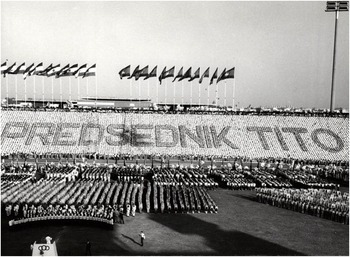
On a similar note, Tito himself is at the centre of the photographs’ attention as they were thought to underscore his image as a political star of global fame and relevance. Tito’s cabinet photographers thereby made sure to show the Yugoslav president moving with ease on the stage of international diplomacy, which was supposed to support the overall narrative that Tito’s extensive journeys around the world and the many guests he hosted in Belgrade or on Brioni happened at the representational intersection of political power and non-aligned friendship. For this reason, Tito, Jovanka and other members of the Yugoslav delegations as well as their Cambodian counterparts are predominantly shown in a jovial mood, enjoying each other’s company and an atmosphere of leisure and relaxation. They are seen while clinking glasses with one another (in fourteen photos), exploring a wine cellar, playing pool billiard and driving electric carts as well as luxury limousines, which was ultimately supposed to evoke the impression of Tito embodying a sphere of political and private glamour unavailable to anyone else in the country. The photographs are also thought to testify to the mass enthusiasm and hospitality with which he was received during his visits; not only were the organised welcoming ceremonies caught on film by the cabinet photographers, but they were also eager to capture close-up scenes of the local population that gathered in the streets to catch a glimpse of the state leaders passing by in their limousine.Footnote 58 It also underscores how ‘Titoism’, to use the words of Dubravka Ugrešić, ‘presupposed (false or real) internationalism (even when he, Tito, went travelling and we looked in wonder at the newspaper photographs of his distant travels)’, which became an ideological notion that also had a powerful effect on the level of ordinary life.Footnote 59 As the public image of Tito was catered towards not only a domestic but also foreign audience,Footnote 60 other state leaders were thereby interested in exploiting both the ideological and iconographical power of Tito’s visit to their countries. So when Sihanouk hosted the Yugoslav president in Cambodia in 1968, that is, during the American–Vietnam War, Tito received a customised exhibit at the Olympic Stadium in Phnom Penh with tens of thousands spectators on the main stands, where it read ‘Long live President Tito’ alternatingly in Serbian (Figure 2) and French, while a large-scale poster with the images of Sihanouk and Tito was subtitled with a banner reading ‘Živelo kmersko jugoslovensko prijateljstvo’ (Long live the Khmer–Yugoslav friendship).Footnote 61
‘Visit to Cambodia: Arrival at the National Sports Stadium in Phnom Penh’, 20 Jan. 1968. FA-MJ, 1968_356_066. Courtesy of the Photo Archive of the Museum of Yugoslavia.

Figure 2 Long description
A stadium scene with a large crowd of people arranged in rows. Above them, numerous Yugoslav and Cambodian flags are visible, creating a backdrop. The words 'Predsednik Tito' are prominently displayed across the seating area, formed by the arrangement of individuals or materials. The crowd is organized in a structured manner, filling the stadium seats and the field area. The scene conveys a sense of a significant event or gathering, with the focus on the display of the name 'Tito'.
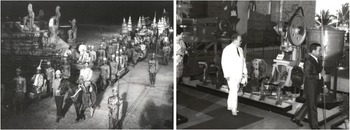
While both hosts and visitors were keen to exploit the symbolic potential of each visit, a third element in the visual language in the Yugoslav–Cambodian encounters is the continuous back and forth between visions of modernity and traditional identities. When Tito was guided through Cambodia, Sihanouk had overseen the preparation of a programme that spanned from a showcasing of the development of the country’s coastline at Sihanoukville to a theatrical re-enactment of Cambodia’s history at Angkor Wat that, over the course of two hours, gave the Yugoslav delegation, including Borba’s correspondent Živko Milić, ‘an unforgettable night in Angkor’Footnote 62 but really represented the political dimension of performing cultural heritage in diplomatic relations. The images of Tito facing an army of Angkorian soldiers in traditional attire seated on decorated horses and elephantsFootnote 63 stand in stark contrast to the photos that were taken a day earlier and show the Yugoslav president inspecting the newest plantation machinery and the photographic documentation of the latest bridge construction work in Phnom Penh at the exhibition ‘Cambodia is building itself’.Footnote 64 Together (Figure 3), these images, however, complement the balancing act between traditionalism and modernity that both countries worked to underscore their state’s historical legitimacy and their contemporary, non-aligned and sovereign politics to be successful and prosperous. Therefore, it is only fitting that the same balancing act can be found in the photographs taken on the occasion of Sihanouk’s visits to Yugoslavia that depict him making himself familiar with the latest Yugoslav technological advancements at an exhibition in ZagrebFootnote 65 but also enjoying a traditional Yugoslav dancing performanceFootnote 66 before showcasing his own talents on the accordion.Footnote 67 Taking the visitor on a tour that integrated sites of both cultural heritage and technological innovation brought together the twofold approach of the hosting countries to be perceived as culturally rich, on the one hand, and as having arrived in a postcolonial modernity, on the other.
‘Visit to Cambodia: At the Performance of “Sound and Light” at Angkor Wat’, 19 Jan. 1968, and ‘Visit to Cambodia: At the Permanent Exhibition “Cambodia Is Building Itself”’, 18 Jan. 1968. FA-MJ, 1968_355_194 & 1968_355_109. Courtesy of the Photo Archive of the Museum of Yugoslavia.

Figure 3 Long description
The first image shows a theatrical performance featuring soldiers in traditional attire riding decorated horses and elephants. The scene is set against a backdrop of large statues and structures, suggesting a historical reenactment. The soldiers are arranged in a line, moving forward in a coordinated manner. The second image depicts Tito in a light-colored suit and Sihanouk in a darker suit, standing beside various pieces of machinery. They appear to be inspecting or discussing the equipment, which includes large industrial components. The setting is indoors, with architectural elements visible in the background.
This modernity was thereby often symbolised through luxurious, open automobiles from which the respective state leaders greeted the masses along the roads, for which also twenty-seven photographs in the funds of the Museum of Yugoslavia are centred on the limousine as a symbol of Tito’s and Sihanouk’s power in the streets of Yugoslavia and Cambodia. Another central element of diplomatic protocol was the exchange of gifts, which allowed the involved parties to express a specific message on the modes of self-representation they intended to reach the receiving end. Thirty-six photographs show the Yugoslav–Cambodian delegation exchanging gifts, which again allowed Sihanouk to underscore his country’s glorious past and cultural heritage by presenting Tito with an Angkorian relief from the twelfth centuryFootnote 68 and traditionally decorated vases and tea services,Footnote 69 while the Yugoslav president often used gifts to other non-aligned state leaders that underlined his desire to be seen as a carrier of modernisation into the world.Footnote 70
The gap between traditionalism and modernity also played a role in the visual relationship between established patterns of – often exoticising – representation and newly developing, postcolonial viscourses. While anti-colonialism was a cornerstone of Yugoslav foreign policy that was ‘based on the clearly expressed principle of coexistence, on peaceful and equal cooperation with all countries, small or large’,Footnote 71 the imagery that Belgrade’s official cabinet photographers produced could for two reasons counteract this ideological orientation. On the one hand, they could be inspired by centuries of colonial representations of (south-eastern) Asia, which correlates to Alexandra Perišić’s observation about Yugoslavs being ‘ambivalent regarding the Global South at large; meaning, they actively supported anticolonial struggles but were unable to free themselves entirely from the influence of European racial ideology’.Footnote 72 As a result and, despite a propagandistic agenda with no room for visual deviation, Yugoslav press photos also reproduced racialised tropes by casting non-European subjects as exotic, primitive or childlike and thereby visually mark them as fundamentally different. The tropes of ‘tribal timelessness’, a ‘white man in Africa’Footnote 73 and eroticised bodies as sensual spectacles for a European and mostly male gaze facilitated turning socio-political contexts into consumable fantasies; while they are not a central element of the visual support of Tito’s official visit to Cambodia with its strictly formalised programme and itinerary, the cultural production in the self-proclaimed anti-colonial Yugoslavia was certainly not immune to ‘othering’ its non-aligned partners in the Global South. On the other hand, they could replicate the self-representation of the visited country, which itself complicates the classification as ‘colonial photography’ insofar as traditional insignia could be deeply rooted in local traditions of visual representations and be a central element of colonial representations at the same time. Radina Vučetić has problematised how the photos of Tito in Ghana can at first glance be read as typical colonial scenes but are on second thought rather the reflection of President Kwame Nkrumah using elements of traditional culture, in his case coming from the royal court of Ashanti, to affirm his authority.Footnote 74 Just like the royal parasol as ‘a gesture of respect for an important guest’ visiting Ghana, the photographs showing Sihanouk and Tito under gigantic umbrellas carried by porters in traditional Khmer clothingFootnote 75 (Figure 4) build on the symbolic capital of a traditional chatra, a ceremonial, royal or holy umbrella, that symbolises royalty or divinity in Khmer culture and therefore needs to be interpreted in favour of a Cambodian sovereignty in choosing its own symbols of royalty and diplomatic protocol rather than a mode of self-exoticisation.
‘Visit to Cambodia: Welcome at the Airport in Siem Reap’, 19 Jan. 1968. FA-MJ, 1968_355_143. Courtesy of the Photo Archive of the Museum of Yugoslavia.

Figure 4 Long description
Five men are walking on a carpeted path. One man, who is dressed in traditional Khmer attire, is holding a large umbrella over Tito who is holding a hat. . Sihanouk is also wearing a suit. Another man in the background is wearing a Yugoslav military-style uniform. The scene appears formal, with the men walking in a procession-like manner.
The Yugoslav images were therefore produced while walking the thin line between established colonialist representation of Indochina, a replication of locally rooted visual traditions and anti-colonialism as a central pillar of Yugoslavia’s foreign policy. The latter thereby played a major role in the visit and the accompanying visual documentation itself as the produced imagery of Tito supporting Cambodia on-site during the looming (and eventually ensuing) incursion into the country from the American–Vietnam War was a strong symbol in favour of non-alignment and against the ‘reactionary and imperialist forces’ that Tito addressed in his Phnom Penh speech.Footnote 76 The produced photographs thereby overshadowed the otherwise fairly vague speeches by Tito and Sihanouk where the two state leaders repeatedly evoked the cordial friendship between the two countries but never specified what the shared values and ideals they talked about actually meant and to which concrete projects the envisioned deepened collaboration could potentially lead in the nearer future.
Finally, the Yugoslav–Cambodian photographs were embedded in gendered imaginaries that represented the roles of men and women personified through Josip and Jovanka Broz, on the one hand, and Norodom Sihanouk and Monineath, on the other. Nataša MiškovićFootnote 77 has used Tito’s photo collection to show in detail how Yugoslavia’s president used traditional ideas of masculinities and cultivated his image as a hero and patriarch to affirm his authority and power – a conclusion that is evident also after studying the photographs that were taken on the occasion of the Tito–Sihanouk meetings. Tito’s upright body posture allowed him to tower above his Cambodian conversation partners and especially Sihanouk, who, in an early photo from 1959, is portrayed as bowing to Josip BrozFootnote 78 – a mode of hierarchical representation that is absent from their later encountersFootnote 79 but is similarly expressed in his meeting with GRUNK’s foreign minister Sarin Chhak in 1971, who is photographed while lighting his host’s cigar.Footnote 80 A central element in Tito’s visual language is the use of a white, pompously decorated marshal uniform – a uniform he was also sporting for his arrival and departure from Pochentong airport – through which he was able to express seniority and a superior hierarchical status based on military ranks.
The chosen pastimes during the Yugoslav–Cambodian encounters are also representative for the gendered imaginaries that dominated the diplomatic protocol. On the one hand, Tito welcomed Sihanouk to his hunting grounds in Karađorđevo in 1973 to perpetuate a well-established outlet of displaying elite status and the power of masculinity, which not only could build on the trope of the colonial hunter that had already been ‘one of the most striking figures of the Victorian and Edwardian imperial landscape’Footnote 81 but also played an important role in diplomacy in the socialist world.Footnote 82 Jovanka Broz, on the other hand, fulfilled her role as Yugoslavia’s gracious first lady on the side of her husband-president and, as a dutiful member of the patriarchal state family, is depicted while joining Norodom Monineath at a children’s theatre performance and as inspecting a collection of jewellery in Cambodia’s Royal Palace before eventually opening a department store in Phnom Penh.Footnote 83 Seven years later, they would replicate the programme in a way and visit Koper’s regional museum to inspect ethnographic objects from Yugoslavia before going to a department store and a school in the Slovenian city.Footnote 84 The photographs taken of Jovanka Broz and Norodom Monineath (see Figure 5) are indicative of the role of women within the sphere of high non-aligned diplomacy, which was based on a gendered division of both diplomatic and pastime activities and allocated them tasks that represented the handling of children (and their education), consumerism and exchange with local women.
‘Visit to Cambodia: Jovanka Broz Opens a New Department Store’, 21 Jan. 1968, and ‘Visit of Prince Sihanouk: Princess Monineath Sihanouk and Jovanka Broz in Koper’, 18 Dec. 1975. FA-MJ, 1968_356_108 & 1975_600_098. Courtesy of the Photo Archive of the Museum of Yugoslavia.

Figure 5 Long description
The left image shows Jovanka Broz shaking hands with a man in a suit. She is wearing a dress and is surrounded by several people, including women and men, who are observing the interaction. A table with refreshments is visible in the foreground. The right image shows Jovanka Broz standing outside the Regional Museum of Koper with Princess Monineath Sihanouk and several other women. They are positioned near the entrance, with Jovanka Broz and Princess Monineath Sihanouk in the center. The women are dressed in coats and appear to be engaged in conversation. A sign is visible on the wall next to the entrance, indicating the location. The setting is outdoors, with a stone wall and a large door in the background.
Nada Marinković in Cambodia: Ambiguous Imaginations of Non-Alignment
Presidents’ partners such as Jovanka Broz or female state leaders such as Indira Gandhi or Sirimavo Bandaranaike were, however, not the only women to actively shape the non-aligned movement – far from it. An international team of scholars based at Ca’ Foscari University of Venice is currently demonstrating what role women activists and organisations played within the NAM and towards development in their respective countries as well as how women’s internationalism within the NAM contributed to an intersectional vision of women’s rights.Footnote 85 Their project builds on the idea that both non-aligned relations and interactions, on the one hand, and the transnational women’s movement, on the other, share common values and goals that translated into international solidarity and towards exchange and empowerment. One group of actors that can often be found at the intersection of such initiatives are (women) journalists and writers who sought to capture the underlying ideas of decolonisation and pluralisation in their writings. Two recent publications on the ‘forgotten friendships’ in the ‘nonaligned imagination’ show how the literary and cultural history of the NAM was forged across borders and through new networks of intellectual engagement. By bringing Yugoslav and Francophone actors into dialogue, Alexandra Perišić, on the one hand, argues that Yugoslav involvement in the NAM should not be considered ‘exclusively through the frame of government policy but through the views and experiences of Yugoslavs engaged in building transnational solidarity’Footnote 86 and, on the other hand, demonstrates how women, ‘whose political views and practices sometimes overlapped and sometimes diverged’, established networks of support ‘because they truly believed they were a part of the same international struggle’.Footnote 87 Nataša Kovačević paints an even larger picture of Yugoslav ‘intellectual engagement and affective solidarity with the decolonizing world’,Footnote 88 also discussing ‘Yugoslav writers and scholars who travelled abroad as cultural ambassadors of nonalignment’.Footnote 89
A rare example of a European writer to connect with Cambodia’s literary scene is the Yugoslav journalist and travel writer Nada Marinković (1921–98). Born in Karlovac, she spent her childhood and youth in Valjevo and Zemun before studying at the University of Belgrade. Marinković was a well-connected public figure within her home country and a member of the Journalists’ Association of Yugoslavia and the Yugoslav Writer’s Union – circles that she, according to her colleague at Radio Beograd, Miloš Jevtić, however, didn’t feel particularly comfortable in.Footnote 90 A more remarkable detail of her CV is, however, that she had also become an honorary member of the latter’s pendants in Cambodia and Indonesia, testifying to her ambitions to extend her personal and professional networks to the Global South. Not only working as a journalist for the newspaper Politika and for Radio Beograd, Marinković was a productive author of more than twenty novels and travelogues. Her works mirror her extensive journeys around the polarised world of the twentieth century. She travelled across Central and Western Europe, repeatedly to the Soviet Union – and not only to the centres of Russian cultural and political power but also to the republics in the Caucasus and in Central Asia – to Central America, to Western and Central Africa, and to China and Southeast Asia. For some of her travels she could probably also rely on organisational assistance by the professional networks of her second husband, Aleksandar Tapavica, whom she married in 1963 and who was the director of Energoprojekt’s offices in Western Africa and the Far East.Footnote 91
Her 1966 literary travelogue Stanice u vremenu (Stations in time) brings together three journeys to the Soviet Union between Siberia and the Donbas, to Guinea and to Cambodia. It is based on her first visit to the Kingdom in Southeast Asia in 1964, which she would return to visit again in 1966 and 1967. In order to get to Cambodia, Marinković travelled by plane and via Athens, Tehran and Karachi before touching ground at Pochentong airport to begin a visit that allowed her to explore Cambodia over the course of half a year from February until August. As a rare scholarly reference to Marinković and writing about the different positions of men and women (travel) writers in general, and not about Stanice u vremenu in particular, Wendy Bracewell describes her style as ‘more impersonal and [her] subject matter less populist, perhaps in reaction to stereotypes of women writers’.Footnote 92 This brief integration of Marinković’s works into a bigger picture of literary criticism and gender sensitive aspects of (travel) writing seems vital in contextualising Stanice u vremenu. In terms of auctorial positioning, her Cambodian travelogue is indeed untypically detached from her own experiences in the country and rarely is an episode of the book centred on Marinković and her interactions with other people in the country. This is understandable from the viewpoint of a woman writer confronted with traditional obstacles in an androcentric, patriarchally organised literature scene where women were thought to be too personal and subjective in their writing,Footnote 93 but regrettable from the perspective of a scholar looking for insights into the nature and development of Marinković’s professional and personal networks in a country that seems to have welcomed her with open arms and minds.
A discussion of other gender-relevant aspects in Stanice u vremenu is, however, central for the analysis of the book’s contents as well. Not only is Marinković, a woman, producing what is probably the only travelogue in Serbian about Sangkum Cambodia,Footnote 94 but she extensively describes local women in it. The text is, however, hardly a manifestation of the feminist potential in this rare Yugoslav encounter with women in a politically close, non-aligned country in Southeast Asia. It is much rather a reflection of the imperial and colonial origin of the travelogue as a literary genre where images of the ‘Self’ and the ‘Other’ were constitutive elements in the construction of spatial visions. As Marina Matešić has shown by analysing travelogues from south-eastern Europe, the exploration of the Balkans has always correlated with the observation of women and the description of their bodies.Footnote 95 Marinković actively employs these Balkanist strategies in her Cambodian travelogue, however, herself and against the backdrop of a south-eastern Asian ‘Other’. While Marinković makes a differentiation in her descriptions of women of different ethnic backgrounds, they all open with an emphasis on these women’s physiognomic features, which are described with an implicit comparison to European body norms and beauty standards. Chinese women are portrayed as ‘fragile and their faces are like squeezed buds’ with ‘a haughty, prying look shimmering through the slits of their eyes’.Footnote 96 She goes on to describe Khmer women by focusing on their darker skin tone, dark eye colour, nostrils that she attributes almost animal-like qualities and the stereotypical mentioning of a broad smile that correlates with the article titled ‘The Khmer Smile’ that kicked off the coverage of Tito’s visit to Cambodia in the newspaper Borba.Footnote 97 The ensuing portrayal of Vietnamese women is a bit different but follows another logic of colonial travel literature insofar as they are attributed with qualities that are traditionally associated with masculinities, which again removes them from European standards. Marinković describes them as not only taller but also radiating self-awareness and certainty, as ruling over everything in their own houses where they are wives and mothers and as having ‘the imagination of poets and the courage of soldiers’.Footnote 98 Additionally, the presented physiognomic deviations are part of the Romanticist trope of the ‘noble savage’, where the exotic, sensual beauty of foreign women is connected to the depiction of a freedom-loving people yet uncorrupted by modernity or, in the words of Marinković, ‘luxuriously looking Khmer women’Footnote 99 to a ‘country in which the concepts of freedom and independence are worth more than life’.Footnote 100 These strategies are ultimately all deeply rooted in European traditions of travel writing and enforce an image of south-eastern Asia as an othered realm through the depiction of local women.
While a woman’s mobility per se can also be considered a political act,Footnote 101 and so should Marinković’s travelling within the non-aligned world, Stanice u vremenu is political only on a secondary level. Social problems, again especially of women, such as prostitution and poverty, are rarely and mostly inadequately addressed,Footnote 102 while she primarily centres her explanatory model for the development and present of Cambodia on religion and spirituality rather than politics.Footnote 103 Marinković does put her travelogue on the general ground of explicit anti-colonialist argumentation by writing that ‘in Indochina, the problem of “white demons” and the evils they bring with them begins with colonialism’,Footnote 104 which ‘left behind a great disharmony in peoples’ lives, traces of exceptional luxuries and extreme poverty’ and required a ‘fight against poverty, backwardness, against neocolonial attempts and against aggressions at the borders’;Footnote 105 however, this clear stance does not translate into a reflection of her role as a (white) European traveller describing the visited country’s population, and especially women, in an overly stereotypical and generalising way. Other passages in the book thwart the potential ambition to express non-aligned solidarity even more, for instance, when she describes the festivities around Chinese New Year, where ‘one would have to imagine the mysticism of wild tribes that summon spirits in the depths of the rainforest’,Footnote 106 or points out an alleged backwardness of the Ratanakiri province, where the traveller would encounter ‘an image of prehistory, its last traces’, which she contrasts with the glory of Angkorian history.Footnote 107 A visit to Koh Kong, another ‘step into prehistory’ for Marinković, is the only platform for the author to coopt the rhetoric that framed the official diplomatic relations between Yugoslavia and Cambodia where progress, ‘a new life’ and ‘a pioneering spirit of hope and zest’ stood in the foreground.Footnote 108 The immediate integration of Marinković into both the intellectual and especially the political elite of Cambodia let her associate any trace of change with Prince Sihanouk, whom she describes as a man of many talents – a leader, father figure for an entire nation, artist, excellent speaker, womaniser and a man of the law – and praises him for his accomplishments.Footnote 109
As addressed already above, Marinković’s far-reaching dissociation of her personal experiences in the text leaves the reader with questions on how she established contacts to the literary scene in Cambodia and to its most prominent members, such as Khmer Writers Association’s president Hell Sumphea, the procedure of why and how she became an honorary member of this organisation so quickly and how the cooperation generally worked over the months of her stay in the country.Footnote 110 A clearer but still fragmented picture of the nature and extent of Marinković’s integration into Cambodia’s political and literary circles can be obtained by studying her personal fund at the Historical Archives of Belgrade. A collection of letters shows how she remained in reciprocal exchange with Norodom Sihanouk upon her return to Belgrade and how she would let Ung Hong Sath, chairman of Cambodia’s national assembly, know she had written a book based on her first visit to Cambodia and that she was hoping that it would be published in the near future.Footnote 111 Cambodian newspaper articles from 1967, documenting what was probably her last visit to the country, underscore how the writer from Yugoslavia had become a recurrent guest with contacts in the highest circles.Footnote 112
The largest part of the materials related to Marinković’s trips to Cambodia across the twenty-seven boxes in the archival funds is, however, her collection of photographs. The preceding analysis of (parts of) Marinković’s book on Cambodia is important for the contextualisation of these images, as the photographs add a different layer to the established textual image and add an impression of solidarity and cooperation – an ambiguity that the reader of the book or the viewer of the photographs cannot possibly grasp unless he or she combines both experiences. On the occasion of a dinner honouring her 1967 visit to the country, the Yugoslav writer is thereby shown in the midst of an exchange among women exclusively. By the help of a note on the backside of the photograph, two of the women can be identified as the writers Pich Sal and Sakhon Samon, but a third, sitting to the right of Marinković, is referred to not by her own name but as the wife of Trinh Hoan(h), then president of the Khmer Writers Association. In an interview with the Indonesian TV station, Marinković expressed how she had not come to the region as a woman but as a writerFootnote 113 and that she would not see any differences in the participation of Yugoslav and Indonesian women in revolutionary struggles and in the building of a new life, who would both give all their strength alongside men, alongside their brothers and husbands, in the first rows of the battle to win a better, happier life.Footnote 114 And while some images reflect the gendered division of activities that can be seen at hand in the photos of Josip and Jovanka Broz in Cambodia, with Marinković also attending to local groups of children and networking with Cambodian women, she is also portrayed at eye level with the state leader Norodom Sihanouk and among a group of men looking at a map showing the latest developments in the country’s network of thermal power stations, through which her collection of photographs (see Figure 6) partly breaks with such pictorial traditions.
Nada Marinković in Cambodia, 1967. IAB, 2153, K27. Courtesy of the Historical Archives of Belgrade.

Figure 6 Long description
The first image shows Nada Marinković seated with three women around a small table, engaged in conversation. The second image depicts her walking alongside a group of children, who are smiling and interacting with her. The third image features Marinković seated on a couch, conversing with Norodom Sihanouk dressed in a suit. The fourth image shows her standing with a group of people, observing a large map on the wall. The group includes both men and women and they appear to be discussing the map's details.
Conclusions
The written and visual works of Marinković paint an ambiguous image of non-aligned relations as encountered in private initiatives and below the level of top-level state diplomacy. Her photographs show how the Cambodian state was actively fostering cultural cooperation by supporting writers visiting from non-aligned partner countries and by some of the state’s highest cultural and political representatives. They also show how women established networks of transnational cooperation in fields where they were underrepresented, such as the patriarchally organised literature scene.Footnote 115 In the expression of these tropes, the private photographic practices of a Yugoslav travel writer working on the representation of a country in the Global South are in line with the state-sponsored visual language as captured in Tito’s photo collection. The images produced by the president’s cabinet photographers focus on the portrayal of bilateral proximity, non-aligned solidarity and the interlinked representation of both historically rooted cultural richness, on the one hand, and technological (postcolonial) modernity, on the other. Photography was furthermore an ideal medium for the fostering of the personal cult around Tito as a global political icon while Cambodia – that is, Tito’s visit to the country in 1968 and the repeated visits of Cambodian representatives to Yugoslavia – was an adequate mirror for the Yugoslav ambition to represent itself as a leading advocate for all neutral, newly independent and non-aligned states. The Yugoslav representation of the country in Southeast Asia was, however, walking a fine line between traditional representations of the region rooted in colonialism, on the one hand, and anti-colonialism as a central pillar of the non-aligned movement and Yugoslavia’s foreign policy, on the other. While this ambiguous relationship can be complex to evaluate within visual sources, Nada Marinković’s travelogue from Cambodia demonstrates how non-aligned encounters and their underlying ideological framework did not lead to the immediate elimination but rather the perpetuation of stereotypical descriptions from colonial times. Hence, photographic practices within the manifold entanglements of Yugoslav–Cambodian histories – of which two are addressed in this article – reflected and co-constructed ideas and practices of entangled histories within the non-aligned movement, conflicting notions of colonial traditions of visual representation and anti-colonialism as the backbone of transnational exchange and cooperation, imaginations of socialist, postcolonial modernity and predominantly traditional imageries of masculinities and femininities.



 Open access

