

Introduction
The pursuit of measures to enhance the environmental sustainability of societies has shifted to become a core aspect of contemporary public policy. Reflecting this, commitments and initiatives focused on the design and redesign of an array of public and private activities are now framed in the context of an enhanced awareness of the climate crisis, and national and international commitments to radically address it. Among these actions, taxation measures intended to encourage more environmentally sustainable behaviour have become a central plank of the policy response. However, these initiatives arise alongside other taxation and redistributive policy objectives focused on equity (Ruane et al., Reference Ruane, Collins and Sinfield2020; Collins et al., Reference Collins, Ruane and Sinfield2020, Collins et al., Reference Collins, Ruane and Sinfield2022).
The purpose of this article is to explore the taxation policy design challenges raised by attempts to pursue simultaneously environmental sustainability and traditional social policy objectives regarding social justice. This is important because such efforts are crucial in countries’ management of decarbonising transitions in accordance with sustainable development principles (Uršič et al., Reference Uršič, Deželan and Maksuti2014). First enunciated in the 1987 Brundtland Report, these principles call for a coordination in transition processes of economic, environmental, and social goals (Mandelli, Reference Mandelli2022) in pursuance of an environmentally sustainable outcome defined by that report as one ‘meeting the needs of the present without compromising the ability of future generations to meet their own needs’ (UN, 1987: 16). The article thus contributes to increasing consideration by social policy scholars of the social implications of the environmental crisis (e.g. Gough et al., Reference Gough, Meadowcroft, Dryzek, Gerhards, Lengfeld, Markandya and Ortiz2008; Zimmermann and Graziano, Reference Zimmermann and Graziano2020; Middlemiss et al., Reference Middlemiss, Snell, Morrison, Chzhen, Owen, Kennedy, Theminimulle and Carregha2023; Snell et al., Reference Snell, Anderson and Thomson2023), particularly whether attempts to mitigate climate change will exacerbate existing inequalities and inequities (e.g. Robinson and Shine, Reference Robinson and Shine2018; Markkanen and Anger-Kraavi, Reference Markkanen and Anger-Kraavi2019; Scott and Powells, Reference Scott and Powells2020). Given the unavoidable increasing role for climate change policies, further developing an understanding of these implications within the social policy community is of growing importance. Furthermore, reflecting the focus of this special edition, enhancing our knowledge of the interaction between the design and implementation of climate change related taxation measures is crucial for our appreciation of many current and future social policy contexts and challenges.
The article first explores the contemporary context for carbon taxes, examining commitments for emissions reductions and the international and comparative data on the emissions of high-income countries. While these frame much of the debate on environmental taxes, based on the mainly economic theoretical literature relating to the polluter pays principle and behavioural change, the article argues that an important limitation of this approach is its inadequate incorporation of social justice issues, particularly equity. Based on this critique the article develops a social policy framework for the analysis of these taxes, one which facilitates consideration of the fairness of environmental taxes/tax systems and the processes used to manage sustainable development trade-offs between this principle and environmental goals. It then applies this framework to environmental taxation policy in two countries, Ireland and the UK. These make for an interesting comparison given that they are both liberal political economies with broadly similar tax structures and policy systems. Both are also, at least discursively, committed to sustainable development.Footnote 1 However, despite these similarities, both countries have adopted different approaches to carbon taxation. The article focuses on how each country has approached this issue and managed the main environmental taxation policy trade-offs – how they have balanced the need for behavioural change with the question of fairness. It does this in light of suggestions liberal political economies struggle most to coordinate environmental, economic, and social policy in pursuing sustainable development (Gough et al., Reference Gough, Meadowcroft, Dryzek, Gerhards, Lengfeld, Markandya and Ortiz2008).
The article’s social policy framework is inspired by the just transition literature (e.g. Newell and Mulvaney, Reference Newell and Mulvaney2013; Sovacool and Dworkin, Reference Sovacool and Dworkin2015; McCauley and Heffron, Reference McCauley and Heffron2018) focusing particularly on its concern about the distributive implications of policy responses to the environmental crisis. This is used to conceptualise fairness in relation to vertical and horizontal distributive issues (Pizer and Sexton, Reference Pizer and Sexton2019) and procedural considerations.
The vertical distributive dimension focuses attention in relation to taxation on income, whether environmental taxes are regressive – falling hardest as a proportion of income on those with the least means – or progressive – higher as a proportion of income for those with greater means. Consideration of horizontal distribution directs attention to how different types of population groups (e.g. older or disabled people) with similar incomes are variously affected by taxes. Procedural fairness is concerned with the decision-making processes that leads to distributive decisions, particularly their transparency and rationale.
Based on this analysis, and to assess the consistency of carbon taxation in Ireland and the UK with sustainable development principles, consideration is given to the transparency of distributive issues in the governance of the two systems and the range and scope of the socially compensatory interventions in the two countries, including the use of the welfare system. The empirical literature on these initiatives is used to assess the adequacy of the support provided, particularly for those in greatest need, and the degree to which compensatory interventions are coordinated with the carbon taxation system.
After first outlining the context for the growing interest in environmental taxation, the next section highlights the issues and challenges raised by using tax systems to achieve goals linked to sustainability. Mainstream approaches to the design of such taxes associated with the polluter pays principle and behavioural change are discussed. In the following section, the article’s social policy framework is established. This is then used to analyse the tax systems of Ireland and the UK. To finish, the article’s analysis is discussed before the article concludes.
Environmental sustainability and carbon taxes
Over the past three decades, the issue of climate change has come to the fore as a major area of national and international public policy. The United Nations Framework Convention on Climate Change (UNFCCC), agreed at the Rio de Janeiro Earth Summit in June 1992, commenced a series of global initiatives to stabilise, and subsequently reduce, greenhouse gas (GHG) emissions as a means of limiting the adverse effects of climate change ‘attributed directly or indirectly to human activity’ (UN, 1992: 7). The Convention defined these as ‘changes in the physical environment or biota resulting from climate change which have significant deleterious effects on the composition, resilience or productivity of natural and managed ecosystems or on the operation of socio-economic systems or on human health and welfare’ (UN, 1992: 7). The subsequent Kyoto Protocol, adopted in 1997 and entering into force in 2005, provided a set of agreed GHG emissions reduction targets for the thirty-seven most industrialised economies initially covering the period 2008-2012 (an average 5 per cent reduction on 1990 levels) and subsequently extended via the 2012 Doha amendment to the Kyoto Protocol to an at least 18 per cent reduction by 2020 (UN, 1997 and 2012).
The most recent amendment to the UNFCCC, via the Paris Agreement in 2015, asserts the urgency of a global response to climate change via commitments to limit the increase in global average temperatures to ‘well below 2°C above pre-industrial levels’ and to pursue efforts to limit this to 1.5°C (UN, 2015: 3). A subsequent report by the Intergovernmental Panel on Climate Change (IPCC, 2018a) identified a need to reach and sustain net zero global GHG emissions by 2050 as key to halting global warming at less than the 1.5°C level (IPCC, Reference Masson-Delmotte2018b: 5; Rogelj et al., Reference Rogelj, Huppmann, Krey, Riahi, Clarke, Gidden, Nicholls and Meinshausen2019). Net zero has rapidly transformed ‘from scientific principle to global organising principle in just a few years’ and become the basis of most contemporary public policy aimed at addressing environmental emission and achieving the UN Sustainable Development Goal (SDG) thirteen on Climate Action (Net Zero Tracker, 2023: 3). It aims for GHG emissions to be reduced as far as possible by 2050, or before, with any remaining emissions re-absorbed from the atmosphere (UNEP, 2021: 18). By mid-2023 seventy countries had either legislated for net zero targets or outlined it as an environmental policy goal with country-level targets covering states responsible for 92 per cent of world GDP, 88 per cent of global GHG emissions, and 89 per cent of the global population (Net Zero Tracker, 2023: 16, 3).
Despite these commitments and targets, global GHG emissions have continued to rise albeit at a slower rate, of 1.1 per cent per annum, between 2010-2019 (UNEP, 2022: 5). Benchmarked against 1990 levels (see Figure 1) the UK and EU-27 states record notable declines predominately driven by shifts in the composition of electricity generation (Adam et al., Reference Adam, Delestre, Levell and Miller2022; EEA, 2023). Contrastingly, OECD states record limited progress while non-OECD states grew their emissions. Ireland, examined further later, grew its emissions reflecting its rapid economic growth across the 1990s but has since made limited progress with ‘efforts to decarbonise constrained by strong economic activity’ (Government of Ireland, 2023: 29). The data highlight two sharp declines in GHG emissions associated with the Great Recession (2007-09) and the Covid-19 pandemic (2020). However, the small, and short-lived, scale of these declines underscores the challenge societies face to induce further sustainable declines so that the net zero target can be met.
Trend in Greenhouse Gas Emissions, 1990-2021 (index 1990 = 100).
Note: Index created using indicator measuring total GHG emissions including Land Use, Land-use Change, and Forestry (LULUCF) in thousands of tonnes of CO2 equivalent
Source: Calculated by Authors from OECD (2023)

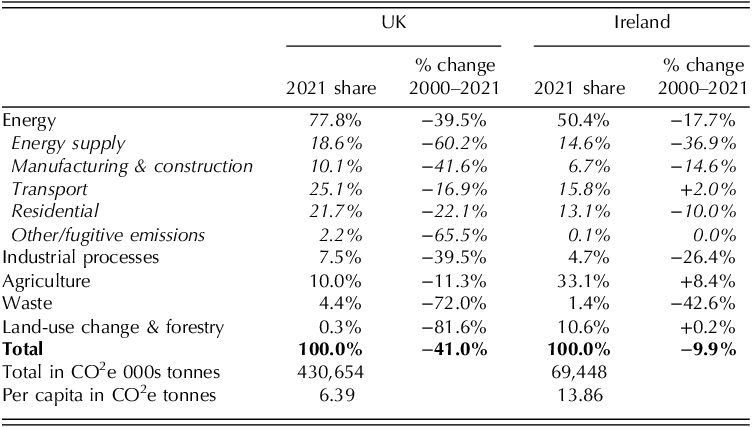
Table 1 summarises the sources of GHG emissions in the two states examined later in this article. While differences in the economic and natural resources of both states account for some of the differences in the composition of emissions, both illustrate the centrality of energy-related emissions, ranging from supply to transport and heating, to the national totals. Green policy interventions reflect various initiatives to reduce these emissions via changes to the composition of energy supply, changes to product types and standards (e.g. building standards, farming techniques, and vehicle types), and alterations to demand.
Source and changes to greenhouse gas emissions in the UK and Ireland

Notes: Data are for national emissions and exclude indirect and imported emissions. As Figure 1 illustrates, 2021 saw both countries report increased emissions versus those recorded during 2020 when the Covid-19 pandemic caused them to decrease.
Source: Calculated by Authors from OECD (2023) and OECD Population Statistics
Carbon taxation measures serve as one of the policy instruments governments can use to reduce GHG emissions. These reflect the failure of markets to include the negative externality of pollution in the costs of goods and services provided by industry and experienced by consumers. Taxation measures attempt to induce behavioural change by imposing a Pigouvian tax; increasing costs and prices so that consumption decisions are framed in the context of the complete social costs of production. Therefore it argues that the ‘polluter pays’ for the emissions they are responsible for creating and the associated administrative and mitigation measures society is required to pursue (OECD, 1992; Greve, Reference Greve2022). Theoretically, higher prices internalise these negative externalities and thereby reduce emissions by disincentivising the consumption of some goods and services, incentivising the adoption of cleaner manufacturing processes, and/or changing behaviours so that activity shifts towards lower emissions alternatives (IFS and Mirrlees, Reference Mirrlees2011; Metcalf, Reference Metcalf2021; ECA, 2021).
Although carbon taxation represents a small part of current taxation systems, for example it averaged 6 per cent of annual total taxation revenue in the EU between 2000-2021 (Eurostat, 2023), it has been highlighted as an area where policy can contribute to the pursuit of net zero emissions targets in the years ahead. In the UK the Committee on Climate Change (2019) and in Ireland the Commission on Taxation and Welfare (2022) both recognised its important role in incentivising change, shifting away from their previous focus as revenue raising measures targeted on inelastic demand. To date most environmental taxation measures target energy and transport; with these accounting for 78 per cent and 18 per cent respectively of total EU environmental taxation revenue in 2021 (Eurostat, 2023). Overall, Eurostat found that households pay 47 per cent of total environmental taxes and within this they are responsible for 42 per cent of energy tax revenues and 68 per cent of transport taxes; the remainder is paid by corporations and non-residents (Eurostat, 2023). Given the social policy focus of this article, our analysis focuses on households and the challenges arising in the design and implementation of associated energy and transport related carbon taxes given the parallel sustainable development objectives of equity and fairness.
Carbon taxation and fairness: A social policy approach
To the extent that fairness is considered at all as part of the polluter pays approach, it is understood in relation to responsibility: payment of environmental taxes by those most responsible for pollution is considered fair particularly when targeted on those whose adaption costs are lowest.
Ignored in this formulation is consideration of the broader social context within which such behaviours take place. From a social policy perspective, such considerations are crucial (Collins et al., Reference Collins, Ruane and Sinfield2022; Lymer et al., Reference Lymer, May and Sinfield2023). This perspective views polluting behaviours not only as a product of individual responsibility but as socially embedded, influenced particularly by structural inequalities (e.g. poverty and income inequality, disability, age) which also affect the affordability of adaption. Tax systems which purport to be fair must reflect these broader determinants (Ruane et al., Reference Ruane, Collins and Sinfield2020; Lymer et al., Reference Lymer, May and Sinfield2023).
The practical implications of these differences of perspective for environmental taxation design can be illustrated using the example of domestic energy consumption. From the polluter pays perspective, it is largely unproblematic to tax this using a single rate with each unit of pollution taxed the same. From a social policy perspective, however, taxation of this good needs to take account of the relatively income-inelastic consumption of household energy across the income distribution (Preston et al., Reference Preston, White, Browne, Dresner, Ekins and Hamilton2013; Bridgen and Büchs, Reference Bridgen, Büchs, Lymer, May and Sinfield2023), a product primarily of structural inequalities. These inflate the energy costs of some lower income and/or vulnerable households based on, for example, the additional needs for household warmth of vulnerable individuals (e.g. related to health and/or disability), location (rural/urban), and/or the quality and efficiency of housing and energy systems (Middlemiss and Gillard, Reference Middlemiss and Gillard2015; Robinson et al., Reference Robinson, Lindley and Bouzarovski2019). On the latter, the concentration of lower-income or vulnerable households in dwellings of lower quality (Reames, Reference Reames2016) means they are unable to afford the costs of housing adaptations to improve the efficiency of heating systems and/or dwelling infrastructure. This inflation of consumption generally at the lower end of the income scale means a flat rate tax inevitably bears hardest as a proportion on income on those with greatest needs and/or lowest incomes.
Analysing carbon taxation design from a social policy perspective thus requires systematic consideration both of a tax’s suitability for changing environmentally damaging behaviours and its fairness. To this end, this article is inspired conceptually by the just transition literature (Newell and Mulvaney, Reference Newell and Mulvaney2013; McCauley and Heffron, Reference McCauley and Heffron2018; Jenkins et al., Reference Jenkins, McCauley, Heffron, Stephan and Rehner2016; Snell et al., Reference Snell, Bevan, Gillard, Wade and Greer2018 and Reference Snell, Anderson and Thomson2023; Middlemiss et al., Reference Middlemiss, Snell, Morrison, Chzhen, Owen, Kennedy, Theminimulle and Carregha2023), focussing particularly on its concern about the distributive implications of policy responses to the climate crisis. We consider both vertical and horizontal equity (Pizer and Sexton, Reference Pizer and Sexton2019). When applied to carbon taxation, vertical equity is concerned primarily with the extent to which the costs and benefits of an action are allocated in relation to income, with systems judged as progressive, regressive, or proportional, depending on how average tax incidence falls. Where incidence is higher as a proportion of income for those on higher incomes, the tax is progressive; where it is lower for this group, the tax is regressive; where it is constant, the tax is proportional. As indicated above, flat-rate taxes levied on income inelastic goods and services will be regressive. Consideration of horizontal equity in relation to tax systems is more controversial (Pizer and Sexton, Reference Pizer and Sexton2019). However, it has increasingly been used to highlight the varying implications of tax systems for individuals or households with broadly similar incomes that differ in other respects that affect their tax incidence (e.g. Cronin et al., Reference Cronin, Fullerton and Sexton2017; Bourgeois et al., Reference Bourgeois, Giraudet and Quirion2021). This might include, for example, considerations of age, gender, race/ethnicity, geographical location, and/or disability. Consideration of these issues in relation to carbon taxation highlights the types of behaviour systems are most designed to discourage (e.g. energy consumption) and the extent to which such targeting disproportionately affects particular population groups. For example, as indicated above, a tax on domestic heating energy consumption has particular implications for vulnerable population groups requiring greater levels of warmth.
Based on this social policy framework, the ideal carbon tax from a sustainable development perspective would be one that, while efficient and effective in reducing environmentally damaging behaviours, was: (i) progressive; (ii) paid attention to concerns related to horizontal equity; and (iii) transparent in its operation. In reality, of course, most existing or proposed environmental taxes are unable to deliver against all of these criteria; some degree of balance and compromise of goals is necessary.
These efforts might include, for example, reductions in the scale of flat rate consumption taxes to mitigate their regressive impact; adjustments to universal levies designed to target specific types of expenditure (e.g. taxes on car use might be higher for vehicles with larger engines); the exclusion from a tax of certain vulnerable population groups; and the use of compensation mechanisms, often involving the welfare system to provide general or targeted support on lower income and/or vulnerable individuals/households negatively affected by the tax.
We are interested in the extent to which the need for such interventions is recognised in the carbon taxation policy process in the two countries and, if they are, the nature of the interventions. The literature suggests such efforts are likely to be less systematic and more ad hoc in liberal political economies, such as Ireland and the UK, due to the smaller size of their states; the absence of coordinating capacity and culture given the lack of corporatist institutions (Gough et al., Reference Gough, Meadowcroft, Dryzek, Gerhards, Lengfeld, Markandya and Ortiz2008); and the limited opportunities given for Green Party representation within many electoral systems (Carter, Reference Carter2013).
Carbon taxes in the UK and Ireland
In this section we apply the framework outlined above to assess the role of carbon taxation in each country’s approach to environmental transition, particularly its consistency with sustainable development principles. We start with efforts and commitments to reduce emissions.
Both countries have adopted legally binding net zero targets to be reached by 2050 (HM Government, 2021; Government of Ireland, 2021). The UK’s target includes an interim target to reduce GHG emissions by at least 68 per cent by 2030, compared to 1990 levels (Burnett et al., Reference Burnett, Edwards and Watson2023). The Irish target also includes an interim target for a 51 per cent reduction in GHG emissions by 2030, compared to 2018 levels (Environmental Protection Agency (EPA), 2023). Both countries have underpinned these plans with multi-annual carbon budgets and sector ‘ceilings’ or ‘pathways’ within which sit carbon pricing policy measures (Committee on Climate Change, 2020; Climate Change Advisory Council, 2021). More broadly, they have placed such efforts in the context of a commitment to sustainable development, balancing environmental/economic/social goals in seeking to meet these targets (Department of Environment, Food, and Rural Affairs (DEFRA), 2006; Her Majesty’s Government (HMG), 2021; Government of Ireland, 2021). However, despite these similarities, both countries have adopted contrasting approaches to carbon taxation.
The UK experience
The UK does not currently have a specific carbon tax but has introduced incrementally over many years a range of fiscal instruments on individuals and businesses that affect the cost/price of carbon. Most were not established to address environmental objectives, but their impact on price signals means they have behavioural and distributive implications (Bridgen and Büchs, Reference Bridgen, Büchs, Lymer, May and Sinfield2023). Of these, three main taxes affect the price individuals or households pay for energy – hydrocarbons tax (commonly known as fuel duty); value-added tax (VAT) on motor fuel; and VAT on domestic energy (gas and electricity). Oversight of all of these taxes is by the UK parliament with no responsibilities in this area devolved to governments in Northern Ireland, Scotland, and Wales (Torrance, Reference Torrance2022).
Fuel duty is applied to all sales of hydrocarbon-based fuels such as petrol, diesel, biodiesel, biogas, and liquefied petroleum gas (LPG) at different rates for different fuel types. The total amount raised dwarfs that from the other taxes, amounting to more than fourteen billion pounds in 2019 (Bridgen and Büchs, Reference Bridgen, Büchs, Lymer, May and Sinfield2023). In addition, VAT at 20 per cent has been added to fuel costs since 1973. The two taxes combined account for around 72 per cent of motorists’ fuel cost (Office of National Statistics (ONS), 2016).
Domestic energy is also subject to VAT, but this has been capped at 5 per cent since 1997 (Dresner et al., Reference Dresner, Jackson and Gilbert2006). Up to 2022, UK households were also subject to a range of ‘green levies’ on their fuel bills, sometimes described as quasi-taxes (Owen, Reference Owen2006). These fund a range of market-regulatory initiatives designed to encourage improvements in domestic energy efficiency, renewables and smart metering (see Rosenow, Reference Rosenow2012; Owen and Barrett, Reference Owen and Barrett2020; Bridgen and Büchs, Reference Bridgen, Büchs, Lymer, May and Sinfield2023), the operation of which can vary somewhat in Northern Ireland, Scotland, and Wales. On average, these constituted 13 per cent of household bills when last estimated in 2016 (NAO, 2016: 16). Since March 2022, most of these costs have ‘temporarily’ been paid through taxation in response to the energy crisis (GOV.UK, 2022; Hick and Collins, Reference Hick and Collins2024).
Distributive fairness
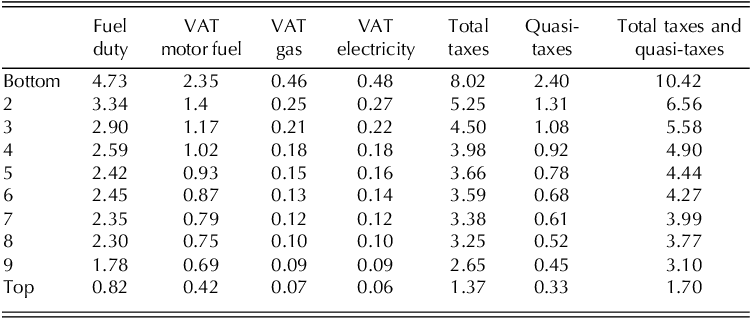
The most recent analysis of the distributive impact of these instruments with respect to vertical equity using 2020 ONS and DEFRA data for 2019/20 shows all are clearly regressive (see Table 2). VAT on domestic gas and electricity were the most regressive taxes. However, in terms of overall impact on lower-income budgets, taxes on car fuel are most significant, amounting in combination to more than 7 per cent of the equivalised disposable household income of the bottom income decile in 2019/20. The ‘green levies’ were the most regressive of all instruments in 2019/20.
The distributive impact of UK energy-based taxation on households by equivalised decile groups as a percentage of equivalised disposable income, 2019–20

Note: Quasi-taxes refer to a range of ‘green levies’ on household fuel bills up to 2022, which funded improvements in domestic energy efficiency, renewables, and smart metering.
Source: Bridgen and Büchs (Reference Bridgen, Büchs, Lymer, May and Sinfield2023)
In terms of the overall distributive impact of taxes on household energy consumption, Table 2 shows that while the bottom two income deciles spent respectively 8.02 and 5.25 per cent of equivalised disposable household income on these taxes, the top two income deciles spent only 2.65 and 1.37 per cent. With the addition of quasi-taxes, this disparity between the bottom and top of the income distribution increases.
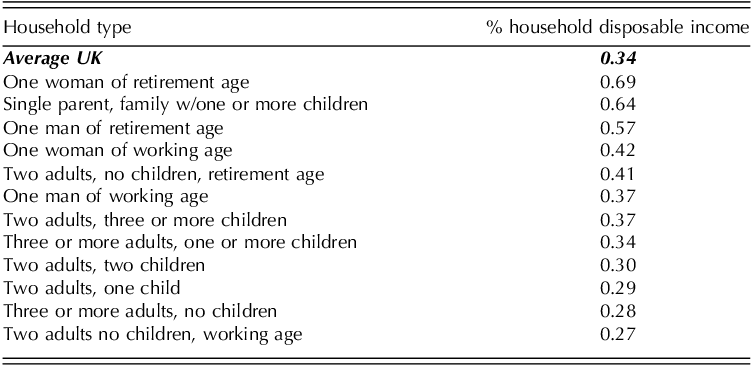
In terms of horizontal equity, there is no research that considers the combined impact of household energy use taxation and quasi-taxation in the UK by population group. Work on the impact of quasi-taxation suggests that retired households of all types, larger families and single adult households, particularly single-parent ones, pay the greatest amount in relation to their income (see Table 3), but these results are not controlled for income. Thus, high quasi-tax incidence among some of these household types might be due to lower average incomes rather than the other differences between them (see Büchs et al., Reference Büchs and Schnepf2013).
The demographic impact of UK quasi-taxes, 2016

Source: Owen and Barrett (Reference Owen and Barrett2020)
In this regard, Büchs et al.’s Reference Büchs and Schnepf2013 findings on UK household energy consumption are pertinent. After controlling for income, these highlight older populations, single-parent (especially female-headed), and workless households as particularly heavy users of domestic heating and thus likely to be disproportionately liable to taxes on the consumption of this good. However, this situation is compensated to some extent by the lesser use of private transportation by these groups (Büchs et al., Reference Büchs and Schnepf2013: 122). There is also evidence that people with low health status use more domestic electricity and thus will be disproportionately affected by taxes on this good, although again lower transport use mitigates this impact (Büchs et al., Reference Büchs, Bahaj, Blunden, Bourikas, Falkingham, James, Kamanda and Wu2018). Finally, disabled people tend to use less domestic energy overall, due mainly to lower incomes, but heating takes up a higher proportion of this usage than for other types of household and is generally insufficient to meet needs (Ivanova and Middlemiss, Reference Ivanova and Middlemiss2021).
Distributive governance and compensatory mechanisms
In the absence of any transparent carbon-reduction goals as part of UK tax policy on household energy use, very little systematic and coordinated government consideration has been given to the distributive impact of the instruments detailed above (Jordan et al., Reference Jordan, Rüdiger and Zito2013). Coordinated evaluation is further inhibited by separate administration of different instruments, fuel duty, and VAT by His Majesty’s Revenue and Customs (HMRC) and quasi-taxes by the Department of Energy Security and Net Zero. Consequently, public debate on the general role of taxation in achieving the UK’s net zero targets is significantly diminished by an absence of reliable/official information, particularly with respect to how this might best be done most fairly (Climate Change Committee, 2019; Bridgen and Büchs, Reference Bridgen, Büchs, Lymer, May and Sinfield2023).
Thus, while some efforts are in place to mitigate the system’s regressive impact and/or shield vulnerable population groups, these are not systematic, and there has been little official analysis of their adequacy. In terms of tax system design, limiting VAT on domestic fuel to 5 per cent since 1997 is the only mechanism in place. However, this is inefficient, given in absolute terms most of the income foregone is retained by higher-income households (Preston et al., Reference Preston, White, Browne, Dresner, Ekins and Hamilton2013). Efforts have also been made to target schemes funded by the ‘green levies’ on lower-income groups, specifically fuel-poor households. These include Energy Company Obligations to improve domestic energy efficiency and the Warm Homes Discount to subsidise bills. However, there is considerable evidence that this targeting has been ineffective (e.g. Committee on Fuel Poverty, 2022; Bridgen and Büchs, Reference Bridgen, Büchs, Lymer, May and Sinfield2023; Bridgen and Robinson, Reference Bridgen and Robinson2023).
With regard to the welfare system, universal Winter Fuel Payments have been provided to UK pensioners since 1997, ostensibly to address fuel poverty (Kennedy, Reference Kennedy2005).Footnote 2 While these costs amount to almost two billion pounds per annum, their efficiency is questionable with the Committee on Fuel Poverty (2023) finding that only around 6 per cent of recipients were in fuel poverty.
The Ireland experience
Ireland has a long-standing suite of environmentally focused taxes on energy and transport, like those outlined for the UK. However, over time, its system has evolved beyond traditional measures, predominantly focused on raising revenue, to include newer measures which place a greater emphasis on encouraging behavioural change by linking taxation levels to the emissions associated with certain consumption.
Mineral Oil Tax, commonly known as excise duties on fuel (petrol, diesel, kerosene, biofuel, and LPG), raised almost half of the non-VAT-related revenue from environmental taxes, approximately 2.5 billion euro per annum in the years prior to the Covid-19 pandemic and 2021/23 energy crisis (Department of Finance, 2023a). Duty is collected at different rates for different fuel types, and although changes to these rates carry a price effect, and a possibility to alter demand in pursuit of environmental objectives, the tax is principally a source of recurring revenue. VAT is also charged on fuel at the standard rate (23 per cent) for petrol and auto-diesel and at a reduced rate (13.5 per cent) for kerosene and diesel intended for agricultural and heating (Revenue Commissioners, 2023a).Footnote 3 VAT also applies to domestic energy consumption, with both electricity and gas supplies unusually classified as a service rather than a good, and consequently levied at the reduced rate (Commission on Taxation and Welfare, 2022). This VAT rate was further reduced to 9 per cent for electricity and gas as part of measures to assist households with the increased costs of the energy crisis (Collins, Reference Collins2023).
Other measures incorporate a clearer relationship between carbon emissions and the rate of tax. Since 2008 Motor Tax and Vehicle Registration Tax (VRT) have been calculated on the basis of carbon emissions. Motor Tax is an annual charge on vehicles with rates arising based on the emissions of the engine. For private cars registered from January 2021 these range across sixteen bands from €120 (zero emission) to €2,400 (more than 225g of CO2 per kilometre) with the tax raising €902m in 2022 (Department of Finance, 2023a). VRT arises at the purchase of a vehicle and is calculated based on the carbon dioxide and nitrogen oxide emissions of vehicles (Collins, Reference Collins, O’Hagan, O’Toole and Walsh2021). For cars, this is set at a percentage of their determined open market selling price (OMSP) and in 2023 ranged across twenty bands from 7 per cent (zero to less than fifty grams of CO2 per kilometre) to 41 per cent (more than 190g of CO2 per kilometre) (Revenue Commissioners, 2023b). VRT raised €757m in 2022 (Department of Finance, 2023a).
Ireland introduced a carbon tax in 2010, following a recommendation of the 2009 Commission on Taxation (2009: 325-372), and it serves as the core carbon reduction-related taxation measure. Its base has broadened over time such that it currently applies to approximately 50 per cent of all CO2 emissions (Government of Ireland, 2023: 118). In 2020, following recommendations from an all-party parliamentary committee on climate change, an annual increase of seven euro and fifty cent per tonne was legislated for, meaning the rate will reach €100 per tonne by 2030; as of 2024 the rate is set at fifty six euro per tonne (Commission on Taxation and Welfare, 2022: 321). The additional revenues over 2021-2030, estimated at 9.5 billion euro, have been ring-fenced and hypothecated with three billion euro earmarked for compensatory social welfare payments, five billion euro for a ‘socially progressive retrofitting programme,’ and 1.5 billion euro for the promotion of sustainable agricultural practices (Department of Finance, 2022).
The carbon tax is imposed in addition to excise duties and VAT, and its structure aligns with the polluter-pays principal, with products taxed in proportion to the amount of carbon they emit. For example, calculations by the Department of Finance report that the seven euro and fifty cent increase in 2024 will add one euro and twenty-eight cent to a sixty litre fill of petrol, one euro and forty-eight cent to a sixty litre fill of diesel, ninety cent to a forty kilogram bag of coal, nineteen euro and forty cent to a 900 litre tank of home heating oil and sixteen euro and ninety-eight cent to the average annual household natural gas bill (2023c: 2).
Distributive fairness
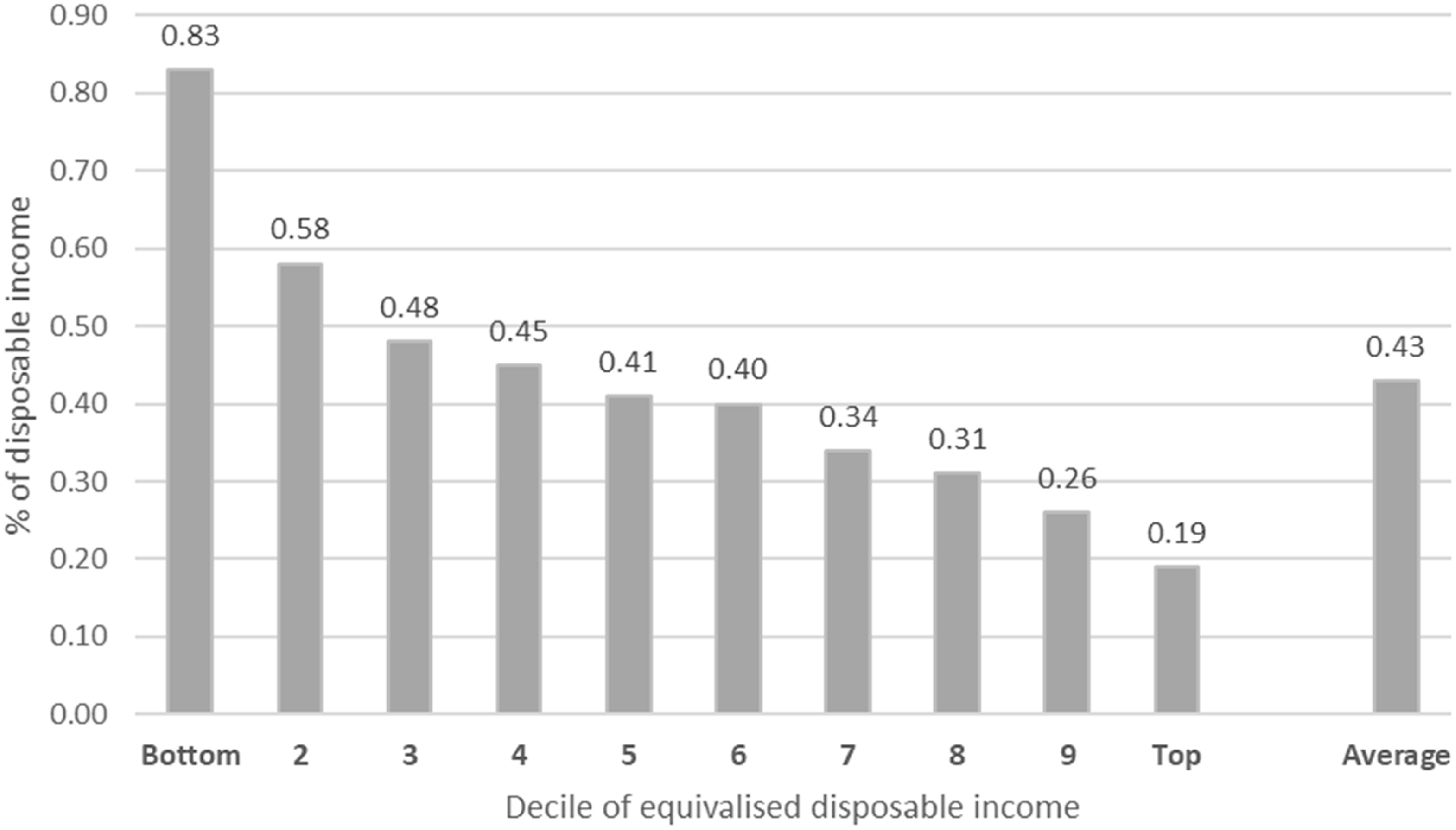
Assessments of the distributive impact of excise duties and VAT on fuel and energy has found them to be regressive, reflecting the higher proportion of income that is spent by lower-income households and that these goods comprise a larger proportion of their expenditure (O’Donoghue, Reference O’Donoghue1997; Callan et al., Reference Callan, Lyons, Scott, Tol and Verde2009; Collins, Reference Collins2014; Flues and Thomas, Reference Flues and Thomas2015; Lydon, Reference Lydon2022). For example, for fuel excise duties, Kakoulidou and Roantree (Reference Kakoulidou and Roantree2021) find that it is only the top four deciles that pay a below-average proportion of disposable income. Empirical evidence on the distributive effect of motor tax and VRT is absent, but a priori we can expect that higher income households will find it easier to shift their consumption towards lower emissions vehicles and thus face lower liabilities. Research on the carbon tax has also found it to be regressive (see Figure 2), driven by lower-income households spending a greater share of their income on carbon-intensive goods such as home heating fuel (de Bruin and Yakut, Reference de Bruin and Yakut2018; O’Malley et al., Reference O’Malley, Roantree and Curtis2020; Department of Finance, 2023b).Footnote 4
The Distribution of Carbon Tax Liabilities, Ireland 2015/16.
Source: O’Malley et al., Reference O’Malley, Roantree and Curtis2020: 32

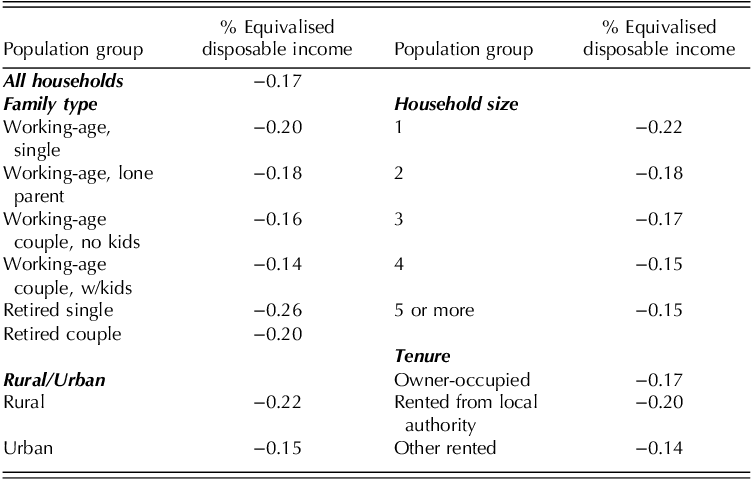
With respect to horizontal equity, given Ireland’s carbon tax design includes objectives to recycle most of its revenue into cash transfers and targeted spending, some research has emerged identifying those groups most exposed to these tax increases (Tovar-Reaños and Lynch, Reference Tovar-Reaños and Lynch2019; Bercholz and Roantree, Reference Bercholz and Roantree2019; de Bruin et al., Reference de Bruin, Monaghan and Yakut2019; O’Malley et al., Reference O’Malley, Roantree and Curtis2020). Bercholz and Roantree (Reference Bercholz and Roantree2019) look at broad population groups and find above-average effects for retired people living alone, single working-age adults, rural households, and retired couples (see Table 4). However, what combination of these effects is driven by higher energy needs versus higher expenditure relative to income is undetermined. Similarly, evidence has yet to emerge assessing the impact on key groups for social policy, including people with a disability, those with long-term illness, children, workless households, and for gender and ethnic groups.
Demographic impact of a €10 carbon tax increase, Ireland 2019

Source: Bercholz and Roantree, Reference Bercholz and Roantree2019: 26
Distributive governance and compensatory mechanisms
A lack of clarity regarding the expected contribution of taxation measures, and in particular the carbon tax, to the achievement of national climate change targets undermines the ability of policymakers and the general public to engage on the appropriateness and effectiveness of Ireland’s current carbon taxation policies. While the Commission on Taxation and Welfare (2022: 321) noted there is ‘broad consensus and societal buy-in’ in support of the tax and clarity regarding its planned increases to 2030, this contrasts with the lack of measurable benchmarks for progress other than as an undefined element of overall national emissions reductions. Similarly, the role taxation should play in the period from 2030-2050 remains undefined. These features somewhat undermine the ability of society to assess the role and contribution of the carbon tax and dilute its intended perception as a socially worthwhile policy tool. They also highlight the potential for establishing societal consensus, perhaps using consultative models such as Citizen’s Assemblies, which have been found to work well in Ireland to date (Farrell et al., Reference Farrell, Suiter, Harris, Cunningham, Farrell and Hardiman2021; Lage et al., Reference Lage, Thema, Zell-Ziegler, Best, Cordroch and Wiese2023). Currently, taken together with the aforementioned data gaps, these issues impede public understanding and debate on carbon taxes.
Compensating lower income households for the effects of the carbon tax, such that the effect of the tax is progressive, is stated as a key aspect of the design of Ireland’s carbon tax (Government of Ireland, 2021: 24). Following Budget 2024, €262m of the total additional carbon tax revenue of €788m, was used to part-fund increases in means-tested fuel allowances, welfare top up for families with children, welfare supports for working families with children and additional weekly welfare top-ups for pensions who live alone (Department of Finance, 2023b). The Department report that the net effect of these measures is that the carbon tax increase is progressive with ‘households in the bottom five income deciles are materially better off as a result of the social protection measures funded by the increased carbon tax’ (2023c:5). However, the analysis does not explicitly separate the proportion of these welfare payment increases that is a compensation for the carbon tax versus those that are provided as part of an annual uprating of benefits. For example, a Budget 2024 increase in welfare payments for children in welfare dependent households of four euro per week is presented as part funded by carbon taxes in one budget document, and therefore offsetting some of the effects of the carbon tax increase, and as a child poverty measure in another (Department of Finance, 2023c and 2023d). While it may be both, the delineation between compensation to maintain current living standards and resources to enhance current living standards is not made clear to either policymakers or recipients.
Discussion and conclusion
The preceding sections have analysed carbon taxes levied on household energy use in Ireland and the UK from a social policy perspective using the energy justice literature as an inspiration. Based on this analysis, the article considered the transparency of distributive issues in the governance of the two systems and the compensatory mechanisms used in both countries to mitigate their social impact. Such efforts are essential, it was suggested, if efforts to respond to environmental challenges are to remain consistent with sustainable development principles. These principles encourage governments to facilitate decarbonising transitions while simultaneously promoting, or at least protecting, economic and social objectives (Uršič et al., Reference Uršič, Deželan and Maksuti2014).
With regard to the distributive impact of the two-systems analysis focused not just on vertical equity, consideration of which is reasonably common, but also horizontal equity, which population groups are most disadvantaged.
To assess if and how carbon taxation in the two countries is aligned with the social dimension of sustainable development, consideration was given to the governance of distributive issues, particularly its transparency, tax policy interventions, and complementary social policies, such as use of the benefit system. With regard to tax policy, the article focused on reductions of – or exclusions from – taxes for more vulnerable groups. With regard to the welfare system, consideration was given to income or other resource supports for vulnerable groups most negatively affected by a tax.
In both countries, the energy-related taxes that households face derive from an array of instruments introduced incrementally over a long period, mainly as revenue-raising mechanisms. In the UK, these have predominantly evolved without specific environmental objectives whereas in Ireland there have been some initiatives to embrace the polluter pays principle via emissions-related vehicle taxes and the adoption of a carbon tax. Despite these differences, in terms of vertical equity, both countries possess notably regressive systems with fuel duties, excises and VAT, and Ireland’s carbon tax, impacting most on the incomes of those in the lowest deciles. With respect to horizontal equity, the available (and limited) evidence suggests that it is older populations, single households, and single-parent households that are most negatively affected by the systems in each country. However, in both countries, there remain information gaps regarding the impact these systems are having on key groups of interest to social policy; information deficits that significantly impact the ability of policymakers to understand and, if desired, compensate certain vulnerable populations whose living standards are particularly exposed to energy price increases. Procedurally, the general picture is that incremental and uncoordinated policy development means that transparency is lacking in both states, with little academic or political attention given to the range of taxes that households face as a system. In Ireland the hypothecation of carbon tax revenues to certain compensatory and energy efficiency measures suggests some rationale for the use of taxation revenues, although this has not been accompanied by the transparency necessary for households, and society more generally, to appreciate the association between taxes raised, measures adopted, and living costs assistance for some households. In both countries the effectiveness of compensation mechanisms is also undermined by the lack of clarity on the delineation between the proportion of payments, or subsidies, that are intended to assist households with polluter-pays-driven energy cost increases and that are intended to assist with a general increase in living costs. Similarly, many of the compensating measures in both countries, for example via VAT reductions, welfare increase, and energy-efficiency improvements and supports, deliver as much, if not more, support to better-off households than to those most exposed to the living cost consequences of carbon-related tax policy reforms. Looking to the future, there is a clear need for governments and researchers in both countries to determine the net effect for individuals and households of carbon tax-related policies, including both the income effects of taxation changes and compensation measures.Footnote 5
Collectively, this suggests that in both countries, current carbon taxation policies are deficient when assessed against sustainable development principles. Although Ireland’s introduction of a specific carbon tax means it is better placed than the UK in this respect, the outcomes for both states echo the literature’s expectation that liberal political economies find environmental transitions consistent with sustainable development principles difficult, due to inadequacies in their state’s coordinating capacity (Gough et al., Reference Gough, Meadowcroft, Dryzek, Gerhards, Lengfeld, Markandya and Ortiz2008; Carter, Reference Carter2013). Future research might consider whether carbon taxation systems in other worlds of welfare are designed better to ensure the clear and transparent coordination of environmental, economic, and social goals. Certainly, such coordination is essential if carbon taxation and other responses to the climate crisis are to gain and retain public acceptability.


 Open access

