


Introduction
Catatonia, first described by Kahlbaum in 1874 [Reference Fink1], is a neuropsychiatric syndrome characterized by motor, affective, behavioral, and sometimes autonomic dysregulations. Signs can be assessed using the Bush-Francis Catatonia Rating Scale (BFCRS), which has high sensitivity and specificity [Reference Sienaert, Rooseleer and De Fruyt2, Reference Bush, Fink, Petrides, Dowling and Francis3]. Although under-recognized [Reference Llesuy, Medina, Jacobson and Cooper4, Reference Bhati, Datto and O’Reardon5], catatonia has a mean prevalence of 9.2% among subjects diagnosed with psychiatric or general medical conditions (GMCs) [Reference Solmi, Pigato, Roiter, Guaglianone, Martini and Fornaro6]. Catatonia frequently complicates mood (20.1%) and psychotic disorders (9.8%) but is also common in medical conditions (20.6%) [Reference Solmi, Pigato, Roiter, Guaglianone, Martini and Fornaro6–Reference Smith, Smith, Philbrick and Kumar9]. Iatrogenic catatonia, initially described as antipsychotic-induced [Reference Duggal and Singh10, Reference Lee11], also occurs after abrupt clozapine discontinuation [Reference Lander, Bastiampillai and Sareen12, Reference Boazak, Cotes, Potvin, Decker and Schwartz13].
“Malignant” catatonia (MC), which is characterized by altered consciousness, autonomic dysfunction, and hyperthermia [Reference Philbrick and Rummans14, Reference Mann, Caroff, Bleier, Welz, Kling and Hayashida15], can be life-threatening [Reference Fink and Taylor8, Reference van der Heijden, Tuinier, Arts, Hoogendoorn, Kahn and Verhoeven16], whereas the prognosis of uncomplicated catatonia remains good. Benzodiazepines (BZD) are the gold standard treatment [Reference Fricchione, Cassem, Hooberman and Hobson17–Reference McEvoy and Lohr19] with a response rate of around 80% [Reference Bush, Fink, Petrides, Dowling and Francis20]. Electroconvulsive therapy (ECT) is used as second- or as first-line treatment for patients with MC or who cannot undergo a BZD trial [Reference Hawkins, Archer, Strakowski and Keck21–Reference Raveendranathan, Narayanaswamy and Reddi23].
The impact of catatonia on schizophrenia prognosis and therapeutic response is unclear [Reference Ungvari, Gerevich, Takács and Gazdag24, Reference Ungvari, Caroff and Gerevich25]. Catatonic signs could be a marker of a less responsive subtype [Reference Ungvari, Gerevich, Takács and Gazdag24, Reference Ungvari, Leung, Ng, Cheung and Leung26–Reference Beckmann, Fritze and Franzek28]. The use of antipsychotics in catatonic patients is discouraged even in the presence of underlying psychotic disorders because of an increased risk of ineffectiveness and clinical deterioration [Reference Fink and Taylor8, Reference Philbrick and Rummans14, Reference Mann, Caroff, Bleier, Welz, Kling and Hayashida15, Reference White and Robins29, Reference Rosebush and Mazurek30]. Fink and Taylor [Reference Fink and Taylor8] recommended postponing antipsychotic introduction until syndrome resolution, whereas others [Reference Caroff7, Reference Edinoff, Kaufman, Hollier, Virgen, Karam, Malone, Cornett, Kaye and Kaye31, Reference Brar, Kaushik and Lippmann32] proposed introducing antipsychotics only in patients already treated with BZD.
Conversely, there has recently been an increase in successful cases involving second-generation antipsychotics (SGA) in catatonia. In the first years of their market introduction, some authors believed that SGA were safer and did not induce neuroleptic malignant syndrome (NMS) [Reference Fink and Taylor8]. Although catatonia or NMS has since been reported in all SGA [Reference Trollor, Chen and Sachdev33–Reference Ananth, Parameswaran, Gunatilake, Burgoyne and Sidhom36], some authors suggest that the incidence and mortality of NMS might be lower with SGA [Reference Strawn, Keck and Caroff37–Reference Schneider, Regente, Greiner, Lensky, Bleich and Toto42]. Similarly, SGA may cause less catatonic syndromes than FGA [Reference Costa, Very, Rousseau, Virolle, Redon and Taïb43]. A previous review of 10 successful cases suggested their potential usefulness in patients with non-MC [Reference Van Den Eede, Van Hecke, Van Dalfsen, Van den Bossche, Cosyns and Sabbe44]. The Maudsley prescribing guidelines suggest “careful consideration” of olanzapine or clozapine in schizophrenic patients with catatonia when NMS has been ruled out [Reference Taylor, Barnes and Young45]. Another recent review suggests using SGA “if psychosis is a prominent feature” [Reference Beach, Gomez-Bernal, Huffman and Fricchione46]. Finally, abrupt clozapine withdrawal has been associated with the onset of catatonia, effectively treated by its reintroduction [Reference Lander, Bastiampillai and Sareen12, Reference Boazak, Cotes, Potvin, Decker and Schwartz13]. However, the use of antipsychotics remains one of the most controversial areas in catatonia management [Reference Rogers, Oldham, Fricchione, Northoff, Ellen Wilson and Mann47].
To determine whether antipsychotics could be an alternative treatment for catatonia, we conducted a systematic review of the literature investigating the outcomes of catatonic events treated with antipsychotics.
Methods
Search strategy
A systematic literature search was conducted following the Preferred Reporting Items for Systematic Reviews and Meta-Analysis (PRISMA) guidelines [Reference Moher, Liberati, Tetzlaff and Altman48]. We searched two electronic databases (Medline and Web of Science) using MeSH terms and keyword-based queries. In each database, we searched for “cataton*” in combination with antipsychotic-related keywords using Boolean operators. Searches including all antipsychotics by name according to the Anatomical Therapeutic Chemical classification were also conducted. Searches were restricted to adult humans and included articles published between January 1, 1951 (distribution of chlorpromazine) and December 31, 2023. During title screening, the period of interest was narrowed from 2000 to 2023 to capture more actual prescribing habits.
Duplicate references were removed. Titles and abstracts were independently screened for inclusion by two authors (MR, JV). When there was disagreement in the assessment, the article was retained for full-text screening. Any disagreement on the inclusion of a full-text article was resolved by consensual discussion with all authors, including two senior psychiatrists with expertise in catatonia (EV, JDC) and one clinical psychopharmacologist (FM).
Attempts were made to contact the authors if the article was unavailable. The reference lists of all eligible publications and review articles were manually searched to identify other relevant articles.
Eligibility criteria
We included all original peer-reviewed articles (case-control studies, cohort studies, case reports, and case series) reporting on the successful or unsuccessful use of antipsychotics after the onset of catatonia, either as a monotherapy or as an adjunct to conventional treatments.
As standardized tools (such as the BFCRS) were not systematically used to report diagnosis, we decided to assess the presence of catatonia by comparing the signs reported in the article with consensual psychiatric classifications (DSM-IV-TR, DSM-V), taking into account the date of publication. If the signs were unreported or did not meet the classification requirements, the publication was excluded as the presence of catatonia could not be confirmed.
As our aim was to investigate outcomes of catatonic events treated with antipsychotics, we chose the trial of an antipsychotic molecule as the unit of analysis. For each selected article, we isolated all the described “antipsychotic trials” which were defined as antipsychotic initiation or posology change after the onset of catatonia. Thus, multiple antipsychotic trials with different antipsychotics for a single patient were considered separate and recorded. Mentions of previous antipsychotic-treated catatonic episodes, if any, were also included in addition to the index episode.
Relevant data for each antipsychotic trial were extracted from eligible articles reporting patient-level data and coded into an Excel database using a standardized method. Publications that did not report detailed patient-level data were not included in the analysis, as descriptive variables related to the antipsychotic trials could not be extracted. Any uncertainty concerning the eligibility of an antipsychotic trial or the data extraction was supervised by a senior author (EV) or discussed with the entire research team.
Thus, the exclusion criteria were the following: (1) absence of diagnosed catatonia (i.e., absence of diagnostic criteria as defined in DSM, clearly specified in the article) before antipsychotic initiation; (2) unclear treatment strategy or treatment without antipsychotics; (3) lack of clinical evaluation after antipsychotic initiation; (4) patients under 18 years old; (5) theoretical reviews; and (6) publications in languages other than English and French.
Data extraction and analysis
Descriptive variables extracted for each antipsychotic trial consisted of demographic characteristics (age, gender), underlying diagnosis (schizophrenia, schizoaffective disorder, other psychotic disorders, bipolar disorder, unipolar depression, GMC, other diagnoses); personal history of catatonia; characteristics of catatonia (type, periodic, malignant, associated with clozapine withdrawal, BFCRS score); previous treatments (BZD, ECT, antipsychotics); current adjunctive treatments (ECT, BZD, anticonvulsant mood stabilizers, N-methyl-d-aspartate [NMDA] antagonists, other medications); characteristics related to antipsychotic exposure (agent, dosage, single or combination therapy, delay in introduction, final BFCRS score); and outcome. Unavailable and unclear data were recorded as “unspecified.” Clozapine withdrawal events were defined as occurring in 14 days or less after clozapine discontinuation, as events occurring after a longer interval would likely be due to another mechanism (e.g., a relapse) [Reference Lander, Bastiampillai and Sareen12, Reference Saini, Begum, Matti, Ghanem, Fripp and Pollak49].
The outcome was qualitatively defined as “detrimental” (worsening of catatonic signs, onset of MC or NMS, death), “neutral” (no impact on catatonic signs), or “beneficial” (improvement of catatonic signs or complete recovery). When reported in the publication, the results of standardized assessment tools were used to determine the outcome. If multiple agents were introduced at the same time, all were considered as effective or ineffective.
No criteria for NMS have been fully agreed upon [Reference Levenson50, Reference Tse, Barr, Scarapicchia and Vila-Rodriguez51]. Since DSM-V does not define a number of criteria to reach to diagnose NMS and DSM-IV-TR does not specify decision thresholds for quotation, we choose to employ modified DSM-IV-TR criteria with thresholds mentioned in DSM-V: hyperthermia of 38°C or greater, tachycardia representing a 25% increase, elevated blood pressure of a 25% increase, labile blood pressure indicating a 25% modification of systolic BP or a 20% modification of diastolic BP, and elevated CPK of four times the upper limit [52, 53]. MC was defined as fever and/or elevated or labile blood pressure not due to another cause [Reference Philbrick and Rummans14].
Descriptive statistical analysis was performed using Microsoft Excel.
Results
Search results
Initially, a total of 6,219 records were found. Following the elimination of 1,693 duplicate entries, a total of 4,560 records (including 34 additional records identified through citation searching) underwent title and abstract screening. Of the 125 articles retained for full-text assessment, 79 were included. The PRISMA flowchart is presented in Figure 1. The full list of included articles can be found in Supplementary Material.
PRISMA flowchart.

Few clinical studies reported patient-level data in line with our inclusion criteria. An open-label study [Reference Arora, Banal, Praharaj and Mahajan54] in a sample of 15 patients presenting retarded catatonia with underlying diagnoses of acute psychosis (n=8), undifferentiated schizophrenia (n=6), and depression (n=1) investigated the time to symptom resolution with an augmentation strategy of lorazepam (2–4 mg/d) with low-dose amisulpride (100 mg/d). All catatonic signs resolved by day 2 without adverse effects.
In contrast, another author reported 17 cases of patients with catatonia who progressed to NMS after administration of FGA [Reference White and Robins29]. Five had autonomic dysfunction and mild pyrexia before antipsychotic administration. Fifteen patients (88%) showed gradual resolution of signs but two died.
In addition, 148 antipsychotic trials were extracted from 77 case reports. As such, 175 distinct antipsychotic trials occurring in 110 patients were analyzed.
Population’ characteristics
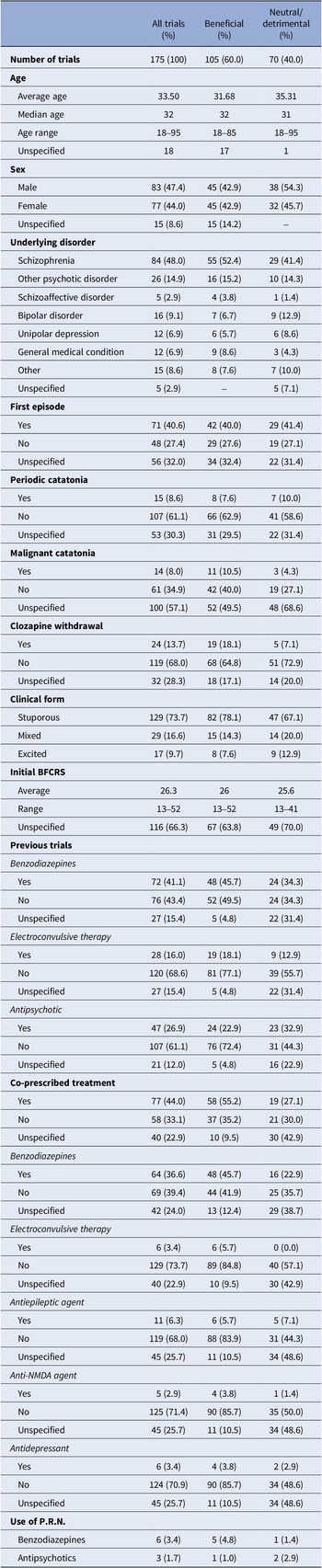
Eighty-three antipsychotic trials (47.4%) were on male patients. Age ranged from 18 to 95 years, with a mean age of 33.50 years.
Psychotic disorders were the most common etiology (62.9%) with 84 antipsychotic trials involving patients suffering from schizophrenia (48.0%), 5 schizoaffective patients (2.9%), and 26 other psychotic patients (14.9%). Mood-related disorders were implicated in 28 trials (16.0%): 16 with bipolar disorder (9.1%) and 12 with major depressive disorder (6.9%). Catatonia was due to GMC in 12 trials (6.9%). Among the “other” underlying etiologies, four trials were reported in the context of obsessive-compulsive disorders, two were substance-induced, three occurred in patients with autism spectrum disorder, and 6 were idiopathic. The underlying diagnosis was not specified in five trials.
Seventy-one (40.6%) involved a first episode of catatonia. Fifteen (8.6%) involved periodic catatonia, while 24 (13.7%) occurred after clozapine withdrawal. Features of MC were present for 14 trials (8.0%), but data were frequently missing. Notably, catatonia was of stuporous form in 129 (73.7%) trials, excited in 17 (9.7%), and mixed in 29 (16.6%). Pre-trial BFCRS scores were reported for only 59 trials (33.7%) and ranged from 13 to 52 (mean of 26). The BFCRS after antipsychotic introduction was only reported in 23 (13%) trials. The delay between catatonia onset and antipsychotic initiation was almost systematically missing or unclear but ranged from a few days to 3–4 months.
BZD were tried before antipsychotics in 72 trials (41.1%) and ECT in 28 (18.1%). A summary of the characteristics of the population and the context of antipsychotic exposure is presented in Table 1.
Patient characteristics and context of antipsychotic trial

Abbreviations: BFCRS, Bush-Francis Rating Scale; ECT, electroconvulsive therapy; NMDA, N-methyl-d-aspartic acid; P.R.N., Pro Re Nata.
Antipsychotic exposure and outcome
SGA were used in 140 antipsychotic trials (80.0%), while 38 trials (21.7%) involved FGA. Olanzapine was involved in 39 trials (22.3%), clozapine in 32 (18.3%), risperidone in 22 (12.6%), haloperidol in 19 (10.9%), amisulpride in 18 (10.3%), aripiprazole in 17 (9.7%), quetiapine in 8 (4.6%), clothiapine in 6 (3.4%), chlopromazine in 4 (2.3%), and fluphenazine and ziprasidone in 3 (<2%). Sulpiride, paliperidone, benperidol, and zuclopenthixol were involved in two trials each. Loxapine, flupenthixol, perphenazine, and asenapine only appeared in one trial each.
In some antipsychotic trials (44.0%), several concomitant therapies were used. BZD were co-prescribed in 64 trials (36.6%), whereas ECT was only used in 6 trials (3.4%). Antiepileptic agents were reported in 11 trials (6.3%), NMDA agonists in 5 (2.9%), and antidepressants in 6 (3.4%). Detailed data were missing for a significant proportion of trials.
Treatment with antipsychotics was considered beneficial in 105 trials (60.0%), neutral in 51 trials (29.1%), and detrimental in 19 trials (10.9%). For detrimental outcomes, FGA were the most represented with 14 trials (73.7%), including the use of clothiapine (6 trials), haloperidol (4 trials), fluphenazine (2 trials), chlorpromazine (2 trials), and perphenazine (1 trial). Only five trials involved SGA: four with olanzapine and one with clozapine. NMS occurred in four patients (two with olanzapine, one with clozapine, one with haloperidol). Three patients died (one with clothiapine and one with olanzapine).
Fourteen trials featured MC, with underlying diagnoses of psychotic disorders (five trials), mood-related disorders (six trials), and GMC (three trial). None reported worsening after antipsychotic initiation. The outcome was stable in 3 trials and beneficial in 11 trials. Only nine cases benefited from a previous BZD trial, and only one from ECT.
Eight trials (4.6%) involved antipsychotic bitherapy, mainly through augmentation therapy. One patient remained stable after bitherapy with aripiprazole and haloperidol [Reference Tang and Park55]. In another case, the combination of quetiapine and risperidone did not produce positive results, but the evolution was favorable with amisulpride and risperidone [Reference French and Eastwood56]. Similarly, the combination of zuclopenthixol and olanzapine, followed by a switch to clozapine, was ineffective; however, the addition of asenapine yielded results [Reference Buoli, Dobrea, Caldiroli, Cremaschi and Altamura57]. A beneficial outcome was reported after co-prescription of haloperidol and olanzapine [Reference Numata, Kato, Misawa, Kanai, Kasahara and Ohmori58]. Worsening of signs and death were reported after association of clothiapine and perphenazine [Reference White and Robins29].
In terms of clozapine-withdrawal-induced catatonia, 17 trials (70.8%) showed beneficial evolution, mostly with clozapine reintroduction but also with risperidone [Reference Wang, Gupta, Bastiampillai and Sani59], amisulpride [Reference Kanagasundram and Chengappa60], and olanzapine [Reference Koch, Reich, Wielopolski, Clepce, Fischer and Kornhuber61].
“Beneficial” versus “neutral/detrimental” trials
To obtain a more precise description of the parameters associated with a beneficial response to antipsychotics, we compared the characteristics of “beneficial” trials to “neutral” and “detrimental” trials.
Only beneficial interventions were reported for amisulpride and asenapine. In contrast, all interventions with clothiapine, fluphenazine, sulpiride, zuclopenthixol, flupenthixol, loxapine, and perphenazine were neutral or detrimental. The ratio of “beneficial” to “neutral/detrimental” reported outcome was favorable for clozapine (7.0), risperidone (2.7), and ziprasidone (2.0). It appeared almost balanced for aripiprazole (1.4) and olanzapine (1.2) but unfavorable for haloperidol (0.6), quetiapine (0.6), and chlorpromazine (0.33). The distribution of trials for each agent is reported in Figure 2.
Number of beneficial and neutral/detrimental trials reported for each antipsychotic agent.

Males were slightly more represented in the “neutral/detrimental” group (54.3% vs. 42.9%). Psychotic disorders were overrepresented in the “beneficial” group with 71 trials (67.6%) compared to 39 trials (55.7%) in the “neutral/detrimental” group. This was particularly striking for haloperidol, where all patients with “beneficial” trials suffered from psychotic disorders compared with only 40% of the “neutral/detrimental” trials. GMC were also more common in the “beneficial” group (8.6% vs. 4.3%). Conversely, mood disorders appeared to be more common among “neutral/detrimental” trials (20.5% vs. 12.4%). Similarly, 50% of the 19 detrimental trials were associated with mood disorders. The mean BFCRS score was similar between the groups, but the excited form was more common in “neutral/detrimental” trials (12.9% vs. 7.6%).
Regarding prior interventions, “beneficial” trials benefited more from BZD (45.7% vs. 34.3%) and ECT (18.1% vs. 12.9%) before antipsychotic exposure. Co-prescription of BZD (45.7% vs. 22.9%) and ECT (5.7% vs. 0%) was also higher in the “beneficial” group. The outcomes for bitherapy did not differ from monotherapy. The main differences are summarized in Table 1. Mean doses (reported in “defined daily doses”) [Reference Leucht, Samara, Heres and Davis62] for FGA and SGA are presented in Table 2.
Antipsychotic mean dose for FGA and SGA

Abbreviations: B, Beneficial; DDD Eq, Defined Daily Doses Equivalents; FGA, First-Generation Antipsychotic, N/D=Neutral/Detrimental; SD, Standard Deviation; SGA, Second-Generation Antipsychotic.
a Doses reported for each antipsychotic trial were converted in chlorpromazine equivalents based on defined daily doses (DDDs) calculated with a validated method [Reference Leucht, Samara, Heres and Davis62].
Discussion
This review presents the outcomes and the associated pharmacological context of 175 antipsychotic trials in patients presenting catatonia. Trials originate mainly from case reports and case series. Antipsychotic use was considered beneficial in 105 trials (60.0%), neutral in 51 trials (29.1%), and detrimental in 19 trials (10.9%). While amisulpride, clozapine, and risperidone tended to be reported with a beneficial outcome, olanzapine and aripiprazole showed mixed results. The outcomes for FGA and quetiapine were detrimental.
Antipsychotics in catatonia: an option?
The place of antipsychotics in the management of catatonia is still under debate. Withdrawal until the resolution of the episode is generally recommended with the argument that they may precipitate, maintain, or worsen catatonia [Reference Lee11, Reference Rosebush and Mazurek63–Reference Carroll and Lee65]. However, some authors argue that the risk of exacerbation may be concentrated in antipsychotics with a higher D2 dopamine receptor blockade [Reference Su, Chang, Hayes, Harrison, Lee and Broadbent39, Reference Nielsen, Jensen and Nielsen66, Reference Hatta, Miyakawa, Ota, Usui, Nakamura and Arai67], which is consistent with our findings.
The majority of the published reports over the last 20 years have described beneficial or at least well-tolerated SGA trials during catatonic events. Only a few cases reported worsening of signs, and these were mainly associated with the use of FGA (representing 22% of trials), which was beneficial in only nine trials but caused 74% of the detrimental outcomes, whereas SGA (80% of trials) were harmful in only five trials (4%) but were responsible for 92% of the improvements. FGA should be avoided because they carry a greater risk of worsening catatonia.
Differential response between SGA
In descending order, the most commonly used SGA were olanzapine, clozapine, risperidone, amisulpride, and aripiprazole. Despite being recommended by some authors [Reference Yoshimura, Hirota, Takaki and Kishi68, Reference Kendurkar69], quetiapine was seldom used with poorer outcomes. In our review, olanzapine was ineffective in 46% of its trials and aripiprazole in 41%. In addition, of the five trials reporting detrimental outcomes with SGA, four were with olanzapine (including two NMS and one death). The mixed results for olanzapine and aripiprazole are particularly interesting as they are among the most recommended antipsychotics in recent reviews [Reference Sienaert, Dhossche, Vancampfort, De Hert and Gazdag22, Reference Beach, Gomez-Bernal, Huffman and Fricchione46, Reference Pelzer, van der Heijden and den Boer70], which is likely based on studies that found olanzapine to be potentially effective in catatonia with underlying psychotic disorders. Indeed, a 6-week efficacy analysis [Reference Martényi, Metcalfe, Schausberger and Dossenbach71] conducted on data from 35 patients diagnosed with schizophrenia found olanzapine to significantly reduce catatonic signs in the 25 remaining patients at week 6. Another study [Reference Peralta, Campos, de Jalon and Cuesta72] investigated the treatment response of catatonic features after a 1-month trial of antipsychotics (haloperidol, risperidone, or olanzapine) in 24 antipsychotic-naive patients diagnosed with catatonia and non-affective psychosis. Catatonia scores improved significantly after one month with only four patients remaining catatonic. Nevertheless, our results appear to be consistent with those of a retrospective chart review [Reference England, Öngür, Konopaske and Karmacharya73] of 25 catatonic patients with various underlying psychiatric disorders. Aripiprazole was tried in three patients but worsened some catatonic signs (two neutral, one likely detrimental). Nine patients received olanzapine with mixed results: four definitely beneficial, two neutral, and three likely detrimental.
Amisulpride, clozapine, and risperidone were associated with more positive outcomes in our review. However, almost all amisulpride trials were included from one open-label study that proposed its use at low dosages in addition to lorazepam [Reference Arora, Banal, Praharaj and Mahajan54]. For clozapine, in addition to the phenomenon of “clozapine-withdrawal catatonia” with a positive outcome with clozapine reintroduction [Reference Lander, Bastiampillai and Sareen12, Reference Boazak, Cotes, Potvin, Decker and Schwartz13], we identified 14 beneficial reports on clozapine, thus supporting its proposed use in recent recommendations [Reference Sienaert, Dhossche, Vancampfort, De Hert and Gazdag22, Reference Beach, Gomez-Bernal, Huffman and Fricchione46, Reference Pelzer, van der Heijden and den Boer70], particularly for clozapine-withdrawal catatonia. Notably, clozapine induced NMS in one trial. In the retrospective chart review previously mentioned [Reference England, Öngür, Konopaske and Karmacharya73], seven patients received clozapine with six definitely beneficial outcomes and one likely beneficial outcome, all after long exposure (mean of 7 weeks). Concerning risperidone, a double-blind, randomized, controlled study compared its efficacy (2 mg/d increased to 4–6 mg/d) with bilateral ECT for 3 weeks in 14 non-affective, lorazepam-resistant, catatonic patients with schizophrenia [Reference Girish and Gill74]. BFCRS scores decreased in both groups but significantly more in the ECT group (90% vs. 50%). No worsening of catatonia or onset of NMS was observed.
The numerous reports of ineffectiveness and the occurrence of NMS with olanzapine raise concerns about its use and its “recommended” status in algorithms. Although aripiprazole may be an option and seems well-tolerated, it appears to be only moderately effective in our review. It seems preferable to use low-potency drugs such as clozapine. Amisulpride, which preferentially blocks presynaptic D2 and D3 receptors, causing dopamine release at low dose [Reference Curran and Perry75], could be another option.
Catatonia with underlying psychotic disorders: a therapeutic niche
We found an overrepresentation of psychotic disorders in our results compared with prevalence studies [Reference Solmi, Pigato, Roiter, Guaglianone, Martini and Fornaro6]. Psychotic disorders were also overrepresented in the “beneficial” group with 68% of the trials compared to 56% in the “neutral/detrimental” group. Conversely, mood disorders were more common in the latter.
The treatment of catatonic schizophrenia is particularly difficult and remains challenging in clinical practice, as first-line treatments for catatonia may be less effective in this subgroup. There is increasing evidence to suggest that catatonic patients presenting with psychotic disorders respond less well to BZD [Reference Ungvari, Gerevich, Takács and Gazdag24, Reference Lee, Schwartz and Hallmayer76–Reference Lin, Hung, Tsai and Huang78]. ECT was also reported to be less effective in catatonic schizophrenia than in affective disorders in a case series [Reference Pataki, Zervas and Jandorf79]. Differences in response rates to different treatments depending on etiology support an influence of the underlying etiology on the response to a given treatment. Both FGA and SGA demonstrated clear and rapid efficacy in the treatment of schizophrenia [Reference Huhn, Nikolakopoulou, Schneider-Thoma, Krause, Samara and Peter80–Reference Agid, Kapur, Warrington, Loebel and Siu83]. One hypothesis might be that prescribing antipsychotics to people with catatonic schizophrenia might improve the catatonic syndrome by acting on the underlying disorder.
While understanding the mechanisms of SGA in catatonia remain complex given their multiple actions, some authors suggest that 5HT2A antagonism, 5-HT1A agonism, and GABA agonism may increase dopamine release in the prefrontal cortex, which could reduce catatonic signs [Reference Daniels84, Reference Babington and Spiegel85]. Therefore, the use of SGA with a low D2 blockade, GABA-A-regulating potencies, such as clozapine [Reference Tabbane, Halayem and Joober86], or with D2 partial agonism, such as aripiprazole [Reference Muneoka, Kanahara and Kimura87], has already been proposed as a second- or third-line treatment for patients with underlying psychotic disorders [Reference Sienaert, Dhossche, Vancampfort, De Hert and Gazdag22, Reference Van Den Eede, Van Hecke, Van Dalfsen, Van den Bossche, Cosyns and Sabbe44, Reference Beach, Gomez-Bernal, Huffman and Fricchione46].
BZD had not been tried before antipsychotics in almost half of the trials. The particularly low trial rate of BZD in psychotic patients may be related to the lower efficacy in this context. A randomized, double-blind, placebo-controlled, 12 weeks crossover study in 18 patients with chronic schizophrenia and catatonia reported a non-significant difference in the response between placebo and lorazepam [Reference Ungvari, Chiu, Chow, Lau and Tang88]. Response rates of only 20%–30% [Reference Rosebush and Mazurek63] or 59.1% [Reference Rasmussen, Mazurek and Rosebush89] were reported compared with an overall response rate of over 80% with other underlying etiologies [Reference Bush, Fink, Petrides, Dowling and Francis20]. Finally, some recommendations advocate for a trial of SGA in stuporous catatonia in the context of psychotic disorders even before a BZD trial [Reference Taylor, Barnes and Young45].
In our review, BZD were co-prescribed in only one-third of the trials and were more commonly co-prescribed in the “beneficial” trials (42%) than in the “neutral/detrimental” (22%). In line with the suggestion of Caroff et al. [Reference Caroff7] and the recommendation of recent consensus guidelines [Reference Rogers, Oldham, Fricchione, Northoff, Ellen Wilson and Mann47], we would recommend trying BZD monotherapy before antipsychotic initiation and to continue it as an adjunctive treatment after SGA initiation in the hope that this will reduce the risk of clinical deterioration and improve efficacy.
Strengths and limits
There are several limitations in our review. Almost all of the included data come from case reports, which are primarily written to report unusual events and are subject to various biases, such as publication bias, recall bias, and overinterpretation. As such, our results represent only the frequency of events reported in the literature, not the frequency of occurrence in real-world practice. Furthermore, data were collected without access to the overall relative usage of each class of antipsychotic or individual agent in the clinical setting where each case occurred. It is likely that FGA prescription decreases and SGA prescription increases over the study period. As poor response and clinical deterioration in antipsychotic-treated catatonic patients were established decades ago, adverse outcomes with newer drugs may be under-reported. Given these limitations, it is impossible to perform meaningful statistical analyses and generalize our results widely. Another limitation is the heterogeneity of the reported data between case reports. Clinical descriptions varied from basic exposure to signs and mentions of antipsychotics used to extensive data on co-prescriptions and previous trials. The comparison between qualitatively assigned “beneficial” and “neutral/detrimental” groups is limited by the lack of consistency and the high percentage of unspecified data. Additionally, the manuscripts did not use causality criteria; unreported confounding factors may be involved in the improvement of catatonic signs.
Despite the abovementioned limitations, this study has several strengths. To our knowledge, this is the largest review of antipsychotic-treated catatonic syndromes reported over a 20-year period using a systematic approach with only peer-reviewed cases. To increase our confidence in the diagnosis of catatonia, we restricted trial inclusion to detailed clinical description meeting DSM-5 criteria for catatonia. To be comprehensive, we included all reported antipsychotic trials in publications in addition to the index trial to capture broader information and possible ineffective previous trials. The detailed variables extracted from the reports enable a thorough analysis of the associated factors. Our findings add to recently published reviews on alternative treatments for catatonia and may help guide clinicians when dealing with patients suffering from disorders that warrant reliance on antipsychotic medication.
Conclusion
Although mostly based on case reports, this is the largest review published to date, providing new insights into how SGA might be useful in the treatment of catatonia in patients with psychotic disorders. Our findings support a higher risk of clinical deterioration with FGA, and SGA might be a possible therapeutic option in combination with BZD. Nevertheless, worsening of signs or ineffectiveness has been reported in varying proportions for almost every SGA, which should prompt caution in their use. Despite being the most widely used antipsychotic, the efficacy and safety profile of olanzapine appears mixed, which may temper the recommendations in favor of its use. Clinical trials designed to investigate the risk/benefit balance of SGA treatment in catatonic patients should be proposed.
Supplementary material
The supplementary material for this article can be found at http://doi.org/10.1192/j.eurpsy.2025.9.
Data availability statement
The data that support the findings of this study are available from the corresponding author upon reasonable request.
Acknowledgments
The authors would like to thank Nadia Aguilar and Valérie Mallard for their help regarding record retrieving.
Financial support
This research received no specific grant from any funding agency in the public, commercial, or not-for-profit sectors.
Competing interests
The authors declare none.



 Open access


Comments
No Comments have been published for this article.