


Iodine deficiency is the leading cause of preventable mental retardation. It is estimated that globally 1.6 billion people are at risk of iodine-deficiency disorders (IDD), 760 million people have goitre, 43 million suffer from brain damage and 11 million have overt cretinism1. Yet iodine deficiency is fully preventable through supplementation or fortification, usually of salt.
In Tanzania, the presence of IDD was recognised in 1963Reference Latham2, and between 1980 and 1990 a series of district goitre surveys was conducted to establish the magnitude of the problem. These surveys revealed that an estimated 41% of the population lived in iodine-deficient areas and were therefore at risk, while 25% suffered from IDD. This included an estimated 5.6 million people with goitre, 450 000 cretinoids and 160 000 cretinsReference van de Haar, Kavishe and Medhin3. In the mid 1980s Tanzania began to distribute iodised oil capsules (IOCs) in severely deficient districts as an interim measure, and simultaneously initiated the process of universal iodisation of salt as the permanent strategy, aiming to eliminate IDD by the year 2000Reference Kavishe and Mushi4.
Starting in 1986 IOCs were distributed to the 27 districts most severely affected by IDD, i.e. those with a median urinary iodine concentration (UIC) ≤ 20 μg l− 1, visible goitre (3+2+1b) prevalence ≥ 10% or total goitre prevalence ≥ 30%Reference Kavishe and Mushi4. By 1998, more than 16 million capsules had been distributed to everyone possible aged 1–45 years in eligible districts. The mean coverage of 57 rounds of IOC distribution campaigns in the 27 districts from 1986 to 1994 was 64% (range 24–96%). Capsule distribution was gradually phased out completely in 1996Reference Peterson, Assey, Forsberg, Greiner, Kavishe and Mduma5 as salt iodisation was satisfactorily established in each district.
The United Nations Children's Fund (UNICEF) spearheaded the procurement and installation of iodation machines of varying iodation capacities ranging from 0.5 to 16 tons per hour. Other inputs supported were potassium iodate, packaging materials and test kits for monitoring salt at production, distribution and consumption levelsReference Kavishe and Mushi4. A process monitoring system for iodised salt was established from household to national levels. By early 1999, an average of 68% of rural households and 87% of urban households in mainland Tanzania had access to iodised salt6.
The present cross-sectional study was carried out in 1999 in populations living in known IDD-endemic districts. The objective was to determine the iodine status of the previous severely iodine-deficient population.
Methods
Study areas, population and sampling
The present study was conducted in 16 out of the 27 districts that were identified previously as the most severe IDD-endemic districtsReference Kavishe and Mushi4. These districts are located in nine of the 21 administrative regions of Tanzania mainland. For all regions in which only one district was severely affected, the district was chosen directly for the survey. In regions with more than one affected district, all districts were listed and two or three districts per region were randomly selected by a lottery procedure. Selection of schools within a district was based on three geographical strata, i.e. highland, lowland and township, a criterion that was also used in the baseline surveyReference van de Haar, Kavishe and Medhin3. Ten schools in each district, i.e. four from highland, four in lowland and two in a township, were selected. A total of 160 schools were selected. However, nine schools (all in different districts and three in each of the geographical strata) could not be reached because of bad roads and heavy rains, and were excluded from the survey.
The study population was primary-school children aged 6–18 years who attended school on the day of the survey. Schoolchildren are commonly used for goitre surveys because of their easy accessibility and their relative suitability in representing the population as a whole1.
Salt samples for iodine content
Salt samples for iodine analysis were collected from households and in retail/wholesale shops. One child from every household brought a teaspoonful of salt wrapped in a dry paper, which was tested for iodine content using a rapid field-test kit (MBI KITS). This is a semi-quantitative method which can detect ≥ 15 ppm of iodine in salt.
Similarly, a convenience sample of salt brands from shops in the surveyed area was also tested for iodine. Among the salt samples from the shops that tested positive for iodine using the test kit, a convenience sub-sample of five to 10 samples per district was collected for validation of iodine content using the titration method, which has a lower detection threshold of < 1.0 ppm iodine and precision (coefficient of variation, CV) of < 15%7.
UIC
For determination of UIC, a sub-sample of 15 children per school was selected through systematic sampling (after palpation of goitre) to give a urine sample1. On average 150 urine samples were collected per district, and each child gave 10–15 ml of urine in a 20 ml tightly closed glass bottle. Analysis was done at the Tanzania Food and Nutrition Centre (TFNC) laboratories using the ammonium persulfate digestion methodReference Pino, Fang and Braverman8. The accuracy of the assay method was measured using reference quality control specimens supplied by the Centers for Disease Control and Prevention (CDC); it reached a precision of CV < 8%, meeting the Division of Laboratory Sciences–CDC's desirable threshold of CV < 10%Reference Haldimann, Zimmerli, Als and Gerber9, 10.
Goitre prevalence
Children aged 6–18 years from 151 schools covered were selected using a systematic sampling procedure with all classes proportionately represented. In each school 120 children were sampled for goitre assessment, making an expected grand total of 18 120 children. However, due to poor attendance in some schools, only 16 222 schoolchildren or 89.5% of the expected sample size was achieved. The 1960 criteria for goitre classification of the World Health Organization (WHO)Reference Perez, Scrimshaw and Munoz11 were used to allow comparison with goitre results obtained in the 1980s by the same methodReference van de Haar, Kavishe and Medhin3, for reasons previously reportedReference Peterson, Sanga, Eklöf, Bunga, Taube and Gebre-Medhin12. Goitres were graded as 0, 1a, 1b, 2 or 3 by two experienced staff who trained on the goitre palpation and grading procedure according to Perez et al. Reference Perez, Scrimshaw and Munoz11.
Ethics and consent
The study proposal was approved by the TFNC's Committee on Research and Ethics. Two of the authors participated in executing the study, where they explained the purpose and requirements of the study to the schoolchildren, primary-school teachers and community members. Only those children who gave verbal informed consent participated in the study.
Data processing and analysis
Data were entered into Epi-Info version 6.02 (CDC/WHO). Entries were validated through running of frequencies and cross-tabulations, and errors rectified against original data forms. Data analysis was done using SPSS version 9.0 (SPSS Inc.) to generate frequencies and proportions for categorical data, and means and medians for continuous data. The non-parametric Mann–Whitney U-test was used to compare goitre prevalences in the 1980s with those in 1999. Goitre grades were summed up and categorised as visible goitre prevalence (grades 2+3/n) and total goitre prevalence (grades 1a+1b+2+3/n). P-values below 0.05 were considered statistically significant.
Results
Use of iodised salt
Sixty-three per cent of household salt samples provided by the schoolchildren (n = 21 160) were crushed/fine. The crushed/fine salt found in most shops was packaged in 500–1000 g plastic packets, while raw coarse salt in 50 kg burlap bags was sold loose from open containers at retail shops and in markets.
Out of 21 160 household salt samples, 83% tested positive, indicating that they had ≥ 15 ppm of iodine. In seven out of the 16 districts >90% of the household salt samples were iodised, indicating adequacy1, while the proportion of iodised salt in the household samples from the remaining nine districts ranged from 53 to 83% (Table 1).
Proportion of households and shops found with ≥15 ppm iodine in salt, median urinary iodine concentration (UIC) and prevalence of goitre in schoolchildren by district

VG – visible goitre (grades 2+3), in this survey no goitre grade 3 was found; TG – total goitre (1a+1b+VG).
In wholesale/retail shops, 94% of the 397 salt samples tested using test kits had iodine ≥ 15 ppm. This proportion would be considered adequate according to the WHO criterion for iodised salt sold in shops at district level1.
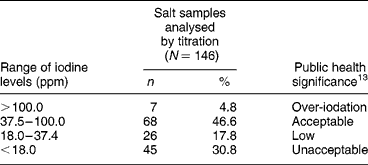
The median iodine concentration by titration from a sub-sample of 146 out of 397 salt samples in shops, previously tested using test kits, was 37.0 ppm (range 4.2–240 ppm) and mean was 46.1 ppm iodine. Nearly half of the samples were in the acceptable range (Table 2). In 49% of samples, iodine was below the government recommended level of 37.5 ppm14. Only 4.8% had excessive levels (>100 ppm iodine).
Distribution of titrated iodine levels in salt samples from shops by category
UIC
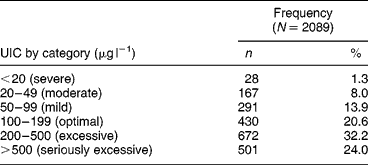
Table 1 shows UIC values in 2089 urine samples collected and analysed from primary-school children in 16 districts. The overall median UIC value of 235 μg l− 1 indicates adequate iodine intake (median IUC ≥ 100 μg l− 1 is recommended by WHO for adequacy). However, four districts had low-to-borderline median UIC values: Songea rural (88 μg l− 1), Ludewa (92 μg l− 1), Mufindi (92 μg l− 1) and Ulanga (70 μg l− 1).
Among the sampled individuals only 9.3% had UIC < 50 μg l− 1; this is far below the 20% cut-off point required by WHO for declaring IDD elimination1. Meanwhile, 32.2% and 24.0% of the individuals had UIC of 200–500 μg l− 1 and >500 μg l− 1, respectively (Table 3).
Urinary iodine concentration (UIC) by category in children living in goitre-endemic districts in Tanzania
Prevalence of goitre
Figure 1 compares total goitre prevalence between the baseline goitre surveys in the 1980s and the present survey in 1999 for the 16 districts. The unweighted mean total goitre prevalence in the 16 districts was 24.3%, range 4.1–49.4% (Table 1). These results indicate a statistically significant decrease compared with the unweighted total goitre prevalence in the 1980s of 65.4% (Fig. 1, P < 0.05). Such a large difference is also certainly of biological and public health significance.
Total goitre prevalence before (1980s) and after intervention (1999) in 16 high-prevalence districts in Tanzania

The total goitre prevalence was 18.0% in children aged 6–12 years (n = 7147), 28.3% in 13–15-year-olds (n = 7041) and 26.7% in 16–18-year-olds (n = 2034). Visible goitre alone was < 10% in all age groups (range 3.6–8.6%), with an unweighted mean of 6.7%, compared with 11% in the baseline studiesReference Kavishe and Mushi4, representing a statistically significant decrease (P < 0.05) in visible goitre prevalence.
Discussion
This study suggests that iodine prophylaxis consistently pursued from the mid 1980s to 1999 improved iodine status, probably by preventing the consequences of iodine deficiency in severely goitre-endemic districts in Tanzania1, Reference Kavishe and Mushi4. The availability of iodised salt at household level increased dramatically and this decreased goitre prevalence, similar to findings reported in other areasReference l'Ons, Jooste, Weight and Huskisson15–Reference Salarkia, Hedayati, Mirmiran, Kimiagar and Azizi17. This concurs with the recommendation that salt is the ideal vehicle to deliver iodine to all individuals irrespective of socio-economic status18, Reference Mannar and Dunn19. However, several challenges remain before Tanzania can completely eliminate IDD.
Availability of iodised salt
The salt regulations in Tanzania require that all salt meant for human consumption be iodated at 75–100 ppm at factory level and should not contain < 37.5 ppm iodine at its point of sale14. The presence of salt regulations linked to relevant interventions appears to have worked for Tanzania, but the proportion of households in goitre-endemic districts with access to iodised salt (83%) still falls short of the 90% criterion of adequacy recommended by WHO1. Salt with an iodine level of 10 to < 15 ppm may not be detected by the test kits, but if available constantly it will likely prevent occurrence of goitre in the absence of goitrogens.
Although the median and mean iodine content at retail level (37.0 and 46.1 ppm, respectively) was close to complying with Tanzanian standards, the range was wide (4.2–240 ppm) and half the retail samples did not comply. This could be due to inadequate salt iodation, poor handling and storage during transportation, or marketing processes before consumption. The uncontrolled traditional iodation technologies used in some salt production sites is likely to lead to a lack of homogeneity in salt–iodine mixingReference Chauhan, Bhatt, Bhatt and Majeethia13. Some of the salt iodation and storage processes probably are inadequate to control iodine losses. This suggests that there is a need to improve iodation and salt storage procedures and to strengthen internal quality assuranceReference Chauhan, Bhatt, Bhatt and Majeethia13, Reference Dunn and van de Haar20.
Currently, levels of iodine in salt at household level are on average too low. Yet mean UIC is too high in some districts. One way to deal with these discrepancies would be to improve homogeneity during salt iodation. Continued surveillance is required, as increased use of consumer packaging could eventually require a downward revision of national recommendations for salt iodation levels at production level14. Risks of iodine-induced thyrotoxicosis may be substantial in some population groupsReference Delange, de Benoist and Alnwick21, and this has received only cursory research attention in TanzaniaReference Kavishe and Mushi4.
Urinary iodine
Urinary iodine is considered the most reliable indicator for IDD assessment in populations. The intake of iodine in a population is considered adequate when the median value of UIC is between 100 and 200 μg l− 1, with not more than 20% of the samples below 50 μg l− 1 (references 1 and Reference Delange, de Benoist and Burgi22), which is the criterion met in the districts sampled.
However, 24.0% of children actually had median UIC >500 μg l− 1 (Table 3). Urinary iodine >500 μg l− 1 is regarded as a serious excessive iodine intake, since it has been associated with increased thyroid volume which reflects the adverse effects of excess iodineReference Zimmerman, Ito, Hess, Fujieda and Molinari23. This emerging problem of serious excessive iodine intake observed in Tanzania was also recently reported in LesothoReference Sebotsa, Dannhauser, Jooste and Joubert24.
Four districts with median UIC values < 100 μg l− 1 had salt supplied primarily by small-scale producers along the south-eastern coast and central regions of Tanzania, and quality control at the point of iodation for the multitude of small-scale salt producers is inadequateReference Kavishe and Mushi4. This suggests that there is a need to have periodic surveys of salt and UIC to monitor actual iodine intake, which then should be adjusted accordingly to ensure a steady median UIC at 100–200 μg l− 1 and low proportions below 50 μg l− 1.
Ulanga is one of the few districts that had successful coverage of IOC distributionReference Kavishe and Mushi4 followed by high coverage of availability of iodised salt at household level in the mid 1990s. Sustainable elimination of iodine deficiency needs continuous surveillance to avoid the recurrence of mild iodine deficiency, as recently reported in Tasmania and MoroccoReference Guttikonda, Burgess, Hynes, Boyages, Byth and Parameswaran25, Reference Zimmerman, Wegmuller, Zeder, Torresani and Chaouki26.
Goitre prevalence
After more than a decade of intervention, findings in this study showed that the magnitude of the IDD problem in Tanzania has declined from severe to moderate rate according to WHO standards1–Reference Kavishe and Mushi4. Apparent goitre prevalence has decreased substantially but still remains high in nine districts (Table 1 and Fig. 1). Ludewa district, with the mildest problem at the baseline survey, showed the least improvement.
There was also little reduction of goitre prevalence in the western districts of Biharamulo, Ngara, Kibondo and Kigoma. This could be due to poor availability of iodised salt from the local large-scale Uvinza salt factory after it was closed for a long period. Also, there has been an influx of refugees into western Tanzania from neighbouring countries where iodine interventions have been hindered by long ethnic wars (Burundi, Democratic Republic of Congo and Rwanda). In Tanzania these refugees received iodised salt whether or not they integrated into local communities, but it will take time for the goitres to regressReference Peterson, Assey, Dalenbring, Lorri and Gebre-Medhin27. That this salt is now adequately iodated is indicated by the high UIC values in these districts.
Goitre regression may be delayed in some districts due to low coverage of the IOC supplementation implemented earlierReference Peterson, Assey, Forsberg, Greiner, Kavishe and Mduma5. In other cases IOC distribution may have ended before iodised salt was adequately supplied and consistently available.
Goitre prevalence varied with age; the youngest children, 6–12 years old, had the lowest prevalence. This is likely, in part, a cohort effect and has been found in similar studies in Tiberina valley in ItalyReference Aghini-Lombardi, Antonangeli, Pinchera, Leoli, Rago and Bartolomei28 and LesothoReference Sebotsa, Dannhauser, Jooste and Joubert29. These younger children were born during the period when IOCs were being widely distributed in these districtsReference Peterson, Assey, Forsberg, Greiner, Kavishe and Mduma5. From 1990, salt iodisation gradually started in Tanzania and by 1999 iodised salt was reaching about 77% of the population6, protecting the younger age group against IDDReference Pharaoh and Connolly30, Reference Pichard, Soula, Fisch, Rhaly, Diarra and Sebbaq31. Thyroid size in older children exposed to iodine deficiency in the first years of life might fail to regress completely following consumption of iodised salt, as observed in previous studiesReference Jianqun, Quingyu and Xin32, Reference Zhao, Shang, Chen and Hu33. This suggests that goitre prevalence may not be the most appropriate indicator to use in short-term evaluationsReference Zhao, Shang, Chen and Hu33.
The impact (total goitre prevalence declined from 65.4% in the 1980s to 24.3% in 1999) observed in this study is smaller than was seen in Jixian, China, where it was claimed to fall from 65% to 4% only four years after introduction of iodised saltReference Jianqun, Quingyu and Xin32. If the results from the four western districts (described above) are left out, the unweighted mean goitre prevalence for the other 12 districts declined from 68.3% to 18.6%. However, while goitre remains in many areas, we are encouraged by the high urinary iodine levels.
The current iodine status in the vast areas of Tanzania with moderate, mild or no iodine deficiency is not known. Nationwide investigations could assess possible over-iodation and its effects in these areas. There may also be small isolated areas of severity not yet adequately reached by iodised salt. This study reflects the situation in schoolchildren, but other vulnerable groups such as pregnant women and neonates are critical and should also be carefully studied before declaring national elimination of iodine deficiencyReference Sundqvist, Wijetunga, Assey, Gebre-Medhin and Peterson34.
We were unable to survey nine out of the 160 schools selected to be in the second survey. As is the case for any survey repeated after such a long period of time in such a low-income setting, there are methodological problems limiting the accuracy of the findings. Goitre palpation always involves substantial intra- and interpersonal variation among examinersReference Peterson, Sanga, Eklöf, Bunga, Taube and Gebre-Medhin12. This study benefited from the fact that much of the palpation was done by the same individuals in both surveys, all of whom were highly skilled and experienced.
The results indicate substantive success in controlling a major public health problem in some of the areas worst affected by IDD in a very low-income country like Tanzania. The district differences we found suggest that the approach of doing national-level studies, as reported by Andersson et al. Reference Andersson, Takkouche, Egli, Allen and de Benoist35, may conceal continued iodine deficiency in large segments of the population.
Acknowledgements
Sources of funding: The work was funded by the Government of Tanzania and UNICEF.
Conflicts of interest: None declared.
Authorship contributions: V.D.A. was the principal author responsible for study design, conducting the field research upon which this paper was based and writing the manuscript. C.M. contributed in the statistical analyses of study data and provided scientific comments during manuscript writing. N.M. contributed in the interpretation of laboratory data and in writing the manuscript. A.S. contributed in early planning of the survey, examined children for goitre and provided comments on the manuscript. G.D.N. participated in study design and critical review of the manuscript before submission. T.G. provided intellectual input and contributed to writing the manuscript. S.P. contributed to the study design and provided intellectual input in writing the manuscript.
Acknowledgments: We would like to express our gratitude to all those who in one way or another contributed to the accomplishment of the study. We are also grateful to the Ministry of Education and Culture in Tanzania for the cooperation and assistance extended to the survey team, especially from the District Education Officers, primary-school teachers, school committees and children who participated in this survey. Special thanks to TFNC staff who contributed in survey planning, fieldwork and carrying out laboratory analyses. The authors wish to acknowledge to the support from the Government of Tanzania and UNICEF for funding the study.



