

The campaign for the Philippines was the largest and costliest waged by the US armed forces in the Pacific during World War II.2 For the US Army in the Pacific, it was by the fall of 1944 the main focus. Even so, the Philippines campaign, in particular the liberation of the islands in 1944 and 1945, has received far less attention than has been afforded to the naval battles and island invasions of the South and Central Pacific.3 Marine invasions of Guadalcanal, Tarawa, Saipan, and Iwo Jima, as well as naval battles in the Coral Sea, at Midway, and in the Philippine Sea, captured the imagination of the American people in a way that fighting in New Guinea, Leyte, and Luzon did not. By the end of the war, however, the US Army had deployed twenty-one divisions to the Pacific, while the Marines deployed just six – the entire strength of the Fleet Marine Force.4 Of the US Army divisions deployed to the Pacific, all but two served in the campaign for the Philippines. The Philippines campaign was massive, but why it came to pass and how it was waged is shrouded in the mists of time for most Americans today.
Since the end of the Spanish–American War in 1898, the Philippines were US territory. The acquisition of an empire had seemed like a good idea at the turn of the twentieth century, but by the 1930s the US Congress was ready to set the islands on the path to independence. The Tydings–McDuffie Act, signed into law by President Franklin D. Roosevelt on March 24, 1934, granted Philippine independence on July 4, 1946, after ten years of interim Commonwealth government. On March 23, 1935, Roosevelt approved the Philippine constitution, and in September of that year the Philippine people elected Manuel Quezon as their president. He would serve until his death from tuberculosis in 1944, just prior to MacArthur’s return to the Philippines at the head of a military juggernaut made possible by the mobilization of the United States for total war. On November 15, 1935, the Philippine Commonwealth came into existence on the steps of the Legislative building in Manila, which would be devastated during combat operations to liberate the city nearly ten years later.
The Philippines campaign is intimately tied to the life and leadership of General of the Army Douglas MacArthur, without whom the campaign to liberate the island archipelago in 1944 and 1945 might not have been fought at all. MacArthur was intelligent, ambitious, personally courageous, a superb orator, and at times strategically brilliant. He was also egotistical, publicity hungry, self-centered, insubordinate, often ignorant of conditions at the front, and so certain of himself that he frequently ignored intelligence assessments grounded in fact but with which he disagreed for no other reason than that to accept them would have forced him to change his preferred course of action. More than two dozen biographers have examined his life, and their assessments range from respect and admiration to criticism and disparagement.5 For MacArthur, it seems, after death as during his life, there is no middle ground.
MacArthur descended from a storied military family. His father, Lt. Gen. Arthur MacArthur Jr., rocketed to fame after the Battle of Missionary Ridge during the Civil War, in which he planted the flag of the 24th Wisconsin on the crest and shouted, “On Wisconsin!,” which the state university later adopted as its motto. Before he had even reached the age of twenty, the elder MacArthur had been breveted to colonel; he would later be awarded the Medal of Honor for his actions on Missionary Ridge. Clearly, his second son Douglas had much to live up to.
After a long period of peacetime service as a junior officer, Arthur MacArthur once again earned fame and promotion, this time in the Philippines during the Spanish–American War.6 Quickly breveted to brigadier general, MacArthur commanded a brigade in the Battle of Manila on August 12, 1898. After the defeat of the Spanish forces in the Philippines, MacArthur fought against Filipino insurrectionists, earning permanent promotion to major general in the Regular Army. MacArthur led counterinsurgency operations as Military Governor of the Philippines for more than a year before he relinquished command on July 4, 1901. He returned to the United States, where he commanded several different military departments and was promoted to lieutenant general. Passed over for the position of US Army chief of staff, the elder MacArthur retired on June 2, 1909.
Douglas MacArthur had by then come to know the Philippines. After departure from the US Military Academy at West Point in 1903, where he rose to the rank of First Captain and graduated first in his class, MacArthur deployed to the Philippines with the 3rd Engineer Battalion.7 In October 1905, the younger MacArthur traveled to Tokyo to accompany his father on a tour of Asia, which took the pair from Japan to Shanghai, Hong Kong, Java, Singapore, India, Thailand, Vietnam, Canton, Qingdao, Beijing, Tianjin, Hankou, and Shanghai again before their return to Japan in June 1906. The whirlwind adventure solidified both father and son’s thinking that America’s destiny lay in the Far East, across the vast Pacific Ocean.
As the son of one of America’s most famous generals, MacArthur was already a rising star in the US Army (he had served in the White House as an aide to President Teddy Roosevelt and in 1916 as a major he functioned as the army’s first press officer – experience that would stand him in good stead in years to come), but he rocketed to fame during World War I as the chief of staff of the 42nd Infantry Division (the “Rainbow” Division – a composite National Guard organization MacArthur had a role in creating) and as commander of the 84th Infantry Brigade. For his bravery in combat, MacArthur received two Distinguished Service Crosses and seven Silver Stars – he was among the most decorated soldiers in the US Army in that conflict. He was gassed several times owing to his refusal to carry or wear a protective mask (most likely because he tended to get claustrophobic), but not severely enough to require hospitalization. While later serving as chief of staff of the US Army, he would create the Purple Heart, and, in typical MacArthur fashion, would award himself the first such decoration.
From his World War I experiences, MacArthur came to believe in the necessity to act first and request permission later – if at all. He often took the initiative after conducting personal reconnaissance forward of the front line armed with nothing more than a riding crop. “Sometimes it is the order one disobeys that makes one famous,” he quipped to a subordinate during fighting in the St. Mihiel salient.8 His later career would verify that thought, but acting on it would also ultimately end his career. MacArthur also learned the value of creating a unique image. He refused to wear a steel helmet and olive drab uniform top, instead opting for a crumpled barracks cap, his gray West Point sweater, and a scarf. His superiors indulged him, and the press and the public ate it up. MacArthur would exit the Great War as America’s most distinguished battlefield leader.9
Unlike most other brigadier generals in the American Expeditionary Forces, MacArthur retained his rank after the armistice. After the war, he served as superintendent of the US Military Academy, attempting to reform the institution by expanding the curriculum (which the Academy’s Academic Board fought tooth and nail), formalizing the honor code, and requiring all cadets to participate in intramural or intercollegiate sports. MacArthur also married socialite Louise Cromwell Brooks, a relationship that ended in divorce seven years later. He served twice more in the Philippines, mapping the terrain of the Bataan Peninsula and commanding a brigade of the US Army’s Philippine Division – experience he would put to good use when war again erupted in the Pacific. During his tenure in the islands, MacArthur deepened his friendship with Manuel Quezon and developed relationships at the highest levels of Philippine society – relationships that would become critical in the years to come.10
On January 17, 1925, MacArthur became the youngest major general in the army. He was the most junior member of the court martial board for the trial of airman Billy Mitchell (MacArthur claimed he voted for acquittal) and served as president of the US Olympic Committee in preparation for the 1928 summer Olympics in Amsterdam, where the American team set seventeen Olympic and seven world records and earned fifty-six medals – twenty-two of them gold – nearly twice as many as the next most successful country. MacArthur, it seemed, had the Midas touch.
On November 21, 1930, President Herbert Hoover vaulted MacArthur over numerous other candidates and assigned him as the US Army chief of staff, which also brought a promotion to full general. During MacArthur’s tenure in this position, he dealt with the budget woes brought forth by the Great Depression, reorganized the US Army into four ground armies controlling a total of nine corps areas, created a general headquarters for the Army Air Corps, and supported army administration of the Civilian Conservation Corps. His most controversial action came in 1932, when he ordered (and personally led) troops to disband the Bonus Army of roughly 20,000 Great War veterans who had descended on Washington, DC, to press their case for early payment of wartime bonus certificates. MacArthur, who was acting on orders of President Hoover, believed the movement was communist-inspired, which was not the case, although a group of communist sympathizers had embedded themselves among the marchers and attempted to spark a riot. It was one of the few times in his career when MacArthur misread public opinion, which sided with the veterans of the Great War and considered his actions – deliberately misrepresented to the public by Communist Party organs – reprehensible.11
Upon his relief in 1935 after five years as US Army chief of staff, MacArthur accepted an offer from Quezon to head the newly established Philippine Army with the rank of field marshal. MacArthur retained his Regular Army rank of major general and served simultaneously as US military advisor to the Philippine government and as head of the Philippine Army. This meant he could retain his annual army salary of $7,500 along with the compensation offered by Quezon’s Philippine government – $18,000 per year plus another $15,000 annually in expenses, as well as just under 0.5 percent of the Philippine defense budget as a performance bonus. MacArthur was not just heading back to a land and a people he genuinely loved, but was going to become rich in the process.12 On the voyage to Manila, MacArthur met Jean Marie Faircloth, who would in April 1937 become his second wife and ten months later bear his only child, Arthur MacArthur IV.13 Theirs would be an intimate and successful relationship, Jean providing the companionship that MacArthur craved, especially after the deaths of his beloved (and domineering) mother and his brother Arthur.14
Taking residence in the penthouse of the Manila Hotel, MacArthur got to work creating an army, assisted by his able chief of staff, Major Dwight D. Eisenhower, and Major James B. Ord. Ord would die in a plane crash in January 1938 and was replaced by Lt. Col. Richard K. Sutherland. MacArthur retired from the US Army at the end of 1937 to avoid being reassigned to a less prestigious (and less lucrative) and duller assignment stateside. In the summer of 1938, Eisenhower returned to the United States for a period of leave and to visit the War Department to attempt to pry more resources out of it for Philippine defense. In his absence, MacArthur, privy to an untrue conspiracy theory that Eisenhower was maneuvering behind his back to replace him as military advisor to the Philippine president, realigned the staff. Upon his return to the headquarters in Manila, Eisenhower discovered he was no longer the chief of staff. Understandably miffed by his effective demotion in the pecking order in MacArthur’s headquarters and by this time discouraged with the attempt to create an army with little support from the War Department, he requested and received orders back to the United States, where he could help the army prepare for the war he believed was coming.15 MacArthur promoted Sutherland to chief of staff, while a year later Maj. Richard J. Marshall, whose expertise was logistics, was brought into the circle as deputy chief of staff.16 These two officers would serve in those roles throughout the war to come.
Building the Philippine Army from scratch was no easy feat (some would claim it was an impossible task), and MacArthur’s record in this regard is uneven at best. He envisioned a military establishment of ten districts based on the Swiss model, with a small core (930 officers and 7,000 enlisted soldiers) of regular army officers and troops, supported by 6,000 members of the paramilitary Philippine Constabulary, who would provide annual basic training for 40,000 Filipino men broken into two cohorts, who would then become reservists until age 50.17 After 10 years, the army would number 400,000 men. A single regular Philippine Army division would augment these reserve forces. A military academy in Baguio would graduate 100 officers per year. A larger, decentralized national militia, a small air force, and a flotilla of motor torpedo boats would round out the defense establishment.18
The Philippine government could not afford modern weapons and equipment, and so the Philippine Army was reliant on whatever surplus arms the United States could provide. Forget artillery and tanks; MacArthur could not even convince the War Department to furnish an adequate number of antiquated Enfield rifles to arm Filipino forces. He was hamstrung partly by the resistance of Philippine High Commissioner Frank Murphy and US Interior Secretary Harold Ickes, who didn’t want the Filipinos armed at all, partly because they viewed the Philippines as indefensible, but also because of the worry that some Filipinos might take up arms against the United States.19 Defense against a modern military power such as Japan would also require the United States to provide a navy and air forces sufficient to control the seas and skies surrounding the Philippines. Given the low priority the US defense establishment placed on the Philippines, these assets were unlikely to be forthcoming.
MacArthur’s training program for the Philippine Army failed for a variety of reasons: the difficulty in training officers and noncommissioned officers, some of whom were illiterate; communicating with soldiers who spoke a dozen languages with more than 100 dialects; inadequate training facilities; lack of weapons on which recruits could train; lack of money; lack of support from a young male Philippine populace lukewarm at best about spending five-and-a-half months in military training; and lack of time. MacArthur had deceived himself into believing that if he ordered an army into existence, his capable subordinates could fill in the details to make it happen. When reality sank in, MacArthur turned on his staff, especially Eisenhower, who knew the plan was unaffordable and said so repeatedly.20 MacArthur’s plan envisioned a viable Philippine military establishment by 1946, when the islands would gain their independence. He did not realize it when he accepted the position, but the Philippines would be at war in less than half that amount of time. But perhaps the biggest obstacle was President Quezon, who, seeing war clouds on the horizon, decided that only the immediate provision of independence coupled with a policy of neutrality could keep his nation safe from a Japanese invasion. Quezon distanced himself from MacArthur, even as war approached on the horizon. MacArthur was doing his best to create a defense establishment that seemingly no one else wanted.21
The United States military had been preparing for a potential war with Japan since a war scare in 1906 compelled the staff at the Naval War College to plan for one. As a shorthand device, in 1904 the presidents of the Army War College and the Naval War College had assigned colors to the nations involved in planning for future operations.22 The United States was blue. Japan was orange. War Plan Orange evolved over the years, but since its earliest incarnation it was focused on defeating Japan, presumably embroiled in war on the Asian mainland, by a naval campaign in the Central and Western Pacific.23
Projecting power into the Western Pacific was at the heart of the problem confronted by planners. The 1922 Washington Naval Treaty prohibited the United States from building a new major naval base in the region, as the British had already done in Singapore. Relying on the US Navy to sortie to Manila Bay shortly after the outbreak of war was a risky proposition, and in any case the fleet lacked the strength to challenge the Japanese so far from US bases in Hawaiʻi. By the mid 1930s the planners had settled on a third option – to seize a series of island bases in the Central Pacific and supply the navy by creating a mobile logistics fleet train that would come to number more than 1,000 vessels by 1945. This strategy would take at least two years to implement, however, effectively abandoning the Philippines to its fate.24
War Plan Orange – and its Rainbow successors – left the Philippines in an awkward position. The islands were indefensible given the number of troops the United States was willing to commit to their retention, and planners knew it. But successive presidential administrations and the Army–Navy Joint Board could not admit publicly that they were willing to write off the islands.25 Instead of stating its intention to abandon the defense of the Philippines in the event of war with Japan and accept the political blowback, the Roosevelt administration instead chose a policy of “calculated hypocrisy” that mouthed the right words about supporting the defense of the Philippines without providing the resources to actually do so.26 The person left holding the bag would be the newest Philippine field marshal, Douglas MacArthur.
As World War II commenced, Army and Navy leaders realized the need to update their war plans. They accordingly directed their planners to draw up a series of Rainbow war plans, which envisioned the United States operating as part of a broader coalition. The final iteration, Rainbow 5, was submitted to President Roosevelt on June 2, 1941.27 Rainbow 5 gave priority to defeating Germany first, which meant that any offensive in the Pacific would be delayed until resources were available to execute it. Regarding the Philippines, planners estimated an invasion by 100,000 Japanese troops, supported by substantial naval and air assets. American and Filipino forces in the Philippines, guided by the dictates of War Plan Orange-3 (WPO-3), would fight a delaying action, falling back to the Bataan Peninsula, which they would defend to the “last extremity.”28 They would presumably await relief by the US Pacific Fleet, but the navy had long before written off defense of the Philippines as hopeless.29 The tiny Asiatic fleet, with the exception of a few PT boats and a couple of dozen submarines, would abandon Manila upon the outbreak of war and head for safer harbors. In the event, the US Pacific Fleet would not sortie in the defense of the Philippines, not least because after December 7, 1941, many of its battleships rested on the bottom of Pearl Harbor.
When France fell in June 1940, the United States finally awoke from its peacetime stupor and began mobilizing for war. Even as American industry converted to armaments and munitions production, the Philippines would see little reinforcement. After the passage of the Lend–Lease Act in March 1941, the weapons and munitions rolling off the assembly lines went to Great Britain and, after the German invasion of the Soviet Union in June 1941, to the USSR. The next priority was to arm and equip the expanding US military forces. The Philippines would have to fend for itself.
To paraphrase Leon Trotsky, the Philippines might not have been interested in war, but war would soon be interested in the Philippines. The collapse of France and the Netherlands made their colonial possessions in Asia vulnerable, and it was not long before the Japanese government took advantage of their weakness. To support its ongoing invasion of China, on June 19, 1940, the Japanese government demanded the closure of road and rail links between Indochina and China; the French complied by the end of the month. The Japanese then demanded the ability to station ground, air, and naval forces in the Gulf of Tonkin region. The Vichy government balked, but it was powerless to prevent the inevitable, and acquiesced in an agreement reached on September 22, 1940. In response, President Roosevelt embargoed the sale of scrap metal, steel, and aviation gasoline to Japan.
After the initiation of Operation Barbarossa, the German invasion of the Soviet Union on June 22, 1941, the Japanese military no longer feared a Red Army invasion into Manchuria and became emboldened to reach further. A month later, Japanese forces occupied southern Indochina, which the US government (which had cracked the Japanese diplomatic cipher) properly read as preparation for an offensive against British and Dutch colonial possessions. Cam Ranh Bay, which the Japanese coveted as a naval and air base, was just 800 miles from the Philippines. Further south, the Netherlands East Indies had the raw materials – especially oil – needed by the Japanese war economy, and Japan was willing to take them by force if necessary. In response, on July 26, 1941, President Roosevelt froze Japanese assets in the United States and embargoed oil and gas exports to Japan. In a stroke of the pen, Japan lost 75 percent of its overseas trade and nearly all of its imported oil. Japan could either back down or fight, and it had maybe nine months at most to act before its oil stocks ran out. The United States and Japan were now on the road to war, and the Philippines were squarely in the middle.
Roosevelt needed a commander in the Philippines who could unify the American and Filipino forces and provide the needed energy and strategic acumen to defend the islands against a Japanese invasion. Fortunately, he already had an available candidate in Manila. On the same day he signed the embargo against Japan, Roosevelt reinstated MacArthur as a major general in the US Army (elevated to temporary lieutenant general two days later and four-star general in December) and gave him command of a new organization, the US Army Forces in the Far East (USAFFE), which would control all US and Philippine army forces in the region.
MacArthur formed a staff that would support him over the long war to come. These officers formed the core of the “Bataan Gang” who would serve under MacArthur from Manila to Tokyo. Promoted to brigadier general (and on December 20, 1941, to major general), Sutherland would continue to serve as chief of staff. A graduate of Yale University, he was an intelligent and perceptive thinker with a harsh personality and limited empathy and would rule over the staff with an iron fist.30 On the other hand, according to MacArthur’s press relations officer Carlos Romulo, “no one else seemed so able to interpret the thoughts and plans of the general.”31 Sutherland’s deputy, who received a promotion to full colonel and by the end of the year became a brigadier general, was the calm and approachable Richard Marshall, who, unlike his boss, “could be liked.”32 Col. Hugh J. “Pat” Casey would serve as the chief engineer and Col. Spencer B. Akin became the chief signal officer; both would receive promotion to brigadier general on December 20, 1941. Lt. Col. William F. Marquat would become the antiaircraft artillery officer. Lt. Col. (promoted to Colonel on October 14, 1941) Charles A. Willoughby, who was born in Germany and spoke English with a German accent, also joined the staff. MacArthur made Willoughby his intelligence officer – a position in which Willoughby would perform much like his boss: “When he was good, he was very, very good, and when he was bad, he was horrid.”33 In the Philippines in 1941–1942, both fit the latter description.
USAFFE unified the US and Philippine military establishments under one command, giving MacArthur authority over the 22,000 Americans and 120,000 Filipinos in uniform.34 In theory, MacArthur commanded eleven divisions, all but one of them reserve formations of the Philippine Army. In reality, none of the reserve divisions was properly manned, equipped, or trained; by the time of the Japanese assault on Pearl Harbor, only two regiments in each division had been mobilized, and they lacked critical assets such as artillery and antitank guns.35 Many of the troops had never fired a rifle before engaging in combat. The troops didn’t even speak a common dialect and many were illiterate, making command and control difficult at best.36 The two most capable ground units were the 26th Philippine Scout Cavalry Regiment and the 10,000-man Philippine Division (Maj. Gen. Jonathan M. Wainwright), composed of the US 31st Infantry Regiment, the 45th and 57th Regiments of Philippine Scouts (PS), and two field artillery regiments armed with 2.95-inch mountain guns and 75 mm field guns.37 Upon the withdrawal of the 4th Marines from Shanghai on November 28, it redeployed to Luzon, where it would provide a defensive force for the island fortress of Corregidor.38 The US Asiatic Fleet spread throughout the region consisted of the heavy cruiser Houston, light cruisers Boise (joined after December 7) and Marblehead, thirteen World War I-era destroyers, twenty-nine submarines, and six PT boats, among other ancillary vessels.39 It would be hard pressed to survive, much less interdict a Japanese fleet headed to Luzon.
In Washington, US Army Chief of Staff Gen. George C. Marshall made determined efforts to reinforce the Philippines, at least until the United States was at war. In the fall of 1941, USAFFE received an antiaircraft artillery regiment, two tank battalions with 108 M3 Stuart light tanks, and 25 M3 GMC 75 mm guns, mounted on armored half-tracks.40 Plans to bolster the Philippine Division with an additional US infantry regiment, reinforce USAFFE with a field artillery brigade and a reconnaissance squadron, provide army and corps troops for the tactical commands, and add two bombardment groups and a pursuit group to the USAFFE air forces came to naught as the Japanese invasion commenced before they arrived.41

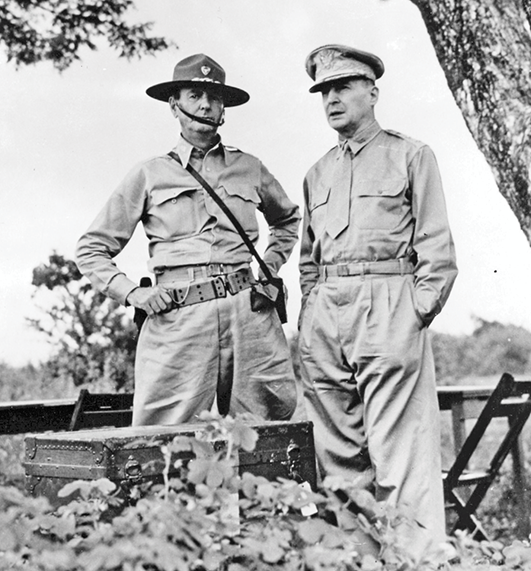
1.1: Gen. Douglas MacArthur, commander of forces in the Philippine Islands, with Maj. Gen. Jonathan Wainwright, commander of the Philippine Division, October 10, 1941. Wainwright would take command of US and Philippine forces when MacArthur escaped to Australia and would be forced to surrender them to the Japanese in May 1942.
These forces were perhaps sufficient to hold the Bataan Peninsula and the island of Corregidor guarding the entrance to Manila Bay for several months until help could arrive, presumably in the form of the US Pacific Fleet. But MacArthur, contrary to WPO-3, which dictated a pullback to Bataan and Corregidor until the Pacific Fleet could arrive (if indeed it ever would before the Philippines fell), decided instead to defend the entirety of Luzon and fight invading Japanese forces at the beaches of Lingayen Gulf, 100 miles to the north.42 He would not stay on the defensive and passively await defeat. MacArthur divided the command of forces on Luzon among a North Luzon Force (Maj. Gen. Wainwright), a South Luzon Force (Brig. Gen. George M. Parker, Jr.), and a Reserve Force of two infantry divisions in Manila. Additionally, he created a Visayan–Mindanao Force (Brig. Gen. William F. Sharp), which was tasked with defending the Central and Southern Philippines. Critically, MacArthur ordered supply dumps to be moved north onto the central plain to support the forces defending Lingayen Gulf.43 With a well-trained and -equipped army enjoying some measure of air support, he might have been able to pull off a forward defense. But USAFFE had neither required force, or at least it wouldn’t until well into the spring of 1942 if current deployment projections held, making the decision one of the worst of his military career. For his part, Gen. Marshall, contrary to the dictates of Rainbow 5, approved MacArthur’s forward defense plan on November 21, 1941 – unbeknownst to either of them, just two-and-a-half weeks before the outbreak of war.44
The War Department placed great faith in the B-17 bombers and P-40 Warhawk fighters being sent to the Philippines: 4 heavy bombardment groups totaling 272 bombers and 2 fighter groups totaling 260 fighters, to be based at a planned two dozen-plus airfields US Army engineers would construct throughout the Philippines. They would come under the control of Maj. Gen. Lewis H. Brereton, as of November 3, 1941, the commander of the newly established Far East Air Force (FEAF). They would presumably control the skies over Luzon and send any Japanese invasion force to the bottom of the South China Sea. But by December 7, 1941, the FEAF possessed only 35 B-17 bombers and 107 P-40 Warhawk fighters in the Philippines, based at just 6 airfields – not enough to stop a full-throated Japanese invasion.45 Many of the fighters were so new their motors had not yet been slow timed (i.e., broken in), and spare parts were scarce. But even this meager allotment should have accomplished something before succumbing to superior Japanese numbers. Events would prove otherwise.
When war came, there was only one air-warning service company in the Philippines (at Iba on the west coast of Luzon), with only a single operational radar set. The rudimentary system of ground observers used unreliable land line communications to report their sightings. USAFFE lacked sufficient antiaircraft artillery to defend its airfields.46 MacArthur, Sutherland, and Brereton, warned in late November by air staff officers that the bomber force on Luzon was vulnerable to a Japanese strike, concurred in relocating the B-17s to the Del Monte airfield on Mindanao until engineers could construct air bases in the Visayas that were better positioned and more defensible.47 But when the Japanese attacked on December 8 (in the Philippines, which was across the International Date Line), only half the bombers had moved south, as Brereton was planning to station the incoming 7th Bombardment Group at Del Monte and there was not enough ramp space there to accommodate all of the planes.48 But since airfields on Luzon lacked an adequate air-warning system and a robust air defense capability, the B-17s remaining at Clark were vulnerable to attack by Japanese aircraft. It is unclear whether either Brereton or Sutherland informed MacArthur of this change in plans. In his diary, Brereton indicates the move of sixteen B-17s to Mindanao was coordinated with Sutherland, but after the Japanese air attack on December 8, MacArthur was surprised to discover that all the bombers had not been relocated to Del Monte airfield.49
Meanwhile, Brereton requested permission to execute a high-level photo reconnaissance of Japanese bases in southern Formosa (Taiwan) to determine the extent of the Japanese buildup of air forces on the island. MacArthur, abiding by War Department instructions not to take any action that could prompt hostilities with Japan, limited the range of reconnaissance to two-thirds of the distance to Formosa (a few days later extended to the international treaty line between the Philippines and Formosa), which could only detect naval activity.50 The result of this decision was that complete target packages for a B-17 strike against Formosa could be completed only once war had already begun. As it turns out, that timing would be too late for the survival of FEAF.
Nevertheless, as war approached, MacArthur believed that he could defeat a Japanese attack on the islands. The Chinese military philosopher Sun Tzu once wrote, “If you know the enemy and know yourself, you need not fear the result of a hundred battles. If you know yourself but not the enemy, for every victory gained you will also suffer a defeat. If you know neither the enemy nor yourself, you will succumb in every battle.”51 MacArthur didn’t see the weaknesses of the forces he commanded, and, blinded by racial chauvinism, he failed to understand Japanese capabilities as well.52 It was self-delusion at its worst.
As Japanese carrier-based aircraft crippled the battleships of the US Pacific Fleet in Pearl Harbor, Hawaiʻi, on the morning of Sunday, December 7, 1941, messages flashed to the Philippines warning of an impending attack. Well before daylight, all of MacArthur’s subordinate commands had been alerted, so the forthcoming Japanese attack should not have taken his forces by surprise. Instead, a thick fog prevented the Japanese on Formosa from launching a dawn strike, which US airmen expected. The first Japanese strikes on Luzon – at Tuguegararo and Baguio, the summer capital of the Philippines, well north of Manila, did little damage, but as a precautionary measure, the bombers on Luzon took off and circled overhead until the all-clear sounded. P-40 fighters chased after the Japanese planes, without result.53
The bombers and fighters then landed to be refueled and armed for their next missions. Brereton wanted to bomb Japanese shipping and airfields on Formosa, a request he made known to Sutherland before daybreak.54 But MacArthur denied the request until 10:14, when he called and gave Brereton permission to make the decision on offensive air operations, which would begin with a photo reconnaissance of the Japanese airfields on Formosa.55 MacArthur’s delay in authorizing offensive air operations has never been adequately explained, but his eventual approval came several hours too late to catch the Japanese on the ground before they launched their bombing strikes on the Philippines.
Much ink has been spilled about the delay in ordering a bombing strike. Clearly, MacArthur was hesitant to order a strike as he had not yet transitioned his thinking to a wartime mindset. Timelier approval would have enabled a strike on Formosa, although such a mission would not necessarily have been successful. The target packages lacked photo reconnaissance data, fog shrouded the airfields on Formosa, and even if the fog lifted, the B-17s would have flown without fighter escort as the P-40s lacked the range to reach Formosa (though, to be clear, at this stage of the war the Army Air Forces believed that heavy bomber formations were self-defending), making the bombers vulnerable to Japanese combat air patrols. Numbers of available bombers were also an issue; a strike by seventeen B-17s (the others on Mindanao would not be ready for employment against Formosa until the next day) on Japanese military facilities on Formosa on December 8 would not have changed the course of the fighting in the Philippines. But at least the bombers would have been aloft and striking at the enemy, and with a little luck, perhaps catching the Japanese by surprise and destroying some of their airpower. As it was, nearly every plane at Clark Field was on the ground refueling, rearming, or awaiting orders when the main Japanese strike force of 108 bombers and 84 Zero fighters appeared overhead at 12:35.56
The result was carnage. Inaccurate intelligence and poor command decisions sent available fighters south to fly combat air patrol over Manila or west into the South China Sea, leaving Clark and Iba airbases – both likely targets for Japanese strikes – undefended.57 The 20th Pursuit Squadron had eighteen P-40s ready to take off, but Maj. Orrin L. Grover, commander of the 24th Pursuit Group at Clark Field, kept them on the ground until he could definitively determine the direction of Japanese aircraft formations. Only three planes of the 20th Pursuit Squadron took off before Japanese bombs destroyed the rest.58 Even had they been airborne, the P-40s lacked oxygen and so could not climb to engage the Japanese bombers, which came in overhead above 18,000 feet. They could, however, have engaged Japanese Zero fighters, which attacked next at low level and did much damage to the planes lined up below. Because of a lack of ramp space, FEAF planes were inadequately dispersed, making them easy targets for strafing runs. Antiaircraft fire was ineffective due to poor training and old ammunition that often failed to explode. The bombing cut communications at both Iba and Clark airfields, leaving them isolated. The Japanese attack on Iba Field destroyed sixteen P-40s and the only operational radar set in the Philippines. In one morning, the Japanese destroyed around 100 of the 181 FEAF planes based on Luzon, including 12 B-17s and 53 P-40s, and damaged many others.59 The facilities at Clark Field had been badly damaged. The P-40s that made it aloft downed just one Japanese bomber and seven Zero fighters.60 The Japanese strike had effectively eliminated the FEAF as a combat-effective force, significantly reducing MacArthur’s already slim chances of successfully defending the Philippines.61
In his memoirs, MacArthur brushes off the results of the Japanese attack as inevitable given the odds the FEAF faced.62 Although the ultimate result of the Japanese offensive might have been inevitable, the fact is that MacArthur’s airmen got caught on the ground with insufficient fighter protection overhead. Had the FEAF survived the first strikes by the Japanese, it could have inflicted damage on Japanese invasion forces and delayed the ultimate Japanese victory on Luzon, materially aiding the war effort. But after December 8, 1941, the modern aircraft that the War Department had sent to the Philippines to provide MacArthur with the capability to fight the Japanese on something approaching equal terms were gone.
There is a lot of blame to go around, but, as the saying goes, while victory has a thousand fathers, defeat is an orphan. In his memoir, Brereton blamed the War Department for failing to approve the construction of a sufficient number of air bases in the Philippines and then deploy an adequate air-warning service and enough fighter groups to protect them.63 After the publication of Brereton’s memoir, MacArthur disingenuously attempted to pin the blame on Brereton in a statement to the New York Times.64 Historian William Bartsch pins much of the blame on Grover, stating that he misdirected pursuit planes already aloft to Manila, even though Japanese bombers were clearly heading to Iba and Clark Fields, and then failed to order aloft the 20th Pursuit Squadron when he received a warning of Japanese bombers headed toward Clark Field.65 But blaming such a disaster on a mid-grade officer seems somewhat insufficient. MacArthur and Brereton were in overall command, and they were not even reprimanded, perhaps because doing so would have brought into question the leadership in Washington, which had sent heavy bomber squadrons to the Philippines in advance of the creation of a base structure and the air defenses necessary to accommodate and protect them.
Ultimately, Roosevelt, Congress, and the War Department never held a formal inquiry and held no one accountable for the debacle.66 As one reporter who was on the ground wrote in retrospect, “the picture that emerges is one of confusion and indecision.”67 Within a few months the American people celebrated MacArthur as a hero, and President Roosevelt awarded him the Medal of Honor instead of castigating him for losing more than half of his airpower on the first day of battle. In retrospect, even had everything gone right for the FEAF on December 8, the outcome of the ensuing campaign in the Philippines would not have changed. There were simply not enough bombers and fighters available with the required infrastructure and air defense assets to overcome a determined Japanese attack on the Philippines. MacArthur’s airmen were outnumbered, outgunned, and, to be honest, outgeneraled.
Two days later, the Japanese struck Nichols and Nielson Fields, as well as the Cavite Naval Base south of Manila. The Japanese repeated the strikes on December 12 and 13. The results for the Americans were no better than on the first day of the war. Japanese bombs obliterated their targets and made the stationing of air and naval forces in the area untenable. Much to MacArthur’s chagrin, the commander of the US Asiatic Fleet, Admiral Thomas C. Hart, withdrew most of his remaining surface vessels from Manila Bay, leaving just two destroyers, a half dozen PT boats, and twenty-seven submarines in Philippine waters. Commercial vessels also made good their escape. The remaining B-17s decamped to Del Monte airfield on Mindanao, and, on December 17, flew from there to Australia. Only a couple of dozen P-40s remained to contest Japanese air supremacy over Luzon. Hopelessly outnumbered, they fought valiantly in a losing effort. MacArthur’s ground forces, increasingly isolated, would bear the burden of the battle from this point forward.68
With the Pacific Fleet crippled and the FEAF in tatters, MacArthur should have reconsidered his decision to defend forward on the beaches of Lingayen Gulf. He lacked the air and sea power to defend the approaches to Luzon, and his poorly trained ground forces were not likely to overcome an invasion by Japanese forces backed by superior airpower. There was still time, if barely, to implement WPO-3 and position US and Filipino forces in the Bataan Peninsula, as well as to stockpile supplies there for an extended siege. But, confident of his plan and unwilling to reconsider his command’s prospects, MacArthur made no changes to his orders.

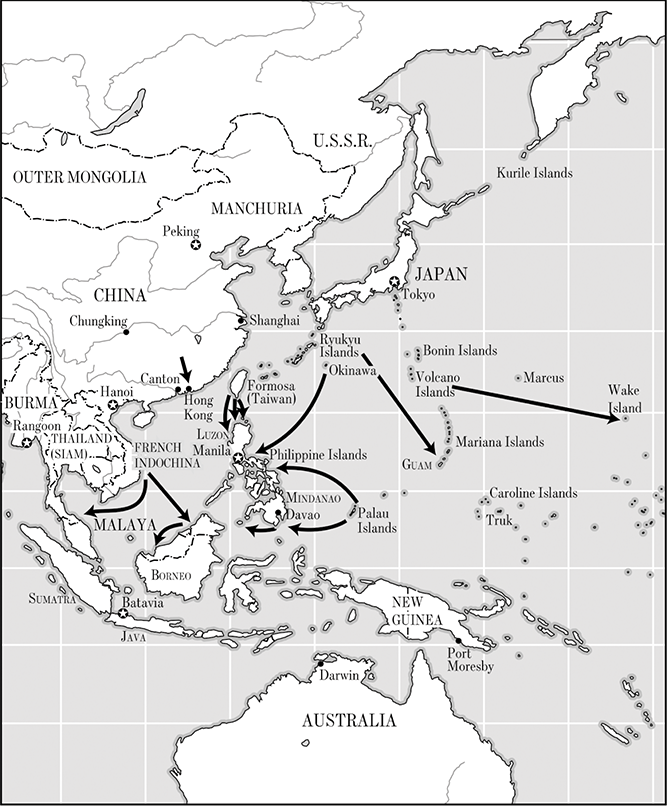
Map 2: Japanese offensive operations, December 1941.
Map 2Long description
The map illustrates Japanese offensive operations in December 1941 during World War II, depicting the rapid and widespread attacks launched across the Pacific and Southeast Asia. Arrows indicate Japan’s strategic advances toward key territories such as the Philippine Islands, Guam, Wake Island, Hong Kong, Malaya, and Borneo, as well as their push into the Dutch East Indies and toward northern Australia.
The Japanese followed up their initial strikes on FEAF airfields and the naval facilities of the Asiatic fleet with small-scale (regimental size or less) landings at Batan Island (December 8), 150 miles off the northern tip of Luzon; Camiguin Island (December 10), 35 miles from Aparri on the northern tip of Luzon; Aparri and Vigan (December 10) in northern Luzon; Legaspi (December 12) on the Bicol Peninsula; Davao (December 20) on Mindanao; and Jolo Island (December 24) on the Sulu Archipelago between Mindanao and Borneo. These locations would provide air bases to cover further operations on Luzon, interdict the San Bernardino Strait, threaten the Netherlands East Indies, and prevent reinforcements from reaching the Philippines.69 The landings were largely unopposed, although air attacks badly damaged two transports, sank a minesweeper, and hit a light cruiser and a destroyer off the coast near Vigan – the last major effort by the FEAF before it was effectively eliminated as a combat force by Japanese bombing and strafing. From this point forward, remaining FEAF aircraft were used for reconnaissance.70 The Japanese detachment at Aparri moved around the coast road to Vigan, where it joined forces with the troops there and reunited the 2nd Formosa Regiment. The combined force then moved south toward the main Japanese landing beaches in Lingayen Gulf.
As Maj. Gen. Wainwright expected, the main Japanese landings occurred in Lingayen Gulf, 100 miles north of Manila. The convoys sailed without interdiction by American air and naval forces, which was the purpose of stationing B-17 bombers and submarines on Luzon. Despite high seas and poor navigation, Japanese troops made it ashore unscathed, although the landing of heavy equipment had to await calmer waters. Lt. Gen. Masaharu Homma’s 14th Army consisted of 43,000 soldiers, with the 48th Division and part of the 16th Division as the primary combat elements. MacArthur’s forces on Luzon outnumbered the Japanese by at least two to one, but, in this case, quality mattered more than quantity.71 More combat-effective Japanese forces brushed aside what little resistance the Filipino troops stationed on the beaches offered as succeeding waves swept ashore. By the middle of the afternoon, Japanese infantry, supported by several pieces of artillery and tanks that had made it ashore, controlled the beaches on which they had landed and pushed inland.72 A timely counterattack by several well-trained divisions might have pushed them back into the sea, but only one such division existed in the Philippines, and it was not stationed in the vicinity. Poorly trained and ill-equipped, the North Luzon Force, according to Wainwright, “were doomed before they started to fight …. They never had a chance to win.”73
The 26th Cavalry (PS) defended Damortis for several hours until ordered to fall back to Rosario. Japanese tanks penetrated the cavalrymen’s lines that evening, routing the regiment as it withdrew. The Japanese took Rosario that night. The defense of Baguio proved just as futile, with Japanese forces seizing the city by dawn on December 24. The 11th, 71st, and 91st Philippine Divisions attempted to stem the Japanese advance to the south, but invariably fell back after first contact with Japanese forces. Only the 26th Cavalry (PS), which fought a heroic delaying action at Binalonan, proved to be combat-effective, and after this fight it was down to just 450 men.74
On December 24, the Japanese launched a supporting attack at Mauban, Atimonan, and Siain in Lamon Bay on the eastern shore of Luzon, fifty-five miles southeast of Manila. The 7,000 soldiers of the 16th Division, minus 2 regiments employed elsewhere, would have to cross the Tayabas Mountains and skirt the shores of Laguna de Bay to reach the Philippine capital. The South Luzon Force, consisting of the 1st Regiment of the 1st Regular Philippine Division, the 51st Philippine Division, the 42nd Infantry of the 41st Philippine Division, six batteries of artillery, and one tank company, was responsible for the area, along with the rest of Luzon south of Manila. A battalion of the 1st Regiment of the 1st Regular Philippine Division, recently inducted on December 19, defended the beach at Mauban, inflicting heavy casualties on Japanese assault forces. After difficult fighting, the Japanese were able to solidify control of the beach and seize the town. Filipino forces likewise fought doggedly for Atimonan, but, by the middle of the afternoon, Japanese forces had secured the town and were advancing into the mountains to the west. Given the small size of the forces employed, Japanese commanders were delighted with their successes.75
The results of the first days of fighting had been predictable. Poorly trained and equipped Filipino reserve troops fled quickly after contact with Japanese forces, and US forces and Philippine Scouts lacked the numbers and firepower to stem the Japanese for long. The Japanese had consolidated two major beachheads on Luzon at Lingayen Gulf and Lamon Bay. Heavy equipment and supplies streamed ashore, and Japanese forces were prepared to advance on Manila. American and Filipino forces would have to fight a delaying action back into the Bataan Peninsula after all, in accordance with WPO-3, which MacArthur had derided as defeatist.76 MacArthur’s unwarranted gamble to defend forward had failed.
Despite the failure of his strategy, “General MacArthur’s name became a symbol of American resistance to a foe who was meeting with success everywhere.”77 Realizing the galvanizing effect of the defense of the Philippines, and aware of the watchful eyes of the peoples of Asia who would castigate the United States for abandoning the Filipino people in their greatest time of need, President Roosevelt directed the War and Navy Departments to make every effort to reinforce MacArthur’s forces. But these efforts ran up against the realities of strategy and logistics.78 The United States had already committed itself to a grand strategy of defeating Germany first before prioritizing the Pacific War. Moreover, getting arms, ammunition, and supplies to the Philippines was easier said than done. Aircraft, of course, could be flown to their destination, provided that a base structure was in place, but the US Asiatic Fleet was too small to counter Japanese control of the seas surrounding Luzon. Supplies could be flown in, but the number of transport aircraft available was so small that two Pan Am clippers were pressed into service to ferry .50-caliber ammunition to the Philippines.79 The War Department diverted a convoy containing two regiments of artillery and B-17 aircraft escorted by the heavy cruiser USS Pensacola to Brisbane, Australia, where it became the foundation for a new command, US Army Forces in Australia. With Guam and Wake Island now under Japanese control, Australia would become the major logistical hub for US forces in the Southwest Pacific. It would take time to turn it into one, a role that Gen. George C. Marshall gave to none other than newly promoted Brig. Gen. Eisenhower, who became head of the Pacific Section of the War Plans Division.
In his new posting, Eisenhower would do what he could to support MacArthur and his command in the Philippines, even though Ike knew the forces on Bataan and Corregidor were doomed. “In spite of difficulties, risks, and fierce competition for every asset we had, a great nation such as ours, no matter how unprepared for war, could not afford cold-bloodedly to turn its back upon our Filipino wards and the many thousand Americans, troops and civilians, in the archipelago,” Eisenhower wrote later. “We had to do whatever was remotely possible for the hapless islands, particularly by air support and by providing vital supplies, although the end result might be no more than postponement of disaster.” The peoples of Asia “may excuse failure but they will not excuse abandonment,” he argued to Gen. Marshall, who agreed with Eisenhower’s assessment.80
For his part, MacArthur urged a change not only in the national strategy for the Philippines, but also in the Allied grand strategy for the conduct of the war. He believed that the United States should focus its air and naval power against Japan, which was isolated in the Pacific and vulnerable to a concerted strike. Otherwise, MacArthur warned, “If the Philippines and the Netherlands East Indies go, so will Singapore and the entire Asiatic continent.”81 He was, of course, right about the threat posed by the Japanese, but the Allies, then meeting in Washington, DC, at the first of their wartime summit conferences, were not about to change course. Germany would be defeated first and then Japan – even if it meant having to retake much of the Asian continent and most of the Pacific in the process.
The noose was tightening on MacArthur and his remaining forces. By the end of the year, the last of the submarines of the US Asiatic Fleet had departed, leaving behind just three gunboats, three minesweepers, and six motor torpedo boats.82 As Japanese forces advanced toward Manila, airfields outside the Bataan Peninsula became untenable. Even had aircraft been available to fly to Luzon, there would have been nowhere for them to land. On December 23, less than two days after the Japanese landing at Lingayen Gulf, MacArthur decided that his forces would withdraw to the Bataan Peninsula and Corregidor after all, in accordance with basic American strategy since the dawn of War Plan Orange. The problem was the lack of supplies to sustain tens of thousands of American and Filipino forces in such a confined area. Because of his insistence on defending forward at the beaches, MacArthur and his staff had neglected to move sufficient food onto Bataan and Corregidor to sustain forces there for more than a couple of months.83 They had not evacuated Filipino civilians from the area or established the required infrastructure to sustain a lengthy siege. MacArthur’s decision not to prepare Bataan for a lengthy defense ranks as his most critical error of the entire campaign in 1941–1942.
MacArthur’s decisions required his ill-trained units to conduct a delaying action while in contact with numerically superior Japanese forces, one of the most difficult of tactical maneuvers. That they did so successfully is a testament to the leadership of Maj. Gen. Wainwright and his subordinate commanders. To save the Philippine capital from destruction, MacArthur declared Manila an open city, which allowed the Japanese to occupy it without subjecting it to bombardment or fighting. It took several days before the Japanese in the Philippines got the memo, for Japanese aircraft continued to bomb military installations in the Manila area.84
As Wainwright’s troops withdrew toward Bataan, MacArthur moved USAFFE headquarters, the Philippine High Commissioner, and the Commonwealth government to the island fortress of Corregidor on Christmas Eve. A week later, Philippine Supreme Court Chief Justice José A. Santos swore in President Quezon and Vice President Osmeña for their second terms in office outside the east portal of the Malinta Tunnel, actually a grid of passages drilled into solid rock beneath Malinta Hill. After a short stay in a house on Topside (the elevated western head of Corregidor), the tunnel would be Jean and Arthur MacArthur’s home for the next three months, “both a refuge and a prison,” while Gen. MacArthur, no doubt due to his claustrophobia, stayed in a house outside the east entrance. Safe from the ravages of Japanese bombs and shells, the tunnel system was also “a dusty, musty, crowded, dark, damp hole in the ground,” which made its denizens yearn “for the sunshine and fresh air outside.”85 Brig. Gen. Marshall stayed behind in Manila and supervised the movement of supplies to Corregidor and Bataan, as well as the destruction of Manila’s port facilities and whatever supplies could not be moved in the time available.86 On Bataan, the newly promoted Maj. Gen. Parker assumed command of the Bataan Defense Force, initially consisting of the 31st and 41st Philippine Army divisions, charged with preparing defenses on the peninsula in advance of the arrival of the North and South Luzon Forces.
The North Luzon Force was to fight a delaying action on five lines, designated D-1 through D-5, anchored on key defensive terrain features from Lingayen Gulf to Bataan. D-1 was aspirational, meant as a position “to reorganize the badly disorganized forces north of the Agno River.”87 The first real delaying position was D-2, situated along the Agno River south of Lingayen Gulf. D-3 and D-4 were each a day’s march to the south. The final line, D-5, was anchored on Ft. Stotsenburg, Mt. Arayat, and the Candaba Swamp. Here the North Luzon Force would hold until the South Luzon Force could withdraw into Bataan. Engineers would build obstacles and destroy bridges along likely avenues of approach to further delay Japanese forces.
By Christmas Day, the 21st, 11th, and 91st Philippine Divisions and the 26th Cavalry (PS) were arrayed west to east along line D-2, south of the Agno River. The 26th Cavalry (PS) fought valiantly for Tayug before superior Japanese strength forced a withdrawal from the river. The cavalrymen, reduced to a fraction of their full strength while standing up to Japanese forces in three pitched battles, went into reserve while the Philippine Army divisions continued the fight.88 A Japanese attack on Carmen destroyed the 1st Battalion, 21st Infantry and forced the withdrawal of the 11th Philippine Division to the south. By December 27, the North Luzon Force was established along line D-3, although fifteen tanks were abandoned when a bridge was prematurely detonated, leaving a tank company stranded north of a stream at Moncada.89 As Japanese forces had temporarily halted to reorganize, there was no contact along the D-3 line, and the North Luzon Force withdrew to the D-4 line on the night of December 27–28. Wainwright, concerned about retaining the bridges over the Pampanga River at Calumpit over which the South Luzon Force would have to pass to reach Bataan, decided to hold this line “at all costs.”90
The 48th Division, supported by tanks and artillery, attacked the Philippine 91st Division at Cabanatuan on December 29, forcing its withdrawal from the line of the Pampanga River. The Japanese quickly advanced south along Highway 5, destroying an attempt to reform the defensive positions near the village of Gapan along the Penaranda River. In the center of the D-4 line stretching from Zaragoza and La Paz, the 11th Infantry Regiment of the 11th Infantry Division, commanded by Maj. Russell W. Volckmann, put up a spirited defense against Japanese attempts to envelop the position from the east.91 The regiment delayed the Japanese advance for twenty-four hours before receiving orders to withdraw to the D-5 line on the afternoon of December 30. In the west, the 21st Philippine Division likewise put up stiff resistance prior to receiving orders to withdraw south. By dawn the next day, the division was established along the D-5 line. “For the most part,” concludes the official US Army historian, “the withdrawal was conducted as well as it could be with the untrained and ill-equipped Philippine Army troops.”92
The South Luzon Force, now under the command of Maj. Gen. Albert M. Jones, likewise conducted a week-long delaying action from its positions in the mountains west of Lamon Bay to Manila and thence northward to Bataan. The green Philippine troops, unexpectedly reinforced by 300 retired Philippine Scouts who used taxis to move from Fort McKinley to the sound of the guns, did about as well as one could expect of inadequately trained and poorly equipped soldiers. Poorly disciplined soldiers fled when attacked by well-trained Japanese units. Battalions and companies dissolved and had to be reformed in subsequent positions without a coherent chain of command to bring order to the hastily reconstituted units.93 Nevertheless, the force was able to delay in the face of Japanese assaults and destroy the bridges over which the Japanese would need to pass. On December 28, the South Luzon Force was saved from further combat by Gen. MacArthur, who, concerned about the integrity of the North Luzon Force D-4 defensive line, ordered Jones and his forces to break contact with the Japanese and withdraw through Manila and into Bataan before the Japanese could seize the bridges at Calumpit. The South Luzon Force executed these orders to perfection, establishing defensive positions at Plaridel to block the 48th Division bearing down from the north and closing on Bataan by New Year’s Day.94
The defense of Plaridel and, to its north, the town of Baliuag was crucial to ensure USAFFE elements east of the Pampanga River could withdraw into Bataan. As Japanese forces massed for an assault on Baliuag, Jones ordered a preemptive attack by two platoons of tanks from Company C, 192nd Tank Battalion. At 17:00 the tanks smashed into the northern end of the town, destroying eight Japanese tanks and disrupting the infantry preparing to attack. This action enabled the forces east of the river to cross the Calumpit bridges without disruption, the last ones clearing the river to the west by 05:00 on January 1. They then headed for San Fernando and the road to the Bataan Peninsula. Wainwright ordered the destruction of the Calumpit bridges at 06:15.95
As the main strength of the 14th Army headed for Manila, the 11th and 21st Philippine Divisions delayed Japanese forces along the D-5 line before withdrawing south toward Bataan. The road into the peninsula was jammed with vehicular and pedestrian traffic, for long stretches bumper-to-bumper.96 But the withdrawal was successful, with Filipino units repelling Japanese attacks and buying time for an orderly move south. By early morning on January 2, the final units of the North and South Luzon Forces had passed through San Fernando, merging into a single command under Wainwright’s tactical control.
The 11th and 21st Philippine Divisions defended a line from Guagua in the east to Porac in the west, with their flanks protected by swamps and mountains. The Japanese attacked this line with two reinforced infantry regiments on January 2 and 3, nearly breaking the 21st Philippine Division the next day before being halted by effective artillery fire that reminded one senior officer of Lt. Alonzo Cushing’s defense of Cemetery Ridge during the Battle of Gettysburg.97 The advance of the Tanaka Detachment cut off the 11th Infantry Regiment and other portions of the 11th Philippine Division, necessitating a circuitous night march of thirty miles to new positions just north of Santa Cruz. By the morning of January 5, a new line had been formed south of the Gumain River, buying time for the troops in Bataan to prepare defensive positions. Wainwright ordered a withdrawal from the Gumain River at dusk, beginning with the 11th Philippine Division followed by the 21st Philippine Division. The two divisions passed through the town of Layac and across the Culo River into Bataan. The withdrawal was accomplished by 02:00 on January 6, after which engineers demolished the bridge across the Culo River.98 The US 31st Infantry, 71st and 72nd Philippine Infantry, and 26th Cavalry (PS) defended the Culo River until nightfall under intense Japanese pressure, and then withdrew south under cover of darkness. “It was, in short, a sickening experience to withdraw into the peninsula,” Wainwright lamented. “I issued the order with the greatest of sorrow.”99 MacArthur’s forces were now in Bataan, but how long they could hold the peninsula was an open question.
Japanese troops entered Manila in the late afternoon of January 2, taking control of the Philippine capital. They interned the roughly 3,000 American and British civilians who remained in the city on the campus of Santo Tomas University, where they would remain until their dramatic liberation 3 years later.
On Corregidor, MacArthur advocated a strategy of securing Mindanao as a base for future operations in conjunction with a relief expedition to keep open the lines of communication to the Philippines. The American and British staffs, then meeting in Washington, recognizing that the basic grand strategy of the Allied Powers was to defeat Germany first, recommended instead the defense of the Malay Barrier from Australia to Burma. The War Plans Division concluded that a Philippines relief expedition was simply not in the cards. Although the planners sympathized with the plight of MacArthur and his troops, the forces, weapons, and equipment – most notably combat vessels and aircraft – required to restore America’s position in the Philippine archipelago in the time available before the collapse of the positions on Bataan and Corregidor simply did not exist. It was the same conclusion that successive groups of planners working on War Plan Orange had reached for more than two decades. Secretary of War Henry L. Stimson and Gen. Marshall acknowledged the study, but never wavered in their attempts to send MacArthur whatever aid was available.100
Although the strategic situation was far from enviable, the tactical situation on Bataan worked in favor of the Americans and the Filipinos, at least as long as supplies held out. The terrain was well known to the commanders, who had mapped out prospective defensive lines before the war. The peninsula is just twenty miles wide, with only a single highway running north–south down both sides and a single road cutting east–west from Bagac to Pilar across the waist. The rest is mountainous jungle, with ample cover and concealment to protect defending forces from overhead observation. The main defensive line ran from Mauban on the west to Mabatang on the east and was bisected by Mt. Natib, an extinct volcano rising to 4,222 feet. A subsequent defensive line from Bagac to Orion roughly paralleled the east–west road approximately eight miles to the south.
Maj. Gen. Wainwright commanded the 22,500 soldiers of the I Corps on the western half of the peninsula, consisting of the 1st Regular, 31st, and 91st Philippine Divisions, as well as elements of the 71st Philippine Division and the 26th Cavalry Regiment (PS) and supporting artillery.101 Maj. Gen. Parker commanded the 25,000 soldiers of the II Corps on the eastern half of the peninsula, consisting of the 11th, 21st, 41st, and 51st Philippine Divisions, as well as the 57th Infantry Regiment (PS) and supporting artillery. In the service command area in the southern part of the peninsula were positioned the 2nd Division (Philippine Constabulary), elements of the 71st Philippine Division, provisional infantry units created from air corps personnel no longer needed to service nonexistent aircraft, and a provisional battalion of sailors and marines. The Philippine Division, minus one regiment, plus a tank group, a group of M3 GMC 75 mm guns, and corps and USAFFE artillery were in reserve. MacArthur, of course, was in overall command, which he exercised through a Bataan echelon under Brig. Gen. Marshall in USAFFE headquarters on Corregidor.102
MacArthur’s decision to move supplies northward to support a forward defense of Lingayen Gulf invalidated the plan to move supplies into Bataan to support an extended defense of the peninsula. Movement of supplies did not begin in earnest until December 23, by which time it was too late to provision the peninsula with the amount needed to sustain an extended siege. So, instead of sufficient supplies to support 43,000 soldiers for 6 months, logisticians were able to move only a fraction of the amount necessary to support forces on Bataan that by January 7 had swelled to 80,000 soldiers and 26,000 civilians. Food was the critical shortage, with only a 30-day supply sufficient to support 100,000 soldiers. Because of pre-war stockpiling, Corregidor was better off, with sufficient supplies to sustain 10,000 soldiers for 6 months. Nevertheless, on January 5, MacArthur placed all soldiers and civilians on Bataan and Corregidor, himself included, on half rations, about 2,000 calories a day.103 Malnutrition and diseases, particularly malaria, would take their toll on the forces in Bataan as the weeks rolled by. “The shortage of supplies of all types,” records the official US Army history, “and especially food, had a greater effect on the outcome of the siege of Bataan than any other single factor.”104
One factor in favor of the US and Filipino troops was Japanese overconfidence. Convinced that little remained of the battle for Luzon other than mopping up, the Southern Area Army withdrew the 48th Division to prepare for the invasion of Java, replacing it with the newly formed and much less capable 65th Brigade, commanded by Lt. Gen. Akira Nara. Poor Japanese reconnaissance led to an ineffective opening artillery barrage when the battle for Bataan commenced at 15:00 on January 9. The next day, MacArthur made a trip by PT boat to visit the troops on Bataan, the only time he ever left the island of Corregidor before departing to Australia in March. Of course, he needed to remain near his communications center to dialogue with the War Department, and there was a risk in sailing over unfriendly waters to visit Bataan. But his troops needed to see him, and his reluctance to visit them contrasts sharply with his performance in World War I, when he frequently led trench raids. No doubt he was in better shape when younger, and traveling to Bataan was physically draining. Wags among the troops, however, took his absence for cowardice, which was certainly not the case. But the nickname they coined, “Dugout Doug,” stuck.105
It took two days before Japanese forces uncovered the main line of resistance in the II Corps sector, and their attacks against it met with heavy losses. Japanese units became disoriented in the difficult terrain. They continued to hammer at the II Corps’ lines, however, and by January 15 the situation on the western flank of the corps had become unsustainable. Maj. Gen. Parker responded by requesting reinforcements, which USAFFE provided. Upon receiving control of the Philippine Division (minus the 57th Infantry [PS], which had already been committed) and most of the 31st Philippine Division, Parker ordered a counterattack. The 51st Philippine Division scattered in the face of Japanese attacks, but Japanese commanders failed to capitalize on the gap thus created. A counterattack by the US 31st and 45th (PS) Infantry Regiments beginning on the morning of January 17 and continuing for several days failed to restore the main line of resistance along the Balantay River. The Japanese commander realized the weakness of the American and Filipino line and shifted the bulk of his forces to the high ground in the west to envelop their positions. A Japanese attack on January 22 forced the Philippine Division back to its original start line where it had begun its counterattack five days earlier. Maj. Gen. Parker realized the predicament of his corps, threatened by Japanese troops that could drive his forces against Manila Bay. Moreover, the 9th Regiment had by this time worked its way south along the Abo-Abo River valley to Guitol, where it seized and held the high ground dominating the southwestern flank of II Corps. The situation had become critical.106
The 122nd Regiment contacted Wainwright’s I Corps’ outpost line on January 16. Reinforced by a battle group of the 16th Division under the command of Maj. Gen. Naoki Kimura, the regiment attacked the main defensive line on the western side of Bataan beginning on January 18. By January 21, the 3rd Battalion, 20th Regiment managed to infiltrate through I Corps lines to block its main supply route, creating an emergency so critical that Wainwright personally led a platoon of twenty men in a counterattack in an attempt to destroy the Japanese position. His attack stalled, but other units from the 91st Philippine Division, 26th Cavalry (PS), and Company C, 194th Tank Battalion were marching toward the sound of the guns. Beginning on January 22 and continuing for several days, these forces attempted to reduce the Japanese roadblock and thereby relieve pressure on the 1st Philippine Infantry Regiment to the north, which was defending against heavy attacks. Despite numerical superiority, the counterattacks were unsuccessful. By the evening of January 24, the situation was critical, with the 1st Regular Philippine Division desperately short of rations and ammunition. Col. Kearie L. Berry, in command of two regiments of the 1st Regular Philippine Division, made the decision to withdraw from the main line of resistance. The next morning, the division withdrew along the only route available, the beaches fronting the west coast of Bataan. The route was passable only to foot traffic. Although most of the troops made it south to new positions with their small arms, all the division’s artillery was abandoned in the withdrawal.107
With both corps under pressure, MacArthur ordered Sutherland to make a personal visit to assess the situation. On January 22, Sutherland arrived in Bataan and spoke to Maj. Gen. Parker near his headquarters in Limay. Concerned by what he heard and with all USAFFE reserves already committed to the fight, Sutherland gave Parker and Wainwright a warning order to withdraw their forces to the subsequent defensive line, an order subsequently approved by MacArthur.108 Beginning on the night of January 23–24, II Corps began its move to the rear. The first night’s movement went smoothly, but poor traffic control on the night of January 24–25 led to a tangle of units and mass confusion, which the Japanese were unable to take advantage of. Japanese aircraft bombed and strafed units that moved during the day, but II Corps moved into its new positions by the morning of January 26. In the west, I Corps withdrew with little difficulty to the subsequent defensive line, reaching it at the same time as II Corps to the east. In its attack against the main defensive line, the 65th Brigade had sustained nearly 25 percent casualties, but it had forced American and Philippine forces back to their last defensive position on Bataan. Those forces would stand and fight where they now stood. MacArthur wrote to Marshall, “With its [the subsequent defensive line] occupation all maneuvering possibilities will cease. I intend to fight it out to complete destruction.”109
As I and II Corps began their withdrawal to the subsequent defensive line, a new threat developed to the rear along the southwest coast of Bataan. On the night of January 22–23, a Japanese battalion landed on Quinauan Point and Longoskawayan Point deep in the Service Command Area. The area was thinly defended by a pick-up team of various US and Filipino army, constabulary, naval, and air personnel and a few artillery pieces under the command of the 71st Philippine Division (Brig. Gen. Clyde A. Selleck). Most of the converted infantrymen, who had served up to now as air crews or police, had received only a few days training as such. The Japanese had actually been heading to Caibobo Point further to the north, but inadequate maps, poor navigation, and the opposition of PT 34, which destroyed two of the Japanese landing barges, led to the force being split up and landing further south than intended. The 300 troops that landed in the south at Longoskawayan Point briefly seized the key terrain on Mt. Pucot before a combined force of sailors, marines, and airmen drove them back. A counterattack at Quinauan Point failed to force the 600 dug-in Japanese back into the sea. Believing that more vigorous leadership was required, on January 24, Selleck was relieved by Col. Clinton A. Pierce, who had successfully commanded the 26th Cavalry (PS) during the past month. More importantly, USAFFE dispatched two battalions of Philippine Scouts from its reserve to reinforce the troops at Quinauan Point and Longoskawayan Point.110

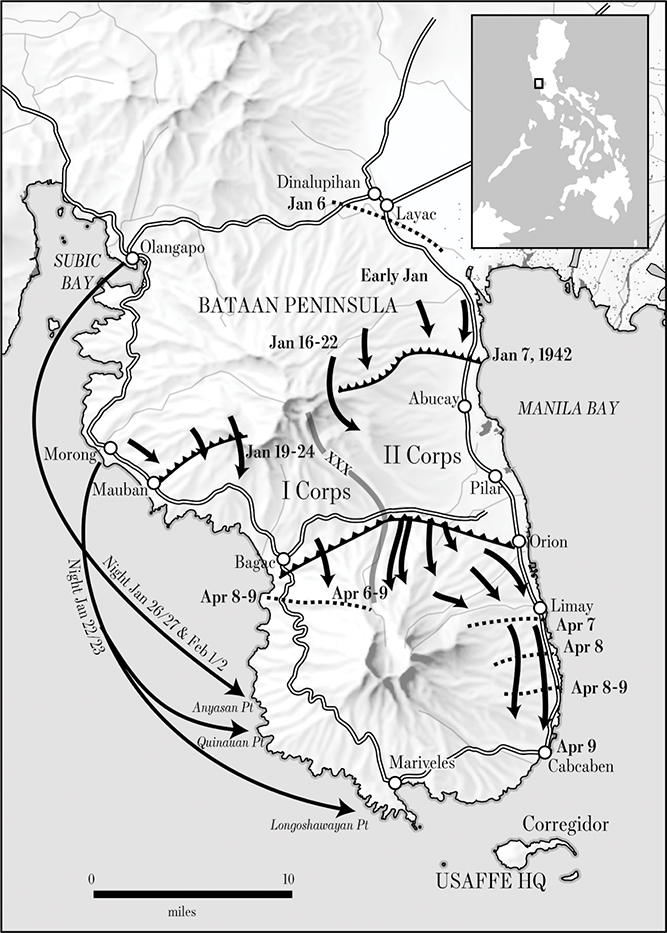
Map 3: Bataan and Corregidor, January–May 1942.
Map 3Long description
The map detailing military operations on the Bataan Peninsula in the Philippines from January to May 1942. It shows the positions and movements of the United States Army Forces in the Far East (U S A F F E) and the advancing Japanese troops. Key engagements are marked by dates, including early January defenses at Layac, mid-January clashes along the Abucay-Mauban line, and April offensives leading to the fall of Bataan. The map identifies critical locations such as Mariveles, Pilar, Orion, and Corregidor Island, from where United States Army Forces in the Far East coordinated resistance. It also includes a scale at the bottom, indicating distances in miles.
After a heavy preparatory bombardment on the morning of January 29, which included 12-inch coastal mortars based on Corregidor, the 2nd Battalion, 57th Infantry (PS) attacked and by nightfall had overrun the Japanese positions on Longoskawayan Point. Because of heavy jungle vegetation and greater Japanese strength, the Philippine Scouts of the 3rd Battalion, 45th Infantry (PS) reinforced by Company B, 57th Infantry (PS) had a more difficult time reducing Japanese positions on Quinauan Point. Attacks commenced on January 28 and, for several days, advances, even after tank reinforcements bolstered the assault, were measured in yards. After a week of combat, the Scouts were down to 50 percent strength. “The sight and stench of death were everywhere,” recalled Capt. William Dyess, who would later escape from Japanese captivity to report to MacArthur in Australia what had happened to the survivors of Bataan during the death march that followed the surrender. “The jungle, droning with insects, was almost unbearably hot.”111
After further tank reinforcements had arrived, the Scouts attacked again on February 4. By February 8, the Scouts and airmen of the 21st Pursuit Squadron, led by Dyess, had destroyed the final resistance at Quinauan Point. Better tank–infantry coordination resulted in the reduction of the Japanese position to a small area along the cliff overlooking the South China Sea. At Wainwright’s orders, engineers reinforced the attacking forces. They fashioned dynamite bundles to finish off the Japanese ensconced in caves along the cliff. Navy gunboats added to the fire directed at Japanese cave positions.112 “There were no survivors,” Wainwright remarked in his memoirs. “It had at last dawned on me, as it was to dawn on so many commanders who followed me in the Pacific War, that the Jap usually prefers death to surrender.”113
The Battle of the Points was not yet over, for, at 03:00 on January 27, the Japanese, in an effort to support the 2nd Battalion, 20th Infantry fighting at Quinauan Point, landed 200 soldiers of the 1st Battalion, 20th Infantry on the southwest coast of Bataan. Once again, poor navigation led to the force landing astray, this time between the Anyasan and Silaiim Rivers 2,000 yards north of Quinauan Point. The 17th Pursuit Squadron and the 2nd Battalion, 2nd Philippine Constabulary marched to the area, where they found the Japanese dug in approximately 1,000 yards from the beach. The situation remained tenuous until the arrival on January 29 of the 2nd Battalion, 45th Infantry (PS) along with the 1st Battalion, 1st Philippine Constabulary and the 1st Battalion, 12th Philippine Infantry. The combined forces were prepared to attack the next day, when the preparatory artillery barrage landed short, killing or wounding twenty scouts and ending the attack before it began. Pierce, now a brigadier general, ordered the 57th Infantry (PS) into the area, and its commander, Col. Edmund J. Lilly, Jr., assumed control of the operation.114
Meanwhile, the commander of the 14th Army, Lt. Gen. Homma, had finally decided to support the landings, which up to this time had been a local affair. Attempts to supply the troops ashore by air came to naught because of poor navigation. A more significant effort came on the night of February 1–2, when the remainder of the 1st Battalion, 20th Infantry sailed to reinforce the landing at Quinauan Point. Fortunately for the defenders, a written order detailing the operation had been found on the body of a dead Japanese officer, allowing USAFFE to alert its units and gather reinforcements. A coordinated attack against the Japanese flotilla by artillery, four P-40 fighters (all that remained of the FEAF), and PT 32 destroyed about half of the Japanese force, but the remainder made it ashore at Salaiim Point, where it joined the company already there.115
An attack by three battalions of Philippine Scouts at dawn on February 2 hit strong resistance except on the southern flank, where the tortuous terrain slowed the advance to a crawl. It took five days for the 1st Battalion, 57th Infantry (PS) (minus one company) on the southern flank to make contact with the Japanese in its zone and when it did, the Japanese repelled its assault. Lilly reinforced this unit with air corps troops and a battalion of Philippine Constabulary, while a company of tanks reinforced the attack down the trail leading to the beach in the center of the zone between the Anyasan and Silaiim Rivers. The end of the fighting at Quinauan Point on February 8 enabled further reinforcements to flow north. By evening on February 11, the Scouts had reached the mouth of the Anyasan River and the end of the battle was in sight. At dawn the next day the Japanese attempted to break out of their encirclement, exploiting a gap in the lines of the 2nd Battalion, 45th Infantry (PS). The attack succeeded in penetrating the line and overrunning the command posts of the 17th Pursuit Squadron and Company F, 45th Infantry (PS). Lilly ordered the 3rd Battalion, 57th Infantry (PS) into the area to restore the situation. Its attack began at noon and made steady progress that afternoon and the next day. By the middle of the afternoon on February 13, the Scouts had reached the beach, hastily abandoned by Japanese troops who attempted to swim or raft to safety. Few made it – “the beach was befouled with bloated and rotting bodies” – while a group of about eighty Japanese who had infiltrated out of the area to the north were finally located three days later and killed in a two-day battle.116 The Battle of the Points was over; it had cost the Japanese two battalions of much-needed infantry.
The battle for the new main line of resistance, now positioned on the subsequent defensive line running from Bagac to Orion across the waist of the peninsula, continued to rage. The mountainous, jungle-covered terrain, intense heat, and shortage of provisions tested the resilience of the 90,000 troops packed into the 200 square miles of southern Bataan. The II Corps sector in the east was divided into five subordinate sectors, labeled A through E, while the I Corps sector in the west was divided into a right sector and a left sector, with a south sector controlling the beach defenses of southwest Bataan. As the corps were occupying their new lines, Sutherland (presumably with MacArthur’s consent) decided to withdraw the Philippine Division to form a USAFFE reserve. The subsequent confusion of this last-minute decision would profoundly impact the battle to come.117
Lt. Gen. Homma, believing the new defensive line was further south than it actually was, ordered an immediate attack. In this case fortune favored the bold, for the attack hit the sectors most affected by the unfortunate shuffling of units caused by the withdrawal of the Philippine Division into USAFFE reserve. In Sector C in the II Corps’ sector, Brig. Gen. Clifford Bluemel was caught flat-footed by the repositioning of units out of his defensive line on Maj. Gen. Parker’s orders; apparently the corps staff failed to inform Bluemel of the changes to the order of battle.118 Bluemel did what he could to plug the gaps, but his line was exceedingly thin. Nevertheless, it held. At 15:00 on January 27, Lt. Gen. Nara’s 65th Brigade attacked, but was unable to penetrate the main line of resistance. That night the 41st Philippine Infantry arrived to bolster Sector C, just in time to repulse a renewed Japanese attack the next day. A renewed attack on January 31, preceded by air and artillery support, likewise failed to pierce the defensive line. As the Japanese withdrew their lead units from a bamboo thicket in front of Trail 2, the key terrain in Sector C, a counterattack by the 31st Engineer Battalion on February 2–3 regained the ground lost since the beginning of the Japanese offensive. The danger of a Japanese breakthrough in this area, for now, was over.119
In the western half of Bataan, the Kimura Detachment (Maj. Gen. Naoki Kimura, soon to be superseded by Lt. Gen. Susumu Morioka), attacked on January 26 down the road bordering the west coast. Unable to advance in this area, the Japanese found a weakness in Wainwright’s lines in the sector occupied by the 1st Regular Philippine Division. The 20th Regiment assaulted the area on the night of January 28, exploiting a gap created by the attack and advancing south along the Cotar and Tuol Rivers in nearly impenetrable terrain. The Japanese force ended up splitting into two components, each occupying a pocket of terrain behind the main line of resistance. Counterattacks against the pockets quickly discovered that they were occupied by substantial forces, requiring the commitment of reserve forces to reduce. The 1st Regular Philippine Division restored the main line of resistance on January 31, thereby cutting off the Japanese forces in the pockets from resupply. Tank attacks on February 2, 3, and 4 penetrated the larger pocket, but accompanying infantry could not make headway against the dug-in Japanese infantry.120 On the night of February 6–7, a renewed Japanese attack managed to penetrate 600 yards through the lines of the 11th Philippine Infantry, but remained 800 yards short of the troops surrounded in the larger pocket.121
It was now Wainwright’s turn to attack. On the morning of February 7, troops from the 1st Regular Philippine Division advanced on the smaller pocket and by the next evening had closed the noose around it, with the exception of an undetected gap on the eastern flank. When the advance resumed on the morning of February 9, the attacking troops found only dead bodies and discarded equipment. The surviving Japanese had escaped the trap to the east during the night, only to be killed later that morning attempting to move north through the main line of resistance. American and Philippine forces now focused their efforts on eliminating the larger pocket of Japanese, which had received orders to withdraw to the north to join with the forces that had created a salient in the main line of resistance. Filipino forces reduced the pocket on the afternoon of February 12, again finding only dead bodies (450 including those already buried in shallow graves) and abandoned equipment and supplies. The rest worked their way slowly north, with 377 Japanese finally regaining the safety of their lines at noon on February 15. The 20th Regiment had been effectively eliminated as a combat-effective unit.122
For the moment, Lt. Gen. Homma had seen enough to know the wiser course of action was to suspend the offensive in Bataan while Japanese forces seized other portions of the Philippines. By the middle of February, the 16th Division’s infantry strength was just over 700 soldiers, while the 65th Brigade had lost 4,000 of the 5,000 men with which it had entered combat the previous month. The American and Filipino supply situation on Bataan was growing worse by the day, and waiting a couple of months before attacking again would allow malnutrition to take its course on the combat effectiveness of their units. It would also allow time for Tokyo to move reinforcements to the Philippines to bolster the fighting strength of the 14th Army. On February 8, Homma ordered a general withdrawal northward to defensive positions.123
The same day the Japanese began their withdrawal, President Quezon, incensed by the lack of support from the United States for Philippine defense, messaged Washington with a proposal for the United States to grant the Philippines immediate independence, after which Quezon would declare neutrality and request the withdrawal of both Japanese and American forces from the islands.124 The scheme was wholly impractical and ignored the strategic needs of the Japanese, who would never abide by its terms. As Gen. Marshall and Brig. Gen. Eisenhower worked on a reply to that effect, Secretary of War Henry L. Stimson walked into the office. “There are times when men have to die,” he pointedly remarked.125 After a flurry of messages between Quezon, MacArthur, and President Roosevelt, the issue died.126
President Roosevelt made his policy clear by writing MacArthur, “American forces will continue to keep our flag flying in the Philippines so long as there remains any possibility of resistance.”127 Roosevelt also ordered MacArthur to evacuate Quezon and his family from the Philippines, which would end the threat of Filipino capitulation. Quezon and his family left Corregidor via submarine on February 20 to head the Philippine government, first in the Visayas and then in exile. Before he left Malinta Tunnel, MacArthur assured him, “You’re going back to Malacañan Palace, Mr. President, if I have to put you there on the points of my bayonets!”128 Quezon would die of tuberculosis before MacArthur could make good on his promise. As he boarded the boat that would take him to the submarine, Quezon gave MacArthur the signet ring he habitually wore with the words, “When they find your body, I want them to know you fought for my country.”129 He also awarded MacArthur something far more tangible – $500,000 for his service to the Philippines, as well as awarding lesser but still sizable amounts to Sutherland, Richard Marshall, and aide Lt. Col. Sidney L. Huff.130 Since he was a serving US military officer, MacArthur’s acceptance of the money was ethically questionable, but the gift was in keeping with his close relationship with the Philippine president and fell within the norms of Filipino culture. Aware of the transaction, Roosevelt, Stimson, and Gen. Marshall made no objections to it.131
Aside from Quezon’s gloominess to the rejection of his proposal, after the defeat of the Japanese offensive, morale among the defenders of Bataan soared. MacArthur had earlier, on January 15, issued a message to the troops, promising substantial reinforcements from the United States and urging the troops to “hold until these reinforcements arrive. No further retreat is possible. We have more troops in Bataan than the Japanese have thrown against us; our supplies are ample [not true]; a determined defense will defeat the enemy’s attack. It is a question now of courage and of determination. I call upon every soldier in Bataan to fight in his assigned position, resisting every attack. This is the only road to salvation. If we fight we will win; if we retreat we will be destroyed.”132 MacArthur was navigating a fine line between motivating the troops for continued exertions and informing them that they would all be sacrificed to buy time for the United States to marshal its forces for a counteroffensive. To be fair to MacArthur, messages from the War Department seemed to promise aid without making specific commitments, leading him to believe more support was forthcoming than was actually the case.133 The War Department’s deception was deliberate; MacArthur’s internal confusion was self-inflicted.
The War Department attempted to run the Japanese blockade to send food, ammunition, and medical supplies to the Philippines, but with scant success. Japanese aircraft and naval vessels were able to interdict cargo vessels, which alone had the requisite capacity to transport sufficient quantities of supplies to Bataan and Corregidor. Submarines and aircraft brought in small amounts of badly needed supplies and took out 220 personnel and part of the Philippines’ gold and silver reserves, but they lacked the capacity to transport the one commodity needed more than any other – food.134
MacArthur missed an opportunity at this point to prepare the groundwork for an extensive guerrilla campaign against the Japanese. Other than one small party led by his provost-marshal, Major Claude A. Thorp, that infiltrated into the Zambales Mountains region, there were no efforts to establish a guerrilla resistance on Luzon. There were efforts to stockpile supplies and prepare for guerrilla conflict on islands in the Central and Southern Philippines, but a misunderstanding with the War Department would lead to the forced surrender of all US and Filipino forces in the Philippines after the fall of Corregidor in May. If a guerrilla movement were to begin thereafter, it would have to grow organically.
Although the defenders of Bataan did not know it, this moment was the high-water mark of the campaign. Some among them wanted to launch a counteroffensive, but it was questionable whether it would have succeeded, given the waning strength of the soldiers. Washington – as well as by now MacArthur – had a clearer assessment of the strategic situation, which had not changed. Bataan would eventually fall, and everyone there would either die or be shuffled off to prisoner of war camps. MacArthur was willing to fight it out to the end on Bataan and Corregidor. That was certainly one possible future, for the British fortress of Singapore had fallen on February 15, with 90,000 troops entering captivity along with their commander, Lt. Gen. Arthur E. Percival.
President Roosevelt was unwilling to see MacArthur suffer such a fate, perhaps as much for his party’s political prospects in the mid-term elections that year as for genuine concern over losing MacArthur’s military expertise. In any case, the collapse of the ABDA (American–British–Dutch–Australian) Command forced a split in command arrangements in the Pacific, with the British commanding forces in Southeast Asia and India and the Americans commanding the broad expanse of the Pacific Ocean, including what would become a new Southwest Pacific Command. MacArthur was the logical choice to command the latter organization, and this role had the added benefit of keeping him away from Washington, where he could interfere with the grand strategy of defeating Germany first. Furthermore, MacArthur was now firmly embedded in the American people’s imagination as THE hero of the Pacific War. Much of this was due to MacArthur’s masterful and often deceptive manipulation of the media. According to his most recent biographer, MacArthur’s communiqués “were masterpieces of verbal pyrotechnics, combining a strong dose of poetic license – or, one might say, heroic license – with artistic ego.”135 Three-quarters of those messages sent in the first four months of the war “mentioned only one individual, MacArthur.”136
On February 22, President Roosevelt ordered MacArthur to turn over command of the forces on Bataan and Corregidor to Wainwright and decamp to Mindanao, where he would organize a prolonged (presumably guerrilla) defense. From there, MacArthur would fly to Australia to assume command of a new theater of operations in the Southwest Pacific. He was assured a major effort was under way to turn Australia into a robust base for future operations.137
MacArthur’s initial thought was to refuse to go, and he drafted a message to that effect. But cooler heads among his immediate staff prevailed, and they convinced MacArthur to move to Australia to lead a counteroffensive to relieve the troops still battling on Luzon. MacArthur then accepted the President’s order, with the caveat that the general would determine the right departure date, based on the situation in the Philippines. On Corregidor, MacArthur turned over command to Maj. Gen. Wainwright, promising to promote him to lieutenant general if he was still fighting on Bataan when MacArthur returned. Both had been first captains of their respective classes at West Point, and both had to this point thrived in their army careers. “I’ll be on Bataan if I’m alive,” Wainwright responded. It was a hollow promise; Wainwright survived the war as a Japanese prisoner, but would never see Bataan again.138
The right date arrived on March 11, when MacArthur, his wife and son and the son’s nanny, and a select group of staff officers – twenty-one people altogether – boarded four PT boats at Corregidor and began a hazardous journey to Mindanao.139 On the dock, MacArthur looked back at the Rock, but “the desperate scene showed only a black mass of destruction.”140 MacArthur had carefully chosen his fellow travelers. Most of them were staff officers he would need in Australia; the Bataan Gang would remain largely intact.141

After two days of rough sailing in heavy seas, during which at one point the boats became separated and one dumped its spare fuel believing it was under attack by a Japanese warship, thereby necessitating the transfer of its passengers to the other three boats, the small flotilla reached the northern coast of Mindanao. From there the party was trucked to Del Monte airfield, where supposedly B-17s were waiting to ferry them to Australia. Of the four planes initially sent from Australia, only one had arrived, and Maj. Gen. Sharp considered it mechanically unreliable and therefore unsuitable to carry passengers and ordered it to return to Australia. After a sharply worded message from MacArthur to Lt. Gen. George H. Brett, the commander of US Army Forces in Australia, three more B-17s (borrowed from the US Navy) left Australia, with two making it to Del Monte late on March 16. The party was packed aboard the two bombers, which arrived at Batchelor Field fifty miles from Darwin, Australia, at 09:30 the next day in the midst of a Japanese air raid on the city.142
MacArthur would undoubtedly be of more use to the United States commanding a theater of war as opposed to being held in a Japanese prisoner of war camp or as a dead martyr, and the President ordered him to withdraw to Australia – the choice had not been MacArthur’s, despite what his detractors might claim. “But for those of us who would be left behind on Corregidor and Bataan,” recalled Carlos Romulo, “it was like a death sentence.”143
Back in the Philippines, Wainwright assumed command of forces on Luzon, redesignated as Luzon Force, while Brig. Gen. Sharp would continue to command forces on Mindanao and Brig. Gen. Bradford G. Chynoweth would assume command of forces in the Visayas. Maj. Gen. Jones would assume command of I Corps. MacArthur failed to inform the War Department of these command arrangements, which Gen. Marshall rejected, believing MacArthur’s broader responsibilities as theater commander precluded him from directly commanding US and Filipino forces in the Philippines. The War Department confirmed Wainwright, nominated by the President for his third star, as commander of all US and Filipino forces in the Philippines, a command renamed as US Forces in the Philippines (USFIP). This decision would have important ramifications later, when, after the seizure of Corregidor, the Japanese forced Wainwright to surrender all forces in the Philippines, rather than just those on Luzon and in Manila Bay. Upon his ascension to command of USFIP, Wainwright selected the USAFFE chief of artillery, Maj. Gen. Edward P. King, Jr., to command Luzon Force. It would fall on King’s shoulders, when the time came, to surrender the forces on Bataan to the Japanese.144
That moment was approaching faster than the new commanders would have wished, if for no other reason than that food was running out. In January, the troops subsisted on 2,000 calories a day, half of the amount required for an active man in combat. By February, the amount had declined to 1,500 calories. On March 22, Wainwright put troops on quarter rations, just 1,000 calories a day, “which according to the surgeon is barely sufficient to sustain life without physical activity.”145 Quartermasters exploited all resources on Bataan to extend the food supply. Rice was harvested and threshed in mills built by engineers. Native carabao were slaughtered for meat, as were the horses and mules of the 26th Cavalry (PS). Local fishermen added tens of thousands of pounds of fish to the food supply. Troops gathered native plants such as camotes (sweet potatoes), mangoes, and bananas, and slaughtered dogs, monkeys, and iguanas for additional meat. Some units had stripped depots bare during the retreat to Bataan and hoarded their food supply; others padded their rolls to receive a greater share of rations. Looting and theft were commonplace. Cigarettes and coffee disappeared, leaving troops desperate for stimulants. The fact that troops on Corregidor ate somewhat better was more a matter of fairness and morale than of substance, for there was simply not enough to go around. When Wainwright assumed command on Corregidor, he shipped some of its food stocks to Bataan to feed the starving troops there. “But it was little more than a crumb for the 70,000 starving men over there,” he lamented.146
No matter how it was obtained and measured, the supply was limited; by April, the troops had stripped Bataan bare of anything edible. In the wake of malnutrition came maladies of vitamin deficiency such as scurvy, beriberi, and dysentery, adding to the misery of endemic diseases such as hookworm, dengue fever, and, most critically, malaria, as the supply of prophylactics such as quinine ran out. By the end of March, four out of every five soldiers in front-line units on Bataan had been stricken with malaria. The disease hung over the soldiers on Bataan “like a black cloud.”147
By the end of March, the combat efficiency of the 80,000 defenders of Bataan was fast approaching zero. Starving soldiers could barely defend their positions, much less launch counterattacks or reposition to blunt Japanese advances. “Bataan was a hopeless hell where everything was bad except the will to live, the memories of home … and the ever-dimming hope that the great country we represented would somehow find a way to help us,” Wainwright recalled.148 He warned the War Department that without provision of additional subsistence to the troops on Bataan, they would be starved into submission by April 15. “In any event,” Wainwright concluded, “I assure you that our troops will continue to oppose the enemy as long as they have the physical strength to hold a rifle or wield a bayonet.”149
The troops nevertheless did what they could to improve their positions. Aided by engineers, the infantrymen arrayed on the main line of resistance had strengthened their fortifications, laid minefields, and strung available barbed wire, of which there was not much. Artillery, tanks, and reserve forces were positioned to counter expected attacks when they came. The Japanese, meanwhile, had reinforced their forces on Luzon in preparation for a final assault on Bataan and Corregidor. The 65th Brigade and 16th Division were replenished with individual replacements, while the 11,000 men of the 4th Division and a 4,000-strong detachment of the 21st Division arrived on Luzon to bolster Japanese troop strength. Additional aircraft arrived to increase Japanese air strength for the final offensive. Thus, within forty-five days of the defeat of the first Japanese offensive on Bataan, the situation had reversed, with Japanese forces now ready to finish off the American and Filipino garrison.150
The final Japanese offensive began on April 3 with a six-hour artillery and air bombardment that devastated parts of the defensive fortifications that the defenders of Bataan had constructed over the past six weeks. Aircraft dropped sixty tons of bombs, while some observers likened the artillery bombardment to the barrages on the Western Front during World War I.151 At 15:00, Japanese infantry and tanks attacked the western half of the II Corps’ line, manned by the 21st and 41st Philippine Infantry Divisions. The reinforced Japanese 4th Division and 65th Brigade struck units that were already reeling from the effects of the air and artillery bombardment; by nightfall the Japanese had advanced 1,000 yards against minimal opposition. Maj. Gen. Parker released his reserve, the 33rd Philippine Infantry, to plug the gap left by the disintegration of the 41st Philippine Division, but, by dawn on April 4, the western half of the II Corps line was dangerously thin. Taking advantage of the unexpected success, Lt. Gen. Homma ordered a continuation of the attack.152
Japanese air and artillery bombardments once again fell on the luckless remnants of the 42nd and 43rd Philippine Infantry Regiments, causing Filipino infantrymen to flee to the rear. The 41st Philippine Infantry remained intact, but Japanese assaults forced it back east toward the boundary with I Corps, thus opening Trail 29 to penetration southward by the 65th Brigade. The 4th Division succeeded in eliminating the last opposition along the main line of resistance in its zone, with lead elements approaching the key terrain of Mt. Samat. The next day, Easter Sunday, began with yet another Japanese bombardment, followed again by assaults by Japanese infantry and tanks. The 21st Philippine Division put up fierce resistance until Japanese infantry overran its artillery, after which it gave way. Japanese infantry seized Mt. Samat, and by evening little remained of the 21st and 41st Philippine Infantry Divisions. The Japanese assault in Bataan was reaching its climax.153
If Luzon Force was to survive, its reserve – the Philippine Division, the Provisional Tank Group, and two battalions of combat engineers – would need to counterattack to repulse Japanese forces in the II Corps zone and regain the main line of resistance. It was a tall order for the emaciated soldiers, who lacked sufficient artillery support and air cover. Their attack early on the morning of April 6 would run headlong into the 65th Brigade and 4th Division, which were exploiting their gains of the previous days.
The counterattack ran into problems before it properly began, as the US 31st Infantry encountered advance Japanese forces while moving into its jump-off position on the evening of April 5. Faced with the dissolution of the 21st Philippine Division, Lt. Col. Jasper E. Brady, commanding the US 31st Infantry, concluded that he lacked the strength to attack the Japanese or to hold any gains made even if successful. His orders were changed to defend the ground on which his regiment stood. On the II Corps western flank, the 41st Philippine Infantry advanced toward Trail 29 and a hoped-for link-up with the 45th Infantry (PS). The following morning, a reinforced battalion of the 65th Brigade counterattacked, forcing the Filipino infantry back toward the banks of the Pantingan River. The 45th Infantry (PS) began its attack northward along Trail 29 at 02:00, collapsing Japanese outposts by the middle of the morning and making contact with a strong defensive position at 15:00. The Scouts successfully breached this position before digging in for the night, marking an advance of 2,500 yards for the day, but that was the only success. The counterattack by the 33rd Philippine Infantry and the remnants of the 42nd and 43rd Philippine Infantry Regiments came to naught, as the Japanese scattered the remains of the latter two regiments and surrounded the 33rd Philippine Infantry before it could move. The reserve 57th Infantry (PS) ran into Japanese troops from the 65th Brigade while moving into position. The counterattack that alone could have saved the Luzon Force had failed.154
The commander of the 4th Division, Lt. Gen. Kenzo Kitano, smelling blood in the water, committed his reserve force, the 37th Infantry, to the battle. By the middle of the afternoon, Japanese forces were advancing across the II Corps front, compelling Maj. Gen. Parker to order a withdrawal behind the San Vincente River. The 21st and 41st Philippine Divisions had ceased to exist, and the 33rd Philippine Infantry was surrounded. All remaining units were seriously understrength, with the soldiers’ energy sapped from lack of food. “The outlook,” in the words of the official US Army historian, “was bleak.”155
The Luzon Force on Bataan collapsed in the following two days as panic and demoralization set in. A Japanese barrage at dawn on April 7 hammered American and Filipino positions along the San Vincente River line, which quickly gave way. Filipino soldiers streamed to the rear, and commanders could do little to stem the swelling tide of refugees from the fighting. Brig. Gen. Clifford Bluemel, commander of Sector C in the II Corps area, attempted to reform a line on the south bank of the Mamala River, but, by this time, any operational plans were merely aspirational as the Japanese attack gained momentum. By evening, Bluemel had already ordered a further withdrawal to the south bank of the Alangan River, to be completed by dawn. I Corps to the west would withdraw to the south bank of the Binuagan River to tie into II Corps to the east.156
The Alangan River defenses could not possibly hold back the Japanese assault on April 8. Regiments were now the size of battalions or companies, with the men so exhausted from malnutrition and lack of sleep that they could no longer maneuver effectively. A Japanese air and artillery bombardment once again caused large numbers of troops to flee to the rear, and the Japanese attack in the middle of the afternoon quickly penetrated into the large gaps between the remaining units, which retreated south. Along the East Road bordering Manila Bay, Japanese attacks scattered the Philippine Constabulary troops assigned to the sector and opened the road to rapid penetration. By evening, II Corps was attempting to position troops along the Lamao River, and committed its last available unit, the Provisional Coast Artillery Brigade, to the defense. The commitment of such meager reserves failed to stem the Japanese tide. The food stocks on Bataan were exhausted, the troops incapable of accomplishing the orders issued by Luzon Force. MacArthur was out of touch with the situation, ordering an attack by I Corps to seize Olongapo on the northwest corner of the Bataan peninsula and allow some of Bataan’s defenders to escape into the Zambales Mountains to become guerrillas. Maj. Gen. King, aware of the state of I Corps, which was in the process of withdrawing to the Binuagan River, declined to transmit the orders as he knew full well the corps could not follow them. The end of the fighting on Bataan was at hand.157
By nightfall on April 8, II Corps had all but disintegrated, sending streams of uniformed refugees south along roads and trails, away from the onrushing Japanese. Command and control of shattered units was not possible, as discipline had vanished. Under the circumstances, Maj. Gen. King took the better course of valor to prevent a bloodbath and sought terms of surrender from the Japanese. MacArthur had prohibited surrender “under any conditions,” but MacArthur was no longer in the Philippines and unaware of the reality on the ground. The 78,000 starving, emaciated, disease-ridden soldiers on Bataan had given their last full measure in the defense of the peninsula. They were no longer capable of meaningful resistance. Nothing would be gained from further fighting other than to increase the death toll as Japanese forces rolled through the unprotected rear areas and seized Mariveles on the southern tip of Bataan. King’s decision to surrender was both logical and humane. President Roosevelt belatedly came to the same conclusion, rescinding his February order not to surrender the forces on Bataan under any circumstances and giving Wainwright leeway to make “whatever decision you may be forced to make.”158 By the time this order reached MacArthur in Australia, American forces on Bataan had already surrendered.
As King’s emissaries approached Japanese lines under a white flag of truce, soldiers began to destroy any equipment and supplies of military value. Around 2,000 soldiers and army nurses made their way on barges and small boats to Corregidor, where another month of bombardment and anguish awaited them.159 Maj. Gen. King went forward to discuss terms of surrender with Gen. Homma’s representative, but the Japanese would only accept unconditional surrender of the entire Philippine archipelago. Now out of options, at 12:30 on April 9, King surrendered his command unconditionally.160
Wainwright notified MacArthur of the surrender of troops on Bataan. “Physical exhaustion and sickness due to a long period of insufficient food is the real cause of this terrible disaster.”161 The battle for Bataan was over, but, for the Americans and Filipinos now in Japanese captivity, the suffering was just beginning.
The Japanese viewed surrender as dishonorable and treated their prisoners inhumanely. The 78,000 Americans and Filipinos captured on Bataan were already suffering from severe malnutrition and disease, and needed food and medical care. They received neither; instead, the Japanese forced the exhausted prisoners to march more than sixty miles to a railhead at San Fernando, despite the fact that King had saved enough vehicles and gasoline to transport about half of them by truck. Even had the Japanese attempted to treat their prisoners humanely, three assumptions ensured a degree of chaos in their handling. First, the Japanese estimated they would take 40,000 prisoners, a severe undercount of the number of American and Filipino troops on Bataan. In addition to the soldiers, there were 26,000 Filipino civilians behind the lines in Bataan, and they too needed to be fed. Next, the Japanese had no idea that the prisoners they would take would be seriously malnourished and suffering from disease, primarily malaria. Finally, Homma estimated it would take a month to defeat the defenders of Bataan once the final offensive began, giving his staff plenty of time to work out arrangements for the prisoners they captured. Instead, the Japanese victory came in less than a week, and the Japanese had made none of the necessary preparations for the care of so many prisoners.162
The 14th Army was short on food and medicines, so even had they attempted to treat their prisoners with a degree of compassion, their efforts would have fallen short. But that does not excuse the brutal treatment the Japanese meted out to the prisoners as they made their way north out of Bataan. They could at least have provided water to the prisoners along the route of march. Japanese troops routinely beat the captives and killed any who dropped out of the columns trudging their way north, past the grisly scenes of the recent battlefields and the charred remains of Filipino villages. Some prisoners simply dropped to the ground and died from exhaustion, dehydration, disease, and malnutrition. Japanese wielding swords and bayonets slaughtered wholesale between 350 and 400 officers and noncommissioned officers of the 91st Philippine Division.163 The prisoners were denied sufficient food and medical care, and there was little attention paid to ensuring that they received enough water, a lifesaving necessity in the tropical heat. The sun was ruthless. Many prisoners drank from stagnant pools, only to suffer later from dysentery. Malaria continued to ravage the ranks. A sickening stench hung over the columns of marching prisoners. The only succor came from Filipino civilians, who lined the route of march and passed what food and drink they could to the trudging masses.164
Once at San Fernando, the captives were packed into windowless freight cars and railed the final twenty-five miles past Clark Field to Capas, from which they would march to Camp O’Donnell, their final destination. Heat and lack of air crazed the prisoners as they chugged along, their sweat draining the last ounces of water from their bodies. Dysentery victims relieved themselves at will, and the smell caused others to vomit, adding to the noxious mixture on the floor of the cars. Many men fainted. A few lucky men were able to open the train car doors and jump to freedom. Others died in the enclosed torture chambers during the four-hour trip to Camp O’Donnell, where other horrors awaited the prisoners in the months and years ahead.165
By early May, the men of Luzon Force – with the exception of a few thousand still in hospitals on Bataan – were collected at Camp O’Donnell. Several thousand Filipinos and a few Americans had been able to escape during the transit. The number of soldiers who perished can never be known for certain, but, according to Stanley Falk, the foremost historian of the topic, perhaps 600–650 Americans and between 5,000 and 10,000 Filipinos lost their lives in the march. Add to this total prisoner deaths during the first 2 months at Camp O’Donnell, which totaled 1,600 Americans and upwards of 16,000 Filipinos, and the terrible toll of the death march becomes clear. Maj. Gen. Jones later recalled that in Camp O’Donnell, “the hideous presence of death” was all around him.166 Neither Wainwright nor MacArthur knew the fate of the prisoners taken on Bataan, until three escapees – including Air Corps Captain William Dyess – made their way to MacArthur’s headquarters in Australia in July 1943.167
Falk blames the death march on poor Japanese leadership, and certainly poor leadership was part of the reason for the failure to take care of the prisoners of Bataan.168 But, as he points out, the deliberate cruelty of many Japanese officers and enlisted soldiers can best be explained by the culture of the Imperial Japanese Army, which found surrender dishonorable and therefore viewed prisoners with contempt.169 For his failure of leadership, Homma would find himself convicted by a war crimes tribunal after the war, and was executed by firing squad on April 3, 1946. For their roles in the death march, two of his subordinates, Maj. Gen. Yoshitaka Kawane and Col. Kurataro Hirano, were prosecuted three years later, sentenced to death by hanging, and executed on June 12, 1949.
As the fighting on Bataan ceased, Japanese forces moved to secure Mindanao and the Visayas. Japanese forces had seized the port of Davao on Mindanao in December, but lacked the strength to do anything more until reinforcements reached the Philippines. The three Philippine divisions in the Visayas and on Mindanao, under the command of Brig. Gen. Bradford G. Chynoweth and Maj. Gen. William F. Sharp, respectively, were poorly trained and equipped, even by the standards of the Philippine Army of 1941–1942. Against these units, the Japanese would commit the forces that had landed at Davao in Mindanao on December 20, consisting of elements of a battalion of the 33rd Regiment; the Kawaguchi Detachment, consisting of the 35th Brigade headquarters and the 124th Regiment; and the Kawamura Detachment, consisting of the 9th Brigade headquarters and the 41st Regiment. Filipino forces outnumbered their opponents, but they were no match for the Japanese in terms of combat power. Recognizing this disparity, Chynoweth prepared the Visayas for a guerrilla campaign by stockpiling food, arms, ammunition, and other supplies in the remote interiors of the major islands. These supply caches would prove invaluable in bolstering the Filipino guerrilla movement in the years ahead.170
The first Japanese target was the island of Cebu in the Visayas, which the Kawaguchi Detachment invaded on April 10. The Japanese made quick work of the defending police regiment in Cebu City and a battalion of Philippine Army troops at Toledo on the west side of the island. Filipino troops defending the approaches to Chynoweth’s headquarters at Camp X in the interior fled at the approach of Japanese infantry and tanks. Chynoweth retreated north into the mountains with 200 men to prepare a guerrilla force. His role in the fighting was over; on April 16, Lt. Gen. Wainwright placed all the forces in the Visayas under Maj. Gen. Sharp’s command.171
Panay was the next target. The 4,000-strong Kawamura Detachment invaded without opposition at dawn on April 16. The 61st Philippine Division destroyed anything of military value and moved into the mountains, which had been stockpiled with supplies for an extended guerrilla campaign. Negros, Samar, Leyte, and Bohol were practically undefended, and the Japanese could take them at will. The only island left with significant forces to defend it was Mindanao.172
The Kawaguchi Detachment invaded the west coast of Mindanao between Cotabato and Parang on the morning of April 29. The 2nd Battalion, 104th Infantry, and the 3rd Battalion, 102nd Infantry of the 101st Philippine Division, along with the 2nd Infantry, 1st Regular Philippine Division, put up a spirited defense for several hours until forced to withdraw east along Route 1. In the Davao area, the Miura Detachment assembled at Digos and attacked west along Route 1 toward a junction with the Kawaguchi Detachment at Kabacan, the southern terminus of the Sayre Highway. Here the 2nd Battalion, 102nd Philippine Infantry, along with the bulk of the 101st Philippine Field Artillery, led by Lt. Col. Reed Graves, repulsed Japanese attacks for four days before being ordered to withdraw to the west. Graves’ troops made their way to Kabacan, which they held against Japanese attacks until the surrender of all forces in the Philippines a week later.173
At 03:00 on April 30, the Kawaguchi Detachment landed another force south of Malabang, where it engaged the 61st Philippine Infantry, led by Col. Eugene H. Mitchell. After an all-day fight, Mitchell withdrew his forces along Route 1. The Japanese attacked the next morning, and by evening had captured Michell and shattered his force, which disappeared from the order of battle. The Japanese now had control of Route 1 leading to Lake Lanao, defended by the 73rd Philippine Infantry, commanded by Lt. Col. Robert H. Vesey. His force put up a stiff defense at Bacolod on May 3 before an attempted Japanese envelopment forced a withdrawal into the hills north of the lake.174
The Kawamura Detachment landed at Macajalar Bay in northern Mindanao beginning at 01:00 on May 3. The 102nd Philippine Division put up a strong defense until Japanese pressure forced a withdrawal toward the northern terminus of the Sayre Highway. Maj. Gen. Sharp committed his last reserves, the Philippine 62nd and 93rd Infantry Regiments, in an attempt to hold the line. By the next morning, Sharp had arrayed his forces parallel to the Mangima Canyon, east of Tankulan and approximately twelve miles from the landing beaches. The Japanese resumed their attack on May 6, but the line held until the night of May 8–9, when the Japanese were able to infiltrate through a gap in the 62nd Philippine Infantry’s sector. By the end of the day, the 62nd Infantry had scattered, erased from the order of battle. The Japanese were now in control of all major highways on Mindanao, all but ending the fight for the island.175
The island of Corregidor, two miles off the southern coast of Bataan and blocking access to Manila Bay, would hold out for another month after the fall of Bataan. Corregidor had been better stocked with food, was accessible only via an amphibious assault, and possessed formidable fortifications, such as the extensive tunnel system beneath Malinta Hill in the center of the island just east of the low-lying docks area, known as Bottomside. Protected by fifty-six coastal defense guns and mortars, as well as twenty-four 3-inch antiaircraft guns, Corregidor was more than just a nuisance. The Japanese had to take the island to open Manila harbor to shipping.176
On December 29, the Japanese launched the first bombing raid on Corregidor. The raids continued until January 6, when Japanese attention shifted elsewhere. Japanese artillery emplaced on the southeast shore of Manila Bay in Cavite Province then took up the battle, pounding Fort Drum, Fort Frank, and Fort Hughes – the three forts located on smaller islands in Manila Bay – and Corregidor until March 22, when the Japanese shifted their artillery to support the final offensive on Bataan.177
Japanese army and navy bombers returned to Corregidor on March 24 and bombed round the clock for the next week. Wainwright abandoned his above-ground house – inherited from MacArthur – and withdrew into Malinta Tunnel, taking only MacArthur’s old walking stick with him.178 Because of the construction of additional tunnels and air raid shelters in the wake of the earlier bombing offensive, the bombing achieved little of military value.179 Nevertheless, with only approximately two months’ supply of food remaining, the defenders of Fortress Corregidor were living on borrowed time.
Homma was unwilling to wait until lack of food forced Wainwright’s surrender, and instead began planning and preparations for an amphibious assault on the island as soon as the fighting on Bataan had concluded. The 4th Division, reinforced by the 7th Tank Regiment and additional artillery, would make the landing. Assembling landing craft under the guns of Fortress Corregidor was no mean feat, but the Japanese accomplished the task by sailing small groups of ships around the southern tip of Bataan under cover of darkness. Japanese commanders also had to overcome an outbreak of malaria in the 4th Division, which had moved into the malarial flatlands of southern Bataan. The Japanese accomplished the task by the end of the month only thanks to an emergency airlift of 300,000 quinine tablets.180
As soon as the fighting on Bataan ended, Japanese artillery positioned there and on the southeastern shore of Manila Bay in Cavite Province opened up on Corregidor, turning its well-prepared defenses into a shambles over the course of the next four weeks. Japanese bombers returned to Corregidor, adding to the damage and destruction. Japanese fire damaged or destroyed most of the coastal defense batteries and antiaircraft guns on the island. After April 18, the Japanese added 240 mm howitzers to their arsenal, and the devastation increased by an order of magnitude. The 12-inch mortars of Batteries Geary and Way responded with counterbattery fire until the former was knocked out of commission on May 2 by a direct hit from a Japanese 240 mm gun on Geary’s powder magazine, which exploded with catastrophic results for both mortars and men alike. By this time, Battery Way was down to two mortars, and the island was all but defenseless against Japanese artillery fire.181
By the end of April, the defenders of Corregidor had begun to show the effects of vitamin deficiency. Life in the cramped tunnels under Malinta Hill was increasingly unbearable, with dust, fumes, and unpleasant odors filling the corridors packed with the sick, diseased, wounded, and dying. “We were sharing a democracy of filth,” recalled Carlos Romulo, who served with the USAFFE staff on Corregidor before deploying to Bataan.182 The strain of constant bombardment left nerves raw and tempers short. Damage to the island’s power plant often left Malinta Tunnel in darkness, while damage to the island’s water supply and distribution pipes resulted in the water ration being cut to one canteen per person per day by the end of the month. Upwards of 100 personnel – key officers, cryptologists, and nurses – were evacuated by Navy flying boats, submarine, and small liaison aircraft, but, for the rest of the 11,000 soldiers, sailors, and marines on Corregidor, captivity in a Japanese prisoner of war camp was nearing.183
Beginning on May 1, the Japanese began their pre-assault bombardment. By May 4, the tempo of the bombardment had increased to 16,000 shells per day. The bombardment badly damaged the beach defenses, denuded the island of tree cover and vegetation, and destroyed all but three of the big guns the defenders were counting on to defend the island. The next day witnessed a crescendo of fire, the prelude to the long-awaited amphibious landing.184
Under the light of a full moon, Japanese troops of the 61st Regiment, reinforced by tanks, crossed the channel separating Bataan from Corregidor and landed at 23:10 on North Point on the eastern end of Corregidor, 1,000 yards east of their intended landing point. The American defenders in this area plastered the Japanese landing barges at close range with every available gun, exacting a heavy price for every foot of beach taken. The two battalions that reached shore lost more than 50 percent of their soldiers, while half to two-thirds of the landing boats were destroyed by fire. Despite the casualties, the remaining Japanese troops, after a brief fight with a company of marines stationed in the area, crossed the island to the south shore and then turned west toward Malinta Hill. The commander of the 4th Marines, Col. Samuel L. Howard, who commanded the beach defenses on Corregidor, committed all the reserves he had available, a battalion of sailors along with several batteries of artillerymen turned into infantry after the Japanese had destroyed their guns.185 The troops moved into position as dawn approached and counterattacked the Japanese on Denver Hill beginning at 06:15. The Americans gained about 300 yards, but the assault faltered due to the lack of artillery, machine guns, and trained troops. When three Japanese tanks (actually, two Japanese tanks and a captured American M3 light tank operated by Japanese crewmen) entered the fray at 10:00, the poorly trained American troops, lacking antitank weapons, panicked and fell back. There were no more reserves to put into the fight, and Japanese artillery fire on James and Cheney Ravines to the west indicated that another Japanese landing was imminent. At 10:30 on May 6, Lt. Gen. Wainwright, certain that the end was near and wishing to avoid a wholesale slaughter of the thousands of soldiers under Malinta Hill, broadcast a surrender message to Lt. Gen. Homma.186
To President Roosevelt and Gen. MacArthur, Wainwright broadcast a final farewell. “With broken heart and head bowed in sadness but not in shame I report to Your Excellency that today I must arrange terms for the surrender of the fortified islands of Manila Bay …. There is a limit of human endurance and that limit has long since been passed. Without prospect of relief I feel it is my duty to my country and to my gallant troops to end this useless effusion of blood and human sacrifice …. With profound regret and with continued pride in my gallant troops I go to meet the Japanese commander.”187 He then sent an officer with a white flag of truce toward Japanese lines to arrange a meeting with Lt. Gen. Homma.
Wainwright traveled to Bataan to meet with Homma and made a vain attempt to surrender only Corregidor and the other three fortified islands in Manila Bay. The War Department’s earlier decision to make Wainwright commander of all forces in the Philippines now rebounded badly. Homma would not agree to the terms and demanded the surrender of all US and Filipino forces in the Philippines before accepting the surrender of Wainwright’s troops. Wainwright, fearing a bloodbath if the fighting continued, agreed to the terms, and attempted to surrender all forces in the Philippines unconditionally. Homma, incensed that Wainwright initially claimed he lacked authority over the Visayas and Mindanao, refused the offer and sent the Americans back to Corregidor empty-handed. Upon returning to the island, Wainwright surrendered both the fortress and all troops in the Philippines unconditionally to Col. Gempachi Sato, the commander of the 61st Regiment, which had taken possession of Malinta Hill during the day. The next day, the Japanese ordered Wainwright to travel to Manila to broadcast the surrender over radio station KZRH.188
Getting forces elsewhere in the Philippines to surrender was more difficult. Wainwright sent a messenger to Maj. Gen. Sharp on Mindanao, ordering him to have his forces there and in the Visayas lay down their arms. Otherwise, the 11,000 soldiers, sailors, and marines on Corregidor would be treated as hostages and not as prisoners of war, with an implied threat that they would be killed if forces elsewhere in the Philippines did not surrender. Within a matter of days, most US commanders obeyed the instructions to surrender, but a few officers and a large number of Filipino soldiers in northern Luzon and on various other islands disappeared into the hills. Plans for extended resistance in the Visayas and Mindanao, which had begun to be formalized, were scratched. Instead, guerrilla resistance would grow organically, led by US and Filipino junior and mid-career officers and noncommissioned officers who refused to go quietly into the night. But, for now, the fighting ceased. On June 9, the Japanese declared the campaign for the Philippines over.189 The occupation, which would be contested by one of the great resistance movements in the history of armed conflict, had begun.