





Introduction
Household food waste (HFW) avoidance and diversion from landfill are increasingly critical aspects of environmental sustainability. Local governments, here referred to as councils, play a central role in not just creating the rules and practices around kerbside waste and recycling (dry and organics) but in direct delivery of the services. Municipal councils thus play a pivotal role in waste and recycling collections and contamination mitigation (Blair & Mataraarachchi, Reference Blair and Mataraarachchi2021). Contamination in this context refers to incorrect materials being placed in segregated kerbside bins such as non-recyclables in the recycling or inorganic materials in the Garden Organics (GO) or Food and Garden Organics (FOGO) bins.
The growing volume of waste generated by households poses significant environmental and economic challenges, necessitating effective waste separation strategies and policy interventions. Poor community waste management practices contribute to pollution, resource depletion, and greenhouse gas emissions such as production of the potent greenhouse gas, methane, from organic waste decomposition in landfills (Krause et al., Reference Krause, Detwiler, Eades, Marro, Schwarber and Tolaymat2023; Sharma & Tong, Reference Sharma and Tong2025). With HFW accounting for approximately 30% of the total pool of food waste (DCCEEW, 2024), optimising kerbside waste collection services has become a priority for municipalities seeking to mitigate climate change impacts, enhance resource recovery, meet officially defined targets, and shift towards a circular economy.
For most developed countries kerbside waste services which include general waste (GW), GO, and FOGO collections play a pivotal role in managing household waste streams. However, contamination of recycling and organic waste bins presents a major challenge, undermining the efficiency of recycling programmes and increasing processing costs. Contamination occurs when incorrect, non-recyclable or inappropriate materials are disposed of in wet or dry recycling bins, leading to higher rejection rates at processing facilities, poor stream quality, and diminished material recovery rates (Rosenthal & Linder, Reference Rosenthal and Linder2021; Zaman et al., Reference Zaman, Abolfazl Mostafavi, Rabiei-Dastjerdi and Zaman2022). For council purposes, identifying trends in contamination rates and evaluating the effectiveness of policy and practice responses are thus important steps in developing targeted interventions to address this issue. This raises questions around supporting councils with applying reform-enabling practices and policy application. It highlights mechanistic gaps, such as a lack of requirement for waste to be considered in local and state development planning, and the implementation of high level extended public education campaigns. Recognising these gaps acknowledges the challenges faced by councils in encouraging individual responsibility for waste generation and management, however continuing contamination rates indicate a need for exploration of alternative approaches such as those provided by the environmental education field.
To support future research into these alternative approaches, this paper provides a contextualised snapshot of current kerbside waste management practices gained from Australian waste services staff, focusing on the prevalence of different waste collection systems, contamination trends, and municipal policy responses. In this context, Australia typifies the issues faced by those countries which lack a robust approach to community use of kerbside waste collection systems. It examines reported contamination in recycling, GO, and FOGO bins, including perceived and real changes over time, and the measures taken to address contamination events by participants. It explores the role of their enforcement mechanisms and community engagement initiatives in promoting correct food waste and recycling disposal behaviours, opening up a range of questions around enhanced and council approved waste management policies, and investment in in-truck technology to mitigate contamination at the collection point. Contamination remains the key focus and is viewed as a reflection of community comprehension, with the results framed by the following research question:
RQ: To what extent are current local government kerbside recycling, GO and FOGO bin contamination avoidance strategies effective in generating usable waste and recycling materials for a circular economy?
Literature review
The increasing production of municipal solid waste, particularly HFW, presents significant challenges for policymakers, waste managers and processors. With the rising urgency of climate change, reducing contamination in waste streams has become a focal point of research and policy development (Busetti & Pace, Reference Busetti and Pace2022; De Silva & Taylor, Reference De Silva and Taylor2024; Diana et al., Reference Diana, Martianto, Baliwati, Sukandar and Hendriadi2022). Contamination in kerbside waste collection systems – particularly in recycling and organic kerbside waste bins – undermines material recovery processes, increases waste management costs, and reduces the effectiveness of sustainability initiatives (Echavarri-Bravo et al., Reference Echavarri-Bravo, Thygesen and Aspray2017; Rosenthal & Linder, Reference Rosenthal and Linder2021). This literature review examines key scholarly perspectives on waste contamination, policy interventions, community engagement, and technological innovations in waste management.
The impact of contamination on resource recovery
Contamination in recycling and organic waste streams is a significant and persistent issue that diminishes the effectiveness of waste diversion programmes (De Silva & Taylor, Reference De Silva and Taylor2024; Jiang et al., Reference Jiang, Chen, Shan and Wang2024; Kohli et al., Reference Kohli, Prajapati, Shah, Das and Sharma2024). Work is yet to be done on how contamination interrupts circular economy implementations through reducing market and processor confidence. However, research does clearly indicate that kerbside bin contamination leads to increased processing costs, financial impost on council in landfilling of rejected materials, and lower recovery rates, as materials that cannot be effectively sorted are often sent to landfills or incineration facilities (Sharma et al., Reference Sharma, Bano, Singh, Atkinson, Lam, Iqbal and Tong2022; Zaman et al., Reference Zaman, Abolfazl Mostafavi, Rabiei-Dastjerdi and Zaman2022).
Organic waste streams, such as GO and FOGO, are particularly susceptible to contamination from soft plastics (i.e., plastic bags), non-compostable materials, chemically treated compostables (e.g., PFAS treated compostable packaging), and HFW trapped in containers. Addressing this has identified a spectrum of community attitudes, from committed and responsive to non-interested or non-compliant (Reingewertz & Ayalon, Reference Reingewertz and Ayalon2025). At the base of consumer segmentation and targeted messaging (Karunasena & Pearson, Reference Karunasena and Pearson2022; Karunasena & Pearson, Reference Karunasena and Pearson2023; Nabi et al., Reference Nabi, Karunasena and Pearson2021), is the cost of contamination.
Noted consistently by council and official reports, but largely absent from research, is the financial cost of contamination (Agarwal et al., Reference Agarwal, Werner, Lane and Lamborn2020; Lane et al., Reference Lane, Kronsell, Reynolds, Raven and Lindsay2024). Although some studies explore contamination management (Benyam et al., Reference Benyam, Kinnear and Rolfe2018; Thakali et al., Reference Thakali, MacRae, Isenhour and Blackmer2022), most tend to identify what councils should do, rather than determining their financial capacity within their specific logistical, socioeconomic, and paradigmatic situations. Very few identify the critical importance of waste separation at source in reducing contamination, thereby improving the value of outputs, and the efficacy of recycling and composting programmes (Zaman & Lehmann, Reference Zaman and Lehmann2013). Concurrently, councils’ contamination management strategies highlight gaps in the infrastructure required to meet state policy and targets (Infrastructure Australia, 2024). This infrastructure determines recycling processing and flow on market development, with the inconsistencies between service provision and policy now attracting attention (Authors, 2024; Zamri et al., Reference Zamri, Azizal, Nakamura, Okada, Nordin, Othman, Akhir, Sobian, Kaida and Hara2020). However, public participation and behavioural change initiatives continue to be recognised as crucial in mitigating waste contamination.
Literature shows how governments and municipalities have implemented a range of behavioural policies aimed at reducing contamination and improving recycling sorting (Busetti & Pace, Reference Busetti and Pace2022; Diana et al., Reference Diana, Martianto, Baliwati, Sukandar and Hendriadi2022; Treutwein & Langen, Reference Treutwein and Langen2021). Some have targeted legislative measures, such as standardised collection requirements, bin sizes, and information on the bin (see Figure 1), with some advocating stringent fines to improve compliance (Middha & Horne, Reference Middha and Horne2024b). Additionally, extended producer responsibility (EPR) schemes which place the onus on manufacturers have extended to the design of compostable materials, albeit disrupted by using toxic chemicals such as PFAS (Groendijk, Reference Groendijk2024; Thapliyal et al., Reference Thapliyal, Karale, Diwan, Kumra, Arya and Verros2024).
Garden organics (lime green lid), food organics (dark green lid), recycling (yellow lid) and general waste (red lid) examples of information hot stamped on kerbside bin lids (reproduced with permission from Mastec.com.au).

As these studies show, effective and responsive state and national policy development, and its enforcement mechanisms, are works in progress. Implementation remains with the councils and their responses to their specific situations. This includes an increase in high density living, such as multi-unit dwellings (MUDs), which further complications contamination management.
MUD residents often lack direct control over waste disposal practices (Xu et al., Reference Xu, Xu and Gui2020). Indeed, MUDs present a significant challenge in municipal waste management and research indicates that high-density residential areas experience higher contamination rates (Chia et al., Reference Chia, Yap, Wu, Berezina, Aroua and Gew2024). This is mostly related to shared waste disposal infrastructure, limited oversight, and reduced accountability among residents (Middha & Horne, Reference Middha and Horne2024b). Increasingly, a lack of integrated planning requirements for waste in high density dwellings is emerging as a gap in the HFW management chain (Andrews et al., Reference Andrews, Johnson, Horne and Thornton2024; Middha & Horne, Reference Middha and Horne2024a). From a community engagement perspective, solutions such as convenient waste collection points, improved signage, and increased communication between property managers and waste service providers have been proposed to address these challenges (MacLaren et al., Reference MacLaren, Ikiz and Alfred2022). Additionally, integrating smart waste bins that provide real-time feedback to residents has shown promise in encouraging correct waste disposal practices (Zhang & Zhao, Reference Zhang and Zhao2019). This raises further unexplored questions around the interaction of private waste contractors for properties which councils cannot service, such as MUDs with no access for collection vehicles, and the requirements placed on councils to manage waste. Studies increasingly indicate that a combination of situationally appropriate, easily accessible, and well-signed collection structures with regular regulatory enforcement and ongoing community education, remain the primary means of encouraging waste separation (Chia et al., Reference Chia, Yap, Wu, Berezina, Aroua and Gew2024; McKay et al., Reference McKay, Khan and Teh2023; Pickering et al., Reference Pickering, Pickering, Northcotte and Habermebl2020).
Some studies have further refined interventionist approaches, identifying improvements in waste sorting behaviours through a combination of monetary incentives and appropriate/convenient collections (Reingewertz & Ayalon, Reference Reingewertz and Ayalon2025). Others have long since argued more for individual responsibility, tending to support personalised feedback systems, such as bin tagging (see Figure 2) and contamination warning letters, to generate and reinforce desired waste disposal habits (De Silva & Taylor, Reference De Silva and Taylor2024). Furthermore, cultural, linguistic, and socio-economic factors play a significant role in waste sorting behaviours, necessitating localised and context-specific outreach programmes (Etim et al., Reference Etim, Choedron, Ajai, Duke and Jijingi2024). Studies suggest that sustained engagement, rather than one-time awareness campaigns, and participatory programme design are essential for long-term behavioural change (Wentworth et al., Reference Wentworth, Arroyo, Lembi, Feingold, Freedman, Gray, Hodbod, Jablonski, Janda-Thomte, Lemoine, Nielsen, Romeiko, Salvo, Olabisi, van den Berg and Yamoah2024).
Examples of bin tags used to advise residents of incorrect materials in placed in the bin. Where bin audits are carried out more broadly, positive messaging tags are also used to acknowledge correctly used bins. (Images used with permission of Willoughby City Council, Chatswood, NSW).

Concurrently, advancements in waste management technology have improved the efficiency of contamination detection and materials recovery facility waste sorting processes. In-truck monitoring systems equipped with sensors and cameras allow for real-time tracking of contamination hotspots, enabling municipalities to implement more targeted interventions (Vu et al., Reference Vu, Ng, Fallah, Richter and Kabir2020). Additionally, artificial intelligence (AI) and machine learning have been integrated into sorting facilities to enhance the identification and separation of recyclable materials (Lubongo et al., Reference Lubongo, Bin Daej and Alexandridis2024). These technologies have the potential to complement traditional policy and engagement strategies, reducing contamination rates and improving resource recovery, supporting the transition to a circular economy.
Increasingly, circular economy principles are being applied to municipal waste and resource recovery. These studies explore the collaboration required between all levels of governments, businesses, and consumers to create closed-loop material flows (Zhang et al., Reference Zhang, Bhuiyan, Zhang and Sandanayake2024). These results further highlighted the need for robust policy frameworks and financial incentives to accelerate the transition towards a circular waste management system (Iqbal & Kang, Reference Iqbal and Kang2024).
This literature review underscores the complexity of addressing waste contamination and recycling, and the multifaceted approaches required to address it effectively and bridge the gap between current waste education practices and developments in the field of environmental education, change management and community engagement. The following draws on one aspect of councils’ responses to kerbside contamination through an online investigation into current contamination rates. Whilst limited to waste services staff involved in delivery of domestic kerbside bins system and may include subjective responses, it provides a rare snapshot of the correlation between policy and practice from a local government perspective, bringing into question the efficacy of current behavioural theories in the face current contamination rates. Whilst the data originated from a small number of participants, primarily from New South Wales (NSW), the range of issues raised, and approaches applied reflected similarity across the issues and challenged faced by many councils in managing kerbside bin contamination. This paper explores current contamination management practices and their perceived efficacy.
Methods
Study design and data collection
This study used publicly available data gathered from an online poll conducted of waste education council-based staff. The poll took place via Zoom in November 2024 and was focused on two specific themes, namely contamination management (16 questions) and community engagement (7 questions). In the introduction, six questions were used to frame the goals of the poll (see Table 1).
Introductory poll questions and their aligned goals

An invitation was issued by the Waste Educator group coordinator and members of the group (local government waste services staff) were invited to register for the event. 82 people who attended the event responded (some individually and some in group online rooms), with 55 poll responses (including joint responses) gathered. These formed the basis for this paper. 47 of the respondents gave their work locations, with the majority (57%) representing a metropolitan NSW council, 19% from regional NSW councils and 9% from rural constituencies. A minority of responses were from Queensland councils (13%) and Victoria (2%).
Data analysis
After initial graphical representation, the data was subjected to basic descriptive analysis through SPSS. Pearson’s (p) was used to explore linear relationships amongst normally distributed variables, and Spearman’s rho (r) for the non-normally distributed variables. Significance was set at a conservative 0.01 level. In presenting the following, we refer to ‘responses’ rather than respondents, to reflect that the responses below reflected, in some instances, group responses than individual ones.
All materials and processes were in accordance with the Australian National Statement on Ethical Conduct in Human Research and ethics approval was gained from the institutions Human Research Ethics Committee.
Results
Kerbside services
All responses reported providing a GW and some form of recycling kerbside collection services, with 72% also providing a GO kerbside collection and 42% providing a FOGO kerbside collection. For comparison, note that the NSW EPA suggests current councils with functional FOGO systems or implementing FOGO represent 48% of the total (NSW EPA, Reference E.P.A.2025). The (yellow lidded) recycling bin showed the highest rates of contamination (11% and over), with 86% of respondents showing low levels of GO and FOGO contamination (5% and under). One response reported FOGO contamination of over 26%.
Respondents were also asked for their observations of changes in contamination rates over time. As Figure 3 shows, 43% of responses reported increases in recycling contamination rates. Of those with a GO service, the majority reported no change or a decrease in GO contamination (46%) and for FOGO this was 44%.
Participants reported contamination changes in the past 10 years.

Contamination policy
All participants reported having a contamination policy for their recycling bins, with 43% also having a GO contamination policy, and 27% one for FOGO. As regards formalised policy, half of respondents reported having a written contamination strategy/process, with 29% of these having a council-adopted council (see Figure 4). Of those with policies, under half have differentiated between single-unit dwellings (SUDs) and MUDs.
Responses to contamination policy differentiations.

Within contamination policies, a range of approaches were demonstrated, with most (79%) sending a letter in response to a contamination event and just over half (52%) stating they removed bins that were continually contaminated. This corresponded with strategies for returning bins to households post removal (52%) (see Figure 5). The method of communicating contamination events to councils by contractors was not captured here.
Contamination response strategies by councils.

As to the means of communicating contamination events to the community, 36% of councils reported using bin stickers and 28% bin tags or a combination of both. Messaging strategies with bin tags ranged from positive messages, to messaging related to contaminated or service issue information or a combination whilst bin stickers predominantly offered general recycling information (76%) with an emphasis on no plastic bags (38%). These actions were undertaken predominantly by council staff checking bins (57%), with 14% undertaken by collection contractors, with the balance (37%) being undertaken by a combination of both. The use of in-vehicle technology installed on trucks such as cameras was also apparent (27%). The vestigial nature of this process is indicated by the level of discussion it generated and current trials involving, for example, CleanBins’ and ‘SquidAI’. Some councils reported using data management tools such as Konect and Fulcrum for collecting information during their bin top inspections. The number of bins audited, and the frequency of these contamination checking cycles had low response number (57%). Most (55%) had cycles between 2 and 6 weeks, whilst 25% did not report a regular cycle.
As well as these physical responses to kerbside bin contamination, councils tended to run a range of community engagement and education strategies to try and pre-empt issues with incorrect bin usage, with website ‘broadcast’ a particularly common strategy (see Figure 6).
Common types of engagement activities used by participants to address and pre-empt kerbside bin contamination.

Strong correlations of kerbside policy with contamination practices
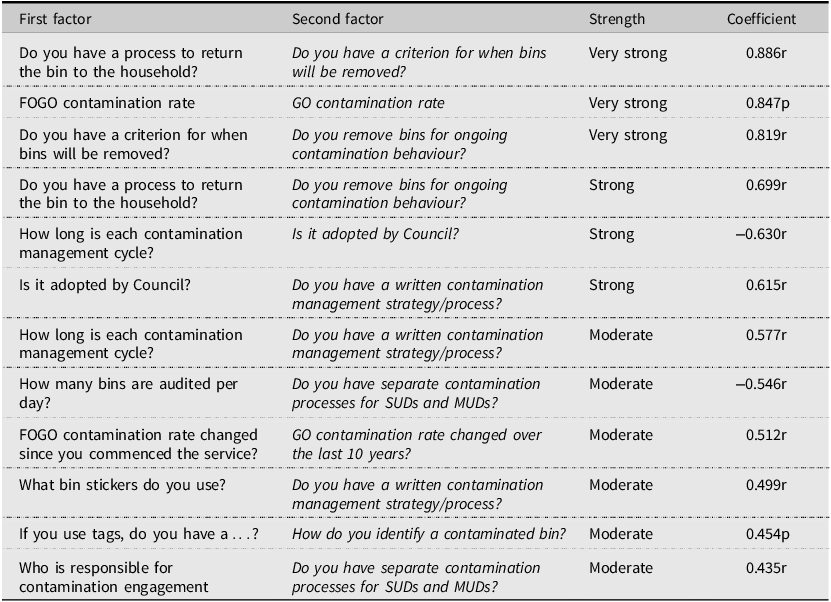
Strong correlations were observed in relation to bin removal criteria, bin return processes, and policy adoption (see Table 2). Spearman’s rho negative correlations indicated that longer contamination checking cycles and lower audit rates may contribute to higher contamination.
Descriptive analysis to identify potential correlations from the data

p = Pearsons correlation: ** Correlation is significant at the 0.01 level (2-tailed). r = Spearman’s rho absolute values of r shown when 0.40–0.59 as moderate, 0.6–0.79 as strong and 0.8–1 as very strong correlation.
Contamination Rates and Changes Over Time: The GO and FOGO contamination rates were significantly correlated (.847**p), indicating a strong relationship between the two systems.
Council Adoption of Policies: There was a strong correlation between the production of a formal, written contamination policy that having this policy adopted by elected members (.615**r). The importance of this relates to councillor support for waste policy application.
Contamination Management Cycle: The length of each contamination management cycle was negatively correlated with contamination rates (−.630**r), suggesting that longer contamination checking cycles may lead to increased contamination issues.
Bin Auditing and Removal: Removal of bins due to ongoing contamination behaviours and the use of an established criteria for managing kerbside bin contamination showed a very strong correlation (.819**r). The process for returning bins after removal was also strongly correlated with bin removal due to contamination approach (.699**r); and established criteria for the removal of the kerbside bin (.886**r). Table 2 represents these correlations according to the strengths of their relationships.
Moderate correlations worth noting were as follows
Contamination Rates and Changes Over Time: The FOGO contamination rate since the service commenced was moderately correlated with changes over time (.512**r) indicating changes due to familiarisation with the kerbside bin system.
Bin Auditing and Removal: The number of bins audited per day had a moderate negative correlation with differentiated policies (−.546**r) indicating that councils with differentiated contamination policies tend towards increased bin audits
Contamination Identification and Engagement: The existence of a written contamination management strategy and associated process moderately correlated with the use of bin stickers to communicate contamination to residents (.499**r).
Differentiated policies for MUDs and SUDs moderately correlated with who is responsible for contamination engagement (.435**r).
Use of Bin Tags: The use of bin tags to communicate contamination to the residents moderately correlated with how contamination is identified in the kerbside bin (.454**p).
Discussion
It is widely accepted that to achieve the sustainability goals embedded in Australia’s waste reduction targets will requires a concerted, whole-of-community, effort (Karimipour et al., Reference Karimipour, Tam, Burnie and Le2019). However, this study indicates that, despite extensive efforts by councils, a disconnect remains between councils’ kerbside waste services and the community’s current use of it, suggesting that more research needs to be undertaken into alternatives to purely behavioural interventions. While this study is small, it represents practice in a diverse geographic and sociodemographic situations, with varying council make ups, staff numbers, and resident bases. Therefore, even a study of this nature raises significant questions around policy and practices to achieve community cooperation, capacity, and understanding, especially when viewed through the lens of contamination. Four key points were raised in this paper in response to the research question guiding the study: RQ: Are current local government kerbside recycling, GO and FOGO bin contamination avoidance strategies effective in generating usable feedstocks for a circular economy? Observed trends in contamination rates for recycling, GO, and FOGO bins
High recycling contamination rates have been associated with community confusion which in turn may be associated with unclear messaging by councils or messaging in one council district conflicting with that issued in another district (Benyam et al., Reference Benyam, Kinnear and Rolfe2018; Wang et al., Reference Wang, Shreedhar, Galizzi and Mourato2022). These messages are themselves dictated to by diversity in materials accepted by Materials Recovery Facilities leading to inconsistency in recycling rules (Middha & Horne, Reference Middha and Horne2024b). Currently, vestigial markets, stream inconsistency and cheap virgin material availability exacerbate a lack of market pull to support councils’ diversion of waste into resource (Cáceres Ruiz & Zaman, Reference Cáceres Ruiz and Zaman2022). Policy that demands waste diversion by councils has subsequently been identified as needing a broader remit that includes the push and pull factors acting upon councils – from control of non-recyclable materials entering the marketplace to infrastructure and technology for processing and markets for circulating (Infrastructure Australia, 2019; Infrastructure Victoria, 2019).
In contrast, GO and FOGO bins generally maintain lower contamination rates, with most councils reporting levels at or below 5%. The concern is therefore perhaps more around the quantity of FOGO that a mandate launches upon the market, plus the potential for pernicious contamination, such as PFAS, to derail its usage. At the same time, the relative stability of contamination levels in GO and FOGO bins suggests that these waste streams benefit from clearer guidelines and stronger community adherence, bearing in mind that they are simpler systems with simpler messaging.
Whilst governments struggle to legislatively address changing materials entering the marketplace, and sorting methodologies and technologies continue to evolve, the responsibility remains with councils to find ways of managing waste and combatting contamination. The results here indicated that currently a combination of well-resourced, regularly undertaken and publicly visible contamination management practices, alongside councillor-approved policy, achieves best results. Where contamination checking cycles are short and bins are checked regularly, contamination rates are reported as reduced. This social modelling (Kaufman et al., Reference Kaufman, Meis-Harris, Spanno and Downes2020) form of community interaction is known to be expensive, time consuming and resource intensive. However, cleaner recycling streams have been shown to balance this cost (Lee, Reference Lee2022). It is noted that where councils have endeavoured to extend their recycling capacity, allowing a broader range of materials in the recycling bin, they have created precedents and expectations that other councils do not always embrace, resulting in materials being considered contamination by one council and not by the other. With modern populations relatively mobile, it is inevitable that residents will find themselves moving, with existing expectations, to council areas where those expectations fail to match local reality. Thus, otherwise well-intentioned contamination may continue to increase.
Formal contamination policies, implementation and planning
The existence of formal contamination policies in 50% of municipalities surveyed inferred that half of these regions recognised the need for structured interventions and had the organisational support to determine them. Where councils had a process to remove consistently contaminated bins, they also had one for return of the bins, thereby indicating councillor acceptance and a stronger nexus between waste and local members. However, the fact that only 29% of these policies are formally adopted suggests potential barriers to policy implementation, such as budget constraints, political considerations, and perceived community resistance.
Another key consideration is the need for greater differentiation in contamination policies between SUDs and MUDs. The findings indicate that many councils do not yet distinguish between these housing types, despite their differing waste disposal challenges. Residents of MUDs often face unique barriers such as limited access to proper waste infrastructure, lack of space for multiple waste streams, and reduced direct engagement with waste education initiatives. Developing targeted strategies that address these specific challenges, such as centralised waste stations or improved signage and communication within apartment complexes, could improve compliance and reduce contamination rates in these settings. The retrofitting of macerators and how this interacts with the wastewater system is currently under both research and discussion (Jazbec et al., Reference Jazbec, Turner, Madden and Nghiem2023; Turner et al., Reference Turner, Fam, Madden and Liu2017). It is worth noting that this, again, is a council response to a lack of waste consideration at the planning stage beyond councils’ controls which creates situations where councils’ capacity to provide a service to certain building types is challenged. Addressing these planning gaps requires a more nuanced approach that accounts for the unique waste disposal challenges faced by MUD residents and stronger consideration of waste services at the planning stage, especially those that circumvent council operations.
Community engagement strategies employed to improve waste sorting behaviours
Community engagement and education clearly play an essential role in fostering change in attitudes and behaviours and preventing contamination at the source. Councils employ a range of strategies to enhance public awareness and encourage responsible waste disposal. These approaches align with the best global practices, where behavioural interventions and community participation have been shown to improve waste sorting and reduce contamination (Kaufman et al., Reference Kaufman, Meis-Harris, Spanno and Downes2020). This study’s findings highlight the ongoing efforts of councils to balance enforcement with education, ensuring that waste management policies remain both effective and publicly accepted (Lane et al., Reference Lane, Kronsell, Reynolds, Raven and Lindsay2024).
However, despite these efforts, challenges persist in ensuring compliance with correct waste sorting practices. The increasing reliance on enforcement measures, such as issuing letters and bin removals, suggests that existing educational strategies may not be sufficient in changing long-term behaviours. This raises questions about the need for more targeted educational campaigns that account for demographic, cultural, and socio-economic differences in waste disposal habits. Research has shown that tailored messaging and localised engagement can significantly enhance public participation in recycling programmes (Roe et al., Reference Roe, Qi, Beyl, Neubig, Apolzan and Martin2022). Therefore, more personalised and community-driven initiatives that integrate social modelling and learner agency with social media have the potential to yield more effective outcomes but remain dependent on councils’ resource capacity and awareness of engagement options.
Engagement mechanisms for contamination control varied widely among respondents. The most common approach, reported by 79% of councils, included issuing letters to offenders. While this method serves as an initial warning, its effectiveness may be limited without complementary measures. More than half of respondents indicated that they resort to bin removal for repeat offenders, an approach that serves as a strong deterrent but may also lead to unintended consequences, such as illegal dumping.
The role of technology in identifying and mitigating contamination
The urgency of the waste issue has raised calls for more rigorous policy enforcement and innovative engagement strategies, plus consideration of alternative technologies and methodological buffers, from anaerobic digestion of organics to production of Solid Recovered Fuel from plastics (Advetec, 2024). Continued contamination is driving innovation and the use of AI to assist. In-truck technology has become an important tool for contractors, although its success depends on the level of driver engagement with contamination recognition and management. Questions have also been raised about consistency in contractor communication of contamination events. Effective contamination management increasingly relies on data collection, the usefulness of which is reliant on inter-organisational integration pathways to allow for real-time monitoring and for councils to track contamination incidents more accurately and implement targeted interventions.
Technology therefore plays a crucial role in improving waste management efficiency (Sanciolo et al., Reference Sanciolo, Rivera, Navaratna and Duke2022). The growing adoption of in-truck technology for identifying contamination presents an opportunity for more data-driven policy decisions. Real-time monitoring can help contractors and/or councils identify contamination hotspots and adjust educational efforts accordingly. Additionally, advancements in waste sorting infrastructure, such as AI-powered sorting facilities, could further alleviate the burden of contamination by automating material recovery processes (Wilts et al., Reference Wilts, Garcia, Garlito, Gómez and Prieto2021). The integration of such technologies, combined with effective policy enforcement, could lead to more sustainable and cost-effective waste management systems.
In addition to policy and technological interventions, broader systemic changes must also be considered. The contamination of recycling and organic waste streams is often a symptom of wider issues within the waste management system, including inconsistent product labelling, lack of standardisation in recyclable materials, and a nascent market demand for recycled goods (Devin & Richards, Reference Devin and Richards2018; Rashid & Shahzad, Reference Rashid and Shahzad2021). Indeed, in the Australian scenario, it could be said that the efficiency of councils in managing kerbside waste has covered up the background issues, delaying recognition of waste management as an essential service and subsequent consideration through the consumption chain.
Conclusion and recommendations
Addressing these structural issues requires collaboration across all levels of government, businesses, and consumers to create a more cohesive circular waste economy. Policy measures such as EPR schemes, which hold manufacturers accountable for the end-of-life management of their products, could play a crucial role in reducing contamination at the source by improving packaging design, message clarity, and recyclability. These means of ‘building in’ recyclability will reduce the importance of individual or even council engagement with the waste cycle.
This paper explored the interaction of waste contamination with current council policies and through discussion, offered insights into optimising waste collection services, reducing contamination, and fostering greater community engagement in sustainable waste practices. It also brought into question the current approaches to community engagement with contamination management, opening the door to further research into alternative environmental education options. A multifaceted approach that integrates policy refinement, technological advancements, and insights into change and community engagement will be essential in creating a more sustainable and efficient waste management system in the future.
Overall, the results highlight the complex and multifaceted nature of kerbside waste contamination. While some progress has been made in managing GO and FOGO streams, Recycling contamination remains a significant challenge. The variations in policy adoption, enforcement mechanisms, and technological interventions suggest that municipalities require more support to address contamination effectively. The findings underscore the need for a balanced approach that reconsiders policy design from a stakeholder perspective whilst also integrating policy enforcement, technological innovations, and ongoing community education to improve waste sorting behaviours and enhance overall waste management efficiency.
Policy recommendations
Based on the findings, policymakers, practitioners and governments should consider the following recommendations to enhance waste management and reduce contamination:
For government to recognise the current gaps between theory and practice in shifting waste collections to circular resource recovery. This requires a better understanding of emerging environmental education and engagement theories and their translation into effective, reform-enabling practice. This study would provide the baseline for testing more effective community engagement solutions designed to overcome the complexities of contamination management.
For key stakeholders to encourage innovation and public–private partnerships. Funding and support for innovation and development of waste technology whilst ensuring risks are addressed but that regulations do not inhibit progress. For example, the use of in-truck monitoring technology and AI-powered sorting systems to improve contamination detection and streamline processing efforts are ideal pathways to public–private partnerships. The generation of clean streams is required for market confidence which will then encourage ccollaboration with businesses and community organisations to develop circular economy initiatives that promote material recovery and waste minimisation.
For government to enforce EPR schemes – Require manufacturers to adopt sustainable packaging practices and take greater accountability for the end-of-life disposal of their products. This includes lobbying of government by councils to place emphasis on designing out waste and designing in recyclability in connection with the drive towards a circular economy.
To support pathways for councils to share effective contamination policies. Support councils’ development and enforcement of contamination policies across municipalities, providing consistency in waste management regulations that balances with social modelling and use of social connection systems for public messaging. This includes policy differentiation for diverse structures, such as MUDs, to introduce targeted interventions such as centralised waste collection points, clearer signage, and increased on-site engagement with residents.
For key stakeholders, especially councils, to test alternative community engagement processes to normalise waste sorting. Tailor educational materials to specific demographics, ensuring that language, accessibility, and cultural factors are considered when promoting correct waste disposal behaviours. This includes exploring new approaches that evolve beyond behaviourism towards a circular bio-economy. This will require further research and a form of transition brokerage to determine best practice.
By implementing these recommendations, policymakers and stakeholders can foster a more sustainable, circular, and effective waste management system, reducing contamination, improving recycling rates, and mitigating environmental impacts.
Acknowledgements
We are grateful to all participants in these studies for sharing their time and expertise and giving permission for this study to be undertaken.
Ethical statement
All materials and processes were in accordance with the Australian National Statement on Ethical Conduct in Human Research and ethics approval was gained from CQ University’s Human Research Ethics Committee (Ref. 00000 22641).
Financial support
This work was supported by the End Food Waste Australia Cooperative Research Centre, whose activities are funded by the Australian Governments Cooperative Research Centre Program, and by CQ University. Approval to publish reference number: EFWCRC Publication 2025_022.
Author Biographies
Esther Landells is a waste policy analyst working with Local Government NSW. Her main research is on waste management by local government, specialising in food waste diversion from landfill and circular economy implementations. She provides advice across levels of government on effective waste management practices, seeking to fill the transition brokerage gap between research, policy and practice. As an early career researcher, Esther is now combining her passion for applying effective waste interventions with her academic interest in behaviour change.
Anjum Naweed is a Professor of Human Factors and Operational Readiness at theAdelaide campus of CQUniversity Australia. His research focuses on complexdecision-making, human factors, and the interplay between people, technologies,tools, environments, and systems. Anjum has co-edited books, published over 175peer-reviewed articles and secured more than $7.5 million in research funding. Heserves as Scientific Editor for the international leading journal, Applied Ergonomics,and his work has received numerous accolades, including two Vice-Chancellor’sAwards for Outstanding Researcher of the Year.
Olav Muurlink is a social and health psychologist whose research focuses onworking time and counter-attitudinal behaviour. He holds degrees from The Universityof Queensland, University of St Andrews, and Griffith University. He chairs Co-operation in Development, one of Bangladesh’s largest educational charities,extending his work into public health, climate impacts, and demographics. Hisbusiness background spans manufacturing and media, including export andpublishing ventures in Australia and China. He has also consulted for the British, New Zealand, and Queensland governments on psychological and social researchprojects.



 Open access

