


Where central state authority is limited, local leaders often play a key role in mobilizing political engagement. Yet, why are some more effective than others in mobilizing citizens, for instance, to participate in election campaigns or vote for a candidate?
Scholars addressing this question focus on how characteristics of leaders and citizens shape mobilization. Some consider leader-citizen relationships and emphasize leaders’ physical and social proximity (e.g., Auyero Reference Auyero2001; Jöst and Lust Reference Jöst and Lust2025; Ravanilla, Dotan, and Hicken Reference Ravanilla, Dotan and Hicken2022; Stokes et al. Reference Stokes, Dunning, Nazareno and Brusco2013) and shared identities with their supporters (Ferree, Gibson, and Long Reference Ferree, Gibson and Long2021; Posner Reference Posner2005). This body of work has shed light on how leader–citizen relationships are structured as well as how poor and marginalized voters often depend on leaders in their daily lives (Auyero Reference Auyero2001; Koter Reference Koter2013). Other scholars, drawing on the classical literature on political participation, highlight citizens’ individual-level characteristics, such as wealth, education, and gender, as shaping engagement (Gallego Reference Gallego2014; Smets and Van Ham Reference Smets and van Ham2013; Verba and Nie Reference Verba and Nie1972). In much of the Global South, for instance, less affluent individuals are more likely to participate than wealthier ones (Kasara and Suryanarayan Reference Kasara and Suryanarayan2015).
We argue that understanding variation in leaders’ mobilizing power requires bridging these two perspectives. Existing work has convincingly shown that brokers’ and leaders’ influence depends on both leader characteristics and voters’ vulnerabilities, such as poverty (Jöst and Lust Reference Jöst and Lust2025; Ravanilla, Dotan, and Hicken Reference Ravanilla, Dotan and Hicken2022; Stokes et al. Reference Stokes, Dunning, Nazareno and Brusco2013); much of this work echoes that of earlier scholars of clientelism who implicitly suggest that leader–citizen ties and individuals’ vulnerabilities increase individuals’ dependence across various aspects of their lives (Auyero Reference Auyero2001; Scott Reference Scott1972). Yet, these studies do not explicitly conceptualize the importance of leaders’ influence over multiple domains of individuals’ lives or test the relationship between more expansive dependence and leaders’ capacity to mobilize. Building on these insights, we introduce the concept of encompassing authority, which shifts attention to the scope of authority or, specifically, citizens’ understandings of how many aspects of their lives are influenced by a leader.
Encompassing authority reflects the difference between individuals who view the leader as having expansive, or encompassing, influence across multiple domains—for example, affecting their ability to find a job if needed, secure land and property rights, and maintain spiritual well-being—versus those who view the leader’s influence as limited to one or two specific domains, such as employment or secure property rights. We argue that leaders’ abilities to influence individuals on a single issue—for instance, mobilizing electoral support or engagement in public goods campaigns—derives not simply from the ties they have with individuals, the resources they bring to bear, or individuals’ vulnerabilities with regard to the issue at hand but rather from leaders’ influence across various domains. Two leaders with equal resources and ties to equally vulnerable individuals may differ in their ability to mobilize community members when one leader’s influence extends over more domains than the other’s. Mobilization outcomes should thus vary systematically with the breadth—not just the depth—of perceived leader authority, even when holding constant leader resources and individuals’ vulnerabilities.
Individuals are more likely to comply with leaders they perceive as having encompassing authority for both strategic and normative reasons. Strategically, they may comply because they fear that failure to do so jeopardizes good relations with leaders who can affect more dimensions of their life; the more encompassing a leader’s perceived authority, the greater the potential costs of falling out of favor, because the leader’s punishment or withdrawal of support could cascade across domains. Normatively, individuals may believe that leaders who affect more domains in their lives have more right to demand their compliance.
Despite its significance, encompassing authority has not been explicitly conceptualized, measured, and tested. Scholars have noted that leaders with broader influence can be more effective mobilizers (e.g., Auyero Reference Auyero2001; Baland and Robinson Reference Baland and Robinson2008; Baldwin Reference Baldwin2019; Scott Reference Scott1972; Zarazaga Reference Zarazaga2014), but they have not distinguished encompassing authority from leaders’ resources and ties with communities or individuals’ vulnerabilities. Leaders’ resources and individuals’ characteristics do shape authority, but encompassing authority operates as a distinct, relational feature: the same leader can be perceived as encompassing by some community members but not by others. Extant research has yet to systematically conceptualize encompassing authority or explore the mechanisms through which it shapes political behavior. We aim to fill this gap.
To do so, we use data from the Zambian Election Panel Study (ZEPS), an original survey conducted in the context of Zambia’s 2021 elections (n = 1,536; Lust et al. Reference Lust, Beardsworth, Krönke, Seekings and Wahman2021).Footnote 1 Zambia provides an important context for studying encompassing authority because, like many countries, state capacity is weak and a variety of local leaders play important and overlapping roles in politics. We focus on three types of local leaders who often seek to act as intermediaries, mobilizing voters to support MP candidates: religious leaders, village chiefs/neighborhood heads, and local councillors.Footnote 2
First, we examined which individuals perceive leaders as more encompassing. Second, we conducted a vignette experiment to measure how encompassing authority and shared identity affect respondents’ willingness to participate. We designed the scenarios based on individuals’ actual leaders (and their attendant qualities) to create a more realistic experimental treatment. We randomized which leader type makes the mobilization request (religious leader, chief, or local councillor), which campaign activities are requested, and which candidate characteristics are mentioned,Footnote 3 but we measured leaders’ characteristics— encompassing authority and social identity—through survey questions.Footnote 4 To examine the impact of encompassing authority on mobilization and the underlying mechanisms, we asked respondents how likely they would be (1) to participate and whether they anticipated sanctioning if they failed to comply, (2) to view the leader’s request as legitimate, and (3) to expect others to follow the leader.
Our analyses find that encompassing authority strongly predicts these leaders’ abilities to mobilize voters. Unemployment, education, and gender are related to how encompassing individuals perceive their leaders to be, and these relationships vary by leader type. Importantly, encompasing authority is significantly related to mobilization, even when leader type and individual characteristics such as poverty, education and gender are taken into account. Moreover, we uncover evidence that multiple mechanisms underlie this relationship: voters perceive leaders with more encompassing authority to be more likely to sanction noncompliance, more legitimate in requesting participation, and more effective in coordinating community action.
Our study makes four key contributions. First, we introduce and test encompassing authority as a distinct mechanism of political mobilization, demonstrating that the breadth of a leader’s influence across domains of individuals’ lives—not simply the depth of influence in a single domain— predicts mobilization capacity independently of leader type or individuals’ characteristics. In doing so, we expand the literature that has focused primarily on leaders, emphasizing the mobilizing power of different types of actors (Baldwin, Kao, and Lust Reference Baldwin, Kao and Lust2025; Díaz-Cayeros, Magaloni, and Ruiz-Euler Reference Díaz-Cayeros, Magaloni and Ruiz-Euler2014; Jöst and Lust Reference Jöst and Lust2025) or shared social ties between mobilizers and citizens (Atwell and Nathan Reference Atwell and Nathan2022; Cruz, Labonne, and Querubín Reference Cruz, Labonne and Querubín2017; Van Leeuwen et al. Reference Van Leeuwen, Ramalingam, Arjona and Schram2019). Second, we identify multiple pathways through which encompassing authority operates— including fear of sanctions, expectations about coordination, and perceptions of legitimacy—thereby providing a richer understanding of how encompassingness affects compliance than previous accounts. Third, we show that individual characteristics such as unemployment, education, and gender systematically shape which citizens perceive which leaders as encompassing, revealing that the same leader can have differential levels of encompassing authority across their community and helping explain why some leaders are more effective mobilizers than others. This finding extends studies focused on how voter characteristics relate to political participation (Kasara and Suryanarayan Reference Kasara and Suryanarayan2015; Verba and Nie Reference Verba and Nie1972). Finally, we join other recent work in demonstrating the value of studying election engagement beyond rallies and voting, highlighting various ways that mobilizers generate political support during election campaigns (Bob-Milliar and Paller Reference Bob-Milliar and Paller2023; Jöst et al. Reference Jöst, Krönke, Lockwood and Lust2024).
Leader Characteristics, Individual Traits, and Encompassing Authority
There are two main perspectives on why some leaders are more effective mobilizers. One centers on leader–citizen relations, especially leaders’ shared identity with followers and their social embeddedness in the community. The other focuses on citizens’ individual traits, such as socioeconomic status. This existing work demonstrates that leaders’ characteristics and individuals’ traits shape mobilization, but we argue that it overlooks a crucial factor: the breadth of a leader’s perceived influence across domains of citizens’ lives. We introduce the concept of encompassing authority to capture this element, which is distinct from leaders’ traits and individuals’ characteristics.
The first perspective focuses on leader–citizen relations: shared identity and social embeddedness. Leaders are expected to be more effective when they share key social characteristics, such as ethnicity, religion, or gender, with those they seek to mobilize. For instance, candidates are more effective in mobilizing voters who are co-ethnics (Adida Reference Adida2015; Carlson Reference Carlson2015; Ferree, Gibson, and Long Reference Ferree, Gibson and Long2021) and co-gender (Kao and Benstead Reference Kao and Benstead2021; Lust and Benstead Reference Lust and Benstead2024; Sanbonmatsu Reference Sanbonmatsu2002; Schwarz and Coppock Reference Schwarz and Coppock2022). These findings are consistent with social psychology theories indicating that people like, interact socially, and cooperate with others who share their social characteristics (Cialdini and Trost Reference Cialdini and Trost1998; McPherson, Smith-Lovin, and Cook Reference McPherson, Smith-Lovin and Cook2001) and with literature that highlights how individuals expect those in their in-group to be more likely to assist them than those of an out-group (Chandra Reference Chandra2004; Habyarimana et al. Reference Habyarimana, Humphreys, Posner and Weinstein2007). Thus, people should be more likely to comply with requests from mobilizers who share their social characteristics (i.e., gender and ethnicity). Footnote 5
Leaders who are more integrated into local networks, or embedded, through kinship or community associations are also seen as better positioned to build trust and coordinate action. Embeddedness has traditionally been conceptualized in terms of local belonging and measured through civic engagement and family ties (Cruz, Labonne, and Querubín Reference Cruz, Labonne and Querubín2017; Díaz-Cayeros, Magaloni, and Ruiz-Euler Reference Díaz-Cayeros, Magaloni and Ruiz-Euler2014; Ravanilla, Dotan, and Hicken Reference Ravanilla, Dotan and Hicken2022; Tsai Reference Tsai2007). Embedded leaders can more effectively leverage norms of reciprocity (Tsai Reference Tsai2007; Thachil Reference Thachil2014), generate accountability (Díaz-Cayeros, Magaloni, and Ruiz-Euler Reference Díaz-Cayeros, Magaloni and Ruiz-Euler2014), and coordinate collective action (Chwe Reference Chwe2022; Schelling Reference Schelling1980), thereby wielding greater influence over community members (Cruz Reference Cruz2019; Cruz, Labonne, and Querubín Reference Cruz, Labonne and Querubín2017; Van Leeuwen et al. Reference Van Leeuwen, Ramalingam, Arjona and Schram2019). Importantly, this literature generally treats embeddedness as a property that affects all community members equally; a leader who is embedded in a community should have the same level of influence over all the members within it.
However, this need not be the case. A mobilizer who is equally embedded in the community may still have very different relationships with individual community members. Consider, for example, a religious leader. The leader may affect all congregationalists’ spiritual paths, but for some members of the congregation, the leader also determines whether they can access charity or maintain their social standing in the community. The leader is the same, the embeddedness is the same, but the scope of the religious leader’s authority varies across individuals. Similarly, a local councillor may influence all community members by determining where donors place development projects, but for some, the local councillor also shapes access to much-needed aid or employment opportunities. This within-community variation in the breadth of the leader’s influence is not explained by embeddedness or shared identity alone.
A second perspective highlights the role of citizens’ characteristics. The classical literature on political participation has long shown that socioeconomic status, including education, wealth, and employment status, is closely associated with political engagement (Brady et al. Reference Brady, Verba and Schlozman1995; Gallego Reference Gallego2014; Verba and Nie Reference Verba and Nie1972; for an overview see Smets and Van Ham Reference Smets and van Ham2013). Initial work in this vein, based on findings from the United States and Europe, found that individuals of a higher socioeconomic status possess more resources and civic skills that facilitate their engagement.Footnote 6 Subsequent research from the Global South paints a contrasting picture, showing that low-income individuals are more likely to vote than wealthier ones (Kasara and Suryanarayan Reference Kasara and Suryanarayan2015). Yet, this literature typically focuses on participation rates in general, rather than on how individuals respond to specific mobilizers. It thus does not fully explain why the same vulnerable individual is more likely to comply with one leader than another.
Building on these insights, we argue that both leaders’ characteristics and the characteristics of the individuals they aim to mobilize shape leader influence, but that a critical dimension is not clearly conceptualized: the breadth of a leader’s perceived influence on various domains of an individual’s life. We propose the concept of encompassing authority to capture individual-level differences in the relationship between leaders and individuals. Encompassing authority refers to the extent to which a citizen perceives the mobilizer as affecting multiple domains of their life, such as access to employment, housing, food, and social networks. Crucially, we conceptualize encompassing authority as a dyadic construct: authority emerges from the interaction between a mobilizer and an individual, rather than from individual or mobilizer characteristics alone. The same mobilizer may be perceived as highly influential by some individuals but not by others, depending on how many domains of an individual’s life intersect with the leader’s sphere of influence.
This focus on dyads highlights the need to distinguish individual-level variation from broader communal perceptions of leaders’ influence. Encompassing authority is not simply a renaming of leader traits or citizen vulnerabilities. Leaders’ mandates and resources matter; those with broader mandates and greater resources have the potential to have more encompassing authority. However, whether that potential is realized also depends on individuals’ characteristics. Socioeconomically disadvantaged individuals, such as the unemployed and poor, often depend on local leaders for access to resources and social inclusion, making them more likely to view leaders as encompassing. At the same time, however, variation in life circumstances—family networks, religious practice, individual needs for acceptance—shapes how many domains in their life a given leader may influence.
We argue that encompassing authority helps account for why and when individuals, particularly those facing economic hardship, are more likely to comply with mobilizers, even in the absence of material incentives. This may be for both strategic and normative reasons. Strategically, when a leader influences multiple domains of everyday life, noncompliance carries greater risks: losing the leader’s support could have negative consequences across multiple areas of an individual’s life—their economic welfare, property rights, and social standing (Harris and Honig Reference Harris and Honig2023: Lust Reference Lust2022). Normatively, encompassing authority can also shape perceptions of legitimacy: individuals may believe a leader who has influence across multiple domains of their life has a greater right to request compliance. They may also expect that others would hold such views as well, facilitating coordination (Chwe Reference Chwe2022).
This may help explain well-documented patterns of compliance. Voters often cast ballots in accordance with their male heads of households, whose control extends over much of their lives (Schaffer Reference Schaffer2014). Similarly, poor people frequently respond to their neighbors’ calls for help, recognizing that they rely on them in turn for a wide range of support (Piff et al. Reference Piff, Kraus, Côté, Cheng and Keltner2010; Piff and Robinson Reference Piff and Robinson2017; Piff et al. Reference Piff, Stancato, Côté, Mendoza-Denton and Keltner2012). Accordingly, we expect individuals to be more likely to participate when they view mobilizers as having more encompassing authority. Footnote 7
Before exploring encompassing authority in more detail, it is important to consider how it relates to shared identity. One might expect that the lives of mobilizers and community members are more intertwined when they have a shared identity: they are more likely to attend the same schools, worship at the same churches, and engage in the same associations, thereby increasing mobilizers’ opportunities to influence multiple aspects of the community members’ lives. Shared identities such as co-ethnicity or co-partisanship are associated with social institutions or rules that obligate members of the same identity group to support one another (e.g., Habyarimana et al. Reference Habyarimana, Humphreys, Posner and Weinstein2009; Miguel and Gugerty Reference Miguel and Gugerty2005), which may translate into broader authority.
However, encompassing authority is not reducible to identity. It depends both on the expectations that leaders place on individuals and on the extent to which individuals rely on leaders for support. For this reason, we do not expect a one-to-one correspondence between identity and encompassingness, even when identity signals obligations of support. In our view, the two are complementary but distinct concepts: identity may serve as one channel through which encompassing authority is constructed, but encompassing authority also captures broader dynamics of dependence and obligation that extend beyond shared identity. Empirically, this means we should see encompassing authority predict mobilization, even when controlling for shared identity.
Overview of the Case and Data
Campaign Participation in Zambia
We explore these relationships in Zambia, a country with active political participation and heavily contested elections.Footnote 8 According to the 2020 (Round 8) Afrobarometer survey, it is not unusual for Zambians to engage in election activities such as attending a campaign rally, campaigning for a candidate, or contacting an MP. The 2020 Afrobarometer found that 37% attended a campaign rally, 15% had worked for a party or candidate, and 13% had contacted an MP. Moreover, 55% of Zambians reported having participated in a community meeting. The activities we focus on in this study—participating in a meeting with an MP or campaigning on behalf of a candidate—are thus realistic.
In Zambia, as in many countries, the central state is relatively weak, and local authorities therefore assume important responsibilities. A diverse array of local leaders mobilize voters. We examine three main leaders who are known to do so: religious leaders, who have long been active in Zambian politics (Cheyeka Reference Cheyeka2008; Cheyeka, Mwale, and Chita Reference Cheyeka, Mwale and Chita2022; Hinfelaar Reference Hinfelaar2008; McClendon and Riedl Reference McClendon and Riedl2019); local chiefs, who are prohibited from seeking most political officesFootnote 9 but nevertheless partner with MPs to advance development and, in turn, signal their support of specific candidates (Baldwin Reference Baldwin2015); and local councillors, who mobilize support for MPs out of interest for their party and often their future prospects (Beardsworth et al. Reference Beardsworth, Siame, Resnick and Fraser2021). Considering the extent to which religious leaders, local chiefs, and local councillors can influence community members’ willingness to engage in election campaigns allows us to engage with scholarship on authority, which often focuses separately on the roles of customary leaders (Baldwin Reference Baldwin2015; Díaz Cayeros, Magaloni, and Ruiz-Euler Reference Díaz-Cayeros, Magaloni and Ruiz-Euler2014; Magaloni, Díaz-Cayeros, and Ruiz Euler Reference Magaloni, Díaz-Cayeros and Euler2019; Murtazashvili Reference Murtazashvili2016), religious figures (Brooke and Mendoza Reference Brooke, Buckley, David and Mendoza2022; Kingsley Reference Kingsley2014; Koter Reference Koter2013; McCauley Reference McCauley2017), or armed groups (Arjona Reference Arjona2016; Arjona, Kasfir, and Mampilly Reference Arjona, Kasfir and Mampilly2015; Magaloni, Franco-Vivanco, and Melo Reference Magaloni, Franco-Vivanco and Melo2020).Footnote 10 It also allows us to consider leaders whose influence may vary in other aspects of individuals’ lives, with religious leaders playing a greater role in individuals’ spiritual well-being, local chiefs having greater influence on villagers’ daily lives, and local councillors being better placed to provide access to state resources.
Importantly, the activities we focus on in this study—attending a campaign meeting and campaigning on behalf of a candidate—are not under the exclusive mandate of any of these actors. The three sets of mobilizers we examine can and do call on community members to attend meetings with candidates and engage in their campaigns. When asked whether these authorities mobilized them to campaign for a candidate or attend a community meeting with an MP, 22% of the respondents in our survey reported that their local religious leader had asked them to do so; 31% said their local chief had asked this of them; and 37% noted their local councillor asked them to participate in a campaign or community meeting.
Nor does such mobilization appear to be unique to Zambia. Data from Round 8 of the Afrobarometer (2022) shows campaign mobilization in Zambia (15%) is near the average level (17%) across the continent.Footnote 11 Moreover, 55% of respondents report having attended a community meeting in the past, compared to a country average of 60% (Afrobarometer 2022). Such local actors play an important role in mobilization elsewhere as well. For instance, in a separate study we provide evidence that village heads, neighborhood chiefs, and local councillors drum up electoral support in Kenya, Malawi, and Zambia (Jöst and Lust Reference Jöst and Lust2025). These results give us reason to believe that this study’s findings generalize to other countries in the region and likely beyond.
Survey Data
To test our theoretical expectations, we use data from the ZEPS dataset, an original survey (n = 1,536) conducted around the 2021 elections (July 15–August 10, 2021; Lust et al. Reference Lust, Beardsworth, Krönke, Seekings and Wahman2021).Footnote 12 This survey was administered by phone, using numbers collected from respondents of the Local Governance Performance Index (LGPI), a 2019 face-to-face household survey (Lust et al. Reference Lust, Kao, Landry and Harris2020; see figure 1 for the sampling map).
Heatmap of 2021 Respondents with an Overlay of the Locations of Respondents in the 2019 Survey
Notes: Black dots represent respondents in the 2019 LGPI survey. Orange locations present respondents’ location in the 2021 ZEPS survey and the survey experiment. Shades of color reflect the number of respondents by location.

Figure 1 Long description
The map displays the administrative boundaries of Zambia. The data is concentrated in two primary regions.
In the East and Northeast, a continuous vertical band of districts along the border is shaded in varying intensities of orange, indicating 2021 Z E P S survey respondents. Within these orange-shaded districts, clusters of black dots represent the 2019 L G P I survey respondents, particularly dense in the northernmost and central-eastern border areas.
In the South-Central region, a cluster of three districts shows a high concentration of both data sets. The central district in this cluster is shaded a darker orange and contains a very dense, circular mass of black dots, indicating a major urban center or high-response area.
Isolated light orange shading appears in two districts in the North and one in the Central-East. The Western and Southern regions of the map are entirely white, indicating no respondents from either survey in those administrative areas.
The survey sample primarily includes respondents from Lusaka, Muchinga, and Eastern Provinces, districts where former President Lungu’s party, the Patriotic Front (PF), won decisively in 2016. These districts were influential in past elections (Seekings Reference Seekings2022), and they proved so again in 2021 by swinging votes to the opposition victor, President Hakainde Hichilema (HH).Footnote 13 Comparison with census data suggests that the sample slightly underrepresents younger respondents and, in some districts, overrepresents male respondents. These sampling details should be considered, although we have little reason to believe they affect our analysis (see balance tests in tables B.1–B.4 in the appendix).Footnote 14 Table 1 presents descriptive statistics for the survey sample.
Descriptive Statistics of Individual-Level Measures from the 2021 Survey

Table 1 Long description
The table contains two columns: Attribute and Percent.
Gender distribution:
* Woman: 46.03
* Man: 53.97
Education levels:
* No formal education: 2.41
* At least some primary education: 27.54
* At least some secondary education: 52.34
* Post-secondary or higher education: 16.99
* Refused to answer on education: 0.72
Age ranges:
* Age 18 to 34: 50.07
* Age 35 to 54: 38.35
* Age 55 to 74: 11.07
* Age 75 to 92: 0.52
The total number of survey respondents is 1,536.
Explaining Perceptions of Leaders’ Encompassing Authority
Measurement of Encompassing Authority
To measure the degree of encompassing authority, we relied on survey questions asking how different types of mobilizers affect an individual’s well-being. We chose a range of activities for which each of the three leaders could have impact,Footnote 15 including the ability to make it through hard times, obtain and secure land and property rights, find a job, ensure their personal safety, have positive social relations with others in their community, and further their spiritual well-being.Footnote 16 The battery asks individuals to say whether they think their local religious leader, local councillor, local chief, or all leaders equally affect their ability to meet a range of needs essential to personal well-being.
Our main measure, encompassing authority, is a simple additive index measuring each actor’s influence over these activities. Responses to each subquestion are captured using three indicator variables, one for each leader. An indicator variable is coded as “1” if the specific leader was selected for the sector or if “all mobilizers equally” was chosen, and as “0” if the specific mobilizer was not selected. We then calculated the primary measure of encompassingness separately by the type of leader.
In addition, we created secondary measures of encompassingness to explore whether different dimensions drive the association between encompassingness and participation. Using factor analysis, we uncovered three dimensions of encompassingness: material-social, including assistance, property, safety, and social relations; economic, including assistance and help finding a job; and spiritual, including assistance, well-being, and property (see table C.1 in the appendix).
Predictors of Encompassing Authority: Community and Individual Characteristics
We used observational data from the survey to examine the extent to which individual or community characteristics are associated with the encompassingness of various authorities. Doing so allowed us to consider how a focus on encompassingness relates to the literature focused on individual-level drivers of participation. It also probed potential concerns that conditions at the local level explain the encompassingness of local chiefs, local religious leaders, or local councillors. Encompassing authority, in this case, would reflect a community-level pattern, rather than dyadic relationships between individuals and authorities.
First, we used ordinary least squares (OLS) to regress encompassing authority on respondents’ individual-level characteristics and to examine how individual traits such as age, gender, and socioeconomic status are associated with perceptions of leaders’ encompassingness. Education was categorized as “no formal education” compared to “some education,” “secondary education,” or “higher education.” Age was measured in brackets: “18–34,” “35–54,” “55–74,” and “75 and above.” We also controlled for the specific leader presented to respondents in the vignette experiment, which we discuss in the next section. Unemployment (0/1) was measured using the survey question: “Do you have a job that pays a cash income/salary?” Poverty was measured using a survey question that asks respondents whether their household income is sufficient to cover their needs.Footnote 17
We found that individual traits predict the extent to which an individual perceives a leader as encompassing and that the associations between traits and perceived encompassingness differ by leader type (see table 2). Unemployed individuals are significantly more likely to perceive local chiefs and local councillors as encompassing (p <0.01), compared to respondents who report having a steady income. However, as the models disaggregated by local leader type show, this pattern does not hold for religious leaders. Poverty, by contrast, is associated with lower perceptions of local councillors’ encompassing authority (-0.185, SE = 0.085, p <0.05) but not with perceptions of religious leaders and local chiefs.
Regression Results with Individual-Level Characteristics and Encompassing Authority as DVs

Table 2 Long description
The table presents O L S regression results across three models. The columns represent the dependent variables: Local chief, Religious leader, and Local councillor.
* Poverty: Local chief -0.062 (0.095), Religious leader -0.088 (0.098), Local councillor -0.185* (0.085).
* Unemployment: Local chief 0.303*** (0.077), Religious leader -0.122 (0.079), Local councillor 0.276*** (0.069).
* Education (baseline: no formal education):
- At least some primary: Local chief 0.570* (0.244), Religious leader -0.616* (0.250), Local councillor -0.177 (0.219).
- Secondary: Local chief 0.251 (0.241), Religious leader -0.658** (0.247), Local councillor -0.063 (0.216).
- Postsecondary: Local chief -0.314 (0.251), Religious leader -0.489+ (0.257), Local councillor -0.117 (0.225).
* Female: Local chief -0.336*** (0.072), Religious leader 0.167* (0.074), Local councillor -0.066 (0.065).
* Age (baseline: 18 to 34):
- 35 to 54: Local chief 0.002 (0.078), Religious leader -0.013 (0.080), Local councillor 0.026 (0.070).
- 55 to 74: Local chief 0.006 (0.121), Religious leader 0.025 (0.124), Local councillor -0.267* (0.108).
- Greater than 74: Local chief -0.812+ (0.477), Religious leader -0.079 (0.489), Local councillor 0.234 (0.428).
* Authority given in Experiment (baseline: religious leader):
- Local chief: Local chief 0.034 (0.087), Religious leader -0.159+ (0.089), Local councillor 0.168* (0.078).
- Local councillor: Local chief -0.001 (0.087), Religious leader 0.012 (0.089), Local councillor 0.075 (0.078).
* Constant: Local chief 1.434*** (0.262), Religious leader 2.893*** (0.269), Local councillor 1.320*** (0.235).
* Summary Statistics: Number of observations is 1,431 for all models. R-squared values are 0.070 for Local chief, 0.016 for Religious leader, and 0.024 for Local councillor.
Significance levels: *** p < 0.001, ** p < 0.01, * p < 0.05, + p < 0.1. Standard errors are in parentheses.
Notes: Standard errors are in parentheses. OLS regression with additive index of encompassing authority as DV. ***p < 0.001, ** p < 0.01, * p < 0.05, +p <0.1.
Education and gender also appear to shape perceptions of encompassing authority. Respondents with no formal education are more likely to view religious leaders as influential compared to those with primary, secondary, or higher education. Women are also more likely to report that the religious leader is encompassing, although they are significantly less likely than men to perceive the local chief as influential.
These findings suggest that perceptions of a leader’s authority are not only shaped by their formal leadership role—and are thus constant across individuals—but also by the characteristics of the citizens and authorities. This highlights the influence that local leaders, in particular local chiefs and councillors, have in the lives of more vulnerable citizens, as suggested in previous work (Auerbach Reference Auerbach2019; Jöst and Lust Reference Jöst and Lust2025; Thachil Reference Thachil2014). The findings also suggest, however, that variation in individuals’ needs and the nature of different authorities may shape encompassingness. For instance, the finding that unemployment is associated with encompassingness while poverty is not may reflect beliefs that authorities such as local chiefs and local councillors can help individuals find a job, whereas many may view poverty, in a context like Zambia, as intractable. Similarly, women may be more likely to see religious leaders as encompassing because they may be more engaged with the church, whereas men view local chiefs as encompassing because they are more engaged in village affairs.
The observational data uncover a dyadic relationship between individual characteristics and encompassing authority of various leader types but do not reveal a similar relationship with community-level factors. The intra-class correlation (ICC) is 0.08, meaning that community-level factors account for only a small share—about 8%—of the overall variation in encompassing authority. The vast majority (92%) of differences arise among individuals within communities, suggesting that encompassing authority is largely shaped by individual rather than contextual characteristics.Footnote 18
The Relationship between Encompassing Authority and Willingness to Comply
Vignette Experiment
We drew on a vignette experiment to explore the relationship between encompassing authority, leader type, and citizens’ stated willingness to comply. In our survey, we presented respondents with a vignette, which asked them to imagine that their local leader is requesting them either to attend a community meeting to raise concerns to the MP or to campaign for a parliamentary candidate. We randomized the mobilizer type and activity to examine the impact of different mobilizers on individuals’ willingness to comply with their requests, but we refrained from randomizing mobilizer identity and encompassing authority. We were concerned that introducing a hypothetical mobilizer would not align with respondents’ actual knowledge of the local intermediary, and we doubted the credibility of randomizing mobilizer influence in a survey experiment. Consequently, we assessed mobilizers’ attributes through observational survey questions and incorporated these variables into our analysis.Footnote 19 The experiment begins with the following prompt: “We realize that campaigns are in session, but for now, I’d like you to consider a hypothetical situation.”
The interviewer then read the following vignette. The attributes in brackets were randomized with equal probability. Items in parentheses were assigned based on the randomly chosen attributes.
I’d like you to imagine that [your local religious leader/ your local chief or neighborhood leader/Footnote 20 your local councillor] is urging you to [help campaign for a candidate for Member of Parliament/attend a community meeting, expressing local concerns to the MP candidate].
The MP candidate is a [co-ethnic (respondent’s ethnicity piped-in)/non-co-ethnic (randomly chosen, non-coethnic with respondent piped-in)] [man/woman] running for parliament as the [co-party (respondent’s preferred party piped-in)/non-co-party (randomly chosen other party)] candidate. (He/she) was [born here/born in a different region] (and/but) [currently lives in a village or neighborhood nearby/currently lives in a village/neighborhood on the other side of the district].
Your [local religious leader/local chief or neighborhood leader/local councillor] is keen on you helping campaign for a parliamentary candidate/attending a community meeting, expressing local concerns to the MP candidate, [but is not keeping track of whether or not you do/and will be keeping track of whether or not you do.] [No one else in the community is/Many others in the community are] keeping track of whether or not you campaign for the candidate/attend the meeting.
[Many/None] of your friends have already agreed to join in the campaign/attend the meeting and [you will be compensated for your efforts/you will not be compensated for your efforts].
After the vignette was read, interviewers asked several questions that we used to measure compliance and tap into the underlying mechanisms (discussed later). These follow-up questions, posed in a fixed order with the mobilizer and action described in the vignette piped in, are our dependent variables in the analyses. To measure willingness to participate, we asked, “How likely are you to spend a day helping campaign for a parliamentary candidate/attending a community meeting, expressing local concerns to the MP candidate?” The answer set is very likely, somewhat likely, not very likely, not likely at all, and don’t know/refuse to answer.
To test our expectations regarding shared social identity, we added two follow-up questions to measure the mobilizers’ ethnicity and gender: “Please think of your [local religious leader/local chief or neighborhood leader/local councillor]. First, tell me: is this a man or a woman?” and “Is (he/she) (piped in respondent ethnicity)?” We coded respondents as “1” if they shared the mobilizer’s ethnicity and as “0” otherwise, and we did the same with gender. The leader’s social characteristics are not randomly assigned in the experiment, and moreover, local leaders are more likely to be male. Thus, this is not an experimental test of the shared identity hypothesis, and the skewed distribution toward male mobilizers (i.e., that male respondents are thus more likely than females to have been called on by co-gender leaders) limits our ability to test the significance of co-gender effectively. We nevertheless believe it is important to explore these relationships and thus test the effect of mobilizer identity by including both co-gender and co-ethnicity separately in the analysis.
Analyses of Encompassing Authority and Stated Willingness to Participate
We analyzed the relationship between encompassing authority and willingness to participate in four ways: using the main additive measure and the three dimensions—social-material, economic, and spiritual—of encompassing authority. We rescaled our measure of participation to take values between 0 and 1 and used OLS regression in the analysis (Hainmueller, Hopkins, and Yamamoto Reference Hainmueller, Hopkins and Yamamoto2014).
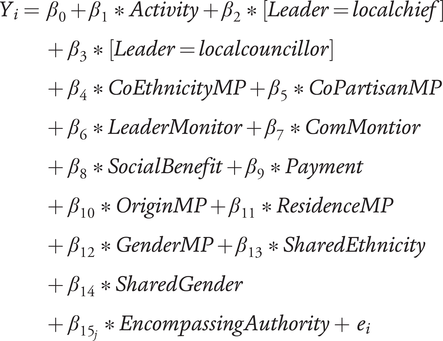
Model M1 includes all experimental attributes and additional observational variables for co-gender, co-ethnicity, and encompassing authority. Our dependent variable, yi, is the respondent’s stated willingness to participate, and β0 denotes the intercept. The coefficients of the experimental attributes are included as β 1 to β 12 in the model specification. Moreover, β 13 is added to the model, indicating the coefficient on whether the respondent shares the ethnic identity of the mobilizer making the request, whereas β14 denotes the coefficient on shared gender. The variables are coded as dummy variables with “1” denoting “shares the identity of the mobilizer” (i.e., ethnicity or gender) and “0” otherwise. β15 indicates the coefficient on social centrality, and β16 is the coefficient on encompassing authority. The residual is included as ei in the model.
M1 Main effects model with measures of leader shared identity, social centrality, and encompassing authority
Results of Analyses on Willingness to Participate
The results show that encompassing authority significantly predicts respondents’ willingness to participate (see table 3).Footnote 21 The relationship is significant for the overall measure of encompassingness and for the material-social and economic dimensions. It is not significant for the spiritual dimension of encompassingness.
Regression Results with Encompassing Authority and Shared Identity and Participating as DV

Table 3 Long description
The table lists independent variables in the first column and the dependent variable Participating across four columns.
Independent variables and their coefficients (standard errors in parentheses):
* Encompassing authority: 0.024 super ** (0.008) in model 1.
* Encompassing: social material: 0.031 super ** (0.010) in model 2.
* Encompassing: economic: 0.039 super * (0.017) in model 3.
* Encompassing: spiritual: 0.007 (0.016) in model 4.
Control variables consistent across all four models:
* Mobilizer co-gender: coefficients range from 0.014 to 0.017 (0.022).
* Mobilizer co-ethnic: coefficients range from 0.037 to 0.039 with + significance (0.023).
* Community meeting: 0.138 to 0.139 super *** (0.022), showing the strongest positive correlation.
* Local chief: -0.021 to -0.049 (0.027 to 0.028).
* Local councillor: 0.003 to 0.028 (0.028 to 0.031).
Bottom rows:
* Experimental attributes: marked with a checkmark for all models.
* Number of Observations: 1,268 for all models.
* R super 2: ranges from 0.064 to 0.071.
Notes: Standard errors are in parentheses. O L S regression models. Significance levels: *** p < 0.001, ** p < 0.01, * p < 0.05, + p < 0.1.
Notes: Standard errors are in parentheses. OLS regression models. Full models are reported in table C.6 in the appendix. ***p <0.001, **p <0.01, *p <0.05, +p <0.1.
In our model, the respondents’ stated willingness to participate increases by 2.4 percentage points (SE = 0.008, p <0.01) with every one-point increase in encompassing authority, measured as the number of activities (ranging from 0 to 6) over which the mobilizer has influence.Footnote 22 Their stated willingness to participate increases by 3.1 percentage points (SE = 0.010, p <0.01) for the social-material dimension of encompassing authority and 3.9 percentage points (SE = 0.017, p <0.05) for the economic dimension. Respondents’ stated willingness to participate in a community meeting and raise concerns to the MP is significantly higher than the willingness to campaign for a political candidate (0.14, SE = 0.02, p <0.001).
However, the type of actor is not significant. As shown in table 3, neither local chiefs nor local councillors are better able to mobilize support than local religious leaders; thus, although individual characteristics and leader type, combined, are associated with encompassing authority, it is not leader type that drives the association between encompassing authority and participation.
Similarly, the results suggest that shared identity may influence encompassing authority but does not fully explain the relationship between encompassing authority and the stated willingness to participate. Shared ethnicity between the mobilizer and respondent is not significantly associated with respondents’ stated willingness to participate in any of the four models. Furthermore, when we estimate the model without encompassing authority, co-ethnicity is significant at the 90% level; however, once encompassing authority is included, the effect of co-ethnicity drops slightly (to 0.037; see table C.5 in the appendix). This suggests that encompassing authority helps account for the mobilizing role of co-ethnicity, but encompassing authority and shared identity are distinct. We do not find any significant effect of co-gender in this context.
What Underpins the Relationship between Encompassingness and Mobilization?
Potential Mechanisms
Recognizing the influence of shared identity and encompassing authority still does not answer why these factors make some local leaders more effective than others. As described earlier, we expect that those with more encompassing authority will be more effective mobilizers, at least in part because they have more levers by which to sanction individuals and thus gain their compliance. But to what extent is encompassing authority uniquely linked to fear of sanctions? And what other mechanisms may underpin the relationship between encompassing authority and the local leader’s mobilizing power? In this section, we explore four potential mechanisms: legitimacy in campaign mobilization, mobilizer sanctioning, community sanctioning, and coordination.
Legitimacy can play an important role in fostering compliance (Blair Reference Blair2018; French, Raven, and Cartwright Reference French, Raven, Cartwright and Cartwright1959): it is the idea that individuals view actors and their demands as “appropriate and proper, with the consequence that they feel obligated to defer to the decisions made by leaders with legitimacy and the policies and rules they create” (Tyler Reference Tyler2006, 393). It is also referred to as “the normative dimension of power relations, and the ideas and practices that give those in power their moral authority and credibility” (Beetham Reference Beetham2013, 11).Footnote 23 People follow actors they perceive as legitimate because of an internalized duty or social norm to obey (French, Raven, and Cartwright Reference French, Raven, Cartwright and Cartwright1959; Kelman and Hamilton Reference Kelman and Hamilton1989; Tyler Reference Tyler1990; Reference Tyler2006).Footnote 24 For instance, Magaloni, Díaz-Cayeros, and Ruiz Euler (Reference Magaloni, Díaz-Cayeros and Euler2019) find that in traditionally ruled municipalities in Mexico, disputes are solved by community members perceived as legitimate by the wider community. In this article, we focus on a form of context-specific legitimacy, namely how respondents perceive leaders’ authority and appropriateness in campaign mobilization. We expect individuals will be more likely to comply with one whom they see as more legitimate when asking people to participate in a community meeting or campaigning.
Mobilizers may also gain compliance through sanctions, implemented either directly or through community members. For instance, Baldassarri and Grossman (Reference Baldassarri and Grossman2011) find that leader punishment increases people’s willingness to contribute to public goods. Silverman, Slemrod, and Uler (Reference Silverman, Slemrod and Uler2014) show that authorities more effectively mobilize community contributions to public goods after they threaten citizens with social punishment. Comparing traditionally governed communities with those governed by political parties in Oaxaca, Mexico, Díaz-Cayeros, Magaloni, and Ruiz-Euler (Reference Díaz-Cayeros, Magaloni and Ruiz-Euler2014) suggest that socially embedded leaders perform better because they generate accountability and exert sanctions in case of noncooperation. More generally, individuals are more likely to turn out to vote when they expect social pressure from peers and community members (Eubank et al. Reference Eubank, Grossman, Platas and Rodden2021; Gerber, Green, and Larimer Reference Gerber, Green and Larimer2008; Sinclair Reference Sinclair2012).
Effective sanctioning requires both that mobilizers can monitor actions, knowing whether individuals comply with their requests, and that they have effective tools to punish noncompliers. Monitoring is easier when actions are visible, as it is for the campaign activities examined in our study. Mobilizers also can monitor more effectively when they hold central positions within communities (Cruz, Labonne, and Querubín Reference Cruz, Labonne and Querubín2017; Tsai Reference Tsai2007; Wilfahrt Reference Wilfahrt2018) or share identities (Habyarimana et al. Reference Habyarimana, Humphreys, Posner and Weinstein2007); we anticipate that having more areas of engagement—likely to be associated with more encompassing authority—also facilitates monitoring. That is, we expect shared identity and encompassing authority to increase mobilizers’ abilities to monitor. We also expect that both of these characteristics are associated with a greater ability to sanction. Encompassing authority may be particularly salient, however, because community members may fear losing mobilizers’ current and future support more when those mobilizers influence more areas of their lives.Footnote 25
Finally, the ability to mobilize community members may be based on leaders’ ability to help them coordinate.Footnote 26 If individuals are willing to participate when they believe others will too (Chwe Reference Chwe2022; Lewis Reference Lewis1969; Schelling Reference Schelling1980), then mobilizers’ power may be based on the signals they send, coordinating action.
Analyzing the Underlying Mechanisms
After the vignette was read, interviewers asked several questions that we used to tap into the underlying mechanisms: legitimacy in campaign mobilization, mobilizer and community sanctioning, and coordination or conditional cooperation. These follow-up questions were posed in a fixed order, with the mobilizer and action described in the vignette piped in and with an answer of very likely, somewhat likely, not very likely, not likely at all, and don’t know/refuse to answer for each of the following questions:
-
• Expected mobilizer sanctioning: “How likely is it that [your local religious leader/local chief or neighborhood leader/local councillor] would treat you better or worse in the future, depending on whether or not you help [campaign for a parliamentary candidate/attend a community meeting, expressing local concerns to the MP candidate]?”
-
• Expected community sanctioning: “How likely do you think it is that other members of your village or neighbor would treat you better or worse in the future, depending on whether or not you help [campaign for a parliamentary candidate/attend a community meeting, expressing local concerns to the MP candidate]?”
-
• Coordination/conditional cooperation: “How likely do you think others in your neighborhood would be to [help campaign for a parliamentary candidate/attend a community meeting, expressing local concerns to the MP candidate], if your [local religious leader/local chief or neighborhood leader/local councillor] asked them to do so?”
-
• Perceived legitimacy of the mobilizer: “How much do you think it is right and proper for your [local religious leader/local chief or neighborhood leader/ local councillor] to urge you to [help campaign for a parliamentary candidate/attend a community meeting, expressing local concerns to the MP candidate]?”
To test the potential mechanisms, we explored whether a mobilizer’s encompassing authority increases the likelihood that the respondent expects to be sanctioned by the mobilizer and the community, as well as the respondent’s perception of the leader’s legitimacy in campaign mobilization. We reran model M1 with our alternative dependent variables for leader sanctioning, community sanctioning, and legitimacy, and we also conducted exploratory analyses of the coordination mechanism, using the question asking individuals whether they expected that their neighbors would participate.Footnote 27 We analyzed the relationship between encompassingness and potential mechanisms using our main measure, encompassing authority, and measures of each of its three dimensions: social-material, economic, and religious. We present the outcomes of the main measure in table 4, with full regression results for all analyses in table C.7 in the appendix.
Regression Results with Encompassing Authority and Shared Identity and Mechanisms as DVs

Table 4 Long description
A table of O L S regression results. The columns represent four dependent variables: Mobilizer sanctioning, Community sanctioning, Legitimacy, and Conditional cooperation. The rows list independent variables with coefficients and standard errors in parentheses.
* Encompassing authority: 0.021 super ** (0.008) for Mobilizer sanctioning; 0.013 super + (0.008) for Community sanctioning; 0.027 super ** (0.008) for Legitimacy; 0.021 super ** (0.007) for Conditional cooperation.
* Mobilizer co-gender: -0.001 (0.021) for Mobilizer sanctioning; 0.023 (0.020) for Community sanctioning; -0.005 (0.021) for Legitimacy; 0.025 (0.019) for Conditional cooperation.
* Mobilizer co-ethnic: 0.043 super * (0.021) for Mobilizer sanctioning; 0.020 (0.021) for Community sanctioning; 0.013 (0.022) for Legitimacy; 0.024 (0.019) for Conditional cooperation.
* Community meeting: -0.004 (0.021) for Mobilizer sanctioning; 0.020 (0.020) for Community sanctioning; 0.168 super *** (0.022) for Legitimacy; 0.077 super *** (0.019) for Conditional cooperation.
* Local chief: 0.078 super ** (0.025) for Mobilizer sanctioning; 0.039 (0.025) for Community sanctioning; 0.099 super *** (0.026) for Legitimacy; 0.004 (0.023) for Conditional cooperation.
* Local councillor: 0.073 super ** (0.026) for Mobilizer sanctioning; 0.046 super + (0.026) for Community sanctioning; 0.170 super *** (0.027) for Legitimacy; 0.030 (0.024) for Conditional cooperation.
Experimental attributes are checked for all models. Number of observations ranges from 1230 to 1265. R-squared values are 0.026, 0.021, 0.092, and 0.049 respectively. Significance levels: *** p < 0.001, ** p < 0.01, * p < 0.05, + p < 0.1.
Notes: Standard errors are in parentheses. OLS regression models. Full models are reported in Tables C.7 in the appendix. ***p < 0.001, ** p < 0.01, * p < 0.05, +p <0.1.
We found that encompassing authority is associated with leader sanctioning and legitimacy in campaign mobilization. Respondents are more likely to see those with a higher degree of encompassing authority as significantly more likely to sanction nonparticipation, with a 2.1 percentage point increase in the likelihood of expected leader sanctioning (SE = 0.008, p <0.01). This result holds for both the social-material (0.08, SE = 0.028, p <0.001) and economic dimensions (0.14, SE = 0.046, p <0.01) of encompassing authority; the spiritual dimension remains insignificant. We also find a 2.7 percentage point increase in the stated perception that the leader is more legitimate in making demands (SE = 0.008, p <0.01), which again holds for the social-material (0.03, SE = 0.010, p <0.01) and economic (0.07, SE = 0.041, p<0.001) dimensions, but not the spiritual dimension of encompassing authority (see tables C.8–11 in the appendix).
Moreover, we found suggestive evidence that coordination explains the influence of more encompassing authorities. Respondents’ expectations about other community members’ participation increased by 2.1 percentage points (SE = 0.007, p <0.01) with every one-point increase in encompassing authority. The findings from analyses of the social-material (0.023, SE = 0.009, p <0.01) and economic (0.041, SE = 0.014, p <0.01) dimensions are again consistent, whereas the spiritual dimension is insignificant. We believe this suggests that individuals are more likely to participate when asked by leaders they view as having encompassing authority, at least partly because they believe others in the community will participate as well. This finding aligns with the literature on conditional cooperation, which demonstrates that individuals’ expectations about others’ behavior significantly influence their own responses (Ostrom Reference Ostrom2000; Rustagi, Engel, and Kosfeld Reference Rustagi, Engel and Kosfeld2010; Thöni and Volk Reference Thöni and Volk2018).
Our results provide less evidence that leaders with more encompassing authority can rely on other community members to sanction misbehavior. The point estimate on respondents’ views on the likelihood that the community will sanction nonparticipation is small and only significant on the 90% level (0.013, SE = 0.008). Here, analyses of the three dimensions of encompassing authority find that the economic dimension is significant (0.05, SE = 0.015, p <0.01), although the social-material and spiritual dimensions remain insignificant.
Although we find no evidence that shared identity predicts a higher willingness to participate, we still considered whether it is associated with underlying mechanisms that may foster participation. We did not find shared identity to be associated with a higher likelihood of being sanctioned by other community members or that mobilizers who share the ethnicity or gender of the respondent are seen as more legitimate. There was, however, some evidence that respondents expect co-ethnic mobilizers to be more likely to sanction nonparticipation, even when encompassingness is taken into account. The likelihood that respondents believe the leader would sanction them if they did not participate increases by 4.3 percentage points when the leader is co-ethnic (SE = 0.021, p <0.05) (see findings reported in table 4). We do not find the same evidence regarding gender.Footnote 28
Finally, leader type does not appear to explain their mobilizing power, but it is associated with differences in respondents’ expectations about sanctioning and legitimacy in campaign mobilization. Respondents are more likely to expect that local chiefs and councillors will sanction misbehavior than they are to expect religious leaders will do so. They also view local chiefs and councillors as more legitimate in requesting participation.
Robustness Checks and Alternative Explanations
We ran additional analyses to check the robustness of our results and explore alternative explanations. These focused on the extent to which leader type influenced our results, exploring alternative measures of encompassing authority, accounting for characteristics of individuals and their context, and examining alternative explanations of domain congruence and social centrality.
A design-based limitation of our work is that the questions used to measure the mobilizers’ encompassing authority were asked post-treatment. They were not asked directly after the experiment, but the local intermediary given in the experiment may have affected responses. To examine the extent of this problem, we ran two additional analyses. In the first analysis, we interacted the encompassing authority of each mobilizer with the authority type. This allowed us to assess whether the mobilizer’s influence on the respondents’ stated willingness to participate changes depending on the type of mobilizer given in the experiment (see table C.12 in the appendix). We found no evidence of a moderating relationship, and we view this as evidence that the type of authority given in the experiment does not affect our measure of encompassing authority. Second, we ran the experiment using the encompassing authority indices as outcome variables. We again found no reason to believe that the respondents’ reported influence of their leaders was based on which leader they received in the experiment (see table C.13 in the appendix).
We also explored whether mobilizing power depends on leader type. We ran interaction models to test a potential moderating effect of actor type on the relationship between the leader’s encompassing authority and the respondents’ stated willingness to participate. We found no evidence of a moderating effect of leader type in our models, indicating the effect of the mobilizer’s influence on the respondent’s stated willingness to participate exists independently of leader type. (Interaction models are presented in table C.14 in the appendix.) We also did not find evidence that leaders’ mobilizing power varies largely with the type of actor, including the interaction between the two experimental attributes (see table C.15 in the appendix).
We ran additional robustness checks using alternative measures for encompassing authority. First, we recoded encompassing authority to include “1” if the mobilizer or “all mobilizers equally” is selected, and we found our results to be robust (see table C.16 in the appendix).Footnote 29 Second, because influence over specific aspects of individuals’ lives, not encompassing authority more generally, may affect participation, we tested several alternative measures of the leader’s authority. We included each aspect of the individual’s life separately in the analysis and found that a leader’s influence over the respondent’s personal safety and the social relations within the community are both positively associated with a higher stated willingness to join the event at the p <0.05 level (see table C.17 in the appendix). Somewhat surprisingly, we found that personal well-being is negatively associated with a higher stated willingness to participate (p <0.01).Footnote 30
One may also expect that what matters most is the leader’s influence over the most important aspect of an individual’s life. We thus created a new variable based on the following survey question: “Which of the following is most important to you? Material assistance, land security, employment, safety, community relations, your spiritual well-being.” We used answers to this question to compute a measure of the leader’s influence on respondents’ priorities (see table C.19 in the appendix). These results give us confidence that it is the degree to which the mobilizer’s authority is encompassing, and not simply authority over single issue areas, that affects an individual’s stated willingness to comply.
To further consider the importance of various activities, we also created a weighted index of encompassing authority. In this version, leaders receive two points if they are identified as influencing the respondent’s most important life domain (as reported in the “most important aspect” question) and one point if they are identified as influencing other domains. Leaders not named in any domain are coded as 0. Results remained statistically significant at the 95% level, although the effect size decreases slightly to 0.018 (SE = 0.007). Full results are presented in table C.20 in the appendix.
We further tested the robustness of our findings in the face of individual controls. Our findings are robust to running the model presented in tables 2 and 3 with additional individual-level controls for gender, age, education, and ethnicity. Even taking individual characteristics into account, encompassing authority (p <0.05) increases the likelihood of stated willingness to join a community meeting or campaign for an endorsed candidate (see table C.21 in the appendix). Encompassing authority captures the dyadic relationship between individuals and authorities, which is influenced by individuals’ traits and leaders’ characteristics, but it is not reduced to either of these alone.
We explored context as well. The experiment lacks the power to make any definitive claims regarding findings from rural, urban, and peri-urban samples (see table C.22 in the appendix), because our n drops significantly after splitting the samples, with 383 respondents in the urban sample, 339 in the peri-urban sample, and 550 in the rural sample. Encompassing authority is statistically significant in peri-urban communities (0.033, SE = 0.015, p <0.05), yet is only significant on the p = 0.1 level in urban communities (0.26, SE = 0.016) and is statistically insignificant in rural communities. These findings are surprising, given that we would expect rural communities—where residents typically have fewer external networks and rely more on local leaders as gatekeepers to outside resources—to show stronger dependence. Future research should examine this further.
Lastly, scholars may point to some alternative explanations that we find in the literature, such as domain congruence (Baldwin, Kao, and Lust Reference Baldwin, Kao and Lust2025) and social centrality (Cruz, Labonne, and Querubín Reference Cruz, Labonne and Querubín2017; Ravanilla, Dotan, and Hicken Reference Ravanilla, Dotan and Hicken2022). We had initially registered expectations that both domain congruence—or the match between the nature of the activity and the scope of the mobilizer’s authority—and social centrality, whether this leader is influential in the community, would affect respondents’ willingness to comply. However, through discussions with other scholars, we concluded that the distinction between mobilizers’ domains and the nature of activities was less clear-cut than we initially expected. Additionally, we recognized that our measure of social centrality, defined as influence, was endogenous to the mobilization outcome. These limitations prevented us from offering more than suggestive evidence, but we present the results in the appendix. Importantly, our findings on encompassing authority remain robust even when accounting for these imperfect measures of domain congruence and social centrality (see table C.23 in the appendix).
Discussion and Conclusion
Our study introduces the concept of encompassing authority—the breadth of a leader’s perceived influence across domains of individuals’ lives—as a distinct factor influencing political mobilization in settings with multiple, overlapping authorities. We show that it predicts mobilization, independently of leader type and individual vulnerabilities. Importantly, we also show that encompassing authority is a dyadic, relational property: the same leader can have different mobilizing power across community members, depending on how many aspects of each individual’s life intersect with the leader’s sphere of influence. Moreover, individual characteristics such as unemployment, education, and gender can systematically shape these perceptions, but encompassing authority appears to influence mobilization even when controlling for these factors.
The study advances our theoretical understanding of authority and political mobilization in several ways. It suggests that leader’s mobilization capacity is not simply additive—as a function of leader type and the vulnerabilities of community members. Instead, mobilizing capacity depends on individuals’ perceptions of the breadth of leader’s authority across different domains, which can vary within communities even for the same leader. Conceptualizing encompassing authority allows us to explain variation that existing work does not explicitly address: why equally poor individuals respond differently to the same leader or why leaders of the same type (e.g., religious leaders, chiefs) mobilize some community members more effectively than others.
Our study also sheds light on the relationship between encompassing authority and shared social identity. Extensive research shows that shared identity facilitates mobilization (Carlson Reference Carlson2015; Ferree et al. Reference Ferree, Gibson and Long2021; Lust and Benstead Reference Lust and Benstead2024), but we find that encompassing authority is related to leaders’ mobilizing power, whereas while co-ethnicity and co-gender are not. The results may reflect the fact that we could not test co-ethnicity and co-gender experimentally.Footnote 31 However, we expect that identity-based mobilization works, at least in part, through encompassing authority: shared identities create opportunities for engaging across domains, such as worshipping, learning, and socializing together, which in turn fosters broader authority. Although encompassing authority can exist without shared identity and may be absent even when identity is shared, we argue that it constitutes a more proximate and robust predictor of compliance. Future work should further explore how identities, including co-partisanship, co-religion, and shared place of origin, relate to encompassing authority (Jöst et al. Reference Jöst, Krönke, Lockwood and Lust2024; Kuenzi and Lambright Reference Kuenzi and Lambright2011).
We identify several mechanisms underpinning the relationship between encompassing authority and participation. Citizens appear to view mobilizers with encompassing authority as more legitimate in requesting participation, having greater capacity to coordinate collective action, and more able to sanction noncompliers. Notably, fear of sanctions appears particularly important: our analyses uncover significant evidence that material domains, such as social protection and economic opportunities, drive the stated willingness to participate and expectations of sanctioning more than spiritual support. This suggests that encompassing authority operates primarily through strategic calculations over the tangible, material costs of noncompliance. The relative importance of these mechanisms may vary by context and thus warrants further investigation.
These findings have important implications for the study of clientelism. They suggest that brokers’ ability to mobilize depends not simply on their access to resources or their position in party hierarchies but also on citizens’ perceptions of their ability to influence multiple domains of their lives, such as jobs, housing, and social standing. This can help explain variation in broker effectiveness: brokers with similar resources or embeddedness may have different mobilizing capacity based on whether citizens depend on them across multiple domains or only for specific benefits. Further research should be done to explore how voters’ perceptions of the relationship between brokers and candidates—or, put differently, their expectations of how various candidates’ success may influence their perceptions of brokers’ ability to respond to their needs—shape elections.
The concept of encompassing authority should travel beyond electoral mobilization. Scholars have shown how the relationship between authorities and activities based on expertise (Kao et al. Reference Kao, Lust, Dulani, Ferree, Harris and Metheney2021) and domain congruence (Baldwin, Kao, and Lust Reference Baldwin, Kao and Lust2025)—shapes leaders’ ability to mobilize across diverse activities ranging from compliance with public health campaigns to community goods provision. Encompassing authority extends this insight by showing that leaders’ influence over unrelated domains also matters: a religious leader’s control over employment or property rights enhances their ability to mobilize voters, even though these areas have no clear connection to electoral participation. We expect encompassing authority to be particularly important in contexts with overlapping authorities and weak state presence, as is often the case in the Global South, where citizens navigate multiple, competing claims on their loyalty and compliance.
We encourage scholars to extend our understanding of encompassing authority. First, further work is needed to address some of the gaps in this study by going beyond the three leader types in the case of Zambia, using behavioral (rather than self-reported) outcomes, and experimentally manipulating both shared identity and encompassing authority to establish stronger causal identification. Second, longitudinal studies could examine how encompassing authority changes over time; for instance, whether economic development or the extension of state capacity has an impact on leaders’ encompassing authority. Third, comparative work could explore variation across institutional contexts, considering whether encompassing authority operates differently in dominant party systems versus competitive democracies, or when leaders mobilize contributions to service provision versus electoral engagement. Fourth, researchers could also investigate the origins of encompassing authority, examining how social-structural, institutional, or historical factors enable some leaders to accumulate influence across domains. Finally, scholars might fruitfully explore how citizens navigate multiple authorities: When do individuals strategically cultivate relationships with multiple authorities to reduce their dependence on any single one?
This study also has implications for policy makers and practitioners. Organizations seeking to mobilize citizens—whether for civic education, public health campaigns, or other development programs—should attend to the structure of local authority, rather than simply partnering with formally recognized leaders. Our results suggest that effectiveness depends on identifying leaders with encompassing authority in target communities, recognizing that such authority may not align with formal positions and may vary both across communities and individuals within them.
At the same time, policy makers and practitioners should recognize that encompassing authority may be a double-edged sword: it can facilitate collective action but also can entrench hierarchies and further limit individuals’ autonomy. Future research should explore whether and how alternative institutions—directly provided safety nets or formal labor markets—can reduce dependence on individual leaders and create space for more autonomous political participation while preserving communities’ capacity for collective action.
Supplementary material
To view supplementary material for this article, please visit http://doi.org/10.1017/S1537592726105258.
Data Replication
Data replication sets are available in Harvard Dataverse at: https://doi.org/10.7910/DVN/KUJQSF
Acknowledgements
We would like to thank the editors and three anonymous reviewers for their thoughtful and constructive feedback. We are also grateful to Adam Harris, Allen Hicken, Kate Baldwin, Karen Ferree, Lauren Honig, Ian Madison, Erica Metheney, Rachel Riedl, and the participants in the 2022 American Political Science Association Annual Conference, the 2022 GLD Annual Conference, and the African Politics Working Group at Yale, as well as seminar participants at Cornell University, the University of Konstanz, and the University of Zurich for helpful comments and suggestions.
This data collection was supported by the University of Cape Town, the Swedish Research Council Recruitment Grant (Swedish Research Council– E0003801; PI: Pam Fredman), and the Cluster of Excellence “The Politics of Inequality” at the University of Konstanz (DFG Grant EXC-2035/1– 390681379). We thank Ubuntu Research and Rural Development Company Ltd. for implementing the survey; Dr. Erica Ann Metheney and Kirk Ammerman for data collection support; and Rose Shaber-Twedt, Dalila Sabanic, and Julie Nadler Visser for administrative support.


 Open access

