





Policy Significance Statement
This paper’s conceptualization of peace as a dynamic process emerging through interactions among individuals, groups, and nations, offers vital insights for policymakers navigating the complexities of a globalized and digitalized 21st century. By conceptualizing peace not as a noun or a thing that can be built or lost, but as a ‘verb’ that is closely tied to human behaviur and a dynamic relational phenomenon that happens when humans connect, interact, and relate with each other, it underscores the role of networks in (re-)creating peace. The development of a meso-level theory on networks highlights the importance of analyzing the quantity and quality of human interactions and relationships, urging a shift in focus from institutional and top-down approaches to humans’ lived experience embedded in social networks of peace (or violence).
1. Introduction
Peace is commonly defined as the time period when there is no war or armed conflict in a given setting. Greek philosophers such as Socrates, Plato, and Aristoteles (Stanford Encyclopedia of Philosophy, n.d.) have defined peace as the search for inner harmony and virtue. Enlightenment philosophers including Rousseau (Reference Rousseau1762) and Kant (Reference Kant1795) among others, later emphasized the need to build just and democratic institutions based on reason. Modern peace research has defined peace as the absence of direct, structural, and cultural violence (Galtung, Reference Galtung1969). While this last definition allows to differentiate between negative (no direct violence) and positive peace (no direct, structural, and cultural violence), it does not serve to fill the value of peace with meaning that goes beyond a state of violence that is not. Measuring something by its absence presents a conceptual challenge that is difficult to overcome as collecting and analyzing data for something that is not there, is tricky. Moreover, peace, defined merely as the absence of violence, lacks the properties to provide policymakers with a vision of peace that is fit for a globalized and digitalized 21st century. As a consequence, we continue to struggle to prevent new wars from emerging and transform old conflicts peacefully. We need a new vision of peace that—considering the impacts of the digital transformation on society and human wellbeing—is no longer treating peace as a ‘thing’ or ‘noun,’ but more of a ‘verb’; as something that is closely tied to human behavior and emerges through interactions both in the physical and online world (Peace Innovation Lab, University of Stanford). However, despite the growing acknowledgment of the importance of the relational aspect of peace and its potential for peaceful conflict transformation (Cox, Reference Cox1986; Oelsner, Reference Oelsner2007; Maddision, Reference Maddision2015; Brigg, Reference Brigg2018; Davenport, Reference Davenport, Melander and Regan2018; Söderström et al., Reference Söderström, Åkebo and Jarstad2021; Jarstad et al., Reference Jarstad, Söderström and Åkebo2023), there is to date no coherent theory on how human connections and interactions (re-)produce, promote, or hinder peace. Indeed, peace as a behavior or interaction remains under-specified, contested, and elusive.
This paper addresses this gap by discussing the ambitious objective of outlining a meso-level theory on networks of peace that meets the requirements of a globalized and digitalized age. It thereby unpacks three aspects. First, how relational peace can be conceptualized in terms of quantity and quality of interactions, by examining its manifestations in human connections over time and across different settings. Second, how interactions can be mapped into networks of peace, by uncovering the factors that either promote or hinder the networks’ ability and willingness to (re-)produce peaceful behavior among its members. Third, how networks of peace relate to the physical and online environment they operate in, by discussing how external factors and structures influence the quantity and quality of interactions and connections taking place in them. Fourth, how a meso-theory of networks interferes with already existing AI applications relevant to peace. The present paper breaks new ground by making distinct theoretical and conceptual contributions that can direct further empirical research into this topic. Theoretically, it combines the philosophical ethics and peace research literature by analyzing the presence and emergence of peace in human behavior and relations. Conceptually, it establishes a new understanding of peace based on connections, interactions, and relationships that can be mapped into networks and analyzed with Social Network Analysis (SNA) tools. This shifts the focus from those who are trying to build peace towards those directly involved in peaceful or violent interactions. Methodologically, it advocates for building bridges between normative sciences that focus on the realization of peace through behavior (philosophical ethics) and descriptive social sciences (quantitative and qualitative network analysis). Overall, the paper makes an innovative contribution by providing clarity on how peace can be conceptualized through human interactions in an increasingly digitalized and networked society.
2. The micro level: Peace as a byproduct of personal virtue
The concept of peace has been the subject of philosophical inquiry since ancient times. Some of the earliest philosophers who thought and wrote about peace include philosophers from Ancient Greece. When thinking about peace, they were mostly concerned with achieving inner peace. For them, peace started on an individual level, and it was the responsibility of the individual human being to search for self-awareness, acquire wisdom, and pursue moral virtues which were seen as the preconditions to achieve inner peace and harmony with oneself and with others. This is deeply aligned with virtue ethics which suggests that personal well-being and tranquility stem from living a life based on moral virtues. Inner peace will emerge as a byproduct of living a life guided by moral values. If enough individuals would manage to cultivate inner peace and harmony within themselves and with others, this would naturally translate into a peaceful society. This reflects a bottom-up approach from the micro (individual) to the macro (societal structures) level.
Socrates was one of the first philosophers to establish this line of thought. He emphasized the role of self-knowledge and virtue in achieving ‘eudaimonia’ (well-being or flourishing). His dialectical method, aimed at understanding the nature of virtues like justice and wisdom, highlighted the importance of inner harmony for personal and societal peace (Stanford Encyclopedia of Philosophy, n.d.). Plato, one of his students, further developed these ideas, integrating them with his political theories. In The Republic, Plato described a just person as one in whom the soul’s three parts—reason, spirit, and appetite—are in harmony. This internal harmony, achieved through the cultivation of virtues, was essential for achieving inner peace and a well-ordered soul. Aristotele further delved into the concept of peace in the context of his political and ethical theories. He viewed peace as a natural outcome of a just society, emphasizing the cultivation of virtues such as wisdom, courage, and moderation for achieving ‘eudaimonia’ (Cox, Reference Cox1986).
Yet conceptualizing peace as a virtue made it impossible to measure both its presence and its impact. Whether a person had attained inner peace or not, could not be examined from the outside or assessed in any objective way that would have met any standards of modern science. Notably, virtue is also not directly connected to impact, as good intentions do not always lead to good consequences due to possible misinterpretation, lack of information, or other obstacles. When peace is located at the individual level, and notably not in an individual’s actions, but in its intentions and virtues, any possibility of meaningfully measuring it is foreclosed. There is up to date no way of figuring out what degree of virtue and inner peace they may have attained on their personal life path. Not being able to measure peace as a virtue, however, does not mean that trying to attain inner peace would not be important both for the individual and the societal level. Without peaceful individuals, a peaceful society remains a utopia. The most important things can often not be measured—and for virtue ethics, peace is one of them. This does not mean, however, that the things that we cannot collect data for would not be important or desirable—it simply means that data collection has its natural limits and that we should remain humble in our aspirations to explain the world through data and metrics. Yet if there is any meaningful way to increase inner peace, this should not be dismissed, only because its effectiveness or impact cannot be measured.
3. The macro level: Establishing peaceful societal structures and institutions
3.1 Peace as a product of reason and rights
The assumption of Greek philosophers such as Socrates, Plato, and Aristotele that virtue and inner peace would more or less automatically translate into peace on a societal level was yet not always correct, and as historical experience revealed, in any case not sufficient to produce peace everywhere and all the time, given that not all individuals would make an effort to attain inner peace—and even those that would make this effort, could not be expected to always be peaceful in their behavior towards others due to other constraints, priorities, and limited capacities to influence the course of their own and others actions. This led philosophers of the Enlightenment period such as Hobbes, Kant, Locke, and Rousseau, among others, to search for new ways to attain and safeguard the peace that was not dependent on the fluctuating virtue of individuals—which could also be deliberately guided by the pursuit of particularistic interests, aspirations of power, or even irrational emotions—but could be agreed upon on a systemic level based on reason. As a result, the focus shifted not only from virtue to reason, but also from the individual (micro level) to society (macro level), and from a bottom-up to a top-down approach. Peace was now not sought primarily inside of a virtuous person but was to be implanted in the political structures of society that were to be designed in such a way, that peace would become the most likely outcome. Hobbes (Reference Hobbes1651), for example, was convinced that individuals would need to succeed their power to a ‘leviathan,’ which would then be responsible for guaranteeing order and security (Newey, Reference Newey2008). In exchange for giving up their personal power to a higher power embedded in the political system, they would receive maybe not precisely peace in the sense of harmony as advocated for by Greek philosophers, but at least a sense of stability and order.
The Enlightenment period was also an era illuminated by the ideals of reason and individual rights. It saw significant contributions from key philosophers, reshaping our understanding of peace in relation to democratic governance and human rights. Immanuel Kant (Reference Kant1795), in his seminal work Perpetual Peace: A Philosophical Sketch, proposed a visionary framework for peace that transcended the traditional notion of peace as merely the absence of war. Kant’s framework, built on democratic principles and international cooperation, prefigured modern international organizations’ role in global governance for peace (Gallie, Reference Gallie1979; Volker, Reference Volker2000). John Locke’s (Reference Locke1689) social contract theory, as expounded in Two Treatises of Government, posited the state’s role in protecting citizens’ natural rights, laying the groundwork for liberal democracy and the rule of law as key elements of a peaceful society. His theory highlighted the importance of democratic governance derived from the consent of the governed. Jean-Jacques Rousseau (Reference Rousseau1762), another Enlightenment philosopher, further emphasized the collective will of the people as the foundation of political legitimacy in his work The Social Contract. Rousseau’s focus on democratic participation and civic engagement illustrated the role of a government that mirrors the people’s collective will in fostering peace.
These and other Enlightenment philosophers laid the intellectual groundwork for modern concepts of governance, human rights, and international law, advocating for the principles of liberty, equality, and democracy. Their main ideas continue to influence global politics and institutions aimed at sustaining global peace and justice up to today. The drafting of the United Nations Charter after the catastrophic events of the Second World War in 1945 lead to the creation of the United Nations with its explicit goal of maintaining international security and peace is the most prominent example. In line with Enlightenment ideals, the organization was founded on the principles of rational governance, cooperation, and the promotion of peace through dialogue and understanding. In 1948, the Universal Declaration of Human Rights was unanimously adopted by the UN General Assembly, representing another milestone in reaching a global consensus on the fundamental rights and freedoms. This declaration, deeply rooted in the Enlightenment belief in the sanctity of the individual and the importance of protecting individuals against the abuse of power, established ethical minimum standards for protecting the human dignity and freedom of individuals worldwide. The progression continued with the adoption of the two International Covenants on Human Rights in 1966: the International Covenant on Economic, Social and Cultural Rights (1966) and the International Covenant on Civil and Political Rights (1966). These covenants expanded the framework laid out by the Universal Declaration of Human Rights (1948), embedding Enlightenment ideals into binding international law.
Conceptualizing peace as a product of reason, achieved through agreements and safeguarded by institutions, yet did not solve the challenge of measurement. In virtue ethics, peace was seen as residing within individuals, but now both peace and violence were dispersed across the broader political, social, and economic systems in which these individuals lived. This dispersion made it difficult to distinguish between causes and effects. For example, were justice and solidarity the outcomes of effective agreements and democratic institutions, or were they the very reasons why these agreements and institutions could create peaceful societies in the first place? If agreements and institutions were undemocratic, unjust, repressive, or failed to show solidarity with those in need, would they still have enjoyed the same legitimacy and capacity to foster peace at the societal level? Even when correlations can be observed, establishing causal relationships that meet the criteria of being asymmetrical (causes precede effects), non-reflexive (no event causes itself), and transitive (if A causes B, and B causes C, then A causes C) remains challenging. This is not only due to a lack of empirical data and evidence but also because numerous variables interfere and mutually influence each other, making it difficult to separate them on a societal macro level. Societies are highly complex entities, with causes and effects spread across the political, social, and economic systems that shape them.
Questions such as how to measure the effectiveness of the UN in maintaining global peace and security are thus exceptionally difficult to answer. Numerous wars and conflicts have occurred that the UN and its Security Council were unable to prevent or resolve, including the Russian invasion of Ukraine in February 2022 and the Hamas-Israel war in Gaza that erupted in October 2023. But how can we measure what hasn’t happened because of the UN’s efforts? If the UN Charter had never been adopted, we might be living in a very different world today. This raises substantial challenges in measuring peace and assessing the impact of institutions and structures on peaceful coexistence. Peace is a relative concept, not only shaped by subjective experiences that can shift over time (Firchow, Reference Firchow2018), but also relative in the sense that, without certain structures and institutions in place to safeguard peace, our reality could be vastly different—potentially far less peaceful. Comparing our current reality with a hypothetical scenario in which the UN did not exist is impossible. As such, measuring the peacefulness or violence of such a hypothetical state and comparing it with our present reality remains a significant challenge, for not to say impossible.
3.2 Peace as the absence of violence
The realization, however, that there is also violence in the political, economic, and social structures that define the functioning of societies, opened a new field of peace research. As opposed to conventional security studies, the focus was not on wars and armed conflicts, but on the conditions and circumstances leading to peace among peoples and nations. Even with the best of intentions (virtue ethics) and knowledge (Enlightenment philosophy), agreements and institutions created to promote and safeguard peace were sometimes not only ineffective but even became themselves a new source of violence and repression. The monopoly of violence held by the state, incorporated in Hobbes’ (Reference Hobbes1651) Leviathan, could not only serve to bring order and security to troubled societies but also be used by powerful elites to suppress the freedoms and rights of citizens. Human rights were often not implemented and respected. Even in functioning democracies, unequal power relationships persisted, leading to inequality, discrimination, and exclusion. Life chances are not distributed equally across society. This sort of indirect violence that hinders or actively represses individuals in realizing their life’s potential is latent in all societies, yet to different degrees.
On an academic level, peace research studies emerged as a stand-alone discipline when Johan Galtung together with other researchers founded the Peace Research Institute in Oslo (PRIO) in 1959. Johan Galtung introduced a critical distinction in the understanding of peace through his concepts of ’negative’ and ’positive’ peace. Negative peace, according to Galtung, is the absence of direct physical violence or war. Positive peace, however, is a more encompassing idea and is defined as the absence of not only direct physical violence but in addition also the absence of structural and cultural forms of violence. It thus not only seeks to eliminate direct violence such as manifested in wars and armed conflicts, but also tackles structural and cultural violence manifesting as social injustice, inequality, oppression, and discrimination in society. Positive peace addresses the root causes of conflict, aiming to build structures and systems that promote harmony and prevent future conflicts. What Galtung shares with the Enlightenment philosophers is his focus on the societal structures that shape the violent or peaceful actions and behaviors of individuals, as well as their life chances (Galtung, Reference Galtung1969).
The central concern with how power is distributed and re-produced in society, benefiting some, yet repressing others, settled this new field of peace research within the broader disciplines of political science and international relations (as opposed to philosophy). Peace was now understood as a matter of power and power abuses which could lead to violence in many different forms, reaching from direct physical violence to more subtle forms of discrimination and exclusion. Not only the reduction of direct forms of violence now stood at the center of attention, but also the ambition to tackle the structural and cultural root causes of conflicts such as injustice, inequalities, and poverty. More and more institutions, including International Organizations and NGOs, entered this new domain of peacebuilding. The question of how individuals could be protected against power abuses by political and economic elites reinvigorated the significance of human rights as a barrier against violence perpetuated by state authorities and other actors.
Conceptualizing peace as the absence of violence (Galtung, Reference Galtung1969), i.e., as something that is not, made intents to measure peace even more complicated—especially when it comes to structural and cultural forms of violence. For example, the absence of laws discriminating on the grounds of gender does not necessarily mean women or other gendered people would enjoy full equality and freedom in society. Even if taking into consideration the absence of work-related discrimination against women, the absence of unequal access to education or health, and the absence of domestic violence against women, this still does not mean that structural and cultural violence do not exit, hindering women from living the life they wish to and becoming the person they choose to be. There may be other, more subtle forms of structural and cultural violence that escape scholarly attention, and thus also measurement.
Nonetheless, there have been a few noteworthy attempts to overcome these obstacles and measure peace on a societal, national, or even global level. The most comprehensive and prominent index is the Global Peace Index (GPI). Produced by the Institute for Economics and Peace (IEP), the GPI evaluates global peacefulness based on a range of factors that reflect the level of societal safety and security, the extent of ongoing domestic and international conflict, and the degree of militarization (Institute for Economics and Peace, n.d.). The Positive Peace Index (PPI) attempts to measure the level of societal resilience through collecting data on attitudes, institutions, and structures that create and sustain peaceful societies (Institute of Economics and Peace, n.d.). Pamina Firchow (Firchow and Ginty, Reference Firchow and Ginty2017), who has founded the Everyday Peace Indicators (EPI) project, suggests an alternative bottom-up method by capturing the subtle changes of peace over time from community perspectives, highlighting the importance of localized, everyday experiences in understanding peace. In contrast to conventional measurements, such as the Global Peace Index, the EPI projects advocate for a community-led measurement process, where communities themselves establish their own indicators to measure peace and trace their development over time (Everyday Peace Indicators). Richard Caplan (Reference Caplan2019) in his work Measuring Peace, considered several key factors essential for the assessment of peace which involves monitoring and evaluating peace initiatives and their outcomes, identifying elements critical to stabilizing peace post-conflict, such as governance, economic stabilization, and democratization, as priorities for sustainable peace, and explicit examination of the quality and sustainability of peace, incorporating quantitative analysis. His approach underscores the complexity of measuring peace and the necessity of a multidimensional assessment that accounts for both quantitative and qualitative factors. As this short overview of different peace indexes and methods reveals, it is a highly complex process to measure peace through a structural approach.
4. The meso level: Peace emerging through interactions in networks
4.1. The neglected relational aspect of peace
Given that measuring peace proves to be so tricky both at the micro level (individuals) and the macro level (societal and political structures)—are there any alternative ways to conceptualize peace neither at the micro- nor at the macro level, but somewhere in between? Individuals interact with each other embedded in social, political, and economic structures—and the manner in which they do that is either more peaceful or more violent. Human interactions can be observed, recorded, and operationalized—which opens new avenues for measuring peace. Yet what is striking when looking at the literature on peace both in philosophy and political sciences is that most research does not consider how individuals, groups, and states, connect, interact, and relate with each other. While some authors and thinkers such as Gandhi (Reference Gandhi1965) with his principle of Non-Violence, Albert Schweitzer (Reference Schweitzer1966) with his Reverence for Life underlined the importance of being in peace not only with oneself, but also with others as manifested in how we related with people, animals, and nature in general, and John Paul Cox (Reference Cox1986) who advocated that we should think of peace as an activity and practice, have outlined that peace is an essential part of our actions and relationships, the relational aspect of peace remains nonetheless understudied. In accordance with Galtung (Reference Galtung1969), it is postulated that not only direct physical interactions which can be peaceful or violent, matter, but also other indirect forms of interactions such as for example monetary exchanges, trade networks, business operations, supply- and demand chains, political engagements, cultural celebrations, arts, education, online social media and news networks, and last but not least the cultivation of personal relationships based on family ties, friendship or belonging to a specific ethnic or religious group, among many other. What is more, the individuals being affected by peaceful or violent interactions are often assumed to be rather passive in terms of being a part of conflict dynamics, but not equipped with agency when it comes to transforming relationships marked by violence into peaceful connections. In other words, they are treated as objects rather than subjects of peaceful or violent interactions in that studies are usually on them, but not necessarily from their perspectives (one notable exception is the above-mentioned Everyday Peace Indicators (EPI) (n.d). This has led to a lack of research that analyses individuals’ views on the interactions and networks they are part of both individually and collectively (by being part of an ethnic, religious, or other group, or citizen of a nation) and how they would rate them in terms of their peaceful or violent nature.
This neglect is surprising given the centrality of connections, interactions, and relationships between individuals and groups as a foundational principle of the different manifestations of peace and violence. Both violence and peace involve not only subjects and objects statically living in a certain context that is defined by social, political, and economic structures, but these subjects and objects interact with each other within these societal structures, and it is precisely the characteristic of their interactions that will define the violent or peaceful nature of their relations among themselves and towards others. While the relational aspect of peace has been implicitly recognized in the works of some peace researchers such as John Paul Lederach (Reference Lederach2005) in The Moral Imagination: The Art and Soul of Building Peace where he emphasizes the role of human creativity and empathy for ethical reflection and action and some contemporary philosophers such as Judith Butler (Reference Butler2003) and Paul Ricoeur (Reference Ricoeur2005) who study the role of mutual recognition and gratitude in human relationships, as well as Bruno Latour (Reference Latour1999) who in Pandorra’s Hope asserts that we fundamentally change our being through connecting with other people and even objects, it was only Mark Nelson who defined peace as “a set of positive, prosocial behaviors that maximize mutually beneficial positive outcomes resulting from interactions with others” (Guadagno et al., Reference Guadagno, Nelson and Lock Lee2018; Nelson, Reference Nelson2019). Focusing on the interactions taking place within a network is thus key to better understanding how peaceful and violent behaviors manifest into peaceful or violent relationships at all levels, reaching from individuals to groups, to nations, and to the international community at large.
Conceptually, a distinction can be made between connections, interactions, and relationships, which together form the raw material of relational peace. While these elements are closely interlinked, each represents a different aspect of peace, all revolving around the central theme—and title of this paper—of “doing peace” as manifested through interactions. How we feel about a particular connection largely influences how we interact with the other, and the nature of our interactions (what we do), will, in turn, shape and (re-)create the relationship between us. (Table 1).
Distinction between human connections, interactions, and relationships in relation to peace

Peace in this understanding is not so much a ‘noun’ or a ‘thing’ that we can build, but more of a ‘verb’ that is tied to the interaction between us (Peace Innovation Lab Stanford University). For instance, when looking at soldiers lying in the trenches, it is obvious that as long as they are engaged in direct fighting, their interactions are characterized by the direct exchange of hostilities. As Axelrod (Reference Axelrod1984) has shown, however, even in the midst of confrontations and without any direct means of communication, mutual cooperation can emerge between enemy soldiers, for example when they stop fighting each other through implicit agreements during special holidays, or on rainy days or stop targeting their food supply chains or eventually even only engage in retaliatory attacks if the other party attacked first. What this example illustrates, is both that cooperation can evolve among enemies and that interactions are inherently open to change, even if circumstances or expectations would not suggest so. This leads to the hypothesis that peace, understood as a ‘verb’, as something that is ‘done’ or something that ‘happens’ between two individuals or groups, can emerge even during wars. As Axelrod’s (Reference Axelrod1984) study also shows, human interactions are not exclusively characterized by either violence or peaceful behavior, but are a mix of both, to varying degrees, at the same time. Peace, as manifested in human interactions, is thus not a dichotomy of either-or, but a continuum of varying greyscales. This is confirmed by the basic observation that peaceful interactions can happen during wars (e.g. in the form of mercy or friendships), and violent interactions can happen during peace times (e.g. in the form of crime). As I hypothesize in this paper since humans are never entirely good or entirely bad, so are their interactions with others—in all our interactions there is some peace and there is some violence. Recognizing and accepting this, presents the first step to actively direct our connections, interactions, and relationships with others towards more harmony and peace. As I also hypothesize in this paper, our interactions are influenced by the interactions taking place around us by others—we are no unconnected individual dots in space, but interwoven in a fabric of social, political, and economic networks that define who we are and how we relate with others. Both individual and collective interactions can be mapped into networks to visualize peaceful and violent interactions taking place in and between individuals, groups, and societies (Guadagno et al., Reference Guadagno, Nelson and Lock Lee2018). Network activities thereby shape individual actions and vice-versa. The probability of a-synchronized interactions happening is arguably lower than for interactions that align with the setting and other interactions taking place around them, yet as human beings we do have the freedom to choose differently—as opposed to so-called artificial intelligence (AI) which is programmed to act in accordance with the algorithms it was designed and trained with. And choosing differently will leave an impact on the network, even if dominant patterns of interactions continue to have a stronghold on individual actions.
In order to outline how a meso-level theory on networks of peace (and violence) is defined through the quantity and quality of interactions, I will draw in the following sub-chapters on the previous discussion and make a distinction between (1) the ‘nodes’ (individuals actors and entities) and their connections, interactions, and relations with others (‘links’) on the micro-level, (2) the mapping of interactions into networks on the meso-level, and (3) the wider ‘ecosystem’, including political, social, and economic structures in which networks operate on the macro-level. The focus of such a theory is how networks produce and re-produce peace (and violence) depending on the quantity and quality of connections, interactions, and relations taking place between their members, with other networks, and the surrounding ecosystem.
4.2 Defining the network nodes and their links
To start with, there is a need to examine on a micro level how the relational aspect of peace can be conceptualized by providing a fine-grained analysis of how peace emerges through human interactions, can be maintained, and ultimately also strengthened in practice, both on- and offline, over time, and across different settings. Defining peace as ‘high quality interactions’ which over time lead to peaceful relationships, presents an opportunity for paradigm change to move beyond the traditional definition of peace as the absence of direct, structural, and cultural violence (Galtung, Reference Galtung1969) and establish a new theory of peace consisting of something that is and that can be analyzed through concrete indicators that characterize its properties, and thus also measured. Conceptualizing peace as being present in certain qualities of connections, interactions, and relations thus needs to consider who interacts and with whom based on 1) what purposes and intentions (virtue ethics), 2) what norms and principles guide their interactions (deontology), and 3) what outcomes these interactions produce (consequentialism), as tentatively outlined in Table 2 below and elaborated in continuation.
Defining the quality of human connections, interactions, and relations
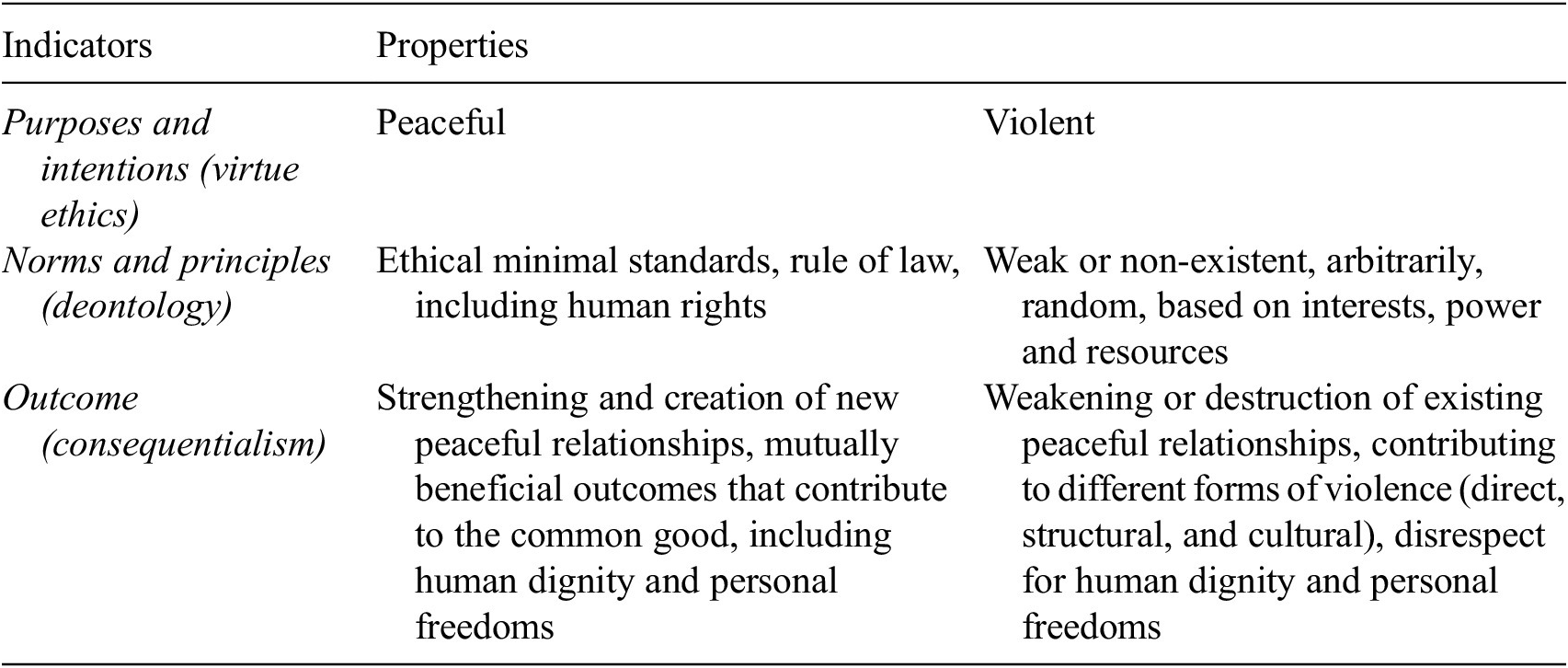
First, is the question of who interacts and connects with others for what purposes and based on what motivations and intentions. The focus is on the individual subject or entity that interacts with others based on certain motivations and interests in a given context. In virtue ethics, as elaborated above, peace is something that we can develop and cultivate through inner reflection. It is something that we can search and find inside of ourselves, i.e., something that we experience, that defines who we are as human beings, and how we relate with others. Virtue ethics also points us to the limits of AI, as it opens the question of whether AI can be ‘good’ or peaceful in the sense of being intrinsically ‘good’ by attitude, or if it can ‘only’ be programmed to behave as if. In virtue ethics, intentions and motivations that act as drivers of human behavior are evaluated to figure out if a person acts ‘good’ by the virtue of being good, i.e., good intentions are assumed to be followed by good actions that increase the virtue of the subject, as well as contribute to the larger common good and society, including peace. We must therefore ask what the intentions and motivations of subjects are to start interacting with each other and try to rate these intentions according to their level of peacefulness and violence. The question of whether AI can potentially develop any genuine intention—whether peaceful or violent—that goes beyond pure rule-following remains so far open.
Second, is the question of what norms, principles, and standards guide human behavior while engaging in interactions with others (deontology). Social, political, and economic interactions are usually regulated and constrained by a certain set of norms which define what is considered appropriate behavior in a given setting (Jepperson et al., Reference Jepperson, Wendt, Katzenstein and Peter1996; Andrighetto and Vriens, Reference Andrighetto and Vriens2022). Violence, at least in its direct and physical manifestation, is usually forbidden, or at least restricted in most human interactions by a large set of moral norms which have also been translated into legally binding norms and found their reflections in criminal law and international human rights (Tauchnitz, Reference Tauchnitz2023a). Principles and norms, however, might also be contested or compete with each other, such as for example in the case of the international community’s ‘Responsibility to Protect’ (R2P) vulnerable populations against mass atrocities. Overcoming such challenges requires carefully crafted negotiation strategies that build on objective standards, but also adhere to overarching values such as empathy, mutual respect, and trust (Tauchnitz, Reference Tauchnitz2024a). Kirchschlaeger (Reference Kirchschlaeger2021) and Tauchnitz (Reference Tauchnitz and Shamira2024b) have argued for an ‘ethics of human rights’ as a minimum ethical standard to guide human behavior. With AI developing its capacities more and more, the additional question arises whether there will be a need for new norms and principles to assure peaceful coexistence between humans and AI or if AI should be at some time in the future entitled to certain rights, depending on its level of consciousness and ‘ability to suffer’ in analogy with the animal’s right discourse. We can thus distinguish between (a) principles and norms to guide peaceful human interactions, (b) principles and norms to guide peaceful interaction between humans and AI, (c) principles and norms to guide peaceful interactions between purely AI-AI interactions, and (d) principles and norms to guide peaceful interactions in the hypothetical case of hybrid human-AI intelligence (Carter, Reference Carter2023).
Third, is the question of what consequences interactions produce for the involved parties, the network, and their surrounding environment (consequentialism). Guadagno et al. (Reference Guadagno, Nelson and Lock Lee2018) observed that interactions should maximize mutually beneficial positive outcomes for those interacting with each other. Yet if conceptualized only as mutually beneficial outcomes for those directly involved in the interaction, peace for some could result in violence for others. Two dictators for instance cooperating on arms trade could produce a mutually beneficial outcome for them but bring war and suffering to their enemies and innocent bystanders. In addition to mutually beneficial outcomes, interactions should thus also lead to beneficial outcomes for society at large and improve the relationships not only between individuals in a given network, but also between a given network and its surrounding environment in the middle- to long-term. When rating the peacefulness of a given interaction, we thus need to analyze (a) to what extent the interaction has been mutually beneficial to the involved actors, (b) to what extent it has contributed to the common good (peace), and (c) the context in which these human and non-human interactions take place.
The digital age can be expected to lead to an exponential surge in the quantity of connections. However, the quality of interactions may change profoundly, even more so as digital technologies not only impact the way humans interact with each other, but new actors as AI may also enter the scene and become new actors themselves that interact with humans and among each other (AI-AI) in digital and hybrid networks. Digital technologies may inadvertently erode the quality of human interactions by replacing traditional ways of contact and face-to-face communication. Intimate and affective interpersonal relationships that are based on repeated ‘circles of interaction’ and ‘joint attention’ are yet important for the quality of life of human beings (Penninga et al., Reference Penninga, Nijs, van Bakel and Embregts2022). Such meaningful relationships, however, take effort to establish and maintain over time and include many uncertainties—which lots of people might not be able or willing to take in view of the comparably easy, timesaving, and risk-free possibilities offered by digital communication technologies. In addition, digital technologies also create new and increase existing vulnerabilities, including concerns related to the privacy of personal data, cyberattacks, online mobbing, manipulation, and state and corporatesurveillance. This underscores the necessity for a reinvigoration of human rights as a fundamental ethical benchmark to safeguard against potential power abuses both on- and offline (Kirchschlaeger, Reference Kirchschlaeger2021; Tauchnitz, Reference Tauchnitz2023d, Reference Tauchnitz2024a, Reference Tauchnitz2024c).
4.3 Mapping interactions into networks
On a meso level, it can be examined how interactions and connections between different individuals or groups, i.e., ‘nodes’ can be mapped into networks of peace (and violence). More clarity is needed on whether and how networks, similar to individuals, have the capability to create peace (Sen, Reference Sen1974), either actively through peace-building initiatives, or passively through increasing interactions and connections in other sectors such as trade, finances, or traffic, as seen in the European Union, eventually leading to political and social cooperation. On the other side, there is a need to look at networks of violence and how they sustain themselves through their violent practices. For this purpose, we must dive into the elusive manifestations of peace and violence in the interactions taking place within a given network, discerning where they intertwine and where they stand apart. Human interactions and relationships are as already observed, seldomly exclusively peaceful or violent—but it is hypothesized that they are mostly characterized through a specific mix of both ‘good’ and ‘bad’ intentions, behaviors, and consequences at the same time which are subjectively and in exchange with the ‘other’ socially constructed. I thus challenge the conventional understanding that peace is solely the absence of violence, exploring whether the two seemingly contradictory phenomena of peace and violence can coexist within interactions and networks, their harmony or discord contingent on the strength and intensity of connections and resilience of relationships. For example, strong, high-quality connections may not be absent of violence, but if embedded in a predominately peaceful network, their members can be expected to be better able to manage their relations’ violent aspects, as compared to weak or violent networks characterized by low-quality connections that are characterized by instability or mistrust. The literature on conflict transformation (Galtung, Reference Galtung, Fischer, Galtung and Fischer2013) indeed suggests that conflicts can be transformed more easily through peaceful means if there exist trustful relationships characterized by mutual respect. It is thus important to define minimal standards and principles, including human rights, for networks to safeguard peace among their members such as for example transparency, accountability, and respect based on the mutual recognition of members’ dignity and individual freedom. What is important to note in view of digital networks is that more interactions and connections do not automatically guarantee more peace, as connections always incorporate the risk of violence, too. If the violent aspects dominate in a certain connection or network, it might be best to disconnect—if this possibility (still) exists.
Networks have been examined mostly in social sciences through Social Network Analysis (SNA) which focuses on understanding the structures and dynamics of social networks. It seeks to analyze the relationships between network actors (individuals, organizations, etc.) and how these relationships influence behaviors and outcomes. This includes the adoption of various statistical techniques for data analysis, emphasizing the significance of network structures in the diffusion of information, communication, and behaviors. Recent literature highlights the application of data mining to social networks, driven by the availability of large volumes of data, which has opened new avenues for analyzing complex social systems. This interdisciplinary field combines elements from sociology, psychology, mathematics, and computer science to provide insights into the social and behavioral sciences (Aydin, Reference Aydin2018; Knoke and Yang, Reference Knoke and Yang2019; Marin and Wellman, Reference Marin and Wellman2011; Serrat, Reference Serrat and Serrat2017; Tabassum et al., Reference Tabassum, Pereira, Fernandes and Gama2018).
Operationalizing human interactions is not necessarily an easy task, but it can be done. Typically, networks are characterized in terms of nodes (individuals, groups, nations, institutions) and the ties, edges, or links (connections, interactions, or relationships) that connect them. Network metrics play a crucial role in analyzing and interpreting network characteristics. These metrics can characterize entire networks, specific subgroups within those networks, or individual actors. Aggregate graph metrics, such as density, centrality, and clustering coefficient, provide insights into the overall connectivity, importance of nodes, and the tendency for clustering within the network, respectively. Density measures the proportion of actual connections to the total possible connections within a network, offering a glimpse into how closely knit the network is. Centrality metrics, including betweenness, closeness, eigenvector, and degree centrality, quantify the significance or influence of nodes based on their position within the network’s structure. The clustering coefficient, on the other hand, assesses the degree to which nodes in a network tend to cluster together, indicating the presence of tightly-knit subgroups (Flynn et al., Reference Flynn, Reagans and Guillory2010; Hanneman and Riddle, Reference Hanneman and Riddle2011; Kadushin, Reference Kadushin2012). Visualizing these metrics using software tools such as NetDraw or Ucinet enhances the understanding of network operations by providing graphical representations that highlight relationships, network density, and node centrality. This combination of quantitative metrics and visualization techniques allows researchers to dissect complex network data, revealing underlying patterns and interactions that may not be immediately apparent through raw data analysis alone.
While the role of networks in promoting and safeguarding peace remains understudied, scholars have used SNA tools to analyze the role of networks in politics and international relations in general, and conflict dynamics in specific (Hafner-Burton et al., Reference Hafner-Burton, Kahler and Montgomery2009; Hansen, Reference Hansen2009). SNA allows us to map and measure relationships, communication, and flows between actors to better understand the structural and dynamic aspects of networks in conflict settings (Lilja, Reference Lilja2012; Gizelis, Reference Gizelis2021; Hamilton et al., Reference Hamilton, McSwiney, Nyibeny and Shepherd2022). SNA has been used to provide a dynamic analysis of conflict networks, mapping changing relationships between government forces, rebels, and other actors involved (Walther et al., Reference Walther, Radil and Russell2021). Social networks can thereby act as both fuels for conflict and tools for peaceful transformation, influencing how individuals construct their reality and understanding of conflicts. Civil society activists also point out the role of religious and traditional networks in certain conflict contexts, emphasizing their potential to facilitate peace (Network for Religious and Traditional Peacemakers, n.d.). Network analysis is also recognized for its ability to understand social processes within complex systems, aiding in conflict identification and providing early warnings (Wolfe, Reference Wolfe2004). Social networks are thereby observed to be subject to constant change, modification, and evolution. Not only do links emerge, change, and disappear, but the very aim and purpose or ‘programme’ of a network is subject to permanent, although not necessarily steady, transformation (Castells, Reference Castells2009, Reference Castells2010, Reference Castells2011). Although there are still various methodological challenges related to SNA, including what data are collected and how networking tools are applied to interpret the data, slowly, a common understanding of the importance of networks in understanding the dynamics of peace and conflict is emerging among researchers (Wolfe, Reference Wolfe2004; Hafner-Burton et al., Reference Hafner-Burton, Kahler and Montgomery2009; Hansen, Reference Hansen2009).
Open questions, however, remain, namely whether to focus more on the structural properties of networks (such as centrality, and density) or on the quality of relationships (trust, cooperation) within these networks and how they can possibly be operationalized in practical terms. Furthermore, there are ongoing debates regarding the extent to which networks contribute to peacebuilding or conflict escalation, and under what conditions networks play a constructive versus destructive role. What this means, is that while scholars agree that networks do matter, they disagree on how they matter. More empirical research is needed to understand under what social, economic, and political conditions the influence of networks is rather conducive to peace or, quite in opposite, fuels violence. This points to the urgent need to dwell on the question of what defines the quality of human interactions as elaborated above in sub-chapter 4.2, and how interactions taking place on the micro-level shape network dynamics on the meso-level. What qualities should human interactions possess to be rated as peaceful? What should the minimum relation between peaceful and violent traits in a relationship be to still be considered predominantly peaceful? How does the co-existence of both peaceful and violent characteristics of interactions manifest on the network level? Based on what properties and metrics can networks be rated as peaceful?
With the digital transformation, it becomes more pressing to find satisfying answers to these questions as individuals’ possibilities to influence and interact with others around the world have increased dramatically. New networks have arisen in the digital sphere and already existing ones have been strengthened through entirely new means of interaction. Geographical and timely boundaries have melted away and more and more people are not merely being connected to the internet but are discovering more and more the possibilities to interact with each other around the globe. Through the internet, we have become part of one global network. However, power structures present in the physical world are mirrored in digital spaces. Wealthy countries and powerful corporations hold disproportionate control over the internet’s infrastructure and the platforms that shape global interactions, while issues such as digital illiteracy, unequal access to the internet, and the dominance of English as the primary language online pose significant barriers to the meaningful participation of marginalized populations. These power imbalances not only influence who participates in the digital space but also how online interactions are structured, often perpetuating the inequalities found in offline societies.
AI plays a growing role in shaping these interactions, but it is important to recognize that AI is not neutral. The outcomes of AI systems depend heavily on who designs their algorithms and what data they are trained with. If AI is developed without consideration for diversity, inclusivity, and fairness, there is a significant risk that it will replicate and even amplify different forms of discrimination present in the real world. This phenomenon, known as algorithmic bias, can manifest in multiple ways. For instance, research by Noble (Reference Noble2018) highlights how search algorithms on platforms like Google often reinforce racial and gender stereotypes, where certain groups are marginalized or misrepresented in search results, perpetuating existing societal prejudices. Similarly, O’Neil’s (Reference O’Neil2016) work demonstrates how predictive algorithms in fields such as criminal justice, hiring, and credit scoring disproportionately disadvantage marginalized communities, exacerbating inequalities rather than alleviating them. Furthermore, AI used in facial recognition technology has been shown to have lower accuracy rates for people of color and women, leading to a higher likelihood of misidentification and wrongful consequences (Buolamwini and Gebru, Reference Buolamwini and Gebru2018). In the context of law enforcement, predictive policing algorithms, which use historical crime data to predict future crimes, can inadvertently reinforce racial profiling and over-policing in minority communities (Angwin et al., Reference Angwin, Larson, Mattu and Kirchner2016). In addition, AI’s potential to perpetuate biases is also influenced by the cultural and institutional contexts in which it operates. As seen with Facebook and other social media platforms, algorithmic decision-making can amplify political polarization, misinformation, and hate speech, making it imperative to develop regulatory mechanisms that prioritize the public good over profit-driven motives (Tufekci, Reference Tufekci2018).
To mitigate these risks, careful oversight, diverse datasets, and participatory design are essential. As Noble (Reference Noble2018) suggests, a key step is to diversify the teams that design and train AI systems to include voices and perspectives from historically underrepresented groups, which could help address some of the biases that are inherent in AI. Furthermore, the design of AI systems should be guided by ethical principles that prioritize inclusivity, fairness, and mutual understanding. Without this, there is a significant risk that AI becomes a tool that perpetuates discrimination, exclusion, inequality, and even hate, rather than contributing to peaceful, inclusive societies. Moreover, these concerns must be addressed across all sectors in which AI is applied, including trade, finance, social media, news, diplomacy, and international politics. Ethical standards are crucial for maintaining the integrity of digital interactions and ensuring that AI promotes human rights, individual freedoms, transparency, and accountability.
However, the challenge remains as to who defines these ethical standards and how they are applied in practice. While global governance bodies, such as the United Nations, have frameworks in place to promote human rights and accountability, the regulation of online interactions largely rests with private companies and governments. The interests of these entities, often driven by economic or political motives, may not always align with the broader goal of fostering equitable and peaceful digital spaces. AI can be a powerful tool for peacebuilding, but its deployment must be approached with caution, ensuring that its design, application, and oversight adhere to ethical standards that stand above particularistic financial or political interests and align with the goal of creating peaceful, equitable societies.
Moreover, the standards guiding digital networks must strike a delicate balance between freedom, privacy, and security. For instance, tools like Virtual Private Networks (VPNs), while offering individuals privacy and protection from censorship, complicate efforts to establish common security standards. Similarly, ongoing debates around data privacy versus surveillance reflect the tension between protecting individual freedoms and ensuring collective security. Though complex, it is crucial that any ethical framework prioritizes human dignity, freedom, and respect for human rights to ensure that global digital networks foster peaceful, rather than divisive, interactions. Ultimately, safeguarding peace on local, national, and global levels requires more than just connecting people through digital networks—it requires high-quality interactions based on principles such as inclusivity, equality, accountability, transparency, respect, and trust.
4.4 The structural ecosystem networks operate in
Consequently, we need to look at how networks of peace (and violence) relate to the physical and online environments they operate in, by exploring how external factors and structures influence the quantity and quality of interactions and connections taking place in them. Human behavior cannot be understood independently from the physical, social, and cultural environments in which individuals are embedded (Quintana, Reference Quintana2022). Depending on the context, human behavior, and the consequences it produces, are often interpreted very differently. Killing another person for instance, is generally strictly forbidden under criminal law, but in wars and armed conflicts, soldiers are not only permitted, but even expected to kill enemy solidiers who are, of course, human beings, too. In the first case, the individual could end up in jail for murder, in the second, this might be celebrated as a military victory.
The peace research literature stresses the importance of effective, fair, and democratic institutions and decision-making structures that are based on the rule of law, including respect for human rights (Turner, Reference Turner2008; Richmond, Reference Richmond2010; Press, Reference Press2017). Similarly, socio-economic factors such as the elimination of poverty, equal access to education and health, and living conditions that allow for a life with human dignity, play a fundamental role in promoting peace by reducing different forms of structural and cultural violence (Galtung, Reference Galtung1969). However, despite the broad agreement that these factors matter for sustaining long-term direct, structural, and cultural peace, their influence on the operation of networks and their capacity to foster peaceful relationships among their members internally, as well as externally with other individuals and networks, has so far not been the subject of research.
Additionally, to Galtung’s distinction between direct, structural, and cultural violence, new forms of digital violence have emerged. Whether more interactions and connections will bring more peace is thus not predefined. Digital violence is characterized by different forms of online and hybrid violence that have emerged through the new possibilities offered by digital technologies, including AI, such as for example cyber-attacks, drone strikes, or deadly actions carried out by lethal autonomous weapon systems. The advent of online networks and the convergence of digital and physical realities through virtual and augmented reality, further complicates this landscape, giving rise to ever-new forms of digital violence (for example the killing of avatars in the metaverse) and challenges to personal data security (for example intimate partnerships among avatars). Yet digital technologies and AI have also fueled traditional forms of direct, structural, and cultural violence in the physical reality as it has become much easier and cheaper to collect, analyze, and share critical data which has facilitated new forms of mass surveillance, political control, hate speech, and cyber-mobbing, to just name a few. In a peaceful context, the power of digital technology may well be used for the benefit of humanity improving access to education and healthcare and contributing to the common good. In a violent context, however, digital technologies are at risk of being used by powerful political and economic elites to suppress the demands of minorities or other vulnerable groups. How networks operate, and for which purposes they use digital technologies, thus is deeply tied to the ecosystem they are embedded in. Studying this ecosystem, requires in-depth qualitative analysis of the linkages of a given network with other proximate networks, overlapping and clustering effects, and how networks evolve over time in a given setting.
In general, both the physical and digital ecosystems that human interactions take place in, have expanded through the possibilities offered by modern technology and AI, leading to an enlargement of the ‘space’ that we have access to. With digital change, the physical and digital ecosystems we are living in, i.e. our personal ‘lifeworlds’ (Habermas, Reference Habermas1994) have experienced an exponential surge in connections linking different previously unconnected networks and dots. Whereas before the digital revolution our actions, influences (on us), and impacts (by us) were motivated by and limited to the immediate physical environment we lived in, nowadays our actions and interactions with others are more and more shaped by what happens in previously unlinked and remote systems. They have also expanded in scope—we can reach much further, much faster much more people with our ideas, concerns, and aspirations than ever before (for example me-too or black-lives matter campaigns on social media, but also foreign manipulation of democratic elections). This is not only true for individuals, but also for networks that have intensified and expanded by establishing more connections among more people. Digital transformation together with globalization has led to a networked society on a global level (Castells, Reference Castells2010), where not only individuals interconnect in networks, but also on- and offline networks intertwine with each other —eventually even blurring the distinction between the ecosystem and the network, i.e., overlapping networks become the ecosystem.
4.5 Grounding a meso-theory on networks in AI applications
Lastly, this section addresses how a meso-theory of networks interferes with and can be combined with already existing AI applications in fields such as peace building, conflict monitoring, early warning, humanitarian aid distribution, social media, infrastructure rebuilding, mental health, and reconciliation. These areas have been selected for the unique opportunities and challenges they present for maintaining and promoting peace. It is important to note that this is not an exhaustive list, but just some examples of how AI can facilitate peaceful human interactions, which can be subsumed under broader terms like “PeaceTech” or “AI for Good.” Focusing on the positive potential of AI yet does not mean downplaying the risks that present and future AI developments pose for peace. On the contrary, they are manifold and may outweigh the potential benefits, as exemplified by the development of lethal autonomous weapons and mass surveillance technologies. Additionally, it is essential to recall that AI development and training are embedded in social and economic systems driven largely by profit, rather than by the goal of fostering peaceful relationships among people and nations.
Conflict monitoring, early warning, and humanitarian aid distribution: AI plays a crucial role in monitoring conflicts, analyzing patterns, and providing early warnings, which is vital for preventing escalation. AI systems can analyze large datasets to identify signs of emerging conflicts through social media analysis, providing real-time information that can be used for timely interventions (Vision of Humanity, 2023). In humanitarian aid distribution, AI can optimize the allocation of resources by analyzing data on affected populations and logistical constraints, ensuring that the provision of aid reaches those in need more efficiently. AI systems can also track the movement of humanitarian goods, providing transparency in aid distribution and facilitating the efficient allocation of resources. Furthermore, drones and satellites equipped with AI can monitor ceasefire agreements, ensuring compliance and providing unbiased data to international observers. This capability enhances transparency and accountability, which are vital for turning violent into peaceful interactions (United States Institute of Peace, 2023). However, these technologies also bring the risk of misuse in surveillance, potentially infringing on human rights and personal freedoms that are fundamental for peace on an individual and collective level. Such misuse could deepen societal divides and erode trust in human relationships, fueling conflicts rather than fostering understanding and reconciliation.
Social media: AI’s potential in social media is double-edged. While it can facilitate diverse and constructive interactions among friends and relatives, it can also amplify misinformation, hate speech, and echo chambers (Shirky, Reference Shirky2011; Fuchs, Reference Fuchs2014). These challenges are particularly concerning as AI-driven algorithms prioritize sensationalist content that often divides rather than unites. Additionally, the use of AI for politically motivated microtargeting can manipulate public opinion and democratic elections, potentially escalating tensions between groups and posing a grave challenge to democracy (Fuchs, Reference Fuchs2014). On a more positive note, AI would also have the potential to foster peacebuilding by promoting diverse and constructive interactions across real and imagined traditional boundaries. For example, AI could actively suggest new friends and contacts from different religious or ethnic groups or even from countries considered ‘enemies,’ encouraging cross-cultural dialogue and understanding (Alliance for Peacebuilding, 2023). AI systems could also prioritize content that fosters empathy and mutual understanding, transforming social media into a platform for peace initiatives. This involves promoting narratives of reconciliation and shared human experiences, highlighting stories that encourage solidarity rather than division. The role of social media and digital networks in conflicts is thus not predetermined but can sway between fostering peace and exacerbating conflicts. In addition, social media have also emerged as a significant data source for researching conflict actors and their strategies. Social Network Analysis (SNA) can be used to analyze social media data, map conflict actors, visualize links between them, and identify both conflict risks and positive potential for peacebuilding (Zeitzoff, Reference Zeitzoff2017, Reference Zeitzoff2018; Bunse, Reference Bunse2021).
Infrastructure development and rebuilding: In the aftermath of armed conflicts, infrastructure development plays a pivotal role in restoring essential services and stabilizing societies. Rebuilding roads, bridges, water systems, and energy grids is crucial not just for economic recovery but also for fostering social cohesion, especially after civil wars when communities are divided. Well-planned infrastructure can facilitate peace by providing spaces where communities reconnect and recover together. However, the reconstruction process must prioritize social inclusion and address the deep-rooted inequalities that fuel tensions (Bachmann and Schouten, Reference Bachmann and Schouten2018; Hay et al., Reference Hay, Karney and Martyn2023). AI can help design infrastructure in ways that foster peaceful human interactions, particularly through the principles of peace engineering. Peace engineering, as defined by Mark Nelson, and others, integrates traditional engineering with peacebuilding, aiming to create systems that actively promote social cohesion and mitigate conflict with the help of technology. By leveraging AI, urban planners and peacebuilders can simulate and optimize environments that encourage interaction across diverse communities, thereby strengthening communal ties and reducing the likelihood of future conflicts (Guadagno et al., Reference Guadagno, Nelson and Lock Lee2018; Peace Innovation Lab, 2018). For instance, AI-driven urban planning tools can analyze social and demographic data to identify the most effective locations and design for shared public spaces, schools, and markets—areas where positive social interactions naturally occur, fostering a sense of community and shared identity (Firchow et al., Reference Firchow, Martin-Shields, Omer and MacGinty2017). Moreover, AI can help design inclusive infrastructure that prioritizes the needs of marginalized groups often neglected in conventional reconstruction efforts, thereby reducing structural inequalities and preventing future conflicts. By using machine learning algorithms to assess community needs and vulnerabilities, AI can help allocate resources more equitably, reducing social disparities and fostering an environment where all community members feel represented and included. This proactive approach not only helps prevent future conflict but also ensures that the rebuilding process contributes to long-term social stability and cohesion (UNOPS, 2023). The combination of peace engineering principles with AI’s analytical and predictive capabilities can thus help identify areas where infrastructure improvements can have the most significant impact on community well-being and cohesion, ultimately reshaping post-conflict environments to be more conducive to sustainable peace and social harmony (Alliance for Peacebuilding, 2023).
Mental health and social reconciliation efforts: AI has the potential to facilitate reconciliation and community healing processes by fostering empathy and understanding between conflicting parties. AI-powered mental health platforms can offer personalized support to individuals and facilitate group healing sessions that address shared traumas and vulnerabilities (Firchow et al., Reference Firchow, Martin-Shields, Omer and MacGinty2017). For example, AI systems can guide communities through structured dialogue and storytelling exercises, helping individuals articulate their experiences and find common ground with others. Although empirical evidence on AI’s effectiveness in community healing is still emerging, some pilot projects have shown promise. For instance, AI has been used in some conflict zones to facilitate dialogue between divided communities by translating conversations in real-time and identifying common themes in narratives, promoting mutual understanding and peaceful relationships (Alliance for Peacebuilding, 2023). However, it’s crucial to approach these technologies cautiously and recognize that human facilitators remain essential in guiding reconciliation processes. AI-powered platforms cannot replicate the authenticity of human interactions. While AI can help guide communities through structured dialogues, true reconciliation requires a level of empathy and vulnerability that only human facilitators can provide (Butler, Reference Butler2003).
While AI thus has the potential to support peace networks by facilitating conflict monitoring, making humanitarian aid distribution more effective, enhancing positive narratives in social media, promoting social cohesion through peace engineering, and fostering community healing, it is not a panacea. As mentioned earlier under subchapter 4.3, its use must be carefully managed taking into account its limitations and risks, and ethical and human rights considerations must take center stage. AI should be viewed as a tool that complements rather than replaces the inherently human aspects of peacebuilding. The main reason is that AI, however advanced, lacks the ability of genuine empathy, which is vital for fostering a sense of connection that can bridge divides and lay the groundwork for lasting peace. Genuine empathy arises from the ability to experience, recognize, and relate to our shared vulnerabilities as humans (Butler, Reference Butler2003; Guadagno et al., Reference Guadagno, Nelson and Lock Lee2018). AI lacks this foundational aspect as it cannot experience vulnerability or directly relate to the emotional and experiential dimensions of human life. AI is not only not human but, more importantly, not alive, which means that it is not able to experience life with all the biological, mental, and emotional vulnerabilities and constraints that come along with it. As such, while AI can simulate responses that appear empathetic, it cannot truly comprehend the depth of human suffering or the authenticity required for meaningful connection with other human beings (Firchow and Ginty, Reference Firchow and Ginty2017). It cannot feel love, freedom, fear, or loss, which are essential elements in the human experience of conflict and reconciliation. Therefore, while AI can assist in facilitating dialogues and providing platforms for interaction, the deeper work of building authentic relationships and healing must continue to come from human connection and engagement.
Furthermore, the development and training of AI systems are crucial areas where ethical considerations must be paramount (ethics by design). As noted before, AI training datasets must be diverse and free from biases that could perpetuate violence or inequality (Fuchs, Reference Fuchs2014; Noble, Reference Noble2018). A further critical point to address is that low-paid workers, often in developing countries, are sometimes exploited for labelling violent or otherwise traumatic internet and data content. This exposure can have severe mental health impacts, highlighting the need for ethical standards in AI training practices. Participatory approaches in AI development in turn can help ensure these systems are designed with inclusivity and fairness in mind. Involving communities in the design and implementation process from early stages (co-creation approach) can provide culturally sensitive and context-specific AI applications, enhancing their effectiveness in promoting peace (Alliance for Peacebuilding, 2023). By incorporating diverse and flexible perspectives, AI systems can be tailored to specific circumstances, improving their early warning capabilities, as well as enhancing their effectiveness in conflict monitoring and reconciliation of divided communities.
5. Conclusions
The paper has made several new distinct theoretical, empirical, and methodological contributions. Theoretically, it combined the literature on peace as a product of virtue (Greek philosophers) and reason (Enlightenment philosophers) from philosophical ethics with the discipline of peace research as a branch of political science and international relations. While some scholars have addressed the interplay between ethics as the applied branch of philosophy and peace research (Schuman, Reference Schuman1932; Cox, Reference Cox1986; Dower, Reference Dower2009; Justenhoven and Barbieri, Reference Justenhoven and Barbieri2012; Frowe, Reference Frowe2022), the two literature strands have remained surprisingly separate over time. Combining them allows for a more comprehensive analysis of peace as a behavior and interaction that can be mapped into networks. In view of the digital transformation, it is important to consider how peace emerges and spreads through connections and interactions in and among networks operating in a given environment.
Empirically, there is a need for more fine-grained and comprehensive data on networks’ ability to (re-)produce peace among their members, with other networks, and within the wider environment they operate in. There is a need to shift the focus from governments and international organizations trying to secure peace through formal institutions and decision-making processes towards those directly involved in peaceful or violent interactions. While Greek philosophers such as Socrates, Plato, and Aristoteles, have highlighted that peace is something that can be developed and cultivated through virtue, modern peace research has focused almost exclusively on how to eradicate violence in its different forms from social and political structures on the macro level. This paper complements existing analysis from the micro (virtue) and macro (societal structures) level by focusing on social and digital networks that connect the individual with higher social and political structures on the intermediary meso level, and in so doing, brings new insights into the study of peace in general, and specifically how digital technologies are impacting on existing and newly emerging networks of peace (and violence) both on- and offline.
Methodologically, the paper advocates for improving the connections between philosophical ethics as a normative science and descriptive social sciences (network analysis) by calling for innovative mixed-methods approaches that allow for theory development based on ethical reasoning and empirical findings. In the literature on philosophical ethics that touches upon the topic of peace, philosophical and rather abstract moral principles and approaches dominate with relatively little interaction between normative and empirical sciences. The peace research literature on the other hand is for the most part almost entirely practice-oriented, and while it does sometimes investigate the underlying principles and values of peace building such as freedom, justice, and human dignity, there is very little research on how these concepts manifest in human interactions and behaviors. There is thus still a wide gap between normative and empirical sciences in both ethics and peace research literature. To address this gap, future research adopting an innovative mixed-methods approach focused on human interactions and networks that ensures sound theory development based on contextualized findings that are critically reflected both on their normative value and empirical validity appears to constitute the most suited approach.
Furthermore, this article has critically explored how peace can not only be conceptualized, but potentially also measured, starting from virtue ethics on the individual level and Enlightenment philosophy and peace research on the structural level to a more nuanced understanding of peace as a dynamic process occurring through interactions within networks. Virtue ethics sees societal peace as a desired state of individuals coming together who have achieved inner peace and harmony through virtue. The logic that peaceful individuals would not fight each other is convincing, yet it does not offer a solution on how to handle the fact that not all individuals are always peaceful. Enlightenment philosophers filled this gap by focusing on the establishment of agreements, structures, and institutions that would enable society to take care of conflicts arising both internally and externally in a more professional and responsible manner. The problem that violence could also reside in the structures—hence termed ‘structural violence’ by Johan Galtung (Reference Galtung1969) was recognized by later peace researchers, although never fully solved. To analyze how the micro level (virtue ethics focused on individuals) connects with the macro level (peace through reason, focused on structures), I have introduced a meso-level on networks that are operating in between those two spheres. These networks, as I have argued, are active spaces where peace (and violence) manifests through connections, interactions, and relations among individuals, groups, and even nations—and in a near future arguably also AI interacting with humans and with other AI.
By advocating for a conceptualization of peace as a ‘verb’ tied to human behavior (Peace Innovation Lab, Stanford University, n.d.) I posit that peace is not a static state to be achieved but a continuous process that unfolds through human connections, interactions, and relations. Elevating individual interactions to a collective level allows to map interactions, connections, and relationships into networks of peace (and violence). This perspective shifts the paradigm of peace studies by emphasizing the importance of understanding peace as an emergent property of behaviour and networked interactions. This understanding not only broadens the scope of peace studies but also offers a practical framework for policymakers to identify and connect with relevant peace networks to enhance peace in digital and physical realms. It also challenges policymakers to consider the quality of connections, interactions, and relations between individuals, groups, and nations, and the role of social networks in (re-)producing, promoting, and safeguarding peace beyond the confines of traditional institutions such as governments or international organizations.
In the context of the digital transformation, the question of how peace can be conceptualized through interactions and connections in a networked society becomes extremely relevant in view of the quantity of (potential) connections and interactions which can be expected to rise exponentially over the next years. The potential for digital and hybrid networks to expand and evolve is unprecedented, highlighting the need for innovative governance approaches to foster peace in a rapidly changing world. What is more, in order to know how to design peaceful interactions between humans and AI, more clarity is needed on what properties define peaceful human interactions in the first place.
Future research should therefore focus on operationalizing and measuring the qualities and properties of interactions that foster peace, understanding the dynamics of networks in peaceful and violent contexts, and exploring the impact of digital technologies on relational peace. By doing so, policymakers can develop more effective governance strategies for promoting peace that is adapted to the complexities of the digital age where networks play a pivotal role (Tauchnitz, Reference Tauchnitz2023b, Reference Tauchnitz2023c). This paper has tried to offer a new lens through which to view and cultivate peace—understood as a ‘verb’ that can take different forms—in our interconnected world: Peace, is what we feel when we meaningfully connect with ourselves (inner peace) and others, what we do when we purposefully and respectfully interact with others, and what we create when we make a positive impact through relationships that are based on mutual recognition of our shared human dignity and individual freedom.
Abbreviations
- AI
-
artificial intelligence
- EPI
-
everyday peace index
- GPI
-
global peace index
- PPI
-
positive peace index
- SNA
-
social network analysis
- UN
-
United Nations
Data availability statement
Data availability is not applicable to this article as no new data were created or analyzed in this study.
Acknowledgments
The author is grateful for the thoughtful in-depth conversations on innovative peace approaches with Mark Nelson, Director of the Peace Innovation Lab, Stanford University, which strongly inspired the content of this paper.
Author contribution
The whole conceptualization and writing of this manuscript has been done by the single author of this paper.
Funding statement
This work received no specific grant from any funding agency, commercial or not-for-profit sectors.
Competing interest
The authors declare none.


 Open access


Comments
No Comments have been published for this article.