


Statement of Research Significance
Research Question(s) or Topic(s): One clear obstacle of academic success can be reading difficulties. These difficulties have been observed in attention-deficit/hyperactivity disorder resulting in diminished reading comprehension. Given previous work that participants with attention-deficit/hyperactivity disorder exhibit eye movement alteration during reading as well as more general eye movement deficits associated with non-verbal stimuli, we hypothesized that eye movements contribute to reading comprehension difficulties. Main Findings: We found that minimizing the need for eye movement during reading boosted comprehension in the attention-deficit/hyperactivity disorder but not the control group. Study Contributions: Our study suggests that previously documented eye movement deficits in attention-deficit/hyperactivity disorder have negative cognitive ramifications during reading. Our data further suggest that minimizing eye movements might be a way to minimize these negative effects. The study indicates that rapid serial visual presentation can be a useful tool for reading texts to improve comprehension in attention-deficit/hyperactivity disorder.
Introduction
Attention-deficit/hyperactivity disorder (ADHD) is a common neurodevelopmental disorder that occurs in children as well as adults (Polanczyk & Rhode, Reference Polanczyk and Rohde2007; Sayal et al., Reference Sayal, Prasad, Daley, Ford and Coghill2018; Willcutt, Reference Willcutt2012). It encompasses symptoms of inattention, hyperactivity, and impulsivity according to the Diagnostic and Statistical Manual of Mental Disorders (5th ed., text rev.; DSM-5-TR; American Psychiatric Association, 2022) and is associated with social, academic, and cognitive impairments (e.g., Lahey et al., Reference Lahey, Applegate, McBurnett, Biederman, Greenhill, Hynd, Barkley, Newcorn, Jensen, Richters, Garfinkel, Shaffer and Waldman1994; Pievsky & McGrath, Reference Pievsky and McGrath2017). Although impulsivity and hyperactivity have been found to decline with age, inattention appears to persist into adulthood (Biederman et al., Reference Biederman2000; Hart et al., Reference Hart, Lahey, Loeber, Applegate and Frick1995) with multiple ongoing adaptive impairments, higher divorce rates, lower socioeconomic status, and a lack of academic achievement (e.g., Borland et al., Reference Borland and Heckman1976, Murphy & Barkley, Reference Murphy and Barkley1996).
It is clear that a major hurdle of academic success can be reading difficulties (e.g., Bastug, Reference Bastug2014; Bergey et al., Reference Bergey, Deacon and Parrila2016). Such difficulties have been indeed found in ADHD resulting in diminished comprehension and various compensation strategies (e.g., Brown et al., Reference Brown, Reichel and Quinlan2011; Miller et al., Reference Miller, Keenan, Betjemann, Willcutt, Pennington and Olson2013; Palmini, Reference Palmini2008; Rucklidge & Tannock, Reference Rucklidge and Tannock2002; Stern & Shalev, Reference Stern and Shalev2013). Prior ADHD research has assessed reading comprehension using both standardized multiple-choice tests (e.g., Nelson–Denny; Brown et al., Reference Brown, Reichel and Quinlan2011) and free-recall paradigms (e.g., Miller et al., Reference Miller, Keenan, Betjemann, Willcutt, Pennington and Olson2013), highlighting that multiple formats can capture comprehension performance. A recent scoping review synthesized findings from 34 studies confirmed that reading comprehension is often reduced in ADHD, especially on tasks requiring recall of central story ideas or references (Parks et al., Reference Parks, Moreau, Hannah, Brainin and Joanisse2022). However, this study also highlighted that the magnitude of reading difficulties in ADHD varies considerably across studies depending on task demands. This suggests a possibility that reading comprehension deficits in ADHD may partly reflect some kind of underlying cognitive or attentional constraints.
In addition, eye movements during reading are altered in ADHD (Deans et al., Reference Deans, O’Laughlin, Brubaker, Gay and Krug2010; Molina et al., Reference Molina, Redondo, Vera, García, Muñoz-Hoyos and Jiménez2020; Thaler et al., Reference Thaler, Urton, Heine, Hawelka, Engl and Jacobs2009) and to some extent might be reflecting underlying comprehension difficulties given that linguistic processes are mirrored in the eye movements (e.g., Gagl et al., Reference Gagl, Gregorova, Golch, Hawelka, Sassenhagen, Tavano, Poeppel and Fiebach2021; Rayner, Reference Rayner1998). However, even when ADHD participants read at individually adjusted difficulty levels eye movements are impaired (Molina et al., Reference Molina, Redondo, Vera, García, Muñoz-Hoyos and Jiménez2020). What is more, eye movement deficits have been observed for non-verbal stimuli (e.g., Dankner et al., Reference Dankner, Shalev, Carrasco and Yuval-Greenberg2017; Fried et al., Reference Fried, Tsitsiashvili, Bonneh, Sterkin, Wygnanski-Jaffe, Epstein and Polat2014; Granet et al., Reference Granet, Gomi, Ventura and Miller-Scholte2005; Mostofsky et al., Reference Mostofsky, Lasker, Cutting, Denckla and Zee2001; Munoz et al., Reference Munoz, Armstrong, Hampton and Moore2003; O’Driscoll et al., Reference O’Driscoll, Dépatie, Holahan, Savion-Lemieux, Barr, Jolicoeur and Douglas2005; Rommelse et al., Reference Rommelse, Van der Stigchel, Witlox, Geldof, Deijen, Theeuwes, Oosterlaan and Sergeant2008a; Solé Puig et al., Reference Solé Puig, Pérez Zapata, Puigcerver, Esperalba Iglesias, Sanchez Garcia, Romeo, Cañete Crespillo, Supèr and Hills2015; for a review: Rommelse et al., Reference Rommelse, van der Stigchel and Sergeant2008b).
Recent eye-tracking research has demonstrated consistency of oculomotor control deficits in ADHD. Children with ADHD show longer fixation durations and shorter and more erratic saccades during complex virtual reality memory tasks (Merzon et al., Reference Merzon, Pettersson, Aronen, Huhdanpää, Seesjärvi, Henriksson, MacInnes, Mannerkoski, Macaluso and Salmi2022), and adults with ADHD exhibit gaze dynamics distinct enough to enable high-accuracy classification using machine-learning models (Deng et al., Reference Deng, Prasse, Reich, Dziemian, Stegenwallner-Schütz, Krakowczyk and Jäger2022). A meta-analysis of 26 studies confirmed significant impairments in antisaccade inhibition, delayed and imprecise saccade initiation, and increased fixation variability across age groups (Maron et al., Reference Maron, Bowe, Spencer-Smith, Mellahn, Perrykkad, Bellgrove and Johnson2021). Additional antisaccade deficits observed in ADHD include longer and more variable reaction times, more frequent direction errors (Schwerdtfeger et al., Reference Schwerdtfeger, Alahyane, Brien, Coe, Stroman and Munoz2013), and heightened distractibility by task-irrelevant gaze cues (Lee et al., Reference Lee, Lee, Chang and Kwak2015; Ossmann & Mulligan, Reference Ossmann and Mulligan2003), often co-occurring with deficits in response inhibition and prefrontal executive function (Schneider et al., Reference Schneider, Retz, Coogan, Thome and Rösler2006; Seidman, Reference Seidman2006). Beyond this, atypical visual scan paths have been shown to impair memory performance in children with ADHD (Mohammadhasani et al., Reference Mohammadhasani, Caprì, Nucita, Iannizzotto and Fabio2020). Fabio et al. (Reference Fabio, Andricciola and Caprì2022) demonstrated that children with ADHD rely more heavily on controlled attentional processes during visual–motor tasks, which could increase cognitive load and reduce efficiency. These oculomotor and attentional deficits align with executive dysfunction models of ADHD (Barkley, Reference Barkley1997), suggesting that top-down control deficits may cascade into broader sensorimotor and cognitive challenges. Importantly, these oculomotor deficits are not restricted to controlled laboratory settings. Poor oculomotor control including dysmetria and tracking difficulties has been linked to reading and writing challenges (Chamorro et al., Reference Chamorro, Treviño and Matute2017; Kim et al., Reference Kim, Petscher and Vorstius2019; Langmaid et al., Reference Langmaid, Papadopoulos, Johnson, Phillips and Rinehart2014; Shen et al., Reference Shen, Lee and Chen2012). This suggests that disruptions in the visuomotor system have downstream consequences for learning and daily functioning. Accordingly, understanding oculomotor patterns in ADHD is essential to identifying how atypical eye movement patterns may relate to broader neurocognitive and academic difficulties (Maron et al., Reference Maron, Bowe, Spencer-Smith, Mellahn, Perrykkad, Bellgrove and Johnson2021). Together, these findings indicate that ADHD is characterized by broad and domain-general deficits in oculomotor control.
It is possible that reading difficulties in ADHD are aggravated by eye movement difficulties, because reading deficits in ADHD are correlated with working memory performance (Miller et al., Reference Miller, Keenan, Betjemann, Willcutt, Pennington and Olson2013) and because working memory is impacted by eye movements (Moussaoui et al., Reference Moussaoui, Pereira and Niemeier2023; Vasquez & Danckert, Reference Vasquez and Danckert2008).
To our knowledge the hypothesis that eye movements disrupt reading comprehension in ADHD has not been explored. Here we asked whether participants with ADHD relative to neurotypical individuals would benefit from a reading condition that requires little or no eye movements. Specifically, reading during rapid serial visual presentation (RSVP) presents consecutive words in the center of a computer screen. Although RSVP is not necessarily advantageous for neurotypical readers (e.g., Benedetto et al., Reference Benedetto, Carbone, Pedrotti, le Fevre, Bey and Baccino2015; Masson, Reference Masson1983), the benefits of reading without eye movements might still outweigh their disadvantages in ADHD. Therefore, in the present study our first aim was to test whether RSVP reading relative to normal reading offers more of a benefit in ADHD compared to control participants. Such an RSVP benefit would suggest a to-date unnoticed causal relationship between sensorimotor/attentional processes and cognition in ADHD as well as open up a new avenue towards aiding students with ADHD in their academic success besides extended exam times (Brown et al., Reference Brown, Reichel and Quinlan2011) and pharmacological treatment (Sharma & Couture, Reference Sharma and Couture2013). Also, recognizing that medication is a prominent contributor to ADHD treatment we intended to test whether RSVP reading has benefits regardless of medication. Thus, identifying simple and scalable strategies that improve reading comprehension in ADHD could have important implications for classroom accommodations and digital learning design.
Methods
Participants
Seventy-six undergraduate students were sampled from the University of Toronto community. Our target sample size of about thirty-five participants per group was informed by previous research on ADHD and reading comprehension as well as oculomotor deficits in ADHD (Maron et al., Reference Maron, Bowe, Spencer-Smith, Mellahn, Perrykkad, Bellgrove and Johnson2021; Parks et al., Reference Parks, Moreau, Hannah, Brainin and Joanisse2022). There was no prior study to our knowledge that tested the RSVP benefit in ADHD; thus, a priori power analysis was not feasible.
All participants were undergraduate students recruited from the University of Toronto Scarborough (UTSC), a large public institution in Ontario, Canada. To contextualize the sample, UTSC is a highly diverse university community. As of recent reports, approximately 33% of students are international and 67% are domestic, with international students coming from countries such as China, India, South Korea, Taiwan, and Vietnam. The average entering grade is high (87.9%), and nearly half of all students (48%) receive financial aid through the Ontario Student Assistance Program (OSAP). Among OSAP recipients, 39% report parental incomes below $50,000, further reflecting the socioeconomic diversity of the student population (2016 Census; Statistics Canada; https://www.statcan.gc.ca/en/start). We present these institutional demographics for descriptive context only and do not infer that our sample is representative of the larger student population.
All participants gave their written and informed consent to participate in the study and received a course credit or monetary compensation ($5/30 min, usually $10). All participants had normal or corrected-to-normal vision. Thirty-eight of them were neurotypical participants (22 females; age range: 17 to 36 years, median = 19.0 years, S.D. = 2.5 years). To be included, they were required to self-identify as neurotypical, report no history of ADHD or other neurodevelopmental, learning, or psychiatric disorders, and not be receiving academic accommodations through UTSC AccessAbility Services. Neurotypical control participants were recruited through the UTSC Psychology Department’s SONA research participation system, where students enrolled in eligible courses volunteer for research studies in exchange for partial course credit. Another thirty-eight participants were recruited through the university’s Accessibility Services, which supports students with documented disabilities, and were invited to contact the research team directly in response to approved recruitment advertisements and received monetary compensation for their time. ADHD participants were required to have a formal diagnosis of ADHD made by a clinician (21 females, 15 males, and 2 non-binary, age range: 18 to 44 years, median = 23.3, S.D. = 4.8). These participants then self-reported whether their diagnosis was of the inattentive (14 participants), hyperactive (3 participants), or mixed subtype (20 participants). Consistent with the known high rates of comorbidity in ADHD (e.g., anxiety, depression, learning disorders, autism spectrum disorder), thirteen of the ADHD participants reported one or more additional co-morbid conditions (depression: 3, obsessive compulsive disorder: 2, anxiety: 4, subependymal nodular heterotopia: 1, cerebral palsy: 2, autism: 3, and learning disorders: 3). We adopted an inclusive sampling strategy to better reflect the heterogeneity of real-world ADHD populations (Faraone et al., Reference Faraone, Bellgrove, Brikell, Cortese, Hartman, Hollis, Newcorn, Philipsen, Polanczyk, Rubia, Sibley and Buitelaar2024; Burnford & Vidnyánszky, Reference Bunford and Vidnyánszky2025; Gillberg et al., Reference Gillberg, Fernell and Minnis2013; Pallanti & Salerno, Reference Pallanti and Salerno2020; Taanila et al., Reference Taanila, Ebeling, Tiihala, Kaakinen, Moilanen, Hurtig and Yliherva2014; Wilens et al., Reference Wilens, Biederman, Brown, Tanguay and Monuteaux2002). Participants were not excluded based on comorbid diagnoses unless the condition involved major sensory, language, or cognitive impairments that would prevent comprehension of task instructions. Recruiting adults with ADHD was challenging, and applying stricter exclusion criteria would have further limited our sample size and reduced representation of a common comorbid condition. We report separate analyses for ADHD participants with and without comorbidities and acknowledge that these comparisons are exploratory due to the small and heterogeneous subsamples. ADHD participants were free to choose whether they took medication on the day of the experiment or not, for greater ecological validity. That is, we intended to test the benefits of RSVP reading in a scenario closer to normal life where each person would decide on a daily basis whether they take medication (see Results for separate analyses of ADHD participants with and without medication). All procedures were approved by the Delegated Ethics Review Committee of the University of Toronto Scarborough and were completed in accordance with Helsinki Declaration.
Stimuli and procedures
The study was conducted online. Previous research has shown that online testing if conducted properly produces data that have similar reliability as data collected in lab settings (Anwyl-Irvine et al., Reference Anwyl-Irvine, Dalmaijer, Hodges and Evershed2020; Krantz & Dalal, Reference Krantz and Dalal2000; Meyerson & Tryon, Reference Meyerson and Tryon2003). To optimize experimental control, participants were asked several days prior to joining the experiment to be well rested and arrange for a comfortable and distraction-free environment while using a computer (laptop or desktop, no tablet or smartphone) of their own choice. For their computer participants were also asked to have Zoom installed as well as to download the Inquisit player (Millisecond Software). Participants then joined a one-on-one online meeting with one of the experimenters and were monitored with the webcam feature on Zoom. Participants used Inquisit to respond to a participant information questionnaire, followed by the ADHD Self-Report Scale-V1.1 and the Matrices Abstract Reasoning Test as well as the reading experiment. Furthermore, because convergence insufficiency has been found to have a prevalence of 15% in ADHD (Granet et al., Reference Granet, Gomi, Ventura and Miller-Scholte2005) we administered the convergence insufficiency symptom survey in the ADHD group (4 participants were unable to complete the survey due to technical difficulties).
ADHD questionnaire
Each participant completed the Adult ADHD Self-Report Scape (ASRS-v1.1) to assess ADHD symptoms in adults (Kessler et al., Reference Kessler, Adler, Ames, Demler, Faraone, Hiripi, Howes, Jin, Secnik, Spencer, Ustun and Walters2005). The ASRS-v1.1 test is based on the Diagnostic and Statistical Manual of Mental Disorders Text Revision Fourth Edition (DSM-IV-TR) and consists of eighteen questions of which the first six questions (ASRS Part A) are considered to be most predictive of ADHD. ASRS Part B captures supplementary information about ADHD symptoms.
Matrices abstract reasoning test (MART)
The MART is a subset of the International Cognitive Ability Resource (Condon & Revelle, Reference Condon and Revelle2014) and consists of 11 tasks that, similar to the Standard Progressive Matrices, require the completion of 3-by-3 arrays of geometric patterns. The MART measures cognitive abilities, more specifically, general intelligence (Bors & Stokes, Reference Bors and Stokes1998; Condon & Revelle, Reference Condon and Revelle2014; Dworak et al., Reference Dworak, Revelle, Doebler and Condon2021; Hamel & Schmittmann, Reference Hamel and Schmittmann2006).
Convergence insufficiency symptom survey (CISS)
The CISS is a 15-question survey (e.g., Rouse et al., Reference Rouse, Borsting, Lynn Mitchell, Scheiman, Cotter, Cooper, Kulp, London and Wensveen2004; see table S1) used to identify and quantify symptoms of convergence insufficiency (CI). CI involves difficulties to focus on nearby objects because of a decreased ability to converge the eyes. Scores larger than 21 indicate a clinical level of CI (Bolding et al., Reference Bolding, Lahti, Gawne, Hopkins, Gurler and Gamlin2012; Horwood et al., Reference Horwood, Toor and Riddell2014; Rouse et al., Reference Rouse, Borsting, Lynn Mitchell, Scheiman, Cotter, Cooper, Kulp, London and Wensveen2004)
Reading comprehension task
The reading experiment required participants to read text passages and answer multiple-choice questions with four alternatives about their content. We selected a reading comprehension task because it engages the full range of cognitive processes involved in naturalistic reading, including attentional control, eye movement coordination, memory, and semantic integration. This method provides a direct measure of reading outcomes. This allowed us to evaluate whether reducing the need for eye movements affects comprehension itself, rather than only speed or accuracy on more basic tasks like word naming or lexical decisions that do not require saccades. Importantly, the study was conducted during the COVID-19 pandemic, when in-person testing and eye-tracking was not feasible. A reading comprehension task thus offered an ecologically valid and practically feasible way to investigate eye movement demands in a remote, webcam-monitored setting. The passages were each 142 words long on average (SD = 4.64). Initially 30 passages were adopted and modified from Wikipedia articles. These passages were selected to reflect an intermediate reading level for undergraduate university students using the same multiple-choice comprehension format employed in the main study (i.e., one four-alternative question following each passage). Topics were intentionally varied to span a broad range of knowledge domains, including science, history, literature and the arts, and social issues. This pilot experiment was tested on a separate group of undergraduate participants. All passages were written in language appropriate for a university population and were empirically selected based on pilot performance. Readability indices (Flesch Reading Ease, Flesch–Kincaid Grade Level, SMOG, Dale–Chall) were computed for the passages (e.g., Flesch, Reference Flesch1948; Noblin et al., Reference Noblin, Zraick, Miller, Schmidt-Owens, Deichen, Tran and Patel2022). On average, passages had a Flesch Reading Ease of 36.3 (SD = 11.6), Flesch–Kincaid grade level of 13.8 (SD = 2.3), SMOG index of 15.5 (SD = 2.0), and Dale–Chall score of 18.4 (SD = 6.4; see Supplementary Table 9). These values indicate that the materials were consistently at a college-level reading difficulty, appropriate for our undergraduate sample, with modest variability across passages. All questions were constructed to assess explicit information presented directly in the passages and required integration of specific facts, causal relationships, or key arguments that appeared in the body of the text. A first pilot experiment was conducted (font style: Courier New, size: 2.5% of the screen height, black on white, constant presentation time: 60 seconds; for additional display parameters see “fully visible reading” condition in the next paragraph). The purpose of pilot 1 was to find passages with an intermediate level of difficulty of about 62.5% accuracy (i.e, the midpoint between perfect performance and guessing rate) to avoid ceiling or floor performance, resulting in the selection of the 21 passages closest to that difficulty. For the 21 passages, a second pilot experiment then observed intermediate response accuracies for a wide range of presentations times. That is, for presentations times of 25, 30, 40, 50, 60, and 70 s, performance was 62.7% on average with minimal deviation across those times (SD = 1.29%), suggesting that presentation time within a wide range had close to no influence on comprehension. For that reason and to keep the total time of the main experiment to about 1 hour, we decided on a relatively short presentation time. Specifically, during normal text reading (FULL condition) presentation time was always 35 s per passage regardless of numbers of words in a given passage. During the PACED and RSVP conditions presentation time varied slightly because total time depended on the presentation time of each word which was set to 0.25 s (regardless of numbers of syllables or letters, i.e., 35 s / 142 words ≈ 0.25 s equivalent to 15 frames on a 60 Hz monitor; note that this created a small rounding error of additional 0.6 s on average).
During the experiment, reading comprehension was captured by randomly distributing (without replacement) the 21 passages across three reading conditions. One could argue that the number of passages per condition (seven) is modest. However, psychometric analysis showed that comprehension scores reached a Cronbach’s alpha as well as split-half reliability of 0.74. These values are generally considered acceptable for experimental tasks of this kind. Importantly, the values are likely conservative estimates, as they were calculated across all experimental conditions rather than within condition, which probably attenuates internal consistency. Thus, despite the limited number of passages per condition, the task provides a reliable measure of comprehension performance suitable for examining group and condition effects.
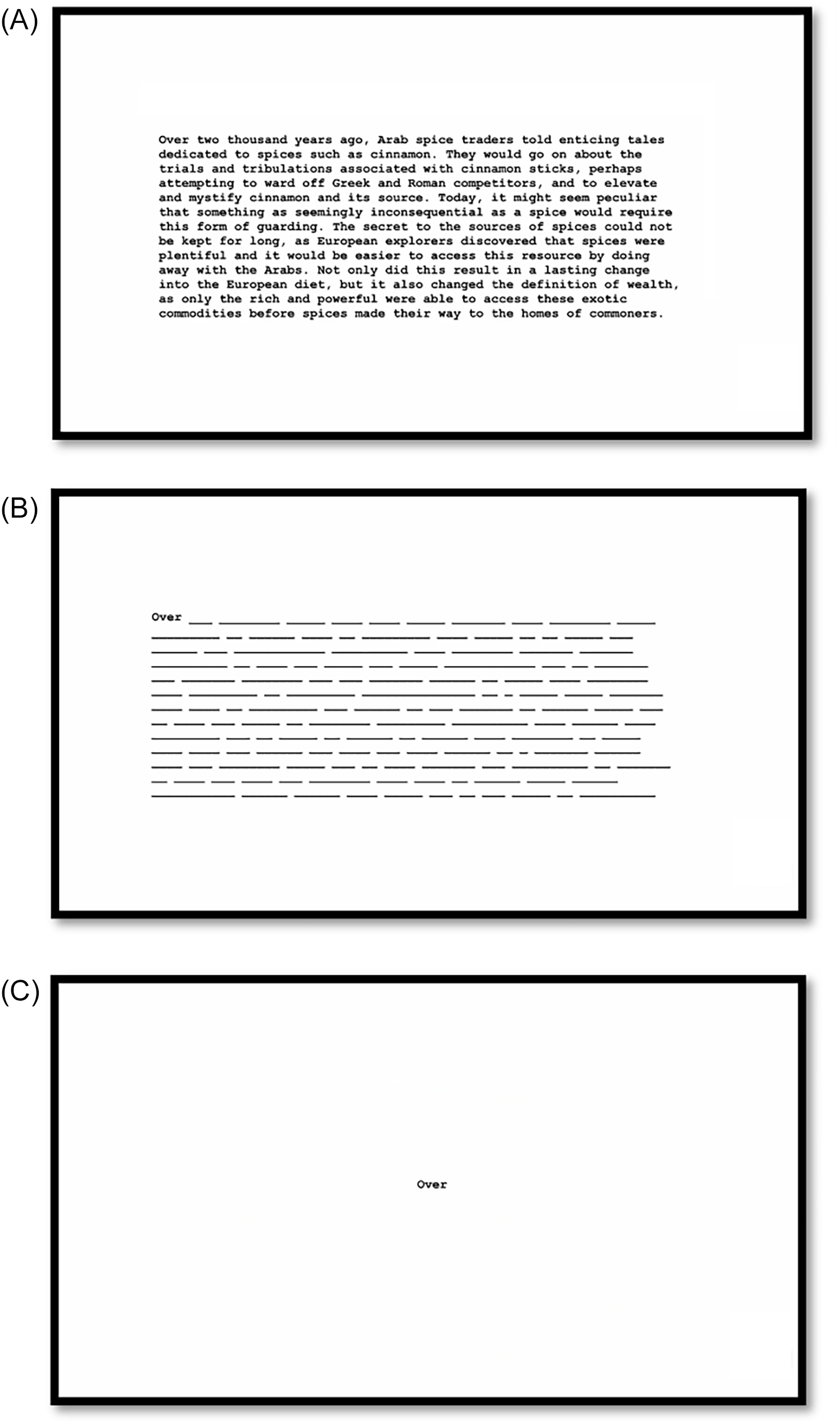
Each condition presented words with the same font style and size as in the pilot studies but varied in sensorimotor demands (Figure 1): In the fully visible reading condition (FULL), experimental trials presented participants with a text paragraph for 35 s, followed by a new screen that presented a multiple-choice question to test reading comprehension. Participants had two minutes to select the correct answer (using their computer mouse or touch pad) and to confirm their choice by clicking a “continue” button. Next, they saw a “Spacebar” prompt in the center of the screen. Participants were free to press the spacebar on their keyboard whenever they were ready to move on to the next trial for a total of seven trials/text passages.
Three reading tasks. The figure depicts the experimental reading conditions. (A) FULL, (B) PACED, (C) RSVP.

Likewise, in the PACED condition each trial presented a text passage on the screen with the spatial layout of a paragraph. Instead of words, however, horizontal lines equal in length to the respective word appeared as placeholders for 500 ms. Then one placeholder at a time (starting from the top left) was replaced by the respective word for about 250 ms (depending on the refresh rate of each participant’s monitor). Thereafter, the placeholder re-appeared to completely mask the word once again, and the next word was revealed in the normal order of the text until all words had been shown. This way, participants were required to make eye movements to each word similar to eye movements during normal reading, except no regressive eye movements to previously presented words (e.g., Frazier & Rayner, Reference Frazier and Rayner1982) or previews of future words (Rayner, Reference Rayner1975) were possible – unlike in the FULL condition. However, similar to the FULL condition, the PACED condition preserved spatial certainty and layout. That is, with the help of the line placeholders participants could predict the center of mass of each future word and, thus, plan eye movements. In addition, the lines conveyed information about where each word was placed relative to the paragraph as a whole. That said, one could argue that the placeholders created unwanted visual distraction. However, the lines should have been less distracting than the surrounding words in the FULL condition because lines are more dissimilar to words than words to one another. At the same time, the words suddenly appearing in the PACED condition (also see RSVP condition) created visual transients that should have been substantially more salient than continuously visible lines. In sum, the advantages of the placeholders outweighed the disadvantages.
Finally, similar to the PACED condition the RSVP condition showed single words for 250 ms each. However, each trial started with a plus (2.5% of screen height) in the center of the screen for 500 ms, followed by every word of a given passage appearing, one at a time, in that same central position, i.e., without the spatial context of the paragraph. Alternatively, we could have placed words centered on their optimal viewing point (OVP) which tends to be between the beginning and the middle of a word (e.g., Brysbaert & Nazir, Reference Brysbaert and Nazir2005; for the limited effectiveness of OVPs during RSVP: Benedetto et al., Reference Benedetto, Carbone, Pedrotti, le Fevre, Bey and Baccino2015). However, that would have meant that the center of mass of the words shifted with each word and, thus, could have triggered involuntary shifts of the eyes and of attention. Also, to avoid that words masked one another, to approximate saccadic suppression of vision (e.g., Burr et al., Reference Burr, Morrone and Ross1994; Frost & Niemeier, Reference Frost and Niemeier2015) as well as to minimize the subjective impression that the “inner voice” during reading appeared as too “robotic,” we used 50 ms gaps in the display. Thus, the RSVP condition had participants read the text with a minimal (or no) need to make eye movements during a given trial. In addition, participants were explicitly instructed to focus on the center of the screen during word presentation (as approximately confirmed by the experimenter via Zoom) and to attend carefully to each passage in preparation for a comprehension question. Also, given the brief presentation time of individual words similar to typical saccade latencies, a strategy of scanning words with multiple fixations would have been highly inefficient and thus unlikely. However, precise foveation could not be verified.
Trials of all three reading conditions were presented in a blocked fashion and the order of blocks was randomized across participants. Furthermore, to check the randomness of text passages being distributed across reading conditions we used two-sample Kolmogorov–Smirnov tests and found no significant differences between the ADHD and the control group (FULL: D (868) = 0.0378, p = 0.9695; PACED: D (868) = 0.0931, p = 0.1080; RSVP: D (868) = 0.0771, p = 0.2696).
Statistical analysis
All statistical analyses were performed using RStudio (Version 2022.07.1.554) and IBM SPSS Statistics (Version 29.0; IBM Corp., 2022). To analyze reading comprehension performance (scored as binary correct/incorrect responses), we used generalized linear mixed models (GLMMs) with a binomial link function. These models included a fixed within-subjects factor of Task Condition (FULL, PACED, RSVP) and, where appropriate, a between-subjects factor of Group (e.g., ADHD vs. control, medicated vs. unmedicated). Subject ID was modeled as a random intercept to account for individual variability and repeated measures.
We chose GLMMs over traditional ANOVAs because they are better suited to the structure of our data. In particular, GLMMs can handle binary outcome variables like comprehension accuracy and account for trial-level noise and individual differences via random effects. In contrast, ANOVAs assumes continuous, normally distributed outcomes that typically requires averaging across trials, which can obscure variability and reduce sensitivity (Baayen et al., Reference Baayen, Davidson and Bates2008; Barr et al., Reference Barr, Levy, Scheepers and Tily2013).
Our main approach involved likelihood ratio chi-square tests comparing nested models. Specifically, we assessed whether adding task condition, group, or their interaction significantly improved model fit relative to simpler models (e.g., intercept-only or main effects only). Fixed effect estimates, standard errors, and Wald z-tests are reported; however, our main conclusions are based on these model comparisons.
To rule out the possibility that the RSVP benefit was the simple consequence of a oculomotor control deficit, convergence insufficiency, we conducted a series of analyses testing for a potential statistical relationship between comprehension scores and scores from the Convergence Insufficiency Symptom Survey (CISS) within the ADHD group. Furthermore, because the CISS is based in part on questions inquiring about difficulties during reading, potentially capturing cognitive–linguistic challenges aside from purely motor control difficulties, we also conducted an exploratory principal component analysis (PCA) on the CISS scores to better understand its data structure. The PCA was performed using IBM SPSS Statistics (Version 29.0; IBM Corp., 2022), with components extracted based on standard criteria (eigenvalues > 1) and varimax rotation to improve interpretability. Removing a component that mainly reflected cognitive variance in the data, we then calculated a modified CISS score that arguably more purely captured oculomotor difficulties and re-computed correlations with RSVP comprehension accuracy. Although this analysis was exploratory, it was included to examine whether latent symptom dimensions might help explain individual differences in reading performance. Crucially, we used the PCA to reduce the risk of a type II error with respect to the observed null result (i.e., no correlation between CISS and RSVP benefit).
Results
MART scores revealed no difference between control and ADHD participants (t(74) = −0.70; p = 0.48; Cohen’s d = 0.16; see Table 1), suggesting comparable levels of general intelligence in both participant groups. In contrast, participants with ADHD scored significantly higher on the ADHD scale relative to controls (t(74) = −7.43; p < 0.001; Cohen’s d = 1.70).
Descriptive statistics for primary measures by group

Note: Values reflect group means and standard deviations (in italics) for the ADHD and control groups on all primary dependent measures. * Indicates significant group differences. The ADHD Scale refers to the ADHD Self-Report Scale (ASRS-v1.1); MART = Matrices Abstract Reasoning Test; CISS = Convergence Insufficiency Symptom Survey. Reading accuracy values reflect the proportion of correct responses for each presentation condition (FULL, PACED, RSVP).
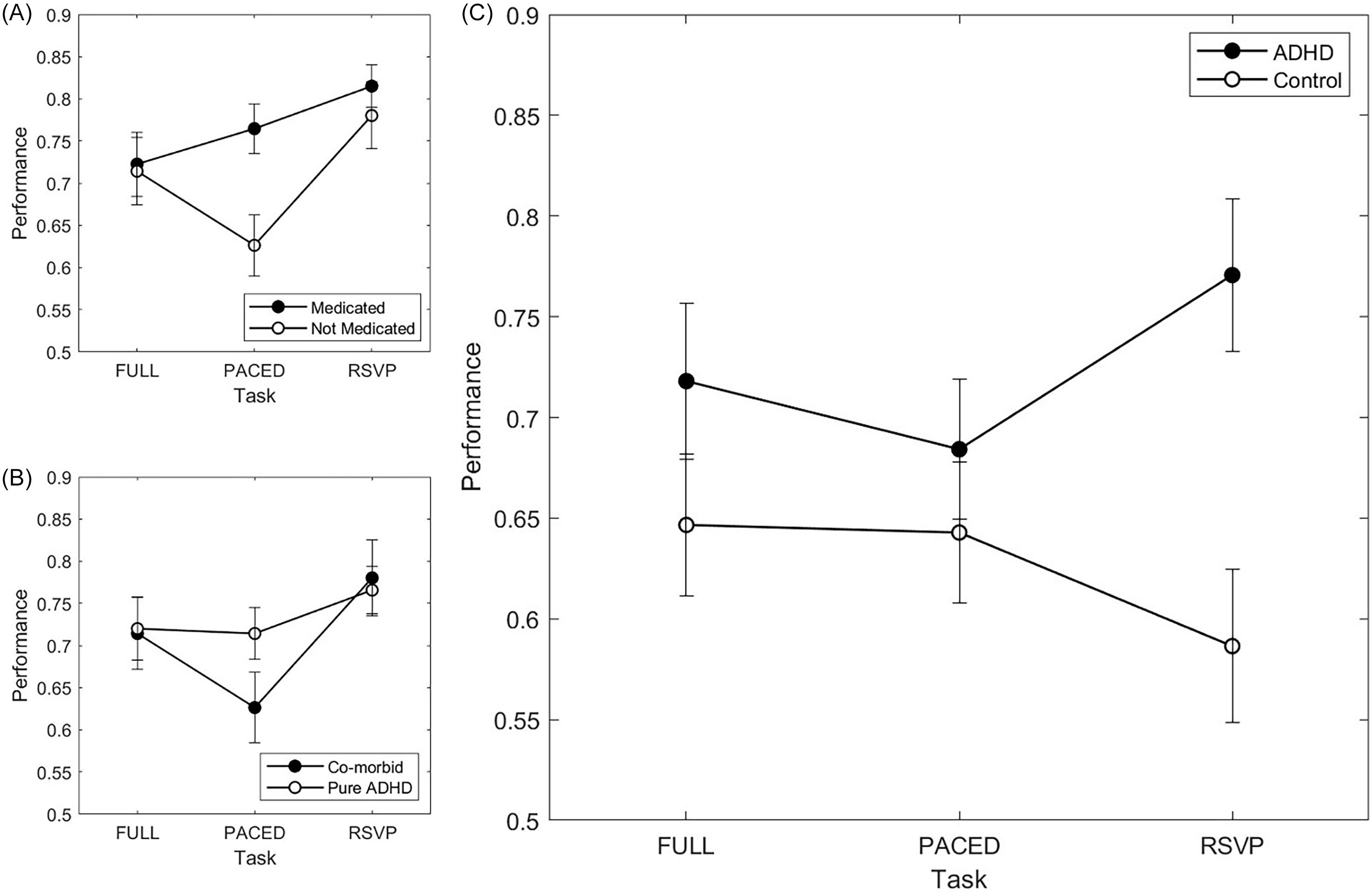
To inspect the reading performance data, we first compared medicated versus not medicated ADHD participants (Figure 2A) using GLMM with a binomial link function with a fixed within-subjects factor Task Condition (FULL, PACED and RSVP), and a between-subjects factor Group (here: medicated vs. not medicated; for details: Table S2). Relative to the intercept model, there was a trend for the task effect model (χ2 2,4 = 5.67, p = 0.058). Crucially however, there was no medication status effect (χ2 2,3 = 1.97, p = 0.16). Also, the model that included the interaction did not explain more than the model that consisted of the main effects alone (χ2 5,7 = 3.22, p = 0.20). Second, we found that ADHD participants with and without comorbidities did not differ significantly from one another (Figure. 2B): relative to the intercept, there was no co-morbidity effect (χ2 2,3 = 0.005, p = 0.818), and the model that included the interaction did not explain more than the model that consisted of the main effects (χ2 5,7 = 2.02, p = 0.36; for details: Table S3). For exploratory comparisons between ADHD subtypes (combined and inattentive; note that only three participants identified as hyperactive), please see the Supplementary Material (Table S4 and Figure S1).
Comprehension in the reading experiment. (A) medicated vs. unmedicated participants with ADHD, B) ADHD participants with and without comorbidities, and (C) ADHD group vs. control. Error bars indicate standard errors.

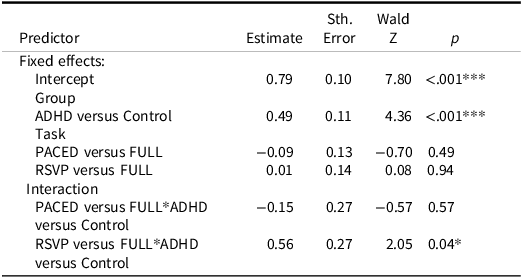
Figure 2C shows reading performance in the ADHD group as a whole compared to control participants suggesting that participants with ADHD performed better, especially in the RSVP condition. Indeed, relative to the intercept, there was a significant group main effect (χ2 2,3 = 18.87, p < 0.001). However, there was no main effect of task (χ2 2,4 = 0.505, p = 0.78; Table 2), suggesting that the small differences in presentation time and variability across tasks had little influence on performance, consistent with our pilot data. Most importantly, the model that included the interaction significantly explained more than the model that just consisted of the main effects (χ2 5,7 = 7.58, p = 0.022).
Generalized Linear Mixed Model: All Participants Regression Estimates – Group and Reading Condition
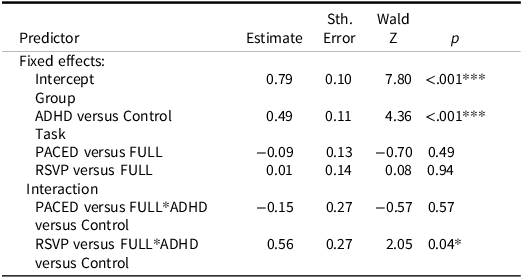
Note: Subject ID as random effect, with variance = 0.27, S.D. = 0.51. Control and FULL modeled as reference groups. ***p< 0.001, ** p < 0.01
To explore post-hoc the interaction we used a linear contrast approach. To this end we first compared conditions where participants needed to make saccades (FULL and PACED) to the minimized eye movement condition (RSVP) in line with our a-priori assumption that participants with ADHD are impacted by eye movements (for the second part of the linear contrast we compared FULL vs. PACED, see later). The model that included the interaction significantly explained more than the model that just consisted of the main effects (χ2 4,5 = 7.26, p = 0.007, significant after serial Bonferroni correction) (see Table S5). This shows that, relative to controls, there was an RSVP benefit in ADHD. Expressed in numbers, relative to the saccade conditions ADHD participants improved by 6.96% whereas controls got worse by 5.82% thus amounting to a relative benefit of 12.78%.
To test whether separate RSVP benefits and disadvantages existed in the ADHD and the control group, respectively, two additional follow-up GLMMs were run separately for ADHD and control participants comparing performance on the FULL and PACED task to the performance on the RSVP task. Relative to the intercept, ADHD participants displayed a main effect of task (χ2 2,3 = 4.86, p = 0.027; Table S6), suggesting that ADHD participants had better comprehension without eye movements than with eye movements. By contrast, control participants showed a non-significant trend for worse comprehension in the RSVP condition relative to the other conditions (χ2 2,3 = 2.82, p = 0.09; Table S7).
We also compared the FULL and PACED conditions (as the second part of the linear contrast). The model that included the interaction did not explain more than the model that just consisted of the main effects (χ2 4,5 = 0.09, p = 0.77) (see Table S8). Together, these post-hoc analyses show that participants with ADHD benefitted from the RSVP condition more than the FULL or the PACED condition, whereas control participants showed no reliable difference in comprehension.
Because the ADHD group had a higher ratio of male participants than the control group, we also compared reading performance of female and male participants. In neither of the two groups did we observe gender-specific differences (ADHD group: χ2 2,3 = 0.07, p = 0.79; control group: χ2 2,3 < 0.01, p = 0.99). This shows that the RSVP benefit in the ADHD group is not due to having more male participants.
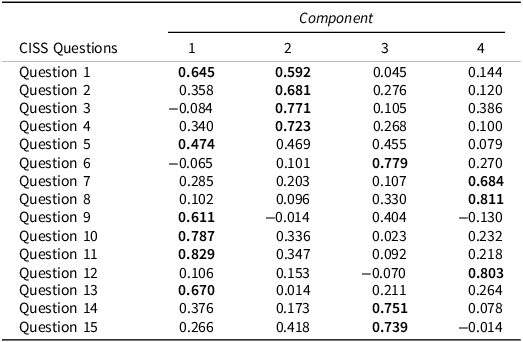
Finally, we tested whether the RSVP benefit in ADHD was statistically explained by different degrees of convergence insufficiency as captured with the CISS. A total of 25 out of the 34 ADHD participants who completed the CISS showed a score larger than 21 which is indicative of a clinical level of CI (Bolding et al., Reference Bolding, Lahti, Gawne, Hopkins, Gurler and Gamlin2012; Horwood et al., Reference Horwood, Toor and Riddell2014; Rouse et al., Reference Rouse, Borsting, Lynn Mitchell, Scheiman, Cotter, Cooper, Kulp, London and Wensveen2004). Inspecting the reading performance data in the participants with lower CISS scores still revealed an RSVP benefit that was comparable to that of participants with higher scores (5.61% vs. 8.00% respectively). Furthermore, we found that CISS scores correlated with the FULL as well as the RSVP condition (r = −0.61, p < 0.001, and r = −0.377, p = 0.028, respectively), whereas the scores did not correlate with the PACED task (r = −0.21, p = 0.22). Crucially, CISS scores did not correlate with the RSVP benefit (performance in the FULL and PACED conditions relative to RSVP; r = 0.131, p = 0.46). Because only CISS scores but no formal diagnosis of convergence insufficiency was available for our study, we next examined the CISS more closely. Given that many of its questions asked about reading difficulties it is possible that the survey did not measure purely oculomotor difficulties but cognitive–linguistic challenges with reading as well, or that our participants, sensitized by their participation in a reading study, responded in a biased manner to survey items about reading. Therefore, we ran a PCA that extracted four components (eigenvalues: 6.54, 1.68, 1.42, and 1.04 respectively; 71.2% of total variance explained; Varimax rotation; Table 3 and see supplementary Table 2). Based on these results component 3 seemed to capture cognitive difficulties, whereas the other components seemed to reflect more oculo-motor difficulties and visual aspects of reading difficulties. For that reason, we removed component 3 and only summed over the factor scores for components 1, 2, and 4 as an alternative CISS score. We correlated this modified CISS measure with the RSVP benefit. Still no significant correlation was observed (r = 0.11, p = 0.58), suggesting that CI has a negligible, if any, influence on the RSVP benefit.
Rotated Component Matrix of PCA

Note: Considered component loads larger than 0.47 (bolded).
Discussion
We tested the hypothesis that eye movements during reading might be disruptive to reading comprehension in individuals with ADHD. To this end we had undergraduate students with and without ADHD read short paragraphs in a FULL condition with normal text reading, in a PACED condition that retained the spatial structure of the paragraph but revealed only one word at a time, and in an RSVP condition where the spatial structure was broken up and all words appeared in the center of the screen in a consecutive manner, thereby requiring minimal eye movements. We observed that in the RSVP condition ADHD participants performed better than in the two other conditions that made eye movements necessary. In contrast, control subjects showed the opposite pattern; they showed a trend for greater difficulties with RSVP reading as opposed to reading with eye movements such that the relative RSVP benefit in ADHD amounted to a drastic improvement in comprehension of about 13% compared to controls. As we will argue, these results suggest that in ADHD eye movements interfere with reading comprehension and that the interference can be avoided in the RSVP condition.
However, before discussing how this RSVP benefit in ADHD might arise from the absence of eye movements, five alternative interpretations of the RSVP benefit unrelated to eye movements should be considered. First, flashing words RSVP style might have an alerting effect on ADHD participants and, thus, improve sustained attention. Challenges with sustained attention can be a predictor of poor reading performance (Stern & Shalev, Reference Stern and Shalev2013) and are often observed in ADHD (e.g., these challenges can be reflected in diminished suppression of microsaccades in anticipation of upcoming events in ADHD; Dankner et al., Reference Dankner, Shalev, Carrasco and Yuval-Greenberg2017; Fried et al., Reference Fried, Tsitsiashvili, Bonneh, Sterkin, Wygnanski-Jaffe, Epstein and Polat2014). Second, perhaps RSVP reading removes visuo-attentional distractions that otherwise would impact normal reading. That is, normal text paragraphs might present visually complex images that reflexively attract attention thereby impeding the typical flow of reading in ADHD. Third, it is possible that RSVP reading removes distractions on a level of cognitive–linguistic processes that impacts paragraphs reading in ADHD. That is, during normal reading the preview of future, not yet fixated words (and the opportunity for regressions, i.e., to go back to and re-read earlier words) is often beneficial (Benedetto et al., Reference Benedetto, Carbone, Pedrotti, le Fevre, Bey and Baccino2015). But it might help ADHD readers to be forced to focus on one word at a time during RSVP. Fourth, ADHD participants might have had poorer strategic abilities to time their reading speed. That is, because the present reading experiment limited the time for reading, ADHD participants might have been less sure about how fast or slow to read the paragraphs to make optimal use of their time in the FULL condition whereas in the RSVP condition no such strategic challenge existed. Fifth, the RSVP format may have benefited ADHD participants simply because it was novel. Individuals with ADHD are often more responsive to novel or stimulating tasks which can enhance motivation and cognitive engagement (e.g., Zentall, Reference Zentall2005). This may have made the RSVP condition more engaging for ADHD participants relative to controls, potentially amplifying their attention and efforts. However, all five interpretations of the RSVP benefit are at odds with the fact that the PACED condition too was novel and flashed words on the screen which should have alerted participants as well as guided their attention and PACED reading too did not permit previews or regressions like RSVP reading while removing the strategic necessity to time one’s own reading speed. Nevertheless, PACED reading produced no benefit relative to normal text reading. In sum, our results are difficult to reconcile with an explanation that is unrelated to eye movements. Instead, our results suggest that linguistic and working memory processes involved in reading (Miller et al., Reference Miller, Keenan, Betjemann, Willcutt, Pennington and Olson2013) are impacted in ADHD due to interference with programming and/or executing eye movements.
Several aspects of eye movements seem to be affected in ADHD and could contribute to reading difficulties. Some individuals with ADHD show altered coordination of the two eyes. Granet et al. (Reference Granet, Gomi, Ventura and Miller-Scholte2005) noted that the prevalence of clinical convergence insufficiency (CI) in ADHD was 15%. This is consistent with a recent eye movement study on reading that reported differences in vergence movements in ADHD children compared to controls (Molina et al., Reference Molina, Redondo, Vera, García, Muñoz-Hoyos and Jiménez2020; for an attention-based lack of vergence movements see Solé Puig et al., Reference Solé Puig, Pérez Zapata, Puigcerver, Esperalba Iglesias, Sanchez Garcia, Romeo, Cañete Crespillo, Supèr and Hills2015). Furthermore, reading is a typical task where a clinical level of CI is noticed with various symptoms such as unstable vision and blurred or moving words, discomfort of the eyes and headaches as well as sleepiness (Rouse et al., Reference Rouse, Borsting, Lynn Mitchell, Scheiman, Cotter, Cooper, Kulp, London and Wensveen2004). Therefore, in the present study we considered the possibility that eye movements during normal reading might cause blurred or double vision in ADHD, hence explaining the benefit of the RSVP condition that required no eye movements. However, we found no support for the idea that the RSVP benefit was driven by CI in the subgroup of our ADHD participants with potentially clinical levels of CI. There was no evidence that CI scores were correlated with the RSVP benefit, even when we conducted a more in-depth analysis of the CI scores, arguably removing possible cognitive confounds in the score. This approach reflected a good-faith attempt to challenge the null result of no correlation between CI scores and RSVP benefits. Indeed, trying to disprove the null finding through such an additional, structured analysis, and still failing to find supporting evidence for a correlation, offers increased confidence that the RSVP benefit is truly unrelated to CI.
Another form of eye movement deficit concerns overt orienting during visually guided saccade tasks where individuals with ADHD exhibit longer and more variable latencies relative to neurotypical participants (e.g., Mostofsky et al., Reference Mostofsky, Lasker, Cutting, Denckla and Zee2001; Munoz et al., Reference Munoz, Armstrong, Hampton and Moore2003). These difficulties might be mirrored in slower covert orienting of attention as found in some studies (Brewer et al., Reference Brewer, Fletcher, Hiscock and Davidson2001; McDonald et al., Reference McDonald, Bennett, Chambers and Castiello1999; Nigg et al., Reference Nigg, Swanson and Hinshaw1997; Oberlin et al., Reference Oberlin, Alford and Marrocco2005; Tomporowski et al., Reference Tomporowski, Tinsley and Hager1994; Wood, Reference Wood1999) and a diminished natural asymmetry of visuo-spatial attentional functions (e.g., Chen & Niemeier, Reference Chen and Niemeier2017). Thus, it is possible that making eye movements and shifting attention is harder in ADHD such that reading turns into a dual task of spatially shifting behavior and concurrent semantic processing. As a caveat though, several other studies have reported slower covert orienting to one side only, only during re-directing of attention, or no deficits at all (Aman et al., Reference Aman, Roberts and Pennington1998; Carter et al., Reference Carter, Krener, Chaderjian, Northcutt and Wolfe1995; Epstein et al, Reference Epstein, Conners, Erhardt, March and Swanson1997; Epstein et al., Reference Epstein, Johnson, Varia and Conners2001; Novak et al., Reference Novak, Solanto and Abikoff1995; Pearson et al., Reference Pearson, Yaffee, Loveland and Norton1995; Roberts et al., Reference Roberts, Ashinoff, Castellanos and Carrasco2017; Swanson et al., Reference Swanson, Posner, Potkin, Bonforte, Youpa, Fiore, Cantwell and Crinella1991). For now, it is unclear whether these inconsistencies potentially arose from differences in paradigms, small group sizes, or publication biases. As another possible factor, some studies might have found normal orienting in ADHD because their participants were recruited from a population of high-functioning individuals. But if so, it would be also unlikely that the RSVP benefit reflects orienting difficulties in the current study because our participants were recruited from a pool of university students (more on recruitment biases later). Future research will have to clarify whether slow orienting of eyes and attention contributes to the RSVP benefit.
As a third eye movement deficit, individuals with ADHD seem to have difficulties with executive levels of oculomotor control. They have been found to make unwanted anticipatory eye movements during memory-guided saccade tasks (Castellanos et al., Reference Castellanos, Marvasti, Ducharme, Walter, Israel, Krain, Pavlovsky, Hommer and Hommer2000; Mostofsky et al., Reference Mostofsky, Lasker, Cutting, Denckla and Zee2001; Rommelse et al., Reference Rommelse, Van der Stigchel, Witlox, Geldof, Deijen, Theeuwes, Oosterlaan and Sergeant2008a; Ross et al., Reference Ross, Radant, Hommer and Young1994) or during tasks requiring prolonged fixation (e.g., Munoz et al., Reference Munoz, Armstrong, Hampton and Moore2003). Furthermore, a review by Rommelse et al. (Reference Rommelse, van der Stigchel and Sergeant2008b) found that in a majority of studies examining antisaccades individuals with ADHD made directional errors. These deficits might point at difficulties with response inhibition and sustained attention as an underlying cause. Therefore, it is possible that ADHD participants in our study, in an effort to make functional saccades during reading and avoid unwanted saccades elsewhere, over-activated frontal cortical regions associated with oculomotor control that then interfered with working memory. Working memory is a predictor of reading performance in ADHD (Miller et al., Reference Miller, Keenan, Betjemann, Willcutt, Pennington and Olson2013), and saccadic eye movements are known to be disruptive in transsaccadic working memory tasks (Moussaoui et al., Reference Moussaoui, Pereira and Niemeier2022; Vasques & Danckert, Reference Vasquez and Danckert2008). This saccadic disruption of working memory might be more severe in ADHD than in controls and affect spatial and non-spatial contents of memory. Once again, more research is required to investigate this possibility.
Further research is also required to test whether the RSVP benefit generalizes to other reading speeds. Our pilot tests suggested that comprehension was little influenced by a relatively wide range of presentation times, implying that the RSVP benefit is fairly robust to different speeds. Nevertheless, it is possible that the time constraints created a contrived situation that is different from daily life where reading is often timed based on individual abilities. Future studies should therefore test whether RSVP reading remains beneficial under more flexible conditions.
It is also important to consider whether differences in total reading time across conditions could explain the observed effects. While presentation timing varied slightly across formats due to imperfections in the experimental design, it was not reflected in a main effect of task on comprehension, also consistent with our pilot studies that showed a limited effect of presentation time on performance for a wide range of times. Instead, we observed a group-by-task interaction between RSVP and the other conditions: participants with ADHD benefited from the RSVP condition, while neurotypical controls showed a trend for reduced RSVP comprehension. This crossover pattern cannot be explained by presentation time differences.
To-date unclear is whether the RSVP benefit generalizes to other participants. Recruiting a sample from university students might have created recruitment biases and generalizability limitations. What is more, there likely was a recruitment bias between our two participant groups because we found that ADHD participants overall were better at reading than neurotypical controls when in the general population the opposite should be expected. The reason for this observation likely has to do with our ADHD participants being more motivated, often showing a keen personal interest in the research topic, and the fact that many of them came from other departments, such as the English department, whereas control participants were recruited from introductory psychology courses. Although recruitment biases would not explain the RSVP benefit in ADHD, it remains to be seen whether with greater representativeness relative to the general population the RSVP benefit is different, arguably greater than observed here. For that reason, future work should replicate this paradigm in larger and more diverse populations, including younger age groups and individuals with different academic profiles.
Testing younger age groups will also be interesting because ADHD of the hyperactive subtype should be more common. In the present study we observed no comprehension differences between subtypes. However, there only were three participants of the hyperactive subtype. Interestingly, numerically these participants showed rather different comprehension patterns and potentially no RSVP benefit. Therefore, future studies should revisit the question whether the RSVP benefit might depend on the subtype of ADHD.
One common feature in ADHD is its heterogeneity. Although our inclusive sampling approach reflects real-world heterogeneity of ADHD, it also introduces variability that may obscure subtle differences. Future research could benefit from recruiting more narrowly defined ‘pure’ ADHD samples, which would exclude individuals with comorbid conditions in order to isolate specific cognitive or oculomotor mechanisms. However, we note that this may reduce generalizability and introduce new sampling biases, particularly given that comorbidities are highly prevalent in ADHD populations (e.g., Faraone et al., Reference Faraone, Bellgrove, Brikell, Cortese, Hartman, Hollis, Newcorn, Philipsen, Polanczyk, Rubia, Sibley and Buitelaar2024; Pallanti & Salerno, Reference Pallanti and Salerno2020). This trade-off between experimental control and ecological validity should be considered carefully in the design of future studies.
We also acknowledge a potential methodological limitation in our measure of reading comprehension requiring a response to a single multiple-choice question following short passages provides a limited approximation of deeper semantic understanding. We selected this format because it is widely used in ADHD and reading research, and because it provides an ecologically relevant measure of reading outcomes. For example, Brown et al. (Reference Brown, Reichel and Quinlan2011) employed a standardized multiple-choice instrument (Nelson–Denny), although other forms of measures have been used such as a free-recall paradigm (Miller et al., Reference Miller, Keenan, Betjemann, Willcutt, Pennington and Olson2013). Importantly, we were constrained by the need to keep the total session time within approximately one hour to accommodate participants with ADHD and minimize fatigue. This time window, which included pre-task questionnaires and cognitive measures, restricted the number of passages and items we could feasibly include. Although our comprehension items were piloted for consistency and moderate difficulty, future research should incorporate a more extensive reading battery incorporating various measures of comprehension.
Finally, this study represents an initial step toward understanding how oculomotor demands influence reading comprehension in ADHD. While our findings offer promising insights, they also raise important questions about underlying mechanisms. Future work should incorporate standardized assessments of decoding and reading fluency, as well as direct eye-tracking measures, to more precisely characterize how eye movement control relates to comprehension as well as to associated cognitive functions such as working memory across saccadic eye movements (e.g., Frost et al., Reference Frost, Tomou, Parikh, Kaur, Zivcevska and Niemeier2019; Moussaoui et al., Reference Moussaoui, Pereira and Niemeier2023). Although our comprehension task was brief and not a standardized instrument such as the Nelson–Denny (used in Brown et al., Reference Brown, Reichel and Quinlan2011), we demonstrated that it had acceptable internal consistency. Future work should replicate these findings using longer and standardized reading batteries. This will help clarify whether the observed RSVP benefit in ADHD reflects reduced oculomotor demands, enhanced attentional focus, or working memory. Together, this will advance a mechanistic understanding of reading difficulties in ADHD and support the development of more targeted and evidence-based interventions.
In conclusion, in the present study we observed a marked improvement in reading comprehension when participants with ADHD were able to avoid eye movements, arguably because normal reading constitutes a dual task or because eye movement control during reading interferes with cognitive processes. We argue that RSVP reading might be a way in which individuals with ADHD could improve their academic success.
Supplementary material
The supplementary material for this article can be found at https://doi.org/10.1017/S1355617725101628.
Acknowledgements
Sources of financial support
This work was supported by the Natural Sciences and Engineering Research Council of Canada 559 (NSERC), Discovery Grant [RGPIN-2020-06018] awarded to Dr Matthias Niemeier.
Competing Interests
The authors declare no competing interests.



 Open access

