


Introduction
Maintaining biodiversity and ecological functioning is vital to ecosystem health and integrity, but wildlife populations continue to decline around the world (Ripple et al., Reference Ripple, Chapron, Lopez-Bao, Durant, Macdonald and Lindsey2017). Human activity threatens c. one-quarter of all living species (Díaz et al., Reference Díaz, Settele, Brondízio, Ngo, Agard and Arneth2019), and 32% of monitored species have experienced a decline in population size or distribution since 1900 (Ceballos et al., Reference Ceballos, Ehrlich and Dirzo2017). The loss of animal species, also referred to as defaunation, is a global issue, but it is particularly acute in biodiverse tropical regions where terrestrial mammal distributions have contracted by > 40% since the early 1990s (Gallego-Zamorano et al., Reference Gallego-Zamorano, Benítez-López, Santini, Hilbers, Huijbregts and Schipper2020) and populations have declined by 13% since 1980 (Benítez-López et al., Reference Benítez-López, Santini, Schipper, Busana and Huijbregts2019).
Defaunation disproportionately affects terrestrial mammals, especially large-bodied species including carnivores and herbivores, through the combined impacts of habitat loss and overexploitation (Ripple et al., Reference Ripple, Chapron, López-Bao, Durant, Macdonald and Lindsey2016; Benítez-López et al., Reference Benítez-López, Santini, Schipper, Busana and Huijbregts2019; Bogoni et al., Reference Bogoni, Peres and Ferraz2020). Many medium-sized to large mammals exhibit multiple characteristics that increase their vulnerability to environmental and anthropogenic stressors: they have relatively low reproductive rates and delayed sexual maturity, large home ranges, low population densities, limited geographical distributions and substantial overlap with human populations and activities (Cardillo et al., Reference Cardillo, MacE, Gittleman, Jones, Bielby and Purvis2008).
The loss of mammals in terms of their distribution, abundance and diversity threatens the provision of regional and global ecosystem services, food security and human well-being (Dirzo et al., Reference Dirzo, Young, Galetti, Ceballos, Isaac and Collen2014; Young et al., Reference Young, McCauley, Galetti and Dirzo2016). For example, mammal declines can lead to altered habitat structure, which in turn hampers the regeneration of forests (Gardner et al., Reference Gardner, Bicknell, Baldwin-Cantello, Struebig and Davies2019). They are also linked to the emergence of zoonotic diseases, disrupted food supplies and negative interactions between people and wildlife (Singleton et al., Reference Singleton, Belmain, Brown, Aplin and Htwe2010; Newbold et al., Reference Newbold, Hudson, Phillips, Hill, Contu and Lysenko2014; Holland et al., Reference Holland, Larson and Powell2018).
Global analyses highlight Indonesia and other Southeast Asian countries as defaunation hotspots, but this conclusion is founded on limited data (Ceballos et al., Reference Ceballos, Ehrlich and Dirzo2017; Allan et al., Reference Allan, Watson, Di Marco, O'Bryan, Possingham, Atkinson and Venter2019; Beyer & Manica, Reference Beyer and Manica2020). Indonesia harbours 738 terrestrial mammal species, representing 12% of global mammal diversity (Maryanto et al., Reference Maryanto, Maharadatunkamsi, Achmadi, Wiantoro, Sulistyadi and Yoneda2019). Many Indonesian mammals are threatened, with 79 species (11%) categorized as Endangered or Critically Endangered on the IUCN Red List, 144 (20%) listed in CITES Appendices and 105 (14%) formally protected within the country (Maryanto et al., Reference Maryanto, Maharadatunkamsi, Achmadi, Wiantoro, Sulistyadi and Yoneda2019). The increasing stressors acting on mammal populations in Indonesia result from multiple factors. Forest conversion in Indonesia is the most extensive amongst the Association of Southeast Asian Nations (ASEAN; Estoque et al., Reference Estoque, Ooba, Avitabile, Hijioka, DasGupta, Togawa and Murayama2019), with 9.79 million ha (11%) of primary forests lost during 2001–2019 (Gaveau et al., Reference Gaveau, Locatelli, Salim, Husnayaen, Manurung and Descals2022). The country has also become a source and hub of the global illegal wildlife trade, with government reports estimating the financial turnover from such trade to be USD 600 million per year (Trinirmalaningrum et al., Reference Trinirmalaningrum, Dalidjo, Rahardjo, Pribadi, Widarto and Santosa2016).
Despite increased scientific attention and global analyses concerning these issues, there is a relative dearth of empirical data on the level of biodiversity change or defaunation in Indonesia, implying that the global perception could be under- or overestimating the extent of the problem. To address this, we reviewed research articles on mammal biodiversity, distribution and abundance across time and/or location within Indonesia that were published in English or Bahasa Indonesia during 2000–2020. We sought to characterize the contents of publications over time, identify knowledge gaps and propose recommendations to the scientific community on how to improve conservation management and future research in the region.
Methods
Literature search
Defaunation is a relatively new concept, having only been formally introduced in 2014 (Dirzo et al., Reference Dirzo, Young, Galetti, Ceballos, Isaac and Collen2014). Therefore, few publications were likely to include this term in their titles, abstracts or keywords. To assess the use of this term in the literature, we conducted a preliminary search on the Google (2021) and Google Scholar (2021) platforms in March 2021, using the keywords ‘defaunation’ in English and ‘defaunasi’ in Bahasa Indonesia. We found that even in recent scientific publications the use of ‘defaunation’ in Indonesia was mostly limited to local agricultural and veterinary studies, and the term was absent from ecological studies and rarely used in popular news coverage. Thus, we collated published scientific articles that evaluated variations in mammal diversity, distributions and abundance, representing different population parameters, either at a single location or over larger spatial scales, and across a range of temporal periods.
We focused on single- or multi-species studies of medium (1–10 kg adult body mass) to large (> 10 kg adult body mass) terrestrial mammals, excluding volant mammals, small mammals (< 1 kg adult body mass), domestic and introduced animals as these taxa are typically of less conservation concern (see Supplementary Material 1 for a rationale). Using a national checklist (Maryanto et al., Reference Maryanto, Maharadatunkamsi, Achmadi, Wiantoro, Sulistyadi and Yoneda2019) as the principal reference, we generated a list of 157 terrestrial mammal taxa, which included arboreal and ground-dwelling species and comprised 128 medium-sized and 29 large species (Supplementary Table 1).
During March–September 2021,we conducted a systematic search of peer-reviewed articles published during January 2000–December 2020. The search used three academic databases: Scopus (Elsevier, The Netherlands) and Web of Science (Clarivate, USA) for English publications, and Indonesia's Garuda database (Garuda, 2020), in which local publications in Bahasa are more prominent. We chose this 21-year study period to capture the growing number of Indonesian biodiversity publications (Amelia & Rahmaida, Reference Amelia and Rahmaida2017) up until the Covid-19 pandemic, which negatively affected scientific activity. We considered studies that utilized both primary and secondary data (e.g. meta-analyses) and excluded literature reviews.
Searching in Scopus and Web of Science databases began with the following terms (in the article title, abstract and keywords) with Boolean operators: mammal* AND Indonesia* AND (biodiv* OR divers* OR distribution OR population* OR density OR abundan*) NOT marine. These arguments imply that the article must include both mammal and Indonesia keywords, along with a minimum of one of the following keywords: biodiversity, diversity, distribution(s), population(s), density and abundance, whilst excluding studies from the marine realm. To complement these searches and maximize the number of relevant articles found, we conducted additional searches using combinations of two keywords: the common English name of the species and region where the species’ distribution is known (e.g. for rhinoceros: rhino* AND Sumatra, rhino* AND Java, rhino* AND Kalimantan). We applied this search method for all species in all island groups of Indonesia as appropriate to the taxon (i.e. Sumatra, Kalimantan, Java–Bali, Sulawesi, Nusa Tenggara (Lesser Sunda), Maluku (Mollucas) and Papua), which involved 202 searches.
In the Garuda database we started the exploration using the terms ‘mamalia’ (Bahasa) or ‘mammal’ (English) within the title as the database only recognizes AND Boolean operators. We continued the search by using the common Indonesian or English name of the species (e.g. badak or rhinoceros).
Database compilation
Once compiled, the two lead authors (ARD and IMRP) read each publication and recorded the following characteristics: population parameter (species diversity, distribution, abundance or a combination of these), location (i.e. one of the 34 provinces of Indonesia, or regions of West, Central and East Indonesia), status of study area (protected, unprotected or both), species group (single or multiple species), first author nationality (Indonesian or non-Indonesian), language (Bahasa Indonesia or English) and methodology (e.g. study design and data analysis).
We derived administration boundaries from the Indonesian Geospatial Information Agency (Badan Informasi Geospasial, 2022). The country is divided into three biogeographical regions according to the Wallace and Lydekker lines (Darajati et al., Reference Darajati, Pratiwi, Herwinda, Radiansyah, Nalang and Nooryanto2016; Badan Pusat Statistik, 2021): West (Sumatra, Java–Bali and Kalimantan; 1,160,165 km2 land area across 5,385 islands), Central (Sulawesi, Nusa Tenggara and Maluku; 334,750 km2 land area across 6,320 islands) and East (Papua; 421,991 km2 land area across 5,061 islands). We confirmed protected area boundaries via the Ministry of the Environment and Forestry of Indonesia protected area database (Badan Informasi Geospasial, 2022)..
We determined species group according to the number of species studied in each article: single species (e.g. Sumatran orangutan Pongo abelii) or multi-species (e.g. primate community; Maryanto et al., Reference Maryanto, Maharadatunkamsi, Achmadi, Wiantoro, Sulistyadi and Yoneda2019). We assumed the first author's nationality based on author names and affiliations. We classified publication language based on the principal language of each article, excluding the abstract. Lastly, we categorized studies based on whether they implemented an appropriate scientific design (i.e. reported the study design clearly in the publication or justified the selection of sample sizes/sites in relation to the research question) and utilized a statistical/modelling approach that accounted for imperfect detection.
Results
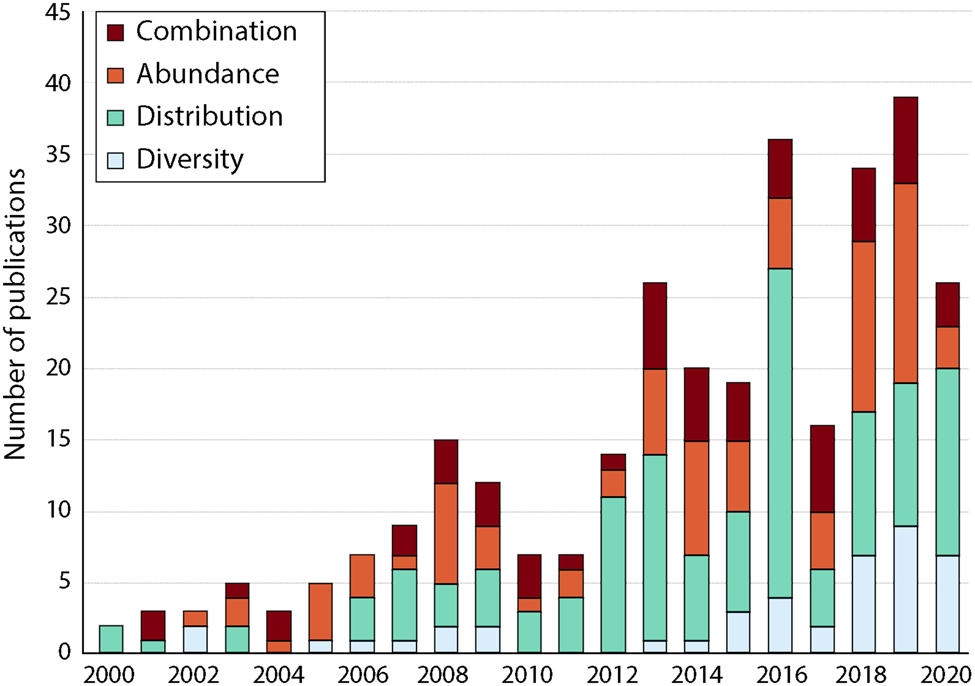
Our systematic literature search returned 308 peer-reviewed articles. The publication rate (number of publications per year) increased over time (R 2 = 0.78, F 1,19 = 67.1, P < 0.0001; Fig. 1). This trend was associated with increased numbers of publications on distribution (of which there were 125 over the study period, 40.6% of the total of 308 publications), abundance (84, 27.3%), diversity (42, 13.6%) and a combination of parameters (57, 18.5%) (β = 0.68, 0.41, 0.33 and 0.29, respectively; P < 0.001). The highest number of publications was produced in 2019.
Number and type of publications on mammal biodiversity in Indonesia during 2000–2020.
Single-species publications dominated our search results (217, 70.5%). The rest focused on multiple species (e.g. herbivores or carnivores) or the mammal community as a whole. Most studies were conducted at a single point in time (277, 89.9%) and in one location (225, 73.1%). The number of articles published in English (155, 50.3%) was similar to that of papers published in Bahasa Indonesia (153, 49.7%). More English-language publications were led by non-Indonesian authors (90, 58.1%) than Indonesian authors (66, 42.6%), and all Bahasa articles were led by Indonesian authors.
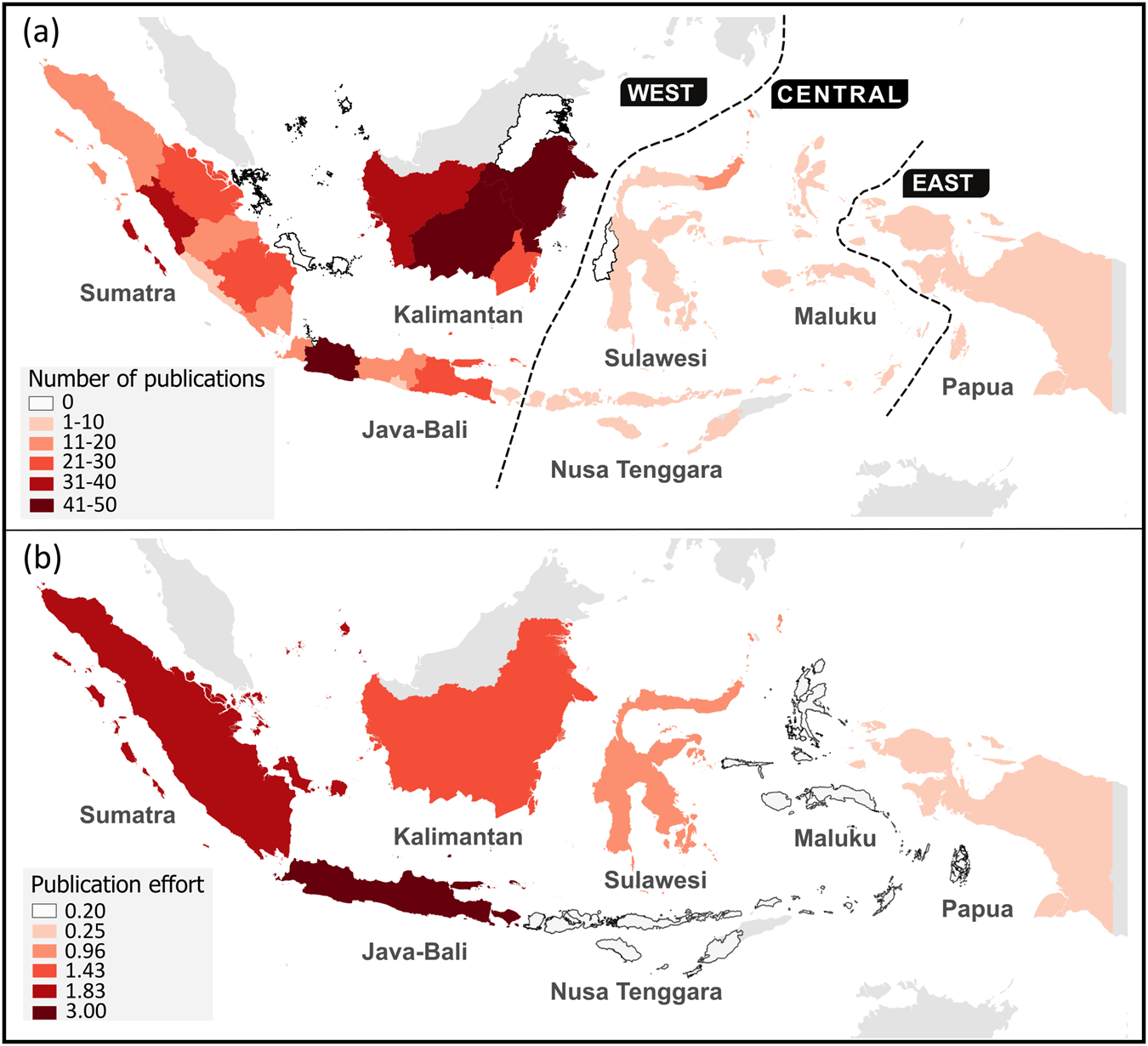
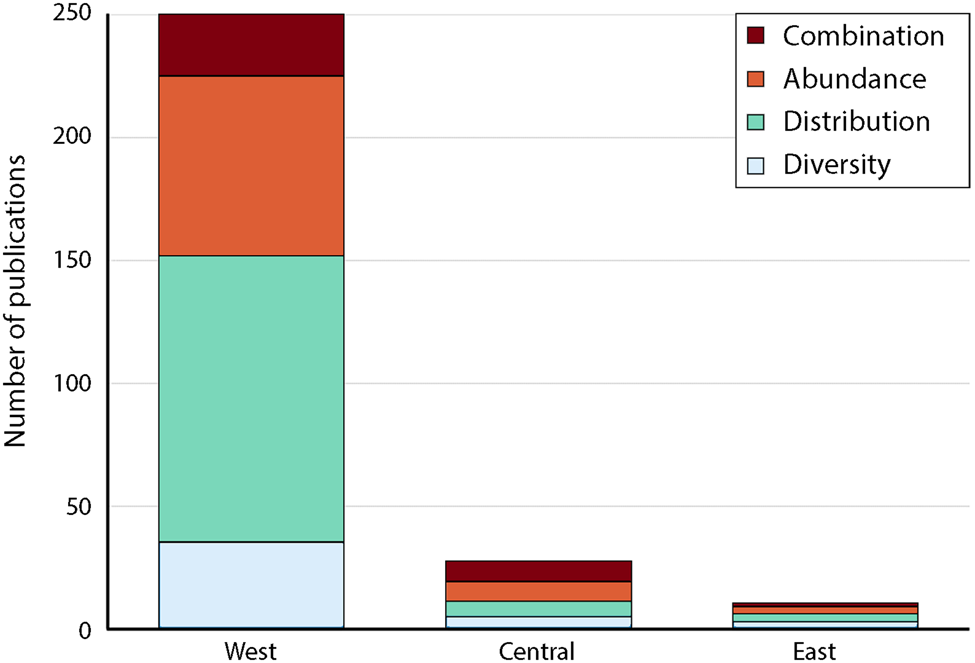
Published studies showed a marked regional/provincial bias (Figs 2 & 3): most publications were based on research undertaken in West Indonesia (268, 87.0%), with much fewer studies focused on Central (23, 7.4%) and East (9, 2.9%) Indonesia. Even when accounting for variation in species numbers across the archipelago, publication effort (i.e. number of publications per number of species found in the island group) was much higher in western than eastern islands (Fig. 2b, Supplementary Table 2). For example, > 12 times more publications were produced for mammals in Java–Bali than for those in Papua. Only eight publications (2.6%) considered the national scale. The majority of research was based in three provinces in West Indonesia: West Java (37 articles, 12.0%), Central Kalimantan (23, 7.7%) and East Kalimantan (14, 4.5%). Nevertheless, four out of five provinces with no publications were located in West Indonesia: Bangka Belitung, Jakarta Capital Region, the Riau Islands and the newly established (2012) province of North Kalimantan. There were also no publications from the recently established (2004) West Sulawesi province in Central Indonesia. Most field studies were undertaken in sites that cover both protected and unprotected areas (193 sites; 41.0%), followed by studies focused solely on either protected areas (181 sites; 39.0%) or unprotected areas (92 sites; 20.0%).
(a) Spatial distribution of mammal research effort in Indonesia based on 308 studies published during 2000–2020. The colour of provinces reflects the number of publications focused on the mammals from that province. (b) Spatial distribution of publication effort (number of publications divided by number of species) per island group.
Number of studies published during 2000–2020 focusing on the main regions of Indonesia, by study topic.
Of the 157 mammal species considered, 104 (66.2%) were studied as either a single focal taxon (64) or within a species group (40). Orangutans Pongo sp. (a total of 27 articles), tigers Panthera tigris (12) and Asian elephants Elephas maximus (11) had more single-species publications than other large mammal taxa (1–15 studies). The long-tailed macaque Macaca fascicularis, spangled ebony langur Trachypithecus auratus and Javan slow loris Nycticebus javanicus dominated publications about medium-sized mammals, with 18, 12 and 10 studies, respectively. Generalist large species such as wild boar Sus scrofa (32), southern red muntjac Muntiacus muntjak (32) and sun bear Helarctos malayanus (25), along with medium-sized species such as the long-tailed macaque (37), leopard cat Prionailurus bengalensis (36) and southern pig-tailed macaque Macaca nemestrina (28) were often studied in multi-species publications (Supplementary Table 1).
Discussion
We found that most publications on the mammal populations of Indonesia focused on the distribution and abundance of single species and were geographically biased towards the west of the country. Nevertheless, useful datasets are being generated as the conservation of medium and large mammals receives increased research attention and funding, improving our knowledge on population declines, range contractions and extirpation dynamics (MacKenzie et al., Reference MacKenzie, Nichols, Hines, Knutson and Franklin2003; Peterman et al., Reference Peterman, Rittenhouse, Earl and Semlitsch2013). We outline four major research gaps to be addressed.
Disproportionate focus on a few species
The taxonomic dominance of a few well-studied species in the Indonesian literature reflects funding priorities, species conservation status, familiarity with taxa and research capacity. Wildlife research and conservation measures require long-term financial support, which is often targeted at a narrow subset of high-profile species. The Indonesian government focuses conservation actions on 25 priority species (MoEF, 2015), 14 of which were included in our review. These species were studied more than any other taxa, in part to meet government targets. Most research and conservation investments centre on funds raised for tigers, orangutans, rhinoceroses and elephants (KEHATI, 2019; Santika et al., Reference Santika, Sherman, Voigt, Ancrenaz, Wich and Wilson2022).
Familiarity and research accessibility also contribute to species bias. The long-tailed macaque received the greatest publication effort. This commensal primate widely coexists with people (Eudey et al., Reference Eudey, Kumar, Singh and Boonratana2021), so the species can be easily observed, and most studies were undertaken in accessible human settlements and nearby forests (e.g. Santoso et al., Reference Santoso, Febriani and Subiantoro2019). Publication effort was also reflected by the presence of long-term species conservation projects in West Indonesia (e.g. Kalimantan orangutans, Knott et al., Reference Knott, Kane, Achmad, Barrow, Bastian and Beck2021; Sumatran tigers, Chandradewi et al., Reference Chandradewi, Semiadi, Pinondang, Kheng and Bahaduri2019; Javan lorises, Nekaris, Reference Nekaris and Weller2016). If this trend continues, initiatives established more recently in Central and East Indonesia could lead to greater research effort in these regions (e.g. Talaud bear cuscus Ailurops melanotis in Sulawesi and long-beaked echidna Zaglossus sp. in Papua; Sheherazade, 2023).
Uneven geographical representation
Research effort was focused primarily in Java–Bali, Sumatra and Kalimantan, with relatively little work undertaken in eastern islands. Studies published on mammals from West Indonesia numbered 10 times more compared to those of the central islands (Sulawesi, Nusa Tenggara, Maluku), and 20 times more than those in East Indonesia (Papua).
Most Indonesian islands support medium to large mammals, but more species are found in the west, including conservation flagship and commensal species that attract research attention. However, even when this skewed diversity is accounted for, publication rates per species are still greater for Java–Bali, Sumatra and Kalimantan. In Central Indonesia, small-bodied mammals tend to receive a greater focus, given the interest in the Wallacea region in terms of evolutionary biology and biogeography (Broto & Mortelliti, Reference Broto and Mortelliti2019; Struebig et al., Reference Struebig, Aninta, Beger, Bani, Barus and Brace2022). Taxonomic and molecular studies have also resulted in the splitting of several prominent species (e.g. tarsiers Tarsius spp. and macaques Macaca spp. in Sulawesi; lorises Nycticebus spp., gibbons Hylobates spp. and langurs Presbytis spp. and Trachypithecus spp. in Kalimantan and Sumatra) into many cryptic taxa, reducing the number of publications per species.
Research capacity is also concentrated in the western islands. Of the 219 publications led by Indonesian researchers, 73% were affiliated with universities based in Java, Sumatra or Kalimantan. Equally, NGOs and government ecological and conservation expertise are also disproportionately concentrated in this region. Research effort thus mirrors the distribution of threats to a restricted set of species. The 2 decades of research that we assessed coincided with intensive deforestation in Kalimantan and Sumatra (Margono et al., Reference Margono, Potapov, Turubanova, Stolle and Hansen2014; Gaveau et al., Reference Gaveau, Locatelli, Salim, Husnayaen, Manurung and Descals2022), however, in recent years, industrial agriculture and mining have expanded eastwards (Supriatna et al., Reference Supriatna, Shekelle, Fuad, Winarni, Dwiyahreni and Farid2020; Voigt et al., Reference Voigt, Supriatna, Deere, Kastanya, Mitchell and Rosa2021). Wildlife exploitation and trade are also prominent in Central and East Indonesia (Pattiselanno et al., Reference Pattiselanno, Apituley, Arobaya and Koibur2019; Latinne et al., Reference Latinne, Saputro, Kalengkongan, Kowel, Gaghiwu and Ransaleleh2020), which could exacerbate population declines of endemic and forest-dependent species through habitat change. Thus, threats to mammals are shifting and/or expanding across the country, implying that research and monitoring efforts will need to follow suit to be effective.
Study design limitations
Most articles reported little information on study design, disregarded advances in survey methods and/or lacked robust statistical analyses. For example, 92% of the studies did not account for imperfect detection and would have benefitted from more rigorous analytical approaches such as occupancy modelling, distance sampling or capture–recapture. Sampling location often appeared to be based on accessibility (i.e. near forest boundaries or in easily accessible terrain), with publications frequently omitting key information on sampling approaches. Some were also prone to replication issues, such as limited sample sizes or highly unequal sampling efforts between habitat types/treatments. The potential for species misidentification (i.e. false positives) was high. For instance, Javan mouse deer Tragulus javanicus were reported beyond the confirmed species distribution in Java in several studies. To overcome these problems, researchers should consider species ecology (e.g. the grid size for camera trapping should be appropriate for the species’ home ranges) and the minimum sample sizes required to support statistical models (e.g. through power analysis). Accounting for bias (e.g. imperfect detection and false positives) is essential to ensure scientifically robust conclusions can be derived from analyses.
Limited long-term population studies
Appropriate study design and data analysis also allow researchers to replicate population studies over time, which can be useful for tracking population trends and evaluating conservation impacts (Purwandana et al., Reference Purwandana, Ariefiandy, Imansyah, Rudiharto, Seno and Ciofi2014; Chandradewi et al., Reference Chandradewi, Semiadi, Pinondang, Kheng and Bahaduri2019). Yet this information is lacking from global defaunation analyses, especially in Southeast Asia (Dornelas et al., Reference Dornelas, Antão, Moyes, Bates, Magurran and Adam2018). In Indonesia, most published biodiversity studies have been undertaken over short time frames, often to provide baseline data but without adequate planning for future monitoring.
Although comparing biodiversity patterns between various habitats or treatments can yield useful information on the effects disturbance, studying population or community changes over time can provide deeper insights into response mechanisms (Setiawan et al., Reference Setiawan, Gerber, Rahmat, Daryan, Firdaus and Haryono2018). Long-term studies can also reveal the potential impacts of population changes on the wider community and ecosystem (e.g. removal of tigers can lead to surges of ungulate prey that in turn forage in farmland; Thinley et al., Reference Thinley, Rajaratnam, Lassoie, Morreale, Curtis and Vernes2018). Yet we found only a few published examples that spanned more than 1 decade (e.g. siamang Symphalangus syndactylus densities in Sumatra, Lappan et al., Reference Lappan, Sibarani, Rustiati and Andayani2017; Javan rhinoceros Rhinoceros sondaicus in Java, Setiawan et al., Reference Setiawan, Gerber, Rahmat, Daryan, Firdaus and Haryono2018).
Enhancing biodiversity research capacity in Indonesia
Mainstreaming well-designed wildlife population research is important for biodiversity conservation around the world. According to our review of the Indonesian literature, population information is available at local or regional scales for only 104 out of 156 medium-sized to large mammal species, and much of this is sparse. It is important to further enhance the scientific capacity of local researchers, who are highly capable in collecting data but often struggle to design or resource ecological studies appropriate for rigorous analysis. Access to training and/or literature is often limited, not least because the bulk of it is available only in English. This is also a problem for publishing research internationally, as only 28% of 156 articles in English-language journals were led by Indonesian authors.
Language is a barrier to many non-English speakers, making it difficult for them to remain updated with research advances and techniques, and to publish in international journals (Amano et al., Reference Amano, Rios Rojas, Boum, Calvo and Misra2021). Local-language publications are thus highly important for informing mammal population assessments, but these studies have limited exposure internationally and may not be considered in the context of global analyses (Amano et al., Reference Amano, González-Varo and Sutherland2016). Publication costs are also often prohibitive, with a typical fee of USD 1,300 per article for open-access publication, which is equivalent to four times the monthly minimum wage in Jakarta, the capital city of Indonesia (Badan Pusat Statistik, Reference Badan Pusat Statistik2022). There are few options available to fund these costs institutionally in Indonesia (Sunol & Saturno, Reference Sunol and Saturno2008), leaving researchers reliant on fee waivers or open access agreements between publishers and institutions overseas. Thus, substantial amounts of data that would be useful for conservation and defaunation research are confined to the so-called grey literature and remain difficult to access, including for this review.
English-language proficiency in Indonesia is improving, and early-career researchers have greater access to postgraduate training and overseas scholarships than ever before. Nevertheless, more resources are needed in Bahasa, and universities, NGOs and local chapters of international professional societies (e.g. the Association for Tropical Biology and Conservation, and the Society for Conservation Biology) have key roles to play in providing these. Notable initiatives include Conservation Camps led by the Tambora Muda Conservationist Network, R statistical workshops by R-Ladies Indonesia and NGO scholarships (e.g. research fellowships by the Wildlife Conservation Society – Indonesia). This also represents an opportunity for local universities to establish more conservation-focused postgraduate programmes outside of Java to ensure capacity is built in the eastern regions of Indonesia.
Utilizing existing data
The ecological research and conservation programmes of Indonesia produce a significant amount of wildlife data that could inform population monitoring and conservation. For example, researchers have pooled tiger occupancy data from sign transect surveys across Sumatra from 2007 and 2009 (and new data are being collected using the same survey design), producing valuable ‘bycatch’ data on other, non-target species, although only tiger data have been analysed so far (Wibisono et al., Reference Wibisono, Linkie, Guillera-Arroita, Smith, Sunarto and Pusparini2011). The country also adopted the Spatial Monitoring and Reporting Tool (SMART) in protected areas nationwide, thus enabling more joined-up data on biodiversity and threats to be obtained (Kholis et al., Reference Kholis, Puspita, Gunaryadi and Sadikin2016). The governmental launch of a national biodiversity database is also a promising development that should help track population and biodiversity trends. However, to maximize their utility for analyses, these databases will need significant investment in maintenance and data verification. Allowing researchers to query and analyse biodiversity data (in similar ways to the Global Biodiversity Information Facility) will be an important step towards achieving this goal.
Many tropical countries face significant challenges in monitoring large numbers of species, which hinders evidence-based conservation management (Ceballos et al., Reference Ceballos, Ehrlich and Dirzo2017). Our review of the literature published in English and Bahasa on mammal population research in Indonesia revealed notable knowledge gaps and issues that are also prevalent in other countries: species and geographical bias, poor study design and analysis, and limited long-term research. To establish robust wildlife population monitoring and investigate defaunation trends, it is necessary to increase research capacity and facilitate the sharing and utilization of existing data. Moreover, we advocate a holistic approach that integrates the ecological and human dimensions of conservation to better understand and address the interconnected drivers of biodiversity loss.
Author contributions
Study conception, design: ARD, IMRP, MJS; literature search: ARD, IMRP; compilation of results, production of figures: IMRP; writing: ARD, IMRP, with input from MJS; revisions: all authors.
Acknowledgements
This study was supported by a Leverhulme Trust Research Leader Award granted to MJS for researchers at the University of Kent and Universitas Indonesia to study wildlife populations in Indonesia. ARD and IRMP were also funded by the University of Kent's Global Challenges Doctoral Centre. We thank the National Research and Innovation Agency (formally RISTEK) for granting permission to undertake research in Indonesia (2/TU.B5.4/SIP/VIII/2021). This manuscript is dedicated to all conservationists, ecologists and biologists in Indonesia who work tirelessly to document and improve the status of wildlife populations in this highly biodiverse country.
Conflicts of interest
None.
Ethical standards
This research abided by the Oryx guidelines on ethical standards.
Data availability
The data that support the findings of this study are available in the Supplementary Materials.


 Open access

