


Food security refers to having consistent and dependable access to enough food to live an active, healthy life(Reference Coleman-Jensen, Rabbitt and Gregory1). The US Department of Agriculture (USDA) divides food security status into four categories or levels(2):
1. High food security: no indications of problems or limitations related to food access
2. Marginal food security: one or two indications of problems or limitations, such as anxiety around accessing food, however little or no changes in food intake or diet
3. Low food security: reports of reduction in quality, variety or desirability of diet, but no reduction in food intake
4. Very low food security: reports of disrupted eating patterns and reduced food intake
In 2016, when this study was conducted, nearly 13 % of the non-institutionalised US civilian population (41·2 million people) lived in households that were food-insecure(Reference Coleman-Jensen, Rabbitt and Gregory1). Over 26·6 million (8·3 % of US non-institutionalised civilian population) lived in households experiencing low food security, and over 14·6 million (4·6 % of US non-institutionalised civilian population) lived in households experiencing very low food security(Reference Coleman-Jensen, Rabbitt and Gregory1).
Food insecurity is related to a variety of negative health outcomes in adults, including poorer dietary intake(Reference Dixon, Winkleby and Radimer3–Reference Leung and Tester5), higher rates of mental health problems(Reference Casey, Goolsby and Berkowitz6,Reference Heflin, Siefert and Williams7) and higher rates of chronic health conditions such as diabetes(Reference Seligman, Laraia and Kushel8,Reference Seligman, Bindman and Vittinghoff9) , hyperlipidaemia(Reference Seligman, Laraia and Kushel8) and hypertension(Reference Seligman, Laraia and Kushel8). College students are a group that have been overlooked in food insecurity research in the past; however, there has recently been an increase in the amount of research on this topic. The US Government Accountability Office recently released a report on food insecurity among college students that reviewed thirty-one studies containing a range of prevalence rates of food insecurity, yet national estimates are not currently available for this group(10). Studies that looked at food insecurity among college students have found it to be a serious public health problem, with a systematic review finding an average prevalence rate of nearly 42 % (range 12·5–84 %)(Reference Bruening, Argo and Payne-Sturges11). Studies have linked food insecurity to the health and academic performance of college students, with prior studies showing food insecurity to be positively associated with poorer perceived health rating(Reference Patton-López, López-Cevallos and Cancel-Tirado12–Reference Gallegos, Ramsey and Ong17), dietary intake(Reference McArthur, Fasczewski and Wartinger15,Reference Gallegos, Ramsey and Ong17– Reference Mirabitur, Peterson and Rathz20), academic performance(Reference Patton-López, López-Cevallos and Cancel-Tirado12–Reference McArthur, Fasczewski and Wartinger15, Reference Martinez, Frongillo and Leung21–Reference Wooten, Spence and Colby24) and mental health outcomes(Reference Bruening, van Woerden and Todd18,Reference Bruening, Brennhofer and van Woerden19,Reference Martinez, Frongillo and Leung21,Reference Raskind, Haardörfer and Berg23,Reference Wattick, Hagedorn and Olfert25,Reference Payne-Sturges, Tjaden and Caldeira26) . A variety of characteristics have been associated with food security status among college students, including race/ethnicity(Reference Mirabitur, Peterson and Rathz20,Reference Morris, Smith and Davis22,Reference Payne-Sturges, Tjaden and Caldeira26– Reference van den Berg and Raubenheimer29), year in school(Reference Hagedorn and Olfert13,Reference Wooten, Spence and Colby24) , gender(Reference McArthur, Ball and Danek14,Reference van den Berg and Raubenheimer29) , financial aid receipt(Reference McArthur, Ball and Danek14,Reference Payne-Sturges, Tjaden and Caldeira26,Reference Munro, Quayle and Simpson30) , income(Reference Patton-López, López-Cevallos and Cancel-Tirado12,Reference Hughes, Serebryanikova and Donaldson16,Reference Gallegos, Ramsey and Ong17) , employment status(Reference Patton-López, López-Cevallos and Cancel-Tirado12,Reference Gallegos, Ramsey and Ong17,Reference Raskind, Haardörfer and Berg23,Reference Wooten, Spence and Colby24) , car ownership/access(Reference McArthur, Ball and Danek14,Reference Mirabitur, Peterson and Rathz20) , living situation(Reference Hughes, Serebryanikova and Donaldson16,Reference Gallegos, Ramsey and Ong17,Reference Morris, Smith and Davis22,Reference Raskind, Haardörfer and Berg23,Reference Chaparro, Zaghloul and Holck28,Reference Micevski, Thornton and Brockington31) and cooking frequency(Reference McArthur, Ball and Danek14,Reference Knol, Robb and McKinley32) .
Most prior studies looking at the characteristics associated with food security status among college students have not examined all four of the USDA classifications and, instead, categorised students as either food-secure or food-insecure, with ‘food-secure’ referring to those experiencing high and marginal food security, and the term ‘food-insecure’ referring to those experiencing low and very low food security(Reference Patton-López, López-Cevallos and Cancel-Tirado12–Reference McArthur, Fasczewski and Wartinger15, Reference Gallegos, Ramsey and Ong17–Reference Bruening, Brennhofer and van Woerden19, Reference Martinez, Frongillo and Leung21, Reference Raskind, Haardörfer and Berg23–Reference Wattick, Hagedorn and Olfert25, Reference Forman, Mangini and Dong27, Reference Chaparro, Zaghloul and Holck28). A few studies have looked at three levels of food security status using food-secure, marginal and food-insecure(Reference Payne-Sturges, Tjaden and Caldeira26,Reference Gaines, Robb and Knol33) , or food-secure, food-insecure without hunger and food-insecure with hunger(Reference Hughes, Serebryanikova and Donaldson16,Reference van den Berg and Raubenheimer29,Reference Munro, Quayle and Simpson30) . We are only aware of three published peer-reviewed studies looking at factors associated with food security status that use all four of the USDA classifications(Reference Mirabitur, Peterson and Rathz20,Reference Morris, Smith and Davis22,Reference Knol, Robb and McKinley32) . The analyses from two of these studies are limited in that they use chi square tests or ordered logistic regression to assess associations between food security status and student characteristics, which does not allow for the associations between each different food security level and a characteristic to be presented(Reference Mirabitur, Peterson and Rathz20,Reference Morris, Smith and Davis22) . The other study used a multiple regression analysis that used cooking self-efficacy and food preparation behaviour as dependent variables and did not assess the association of food security status with other student characteristics(Reference Knol, Robb and McKinley32). These few more detailed studies represent a limited number of colleges and universities with fairly small sample sizes, indicating a need for additional research from larger samples at other universities.
Research quality is improved when it is more precise. In examining the characteristics associated with food security status, we believe it is important to consider using all four food security status categories rather than the standard two larger groups as this may change our understanding of campus-based food insecurity and the policies needed to address it. For example, students experiencing marginal food security may have different characteristics and outcomes than those experiencing high food security. The objective of this study was to estimate the prevalence of each of the four USDA food security status levels among a large sample of students at a major flagship university in south-eastern USA; identify characteristics associated with food security levels using the more precise measurement; and note any differences with categorising students using only two levels (food-secure and food-insecure).
Methods
Study sample
This cross-sectional study collected data from students at a large public university in south-eastern USA in October and November 2016. Four times over a 6-week period, an email invitation and link to an anonymous questionnaire, through Qualtrics online survey software, were sent to all students with a publicly available email address. Email addresses were obtained through the university registrar’s office from their public directory. The survey links were personalised and could only be completed once in order to prevent duplicate responses. As an incentive, a drawing for a $100 Amazon gift card was offered to students who completed the online questionnaire. Students who had missing values for items used to calculate the dependent variable, or any independent variables included in the models, or reported implausible values for height or weight were excluded from the analyses.
Measures
The questionnaire was originally used in a study of food insecurity among college students at Appalachian State University where it was determined to have content validity and pilot-tested in a small group of students(Reference McArthur, Ball and Danek14). The ten-item US Adult Food Security Survey Module was used to assess food security status over the past 12 months, using the USDA’s scoring system by adding up the number of affirmative responses. A score of zero indicates high food security; 1–2, marginal food security; 3–5, low food security; and 6–10, very low food security(34). For the analysis using only food-secure v. food-insecure, students experiencing high and marginal food security were considered food-secure and those experiencing low and very low food security were considered food-insecure.
Students self-reported demographic information, including age, gender, race/ethnicity, marital status and whether they had dependent children living with them. They also reported information on their student status, including year in school (freshman, sophomore, junior, senior, graduate student), whether they were an international student, enrolment status (full-time v. part-time) and financial aid receipt. Additional information collected included employment status (unemployed, one or more part-time jobs, one full-time job), residency (on-campus v. off-campus), having a car, perceived health rating (excellent, good, fair, poor), cooking frequency (never, sometimes, often), perceived cooking skills (poor, fair, good, excellent) and participation in an on-campus meal plan. Self-reported height and weight was used to calculate BMI, with <18·5 considered underweight, 18·5–24·9 considered normal weight, 25–25·9 considered overweight and ≥30 considered obese(35).
Statistical analysis
Only students with complete data for all variables in the models were included in the analyses. Frequencies were calculated for each of the food security status categories and for each question within the ten-item US Adult Food Security Survey Module by food security status category. Bivariate associations were assessed using Pearson’s chi square tests for categorical variables, and ANOVA for continuous variables. Multiple logistic regression was used to examine the association of food security status classified using the two-level variable (food-secure and food-insecure) with the following characteristics: age, gender, race/ethnicity, marital status, having dependent children, international student status, full-time v. part-time student status, off-campus v. on-campus housing, employment status, having a car, financial aid receipt, perceived health rating, BMI, cooking frequency, perceived cooking skills and having a campus meal plan. Food-secure was used as the reference group. Multinomial logistic regression was used to examine the association of food security status using the four-level variable (high, marginal, low and very low food security) with the previously mentioned student characteristics. High food security was used as the reference group. All characteristics were included simultaneously in the models. Analyses were conducted using SAS, version 9.4. Statistical significance was considered P < 0·05.
Results
The online survey invitation and questionnaire link were sent to 29 895 students – 5502 agreed to participate and 5430 (18·2 %) responded to at least one question beyond the screener. The analytical sample used in this study was 4829 students (595 excluded for missing variables included in the models, and six excluded for implausible values for height or weight), which was 16·2 % of the students invited to participate.
Among students in the sample, 56·2 % experienced high food security, 21·6 % experienced marginal food security, 18·8 % experienced low food security and 3·4 % experienced very low food security. Table 1 shows the responses to each of the items in the ten-item US Adult Food Security Survey Module by food security status category. The results for the high food security status category are not included in the table because, in order to be classified in this category, the response to all questions must be ‘never’ or ‘no’.
Responses to the ten-item US Adult Food Security Survey Module by food security status for college students from a large university in south-eastern USA in October and November 2016

* Percentages may not add up to 100 % due to rounding.
† Only includes respondents who answered affirmatively to the prior question.
Table 2 shows the characteristics of students in the sample by food security status along with the bivariate associations. There were significant associations between food security status and the majority of characteristics examined, including age, gender, race/ethnicity, marital status, dependent children, year in school, international student, enrolment status, employment status, having a car, financial aid receipt, perceived health rating, weight status, cooking frequency and having a meal plan. The only characteristics examined that were not significantly associated with food security status were residency (on- v. off-campus) and perceived cooking skills.
Characteristics of the overall sample and by food security status for college students from a large university in south-eastern USA in October and November 2016
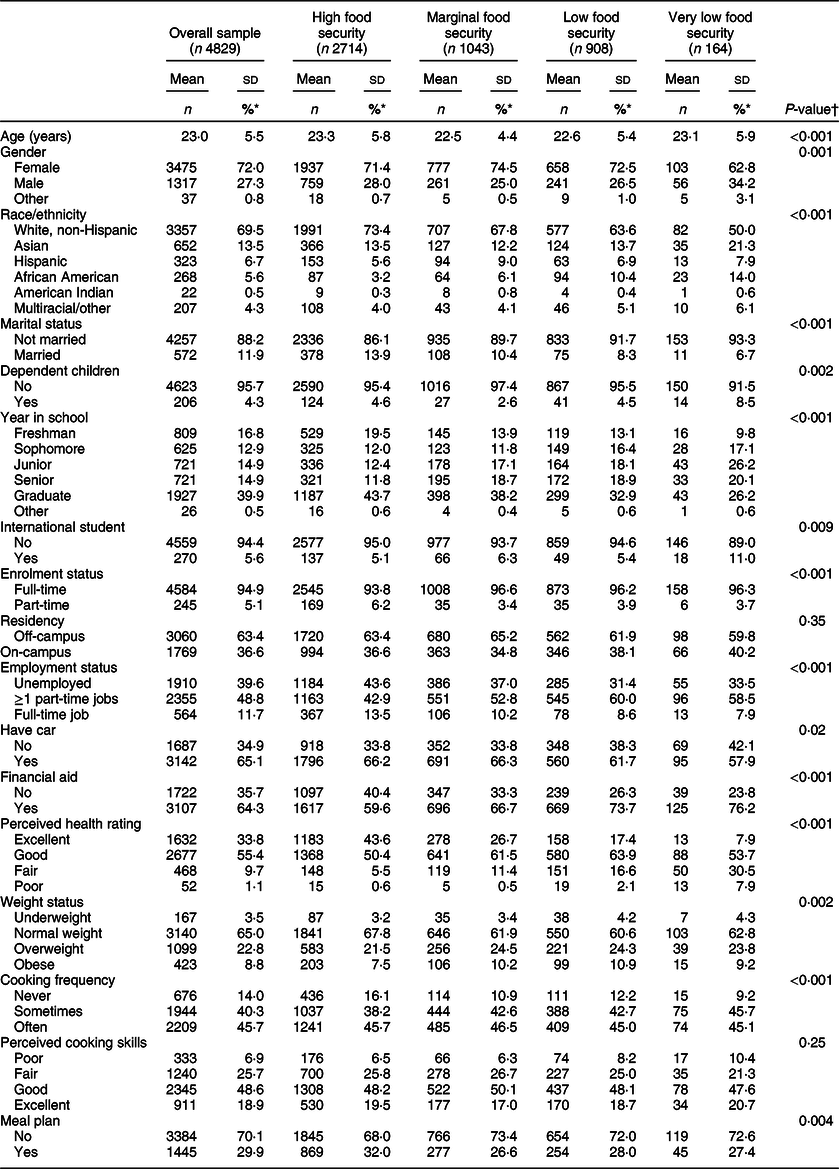
* Percentages may not add up to 100 % due to rounding.
† Statistical significance was assessed using ANOVA for continuous variables, and Pearson’s chi square tests for categorical variables.
Table 3 shows the results of multiple logistic regression where food security status is classified as food-secure v. food-insecure. Characteristics associated with a greater adjusted odds of being food-insecure were being male, African American, having dependent children, having one or more part-time jobs and receiving financial aid. Sophomores and juniors also had greater adjusted odds of being food-insecure compared with freshman. Compared with students who never cooked, students who sometimes or often cooked were also more likely to be food-insecure. A lower perceived health rating was also associated with greater adjusted odds of being food-insecure. Characteristics associated with being less likely to be food-insecure were being married, having a car, having fair compared with poor perceived cooking skills and participating in an on-campus meal plan. Age, international student status, enrolment status, residency and weight status were not significantly associated with food security status when the two-level variable was used as the outcome.
Adjusted ORs† for the characteristics of college students from a large university in south-eastern USA in October and November 2016 by food security status using the two-level food security variable
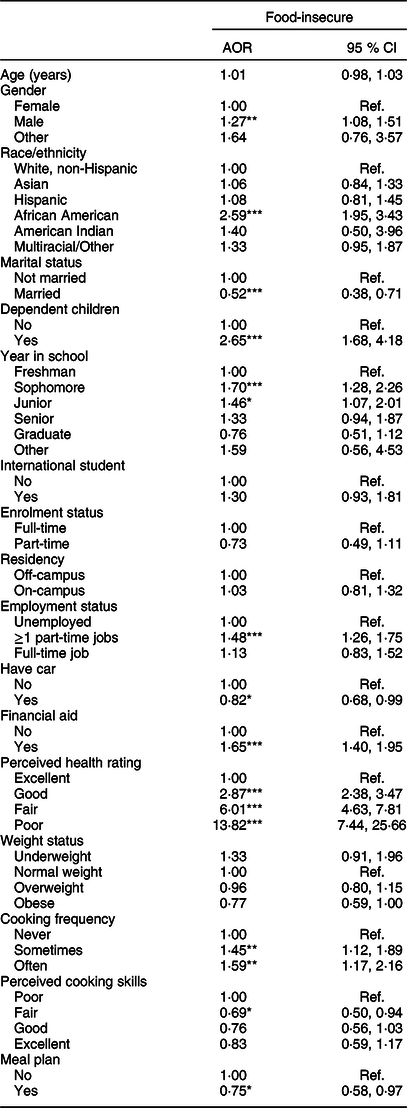
AOR, adjusted OR.
*P < 0·05, **P < 0·01, ***P < 0·001.
† Multiple logistic regression was used with food-secure as the reference group. Variables included in the models are age, gender, race/ethnicity, marital status, dependent children, year in school, international student, enrolment status, residency, employment status, have car, financial aid, perceived health rating, BMI, cooking frequency, perceived cooking skills and meal plan.
Table 4 shows the results of multinomial logistic regression. Highlights of the findings include the following instances where a difference was found between the categories that would usually be grouped together. In other words, these findings would have been obscured using the more common catch-all categories of simply food-secure and -insecure. Age was negatively associated with experiencing marginal food security. Students were more likely to experience marginal food security if they were African American or Hispanic, juniors or seniors, an international student, had one or more part-time jobs, received financial aid, had a perceived health rating of good or fair, or sometimes or often cooked. Students receiving a meal plan were less likely to experience marginal or low food security, but there were no significant differences for very low food security. Low food security was positively associated with being a senior, and negatively associated with car ownership or having a meal plan, but there were no significant associations with these variables and very low food security. Males, international students and students who were obese were more likely to experience very low, but not low food security.
Adjusted ORs† for the characteristics of college students from a large university in south-eastern USA in October and November 2016 by food security status using the four-level food security variable
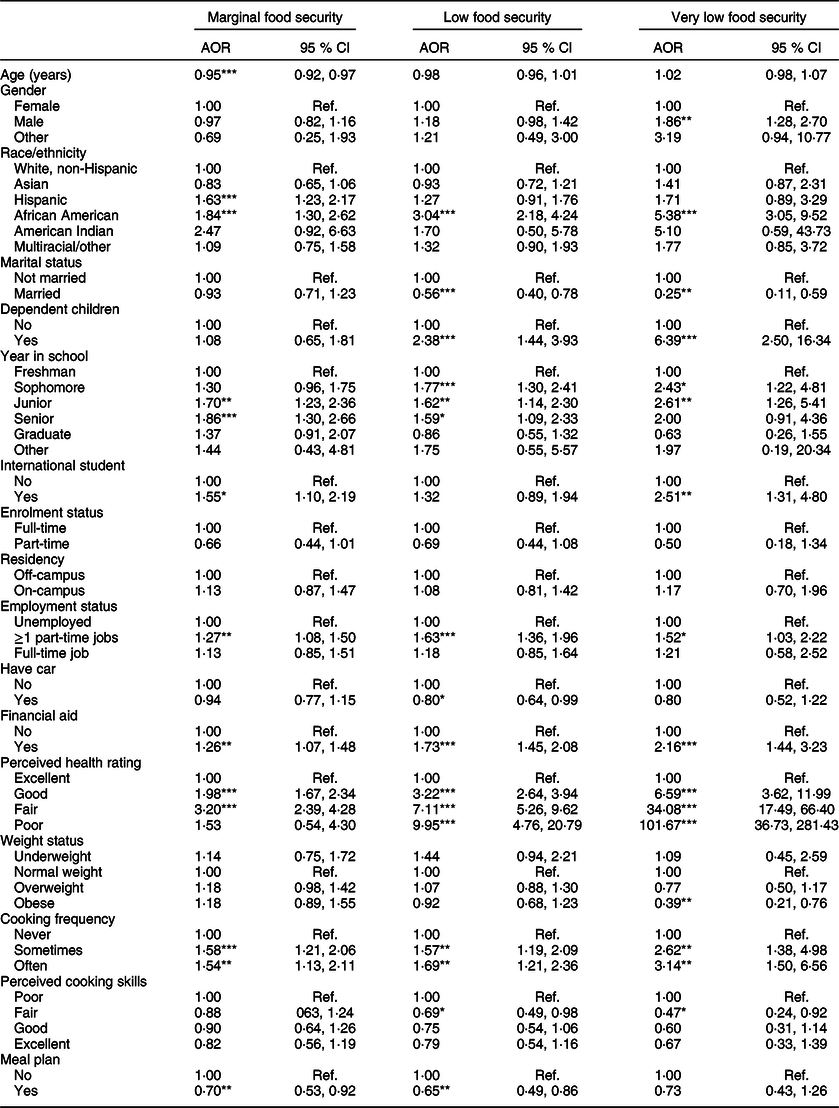
AOR, adjusted OR.
*P < 0·05, **P < 0·01, ***P < 0·001.
† Multinomial logistic regression was used with high food security as the reference group. Variables included in the models are age, gender, race/ethnicity, marital status, dependent children, year in school, international student, enrolment status, residency, employment status, have car, financial aid, perceived health rating, BMI, cooking frequency, perceived cooking skills and meal plan.
As expected, we also found instances where traditional groupings would have produced results in the same general direction as when using more precise measurement. Students were more likely to experience low or very low food security if they were African American, sophomores or juniors, had dependent children, had one or more part-time jobs, received financial aid, had a lower perceived health rating, or sometimes or never cooked. Students who were married or had fair perceived cooking skills were less likely to experience low or very low food security. Enrolment status and residency were not significantly associated with food security status.
Discussion
A large proportion of students in our sample experienced problems or limitations with accessing food, which is very alarming. Over 22 % of students in our sample had low or very low food security, which is higher than the national prevalence of nearly 13 %. Additionally, nearly 22 % of students experienced marginal food security. The rate of food insecurity that we found in our sample was within the range found in other studies of food insecurity among college students, with all of the US studies that we are aware of showing prevalence rates of food insecurity above the national rate(Reference Patton-López, López-Cevallos and Cancel-Tirado12,Reference McArthur, Ball and Danek14,Reference McArthur, Fasczewski and Wartinger15,Reference Bruening, van Woerden and Todd18– Reference Chaparro, Zaghloul and Holck28, Reference Gaines, Robb and Knol33).
Many of the past studies examining the association of food security status with student characteristics have only used two categories of food security status – food-secure and food-insecure(Reference Patton-López, López-Cevallos and Cancel-Tirado12–Reference McArthur, Fasczewski and Wartinger15, Reference Gallegos, Ramsey and Ong17–Reference Bruening, Brennhofer and van Woerden19, Reference Martinez, Frongillo and Leung21, Reference Raskind, Haardörfer and Berg23–Reference Wattick, Hagedorn and Olfert25, Reference Forman, Mangini and Dong27, Reference Chaparro, Zaghloul and Holck28). Some of the characteristics that were found to be significantly associated with food security status when using the four-level variable were NS when using the two-level variable. These characteristics included age, international student status and weight status. In particular, the importance of having a separate marginally food-secure category is clear. Although high and marginal food security are typically combined to create the food-secure classification, there were many student characteristics, including age, race/ethnicity, year in school, international student status, employment status, financial aid receipt, perceived health rating, cooking frequency and participation in an on-campus meal plan, that significantly differed between the high and marginal food security groups, indicating these are actually two separate groups of students. There were also some differences in associations seen between the low and very low food security status categories. Even where similarities in the direction of association were seen, there were often differences in magnitude. These differences suggest that research findings using only the grouped food-secure or food-insecure categories may be flawed, as well as any programmatic or policy prescriptions flowing from those results. As an example, the results of the analysis using only food-secure v. food-insecure makes it seem as though international student status is not associated with food security status. When looking at the results using the four-level variable as the outcome, being an international student is associated with higher odds of experiencing marginal and very low food security. These results suggest that it may be beneficial to target this group of students with programmes or policies; however, the results of using only food-secure and food-insecure do not suggest this, which could cause this group to be overlooked in developing potential interventions or policies. In developing targeted strategies, it is important that they do not contribute to stigmatising particular groups of students, however, as stigma around receiving food assistance can be a barrier to college students seeking aid(10). Targeted strategies can help to complement other programmes and policies that universities can implement to help normalise receiving food assistance and reduce stigma such as food pantries placed in the centre of campus(10).
Differences among students in the different food security status categories are also highlighted by the differences in their responses to the questions in the ten-item US Adult Food Security Survey Module. A higher proportion of students with very low food security indicated that they experienced the items asked about more frequently compared with students with low or marginal food security. The items that students with marginal food security most commonly responded affirmatively to were that they could not afford to eat balanced meals (59·7) and worried that their food would run out before they got money to buy more (29·1 %). The majority of students with marginal food security who responded affirmatively to these items said they sometimes experienced them, whereas the majority of students with very low food security responded that they often experienced them. It is very concerning to see that a large proportion of students with low and very low food security responded affirmatively to questions related to not being able to eat because there was not enough money for food. Over 80 % of students with low food security and all students with very low food security reported cutting the size of or skipping meals. Nearly 60 % of students experiencing very low food security reported not eating for a whole day because there was not enough money for food, with a quarter of these students saying they experienced this almost every month. Different strategies may be needed for addressing different challenges such as not eating balanced meals v. not eating for an entire day.
We recognise that there may be some challenges to reporting the four-level variable and that the ability to do so depends on the choice of instrument used to assess food security status. The ten-item US Adult Food Security Survey Module used in this study and the eighteen-item US Household Food Security Survey Module allow for classification into the four food security status levels(34). The ten-item US Adult Food Security Survey Module appears to be the most commonly used survey to assess food security status in studies of college students(Reference Hagedorn and Olfert13–Reference McArthur, Fasczewski and Wartinger15, Reference Morris, Smith and Davis22, Reference Wooten, Spence and Colby24, Reference Wattick, Hagedorn and Olfert25, Reference Chaparro, Zaghloul and Holck28, Reference Micevski, Thornton and Brockington31, Reference Gaines, Robb and Knol33). The US Household Food Security Survey Module: Six-Item Short Form, another commonly used survey to assess food security status that has the ability to classify individuals into four levels, is not as precise or reliable as the ten-item US Adult Food Security Survey Module, and many individuals who would have been classified as having marginal food security on the ten-item version would be classified as having high food security(34). This survey has been used in multiple studies of food insecurity in college students as well(Reference Patton-López, López-Cevallos and Cancel-Tirado12,Reference Bruening, van Woerden and Todd18,Reference Mirabitur, Peterson and Rathz20,Reference Martinez, Frongillo and Leung21,Reference Raskind, Haardörfer and Berg23,Reference Forman, Mangini and Dong27) . Some studies assess food security status with only one or two questions; however, it appears that few studies of food insecurity among college students have used this approach(Reference Bruening, Brennhofer and van Woerden19). While shorter surveys reduce respondent burden, precision should be strongly considered when selecting a survey instrument. With the majority of studies assessing food security status in college students using the ten-item US Adult Food Security Survey Module or US Household Food Security Survey Module: Six-Item Short Form, it seems feasible that most future studies would be able to categorise students into the four levels given large-enough sample sizes.
In measuring food security status in college students, it is important to keep in mind that the previously mentioned instruments were not designed specifically for college students, and there has been limited testing of their appropriateness for this population. A study by Nikolaus and colleagues examined the psychometric properties of the ten-item US Adult Food Security Survey Module and US Household Food Security Survey Module: Six-Item Short Form, both alone and in combination with the two-item screener used in the Current Population Survey, in a sample of 462 undergraduate students from a single university in Illinois and found that the psychometric properties of these instruments were not ideal in their sample(Reference Nikolaus, Ellison and Nickols-Richardson36). Their results suggest that the ten-item US Adult Food Security Survey Module in combination with the two-item screener was the best measure that is currently available in this population(Reference Nikolaus, Ellison and Nickols-Richardson36). Additional research in larger and more diverse samples that also include graduate students is needed to determine the best methods for assessing food security status among college students. If new instruments are being developed and adapted, the results of our study suggest that these instruments have the ability to classify students into four food security status levels.
Similar to other studies of food insecurity among college students, food insecurity was associated with lower perceived health rating(Reference Patton-López, López-Cevallos and Cancel-Tirado12–Reference Gallegos, Ramsey and Ong17). However, marginal food security was also associated with lower perceived health rating, and the adjusted ORs were much larger for very low compared with low food security. As discussed earlier, the types of limitations and frequency of experiencing them differed between marginal, low and very low food security status groups. Our findings suggest that experiencing any type of limitation related to food access is related to lower perceived health rating; however, the number, specific types and frequency of experiencing these limitations may influence the extent to which they are related to lower perceived health rating. Perceived health rating is commonly used as an indicator of actual health and has been shown to be associated with health risk indicators and outcomes(Reference Wu, Wang and Zhao37,Reference Gallagher, Wilkie and Cordner38) , suggesting that the lower perceived health rating of students experiencing marginal, low and very low food security are related to poorer actual health. Our finding that students with part-time jobs were more likely to be food-insecure also agrees with the results of other studies(Reference Gallegos, Ramsey and Ong17,Reference Wooten, Spence and Colby24) . While the adjusted odds of receiving financial aid were higher for students experiencing marginal, low or very low food security compared with high food security, they were highest for those experiencing very low food security, followed by low and marginal. These findings suggest that current financial aid packages may not be meeting the needs of students.
In addition – perhaps due to our much larger sample size, differences in student population or categorising food security status into four rather than two levels – some results contradicted prior research. Sophomores, juniors and seniors tended to have higher odds of being in lower food security status categories compared with freshman, but the results showed no differences between the food security status of graduate students and freshman. This result differs from a study by Hagedorn and Olfert that found freshmen more likely to be food-insecure compared with graduate students(Reference Hagedorn and Olfert13). In another case of conflicting results, students who sometimes or often cooked were more likely to experience marginal, low or very low food security compared with students who never cooked, with students experiencing very low food security having highest adjusted odds for both sometimes and often cooking. This differs from a study by McArthur and colleagues that found that students were more likely to be food-insecure if they never cooked(Reference McArthur, Ball and Danek14), and a study by Knoll and colleagues that reported that students experiencing very low food security engaged in food preparation behaviours less often than students experiencing high, marginal or low food security(Reference Knol, Robb and McKinley32). It is possible that the students in our sample who cooked more often were cooking out of necessity because they could not afford a meal plan or eating out.
Students with a meal plan were less likely to experience marginal or low food security. Our results differ from prior studies that did not find a significant association between participating in a meal plan and food security status(Reference Patton-López, López-Cevallos and Cancel-Tirado12–Reference McArthur, Ball and Danek14, Reference Wooten, Spence and Colby24, Reference Chaparro, Zaghloul and Holck28, Reference Gaines, Robb and Knol33). Meal plans provide students with access to meals on-campus, which may help to reduce the likelihood that they experience food insecurity. While some universities include the cost of meal plans in the on-campus housing cost and require students in on-campus housing to purchase meal plans, the university where this study took place does not require students to purchase meal plans. There is a cost associated with meal plans, so another possible explanation for this association is that students with high food security are more likely to be able to afford and, therefore, purchase meal plans.
We found that students who were married were less likely to experience low or very low food security, but students who had dependent children were more likely to experience low or very low food security. It is possible that married students with an additional income have sufficient money to purchase food, while students with additional members in their household may have less money to spend on food. A study by van den Berg and Raubenheimer found that unmarried students from a university in South Africa were more likely to be food-insecure compared with married students, although this finding was NS in adjusted models(Reference van den Berg and Raubenheimer29). Other studies examining the association of marital status and/or having dependent children with food security status among college students have not found significant differences(Reference Patton-López, López-Cevallos and Cancel-Tirado12–Reference McArthur, Ball and Danek14, Reference Chaparro, Zaghloul and Holck28, Reference Gaines, Robb and Knol33). Our ability to detect statistically significant differences may be due to differences in our sample, which consisted of 40 % graduate students who were more likely to be married and/or have dependent children compared with undergraduate students. Our results are similar to what is seen in the general US non-institutionalised population. Compared with the national rate, food insecurity rates are lower among US households with no children and more than one adult and higher among households with children(Reference Coleman-Jensen, Rabbitt and Gregory1).
Limitations
Because this study used a cross-sectional design, causality cannot be concluded. All measures were self-reported, which could have led to response bias. The study was also limited to one large, south-eastern public university, which may limit the generalisability of the results to students from other universities. Past studies of food insecurity among college students also faced these limitations, and our study used a larger sample size from a single university compared to other published studies.
Conclusion
A large proportion of students in our sample experienced marginal, low or very low food security, which indicates a need to identify strategies for improving food security status among college students. We also found differences in the characteristics associated with and magnitudes of associations with four food security status categories. Future studies should use the four established categories, whenever possible, as opposed to collapsing them into ‘food-secure’ and ‘food-insecure’. If categories must be collapsed, studies should at least consider separating out marginal from high food security groups. By definition, marginally food-secure students are experiencing some problems or limitations around accessing food, and it may not be appropriate to consider them to be food-secure. Our results showed that these students were different than those who had high food security. Our study focused on characteristics associated with food security status. Future studies should also look at health and academic outcomes associated with food security status in college students using the four food security status categories.
Acknowledgements
Acknowledgements: The authors would like to thank Julia Da Silva, MSW, MPA, for her support with data collection. Financial support: This study was supported by a University of North Carolina at Chapel Hill Food-for-All micro-grant. The funder had no role in the design, analysis or writing of this article. Conflict of interest: None. Authorship: M.B. oversaw the overall study design and data collection. J.S. analysed the data and wrote the first draft of the manuscript. M.B. critically revised the manuscript. Both authors contributed to the interpretation of results and approved the final version of the manuscript. Ethics of human subject participation: This study was conducted according to the guidelines laid down in the Declaration of Helsinki, and all procedures involving study participants were reviewed and considered exempt by the University of North Carolina at Chapel Hill Institutional Review Board. Consent was obtained from all study participants by invitation email, indicating that by clicking on the link to the survey they consented to participate in the study.



