




Highlights
-
• Intensity and duration influence the stressed vowel, while F0 does not.
-
• Duration predicts stressed vowels relative to adjacent vowels (pre-stressed and post-stressed).
-
• Intensity predicts stressed vowels only relative to post-stressed vowels.
-
• Duration is the most reliable predictor of stressed vowels.
1. Introduction
Speech production is composed of segmental and suprasegmental levels that exchange acoustic features within each level. The fundamental acoustic features are frequency (F0), duration, and intensity. Specifically, F0 is defined as the average number of oscillations per second (Erbe et al., Reference Erbe, Andrew, Laura, Terhune, Thomas, Christine, Andrew, Laura, Terhune and Thomas2022) and its unit of measurement is Hertz (Hz). Duration is defined as the time taken to utter any part of the speech signal (Fox, Reference Fox2000), such as a phoneme, a word, a pause, or, in the case of this study, a syllable. Its unit of measurement is the millisecond (ms). Intensity is defined as the acoustic power that is transmitted through a surface and its unit of measurement is the decibel (dB) (Quilis, Reference Quilis1981, p. 49).
The difference between the levels relates to the extension of the feature. At the segmental level, the features form a cluster recognizable as a linguistic sound by inspection of the segment itself; but at the suprasegmental level, the features are established by comparison between the segments in a sequence (Lehiste, Reference Lehiste and Whitaker1976). In this sense, Quilis (Reference Quilis1981) indicates that stress is a prosodic feature that emphasizes linguistic units larger than the phoneme, such as syllables, morphemes, words, phrases or sentences. Thus, stress is manifested in utterances as a contrast between stressed and unstressed language units.
Stress typology
The use of acoustic parameters is very specific to each language. Lexical stress divides languages between fixed-stress and free-stress. Spanish, English and Portuguese belong to the free-stress group because stress can be located in different places in the word; while in languages with a fixed stress, such as French or Hungarian, stress falls systematically on the same syllable. Cutler, Dahan and Van Donselaar (Reference Cutler, Dahan and Van Donselaar1997) highlight that the difference between both types lies in their functionality, given that in languages with free stress it contributes to understanding meaning, while, in the other type, stress contributes more to determining the limits of words.
Specifically, Spanish has three stress typologies: (1) oxytone words, where the stress is placed on the last syllable of a word, as in bandolín (‘bandolin’); (2) paroxytone words, where the stress falls on the penultimate syllable, as in guitarra (‘guitar’); and (3) proparoxytone words, where the stress is placed on the antepenultimate syllable, as in máquina (‘machine’). Furthermore, the placement of the stress, which is visually conveyed by the stress mark, can be related to changes in meaning, as in the case of the word número (number, noun), numero (number, verb), numeró (numbered, verb). In very rare cases, it can fall on the fourth-last syllable in compound words such as analógicamente (analogically).
Acoustic parameters
In relation to the acoustic parameters (F0, duration, and intensity), the essential question is: which of these features correlates most with stress? One of the first studies addressing this topic was carried out by Fry (Reference Fry1955) in the context of American English. Fry’s work aimed to investigate the influence of acoustic cues on stress perception. To do this, he used minimal pairs of words that had identical segments but differed in stress. These differences were observed to produce changes in both the meaning and grammatical category of the words, as exemplified by obJECT (verb) versus OBject (noun). Fry gradually modified the duration and intensity of each syllable of each word. As part of the experiment, he asked participants to listen to a word pair, then to observe the written words and underline the syllables that they identified as stressed. The results indicated that for words in which duration and intensity operated in the same direction, there was excellent agreement between subjects. However, when intensity and duration were studied separately, it was found that the duration ratio had a greater influence on stress judgment than intensity. This contradicts some studies that had indicated that in English, there is a stronger link between intensity and the differentiation of stress. Subsequent studies conducted on American English have shown that F0 is the main perceptual parameter for lexical stress; in addition, the effect of duration is also significant, although the effect of amplitude is insignificant (Cutler, Reference Cutler, Pisoni and Remez2005, p. 265).
The contribution of duration in defining the stressed segment of words varies across linguistic contexts to a large extent. In French, for example (cf. Dupoux et al., Reference Dupoux, Núria, Enrique and Sharon2008), F0, duration and intensity collectively play a role in the realization of stress patterns. In contrast, in Hungarian, duration is, in itself, an intrinsic segmental cue, which implies that it is constrained to how much it can contribute to syllabic stress (Garami et al., Reference Garami, Andrea, Ferenc and Valéria2017). Similarly, in Brazilian Portuguese, studies have shown that the primary acoustic correlate of stress is the longer duration of the stressed syllable (Madureira et al. Reference Madureira, Barbosa, Fontes, Crispin and Spina1999).
A review study conducted by Gordon and Roettger (Reference Gordon and Roettger2017) highlighted the growing importance of the study of prosodic prominence in recent years. The review synthesized results from 110 studies of 75 languages related to the acoustic correlates of word stress (Gordon and Roettger, Reference Gordon and Roettger2017). The main findings, based on a statistical analysis of the features used, indicated duration as the most reliable cue for stress across languages, although each of the measured parameters was able to differentiate stress in the majority of languages evaluated.
Spanish stressed and unstressed syllables: Earlier Studies
Specifically, studies related to the Spanish language showed that the influence of the parameters differs at the phrase and word levels. Most researchers seem to agree that word stress is conditioned by the prosody of the sentence (Martínez Celdrán and Fernández Planas, Reference Martínez Celdrán and Fernández Planas2013, p. 199). It is precisely within this framework that that the present work is situated.
At the word level, some authors pinpoint intensity as the primary correlate of stress (Cuervo, Reference Cuervo1954; Navarro Tomás, Reference Navarro Tomás1963), while others advocate for duration (Canellada and Madsen, Reference Canellada and Jhon Kuhlmann1987), and still others argue for F0 (Bolinger and Hodapp, Reference Bolinger and Marion1961; Quilis, Reference Quilis1981). Furthermore, some authors emphasize the importance of a hierarchical approach to the different parameters for determining stress. For instance, Contreras (Reference Contreras1963), prioritizes F0 as the prominent marker, followed by intensity, and duration is ranked third. Cabrera (Reference Cabrera1995) agrees on the ranking of F0, but reverses the order of the other two parameters, suggesting that duration comes second in importance, and intensity third.
At the level of words embedded in phrases, which is the focus of this work, various proposals have been made. For example, Garrido et al. (Reference Garrido, Llisterri, de la Mota and Ríos1995) conducted a study that aimed to observe the behavior of prosodic parameters in stressed and unstressed syllables. The study involved five male speakers of Peninsular Spanish who read 15-syllable sentences in two different scenarios: isolated, and contextualized at the beginning, middle and end of a paragraph. One of the results showed that duration is an important correlate of stress because stressed syllables are significantly longer than the adjacent syllables. Additionally, a Pearson correlation analysis indicated that there is no linear relationship between duration and F0.
Unlike the previously mentioned study, Candia et al. (Reference Candia, Cárdenas and Fernández Ulloa2006) suggest that F0, duration, and intensity are all relevant in the prosodic configuration of sentences. The authors carried out an experiment in which four university students from northern Spain (two women and two men) read 72 unconnected declarative statements to each other. The objective of the study was to measure the values of four acoustic variables: pitch, amplitude, vowel duration, and syllable duration. Additionally, the stress condition of the syllable (lexically stressed, pre-stressed, or post-stressed) was included as a variable to explore whether the stressed syllable was the parameter with the greatest intensity, pitch, or duration within the lexical sequence in which it appeared. To do this, they performed partial correlation and multiple regression statistical analyses that showed a high correlation and interaction among the three parameters.
Méndez (Reference Méndez2010) carried out a study about Andean Venezuelan speech in which the relationship between the acoustic parameters of fundamental frequency (F0) and duration was shown. In this study, the fixed corpus of declarative and interrogative sentences from the AMPER-VE3 project was used. The participants were four women without higher education, two from urban areas and two from rural areas. A descriptive analysis of each of the variables was carried out and the author concluded that there is an inverse relationship between the tonal field and the durative field. That is, in declarative sentences, a smaller tonal field interacts with a larger durative field, the reverse pattern occurring in interrogative sentences.
Interestingly, Ortega-Llebaria and Prieto (Reference Ortega-Llebaria and Prieto2011) compared Spanish and Catalan, measuring duration, overall intensity, and spectral tilt. In this experiment, 10 native speakers of Castilian Spanish and 10 native speakers of Central Catalan participated. They answered 30 questions using declarative and reporting sentences. The ANOVA (Analysis of Variance) results point to duration as a consistent stress correlate in all vowels in both languages and also show that stress-related formant frequency differences between corresponding vowels amplify the duration cues to the stress contrast. On the other hand, the speakers’ use of intensity was not as pervasive as that of duration. This result is interesting because, according to Ortega-Llebaria (Reference Ortega-Llebaria2006), both pitch and duration are features that commonly correlate with lexical and sentential prominence, playing a significant role in signaling stress.
Specifically, regarding Colombian speech, there are some studies that can be mentioned. Muñetón-Ayala (Reference Muñetón-Ayala2016), within the framework of the AMPER-Col project, conducted an investigation that aimed to analyze the behavior of fundamental frequency, duration and intensity in sentences without expansion, with expansion in the subject, with expansion in the object, and in the interrogative modality. The speech analyzed was that of an urban man without studies from Medellin. She based the analysis on the Pearson correlation model, taking the absolute data of the three variables. The results revealed that in comparison to the adjacent pre-stressed and post-stressed syllables, the stressed vowel has a longer duration. The three variables correlate to stress prominence in the following way: duration correlates negatively with F0 and intensity, while these last two variables do so positively. The data allowed her to infer that the longer the duration, the lower the F0 and the lower the intensity.
The following year, Muñetón-Ayala (Reference Muñetón-Ayala2017) analyzed the voice of a woman without formal education from the urban area of Medellín. The primary aim was to show the pattern of correlations between the three parameters and, additionally, to explore whether these patterns differed between the declarative and the interrogative modalities, as in the previous year. This research employed a corpus of 378 sentences (189 declarative and 189 interrogative). The general results show that the highest F0 index is synchronized with the post-stressed syllable, the second highest with the pre-stressed syllable, and the lowest with the stressed syllable. Regarding duration, the longest duration always falls on the stressed syllables. In line with the 2016 article, this study confirmed that there is a pattern of association, and, furthermore, concluding that it is mediated by sentence modality. Specifically, this conclusion stems from the observed association between F0 and duration: in the declarative modality this association occurs in stressed syllables, while in the interrogative modality both parameters co-occur when the F0 of the pre-stressed syllable is greater than that of the stressed syllable. At the same time, the stressed syllable has a perceptually longer duration than the pre-stressed one.
In Bogota, the speech of a woman and a man without higher education residing in the urban area, was analyzed (Muñetón-Ayala and Dorta, Reference Muñetón-Ayala and Josefa2021). Data was collected using 108 sentences without expansion (adjective) from the experimental corpus: 54 declarative and 54 interrogative sentences. In relation to F0, the maximum peak of both participants coincides with an unstressed syllable and with a syntagmatic border. However, concerning duration, the stressed vowel is characterized by having a greater length than adjacent ones, regardless of gender or sentence modality. Nevertheless, it is interesting to note that in general terms, the results show that F0, duration and intensity are higher in a female voice than in a male voice. Finally, in declarative sentences the greatest intensity can fall on the pre-stressed or stressed syllable, while in interrogative sentences it falls only on the stressed syllable.
In line with the above, a study carried out in four main Colombian cities (Bogotá, Medellín, Cali and Barranquilla) showed that the F0 of the nuclear tonal accent tends to convert to a post-stressed syllable rather than aligning with the stressed syllable. This result coincides with results obtained for Spanish in general (Garrido et al., Reference Garrido, Joaquim, Carme de la and Antonio1993, Reference Garrido, Llisterri, de la Mota and Ríos1995; Hualde and Kim, Reference Hualde and Jong-Yun2015; Llisterri et al., Reference Llisterri, María José, Carlos de la, Marta and Antonio2002, Reference Llisterri, María José, Carlos de la and Marta2003; Prieto et al., Reference Prieto, Jan Van and Julia1995; Xu, Reference Xu1999).
The present study
While earlier studies have progressed in identifying the major prosodic features in speech production at the sentence level, there are crucial differences in approach between the current research and those mentioned above, meaning that certain gaps remain unaddressed. This study focuses on Colombian Spanish, given its specific linguistic features and limited prior research that explicitly addresses these factors. The following are the factors that set this investigation apart from others:
-
1. Most of the studies mentioned in the literature review of this article have concentrated primarily on the acoustic correlate in declarative sentences, except for two; one that analyzed interrogative sentences, and another that analyzed the contrast between both modalities.
-
2. In general, the studies did not control for the influence that each of the Spanish stress typologies (oxytone, paroxytone and proparoxytone) may have on acoustic correlates.
-
3. The studies rarely contrasted the different word positions within a sentence. In general, short sentences have been used.
-
4. Due to the complexity of data processing and analysis, previous studies have generally included a small number of participants, ranging from one to 10. This study expanded the participant pool to 36 subjects.
These key differences give rise to the following research questions:
-
1. Which of the acoustic parameters (F0, duration and intensity) mark lexical stress in Colombian speech?
-
2. Does this parameter vary depending on the linguistic variables of modality (declarative and interrogative), sentence structure (without expansion, with expansion in the subject, and with expansion in the object) or stress typology?
Based on these research questions, the following hypotheses are proposed:
-
1. The Spanish spoken in Colombia will show an acoustic correlate that differentiates stressed vowels from adjacent ones in both types of vowel contrasts: pre- stressed versus stressed and stressed versus post-stressed.
-
2. The acoustic correlate will remain unaffected by linguistic variables such as modality, sentence structure and stress typology. From this point of view, if a feature serves as the correlate of the stressed vowel, it remains consistent throughout speech, because the brain requires rapid identification of the stressed syllable to comprehend meaning.
The acoustic correlate must be identified based on quantitative measures. It is likely that the correlate of the stressed vowel will emerge as the feature that most significantly predicts stress across different clauses, stress typologies and sentence structures. To achieve our purpose, we applied a multinomial regression analysis in order to determine the relative contribution of F0, duration and intensity to distinguish between the stressed-unstressed (pre-stressed versus stressed versus post-stressed). The analysis was carried out within each of the clauses in order to control for the possible influence that the use of vowels could have within the study.
We also present a brief exploratory analysis using repeated measures ANOVA, where vowels (pre-stressed, stressed, and post-stressed) are treated as within-subject factors to assess whether Colombian Spanish speakers use prosodic parameters such as intensity, duration or F0 to mark the stressed vowel.
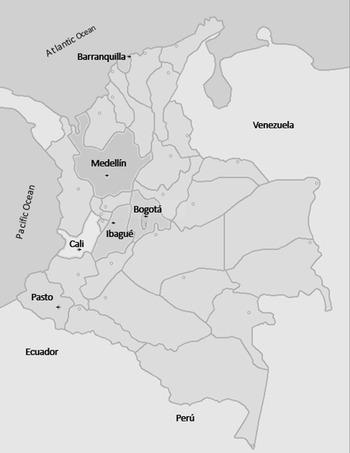
Cities that participated in the study: Bogotá, Medellín, Barranquilla, Cali, Ibagué and Pasto.
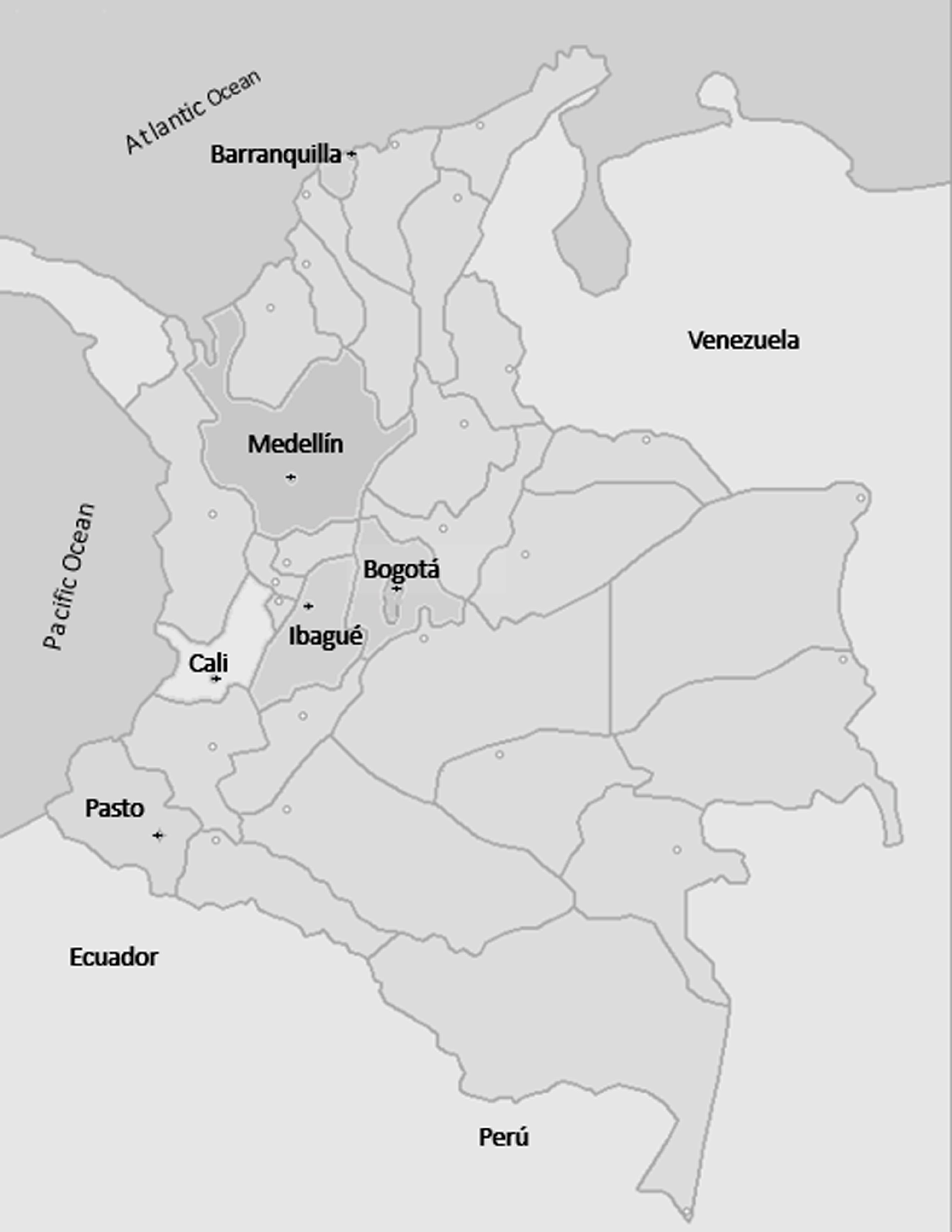
Figure 1 Long description
The map of Colombia displays major cities such as Bogota, Medellin, Barranquilla, Cali, Ibague, and Pasto. It also shows neighboring countries including Venezuela, Ecuador, and Peru, as well as the Atlantic and Pacific Oceans. The map is used to illustrate the geographic distribution and key locations within the study area.
2. Method
The present study was developed as part of the international project: Multimedia Atlas of Prosody of the Romance Language Space (AMPER_Col), specifically regarding the Spanish spoken in Colombia (Muñetón-Ayala et al., Reference Muñetón-Ayala, Fernández and López González2023). Different countries participated in this project and applied the same methodology. One of the main goals of this project is to evaluate the relative contribution of the fundamental prosody parameters of intensity, duration and F0. To extract this information, the AMPER project used different experimental and spontaneous corpora. As we will explain in the Section 2.2, we used the AMPER_Col project experimental corpus.
2.1 Participants
The participants were selected from six major cities in Colombia – Bogotá, Medellín, Cali, Barranquilla, Ibagué, and Pasto – to reflect the country’s linguistic diversity (see Figure 1). These cities are representative of the regional dialectal variations present across Colombia. Participants (six from each city, three female and three male) were aged between 25 and 55 and were all long-term native residents of their respective cities. They were considered authentic, representative speakers of their regional variety of Spanish because they have all lived in their respective cities from birth, creating a diverse and representative participant pool.
2.2 Corpus
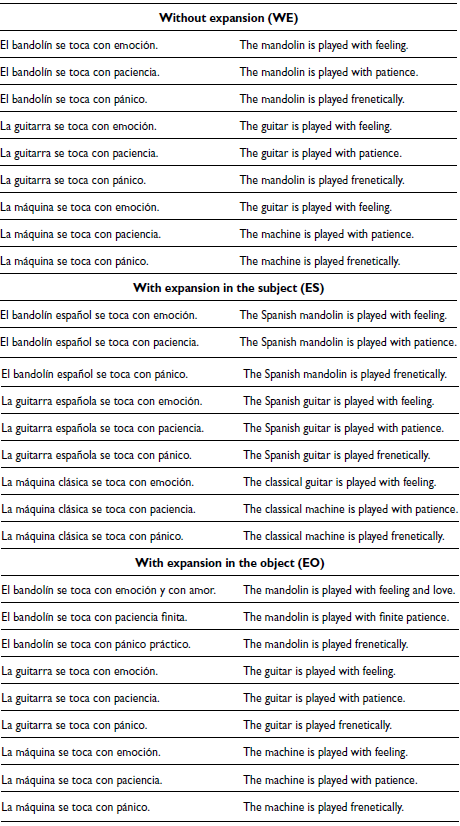
This is an experimental corpus obtained through textual elicitation, consisting of nine sentences with SVO_structure (subject+verb+object), nine with expansion in the subject with S+E+VO_structure (subject+expansion+verb+object), and nine with expansion in the object with SVO+E_ structure (subject+verb+object+expansion). Each speaker repeated every sentence three times in both declarative and interrogative modalities. This procedure allowed the average production of each speaker to be established. Consequently, each participant produced a total of 162 sentences, resulting in a corpus of 972 sentences.
The subject and the object consist of a trisyllable noun and belong to different stress typologies such as oxytone, paroxytone and proparoxytone. The verb clause is the same for all data samples; it is paroxytone (see the Appendix for a full list of all 27 sentences). The following are examples, the stressed vowels highlighted in boldface:
-
(1) sentence without expansion with paroxytone stress in the noun clause and oxytone stress in the prepositional clause
-
La guitarra se toca con emoción (The guitar is played with feeling)
-
(2) sentence with expansion in the subject with oxytone stress in the noun clause: subject and expansion; and paroxytone stress in the prepositional clause
-
El bandolín español se toca con paciencia (The Spanish mandolin is played with patience)
-
(3) sentence with expansion in the object with paroxytone stress in the noun clause and proparoxytone stress in the prepositional clause: object and expansion
-
La guitarra se toca con pánico práctico (The guitar is played frenetically)
In this way, all of the sentences have the same number of interstress syllables and each sentence is uttered in declarative and interrogative modality.
2.3 Data coding
First, we extracted the measurement of each feature (intensity, duration and F0) in each vocal segment from the sentences. The unit of measurement for intensity is the decibel (dB), for fundamental frequency, the hertz (Hz); and for duration, the time measured in milliseconds (ms). Routines created in Matlab made it possible to obtain three values for intensity and F0: at the beginning, middle and end of the vowel. For these two parameters, we used the middle value. The intensity, duration or F0 across the three repetitions of each sentence were averaged. This method of analysis is common to all of the investigations carried out in the AMPER Project.
Second, the data of the sentences were labeled based on clause type: noun, verb and prepositional. Sentences with expansion have two parts: a noun and the its corresponding expansion (adjective). Clause measurements were averaged across words with the same stress typology. All data were organized according to stress typology and the declarative and interrogative modalities.
Third, each vowel was labeled as pre-stressed, stressed or post-stressed based on normal or syntactic phonetics. For example, in the text “el bandolín se toca”, the stressed syllable is “lín”, thus the post-stressed syllable is “se”. The sentences without expansion contained three stressed syllables, while the other types had one more stressed syllable.
3. Results
In this section we present two sets of analysis. The first one is an exploratory analysis of means related to the three main prosodic features: intensity, duration and F0. The second is a multinomial regression in order to determine the feature that significantly predicts the stressed vowel.
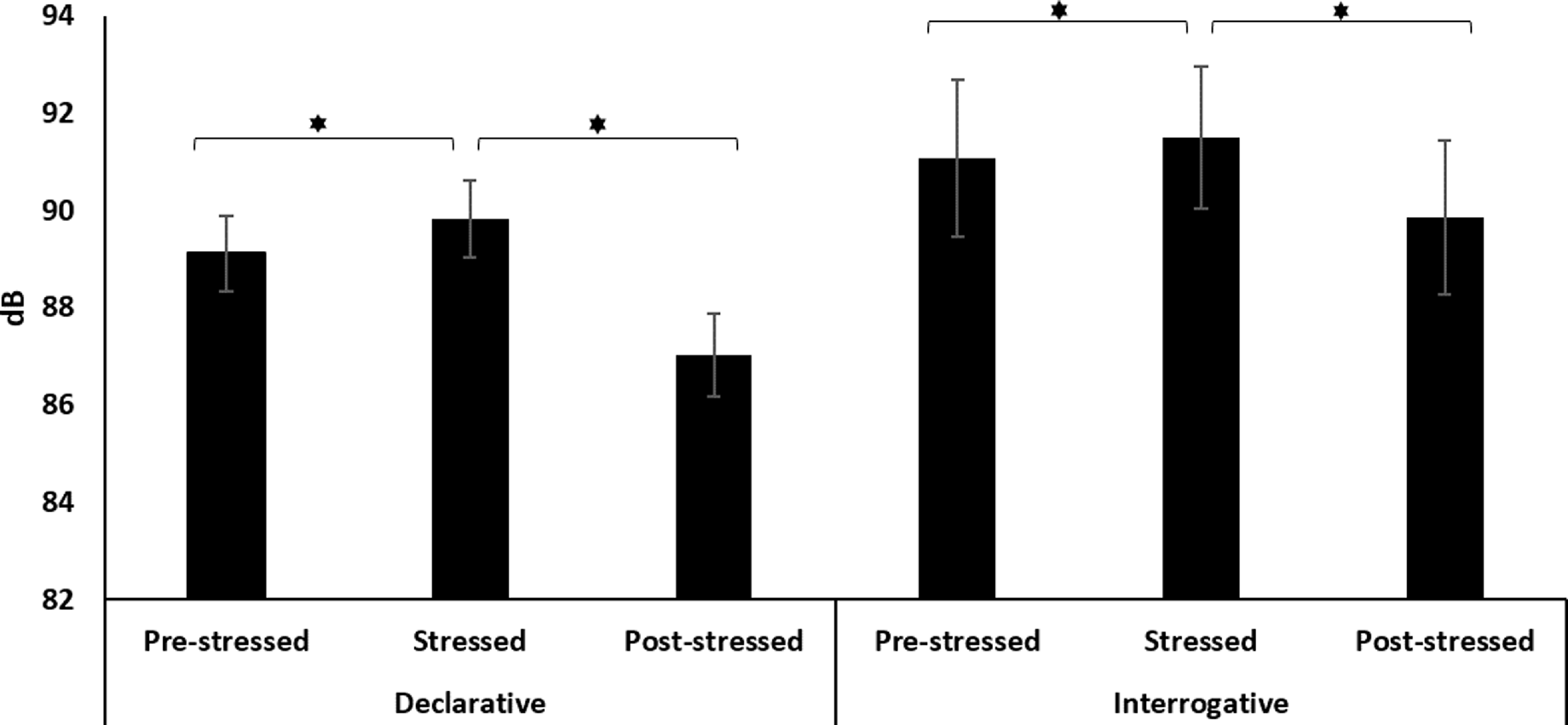
Mean average contrasts for pre-stressed versus stressed and stressed versus post-stressed context in the declarative and interrogative modalities, based on the intensity cue. Asterisks indicate statistical significance (p < 0.05).
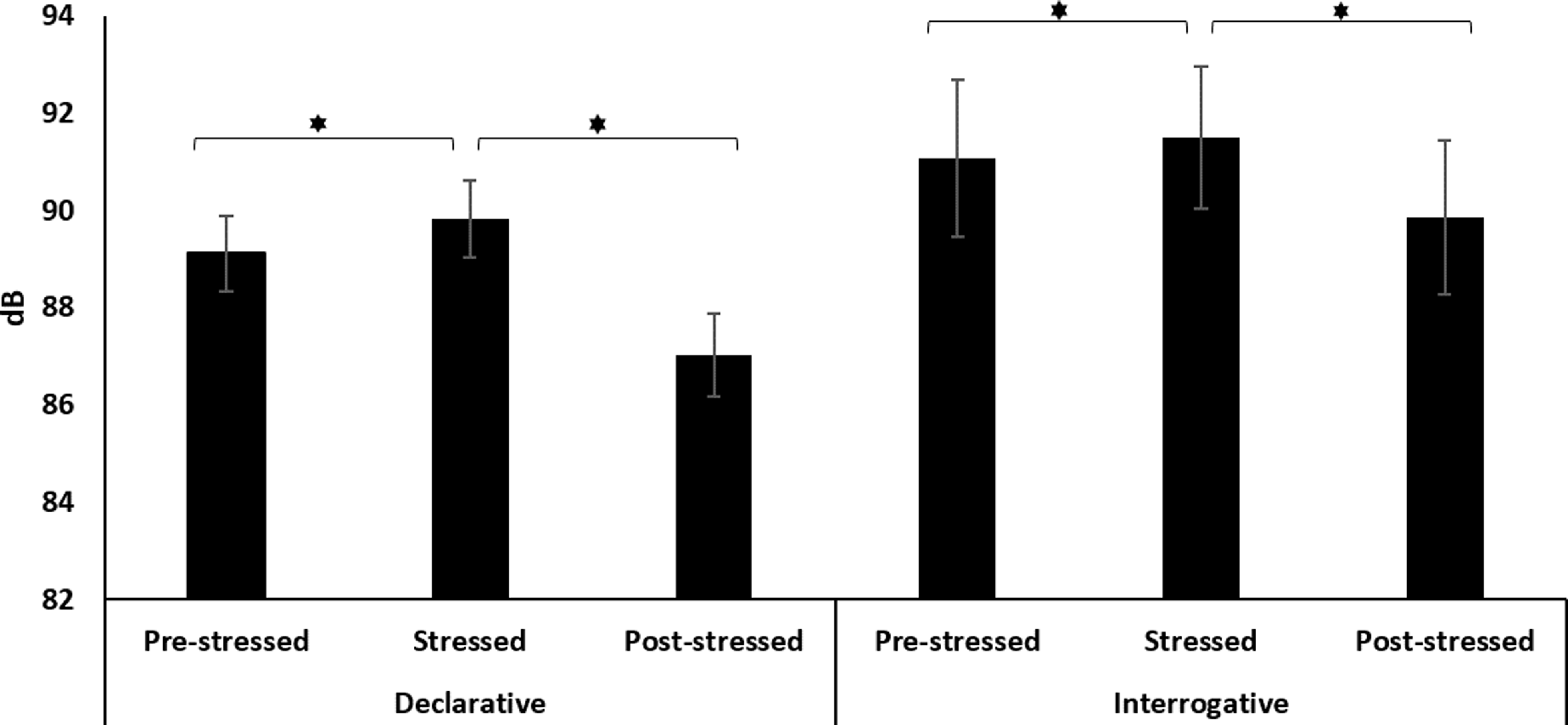
Figure 2 Long description
The bar graph compares mean average contrasts for pre-stressed, stressed, and post-stressed contexts in declarative and interrogative modalities based on the intensity cue. The x-axis represents the different contexts (pre-stressed, stressed, post-stressed) for both declarative and interrogative modalities. The y-axis measures the intensity in decibels (dB), ranging from 82 to 94. The graph features six vertical bars grouped into two categories: declarative and interrogative. Each group contains three bars representing pre-stressed, stressed, and post-stressed contexts. The bars are black with error bars indicating variability. Asterisks above certain comparisons indicate statistical significance (p < 0.05). In the declarative modality, the pre-stressed context shows a mean intensity of approximately 89 dB, the stressed context around 91 dB, and the post-stressed context around 87 dB. In the interrogative modality, the pre-stressed context shows a mean intensity of approximately 90 dB, the stressed context around 92 dB, and the post-stressed context around 89 dB. The graph highlights significant differences between pre-stressed versus stressed and stressed versus post-stressed contexts in both modalities. All values are approximated.
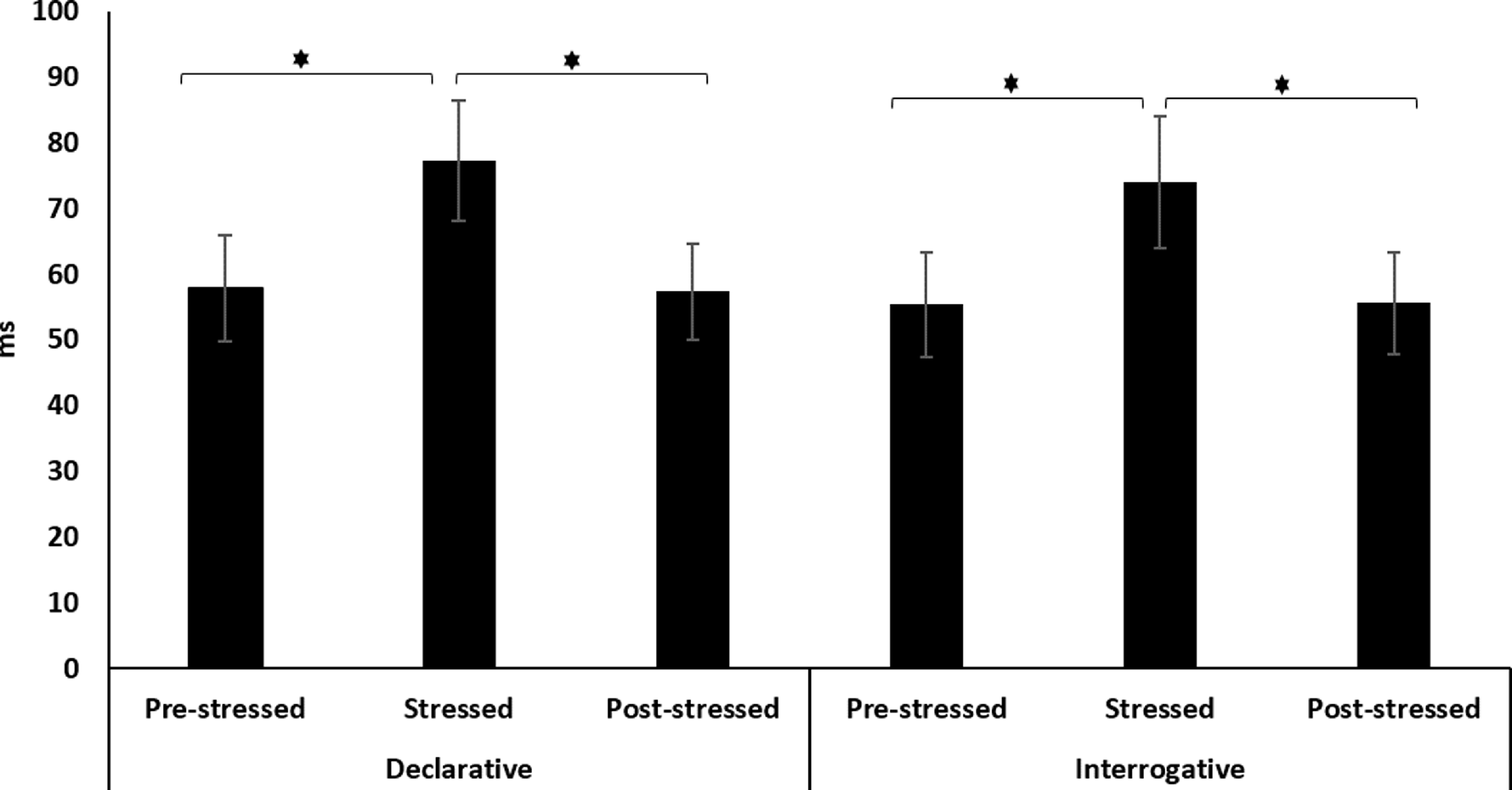
Means contrasts for pre-stressed versus stressed and stressed versus post-stressed contexts in the declarative and interrogative modalities, based on the duration cue. Asterisks indicate statistical significance (p < 0.05).
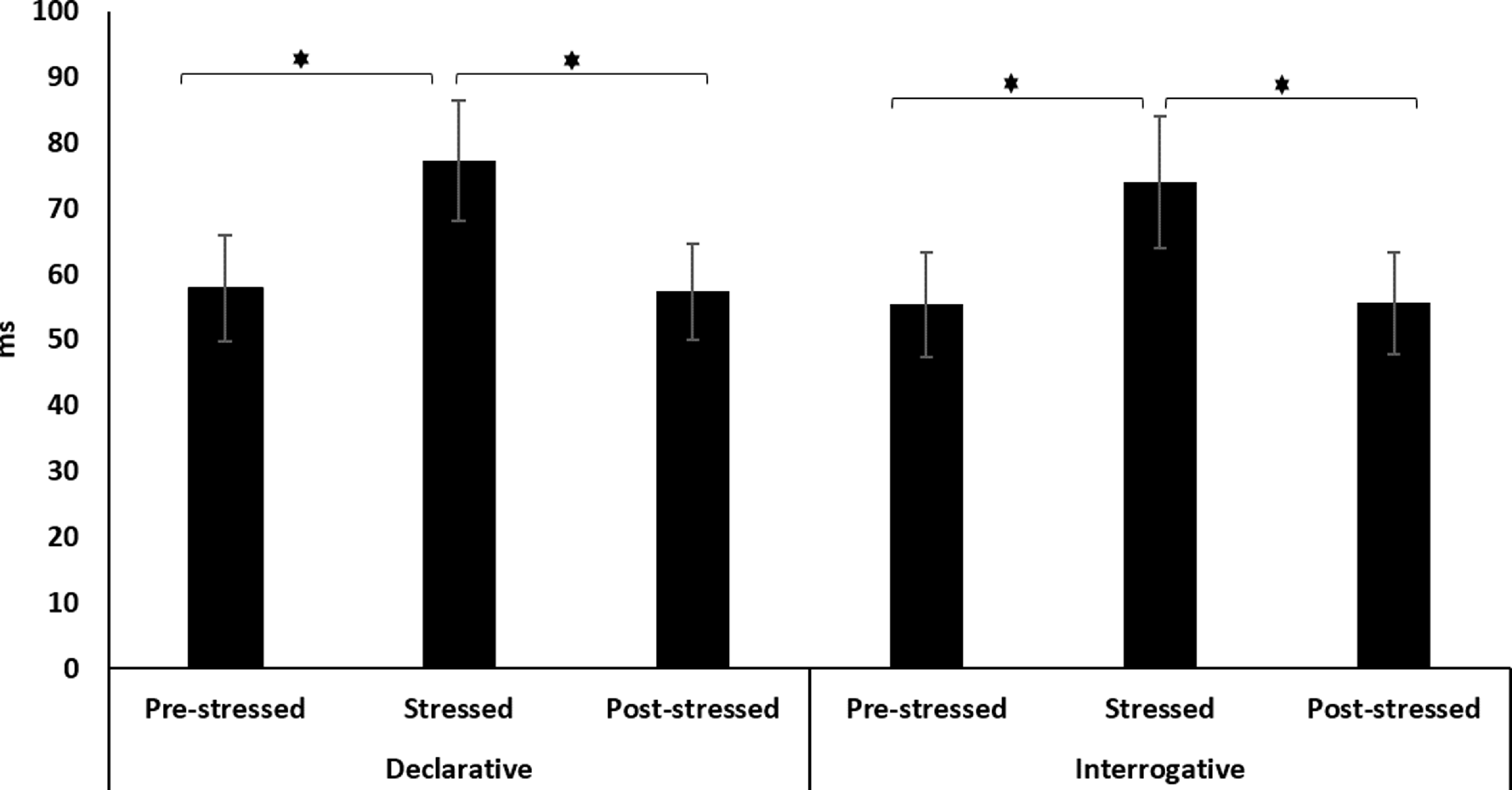
Figure 3 Long description
The bar graph compares the duration cue in milliseconds for pre-stressed, stressed, and post-stressed contexts in declarative and interrogative modalities. The x-axis represents the different contexts: pre-stressed, stressed, and post-stressed, divided into declarative and interrogative categories. The y-axis measures the duration in milliseconds, ranging from 0 to 100. There are six bars in total, three for declarative and three for interrogative contexts. Each bar represents the mean duration with error bars indicating variability. The stressed contexts show higher durations compared to pre-stressed and post-stressed contexts in both declarative and interrogative modalities. Asterisks indicate statistical significance (p < 0.05) between pre-stressed versus stressed and stressed versus post-stressed contexts. The bars are colored in black, and the graph highlights significant differences in duration cues across different stress contexts. All values are approximated.
3.1 Exploratory analyses
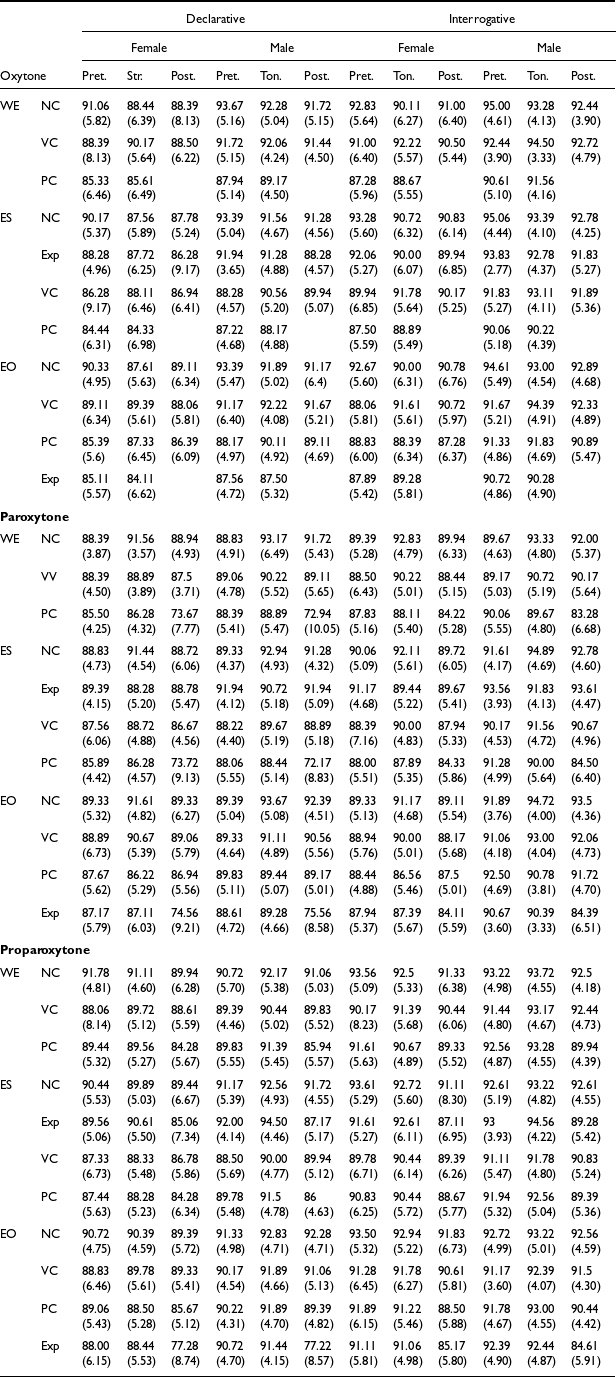
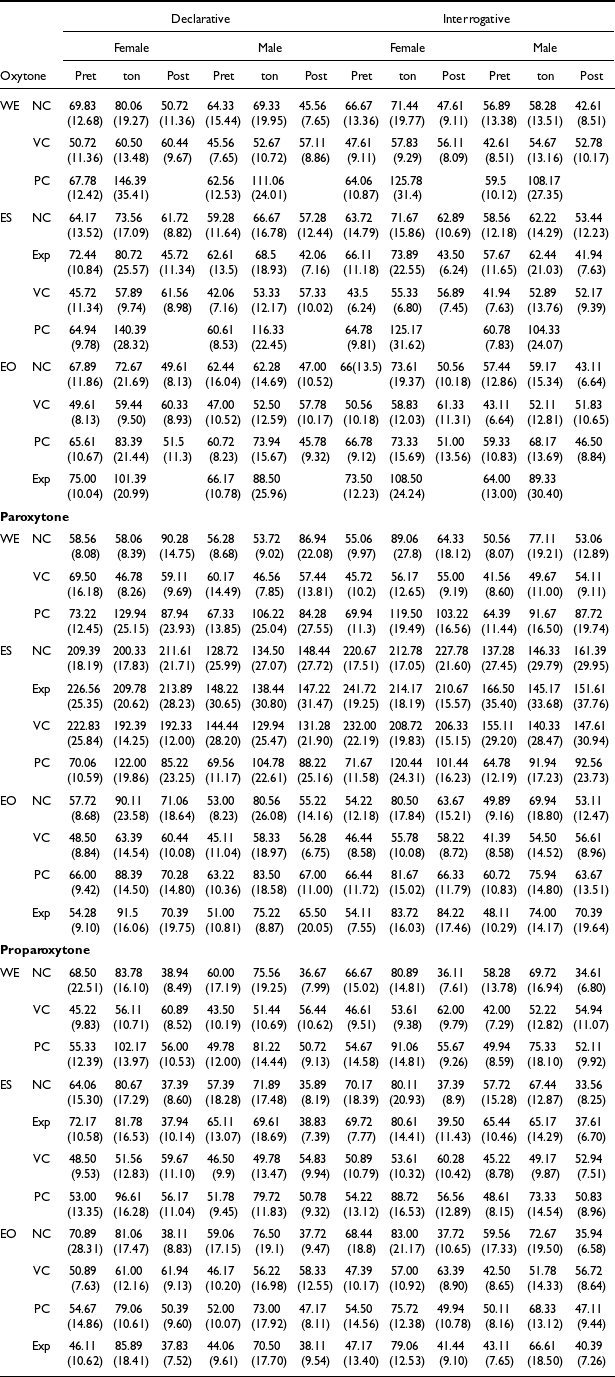
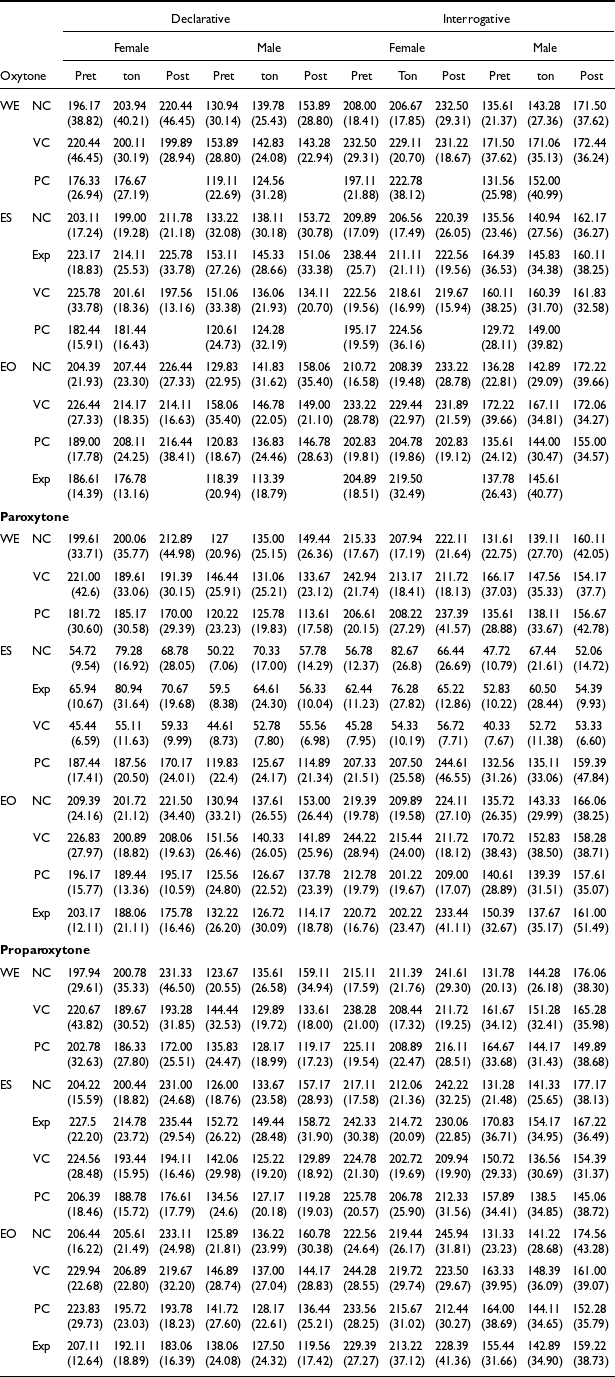
We performed a repeated ANOVA on syllable intensity, duration and F0 to compare the means of the three vowels: pre-stressed versus stressed versus post-stressed in each modality. Also, given that F0 is conditioned by gender because of anatomical factors, we conducted repeated analyses of the measurements to observe its influence on the utterance of the vowels. The descriptive statistics of intensity (Table 1), duration (Table 2) and F0 (Table 3) are in the Appendix.
Results about intensity, as shown in Figure 2, indicate that there are significant differences between the vowels in the declarative (f(2,34)=86.45; p<.000, ηp 2 =.81) and interrogative modalities (f(2,34)=42.62; p<.000, ηp 2 = .55). Stressed syllables exhibited higher intensity levels than pre-stressed syllables (p<.000; p<.028, respectively) and post-stressed syllables (p<.000; p<.000, respectively).
Figure 3 represents the results of duration cue measurements. Results indicate that there are significant differences between the vowels in the declarative (f(2,34)=115,08; p<.000, ηp 2 =.81) and interrogative modalities (f(2,34)=145,64; p<.000, ηp 2 = .84). Stressed syllables had longer duration than pre-stressed syllables (p<.000; p<.000, respectively) and also than post-stressed syllables (p<.000; p<.000, respectively).
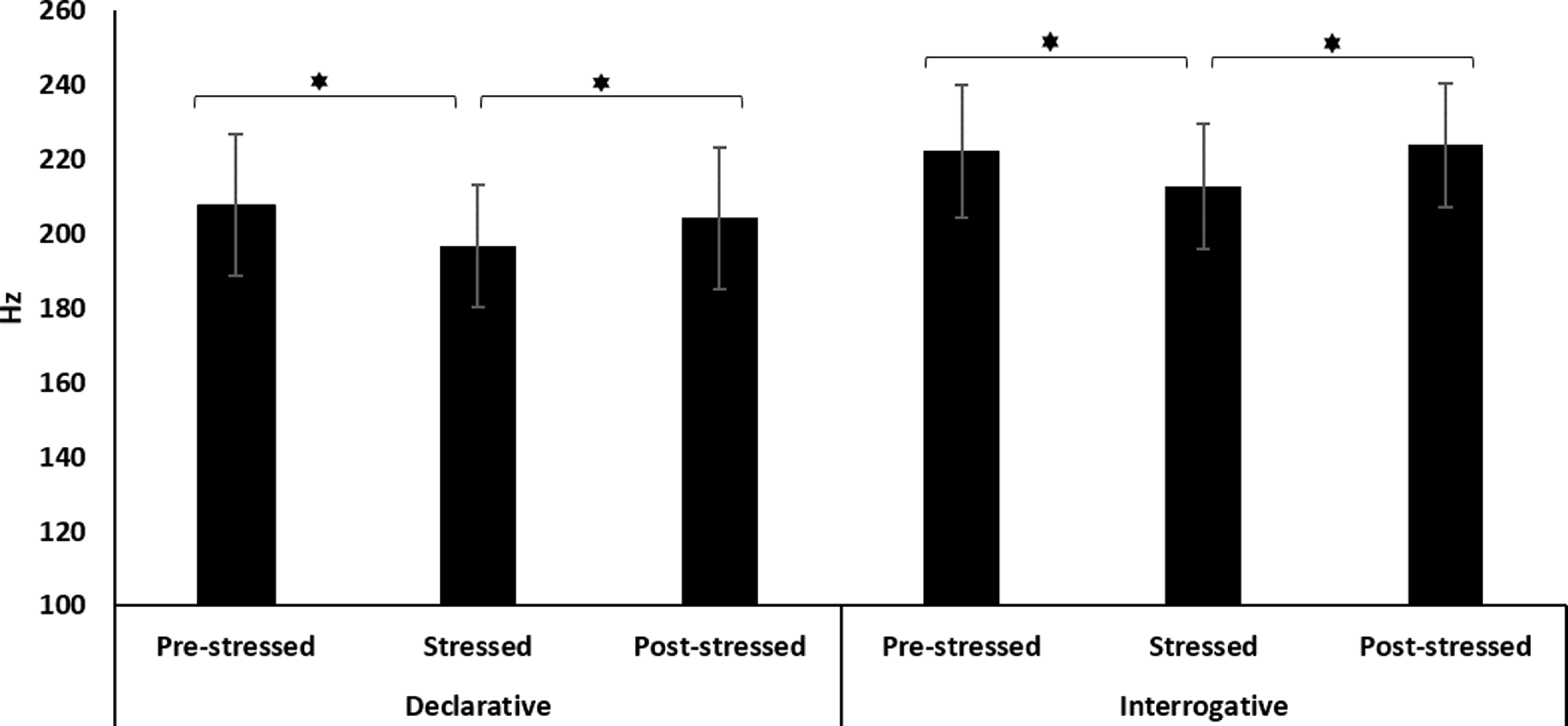
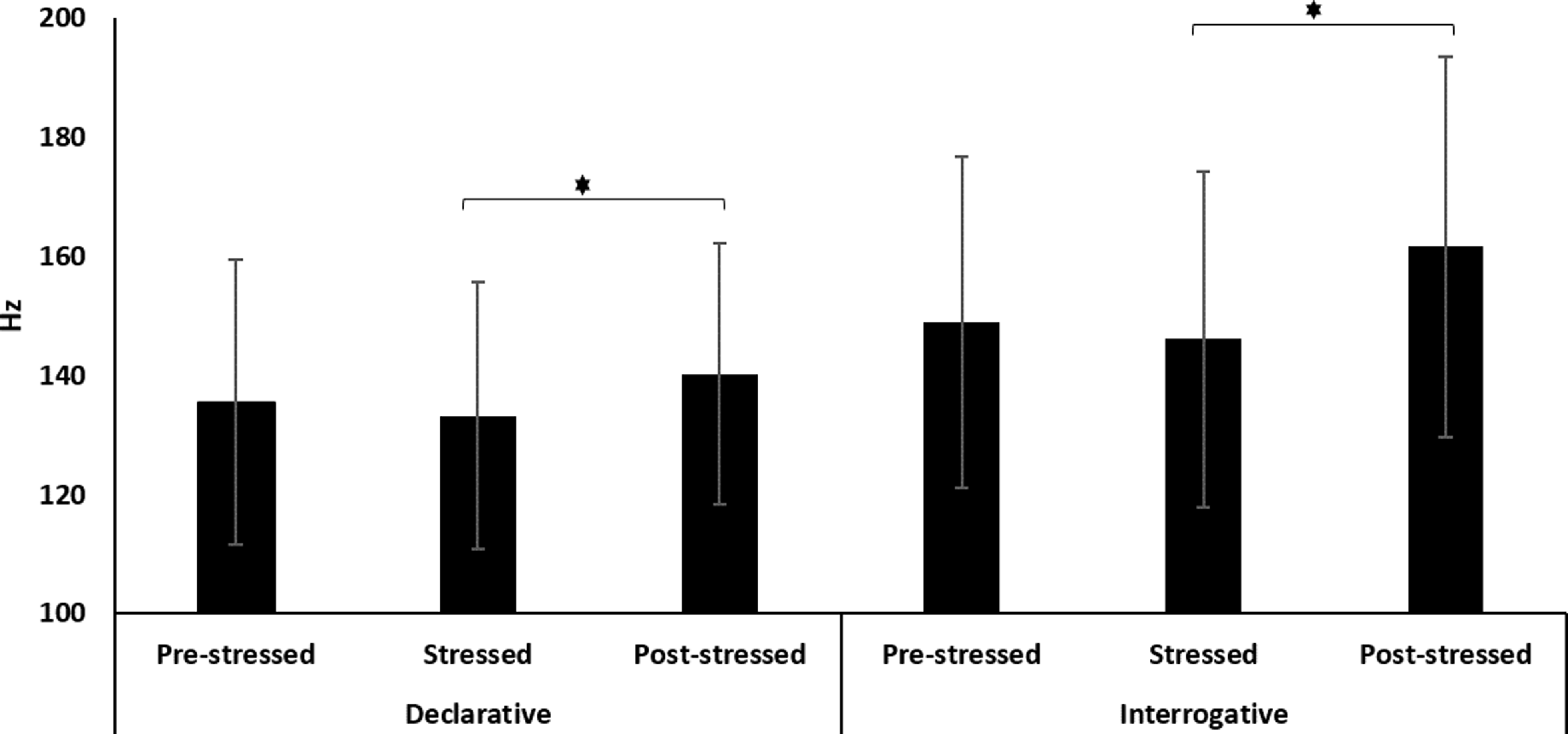
Figure 4 (female voice) and Figure 5 (male voice) show the results regarding F0. In general, there is significant interaction between the vowels and gender in the declarative (f(2,33)=58.89; p<.001, ηp 2 =.66) and interrogative modalities (f(2,33)=7.88; p<.002, ηp 2 =.30). In female voices (f(2,33)=50.30; p<.000, ηp 2 =.75; f(2,33)=15.81; p<.000, ηp 2 =.49, respectively), the stressed syllable had lower F0 than pre-stressed syllables (p<.000; p<.000, respectively) and also than post-stressed syllables (p<.000; p<.000, respectively), whereas, in male voices (f(2,33)=17.56; p<.000, ηp 2 =.52; f(2,33)=24.05; p<.000, ηp 2 =.59, respectively), the stressed syllables had lower F0 than post-stressed syllables (p<.000; p<.000, p<.000, respectively).
Mean contrasts of the female voice for pre-stressed versus stressed and stressed versus post-stressed contexts in the declarative and interrogative modalities based on the F0 cue. Asterisks indicate statistical significance (p < 0.05).
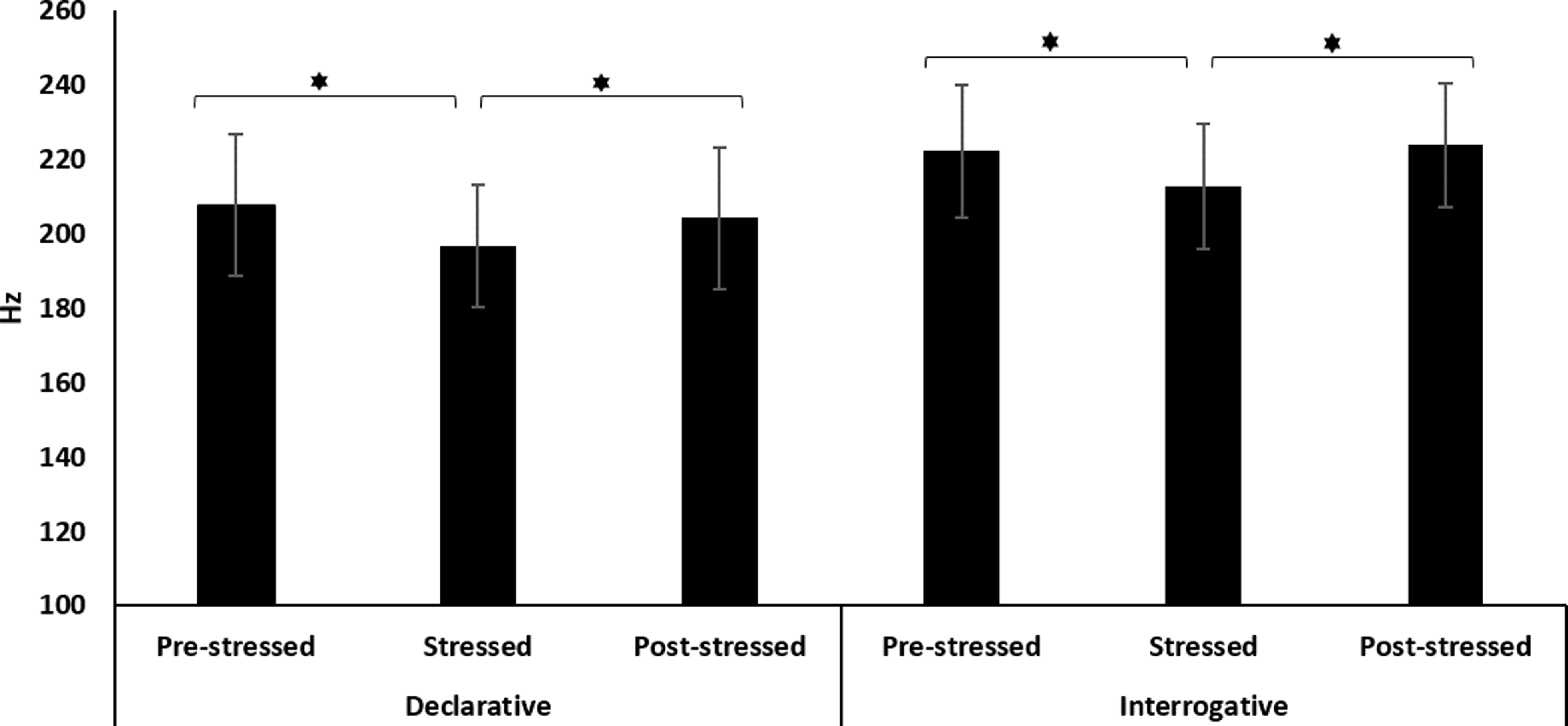
Figure 4 Long description
The bar graph compares mean contrasts of female voice frequency in pre-stressed, stressed, and post-stressed contexts for declarative and interrogative modalities. The x-axis labels are Pre-stressed, Stressed, and Post-stressed under Declarative and Interrogative categories. The y-axis is labeled in Hertz (Hz) ranging from 100 to 260. There are six vertical bars grouped into two categories: Declarative and Interrogative. Each category has three bars representing Pre-stressed, Stressed, and Post-stressed contexts. The bars are black with error bars indicating variability. Asterisks above certain comparisons indicate statistical significance with p values less than 0.05. The Declarative category shows a decrease in frequency from Pre-stressed to Stressed and an increase from Stressed to Post-stressed. The Interrogative category shows a similar trend with higher overall frequencies compared to the Declarative category. All values are approximated.
Mean contrasts of the male voice for pre-stressed versus stressed and stressed versus post-stressed contexts in declarative and interrogative modality based on the F0 cue. Asterisks indicate statistical significance (p < 0.05).
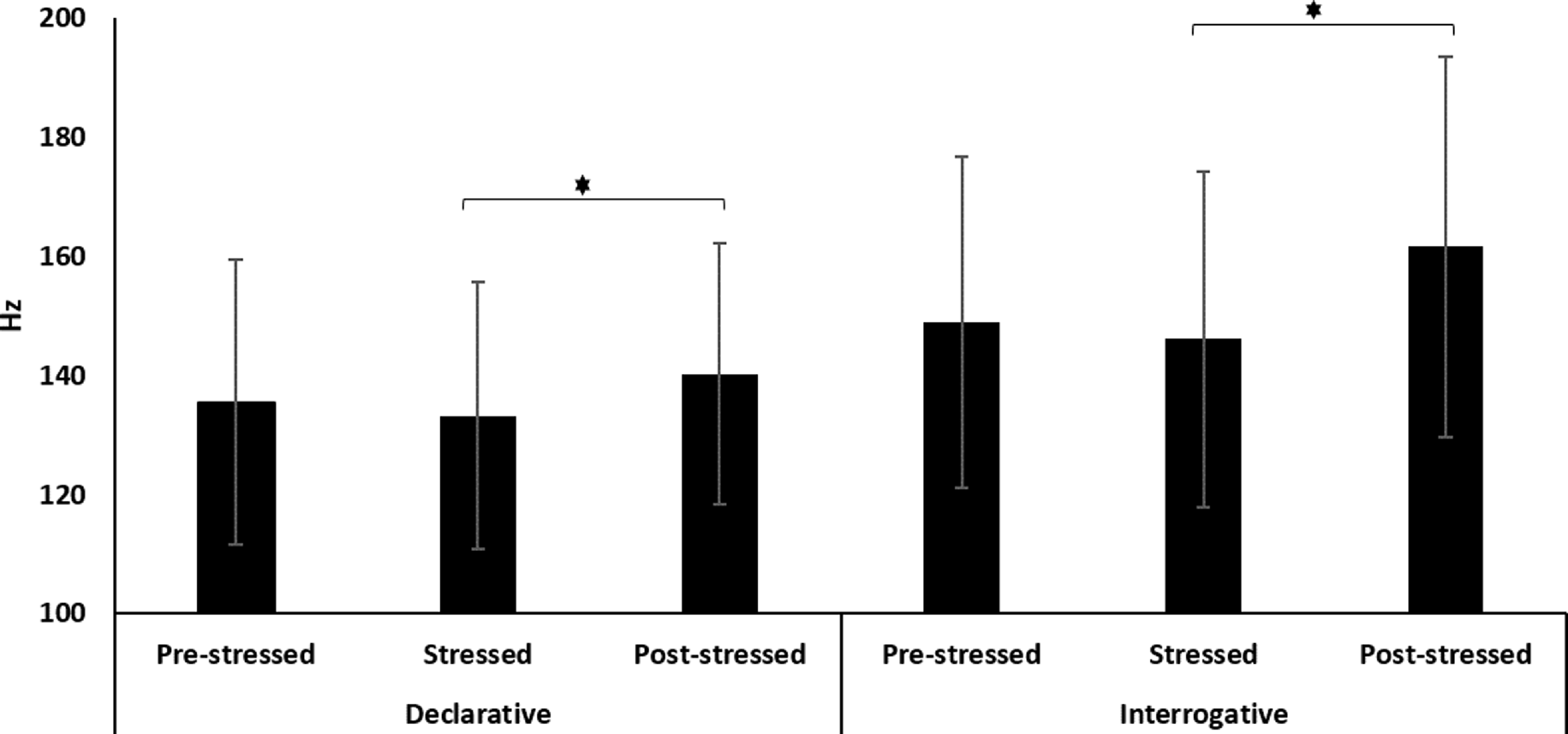
Figure 5 Long description
The bar graph compares mean contrasts of the male voice for pre-stressed versus stressed and stressed versus post-stressed contexts in declarative and interrogative modality based on the F0 cue. The x-axis represents the different contexts: pre-stressed, stressed, and post-stressed, for both declarative and interrogative modalities. The y-axis represents the frequency in Hertz (Hz), ranging from 100 to 200 Hz. There are six vertical bars grouped into two categories: declarative and interrogative. Each category has three bars representing pre-stressed, stressed, and post-stressed contexts. The bars are black with error bars indicating variability. Asterisks above certain bars indicate statistical significance with a p-value less than 0.05. The declarative modality shows a significant difference between stressed and post-stressed contexts. The interrogative modality shows a significant difference between pre-stressed and post-stressed contexts. All values are approximated.
3.2 Acoustic predictors of stressed vowels
We performed a multinomial analysis to observe which acoustic parameter (intensity, duration or F0) could be the correlate of the stressed vowel. We used vowels in pre-stressed, stressed and post-stressed positions. The stressed level was chosen as the reference category. The regression model evaluated whether stress could be predicted using five independent variables: gender, modality, intensity, duration, and F0. This analysis was conducted for each stress typology: oxytone, paroxytone, and proparoxytone, and for each clause in each syntactic structure (SVO, S+E+VO and SVO+E). Thus, first, we present the results related to oxytone stress, then to paroxytone stress and, finally, results related to the proparoxytone stress.
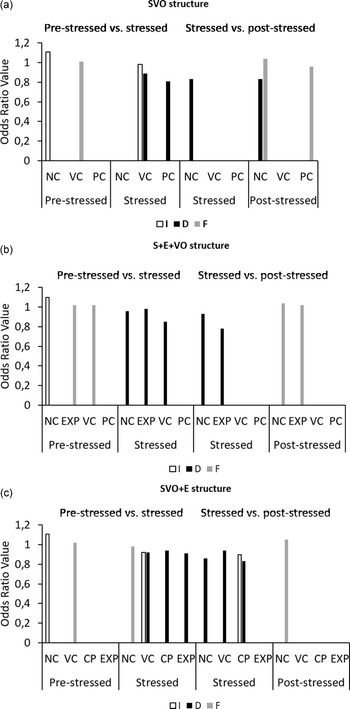
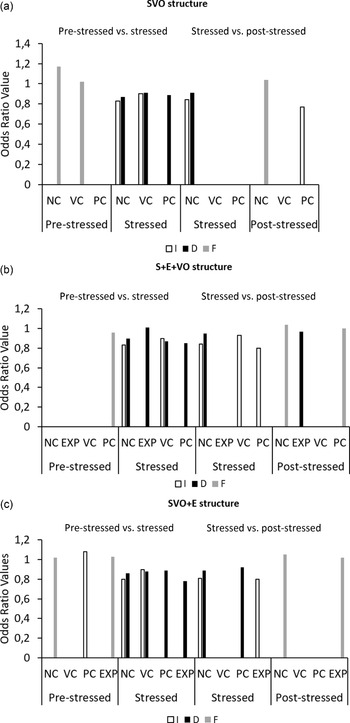
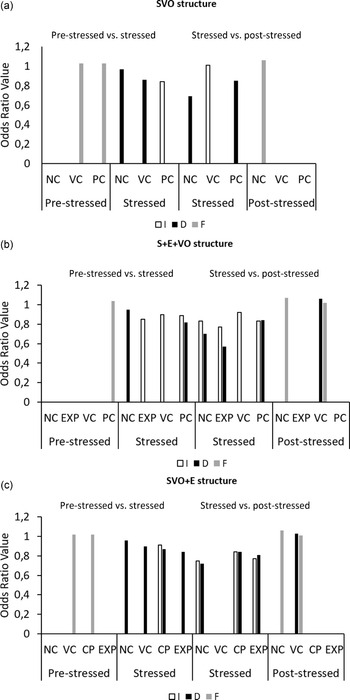
In order to better interpret the data, in Figures 6, 7 and 8 we have presented the values of the odds ratios (see Tables 4, 5 and 6 in the Appendix) that have reached statistical significance (p < .05). We present the value of the odds ratio because it indicates the strength of the prediction of the acoustic parameters on the syllables. This means that if a significant odds value is found in the intensity (white bars), duration (black bars) or F0 (gray bars), this acoustic parameter predicts the vowels in which it is located.
Representation of the odds ratio in statistically significant data (p < .05) according to different sentence structure clauses and vowel contrasts (pre-stressed versus stressed and stressed versus post-stressed) in oxytone typology. Abbreviations: D=Duration; EXP= Expansion; F= Fundamental frequency (F0); I=Intensity; NC= Noun clause; PC= Prepositional clause; VC= Verb clause. Figure 6A presents sentences with SVO structure, Figure 6B presents sentences with S+E+VO structure and Figure 6C presents sentences with SVO+E structure.
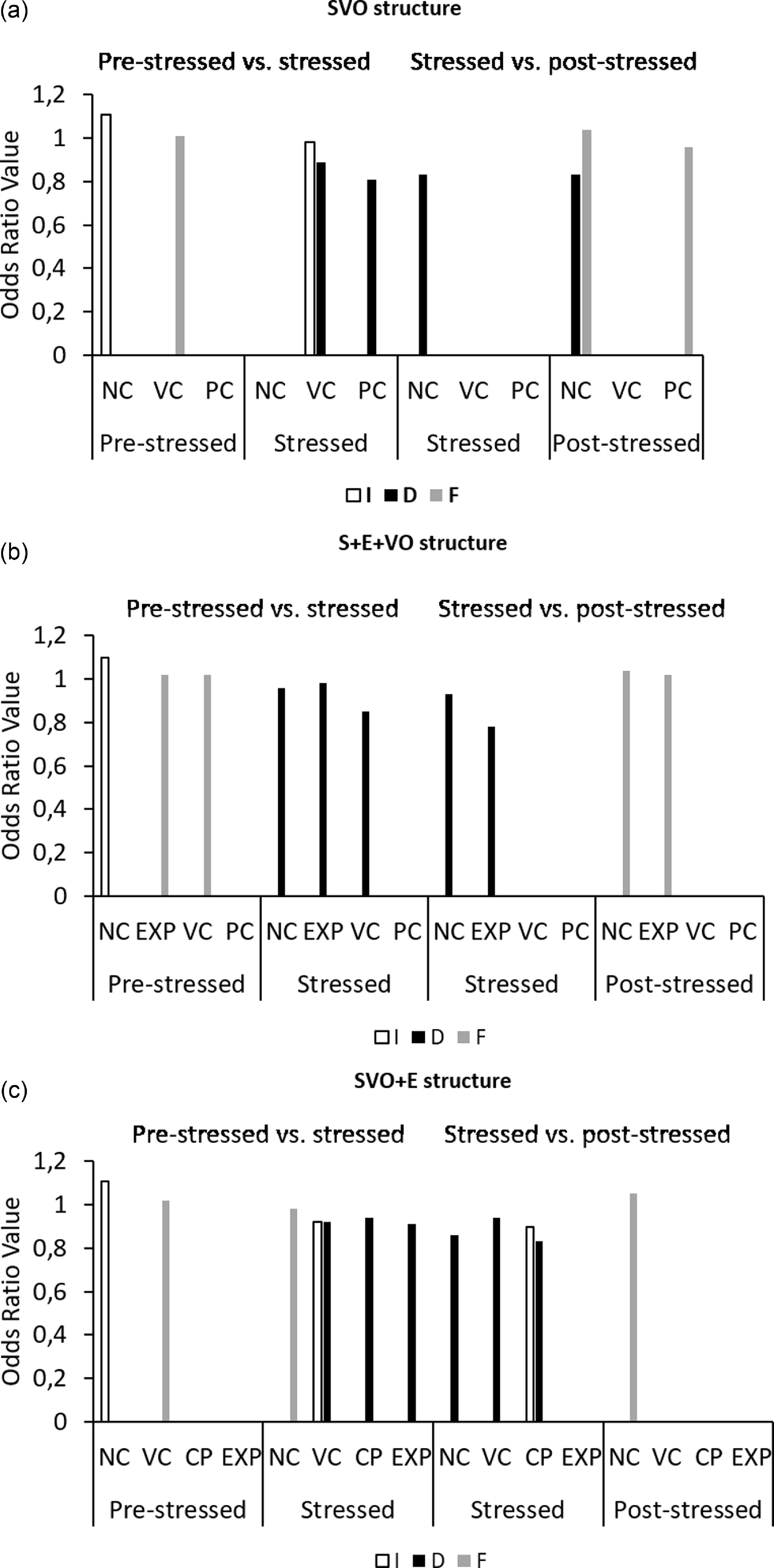
Figure 6 Long description
Three bar graphs compare odds ratios in statistically significant data for different sentence structures and vowel contrasts. The graphs are divided into three sections: SVO structure, S+E+VO structure, and SVO+E structure. Each section compares pre-stressed versus stressed and stressed versus post-stressed conditions. The x-axis represents different clauses: NC, VC, PC for SVO structure; NC, EXP, VC, PC for S+E+VO structure; and NC, VC, CP, EXP for SVO+E structure. The y-axis shows the odds ratio value ranging from 0 to 1.2. Each bar represents different acoustic parameters: I (Intensity), D (Duration), and F (Fundamental frequency). The bars indicate the odds ratio values for these parameters under different stress conditions. The graphs show variations in odds ratios across different sentence structures and vowel contrasts, highlighting the influence of acoustic parameters on stress perception.
Representation of the odds ratio in statistically significant data (p < .05) according to different sentence structures, clauses and vowel contrasts (pre-stressed versus stressed and stressed versus post-stressed) in paroxytone typology. Abbreviations: D=Duration; EXP= Expansion; F= Fundamental frequency (F0); I=Intensity; NC= Noun clause; PC= Prepositional clause; VC= Verb clause. Figure 7A represents sentences with SVO structure, Figure 7B represents sentences with S+E+VO structure and Figure 7C represents sentences with SVO+E structure.
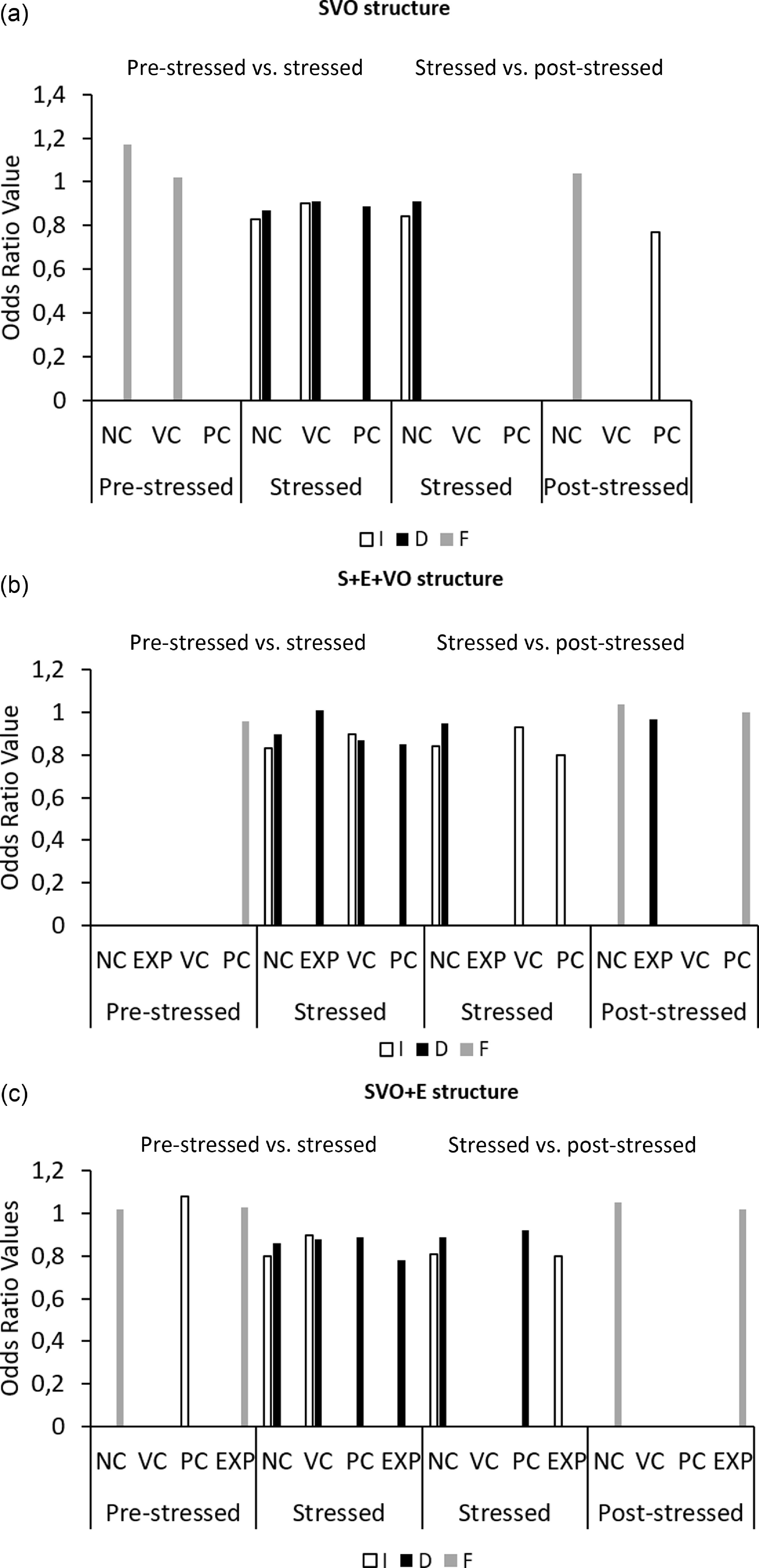
Figure 7 Long description
The bar graph compares odds ratio values across different sentence structures, clauses, and vowel contrasts in paroxytone typology. The graph is divided into three sections: Figure 7A, Figure 7B, and Figure 7C. Each section represents different sentence structures: SVO structure, S+E+VO structure, and SVO+E structure, respectively. The x-axis categorizes the data into pre-stressed versus stressed and stressed versus post-stressed conditions, with subcategories for noun clause (NC), verb clause (VC), and prepositional clause (PC). The y-axis measures the odds ratio values, ranging from 0 to 1.4. Each bar represents different acoustic parameters: duration (D), expansion (EXP), and fundamental frequency (F0). The bars are color-coded: white for intensity (I), black for duration (D), and gray for fundamental frequency (F0). The graph shows variations in odds ratio values across these parameters and conditions. All values are approximated.
Representation of the odds ratio in statistically significant data (p < .05) according to different sentence structures, clauses and vowel contrasts (pre-stressed versus stressed and stressed versus post-stressed) in proparoxytone typology. Abbreviations: D=Duration; EXP= Expansion; F= Fundamental frequency (F0); I=Intensity; NC= Noun clause; PC= Prepositional clause; VC= Verb clause. Figure 8A represents sentences with SVO structure, Figure 8B represents sentences with S+E+VO structure and Figure 8C represents sentences with SVO+E structure.
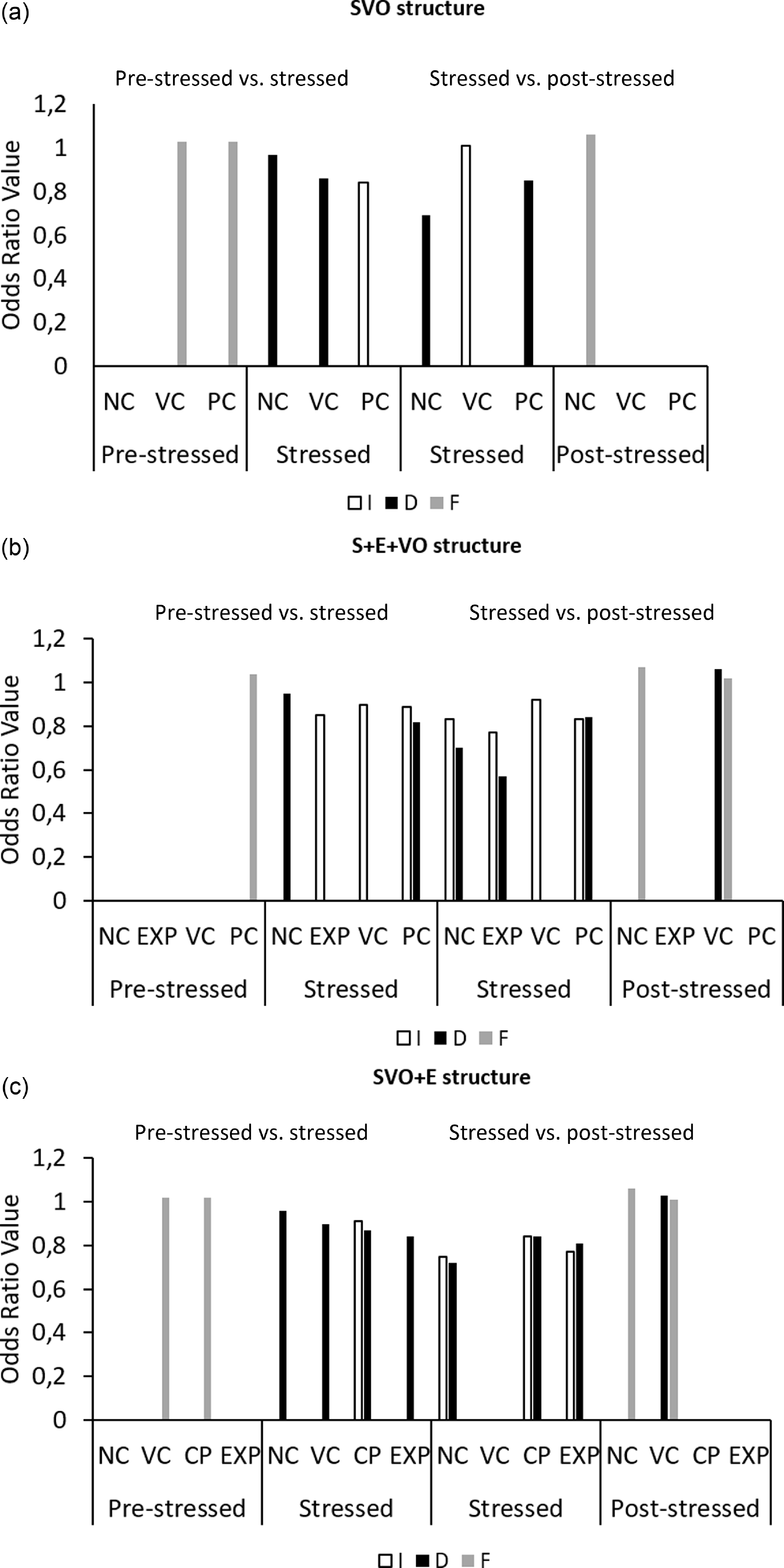
Figure 8 Long description
Three bar graphs compare odds ratios in statistically significant data for different sentence structures and vowel contrasts. The graphs are labeled as Figure 8A, Figure 8B, and Figure 8C. Each graph represents different sentence structures: SVO structure, S+E+VO structure, and SVO+E structure respectively. The x-axis of each graph categorizes data into pre-stressed, stressed, and post-stressed conditions, while the y-axis measures the odds ratio value ranging from 0 to 1.2. Each bar within the graphs is color-coded to represent different parameters: duration (D), expansion (EXP), fundamental frequency (F0), intensity (I), noun clause (NC), prepositional clause (PC), and verb clause (VC). The graphs illustrate the statistical significance of these parameters in different sentence structures and vowel contrasts.
3.2.1 Oxytone stress
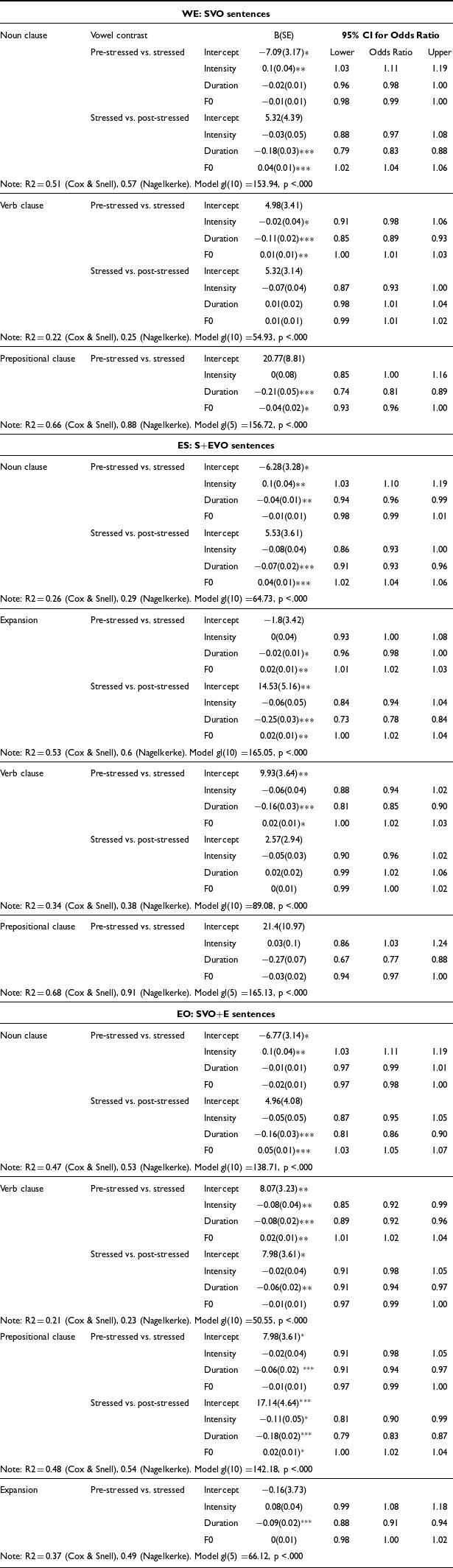
The corresponding outcome of the multinomial logistic regression for oxytone stress is presented in Table 4 (Appendix) and the values of odds ratios for each sentence structure are represented in the Figures 6A (SVO), 6B (S+E+VO) and 6C (SVO+E). In general, the Pseudo R-Squares indicated relatively high effect sizes. There were no significant interactions between the predictors and gender or modality, significant main effects were observed for duration, intensity and F0.
As we can see in Figures 6A, 6B and 6C, the significant results of the odds ratios of the duration parameter (black bars) are located in stressed vowels relative to pre-stressed and post-stressed vowel; that means that duration predicts stressed vowels in this data set. Intensity (white bars) does not show a defined pattern: in some cases, it predicts stressed vowels and in others unstressed vowels. The results of F0 (gray bars) are different; they were found to be concentrated only on unstressed vowels (pre- and post-stressed).
Specifically, the figures presenting the values of the odds ratios show that intensity (white bars) predicts stressed vowels relative to pre-stressed vowels in verb clauses in SVO and SVO+E sentences. They also predict stressed vowels relative to post-stressed vowels in prepositional clauses in SVO+E sentences. Furthermore, they predict pre-stressed vowels in the noun clause across the three syntactic structures (SVO, S+E+VO and SVO+E).
Duration (black bars) predicts stressed vowels relative to pre-stressed vowels in noun clauses of S+E+VO sentences; in verb clauses across the three syntactic structures (SVO, S+E+VO and SVO+E); in prepositional clauses of SVO and SVO+E sentences; and in the expansion of S+E+VO and SVO+E sentences. Similarly, it predicts stressed vowels relative to post-stressed vowels in noun clauses across the three syntactic structures (SVO, S+E+VO and SVO+E); in verb clauses within SVO+E sentences; and in the expansion of S+E+VO sentences.
F0 (gray bars) predicts unstressed (pre-stressed, post-stressed) vowels relative to stressed vowels. This result was observed for pre-stressed vowels in verb clauses in the three syntactic structures (SVO, S+E+VO and SVO+E); and in the expansion clauses of S+E+VO sentences. It was also observed in post-stressed vowels, in noun clauses across the three syntactic structures (SVO, S+E+VO and SVO+E), in expansion clauses of S+E+VO, and in prepositional clauses of SVO. Only in noun clauses of SVO+E sentences did F0 predict stressed vowels relative to pre-stressed vowels.
In summary, duration is a feature that predicts the stressed vowel throughout the majority of the different vowel contrasts (pre-stressed versus stressed; stressed versus post-stressed), clauses and sentence structures. In some cases, although rare, intensity and duration are shown to be features that predict the stressed vowel simultaneously. Unlike the two previously mentioned parameters, F0 is a predictor of unstressed vowels.
3.2.2 Paroxytone stress
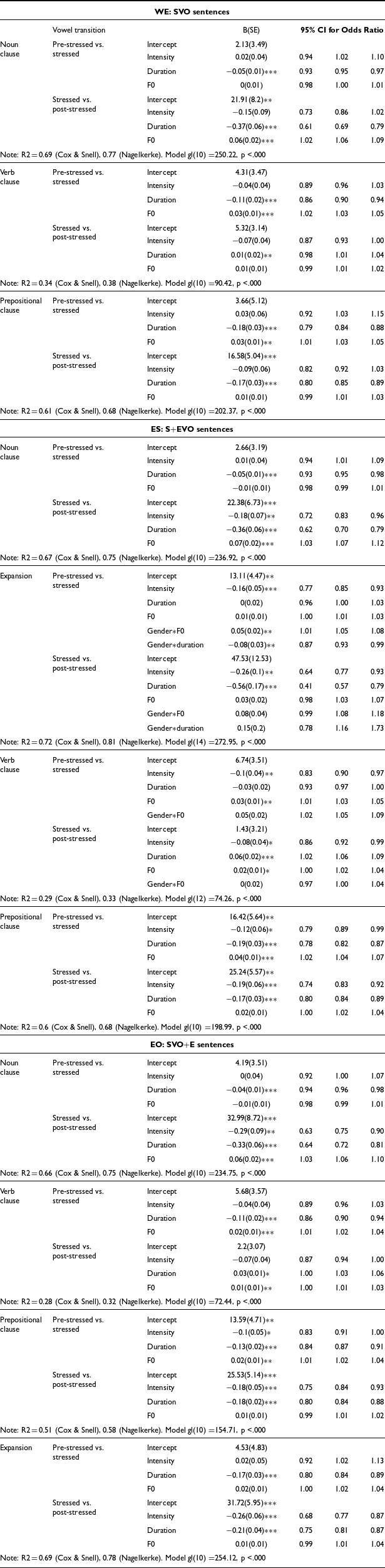
The corresponding outcome of the multinomial logistic regression for paroxytone stress is presented in Table 5 (Appendix) and the values of odds ratios for each sentence structure are represented in Figures 7A (SVO), 7B (S+E+VO) and 7C (SVO+E). In general, the Pseudo R-Squares indicated relatively high effect sizes. Some significant interactions were observed between the predictors and gender or modality, but no systematic pattern emerged, so these occurrences were not further explored.
As we can see in Figures 7A, 7B and 7C, the significant values of the odds ratios for the duration parameter (black bars) are found in stressed vowels compared to pre- and post-stressed vowels; with a higher number observed in the contrast with the pre-stressed vowels than in the post-stress context. In terms of intensity (white bars), the majority of the significative values are found in stressed vowels. Thus, similar to the results above, duration predicts stressed vowels in this data set, but so does intensity. Again, the values of F0 (gray bars) are concentrated on unstressed vowels (pre-stressed and post-stressed) as in the oxytone stress.
Specifically, for the paroxytone stress typology, intensity (white bars) predicts stressed vowels relative to pre-stressed vowels in the noun and verb clauses across the three syntactic structures (SVO, S+E+VO and SVO+E), as well as in prepositional clauses in SVO+E sentences. Intensity also predicts stressed vowels relative to post-stressed vowels in noun clauses in the three syntactic structures (SVO, S+E+VO and SVO+E), in verb clauses in S+EVO sentences, in prepositional clauses in SVO and S+EVO sentences, and in expansion of SVO+E sentences. Only on one occasion did the odds ratio reach statistical significance in the prepositional clause with a pre-stressed vowel.
Duration (black bars) predicts stressed vowels relative to pre-stressed vowels in noun, verb and prepositional clauses within the three syntactic structures (SVO, S+E+VO and SVO+E) and in the expansion of SVO+E sentences. Also, duration predicts stressed vowels relative to post-stressed vowels in noun clauses within the three syntactic structures (SVO, S+E+VO and SVO+E); in prepositional clauses in SVO+E sentences; and in the expansion of S+E+VO sentences.
Similar to the abovementioned oxytone results, F0 predicts unstressed vowels relative to stressed vowels. This result is observed for pre-stressed vowels in noun clauses of SVO and SVO+E sentences, in verb clauses of SVO sentences, in prepositional clauses of S+EVO sentences, and in the expansion of SVO+E sentences. It was also observed for post-stressed vowels in noun clauses across the three syntactic structures (SVO, S+E+VO and SVO+E) and in the expansion of SVO+E sentences.
In sum, similar to the oxytone typology, in paroxytone stress typology duration and intensity are features that predict the stressed vowel simultaneously in some cases, or individually in others. However, duration is a feature that showed a structured pattern through the majority of the different vowel contrasts (pre-stressed versus stressed; versus post-stressed), clauses and sentence structures while intensity did not.
3.2.3 Proparoxytone stress
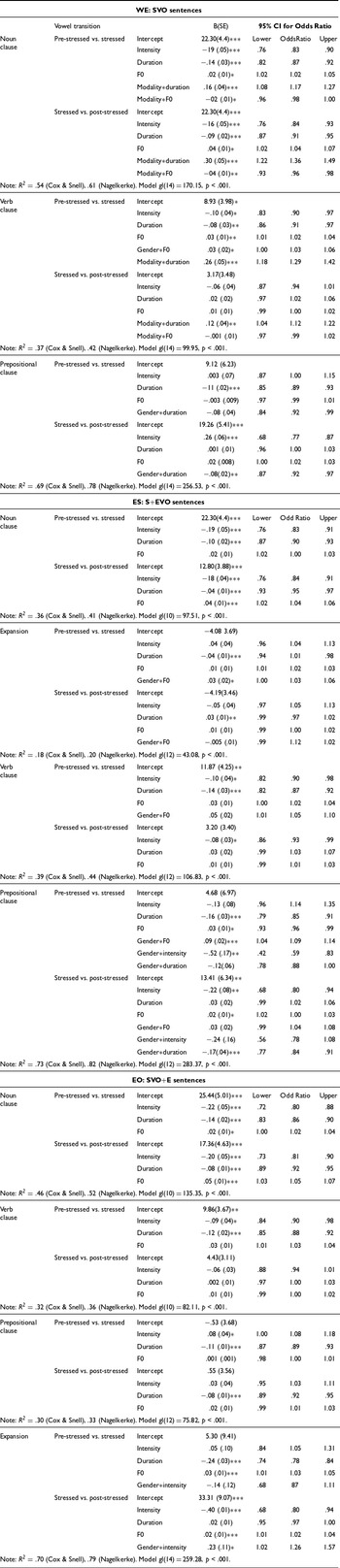
Results for proparoxytone stress are presented in Table 6 (Appendix) and odds ratios values for each sentence structure are represented in Figures 8A (SVO), 8B (S+E+VO) and 8C (SVO+E). In general, the Pseudo R-Squares indicated relatively high effect sizes. There were no significant interactions between the predictors and gender or modality, but significant main effects of duration, intensity and F0 were observed.
Figures 8A, 8B and 8C show us that intensity predicts stressed vowels relative to pre-stressed vowels in noun and verb clauses within the three syntactic structures (SVO, S+E+VO and SVO+E) and in prepositional clauses of SVO+E sentences. Intensity also predicts stressed vowels relative to post-stressed vowels in noun clauses across the three syntactic structures (SVO, S+E+VO and SVO+E); in verb clauses of S+EVO sentences; in prepositional clauses in SVO and S+EVO sentences and, finally, in the expansion of SVO+E sentences.
Duration predicts stressed vowels relative to pre-stressed vowels in noun, verb, and prepositional clauses and in the expansion of SVO, S+EVO and SVO+E sentences. In a similar manner, duration predicts stressed vowels relative to post-stressed vowels in noun clauses across the three syntactic structures (SVO, S+E+VO and SVO+E), as well as in prepositional clauses of SVO+E sentences and in the expansion of S+EVO sentences.
Similar to the results described for oxytone and paroxytone stress, F0 increases the odds ratios for unstressed vowels relative to stressed vowels. This result is observed in pre-stressed vowels in noun clauses of SVO and SVO+E sentences, in verb clauses in SVO sentences, in prepositional clauses of S+EVO sentences, and in the expansion of SVO+E sentences; in post-stressed vowels of noun clauses in all three syntactic structures (SVO, S+E+VO and SVO+E); and in the expansion of SVO+E sentences.
In general, Figures 6 (A, B, C), 7 (A, B, C) and 8 (A, B, C) showed that duration and intensity are features that predict stressed vowels throughout different vowel contrasts, clauses and sentence structures. Nevertheless, duration is the strongest predictor, as it is the prosodic parameter that most consistently signals the stressed vowel.
3.2.4 General model
The compilation of the data presented suggests that while the intensity and duration of a syllable can predict the stressed vowel simultaneously in some cases, duration is more systematic than intensity across the stress typologies and syntactic structures. Every time there is an increase in intensity and duration, the odds for stressed vowels relative to pre-stressed or post-stressed vowels increase. On the other hand, an increase in F0 raises the odds ratios for unstressed (pre-stressed or post-stressed) vowels relative to stressed vowels. Based on these results, a general regression analysis was conducted in order to generate a simplified model.
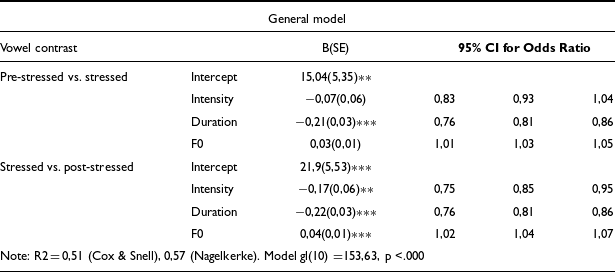
The corresponding results for the general multinomial logistic regression are presented in Table 7. Interestingly, an increase in duration increases the odds ratios for stressed vowels relative to pre- and post-stressed vowels. Again, intensity contributes to predicting stressed vowels but only relative to post-stressed vowels. In general, the Pseudo R-Squares indicated relatively high effect sizes. There were no significant interactions between the predictors and gender or modality. Thus, this analysis confirmed that duration is the dominant acoustic cue for predicting the stressed vowel in this corpus.
4. Discussion
The main objective of this research project was to identify the most salient feature among prosody parameters in speech production at the sentence level. To this end, participants uttered sentences with different stress typologies, syntactical structures, and modalities. We analyzed the prosodic features of the pre-stressed, stressed and post-stressed vowels.
In short, the statistical significances from both the means comparison and the multinomial results align, affirming that intensity and duration are key predictive features of stressed vowels. Furthermore, in line with the rationale of this study, the statistical data – especially those obtained from the multinomial regression model – support our hypothesis that duration is the primary correlate of stressed vowels, as it remained the major predictor of stressed vowels in relation to adjacent vowels (pre- and post-stressed), across the different stress typologies, syntactical structures, and modalities.
The results of the first analysis show that F0 has little influence in marking the stressed vowel, while both duration and intensity are significantly higher in stressed vowels than in their adjacent counterparts, indicating that these two parameters are reliable predictors of stress. These findings are interesting as they present a nuanced contrast to Ortega-Llebaria’s (Reference Ortega-Llebaria2006) conclusions, which suggested that although duration is the most consistent correlate for lexical and phrasal prominence, intensity has little effect on word-level stress.
As mentioned in the results section, this paper shows the relevant characteristics of different models based on stress typology, syntactical structure, and clause. The purpose was to observe whether each prosodic feature behaves in the same manner across these categories when contrasting pre-stressed versus stressed and stressed versus post-stressed vowels. To summarize the main findings, the data showed that when significant, the odds ratios for intensity and duration predicting stressed vowels relative to adjacent unstressed vowels were consistent across stress typologies, syntactic structures, and clause types. In the rare cases where intensity was significant, the odds ratios for intensity were always higher than those for duration. However, the results related to duration were the most prominent throughout the different categories. Thus, this outcome identifies duration as the most reliable predictor of stressed vowels.
So far, we can assume that duration is the cue that predicts stressed vowels in the majority of cases. This result is observed more often in the pre-stressed versus stressed contrast than in the stressed versus post-stressed contrast. These results make sense because in order to convey the correct message during speech production, the stressed syllable must be marked quickly.
Based on the results of our first set of statistical analysis in which we used the multinomial regression, we decided to combine the different categories by merging the data of the three levels of vowels: pre-stressed, stressed and post-stressed, but we separated them by modality and gender in order to observe their influence on the predictive variable. The findings revealed that duration is potentially a cue to differentiate stressed and adjacent unstressed vowels. However, it appears that pre-stressed versus stressed vowels and stressed versus post-stressed vowels differ in intensity. Stress related to pre-stressed had higher duration values and stress related to post-stressed had higher intensity and duration, with duration being a better predictor than intensity. The F0 cue is a good predictor for unstressed vowels.
Specifically, for the F0 cue, pitch accents can only be aligned with a stressed syllable (Silverman, Reference Silverman, Kigston and Bechian1990), and intonation arises from the F0 variation to convey information beyond the word level (Vaissière, Reference Vaissière2005). For example, some studies reveal a general tendency for a peak alignment between post-tonic vowels and with the syntagmatic border in the contexts of Canarian and Colombia Speech (Muñetón-Ayala, Reference Muñetón-Ayala2017). In this sense, it is important to highlight that in our results, the F0 systematically predicts the posttonic vowels of the noun clause. This result makes sense, because in Colombian speech, the pitch accents shows peak displacement in which maximum peaks align with a vowel after the tonic [L>H*] is presented in Colombian speech (Muñetón-Ayala and Dorta, Reference Muñetón-Ayala, Dorta and Dorta2018). Similar results have also been obtained for Spanish in general (Garrido et al., Reference Garrido, Joaquim, Carme de la and Antonio1993, Reference Garrido, Llisterri, de la Mota and Ríos1995; Hualde and Kim, Reference Hualde and Jong-Yun2015; Llisterri et al., Reference Llisterri, María José, Carlos de la, Marta and Antonio2002, Reference Llisterri, María José, Carlos de la and Marta2003; Prieto et al., Reference Prieto, Jan Van and Julia1995; Xu, Reference Xu1999).
Thus, it appears that this use of intensity, duration, and F0 to distinguish between stressed and unstressed vowels, may be duration-specific. This finding is in line with prior evidence from Spanish (Méndez et al., Reference Méndez, Mora and Rojas2008; Méndez, Reference Méndez2010; Ortega-Llebaria and Prieto, Reference Ortega-Llebaria and Prieto2011; Garrido et al. Reference Garrido, Llisterri, de la Mota and Ríos1995; Muñetón Reference Muñetón-Ayala2016) and other languages (Gordon and Roettger Reference Gordon and Roettger2017). For example, Gordon and Roettger (Reference Gordon and Roettger2017) developed a cross-linguistic survey with 75 different languages or language varieties to observe the correlate of word stress commonality. The participants were adult speakers with no reported speech impairments. Researchers compared the three fundamental prosodic parameters, and duration was the most consistent correlate of word stress.
It is interesting to note that the stress differences between languages do not in principle influence the determination of the parameter that correlates with the stressed vowel. For example, Hungarian and French are fixed stress languages; however, they align with free stress languages such as Portuguese and Spanish, in which duration can be the main acoustic correlate of lexical stress.
We believe that an important contribution of the present study is that it shows that the stressed versus unstressed distinction is explained by duration; but not by F0. This result is remarkable because of the fact that Spanish, along with French and Italian, has been classified as a syllable-timed language, unlike English, Dutch, or Arabic, which have been classified as stress-timed languages. The difference between both categories is that syllable-timed languages tend to have a stable syllable duration; while the others tend to have a stable duration for the inter-stress interval. The current results support those provided by Dauer, who, in a cross-linguistic study (English, Thai, Spanish, Italian and Greek), demonstrated that rhythmic grouping is not exclusive to stress-timed languages like English, but also occurs in syllable-timed languages such as Spanish.
Conclusions
Although both male and female voices were evaluated, gender did not significantly affect the results, as no systematic patterns emerged distinguishing the two groups. Additionally, the inclusion of participants from diverse urban centers provided a large and varied pool of individuals, representing a wide range of socio-political and economic backgrounds. While this aspect was not the primary focus of the study, it highlights potential avenues for future research to explore how these factors may influence acoustic features in speech.
In brief, our findings support the idea that the duration parameter contributes to differentiation between the stressed and adjacent unstressed vowels in Spanish spoken in Colombia. From a practical perspective, according to our findings, this feature may be more helpful than the traditional cues such as F0 for language learning, particularly in perception.
Moreover, by linking these results to previous studies on speech perception in Spanish speakers (Muñetón-Ayala et al., Reference Muñetón-Ayala, Vega, Ochoa-Gómez and Beltrán2022; Muñetón-Ayala, Reference Muñetón-Ayala2020), the results suggest that duration is a salient feature in the perception and production of speech acts. For example, Muñetón-Ayala et al. (Reference Muñetón-Ayala, Vega, Ochoa-Gómez and Beltrán2022) examined the neural dynamics underlying the duration cues and the semantic dimension in the perception of Spanish sentences through an experimental electrophysiological design. They used sentences ending with a trisyllable noun, with stress on the penultimate syllable. The pre-stressed syllable was manipulated in the duration feature (correct and incorrect) and the words were manipulated in the semantic dimension (predictable and unpredictable).
The main findings of study reveal a strong association between vowel duration and semantic processes at the perceptual level alongside evidence of automatic processing of the duration feature. These results underscore the role of temporal cues in Spanish and align with prior research in French (Magne et al., Reference Magne, Astesano, Aramaki, Ystad, Kronland-Martinet and Besson2007) which used a similar experimental design. Notably, this study builds on earlier work by Muñetón-Ayala (Reference Muñetón-Ayala2020), who demonstrated that vowel duration can distinguish declarative from interrogative sentences in Spanish, during the production and perception of speech. This study also aligns with Muñiz Cachón (Reference Muñiz Cachón2017), who observed similar patterns in speech productions tasks.
However, it is important to highlight that conducting a perceptual study in Colombian Spanish that analyzes prosodic cues as a function of dialect would be highly relevant, with the aim of contrasting the results obtained in the present study. Whilst it is true that each language has specific prosodic features, it is worth mentioning a study conducted in German that evaluated the influence of 17 linguistic variables on the perception of prominence. The overall results are particularly significant, as they show that all the variables analyzed – including both discrete and continuous prosodic factors, as well as non-prosodic variables – have a considerable impact on prominence perception.
Limitations
The present study is based on experimental data; thus, it would be interesting to investigate the correlate of the stressed or unstressed vowel in spontaneous and interactive speech. In this manner, we can contrast results and better understand the process. Additionally, while this research explored diverse participants, further studies could examine how socio-cultural factors specifically influence acoustic features, providing deeper insights into the interplay between linguistic behavior and social dynamics.
Acknowledgments
This work was supported by the University of Antioquia, Colombia, under the project “Analysis of the Impact of Prosodic Features on the Semantic Dimension of Sentences in Schoolchilfdren With and Without Reading Difficulties Through Evoked Potentials” CODI (2022-52754).
Appendix
Means and standard deviations (in parentheses) of intensity, calculated separately for declarative and interrogative modalities in each clause of sentences with and without expansion for both women and men based on the stress typologyFootnote 1
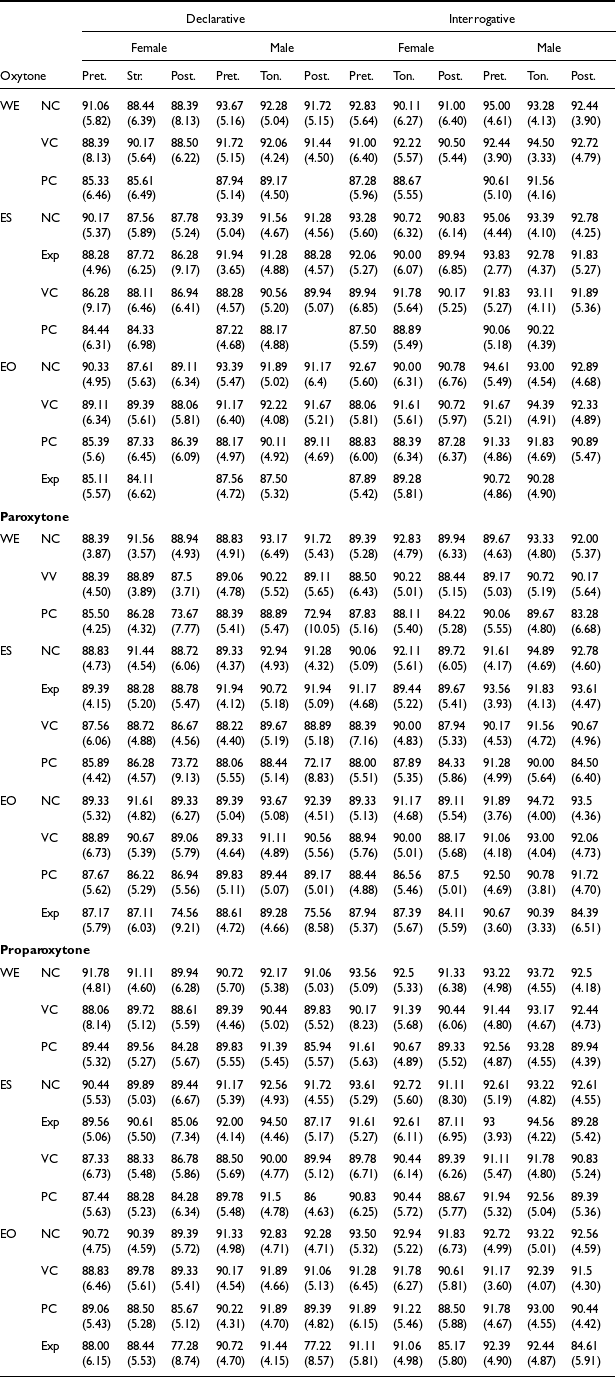
Table 1 Long description
The table presents means and standard deviations of intensity for declarative and interrogative modalities across different sentence structures and genders. It includes data for female and male speakers in declarative and interrogative contexts, with and without expansions, across oxytone, paroxytone, and proparoxytone clauses. The table is organized into columns for different sentence types and rows for various stress positions, providing a detailed comparison of intensity values.
Mean values and standard deviations (in parentheses) of duration, calculated separately for declarative and interrogative modalities, for each clause in sentences with and without expansion based on the stress typology for both women and men
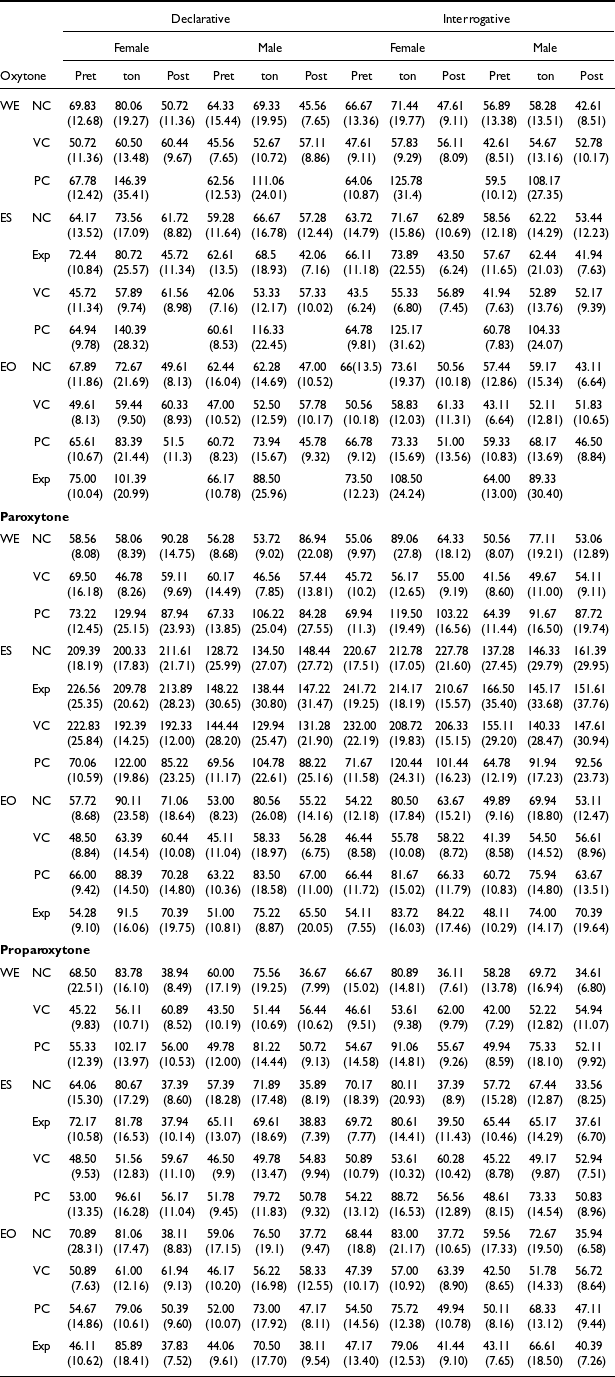
Table 2 Long description
The table presents mean values and standard deviations of duration for declarative and interrogative modalities across different clauses and stress typologies for both women and men. It includes data for oxytone, paroxytone, and proparoxytone clauses, with separate columns for pre-ton, post-ton, and ton positions. The table has 30 rows and 12 columns, detailing the duration values for each clause type and stress position. Notable trends include variations in duration across different stress positions and modalities, with specific differences observed between female and male speakers.
Means values and standard deviations (in parentheses) of F0, calculated separately for declarative and interrogative modalities, for each clause in sentences with and without expansion, based on the stress typology for both women and men
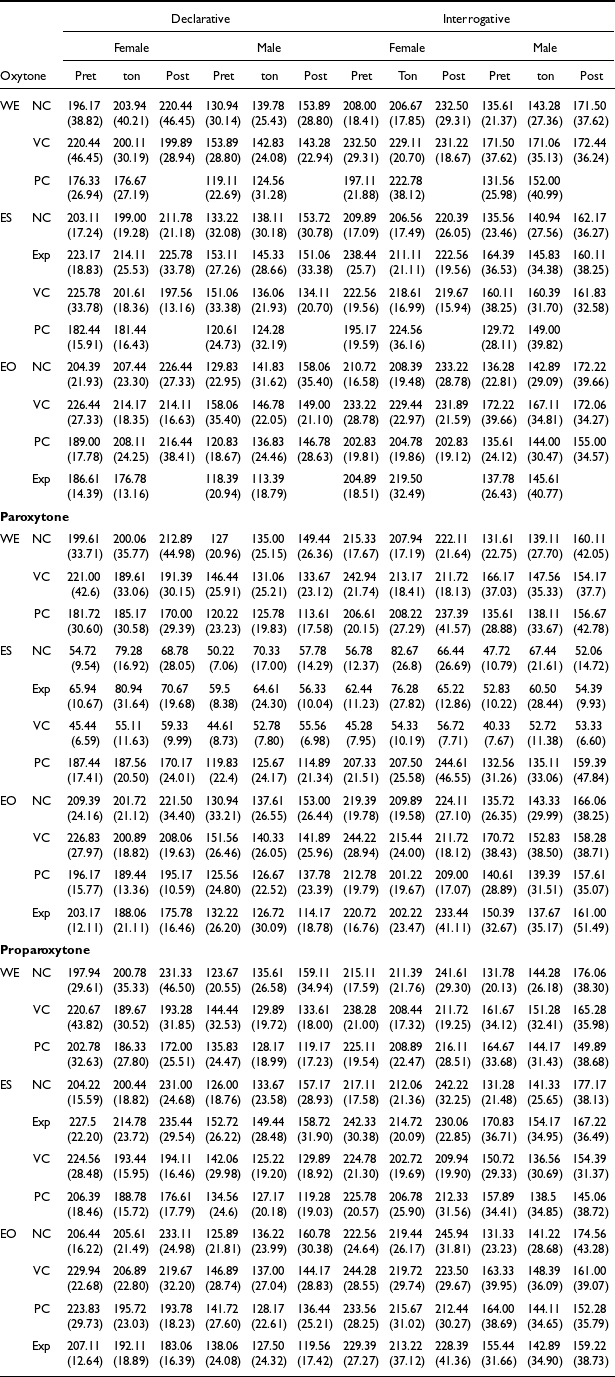
Table 3 Long description
The table presents means values and standard deviations of F0, calculated separately for declarative and interrogative modalities, for each clause in sentences with and without expansion, based on the stress typology for both women and men. The table is divided into four main sections: Oxyton, Paroxyton, and Proparoxyton, each further divided into female and male categories. Each section contains data for pre-stressed, stressed, and post-stressed conditions. The table includes data for different conditions such as NC, VC, PC, and Exp, with specific values for each condition. For example, in the Oxyton section for females, the pre-stressed condition under NC shows a mean value of 196.17 with a standard deviation of 38.82, while the post-stressed condition under Exp shows a mean value of 18.66 with a standard deviation of 14.39. Similar detailed data is presented for males and other sections. The table provides a comprehensive comparison of how F0 varies across different stress typologies and modalities.
Multinomial logistic regression with vowel transition type as the dependent variable (stressed as reference category), and intensity, duration and F0 as independent variables and modality and gender as covariates, for noun, verb and prepositional clauses in SVO, S+EVO and SVO+E sentence structures with oxytone stress
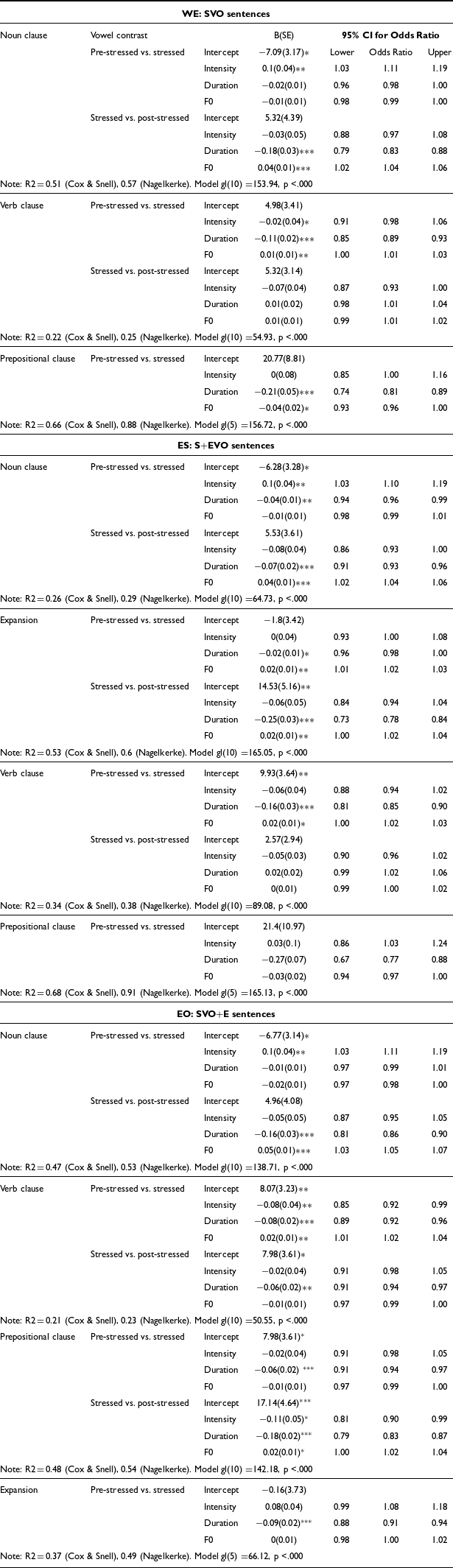
Table 4 Long description
The table presents the results of multinomial logistic regression with vowel transition type as the dependent variable, where stressed is the reference category. Independent variables include intensity, duration, and F0, with modality and gender as covariates. The table is divided into three main sentence structures: SVO, S+EVO, and SVO+E, each with oxytone stress. It includes data for noun, verb, and prepositional clauses. The table lists the intercept, intensity, duration, and F0 values along with their respective odds ratios and confidence intervals. Notable trends include variations in odds ratios across different acoustic parameters and sentence structures, indicating the predictive strength of these parameters on vowel transitions.
* p < .05, ** p < .01, *** p < .001
Multinomial logistic regression with vowel transition type as the dependent variable (stressed as the reference category), and intensity, duration and F0 as independent variables and modality and gender as covariates, for noun, verb and prepositional clauses in SVO, S+EVO and SVO+E sentence structures with paroxytone stress
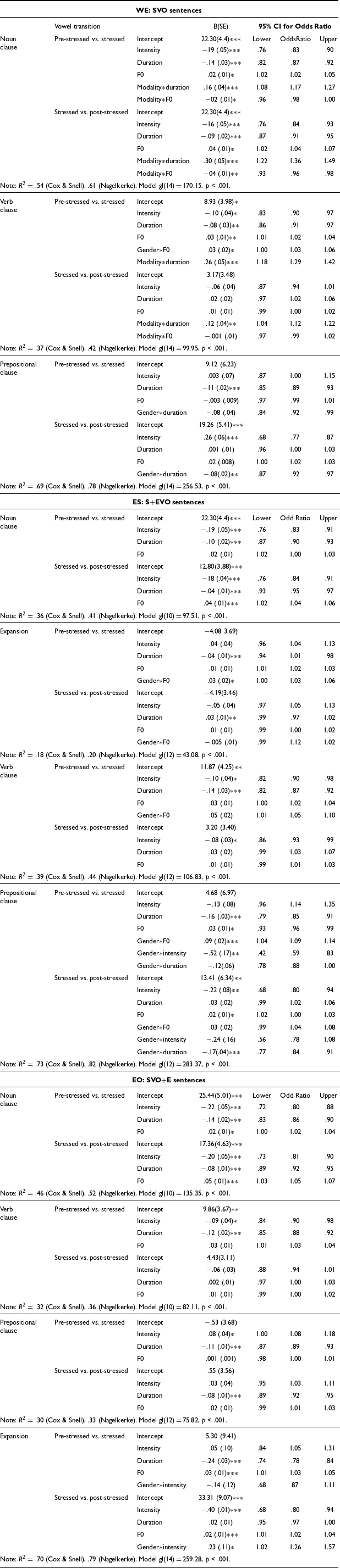
Table 5 Long description
The table presents odds ratios for intensity, duration, and F0 across noun, verb, and prepositional clauses in SVO, S+EVO, and SVO+E sentence structures. It highlights statistically significant values (p < .05) for paroxytone stress, indicating the strength of prediction of acoustic parameters on syllables. The table includes data for different phases, positions, and stress types, with columns for intensity, duration, and F0, and rows for various sentence structures and word types. Notable trends include significant odds ratios in intensity, duration, and F0 for specific sentence structures and word types, suggesting varying predictive strengths of these acoustic parameters.
* p < .05, ** p < .01, *** p < .001
Multinomial logistic regression with vowel transition type as the dependent variable (stressed as the reference category), and intensity, duration and F0 as independent variables and modality and gender as covariates, for noun, verb and prepositional clauses, in SVO, S+EVO and SVO+E sentence structures with proparoxytone stress
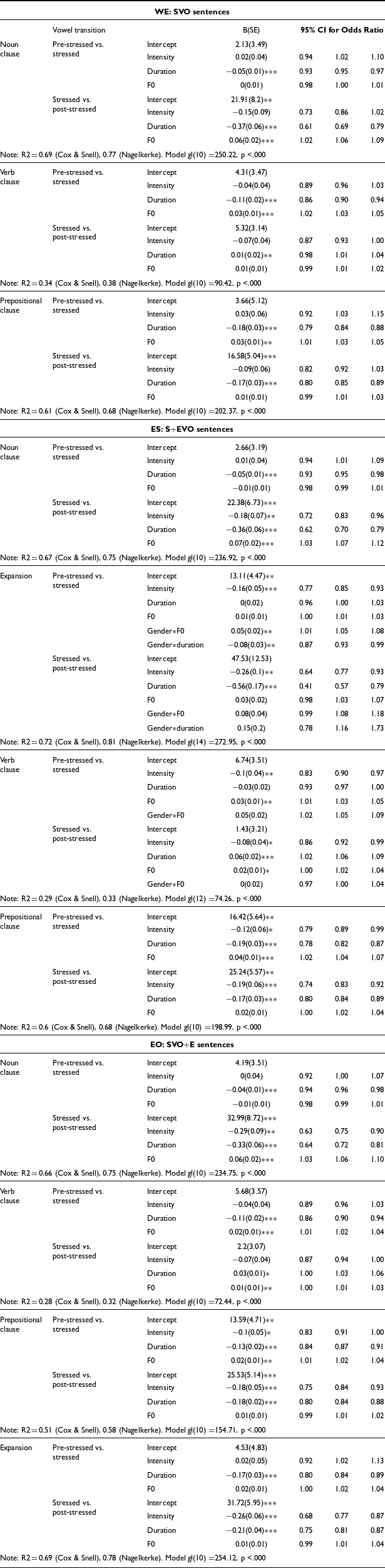
Table 6 Long description
The table presents results from a multinomial logistic regression analysis with vowel transition type as the dependent variable, where stressed is the reference category. Independent variables include intensity, duration, and F0, with modality and gender as covariates. The analysis is conducted for noun, verb, and prepositional clauses in SVO, S+EVO, and SVO+E sentence structures with proparoxytone stress. The table includes odds ratios for intensity, duration, and F0 across different conditions, highlighting statistically significant values (p < .05). Each row represents a specific condition, and columns show the odds ratios for intensity, duration, and F0, along with their confidence intervals. Notable trends include varying predictions of acoustic parameters on vowel transitions across different sentence structures and clause types.
* p < .05, ** p < .01, *** p < .001
Multinomial logistic regression model with vowel transition type as the dependent variable (stressed as reference category); intensity, duration and F0 as independent variables and modality and gender as covariates
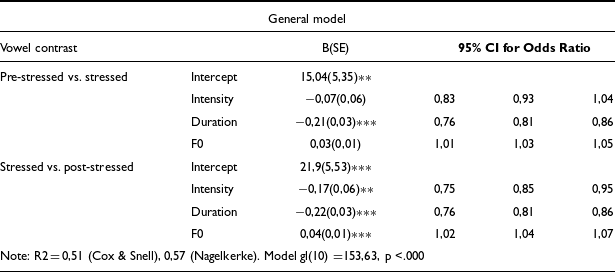
Table 7 Long description
The table presents results of a general multinomial logistic regression model analyzing vowel contrast. It includes two main comparisons: pre-stressed versus stressed vowels and stressed versus post-stressed vowels. The table has four rows and three columns. The columns are labeled as Vowel contrast, B(SE), and 95 percent CI for Odds Ratio. The rows are labeled with Intercept, Intensity, Duration, and F0 for each vowel contrast comparison. For pre-stressed versus stressed vowels, the intercept is 15.04 with a standard error of 5.35, intensity has a B(SE) of -0.07 with a 95 percent confidence interval ranging from 0.83 to 1.04, duration has a B(SE) of -0.21 with a 95 percent confidence interval ranging from 0.76 to 0.86, and F0 has a B(SE) of 0.03 with a 95 percent confidence interval ranging from 1.01 to 1.05. For stressed versus post-stressed vowels, the intercept is 21.9 with a standard error of 5.53, intensity has a B(SE) of -0.17 with a 95 percent confidence interval ranging from 0.75 to 0.95, duration has a B(SE) of -0.22 with a 95 percent confidence interval ranging from 0.76 to 0.86, and F0 has a B(SE) of 0.04 with a 95 percent confidence interval ranging from 1.02 to 1.07. The note at the bottom indicates that the Pseudo R-Squares are 0.51 and 0.57 for Cox and Snell and Nagelkerke, respectively, with a model chi-square value of 153.63 and a p-value of less than 0.000.
* p < .05, ** p < .01, *** p < .001

 Open access

