




1. Introduction
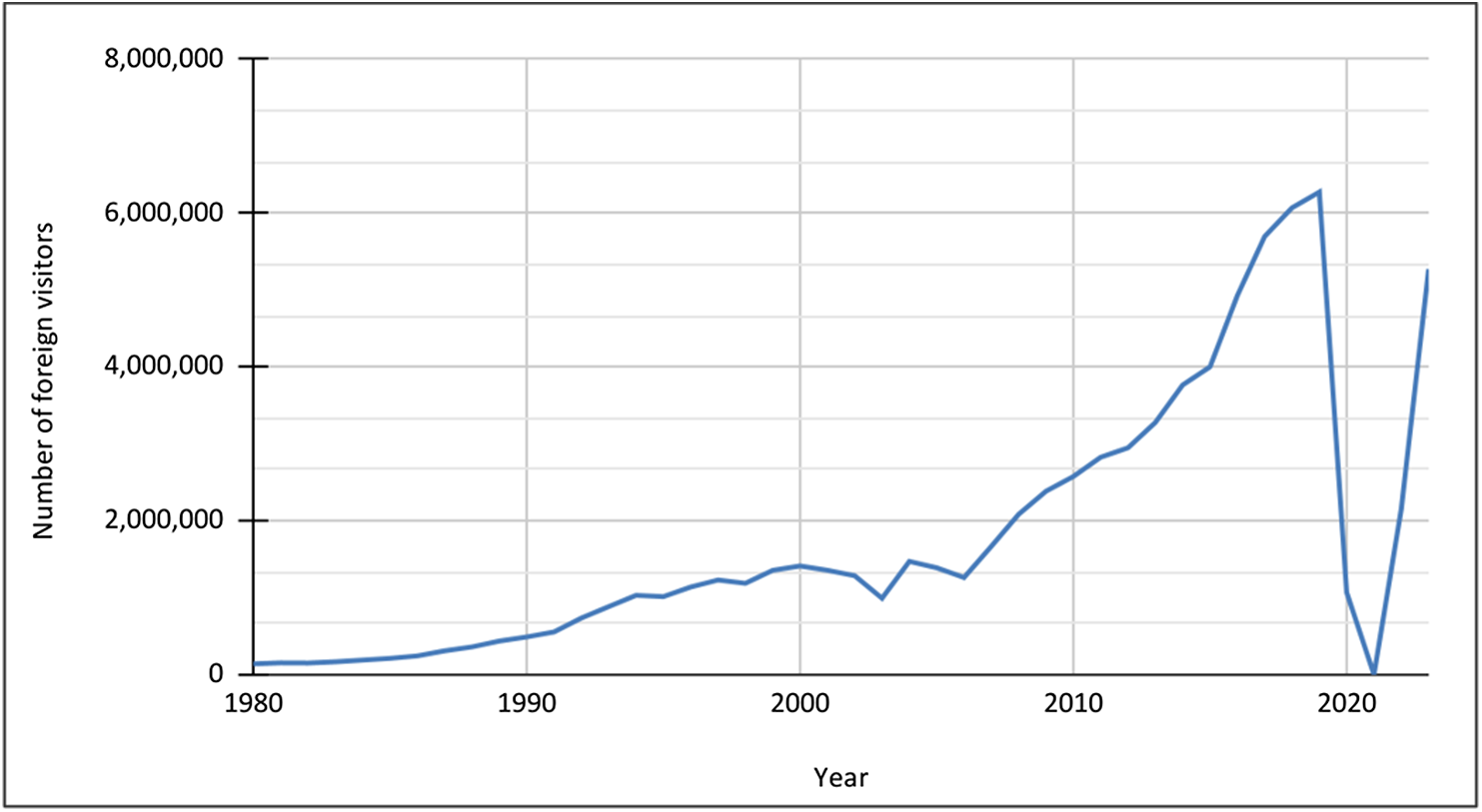
Bali is an island constituting nearly a third of Indonesia’s area. It stands out for its predominantly Hindu culture, attracting both domestic and international tourists (Miwarta and Diari Reference Mirawarta and Diari2020). The Indonesian government boosts tourism through initiatives like visa‑on‑arrival and cultural promotions, scaffolding steady growth in visitors from 1980 until recently (Figure 1). Even though there were just 51 visitors in 2021 due to COVID‑19, the number bounced back to 5.2 million in 2023 (BPS–Statistics Indonesia Bali Province 2024). With tourism contributing 55% to Bali’s GDP (Subadra and Hughes Reference Subadra and Hughes2021), locals recognize the financial advantages of communicating with tourists. As a result, English has become the default lingua franca in the region.
Number of international visitors in Bali from 1980 to 2023 (Bali Province Statistics, 2024).

In this paper, we explore the role of English in Bali’s tourism industry by examining how economic, social, and cultural factors shape the investment in English learning among Balinese tour guides, particularly ‘grassroots’ learners. This study addresses the diverse trajectories of English acquisition among this group, exploring the different experiences of those who rely on only informal and resourceful learning methods compared with those who combine formal education and informal learning methods.
1.1 Language ecology and the tourism industry in Bali
Indonesia’s national language, Bahasa Indonesia, coexists with regional languages like Balinese, which remains vital through preservation efforts. Bali’s language ecology uniquely integrates Balinese, Bahasa Indonesia, and foreign languages such as English and Japanese (Abtahian et al. Reference Abtahian, Cohn and Yanti2022, 162–164), reflecting its tourism‑driven multilingualism. English, in particular, has become essential for locals in the tourism sector.
Tourism anchors Bali’s economy, driven by its rich culture commodified as a marketable and consumable experience (e.g. Utama et al. Reference Utama, Turker, Widyastuti, Suyasa and Waruwu2020, 456). Bali’s predominantly Hindu culture contrasts with Indonesia’s Muslim‑majority regions, attracting tourists with its unique rituals and traditions (Suarmini et al. Reference Suarmini, Suarka and Sukiada2019). Government initiatives, such as mandating Kebaya Bali attire (a traditional Balinese women’s garment which is a fitted blouse often featuring lace details and bright colors) for state employees, reinforce this cultural identity and enhance Bali’s distinctive appeal (Sentana and Sugita Reference Sentana and Sugita2018).
1.2 English at the grassroots
With the rise of mass tourism, English is increasingly widespread, offering new opportunities but often remaining a ‘luxury’ for those with limited access to formal education (Lamb Reference Lamb2013). Many learners from disadvantaged backgrounds must teach themselves English to improve their economic prospects, learning at the grassroots level (Schneider Reference Schneider2016).
In this paper, the term ‘English at the grassroots’ refers to English as acquired by non‑elite users – such as taxi drivers and tour guides – outside of higher or formal education contexts. It also includes those who continue learning English informally after completing basic formal education. Meierkord and Schneider (Reference Meierkord, Schneider, Meierkord and Schneider2021, 8) emphasize that grassroots learners are a heterogenous group with diverse backgrounds, schooling and learner trajectories. Grassroots speakers may not be aware of grammatical conventions, focusing instead on clear communication (Schneider Reference Schneider2016), and English varieties at the grassroots tend to exhibit short or incomplete sentences, missing constituents and other simplification strategies. This article discusses two types of grassroots learners: those who acquired English solely through informal learning methods and those who combined some formal schooling with informal learning. The six participants in this study represent both types. Dewi, Nuri, Widi and Budi received formal English instruction during their basic education and continued to develop their skills informally through workplace interactions. In contrast, Darma and Agung acquired English entirely through informal means. The final section of the article focuses in greater depth on learners at the grassroots who rely solely on informal learning methods.
Local education policies can play a role in spreading English at the grassroots level. While basic education in Indonesia is legally free, families often face hidden costs such as materials (uniforms and books), transport, and informal school fees, which can pose significant barriers for learners from economically marginalized backgrounds (Shaturaev Reference Shaturaev2021). In rural areas, economic pressures may lead families to view schooling as impractical (Lamb Reference Lamb2013). Nonetheless, some manage to draw on diverse resources to learn English, as in Schneider’s anecdotal example below:
For example, a guide in the mountains of northern Bali told me, answering my question about his acquisition path, that he had never had any formal instruction in English in school. However, he had gotten hold of a textbook with cassette recordings and spent hours every day to learn what he read and heard there, and he had a friend who spoke English and could be asked for instructions and explanations. (Schneider Reference Schneider2016, 4)
This research examines the English learning journeys of tour guides in Bali and how these experiences influence their investment. Given Bali’s role as an international tourism hub, tour guides are expected to know English, though individual acquisition affordances and privileges affect their language learning and usage. This study addresses the following questions:
1. What factors shape investment in English learning among Balinese tour guides?
2. How do learners of English at the grassroots who rely on informal learning methods invest in their language learning?
To answer these questions, we analyze the language acquisition trajectories of six Balinese tour guides, focusing on the interplay of economic pressures, cultural practices, and social interactions in shaping their investment in learning English and their ultimate proficiency. The study then examines more closely the investment of two grassroots learners who acquired English through informal learning methods only.
After outlining the research methods drawn on in this work (section 2), we explore participants’ linguistic biographies (section 3), highlighting their diverse backgrounds and learning strategies. In section 4, we analyze the key factors influencing English learning and use, including financial challenges, relocation, and interpersonal interactions. Finally, we explore how ideology, identity, and capital intersect to shape participants’ investment in English (section 5), offering insights into the broader implications of grassroots language learning in Bali’s tourism industry and beyond.
2. Methods
This study applies Norton Peirce’s (Reference Norton Peirce1995) investment theory to examine ideology, identity, and capital in language learning. Data were collected through a questionnaire and optional semi‑structured Zoom interviews with Bali‑based English‑speaking tour guides, focusing on their linguistic backgrounds, career motivations, and English learning journeys. This research is part of a broader Master’s project (Ramadhani Reference Ramadhani2023), where a detailed methodology is available.
2.1 Investment model
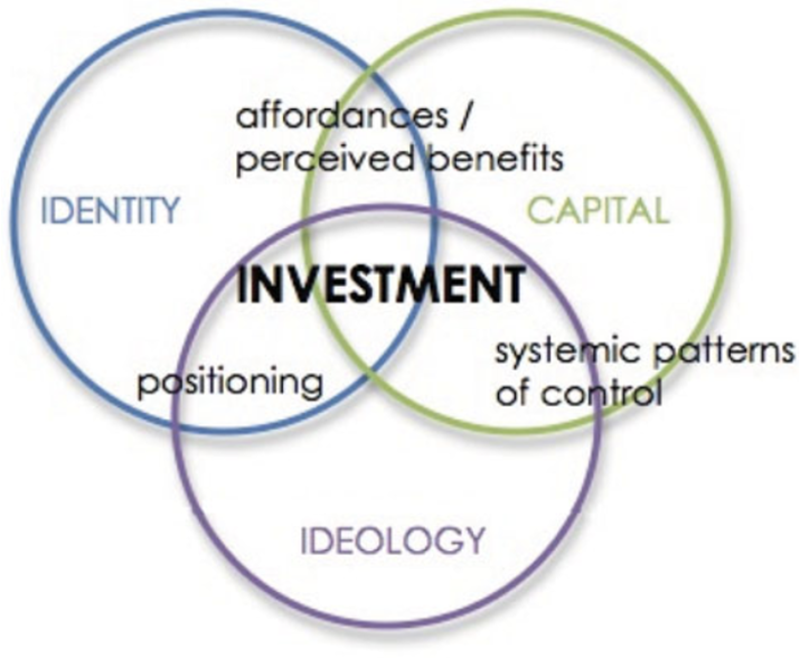
Investment theory extends motivation theory (Dörnyei Reference Dörnyei2005) by emphasizing social factors in language acquisition (Norton Peirce Reference Norton Peirce1995; Darvin and Norton Reference Darvin and Norton2023). Unlike motivation theory, which views learning as an individual effort, investment theory highlights the influence of learners’ histories, social structures, and power dynamics. Identity in this model is understood to be fluid and multiple, evolving through social interactions and power relations (Norton Peirce Reference Norton Peirce1995). Learners negotiate their identities within social contexts, often encountering gatekeepers who shape their language access. Darvin and Norton (Reference Darvin and Norton2015, Reference Darvin and Norton2023) expand this framework by situating investment at the intersection of ideology, capital, and identity as illustrated in Figure 2 below.
Darvin and Norton’s (Reference Darvin and Norton2015) investment model.
Language ideology encompasses beliefs, attitudes, and values related to language use in social settings. Ideologies affect learners’ positions in society and their language access. For example, the shift from viewing translanguaging as incompetence to accepting it as a legitimate practice in Indonesian classrooms demonstrates how ideology can impact language choices (Patmasari et al. Reference Patmasari, Agussatriana and Kamaruddin2022).
Capital, in Bourdieu’s (Reference Bourdieu and Richardson1986) terms, refers to economic, cultural, social and symbolic resources that impact a learner’s social position: economic capital refers to learners’ wealth, property, and income; cultural capital includes education, intellect, speech style and appearance; social capital arises from relationships, while symbolic capital combines these to establish legitimacy as a language user (Darvin and Norton, Reference Darvin and Norton2015; Bourdieu, Reference Bourdieu and Richardson1986). Learners use these resources not only to gain language skills but also to negotiate identities. For instance, language learners may lack economic means but use social capital, such as online communities, to learn (Darvin and Norton Reference Darvin and Norton2023). In East Java, pre‑service teachers build their professional identities through social and economic capital, joining teaching communities that reinforce their roles as English educators (Nue and Manara Reference Nue and Manara2022).
Darvin and Norton’s model also highlights overlaps between constructs: ‘affordances’ link identity and capital as opportunities in specific contexts; ‘systemic patterns of control’ connect capital and ideology by exposing inequalities in access to resources; and ‘positioning’ bridges identity and ideology, reflecting how individuals are shaped by social perceptions and power dynamics. These elements underscore the socially embedded nature of language learning, where individuals navigate constraints, opportunities, and evolving identities within systemic structures.
2.2 Data collection and analysis
The participants were recruited via social media and Himpunan Pramuwisata Indonesia (HPI, Indonesia’s official tour guide association). Eighteen respondents completed the questionnaire, and six volunteered for follow‑up interviews exploring their language experiences. Author 1, an Indonesian from Malang (a city of East Java, the island immediately west of Bali), conducted the interviews, leveraging shared linguistic backgrounds to foster rapport.
Applied thematic analysis was used to code interview transcripts, categorizing themes such as learning methods, language ideology, and motivation. NVivo software facilitated the process, ensuring a structured yet flexible approach to capturing emergent insights.
3. Linguistic biographies of Balinese tour guides
Beginning with a linguistic biographical lens allows us to highlight the diversity within participants’ experiences and showcase each individual’s language skills (Busch Reference Busch, Martin–Jones and Martin2016). Biographical research in multilingual contexts helps illustrate how language beliefs shape identities and attitudes. In this section, we provide a brief biography of the six participants. This article focuses on two types of learners at the grassroots level: (1) those who acquired English entirely through informal learning methods, and (2) those who received basic formal education and continued learning informally through work. The final section of this article examines in more detail the experiences of learners at the grassroots who exclusively acquire English through informal learning methods.
3.1 Dewi
Dewi, originally from Malang, moved to Bali in her 20s because she married a Balinese man and added Balinese to her linguistic repertoire alongside her childhood languages: Javanese, Bahasa Indonesia, and English. Her English proficiency grew through formal education from middle school until high school, interactions with international tourists and 10 weeks of an intensive English course in Melbourne (Table 1). She avoided Indonesian friends there, saying:
(1) Kan saya, cuma, punya waktu. Hanya 10 minggu. Sedikit banget, jadi kalau sama saya. berteman dengan ada orang Indonesia, ketemu sama mereka, saya bertemu mereka berbahasa indonesia, rugi saya, gitu loh. Ya kan.
Table 1.Dewi’s metadata, linguistic repertoire and learning contexts

‘Because I only have 10 weeks, my time is limited. So, if I were friends with Indonesians, I would end up speaking Bahasa Indonesia. It would be my loss.’

Drawing on these experiences, Dewi expresses a preference for native English-speaking teachers:
(2) [ . . . ] Tapi ada bagusnya sih kalau guru bahasa inggris dari orang kita. Tapi kadang-kadang feelingnya kurang ya. Apa namanya, kalau sama native kan kita lebih berusaha untuk mencari apa ya, mencari perbendaharaan kata atau bercerita tentang hal lain apa lah. Gitu lho. Walaupun kadang, apa namanya, eh, vocabnya atau susunan katanya salah, kita gak takut ngomong.
‘. . . But there is still a good side if the teacher is Indonesian. However, it might lack a ‘feeling’. What is it, if it’s with a native speaker, we will be eager to look for, what is it, look for the vocabulary, or tell a story about other things. Like that. Even though sometimes, what is it, the vocabulary or the structure of the sentence is wrong, we’re not afraid to speak.’
3.2 Nuri
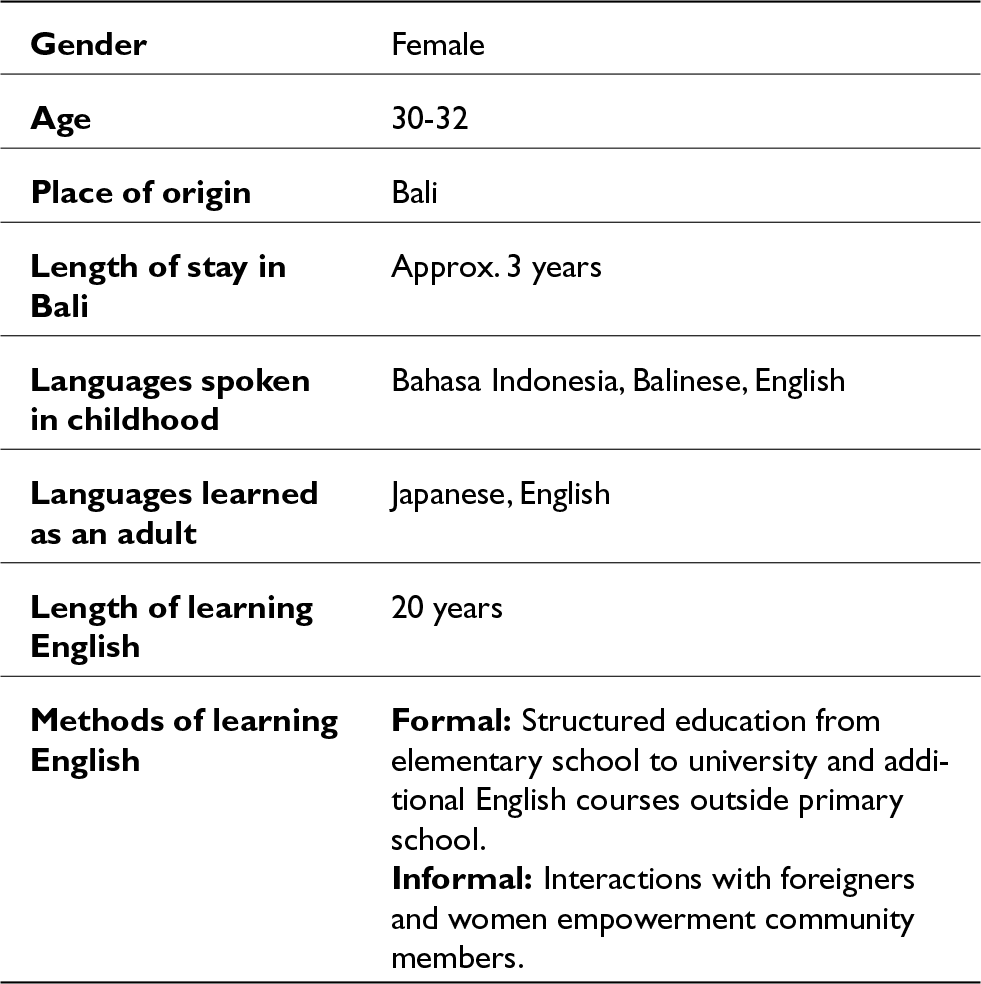
Nuri is a Balinese woman who moved a lot while growing up. She was born in Bali and moved to Semarang from elementary to middle school. In high school, she moved to Jakarta and worked there until 2020. During COVID‑19, she moved back to her parents’ house in Bali. She speaks Bahasa Indonesia, Balinese, and English daily. She has learned English since she was in elementary school (Table 2). Now, she is an English and Bahasa Indonesia teacher and holds tours for women on weekends. She taught adults through online classes and conducted a scheduled women‑only tour in Bali. As Nuri now lives in Bali, she has a new perspective of where she was born as an ‘international hub’.
(3) Bali is an international hub, jadi memang segala sesuatu, regardless of the country, ya. Regardless of the origins, mau dia orang Bali, mau dia orang France, mau dia orang mana, tapi kan ya kita harus – we have to face that the international language is English. Gitu sih.
Table 2.Nuri’s metadata, linguistic repertoire and learning contexts
‘Bali is an international hub, so everything, regardless of the country, yes. Regardless of the origins, whether they are from Bali, France, or wherever they come from, we have to –we have to face that the international language is English. Like that.’
In the international women’s empowerment group she initiated, she expected all the members to speak English without mixing it with Bahasa Indonesia:
(4) Karena aku memang kita, nge‑brandingnya, ya, kita ini international community. Maksudnya, any women, from any nationality, bisa join. Gitu. pun kadang kalau kita, kadang. kalau kita lagi kumpul nih, dan semuanya, orang Indonesia, kadang kita tetap, berbahasa inggris yang tanpa campur.
‘Because I try to make the branding (of the women’s empowerment group) an international community. What I mean is that any woman from any nationality can join this group. Like that. Even if, sometimes, when we gather, and all of us (members of the group) are Indonesians, sometimes we keep using English fully without mixing it (with Bahasa Indonesia).’
She prefers the group to use solely English as the main form of communication because she feels code‑mixing is ‘cringe’:
(5) [ . . . ] Menurut aku, yang membuat agak cringe adalah kalau bicaranya campur‑campur dan maksa gitu. Kadang‑kadang, ngerti kan? Maksudnya, berbahasalah, kalau aku orangnya, ya berbahasalah yang baik dan benar. If you want to use English, use English. The whole sentence. Do it properly. Kalau ingin ber‑Bahasa Indonesia juga berbahasalah yang baik. Mungkin karena aku guru bahasa ya, jadi nggak terbiasa gitu [bahasa campur].
‘[ . . . ] I think it’s a little bit cringe if someone is trying to mix the language and like forcing it. Sometimes, do you know what I mean? I mean, use the language, I’m the kind of person that, yeah, you have to use the language properly. If you want to use English, use English. The whole sentence. Do it properly. Same with Bahasa Indonesia, if you want to use it, use it properly. I mean, speak with a proper language. Maybe because I am a language teacher, so I kind of not used to that kind of thing [code mixing].’
3.3 Widi
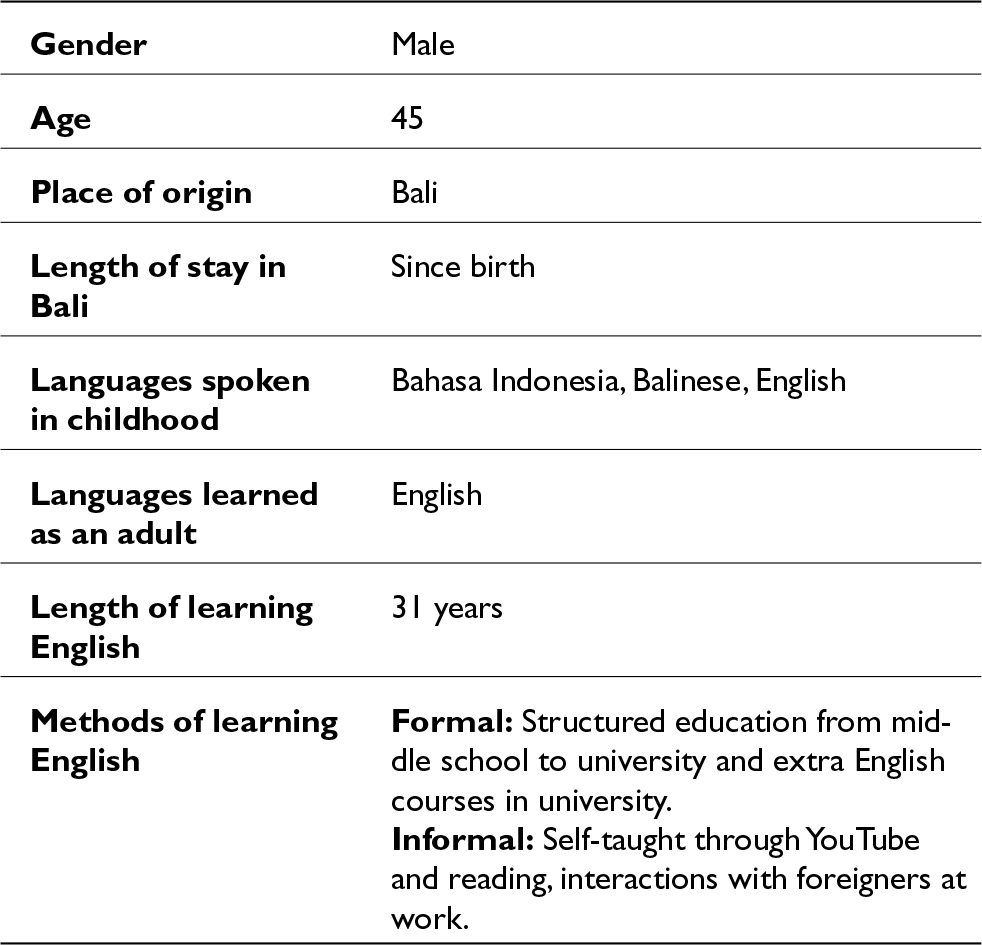
Widi was born and raised in Bali. He can speak two dialects of Balinese (kasar ‘informal’ and alus ‘formal’), Bahasa Indonesia, and English. He learned English in middle school and then continued learning English outside the classroom when he was a university student and continued until he worked as a tour guide (Table 3). Self‑taught via YouTube and reading, Widi values real‑world interactions:
(6) [ . . . ] For English theory, it is really really needed, but when you are on the field, speaking with guests, speaking with other people, sometimes, the theory will be messed up. Yeah, so for me, the dialect practice will be really more helpful, because people are start to listening and pronounce in a right way.
Table 3.Widi’s metadata, linguistic repertoire and learning contexts
Widi strongly believes English is needed in life, stating it is a universal language. He also encourages his sons to master English because it offers worldwide connections, saying:
(7) English for me is just like a universal language. That everyone easily to learn, easily to speak. Even the‑ you came from a different background of culture, something like that. So it will be much‑much‑because I, you know, learning any other languages, it will be most specific to talk with specific race, something like that. But English, is it’s just a universal general one.
3.4 Darma
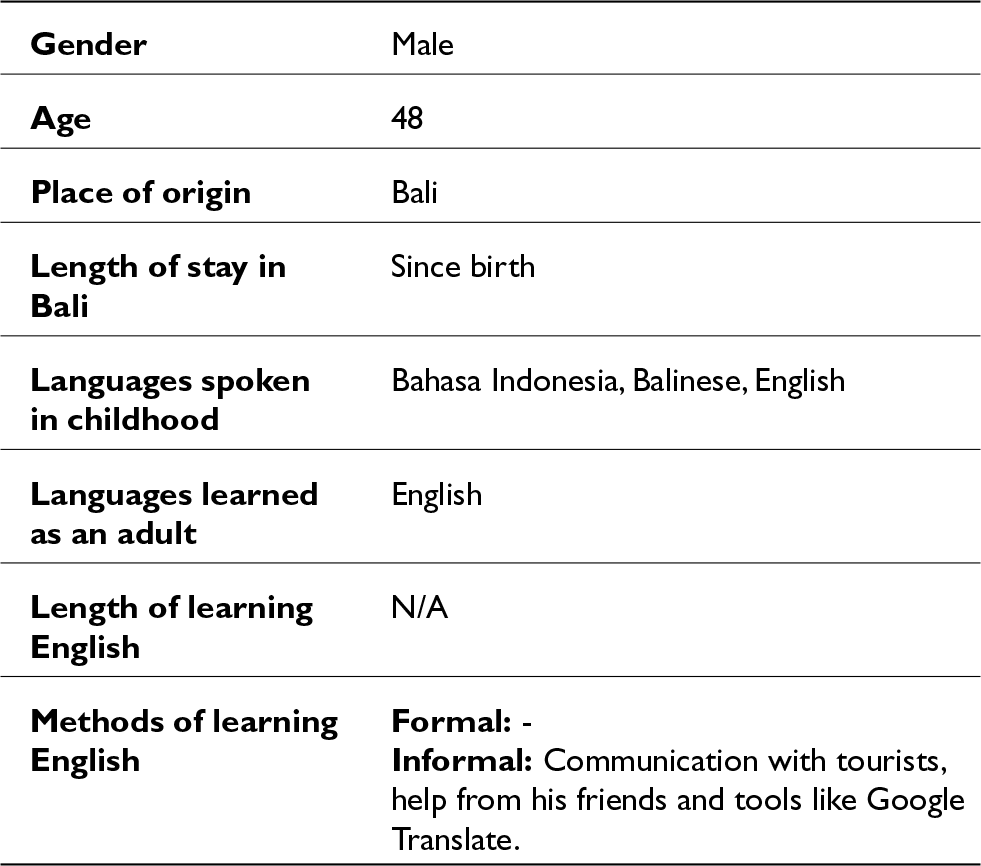
Darma was born and raised in Bali. He speaks Balinese, Bahasa Indonesia, and English daily. Darma is categorized as a grassroots English learner and user in this study. During the interview, Darma thought the first author was from ‘Manila’ instead of ‘Malang’ and proceeded to speak English throughout the interview. Darma’s English utterances are often directly calqued from Bahasa Indonesia.
Darma’s English learning journey began when he worked as a taxi driver and encountered many international tourists. The idea came to him that he could broaden his customer range if he could learn English:
(8) I see the very good plan, a very good plan, because too much people I see in the street, like the tourist from everywhere in the world, and then why I, miss, have special hobby, ya. Like the English is very important in tourism. I’m not used . . . good, at the moment like this.
However, Darma could not afford an English course and had not been a successful student in his school days.
(9) I, miss, never enjoy study in the school. But just until like right now, modern. Modern like university, step‑by‑step learn about English until four years and spend much money for people like me, where are the money, you know?
As a result, Darma started learning English when he drove international tourists around as a taxi driver (Table 4). He asked his friends or anyone to help him translate what the tourists said, with additional help from Google Translate.
(10) [ . . . ] This is very very broken experience I have ya. At the first time I start, I just understand, ‘Hello’, you know. And then, at the time, tourist, it takes me interest with me as driver first, ya. Until now, I remember, he asking me, ‘Where are you from?’ Oh, I’m confused. And then, at the time, tourist arrived in the villa, you know. It translates. The tourist. ‘I’m from Bali’, ‘Bali where?’,’Ubud’, ‘Ubud, where?’ like that. I mean, ‘What the mean, Ubud where?’ Like that. Just example. ‘Oh, I’m live that is – name Ubud, tuiuh menit [‘seven minutes’] from the centre’. Like that. And then you write in the translator in the phone. You know? Like Google Translate.
Table 4.Darma’s metadata, linguistic repertoire and learning contexts
3.5 Agung
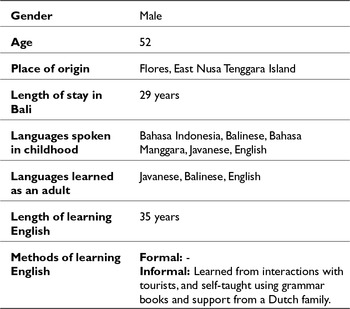
Agung was born in Flores, East Nusa Tenggara. He characterizes his childhood environment as the ‘bush’. He can speak Bahasa Indonesia, English, and Javanese. When asked about his preference in the interview, Agung preferred to mix languages (Bahasa Indonesia and English) or use English exclusively. Agung never learned English at school, so he is a grassroots English learner with solely informal learning methods (Table 5).
Agung’s metadata, linguistic repertoire and learning contexts

Agung’s English education came from working with foreigners and the support of a Dutch family. In his youth, he had a fortuitous encounter with a Dutch couple and their daughter who were holidaying in Flores. He introduced himself and has since developed a friendship with the family, which has strengthened his motivation:
(11) I learn a lot about English from them and every time I met them, they gave me food, they gave me cash, they pay my tuition fee. That was my biggest spirit to learn more and more deeper into English.
He has been learning English since high school, but directly through interaction with tourists instead of in the classroom:
(12) When I was a senior high school, I was like an afternoon school, right? Not morning school. I – before I go to school, I came to meet them at their hotel and you know, have a chat, and also I came around until the time that I have to ready to go to school, you know. And they are, they even gave me, and you know, I learn a lot about language, especially English.
Having lived in Bali since 1994, he takes pride in his ability to speak with a native‑like accent and expresses the belief that language ability is something innate rather than learned:
(13) If you didn’t see me, you’d think I was born overseas. It [language] is just all based on our proper brain that we got it from when we born, I think.
3.6 Budi
Budi originally resided in Yogyakarta, Central Java. His family still lives there but he has been working in Bali for over 20 years. He speaks Bahasa Indonesia, Balinese, Javanese, and English (Table 6). Budi learned English when he was in middle school. He uses it regularly with tourists and finds it awkward to switch to Bahasa Indonesia while guiding:
(14) Like, sorry, English has become like our, our first language when I’m working in Bali… . So, sometime I have to handle Indonesian, and I feel a little bit awkward when I have to change from English to Indonesian, because I’m used to speaking English when I’m guiding.
Table 6.Budi’s metadata, linguistic repertoire and learning contexts
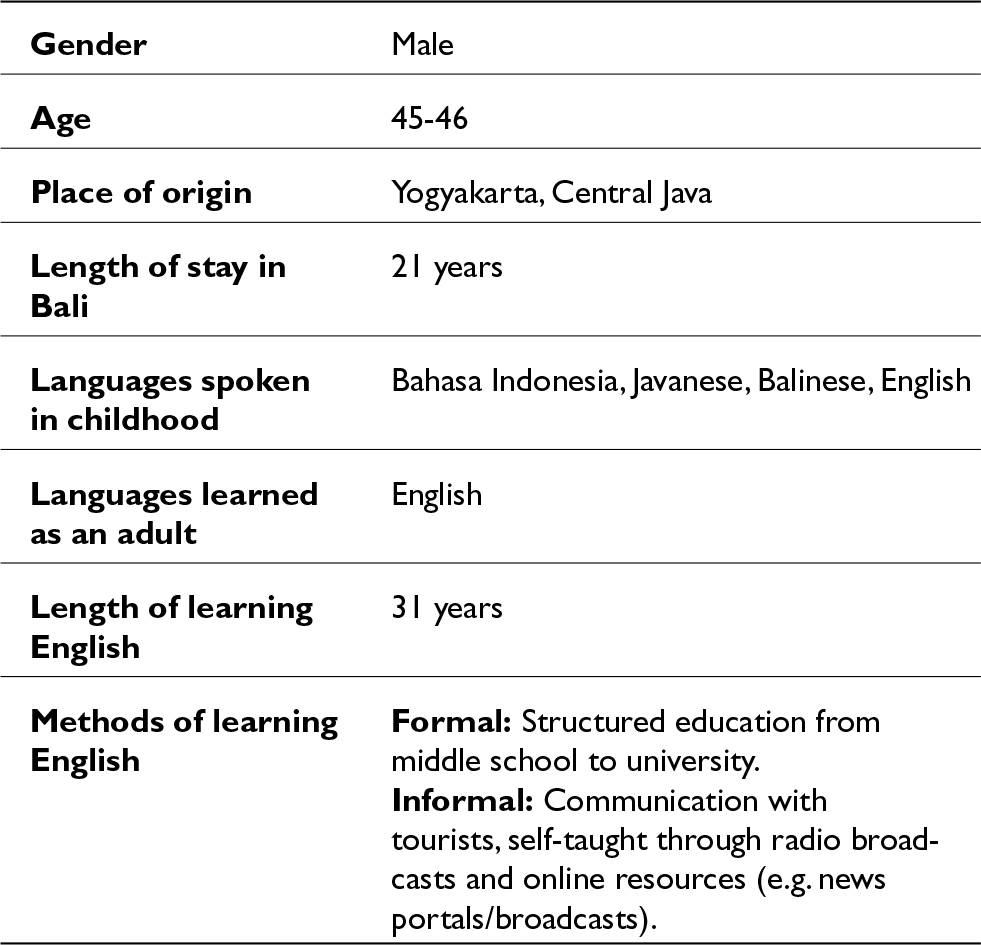
Motivated to work internationally, Budi continued studying English through BBC and VOA broadcasts. He listened to both channels on the radio while learning pronunciation and new vocabulary. In addition, Budi also learned English when working and having conversations with his tourists, stating: ‘Native speakers are my real English teachers.’ Budi communicates in English with his children, believing: ‘If we equip them with English, they will have more opportunity to compete.’
These linguistic biographies illustrate the diverse pathways through which the Balinese tour guides acquire and use English, shaped by their unique cultural, economic, and social contexts. From formal education to informal learning, the participants demonstrate varying strategies, motivations, and challenges in achieving proficiency. Despite differences in their learning journeys, all of the participants view English as an essential tool for navigating Bali’s international tourism industry and advancing their economic and social prospects.
The individual stories also reflect the richness of the participants’ linguistic repertoires, highlighting the complex interplay of identity, opportunity, and resourcefulness in shaping their experiences. While this section has focused on personal learning trajectories, the next section will examine the broader factors – such as economic pressures, systemic barriers and cultural ideologies – that shape English learning experiences among Balinese tour guides, revealing how individual agency and larger social structures intersect.
4. The interplay of social and economic factors in language learning trajectories
The participants’ language acquisition trajectories and usage patterns are shaped by a complex array of social and contextual factors. Their interviews and survey responses articulated various economic, geographic and cultural influences, such as financial constraints and social factors. This section synthesizes key themes from the data, examining the interplay between formal and informal learning among Balinese tour guides.
4.1 From financial challenges to linguistic assets
As key representatives of the tourism industry, tour guides are expected to communicate in English, irrespective of their backgrounds. Some participants struggle to pay for English classes and so develop proficiency through informal learning methods. As Darma explains in (9), for example, he never enjoyed school and found informal learning more accessible, while Agung’s motivation in (11) stemmed from the financial support and encouragement of a Dutch family.
Both learners saw English as a tool for economic advancement, a sentiment echoed by other participants. Agung, originally from Flores – one of Indonesia’s economically disadvantaged outer islands – moved to Bali, where he found more opportunities to practice and benefit from English. Similarly, Nuri and Budi, who had access to formal education, also view English as a pathway to financial stability.
(15) It’s [English] the easiest way to start a career. It’s the easiest way to make money. Balik lagi, di Bali [‘when it comes to Bali’], most of the business, most of the job opportunities, requires you to talk to foreigners. Jadi, ya, [‘so, yeah’,] it’s not going to be a really good thing for you if you only know Bahasa Indonesia. Gitu [‘Something like that’]. (Nuri)
As Nuri expresses in (15), she views English as the key to earning income in Bali’s tourism‑driven economy, using her skills to teach adults and lead an international women’s group. In learning English, Nuri drew on a mix of formal education and informal learning methods through reading English books and communicating with foreigners. Meanwhile, Budi is eager to work abroad to increase his economic status, which drives his willingness to improve his English through self‑study and to spend money on English courses. He learned English in junior high school and enrolled on a local English course (Table 6). This has enabled him to build a career as a tour guide in Bali, where he benefits from tips and interactions with international tourists.
As noted by Darvin and Norton (Reference Darvin and Norton2015), learners often invest in English to acquire social and economic capital, leveraging their language skills for opportunities both locally and internationally. Therefore, regardless of the six participants’ learning approaches, as English learners they generally aim to improve their livelihoods by seeking opportunities abroad, building a career in the tourism sector, or leveraging their skills for entrepreneurial and community‑building initiatives.
4.2 Relocation and the role of English in Bali
Nuri and Agung relocated to Bali, where they had ample opportunities to use and improve their English. Nuri was born in Bali, but she lived in Semarang and Jakarta before returning to Bali during the COVID‑19 pandemic. She began learning English formally in elementary school and continued through higher education. Agung, the grassroots learner from ‘the bush’ in Flores, moved to Bali with little formal education in English but was confident in his ability to learn. He notes:
(16) I’m the only person in my family who can speak English. I move to Bali . . . Whenever people like us who can speak English a little bit, then you have a good chance to work for big companies, like to be tour guides.
Bali’s status as an international tourist hub creates a unique linguistic landscape, where English functions as a lingua franca. Despite differences in their educational backgrounds, both Agung and Nuri capitalized on their environment to refine their English skills, demonstrating how relocation can significantly shape language learning trajectories.
4.3 Interpersonal influences on language acquisition
Frequent social and professional interactions also contribute to the participants’ investment in English. For example, Dewi improved her English through her work in hospitality and guiding:
(17) Dulu kan karena kerja di hotel, mbak. Makanya, harus bisa Bahasa Inggris, kan? Kemudian berkembang setelah itu jadi tour guide. Jadi ngobrol terus sama tamunya, jadinya improve terus bahasa‑[Inggris]nya. Karena kalau salah kan dibenerin sama tamunya kan.
‘I worked in a hotel, Miss. That is why I should have English skills, right? It improved when I became a tour guide. I always talked with the guests, so my language [English] improved. Because if I make a mistake, the guests will correct me.’
Dewi’s cultural capital drives her to learn English in her job, as she enjoys socializing with international guests. To maintain these interactions, she works to improve her English speaking and listening skills. Her personality and interest in history are factors that support her social mobility. Dewi’s economic capital facilitates her English learning, and her cultural capital further supports her progress.
Similarly, Darma (18) learned by asking friends for translations, while Agung’s (19) confidence grew through conversations with foreigners who appreciated his clarity. These experiences highlight the role of cultural and social capital in language development.
(18) Like this, at the time, I’m confused with the speaking of the tourist, ya, I remember. And then, later at the time, at the finish with the tourist. I asking with my friend ‘What the mean of tourist?’, like that. He asking me – oh, the mean of tourist is like this.Footnote 1 (Darma)
(19) Because according to them, I’m easy to communicate, and also they don’t need to use too many tools [like Google Translate] to talk with me on the phone. They just want to be, you know, fast response and quick answer. Yeah. (Agung)
Agung’s experience, along with that of other participants like Nuri, highlights the role of Bali’s unique language ecology in fostering English acquisition. The tourism industry creates an immersive environment where frequent interactions with speakers of English provide opportunities to develop language skills and advance professionally.
5. Ideology, identity, and capital in grassroots learners’ investment
The concept of investment in language learning emphasizes that learners’ commitment to acquiring a language is shaped by their identities, access to resources (capital), and the ideologies surrounding them (Darvin and Norton Reference Darvin and Norton2015, Reference Darvin and Norton2023). For learners like Darma and Agung, their linguistic biographies reflect how systemic barriers, limited access to formal education, and economic constraints have shaped their informal learning journeys. As the only two participants who acquired English exclusively through informal learning methods, their experiences offer insight into how grassroots learners navigate language acquisition without traditional academic support. This section examines how identity, capital, and ideology intersect in shaping their investment in English, drawing connections to the themes explored in Section 4.
5.1 Darma
Coming from a low‑income background, his limited economic capital restricted his access to formal education beyond the basics. When Darma was of schooling age, education in Indonesia was not yet free, and families were required to pay school fees alongside additional costs such as uniforms, supplies, and transportation. These financial demands made continued education unattainable for Darma, who also felt disconnected from a system that did not cater to learners from disadvantaged backgrounds. His dissatisfaction with school reflects broader structural inequalities – such as the inflexibility of the curriculum and the lack of individual support – that contribute to the exclusion of students like him. Despite these challenges, Darma draws on social capital – interactions with tourists and support from friends – to learn English informally. His work as a taxi driver offered valuable affordances, including regular opportunities to practice with English‑speaking tourists and use tools like Google Translate. Darma positions himself as a practical, grassroots learner who prioritizes real‑world experience over classroom‑based learning. His role as a family provider further motivates him to use English for economic advancement and to support his children’s learning, reinforcing his belief in English as a pathway to future opportunity. Figure 3 illustrates the key factors influencing Darma’s investment in learning English.
Darma’s investment.

5.2 Agung
Agung’s investment in English highlights his ability to transform limited resources into significant gains. Growing up in Flores, he faced systemic constraints, such as geographic isolation and economic barriers, which restricted access to formal education. However, Agung’s ideology – his belief that language ability is a natural gift – boosted his confidence to learn English independently. He relied on social capital through interactions with a supportive Dutch family, who provided financial help and encouragement. These experiences became critical affordances, allowing Agung to develop strong speaking skills and adopt a native‑like accent, which he sees as a source of symbolic capital. By positioning himself as a naturally gifted learner, Agung challenges societal expectations that privilege formal education, demonstrating his ability to succeed in Bali’s tourism industry on his own terms. Figure 4 shows the main factors that affect Agung’s investment as an English learner at the grassroots level.
Agung’s investment.

Darma and Agung’s experiences reveal the adaptability of English learners at the grassroots who navigate systemic inequalities to invest in language learning. Despite lacking economic capital and formal education, both learners leveraged social connections and work environments as affordances to improve their English. Their investments are shaped by overlapping aspects of identity, ideology, and capital, reflecting the complex interplay of personal motivation and external constraints. Through their resourcefulness, Darma and Agung illustrate how grassroots learners can transform challenges into opportunities, positioning English as a social and economic mobility tool in Bali’s tourism‑driven context.
6. Conclusion
This study has examined how economic, social, and cultural factors influence Balinese tour guides’ investment in English learning, focusing on grassroots learners. The findings highlight a complex interplay between motivations, resourcefulness in overcoming systemic barriers, and ideologies surrounding English. Economic opportunities in Bali’s tourism industry make English a critical tool for mobility, while tensions persist between its pragmatic use and preserving the Balinese language and culture. For instance, English serves as a ‘universal bridge’ for Widi, while Dewi integrates it at home to prepare for Bali’s global environment, illustrating the duality of identity negotiation and cultural positioning.
Individual learners at the grassroots like Darma and Agung exemplify adaptability. They use informal learning methods such as translations and social interactions to acquire English. Despite limited resources, both leverage social and cultural capital to transform everyday encounters into learning opportunities. Darma’s gradual improvement through tourist interactions and Agung’s pride in his accent challenge the privileging of formal education, showcasing the potential of real‑world affordances.
Conversely, participants like Nuri and Budi combine formal education with self‑study, using structured learning to advance their goals. Nuri’s focus on ‘proper’ English for international branding and Budi’s reliance on media resources reflect how access to education enhances social mobility and supports aspirations for global opportunities.
This study underscores the critical role of social, cultural, and economic capital in shaping language learning trajectories. By foregrounding the experiences of grassroots learners, it highlights their resilience and contributions to Bali’s tourism industry, challenging assumptions that equate language proficiency with formal education. Investment in English learning emerges as a dynamic process shaped by necessity, creativity, and social positioning.
Acknowledgement
Farah Ramadhani has received a grant from BPI (Beasiswa Pendidikan Indonesia – Indonesia Education Scholarship), funded by LPDP (Indonesia Endowment Fund for Education).
 FARAH RAMADHANI is an English lecturer at Universitas Brawijaya, in Malang, East Java, Indonesia. She holds a Master’s degree in Applied Linguistics from Monash University, Australia. Her research interests lie in the areas of sociolinguistics, particularly code‑mixing, the Indonesian language, language investment, and the learning and use of English in Indonesia. She is passionate about exploring how English is studied, adapted, and embedded in everyday Indonesian contexts, especially at the grassroots level. Email: farahrmdhnn@gmail.com
 JILL VAUGHAN is a linguist at the School of Languages, Literatures, Cultures & Linguistics at Monash University. Her research focuses on the lived experience of minoritised multilingualism, and currently involves work with speakers of Australian Indigenous languages of northern Australia, on Celtic languages in the diaspora, the sociolinguistics of Australian Englishes and online language use. Jill is a co‑founder of the high school outreach program The Linguistics Roadshow. Email: jill.vaughan@monash.edu




 Open access

