


Breakfast is widely being promoted as essential for the nutritional well-being of children. Skipping breakfast is associated with health-compromising behaviours in adults and adolescentsReference Keski-Rahkonen, Kaprio, Rissanen, Virkkunen and Rose1. Breakfast consumers tend to have higher intakes of micronutrients and lower intake of fat, and are more likely to have a better overall diet qualityReference Ruxton and Kirk2, Reference Rampersaud, Pereira, Girard, Adams and Metzl3. The consumption of breakfast has been positively associated with enhanced cognitive and academic performance, psychosocial function and school attendanceReference Pollitt4, Reference Pollitt and Mathews5. However, other studies indicate that cognitive performance is relatively robust to short-term fasting in relatively well-nourished childrenReference Rogers6. Aranceta and co-workers stated that it is not clear to what extent breakfast contributes to a better cognitive performance in school. Learning is a complex process resulting from multiple interactionsReference Aranceta, Serra-Majem, Ribas and Perez-Rodrigo7. However, a recent review stated that breakfast may possibly benefit cognitive function, but the interpretation of the results can be complicated by confounding factors such as social and educational variablesReference Rampersaud, Pereira, Girard, Adams and Metzl3.
It has been reported that routinely eating breakfast may lead to more regular eating habits and exercise patterns, healthy food choices and consistent energy intake, which when taken together contribute to a reduced body mass index (BMI)Reference Affenito, Thompson, Barton, Franko, Daniels and Obarzanek8. Eating a healthy breakfast is important to adolescents' health needs in general. Breakfast provides an ideal opportunity for adolescents to begin the day by eating bread, other cereals and fruit, which are all important elements of a healthy and balanced diet. The importance of breakfast consumption in relation to nutritional balance has been shown in different sub-populationsReference Aranceta, Serra-Majem, Ribas and Perez-Rodrigo7, Reference Morgan, Zabik and Stampley9, Reference Navia, Requejo, Ortega, Lopez Sobaler, Quintas and Andres10. Despite the benefits of consumption of breakfast, it is the meal most often skipped by adolescentsReference Sjoberg, Hallberg, Hoglund and Hulthen11.
In the present report, breakfast consumption patterns, on the nutrient and food item level, in Belgian adolescents are described. The analyses reported herein must be situated within a broad context of a search for elements that may be helpful for developing strategies to implement the translation of nutrient dietary guidelines into food- and meal-based dietary guidelines.
Materials and methods
The data presented here were obtained from a cross-sectional dietary survey carried out in an adolescent population (males and females aged 13–18 years) in the region of Ghent (Belgium) in the spring of 1997. The sampling design and the methodology of the field work have been described in detail elsewhereReference Matthys, De Henauw, Devos and De Backer12. In brief, a random sample of 341 adolescents (129 boys and 212 girls) – selected from all educational levels in the Belgian secondary school system – completed a 7-day food record (consecutive) under rigorous conditions of quality control carried out by experienced dietitians.
A 7-day estimated food record method (semi-structured diary) was used to quantify food and nutrient intake. Information on the type (including brand names) and amount of food consumed was collected through an open entry format. Instructions for the completion of the diary and regular checks for quality and completeness of the diaries were carried out by experienced dietitians. In the diaries, days were truncated into six eating moments, namely breakfast, lunch, dinner and snacks, the latter divided into morning, afternoon and late-evening snacks.
Breakfast was defined as the first eating occasion involving a solid food or a beverage that occurred after waking.
Nutrient composition data used in the current study are those from the Belgian and the Dutch food composition tables13–15. Calculation of nutrients was done by means of a nutritional software package developed by the Unilever company in The Netherlands16. Average nutrient and food intakes were calculated as the mean of the 7-day intake period. Food items were classified into different food groups according to the Dutch food composition table13.
For the sake of the present analyses, a concise characterisation of the breakfast habits at the level of the individual was undertaken. This characterisation included both qualitative and quantitative aspects of breakfast. Qualitative aspects of breakfast were related to the presence or absence (in relevant amounts) of food items of three specific food groups (hereafter called ‘target food groups’): cereal products, dairy products and fruit/vegetables. Quantitative aspects of breakfast included both the frequency of having breakfast and the relative contribution of the target food groups to the total daily energy from breakfast.
Qualitative and quantitative aspects of breakfast were combined into a so-called ‘individual breakfast score’ on the basis of the following consecutive steps.
In a first step, every single breakfast from all diaries was characterised in a qualitative way. For that purpose, 14 different labels were developed on the basis of different combinations of food groups present in the breakfast and the amount of energy they represented. These 14 labels were subsequently recoded into five specific ‘individual breakfast labels’ (see Table 1).
Individual breakfast label and individual breakfast score

In a second step, the ‘individual breakfast labels’ were summed up for all days included in the food diary, resulting in a potential overall range of sum-labels from a minimum of seven (individual breakfast label of one for all days in the food diary) up to a maximum of 35 (individual breakfast label of five for each day in the food diary). From this ‘sum-score’, a final ‘individual breakfast score’ was assigned to all 341 subjects in the study (see Table 1).
For this study, the five individual breakfast score categories for breakfast habits were dichotomised into a group who ‘never eats breakfast or eats a low-quality breakfast, i.e. not enough calories and/or not enough variation in foods’ (group 1, score 1–3) and a group who ‘eats a good-excellent-quality breakfast (nearly) every day’ (group 2, score 4–5).
The ratio of energy intake to basal metabolic rate (EI/BMR) was calculated to give an indication of the quality of reportingReference Goldberg, Black, Jebb, Cole, Murgatroyd and Coward17.
Statistical analysis was done with the SPSS software version 12 (SPSS Inc.). Descriptive statistics used means and standard deviations for continuous data. Tests for normality were performed using a Kolmogorov–Smirnov test. Student's t-tests or Mann–Whitney U-tests were used to compare the means of the different groups. In order to search for potential confounders, the number of adolescents in different categories of BMIReference Cole, Bellizzi, Flegal and Dietz18 and education – ‘general’ education (mainly theoretical courses) and vocational training (based on practical skills) – in the different breakfast classifications were compared by use of a Fisher's exact test. A value of < 0.05 was taken as the threshold for significance.
The study was approved by the Ethical Committee of the Ghent University Hospital.
Results
The energy contribution of breakfast to daily energy intake was on average 15.7% in boys and 14.9% in girls. A restricted number of boys and girls had a breakfast energy contribution of >25%, 9.7% in boys and 5.7% in girls, respectively. Figure 1 shows the distribution of the energy contribution of breakfast to the total daily energy intake in both boys and girls.
Histograms showing the percentage energy from breakfast in boys and girls

Overall, the individual breakfast score was < 3 (never eat or usually do not eat breakfast). In boys, 13.2% had an individual breakfast score < 3, in girls 16.9% had an individual breakfast score < 3. In boys, ~18% ate a low-quality breakfast (score 3), ~56% ate a ‘moderate- to good-quality breakfast’ (score 4), while only 13% ate a full value breakfast (score 5). In girls, ~27% had an individual breakfast score of 3, ~45% had a score of 4 and only 10% had an individual breakfast score of 5.
Table 2 presents the number of adolescents in different categories of BMI and education, and mean age and mean EI/BMR according to the different breakfast categories. In both boys and girls, a higher number of subjects were identified as good-quality breakfast eaters. In boys, the age of low-quality breakfast eaters was significantly higher than that of the good-quality breakfast eaters. In girls, the mean EI/BMR ratio was significantly lower in low-quality breakfast consumers than in the subjects identified as good-quality breakfast consumers. In boys, no differences were found between breakfast categories according to BMI and educational training. Significantly more overweight girls and significantly more girls following a vocational training were categorised as low-quality breakfast consumers.
The age, ratio of EI/BMR and number of adolescents in different categories of BMI and education according to breakfast habit (low- or good-quality)
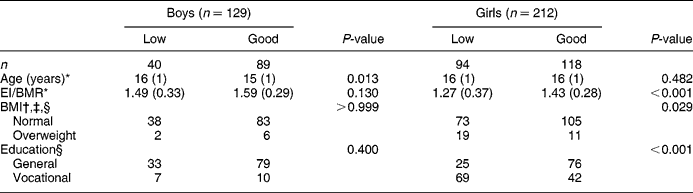
EI – energy intake; BMR – basal metabolic rate; BMI – body mass index. Data for age and EI/BMR presented as mean (standard deviation).
* Mann–Whitney U-test.
† BMI categories according to Cole et al. Reference Cole, Bellizzi, Flegal and Dietz18.
‡ Data of four girls are missing.
§ Fisher's exact test.
Table 3 shows the energy intake at breakfast, the energy contribution of macronutrients to the total energy supplied by breakfast and micronutrient intake at breakfast according to breakfast habits. In both boys and girls, the energy intake and the proportional contribution of proteins were significantly higher in subjects having a good-quality breakfast. Girls who consumed a good-quality breakfast had a significantly higher proportional intake of polysaccharides than the low-quality breakfast consumers. In both boys and girls, the intake at breakfast of the selected micronutrients was significantly higher in subjects consuming a good-quality breakfast.
Energy intake (kcal) at breakfast, contribution of macronutrients (as a percentage of energy) to the total energy supplied at breakfast and micronutrient intake (mg) at breakfast according to breakfast habit (low- or good-quality)

SFA – saturated fatty acids; MUFA – monounsaturated fatty acids; PUFA – polyunsaturated fatty acids.
Data presented as mean (standard deviation).*Mann-Whitney U tests.
In Table 4 total energy intake, the energy contribution of macronutrients to the total energy intake and micronutrient intake according to breakfast habits are presented. In boys, there was no significant difference in the total energy intake between the two kinds of breakfast consumers. The energy contribution of polysaccharides was significantly higher in good-quality breakfast consumers. The intake of all selected micronutrients was significantly higher in good-quality breakfast consumers.
Total energy intake (kcal), contribution of macronutrients (as a percentage of energy) to the total energy and micronutrient intake (mg) according to breakfast habit (low- or good-quality)

SFA – saturated fatty acids; MUFA – monounsaturated fatty acids; PUFA – polyunsaturated fatty acids.Data presented as mean (standard deviation).
*Mann–Whitney U-test.
In girls, the total energy intake was significantly higher in good-quality breakfast consumers. The proportional intake of proteins and polysaccharides was significantly higher in female good-quality breakfast consumers, while the proportional contribution of total fat, monounsaturated and polyunsaturated fatty acids was significantly lower in these girls. The intake of all micronutrients was significantly higher in girls consuming good-quality breakfast. In girls, the relative micronutrient intake (expressed as mg 1000 kcal− 1) was significantly higher in good-quality breakfast consumers (data not shown).
The intake of different food groups is presented in Table 5. Both male and female adolescents who consumed a good-quality breakfast had significantly higher intakes of bread, fruit, vegetables, milk and milk products, and fruit juice, while their intake of soft drinks was significantly lower than those who consumed a low-quality breakfast. In girls, a larger number of differences were found. Female good-quality breakfast consumers also had significantly higher intakes of cereal products, cheese and water.
Intake of some food groups (g day−1) in adolescents according to breakfast habit (low- or good-quality)

SD – standard deviation.
* Mann–Whitney U-test.
Discussion
The Iowa Breakfast Study carried out in the USA at the beginning of the 1960s was one of the first studies that addressed the importance of the role of breakfast in dietary balance, physical and cognitive performance19. To our knowledge, the present study is the first Belgian research on the relationship between breakfast parameters and the overall diet of adolescents. The current study found that consumers of a good-quality breakfast had a better overall dietary pattern – on the nutrient and food group level – than consumers of low-quality breakfast. However, the current differences in dietary intake could not be related to nutrient status due to the lack of biochemical assays of cholesterol, vitamin and mineral status. Nevertheless, the associations between breakfast patterns and biomarkers of nutrient status are not widely reported and are inconsistent. Preziosi and colleagues only found a significantly higher blood thiamin concentration in adolescents consuming high-energy breakfastsReference Preziosi, Galan, Deheeger, Yacoub, Drewnowski and Hercberg20.
In the current study, some methodological considerations have to be taken into account. In this study, individual breakfast labels and scores were computed. These breakfast scores were based on both nutrient and food item recommendations. However, there is no general scientific agreement as to which foods have to be consumed and in what amounts. Therefore, the current rationale for the development of the scores is two-fold. For food items, the rationale is based on the guidelines for a healthy breakfast in schoolchildrenReference Pérez-Rodrigo, Ribas Barba, Serra Majem, Aranceta Bartina, Serra Majem and Aranceta Bartina21, 22 and for energy the rationale is based on the assumption that an ideal breakfast should provide at least 25% of the recommended daily energyReference Morgan, Zabik and Stampley9, Reference Morgan, Zabik and Leveille23. This recommendation is based on the above-mentioned Iowa Breakfast Study19. In addition, by introducing a breakfast score, the authors are aware that a limitation could be introduced due to the lack of information about the heterogeneity and variability of the breakfast consumption pattern of all adolescents, both within and between the good- and low-quality breakfast consumers. As the classification method can group subjects with widely differing intakes into one category and subjects with very similar intakes into different categories if they are close to the cut-off point, this could introduce difficulties for the interpretation of the results. Another possible disadvantage of the breakfast score algorithm used is that a subject receives a lower score when he/she does not consume one of the selected foods. A methodological issue that also has to be taken into account is the sample size. The total sample size contains more girls than boys. The limited number of boys could cause a lack of power in the analyses. The originally selected sample contained fewer boys than girls. This could be explained by the study design where male-only schools were less well represented. It is not clear in what way this may have affected the results of the study but it does not affect the value of the within-gender analyses. However, the strength of the current study is the use of the 7-day dietary record, which reflects the usual dietary intake and reflects in that way the usual breakfast consumption of the different participants. It is not clear how the possible impact of the possible limitations may have affected the results of the study.
The importance of breakfast in ensuring adequate nutrient intake in children and adolescents has been documented in different studiesReference Aranceta, Serra-Majem, Ribas and Perez-Rodrigo7Reference Preziosi, Galan, Deheeger, Yacoub, Drewnowski and Hercberg20Reference Hercberg, Preziosi, Galan, Yacoub, Kara and Deheeger24–Reference Ortega, Requejo, Lopez-Sobaler, Andres, Quintas and Navia26. The current findings, i.e. that consumers of a good-quality breakfast have a better overall dietary pattern than those who consume a low-quality breakfast, are in line with these European studies. However, an inherent problem with comparing different breakfast studies are the methodological differences regarding dietary intake data collection and how breakfast is defined (types, amounts, categories). These inconsistencies should be kept in mind when comparing different studies. In the current study, female good quality breakfast consumers have a higher energy intake, while no difference was found in boys. In the Göteborg Adolescence Study (15–16 years), a similar trend was found, i.e. female adolescents eating breakfast on a regular basis had significantly higher energy intake compared with those with irregular breakfast intakeReference Sjoberg, Hallberg, Hoglund and Hulthen11. In the current study, female good-quality breakfast consumers had a relative higher intake of total protein and polysaccharides, and a relative lower intake of total fat, monounsaturated fatty acids and polyunsaturated fatty acids. In boys, only a relative higher intake of polysaccharides in good-quality breakfast consumers was found. In a French study, adolescents (10–18 years) consuming a high-energy breakfast (>25% of energy from breakfast) had higher total daily intakes (expressed as percentage energy) of carbohydrates but lower intake of total fat and saturated fat than their counterpartsReference Preziosi, Galan, Deheeger, Yacoub, Drewnowski and Hercberg20. Swedish regular breakfast consumers had a higher relative intake of total protein and a lower relative intake of sucroseReference Sjoberg, Hallberg, Hoglund and Hulthen11. However, in the literature, conflicting results can be found. De Graaf and co-workers showed that neither energy content nor macronutrient composition of breakfast had any effect on energy and macronutrient intake consumed over the rest of the dayReference De Graaf, Hulshof, Weststrate and Jas27.
Good-quality breakfast consumers have a higher intake of micronutrients. In a French, Spanish and Swedish adolescent population, the intake of vitamin C, thiamin, riboflavin, calcium, iron and zinc was higher in regular breakfast consumers (Sweden) or high-energy breakfast consumers (France, Spain)Reference Sjoberg, Hallberg, Hoglund and Hulthen11, Reference Preziosi, Galan, Deheeger, Yacoub, Drewnowski and Hercberg20, Reference Ortega, Requejo, Lopez-Sobaler, Andres, Quintas and Navia26. Adolescents eating a low-quality breakfast seem not to be able to make up the low micronutrient intake at other meals during the day. In a recent review, all the above findings are reflected and it is clear that there is evidence that breakfast consumption significantly contributes to the overall nutrient adequacy of the dietReference Rampersaud, Pereira, Girard, Adams and Metzl3.
In the current study, in girls, the group who consume a good-quality breakfast is associated with a lower proportion of overweight adolescents, despite the higher daily energy intake. Skipping breakfast is a popular method of losing weight among adolescentsReference Lattimore and Halford28 and it is shown that adolescents who have the perception of a too high body weight may be more likely to skip breakfastReference Sjoberg, Hallberg, Hoglund and Hulthen11. Skipping breakfast may lead to hunger in the morning and result in increased snacking. From a public health point of view, this phenomenon of increased snacking should be associated with a higher consumption of whole-grain products, fruit, vegetables and water. Unfortunately, snack foods commonly consumed by adolescents tend to be high in added sugars and fat, and low in minerals and vitamins. This could lead to a less healthy dietary pattern. In addition, the food availability at schools could play a role in this increased consumption of ‘empty calories’. A recent study showed that the majority of the food items available in schools, supplied by school shops or vending machines, could be categorised as ‘empty calories’Reference Vereecken, Bobelijn and Maes29. Due to these factors, i.e. skipping breakfast, increased snacking on ‘empty calories’, the availability of poor-quality food items and weight gain, adolescents could get caught in a ‘vicious circle’. However, based on several cross-sectional studies, no uniform association between skipping breakfast and higher weight or BMI is found in adolescentsReference Rampersaud, Pereira, Girard, Adams and Metzl3. Some studies, however, state that breakfast consumption is part of a weight-reduction programmeReference Schlundt, Hill, Sbrocco, Pope-Cordle and Sharp30 and it is one of the factors affecting weight-loss maintenance in adultsReference Elfhag and Rossner31. However, to date, to our knowledge, there have been no randomised controlled trials investigating breakfast consumption and weight control in adolescents. Breakfast consumption, a regular meal rhythm and an increase in feeding frequencies seem to have a positive impact on weight managementReference Louis-Sylvestre, Lluch, Neant and Blundell32. However, there is no scientific consensus about specific recommendations concerning meal frequency and health outcomesReference Mattson33, Reference Gibney and Wolever34.
Good-quality breakfast consumers tend to make more healthy food choices during the day, such as the consumption of more vegetables, fruit, milk and milk products, and water, and a lower consumption of soft drinks. The significantly higher intake of milk and milk products and cheese in female good-quality breakfast consumers is possibly the main contributors of the higher saturated fatty acid intake. A similar pattern was found in Swedish adolescents; girls with irregular breakfast and lunch intake make less healthy food choices and consume more soft drinks and less milk, vegetables and fruitReference Sjoberg, Hallberg, Hoglund and Hulthen11.
Several studies have mentioned the importance of ready-to-eat breakfast cereals; the nutritional benefits of these cereals are associated with improved compliance with dietary recommendations and improved nutrient status based on biochemical measuresReference Gibson35, Reference Galvin, Kiely and Flynn36. In the current study, < 50% of the adolescents consumed ready-to-eat breakfast cereals and the average portion size was < 20 g. As the intake of these food items is rather small, the influence of these cereals could be neglected in this study.
Several authors emphasise the importance of breakfast and that it should be included in educational programmes promoting healthy diets and lifestylesReference Gassin37 or even included in school-based nutrition education programmes, involving families, teachers and others in achieving healthier patternsReference Aranceta, Serra-Majem, Ribas and Perez-Rodrigo7. In the UK, the Department of Health initiated breakfast club schemes in schools. Breakfast clubs are a form of before-school provision serving food to children who arrive early. The main aims of the scheme were to provide breakfast to children who might otherwise not have eaten, to establish a positive relationship at the start of the school day and to offer children a choice of healthy food, which may help to encourage healthier eating habits. However, a recent study indicates that children who attend breakfast clubs have a poorer nutrient intake than other children at the same schoolsReference Belderson, Harvey, Kimbell, O'Neill, Russell and Barker38. It has been shown that parents eating breakfast is associated with adolescents eating breakfast. This suggests that breakfast programmes that address the whole family or just parents may be more effectiveReference Keski-Rahkonen, Kaprio, Rissanen, Virkkunen and Rose1.
The present results and the literature show that the nutritional profile of Belgian adolescents could be substantially improved by the consumption of a healthy breakfast in a family setting on a daily basis, consisting of a variety of foods, namely whole-grain products, fruit and (semi-) skimmed milk products or an alternative source of calcium.
Acknowledgements
The original food consumption survey was financially supported by the National Fund for Scientific Research (fund no. 31557898), the Kellogg's Benelux Company, Unilever Belgium, the Belgian Nutrition Information Center and the ‘Vlaams Wetenschappelijk Fonds’.



