


In Tunisia’s first (and so far only) democratic local elections in 2018, the main secular party, Nidaa Tounes, nominated candidates who were on average less educated and less civically engaged than those of its Islamist rival Ennahda, even though secular citizens on average had higher educational attainment. This paradox of “unequal political selection” raises a broader question: How do political parties on opposite sides of salient cleavages differ in the quality of their candidates?
Recent scholarship has revitalized the study of political selection (Dal Bo et al. Reference Bó, Ernesto, Folke, Persson and Rickne2017; Dancygier et al. Reference Dancygier, Lindgren, Nyman and Vernby2021; Gulzar Reference Gulzar2021), but most accounts treat positive or negative selection as a country-level trait. Yet in many societies, in which deep sociopolitical cleavages, such as religious versus secular, structure competition, parties across these divides may diverge in candidate recruitment strategies and outcomes. This article explores this question: Do equally competent people enter politics across rival parties, and if not, what drives the divergence?
I answer these questions through the case of Tunisia, where the secular–Islamist divide has been a defining cleavage during the democratic decade. The 2018 local elections forced parties to rapidly expand and select thousands of candidates, exposing their organizational strengths and weaknesses. Drawing on an original candidate survey paired with a contemporaneous household survey, I show that Islamist Ennahda’s candidates were consistently of a higher quality than those of the secular Nidaa Party on indicators such as education and civic engagement.
Why did these differences emerge? Are supply-side (who aspires to run?) or demand-side (whom do parties choose?) reasons at play? I argue that the key lies in the parties’ organizational cohesion. Using interviews and a conjoint experiment with party elites, I find that Nidaa’s disjointed organization, fractured by leadership struggles and factional competition, prioritized loyalty and preservation of the status quo, often at the expense of competence and integrity. Ennahda, by contrast, maintained stronger internal cohesion and implemented clearer recruitment policies, enabling it to attract higher-quality candidates. These patterns reflect deeper historical legacies: secular parties claiming state-building legacies typically inherited broad but patronage-dependent networks that undermined cohesion, whereas Islamist parties developed tighter organizational cultures under repression and grassroots activism.
The article makes three contributions. First, it shows that organizational cohesion as an underexplored party characteristic shapes political selection by conditioning the procedures that elites adopt and the candidate traits that they prioritize. Second, it offers a methodological contribution: in contexts where experimental designs or micro-census data are unavailable, pairing candidate surveys with household surveys is an alternative method to study political selection. Third, it offers a new perspective on the study of secular–religious competition. Much of the work on this issue has focused almost solely on the Islamist parties’ appeal, taking secular parties at best as implicit shadow cases. This article, in contrast, pinpoints the secular parties with claims to the legacy of national liberation and state-building as primary competitors of Islamist parties and then compares their historical evolution, organizational characteristics, and candidate selection, using original data from both political traditions.
The findings carry implications beyond Tunisia. Many secular parties in the Middle East and North Africa (MENA) region, from Turkey’s CHP to Morocco’s Istiqlal, claim a lineage from the era of post-independence state-building, which provided them with broad territorial reach through patronage networks but undermined their cohesion. During democratic openings, secular parties often remain vulnerable to fragmentation, especially when leaders neglect to manage factional pressures and engage in leadership struggles. In this sense, party cohesion is less a product of ideology and more an outcome of distinct organizational trajectories and elite strategies. This article studies the cohesion–selection nexus in secular–religious competition through a comprehensive exploration of local elections in Tunisia and discusses in its theory section and the conclusion how these insights can be applied beyond that country.
Political Selection Pipeline, Politician Quality, and Secular–Islamist Competition
Conceptual Framework for the Political Selection Pipeline
More attention has been paid lately to the main questions of political selection, such as what type of people become politicians and what type of interventions can prompt people to run for office (Dal Bo et al. Reference Bó, Ernesto, Folke, Persson and Rickne2017; Galasso and Nannicini Reference Galasso and Nannicini2011; Gulzar and Khan Reference Gulzar and Khan2021; Lawless Reference Lawless2015). Yet, parties’ role in this process remains underexplored (Cirone, Cox, and Fiva Reference Cirone, Cox and Fiva2021; Dal Bo and Finan Reference Dal Bo and Finan2018). Parties remain central in the recruitment and selection of politicians, and we therefore need a parsimonious framework of political selection that acknowledges their role.
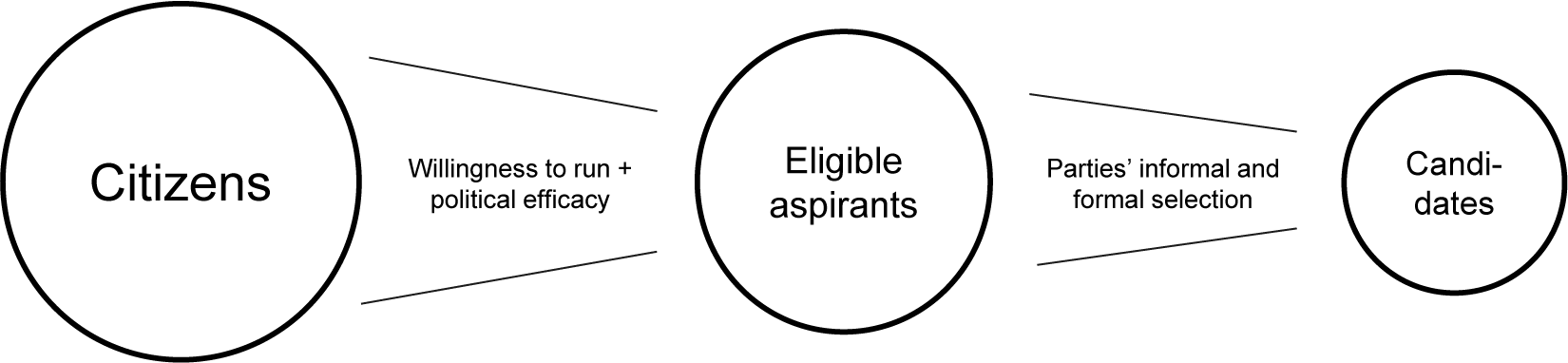
In a party-centered selection pipeline, parties draw candidates from an “eligible aspirants” pool: individuals who seek office as a result of public service motivation, the pursuit of material or status gains, or both (Besley Reference Besley2005; Panebianco Reference Panebianco1988) and those who consider themselves as having the skills to succeed in politics; that is, they have a sense of political efficacy. The size of this pool depends on socioeconomic conditions that shape incentives and resources for individuals’ active participation in formal electoral politics. From this pool of eligible aspirants, parties select candidates using formal and informal procedures. Together, this pipeline from citizens to candidates can be labeled as “party-specific political selection” (see figure 1; Norris and Lovenduski Reference Norris and Lovenduski1995; Siavelis and Morgenstern Reference Siavelis and Morgenstern2008).
Party-Specific Political Selection Pipeline

A new generation of studies uses large-scale citizen–politician comparisons or field experiments to explore who becomes a politician and whether selection produces high-quality politicians.Footnote 1 Following Besley (Reference Besley2005), politician quality is usually defined through competence and honesty; that is, whether politicians have the knowledge and skills to enact policies and pro-public motivations and integrity while doing so. If the pipeline progressively leads to politicians with higher competence and honesty than citizens and eligible aspirants, the outcome is positive selection. If the political leaders have lower average values in competence and honesty, then negative selection is at play.
Conventional wisdom suggests that positive selection is at work in developed countries, whereas developing countries often experience negative selection. In Sweden, politicians have systematically higher levels of education, leadership skills, and cognitive ability than citizens, even in the parties that represent disadvantaged groups such as workers (Dal Bo et al. Reference Bó, Ernesto, Folke, Persson and Rickne2017). In India, by contrast, researchers find that individuals less concerned about their moral reputation and less motivated about public service are more likely to enter politics (Banerjee et al. Reference Banerjee, Iversen, Mitra, Nicolò and Sen2020). Britto et al. (Reference Britto, Daniele, Le Moglie, Pinotti and Sampaio2024) finds evidence from Brazil pointing to negative selection: people with criminal charges are more likely to become politicians, and this pattern is consistent across parties. Positive selection across parties is expected to lead to competent governance and broad representation, whereas negative selection contributes to governance failures, rampant corruption, and weak accountability.
Divergence in Political Selection and Its Drivers
Existing studies of political selection are usually conducted at the country level, aiming to describe political selection patterns in a country as a whole. If they find a change in these overall patterns over time or variation across countries, they usually attribute it to competitiveness or polarization at the system level (Banerjee and Pande Reference Banerjee and Pande2007; DeLuca Reference DeLuca2023; Mattozzi and Merlo Reference Mattozzi and Merlo2015).
Although country-level studies and inferences are valuable, it is equally important to examine whether political selection patterns vary across cleavages and parties within a country. Divergent or unequal political selection arises when one camp fails to achieve comparable improvements in candidate quality at different stages of the political selection pipeline, resulting in a relatively negative selection. Identifying these disparities provides critical insights into electoral competition. For example, a party that prioritizes the selection of higher-quality candidates may secure a competitive edge in elections. Over time, effective selection practices can enhance stability and institutionalization of parties and party systems—an especially important outcome in new democracies. Even from a purely descriptive standpoint, a detailed analysis of who becomes a politician across different social segments provides valuable insights into broader patterns of inclusion and stratification.
Divergent political selection can stem from both party-related and non-party-related factors. Party-related drivers, often referred to as “demand” factors, reflect what party elites prioritize in candidates and candidate selection. “Supply” factors, such as the availability of high-quality aspirants, may also play a crucial role. If fewer qualified individuals are willing to enter the candidate pool for a particular party, its capacity for positive selection is constrained.
Supply-side Drivers
Supply-side factors are shaped by socioeconomic resources and incentives that influence citizens’ willingness and confidence to engage in party politics and pursue political office (Dancygier et al. Reference Dancygier, Lindgren, Nyman and Vernby2021; Norris and Lovenduski Reference Norris and Lovenduski1995). To explain partisan differences in political selection, these factors must influence voter bases on both sides of the sociopolitical divide in distinct ways. For example, when the financial benefits of holding office, such as salaries or rents, are less appealing to competent individuals in one political camp, perhaps because they have higher incomes or better opportunities elsewhere, this can drive partisan divergence. Likewise, high-quality potential candidates in one camp may have diminished interest in the policy benefits of holding office if they have more attractive exit options such as emigration.
Demand-side Drivers
This article focuses on demand-side factors—selection mechanisms that the parties operate and the preferences of party elites—while not denying the potential of supply-side factors to drive divergent political selection. Existing literature suggests that party elites often prioritize other characteristics (such as loyalty) over competence and honesty as they select candidates from their own social networks, aim to control the flow of resources, or both (Cruz, Labonne, and Querubin Reference Cruz, Labonne and Querubin2017; Hankla and Manning Reference Hankla and Manning2017). Yet, the extent and the motivators of this prioritization likely vary, leading to differences in the candidate pool.
Competitiveness and polarization can help explain the divergence in party elites’ candidate preferences. For instance, if one party faces stronger electoral competition across multiple districts, its elites may be compelled to select higher-quality candidates, resulting in an overall advantage in candidate competence compared to its rival (Galasso and Nannicini Reference Galasso and Nannicini2011). Conversely, if one party is more ideologically polarized than the other, the pursuit of ideological purity may lead its elites to deprioritize candidate quality and competence.
Intraparty Politics
A more complete understanding of candidate selection requires an exploration of intraparty politics. Candidate selection has very important consequences for power dynamics within parties (Katz Reference Katz2001). When factions succeed in placing their candidates in elected office, they gain leverage and visibility within the party. At the same time, officeholders may use their positions to build personal followings and form new factions. Recognizing these stakes, party elites often make selection decisions with intraparty competition in mind, especially when there is fierce competition between party factions. Despite its importance, the role of internal party dynamics in shaping candidate selection remains underexplored in the literature.Footnote 2
To what extent factional competition will play a role in candidate selection depends on the degree of intraparty cohesion. All parties, especially older mass-based or catchall parties, such as the Islamist and secular parties examined in this study, are composed of networks of activists and subgroups (Boucek Reference Boucek2009; Panebianco Reference Panebianco1988). In cohesive organizations, the boundaries between these groups are porous, and communication between individual members and formal party structures is less mediated. Factions may still exist and even play a constructive role in outreach or integration, but they tend to adopt a cooperative rather than competitive stance (Boucek Reference Boucek2009; Caillaud and Tirole Reference Caillaud and Tirole2002; Koger, Masket, and Noel Reference Koger, Masket and Noel2010; Ocakli Reference Ocakli2015).
In divided party organizations, by contrast, the boundaries between groups and factions are much less permeable. Instead of cooperating, factions compete for access to resources such as public office or patronage, or they clash over the party’s ideological and strategic direction. These factions need not be ideologically distinct; they may be organized around hometown, sect, tribe, leadership allegiance, or mobilizing structures such as labor unions or civil society organizations.
Exploring candidate selection processes is a suitable way to observe the cohesion and fragmentation of parties. Cohesive parties are more likely to have transparent and rules-based procedures for candidate selection (Chhibber, Jensenius, and Suryanarayan Reference Chhibber, Jensenius and Suryanarayan2014; Panebianco Reference Panebianco1988). Conversely, selection is usually left to the whims of the leaders and opaque processes in divided parties. In some cases—what Panebianco (Reference Panebianco1988) calls “divided but stable” organizations—candidates are selected via negotiations between faction leaders behind closed doors, based on informal power-sharing agreements. If such an understanding does not exist between the party elites (in “divided-unstable” organizations), candidate selection might lead to much more chaotic and even violent incidents.
Cohesion also has consequences for candidate quality. Competent office seekers are more likely to find cohesive parties attractive because their political careers would be less dependent on the unforeseeable preferences of faction leaders. In divided parties, faction leaders prefer to appoint loyalists (to themselves or to the faction) as candidates for public office instead of competent candidates who could later rival them in intraparty power struggles (Hankla and Manning Reference Hankla and Manning2017). As a result, fragmentation not only distorts the selection process but also decreases the average quality of party candidates (see table 1).
Differences between Divided and Cohesive Parties in Candidate Selection

Source: Adapted by the author based on Panebianco (Reference Panebianco1988) and Boucek (Reference Boucek2009).
Secular and Islamist Parties in Contemporary MENA and Drivers of Cohesion
This article explores whether political selection diverges along the secular–religious cleavage. In the MENA region, the divide is salient and has fueled debate on whether and why Islamist parties enjoy an electoral advantage (Brooke Reference Brooke2019; Cammett and Luong Reference Cammett and Luong2014; Grewal et al. Reference Grewal, Jamal, Masoud and Nugent2019; Livny Reference Livny2020; Masoud Reference Masoud2014). Beyond MENA, the cleavage persists and is strengthening in some contexts such as the United States (Campbell, Layman, and Green Reference Campbell, Layman and Green2020; Zuckerman, Galen, and Pasquale Reference Zuckerman, Galen and Pasquale2016), Europe (Pless, Tromp, and Houtman Reference Pless, Tromp and Houtman2023), South Asia (Nellis and Siddiqui Reference Nellis and Siddiqui2018; Yadav Reference Yadav2021), and Southeast Asia (Fossati Reference Fossati2019). This cleavage has the potential to produce divergent political selection, because social groups aligned with each side may be segregated and their members may have differing incentives to pursue political careers; in addition, their parties often have followed distinct paths of organizational development.
Building on a rich literature that has already identified differences in the organizational capacities of Islamist and secular parties and movements (Alexander Reference Alexander2000; Ocakli Reference Ocakli2015; Wickham Reference Wickham2002; Wiktorovicz Reference Wiktorovicz2002), I argue that these patterns can be more precisely understood through the lens of cohesion versus division. Secular parties often grapple with visible leadership struggles, internal disarray, and recurring splits, whereas Islamist parties tend to display stronger internal discipline and coordination. Although some attribute this contrast to ideological or cultural differences, I argue that they are better explained by their parties’ distinct organizational trajectories.
In several MENA countries, the main secular parties claim the legacy of national liberation movements: for example, the Republican People’s Party in Turkey, Istiqlal in Morocco, Wafd in Egypt, and Nidaa Tounes in Tunisia. (Nidaa is slightly different because it is a postrevolution construction, but it also, at least symbolically, claimed the legacy of national liberation and the Bourguibist-Destourian political tradition.) These parties initially attracted members of the urban professional middle classes—lawyers, doctors, bureaucrats, and teachers—and played key roles in post-independence state-building, which gave them privileged access to patronage resources. To incorporate other groups, such as local notables and the rising local bourgeoisie, to the party and to the (authoritarian) modern state-building project, they developed patronage distribution networks that were typically organized as personalized, tribe-based, or hometown-based factions.Footnote 3 These older secular parties’ broad organizational reach made them primary competitors to Islamist parties in competitive settings, but it also bred weak internal cohesion: factions competed for increasingly scarce patronage resources, especially under democratic pressures and neoliberal restructuring, so that coordinated cohesive action became elusive.
Older secular parties also grappled with ideological heterogeneity. During national liberation struggles, they brought together people holding diverse ideologies that opposed colonizers or occupiers. After independence, ruling elites drew from a mix of statism, socialism, and liberalism in pursuit of rapid development. In more competitive environments, these parties embraced the image of the “big tent” and presented themselves as natural governing forces. However, this diversity, when poorly managed, further undermined cohesion.
Islamist parties, by contrast, were more cohesive. Years of repression under authoritarian regimes (Nugent Reference Nugent2020) and experiences of organization building in NGOs and charities (Wickham Reference Wickham2002; Wiktorovicz Reference Wiktorovicz2002) forged a committed cadre of activists. These experiences fostered strong bonds and strengthened organizational discipline that persisted into democratic openings, when relationships within Islamist parties were marked by mutual trust and coordination (Livny Reference Livny2020).
In addition to repression, scholars argue that the party members’ religious backgrounds can play a role in enhancing cohesion. Leaders may exercise moral authority over activists, which can facilitate conflict resolution and internal discipline (Clark Reference Clark2004; Wickham Reference Wickham2002). Religiously inspired values such as duty and patience can encourage activists to endure setbacks without defecting (Wiktorowicz Reference Wiktorowicz2001). These mechanisms, however, are not automatic and change as party organization evolves. Moreover, religious identity can also be a liability for maintaining cohesion, particularly during democratization and rapid expansion. As Islamist parties reposition themselves as catch-all contenders, they must admit new cadres and make difficult decisions about religious doctrine, ties to charity and preaching networks, and cooperation with nonreligious political actors (Cavatorta and Merone Reference Cavatorta and Merone2013; Grewal Reference Grewal2020; Gumuscu Reference Gumuscu2023; McCarthy Reference McCarthy2024; Schwedler Reference Schwedler2006). In democratizing contexts, activists’ expectations multiply and diversify. Leaders must allocate selective benefits—above all, candidacies—among old and new groups (Ocakli Reference Ocakli2015). These thorny issues introduce sources of strain, making cohesion challenging for religious parties as well.
In addition to long-term structural factors, short-term agential dynamics also shape organizational cohesion. Islamist leaders have typically been more attentive to preventing factionalism and projecting unity (Baykan Reference Baykan2018; Ocakli Reference Ocakli2015). By contrast, secular party leaders have often prioritized securing government posts for their candidates or been preoccupied with internal power struggles, thereby neglecting cohesion. Although reversible, such choices deepen the cohesion gap between the two party types.
As a result of both long- and short-term drivers, Islamist parties generally exhibited higher cohesion during the 2010s. This cohesion made them more likely to follow a transparent and participatory process of candidate selection and recruitment of competent candidates, because intraparty groups were more likely to adopt and implement a joint strategy without fear of losing status. Secular party elites, by contrast, were consumed by leadership struggles, adopted opaque selection practices, and prioritized factional loyalty over candidate quality. The large-scale organizational expansion required by Tunisia’s 2018 local elections provides an opportunity to observe these dynamics in action.
General Empirical Approach and Case Background
To examine whether and why the political selection patterns differ between Islamist and secular parties in contemporary MENA, this article relies on a comprehensive comparison of candidate cohorts and selection practices of the main secular and Islamist parties in Tunisia’s first democratic local elections. I first compare the selection pipelines by bringing together an original candidate survey with a contemporaneous household survey. To explain the drivers of divergence, I analyze selection practices based on interviews with party officials and candidates and conduct a conjoint experiment to explore party elites’ preferences. I also provide corroborating evidence on other parties and elections in the country.
The analysis of this unique election offers a window into political selection in Tunisia and in similar environments in which secular–religious competition is important. First democratic elections require parties to expand rapidly and recruit thousands of candidates (Hankla and Manning Reference Hankla and Manning2017). The practices that party operatives adopt under this period of expansion and uncertainty reflect their political survival instincts (Lupu and Riedl Reference Lupu and Riedl2013). If a party survives this transition, the procedures adopted in this period likely become durable patterns.
Another advantage of studying the first democratic local elections is the limited role that incumbency plays in them. Incumbency provides parties with an advantage in recruiting high-quality candidates, but its impact in the 2018 elections was, at best, limited because no party had entrenched incumbency. Since the collapse of the authoritarian regime, specially appointed commissions—usually comprising local activists—ran Tunisian municipalities, while secretary-generals, the highest-ranking appointed bureaucrats, were de facto in charge. Nationally, Nidaa and Ennahda were governing in a loose coalition, limiting any incumbency imbalance stemming from the central level. If anything, holding the presidency and key ministries may have disadvantaged Nidaa, because President Essebsi’s and other leaders’ focus on national governance left the party leaderless and exposed internal rivalries.
Recent studies of political selection usually employ micro-census data to provide a description of who enters politics (Gulzar Reference Gulzar2021), but such data might be unavailable or lack key variables on political cleavages. Yet, arguably, political selection differences across these cleavages or in data-scarce countries raise theoretically interesting and policy-relevant questions. Pairing a large candidate survey with a contemporaneous household survey around a foundational election, and supplementing them with interviews, is a viable strategy for studying political selection in data-scarce contexts.
Case Background: Evolution of the Secular–Islamist Competition in Tunisia
In Tunisia’s first democratic local elections in 2018, two prominent parties, Ennahda (the main Islamist party) and Nidaa (the main secular party) faced the challenge of recruiting thousands of candidates across 350 municipalities. Each approached this challenge with very different organizational characteristics and capacities, rooted in both long-term legacies and postrevolutionary adaptations.
The secular–Islamist cleavage in Tunisian politics can be traced to the national liberation and early state-building periods. The main secular party of the postrevolutionary period, Nidaa Tounes, claimed the ideological-organizational legacy of Destourian/Bourguibism and the Neo-Destour party. Founded in the 1930s, Neo-Destour under Habib Bourguiba led the national liberation movement and was the hegemonic party in the post-independence period. Its core constituency was the newly rising professional middle classes with Western educational backgrounds and the agricultural petit-bourgeoisie of the northeast (Anderson Reference Anderson2014; Angrist Reference Angrist2006). During the single-party regime, Bourguiba enacted policies to limit the role of religion in public life and was considered one of the most secular leaders of the MENA region (Brown Reference Brown2001).
Bourguiba’s health deteriorated throughout the 1980s; Prime Minister Zine El Abidine Ben Ali conducted a soft coup and became the new president in 1987. After a brief liberalization, Ben Ali adopted authoritarianism, presenting himself as a guarantor of security and modernity. He allocated economic privileges to his cronies (Arouri, Baghdadi, and Rijkers Reference Arouri, Baghdadi, Rijkers, Atiyas, Diwan and Malik2019) and repressed Islamist and leftist movements brutally (Nugent Reference Nugent2020). The ruling party, rebranded as the Democratic Constitutional Rally (RCD), became primarily a mechanism of social control (King Reference King1998; Reference King2003; Wolf Reference Wolf2018).
Beginning in the 1970s, an Islamist sociopolitical movement gained strength, especially among the urban petit-bourgeoisie and university students. Under the leadership of Rached Ghannouchi, Islamists first formed the Islamic Tendency Movement (MTI), which later rebranded itself as Ennahda. Ben Ali’s crackdown forced Ennahda underground in the next two decades, and many of its leaders went into exile (Grewal Reference Grewal2020).
When widespread protests in 2010–11 led to the collapse of the authoritarian regime, Ennahda emerged as a mighty political force, winning the plurality of the seats in the 2011 constituent assembly. In these first elections, the Bourguibist-secular political tradition was fragmented, mostly because of the dissolution of the RCD in early 2011. In 2012, an octogenarian secular political leader associated more with Bourguiba than the Ben Ali regime, Beji Caid Es-Sebsi, founded the Nidaa Tounes Party, which brought together many intellectuals, leftists, and liberals. It claimed the legacy of the Bourguibist-secular tradition and positioned itself in stark opposition to the Islamists. In its first few years, the party was able to distance itself from the negative legacy of the RCD, while selectively accepting some of its local networks. Its leadership strove to preserve cohesion and gain the sympathy of voters worried by the perceived dominance of Ennahda and Islamism. In 2014, Nidaa Tounes won the presidency and the plurality in the constituent assembly, and Ennahda came in second.
At that time, Tunisia’s electoral politics was dominated by secular–Islamist competition, and these two parties were perceived to be two large opposing parties with distinct brands. Yet they engaged in a loose grand coalition after the 2014 elections. Nidaa almost immediately became less cohesive: many founders left the party for government positions, and strengthening the party’s organization lost priority. President Essebsi alternated between disengagement from party affairs and attempts to push his son Hafedh as his successor—moves that failed to gain acceptance and fueled internal rivalries. Factional leaders seeking to gain an upper hand in the leadership struggles started to accept RCD networks less selectively into the party.
The first local elections required a major organizational expansion: for a party to run in all 350 municipalities, it had to recruit more than 7,000 candidates. Nidaa’s claim to the ideological-organizational legacy of Tunisia’s secular state-building tradition meant in practice a significant reintegration of old patronage networks. Although this extended the party’s territorial reach, fierce competition between these patronage networks made it very difficult to form a cohesive country-wide organization. Leadership struggles further reduced attention to organization building and ensuring cohesion.Footnote 4 Ennahda, in contrast, was more able to maintain internal discipline and cohesion because of its history of repression and strong central leadership. In the run-up to the local elections, Ennahda also increased its efforts to become more moderate, as it pursued a broader acceptance and appeal in Tunisian society. It adopted a policy of opening its lists to independent candidates (called “infitah”), which aimed to attract new cadres from outside Islamist circles, as well as competent candidates (Meddeb Reference Meddeb2019).
The first democratic local elections were held in May 2018. In 350 municipalities, more than 2,000 electoral lists entered the race. To elect members of municipal councils, a closed-list proportional representation system was adopted in which citizens only voted for one of the partisan or independent lists.Footnote 5 In addition to a secular party claiming the legacy of national liberation and an Islamist party, postrevolutionary Tunisia was home to numerous other political parties, many rooted in long-standing political traditions of the MENA region, such as Arab nationalism, leftist populism, socialism, and center-right liberalism. I return to this diversity in the section titled “Party-Level Variation in the 2018 Local Elections.”
In this context, the 2018 local elections in Tunisia stand out as a revealing case of secular–Islamist competition under conditions of organizational expansion. Long-term organizational trajectories and short-term actions and choices of party elites interacted to shape candidate selection and spur organizational evolution in the opposing sides of this pivotal sociopolitical cleavage.
Citizens, Aspirants, Candidates: Pipeline Analysis with Case-Control Design
Sources of Data
To study parties’ organizational expansion during Tunisia’s first democratic elections, I engaged in intensive fieldwork and original data collection. To compare candidate characteristics across parties, I use the Local Election Candidates Survey (LECS, “candidate survey”) that I and two other researchers conducted before Election Day.Footnote 6 To compare candidates to citizens, I use a large contemporaneous household survey to which I contributed key question modules.
The large-scale candidate survey, which was conducted in April–May 2018, was administered to 1,907 candidates in 100 municipalities. It covered a wide range of candidate characteristics, including demographic and socioeconomic background, experience, policy preferences, campaign activities, political knowledge, and personal values.Footnote 7
The sample was designed to be representative of (1) municipalities of varying sizes, and (2) candidates with a higher likelihood of winning. In each of 100 randomly selected municipalities, Ennahda and Nidaa candidates were included to ensure the representation of both main parties.Footnote 8 The response rate (70%) was relatively high for a survey, with especially high rates for Nidaa (81%) and Ennahda (71%).Footnote 9 I also drew on a nationally representative survey of more than 6,500 Tunisian citizens fielded immediately after the elections by Democracy International in 293 municipalities. I contributed key question modules, allowing for direct comparisons with the candidate survey on attitudes toward secularism and democracy, as well as education and income. For analyses that combined the two surveys, I restricted the sample to the 79 municipalities covered in both.Footnote 10
Comparison of Citizens, Aspirants, and Candidates
This article focuses on the competence aspect of politician quality. To compare candidates to citizens and aspirants, I use educational attainment; specifically, a binary measure of holding an undergraduate-level degree. Educational attainment is frequently used in studies of political selection as an indicator of competence (Beath et al. Reference Beath, Christia, Egorov and Enikopolov2016; Galasso and Nannicini Reference Galasso and Nannicini2011; Gulzar Reference Gulzar2021). Although not without limitations (Carnes and Lupu Reference Carnes and Lupu2016), it is appropriate here for two reasons. First, it correlates with other variables commonly associated with competence, such as leadership skills, policy knowledge, and organizational ability (see Supplementary Materials Section 6). Second, it is theoretically relevant, given that secular parties in the MENA region historically emerged as representatives of the well-educated, professional middle classes (Angrist Reference Angrist2006). Educational attainment is also perceived by Tunisian voters as an indicator of competence.
To divide the population into secular and Islamist segments, I use responses to the three pro-secularism statements in both candidate and household surveys: “The government and parliament should enact laws in accordance with Islamic law” (reverse-coded), “It is better when religious people hold public office in the state” (reverse-coded), and “Religion is a private matter and should be separated from political life.” I constructed two binary measures: respondents agreeing with any two of three statements were coded as “secular-leaning,” and those who agreed with less than two were coded as “Islamist-leaning.” By this metric, 59% of citizens and 82% of candidates are secular-leaning.
The second measure takes Ennahda’s moderation (Grewal Reference Grewal2020; Gumuscu Reference Gumuscu2023) into consideration. Here, I code respondents who agreed with two statements but still advocated for enactment of laws in accordance with Islamic law as “(moderate) Islamists,” and the remaining participants as “(staunch) seculars.” According to this measure, 32% of citizens and 50.5% of candidates are in the (staunch) secular category.Footnote 11
Using this measure of competence and these classifications, I compare citizens, aspirants, and candidates from the secular Nidaa and Islamist Ennahda parties. I operationalize “eligible aspirants” as all candidates (from all lists) in these local elections. People who became a candidate in the 2018 local elections exhibited both a willingness to seek office and political self-efficacy, fulfilling the criteria for “eligible aspirants.” This pool was large because it included candidates in non-party-affiliated (independent) lists. During field research, I observed that main parties, smaller parties, and independent lists competed for candidates from a limited pool of aspirants, often attempting to recruit candidates from other lists. Aspirants unable to secure positions with major parties frequently ran for smaller parties or independent lists. For these reasons, the broader set of local election candidates is a reasonable proxy for the aspirant pool.
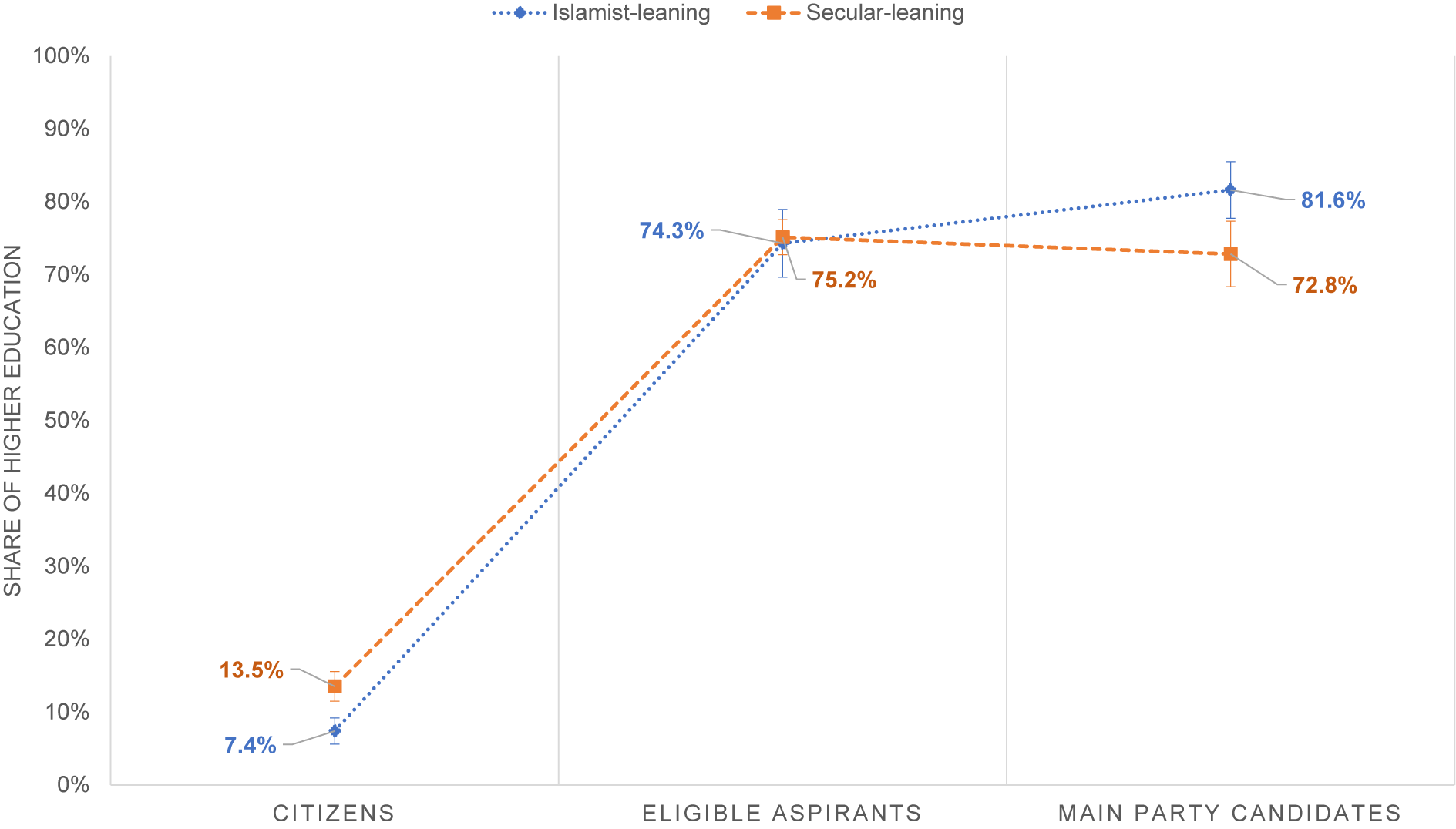
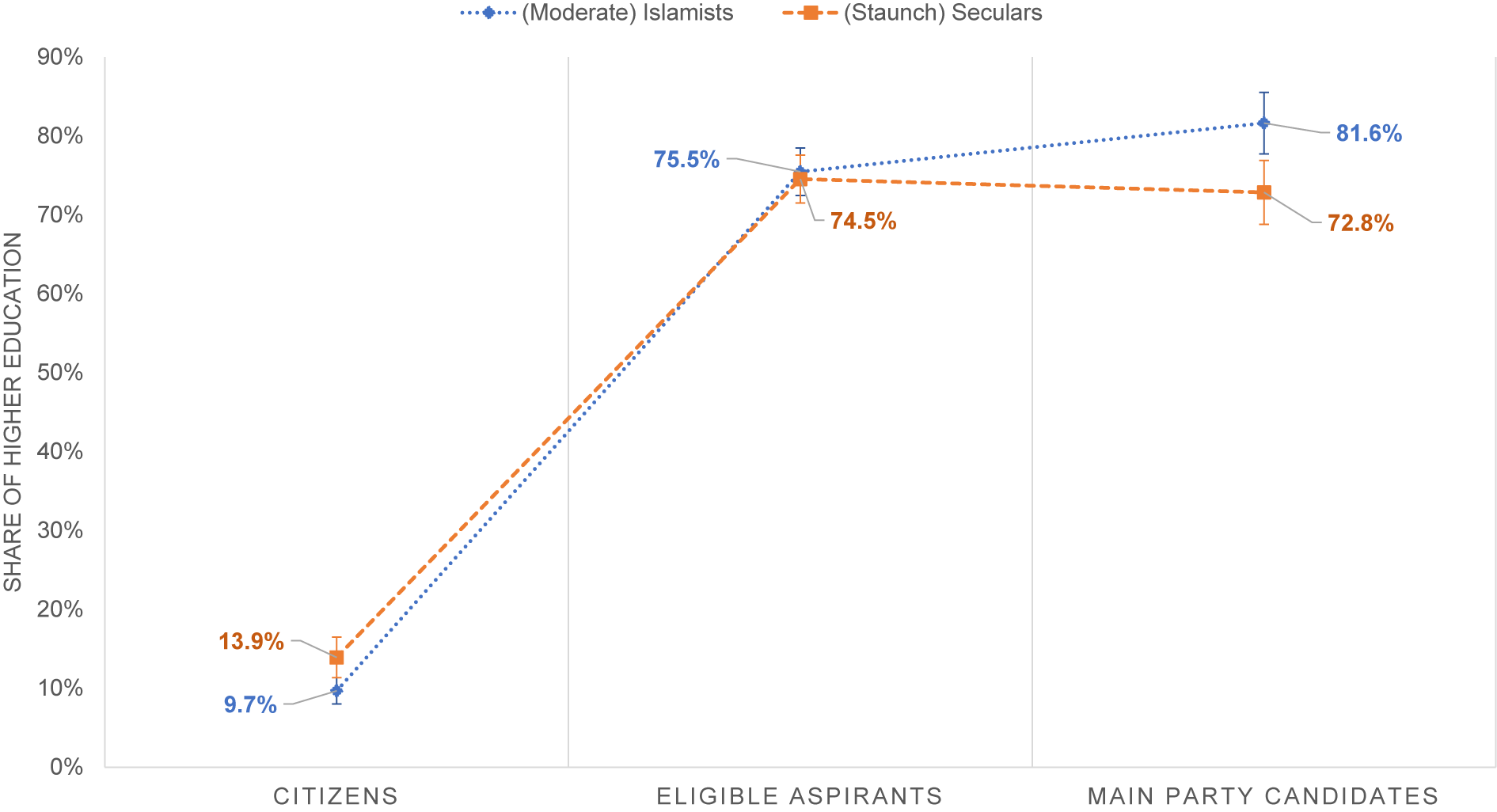
Figures 2 and 3 show that the main secular party Nidaa experienced negative selection compared to Ennahda under both secular–Islamist definitions. Although secular citizens had on average higher educational attainment than Islamist citizens, this advantage disappeared among aspirants and was reversed at the candidate stage. Ennahda candidates were more likely to hold university degrees, indicating that demand-side factors (party-level selection) was a key driver of the divergence in candidate quality.
Share of People with Higher Education in Islamist-Leaning vs. Secular-Leaning Citizens, Eligible Aspirants, and Main Party Candidates

Share of People with Higher Education in (Moderate) Islamists vs. (Staunch) Seculars among Citizens, Eligible Aspirants, and Main Party Candidates

Controlling for Potential Confounders
This comparison across parties shows that secular party candidates were less educated than Islamist party candidates, even though secular citizens were more educated. However, the relationship between being secular and being a candidate might be confounded: characteristics associated with being a secular person might also affect candidacy. For instance, individuals with more income are more likely to have pro-secular attitudes and more likely to become candidates. Similarly, a pro-democracy attitude is sometimes negatively associated with pro-secularism, and it can positively affect candidacy. To account for this, I conduct a multivariate analysis by combining candidate and household data in a “rare events logistic regression model,” an adaptation of a case-control design to study rarely occurring outcomes in social science. This approach tests whether Nidaa’s observed pattern of relatively negative selection persisted after adjusting for covariates.Footnote 12
Rare event logistic regression is a form of a classical logistic regression, in which estimates are corrected by considering the rarity of the outcome. The correction can be made based on prior information about the fraction of positive outcomes in the population (King and Zeng Reference King and Zeng2001). This model is used when data from positive and negative outcome cases are independently collected.Footnote 13 It is similar to the case-control designs frequently used in epidemiology to explore risk factors associated with rare diseases (King and Zeng Reference King and Zeng2001; Reference King and Zeng2002). It fits this study because candidacy is a rare outcome among citizens, and the candidate and household data were collected independently, though contemporaneously.
Table 2 presents the results of the rare event logistical regression models. Candidacy is the binary outcome variable, and education and its interaction with secularism are the main explanatory variables of interest. To correct for the rarity of candidacy (“1” in the outcome variable), I use the prior correction technique by setting the fraction of candidacies in the population at 0.01.Footnote 14 All models include income, age, gender, and pro-democratic attitude as controls. For the coefficients of variables of interest, I use block-bootstrapped standard errors to address the clustered nature of data collection.
Results of the Rare Events Logistic Model

Note: * p < 0.1; ** p < 0.05; *** p < 0.01.
Normal standard errors are presented in parentheses.
Block-bootstrapped standard errors (1,000 replications, clustered at the municipality level) for selected coefficients are in brackets.
Results confirm that the relatively negative selection of seculars into the main secular party survives potential confounders. The interaction term between the secularism binary variable and education has consistently significant and negative coefficients. Predicted probabilities suggest that individuals with an undergraduate degree in the Islamist camp are about 3.1 times more likely to become candidates than their secular counterparts. Conversely, among those with an elementary school degree, secular individuals are 2.3 more likely to become candidates.Footnote 15
Other Differences between Candidate Cohorts
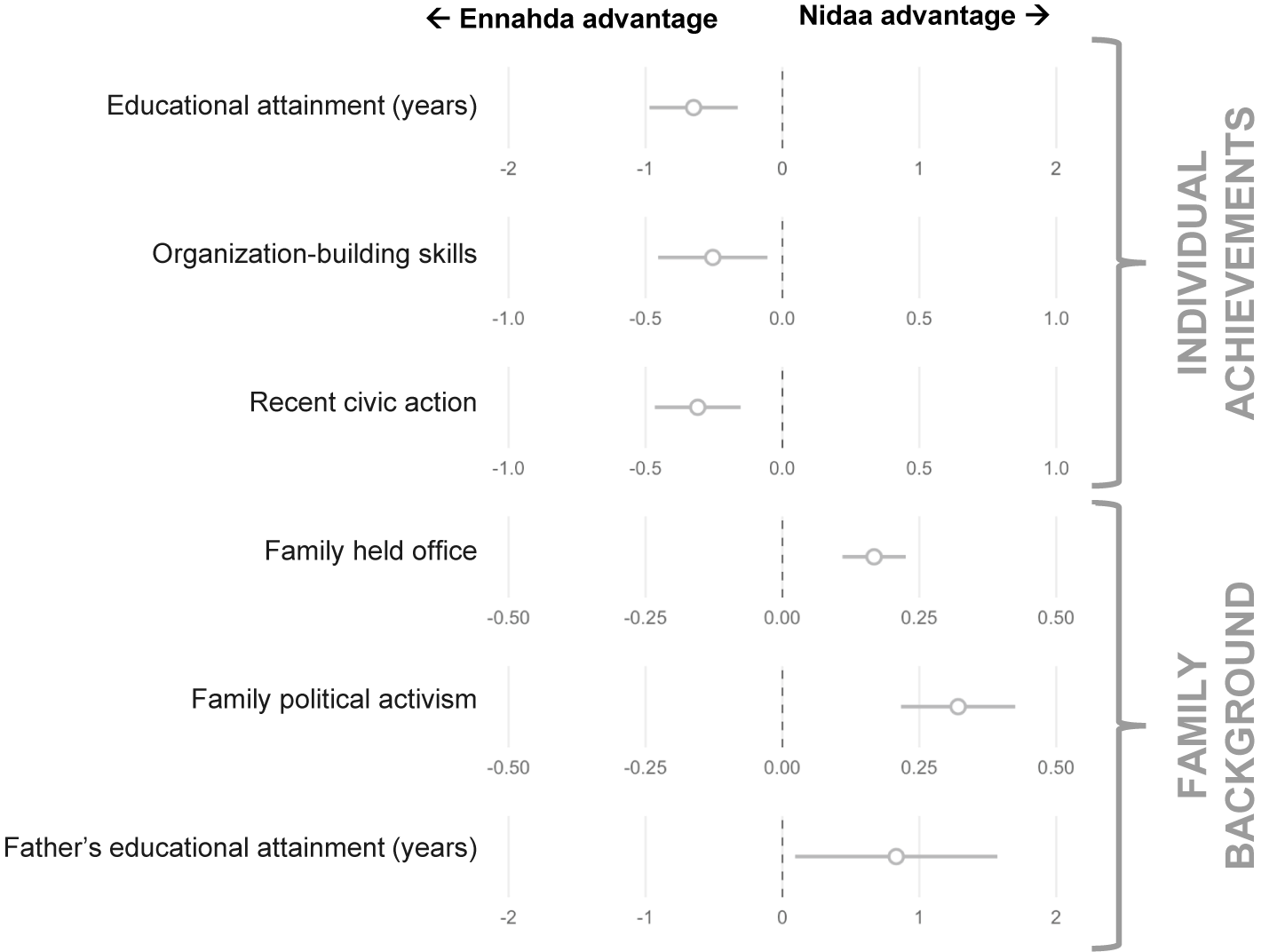
In other competence-related characteristics too, Nidaa’s candidate pool demonstrated a disadvantage. Figure 4 shows conservative estimates of differences between Nidaa and Ennahda candidates across several indicators. Each estimate comes from a separate regression that includes controls for list-level selection factors, such as gender and youth quotas, and sample selection criteria—municipality, gender, and list ranking. Each model uses cluster-robust standard errors. Positive values indicate a Nidaa advantage, negative ones an Ennahda advantage.
Differences in Various Characteristics between Nidaa and Ennahda Candidate Pools

In the variables that reflected individual achievement, Nidaa candidates were less advantaged: they were less experienced in organization building, especially in public speaking and event planning; less civically engaged (e.g., joining a municipal council meeting, contacting an MP), and less likely to belong to civil society organizations or professional associations than Ennahda candidates (not shown in the figure). This is striking given that engagement with voluntary organizations is common among urban professional middle classes, the historical core constituency of the secular party.
By contrast, Nidaa candidates tended to come from more advantaged family backgrounds with higher levels of educational attainment, prior officeholding (elected or appointed), and a history of political activism. These backgrounds suggest inherited political capital but not necessarily individual competence.
Although this section focused on the contrasts between Nidaa and Ennahda candidates and the relatively negative selection for Nidaa, one should note that both parties exhibited positive selection overall: their candidates usually had much higher educational attainment than citizens. This shows that parties, including the smaller ones discussed later, were aware of the voter demand for educated candidates. The fact that Nidaa’s outcomes diverged despite this demand is even more puzzling. The next section explores the party-level dynamics that help explain this outcome.
Understanding the Demand-side Drivers of Unequal Political Selection: The Role of Organizational Cohesion
Cohesion and Parties’ Candidate Selection Practices on the Ground
This section draws on fieldwork conducted in 11 Tunisian municipalities to illuminate how party cohesion shaped candidate selection practices during the 2018 local elections.Footnote 16 Interviews with officials and candidates from both major parties and some of their electoral competitorsFootnote 17 revealed how Nidaa’s lack of cohesion led to ad hoc, fragmented processes, whereas Ennahda’s relatively disciplined organization enabled more orderly, inclusive, and competence-driven recruitment.Footnote 18
Dominant Method of List Making
The main secular and Islamist parties in Tunisia during the 2018 local elections had very different methods of constructing candidate lists. In many towns, harsh factional struggles dominated Nidaa’s candidate selection process. Because there was no formal mechanism of applications and selection, small factions often prepared parallel lists and sought approval from regional offices or central headquarters. For instance, in Essaida, a small town in the interior region, two factions prepared two parallel lists. When headquarters selected one of the two, supporters of the other list resigned, and some ran as an independent list.Footnote 19
Large-scale or individual resignations from Nidaa during the candidate selection process were common. A former official of the party in Bou Arada, a medium-sized town in the northwest, left the Nidaa list because he could not receive a preferred ranking and ran with an independent list. He explains why he took these actions:
I left the party on 15 February [only one week before the deadline for submitting lists], because there was no transparency anymore in the party and the relationships were not fruitful at all. They were coordinating everything with an MP, and each time when regional coordination happened, they did not tell me anything. I complained about this to the MP, and she said to me there is no criterion for how to select the head of the list, and they will select whatever person they will.Footnote 20
Factional struggles were fiercest in larger cities, where party elites expected the municipalities to control extensive fiscal resources. They heavily intervened in candidate selection in these cities. In Sfax, considered to be the economic capital of Tunisia, the central headquarters appointed a three-member committee for candidate selection after months of inconclusive factional struggles.Footnote 21 A constituent assembly member from Nidaa in Sfax described the work of this committee: “A three-people committee came and imposed their list. They selected a head of the list, a businessman, and then this person put his supporters to different ranks in the list. Many people resigned from the party…. The list was a mess. Many candidates we had could not even write and express an election message. They had no idea about local governance.”Footnote 22
In Ennahda, the candidate selection process was more orderly. Unlike in Nidaa, in which new people were frequently appointed to local party posts because of the many resignations, the standing local committees in Ennahda retained control. No parallel lists were reported. As part of its ongoing moderation and “infitah” policy, the party opened half of its lists to independents: people who were not formally affiliated with the party. In most places, there was an open application process both for party member and nonmember candidates. In interviews, local coordinators admitted that they were still encouraging some people to submit an application privately, but the process was much more transparent than in Nidaa Tounes. Rankings were decided through internal elections, which were taken seriously. A female candidate with a prominent ranking in Mnihla, a working-class town on the outskirts of Tunis, told me she joined the internal elections via Skype, because she was on pilgrimage at the time.Footnote 23
Candidate survey results confirm findings from our interviews: Nidaa candidates were significantly more likely to report that rankings were made by a small group of people and that they did not know how the rankings were made; in contrast, Ennahda’s candidates were significantly more likely to report that these decisions were made collectively (see Supplementary Information Section 4).
However, it would be misleading to depict Ennahda’s process as entirely free of conflict. Opening lists to independents meant that long-term members likely felt sidelined, creating frictions in some localities. Yet such tensions were often managed internally through dialogue and reference to the party’s participatory decision-making process and were less likely to escalate into immediate defections. As one regional coordinator explained,
Of course, in our party, people are not angels. They have their own expectations and ambitions. Leaders at the regional and national level tried to convince them to act with an open mind. One of our principles is being committed to the internal law of the party—we are the ones who voted for it. Many Nahdaouis said opening half of the lists to independents was too much. We convinced them through dialogue and discussion, telling them there is a need to renew our party.Footnote 24
Attraction to the “Well-Oiled Machine.”
In addition to internal procedures, a party’s level of cohesion affected perceptions among outsiders and its ability to attract competent candidates. An exchange I had with a female candidate for Ennahda in a northwestern town offers an example. This region of Tunisia is a stronghold of the leftist union movement, stemming from the area’s intensive mining activities during and beyond the colonial era. The candidate was a well-known labor union activist and had been working for years in local administration, an experience that would make her an asset for any party. She surprised, even angered, many, including the head of the local unionFootnote 25 and her children, when she decided to run as part of the Islamist party. She justified her choice: “I want to work for my town; I want to do social work. Ennahda approached me and offered me a candidacy. I accepted because I wanted to observe Ennahda from the inside. I wanted to see how their organization works like a machine.”
Another example is from the city of Monastir on the eastern coast, a stronghold of the secularist movement, and involved a bureaucrat working in the defense sector; such professionals are historically less likely to be Islamist (Koehler, Grewal, and Albrecht Reference Koehler, Grewal and Albrecht2022). He explained why he became a prominent candidate of Ennahda: “Due to the nature of my profession, I am always very disciplined and very organized. I started to look for a party like this. … The relationships within Ennahda are very respectful. The relationships between the regional office, headquarters, and the local offices are very well defined.”Footnote 26
By contrast, some party officials of Nidaa told me they were having difficulty finding well-qualified candidates. One party official in the Moknine region, a stronghold of the secular party, explained that people who cared about their moral reputation were afraid that the party would not stand behind them: “When we approached people, some said: ‘When we are in the municipal council, what will happen when there are disagreements with the party officials? What will happen when people protest against us?’”Footnote 27 In postrevolutionary Tunisia, local protests were frequent, and potential high-quality politicians were afraid that the party as an organization lacked the cohesion and strength to protect them.
Differences between Candidate Selection Criteria: A Conjoint Experiment
In the interviews, both Nidaa and Ennahda officials cited similar candidate selection criteria—competence, integrity, and being well-known—that mirrored scholarly definitions of candidate quality. Yet, the interview data did not allow us to determine whether there was a cross-party difference in the priority given to each criterion. I therefore conducted a conjoint experiment in which party members selected hypothetical candidates. The results of the conjoint experiment move from stated to revealed preferences, capture the underlying logic of political selection, and help verify the interview findings.
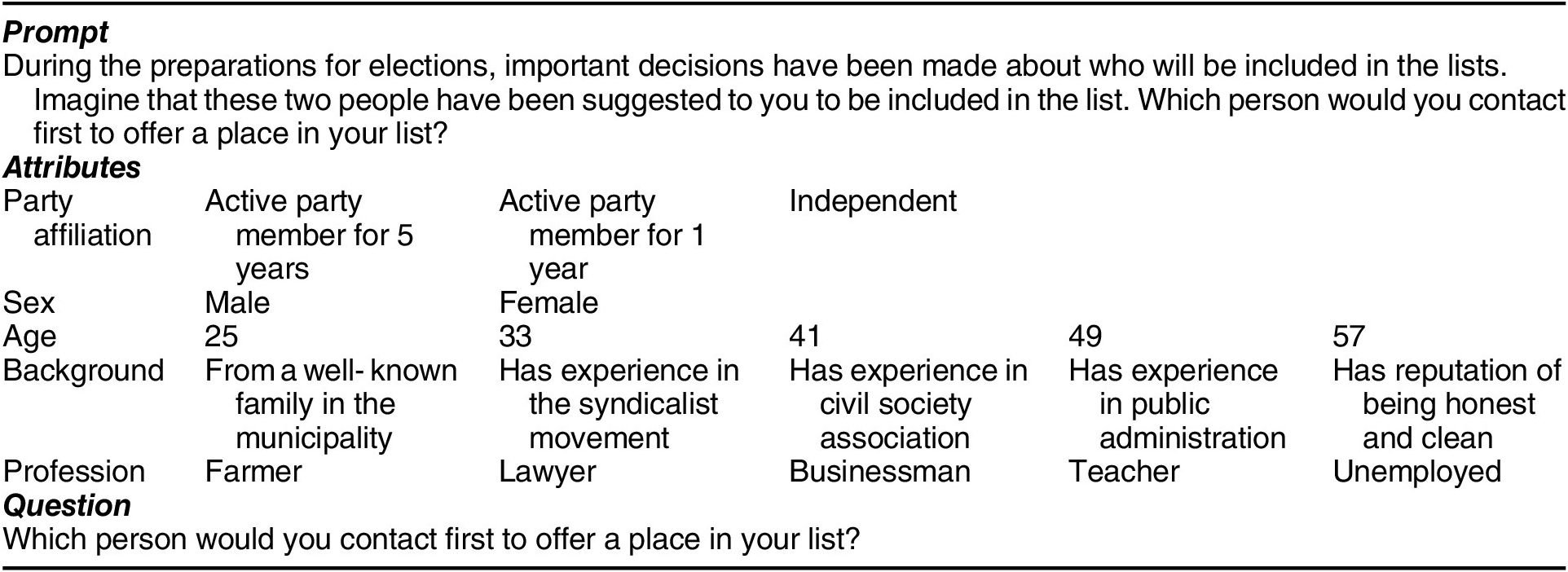
The conjoint experiment was embedded in the candidate survey,Footnote 28 and the analyses in this section focus on respondents who were official party members because they were the most likely gatekeepers in the selection process.Footnote 29 Each respondent completed three rounds, choosing between paired profiles of hypothetical aspirants. Each profile varied across 5 attributes and 21 values (see table 3). For the purposes of this article, two attributes were important: party affiliation, which reveals the willingness to integrate outsiders versus loyalists, and background, which signals how members infer integrity and connectedness.
Attributes and Values in the Candidate Selection Conjoint Experiment

The background attribute was a litmus test for party strategies. Preferring candidates with a reputation of being honest and clean would signal an orientation toward integrity, especially amid the heightened discomfort with corruption in postrevolutionary Tunisia (Yerkes and Muasher Reference Yerkes and Muasher2017). Preference for those with civil society experience would signal an orientation toward integrity and democratic renewal, particularly in the revived associational context (Fortier Reference Fortier2019). Preference for local notables with descent from a well-known family (ʿā’ila ʿarīqa fī al-mintaqa) would reflect conservatism and potential links to prerevolutionary patronage. Party affiliation, in contrast, would be a cue to which party was more open to newcomers and which party favored loyalists. Because the number of candidates that parties had to recruit was so high and the candidate pool was limited, relative favorability levels were also important: Did Nidaa favor, for instance, a good reputation as much as did Ennahda?
I report the results using marginal means differences, rather than average marginal causal effects (AMCE). Marginal means represent the average probability that a profile with a given value is chosen, easing interpretation (Leeper, Hobolt, and Tilley Reference Leeper, Hobolt and Tilley2020).Footnote 30 To identify partisan differences, I subtract the Ennahda marginal means from Nidaa’s. Negative values indicate relative preferences of Ennahda members, whereas positive values indicate relative preferences of Nidaa members.
Figure 5 shows stark partisan differences between the party members’ choices according to party affiliation. Compared to members of Ennahda, Nidaa members were far less likely to favor independents and more likely to select long-standing members. This is in line with faction leaders’ preference for familiar faces and their reluctance to select newcomers, who may pose some risk. Ennahda members, by contrast, displayed a greater openness to newcomers. This difference can be partially attributed to Ennahda’s infitah policy through which the party formally opened its lists to independents. Importantly, this finding suggests that infitah was not merely a top-down directive but one that was internalized by local officials, consistent with the behavior of a cohesive organization.
Nidaa and Ennahda Party Members’ Relative Preference for Different Characteristics of Potential Candidates

Differences were also evident in the background attribute. Nidaa members had a relative preference for candidates from old, important families. This social conservatism was further expressed by disfavoring candidates with a reputation of noncorruption and experience in civil society. Put differently, relative to Ennahda, Nidaa prioritized connections to the status quo while relatively disregarding signals of honesty and integrity. The factional competition and organizational disarray within Nidaa made party members more reliant on familiar patronage networks, even when the party would have benefited from openness and democratic renewal.
Alternative Explanations for Divergent Candidate Quality
Demand-Side Alternative Explanations
Although this article emphasizes organizational cohesion as a key driver of candidate quality, other factors may also have an impact. In the Supplementary Materials, I test two such factors. The first is competitiveness: stronger electoral competition in a larger number of districts can compel one party’s elites to enhance candidate quality. Additional tests suggest, however, that competitiveness is an insufficient explanation for Nidaa’s candidate quality gap in 2018.Footnote 31 Another factor is ideological polarization: if a party is very polarized and puts more emphasis on ideology, it could forego competence for the sake of ideological purity. Yet there is no evidence for this alternative explanation at either the list or individual level.Footnote 32
A third possible factor is that for the 2018 elections, which required an extraordinary degree of organizational expansion, Nidaa’s party elites decided to play it safe and prioritized family connections over competence as a coordinated strategy of recruitment. Neither the interviews nor the candidate survey, however, support this theory of coordinated action by Nidaa’s party elites. Instead, elites were looking for candidates who expressed loyalty to their respective factions, and leadership competitions and disarray led to a relatively negative selection, even though the elites knew the importance of competence and integrity.
Supply-side Alternative Explanations
Although this article focuses on party-level selection—the stage during which eligible aspirants became candidates of the main parties—some of the divergence in candidate quality can be due to supply-side factors. The narrowing gap between secularist and Islamist citizens and secularist and Islamic eligible aspirants in figures 2 and 3 implies a role for supply-side factors. Providing support for that role, survey evidence indicates that educational attainment is more strongly associated with ambition for active political work among Islamists than among secular citizens.Footnote 33 Moreover, among aspirants and main party candidates, competence is positively linked to pro-public motivation—for example, prioritizing national development—for Islamists but is negatively linked for secularists.Footnote 34 In essence, if competence makes secular individuals less likely to prioritize pro-public value while the opposite holds true for Islamists, this suggests an additional role for supply-side factors in unequal political selection.
Electoral Consequences of Unequal Political Selection
Does candidate quality and, specifically, candidates’ educational attainment affect electoral outcomes in Tunisia? Evidence from different sources, surveys, preferences in conjoint experiments, and the relationships between candidate data and electoral results all suggest that this impact is highly likely.
In postrevolutionary Tunisia, surveys showed that candidate quality, and specifically competence, was one of the most important criteria for voting. In Arab Barometer Wave 2 (2011), 68% of respondents indicated that a candidate’s education was important to them “to a great extent,” followed distantly by issue congruence (50%). Conjoint experiments echoed this finding: in Grubman and Svolik (Reference Grubman and Svolik2023), a candidate with an undergraduate degree was 10 percentage points more likely to be chosen than one with a high school degree. Blackman and Jackson (Reference Blackman and Jackson2021) also found positive effects of education. Still, surveys and conjoint experiments may have limitations: they can be seen as cheap talk or having low construct validity for list-based elections in Tunisia. Fortunately, the granular candidate data enable us to observe the effect of candidate quality and education in 2018 local elections.
During my extensive fieldwork, many informants told me that they focused on top-ranked candidates, especially list heads, when they were making their vote choice. This was reasonable, because list heads were default candidates for the mayoral race in each council. By law, parties were required to allocate half of their list heads to women; however, because of Tunisian parties’ tendencies at the time to favor men (Clark, Blackman, and Şaşmaz Reference Clark, Blackman and Şaşmaz2024), it was also possible that the male candidate in the second rank in the list, rather than the female candidate at the top, was seen as the real leader. I therefore examined electoral outcomes by focusing on the top one or two candidates per list.Footnote 35
I first operationalized candidate competence as having an undergraduate degree. To measure the pro-public motivation aspect of candidate quality, a survey item asked candidates to state their most important life goal. A candidate who responded “contributing to Tunisia’s development” was coded as 1 for pro-public motivation, and all other responses—money, professional career, enjoyable life, devotion to religion, and good family life—were coded as 0. Previous experience in public administration is another competence indicator.Footnote 36 As a control, I used the results of the 2014 elections in the same municipality.Footnote 37 All explanatory and outcome variables were calculated as Nidaa–Ennahda differences. Descriptive statistics can be found in Supplementary Materials Section 14.
Table 4 shows positive relationships between candidate quality variables and electoral outcomes. The effect of educational attainment is consistently positive. If Nidaa’s top candidates possessed higher education degrees while Ennahda’s candidates did not, this could translate into an average electoral advantage of 10 to 20 percentage points for Nidaa over Ennahda, controlling for 2014 election results and other quality factors. Notably, table 4 highlights the positive impact of candidates’ pro-public values on electoral performance. This aligns with the article’s broader argument and deserves further exploration.
Candidate Quality and Electoral Outcomes: Nidaa vs. Ennahda in 2018 Local Elections

Notes: † p < 0.15; * p < 0.1; ** p < 0.05; *** p < 0.01.
Normal standard errors are presented in parentheses.
An analysis that takes all eligible lists into consideration (beyond just Nidaa and Ennahda) yields similar findings: lists with two university-educated top candidates outperformed those without by 17 points.Footnote 38
Overall, results of these foundational 2018 elections were telling: Ennahda regained its electoral edge over Nidaa Tounes, securing 29% of the votes versus 21%. Independent lists emerged as significant winners, capturing 32% of the vote amid widespread disenchantment with parties and democracy. Still, the secular–Islamist competition remained an important aspect of the elections. Nidaa Tounes, which had led in 2014, lost ground, partly because of growing internal disarray. Unable to manage the stress test of rapid expansion, it nominated weaker candidates, which was then reflected in the election results.
Evidence on Other Parties and Elections
Party-Level Variation in the 2018 Local Elections
The candidate survey’s rich dataset offers opportunities for comparative analysis across parties beyond Nidaa and Ennahda. Table 5 presents predicted values for pro-secularism and candidate quality measures across eight parties or alliances, as well as independent lists. These values are derived from linear models that control for selection of respondents to the lists and to the sample.
Main Parties, Smaller Parties, and Alliances in the 2018 Elections and Their Pro-Secularism and Candidate Quality Measures

Parties with higher pro-secularism scores tended to have candidates with lower levels of educational attainment. For example, candidates for Civil Alliance, a coalition of several smaller secular parties, displayed high levels of pro-secular attitudes but lower educational attainment. The alliance’s hasty formation, which was orchestrated at the central level with minimal local preparation, can explain the fragmented and chaotic candidate selection processes, which ultimately produced lower candidate quality. The party with the lowest average candidate quality was also the one with the highest pro-secularism score: the Free Destourian Party (PDL). PDL’s unapologetic embrace of the Ben Ali-era RCD contributed to the incorporation of old patronage networks, which explains the lower educational profile among its candidates.
An important exception was the Popular Front, a long-standing alliance of old leftist and far-left parties. Several local party leaders told me that they saw the 2018 elections as an opportunity to give younger activists political experience by holding office and running campaigns, which would explain the higher educational levels. Parties brought together under the family of Arab nationalism and populist-leftism (Democratic Current, People’s Movement, and Movement of the Will) occupied the middle ground. Their candidates were less secular than Nidaa or PDL, and they were comparably or better educated. Fieldwork suggested that these parties, particularly Democratic Current, emphasized organization building and the selection of high-quality candidates.
Other measures of candidate quality showed more mixed patterns. People’s Movement scored highest on pro-public motivation, whereas PDL recruited candidates with prior public administration experience, reflecting ties to prerevolution networks. On these two indicators, Nidaa and Ennahda did not significantly differ.Footnote 39
Even though there was seemingly a correlation between secular attitudes and educational attainment across parties, this does not mean that a secular ideology itself determined candidate quality. Instead, I highlight organizational cohesion as the critical variable. That not only Nidaa but also other secular parties suffered from lower candidate quality outcomes should be attributed to the fact that they emerged from the same ideological-organizational tradition (in the case of PDL) or their central elites made similar bad choices (in the case of Civil Alliance), leading to similar cohesion issues.
Nidaa and Ennahda across Parliamentary Elections
Data from the 2014 and 2019 parliamentary elections further support the role of cohesion in the competition between Tunisia’s main secular and Islamist parties. These data are limited due to the absence of candidate surveys, but data from Marsad Majles, a civil society organization that monitored legislators’ activities, provide valuable insights.
In 2014, a time when Nidaa was more cohesive and selective in its recruitment than in 2018, its candidates had higher educational attainment than those from Ennahda. However, cohesion issues within Nidaa emerged almost immediately after the elections. The probability of its deputies switching parliamentary blocs was 44 percentage points higher than for Ennahda’s deputies. By 2019, Nidaa had fractured into four distinct parties. Comparisons of the educational attainment of deputies from these successor parties with those from Ennahda elected in 2019 reveal that the educational advantage had shifted decisively to Ennahda. These trends further support the argument that organizational cohesion is a key driver of a party’s ability to field high-quality candidates. More details on this analysis appear in Supplementary Materials Section 15.
Conclusion
The first (and so far the only) democratic elections in Tunisia provide a unique window to study how parties responded to the requirements of organizational expansion and candidate selection during democratization. Drawing on an original candidate survey, this article demonstrated a gap in candidate quality across the secular–Islamist divide, a salient cleavage in Tunisia and much of the broader MENA region. Although secular citizens, on average, possessed higher levels of education, Islamist party candidates scored higher on these and other conventional indicators of political competence. This highlights a case of unequal political selection across a central cleavage within the same country—an underexplored phenomenon in the growing literature on political selection.
A closer look at parties’ selection methods and elite priorities, drawing on interviews and a conjoint experiment, showed organizational cohesion as the key driver of unequal selection. The main secular party, riven by factional competition and leadership struggles, failed to establish and enforce clear rules for recruitment and ranking. Its elites often prioritized factional loyalty and preservation of the status quo over competence and integrity. By contrast, the Islamist party managed the conflict-prone process more effectively: internal discipline and dialogue, stronger leadership, and collective decision-making processes led to the recruitment of higher-quality candidates. The cohesion gap thus translated into a candidate quality gap, which in turn appears to have shaped electoral outcomes.
Drawing on the rich literature of the Islamist parties’ organizational capacities, this article brings a comparative perspective focusing on cohesion, thereby offering a fresh perspective on secular–religious competition in MENA and beyond. It locates the secular parties with claims to the legacy of national liberation as the primary competitors to the Islamist parties because of their broad organizational reach through the networks they or their predecessors cultivated during state-building. But because these networks were mainly rooted in patronage distribution, sustaining cohesion has proven difficult, especially amid leadership struggles and waning commitment to organization building at the center. By contrast, Islamist parties, forged under years of repression, developed a tight organizational culture that better equipped them to manage the strains of expansion. Cohesion, understood as the ability of factions and subnetworks to coordinate and work in harmony, thus emerges as a crucial, yet underappreciated, determinant of secular–religious competition.
This organizational theory can contribute to understanding secular–religious competition beyond Tunisia. In countries such as Turkey, Israel, Indonesia, or India, secular parties with state-building legacies often struggle with internal fragmentation and weak candidate quality, whereas religiously rooted rivals display greater discipline and cohesion (Fionna and Tomsa Reference Fionna and Tomsa2020; Kenny Reference Kenny2017). The Tunisian case also shows how such asymmetries can undermine democratic trajectories. For transitions to endure, competing forces must exhibit a degree of organizational symmetry (Angrist Reference Angrist2006; Rustow Reference Rustow1970; Ziblatt Reference Ziblatt2017). The failure of the main secular party to build a robust and cohesive organization helps explain why it lost elections and many of its voters later supported the presidential “autogolpe”Footnote 40 (Lotito Reference Lotito2021; Zogby, Zogby, and Zogby Reference Zogby, Zogby and Zogby2021), paving the way for renewed authoritarianism.
As a methodological contribution, this article offers the combined use of candidate and household surveys as an applicable template for investigating political selection in other developing democracies and hybrid regimes, where official records are limited or experimental designs are not feasible. A final contribution is bringing parties back into the new generation of political selection studies where their role remains underexplored. As Dal Bo and Finan (Reference Dal Bo and Finan2018, 566) note, we still have “a very limited understanding of how political parties recruit and screen their candidates.” This article contributes to filling that gap by showing that organizational cohesion is a critical factor in shaping selection, because it conditions how party elites navigate candidate recruitment, what processes they design and implement, and what traits they prioritize. Future research on political selection must therefore take cohesion seriously as a factor in explaining who enters politics and why. More broadly, attention to parties’ internal workings advances our understanding of the organizational foundations of democratic representation and of secular–religious party competition.
Supplementary material
To view supplementary material for this article, please visit http://doi.org/10.1017/S1537592725103721.
Acknowledgments
I thank Melani Cammett, Steven Levitsky, Tarek Masoud, Daniel Ziblatt, Matt Blackwell, Fırat Kimya, Vineeta Yadav, Nicholas Kuipers, Hans Lueders, Soledad Prillaman, Nathan Grubman, Rania Said, Sihem Lamine, Lisa Blaydes, Sultan Tepe, and participants in the panels and talks at the Tunisia Office of the Harvard University Center for Middle Eastern Studies; the Stanford Center on Democracy, Development and the Rule of Law; Princeton University; Vanderbilt University; and Temple University for valuable feedback on earlier drafts. I am grateful to Intissar Samarat and Ashley Zhuge for outstanding research assistance; Alexandra Blackman and Julia Michal Clark, co-investigators of the candidate survey, for their collaborative partnership; the staff and enumerators of Elka Consulting for their exceptional work in data collection; and especially to the politicians and candidates who generously shared their time. Support for the candidate survey was provided by Democracy International (DI), the Middle East Partnership Initiative (MEPI), Stanford University (the Abbasi Program in Islamic Studies and the Freeman Spogli Institute), the Project on Middle East Political Science (POMEPS), and Harvard University (the Center for Middle Eastern Studies and the Institute for Quantitative Social Sciences).




 Open access

