

Introduction
Social responsibility is a leading concern for policymakers and consumers (e.g. Trivedi et al., Reference Trivedi, Trivedi and Goswami2018), and most businesses want to demonstrate they are acting on it. However, any socially beneficial initiative will have to be financially sustainable to be maintained in the long run, or to be offered at scale (e.g. Eccles & Serafeim, Reference Eccles and Serafeim2013). Joanna Yarrow, Head of Sustainability for IKEA UK and Ireland, illustrated this in her description of IKEA's push to turn waste into a source of revenue (Niskanen et al., Reference Niskanen, Anshelm and McLaren2020): ‘We don't do this just because we're tree huggers, we do this because it's very cost effective’ (Bowden, Reference Bowden2017). In a similar vein, the Kellog company's introduction of smaller and lighter cereal boxes not only reduces carbon emissions from transport, but also lowers manufacturing and production costs (Qureshi, Reference Qureshi2021). Businesses will naturally be eager to identify opportunities that are both prosocial and profitable (e.g. Esty & Winston, Reference Esty and Winston2009; Bonini & Görner, Reference Bonini and Görner2011; Kiron et al., Reference Kiron, Kruschwitz, Haanaes and Velken2012; Eccles et al., Reference Eccles, Ioannou and Serafeim2014; Flammer, Reference Flammer2015; Sebhatu et al., Reference Sebhatu, Enquist and Edvardsson2021), and legislators will also want to support them in doing so.
On the face of it, win-win initiatives, which involve Pareto improvements over the status quo, should be uncontroversial. The creation of ‘shared value’, meaning benefits for a company combined with benefits for the wider community, is traditionally considered the gold standard for corporate social responsibility (CSR) (Porter & Kramer, Reference Porter and Kramer2011; Smith, Reference Smith2016). However, the financial profitability of socially beneficial undertakings may nonetheless present companies with communication challenges. A substantial line of research suggests that people often react negatively to prosocial actions that result in profits or other private benefits for the agent (e.g. Lin-Healy & Small, Reference Lin-Healy and Small2012, Reference Lin-Healy and Small2013; Newman & Cain, Reference Newman and Cain2014; Berman et al., Reference Berman, Levine, Barasch and Small2015; Makov & Newman, Reference Makov and Newman2016; Lee et al., Reference Lee, Bolton and Winterich2017; Carlson & Zaki, Reference Carlson and Zaki2018). This raises the possibility that consumers may form a negative impression of good but profitable initiatives, and even reject them altogether.
In a key article, Makov and Newman (Reference Makov and Newman2016) illustrated such a backlash effect from consumers in the sustainability domain. They demonstrated how, under some circumstances, companies can suffer negative repercussions if they communicate their win-win initiatives by overly emphasising the good they do for the environment. For example, in one of their experiments (Experiment 4), participants learned about a company that undertook a recycling program in which customers donated their obsolete mobile phones. The company, at the same time, earned a profit by reselling the phones. This was a clear win-win, because the journey of phones to landfill was delayed and the company profited from their good deeds. But participants evaluated the company less favourably if the program was framed as a prosocial initiative than as a market one. This is an illustration of the backlash effect.
An almost identical real-world example involves Dow Inc., who ran a shoe-waste collection program to recycle old shoes. Dow emphasised that this initiative was part of their ‘commitment to advance a circular economy’ (Dow, 2021). They then partnered with a used clothing retailer who sold many of the shoes in Indonesian markets (Brock et al., Reference Brock, Budiman and Campbell2023). Again, this was a clear win-win, giving old shoes a second life while profiting the company. While we do not know how consumers would respond to this initiative if it emphasised the market opportunity instead, we do know that it received negative media attention (e.g. Brock et al., Reference Brock, Budiman and Campbell2023; Doctorow, Reference Doctorow2023).
Makov and Newman (Reference Makov and Newman2016) attributed this backlash effect to a mechanism we will label communal norm violation. The concept of norm violation draws on research in the psychology of counterfactuals (e.g. Kahneman & Miller, Reference Kahneman and Miller1986; Roese & Olson, Reference Roese and Olson2014), showing that people evaluate outcomes relative to their expectations or norms, so that the same outcome can be evaluated differently if it brings to mind different alternatives. Makov and Newman argued that the actions of an organisation will be evaluated differently depending on which norm those actions evoke in the mind of consumers or other onlookers. This applies to all judgments, including those of appropriateness or ethicality. If an action is considered less ethical than the norm, it will be judged negatively, if more ethical it will be judged positively. The same action can therefore be judged negatively or positively if evaluated against different norms.
Makov and Newman (Reference Makov and Newman2016) distinguished between communal and market norms. The communal norm is that prosocial actions, such as doing something good for the environment or society, should be selfless and untouched by mercenary considerations. That is, prosocial actions should be what many regard as purely altruistic. The market norm is that actions are taken primarily to earn material benefits. Under the market norm, there is no obligation to display any altruistic or prosocial intent. By emphasising the prosocial dimension of a win-win initiative, companies evoke the communal norm, and therefore may be judged negatively for violating that norm by earning a profit. On the other hand, if they evoke the market norm, there are no expectations of additional benefits, and so no danger of a backlash; if anything, doing good for society may be seen as a positive side benefit.
To illustrate the challenge that communal norm violation might present to companies, consider a real win-win initiative. Virgin Atlantic begins their promotion of their fuel and carbon reduction program by claiming it is their ‘number one environmental priority’ (Virgin Atlantic, 2022). They also report the substantial cost savings it generates. According to the communal norm violation hypothesis, Virgin Atlantic's statement about the social good they are achieving would trigger a communal norm that consumers who learn about the cost savings would believe has been violated. This would lead to a backlash. On the other hand, if Virgin Atlantic were to start by stating that ‘cost savings are our number one business priority’ they would not suffer that backlash since they would not trigger the communal norm, but the market norm instead. In general, if a company advocates the prosociality of their actions, they will be evaluated against the communal norm, and judged negatively if they fall short of the standards it implies. Companies might therefore be better off invoking the market norm, putting social benefits in the back seat, thereby avoiding the danger of a backlash, since the market norm cannot be challenged by the presence of additional prosocial benefits.
While the communal norm violation mechanism is one explanation for the backlash effect documented by Makov and Newman (Reference Makov and Newman2016), we evaluate an alternative mechanism, which we call deception aversion. When companies advocate the social benefits of win-win initiatives without being upfront about their profits or how they make them, consumers may perceive them as attempting to deceive and react negatively. The idea that people react negatively to deceivers is both intuitively compelling and supported by a great deal of research. Deception elicits anger, reduced liking, retaliation, and perceptions of low credibility and trustworthiness (e.g. Croson et al., Reference Croson, Boles and Murnighan2003; Schweitzer et al., Reference Schweitzer, Hershey and Bradlow2006; Tyler et al., Reference Tyler, Feldman and Reichert2006; Ohtsubo et al., Reference Ohtsubo, Masuda, Watanabe and Masuchi2010; Kaufmann et al., Reference Kaufmann, Rottenburger, Carter and Schlereth2018). It is also one of the key elements of greenwashing, associated as it is with companies deceiving about both their motives and their accomplishments (e.g. Siano et al., Reference Siano, Vollero, Conte and Amabile2017; Fernandes et al., Reference Fernandes, Segev and Leopold2020).
Deception was clearly on the minds of those who reported on the Dow Inc. example mentioned earlier, which highlighted not so much that the shoes were being sold rather than recycled, but mostly on the discrepancy between what Dow said they were doing and what they actually did. As Brock et al.'s (Reference Brock, Budiman and Campbell2023) headline puts it: ‘U.S. petrochemicals giant Dow Inc and the Singapore government said they were transforming old sneakers into playgrounds and running tracks … most got exported instead.’
In this paper, we propose companies will not be judged negatively merely because they profit from prosocial actions, but mostly, or perhaps only, if their actions differ from those implied by their stated prosocial policy.
To illustrate how deception aversion differs from communal norm violation, consider again the case of Virgin Atlantic. If the airline claimed their profitable fuel-saving program was entirely about CO2 reduction and not about profit, their customers could react negatively upon discovering the associated cost savings, and this could lead to a backlash. If norm violation is the cause of that backlash, then so long as profits are earned the company would receive no credit for the initiative. If deception aversion is the cause, then being open about the existence of profits related to the initiative would eliminate perceptions of deception, and hence the backlash.
The backlash effect appears much less problematic if deception aversion is its main cause. Companies should be able to avoid negative repercussions from their win-win initiatives by being upfront about the intended or likely profitability of those initiatives, without fear of public condemnation or customer boycott. They simply need to be transparent.
Given that communal norm violation and deception aversion have different implications, it is important to establish which is the most likely cause of the backlash effect. We addressed this question in three highly powered, preregistered studies. In Studies 1 and 2, we examined the relative contribution of these two mechanisms to the backlash effect. In Study 3, we separately manipulated the presence or absence of deception and the presence or absence of profit to test if deception aversion occurs only when deception leads to profit.
Overview
In all studies, participants read a scenario describing a company's win-win initiative and evaluated that company on several dimensions. The scenarios involve clear win-win situations with identical consequences, in which there is an opportunity for either market or communal norms to be evoked. Since an important source of evidence for the hypothesis that communal norm violation causes the backlash effect comes from Makov and Newman (Reference Makov and Newman2016), we took their Experiment 4 as an empirical starting point. We replicated it directly, and also added conditions that allowed us to tease out the effect of communal norm violation and deception aversion.
Our baseline scenarios closely follow Makov and Newman's (Reference Makov and Newman2016) Experiment 4 with some minor modifications. In that experiment, participants learned of a program by mobile phone operator AT&T to encourage customers to donate their old phones for recycling, and then sold them at a profit. To activate market norms, they emphasised the ‘huge business opportunity’ for the company of this ‘reselling’ program (Market framing). To invoke communal norms, they described the program as a ‘recycling’ program, and emphasised the ‘huge cost to the environment’ caused by mobile devices not being recycled (Communal framing). Makov and Newman found that, when participants evaluated the company, there was a backlash effect, with lower ratings for the Communal framing than the Market framing (d = 0.66). This was attributed to communal norm violation.
We reasoned that the backlash effect could be attributed to deception aversion rather than (or in addition to) communal norm violation. The original Communal framing scenario of Makov and Newman (Reference Makov and Newman2016) suggested that not only were AT&T earning a profit from the old phones, but they were also deceiving their customers by promising to recycle them and reselling them instead. As their scenario puts it: ‘Most of the phones collected through this program, however, are not sent to recycling facilities but are resold back to consumers.’ Makov and Newman discussed (but did not test) that some degree of deception might have been attributed to the company who resold the phones they promised to recycle. Interestingly, this distinction between what was promised (recycling) and what happened to the phones (resold for profit) is strikingly similar to the real-world example by Dow Inc.
In our Studies 1 and 2, we replicated Makov and Newman's original experiment and added an additional experimental condition to distinguish between the communal norm violation and deception aversion hypotheses. Specifically, as well as the original Communal and Market framing conditions, we included a new Communal-NoDeception framing. The new condition removed the suggestion in the original Communal framing that customers were being deceived. Consistently with the deception aversion hypothesis, we found the backlash effect disappeared when the deception suggestion was eliminated. These results led us to conclude that deception aversion plays a major role in the backlash effect.
In Studies 1 and 2, the Communal framing always involved profit earning on the part of the company. Consequently, it is possible that both profit and deception are needed to elicit a backlash effect. This was tested in Study 3, in which we modified the scenarios to manipulate profit-making and deception independently. We found a backlash effect for deception even when the deceptive practice earned no profit. Taken together, all three studies provide consistent and strong evidence that deception aversion is an important contributor – perhaps the most important – to the backlash effect.Footnote 1
To access large and diverse samples, our studies were conducted individually through Prolific (https://www.prolific.co). Participants were screened for over 90% approval rate (a measure of response reliability). All materials, sample size determination, hypotheses and analysis plans were preregistered on the Open Science Framework (https://osf.io/tvbm7/) prior to data collection. We report all conditions and all measures in Studies 1–3. For replications of previous findings, sample sizes were chosen to achieve 90% power to detect 75% of the original effect size (Ioannidis, Reference Ioannidis2008; Camerer et al., Reference Camerer, Dreber, Holzmeister, Ho, Huber, Johannesson and Altmejd2018). Power calculations were conducted using G*Power version 3.1.9.4 (Faul et al., Reference Faul, Erdfelder, Buchner and Lang2009).
Because in many comparisons we sought to quantify evidence in favour of the null as well as the alternative hypothesis, and in line with current best practice, our analyses include Bayes factors (e.g. Rouder et al., Reference Rouder, Speckman, Sun, Morey and Iverson2009; Morey & Rouder, Reference Morey and Rouder2011; Lee & Wagenmakers, Reference Lee and Wagenmakers2014; Camerer et al., Reference Camerer, Dreber, Holzmeister, Ho, Huber, Johannesson and Altmejd2018) alongside traditional hypothesis tests. We adopt the interpretive categories of Wetzels et al. (Reference Wetzels, Matzke, Lee, Rouder, Iverson and Wagenmakers2011; Table 1), which indicate the strength of evidence for either the null or alternative hypothesis on a range from decisive evidence for the null hypothesis through to decisive evidence for the alternative. Bayes factor calculations were conducted using JASP version 0.11.1.0 (JASP Team, 2021).
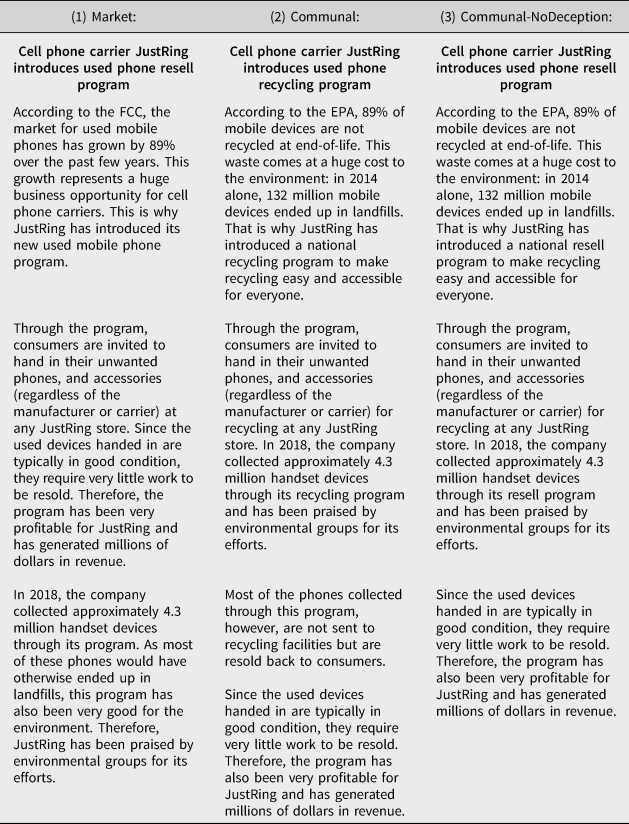
Scenarios used in Studies 1 and 2

Note. In Study 2, the Communal-NoDeception program was described as a ‘reuse’ rather than a ‘resell’ program.
Study 1 – Eliminating the deception cues: a ‘reselling’ initiative
In Study 1, we undertook to replicate the backlash effect as found in Makov & Newman's (Reference Makov and Newman2016) Experiment 4, and then to test whether it was best explained by communal norm violation or deception aversion by introducing a new experimental condition.
Method
Participants were 309 US residents randomly allocated to one of three framing conditions: Communal, Market, and Communal-NoDeception. They received £0.50 for participating. As preregistered, we excluded 24 participants who failed a comprehension check. This left 285 participants (120 men, 161 women, 4 gender not disclosed, M age= 33.7, SD = 11.0, 3 age not disclosed) with 100 in the Market framing, 90 in the Communal framing and 95 in the Communal-NoDeception framing. The average completion time was approximately 4 min.
In all conditions, participants read a hypothetical news story describing how a phone company implemented their phone recycling or reselling strategy, almost identical to Makov and Newman's (Reference Makov and Newman2016) original text. We introduced three minor modifications of no theoretical significance: (1) we changed the dates in the scenarios, to preserve the same time distance between the events described and the time of answering as in the original experiment; (2) we replaced the real mobile operator (AT&T) with the fictional ‘JustRing’ to avoid associating a real company with a fictional and negative scenario; (3) as an aide memoire, the complete text of the scenario was displayed at the bottom of the screen when participants rated JustRing. Table 1 shows the full text of our scenarios.
We propose the Communal framing (Column 2) contains strong deception cues. It introduces the company's motive as the reduction of phones that end up in landfill, hence for environmental purposes, and then gives the sentence implying that the company is not doing what consumers expect: ‘Most of the phones collected through this program, however …. ’ This sentence implies that the company deceived their customers to earn a profit. To test this conjecture, we added a third condition, the Communal-NoDeception framing (Table 1, Column 3) derived from the Communal framing by removing the deception cues. We did this by taking out the sentence given above, and by labelling the program a ‘resell’ rather than a ‘recycling’ program to accurately reflect what happened to the phones.
After reading the scenario, participants evaluated the company on 12 items (presented in a random order determined independently for each participant), averaged to construct an overall company rating. Seven items were judgments of the program: its ethicality, acceptability, morality, altruism, selfishness, manipulativeness and, on the part of respondents, their overall approval of the initiative. The other five concerned the company in general, including competence, product quality, and (on the part of the respondents) liking, trust and purchase intention. The items formed a highly reliable scale (Cronbach's α = 0.92). Following this rating task, participants provided demographic information.
If the main driver of the backlash effect is communal norm violation, the Communal-NoDeception framing should be equivalent to the Communal framing. If the main driver is deception aversion, however, the Communal-NoDeception framing should be equivalent to the Market framing. Intermediate results are also possible.
Results
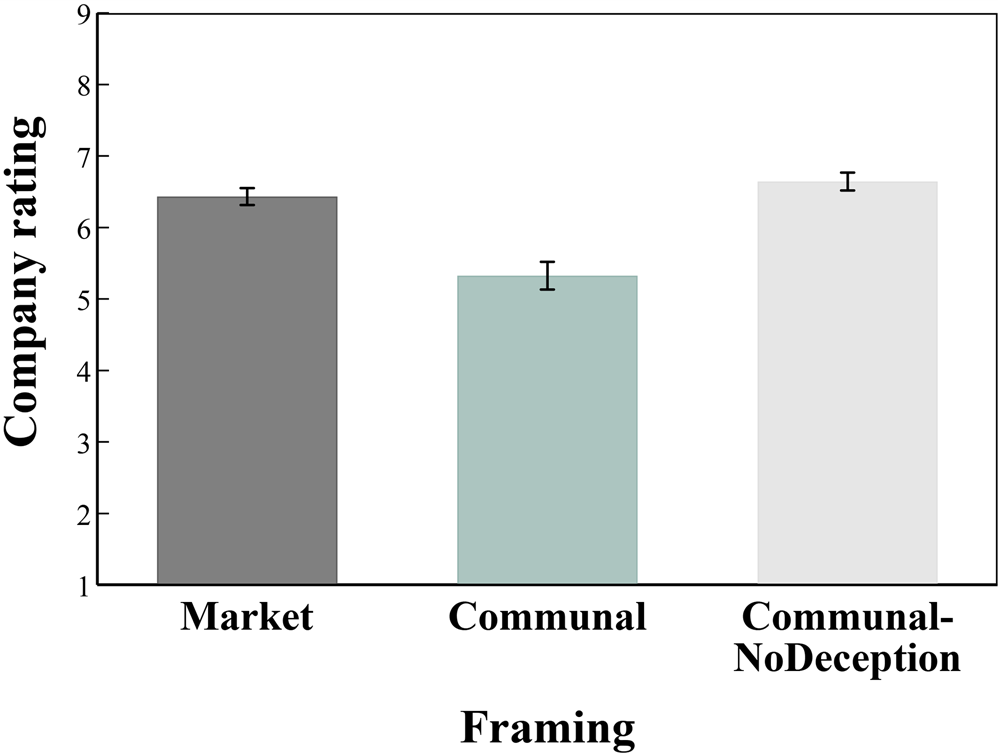
As shown in Figure 1, the results support deception aversion. There was a clear backlash effect: the initiative was more appealing under Market framing (M = 6.43, SD = 1.19) than under Communal framing (M = 5.33, SD = 1.83), t(150.87)= 4.88, p < 0.001, d = 0.72, 95% CI = [0.43, 1.02], BF10 > 100 (decisive evidence), successfully replicating Makov and Newman (Reference Makov and Newman2016). Crucially, however, even though it was designed to invoke the communal norm, company ratings in the Communal-NoDeception framing (M = 6.64, SD = 1.21) did not differ from the Market framing, t(193.92) = –1.22, p = 0.223, d = –0.18, 95% CI = [–0.46, 0.11], BF10 = 0.313, indicating substantial evidence for the null hypothesis of no difference. When deceptive language was removed from the scenario, there was no backlash effect.
Company rating per framing, Study 1. Note. Error bars represent standard errors of the mean.

Study 2 – Eliminating the deception cues: a ‘reusing’ initiative
Study 1 suggests the different responses to the Communal and Market framing were entirely driven by deception aversion, rather than by communal norm violation. However, it is possible that, by referring to the company's initiative as a ‘resell’ program, we primed participants in the Communal-NoDeception framing with market norms. This could explain the similar company ratings in the Market and Communal-NoDeception framings. Study 2 rules this out.
Method
Participants were 305 US residents randomly allocated to one of three framing conditions (Market, Communal, Communal-NoDeception). They were recruited from Prolific in exchange for £0.50. We excluded 29 participants who failed the comprehension check, leaving us with 276 valid responses (132 men, 139 women, 5 gender not disclosed, M age= 32.5, SD = 10.7, 3 age not disclosed), 95 in Market framing, 89 in Communal and 92 in Communal-NoDeception. The study took a little over 4 min on average.
To exclude the possibility that the Communal-NoDeception framing activated market norms, we described the initiative as a ‘reuse’ rather than a ‘resell’ program. The procedures were otherwise just as in Study 1. The answers to the 12 questionnaire items again formed a reliable scale (α = 0.93).
Results
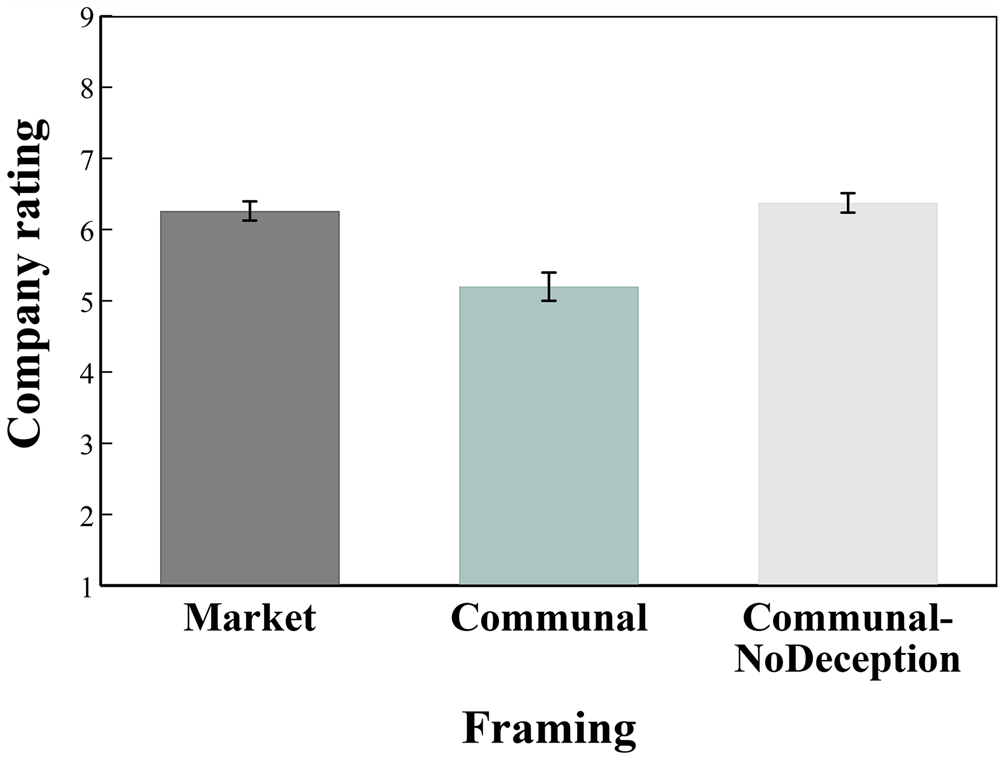
The results, shown in Figure 2, are virtually identical to those of Study 1, ruling out the possibility that the use of the ‘resell’ term was responsible for those results. Ratings were higher under Market framing (M = 6.26, SD = 1.31) than under Communal framing (M = 5.20, SD = 1.87), t(158.29) = 4.43, p < 0.001, d = 0.66, 95% CI = [0.36, 0.96], BF10 > 100 (decisive evidence). As in Study 2, the Communal-NoDeception framing did not differ from the Market framing, in line with deception aversion: M = 6.37, SD = 1.31), t(186.84) = –0.59, p = 0.558, d = –0.09, 95% CI = [–0.37, 0.20], BF10 = 0.186 (strong evidence for the null hypothesis). In short, as in Study 1, the evidence suggests that the deceptive language leads to the backlash effect.
Company rating per framing, Study 2. Note. Error bars represent standard errors of the mean.

Discussion
Studies 1 and 2 suggest that deception aversion, and not communal norm violation, is the main cause of the backlash effect. We precisely replicated earlier findings of a backlash effect in the comparison between the Communal and Market framing conditions but found no backlash effect when the language implying deception was removed without affecting whether communal or market norms were evoked.
Study 3 – Deception and profitability
Our findings so far indicate that consumers dislike companies that do something other than what they announced, or implied they would do, and earn a profit as a result. To explore the boundary conditions of this mechanism, Study 3 tested whether people object to deception in itself or they dislike it only when (they suspect) it is deployed to disguise profit.
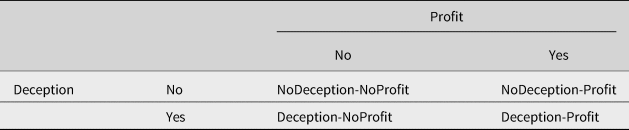
We examined the effects of independently manipulating deception and profit on the evaluation of a win-win initiative via a 2 (NoDeception vs Deception) × 2 (NoProfit vs Profit) design based on a variant of the phone reselling scenario. The resulting four conditions are summarised in Table 2.
Design of Study 3
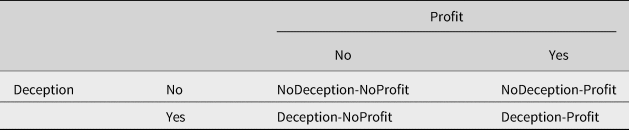
The Communal-NoDeception and Communal framing of Studies 1 and 2 correspond to the NoDeception-Profit and Deception-Profit conditions of Study 3. As we have shown, these conditions demonstrate that a backlash effect occurs in the presence of profit and deception. The NoDeception-NoProfit and Deception-NoProfit conditions, also based on the Communal framing scenario used in those studies, allow us to test simultaneously for two possibilities. First, whether deception on its own can cause a backlash even if it does not result in profit – indicating a main effect of deception – and second, whether any such effect is larger if deception results in profit – pointing to an interaction between deception and profit. To power our study to detect a possible interaction, relative to the earlier studies, we more than doubled the number of participants in each condition (see, e.g., Simonsohn, Reference Simonsohn2015 and Blake & Gangestad, Reference Blake and Gangestad2020 for discussions about the need for large samples to detect interactions).
As well as studying the separate contributions of deception and profit to the backlash effect, we expanded our analysis by introducing an additional dependent measure that we refer to as intended support. Intended support reflects how much the negative reactions captured by lower company ratings translate into less positive behavioural intentions towards the company, in the form of a lower propensity to participate in the company's initiative or being less likely to recommend it to others. In the context of the hypothetical scenarios used in our studies, the intended support measure takes us one step closer to identifying the potential behavioural consequences of the backlash effect.
Method
Participants were 1,038 US residents randomly allocated to one of four experimental conditions. They were recruited from Prolific in exchange for £0.50. We excluded 31 participants based on the comprehension check.Footnote 2 This left 1,007 participants (532 men, 464 women, 11 gender not disclosed, M age = 34.0, SD = 11.6, 13 age not disclosed) with 254 in NoDeception-NoProfit, 248 in Deception-NoProfit, 252 in NoDeception-Profit and 253 in Deception-Profit. The study took an average of almost 6 min.
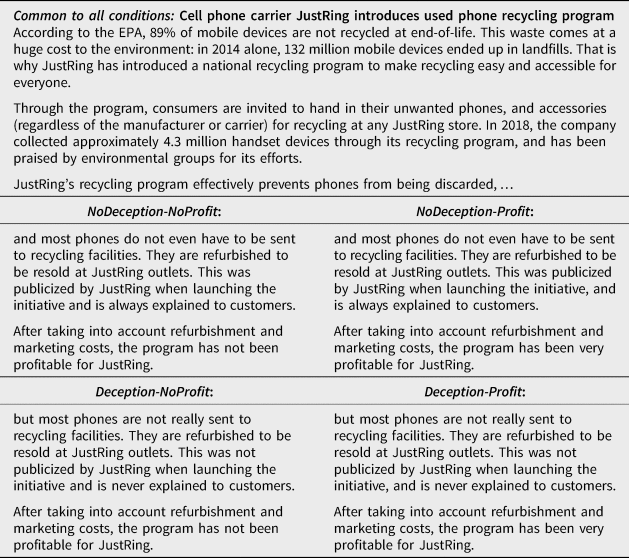
Participants read a scenario presented as a hypothetical news item (see Table 3). All scenarios began with an identical description of a recycling initiative analogous to the Communal framing used in Studies 1 and 2. In the second part of the scenario, we manipulated whether the company informed customers that their old phones could be resold (NoDeception vs Deception), and whether the initiative was profitable (NoProfit vs Profit).
Scenarios used in Study 3
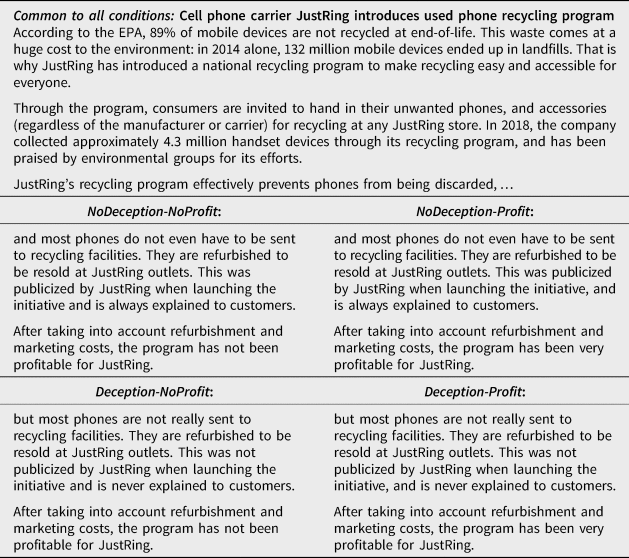
Participants rated the initiative on the company rating scale used in Studies 1 and 2 (α = 0.95). The three additional intended support items (combined into a single scale, α = 0.95) assessed if they would donate a phone to JustRing's program or recommend the program to a friend or family member.
Results
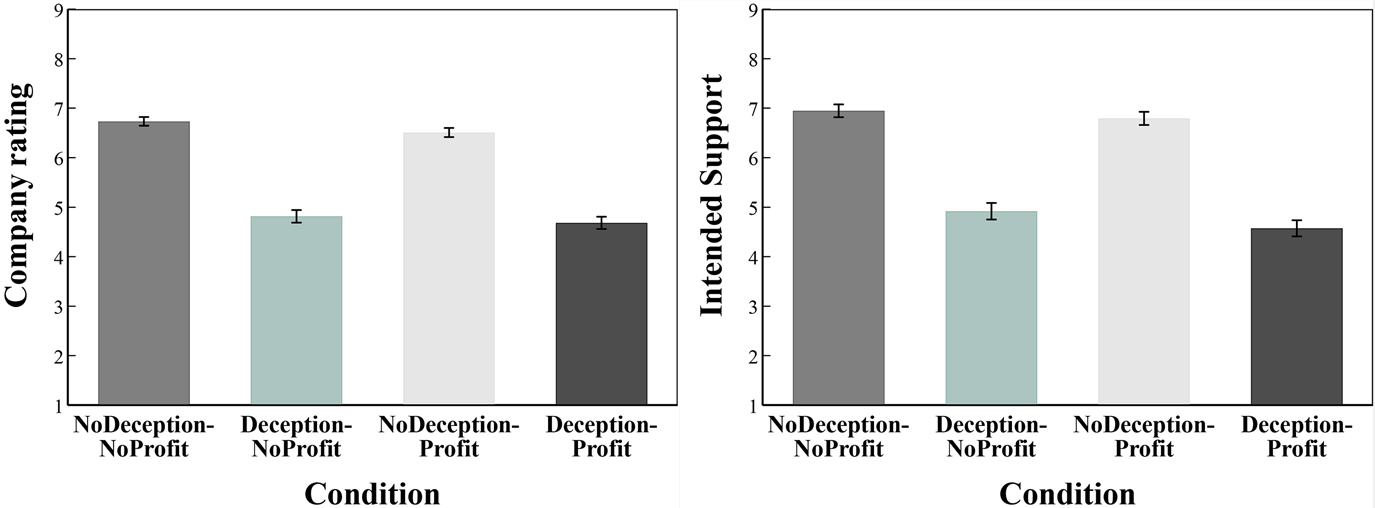
As seen in Figure 3 (panel (a) for company ratings and panel (b) for intended support), the company consistently scored less positively when they deceived, regardless of whether they earned a profit or not. The presence or absence of profit made very little, if any, difference.
Company rating (a) and intended support (b) per condition, Study 3. Note. Error bars represent standard errors of the mean.

We confirmed these observations with a two-way ANOVA on company ratings. There was a sizeable main effect of deception F(1, 1003) = 292.11, p < 0.001; no main effect of profit, F(1, 1003) = 2.69, p = 0.101 and no interaction F(1, 1003) = 0.17, p = 0.677. A similar picture emerges for intended support: a main effect of deception F(1, 1003) = 202.57, p < 0.001; no main effect of profit, F(1, 1003) = 2.79, p = 0.095 and no interaction F(1, 1003) = 0.41, p = 0.523.
We tested the two main effects separately to assess their magnitude. Company ratings were lower with deception (M = 4.75, SD = 1.99) than without (M = 6.62, SD = 1.45), t(915.5) = 17.07, p < 0.001, d = 1.08, 95% CI = [0.94, 1.21], BF10 > 100. Intended support was also lower with deception (M = 4.74, SD = 2.61) than without (M = 6.87, SD = 2.10), t(958.77) = 14.22, p < 0.001, d = 0.90, 95% CI = [0.77, 1.03], BF10 > 100. For both dependent measures, Bayes factors indicate decisive evidence for the hypothesis that deception reduces company ratings and intended support, as clearly shown in Figure 3.
There was no corresponding main effect of profit. Company ratings were equally positive when the initiative was not profitable (M = 5.79, SD = 1.98) as when it was (M = 5.59, SD = 1.97), t(1006.88) = 1.55, p = 0.121, d = 0.10, 95% CI = [–0.03, 0.22], BF10 = 0.231. The same pattern occurred for intended support ((M = 5.94, SD = 2.56 vs M = 5.68, SD = 2.63), t(1006.64) = 1.61, p = 0.107, d = 0.10, 95% CI = [–0.02, 0.23], BF10 = 0.254). For both analyses, Bayes factors indicate substantial support for the null hypothesis that profit has no effect.
General discussion
We investigated whether the backlash that companies may suffer when undertaking profitable prosocial initiatives is caused by the mechanisms of communal norm violation or deception aversion. Our results support the deception aversion hypothesis. Consumers appear to understand that businesses need to be profitable, and do not object to them earning a profit while undertaking socially beneficial activities. They do, however, object to being deceived, whether or not the deception results in profit. When there is deception, there is a backlash, but not otherwise.
The deception aversion mechanism is consistent with evidence from other research fields. There is an extensive organisational literature showing that CSR activities are often met with scepticism (e.g. Webb & Mohr, Reference Webb and Mohr1998; Campbell & Kirmani, Reference Campbell and Kirmani2000; Ellen et al., Reference Ellen, Mohr and Webb2000; Vlachos et al., Reference Vlachos, Tsamakos, Vrechopoulos and Avramidis2009; Skarmeas & Leonidou, Reference Skarmeas and Leonidou2013; Connors et al., Reference Connors, Anderson-MacDonald and Thomson2017). Rather than uncritically accepting companies’ prosocial claims, people often interpret them as insincere and self-serving (e.g. Fein et al., Reference Fein, Hilton and Miller1990; Forehand & Grier, Reference Forehand and Grier2003; Becker-Olsen et al., Reference Becker-Olsen, Cudmore and Hill2006; Yoon et al., Reference Yoon, Gürhan-Canli and Schwarz2006). For example, one survey found that only 12% of US residents trust energy-efficiency labels (Gershoff & Frels, Reference Gershoff and Frels2015). This scepticism can stem from concerns about a lack of transparency, or about greenwashing and its associated deception (e.g. Becker-Olsen & Potucek, Reference Becker-Olsen, Potucek, Idowu, Capaldi, Zu and Gupta2013; Leonidou & Skarmeas, Reference Leonidou and Skarmeas2017; Chen et al., Reference Chen, Bernard and Rahman2019).
Similar dynamics may apply within organisations. For instance, Amengual and Apfelbaum (Reference Amengual and Apfelbaum2021) show that, when companies attempt to induce their employees to adopt behaviours that advance both prosocial and instrumental aims, they will be more likely to succeed if they highlight the instrumental aims. The underlying reason is that instrumental motives are widely assumed in organisational contexts, and so employees perceive them as more genuine. Relatedly, Cassar and Meier (Reference Cassar and Meier2021) show that CSR activities can motivate employees only when these efforts are perceived as genuine and sincere – if the initiative is seen as a ruse to extract low-cost labour from those employees, they react negatively.
Finally, recent work investigating the tainting effects of profit on the evaluation of altruistic and prosocial acts by organisations also suggests the key role of deception. Alempaki et al. (Reference Alempaki, Isoni and Read2023) show that organisations that earn a profit from nudging their clients for prosocial reasons are judged less positively than organisations that nudge without earning a profit, but more positively than organisations that earn a profit without generating any prosocial benefits. Yet, organisations that deceive about their motives by claiming a prosocial rather than a profit motivation are judged more negatively overall and obtain little acknowledgement for the social good they achieve. A related finding comes from de Jong et al. (Reference de Jong, Huluba and Beldad2020), who show that, when organisations carry out an environmentally positive activity because of legal obligations and then attempt to take credit for it, they gain no reputational benefit at all. De Jong et al. call this ‘motive greenwashing’.
We underline our conclusions by returning to Virgin Atlantic's (2022) sustainability initiative. Earlier, we gave only part of their statement of purpose. The complete statement follows: ‘As an airline, we're clear that fuel and carbon efficiency is our number one environmental priority. Not only does aircraft fuel use account for more than 99% of our direct carbon emissions, it's also the single biggest cost to our business, so it's a double win to address it.’ The communal norm violation hypothesis might suggest the first part of this claim would invoke a communal norm (‘number one environmental priority’) that would be undermined by discovering that fuel saving also has business benefits. On the contrary, we would argue that since there is no suggestion Virgin Atlantic is trying to deceive, there will be no backlash. Our findings are consistent with this: consumers respond negatively to non-truthful organisations, but not to profitable ones. Full transparency is the best policy.
While our findings challenge the view that businesses are likely to suffer from consumer backlash due to communal norm violation, this does not rule out that this may have important effects in other contexts. However, some previous findings showing people discredit prosocial actions if they are accompanied by profits might be, at least partially, driven by the proposed deception aversion mechanism. Consider, for instance, Carlson and Zaki's (Reference Carlson and Zaki2018, Experiment 2, Vignette 3) demonstration of a man judged negatively for volunteering to assist their neighbour in carrying ‘a large crate of new power tools’ to be able to ask to borrow the tools at a later stage. It is not straightforward whether evaluators react negatively to the selfish motives accompanying a prosocial action or to the fact that these motives were hidden from the neighbour. Similarly, Lee et al. (Reference Lee, Bolton and Winterich2017, Experiment 2) discuss how, when people learn that one of their favourite charities is in fact a profit-earning business, they judge it very negatively. In this example, it is hard to know how much violations of expectations about organisational norms play a role (i.e. organisations of this type should not earn a profit), but the charity is certainly not being upfront about its status. As Lee et al. (Reference Lee, Bolton and Winterich2017) report, participants were ‘surprised’ to learn that what they thought was a charity was in fact a for-profit social enterprise, suggesting they felt deceived.
In many circumstances, deception and norm violation are not easy to disentangle, and it may not always be easy for organisations that earn a profit to claim that their main goal is to help society without raising doubts about their true motives, and even their likely actions. But Lee et al. (Reference Lee, Bolton and Winterich2017, Experiment 3) also illustrate, as we have done, that profit-earning companies with explicit prosocial agendas are not punished relative to companies that merely earn a profit.
The vignette methodology used in our studies and in the broader literature (e.g. see Finch, Reference Finch1987; Hughes & Huby, Reference Hughes and Huby2002; Aguinis & Bradley, Reference Aguinis and Bradley2014 for overviews) has the advantage of allowing us to neatly demarcate the boundaries between deception aversion and communal norm violation (or, more generally, other potential mechanisms), with obvious benefits in terms of internal validity. The hypothetical nature of the resulting scenarios is a possible limitation, as consumers may react differently when they are personally involved in events, as recipients or observers of real-world company behaviour, instead of having the events described to them. A related issue is that whether consumers feel deceived or not is usually left to their judgment. As a result, the same situation may be interpreted by some as an attempt to deceive, by some as a violation of an implied norm and by others in yet different ways. A key challenge for future research will be to study phenomena like the backlash effect in field settings that allow researchers to pin down the mechanisms at work.
Conclusion
We investigated the possibility that, if companies who profit from prosocial initiatives emphasise the good they do for society, they will suffer a backlash from the public and lose reputation and (perhaps) market share. We concluded this risk exists when companies deceive consumers. The source of the problem is the deception, not the fact that companies earn profits while doing good. Our findings, therefore, provide useful advice for organisations that grapple with the problem of how to communicate that they strive to maximise profits and be prosocial. At a time when there is a pressing need to contribute to society, businesses can do their part without sacrificing their bottom line by openly disclosing the win-win nature of their prosocial initiatives.
Acknowledgements
We thank Tamar Makov and George Newman for providing us with their original data, and for commenting on an earlier draft of the manuscript. We also thank Yuri Kato and Hao Wei for excellent research assistance. We acknowledge the financial support of the University of Warwick and the Economic and Social Research Council [grant number ES/P008976/1] via the Network for Integrated Behavioural Science Programme.
Author contributions
Author names are listed in alphabetical order. All authors contributed equally.
Funding
The studies were funded by the University of Warwick and the Economic and Social Research Council [grant number ES/P008976/1] via the Network for Integrated Behavioural Science Programme. The funders had no role in the study design, data collection and analysis, decision to publish or preparation of the manuscript.
Competing interest
All authors declare that they have no conflict of interest.
Ethical approval
All procedures performed in studies involving human participants were approved by the Humanities and Social Sciences Research Ethics Committee at the University of Warwick and were performed in accordance with the 1964 Declaration of Helsinki and its later amendments or comparable ethical standards.
Informed consent
Informed consent was obtained from all individual participants included in the studies.
Data, Materials and Code availability
All data, materials and code underlying the results reported in the manuscript can be found on Open Science Framework at https://osf.io/tvbm7/.

 Open access

