

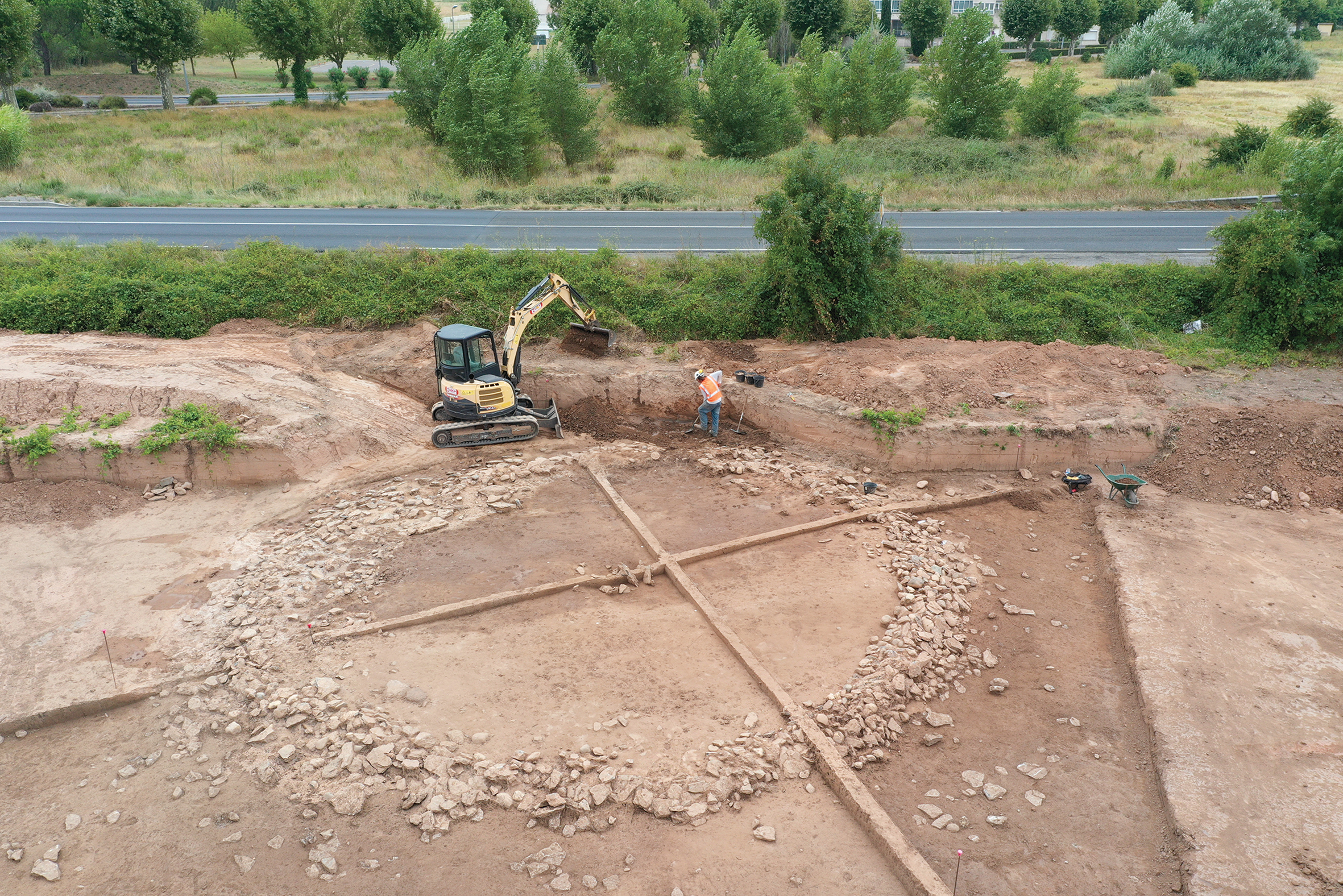
Excavations during summer 2020 at Roque del Die, east of Capendu, Aude department, in south-western France. Investigations in advance of construction have identified three monumental tombs, forming part of a much larger cemetery, previously investigated in 2008. The circular features are 12–15m in diameter and composed of sandstone blocks. Indications of wall facing and courses suggest that each circle supported an earthen mound. At the centre of each enclosure is a slab-built chest. One of these has yielded bones from at least two individuals, probably a child and a woman, as well as personal ornaments of shell and bone dating to the Early Bronze Age (c. 2200–1600 BC). Photograph © Pascal Druelle, Inrap.
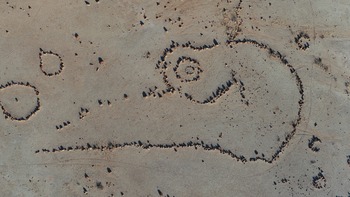
An Aboriginal stone arrangement located in the country of the Mithaka Aboriginal people in the desert channels region of Central Australia. A stone-lined curvilinear pathway leads into two closed circles, forming part of a much more extensive stone arrangement. According to ethnohistorian Alice Duncan Kemp (an early twentieth-century archivist of the Mithaka), these were places where Aboriginal people asked for the influence of the spirits. In Mithaka country, such arrangements may be associated with initiation ceremonies, exchange of marriage partners and cult rituals, as well as trade and exchange. The main structure is approximately 20m in length. The site was located by Mithaka Traditional Owner Josh Gorringe with retired surveyor Ian Andrews in early 2020, and photographed by a quadcopter drone © Mithaka Aboriginal Corporation.

Noughts and crosses
 The end of each year offers a moment to look back on the previous 12 months. The end of a decade provides the occasion to reflect on a more substantial slice of time, to see beyond events and to differentiate the signal from the noise. There is also the opportunity to look ahead and to hope for a prosperous and healthy future. Duly, the end of 2019 was marked by the perennial—and decennial—ritual of looking both back and forward. Twelve months on, 2020 has not turned out as hoped or expected. Even though the threat of COVID-19 had been identified well before the start of the new year, few predicted the speed and scale of events. Combined with the other great social and political movement of the past year, the Black Lives Matter protests, 2020 feels like a tumultuous start to the 2020s. But has the third decade of the twenty-first century already begun? The calendrical purists may beg to differ: if the first decade of our era runs from AD 1–10 and the second from 11–20, and so on, then the end of the 2010s is not 2019 but 2020. Numerical neatness has long since seen the decades and centuries shifted forward by a year—the Millennium bug, for example, focused on the rollover from 1999–2000, not 2000–2001. Nonetheless, many would welcome the opportunity to restart the decade in 2021.
Today, one system dominates the way in which the world organises time: the Gregorian calendar, labelling years reckoned from the birth of Christ. Although sometimes rendered as the Common Era, a name that can be traced back 400 years to Johannes Kepler, the global dominance of the Anno Domini scheme is a function of one continent's religious, scientific and military expansion; its commonness belies the power structures that brought it to universality. The reckoning of years in relation to the Nativity is attributed to Dionysius Exiguus, a Scythian monk based in Rome c. AD 500. The purpose of Dionysius’ scheme was to establish the timing of that most calendrically troublesome of Christian celebrations, Easter. Two hundred years later, in a distant corner of a foggy island off the north-west coast of Europe, a monk was still working on the same problem—when should the faithful mark the resurrection of Christ? But it was that monk's use of the Anno Domini system as the chronological framework for his Historia ecclesiastica gentis Anglorum, or Ecclesiastical history of the English people, that laid the foundations for the system used so widely today (Figure 1).
Manuscript of Bede's Historia ecclesiastica gentis Anglorum from the first half of the ninth century. Photograph © The British Library, Cotton MS Tiberius C II (https://www.bl.uk/collection-items/bedes-ecclesiastical-history-of-the-english-people).

That distant corner of a remote foggy island was north-east England, the setting for the twin monasteries of St Peter and St Paul (Monkwearmouth and Jarrow) and home to the ‘Father of English history’, the Venerable Bede. Satirised in Yeatman and Sellar's 1066 and all that as the ‘Venomous Bede’Footnote 1—the name by which he was always known during my undergraduate days in nearby Newcastle—Bede was the greatest scholar of the Anglo-Saxon world and his scholarship has had an enduring impact on the reckoning of time. Nonetheless, in his native north-east England, Bede was much less of a local medieval celebrity than his near contemporary and patron saint of northern England, St Cuthbert or ‘Cuddy’. Indeed, for several centuries the venerable monk's remains were interred within Cuthbert's lavish tomb in Durham Cathedral before finally being relocated to his own tomb in 1370. In turn, that tomb and the shrine that developed around it were dismantled during the Reformation and replaced with the simple chest-tomb still to be seen in the cathedral's Galilee chapel today.
Appropriately, for a figure who has wielded such influence on the reckoning of time, Bede's tomb and his mortal remains have been the subject of long-running archaeological interest. In 1827, the antiquarian and cathedral librarian James Raine took it upon himself to open the tomb of St Cuthbert—where Bede had once been interred—recovering an astonishing series of finds. In addition to the well-preserved remains of St Cuthbert was another skull, attributed to the Northumbrian king Oswald, and an assemblage of children's bones passed off, Raine claimed, by the monks as “relics of children slain by Herod”.Footnote 2 He also found Cuthbert's original seventh-century wooden coffin, his gold-and-garnet pectoral cross and a wealth of other objects, many of which are today on show in the cathedral's ‘Open Treasure’ exhibition.
Perhaps hoping for further sensational finds, in 1831 Raine dismantled Bede's chest-tomb and, excavating 3ft down, discovered a coffin. In contrast to the opulence of Cuthbert's burial, however, this coffin was found to contain only an incomplete and poorly preserved set of human bones and a finger ring. Raine's precise motives in opening the tomb remain unclear, for he declared no interest in the question of whether these really were the remains of Bede and the bones were briskly reinterred and the chest-tomb reassembled. Before reburial, however, Raine took a cast—in fact, three—of the top of the skull, including the brow, on account of its ‘most peculiar’ form. As recently as 2001, a search could find no trace of any one of the three casts until, quite by chance, one was discovered a few years ago in the Duckworth Laboratory collection in the Leverhulme Centre for Human Evolutionary Studies at the University of Cambridge. Raine had given one of the casts to John Thurnam, a medical doctor and antiquary with a keen interest in skulls, and it was his personal collection that would go on to form the core of the Duckworth Laboratory's collection. Thurnam was co-author of the six-fascicule volume Crania Britannica (1856–1865), and a keen proponent of the idea that the characteristics of skulls could allow individuals to be categorised into a hierarchy of ‘races’. In their investigation of the rediscovered cast in the Duckworth collection, Story and BaileyFootnote 3 relate how Thurnam considered the skull to lack the expected characteristics of an ‘Anglo-Saxon’ cranium, an observation at odds with both Bede's identity and Thurnam's association of Anglo-Saxon ancestry with superior intellect. This led him in turn to question whether the bones discovered by Raine really were those of the venerable monk. Given the emphasis put on different ethnic groups in Bede's histories—Britons, Picts, Scots, Irish, Angles and others—there is a certain irony that his mortal remains should have become the subject of the racialised science of skull measuring. But were the bones found by Raine and studied by Thurnam actually those of Bede? Story and Bailey's review of the documentary evidence leads them to the conclusion that the remains unearthed in 1831 can be plausibly traced back at least to the early twelfth century. Hence, even if the bones interred in Durham Cathedral today are not those of the Venerable Bede, they have nonetheless been venerated as such for at least nine centuries.
Bede may have lived and died well over a millennium ago, but his life-story makes him a man of our own time. As a teenager, in AD 686, he survived a plague that claimed the lives of the majority of his community. He lived a monastic life—a type of self-imposed isolation or social distancing—but he was far from parochial; through his library, the internet of its day, he was well connected to the wider world and sought to engage with and understand it. If COVID-19 has played with our sense of time over the past year, it was Bede who helped to establish the way in which we reckon time in the first place.
Fire and flood
 Whether the end of the 2010s or the start of the 2020s, the past year has brought a striking range of disasters, from the global pandemic to swarms of locusts that have eaten their way across swathes of East Africa and parts of South Asia. Fires and floods in particular have been in the news throughout the year, indeed from its very start: on 1 January, while unprecedented wildfires burned across large parts of New South Wales and Victoria in Australia, much of the Indonesian capital of Jakarta began the year underwater. In more recent months, the worst floods in a generation have swept down the Yangtze River, record-breaking water levels have been recorded on the Blue Nile, and wildfires have raged around the Arctic Circle, in Amazonia and along the U.S. Pacific coast. All of these fires and floods have led to loss of life and property and devastated wildlife, landscapes and economies. They have also threatened, damaged or destroyed cultural heritage. Flooding at the pyramids at Meroe in Sudan was narrowly averted and the citadel of Mycenae in Greece had a lucky escape from wildfires burning through the surrounding hills. Such well-known sites, however, are only the tip of the (melting) iceberg. The damage to wider archaeological landscapes is enormous. Each year, forest fires, coastal storms and melting glaciers may reveal many archaeological sites and objects—but unknowable numbers are also lost without record.
The irony of such losses is that the archaeological record forms a critical part of the archive of past climate and environmental change. As our weather grows increasingly erratic, we have become accustomed to news that the previous month or year has been the hottest, wettest—insert relevant superlative here—‘on record’. In practice, this usually means formal meteorological records stretching back several decades, or perhaps a century at most. But archaeological and palaeoenvironmental data offer a much longer record against which to understand our changing climate and environment, the impact of natural events on human societies and the responses to them, and, crucially, the active role of people in shaping these events and processes. Several papers in the current issue focus on these themes.
Around 8150 BP, a huge underwater landslide off the coast of southern Norway sent out a tsunami into the North Atlantic and south into the North Sea. For Mesolithic communities living in coastal areas, and especially in the extensive lowlands known as Doggerland that now lie beneath the southern North Sea, the Storegga tsunami was a sudden and unexpected event in a period already characterised by rapidly changing climate and environment. Several Mesolithic sites have been identified beneath deposits laid down by the tsunami, feeding into both scholarly and popular accounts of the impact of the event, the latter including Margaret Elphinstone's ‘pre-historical’ novel, The gathering night. Footnote 4 The effects of the tsunami on Doggerland, however, have to date been difficult to assess—did the wave sweep over land occupied by mobile groups, drowning the inhabitants and permanently submerging the area? Or had humans more or less abandoned the region prior to the tsunami? Perhaps the low-lying land had already been largely submerged by rising sea levels? Direct evidence from beneath the southern North Sea has been limited to date. In this issue, Walker et al. review the competing hypotheses about the impact of the Storegga tsunami and present new evidence from cores taken 40km off the current coastline of Britain. Deposits dated to the time of the Storegga event demonstrate the localised impact of the tsunami, reflecting the influence of topography in either blocking or amplifying the wave, while sedimentary aDNA suggests the recovery of terrestrial plant species following the event. The authors conclude that the tsunami was not ‘universally catastrophic’ and that parts of Doggerland survived, only finally succumbing to the inexorable sea-level rise at a later date.
Short of running for the high ground, the Mesolithic communities of the North Sea coasts had limited options in their immediate response to a sudden and unprecedented event. Climate change unfolding over decades, centuries or millennia, however, allows for adaptation, whether relocating settlements to avoid flooding or taking advantage of newly available ecological niches. In their article on Hellenistic and Roman Greece, Bonnier and Finné combine the results of regional field survey with modelling of climate proxies to identify a correlation between a period of drier climate and the reorganisation of agricultural production. The authors observe that political and military events are often assumed to have shaped the changing landscapes of classical antiquity, but here they demonstrate that the effects of climate and environmental change should not be underestimated. Moreover, in the same way that the evidence emerging from beneath the North Sea for the impact of the Storegga tsunami indicates very localised effects, so the modelling for ancient Greece also points to micro-regional patterns of climate change and adaptation.
Humans, however, not only adapt to environmental and climate change—they also create it, in particular through the use of fire, whether clearing forest for agriculture or burning fossil fuels for power. The American Southwest has just experienced the worst ‘megadrought’ in over a millennium, and a recent study attributes half of the explanation to anthropogenic causes.Footnote 5 The effects of such prolonged drought have been all too obvious during 2020. Fires have ravaged more than 20 000km2 of California, Oregon and Washington, renewing questions about the role of fire in ‘natural’ and managed landscapes. Specifically, have forestry management practices intended to prevent fires exacerbated the scale and ferocity of such events? A recent study of archaeological ceramics from the Jemez Mountains in New Mexico uses OSL dating of pottery sherds to demonstrate that the most recent twenty-first-century fire event was more intense than fires over the previous millennium, probably because of the build-up of fuel through fire-prevention strategies.Footnote 6 Indeed, a growing consensus is emerging, drawing on the results of palaeoecological studies and the traditional knowledge of Indigenous groups about the use of fire in maintaining healthy and less combustible forests.Footnote 7 Such ‘braiding’—to use Sonya Atalay's metaphor—of Western and Indigenous sciences is developing as a critical means of advancing both the responsible stewardship of ecological resources and wider social justice.Footnote 8
The intersection of climate change and fire, this time in western Amazonia, is the subject of another article in this issue. Earlier studies have interpreted the presence of charcoal in the regional palaeoenvironmental record as an indicator of increased fires resulting from a drier climate during the Early Holocene. Pärssinen et al., however, present evidence from beneath geoglyph sites near the Brazil/Bolivia border that points towards an anthropogenic explanation for the burning of vegetation through small-scale, periodic fires. As the evidence accumulates for the early peopling of South America and the role of humans in creating a ‘cultural forest’, the identification of anthropogenic soils resulting from active landscape management during the Early Holocene will require a rethinking of both human and climate history in the region.
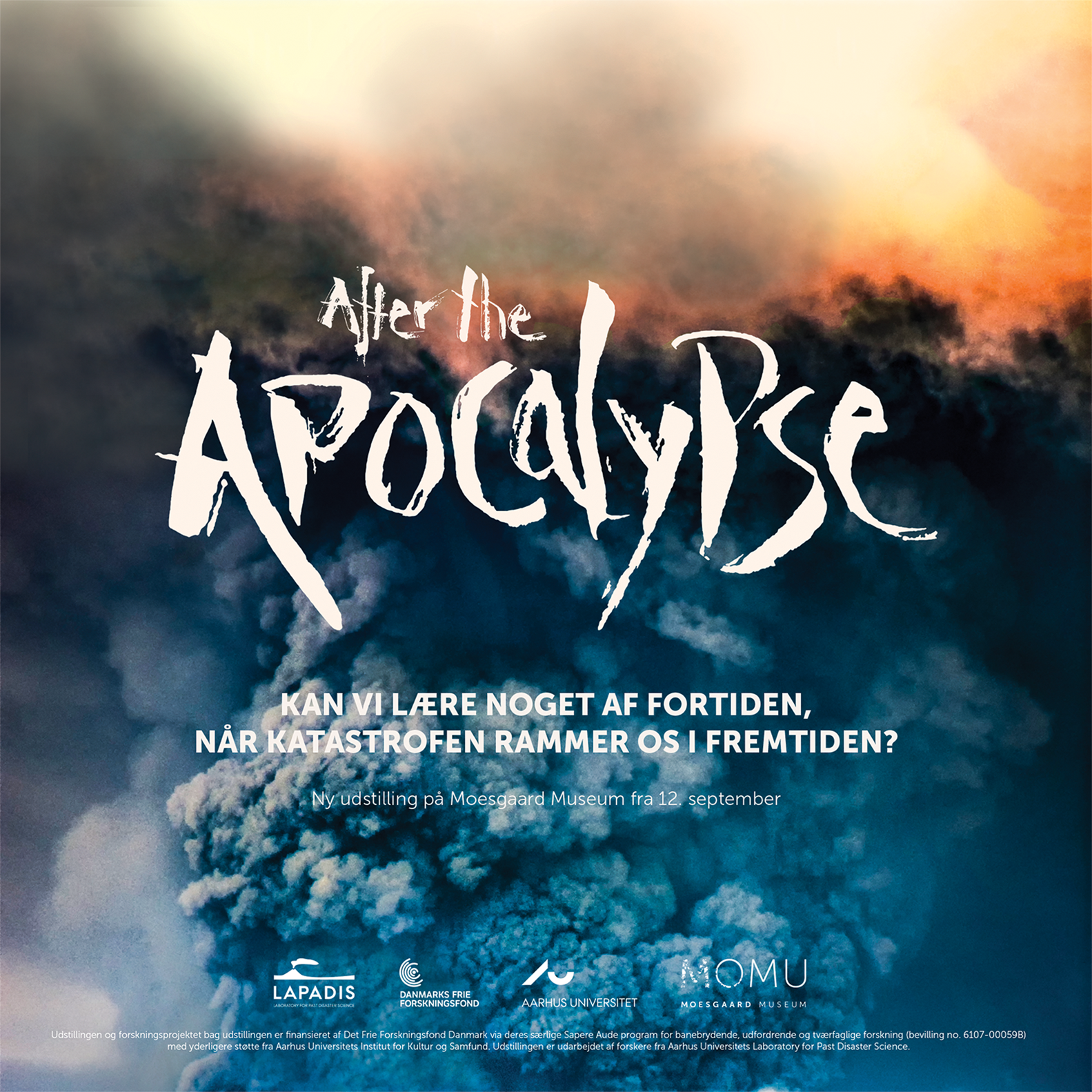
Two timely new exhibitions also explore aspects of the connections between human societies, environmental disasters and climate change. At the Moesgård Museum in Denmark, ‘After the Apocalypse’ examines the effects of the Laacher See volcanic eruption c. 13 000 years ago on the communities of prehistoric Europe and their responses to this disaster (Figure 2). The second part of the exhibition then advances forward to AD 2100 and examines the potential effects of such an event playing out across the Europe of tomorrow, asking: can we learn something from the past about disasters that may impact us in the future?
‘After the Apocalypse’ at Moesgård Museum focuses on the interaction of climate change and extreme events in revealing societal vulnerabilities. The exhibition contrasts a documented volcanic eruption c. 13 000 years ago with a hypothetical future event in 2100 indexed to IPCC-projected climate change across the same region. The curators ask: kan vi lære noget af fortiden, når katastrofen rammer os i fremtiden? Or, can we learn something from the past about disasters that may impact us in the future? Poster design: Tina Gylling Møller, Moesgård Museum.
Meanwhile, the British Museum's latest exhibition, ‘Arctic: Culture and Climate’, examines 30 000 years of human history in the far north. Adapting to the extreme Arctic environment has required innovation and ingenuity. Sadly, such human creativity and resourcefulness have not been applied to the issue of climate change, which is impacting disproportionately on the high-latitude regions. Temperatures are rising at two or three times the global average, threatening the local human populations, the ecosystems they rely on and their cultural heritage.Footnote 9 2020 already holds the unwanted record—another one—for the latest formation of the annual sea ice in the Laptev Sea and predictions for the first ice-free Arctic summer point to a date within the next few decades. The whole planet will experience the effects of less polar ice, but the most immediate impacts are being felt far from the fossil-fuel-consuming regions that continue to drive global warming. Appropriately, given the exhibition's subject matter, the museum's usual carbon-based corporate sponsor has been replaced. ‘Arctic: Culture and Climate’ runs until 21 February 2021.
In this issue
 Elsewhere in this issue, we return to the classic site of Glastonbury Lake Village and a new study of its chronology. We also have an article on the ongoing work at Gjellstad in Norway: the Jell Mound is one of the largest Nordic Iron Age funerary mounds in Scandinavia, but to date the site has appeared to stand in splendid isolation. Geophysical work, however, has now identified extensive activity in the surrounding area, which Gustavsen et al. interpret here as a high-status central place featuring a possible feasting hall and early Viking ship burial. Indeed, subsequent investigations of the latter have now confirmed the presence of a wooden vessel; they have also revealed significant problems with fungal decay, leading to the allocation of Norwegian government funding for urgent excavations over the past summer.
We also feature a Noah's Ark of animals. Fallow deer are not indigenous to Northern Europe and first appear in the archaeological record of the region as isolated bones that suggest the consumption of venison joints during the Roman period. Here, Pigière et al. present the first example of an articulated fallow deer skeleton from the northern Roman provinces. The ancient DNA and isotope analyses suggest that the animal was translocated to northern Gaul, rather than raised in the region, and, combined with the depositional context, may represent an animal imported for prestige and display rather than as a source of food or horn. Meanwhile, Valdez et al. take us to the Andes and new evidence for Inca sacrifice. The team's excavations have recovered a series of llama offerings inserted beneath buildings at the site of Tambo Viejo on the southern coast of Peru. Sacrifices such as these served to materialise and legitimise the power of the Inca state across its conquered provinces. After human beings, the most valued Inca sacrifices involved llamas and the authors demonstrate the careful sequence of ritual and symbolic steps followed in preparing the animals for death and deposition. Meanwhile, Eric Tourigny examines animal death in a very different context —the loss and commemoration of pets. Through an analysis of gravestones and memorials in nineteenth- and twentieth-century pet cemeteries in Britain, the author opens a discussion about historical and contemporary human-animal relations and our attitudes to bereavement and the mourning of pets.
Finally, we also have two articles on different aspects of colonial encounter. The first takes us to Wyoming where Scheiber and Burnett report on the results of fieldwork at Êngkahonovita Ogwêvi, or Red Canyon, that has sought to break down the dichotomies that have traditionally shaped the study of the American West: Indigenous vs settlers, prehistory vs history, cultural change vs tradition. By studying the remains of a nineteenth-century stagecoach station occupied by Swedish immigrants, a tipi ring campsite of the local Shoshone community and a series of petroglyphs, the authors identify the entangled histories of the people who lived in this area and how they engaged with one another's material cultures and the histories previously written into the landscape. Also on the theme of colonial relations, Fernández-Götz et al. open a debate on the ‘dark side’ of the Roman Empire, asking whether the recent emphasis on object agency and post-humanism has led scholars to neglect the role of human beings in facilitating the violent expansion of the Roman world. The authors argue for a new view of the Roman state as a ‘predatory regime’. Four respondents explore this proposition, including Lori Khatchadourian who turns to the current pandemic as a means of contrasting the agency of people vs things and differentiating between causation and culpability. And on that timely theme it remains only to thank everyone who has supported the journal over the past year and to wish you all a safe, prosperous and peaceful 2021.