



Childhood weight problems have become a crucial challenge to global health. Global overweight and obesity rates among children increased by 47·1 % from 1980 to 2013( Reference Ng, Fleming and Robinson 1 ). Underweight also exert effects on childhood well-being( Reference Black, Allen and Bhutta 2 ). In developed countries, 3–8 % of children are underweight, while the rate is about 16 % in developing countries( Reference Mukabutera, Thomson and Hedt-Gauthier 3 ). Studies show that weight problems tend to have an adverse impact on health and predict a wide range of mortality and future morbidity, especially for children under 5 years of age( Reference Ng, Fleming and Robinson 1 , Reference Black, Allen and Bhutta 2 ). Overweight and obese children are at higher risk of diabetes, CVD and psychosocial problems that extend into adulthood( Reference Lloyd, Langley-Evans and McMullen 4 ). Moreover, underweight in early childhood is related to future CHD( Reference Suastika, Dwipayana and Saraswati 5 ). While weight status in toddlers and school-aged children has been extensively studied, the crucial transitional pre-school age of 3–5 years still garners further research( Reference Reinehr, Kleber and Lass 6 , Reference Danielsson, Svensson and Kowalski 7 ). Pre-school children are not only in the period of the adiposity rebound, but also fill the age gap between toddlers and school-aged children( Reference Zong, Li and Zhang 8 ).
Given the growth trend of childhood weight problems, it is crucial to explore the contributing factors. Caregivers not only establish the eating environment but also have an impact on children’s dietary patterns via eating beliefs, attitudes and practices, especially in pre-school children( Reference Farrow and Blissett 9 ). Feeding styles could influence how caregivers modify or maintain children’s diets based on their techniques or behaviours, which in turn affects a child’s weight status( Reference Blissett 10 ). Hughes et al. categorized caregivers’ feeding style into four categories: authoritative style (caregivers allow children take appropriate foods with reasoning and make clear expectations and guidelines that children are aware of); authoritarian style (caregivers punish children to follow strict food rules and do not make any adjustments or exceptions based on the child’s perspectives); indulgent style (caregivers are accepting and warm but rarely make requirements with regard to food); and uninvolved style (caregivers make few demands on children to eat but are unsupportive)( Reference Hughes, Power and Orlet Fisher 11 ). Across a series of previous studies, indulgent feeding styles were related to higher BMI Z-scores or weight status( Reference Hughes, Power and Orlet Fisher 11 – Reference Hennessy, Hughes and Goldberg 14 ), while the relationships of authoritative, authoritarian and uninvolved feeding styles with children’s BMI were inconsistent( Reference Vollmer and Mobley 15 – Reference Shloim, Edelson and Martin 19 ).
Extant research has chiefly concentrated on maternal feeding and weight problems, but there is a distinct lack of research evaluating the role of grandparents and fathers as the main moderator of the relationship between children’s feeding and BMI( Reference Mena, Gorman and Dickin 20 , Reference Farrow 21 ). With changes in society and the redefinition of the patriarchal relationship, fathers are becoming more involved in child feeding time( Reference Mallan, Nothard and Thorpe 22 ). The National Center for Health Statistics showed that 72 % of US fathers were involved on a daily basis in feeding children under 5 years old( Reference Khandpur, Blaine and Fisher 23 ). However, the connection between paternal influences and offspring weight status is still inconclusive( Reference Vollmer, Adamsons and Foster 24 ). For instance, children who were regularly taken care of by their fathers were 1·9 times as likely to be overweight or obese in Korea( Reference Lee, Duffey and Kim 25 ). On the contrary, Chinese children who were mainly cared for by their fathers had a 32 % increase of underweight compared with children cared for by their mothers( Reference Ban, Guo and Scherpbier 26 ). The conflicting result may be driven by feeding styles. One study concluded that the father’s feeding style is not associated with a child’s weight status( Reference Vollmer, Adamsons and Foster 24 ). However, other studies showed that mothers and fathers have different feeding influences on their children’s weight status( Reference Lloyd, Lubans and Plotnikoff 27 ). A review paper suggested that fathers’ feeding, independent of maternal factors, may affect children’s BMI( Reference Barlow 28 ).
Currently, grandparents also play an important role in feeding, particularly when mothers, as the traditional caregiver, encounter pressure from both housework and employment( Reference Xiao 29 ). Twenty-seven per cent of grandparents in American families and 24 % in British families are the primary caregivers of children( Reference Eli, Howell and Fisher 30 ). Forty-three per cent of Hispanic parents reported that there was at least one grandparent involved in their children’s caregiving( Reference Pulgaron, Patino-Fernandez and Sanchez 31 ). In Japan, 52·3 % of families rely on grandparents to care for the child until at least 3 years old( Reference Sata, Yamagishi and Sairenchi 32 ). Due to the importance of ethnicity and spread of culture, the situation in China should be especially taken into consideration. In 2015, the Chinese government introduced the two-child policy( Reference Zeng and Hesketh 33 ), which meant more urban grandparents would be shouldering the responsibility of taking care of the second grandchild( Reference Zong, Li and Zhang 8 ). According to the China Health and Nutrition Survey, more than half of grandparents help parents rear their offspring( Reference Xiao 29 ).
Past studies have shown that grandparent care is closely related with child weight status( Reference Sata, Yamagishi and Sairenchi 32 , Reference Pearce, Li and Abbas 34 , Reference Maher, Li and Carter 35 ). Contrary to parental and formal childcare, childcare by grandparents has been related to higher BMI in pre-school children, as concluded by research from the UK( Reference Pearce, Li and Abbas 34 ) and the USA( Reference Maher, Li and Carter 35 ). The Japanese Ibaraki Children’s Cohort Study stated that being cared for by grandparents at age 3 years was associated with increased mean BMI from childhood to adulthood( Reference Sata, Yamagishi and Sairenchi 32 ). In China, children who were cared for primarily by their grandparents were more than twice as likely to be overweight and obese( Reference Farrow 21 ). These findings partially support that grandparents’ indulgent feeding style was more likely to increase the risk of overweight or obesity in children( Reference Mena, Gorman and Dickin 20 ). However, current available research boasts very few quantitative studies to discuss this topic( Reference Farrow 21 , Reference Eli, Howell and Fisher 30 ).
The present study investigated the associations among caregivers’ type, feeding styles and BMI of Chinese pre-school children. Specifically, the independent and interaction of three caregiver types (mother, father and grandparent) and four feeding styles (authoritative, authoritarian, indulgent and uninvolved) in predicting children’s BMI Z-scores were explored. According to previous literature, we hypothesized that feeding style and the type of caregiver would be independently related to child BMI Z-scores. Second, the effects of feeding styles and caregiver types on child BMI may be additive or offset. For example, a child may have a higher BMI Z-score if s/he is taken care of by a grandparent using the indulgent feeding style.
Methods
Procedures and participants
A cross-sectional survey was conducted in Shenyang, an urban city in northern China. Stratified-cluster sampling was carried out according to districts and kindergartens. Four districts were randomly selected based on the 2015 Liaoning Economic Statistical Yearbook( 36 ). The number of kindergartens was estimated based on registered directories at district education offices. After approval for participation was obtained from the principal of a kindergarten, teachers of the kindergarten requested pre-school children to bring the consent forms and questionnaires home to their caregivers. Participants sent the completed questionnaires back to teachers the next school day. Written informed consent was acquired from all caregivers.
Between June and August 2015, 1010 caregivers’ questionnaires were distributed. Caregiver–child dyads were acceptable if the following criteria were met: (i) the respondent must play the primary role in taking care of the child and must have knowledge of the child’s dietary habits and patterns; (ii) the family was of Chinese ethnicity; (iii) if the participating family had more than one child enrolled in the kindergarten, the primary caregiver should fill out the questionnaire based on information regarding the eldest child; and (iv) the child was aged 3–5 years and did not have any chronic metabolic diseases or birth defects.
Demographic characteristics
Data were collected via questionnaires on various basic demographic characteristics of the caregiver and their child aged 3–5 years. Demographic information included the child’s sex, age, birth weight, and whether s/he was the only child in the family. In addition, caregivers reported their education level (elementary school or below, secondary school, diploma/degree or higher) and household monthly income.
Anthropometric data
After teachers explained the importance of the accuracy of measurements, children’s weights and heights were measured at home. After removing their shoes and bulky clothing, children were measured in their street clothes. BMI was calculated by caregiver respondents, who provided information for each dyad (kg/m2). The pre-school child’s BMI was transformed into a Z-score corresponding to the age- and sex-specific reference outlined by the WHO( 37 ). International cut-offs were used to classify children into four weight groups: underweight( Reference Cole, Flegal and Nicholls 38 ), normal weight, overweight and obesity( Reference Cole, Bellizzi and Flegal 39 ).
Childcare
Information obtained from the item, ‘As your child’s primary caregiver, what is your relationship to the child?’, was used to determine the identity of the ‘primary caregiver’. Caregiver types included: (i) mothers; (ii) grandparents; and (iii) fathers.
Caregiver’s Feeding Style Questionnaire
The Caregiver’s Feeding Style Questionnaire (CFSQ) was originally used to collect data on feeding styles in low-income families with pre-school children( Reference Hughes, Power and Orlet Fisher 11 ). Using a Chinese version with translation–back-translation( 40 ), reliability was pre-tested with a sample of 102 participants from kindergartens in Shenyang. The Chinese version of the CFSQ was a twenty-five-item questionnaire utilizing Likert-scaled responses (1=‘never’ to 5=‘always’). To categorize caregivers’ feeding styles, the critical value of the demandingness subscale was split at the median score and the critical value of the responsiveness subscale was the ratio of the median of the child-centred factor to the median of demandingness. According to dichotomous standards, caregivers’ feeding styles were divided into authoritative (high demandingness, high responsiveness), authoritarian (high demandingness, low responsiveness), indulgent (low demandingness, high responsiveness) and uninvolved (low demandingness, low responsiveness).
Statistical analyses
All data analyses were run using the statistical software package IBM SPSS Statistics version 20.0 (2011). Descriptive statistics explored dispersion, percentile and centralized tendency according to caregiver type. Bivariate associations among predictors, covariates and outcomes were carried out. Spearman’s correlation coefficients were reported for dichotomous variables, while Pearson’s correlation coefficients were analysed for continuous variables.
Linear regression models were used to examine the relationships between feeding styles and child BMI Z-scores and between caregiver types and child BMI Z-scores. Based on the literature( Reference Hughes, Shewchuk and Baskin 12 , Reference Hennessy, Hughes and Goldberg 14 , Reference Sata, Yamagishi and Sairenchi 32 ), authoritative feeding style and mother were set as references for feeding style and caregiver type, respectively, and were adjusted by child’s sex, age, birth weight, whether or not the child was an only child, and caregiver’s education status and family income. Interaction analysis was conducted by Hayes’ PROCESS macro (Model 1)( Reference Hayes 41 ). After centralizing variables, predictors were one of the feeding styles (authoritative, authoritarian, indulgent or uninvolved) and moderating variables were one of the caregiver types (mother, grandparent or father). Covariates were the same as mentioned before. Interactions were interpreted and graphed by the methods of Aiken and West( Reference Aiken and West 42 ).
Results
Completed questionnaires were collected from 857 of 1010 caregivers (response rate: 84·9 %). The number of missing data across all items was low, so mean substitution was used to evaluate missing values. No outliers were detected in the database.
Demographic information is summarized in Table 1. Mean age of the children was 3·8 (sd 0·8) years. Sex assumed an even distribution among children (51·5 % male). The majority of caregivers were mothers (68·7 %), while 148 (17·3 %) children had their father as the primary caregiver and 120 (14·0 %) were cared for primarily by grandparents. These patterns varied by caregivers’ education (P < 0·001) but not weight status.
Demographic information of children and caregivers (n 857) from Shenyang, northern China, June–August 2015
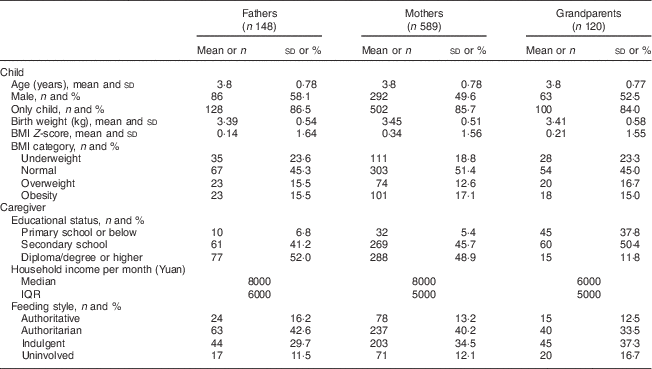
IQR, interquartile range.
Table 2 displays the correlation matrix for all key variables. Indulgent feeding style was positively related to child BMI Z-score. Mothers were inversely linked to indulgent feeding style, but grandparents were positively associated with indulgent feeding style. Grandparents were negatively related to authoritarian feeding style. Finally, there was a positive correlation between grandparents and child BMI Z-score.
Correlations of key variables of children and caregivers (n 857) from Shenyang, northern China, June–August 2015
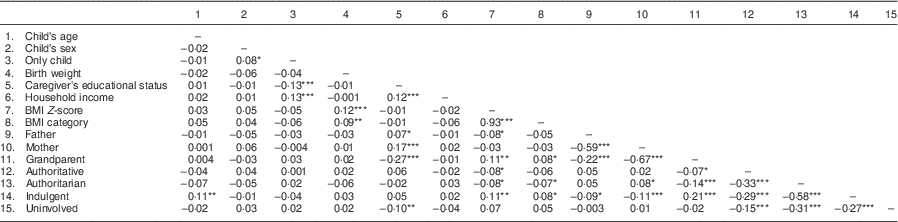
*P<0·05, **P<0·01, ***P<0·001.
After controlling for confounders, authoritarian feeding style was associated with a 0·30 lower BMI Z-score. After adjusting for covariates, fathers as primary caregivers were related to lower BMI Z-scores (β=−0·66), while grandparents as main caregiver were associated with higher BMI Z-scores (β=0·66; Table 3).
Linear regression models for BMI Z-scores of children (n 857) from Shenyang, northern China, June–August 2015
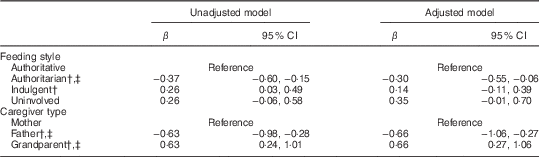
Models adjusted for child’s sex, age, only child and birth weight, and caregiver’s education and income.
† Significant result, P<0·05 (unadjusted model).
‡ Significant result, P<0·05 (adjusted model).
Moderation effects categorized by caregiver type and controlled for confounders are shown in Table 4. The relationship between authoritarian feeding and child BMI was significant for mothers (β=0·50, 95 % CI 0·04, 0·95). The interaction effect accounted for 5·4 % of additional variance in child BMI Z-score. Moreover, the association between indulgent feeding style and BMI Z-score differed as a function of mothers (β=−0·60, 95 % CI −1·06, −0·14). There was a growth in R 2 (ΔR 2=0·078) after adding the interaction.
Moderation effect models of feeding style and caregiver type on child BMI Z-score after controlling for confoundersFootnote † among children (n 857) from Shenyang, northern China, June–August 2015
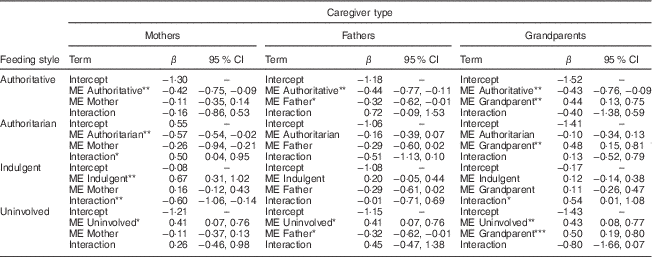
ME, main effect.
*P<0·05, **P<0·01, ***P<0·001.
† Adjusted for child’s sex, age, only child and birth weight, and caregiver’s education and income.
Indulgent feeding style did, however, significantly affect child BMI Z-score when grandparents were added into the model as a moderator (β=0·54, 95 % CI 0·01, 1·08). A marginally significant indulgent feeding style×grandparent interaction (ΔR 2=0·046) could be observed. The above models adjusted for relevant covariates. Thus, our second hypothesis was partially supported by these results.
Discussion
The present study examined the independent and interactive effects of specific feeding styles and caregiver types in predicting child BMI Z-scores. Mothers buffered two relationships: (i) authoritarian feeding style was inversely associated with BMI Z-score; and (ii) indulgent feeding style was positively related to BMI Z-score. Grandparents strengthened the association between indulgent feeding style and BMI Z-score. Nevertheless, fathers were independently associated with lower child BMI Z-score, but did not have any other moderating effect.
Fathers v. mothers
The authoritarian feeding style was independently related to lower child BMI Z-score, which agrees with a previous study( Reference Pai and Contento 17 ). However, several prior studies showed either inconclusive or conflicting results for this feeding style( Reference Vollmer and Mobley 15 ). The cause of the discrepancy could be attributed to the primary caregiver. Two studies of varying parent–child dyads found that authoritarian feeding style was more likely to produce underweight status than other styles( Reference Hughes, Power and Orlet Fisher 11 , Reference Hughes, Shewchuk and Baskin 12 ). In contrast, a study of only mother–child dyads determined that authoritarian feeding style was not connected with child weight status( Reference Tovar, Hennessy and Pirie 13 ). The present study showed similar results, where mothers decreased the negative effect of authoritarian feeding on BMI Z-score. In addition, according to linear regression analysis, fathers reported as the main caregiver was independently associated with an increased risk for children being underweight. Although fathers may prevent children from overweight or obesity, there is a call for further research in this regard and on its benefits before fathers can be promoted as primary caregivers.
Based on literature comparing feeding differences between mothers and fathers, fathers were shown to rarely make efforts to praise the child and often utilized neutral prompts or reasoning( Reference Joan, Orrell-Valentea and Whitney 43 ), making fathers seem more disconnected and aloof. Results from other research indicated that maternal feeding activities reported a higher level of responsibility than paternal( 40 ). Therefore, children who were regularly fed by authoritarian mothers may have been more likely to be normal weight. On the contrary, results from the present study showed that all feeding styles used by fathers as main caregivers would account for a lower weight in the child.
Grandparents v. mothers
The present results differed from recent studies on indulgent feeding style( Reference Tovar, Hennessy and Pirie 13 , Reference Hennessy, Hughes and Goldberg 14 ), where there was a link to higher BMI Z-score only with grandparent primary caregivers’ interaction in the model. A converse pattern demonstrated that mothers attenuated the association between indulgent feeding style and BMI Z-score. Moreover, according to linear regression analysis, grandparents who reported as main caregiver were independently associated with an increased risk for overweight and obesity in children. This is in agreement with previous research( Reference Mena, Gorman and Dickin 20 ). Research on grandparents supports the notion that grandparents’ indulgent feeding was considered a key determinant delaying healthy eating habits in the family context( Reference Jiang, Rosenqvist and Wang 44 ). In addition, other studies showed parents and grandparents had disagreements about concepts of feeding( Reference Eli, Howell and Fisher 30 ). This may be due to intergenerational differences, such as grandparents’ earlier experiences of lack and cultural beliefs that childhood overweight or obesity is a symbol of health, especially in Chinese( Reference Lee and Brann 45 ). A recent qualitative study showed that grandparents in Chinese three-generation families were more likely to use indulgent feeding style than parents, which leads to negative health outcomes, especially since grandparents prefer to utilize food as an emotive tool to reflect love and care( Reference Jiang, Rosenqvist and Wang 44 ). This is consistent with the study by Farrow which suggested that grandmothers were more likely than mothers to use maladaptive indulgent feeding, for example to elevate their grandchildren’s mood( Reference Farrow 21 ). What may appear to grandparents as positive reinforcement with food rewards may in fact discourage a child’s sense of energy balance, fail to set a good example for the child and disturb the regulation of hunger in the child( Reference Blissett, Haycraft and Farrow 46 ). A possible reason to explain grandparents’ preference for the feeding style may be that grandparents do not wish to undermine parental authority in the home and instead use food rewards to gain affection from the child( Reference Knight 47 ).
General comments
To the authors’ knowledge, currently no region or country has reported an effective intervention for underweight or obesity in children( Reference Ng, Fleming and Robinson 1 ). Furthermore, compared with that of teenagers and adults, control of weight problems for pre-school children lacks scientific attention( Reference Zong, Li and Zhang 8 ). Family environment and caregiver types have an impact on the child weight problem epidemic( Reference Lawman and Wilson 48 ). However, studies comparing maternal and paternal or grandparental child feeding are scarce.
Caregivers are the role models in a child’s development environment, so their lifestyles and cultures would infiltrate to their offspring, especially to children in the impressionable pre-school age( Reference Zong, Li and Zhang 8 ). Therefore, studying caregiver-related factors would be beneficial to explore family-based preventions for both obesity and malnutrition. With this information, at-risk populations could be identified at an early age and effective strategies be developed to intervene in the issues of obesity or underweight. Based on our findings, strategies concentrating on promoting child eating practices and well-being should consider the often-ignored contribution of fathers and grandparents. Future research should focus on the clinical aspect of children who are under- or overnourished.
It is essential to consider limitations of the present study, which have an influence on avenues for more research. First, our research is limited in being self-reported in nature. The height and weight of the child and food intake data were self-reported by each caregiver but following careful instructions( Reference Goodman, Hinden and Khandelwal 49 ). Additional exploratory analyses to objectify measured biometrics and other feeding items should be conducted to promote uniformity. Second, our research is limited in its sampling area. The participants in our sample are only from Shenyang, China. As a next step, a large-scale and representative longitudinal study would be ideal. Third, our research is limited in its cross-sectional nature. The present data were collected at one time point only, which cannot identify a cause-and-effect relationship. Furthermore, our research is limited in its results of correlations. Many of the significant correlations were accounting for less than 1 % of the variance.
Despite these limitations, the present research boasted a relatively large sample size and was representative of China, deepening the understanding of the role of caregivers and their feeding styles in child weight problems and creating the necessary foundation to support the development of family-based obesity interventions. Ultimately, longitudinal investigations are needed to evaluate the long-term effects of these factors and their interactions on child weight status.
Acknowledgements
Acknowledgements: The authors extend special thanks to all those who participated in the study. Financial support: This research was supported by funds from Shenyang Science and Technology Plan Projects (F14-231-1-57) and Liaoning Distinguished Professor (Liao taught (2013) No. 204). The funders had no role in the design, analysis or writing of this article. Conflict of interest: The authors declare no conflict of interest in the submission of this manuscript. Authorship: Formulating the research question(s): X.W. Designing the study: X.W., Y.M. Carrying it out: X.W., J.H., W.L., Z.Z. Analysing the data and writing the article: X.W. All authors approved the manuscript for publication. Ethics of human subject participation: This study was conducted according to the guidelines laid down in the Declaration of Helsinki and all procedures involving human subjects were approved by the China Medical University. Written informed consent was obtained from all participates.



