

The reception of Circe's island in and through Classical Antiquity has largely focused on the enigmatic sorceress herself.Footnote 1 The long literary chain of interpretive topoi—Circe the witch, the whore, the temptress—stretches from Apollonius, Virgil, Ovid, and Dio Chrysostom to Spenser, Calderón, Joyce, Margaret Atwood, and Madeline Miller. Her role as Odysseus’ benefactor, so unmistakable in Homer, is soon forgotten; to Virgil, she is above all dea saeva, (‘the savage goddess’, Aen. 7.19).Footnote 2 One distinguishing feature of Circe and her reception is the focus on representation: the enchantment of Circe, as Greta Hawes puts it, is above all a study in allegory.Footnote 3 From the moment Circe put a spell on Odysseus’ companions, transforming them into animals in Book 10 of the Odyssey, Circe has invited analogical reasoning, centered on what the transformation from one being into another represents.Footnote 4 More often than not, this transformation is interpreted according to a dualist thinking about humans and animals: subjects are transformed from one being into another being, thus representing some moral or physical degradation. This article, by contrast, concentrates on Circe's island through the lens of becoming-animal, the concept developed by Gilles Deleuze and Félix Guattari in the tenth plateau of A Thousand Plateaus, ‘1730: Becoming-Intense, Becoming-Animal, Becoming-Imperceptible…’.Footnote 5 I explicate the concept of becoming-animal by applying it to a Deleuzian encounter with Circe's island, both in its ancient articulations and in its various receptions, including H.G. Wells's science fiction novel The Island of Dr. Moreau.Footnote 6
A philosophy of becoming has implications not only for reception studies in general, but also for Circe's reception in particular. After all, Circe's most famous act is the transformation of humans into animals, an act that has traditionally been interpreted through the lens of classical ontology, according to which the change from human to animal is accidental rather than essential.Footnote 7 Becoming, in classical ontology, is merely the comparison between a starting point and an end point. For Deleuze and Guattari, on the other hand, becoming-animal involves a shift from a logic of being to a logic of becoming, a shift from an identity based upon what one is to a process without a subject. They insist that becoming-animal is neither imitative nor imaginary: ‘The becoming-animal of the human being is real, even if the animal the human being becomes is not’.Footnote 8 Deleuze and Guattari prioritize the reality of becoming over the reality of being: ‘What is real is the becoming itself, the block of becoming, not the supposedly fixed terms through which that which becomes passes.’Footnote 9 If the concept of becoming-animal serves as a critique of classical ontology, identity, and representation, the science fiction genre—of which H.G. Wells was an early exponent—explores the philosophical implications of such artificial boundaries as between animal and human; boundaries that, on Circe's island, had been readily crossed already, and are crossed once again on the island of Dr. Moreau. I argue that, in this Deleuzian reading, Circe's island is no longer ruled by the iron fist of analogy but rather becomes a space of potential deterritorialization, in which Circe facilitates a line of flight away from the dominant, Oedipal mode of being that, in the context of the epic, is defined by Odysseus’ homecoming. Instead, Circe's island is a place of new beginnings.
I propose, then, a return to Circe's island, as a place where becomings-animal might, or might not, happen. A Deleuzian visit to Circe's island offers a radical departure from its usual reception, but such a visit is not just a matter of jouissance—no matter how exquisite the delights of Circe's island. It is true that A Thousand Plateaus explicitly encourages experimentation, and its translator Brian Massumi has remarked that the goal of this work is, at least in part, to facilitate thinking new thoughts.Footnote 10 The critic Ronald Bogue has noted that there are two types of commentators on Deleuze and Guattari: ‘Those who seek to extend the experimental movement of [their] thought, adopting the authors’ language and intensifying its tendencies; and those who try to frame Deleuze and Guattari's thought in less esoteric terms, …testing the practical limits, implications and consequences of their thought’.Footnote 11 In this article, I take up the mantle of both types of commentator.
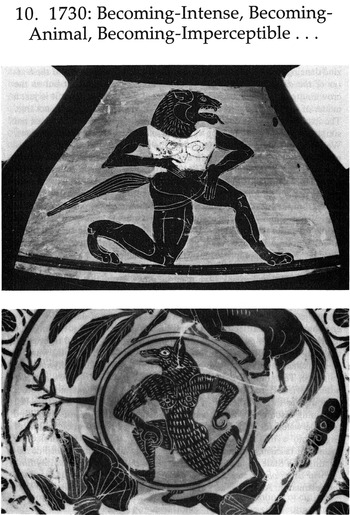
The first reason for engaging Deleuze and Guattari in an interpretation of Circe's island is that it provides us—scholars of (ancient) literature and culture—with a new perspective on the ubiquitous expressions of human-animal interaction in antiquity and beyond, one that moves away from a binary logic and modes of analogy, metaphor, and allegory to one that favors de-identitized, non-representational thinking. For while we are used to regarding animals as pets, workers, and food, Deleuze and Guattari suggest that they do more than conform to our categories.Footnote 12 In turn, engaging with the literary texts allows us to extract philosophy from them, which is what Deleuze and Guattari refer to as the ‘productive use of the literary machine’.Footnote 13 Second, as critics, we have a stake in clarifying and assessing Deleuze and Guattari's own engagement with classical antiquity. At a most superficial level, a quick glance at the title page of the tenth plateau, which features two Etruscan black-figure vase paintings depicting what Emma Aston would call mixanthropy, provides ample visual evidence to warrant our critical interest (Figure 1).Footnote 14 This interest becomes more acute, however, when we consider that Deleuze and Guattari identify not only literary but also political manifestations of becoming-animal, including the African secret society of leopard-men and Indo-European warrior societies comprised of beast-men. This suggests a historical and anthropological component to becoming-animal, much of which remains buried in the rhizomatic network of footnotes and citations at the end of (or, in the French edition, underneath) A Thousand Plateaus.Footnote 15
The title page of the tenth plateau in Deleuze and Guattari (1987), 232, containing images of: Etruscan black-figure amphora, no. E 723, Louvre, Paris (top); Etruscan black-figure pontic plate, no. 84 444, Villa Giulia, Rome (bottom). Image © 1980 Les Éditions de Minuit, Paris. Reprinted with the kind permission of the University of Minnesota Press, Minneapolis and London, and Les Éditions de Minuit.
Circe's Spell
Circe's spell seems to haunt us to this very day. In 2017, the National Institutes of Health in the USA lifted a moratorium on funding research into human-animal hybrids. This scientific research involves joining cells of different species at the embryonic stage to form a hybrid creature known as a chimera. Among the myriad ethical questions that this undoubtedly raises, part of the controversy is based on the essential dualism of humans and animals. One reporter for the BBC commented that ‘it would be truly horrific to create a human mind trapped in an animal's body, a nightmare fit for H.G. Wells’.Footnote 16 Indeed, the experimentation with transgressing or even obliterating the boundaries between such ontological categories as the human and the animal have traditionally been the prerogative of science fiction novels such as H.G. Wells's The Island of Dr. Moreau (1896), and, one could argue, its ancient precursors.Footnote 17 The ‘nightmare’ refers to the gruesome vivisections that Dr. Moreau performs on animals to change them into humans, thus engineering the so-called Beast Folk. If the thought of a chimera created in a twenty-first-century lab evokes the scientific experimentation of Dr. Moreau, it was the literary creation of Dr. Moreau that, in the nineteenth century, evoked the sorcery of Circe.Footnote 18 Upon the first publication of the novel, one of Wells's reviewers wondered in dismay: ‘We that have read his earlier stories will read all he chooses to write; but must he choose the spell of Circe?’Footnote 19 To be precise, Circe's spell did exactly the opposite to what happens in Wells's story. On Circe's island, humans are changed into animals; on Dr. Moreau's island, animals are changed into humans, only to ultimately reveal the beastly nature of humanity. It is generally assumed that H.G. Wells had in fact intended his tale as an inversion of Homer's Circe myth, translating the myth into the language of post-Darwinian science, transitioning from spell to surgery.Footnote 20 In Homer's Odyssey, we are told that Odysseus’ men were given ‘baneful drugs’ (φάρμακα λύγρα, 10.236) and ‘took on the form of pigs, with the heads and voices and bristles of pigs, but their minds intact as they had been before’ (οἱ δὲ συῶν μὲν ἔχον κεφαλὰς φωνήν τε τρίχας τε / καὶ δέμας, αὐτὰρ νοῦς ἦν ἔμπεδος ὡς τὸ πάρος περ, 10.239f.). It seems, then, that Odysseus’ companions experienced the horror envisioned by our BBC reporter: a human mind trapped in an animal body.
Is this the story of Circe's island? A place where humans are degraded into animals, trapped into beastly bodies? The variety of allegorizing interpretations that spring up in antiquity certainly suggests as much. Heraclitus’ Homeric Problems, for example, is typical in allegorizing Circe as the temptation of extravagance and gluttony:
ὁ δὲ Κίρκης κυκεὼν ἡδονῆς ἐστὶν ἀγγεῖον, ὃ πίνοντες οἱ ἀκόλαστοι διὰ τῆς ἐφημέρου πλησμονῆς συῶν ἀθλιώτερον βίον ζῶσι. διὰ τοῦτο οἱ μὲν Ὀδυσσέως ἑταῖροι, χορὸς ὄντες ἠλίθιος, ἥττηνται τῆς γαστριμαργίας, ἡ δ’ Ὀδυσσέως φρόνησις ἐνίκησε τὴν παρὰ Κίρκῃ τρυφήν.
(Homeric Problems 72.2f.)The draught of Circe is a vessel of pleasure, by drinking which the intemperate, on account of a momentary satisfaction, live a life more despicable than that of pigs. Therefore, Odysseus’ companions, who were a foolish lot, succumbed to gluttony, while the wisdom of Odysseus prevailed over the luxuriousness at Circe's.
The interpretation of Odysseus as the representation of temperance and wisdom can be traced to the Socratic tradition.Footnote 21 In Xenophon's Memorabilia, the moderate dining habits of Socrates are contrasted with the gluttony of Odysseus’ men. Socrates himself urges restraint:
τὴν Κίρκην ὗς ποιεῖν τοιούτοις πολλοῖς δειπνίζουσαν⋅ τὸν δὲ Ὀδυσσέα Ἑρμοῦ τε ὑποθημοσύνῃ καὶ αὐτὸν ἐγκρατῆ ὄντα καὶ ἀποσχόμενον τοῦ ὑπὲρ τὸν κόρον τῶν τοιούτων ἅπτεσθαι, διὰ ταῦτα οὐ γενέσθαι ὗν.
(Mem. 1.3.7)[I believe] Circe made pigs by providing a feast with many such things; but Odysseus, both by the counsel of Hermes and his own self-control and avoidance of overindulgence in such things, because of these things he did not become a pig.
If the original audience of Homeric poetry would have been unlikely to regard pigs as ‘greedy, undignified, and unclean’,Footnote 22 Xenophon's anecdote suggests that the association between pigs and gluttony was already available to fifth-century Athenians. By the time of Dio Chrysostom's Orationes, Circe's island had become symbolic for the temptations of pleasure in a general sense:
ὅταν οὖν κρατήσῃ καὶ περιγένηται τῆς ψυχῆς τοῖς φαρμάκοις, γίγνεται τὸ λοιπὸν ἤδη τὸ τῆς Κίρκης· πλήξασα ῥᾳδίως τῇ ῥάβδῳ εἰς συφεόν τινα ἐλαύνει καὶ καθείργνυσι καὶ τὸ λοιπὸν ἀπ᾿ ἐκείνου ἤδη ὁ ἄνθρωπος διατελεῖ σῦς ὢν ἢ λύκος.
(Or. 8.24f.)Therefore, whenever she [i.e. Pleasure, ἡδονή] dominates and overcomes the soul by her charms, the remainder of Circe's art follows at once; with a stroke of her wand, she [Pleasure] easily drives someone into a pig-sty and pens him up, and now from that time forth the man continues his life as a pig or a wolf.
This image would persist through the elaborate allegories of the Neo-Platonists into the early modern period: Circe's island as a symbol for the temptations of pleasure, which only Odysseus, the master of self-restraint, can resist.Footnote 23 On Circe's island, everyone else reveals their beastly nature.
Circe's spell surfaces in other, less well-known corners of intellectual history, ones that are not typically found in surveys of Circe's reception, but that are similarly bastions of analogical reasoning.Footnote 24 When Deleuze and Guattari point out that human-animal transformations have traditionally been understood in relations of analogy, they state: ‘Theology is very strict on the following point: there are no werewolves, human beings cannot become animal.’Footnote 25 It is in this context that the footnotes of A Thousand Plateaus lead the way, referring for the first and only time to Circe's spell, citing it as a model case used during the Inquisition in early modern Europe.Footnote 26 In the Malleus Maleficarum, the infamous Witches’ Hammer (1486–87), the transformation of Odysseus’ companions served as a demonstration that human-animal metamorphosis belongs to the realm of the imaginary.Footnote 27 The subject believes him- or herself to be transformed into a pig, wolf, or lion, and the observers believe it too. But it is not a real transformation of essential forms: ‘Certainly it was merely an appearance that deceived the eyes, so that the form of a beast was brought forth from the repository of pictures (the memory) to the force of imagination.’Footnote 28
The theologian, drawing on an Aristotelian conception of psychology, cannot allow for transformation of essential forms: ‘They are inalienable and only entertain relations of analogy’.Footnote 29 Similarly, in the late sixteenth and early seventeenth century, a French jurist and demonologist by the name of Henri Boguet compiled accounts about trials of witches and werewolves. Besides copious amounts of contemporary evidence and confessions of people changing into wolves (a phenomenon known as lycanthropy), he cites the example of Circe's island to suggest that humans sometimes change into other kinds of animals as well. Ultimately, however, Boguet concludes that ‘lycanthropy is an illusion, and that the metamorphosis of a man into a beast is impossible’.Footnote 30 Boguet denies the possibility of the BBC reporter's Wellsian nightmare:
It is impossible for the body of a brute beast to contain a reasoning soul…Therefore, I think that Homer was in error when, speaking of the companions of Ulysses who were changed into swine by Circe, he says that they had the hair, head and body of swine, but that their reason remained intact.Footnote 31
In the hands of the theologian, then, Circe's spell is no longer about the allegory of temptation and pleasure, but about the metaphysical limitation of the transformation of essential forms.
Surprisingly, Circe's spell still has currency in modern psychiatric and neuroscientific discourse as well, where the term clinical lycanthropy has come to represent all perceived human-animal transformation—not just that of humans into wolves. The neuroscientist Andrew Larner, for example, has suggested that Odysseus’ pig-men may well be the oldest evidence of neuropsychiatric syndromes of lycanthropy.Footnote 32 In a literature review of clinical lycanthropy, one psychiatrist explicitly cites the example of Odysseus’ companions, even though they fall well outside the range of his data sample. But the author's interpretation of clinical lycanthropy is worth quoting, defining it as something that ‘has historically been interpreted by physicians either in a metaphorical sense (i.e. as a symbolic departure from one's identity as a human…) or as imitation (i.e. acting as if one were a wolf), with the ensuing risk of being lured into believing that one has actually become a wolf (i.e. delusion)’.Footnote 33 I note the words metaphorical, symbolic, and imitation: precisely the things that becoming-animal, for Deleuze and Guattari, is not. What this brief glance at the reception of Circe's island suggests is this: to the moralizing allegorist, the medieval theologian, and the modern psychiatrist, the transformation of humans into animals is about relations of analogy between man and animal.
Becoming-Animal on Aeaea
The iron grip of analogy goes back to the text of the Homeric epic itself. When Hermes is supposed to tell Odysseus that his companions have transformed into pigs, he in fact says that ‘they have been penned in like pigs’ (ἔρχαται ὥς τε σύες, Od. 10.283). As Denys Page has pointed out, Hermes’ ‘words implicitly deny that they have been transformed into pigs; only the man who is not a pig can be shut up “as if he were a pig”’.Footnote 34 The view that Odysseus’ men are merely like pigs is also expressed by the Byzantine commentator Eustathius (on Od. 10.283), which suits his allegorical reading. Page may call it a fault in the phrasing, but if he is right in suggesting that the Homeric poet wishes to suppress the magical elements of the tale, then, surely, a seemingly careless ὥς τε turns it from folktale to myth, from a true becoming to relations of analogy.Footnote 35 In the jargon of Deleuze and Guattari, the ὥς τε functions as a major use of language, one that stabilizes meaning and territorializes the identity of the molar stability, the human being.Footnote 36 Becoming-animal, on the other hand, is a process of deterritorialization. To deterritorialize is to ‘turn toward lines of flight so as to dismantle the subject, disorganize the body, or even to destabilize the state’.Footnote 37 In Kafka: Toward a Minor Literature, Deleuze and Guattari write:
To become animal is to participate in a movement, to stake out a path of escape in all its positivity, to cross a threshold, to reach a continuum of intensities that are valuable only in themselves, to find a world of pure intensities where all forms come undone, as do all the significations, signifiers, and signifieds, to the benefit of an unformed matter of deterritorialized flux of nonsignifying signs.Footnote 38
Becoming-animal, Gerald Bruns explains, ‘is a movement from major (the constant) to minor (the variable); it is a deterritorialization in which a subject no longer occupies a realm of stability and identity’.Footnote 39
To facilitate the shift toward thinking of becoming, instead of being, Deleuze and Guattari distinguish three ways of thinking about animals: the individuated, the symbolic, and the demonic animal.Footnote 40 This classification is not a new animal taxonomy; rather, this is the perceptual semiotics that governs A Thousand Plateaus: any animal can be understood in all three ways. The individuated animal is the family pet, an Oedipalized creature that only invites regression (‘anyone who likes cats or dogs is a fool’).Footnote 41 The second type is the classified animal found in mythology, Jungian archetypes, and natural science. This animal has attributes such as courage or cunning, or is classified and organized in series and structures. The individuated and symbolic dominate our thinking about animals: we try to bond with them emotionally, make them part of our family, or we think of them in terms of attributes and analogy: Odysseus is like a lion because he is fearless. Lions, tigers, leopards are all part of the genus Panthera because of resembling cranial features. Another kind of analogy compares structural affinities: a leg is to locomotion on land as a fin is to locomotion in water.Footnote 42 Neither kind of analogy, however, accounts for passages between animals, or between animals and humans. But it is the third type, the demonic animal, that forms a becoming. The word ‘demonic’ does not exclusively point to vampires and werewolves: prominent literary examples discussed in A Thousand Plateaus include rats (from the film Willard), whales (Melville's Moby Dick), and insects (Kafka's Metamorphosis). What makes Kafka's work especially congenial to the concept of becoming-animal is that ‘Kafka deliberately kills all metaphor…Metamorphosis is the contrary of metaphor…It is no longer a question of resemblance between the comportment of an animal and that of a man’.Footnote 43 Thus, any animal can be demonic. They are so called because, unlike gods, demons ‘do not have attributes, territories, and codes’.Footnote 44 While readers of Homer's Circe have often associated her animal transformation with characteristic attributes of pigs—‘comiques et culinaires’, in the words of Gabriel GermainFootnote 45—and seen them as representative of the inferior animal condition in general, the demonic animal has no such attributes.
How does becoming-animal happen? To escape the signifying regime of analogy, Deleuze and Guattari employ perceptual semiotics to look for multiplicity: ‘A becoming-animal’, they write, ‘always involves a pack, a band, a population’.Footnote 46 This pack is populated not through filiation (sexual reproduction), but through contagion and epidemic. This is most obvious in tales of werewolves and vampires, who spread through infection and alliance, not filiation. The logic that makes vampires and werewolves possible requires terms of combination that are not genetic or structural, but heterogeneous.Footnote 47 The wolf, the human, the moon: they form a multiplicity of heterogeneous terms, an assemblage. It is here that humans effect their becomings-animal. On Circe's island, Odysseus’ men similarly form a pack, populated by the contagion of Circe's potion. The sorceress, her existing menagerie, and the κυκεών (‘draught’)—not the ῥάβδος (‘staff’), as Stanford has persuasively argued—effect the becoming-animal of Odysseus’ companions. The magic of the drugs resides in their ability to make the men ‘utterly forget their native land’ (πάγχυ λαθοίατο πατρίδος αἴης, Od. 10.236). One suspects a pun on the land they will forget (αἶα, epic form for γαῖα) and the land they will now inhabit (Αἰαίη). The former is a space of familial relations (πατρίδος), the latter one of alliance (Aeaea is named after Circe herself, whose brother is Aeëtes). The space in which such becomings take place is significant. The Odyssey leaves no doubt as to the location of Circe's island. Aeaea is located in the east, near Dawn and Helius, which is unsurprising given Circe's genealogy as the daughter of the Sun (12.1–4).Footnote 48 The most intriguing detail about the island's geography is its lack of spatial orientation: Odysseus and his men cannot discern where the sun rises and where it sets, presumably because they are too close to the eastern-most edge of the world (10.190–2).Footnote 49 Circe's island is a liminal space par excellence, and it invites liminal activity.Footnote 50
In A Thousand Plateaus, Deleuze and Guattari distinguish between smooth and striated space. Simply put, in smooth spaces individuals can do as they wish, whereas in striated spaces they are limited to the predetermined roles imposed upon them by class, hierarchy, and rule of law. These two spaces are not strictly in opposition to each other: ‘Smooth space is constantly being translated, transversed into a striated space; striated space is constantly being reversed, returned to a smooth space.’Footnote 51 The desert island is such a smooth space, and smooth space is where deterritorializations happen. In his essay Desert Islands, Deleuze claims that ‘dreaming of islands—whether with joy or in fear, it doesn't matter—is dreaming of pulling away, of being already separate, far from any continent, of being lost and alone—or it is dreaming of starting from scratch, recreating, beginning anew.’Footnote 52 In Homer, too, Circe's island represents in some ways a golden age and a place of ‘re-beginnings’.Footnote 53 The four handmaidens on Aeaea provide countless comforts, and the supplies are everlasting (Od. 10.427); Odysseus and his companions gladly linger for a full year. Deleuze explicitly names Circe's island as a desert ‘sacred island’ on which such re-beginnings take place.Footnote 54 It is true that Circe's smooth island has become striated in its own right, but, as Deleuze points out, as an exclusively female community, one that exists outside the molar stability of male-dominated society. As such, the island enables other becomings, conceived of as a re-beginning, a pulling away from societal structures and constraints.
There is a second principle to becoming-animal, namely the alliance with the anomalous individual. Deleuze and Guattari note that the word anomalous comes from a Greek noun that ‘designates the unequal, the coarse, the rough, the cutting edge of deterritorialization’—it is the borderline where the pack opens up to the outside.Footnote 55 The choice for the word anomaly is hardly a coincidence, as its oppositional relation to analogy goes back to ancient grammarians.Footnote 56 ‘Wherever there is a multiplicity, you will also find an exceptional individual, and it is with that individual that an alliance must be made in order to become-animal.’Footnote 57 Captain Ahab, for example, intends a becoming-whale through an alliance with the anomalous Moby Dick. Citing the social anthropologist Edmund Leach, Deleuze and Guattari illustrate this point further with the liminal figure of the sorcerer, as one who has ‘always held the anomalous position, at the edge of the fields or woods’.Footnote 58 On a literary level, clearly both Dr. Moreau and Circe are such sorcerers, whose far-flung desert islands lie at the cutting edge of deterritorialization. Their smooth islands, however, become striated spaces in their own right.
The becomings-animal that may happen on the island present a line of flight, albeit an unstable one, as the pull toward reterritorialization is always present. Deleuze and Guattari's reading of Kafka's Metamorphosis clarifies this point. Gregor Samsa's becoming-bug is incomplete: his line of flight attempts to escape the familial and bureaucratic territories, but eventually, through the Oedipal jealousy of his sister, he is reterritorialized into the family structure—which leads him into death, ‘turns his becoming-animal into becoming-dead’.Footnote 59 For Odysseus and his men, too, the becoming-animal remains incomplete. Circe's island offers an alternative to homecoming, a line of flight away from the family structure, away from the burdens of being human, a non-identitarian existence where Odysseus could inhabit a zone of indiscernibility, a real Outis, a Nobody. Paradoxically, it is the most rhizomatic prop of them all—the mysterious moly, a magical plant defined by its peculiar roots—that prevents Odysseus’ deterritorialization.Footnote 60 He does not suffer (or benefit) from the contagion of Circe's potion the way his men did—or so it seems at first. Rather than joining the pack, he forces Circe to restore his companions to human form. Such lines of flight are not even available to the creatures on Circe's island in Book 4 of Apollonius’ Argonautica. There, Circe marshals from the primeval slime ‘her beasts, who were not similar to flesh-devouring beasts, and not in shape like men, but rather a jumbled mixture of different limbs’ (θῆρες δ’, οὐ θήρεσσιν ἐοικότες ὠμηστῇσιν / οὐδὲ μὲν οὐδ’ ἄνδρεσσιν ὁμὸν δέμας, ἄλλο δ’ ἀπ’ ἄλλων / συμμιγέες γενέων, Argon. 4.672–4). In his commentary, Peter Green admits that the scene reminds him of H.G. Wells's The Island of Dr. Moreau. Footnote 61
Notwithstanding the similarities between the mutilated Beast Folk and Circe's monstrous human assemblages, it is what contrasts with The Island of Dr. Moreau that is even more revealing. That island, as Michael Starr has persuasively argued, becomes progressively more striated, a prototype of a totalitarian regime.Footnote 62 In the novel, Dr. Moreau explains his vivisections as a ‘humanising process’ and describes in detail the physical aspects of this restructuring process:Footnote 63
You forget all that a skilled vivisector can do with living things…Small efforts, of course, have been made—amputation, tongue-cutting, excisions. Of course you know a squint may be induced or cured by surgery? Then in the case of excisions you have all kinds of secondary changes, pigmentary disturbances, modifications of the passions, alterations in the secretion of fatty tissue.Footnote 64
Dr. Moreau's vivisections attempt to bring smooth, natural animals into a striated human system. Animal body parts become categorized, removed, and reconfigured to resemble the human form.Footnote 65 The marked bodies of the Beast Folk bear the scars of these attempts at societalization, with their ‘disproportion between the legs…and the length of their bodies …clumsy and inhuman curvature of the spine…strangely coloured or strangely placed eyes’.Footnote 66 These are the hybrid creatures that reminded Peter Green of the ‘jumbled mixture of different limbs’ in Apollonius’ retelling of Circe's island. Unlike Dr. Moreau, however, Circe successfully turns striated humans into smooth animals. Even when she turns Odysseus’ companions back to humans, this is no reversal of becoming in the way that the Beast Folk revert to their wild animal instincts. Their human bodies do not bear witness to their becoming with scars, wounds, and deformities; rather, they are reconfigured ‘younger than they were before, and much more beautiful and taller to look at’ (νεώτεροι ἢ πάρος ἦσαν, / καὶ πολὺ καλλίονες καὶ μείζονες εἰσοράασθαι, Od. 10.395f.). This second becoming only comes about because the leader of the pack—Odysseus—has established an alliance with the anomalous Circe. As a result, the men are recreated on the sacred desert island of Aeaea for a second time.
And yet, the intended effect of the baneful drugs—namely, ‘to forget about homecoming’ (cf. λαθοίατο πατρίδος αἴης, 10.236)—is precisely the spell that Circe's island eventually casts over Odysseus himself. After a year of leisurely feasting has passed, Odysseus’ companions rebuke him: ‘Mad man, remember now already your native land’ (δαιμόνι᾽, ἤδη νῦν μιμνήσκεο πατρίδος αἴης, 10.472). His men must remind him of his Oedipal connections to his fatherland and familial lineage. The identical line ending and the contrasting verbs λαθοίατο/μιμνήσκεο emphasize the parallel between Circe's drugs and Odysseus’ current condition. Addressing him as δαιμόνιος underscores the idea that, to his companions, Odysseus’ behavior is so abnormal and strange that they suspect supernatural influence.Footnote 67 In his alliance with Circe, then, Odysseus has become infected (and affected) after all; his body may be intact, but his subject is being dismantled. His becoming-demonic offers a line of flight away from the striated space of his native land, into the arms of Circe's smooth becoming, until his men reterritorialize him the way he had reterritorialized them earlier. Circe's spell is one of new beginnings.
Toward a Minor Reception: Gryllus, Faces/Vases, Werewolves
This minor reading of Circe's island offers a new interpretation, one that puts the transformation of Odysseus’ men into pigs on the same plane as Odysseus’ year-long alliance with Circe. Both are deterritorializations—albeit ultimately unsuccessful ones—made possible by the smooth space of Aeaea. Bodies become disorganized, subjects become dismantled, and a positive line of flight is traced away from the so-called molar stability of being human. In this interpretation, the becoming-animal of Odysseus’ companions has nothing to do with any porcine qualities they may or may not possess, or with any moral or ontological degradation symbolized by the transformation from human to animal. Of course, the point of such a reading cannot be to turn Homer into a Deleuzian materialist avant-la-lettre. In fact, as I suggested earlier, the text itself seems to resist actual becomings in favor of analogical reasoning (cf. penned in as if they were pigs). And yet, I shall now argue that this minor reading is in some respects supported by two cases of reception of Circe's island: first, Plutarch's dialogue Gryllus and its reception and, second, the visual record of Circe's island. I argue that both these instances of reception open up new spaces to dismantle conventional codes of the human and the animal.
Plutarch's Gryllus is a curious dialogue that offers a counter-reading to Homer's Odyssey.Footnote 68 In the dialogue, Odysseus asks Circe if, by her favor, he can restore his companions to their original human shape. One pig by the name of Gryllus, onomatopoeic for ‘grunter’, refuses to turn back into a human. He argues that the animal life is actually preferable, not because an unvirtuous life is better or because animals and humans are not so different after all, but because only animals are virtuous, living in accordance with nature, whereas humans have their virtue socially imposed upon them. The dialogue belongs both to a long tradition of philosophical discussion about animal rationality and to the diverse genre of dramatic performance—the protagonist's name, Gryllus, is a pun on both an Egyptian vulgar dance and a style of parodic caricature painting. The dialogue is thus typically read as a form of satire, lampooning the contemporary intellectual culture.Footnote 69 Odysseus, who is here the mouthpiece for molar stability, cannot understand why Gryllus would choose to remain animal:
ἐμοὶ σύ, Γρύλλε, δοκεῖς οὐ τὴν μορφὴν μόνον ἀλλὰ καὶ τὴν διάνοιαν ὑπὸ τοῦ πόματος ἐκείνου διεφθάρθαι καὶ γεγονέναι μεστὸς ἀτόπων καὶ διαλελωβημένων παντάπασι δοξῶν· ἢ σέ τις αὖ συηνίας ἡδονὴ πρὸς τόδε τὸ σῶμα καταγεγοήτευκεν;
(Plut. Mor. 986 E)To me, Gryllus, you seem to have lost not only your shape, but your intelligence also under the influence of that drug. You have become infected with strange and completely perverted notions. Or was it rather an inclination to swinishness that conjured you into this shape?
(tr. Cherniss and Helmbold)Odysseus’ comment about ‘an inclination to swinishness’ (συηνίας ἡδονή) reveals his analogical reasoning: surely, Gryllus’ becoming-pig must be representational. Plutarch's audience may have agreed with Odysseus. And yet, from a Deleuzian perspective, Gryllus’ becoming-animal appears in a completely different light. In his alliance with the sorceress Circe, he has traced a line of flight and mapped out a new beginning; he is not persuaded by Odysseus’ attempts at reterritorialization.
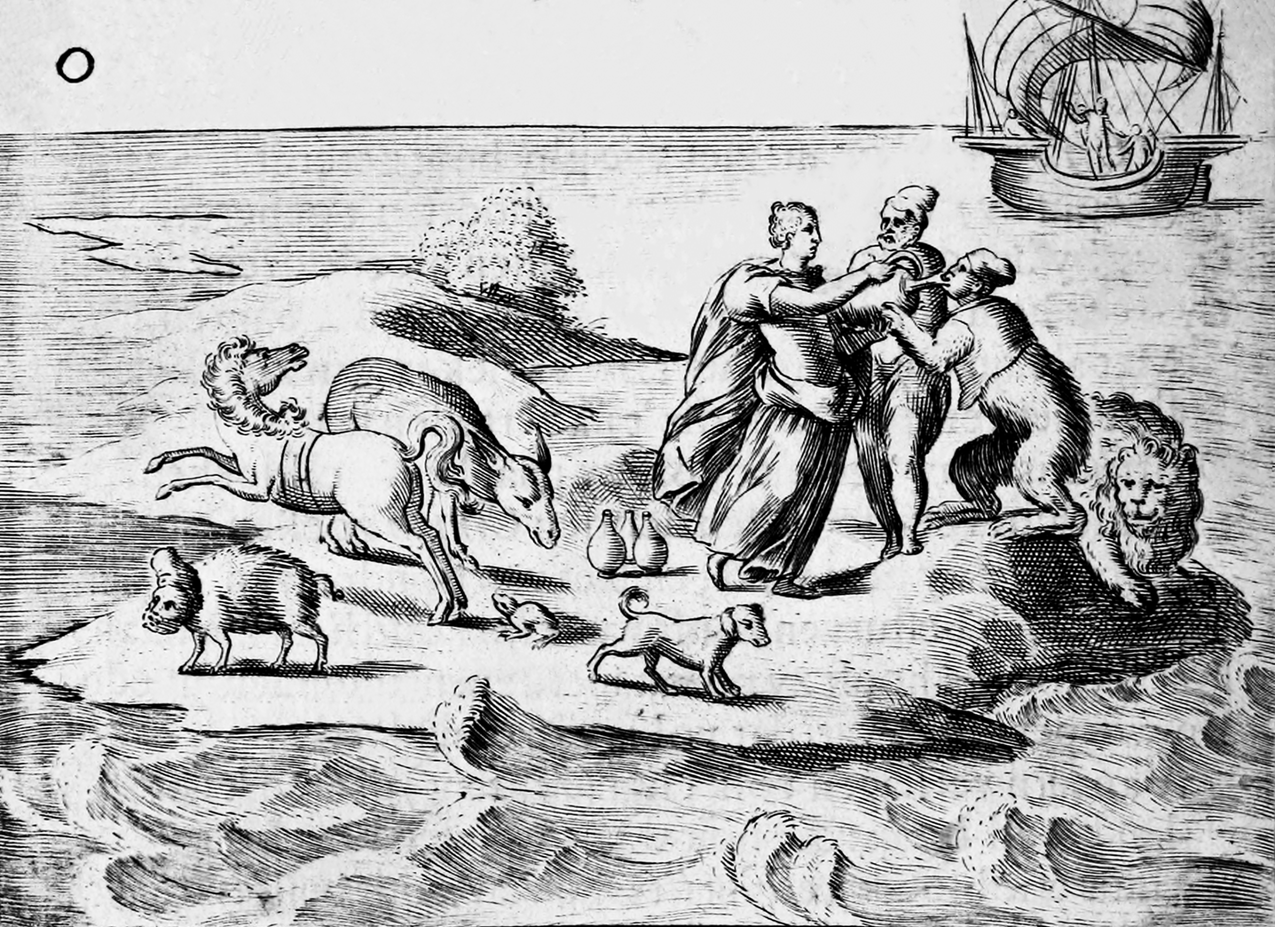
The Gryllus has had its own fascinating reception.Footnote 70 In the Renaissance, Battista Gelli wrote a Grillo in which Odysseus manages to convince his interlocutor, an elephant, of human superiority. When Amyot translated Plutarch's Moralia into French in the sixteenth century, he felt the need to include an apology at the beginning of the dialogue to explain away this mistaken view about humanity's inferiority. It is surely no coincidence that one minor reception of the Gryllus appears in the oeuvre of H.G. Wells.Footnote 71 As a student, Wells wrote an essay titled A Talk with Gryllotalpa (1887), in which the animal sage is a cricket, who expounds on the ‘new learning’ (i.e., Darwinian science) with its cosmic perspective on the ‘infinitesimal littleness of men’.Footnote 72 Wells reverses this paradigm in The Island of Dr. Moreau; there, the animal sage (who significantly appears to be a Swine Man from the Beast Folk) is foolish and absurd, perhaps as a consequence of Moreau's mistaken attempts at societalization. The visual reception and Plutarch's Gryllus come together in De Vernieuwde Gulden Winckel (1622) by the Dutch Golden Age poet Joost van den Vondel. This so-called emblem book, drawing on biblical and classical references, includes a moral poem about Circe's island accompanied by an illustration, i.e., the emblem (Figure 2). The emblem shows Circe on a small island (the Circaeum) surrounded by eight of Odysseus’ companions, some of whom are fully animal (e.g. a dog, horse, and lion) and some of whom are in a state of mixanthropy. Among the mixanthropoi are a bear with a man's face drinking Circe's draught and, off in the far-left corner of the island, a pig with a man's face. The text makes explicit that Odysseus’ companions were transformed into all sorts of animals, including less canonical choices such as frogs, elephants, and oysters. Ostensibly, De Winckel fits the long history of allegorizing interpretation. In this retelling, it is drunkenness in particular which ‘turns men into beasts’.Footnote 73 The text adds two additional details: first, De Winckel notes that when the animals changed back into men, the oyster became a fisherman, the mole a farmer, the snake a doctor, and so forth. Clearly, the reversed transformation, the animals’ becoming-human, is based on characteristics of analogy. Just as the mole digs the soil, so the farmer. The second note, however, is of particular interest as a form of minor reception: the animals did not want to be human again, because human life is so much harder by comparison. Thus, the counter-reading offered by Plutarch's Gryllus persists, even if it is continuously absorbed in major language and subjected to analogical reasoning.
Circaeum (‘Circe's island'), with Odysseus’ companions transformed into animals. Woodcut emblem originally by Geerardt de Jode (ca. 1579); re-engraved by Claes Jansz Visscher (1608), in which state it was reprinted in De Vernieuwde Gulden Winckel (Vondel [1622]).
The visual record of Circe's island is substantial, both in antiquity and beyond.Footnote 74 The focus on pigs, which dominates the analogical reasoning in the literary reception, disappears instantly when one considers the visual reception, not only in later images as that of Vondel but already in antiquity itself.Footnote 75 One Attic black-figure amphora at the Staatliche Museen in Berlin, for example, parades a wide assemblage of animals, including a donkey, cow, pig, and goose (Figure 3). These animals are depicted as hybrid creatures, or mixanthropoi: their bodies are human, their heads are animal. The most heterogeneous assemblage of all is a black-figure kylix at the Museum of Fine Arts in Boston (ca. 550 BCE), which features six mixanthropoi with the heads of a lion, rooster, horse, dog, panther, and goat. The usual explanation argues for artistic taste for variety, but even so these animals do not seem to represent anything. They are not men dressed up as animals or imitating them, nor are they symbolic of any particular animal characteristic. This suggests that, with the perceptual semiotics of A Thousand Plateaus, they can be regarded as demonic animals, forming a becoming. The depiction of Odysseus’ companions as human bodies with animal heads, and occasionally animal feet and hands as well, is typical for ancient vase-painters.Footnote 76 There are some notable exceptions. A Chalcidian black–figure amphora (c. 530 BCE), now in Vulci, depicts Odysseus and Circe surrounded by two companions (Figure 4). The one on the right is a pig-headed man, the one on the left a man-faced pig. This may well be artistic experimentation, as Aston claims;Footnote 77 but these divergent depictions of human-animal hybridity could serve another, philosophical purpose. Buxton has suggested that the artist invites the viewer to ponder a question, namely: ‘Is there a significant difference between a hybrid with the face of a human, and one with the face of a beast?’Footnote 78 In other words, the process of becoming-animal—rather than the particular being one becomes—challenges the molar stabilities of human beings as opposed to animals. Thus, the two porcine mixanthropoi on the black-figure vase can be said to rescue animals from the ‘binary machine’ that opposes them to human beings.Footnote 79 As the boundaries between beings fade away in favor of ‘zones of indiscernibility’ where becomings may happen, new spaces open up where experiments in forms of life can be developed and put into play.Footnote 80
Circe (seated), Odysseus, and four companions. Sketch based on an Attic black-figure amphora, Staatliche Museen, Berlin. Illustration after: Archäologische Zeitung 34 (1876), plate 15.

Circe and Odysseus, surrounded by two of Odysseus’ companions. Chalcidian black-figure amphora, Antiquarium del Castello dell’ Abbadia, Vulci. Reprinted with the kind permission of the Museo Nazionale Etrusco di Villa Giulia, Rome.
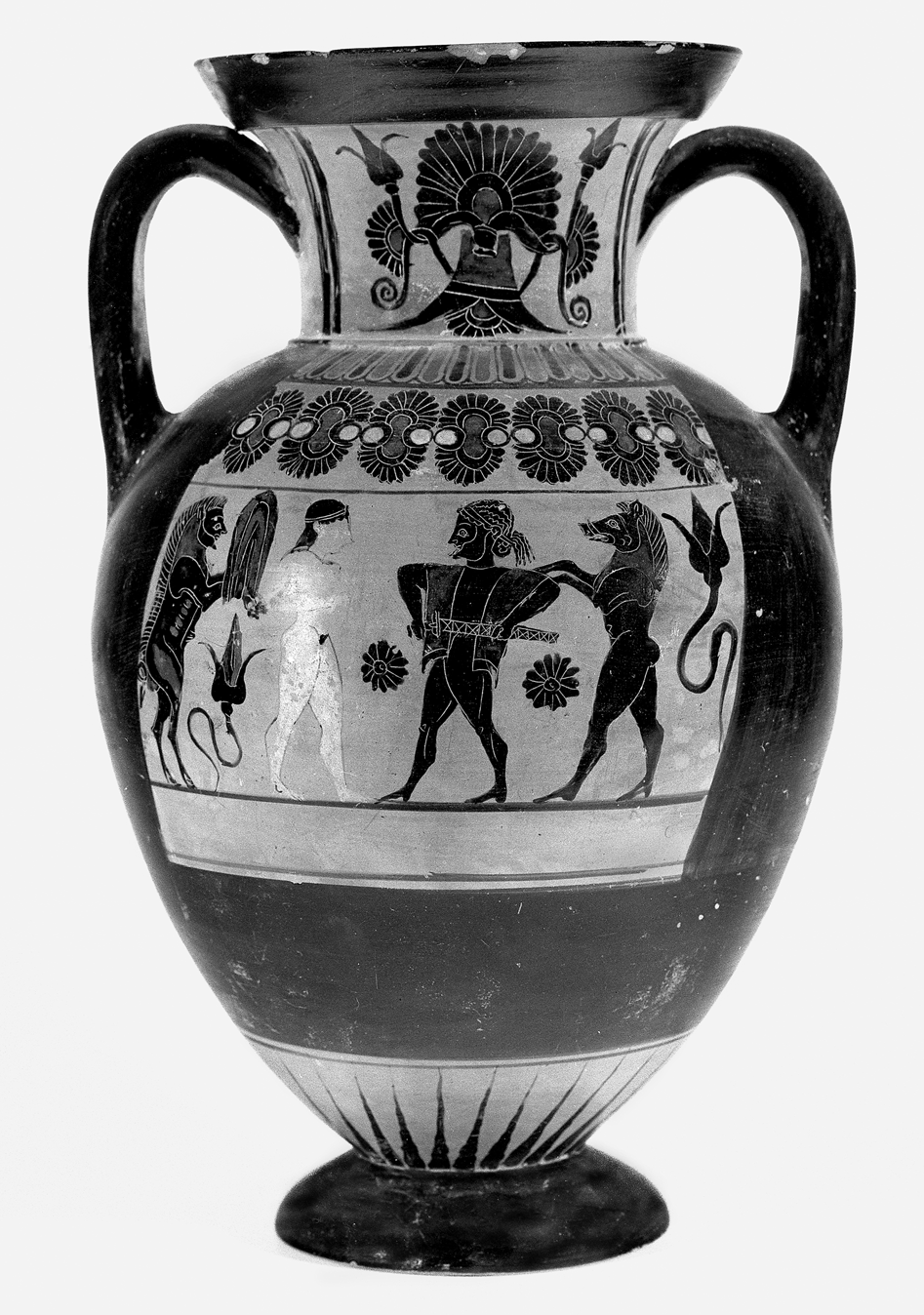
The case of the pig-headed man and man-faced pig (Figure 4) is especially evocative, since it draws attention to the human face.Footnote 81 In Deleuze's book on the artist Francis Bacon, the face plays an important role. Deleuze sees in Bacon a painter of heads, not faces: ‘Bacon thus pursues a very peculiar project as a portrait painter: to dismantle the face, to rediscover the head or make it emerge from beneath the face.’Footnote 82 For Deleuze, the face is a striated, territorialized space, ‘a structured spatial organization that conceals the head’.Footnote 83 By dismantling the face, the body becomes-animal. Deleuze and Guattari describe the total process of facialization as ‘an operation worthy of Dr. Moreau: horrible and magnificent’.Footnote 84 The inverse parallel between Circe and Moreau emerges yet again. If the face is a regime of socialization that must be escaped, Dr. Moreau's surgery subverts this process by stitching faces, quite literally, on its animal subjects. Circe's spell, on the other hand, replaces human faces with animal heads. And yet, the question what becoming-animal looks like seems, in a literary context, not entirely applicable. Bacon's paintings aside, it is hard to imagine what Captain Ahab's becoming-whale looks like. Franz Kafka, in fact, had urged his publisher not to put any image or representation of Gregor's becoming-insect on the cover of the original publication of The Metamorphosis: ‘The insect itself cannot be drawn’, Kafka wrote, ‘It cannot even be shown at a distance.’Footnote 85 From an anthropological standpoint, however, the visual representation of becoming-animal becomes all the more relevant in light of the Etruscan vase paintings included in A Thousand Plateaus itself (Figure 1), since the images are associated with cultural practices of ritual lycanthropy among the ancient Etruscans.
The two Etruscan black-figure vase paintings depicted on the title page of the tenth plateau are perhaps the most obvious case of classical reception within A Thousand Plateaus (Figure 1). As they are presumably meant to illustrate becoming-animal, they are worth analyzing in detail, especially with a view to the anthropological implications of becoming-animal. The first image is part of an Etruscan black-figure amphora by the Munich painter 833 from ca. 530 BCE. Found in Cerveteri and produced, perhaps, in Vulci, the amphora is currently in the Louvre in Paris.Footnote 86 It depicts a mixanthropic figure in the well-known Archaic running/dancing stance, with animal head, animal feet, and a long tail, wearing a cuirass. The second image is part of an Etruscan black-figure Pontic plate by the Tityus painter, dated to ca. 520 BCE, originally from Vulci and currently at the Villa Giulia in Rome.Footnote 87 In the tondo of the plate is depicted a mixanthropic figure in the running/dancing stance, with a lupine head, hairy body, and sharp claws, but with humanoid torso and feet. The list of illustrations at the back of A Thousand Plateaus only identifies the top image (the Louvre amphora) as ‘wolf-man’, but the figure on the Pontic plate seems decidedly lupine as well (perhaps even more so), thus jointly conjuring up the lycanthrope, or werewolf. In the original French, the top image is in fact labeled ‘loup-garou’, i.e., werewolf.Footnote 88 This comes as no surprise. We have already seen how Deleuze and Guattari evoke the werewolf and vampire as demonic animals that effect becomings through infection and contagion. The key question is whether Deleuze and Guattari suppose that becoming-animal is not just a philosophical concept that can be extricated from, and applied to, the artistic expressions of Bacon, Kafka, Melville, and Wells, but also an anthropological phenomenon of which particular ritual manifestations can be found in human history, as evidenced by the two Etruscan images.Footnote 89
The very selection of these images suggests as much, especially the Pontic plate. The wolf-man depicted on the Pontic plate in the Villa Giulia is commonly interpreted as a demonic wolf (démon-loup) of the dead in the context of pan-Italic rituals involving lycanthropy, such as the Samnite cult of Apollo Soranus, whose worshippers were called ‘wolves of Soranus’ (hirpi Sorani).Footnote 90 They would meet in a wolf's cave at Mt. Soracte, north of Rome, and the cave was understood as a passage to the underworld. Based on the stance of the lupine figures, Elliott has argued that this vase painting provides physical evidence for the performance of animal imitative dances by the Etruscans, similar to the Lycoscura in the Greek world, during which women dancers masqueraded as pigs, bears, lionesses, horses, and wolves.Footnote 91 The second image, that of the Louvre amphora, raises another question. Deleuze and Guattari explicitly identify the mixanthrope as ‘loup-garou,’ even though scholars have traditionally interpreted this figure as lion-like rather than wolf-like. This is also the view taken by the curator of the Louvre's Etruscan collection, who refers to the figure as ‘l'homme-lion’, i.e., lion-man.Footnote 92 Where does this identification of the Louvre amphora as ‘wolf-man’ come from? In an article in 1973, seven years before the original publication of A Thousand Plateaus, archaeologist Erika Simon was the first to argue that the figure is not a lion-man but a wolf-man, on the grounds that it does not have a lion's mane and sports the bushy tale of a wolf.Footnote 93 This observation has not been shared by all.Footnote 94 But the part of Simon's argument that has found broad acceptance is that the figure on the Louvre amphora is the closest parallel to the wolf-man on the Pontic plate in the Villa Giulia, and the two are now frequently discussed as a pair.Footnote 95 If, as it seems, Simon's scholarship is the main source for the two illustrations in the tenth plateau—even the very fact that they appear together—then the ritual context in which Simon has placed these vase paintings must be associated with becoming-animal as an anthropological phenomenon as well.
Within this context of ritual lycanthropy, and Italic lupine cults in general, we must revise the idea that these becomings are, strictly speaking, hybrid or even mixanthropic beings. Krauskopf makes precisely this point, when she argues that these demons do not originate from a combination of human and animal, but rather as beings who are neither, and who could take on both forms, caught in a becoming.Footnote 96 What matters for our purposes is that apparently to Deleuze and Guattari these lycanthropic Etruscan images capture their idea of becoming-animal. They identify a politics of becomings-animal in which these ritualized practices may conceivably take place:
There is an entire politics of becomings-animal…which is elaborated in assemblages that are neither those of the family nor of religion nor of the State. Instead, they express minoritarian groups, or groups that are oppressed, prohibited, in revolt, or always on the fringe of recognized institutions, groups all the more secret for being extrinsic, in other words, anomic.Footnote 97
To support this idea of a politics of becoming-animal, the footnotes of A Thousand Plateaus refer to the works of Dumézil and, in particular, anthropological studies on leopard-men in Congo, hyena-men in Sudan, and Carlos Castaneda's controversial work on the shamanistic experiences of the native American Yaqui tribe. This anthropological scholarship gives the impression, indeed, that becoming-animal is real. Miller makes exactly this point when he writes: ‘By using footnotes at all, the authors attach their argument and their concepts, like becoming-animal, to pre-existing, referential research—like Joset's book on leopard-men.’Footnote 98 The problem, as Miller sees it, is that these sources frequently seem to undermine the deterritorializing project envisioned by A Thousand Plateaus. Paul-Ernest Joset's (1955) book on the ritual murders committed by African leopard-men, hailed by Deleuze and Guattari as ‘one of the best studies on this subject’,Footnote 99 is in fact written by a colonial administrator who actively persecuted the leopard-men secret society.Footnote 100 Part of Joset's project is proving that these ritual murders are real, not imagined, but that is not to say that he believes that the murderers actually transform themselves into leopards.
What, then, does it mean that becoming-animal is ‘real’? In response to Miller, Bogue argues—rightly, I believe—that ‘even if anthropological texts had inspired them in the development of the concept, the relationship between becoming-animal and folk beliefs in lycanthropy or other lore about human-animal metamorphosis is complex and oblique.’Footnote 101 After all, becoming-animal has nothing to do with imitating or dressing up as animals. As we have seen on Circe's island, it is a process of becoming-other that allows individuals to undo conventional codes of the human through an interaction with animals, breaking down the human symbolic order. In cultural practices and stories about werewolves, leopard-men, and, indeed, Odysseus’ companions, Deleuze and Guattari find evidence not of literal bodily metamorphoses of humans but of real processes of becoming-other that have been expressed through these stories. Since most of these anomalous becomings become reterritorialized through analogical reasoning, as I have demonstrated in the case of the reception of Circe's island, the interpretive framework of becoming-animal allows us to recapture some of the stories and practices of the ancient world, including folk beliefs in lycanthropy that may underlie the Homeric retelling of Circe's island. More importantly, at least from the philosophical perspective of A Thousand Plateaus, these encounters, facilitated by a return to such smooth spaces as Circe's island, open up new opportunities to undo conventional societal codes of the human and the animal.Footnote 102