





1. Introduction
Following the Free/Open-Source Software Movement, hardware industries, whose products consist electronic or mechanical components, started to embrace an open-source approach in new product development (Thompson Reference Thompson2008; Troxler Reference Troxler2010; Hansen & Howard Reference Hansen and Howard2013; Kyriakou & Nickerson Reference Kyriakou and Nickerson2014; Oberloier & Pearce Reference Oberloier and Pearce2017; Boujut et al. Reference Boujut, Pourroy, Marin, Dai and Richardot2019). Two iconic academic projects, Arduino (Kushner Reference Kushner2011) and RepRap (Bruijn Reference Bruijn2010; Holland, O’Donnell & Bennett Reference Holland, O’Donnell and Bennett2010), accelerated the arrival of global Maker Movement (Dougherty Reference Dougherty2012). Powered by affordable and easy-to-use single board computers and personal fabrication tools, the Global Maker Movement pushed makers onto the stage of innovation. A ‘maker’ is used to refer to hobbyists, crafters and tinkerers who liked to take a Do-It-Yourself (DIY) strategy to address their personal needs. Now, a ‘maker’ can also be a high-tech DIYer who deeply believes that the best learning practices are learning-by-doing, transdisciplinary collaboration and sharing (Browder, Aldrich & Bradley Reference Browder, Aldrich and Bradley2019). Makers use widely accessible fabrication tools to make things and share their invented projects online with global maker communities. Some makers turn their projects into commercial products and become maker entrepreneurs (Troxler & Wolf Reference Troxler and Wolf2017). This paper focusses on a unique group of maker entrepreneurs who have forgone the patents and copyrights of their product design, but instead have licenced their product designs and technologies under open-source licences allowing the public to use their designs for free. These entrepreneurs are called the open-source hardware (OSH) entrepreneurs in this paper, and their businesses are called OSH firms.
Innovators, who are usually technological pioneers, always face a hard decision whether investing in a pioneering technology. According to West (Reference West2006) ‘Pioneer investments are highly risky due to technological, market and financial uncertainty, and their efforts to create a new market usually benefit imitators, particularly fast followers. Meanwhile, imitators have lower costs if they can wait for the pioneer to identify a winning strategy rather than having to make their own investment in technological and market experimentation’. A basic assumption of innovation theory is that the protection of intellectual property (IP) grants the inventor market power to exclude other firms from using the technology without permission (Schankerman Reference Schankerman1998; Lerner Reference Lerner2002). The inventor firms can exclude imitators, thus capturing the technology’s commercial value in the targeted market. It is especially true for new firms which typically do not have enough resources to contend with imitators. Many studies also have confirmed the effectiveness of IP protection in economic growth and formation of a new firm (Lerner Reference Lerner2002; Gans, Hsu & Stern Reference Gans, Hsu and Stern2008; Gans & Stern Reference Gans and Stern2010).
Countering theory, global makers have started to take entrepreneurial attempts using open-source design at an increasing rate in different countriesFootnote 1 (Lindtner, Greenspan & Li Reference Lindtner, Greenspan and Li2015; Browder et al. Reference Browder, Aldrich and Bradley2017; Troxler & Wolf Reference Troxler and Wolf2017). OSH firms well-known among the maker community have experienced rapid revenue growth, such as Sparkfun,Footnote 2 UltimakerFootnote 3 and so forth. Therefore, a more profound understanding of this novel socio-technical phenomenon is required to enrich current theories of entrepreneurship and provide practical guidance on the current increasing trend of OSH entrepreneurship.
In our previous pilot study published as a conference proceeding, we sampled 17 research subjects to draw an architectural framework to explain potential motivation schemes (Li, Ramos & Yang Reference Li, Ramos and Yang2017). In this paper, we furthered the investigation, aiming to answer a more foundational question: Why does this phenomenon exist – Why do entrepreneurs choose to open their product design to start their business? Is it a strategic decision, or is it makers’ idealistic action driven by nonpecuniary benefits? Conducting interviews with 66 OSH firms across 23 countries, we formulated a grounded framework to explain the reasons behind this novel phenomenon. The interviews showed that the reasons for going open result from intrinsic factors, such as entrepreneurs’ sense of moral obligation, altruism and extrinsic motivations, such as market obligations, reduced time-to-market, lowered R&D costs and lowered customer support cost. We also found the change of identities over time among the entrepreneurs, from hobbyist makers who value sharing, openness and collaboration, to professional managers who must make critical decisions every day and are responsible for their firms and employees.
The paper is organised in the following way. First, we review the literature about motivation schemes in open-source software communities, the benefits of open innovation, user innovation and user entrepreneurship and entrepreneurs’ identity. Section 3 explains the inductive research method using interviews and the data analysis method using grounded theory. In Section 4, we explain the grounded framework of entrepreneurs’ motivations of ‘going open’, as well as the change of an entrepreneur’s identity and role over time. In Section 5, we conducted empirical analysis to show how this framework and change of identity could explain the firms’ market, products and openness evolution.
Here, we would clarify the definitions and scope of the research. As this is a follow-up of a pilot study and the whole research area is very interdisciplinary, we adopt a rigorous openness definition so that readers from different disciplines can see the emergent motivations in the extreme cases (thus, we exclude products with only partial open components, such as software). The definition of OSH is adopted from Open Source Hardware Definition 1.0Footnote 4 – Open-Source Hardware (OSHW) is a term for tangible artefacts – machines, devices, or other physical things – whose design has been released to the public in such a way that anyone can make, modify, distribute and use those things. To be considered an OSH startup firm in this paper, a company needs to have a product portfolio with at least one OSH product – the product blueprint, CAD files, software code and assembly instructions must be available online and licenced under an open-source licence within 2-year incorporation. The open-source files need to demonstrate transparency, accessibility and affordability (Fjeldsted et al. Reference Fjeldsted, Adalsteinsdottir, Howard and McAloone2012). All companies included have generated or have attempted to generate revenues through the open-source products. In this paper, we are interested in the formation of OSH firms. The growth phase of all firms is chosen to be within 2-year of incorporation when entrepreneurship activities are quite opportunistic and experimental with limited human resources and financial resources. In this phase, the founder may not even have a detailed business plan or commit to being a full-time entrepreneur.
2. Literature review
2.1. Open practices in management research
Management theory on open practices lies primarily in the research area of technology innovation and management dating back to the 1980s. Open innovation, user innovation and open-source software are the three major research regimes describing and explaining open practices from different perspectives. Open innovation is a term raised by Chesbrough (Reference Henry William2003) in his book Open Innovation, as a knowledge exchange strategy across the organisation boundaries to increase firms’ innovation capability. Ziegler, Gassmann & Friesike (Reference Ziegler, Gassmann and Friesike2013) studied 26 established firms that gave their source code and design for free to the public and found that firms did so for new market identification, cost-cutting, innovation catalysing and providing technology. Henkel, Schöberl & Alexy (Reference Henkel, Schöberl and Alexy2014) studied the computer component industry and identified customer-demand-pulls as the initial reason firms selectively revealed software driver codes. Eftekhari & Bogers (Reference Eftekhari and Bogers2015) found that purposefully managing knowledge flows across the venture’s organisational boundary can benefit startup founders due to increased ecosystem collaboration. Open IP actions from big firms were also reported to leverage market-level technology and pave the way for the maturity market ecosystem. However, not all research finds that open innovation is beneficial. Greul, West & Bock (Reference Greul, West and Bock2016) conducted interviews in the personal 3D printer industry and found that founders’ technological capability was a key factor influencing the absorbability of inbound knowledge. Henkel et al. (Reference Henkel, Schöberl and Alexy2014)) also showed that the success of open innovation practice depends on the modularity of technology and the effectiveness of customer feedback in technology improvement.
Von Hippel (1989) coined the term ‘user innovation’, emphasising users’ intrinsic incentives in innovating to satisfy their own needs in contrast to providers’ profit-driven incentives of innovating. The theories of user innovation perfectly explained the success of many OSH projects during the global maker movement. Baldwin, Hienerth & von Hippel (Reference Baldwin, Hienerth and von Hippel2006) and Baldwin & von Hippel (Reference Baldwin and von Hippel2011) developed a formal theory based on a design search model of when and how user innovators become user entrepreneurs or user manufacturers. In their model, an user innovator becomes an user manufacturer when there is an user purchaser. User purchasers want to buy the goods that embody lead user innovations rather than fabricating goods for themselves. Manufacturers emerge in response to this demand. Generally, the first manufacturers to enter the market are likely to be user-innovators who use the same flexible, high-variable-cost, low-capital production technologies to build their prototypes instead of established manufacturers. The relatively high variable costs of these user-manufacturers will tend to limit the size of the market. If the market volume grows over time, both existing user manufacturers and established manufacturers from other fields may start to evaluate the profitability of scale up the production by investing higher capital. The scaled-up production has lower variable costs. Hence, the price of the products will decrease, and the market will expand. User purchasers then can choose between lower-cost standardised goods and higher-cost, more advanced models that user-innovators continue to develop. In theory, the rate of user innovation based on the product tends to decline because the expected returns from further design improvements decrease.
The third area of literature about open practices is the studies of open-source software (OSS). A leading work explaining firms’ motivations in contributing to OSS development is Feller & Fitzgerald’s (Reference Feller and Fitzgerald2002) Economic-Technological–Social framework. In this framework, firms contribute to OSS for economic reasons, technological reasons and social reasons. Economic reasons include avoiding technological lock-in and high licence fees charged by large software providers, charging service as more realistic revenue, selling adjacent products and reducing R&D fees. Technological reasons include exploiting the open-source community innovation ideas, getting feedback from the open-source community’s feedback and free contribution, promoting market standardisation and addressing security issues. Social reasons include building an altruistic social image, respecting the open-source ideology and breaking market monopoly. Bonaccorsi & Rossi (Reference Bonaccorsi and Rossi2003) further use Feller & Fitzgeral’s (Reference Feller and Fitzgerald2002) framework to empirically examine 146 Italian software firms and state that firms whose business model focuses on an OSS project are more likely to develop OSS projects for economic or technological reasons. In sum, the exploration of firms’ open practices in management research treating entrepreneurs as purely profit-driven and rational, and all their decisions are made to increase expected benefits and decrease costs and risks.
2.2. Non-IP resources contributing to a firm’s success
In a widely cited paper, Cohen, Nelson & Walsh (2000) show that patents are just one of several appropriability mechanisms, including lead time, complementary sales and services, complementary manufacturing facilities and know-how. They find that although patents may have increased importance among large firms in the manufacturing industry, they are still not one of the major appropriability mechanisms in most industries, but rather serve as defensive patents or for anti-patent–blocking from competitors. McEvily & Chakravarthy (Reference McEvily and Chakravarthy2002) surveyed firm R&D departments and found that the complexity, tacitness and specificity of a firm’s knowledge affect the persistence of its performance advantage. Nagle (Reference Nagle2019) studied firms who have developed a close relationship with the OSS community and found that the possession of this relationship allows firms to have good complementary capabilities and thus increases firms’ productivity.
2.3. Research on open-source practices in engineering
The discussions of open practices in engineering research have occurred primarily in computer science and mechanical design. Studies in computer science also explore at both the community/organisation level (Hinds & Lee Reference Hinds and Lee2008; Toral, Martínez-Torres & Barrero Reference Toral, Martínez-Torres and Barrero2010) and the individual developer level (Gacek & Arief Reference Gacek and Arief2004). Research about open-source software commercialisation has been more around the value creation and capture process (Bonaccorsi, Giannangeli & Rossi Reference Bonaccorsi, Giannangeli and Rossi2006; Mann Reference Mann2006), but less has been written about creating a firm. Likewise, studies from the research efforts from mechanical design community have been more about conceptual exploration about the impacts of an open model in design practices and design outcomes (Howard et al. Reference Howard, Achiche, Özkil and McAloone2012; Hansen & Howard Reference Hansen and Howard2013; Kyriakou & Nickerson Reference Kyriakou and Nickerson2014; Mies, Bonvoisin & Jochem Reference Mies, Bonvoisin and Jochem2019). Until now, we found some evidence on whether and how an open model can increase the novelty and creativity of the design outcome products and change the design process in an open, collaborative context (Buechley & Hill Reference Buechley and Hill2010; Mellis & Buechley Reference Mellis and Buechley2011, Reference Mellis and Buechley2012; Kyriakou & Nickerson Reference Kyriakou and Nickerson2014). We also found a lack of rigorous design collaboration between and outside the core design team even if the design projects adopted an open model (Bonvoisin et al. Reference Bonvoisin, Buchert, Preidel and Stark2018; Boujut et al. Reference Boujut, Pourroy, Marin, Dai and Richardot2019). Only Pearce (Reference Pearce2015, Reference Pearce2017) conducted a series of economic advantages of open source, stressing the commercial potential of designing, building and selling open-source scientific equipment. Pearce pointed out that the ease of customisation and low-cost material cost and maintenance costs are two prominent competitive advantages of manufacturing and selling open-source scientific devices. Open-source practitioners, such as Alicia Gibbs (Reference Gibbs2014), have provided roadmaps and advice on how to commercialise OSH products. Interesting enough, when discussing the business model of firms profiting from OSH products, they believe that there is no apparent difference from traditionally closed product commercialisation.
2.4. The limitations of existing theories in explaining OSH entrepreneur’s motivation
There are four limitations if using existing theory to explain OSH entrepreneurs’ mindset behind the act of going open. First, open innovation theories treat entrepreneurs as pure rational profit-seekers, so the identified reasons for conducting open innovation practices have centred around maximising firms’ economic return. The entrepreneurial journeys may start much slower in real-life, and the open-source decision may be made in different stages of the whole entrepreneurial process. Second, user innovation theories do not consider IP rights, so that the lowest cost provided by manufacturers decides the market price. Third, the up-to-date studies about open innovation are exploring more established firms and allowing different openness levels. In the OSH commercialisation setting, the open-source announcement declares the highest level of openness, inviting both customers and competitors to exanimate and freely use the product’s design. In an OSH commercialisation setting, the market price is one of the priorities that an OSH entrepreneur needs to consider. Fourth, the commercialisation processes of software products and hardware products can be very different. Therefore, the existing know-how in the OSS commercialisation has limitations in application in OSH commercialisation. For example, hardware products need manufacturing, packaging, storage and distribution. Therefore, the value creation and capture process of OSH products should be different from OSS products.
3. Research methods
3.1. Data collection
From 2014 to 2018, we have accumulated a database of 949 firms founded from 2001 to 2017 that claimed themselves as OSH firms. The sampling process is from online search and snowball sampling in academic conferences and workshops. All online data sources include crowdfunding platforms – Kickstarter,Footnote 5 Crowd SupplyFootnote 6 (leading crowdfunding companies), Make,Footnote 7 TechCrunchFootnote 8 and CrunchbaseFootnote 9 (leading marketing research firms of new firms), WevolverFootnote 10 (award-winning open collaboration platforms), Open-Source Hardware Association Database,Footnote 11 Opensource.comFootnote 12 (the open hardware section), Hackster.IO,Footnote 13 Hackaday.com,Footnote 14 Tindie,Footnote 15 P2P foundationFootnote 16 and Wikipedia open-source hardware project page.Footnote 17 We used a theoretical sampling of 18 firm founders from 18 unique firms from the Wevolver database in the first-round interviews. Researchers and industrial activists are always cautious about the term ‘open’. In this paper, we focus on the ownership of the released design. Again, if a firm has ever licenced one of its products’ designs under open-source licences listed on the OSHAW platform within 2-year incorporation, we consider it an OSH startup. Many firms claimed themselves as open-source, but the openness is not complete, according to Bonvoisin’s O-meter (Bonvoisin & Mies Reference Bonvoisin and Mies2018). We first used Wayback Machine to check the availability of source code and design after the ‘going open’ announcement to control the data quality. If it was just an intention of the founder thereon without releasing source code and design, we removed the case in our sample list. Then, we reached the qualified firms’ founders for one or multiple interviews.
Then, we used grounded theory to generate our first draft motivation framework. We use snowball sampling to reach another 48 firm founders from 48 unique firms to validate our proposed framework in the second round. Data firms are from 23 countries – China, Japan, Singapore, Russia, India, US, Canada, Brazil, Australia, New Zealand, Germany, Italy, France, Switzerland, UK and Ireland, The Netherlands, Denmark, Finland, Norway, Estonia, Czech Republic and Spain. The number of founders per company varied from 1 to 5, with a mean of 1.7 and a standard deviation of 0.97. Twelve firms produced only electronic components, such as Arduin,Footnote 18 SparkfunFootnote 19 and Adafruit,Footnote 20 whereas 53 firms produced products with mechanical structures, such as OpenROV,Footnote 21 FarmbotFootnote 22 and Dobot.Footnote 23 The average age of an interviewed entrepreneur is 31.2 years old. There are only three females. Figure 1a–c shows the demographic data of the studied firms.
(a) Product type counts, (b) firm location counts and (c) firm founding year counts.

3.2. Interview design
Questions for the first-round interviews were designed in a semi-structured way, with open questions listed below. Before every interview, the consent was sent, and the draft paper was sent to all interviewees for publication purposes.
-
(i) Tell me about your product and your company…
-
(ii) What was your technological background before this firm?
-
(iii) Why did you start the company?
-
(iv) Why did you decide to open source your product?
-
(v) Did you have any concerns when deciding to open your product?
Interviewees were encouraged to speak freely about what they believed to be relevant to the questions. The first-round interviews lasted from 60 to 120 minutes via Skype or in person meetings and were all audibly recorded with the subjects’ permission. The records were then translated into written materials and used to perform the qualitative analysis presented in this paper. The research questions were theoretically modified every time after interview to capture the emerging theory. After seven rounds, the interview questions stabilised as follows:
-
(i) Tell me about you, your product and your company…
-
(ii) How your product different from others? Is it the first one which serves this purpose?
-
(iii) What was your professions before building your firm? Is this your first time being an entrepreneur?
-
(iv) Why did you start the company? (Keep asking what else until and why until there is no new information appeared) What is your expectation of your firm?
-
(v) Who are your customers?
-
(vi) Why did you decide to open source your product? (Keep asking what else until and why until there is no new information appeared) When did you do it?
-
(vii) Did you have any concerns at that time about being open? What if you did not open it?
-
(viii) Have you ever participated in open-source product development?
-
(ix) Do you have any concerns about open source? Have you ever regretted opened your product?
The second-round interview was conducted with similar interview questions. The main difference was that how we asked the opportunistic questions to confirm our proposed framework. When interviewees’ response reflects the concepts proposed in the first-round framework, we would confirm with them using a literal version of definitions. For example, when we asked, ‘Why did you decide to open source your product’, and the interviewee answered, ‘… all products in the market are open source, and I do not see the necessity to close ours’, we interpreted this as demand-driven, so we kept asking, ‘…you mean that customers will only buy the open-source product?’ Then, we kept asking questions, such as, ‘why did you say it is not necessary to close your product?’ We kept doing this iteration by asking ‘what else’ or ‘tell me more’ until the interviewee could not provide new information. Secondary resources were also collected when needed from company homepages, the business and specialist press, and video channels. All cited quotes from interviewees have consented.
3.3. Interview data analysis
The interview data analysis included two parts. The first part was qualitative data analysis. We chose grounded theory as our principal data analysis method due to its efficiency in uncovering hidden theories or building new theories from novel social phenomena and its effectiveness in eliminating subjectivity and replicability (Charmaz 2014). In practice, the authors coded five interview transcripts starting with collected code from literature and then generated new codes as necessary, if existing codes were vague to explain. Next, the two authors discussed and compared the codes and started to cluster them into different concepts. Then, the authors kept conducting new interviews and coding new transcripts with existing codes. If a new code appeared, we discussed whether it belongs to any existing bag of concepts. If not, we would start a new concept. After the fifth interview, we started to build framework 1.0 after the fifth interview and reorganised the framework structure every five new transcripts. The framework started to stabilise after the 15th interviewed firms, and from there, we trained two research assistants to tag the rest transcripts with existing codes and put them into new categories. If a coder had an issue in categorising, we then discussed all together to consider the necessity of making a new code or category. We kept iterating until the very last interview of the first-round interview. Then, the authors compared the new grounded framework to existing theories or framework to understand whether the new framework was just an alternative statement of existing theories (Charmaz 2014). The framework was stabilised throughout the second-round interview. We then returned to the literature to check if the proposed framework is an alternative interpretation of existing theories. We then interpret the identified motivations to dummy variables. For example, if the grounded concept, self-enjoyment, appeared intensively in one entrepreneurs’ interview conversation, we interpret the entrepreneur making his product open with intrinsic motivation as self-enjoyment. Then, we checked the multicollinearity among the identified dummies in order to support the propositions.
3.4. Framework validation
The framework was validated both qualitatively and quantitatively. In the qualitative methods, the interviewee revisits, confirming questions during open-ended interviews. In the quantitative methods, we use multicollinearity to check the mutual exclusiveness of different grounded categories using the scores graded by two researchers independently. We also use the framework scores to conceptually test whether the motivation framework can explain firm market, products and openness evolution in firms’ later growth.
4. Research findings
4.1. A framework approach to describe motivations behind open-source decision
Though many entrepreneurs we interviewed were concerned about the correctness of their open-source decision, they eventually chose to go open. Based on interviews as well as referring to existing frameworks about firms’ motivation schemes, we propose a hierarchical framework (see Figure 2) using an Intrinsic–Extrinsic (Ryan & Deci Reference Ryan and Deci2000) structure to reflect the dual facets of founders’ identities as a selfless social benefit creator and as a profit-driven new firm leader. In the sublayer of intrinsic motivation, we have identified two prominent motivation constructs – Self-enjoyment, Altruism and Reciprocity – reflecting their motivations as individuals in fun-seeking, helping underserved populations, social issues or serving communities of shared interests by democratising certain technologies. The sublayer of extrinsic motivation contains three motive constructs – Market demand, Cost reduction and Strategic innovation – describing the open-source decision resulting from entrepreneurs’ expectations of more extensive market demand, less development cost and a stronger brand. The count of identified motivations are graphed in Figure 3.
The framework of open-source motivations.

Identified motivations and their distribution.

Intrinsic motivations: ‘Open source makes the world better’
Self-enjoyment
This category of motivation describes a person who shares his/her project because the act of sharing automatically and naturally creates more self-enjoyment (Csikszentmihalyi & John Reference Csikszentmihalyi and John1975; Dyer & Parker Reference Dyer and Parker1975; Rossi & Bonaccorsi Reference Rossi and Bonaccorsi2006). By sharing, the person has an excellent chance to find a like-minded ‘playmate’ and or getting an increased reputation within a community (Csikszentmihalyi & John Reference Csikszentmihalyi and John1975; Lin & Lu Reference Lin and Lu2011). When an entrepreneur reported self-enjoyment–related motivations, it is more likely that she had an alternative life-income source and did not commit when starting the firm. The decision of going open was made before the appearance of the first user-purchaser, and rent-seeking behaviours were more for self-fulfilment, such as ‘I made money from my own invention’ or some ‘pocket money’. We have identified this motivation type from interview transcripts like:
… I always learn when people comment on my inventions. Sometimes, they gave very thoughtful and inspiring ideas… – Xpider, a Chinese robotics firm producing the smallest AI robot.
… I did this not for money. It was quite an experience for a sophomore student to show that he was able to make money … – Wire Being, a US firm producing 3D printable and expandable robotic chassis.
… I am a Gun Dam fan from a very young age … It feels great to know that so many people are like you and support your dream… It’s so cool to see so many people from all over the world posting pictures of their DIY Gun Dam using our open-sourced files… They even have their own community battling with each other. That’s incredible and exciting! … – AI. Frame, a Chinese robotics firm producing DIY battle robot.
Altruism
Altruism reflects the willingness to help other people without expected return (Hars & Ou Reference Hars and Ou2002; Hars et al. Reference Hars2013). Some entrepreneurs told us that they had unusual life experiences or difficulties, so they developed a deep understanding of empathy for people. They initiated or invented products to provide people with accessible and affordable solutions to increase their quality of life. Two founders described their motivations for going open as follows:
… A couple of years ago, I got an accident and was told that I might lose my mobility. It was depressing, and from there, I have thought what I could do to move like a normal person. The idea of the e-skateboard appeared in my mind. I decided to make a smart skateboard and share its design with everyone, so people who do not have normal mobility can make it with cheap materials, moving fast and look cool… – FaradayMotion, a Danish e-skateboard production firm.
I was shocked and so touched the first time when I participate in their (the limbless people) monthly get-together. They were very positive and full of energy. They shared how they achieved new movements or customized the prosthetic arms and hands. From that moment, I knew I could do something, and I realized that prosthetic hands that insurance firms provided were always too large for thin women and not customizable. If you do not have insurance, it is going to be very expensive for a normal family. We just want to help them – EXIII, a Japanese 3D printable prosthetic limb firm.
Some other entrepreneurs reported that they felt responsible for the democratisation of certain technologies, which were, at that time, monopolised by big firms and not affordable by average users.
Underwater world is so splendid to explore, but we do not have proper technologies. Not everyone is going to become a professional diver … The price of a very basic underwater robot, at that time, was about 20,000 dollars. There is no way a normal customer is willing to pay for it. – OpenROV, a US firm producing underwater robots.
Reciprocity
Reciprocity means the decision of going open because of having been helped or expecting to be helped (Von Krogh, Spaeth & Lakhani Reference Von Krogh, Spaeth and Lakhani2003). This motivation was reported more frequently when founders did not have much experience at the start of product development, but received significant help from the open-source community or used many existing open-source materials. Reciprocity also appeared in a positive format of ‘I want to help back…’ as well as negative tones like ‘If I do not open …, I would feel (bad, guilty, betrayal …)’. An example quote is ‘… Neither of the founders is professional in underwater device design … The community helped us a lot to design and test OpenROV prototypes and give us many insightful pieces of advice. Without them, we cannot make all these happen … We feel bad if we do not share ‘their’ design with them …’ – Community Manager from OpenROV.
Extrinsic motivations: ‘This is how the game is played’
Demand-pull
Demand-pull motivation was also identified in Henkel et al. (Reference Henkel, Schöberl and Alexy2014) work, describing how the hard drive industry chose to reveal their software code selectively. The demand-pull motivations in the OSH industry are more dominating, as the early adopters in the market (or the user purchasers) have strong beliefs in the open-source spirit, and most of them are open-source advocators and need full autonomy and control of the open-source product technology. The early adopters are also quite influential in the media. Therefore, to enter the market of DIY level microprocessors, robotics or machines, unless the originality is quite strong, being open source is the easiest way to launch a new product – specifically, the market requests open-source on the next two occasions.
Reciprocal licencing or the market ideology – A typical case where an OSH product user becomes an entrepreneur is that he found an improvement and believed that it was not too expensive or hard to commercialise the improvement to get some ‘pocket money’. Therefore, these entrepreneurs are obligated to choose an open-source licence if adopting any GPL licenced modules. These entrepreneurs chose open-source licences by obligation instead of intention. Many other entrepreneurs started their firms by commercialising newly invented and open-sourced products, which provides solutions to a niche market where customers particularly needed total control over the product’s design for learning or customising purposes. Being open-source is a must-have property in order to reach these customers. Entrepreneurs whose products are in an education-related industry or DIY industries are more likely to possess this motivation. On the other side, many entrepreneurs mentioned that the ideology of certain markets is open and sharing. If a new firm enters the market with a proprietary product, customers expect the product must have many advanced technologies that they do not want to share with other players. The example markets are the personal 3D printer market, microcontroller market and robotics market, whose players are almost derivates of project RepRap,Footnote 24 Arduino, UArm and Plen2.
Demonstrate technological capability to leverage other revenue streams – In Cohen et al.’s work (2000), they identified that complimentary services or sales could also be a resource of a firm’s revenue. In the case of new firm creation, some firms were short of distribution or manufacturing capability, so they could not make enough profit from purely selling hardware products. Then, firms decided to open the design and charged a meagre price for the hardware product to attract customers to pay for higher profit-margin services. Related services include coaching, training, outsourcing, incubating, customisation, consulting and cloud software services around the hardware product. Trillion Technology is a London-based design company for space systems. Their 3D-printable telescope is the winner of NASA’s Asteroid Grand Challenge. In order to seek further collaboration with NASA and other space agencies, the CEO of Trillion Technology founded Open Space Agency, open sourcing the design of a 3D-printable telescope as the featured project as a way to attract more clients. ‘…You have to show something real to make the world know what you can do,’ said the founder, ‘our clients can have a better understanding of our design capability’.
Cost reduction
Failures of many hardware startups are due to a lack of cash flow. Compared with software and service businesses, hardware firms may face more pressure from cash flow as they need to have access to physical assets to develop and manufacture products. The key to passing the survival stage (Gupta, Guha & Krishnaswami Reference Gupta, Guha and Krishnaswami2013) is to iterate a product’s design and technology using the minimum time and investment to launch the product to market as quickly as possible. Licencing their products open source is perceived to allow to reduce presales investment and go-to-market time. In specific, three motivations were identified.
Patent as a burden – When the issuance of patents is even slower than a product technology upgrade, and when the technological market barrier is not high enough even with IP protections, a patent will not prevent competitors or copycats entering the market. Many founders mentioned that they did not feel their products are milestone-level inventions but rather recombination of existing technology and open-source blocks. Closing the product only excludes pure copiers, but once the product is on the market, the idea behind the product can still spread to real competitors. ‘Even though you close your product, the copycats can always tear it down and do reverse engineering. Nothing can stop them as long as they want. We’d rather stay open and allow users to innovate upon our current solution’, said the product lead of OpenROV. The expensive and tedious patent filing process and issuance burden cash-sensitive hardware startup firms and experimental entrepreneurs. As the founder of Sparkfun – a U.S. electronic component producer – said, ‘Unfortunately, USTPO is not fast enough to issue patent compared to our new technology innovation speed. The electronic world advances so fast that no people would use technologies from 3 years ago. Additionally, we’d rather do things and test it openly instead of protecting things that you do not know whether it is useful’.
A reduced cost of product iteration – Reduced cost of innovation was identified in the open innovation literature as being open allows a reduction of search cost of innovative ideas or solutions (Ziegler et al. Reference Ziegler, Gassmann and Friesike2013). However, in OSH cases, the cost reduction comes from the searching, prototyping and testing phases. When a founder does not have the technological capability of developing a functioning product or does not have channels to desired talents, she may be motivated to open source the design of a product prototype to co-develop the final product with the community. For them, the completion of the design was the highest priority. An excellent example of co-development is an Austrian startup firm, Apertus Axiom, which started as an amateur community interested in building an affordable professional-level cinema camera. The founder used to be a film director and an artist who did not know much about design or engineering. He believed open-source was the only way to make this project successful. ‘I do not care whether people would copy it. The first important thing is to figure out how and whether we were able to decrease the (camera) cost without compromising the quality’.
A reduced cost of customer support – Peer-to-peer support was widely founded in OSS projects and is regarded as critical to the success of an OSS project (von Hippel & Lakhani Reference von Hippel and Lakhani2003). As the first products of most OSH firms target the niche market where customers have a certain level of hardware or software development skills, they may be able to figure out and fix the product issues by themselves or with the help of community members, without totally relying on the venders. Input Club is a mechanical keyboard producer based in California. The founder told us, ‘If it’s your first product, you’ll probably expect it to have something not working, especially after when you are trying so hard to keep your promise of delivering in time. However, when the business is so small, you do not want to spend all your time dealing with returning or refund every day. It is cheaper and easier for both you and your customers if you could just tell your customers how to fix it. So they need source files open. More importantly, if there is something seriously wrong, you just update your Github and ask your customers to reload the program if it is a software issue. If it is a hardware issue, it is more likely that your customer will probably find the solution before you do’.
Strategic innovation
Strategic motivations differentiate themselves from demand-pull or cost-reduction motivations from whether the motivation is directly profit-related. Some entrepreneurs adopt open-source actions not to get the immediate economic benefit but rather for long-term benefit. Two strategic motivations are identified.
Having access to user innovation – entrepreneurs open the design to gain access to user innovations, so the firm can always stay aware of the most cutting-edge ideas, designs or technologies. An example is a Chinese Internet-of-things (IoT) solution firm, M5Stack, which started by selling open-source IoT microprocessors. The founder told us that ‘our long-term goal is to provide IoT solutions to individual customers and business customers. Open source allows our customers to use our products in all different IoT scenarios. We need to understand our products’ potential issues and improvements to provide a better service to our customers. Competitors may copy our products, but we are under a GPL licence. As long as they use our design and code, they need to open source theirs too, and we can learn from them’.
Educating the market and build standardisation – Open-source has the nature of being an educational tool. Many markets are so nascent and risky that only if all market players grow the pie together can everyone generate profit. Opening an infrastructural product to individual users helps the inventor establish standards in a nascent, immature and high potential market. The standard also helps other market players adopt the technologies with positive externality, leveraging the whole market’s profit potential. Being a standard-setter, one can quickly spread the firm’s reputation, allowing them to control the market technological structure, providing potential revenue streams, such as consultancy and other services. Open Motor (used to called OSVehicle) is an Italian electronic vehicle production firm whose first product was an open-source electronic vehicle chassis. The founder described their motivation of going open as, ‘… Automotive is very conservative, but we believe it is going to change. We pilot the open-source movement in this industry, and our chassis just provides the platform and standards for this change … We understand that we are not going to have a huge market in modular EVs in the short term, but we believe that when the shared autonomous cars are becoming available, cars will be modular and replaceable. Being open allows us to lay the industry standard and encourage more people to participate in EV R&D … The standards will help more and more people participating in this movement and potentially become our customers’. In 2014, 70% of Open Motor’s gross net profit was from selling services related to EV modulisation, legal and technological consultancy to small and big automotive firms (Figures 2 and 3).
4.2. Conflicts in entrepreneurs’ self-identity
Although all entrepreneurs we interviewed made their hardware products open source, we identified conflicts in self-identity between being a selfless social-benefit creator and a profit-driven new firm leader. We could sense the entrepreneurs’ identity as social benefit creators from their beliefs and concerns about open-source ideology and potential social impacts their products would make during the interviews. Of 66 subjects, 14 founders clearly expressed that their entrepreneurial intentions came from a willingness to help solve social problems, such as serving mobility-impaired or vision-impaired people, residents of water- or energy- scarce regions, children lacking educational resources or protecting disappearing animal species and creating green-tech solutions. Thirty-five entrepreneurs stated that they started their firms in order to serve a focal community of shared technological interests through providing open-source solutions and lowering technological barriers to using personal fabrication technology, microprocessor technology, underwater exploration technology, drone technology, robotics development technology, Virtual Reality (VR) & Augmented Reality (AR) development technology, and IoT technology. All open-source entrepreneurs believed that licencing their products as open-source could increase users’ user experiences and welfare, as ‘we not only provide them a product, we give them a tool, a platform and a community to learn, to depend on and to create for their use’, said the founder of firm EXIII, a Japanese firm producing 3D printable prosthetic arms and hands. Entrepreneurs also expressed their beliefs that open source could help diffuse their innovations to people where real needs lay. ‘…Even though they are not going to buy the kits, I still hope they can make their electric skateboards using our design …’ said the founder of FaradayMotion. However, on the other side, we noted that 39 firm founders directly expressed their concerns about open source, which are:
-
(i) Being open lowers the barriers to competitive entry.
-
(ii) Open source is not favoured by venture capital managers, so making fundraising more difficult.
-
(iii) Founders had no experience in managing an open-source project and were overwhelmed by community feedback.
-
(iv) Founders were concerned that customers may not distinguish their original products from cheaper but low-quality clones, which may damage the brand.
The count distributuon of identified concerns are graphed in Figure 4. The intensity of the identity concerns rose rapidly when entrepreneurs first encountered market imitators, which generally take place within 1 year of the market launch of original OSH products. Through the interviews, we also realised that the motivations of going open source are pretty dynamic, as OSS entrepreneurs needed to make a periodical decision on whether they want to keep their new products open source. These dynamics and conflicting identities can be captured by the change of firm openness over time. Among all 66 firms, 34 firms closed their new products’ design within 2 years after incorporation, that is, they filed for a patent for the designs of their products launched. When asking what factors made them decide to close their products, the answers reflected the change of extrinsic motivation. The identified reasons include (see Figure 5): Changing of market focus targeting more common users or business users, who do not care about design openness, but price and quality; market competition – many firms closed their second and future products because imitators were doing fast and charge really price for the cloned products; reduction of manufacturing cost and lead time, and improve quality – This is due to more integrated design are allowed using manufacturing methods like injection moulding; requests from investors – some firms got Venture Capital (VC) investment after their product launch, but were required to close their future products; requests from suppliers – some firms have used proprietary components and were required to close the related design and incapability of community management – some founders realised that they were not capable of engaging with the community and running a business on the same time, so they decided to change to a more traditional model (Figures 4 and 5).
Distribution of different concerns due to the open-source action.

Reasons for going closed.

5. Discussion
5.1. Validation of grounded framework
We have performed three validations for the robustness of the framework. The first one was confirmation questions were raised after the 19th interview when sensing identified motivations (see research methods). The second validation was that we went back to the first 18 interviewees, demonstrated the framework, and asked them whether they agreed with what we have coded about their motivations. If not, we asked further questions to clarify the reasons for the misinterpretation. When doing a second-time confirmation, we managed to characterise different types of motivations by a dummy variable when entrepreneurs decided to open their first profit-seeking products. Then, we checked the correlation coefficients between different motivation categories in the proposed framework. A perfect framework should have its categories mutually exclusives and collectively exhaustive. If the boundaries of coded subcategories are blurred, the two variables’ correlation coefficients should be high. The correlation coefficients of all motivation categories are shown in Table 1. The highest positive coefficient is 0.24 between Altruism and Reduction of cost in development, which respectively belong to Intrinsic and Extrinsic categories, and we did not see high-positive correlation coefficients within Intrinsic or Extrinsic categories. Therefore, the grounded framework should have good independence among different motivation categories.
Validation – correlation coefficient between intrinsic and extrinsic motivations

Note: The index on the horizontal titles is the same as the index on the first column of table.
5.2. Causes and impacts of different motivations
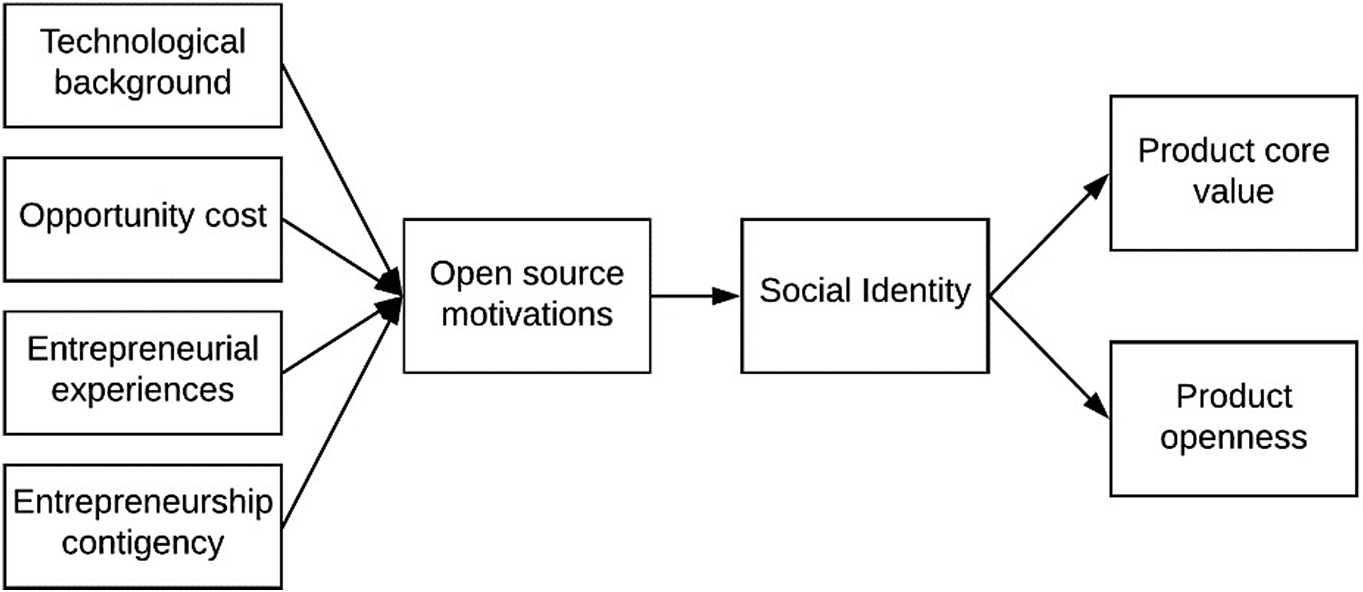
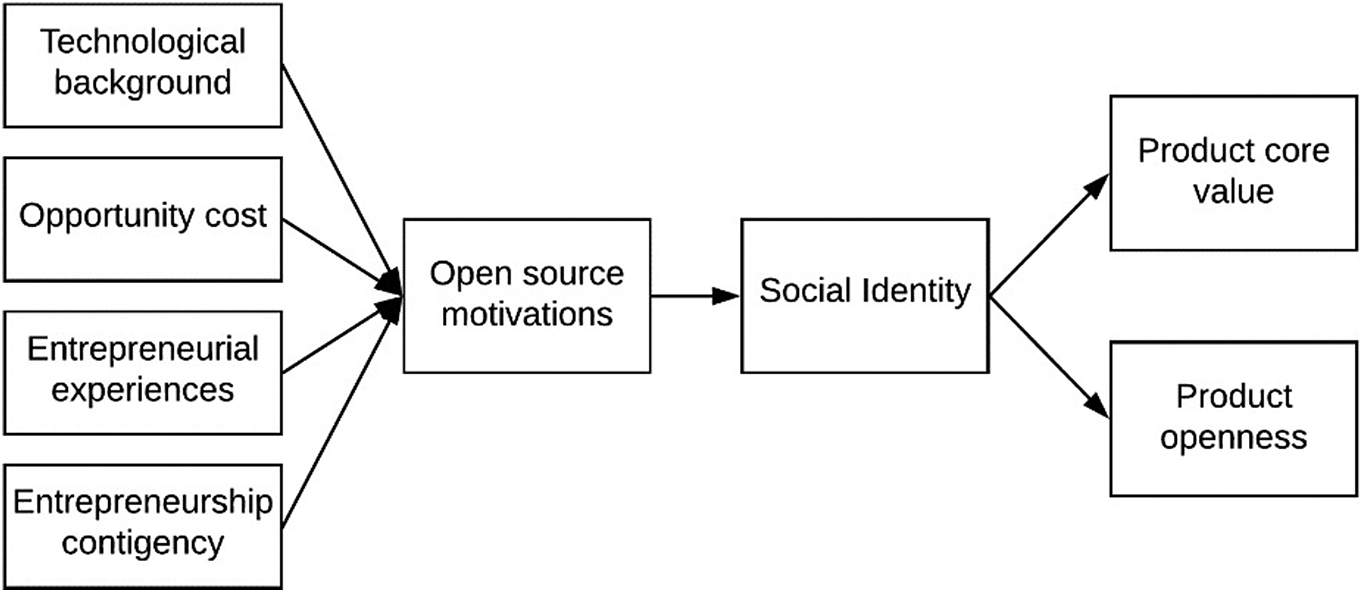
Decision making is an essential topic in design research, and it reflects entrepreneurs’ cognitive status and self-identity. According to Fauchart and Gruber, entrepreneurs’ social identity impacts the product development process and firm business model evolution (Fauchart & Gruber Reference Fauchart and Gruber2011). Therefore, if understanding an entrepreneur’s self-identity, it becomes possible to predict and support entrepreneurs’ decision-making process by, for example, providing different entrepreneurship services. Checking the literature about entrepreneurs’ decision making process in business model design (Amit, Muller & Cockburn Reference Amit, Muller and Cockburn1995; Shah & Tripsas Reference Shah and Tripsas2007; Cassar Reference Cassar2014), We found that founders’ technology capability, perceived opportunity cost, prior entrepreneurial experiences and firm formation contingency are four frequently mentioned factors and may impact the formation of different self-identities resulting in different motivations when making a decision. The definitions of all interesting variables are listed below, and the correlation coefficients are listed in Tables 2 and 3.
-
• Technology capability is a dummy variable with low – 0 and high – 1. If a founder has more than 5 years of engineering experience in industries or schools focussing on product’s core technology areas, she has a high technological capability, which equals 1. The variable’s value is from the answer to ‘What was your profession before building your firm?’
-
• Perceived opportunity cost is a dummy variable describing whether founder’s opportunity cost of creating the firm. If an entrepreneur did not have a stable life income, perceived opportunity cost is coded as high – 1, otherwise 0. The variable’s value is from the answer to ‘What was your profession before building your firm?’
-
• Prior entrepreneurial experience is a dummy variable with first-time entrepreneur – 0, and non-first-time entrepreneur – 1. The variable’s value is from the answer to ‘Is this your first time being an entrepreneur?’
-
• Entrepreneurship contingency (Shah & Tripsas Reference Shah and Tripsas2007) – is a dummy variable with accidental −1, meaning that open-source action takes place before the decision to create a firm; purposeful − 0: Open source action takes place after the decision to create a firm.
Correlation coefficient between preentrepreneur experience and open-source motivation

Note: The index on the horizontal titles is the same as the index on the first column of Table 1.
If we choose an absolute value of correlation coefficient value higher than 0.4 as highly correlated, then Table 3 shows that self-enjoyment as open-source motivation is highly positively correlated with being an accidental entrepreneur and negatively correlated with being an experienced entrepreneur. Reducing community support costs as open-source motivation and being an accidental entrepreneur is highly negatively correlated. Self-enjoyment as an open-source motivation reflects entrepreneurs’ internal needs of playmates or recognition of their achievements. Among all identified motivations, self-enjoyment is the most self-centric one. Then, it is more likely that entrepreneurs open the design due to intrinsic motivations, and the community react to his project, such as the appearance of the user purchaser, and pushed him to turn his hobby idea into a commercialisation trial. It is also not surprising that he is more likely to be a first-time entrepreneur as he had not developed strong enough entrepreneurial cognition, such as IP protection, when he decided to share his work with the public. (The correlation coefficient between being an accidental entrepreneur and being a first-time entrepreneur is 0.38.) (Figure 6)
Potential upstream and downstream causal relationship involving open-source motivations.
Correlation coefficient between pre-entrepreneur experience and open-source motivation

Note: The index on the horizontal titles is the same as the index on the first column of Table 1.
To check the impact of different motivation categories, we use product core values to characterise the product and business evolution. A product’s core value is the first decision in the product development process. In practice, designers ask themselves, ‘I want to make a … (product) with better/more … (functionalities or experiences) to serve … (who)’. In order to describe whether different open-source motivations can potentially influence the product design process, we adopted quality, price and service (Ulrich, Eppinger & Yang Reference Ulrich, Eppinger and Yang2020) as products’ core value propositions. We also add novelty as another dimension as many OSH products were designed for niche markets and customers are willing to pay for novelty instead of waiting for the next best one. It is another big decision whether a firm will always open-source their new products or someday, they will produce proprietary products. The firm’s openness is defined as whether a new hardware product design was still licenced under open-source licences 2 years after the first product’s market availability. The definitions and measurements of variables are listed below:
-
(i) Product core value proposition was measured by four categorical variables: novelty, quality, price and service (Ulrich, Eppinger & Yang Reference Ulrich, Eppinger and Yang2020). Quality, price and service are well-known core value propositions in the design research community. In particular, novelty means that the design criteria of the first product provide a novel, creative solution allowing users have a considerable design space in further development or customisation. Quality means that compared to existing solutions, the product aims to increase the robustness of design or lower the using barriers to attract a broader audience. Price means compared to existing solution product aims to provide low-cost solutions. Service means the product provides better product-related free services, such as delivering speed, returning policy, customer support. The values of this variable are gotten from asking, ‘How your product different from others?’
-
(ii) ‘Closed product within 2 years’ is a dummy variable, equal to 1 if the company files at least a patent after 2 years of the market sales of the first OSH products.
From Table 3, we see that the correlation coefficient between service as a core value and demonstrate the technological capability to leverage other revenue as open-source motivation is highly positively correlated. An open-source model might be beneficial if the core value proposition is to provide better services to the targeted market. The second highest correlation coefficient is between quality as a value proposition and open-source because of market demand. It is not surprising in open-source product markets. A competitor can quickly enter the market due to the low preinvestment (West Reference West2006). Technology and design are shared on a market level, resulting in firms often competing on the manufacturing quality of the products, and other complementary resources, instead of the innovativeness of the products’ design.
6. Limitations, conclusion and future work
Like all other qualitative research, the framework may have generalisability issues, given that the data are collected only from technology startups. Though different motivations were confirmed with interviewees, we do not have data about the dominating motivations. Therefore, it is a reasonable next step to distribute a survey to quantify the impact of different motivations in their decision-making process and how the open-source decisions impact firm performance.
Another potential future research is to explore more profoundly about causes of different motivation formation. Why is it taken for granted by some (and not others) that immediately file a patent rather than taking an open-source licence when starting a firm? Why is it considered the ethical or normatively right thing to do by some and not others? This paper mentioned technological capability, opportunity cost, entrepreneurial experiences and entrepreneurship contingency, and provided the correlation coefficient analysis about how personal variables related to different motivation categories. Is it possible to prove their impacts more quantitatively and rigorously? Apart from individual-level causes, we explained in this paper, are there any institutional variables impacting entrepreneurs’ cognition and self-identity, such as the strength of IP protection law? Or media and public’s attitudes towards Maker Movement and altruistic behaviours? Besides motivations, there are many other related research topics needed further exploration. How is an OSH product designed by the firm’s internal teams when the community is allowed to publicly and openly participate in the design process? How are decisions made across the whole design process in an open-source case? Do ideation, concept prototyping or concept validation stay the same way they are in a closed design process? Does the open-source model indeed help firms to decrease development costs? If so, is it quantifiable? How did the market react when an OSH firm turned closed?
To summarise this work, we reported a novel entrepreneurial phenomenon that newly built firm founders licenced their product design under open-source licences to start their firms. We conducted interviews with 66 founders who founded OSH firms across 23 countries and used grounded theory building to generate a framework explaining the reasons behind this abnormal phenomenon about the hardware product commercialisation process. The interviews showed that the reasons for going open are intrinsic factors, such as entrepreneurs’ moral obligation, altruism and extrinsic motivations such as market obligation, faster time-to-market, a lowered cost R&D and a lowered customer support. Moreover, we also found the change of identities over time among the entrepreneurs, from hobbyist makers valuing sharing, openness and collaboration, to professional managers. We hope to use this paper as a pilot study of this emerging socio-technological entrepreneurial phenomenon. We believe this phenomenon is understudied relative to its counterpart’s traditional business and worthy of more attention due to the richness in data availability.
Competing interests
The authors declare none.




 Open access

