




INTRODUCTION: THE BACKGROUND OF THE STUDY
The Covid-19 pandemic has caused multilevel imbalances in mobility, sociability, and the use of public space, given that state policies have addressed the pandemic in a spatialised manner (Low & Smart Reference Low and Smart2020; Rose-Redwood, Kitchin, Apostolopoulou, Rickards, Blackman, Crampton, Rossi, & Buckley Reference Rose-Redwood, Kitchin, Apostolopoulou, Rickards, Blackman, Crampton, Rossi and Buckley2020). The extensive lockdowns and the consequent expansion of digital technologies for teleworking and socialising have transformed practices in all spatial scale-levels of human life (Salama Reference Salama2020). Indeed, the pandemic has led to a redefinition of people's spatial practices and their interaction with space, demonstrating that Covid-19 is not only a disease but also a social phenomenon with sociopolitical, economic, and cultural implications (Ryan Reference Ryan2021). Accordingly, Contiades (Reference Contiades2020:18–19) approaches governmental responses and pandemic-related discourses as an acute case of biopolitics (Foucault Reference Foucault and Patsogiannis1979/2012)—a form of holistic control over human life, exercised through mechanisms of political biopower in the name of safety and well-being. Biopolitical discourse, capitalising on preventive fear, involves self-restriction deriving from a sense of responsibility and heterorestriction and, thus, suppression (Schismenos Reference Schismenos2020:338–39, 343–44). Lockdown restrictions have resulted in social distancing and home confinement which, in turn, have produced the deterritorialisation of public life and its reterritorialisation within the home (immobility).
This sociospatial experience of the pandemic can thus be approached through Foucault's (Reference Foucault, Dehaene and Cauter1967/2008) notion of heterotopology (heterotopia as heterochrony, i.e. accumulating time indefinitely; or as a chronique, i.e. temporal heterotopia) so as to shed light on the tensions emerging from processes of reterritorialisation taking place at the intersection of immobility and mobility, what we are calling im~mobility. (See also Milani & Levon (Reference Milani and Levon2019) for an emphasis on the spatialization of time when working with the notions of heterotopia and heterochrony.) Mobility in time and/or space creates a threshold, namely, a relationship with spaces—an experience. Thresholds are arrangements that regulate the relationship of heterotopias with their surrounding spaces of normality. Through combining/separating thresholds, heterotopias with their osmotic boundaries are places where ‘otherness’ pervades ‘sameness’, thus resulting in the diffusion of rigid taxonomies (Stavrides Reference Stavrides, Franck and Stevens2006:177–78). Henceforth, we adopt the symbol ~ to denote ‘a non-binary sense of mobility’ (Dou Reference Dou2021), when referring to such spatiotemporal arrangements, that is, to thresholds as hybrid spaces or processes. During the pandemic, the embodied subject was deprived of public life and put into quarantine through a set of biopolitical health technologies. It was hindered from exercising speech and was subjected to spatiotemporally regulated mobility in public space and across borders, gradually losing the very potential to exercise fundamental rights, such as the right to privacy, including the security of personal data and protection against surveillance, freedom of assembly and association, or the right to the city (see e.g. Kitsiou & Bratimou Reference Kitsiou, Bratimou, Fridman and Gensburger2023).
The present study focuses on the homescape since various practices have been reterritorialised in the home where the boundaries between the public and the private have been diffused and hybrid spaces have come into being. These new realities, reshaping the linguistic—more broadly the semiotic—landscape (henceforth LL), have brought into question homelife and performances of the homescape. Transnational individuals with complex (im)mobile trajectories are already subject to multiple constraints, referred to as ‘(im)mobility as a struggle’ (Juffermans & Tavares Reference Juffermans, Tavares, Horner and Dailey-O'Cain2019). Pandemic disruptions in mobility have further complicated immigrants’ homelife, becoming visible though translingual practices in spaces where they were previously unexpected.
In this context, we define the ‘named room’ (e.g. ‘living room’, ‘baby's room’) as a unit of analysis to map the transformations of the homescape, exploring three cases of Greek ‘brain drain generation’ immigrants who reside in Paris (France), Berlin (Germany), and Utrecht (the Netherlands). During the research, no limitations on traveling between EU countries were at play. However, participants’ host-states and common homeland implemented restrictive measures during the pandemic in a diverse way, more or less strictly enforced (e.g. ‘stay at home’, social distancing, ‘work from home’, lockdowns, spatiotemporal restrictions on mobility or gathering). Applying the concept of the transpatial repertoire, in the following sections, we showcase how the homescape was reshaped at the intersection of mobility-immobility (im~mobility) and the online-offline (on~offline) nexus through the translingual and translocal performances of participants, thus shedding light on the emergent heterotopias of im~mobility.
THEORETICAL BACKGROUND
Based on the current scholarly literature, linguistic landscapes (LL) are understood as communication materialised in space through translingual practices, incorporating multimodal resources, such as sounds, artifacts, images, moving images, kinaesthetics, and even bodies (Shohamy & Gorter Reference Shohamy, Gorter, Shohamy and Gorter2008; Shohamy & Waksman Reference Shohamy, Waksman, Shohamy and Gorter2008; Blackwood, Lanza, & Woldemariam Reference Blackwood, Lanza, Woldemariam, Blackwood, Lanza and Woldemariam2016; Gorter Reference Gorter, Pütz and Mundt2018). To highlight the importance of every emplaced resource in meaning making, Jaworski & Thurlow (Reference Jaworski and Thurlow2010) introduce the broader term semiotic landscape. Furthermore, while some semiotic elements of the LL are stable, others are more fluid and temporal, giving rise to transient LLs as manifest in particular social performances in specific spatiotemporal contexts (Barni & Bagna Reference Barni, Bagna, Blackwood, Lanza and Woldemariam2016), for example, in the case of demonstrations (e.g. picket signs, chanted slogans, moving bodies), days of remembrance (e.g. banners, flags), celebrations at home (e.g. relevant decoration), or the pandemic (e.g. masks, gloves, sanitiser). Moreover, digital technologies frequently appropriate resources embedded in physical spaces, rendering them features of virtual spaces as well; this entanglement diffuses the boundaries between physical and virtual interaction, hence creating an ‘online-offline nexus’ (Blommaert & Maly Reference Blommaert and Maly2019).
Referring specifically to the LL constructed within the homes of transnational families, Boivin (Reference Boivin2021) introduces the term homescape to describe the multisensory resources enabling family members to invest their identities within their homes. Approaching ‘home’ as a dynamic ongoing process of home-making promotes a non-binary understanding (e.g. private-public, material-subjective) of everyday life and its trajectories (Vilar Rosales Reference Vilar Rosales2010). From this perspective, informed by new materialism, home is revealed as a porous, relational space, both lived and imagined, that is, an assemblage of resources and practices whose ecology transcends local-national boundaries, especially when connected to migratory experiences (Arcidiacono & Pontecorvo Reference Arcidiacono and Pontecorvo2019; Canagarajah Reference Canagarajah2021). Accordingly, space is understood here as a process of social construction and the locus of social relations realised in the dialectics of what is materially and physically perceived, how it is abstractly conceived and, ultimately, how it is lived, felt, and envisioned (Lefebvre Reference Lefebvre1991).
Thus, space emerges as a key concept in understanding human interaction and meaning making, especially amidst the hybridity and complex fluidity of current communicative repertoires (Shohamy Reference Shohamy2015) that are conceptualised as individual repertoires within a spatially informed sociolinguistic perspective. Individuals participate in complex ever-evolving spatial realities through their individual and shared practices and experiences, and in this way, they invest themselves in the various spaces they inhabit (Lewicka Reference Lewicka2011). During this meaning-making process, human subjects bring in their sociocultural, linguistic, and affective habitus in order to interactionally and embodily engage with the semiotisation of their spaces of livelihood (Stroud & Jegels Reference Stroud and Jegels2014).
In these contexts, people communicate, capitalising on all resources available, that is, they translanguage with flexibility and creativity, exploiting their individual unified semiotic repertoires (García & Wei Reference García and Wei2014). Individual repertoires are then dynamically developed across the lifespan depending on the available and accessible recourses, and thus reflect the (dis)continuities of human experience in mobile, superdiverse times (Blommaert Reference Blommaert2010). Accordingly, translingual practices are indicative of individuals’ life trajectories, which traverse languages, spaces, and cultures, at the same time that they transform the spaces within which they take place (Tsokalidou Reference Tsokalidou2017; Wei Reference Wei2018).
Canagarajah (Reference Canagarajah2020:12) refers to spatial repertoires as the emplacement and assemblages of spatial resources in particular settings. But Kusters, Spotti, & Swanwick (Reference Kusters, Spotti and Swanwick2017) problematise the analytic scope of the concepts ‘linguistic repertoires’ (as repertoires foregrounding the individual) and ‘spatial repertoires’ (as repertoires foregrounding space as an agentive entity that encompasses individual linguistic repertoires), drawing on new materialism and introducing the unifying concept of ‘semiotic repertoires’. They assume that the use of ‘linguistic repertoires’ or ‘spatial repertoires’ is a matter of perspective depending on the emphasis attributed either to human agents (human-centered) or to space (space-centered). Hence, the notion of space-based—namely spatial—repertoire goes beyond the individual's or the community's linguistic resources to include every multisensory and multimodal semiotic resource that is enacted and situated in this place (Pennycook Reference Pennycook2017). People perform and emplace their personal trajectories in space while living their everyday lives, employing the full scope of their repertoires in relation to the meaning-making resources available (Pennycook & Otsuji Reference Pennycook and Otsuji2014). This interplay results in the emergence of ‘spatial repertoires’, that is, ‘a geography of linguistic happenings, the social space of language practices’ (2014:166). In that respect, along with human agents, inanimate resources also co-construct the activities taking place in a space and are agentive and generative of social practices, much like space (Canagarajah Reference Canagarajah2017). Meaning-making is therefore relational, involving human and non-human agents that shape each other. In this sense, relationality can reveal the infrastructural and institutional constraints involved in non/human resources’ emplacement and entanglements, including dis/continuities, vulnerabilities, and resistances (Butler Reference Butler, Butler, Gambetti and Sabsay2016).
Kramsch (Reference Kramsch2018), however, raises a word of caution regarding talking about languaging, communication, literacy, and education through spatial metaphors in the context of the post-humanistic trans-perspective. About the concept of ‘trans-spatial utopias’, she points to the placeless space this trans-perspective foregrounds (cf. Hawkins & Mori Reference Hawkins and Mori2018), emphasising the need not to neglect time and history due to the intense engagement with space, thereby overlooking social constraints and human experience. Here, taking into consideration Kramsch's insightful critique, we aim to conceptualise the term transpatial as part of the concept spatial repertoire, drawing on the pandemic-affected homescape experience.
METHODOLOGY
This multiple case study (Yin Reference Yin2018) integrates elements of ethnography (Bryman Reference Bryman2001) and reflexive photography (Schulze Reference Schulze2007). The general research objective is to explore performances of the homescape during the pandemic as manifested in the everyday lives of three Greek ‘brain drain generation’ immigrants. The three individuals immigrated to EU economic metropolises (France, Germany, and the Netherlands respectively) in search of employment during the last ten years of deep economic crisis in Greece. The main research question of the study is: How is the pandemic-affected homescape discursively constructed by ‘brain drain generation’ Greek immigrants? Table 1 presents in detail the linguistic, educational, and professional profiles of the three participants, as well as their migratory trajectories.
Participants’ profiles.

During the first week of the main research, the participants were provided with specific guidance on how to record their experiences. They kept a daily digital diary for eight weeks about their experiences and thoughts concerning the spaces they live in (132 multimodal diary entries of one to two pages each, including audios, photos, texts, videos). They also produced video narratives (thirteen videos of five minutes duration each) and used instant messaging to express prompt thoughts. Since the research design required a high level of participants’ engagement with data production, their already established relationship with the second author ensured their motivation and openness. Analysing thematically (Braun & Clarke Reference Braun and Clarke2021) the data sets they produced during the first four weeks of the main research, key themes were identified, such as working in the living room. Then, the researchers selected multimodal data pieces indicative of the identified themes and used them in order to involve the participants in a reflexive process through photo elicitation interviews (three interviews, in total seven hours of transcribed data).
In order to answer the research question, we drew on Fairclough's (Reference Fairclough1998) critical discourse analytic approach and transcribedFootnote 1 and analysed the verbals and the visuals identified in oral and visual/multimodal data. In the following section, we explore how the participants discursively engaged in homemaking practices as they visualised and narrated in diverse and multimodal ways (via speech, texting, photo, text and photo, video) their sociospatial experiences, thus making visible aspects of biopolitical control.
RESULTS: TRANSPATIAL REPERTOIRES OF PANDEMIC-AFFECTED HOMESCAPES
Homescape of immobility: Transforming the living room
Identifying resemiotisation, fragmentation, and hybridity as key processes that have reshaped home and its experience during the pandemic, in this section we focus on the living room: one of the home's shared spaces that hosts socialisation practices like dining with friends. Such practices, considered ‘normal’ before the pandemic, have been deterritorialised, and new sociospatial practices have emerged that have reshaped the LL of the living room. Indeed, the reterritorialisation of practices within the homescape and the construction of hybrid spaces were reported across the cases in this study. The boundaries between ‘named’ spaces and their -scapes were dissolved, and various spatial repertoires merged, leading to hybrid -scapes and the emergence of transpatial repertoires. In other words, heterotopic places emerged due to the fragmentation of the living room, highlighting its porous spatiality. The heterochrony of this multi-space ecology was performed in a complex way either by the accumulation of simultaneous activities (multi-tasking or/and multi-actors) or of consecutive ones; that is, different spaces and practices within the living room either overlapped or alternated.
Performing the professional in the living room as a shared workscape
Working from home resulted in the resemiotisation of the living room in the sense that a mosaic of different -scapes emerged according to the activity performed at a given point in time. For example, in excerpts (1) and (2), the spatial repertoire of the living room meshes with that of the workspace through the use of laptops. Excerpts (1) and (2) refer to Anna and her husband, Claude, who are both employed in different telecommunications companies and have been working from home (30 m2) in France since the beginning of the pandemic. In her reflexive interview (see excerpt (1)), Anna describes how part of the living room loses its original and expected use to turn into their workspaces. The media they use to perform their work, two company laptops, have occupied the former common desk in the living room (see left photo in excerpt (2)) but since the desk is not big enough for both laptops, she has set up her workspace at the dining table, which she calls “the table we had been eating”, as shown in excerpt (1).
(1) Anna, photo elicitation interview (emphasis added)
So the table we had been eating became my desk and the old desk where before we were crammed together became Claude's office.
Shared resources (“the table we had been eating”, “the old desk where before we were crammed together”) were redistributed (“became”) to address individual needs (“my desk”, “Claude's office”). The first person plural pronoun “we”, used to express the common space, is replaced by singular first person possessives (“my”, “Claude's”), indexing new boundaries in the living room and creating new compartmentalised and individualised spaces. The resemiotisation of objects and spaces is reflected here in Anna's lexical choices, as the “table” turns into a “desk” and the “desk” turns into an “office”. It should be noted that in Greek the word γραφείο is used for both ‘desk’ and ‘office’; here, the different meanings attributed by Anna to γραφείο are contextually inferred. A table is an object of general use with multiple special uses; one of them is eating. Here, the general use object (“table”) is resemiotised as an object of special use (“desk”) because the space has been transformed into a ‘room’ of specific use, a named transient workspace (“office”) emplaced in the living room.
Before the pandemic, work occasionally took place at home in chroniques, that is, in segments of working time fissuring homelife in a Foucauldian sense. In her interview, Anna recognises an uncomfortable place where they “were crammed together” (“old desk”), since working was not a systematic activity integrated into the homescape. The verb “crammed” indexes the material dimensions of the homescape. The house's size and layout became more visible during the pandemic, since an already confined space for two people had now to become a separate workspace, Claude's office. As a result, the living room became a place to perform professional activities, having to accommodate additional uses and working needs within the same 30 m2 (both Claude's office and Anna's table~desk). The repeated use of the verb “became” signifies the process of transformation taking place due to the reterritorialisation of individual workspaces in the living room and thus the emergence of a heterotopic workscape within the home.
Anna and Claude, although now working at ‘individual’ desks, perform a ‘shared’ workscape. This workscape, as shown in the multimodal display of excerpt (2), is diverse and is diffused discontinuously in the LL of the living room. As depicted in the photos, various agents participate in shaping the LL: (a) human agents, such as Anna filming, Claude working, the baby sleeping, (b) non-human animate agents, such as the cat sleeping, the plant by the window, (c) inanimate material entities, such as toys, ornaments, lambs, special equipment, and (d) im-/material entities, such as natural or artificial light and sounds including speech.
(2) Anna, video narrative
this is the living room [turning the camera]; the baby in the middle [middle photo] as décor; there [left photo] Xiaomi is housed and here [right photo] Samsung is housed ((ironically))
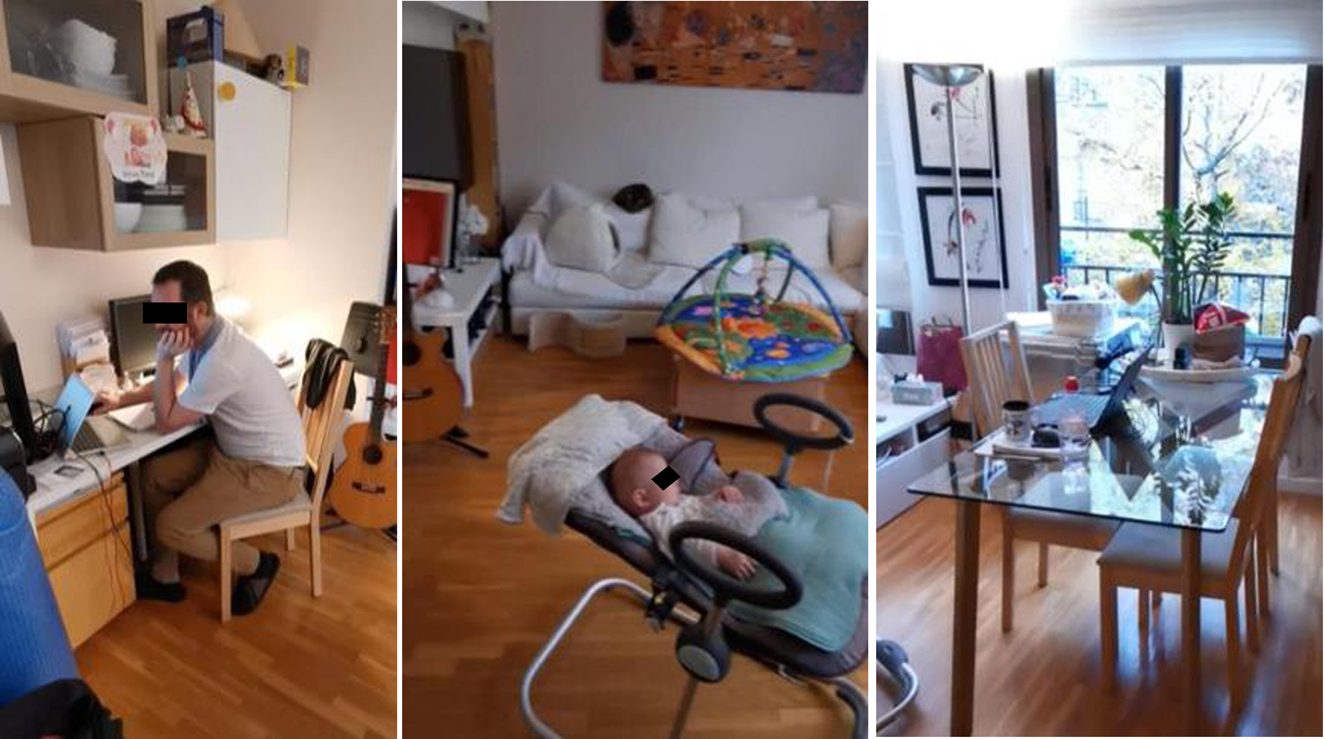
A hybrid LL emerges through the integration of the work and home LL. More specifically, kitchen equipment is placed in the cupboards over the desk where Claude is working (excerpt (2), left photo), while elements and practices fitting to a living room are still present, for example, guitar, sofa, decorative paintings, cat sleeping on the couch, baby's matt and toys on the coffee table (middle photo). Accordingly, next to the dining table~Anna's workspace, where her laptop is placed (right photo), there is also the baby's cot where the baby rests while the parents are working. The accumulation of multiple spaces with disrupted boundaries and the heterogeneous emplacement of resources that are in and out of place at the same time results in a trans-diverse living room~workscape.
If we isolated the middle photo of (2), we could recognise an instance of a ‘normal’ living room spatial repertoire, where a cat and a baby participate actively in homelife, while resting at home (sleeping on the sofa and on the cot). In this spatial context though (between the other photos), the baby and the cat invade the shared workscape as “décor”, in Anna's words; these two agents do not participate in the worklife happening there but serve as a heterotopic element of working at home. They become a transient, fluid boundary (“in the middle”) (a) between homelife and worklife (living room furniture, cat and baby as elements of the homescape that are reconstrued and resemiotised by working activity), and (b) between the two workspaces of competitor companies in telecommunications industry. In the first case, the cat and the baby as residents of the home may disrupt working activity at any moment. In the second case, Anna and Claude, as home-based employees, may disrupt each other's workspace sharing ideas and facts about working synchronously, leading to transpatial intersections of competing workspaces. In the case of tele-meetings, the soundscape of the living room becomes even more diverse in the online-offline nexus through the use of translingual practices (French, English, Greek). It brings together home-based conversations on issues of work (French) or family issues (Greek, French) and digitally mediated conversations with colleagues located elsewhere (French, English). In addition, the metaphor of the baby as “décor”, as a background to the competing workspaces, indexes the othering of the baby (representing it as out of place) and, more generally, the othering of the LL of the living room. This othering results both from and in the construction of a fluid boundary between the home- and work-scape which is constantly negotiated by potential non/participants.
Thus, we observe a process of mobility as human and non-human agents constantly and relationally move in and out of place as well as between the background and foreground, following the continuous re-negotiation of the boundaries of the spatial repertoire of the home. Therefore, the discursive construction of homescape elements, as entities of a background (décor), emerges as a constant process of ‘backgrounding’ depending on what activity is in the foreground each time. Consequently, different spatial scales dominate the hybrid LL in a trans- way, and are integrated into heterotopic chroniques.
A further discursive element revealing the heterotopia of the workscape in (2) appears in the use of the verb “is housed” to describe the emplacement of the two laptops in the living room as if it were the premises of the two companies. This wording indexes a sense of permanence; moreoever, a sense of discontent is expressed in Anna's extra-linguistic ironic tone concerning the integration of the two workscapes within the homescape. The metaphorical use of the verb “house” to refer to the workspace performed in the literal “house” (the physical 30 m2 house) further points to this heterotopic condition. The enforced integration due to the infrastructural and institutional constraints of the pandemic biopolitics reveals the tension between -scapes and therefore the vulnerability of the transpatial repertoire of the living room.
Performing the political in the living room: Multiple political present(s)
In this section, we show how work turns into the contextual background for the activities taking place in the living room. We refer to two cases of performing the political in the living room: (a) politicising the living room, while working at home, as a homeland memoryscape (Blackwood & Macalister Reference Blackwood, Lanza, Macalister, Blackwood and Macalister2020), and (b) politicising the living room as a union's general assembly space.
The multiple fragmentation of the living room is evident in the case of George, who presents the appearance of layered and overlapping soundscapes. During the pandemic, George (credit risk manager) and his Greek roommate (data analyst) have been working from home for different multinational companies, using their dining table as a ‘shared’ office. While working, the two roommates would listen to Greek radio: a formerly out-of-work activity reterritorialised in the workspace as an emergent sociospatial practice enabled by the pandemic and working from home. In other words, they wouldn't have been able to listen, let alone share, Greek radio in the ‘normal’ pre-Covid-19 workspace. Since the two roommates work in English speaking corporations, their dining table accommodates two English speaking workspaces in the performing of the professional. However, listening to the radio merges the soundscapes of separate workspaces, integrating translocal translingual practices into a ‘shared’ common soundscape. The LL, dominated by Greek, constitutes part of the migratory trajectory and meshes different sociospatial performances and languages (professional: English, political: Greek).
Excerpt (3) is a transcription of a video-entry from George's diary, recording an experience of radio listening as a commemoration of the Greek anti-dictatorship struggle (memory day of 17th November 1973). In this instance, a well-known revolutionary song by the Greek artist M. Theodorakis plays in the background while they are working, triggering the memoryscape of the anti-dictatorship struggle. Thus, the current Greek sociopolitical newsfeed and the Greek language are territorialised in the spatial repertoire of George's home~workspace through the radio.
(3) George, diary entry
due to the day today we work with revolutionary songs on the radio …. [radio playing] ‘In our hearts the feast begins / ‘Tak-tak’ you [knock], ‘tak-tak’ I [knock] … which means / in this mute language / ‘I hold on strong / I preserve well’ [translated lyrics heard in the video of the multimodal diary entry]
The song in (3) was written in 1968, during the Greek junta (1967–1974), when the composer was a political prisoner in the headquarters of the State Security Agency. In the lyrics, he describes the torture he and other prisoners were suffering in the agency's headquarters (hence the metaphorical title of the song ‘The slaughterhouse’) and their revolutionary spirit (‘in our hearts the feast begins’). Accordingly, ‘Tak-tak’, the cryptic sound signal (‘this mute language’), refers to the prisoners tapping on the wall between their cells to notify each other that they are well (‘I preserve well’) and staying faithful to the anti-dictatorship struggle (‘I hold on strong’). That is, the song reflects the experience of the prison heterotopia and indexes the vulnerabilities produced by the Junta biopolitics in ‘The slaughterhouse’ as well as the resistance of the prisoners (‘in our hearts the feast begins’, ‘I hold on strong/I preserve well’). This is cryptically communicated and shared through the sound of tapping on the wall. Hence, the song drags a specific past experience into the political present. As an element of the memoryscape, it becomes an ‘audio monument’, a substitute for the material monument of the anti-dictatorship struggle in the physical space of Athens (the central building of National Technical University of Athens).
George, before migrating to the Netherlands, used to participate in the annual commemorative demonstrations held on the 17th of November in Athens’ city center. However, as a migrant in Utrecht, his embodied presence in demonstrations has been disrupted. This deterritorialisation of demonstrative and commemorative practices emerges as a facet of vulnerability due to the migratory experience. Given the migration-generated physical limitations (geographical distance) that prevent George's participation in the embodied performance of the memoryscape in Athens, the song/audio-monument becomes construed as the medium to create a heterochrony of resistance. It emerges as a sociospatial anchor to translocally perform the political in a migrant pandemic-affected homescape.
By listening to “revolutionary songs” on that specific day (“due to the day”), George and his roommate perform the memoryscape of anti-dictatorship struggle in a heterotopic place, namely, in the living room, while tele-working under the biopolitical constraints of mobility. This migratory pandemic-specific commemorative practice transforms the practice of listening to the political radio into a trans-lingual-spatial heterochronic experience. The radio mediates a chronique of commemoration and the transpatial repertoire of the living room accumulates multiple political ‘presents’ and ‘pasts’, as heterochronies.
In excerpt (4), George gets involved synchronously in the commemorations as they are performed in Athens through instant messaging (IM). The online-offline nexus transcends the physical limitations of the living room, enabling a more interactive—although distant—participation in the commemoration. Unlike previous distant engagement with political activity in Greece, this instance of communication is more complex, since the Greek context is regulated by pandemic biopolitics, which violate the right to assembly. More specifically, the commemoration rally was prohibited by a police decree, the excuse being the pandemic (see for example Becatoros Reference Becatoros2020). This vulnerability in resistance (Butler Reference Butler, Butler, Gambetti and Sabsay2016) created a heterotopic rally, disrupting the norms of demonstrating and commemorating in Greece.
While the rally was going on, George was texting with some friends who tried to reach the center of Athens in order to participate in the commemoration rally. Because of the prohibition, the protesters tried to avoid communicating their plans and their whereabouts through digital media. But this meant that George, who was unaware of these precautions and of the disrupted commemorative practices, could not easily follow up with them. He, thus, experienced confusion in trying to understand the situation in Athens, while having to work at the same time.
(4) George, instant messaging
George: you haven't gone eventually?
Rosa: I'm going
George: Ooooh wheeere?
Rosa: to the gyno
George: I am so confused
Rosa: don't be naïve
George: where are you pal?
Rosa: I'm going to where we have talked about 
George:  Heyy take care
Excerpt (4) is part of his IM communication with a demonstrator in Athens, who is heading towards the center of the city, taking precautions to avoid police control. George uses a yes/no negative question, “you haven't gone eventually?”, that reflects his doubt that she will reach the locus of the demonstration, due to the constraints of biopolitical control. Rosa initially gives an incomplete and vague answer (“I'm going”), using an elliptical sentence without a place qualifier to show that she is on the move while avoiding explicitly naming her destination in written form. George, puzzled by her answer, emphatically (“Ooooh wheeere?”) poses a wh-question, extending the word ‘where’ through deviant/vernacular orthography (Shortis Reference Shortis, Ramos and Gea-Valor2007). She then gives a shibboleth reply (“to the gyno”) that further confuses George who states his confusion explicitly (“I am so confused”). Even when he is encouraged by Rosa to read between the lines (“don't be naïve”), he is still unable to make sense of the non-literal, purposefully cryptic answer repeating the same wh-question (“where are you pal?”). Consequently, Rosa again provides a spatially vague answer (“where we have talked about”), indexing a previous conversation conducted in a safe mode, while she expresses her indignation multimodally using an emoji (‘smoke from the nose’). Rosa's frustrated answer resolves the miscommunication and George finally understands the message and expresses his concern (‘heart’ emoji, “take care”) regarding the tension between the police and the demonstrators in the forbidden rally. This instance of miscommunication reveals the vulnerability experienced by George, as an out of place political subject who has difficulty in actually understanding the implications of biopolitical measures (e.g. acute police surveillance and suppression), and the disruptions to pre-pandemic ways of demonstrating (e.g. invention of fraud excuses to move around, such as a visit to a gynaecologist). His persistence though to ‘follow’ the route of his demonstrator-friend can be construed as an act of resisting the constraints of telecommemorating that throw him out-of-place. Politicising the living room, thus, involves an in-and-out-of-place transition of his political subjectivity in the online-offline nexus.
For George, following the flow of the Greek sociopolitical events creates a bridge that enables his remote entanglement with these events, as well as with the lives of his social circle in Greece. Hence, spatially remote events that happen in the homeland are reterritorialised in the transpatial repertoire of the home~workspace, transforming the living room to a heterotopic place. On the one hand, this transpatial repertoire meshes together the sociopolitical events that are happening concurrently in the two countries—countries that are handling the pandemic in diverse ways. On the other hand, it integrates the political past and present, since George is enabled to actively engage with political commemorative practices he used to perform before migrating in a trans- way, that is, at the intersection of home~work~memoryscapes.
The case of George, then, demonstrates how the living room became the space where political subjectivities were performed in relation to the sociopolitical past. In excerpt (5), by contrast, we see the political being performed in relation to the sociopolitical present and future. A public meeting of 6,500 participants comprises the main activity taking place in the living room. More specifically, in excerpt (5), Anna (see Performing the professional in the living room as a shared workscape) is located in the private/domestic environment of her living room while she participates in a virtual union meeting in order to exercise her union membership rights. The assembly was held because the multinational company she works for had—before the pandemic—announced 1,200 redundancies in its French branches. This explains why employees from different cities in France participated in the assembly. Her multimodal diary entry is comprised of a screenshot of her laptop interface, displaying a view of the general assembly digital room and of an accompanying narrative written in French and Greeklish, that is, transliteration of Greek with Latin characters.
(5) Anna, diary entry
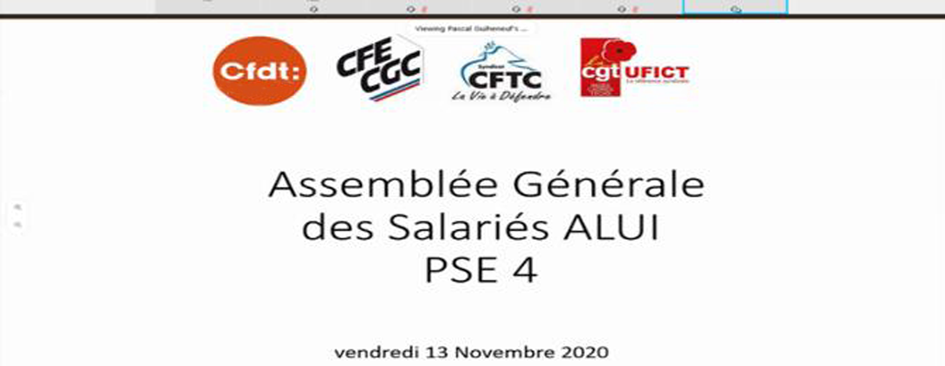 we are talking about 5000 employees in Paris and another 1500 in City X. But in the time of coronavirus, assemblies are held like this.
No difficulties with the quorum, nor the one to speak over the other (the host mutes him)  (I'm crying to laughter).
Here we see Anna capitalising on her prior experiences from union assembly meetings in Greece as a student and an employee, referring to the impact of the (digital) medium in transforming the ‘usual’ performance of the general assembly (“in the time of coronavirus, assemblies are held like this”). She foregrounds the large number of the company's employees who are participating in the same assembly, (5,000; 1,500) despite working for the company in two different cities, a fact that would have otherwise been physically impossible. She also comments on how the affordances of the medium have disrupted the procedure of the assembly, since, on the one hand, the mute button (“the host mutes him”) enforces silencing in the case of interruptive interventions (“no one to speak over the other”). On the other hand, the digital solution/alternative enables the participation of more employees; there were “no difficulties with the quorum” as there had been in pre-pandemic gatherings. Through ‘typographic energy’ (Jane Reference Jane2015:66) (two laughing emojis) and the statement “I'm crying to laughter”, Anna makes explicit her sarcasm regarding the general assembly performance. In this way she questions the efficacy of such digital practices when performing a union assembly in the pandemic era.
Specifically, within this pandemic-specific digital solution, it is impossible for participants to interrupt one another because of the muting function (“the host mutes him”), and this leads to the silencing of disagreements and the limiting of polyphony. This aspect of tele-gathering can be recognised as the vulnerability that creates a heterotopia of the assembly in the living room. When realised online, the assembly is a form of resistance to the vulnerability imposed by pandemic biopolitics and the concomitant restriction of public gatherings. However, a new vulnerability appears in the digital LL due to the silencing practices enforced by a disembodied agent, who takes advantage of the techno-affordances (non-verbal clicks by the host) to control negotiation of disagreements. This is problematic given that disagreements are a core element of democratic decisions and collective action.
Further diversifying the spatial repertoire of the home, then, the manner assemblies held in the pandemic era changed the space from physical to digital, thereby leading to a blending of sociospatial activities in the online-offline nexus. The affordances of digital media transformed the living room into a hybrid space through the diffusion of the boundaries between the domestic-private and the political-public. On the whole, the transpatial repertoire of the home embodied heterotopic elements, namely offline-online sociospatial re/arrangements and the consequent vulnerabilities produced by biopolitical measures.
Homescape of im~mobility: Redistributing space and disrupting boundaries within the home
In this section, we examine how forced immobility due to the pandemic has resulted in great mobility within the home—what has become a redistributing space. Apart from the diffusion of the boundaries between various -scapes performed in the living room, the transference of everyday life activities within the home also reveals a disruption of boundaries across the conventional spaces of the home. The need to accommodate various individual needs within the home has led to their reprioritisation and the consequent redistribution of spaces. The ongoing hybridisation of spaces also manifests itself in the discursive choices of the participants who use different labels to refer to the same space: a language choice determined by the activity being described.
The following excerpts refer to Maria, who is a teacher of German language, and her husband Tim, who works in a multinational insurance company. They have lived in Berlin for the past nine years and are expecting a baby. Prior to the pandemic, neither Maria nor her husband worked from home. Whenever one of the two had to do some work at home they shared a common working space in the study room, a space that they have also been using as a guest room. Since the start of the pandemic, Maria's husband kept the study room as a working space. Maria started using the living room as her working space, when needed (e.g. to correct papers), since it stopped functioning as a place to receive guests. During the day, when her husband was having his work break, Maria would move to the study room to keep working or to socialise digitally, while the living room was once again used as a space for rest by her husband. The couple, after deciding that the study room would become the expected baby's bedroom, permanently moved the office into their bedroom, hybridising this room as well. This chain-like expansion of spatial performances and redistribution of boundaries affects the homescape in a holistic way. The former “study room”, now “baby's room”, was intended to also remain as a “guest room” and was redecorated with a loft bed to continue accommodating the need to host visitors, a need strongly related to Maria's own migratory trajectory.
(6) Maria, video narrative (emphasis added)
a. Usually, if I need to do anything using the PC I would do it in the room which is going to be the future baby's room but anyway up till now we are using it as a guest room or we also have a desk where Tim now works from home. And because he is working now I cannot go there so now I am in the living room with my cats. … At the study [room] I have a lot of Greek books
b. Here is the workspace where I correct papers, the desk and my books
As an illustration of the discursive construction of space, excerpts (6a) and (6b) reveal the importance of the activity taking place in a room to its assigned name, as well as the diffusion of boundaries at different spatial scale levels. Maria here refers to the same room using alternate names depending on the activity she focuses on (“guest room”, “future baby's room”, “study [room]” in (6a); “workspace” in (6b)). Because this room is going to be “the baby's room”, the couple was making changes during the research so as to free up space for the baby's things, while maintaining a bed for guests. Their desire to maintain its operation as a “guest room” constitutes an effort to avoid the deterritorialisation of a provision for friends and family visiting from Greece, a provision on which Maria insists in her diary entries.
Hybridity unfolds as new permanent elements are territorialised within preexisting home materialities and are influenced by their constraints: a process clearly manifested in the language choices made by participants. Family members are redistributing space in the house, prioritising needs and maintaining or creating hybrid spaces (e.g. new baby's room~guest room; bedroom~working space/office).
Despite this process of intentional spatial redistribution in the home, unexpected moments when different sociospatial activities meet and merge may also create hybrid LLs. In excerpt (7), Maria, performing homelife in the context of a socialising event, communicates on Skype (digital threshold) with a Greek-speaking friend in the homeland, while sitting in the living room. In the meantime, her German-speaking husband leaves the study room, where he was working, in order to have his break in the living room. At the same time, Maria moves to the study room to continue her Skype call. In (7), a dialogue is displayed between the three of them while Maria is on the move and meets Tim in the corridor (physical threshold), disrupting his way to his break (both as time zone and space). The following translingual interaction takes place and includes the use of Greek and English at the intersection of worklife and homelife.

One of the most striking elements of this dialogue is the antithetical relationship between confinement in the house (given the protection measures) and mobility across rooms within it. The phrase “stuck at home” is uttered, describing the immobility enforced due to the pandemic, at the same time that Maria and Tim are on the move, changing rooms. The stay-at-home biopolitical imperative is experienced as a stuck-at-home condition that reveals one of the vulnerabilities of the spatial repertoire of the home. This heterotopic im~mobility is immediately recognised by the Skype interlocutor as reflected in her lexical choice, “of course”, opening her answer in turn 3. Although her experiences are grounded in the biopolitics of Greece, the pandemic vulnerabilities are discursively constructed as a translocally shared experience (“me too, here”) that is communicated in this digital space.
The chronique of translingual practices emerged here at an unexpected transition point between events and rooms. Such heterotopic places can be understood as threshold spaces located beyond spatially bounded routines in ‘named’ spaces (e.g. the study room) and ‘named’ languages; that is, translanguaging occurs beyond the binary of online-offline between spaces that would expectedly be separate. Flows of the inhabitants/people, practices, and languages within the home produce ‘unexpected’ communicative events, withstanding the efforts of its inhabitants to border different spaces and their use. In other words, translingual LLs create spatial repertoires that move beyond named spaces, incorporating a reservoir of resources and a variety of practices ‘normally’ expected to be found in different/separate spaces.
This mobility and fluidity of spatial practices creates instances of transgression whereby social and professional events intersect. Participants navigate themselves within their homes, employing the resources available and most appropriate to make meaning. This meaning-making process is dependent on the social action they are performing at the time rather than on the ‘named’ activity they would be expected to perform in a given space. Consequently, translingual practices may appear at the threshold of these moments of intersection, as heterotopic elements of the homescape. Spatiality, therefore, involves a ‘trans-’ dimension due to these processes of hybridization, involving physical and digital thresholds.
Transient homescape of mobility: Performing home transpatially due to distant working
Although working from home had limited the participants’ mobility within their host countries, it also enhanced their mobility across host/home countries. The increasing use of digital technologies during the pandemic (in order to limit movement in public spaces) had a side effect for the participants in this study. That is, working from home provided an exceptional opportunity for them to travel to Greece once restrictions on international flights were lifted. However, while mobility on a macro-level (across countries) was facilitated due to the remote work option, mobility on a micro-level became more restricted for some due to the different measures adopted by different countries. As shown in excerpt (8), the Greek context appears more restrictive (spatiotemporal limitations, mobility limitations) than the Dutch context.
(8) George, diary entry
Today I worked from Simos and at night I returned at Sofia's. In general, moving around is difficult in Greece because I have to send the sms all the time and to be back before 10. I can say it makes me quite anxious … additionally, today two of my friends from Paros visited and they were quite afraid due to the [quarantine] measures
Consequently, for George, mobility at the micro-level of the city becomes a source of anxiety (“moving around is difficult”, “it makes me quite anxious”, “they were quite afraid due to the [quarantine] measures”). These restrictions lead George to devise a strategy of mobility in order to visit his friends while limiting the chances of getting a fine. This strategy, as reported in successive diary entries, includes moving around with his laptop and staying overnight at different friends’ homes (“I worked from Simos and at night I returned at Sofia”) where he also worked the following day and invited other friends to visit him indoors (“today two of my friends from Paros visited”). Enforced immobility and social distancing as biopolitical measures deprived him of social life. By overlooking and/or violating these measures, he performs a form of resistance to biopolitical vulnerability, which takes the form of valuing and performing social life in fragmented homescapes (i.e. there is a constant transition across different homes). Thus, chroniques of working while homemaking foreground George's intensified mobility, rendering the home a constant, fluid, and discontinuous process of de- and reterritorialisation.
The fact that George chooses his workspace according to the friend he would like to visit shows that the workscape becomes even more fluid spatially and is actually centered on his laptop, which he carries into every house he visits. Therefore, his laptop becomes the locus of his work, transforming his workspace into an immaterial non-place. By contrast, this practice of mobile workspaces leads to the emergence of transient LLs, temporarily merging the workscape with the homescape where he is hosted. Moreover, the online-offline nexus facilitates the performing of ‘home’ and ‘work’ transpatially, allowing for extended mobility during immobile times. Correspondingly, the successive changes to the homescape also impact George's workspace, bringing to the fore the fluidity of the boundaries between the private and the public, as well as between the virtual and the physical, as shown in the following diary entry in excerpt (9).
(9) George, diary entry
At video calls my colleagues ask me about the teams’ jerseys at the background since they know I am neither AEK nor Marseille so I put on a Microsoft teams background in order to avoid this inconvenient position
George here reports that his colleagues “ask me[him] about the teams’ jerseys” because they are aware of the usual physical background of his home in Utrecht (scarves in red and white, the colors of the team he supports). They comment on the different physical background of his current workspace within a different homescape in Greece. The new LL creates this tension because of the yellow and black colors of the teams’ jerseys that are strikingly different from those of his team in Utrecht (“they know I am neither AEK nor Marseille”). He reports feeling awkward about his colleagues’ comments (“this inconvenient position”) and decides to apply an interface background (“I put on a Microsoft teams background”) in order to block the intrusion of this specific homescape into his workspace. This incident demonstrates that the interpenetration of different -scapes of the LL can be experienced as a vulnerability, due to the inconvenience resulting from an unwanted intrusion. That is, the fluidity of the homescape(s) reveals that there are LLs which are deemed as inappropriate backgrounds to the workscape.
This process of backgrounding, an important aspect of the pandemic transpatial repertoires of the home and/or work, becomes a matter of negotiation that needs to be controlled. It indexes the need to reset boundaries at the private-nonprivate intersection. In this context, the digital medium and its techno-affordances, otherwise enabling the hybridity of spaces, here is employed in a way that separates the spatial repertoires of the home and work in order to create two spaces that are distinct as possible. When a sense of privacy is disrupted, then, because of the irritating gaze that ‘reads’ the LL of the home, hybridity comes forth as something to be resisted through the setting of checkpoints (Milani, Awayed-Bishara, Gafter, & Levon Reference Milani, Awayed-Bishara, Gafter; and Levon2020).
DISCUSSION: HOMESCAPES OF IM~MOBILITY DURING THE PANDEMIC
The participants in this study have experienced home during the pandemic as multiple spaces. Immobility in local public spaces resulted in increased mobility within the home, and threshold spaces emerged at unexpected transition points (Stavrides Reference Stavrides, Franck and Stevens2006) between events. These threshold spaces diffused the boundaries of spatially bounded routines performed in ‘named’ spaces and ‘named’ languages. Indeed, what we are calling im~mobility has involved the deterritorialisation of sociospatial practices and the alienation of individuals from spaces that were of importance prior to the pandemic, such as workspaces. Human activity has been reterritorialised within the homescape, integrating diverse LLs within it. In the case of immigrants, this process has become even more diversified, due to translocal mobility across countries and the experience of different sociopolitical contexts. Performing translocal practices has reshaped the spatial repertoire of the home and has led to the emergence of transpatial repertoires, which integrate events happening concurrently across countries.
During the pandemic, mobility and immobility has been more or less strictly regulated through measures that have varied across different nations; thus, the violation of the transnational stay-at-home imperative was punished with varying intensity across countries and this has influenced the ways immigrants, ‘stuck’ in their living rooms, performed and construed the political, in addition to worklife and homelife. The integration of -scapes within the home has led to a hybridisation of spaces along the nexus of the outside-inside, the public-private, and the online-offline (Devine-Wright, Pinto de Carvalho, Di Masso, Lewicka, Manzo, & Williams Reference Devine-Wright, de Carvalho, Di Masso, Lewicka, Manzo and Williams2020). What has emerged are heterotopic places in the pandemic-affected homescape. The disruption of the boundaries of these binaries, as we have demonstrated, has reshaped homelife experiences, due to the biopolitics of the pandemic, and has given rise to new home-based vulnerabilities and resistances (Butler Reference Butler, Butler, Gambetti and Sabsay2016).
Working from home has put the home-based background, in other words, the LL of specific rooms, ‘on the move’; that is, working has altered uses of homespaces and has constantly reconfigured boundaries across rooms in the house. Transient boundaries between home and workspaces or between different workspaces within the home have emerged at the intersection of different -scapes due to their transgressive character that has put non/human, im/material and in/animate entities interchangingly in and out of place. This process of continually reconfiguring and diffusing boundaries is an indication that the background, as an aspect of the LL, is in fact a process that is better captured by the word ‘background-ing’.
Backgrounding involves a redistribution and resemiotisation of resources and spaces. In the case of transnational mobility discussed above, because the workspace was reduced to the medium itself (Canagarajah Reference Canagarajah2020) and became an immaterial non-place, backgrounding turned into a means of resisting the intrusion of the homescape into work. The ‘irritating gaze’ was blocked, capitalising on the techno affordances of the digital and using the virtual background as a checkpoint (Stavrides Reference Stavrides, Franck and Stevens2006; Milani et al. Reference Milani, Awayed-Bishara, Gafter; and Levon2020). In another case described above, digital LLs served as a way to address sociopolitical isolation and individualisation (Tavares, Santos, Diogo, & Ratten Reference Tavares, Santos, Diogo and Ratten2020), allowing for the performance of the political in the living room. By contrast, new vulnerabilities arose at the online-offline nexus (Blommaert & Maly Reference Blommaert and Maly2019) such as miscommunication, the loss of a sense of privacy, and the surveilling and controlling of participation in democratic processes (e.g. muting through clicks in assemblies).
In sum, the porous, processual spatiality of home is complex: it does not deny the public-private distinction but rather reveals that its boundaries are fluid. Transitory homescapes emerge through translingual and transient LLs (Barni & Bagna Reference Barni, Bagna, Blackwood, Lanza and Woldemariam2016). Space is fragmented into multiple micro-spaces, and different layers compose the LL, not only temporally superimposed, but also deriving simultaneously from different chroniques. These emerging qualities of the homescape during the pandemic reinforce the recent interest in studying the LL indoors (see e.g. Tran, Starks, & Nicholas Reference Tran, Starks and Nicholas2020; Boivin Reference Boivin2021), despite the fact that linguistic landscape studies usually prioritise the exploration of public space.
The current research shows that, along with language, places also emerge unexpectedly, building on Pennycook's observation about the ‘ordinariness of the unexpected’ (Reference Pennycook2012:18), that is, ‘language turning up in unexpected places … and in unexpected ways’ (2012:17). ‘Unexpected’ communicative events show that translocal translingual spatial repertoires move beyond named spaces, since they incorporate a reservoir of semiotic resources ‘normally’ expected to be found in different spaces. Spatiality therefore involves a ‘trans-’ dimension, involving new resistances to biopolitical vulnerabilities. In studying home as a process, we can palpate the emerging ordinariness of the migratory transpatial repertoires that may potentially go beyond the unexpectedness of the pandemic, forming heterochronies of im~mobility.


 Open access

