




Introduction
… this year (1969) is going to be a most important year for the Negro people of West Papua, because this people will be able to express itself on its future or will be forced by its oppressors, the Indonesians, to vote for its own slavery…
Nicholas Jouwe to the Organisation of African Unity (1969)Footnote 1
Nicholas Jouwe, the author of this letter of protest, was a West Papuan leader who sought refuge in the Netherlands after Indonesia assumed control of West Papua in 1962. In his petition, Jouwe wrote to African leaders asking them to intervene on behalf of the West Papuan people at the United Nations (UN) to ensure they were able to exercise their right to self-determination in the upcoming Act of Free Choice. He denounced the oppression West Papuans faced under the Indonesian regime, which made any fair ‘act of self-determination’ impossible: they enjoyed no political freedoms, the people suffered under harsh military suppression, and to speak freely about future independence was to risk imprisonment, even death.Footnote 2 Jouwe’s letter appealed to African leaders to imagine West Papuans as part of the Black International. He described West Papuans, who were black Melanesian peoples, as ‘negro’ and drew comparisons between their racist treatment under foreign oppression and African experiences of European colonialism.
West Papuans developed these race-based networks to gain recognition as peoples in the dispute over their home territory. Previous UN negotiations had acknowledged only the Netherlands and Indonesia as parties to the agreement over West Papua’s future. The Netherlands and Indonesia signed a bilateral agreement in 1962 transferring the territory between the two states, excluding the West Papuan people. Later in 1969, when a vote was conducted to determine whether the West Papuan people wanted to remain part of the Indonesian Republic, only a small number of Indonesian-sanctioned delegates were allowed to participate. Indonesia justified excluding the majority of West Papuans by emphasising the need to preserve the state’s territorial integrity. In response to criticisms that they ignored West Papuans’ right to self-determination, Indonesia claimed West Papuans were too primitive for democratic voting and drew attention instead to their initiatives to develop the territory.
Recent literature on West Papuans and other sub-state peoples has demonstrated the difficulties these actors faced in their campaigns for decolonisation at the UN.Footnote 3 As Elisabeth Leake has shown, through her exploration of Afghan engagement with the UN, attempts to define self-determination as a right of peoples, not states, were increasingly foreclosed within the state-centric system of the UN and its management of decolonisation.Footnote 4 Beyond threatening the state system, the West Papuan campaign came up against a dominant framing of the dispute over their territory as place-based rather than people-based. While the New York agreement referenced the need to maintain the rights of the inhabitants of West Papua, it was primarily a bilateral agreement between two states over territorial sovereignty. In exploring the impacts of this on West Papuan claims, this article extends this literature by revealing how agency was denied to many actors in the decolonising world who were not yet recognised as peoples by the UN. This denial of the agency of sub-state peoples created many discontents within the era of decolonisation.
While West Papuan elites deployed racialised language to seek solidarity with African statesmen, this framing worked against West Papuans in international forums. West Papuan claims to self-determination confronted larger structures of racial discrimination. Grace Cheng has explored how, in the debates leading up to the 1969 vote, both the Netherlands and Indonesia used racialised depictions of West Papuans as primitive peoples in need of tutelage before they could gain self-governance.Footnote 5 Cheng points to the lingering influence of a European ‘standard of civilisation’ which was used to determine how peoples stood in relation to the global system (and therefore what rights they were afforded).Footnote 6 This standard was written into regulations on non-self-governing territories under the League of Nations Mandates system – creating a three-tiered system that placed Pacific peoples at the bottom of a civilisational hierarchy – and then implicitly carried over into the UN framework for managing dependent territories.Footnote 7 David Webster has also explored how this discourse of racial difference shaped global decolonisation and debates surrounding West Papua.Footnote 8 But these debates did not simply happen to West Papuans: West Papuan activists wrestled with internationalised racism and developed their own notions of transnational racial solidarity. To explore these West Papuan ideas and practices, this article draws on the personal papers of activist Nicholas Jouwe, previously unexamined by historians, alongside West Papuan petitions sent to the UN and the Organisation of African Unity in the 1960s. It then examines how actors used these transnational networks within the international forum of the UN General Assembly (UNGA) and why they were ultimately unsuccessful due to increasingly rigid interpretations of self-determination and a focus on state development over the rights of peoples.
This article also explores the gap between transnationalism and internationalism in decolonisation disputes. The West Papuan campaign was, and is, transnational in nature because it mobilised (diasporic) activist communities across borders, particularly in the Netherlands, Papua New Guinea, and West Papua. It also intersected with transnational anticolonial networks and ideas that emerged in cross-regional forums that sought to imagine decolonisation beyond the frame of the nation-state.Footnote 9 Yet the struggle was also international because it was primarily arbitrated at the UN, an international forum governed by a respect for state sovereignty and that, particularly up to the 1960s, privileged state-based actors. Recent literature has explored the influence of transnational networks in propelling the fight against empire and reshaping the international world order, animating the vibrant worlds of anticolonial worldmaking, particularly amongst Afro-Asian actors.Footnote 10 While this scholarship has studied the convergence of these transnational networks with international forums, less attention has been paid to actors excluded from these transnational and regional groupings or engaged in more asymmetrical forms of networking.Footnote 11 Investigating West Papuans’ attempts, and ultimately their failure, to mobilise transnational race-based networks in support of Papuan self-determination reveals how certain forms of solidarity could not translate into the international forum of the UN. West Papuans sought out transnational solidarities due to persecution at the local, national, and international scales. But equally, their exclusion from political decision-making at home and abroad fundamentally undermined their movement: their liminality within colonial and postcolonial projects undermined their demands for independence. With the decision of the UNGA to honour Indonesia’s claim over the territory, they were further locked out of these networks of transnational racial solidarity that had once held such promise for them. In seeking to carve a new space for themselves in the decolonising world, West Papuans got trapped between the transnational and international.
A History of People and Place
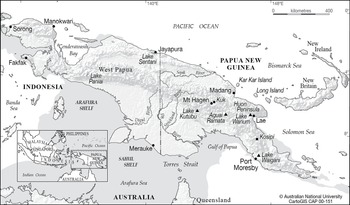
The history and politics of West Papua as a territory are at odds with the history and politics of its people. The territory of West Papua occupies the western half of the island of New Guinea, in the South Pacific Ocean, located to the north of Australia (Figure 1). While West Papua geographically shares an island with the territory of Papua New Guinea, Dutch colonialism bound the territory politically and administratively eastward to the Indonesian archipelago.Footnote 12 This arbitrary division of the island put the two territories on vastly different trajectories. The peoples of Papua New Guinea were unified under an Australian colonial administration and gained independence in 1975 as a postcolonial state.Footnote 13 Conversely, the West Papuan peoples have occupied a contested territory and had their desires for independence frustrated by both the Netherlands and Indonesia. Since the Indonesian occupation in 1963, West Papuans have been severed from the peoples of Papua New Guinea and isolated from Pacific regional forums by a strict military administration.
Map of the island of New Guinea, territories of West Papua and Papua New Guinea, CartoGIS Services, the Australian National University.

Figure 1 Long description
This map shows the island of New Guinea divided down the middle by an almost straight-line - separating the territory of West Papua on the west and Papua New Guinea on the east. An inset map shows the broader geographical context within the Pacific Ocean. The map includes scale and directional indicators.
The territory of West Papua first came under the purview of the United Nations as a non-self-governing territory of the Netherlands, then called West New Guinea or Netherlands New Guinea. The sovereignty of the territory was debated in the UN General Assembly across the 1950s by the Netherlands and Indonesia. Indonesia gained independence through leveraging UN processes via the Security Council leading to the establishment of a UN Commission for Indonesia and then formal negotiations in 1949.Footnote 14 While Indonesia claimed West Papua should be part of its large multi-ethnic republic, the Netherlands justified their retention of the territory of West Papua by arguing the Papuans had been historically isolated from all forms of ‘civilisation’ and therefore needed to remain under European tutelage.Footnote 15 Negotiations relating to West Papua stalled, and the territory remained under the administration of the Netherlands and on the UN’s list of non-self-governing territories while the Indonesian Republic gained formal recognition as a postcolonial state.Footnote 16 Indonesia repeatedly brought the issue before the UNGA in the 1950s, arguing that sovereignty over West Papua should be transferred to the Indonesian Republic.Footnote 17 The Indonesian proposals were all voted down due to the predominance of European and colonial powers in the 1950s, however, their continued campaign and Dutch resistance drew considerable attention to the small, hitherto unknown territory. Both states framed the issue as control of a territory and did very little to represent or consult the peoples of West Papua.
Prior to Indonesian independence in 1949, West Papuans had largely been excluded from the Dutch colonial administration through policies that imposed a racial hierarchy (with West Papuans at the bottom).Footnote 18 Over the 1950s, the Netherlands slowly allowed for more West Papuan political participation and created opportunities for West Papuan leaders to study in the Netherlands.Footnote 19 West Papuan leaders made the most of these changes, pushing for greater involvement in territorial governance and organising across the territory. Papuan elites forged relationships between previously disconnected people groups and fostered a pan-Papuan identity.Footnote 20 In 1960, elections were held for a West Papuan consultative council that would participate in developing legislation in the territory. In 1961, a group of Papuan leaders gathered to form a Papuan National Committee and declared their intention to seek recognition for West Papuans as a people and their right to self-determination and an independent state at the UN.Footnote 21 At the same time, Papuan leaders persuaded the colonial administration to allow them to travel to the UN in December 1961 to campaign for future West Papuan independence.
In their campaign at the UN, West Papuans sought recognition for themselves as actors in the dispute over their territory. Papuan leaders targeted African diplomats, hoping to convince them of the legitimacy of their claims to self-determination.Footnote 22 West Papuans were able to raise awareness of their cause; however, their brief campaign could not turn the tide of UN politics. Indonesia leveraged both its geopolitical power and its military strength to bring the conflict over the West Papua to a breaking point – threatening to invade West Papua if an agreement was not made to transfer the territory to Indonesian control. On 15 August 1962, the Netherlands and Indonesia formally signed an agreement, colloquially known as the New York agreement.Footnote 23
The New York agreement also altered the legal status of the territory of West Papua by taking it off the list of UN-recognised non-self-governing territories. While the agreement was framed as a transfer of authority from Dutch to Indonesian control, there was some recognition of the rights of West Papuans to self-determination due to the recent shift in managing decolonisation facilitated by the passing of Resolution 1514. This Resolution, known also as the Decolonisation Declaration, was passed in 1960 as part of a broader Afro-Asian campaign to strengthen the UN’s commitment to managing decolonisation. Article 2 of the Resolution stated: “all peoples have the right to self-determination; by virtue of that right they freely determine their political status and freely pursue their economic, social and cultural development.” Footnote 24 Despite this growing precedent, Indonesia’s strong opposition to West Papuan claims to independence meant this right was included only in very vague terms. The agreement stated Indonesia was to “give the people of the territory the opportunity to exercise freedom of choice”.Footnote 25 While African diplomats expressed reservations about this wording, it passed through the General Assembly with a clear majority since it would prevent further military confrontations in the area.Footnote 26
West Papua was then administered by the UN Temporary Executive Authority (UNTEA) for eight months, before control of the territory passed to the Indonesian Republic in April 1963.Footnote 27 Indonesia banned West Papuan political expression and sealed the territory off from all outside visitors (including the UN). The situation in the territory worsened in 1965 when Indonesia left the United Nations and closed the Republic off from any international oversight.Footnote 28 West Papua, as a place, dropped off the UN’s radar and the West Papuan people were sealed off from the world. After the 1965 Communist coups and the change of government in Indonesia, Indonesia slowly allowed journalists and the UN to return to West Papua for short, controlled visits in 1966 and 1967. The Indonesian government eventually agreed to re-engage with its responsibilities under the New York agreement by conducting an act of self-determination.Footnote 29 The Fund for West Irian was re-established (FUNDWI); this was staffed by UN personnel and was meant to administer development projects to improve the conditions of the territory.Footnote 30 In 1968, the UN returned to the territory as the UN Representative to West Irian (UNRWI) to oversee the act, which Indonesia had called the Act of Free Choice (deliberately avoiding the term ‘self-determination’).
UNRWI attempted to guide the voting process; however, their small team could not act independently from the Indonesian government due to a lack of resources and knowledge of the territory. Therefore, the UN team mostly just observed the Indonesian military and government and tried to convince them to make small adjustments in line with the New York agreement and international precedent. The UN team suggested increasing the scope for West Papuan participation in the Act, but Indonesia ignored this advice and conducted voting according to a consultative method.Footnote 31 This voting system excluded any West Papuans who were not part of an Indonesian political party or selected by the Indonesian government. In the lead up to the vote, activists across West Papua petitioned the UN offices and staged protests in the territory. They were met with swift violence from the Indonesian military, and the UNRWI, a small team in a vast territory, were unable to provide even the barest protections for those seeking to express their political opinions.Footnote 32 In the end the so-called Act of Free Choice included only 1,024 representatives, who voted on behalf of over 800,000 West Papuans.
After the conclusion of the Act of Free Choice, the head of UNRWI, Fernando Ortiz-Sans, was charged with writing a report on the Act and whether it fulfilled the provisions of the New York agreement. Ortiz-Sans minimised the reality of West Papuan opposition to the Act, however he acknowledged the rights situation in the territory was far below what was required for a ‘free’ vote, and that the UN mission was prevented by the Indonesian government from carrying out many of their core responsibilities under the NY agreement.Footnote 33 This report, alongside an Indonesian one, was to be submitted to the UNGA ahead of the UNGA session on the fulfilment of the New York agreement. It framed the vote as concluding the ongoing dispute about the territory and confirming Indonesia’s sovereignty over West Papua. Both in the UN sections and Indonesian sections the rights of the people were cast as secondary to Indonesia’s rights to the territory.
Throughout this period, West Papua was framed as a place, as the object of a dispute, and the rights of the peoples were often ignored. Despite the many UN conventions that could have covered the territory and the clear guidelines outlined in the New York agreement, West Papuan rights were continually violated under the Indonesian administration across the 1960s and West Papuan voices were silenced by UN structures and bureaucracy. The following sections explore how West Papuans resisted this framing and sought to assert themselves as political actors. Yet, at the same time, how the structures of the UN continually prohibited their full involvement as actors in the dispute and imposed a territorial framing.
Black Transnationalism and Competing Campaigns
In their international campaigning, West Papuans tried to gain visibility as state claimants and legitimacy in the dispute over their territory. Due to West Papuan exclusion from the formal procedures and networks of the UN across the 1960s, they established their own race-based transnational networks to make their cause known. The key nodes of this network, outside of West Papua, were in Papua New Guinea and the Netherlands, where West Papuan leaders were exiled or sought refuge after the imposition of Indonesian rule. West Papuans were far outmatched by Indonesia in West Papua due to their military power, however in the realm of global politics there was a chance their claims might be heard due to the UN’s involvement in the conflict. As David Webster has argued, West Papuans drew on ‘discourses of racial difference generated within a colonial sphere’ but leveraged them to claim a distinct national identity.Footnote 34 They built on this discourse of racial difference to forge new connections between the Black Pacific (Melanesia) and the Black International, writing themselves into earlier transatlantic imaginaries.Footnote 35
In their early nationalist campaigns, West Papuans had focused on their unique ethnic identity as Melanesian peoples, which aligned them more with neighbouring Papua New Guinea than with the populations of the Indonesian Republic. The category of ‘Melanesian’ was used to differentiate the dark-skinned peoples of the larger southern Pacific Islands (“melas” meaning black) from lighter-skinned peoples of the more northern Pacific islands, called Polynesia, and the inhabitants of the smallest Pacific islands, called Micronesia.Footnote 36 While initially a derogatory term used by early European explorers, West Papuans drew on the category to signify their difference from Indonesia and also emphasise their connection to other South Pacific peoples. When Indonesia first made claims to the territory at the end of the Second World War, West Papuan leader Markus Kaisiepo wrote a letter to the Dutch colonial government in exile stating: “we the Papuan people of a Melanesian nation [want to] stay out of the Indonesian state.”Footnote 37 After his exile to the Netherlands in 1962, Kaiseipo continued to use this language in his appeals. In his petitions, Kaisiepo focused on West Papuans’ identity as Melanesian people and argued for their right to be a Melanesian, rather than Indonesian, state. Kaisiepo’s organisation was called the “High Court of the chamber of representatives of West Papua/Melanesia.” In his petitions he explained the title: “the name ‘Melanesia’ is used to indicate that Papua belongs to the group of Melanesians (Negroids) and not to Indonesia.”Footnote 38 Kaisiepo used this framing to both emphasise West Papua’s Pacific connections and to argue for West Papuans’ need to be recognised as distinct political actors in the dispute over their territory.
However, the choice to focus on this aspect of West Papuan identity was risky. Stereotypes about dark-skinned Melanesian peoples as primitive and backward had pervaded early debates about West Papua. In 1962, a US diplomat had argued that Indonesia should just be given the territory because it was only “a few thousand miles of Cannibal land.”Footnote 39 This idea of Papuan primitiveness was used to generate a ‘cannibal tourism’ industry that framed the territory as a living natural history museum and was active into the 1960s.Footnote 40 This undermined not only their claims to independence but also led many commentators to dismiss their nationalist campaign as a product of Dutch colonialism or as an overnight surface-level development. Reporting on the first gathering of the Papuan National Committee, a meeting which announced the West Papuans’ desires for independence and their own state, an Australian publication based in PNG commented that “nationalism is born in a mere 17 days.”Footnote 41 This comment depicted the celebrations leading up to the meeting as emerging from nowhere and elided the longer history of West Papuan political organising and activism across the 1940s and 1950s. In both international and regional forums, West Papuans were faced with these stereotypes about themselves as backward peoples who only recently entered the modern world and were unable to express their independent political desires.
Despite the limitations of this racial framing, due to the initial support from African leaders, West Papuan leaders continued to expand their networks along the lines of racial solidarity across the 1960s. In September 1961, in response to the Dutch proposal (and Indonesian objections), an African coalition, known as the Brazzaville group, proposed a resolution to formally recognise the right to self-determination in any future discussions over the territory.Footnote 42 They acknowledged that the confrontation between Indonesia and the Netherlands needed to come to an end, yet affirmed the need to ensure that “the future of any non-self-governing territory must be based on the principle of self-determination of peoples in accordance with the Charter of the United Nations.”Footnote 43 As a result, they urged the Netherlands and Indonesia to reach a quick agreement and requested the Secretary-General do everything in his power to ensure negotiations were resumed. They also requested the formation of a UN commission composed of five members appointed by the UNGA, to investigate the conditions in the territory and the possibility of establishing international administration and supervision of the territory, then report back to the General Assembly by 1 March 1962.Footnote 44 This proposal would have introduced much greater UN involvement in the territory and could potentially lead to the recognition of West Papuan claims, as an earlier UN Commission had done in relation to Indonesian nationalism.Footnote 45 However, due to strong opposition from Indonesia, the US, and their allies the resolution did not get sufficient UNGA support.
This episode signalled to West Papuan leaders that African diplomats were potential allies in their struggle for self-determination. Papuan leaders focused on developing personal connections with these states in their visit to the UN in 1961 and in subsequent international tours. In April 1962, leaders from Dahomey, Maxime Zollner, and Upper Volta, Frederic Guirma, visited the territory of West Papua to investigate conditions there and meet with West Papuan peoples.Footnote 46 They encouraged West Papuan leaders to continue their struggle and try to separate their campaign from the Dutch. West Papuan leaders also conducted visits to African states in the first half of 1962, touring Upper Volta, Dahomey, Cote d’Ivoire, Senegal, the Congo, Ethiopia, Liberia, Ghana, Guinea, and Sierra Leone.Footnote 47
The dispute between Indonesia and the Netherlands was settled outside the forum of the UN, resulting in the aforementioned New York agreement, which meant other UN member states were not consulted in framing the agreement. However, the New York agreement was debated in the UNGA in 1962 as part of formally recognising the agreement, the UN’s responsibilities in managing it, and the resolution of the conflict between Indonesia and the Netherlands. In this UNGA session, Mr Zollner, the Ambassador for Dahomey, criticised the exclusion of West Papuan peoples: “my government cannot endorse arrangements whereby a people of 700,000 is transferred from one Power to another under a bilateral treaty concluded without previous consultation with the party chiefly concerned, the Papuan people.”Footnote 48 He also questioned the wording of the agreement’s provisions for self-determination. Zollner asked why an eventual vote of self-determination was described only vaguely as determining “the freely expressed will of the population” instead of being called a “referendum.” Footnote 49 He argued calling the vote a referendum would have made the provision much clearer under international law. Zollner also argued the agreement left the responsibility of honouring West Papuan self-determination entirely in the hands of Indonesia – the party least interested in protecting this right. In his arguments Zollner made a case for the recognition of the Papuan people; however, at this point, he was a minority voice. The agreement passed easily through the UNGA with no modification to the provisions that might have protected West Papuan rights to self-determination.
As a result of this early support, after West Papuan leaders were exiled in 1962, they focused on widening their contacts with both African and Caribbean states. This activity coincided with colonies gaining independence in these regions and expanding the UN’s membership to include a greater number of postcolonial states. As part of their campaign to gain recognition in the state-based forum of the UN, West Papuan leaders developed informal race-based networks that could advocate for the recognition of West Papuans as peoples in the dispute over their territory.
To appeal to these race-based networks, Nicholas Jouwe, the chairman of the Freedom Committee for West Papua, based in the Netherlands, developed networks across the Black International and emphasised the West Papuan peoples’ racial identity. The Freedom Committee set up a hub in Senegal from which to make contacts with African leaders and Jouwe also attended the Organisation of African Unity (OAU) meeting in Addis Ababa in 1965.Footnote 50 After the conference, Jouwe also did a tour of African counties to follow up with contacts from the conference.Footnote 51 There is little record of Jouwe’s OAU attendance aside from the pamphlets he prepared to give to delegates. In their petitions, Jouwe’s Freedom Committee appealed to the OAU members as their “brothers and sisters in Africa”Footnote 52 and extended their appeals to “the Negro Race as a whole.”Footnote 53 Jouwe’s group described themselves as “leaders of the Papuan Negroes of West New Guinea” and also referred to West Papuans as a “Negroid people.”Footnote 54 In a booklet sent to the OAU, the Freedom Committee claimed that the island of New Guinea was home to “3 million negroes,” an accompanying map showing the island divided between West Papua with the label “1 million negroes” and Papua New Guinea with the label “2 million negroes.”Footnote 55 In these petitions Jouwe is writing West Papuans into a Black imaginary while also emphasising their connection with other black Pacific peoples mentioning the peoples of both West Papua and PNG and thereby resisting the colonial division of the island of New Guinea. At this point in time, it was rare to consider the Pacific as part of the Black international so West Papuans had to pioneer these bonds. However, as Quito Swan has shown, there was a longer history of interest in the Black Pacific by Black thinkers across the Atlantic which later developed into reciprocal political, social, and intellectual bonds in the 1970s.Footnote 56
West Papuan activists campaigned for the support of Black statesmen who might endorse their claims at the UN and could vote against Indonesia in the UNGA meeting. The forum and organisation of the UN was focused on recognised statesmen, diplomats, and international civil servants, and therefore non-state actors were heavily restricted from accessing official UN channels. While West Papuans could write letters to the UN Secretariat and to UN missions and request meetings with UN administrators, they were not able to circulate information along internal channels like the Indonesian mission could. While not able to access these formal UN channels, West Papuan activist groups positioned themselves so they could inhabit informal spaces and still participate in the social sphere of the UN.Footnote 57 Both Jouwe’s organisation, the Freedom Committee, and Kaiseipo’s, the High Court of West Papua/Melanesia, rented temporary rooms in New York. They deliberately found spaces near the offices of other UN Missions, ensuring they could easily walk to meetings and bump into delegates as they moved around the city.Footnote 58 This location would also have made it easier for them to go back and forth between their rooms and the UN administrative offices throughout the day. The West Papuans were not recognised state actors, part of a registered organisation or backed by any white humanitarian groups. As a result, they would not have been given priority access to meetings and would have had to be ready to take short-notice meetings or return multiple times a day to catch a particular administrator when they were around.
The personal itineraries of West Papuan activists reveal the solidarities they hoped to forge. Jouwe’s personal records from 1965 show a list of addresses from UN Missions, likely those he hoped to visit. The list was composed exclusively of African and Caribbean states.Footnote 59 In a letter to an Australian official in 1966, Jouwe reported that in 1965 he “made contact with 36 Negroid diplomats to the United Nations” in September and November and with “30 African – Negroid – Ministers and Politicians” at the 1965 OAU Conference.Footnote 60 It’s clear from Jouwe’s list of addresses that he made a choice to focus on Black statesmen at the UN. His petitions to these statesmen mirrored those he delivered to the OAU, framing the West Papuans as part of the global struggle against racism and colonialism.
West Papuan networks came into competition with Indonesian networks, particularly those cultivated around Afro-Asian solidarity. As Carolien Stolte and Su Lin Lewis have argued, Afro-Asianism was not a unified movement yet “functioned as an affective and effective banner for rallying a wide range of anti-imperialist agendas across the political spectrum.”Footnote 61 Indonesia was deeply involved in these networks, hosting the iconic Bandung Conference in 1955 and sponsoring many cultural and political conferences and meetings. The impact of these networks was wide-ranging; however, at the UN, one of their most significant contributions was shaping UN Resolution 1514, passed in 1960 and known as the Decolonisation Declaration. This was based upon the wording of statements from the Bandung conference.Footnote 62 Yet Indonesia’s influence at the UN, and within Afro-Asian networks, waxed and waned over the 1960s. Indonesia had controversially left the UN in 1965 over the formation of the Malaysian state. However, after re-joining in 1966, Indonesian diplomats quickly reforged their international contacts and resumed a position of influence among postcolonial states.Footnote 63
Indonesia held a lot of power amongst Afro-Asian networks, but it was still necessary for them to defend their actions in the territory and justify their chosen consultative voting method. In conducting the Act of Free Choice in West Papua, Indonesia had exercised almost total control, ignoring the advice of the UNRWI and the criticisms of foreign journalists.Footnote 64 The Indonesian government had to convince, particularly African statesmen, that Resolution 1514 and the principle of self-determination were not relevant to this dispute.
While the issue of West Papua was not strictly related to Resolution 1514, its principles would have been in the minds of the UN delegates as they prepared for the UNGA session on the Act of Free Choice. West Papuan activists campaigned to make this link more explicit and to ensure delegates were aware of strong support for independence within West Papua. This meant the Indonesian delegation was forced to respond to these claims and defend its choice to use a consultative voting system. In their correspondence with the Indonesian UN mission, US diplomats warned their counterparts of the need to reassure African delegates about their voting system. The US mission reported that the Kenyan mission had expressed interest in studying the New York agreement, since they were not part of the UN at its signing and asked for a copy of the document ahead of the 1969 debate. They reported a conversation with a Kenyan Ambassador Fakih, in which he raised concerns that the Indonesian consultative method appeared “virtually identical” to the Rhodesian methods and their justifications similar to Ian Smith’s claims of receiving the “support of Rhodesian Africans on the basis of consultations with tribal chiefs.”Footnote 65 While Indonesia wanted the dispute over West Papua to be considered in a separate category from other decolonisation issues, for many African leaders events in West Papua were too similar to those occurring closer to home, making comparisons unavoidable.
In response to West Papuan activism in the lead up to the UNGA debate, the Indonesian delegation used their access to the UN’s internal communication channels to try to discredit the Papuan activists. The Indonesian Permanent Representative to the UN, Dr H. Roeslan Abdulgani, wrote to the Secretary-General on 27 October, asking him to circulate an Indonesian letter denouncing the activists. The letter claimed the West Papuans were Dutch sympathisers who had abandoned the territory and were now foreign nationals living in the Netherlands. Indonesia described the diasporic movement as “a few individuals of West Irian origin, pretending to represent a so-called ‘liberation movement of West Irian/West Papua’”Footnote 66 The Indonesian delegation argued that the only West Papuan perspective that should be considered was the outcome of the Act of Free Choice that had occurred in the territory.
Indonesia, at times, made contradictory arguments about the Act of Free Choice. In their comments to the UN regarding Papuan activists, they argued for the vote as a representation of West Papuan opinion and an expression of their political opinion. However, earlier, when the issue was placed on the UNGA agenda, the Indonesian Foreign Minister, Adam Malik, had declared that any opposition to the act was contrary to Indonesia’s national sovereignty and territorial integrity.Footnote 67 In his statement, Malik seemed to dismiss the need to consult the West Papuans if their views did not align with the Indonesian government’s. Malik emphasised the principles of non-intervention and territorial integrity to refute the need to recognise West Papuan self-determination.
The Indonesian government did not wish for the issue to be debated deeply at the UNGA. To prevent this, the Indonesian delegation delayed delivering its report until three days before the UNGA meeting was scheduled.Footnote 68 This meant that the UN’s report, which had been ready for over a month, was also delayed and delegates were not able to access the full details relating to the Act of Free Choice until just before the meeting. As a result of this delay, delegates did not have time to study the report and compare it to provisions of the New York agreement, which the vote was meant to fulfil.
The Indonesian report emphasised the vastness and lack of development in West Papua, drawing on ideas of Papuans as primitive peoples. The Indonesian report concluded by stating that “despite recognised ‘enormous difficulties’” they had fulfilled their international obligations to conduct an Act of Free Choice.Footnote 69 Indonesia dismissed demands for the need to conduct the Act according to democratic voting systems, claiming it would have been inappropriate to apply ‘western’ standards to voting in the region because the West Papuan people were “one of the most primitive and undeveloped communities in the world.”Footnote 70 The report claimed that the method of consultative decision-making fulfilled the “real content and meaning” of the New York Agreement and that conducting the vote according to international practices of self-determination was a “misinterpretation” of the agreement.
In the dispute over their territory, West Papuans attempted to use their unique racial identity to create an imagined black community that reached into the Pacific to gain support for their cause. However, in response, Indonesia leveraged ideas about the backwardness of the Pacific to argue for West Papua’s incorporation into the Indonesian Republic and to justify West Papuan peoples’ exclusion from decision-making over the future of their territory. At the core of these debates was whether West Papua should be considered primarily as a territory or whether the West Papuans as a people should also be considered party to the dispute.
Decolonisation or Development?
This tension between states and peoples came into competition during the debates over West Papua at the 24th session of the UN General Assembly, which ran from September to December 1969.Footnote 71 During this session, UN delegates considered numerous issues relating to decolonisation. Alongside debating the conclusion of the New York agreement, signed between Indonesia and the Netherlands, the delegates discussed Southwest Africa (Namibia), Rhodesia, concerns about Portuguese colonies, and the conflict over Biafra.Footnote 72
Two West Papuan delegations travelled to New York from the Netherlands to be present during the General Assembly sessions. The first was associated with the Freedom Committee: Nicholas Jouwe, Herman Womsiwor, Jos Marey, Zacharias Sawor, DR Hanesbey, and Th. Wanggai. The second were associated with the High Court of the Representatives of West New Guinea/Melanesia: Markus Kaisiepo, Paulis Obinaru, and Fred Korwa.Footnote 73 Jouwe had support from African leaders and members, a few of his organisation’s members were added to the Dahomey delegation as temporary members. Kaisiepo’s organisation had less formal support and had to watch proceedings as outside observers. From the historical evidence, it is unclear why the Freedom Committee was able to gain more formal support than the High Court, but most likely it was the result of different campaigning strategies and resources.Footnote 74 While the groups acted independently, due to personal disagreements, as explored previously, they both argued for West Papuans to be recognised as a distinct people entitled to self-determination.
On 13 November 1969, the UN General Assembly met to discuss the Act of Free Choice and the conclusion of the New York Agreement as part of the 1810th General Assembly Plenary meeting. The issue of West Papua was tabled as the “Agreement between the Republic of Indonesia and the Kingdom of the Netherlands concerning West New Guinea (West Irian): report of the Secretary-General regarding the act of self-determination in West Irian.” The formal agenda stated that the UNGA was to consider two documents: the report of the Secretary-General regarding the Act of Free Choice in West Irian, and a joint statement from Indonesia and the Netherlands. They were also to vote on a draft resolution submitted by Belgium, Indonesia, Luxemburg, Malaysia, the Netherlands, and Thailand to take note of the report and acknowledge it as the fulfilment of the New York Agreement.Footnote 75 The joint statement from the Netherlands and Indonesia affirmed both parties support of the Act of Free Choice as the conclusion of the New York Agreement.
Even though this debate was of central importance to the West Papuan activists, they were not given a formal place within the proceedings. In the UN General Assembly only actors connected to member-state delegations could participate in the discussion. As with the 1962 debates, the Indonesian administration was firm in its exclusion of West Papuans as a recognised party in the dispute over the territory since this would indicate they could be considered a separate people to the Indonesians. While some of the Freedom Committee were allowed to sit as part of the Dahomey delegation, they were not allowed to speak as part of the proceedings.
In his opening remarks, Indonesian Foreign Minister Adam Malik stressed that in 1962 the New York Agreement was “merely ‘taken note of’ by the General Assembly” and therefore this vote should be a procedural acknowledgement of its conclusion. He claimed the reports clearly demonstrated Indonesia had “carried out its responsibility to hold an Act of Free Choice for the people of West Irian, under the terms of the New York Agreement of 1962.”Footnote 76 He emphasised the difficulty of conducting such an act in West Papua, due to its remoteness and the primitiveness of its peoples, and cautioned other delegates against criticising their voting methods which were guided and consultative rather than representative and democratic. Malik recommended that the General Assembly unanimously adopt the resolution since the Netherlands, the other party to the Agreement, had expressed support for the act through their joint statement with Indonesia.Footnote 77 Joseph Luns, speaking on behalf of the Netherlands, was less strident in his support of the act. Luns raised concerns over the voting procedures used to determine the opinions of the West Papuan peoples and Indonesia’s refusal to follow the advice of the UN Representative to make the vote more representative. Despite these concerns, he said the Netherlands recommended the Assembly focus on the future of the territory, rather than debating the past, and vote to accept the resolution.Footnote 78
The proceedings soon took a detour when Maxime Zollner, the representative for Dahomey, rose to speak. Zollner raised concerns that the General Assembly were not given sufficient time to consider the matter due to Indonesia’s delays in delivering the report to the UNGA delegates. He requested a postponement of the debate so the Assembly could have more time to study the reports.Footnote 79 There was some debate over the extension and considerable push back from Indonesian ambassador Sudjarwo, who argued further study of the report was unnecessary since this was an issue of Indonesian sovereignty and not Papuan self-determination. Representatives from Ecuador, Ghana, Togo, Gabon, and the Netherlands spoke in support of Dahomey’s proposal, and the General Assembly President concluded the debate by granting a 7-day extension until 19 November.Footnote 80
There was frenzied campaigning on both the Indonesian and West Papuan sides in the week between the sessions. African delegates held emergency meetings to debate the Act and discuss potential amendments to the draft resolution.Footnote 81 The West Papuan activists continued to petition UN delegates to support West Papuan self-determination and block the resolution of the New York agreement (which would finalise Indonesian control over the territory). Jouwe’s group was likely invited to participate in the African gatherings as they were already being hosted by the Dahomey delegation. The Indonesian delegation also distributed a document in which they reminded delegates: “the Agreement of 1962 exists whether Members of the General Assembly like it or not. It is not their Agreement.”Footnote 82 At the end of the week, West Papuan allies came up with a plan to propose a countermotion rather than accepting Indonesia’s original resolution.
The UN General Assembly returned to the issue of West Papua and the New York agreement on Wednesday 19 November 1969. Once again Jouwe’s group watched on as additions to the Dahomey delegation, while Kaisiepo observed from the public gallery.Footnote 83 The UNGA delegates, who had now spent the week studying the report on the Act of Free Choice, came ready to debate its contents. Notably, aside from the Netherlands, no European delegate spoke in either the morning or afternoon session. Instead, the debate on 19 November occurred largely between delegates from the Global South, the nations most invested in how concepts of self-determination and national sovereignty were defined.Footnote 84
Supporters for West Papuan self-determination, delegates from Sierra Leone and Ghana, spoke first. Nicol, of Sierra Leone, highlighted the key difference in interpretations regarding the Act of Free Choice contained within the report. The UN Representative, Ortiz-Sans, believed the Act was meant to give the West Papuan people a choice, whereas Indonesia saw it as the culmination of the independence of the Indonesian Republic. Therefore, to Indonesia “any dissident voice from West Irian [Papua] implied disunity, disloyalty and a retrograde step” in Indonesia’s independence.Footnote 85 Nicol argued that this belief was reflected in Indonesia’s implementation of the act and was the reason they denied the need for debate. However, his delegation believed the Act of Free Choice was meant to allow for choice and saw within Ortiz-Sans’ report a similar view. In the report, Ortiz-Sans raised concerns about the levels of freedom of speech and political expression in the territory which contravened the West Papuan peoples’ rights under the New York Agreement.
While acknowledging Indonesia’s “fine anti-colonial record,” Nicol said there was clearly a desire among educated West Papuans for complete independence of the territory and the whole island of New Guinea. He addressed Indonesia’s claims in the report that West Papuans were too primitive to participate in a more democratic form of voting as well as the UNRWI’s comments concerning the geographical difficulties they faced in the territory. Echoing the text of Resolution 1514 Nicol insisted: “no society could be said to be so primitive, and no terrain so geographically difficult in the modern world that the vital exercise of democratic government should be indefinitely denied to its peoples.”Footnote 86 Nicol also commented that his delegation was concerned about would happen if the UN applied this method of consultative voting to situations in South Africa, Portuguese colonies, and Rhodesia, and how it might be used “to the detriment of freedom for Black Africans.”Footnote 87 In this statement he drew connections between the treatment of peoples in the Black Pacific and Black Africa. He concluded by saying that Indonesia and the Netherlands’ statements regarding development and investment in West Papua should be reason to give them a future opportunity for self-determination this time “by international standards of freedom of speech and elections.”Footnote 88 This statement affirmed both support for West Papuan self-determination and development of the territory.
Mr Akwei, the representative for Ghana, built on the arguments made by Nicol. He said that after examining the report in detail, particularly the comments of the UN administrator Ortiz-Sans, it was clear Indonesia had failed to uphold several essential provisions in the New York Agreement. Indonesia had not allowed for the continuous presence of UN officials in the territory from May 1963 to August 1968. Therefore, the functions that were supposed to have happened over many years were instead left for the UNRWI’s small team. This was made more difficult, he said, as it took place “over an area which everybody claims is a most difficult geographical terrain.”Footnote 89 Akwei drew attention to the fact that the Indonesian delegation had ignored Ortiz-Sans’ numerous recommendations, including increasing the participation of West Papuans from more developed areas. He pushed back against Indonesia’s claim that the UN had no authority to pass judgement on its conduct of the Act. He argued that the UN were given clear responsibilities under the New York Agreement and therefore it was necessary to assess whether they had fulfilled them.
Akwei was not persuaded that the open consultative decision-making method was the only option in the territory. He argued that Ortiz-Sans’ mixed method approach was similar to the elections conducted under the Dutch in 1961 in West Papua. Additionally, in Papua New Guinea, a territory with a similar level of remoteness and development, there were plans to use a democratic voting system under the Australian administration.Footnote 90 If voting could take place across the border in a territory that had never had elections before, then why not in West Papua? Akwei then put forward an amendment to the draft resolution, proposing that the UN should conduct another vote in 1975 according to the principle of self-determination. Since the New York Agreement had not been upheld by Indonesia and they were only just beginning to invest in development programs, another five years would allow for the development that should have occurred under the New York Agreement between 1963-68 and allow for a free act of self-determination.Footnote 91 These arguments echoed the demands of West Papuans for a true act of self-determination while also conceding to the idea that the population needed to reach an appropriate level of ‘development’ before they were allowed to exercise self-government.
Indonesia’s supporters argued against this amendment, claiming the Act of Free Choice marked the completion of the Asian nation’s struggle for independence and expressing support for Indonesia’s development plans.Footnote 92 The Algerian delegate lectured his African companions over their opposition to Indonesia, claiming Indonesia was a leader of the anti-colonial world and the Afro-Asian bloc needed to vote together. He dismissed the argument that what occurred in West Papua had any similarities to the issues in Africa and claimed the principle of self-determination was irrelevant to the discussion.
There was some administrative chaos in the General Assembly since the amendment had not been submitted prior to the debate. The UN President suggested an adjournment to allow for the amendment to be drafted and discussed informally amongst the delegates.Footnote 93 During the break between sessions, Ghana’s amendment was typed and distributed to the delegates while Indonesia had a word with the African dissenters to remind them of Indonesia’s commitment to African decolonisation.Footnote 94
Following the break, the debates were resumed with all delegates in possession of the proposed amendment. In the afternoon, the Indian ambassador echoed Indonesia’s sentiments, telling the assembly they were being asked to take note of the report and not debate it. The Indian delegate claimed that the undeveloped status of the territory necessitated the method of the vote used by Indonesia and that the principle of self-determination was irrelevant because the Act did not take place under “colonial domination.”Footnote 95
The ambassador for Togo spoke out against this reasoning, citing the UN’s 1960 resolution on decolonisation:
I should like to recall here that the General Assembly in its resolution 1514 (XV) of 1960, declared that the inadequacy of political, economic, social or educational preparedness should never serve as a pretext from delaying independence in any country.Footnote 96
He reiterated Akwei’s argument that since the UN was party to the New York Agreement it was their responsibility to discuss whether the agreement had been fulfilled rather than simply to ‘take note’ of the report without discussing its contents. He urged delegates to take their commitment to the 1960 Decolonisation Declaration seriously and not dismiss West Papuan rights to self-determination.
After further debate, the Indonesian delegate declared that Indonesia did not need the UN’s approval and defended Indonesia’s history as a supporter of self-determination. The Indonesian ambassador pointed to the non-binding nature of the UNGA resolutions and signalled Indonesia’s unwillingness to take any amendments to the New York agreement seriously. Indonesia objected to Ghana’s amendment and said it would alter the entire New York Agreement. Akwei countered, saying that Indonesia had already altered the agreement by failing to fulfil its responsibilities from 1963 onwards and rejecting the UN’s advice about conditions in the territory and the methods of the Act of Free Choice.Footnote 97
The debate began to deteriorate as it became clear that Indonesia would accept no compromises. The President eventually called for a vote on the amendment, and the Assembly then voted to against it – sixty to fifteen, with thirty-nine abstentions. According to UN practice since the amendment was unsuccessful this would be followed by a vote on the original proposal. The Assembly then voted to accept the Act of Free Choice as it stood. This resulted in a vote of eighty-four to zero with thirty abstentions.Footnote 98 Of the abstentions, twenty-four were from African nations and the rest from Caribbean and Latin American states.Footnote 99 West Papuan allies abstained from voting since they saw the issue as unresolved, however they did not receive enough backing to challenge the majority the resolution received.
With this vote the UNGA acknowledged Indonesian sovereignty over West Papua and denied the need to properly consult the West Papuan population through a democratic vote. The acceptance of the Act brought an end to the United Nations formal involvement in the territory under the New York Agreement and signalled a formal recognition of West Papua as a territory of the Indonesian Republic. With this decision West Papuan calls for self-determination were denied and they were placed firmly outside of any avenues of redress within the UN decolonisation framework.
West Papuan Rights denied
The dismissal of West Papuan rights to self-determination reveals how support from their race-based transnational networks failed to translate into backing within the international forum of the UN. The West Papuan peoples’ struggle for recognition as actors in the contest over their territory was the result of UN bureaucracy and the limits of the nation-state system, alongside lingering racism within the international organisation. Racist depictions of Papuans as primitive and backwards led to a dismissal of their political rights and their marginalisation within the dispute over their territory.
In the contest over West Papua, Indonesia exploited the tension between the racial solidarity fostered in transnational networks and the commitment to state sovereignty and development adopted by international organisations. As Leake and Manela argue in the introduction to this issue, this episode reveals what was not carried over in the transition from transnational anticolonialism to postcolonial nationhood. Ideas about racial equality and breaking free from colonial inequalities were central to the platforms of interwar activists. However, as these leaders became postcolonial elites, these ideals were often sacrificed in favour of developing strong postcolonial states. Unable to gain support at either the transnational or international level, West Papuans were then marginalised at the local level and made into a minority within the Indonesian nation-state. Their hopes of joining the Black International and of living as an independent Pacific nation-state were foreclosed by the intersection of decolonisation processes at the UNGA and in what became Indonesia.
This article, and this special issue, underline the importance of studying decolonisation’s discontents. While these international forums excluded the claims of peoples who came to be considered subnational groups or minorities, our international histories of decolonisation need not follow the same path. By making visible these actors and the networks of those who failed to gain independence, we reveal the many visions of decolonisation and its unfinished work.
Acknowledgements
I would like to express my gratitude to Elisabeth Leake and Erez Manela for organising the Decolonisation’s Discontents workshop and this special issue, and for providing me with detailed feedback on this article. This piece benefitted greatly from comments from participants in the workshop, particularly Nana Osei-Opare, Su Lin Lewis, and Jennifer Foray, alongside feedback from my fellow authors in this special issue. I would also like to thank my anonymous reviewers for their valuable comments. Thanks to Nico Jouwe for drawing my attention to the recently deposited collection of his father’s papers at Leiden University Library.

 Open access

