

On the evening of May 2, 2022, people across the United States read a leak of the drafted opinion from the US Supreme Court that would overturn Roe v. Wade and Planned Parenthood v. Casey. The case before the Court was Dobbs v. Jackson Women’s Health Organization (hereafter referred to as Dobbs). The draft of the opinion, which overturned 50 years of precedent, sent shockwaves throughout the country and served as a lightning rod for the upcoming midterm elections.
If people had spoken to any political scientist before May, they would have heard the same forecast for the upcoming midterm elections: given the economy and inflation, as well as President Biden’s approval rating, Republicans were posed to gain a significant number of seats in the US House of Representatives. After the Dobbs decision, everything changed. In a survey by the Pew Research Center (2022) in October, abortion was mentioned as an important issue in the upcoming midterm elections by 56% of registered voters. On Election Day, exit polls revealed that voters in many critical states ranked abortion as the top issue in the election (CNN Exit Polls 2022). The “Red Wave” that was expected in the midterm had not arrived. Republicans barely took back the US House and Democrats picked up a seat in the Senate.
Not only did the 2022 midterm elections happen directly after the Dobbs decision; they also resulted in a record-breaking number of women elected to the US Congress. According to the Center for American Women and Politics (2022), 149 women were elected to Congress in 2022, comprising approximately 27.9% of all congressional seats. Although most of the elected women were Democrats, there also was a slight increase in the number of Republican women elected. The number of women who filed to run for US House seats was also on par with the record of 583 candidates set in 2018 (Statista Research Department 2022).
Given the political climate and the increase in the number of women winning seats in Congress (both Democrats and Republicans), this study explores the ways that candidates engaged with the issue of abortion on Twitter during their campaigns. By leveraging a dataset of all of the tweets sent by candidates for the US House during the two months before the 2022 midterm elections, this article examines how abortion was framed by candidates. Previous research demonstrates that women are more likely to share tweets during their campaigns that discuss “women’s issues,” including healthcare, education, welfare, and equity issues (Evans Reference Evans2016, Reference Evans2022; Evans and Clark Reference Evans and Clark2016).Footnote 1 However, it is not known whether all women—regardless of their partisanship—addressed the issue of abortion in their campaigns or how they discussed it.
By leveraging a dataset of all of the tweets sent by candidates for the US House of Representatives during the two months before the 2022 midterm elections, this article examines how abortion was framed by candidates.
According to previous research, Democratic women are likely to sponsor or cosponsor pro-choice policies and to oppose efforts to limit women’s access to abortion (Dittmar, Sanbonmatsu, and Carroll Reference Dittmar, Sanbonmatsu and Carroll2018; Dodson Reference Dodson2006; Swers Reference Swers2002, Reference Swers2013, Reference Swers, Shames and Och2018). Republican women also were found to be more pro-choice than their male counterparts (Oldmixon Reference Oldmixon2005; Swers Reference Swers1998, Reference Swers2002; Tatalovich and Schier Reference Tatalovitch and Schier1993). More recent research, however, demonstrates that these similarities between Democratic and Republican women are disappearing (Gunnar Bentele, Sager, and Aykanian Reference Bentele, Keith and Aykanian2018; Reingold, Haynie, and Widner Reference Reingold, Haynie and Widner2020; Rolfes-Haase and Swers Reference Rolfes-Haase and Swers2022; Swers Reference Swers, Shames and Och2018; Wineinger Reference Wineinger2022). Wineinger’s (Reference Wineinger2022) study revealed that Republican women used different frames when they discussed abortion in their speeches. They specifically highlighted their position on this issue “as a woman” or “as a mother” (i.e., defined as “women-invoked rhetoric”) and applied a protectionist frame between the 103rd and 113th Congresses.Footnote 2 This article presents an update to Wineinger’s (Reference Wineinger2022) research by exploring not only the relevance of the issue after the Dobbs decision for all candidates by gender and partisanship on social media (i.e., how often they discussed it) but also how they framed it. Did all candidates address the issue equally, or did women lead the way in their communication? Did women candidates—regardless of political party—use women-invoked rhetoric when discussing this important issue, or did Republican and Democratic women differ in their framing during the 2022 midterm campaigns? This article examines the tweets sent during the campaigns after Dobbs to obtain a better sense of whether women candidates were more polarized on this topic that gradually has been increasing in importance to voters (Jones Reference Jones2022).
GENDER AND CAMPAIGN COMMUNICATION
Despite all of the progress women have made electorally during recent decades, they still face many unique challenges when they run for public office. Research on gender and elections has shown that gender matters regarding the attitudes that the general public holds toward specific candidates. Women candidates are judged differently than men candidates (Brown, Heighberger, and Shocket Reference Brown, Heighberger and Shocket1993; Dolan Reference Dolan2010; Huddy and Terkildsen Reference Huddy and Terkildsen1993; Lawless Reference Lawless2004; Leeper Reference Leeper1991; Rosenwasser and Seale Reference Rosenwasser and Seale1988; Sanbonmatsu Reference Sanbonmatsu2002; Sanbonmatsu and Dolan Reference Sanbonmatsu and Dolan2009). Voters project more “feminine” characteristics (e.g., being caring and kind) onto women candidates and project more “masculine” characteristics (e.g., confidence and strength) onto men candidates (Brown, Heighberger, and Shocket Reference Brown, Heighberger and Shocket1993; Leeper Reference Leeper1991; Rosenwasser and Seale Reference Rosenwasser and Seale1988). These traits map onto specific issue areas that women and men are stereotyped as being better able to handle. These masculine characteristics are associated with more competency in areas such as foreign affairs and the economy (so-called “men’s issues”) and these feminine characteristics are associated with greater competency in issues such as education and healthcare (so-called “women’s issues”) (Bauer Reference Bauer2017; Brown, Heighberger, and Shocket Reference Brown, Heighberger and Shocket1993; Carroll and Schreiber Reference Carroll, Schreiber and Norris1997; Leeper Reference Leeper1991; Rosenwasser and Seale Reference Rosenwasser and Seale1988; Sanbonmatsu and Dolan Reference Sanbonmatsu and Dolan2009).
In the electorate, women and men also hold different policy priorities. Women have more liberal attitudes than men in various issue areas, and they prioritize issues that affect children, the elderly, and the poor. Women tend to place a higher priority on social-justice issues, education, and healthcare, whereas men emphasize issues surrounding national defense and tax and foreign policies (Box-Steffensmeier, DeBoef, and Lin Reference Box-Steffensmeier, DeBoef and Lin2004; Bush and Clayton Reference Bush and Clayton2023; Kaufmann and Petrocik Reference Kaufmann and Petrocik1999; Norrander Reference Norrander and Whitaker2008; Seltzer, Newman, and Leighton Reference Seltzer, Newman and Leighton1997). Broadly speaking, these gender differences in the electorate also translate into differences in how the American public perceives candidates based on their gender. Women are perceived as being better able to handle issues that impact children, the elderly, and the poor, whereas men are perceived as being better able to handle economic and foreign-affairs issues (Burrell Reference Burrell1996; Holman, Merolla, and Zechmeister Reference Holman, Merolla and Zechmeister2016; Huddy and Terkildsen Reference Huddy and Terkildsen1993; Sanbonmatsu Reference Sanbonmatsu2002; Sanbonmatsu and Dolan Reference Sanbonmatsu and Dolan2009).
All of these stereotypes can impact the way that women campaign for elected office. For instance, Jamieson (Reference Jamieson1995) suggested that women are placed into a “double-bind.” Specifically, women may garner some benefits by leaning into these stereotypes and campaigning specifically around these issues. When issues such as healthcare and education are at the top of the national agenda, women may have an electoral advantage because they will be perceived as being capable of handling them. However, at the same time, women candidates may be perceived as being able to handle only those specific issues. Research on the double-bind has shown that there are specific times when women can be helped by campaigning as women and other times when they are punished by voters because they believe that women candidates can speak to only a narrow set of issues (Bauer Reference Bauer2015; Herrnson, Lay, and Stokes Reference Herrnson, Lay and Stokes2003; Larson Reference Larson2001; Witt, Paget, and Matthews Reference Witt, Paget and Matthews1994).Footnote 3 Given this previous research, women candidates should stress these women’s issues in their campaigns when they are at the top of the national agenda.
Previous research has shown that there are gender differences in the types of topics that are addressed by candidates during their campaigns, especially on social media. When compared to men, women are more likely to discuss all issues in their tweets. Moreover, the primary difference between women and men on discussing issues is in communication surrounding women’s issues (Evans Reference Evans2016, Reference Evans2022; Evans, Brown, and Wimberly Reference Evans, Brown and Wimberly2018; Evans and Clark Reference Evans and Clark2016; Evans, Cordova, and Sipole Reference Evans, Cordova and Sipole2014). For instance, in 2012, women candidates sent twice as many tweets about women’s issues than men candidates (Evans and Clark Reference Evans and Clark2016). Since that time, the number of tweets sent by congressional candidates about women’s issues during elections has increased, and women have continued to out-tweet their male opponents on all topics (Evans Reference Evans2022).
WHAT ABOUT PARTISANSHIP?
Like gender, partisanship impacts the issues that citizens care about in the electorate and impacts the way that candidates campaign. Voters draw stereotypes of candidates, which has mattered more in voting behavior over time (Dolan and Lynch Reference Dolan and Lynch2017; Hayes Reference Hayes2011; Sanbonmatsu and Dolan Reference Sanbonmatsu and Dolan2009). The political parties are perceived as “owning” specific issues. According to issue-ownership theory, certain issues (e.g., education and healthcare) are consistently associated with Democrats, whereas other issues—including law and order, terrorism, and defense—are associated with Republicans (Petrocik Reference Petrocik1996). These issues align with the so-called women’s issues for the Democrats and men’s issues for the Republicans.
Our discipline is still trying to understand the combined roles of gender and partisanship on campaign communication. Does gender or partisanship drive issue attention? The answer apparently depends on which specific issue is being discussed as well as the political context. Clark and Evans (Reference Clark and Evans2020), for instance, showed in their study on conversation on Twitter by members of Congress during the height of the #MeToo Movement that it was gender, not partisanship, that produced differences in the attention that they gave to sexual assault and harassment. Regardless of their partisanship, women were more likely to tweet statements in support of survivors of sexual assault. However, it was partisanship, not gender, that had the largest impact on tweets relating to the #MeToo Movement during the Brett Kavanaugh hearings at the US Supreme Court (Wright, Clark, and Evans Reference Wright, Clark and Evans2021). There was significant partisan framing of sexual assault during the hearings: Democrats were more likely to frame their tweets in terms of support for survivors and Republicans framed their tweets in terms of due process. These two studies together demonstrate that political context matters.
THE 2022 MIDTERM ELECTIONS
The 2022 midterm elections provide a valuable case study in understanding the impact of both gender and partisanship on the discussion of a specific women’s issue: abortion. The Dobbs decision by the US Supreme Court in late June 2022 galvanized the electorate around the topic of abortion. Did candidates for the US House of Representatives discuss this issue? What about Democrats or women? Moreover, when abortion was discussed, how was it framed? The historical timeline of this political issue reveals that abortion initially was not a partisan issue. In the 1970s, neither party took a position on it. Polls reveal that in 1977, Democrats and Republicans had similar beliefs on the topic: 39% of Republicans and 35% of Democrats reported that abortion should be allowed for any reason (Sullivan Reference Sullivan2022). By the end of the 1980s, however, Republicans had become the “pro-life” party and Democrats had become more committed to abortion rights as a part of women’s rights (Adams Reference Adams1997). As the leaders in both parties began to polarize on the topic, the US public followed. In 1991, 45% of Democrats and 40% of Republicans believed that abortion should be allowed for any reason. More than 30 years later, the gap between the parties had expanded: 85% of Democrats and 41% of Republicans agreed that abortion should be available in 2024 (Pew Research Center 2024).
Since the 1980s, the two political parties have used different frames for discussing the issue of abortion other than simply stating that they are “pro-life” or “pro-choice.” Democrats regularly frame the issue in terms of body autonomy and reproductive rights, whereas Republicans frame it in terms of the unborn or along religious and moral grounds (Jelen and Wilcox Reference Jelen and Wilcox2003; Osborne et al. Reference Osborne, Huang, Overall, Sutton, Petterson, Douglas, Davies and Sibley2022). These frames have been shown to influence the public’s perception of the issue and to drive turnout as well (Osborne et al. Reference Osborne, Huang, Overall, Sutton, Petterson, Douglas, Davies and Sibley2022; Simon and Jerit Reference Simon and Jerit2007).
In general, politicians have gradually polarized on this issue; however, Democratic and Republican women did not polarize on abortion as easily as their male counterparts. In the early 1990s, for instance, many Republican congresswomen were pro-choice. Concerning gender, partisanship, and abortion policy in Congress, Democratic women comprised the group that was most likely to sponsor and co-sponsor pro-choice policies and to oppose efforts to limit access to abortion (Dittmar, Sanbonmatsu, and Carroll Reference Dittmar, Sanbonmatsu and Carroll2018; Dodson Reference Dodson2006; Swers Reference Swers2002, Reference Swers2013, Reference Swers, Shames and Och2018). Republican women, however, were more pro-choice than their male counterparts (Oldmixon Reference Oldmixon2005; Rolfes-Haase and Swers Reference Rolfes-Haase and Swers2022; Swers Reference Swers1998, Reference Swers2002; Tatalovich and Schier Reference Tatalovitch and Schier1993). For instance, Republican women were more likely than Republican men to oppose pro-life initiatives (Rolfes-Haase and Swers Reference Rolfes-Haase and Swers2022). Recently, however, research has revealed that the similarities between Democratic and Republican women on the issue of abortion are disappearing (Gunnar Bentele, Sager, and Aykanian Reference Bentele, Keith and Aykanian2018; Reingold, Haynie, and Widner Reference Reingold, Haynie and Widner2020; Rolfes-Haase and Swers Reference Rolfes-Haase and Swers2022; Swers Reference Swers, Shames and Och2018; Wineinger Reference Wineinger2022). Republican women in state legislatures, for instance, are proponents and often authors of pro-life legislation (Reingold, Haynie, and Widner Reference Reingold, Haynie and Widner2020).
Wineinger’s (Reference Wineinger2022, 44) research describes the movement of Republican women on abortion and how they have become more particularly outspoken about the issue in their speeches during the past 30 years. Republican women were mostly silent on abortion in the 1990s because, as Wineinger’s interviews demonstrate, they thought “engaging in abortion debates was unproductive.” The most outspoken pro-life Republican women at that time used a “protection” framework when discussing the issue in their speeches (i.e., protecting women from pro-choice and abortion legislation). Approximately 20 years later, Wineinger (Reference Wineinger2022) showed that Republican women in the 113th Congress, in general, were more likely to use that protection framework in their speeches and to discuss their desire to “protect” the health and safety of women. They also were more likely to use women-invoked rhetoric, which Wineinger (Reference Wineinger2022) defined as when women speak about their own identity as a woman or claim to speak for other women as a representative.
Given the context of the 2022 midterm elections, the next section explores (1) whether US House candidates discussed abortion during their campaigns; (2) whether there were gender and partisan differences present in the discussion about this issue; and (3) how the issue was discussed. To observe how this played out during the 2022 midterm elections, I turned to Twitter—a popular social-networking site for campaigning by congressional candidates. Twitter is particularly useful to candidates who are outside of the majority—that is, in the “out-party,” including women. They may be drawn to these sites to gain an electoral advantage over majority-group members (i.e., “in-party”) (Gainous and Wagner Reference Gainous and Wagner2014; Karpf Reference Karpf2012). Twitter is especially useful to these candidates because they can reply in real time to events and issues instead of waiting for traditional media gatekeepers to interview them. The only “cost” to this form of communication is time, which makes the platform attractive to minority-status candidates who have limited campaign resources.
Given the context of the 2022 midterm elections, the next section explores (1) whether US House candidates discussed abortion during their campaigns; (2) whether there were gender and partisan differences present in the discussion about this issue; and (3) how the issue was discussed.
Research has shown that women are more likely to have and to use Twitter accounts and are more likely to discuss political issues (Evans and Clark Reference Evans and Clark2016; Evans, Ovalle, and Green Reference Evans, Ovalle and Green2016; Gainous and Wagner Reference Gainous and Wagner2014; Hargittai and Litt Reference Hargittai and Litt2011). Women also are more likely to tweet about women’s issues (Evans Reference Evans2016, Reference Evans2022; Evans and Clark Reference Evans and Clark2016). Given the political context of the 2022 midterm elections, were women more likely to tweet about abortion, how did partisanship play a role, and how was the issue framed?
METHOD
To determine how the issue of abortion was addressed on Twitter during the 2022 midterm elections, I used a dataset of all tweets sent by all candidates for the US House of Representatives during the last two months of the campaigns (i.e., from September 1 to Election Day) (Evans Reference Evans2026). By collecting these data, I could (1) compare these results to previous data-collection efforts in other studies; and (2) capture tweets that happened after the conclusion of all state primary elections. First, using Ballotpedia.org, a research team collected the name, party identification, and gender of each candidate. Major- and minor-party candidates were included. Second, we collected each candidate’s campaign Twitter account information and scraped the Twitter application programming interface using the TwittR package in R to create a dataset of each candidate’s tweets. Ultimately, there were 716 candidates in the dataset and a total of 131,531 tweets sent during the time frame.
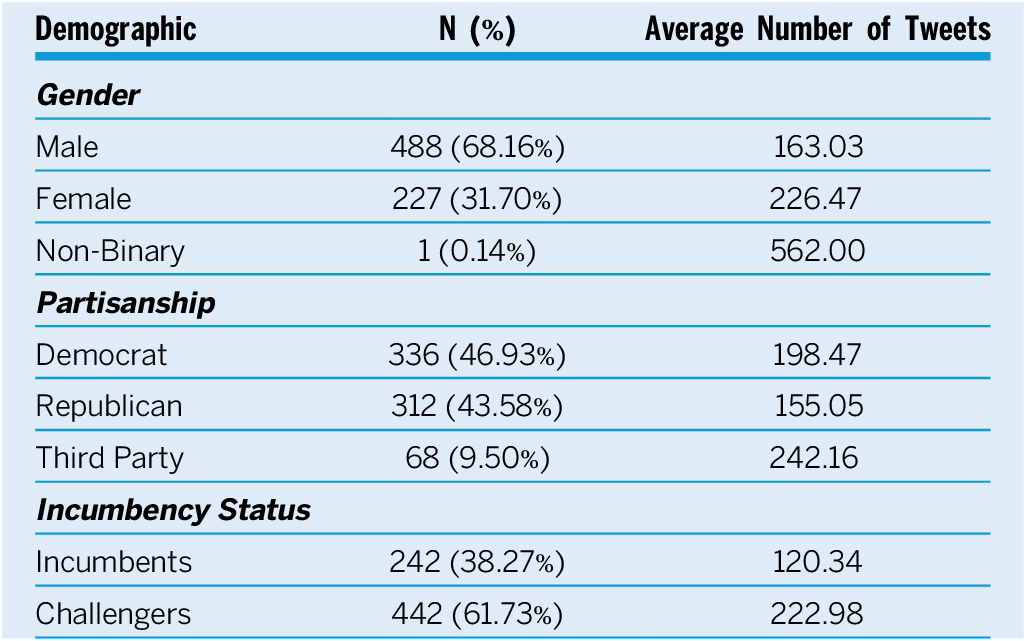
As illustrated in table 1, women sent significantly more tweets than men; third-party candidates sent more tweets than major-party candidates; and challengers sent more than incumbents during the last two months of the campaigns. All of these averages align with the out-party innovation incentives theory (Mayhew Reference Mayhew1974), which essentially states that groups who use innovative “new” media the most are those who are outside of the majority within legislatures (Gainous and Wagner Reference Gainous and Wagner2014; Karpf Reference Karpf2012). For instance, during the 2012 and 2016 presidential elections, out-party candidates (i.e., challengers) were significantly more likely to innovate with digital media (Williams and Gulati Reference Williams and Gulati2018). Whether Twitter is classified as still being a “new” platform is debatable, but these averages demonstrate that women, minor-party candidates, and challengers tweet more often than their counterparts in the majority.
House 2022 Demographics

Table 1 Long description
The table consists of three columns: Demographic, N (%), and Average Number of Tweets.
Under Gender:
- Male: 488 (68.16%) with 163.03 average tweets.
- Female: 227 (31.70%) with 226.47 average tweets.
- Non-Binary: 1 (0.14%) with 562.00 average tweets.
Under Partisanship:
- Democrat: 336 (46.93%) with 198.47 average tweets.
- Republican: 312 (43.58%) with 155.05 average tweets.
- Third Party: 68 (9.50%) with 242.16 average tweets.
Under Incumbency Status:
- Incumbents: 242 (38.27%) with 120.34 average tweets.
- Challengers: 442 (61.73%) with 222.98 average tweets.
Notes: N is the number of candidates in the dataset and % is the percentage of those individuals as a combination of the whole for that demographic category. The minimum number of tweets sent during the campaign by these candidates was one (13 candidates) and the maximum was 3,141 (@UtahPolitician, January Walker, United Utah Party, Utah’s 4th Congressional District).
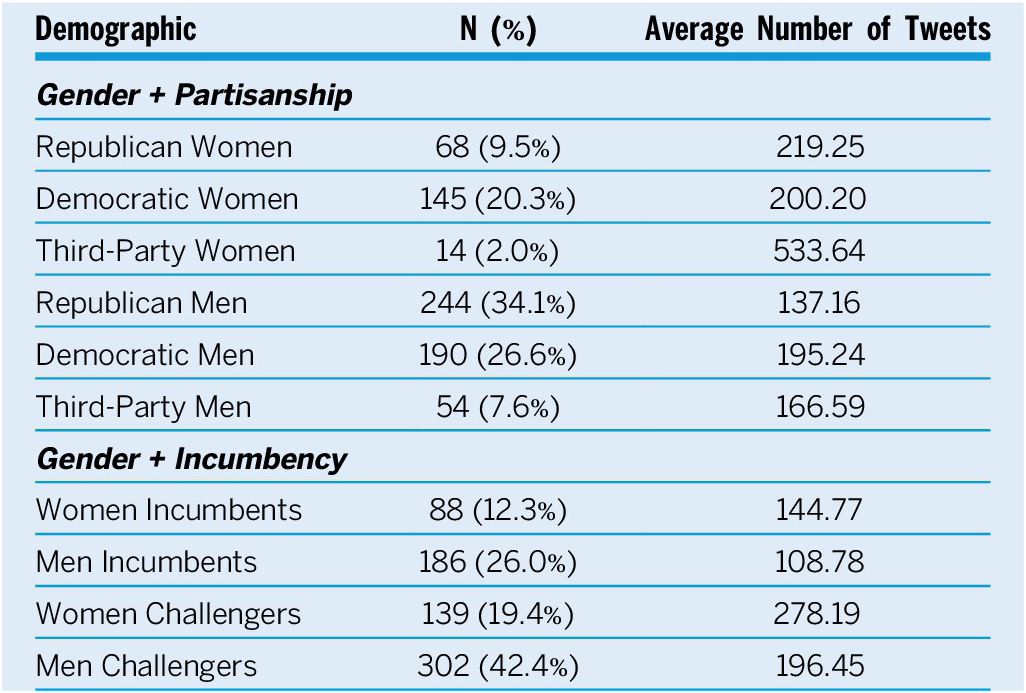
When I examined these averages for women and men in our sample by their partisanship and incumbency status, I found that women send more tweets than their male counterparts regardless of how the data were interpreted (table 2). The smallest difference between men and women in the number of tweets sent was between the Democratic men and women: women sent an average of 200.2 tweets during the last two months of their campaign and men sent an average of 195.24 tweets. Women incumbents sent significantly more tweets than men incumbents, and women challengers sent more than men challengers.
House 2022 Intersectionality Demographics
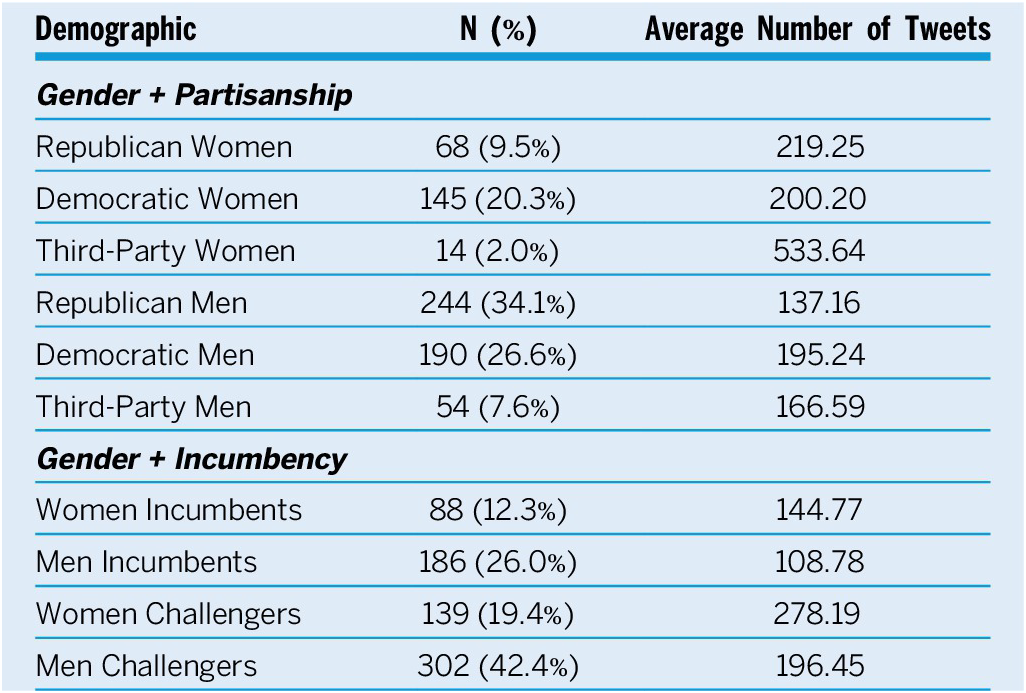
Table 2 Long description
The table contains three columns: Demographic, N (%), and Average Number of Tweets.
Under the Gender plus Partisanship category:
* Republican Women: 68 (9.5%) with 219.25 average tweets.
* Democratic Women: 145 (20.3%) with 200.20 average tweets.
* Third-Party Women: 14 (2.0%) with 533.64 average tweets.
* Republican Men: 244 (34.1%) with 137.16 average tweets.
* Democratic Men: 190 (26.6%) with 195.24 average tweets.
* Third-Party Men: 54 (7.6%) with 166.59 average tweets.
Under the Gender plus Incumbency category:
* Women Incumbents: 88 (12.3%) with 144.77 average tweets.
* Men Incumbents: 186 (26.0%) with 108.78 average tweets.
* Women Challengers: 139 (19.4%) with 278.19 average tweets.
* Men Challengers: 302 (42.4%) with 196.45 average tweets.
Notes indicate N is the number of candidates and % is the percentage of individuals within that demographic category.
Notes: N is the number of candidates in the dataset and % is the percentage of those individuals as a combination of the whole for that demographic category.
To understand exactly how abortion was addressed in the 2022 midterm elections, my first step was conducting a keyword search for all of the following terms found within the tweets: “abortion,” “pro-choice,” “pro choice,” “prochoice,” “pro-life,” “pro life,” “prolife,” “roe,” “dobbs,” “scotus,” and “fetus.” Approximately 269 (37.5%) candidates did not send any tweets using these terms.Footnote 4 Those individuals who did not send a single tweet about abortion were primarily male Republicans (220 of those individuals were men and 170 were Republicans).
The second step in the data analysis was reading and manually coding all of the abortion tweets. I began this process with 4,210 tweets about the topic of abortion, which was defined as containing the terms previously listed. After I began reading each tweet, it was clear that some were not about abortion. For example, many of the tweets using the term “scotus” were not about abortion but instead were about other US Supreme Court cases. I included the term “roe” assuming that it would locate all tweets about Roe v. Wade. Although doing so helped to capture those data, it also resulted in tweets about “heroes” (9/11), “negroes,” “Monroe” (a location), and all of the tweets by “Ann Roe” (former Wisconsin State Assembly member). The term “prolife” also resulted in all of the tweets about “proliferation.” After those tweets were deleted from the analysis, a total of 3,731 tweets specifically about abortion remained.Footnote 5
Third, I coded those tweets for direction, whether pro-life or pro-choice. Pro-life tweets mentioned how important life is and ending access to abortion; pro-choice tweets discussed keeping abortion services available and legal. Of all of the tweets, 89.5% were pro-choice compared to 7.9% that were pro-life. Approximately 2.5% were coded as neither—in those tweets, the individuals did not take a stance either for or against abortion; they simply mentioned the topic.
Borrowing from Wineinger’s discussion regarding the framing of policy issues by Republican women, in the fourth step I also coded for whether the tweets that were related to abortion included women-invoked rhetoric. Wineinger (Reference Wineinger2022, 23) defined this as when a woman “claim(s) to represent women or girls in some way or invoke(s) her own identity as a woman to make a statement about the issue at hand.” It was surprising that not many tweets adopted this style of rhetoric (i.e., only 4.7% of the total abortion tweets). A total of five tweets used the phrase “as a woman” to make a claim about speaking on behalf of women; however, 160 tweets used the term “mother,” 13 used the term “mom,” and 62 used the phrase “as a mother.”
In the fifth step, I coded for whether a tweet discussed the Constitution, including whether the term “codify” was used (i.e., 312 tweets total; 8.4%). Wineinger’s (Reference Wineinger2022) research also showed that Republican women regularly used protectionism language in their speeches to discuss abortion; therefore, I also examined whether the tweets discussed protecting women and girls or rights and freedoms (i.e., 453 tweets, 12.1%).
Sixth, I examined tweets for whether they were about religion (i.e., Christianity), God, Jesus, or the Bible. Few tweets mentioned these topics: two about the Bible, three about Jesus, three about God, nine about religion in general, and 22 about Christianity, resulting in a cumulative 1%.
Finally, I coded for whether the tweets that mentioned abortion were accompanied by a request for fundraising. Approximately 4.2% of the total tweets asked for followers to contribute to their campaigns.
WHO TWEETED ABOUT ABORTION IN 2022? (AND HOW DID THEY TWEET ABOUT IT?)
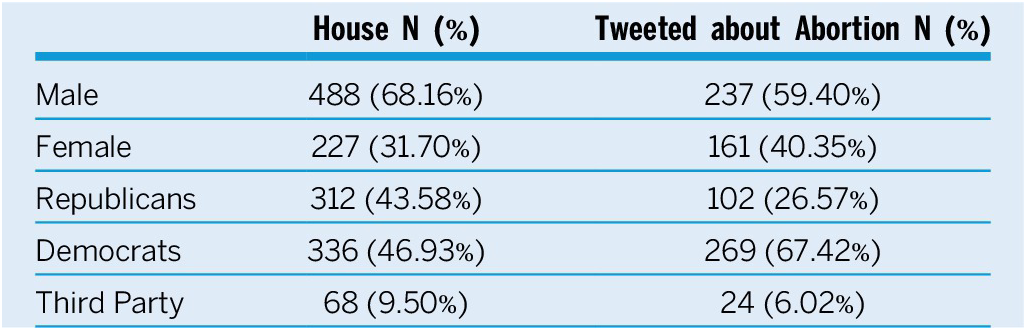
Were women more likely to discuss abortion in their tweets during the 2022 midterm campaigns? The short answer is yes. As demonstrated in table 3, a total of 399 candidates discussed abortion at least once in their tweets during the campaign (i.e., 55.7% of the total number of candidates). Women comprised approximately 31.7% of the total number of candidates in the dataset, but they comprised 40.35% of those who tweeted about abortion. Approximately 71% of all women candidates tweeted about abortion compared to 48.5% of all men candidates. In terms of partisanship, Democrats comprised the group that was most likely to tweet about abortion. Approximately 80% of all Democrats, 32.6% of all Republicans, and 35% of third-party candidates tweeted about abortion.
Who Tweets About Abortion?

Table 3 Long description
The table consists of three columns: Demographic Category, House N (%), and Tweeted about Abortion N (%).
Row 1: Male. House N is 488 (68.16%). Tweeted about Abortion N is 237 (59.40%).
Row 2: Female. House N is 227 (31.70%). Tweeted about Abortion N is 161 (40.35%).
Row 3: Republicans. House N is 312 (43.58%). Tweeted about Abortion N is 102 (26.57%).
Row 4: Democrats. House N is 336 (46.93%). Tweeted about Abortion N is 269 (67.42%).
Row 5: Third Party. House N is 68 (9.50%). Tweeted about Abortion N is 24 (6.02%).
Notes indicate that N represents the number of candidates and % is the percentage within that demographic category. The right-hand column displays individuals who tweeted about abortion at least once.
Notes: N is the number of candidates and % is the percentage within that demographic category. The values in the first column represent the number of candidates included in the dataset that match the demographic. For instance, there are 488 men in the dataset and 227 women. The right-hand column displays the number and percentage of individuals in each category who tweeted about abortion at least once.
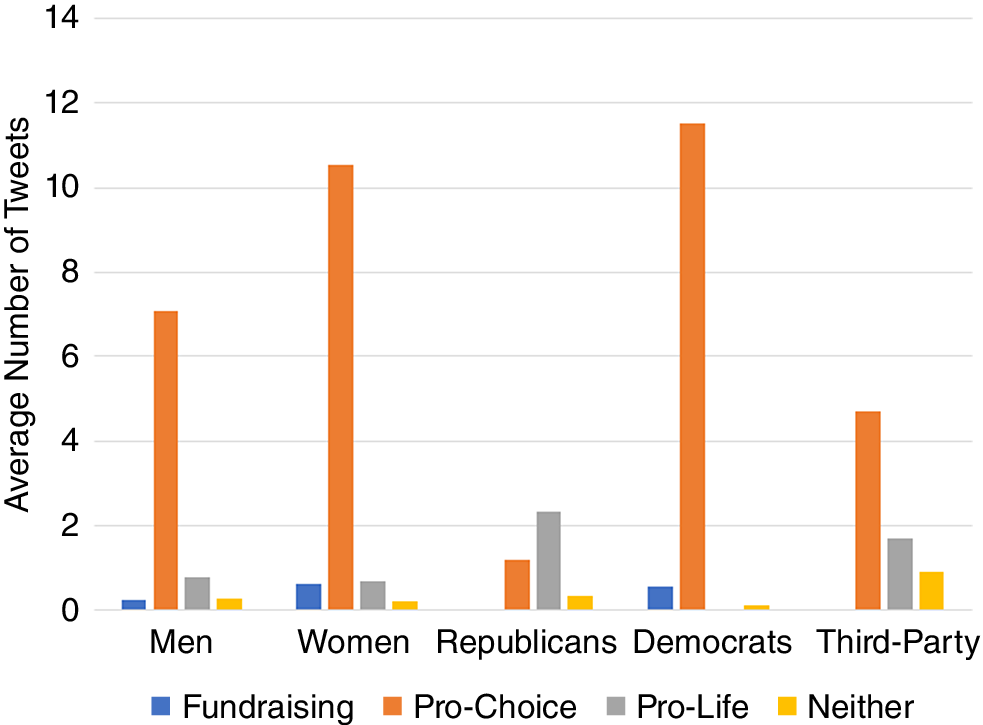
How did these candidates frame their tweets about abortion? As previously mentioned, almost 90% of the tweets sent during the campaigns were pro-choice. I averaged the number of each type of tweet sent (i.e., pro-choice, pro-life, neither, or fundraising) and examined those totals by gender and partisanship. For all groups other than Republicans, pro-choice tweets were the most common. Women sent more pro-choice tweets than men (i.e., 10.5 to 7.07) and Democrats sent the most tweets, on average, that were classified as pro-choice (11.52). The majority of pro-life tweets were sent by Republicans and some of those were sent by women (figure 1). Fundraising tweets were not common and were sent mainly by Democratic candidates.
Average Type of Abortion Tweets

Figure 1 Long description
The Y-axis represents the Average Number of Tweets ranging from 0 to 14 in increments of 2. The X-axis lists five categories: Men, Women, Republicans, Democrats, and Third-Party. A legend at the bottom identifies four colored bars for each category: blue for Fundraising, orange for Pro-Choice, gray for Pro-Life, and yellow for Neither.
* Men: Pro-Choice tweets lead at approximately 7, followed by Pro-Life at 0.8, and Fundraising and Neither both below 0.5.
* Women: Pro-Choice tweets peak at approximately 10.5, with Fundraising and Pro-Life around 0.6, and Neither at 0.2.
* Republicans: Pro-Life tweets are the highest at approximately 2.3, followed by Pro-Choice at 1.2, Neither at 0.4, and Fundraising near 0.
* Democrats: Pro-Choice tweets reach the highest overall peak at approximately 11.5, followed by Fundraising at 0.6, Neither at 0.1, and Pro-Life near 0.
* Third-Party: Pro-Choice tweets are at approximately 4.7, followed by Pro-Life at 1.7, Neither at 0.9, and Fundraising near 0.
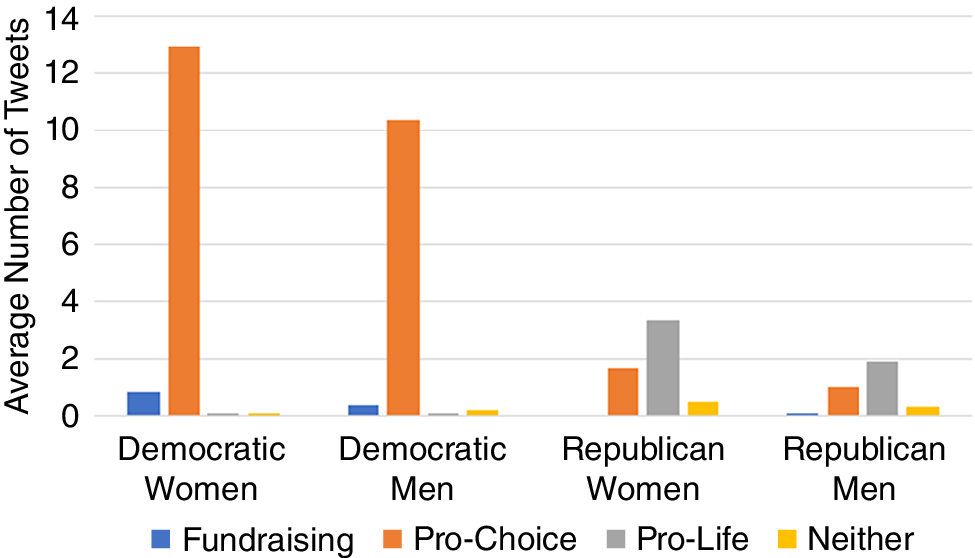
Did Republican women and Democratic women differ in how they discussed this issue? To address this, I divided the sample into four groups: Democratic women (N=121), Democratic men (N=147), Republican women (N=31), and Republican men (N=75). As the results in figure 2 illustrate, Democratic women, on average, sent more pro-choice tweets than any other group about this topic (12.96), but they were followed closely by their male copartisans (10.39). Republican women, conversely, tweeted more pro-life than pro-choice statements. Although there were only 31 Republican women in this dataset, they sent the most pro-life tweets of any group, almost doubling the number that Republican men sent. Republican women also tweeted more pro-choice statements than their male copartisans.
Gendered Partisanship and Type of Abortion Tweets
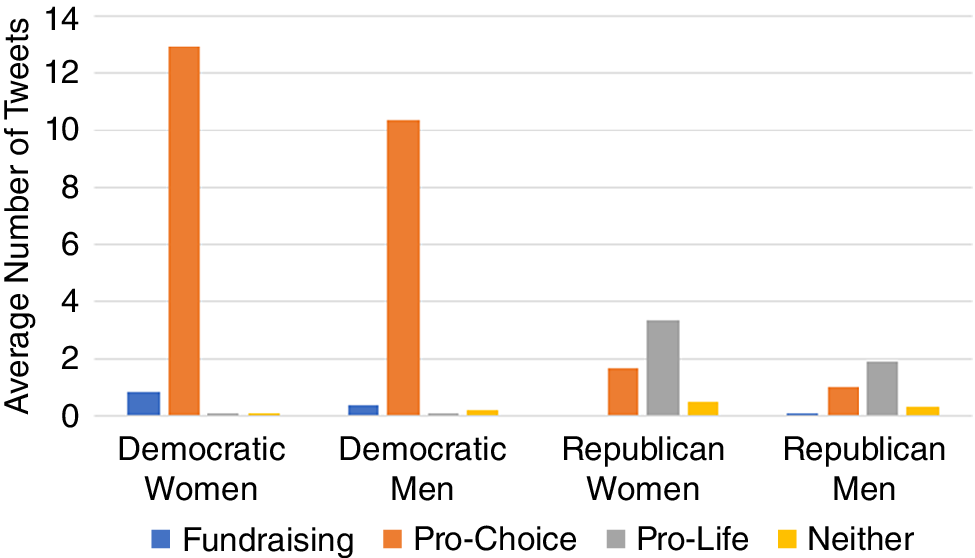
Figure 2 Long description
The y-axis is labeled Average Number of Tweets and ranges from 0 to 14 in increments of 2. The x-axis contains four groups: Democratic Women, Democratic Men, Republican Women, and Republican Men. Each group contains four bars representing content types: Fundraising (blue), Pro-Choice (orange), Pro-Life (gray), and Neither (yellow).
* Democratic Women: Pro-Choice tweets dominate at approximately 13. Fundraising is around 1. Pro-Life and Neither are near 0.
* Democratic Men: Pro-Choice tweets are high at approximately 10.5. Fundraising is around 0.5. Pro-Life and Neither are near 0.
* Republican Women: Pro-Life tweets are the highest at approximately 3.5. Pro-Choice is around 1.8. Neither is around 0.5. Fundraising is near 0.
* Republican Men: Pro-Life tweets are highest at approximately 2. Pro-Choice is around 1. Neither is around 0.4. Fundraising is near 0.
A majority of Republicans tweeted pro-life statements; however, when I examined their tweets for additional substantive content, I found that many included fear language about “abortions after birth” or language about killing children and babies. For instance, Jen Ruth Green (Indiana, District 1) tweeted: “I am pro-life and the majority of Americans want reasonable limits on abortion. My opponent @repmrvan voted for abortion at any time, for any reason, up until the moment of birth, at taxpayer expense. He is being dishonest and his position is the extreme one in this race.” Lucie Volotzky (California District 32) tweeted: “Vote no on Prop 1! If passed, it would change our California constitution to include the “right to an abortion up to nine months” including partial-birth abortion and even killing the baby after birth. No restrictions, no questions!”
Wineinger’s (Reference Wineinger2022) research on the framing of issues by Republican women reveals that, over time, they have used more regularly women-invoked rhetoric, which is defined as speech in which they make a personal connection to the issue through statements about representing women and girls or being a woman and a mother themselves. I found little women-invoked rhetoric in Republican women’s tweets during the 2022 midterm campaigns. The only two Republican women who tweeted about being a mother and connecting it to the issue were Ann Wagner (Missouri District 2) and Diana Harshbarger (Tennessee District 1). Wagner tweeted: “I’m a proud mother and grandmother who will never waver in my efforts to protect life—especially now as Democrats increase efforts to champion abortion even after a baby is born. Proud to be endorsed by the @nrlc!” Harshbarger tweeted: “I am proud to receive @sbaprolife’s endorsement for the 2022 election. As a mother, grandmother, and pharmacist, I know firsthand how precious each and every life is. Fighting for the unborn is a duty I do not take lightly.” Both of these tweets were similar in that they were sent from incumbents discussing their receiving an endorsement from a group dedicated to pro-life policies. Liz Lemery Joy (New York District 20) tweeted: “My opponent Paul Tonko is an extremist fighting and marching to make sure these babies never survive. As a woman, I’m proud to be pro-life.”
Democratic women, conversely, used women-invoked rhetoric and regularly framed the issue in terms of being a mom and a woman and codifying Roe. For instance, Lauren Mallet-Hays (Arkansas District 3) tweeted: “As a mother and a Democrat, I am ready to get to Congress and fight for our residents. This includes codifying Roe and banning assault weapons. Please chip in to help me get there today”—including a request for campaign donations. Odessa Kelly (Tennessee District 7) tweeted: “This is the reality we’re dealing with in Tennessee: women facing death and doctors facing jail time. All because of the GOP’s obsession with power and control. Codify Roe. Codify Roe. Codify Roe.”
Using this issue to attack opponents also was common in tweets about this issue from both Democratic women and men. For instance, Jeanine Lee Lake (Indiana District 5) tweeted: “@repspartz is against all abortions, including any pregnancy resulting from rape or incest. She also doesn’t care if the life of the mother is being threatened. These folks are determined to control women and eliminate our rights and freedoms! #voteblue #in05.” Patty Pansing Brooks (Nebraska District 1) tweeted about the legality of Dobbs in her attack on her opponent: “Our Constitutional freedoms are under attack including access to safe, rare, legal abortions. Mike Flood does not support exception for rape, for incest, or for the life of the mother.” Both of these tweets make a personal connection to the issue by using the word “our.”
Democrat men, conversely, tweeted regularly about abortion but did not have the same personal connection to the issue. Their tweets tended to be attacks on their opponents. Greg Landsman (Ohio District 1), for instance, tweeted: “Chabot has spent his entire career working to outlaw abortion without exceptions for rape, incest, or life of the mother. He’s an anti-choice extremist who is determined to impose his views on all of us. #oh01.” Tony Vargas (Nebraska District 2) tweeted: “Abortion access is a defining difference in this campaign. Congressman Bacon is the cosponsor of a bill that bans abortion with no exceptions for rape, incest, and the life of the mother. He voted for a bill that limits access to contraception.”
Democrats also were more likely to tweet about “protection” and “safety.” These terms were used when they discussed protecting women’s rights and the safety of women and mothers when they need to seek access to abortion. Republicans, conversely, were more likely to discuss religion and its connection to abortion. John Rose (Tennessee District 6), for instance, tweeted: “As a father and a Bible-believing Christian, I will always be #prolife.” However, statements like these were rare.
Although Republican men tweeted the least about abortion, whenever they discussed the issue, there was less connection to the issue. For instance, Eric Brewer (Ohio District 11) tweeted: “@yesweca37213657 @repcleaver @housedemocrats makes no sense. You should be thanking the mothers who did not abort 66 million babies, 40% Black. Pro-life mothers are taking the pregnancy risks. A woman who kills her baby delivers a dead child. Not a new generation.” Dan Crenshaw (Texas District 2), conversely, tried to clarify his party’s position with the following tweet: “@lkhamilton I don’t think that’s the choice. There are zero pro-life positions that would say the life of the mother doesn’t matter. We believe in life, including the mother. Some procedures require removing the baby, but docs should always try and save the baby after. That’s the position.” Chip Roy (Texas District 21) tweeted: “My mom had me at 15. She decided she couldn’t go through with her ‘right’ to kill her kid in the early days of Roe. At times it was hard. We were on food stamps, ADC, she had an abusive marriage, etc. But 49 years later, she would say now I’m the best ‘mistake’ she ever made.”
DISCUSSION
Overall, these findings demonstrate how abortion was discussed and framed on Twitter during the 2022 midterm-elections campaigns. Although a majority of US House of Representatives candidates discussed this topic during their campaigns, their level of attention to and framing of the topic was affected by both their gender and partisanship. Abortion was at the top of the national agenda for the Democratic Party, and the tweets that were sent by Democratic US House candidates tell a similar story. Democrats sent significantly more tweets about abortion, and their tweets were overwhelmingly pro-choice. Regarding gender, although Republican women at one time were likely to side with Democratic women on issues related to reproductive health, they did not during the 2022 midterm-elections campaigns. Republican women spent more time tweeting about abortion than their male copartisans, but their framing was more pro-life than pro-choice. Furthermore, when the Republican candidates were examined as a unit, unlike previous research that has shown Republican women on par with Republican men on their issue position on abortion (Rolfes-Haase and Swers Reference Rolfes-Haase and Swers2022), when it comes to their rhetoric online, Republican women were more likely to tweet both pro-life and pro-choice statements about it.
In addition to identifying these tweets as either pro-choice or pro-life, the results show that Republican women and Democratic women adopted different frames in terms of their discussion of this issue. Democratic women were more likely to speak as a woman through women-invoked rhetoric whereas there was little of that rhetoric from Republican women. This is surprising given Wineinger’s (Reference Wineinger2022) earlier research. At least in this particular election period, Republican women apparently did not use their personal connection as being a woman or a mom to make a case either for or against abortion. Instead, Republican women (and men) were focused on fear. Democrats, conversely, were more likely to use protectionism and attack-style language to discuss abortion.
Given the number of tweets sent by candidates about this issue, it is clear that women have a key role in framing abortion for their parties. Wineinger (Reference Wineinger2022) found that Republican women reframed the abortion debate in their speeches from 1995 to 2016 to be about protection and discussing their personal connection as women to the topic. However, these results reveal that after the Dobbs decision, Democratic women led in framing the issue to highlight their personal connection. Whereas Republican women were not “speaking collectively as and on behalf of women” (Wineinger Reference Wineinger2022, 157) about this issue in 2022, Democratic women were.
…these results reveal that after the Dobbs decision, Democratic women led in framing the issue to highlight their personal connection.
One reason that Republican women may have not spent as much time highlighting their connection as women or as mothers when they discussed abortion during the 2022 midterm-elections campaigns was that their party had achieved their policy goals nationwide, and those goals were not popular with the public. Abortion was salient in voters’ minds at the time, with the mid-term elections falling directly after Dobbs. There were multiple abortion measures on state ballots as well, and public opinion was not in their favor. The Pew Research Center (2022) reported immediately after the Dobbs decision that approximately 62% of Americans believed abortion should be legal in all or most cases. The Republican Party, therefore, should have sent fewer messages about abortion in general, which these results bear out. Nevertheless, Republican women were instrumental for their party in the way that they communicated about this issue, given their connection to the topic as women. Future research should examine how the party message—especially how the gendered–partisan message—changed between the 2020 presidential and the 2022 midterm elections.
We expect that the frames that women candidates use during their campaigns (and while in office) will impact the way that the political parties, the media, and the public thinks about abortion (Zaller Reference Zaller1992). Research has shown not only that particular frames can influence attitudes toward this topic (Simon and Jerit Reference Simon and Jerit2007) but also that the news media can enhance the impact of this rhetoric for the public by focusing on particular key themes and frames that emerge in candidates’ communication that align with their ideological predispositions (Carmines, Gerrity, and Wagner Reference Carmines, Gerrity and Wagner2010; Levendusky and Malhotra Reference Levendusky and Malhotra2016). The tweets sent during the 2022 midterm-elections campaigns highlight that Republicans were focused on the fear of “after-birth abortions,” which means that the more-conservative media likely used this frame as well. Future research should examine whether the news media followed in candidates’ footsteps in terms of their framing of this issue during the 2022 midterm elections and whether public opinion did as well.
ACKNOWLEDGMENTS
I thank everyone who contributed to the data collection for this study. This was a joint effort among undergraduate and graduate students at four different universities: the University of Virginia’s College at Wise, the University of Kentucky, the University of Texas San Antonio, and the University of Houston.
DATA AVAILABILITY STATEMENT
Research documentation and data that support the findings of this study are openly available at the PS: Political Science & Politics Harvard Dataverse at https://doi.org/10.7910/DVN/GDYDJZ.
CONFLICTS OF INTEREST
The author declares that there are no ethical issues or conflicts of interest in this research.