


This paper contains supplementary material that can be found online at http://journals.cambridge.org
Introduction
Globally, freshwater ecosystems have been severely affected by anthropogenic impacts on riverine ecosystem services and resources (Allan & Flecker, Reference Allan and Flecker1993; Collen et al., Reference Collen, McRae, Kothari, Mellor, Daniel, Greenwood and Loh2008). The widespread degradation of these ecosystems threatens aquatic biodiversity at both local and regional scales (Richter et al., Reference Richter, Braun, Mendelson and Master2003; Vörösmarty et al., Reference Vörösmarty, McIntyre, Gessner, Dudgeon, Prusevich and Green2010) and protecting freshwater ecosystems and biodiversity is a global challenge (Collen et al., Reference Collen, McRae, Kothari, Mellor, Daniel, Greenwood and Loh2008; Vörösmarty et al., Reference Vörösmarty, McIntyre, Gessner, Dudgeon, Prusevich and Green2010). Fishes are both an important component of freshwater diversity and a resource widely exploited for consumption and trade (Duncan & Lockwood, Reference Duncan and Lockwood2001) and therefore an important aspect of river conservation (Cowx, Reference Cowx, M.C., I.G. and M.2002; Dudgeon et al., Reference Dudgeon, Arthington, Gessner, Kawabata, Knowler and Lévêque2005).
Freshwater (riverine and wetland) protected areas have been proposed as a solution for conserving freshwater biodiversity, including fishes, and sustaining hydrological services (Saunders et al., Reference Saunders, Meeuwig and Vincent2002; Abell et al., Reference Abell, Allan and Lehner2007; Suski & Cooke, Reference Suski and Cooke2007). Exclusively freshwater protected areas are uncommon, and protection of freshwater habitats (especially flowing waters) is mainly through terrestrial protected areas (Cowx, Reference Cowx, M.C., I.G. and M.2002; Abell et al., Reference Abell, Allan and Lehner2007).
However, terrestrial protected areas do not necessarily represent the overall diversity of landscape features, ecosystems or biodiversity (McNeely et al., Reference McNeely, Harrison and Dingwall1994; SCBD, 2004; Rodrigues et al., Reference Rodrigues, Akçakaya, Andelman, Bakarr, Boitani and Brooks2004a,Reference Rodrigues, Andelman, Bakarr, Boitani, Brooks and Cowlingb). River protection or fish conservation are mostly incidental as part of terrestrial protected areas, which cover <12% of inland waters (Pittock et al., Reference Pittock, Hansen and Abell2008). In addition, designation of terrestrial protected areas is often biased towards high-elevation regions (Joppa & Pfaff, Reference Joppa and Pfaff2009) and charismatic large mammals and birds (Rodrigues et al., Reference Rodrigues, Andelman, Bakarr, Boitani, Brooks and Cowling2004b).
In many developing countries protected areas are often created in the upper reaches of dam catchments, mainly for catchment protection and as compensation for inundation of forests under reservoirs (McNeely, Reference McNeely1987; McNeely et al., Reference McNeely, Harrison and Dingwall1994; Stolton et al., Reference Stolton, Mansourian and Dudley2010). Such protected areas may not be representative of linear river systems or their biodiversity along the gradient of elevation (Collares-Pereira & Cowx, Reference Collares-Pereira and Cowx2004; Becker et al., Reference Becker, Korner, Brun, Guisan and Tappeiner2007; Nel et al., Reference Nel, Roux, Maree, Kleynhans, Moolman and Reyers2007, 2009; Herbert et al., Reference Herbert, McIntyre, Doran, David Allan and Abell2010). Nevertheless, terrestrial protected areas are the most common measure for land-cover protection in many places (McNeely et al., Reference McNeely, Harrison and Dingwall1994; SCBD, 2004; Pittock et al., Reference Pittock, Hansen and Abell2008). Assessments are required of how effectively these protected areas conserve freshwater biodiversity (Chape et al., Reference Chape, Harrison, Spalding and Lysenko2005; Nel et al., Reference Nel, Roux, Maree, Kleynhans, Moolman and Reyers2007; Gaston et al., Reference Gaston, Jackson, Cant'u-Salazar and Cruz-Pinon2008).
In the Western Ghats mountain range of India protected area coverage (9%) mostly extends from mid-elevation forested areas in dam reservoir catchments to higher elevations at the crest of largely inaccessible escarpments and mountain ridges (Gunawardene et al., Reference Gunawardene, Dulip Daniels, Gunatilleke, Gunatilleke, Karunakaran and Nayak2007). Construction of dams and reservoirs preceded the creation of most of these protected areas (Nair, Reference Nair1991), which were later designated for conservation of threatened species of large mammals and birds (Das et al., Reference Das, Krishnaswamy, Bawa, Kiran, Srinivas, Kumar and Karanth2006; Gunawardene et al., Reference Gunawardene, Dulip Daniels, Gunatilleke, Gunatilleke, Karunakaran and Nayak2007). But dedicated conservation of so-called lesser taxa has always been lacking in these protected areas yet they are vulnerable to many threats. For example, native fish communities in this landscape have been identified as susceptible to the impacts of climate change and rapid urbanization (McDonald et al., Reference McDonald, Green, Balk, Fekete, Revenga, Todd and Mark Montgomery2011).
We report here an investigation of the effectiveness of terrestrial protected areas in the southern Western Ghats of India for the conservation of riverine and stream fishes. We know a priori that there are no protected areas in the lowlands and therefore that strictly lowland river fish species are unprotected. We use the number of regionally endemic and total fish species as the response variables to assess the effectiveness of protected areas for fish conservation (e.g. Bergl et al., Reference Bergl, Oates and Fotso2007). Fish species richness was determined for river sites in unprotected and protected areas, and for dammed and undammed rivers. The study area has several potentially confounding ecological factors that could lead to incorrect inferences about the effectiveness of protected areas (e.g. Becker et al., Reference Becker, Korner, Brun, Guisan and Tappeiner2007; Andam et al., Reference Andam, Ferraro, Pfaff, Sanchez-Azofeifa and Robalino2008; Gaston et al., Reference Gaston, Jackson, Cant'u-Salazar and Cruz-Pinon2008; Joppa & Pfaff, Reference Joppa and Pfaff2010). This is because protected areas are mostly at higher elevations and comparable unprotected sites are not available, and protected areas are additionally biased with respect to stream order. We therefore attempted to reduce the impact of these confounding factors as much as possible (Table 1). Further insight into the impact of protected areas was obtained by investigating the pattern of fish species richness along the elevation gradient, which was compared to documented patterns of species richness with altitude (Fu et al., Reference Fu, Wu, Wang, Lei and Chen2004; Becker et al., Reference Becker, Korner, Brun, Guisan and Tappeiner2007; Jaramillo-Villa et al., Reference Jaramillo-Villa, Maldonado-Ocampo and Escobar2010). We also compared the intensity and occurrence of anthropogenic threats to streams in protected and unprotected areas, using direct observations and interviews with local people and protected area managers.
Confounding ecological factors in assessments of the effectiveness of protected areas, with particular reference to this study.

1 Becker et al. (Reference Becker, Korner, Brun, Guisan and Tappeiner2007)
2 Joppa & Pfaff (Reference Joppa and Pfaff2010)
3 Linke et al. (Reference Linke, Turak and Nel2010); see also Fig. 2 and Appendix 1
Study area
The Western Ghats mountain range, a global biodiversity hotspot (Myers et al., Reference Myers, Mittermier, Mittermier, da Fonseca and Kent2000), runs along the west coast of India. Streams originating in these mountains form the headwaters of the many rivers that provide freshwater to the plains (Nair, Reference Nair1991). Freshwater fish diversity is high, with 290 documented species of which 65% are endemic (Dahanukar et al., Reference Dahanukar, Raghavan, Ali, Abraham, Shaji, Molur, Smith, Daniel and Darwall2011). Our study area in the Agasthyamalai (Ashambu) Hills in Kerala state comprises five west-flowing rivers (Fig. 1, Table 2). The landscape is a unique biotope within the southern Western Ghats, with high diversity and endemism of plants, fungi, invertebrates, fishes and amphibians (Nair, Reference Nair1991; Dahanukar et al., Reference Dahanukar, Raut and Bhat2004; Gunawardene et al., Reference Gunawardene, Dulip Daniels, Gunatilleke, Gunatilleke, Karunakaran and Nayak2007). The study area comprises five protected areas: three Wildlife Sanctuaries (Neyyar, Peppara and Shendurney) and two Reserve Forests (Kulathapuzha, Palode) in the midlands and highlands (Fig. 1). The Wildlife Sanctuaries lie in the upper catchments of dam reservoirs and the Reserve Forests occur in the higher reaches of undammed rivers; thus, coverage of midland reaches is variable across protected areas (Table 2). With the exception of the Ithikkara (which originates at c. 240 m altitude), all rivers originate above 1,500 m (Basak et al., Reference Basak, James and Nandeshwar1995) and descend through an elevation and land-use gradient that includes protected areas (highlands/midlands), rubber plantations/mixed-crop cultivation (midlands) and coconut/paddy/mixed-crop cultivation in rural and urban lowland areas.
The five rivers studied in the Agasthyamalai (Ashambu) Hills in Kerala (Fig. 1), the protected areas through which they flow, the total river length, the catchment area that lies within the midlands, and the length of river lying within the protected area.

0,1,2 The number of dams and large weirs constructed on these rivers
Methods
Data collection
Data collection included (1) sampling fish communities and measuring ecological variables across multiple sites in protected and unprotected areas, (2) semi-structured interviews with local stakeholders to assess their perceptions of the intensity of threats to stream fishes, and assigning threat scores to sampled sites, and (3) interviews with protected area managers to assess their knowledge of freshwater conservation.
Fish species and ecological variables
We surveyed fish at 24 sites across five rivers in the lowlands (0–30 m), midlands (30–200 m) and highlands (200–1,700 m) during the post-monsoon season during 2009–2010. Flow conditions were relatively consistent across sites. Data were collected along river reaches at the various elevations. We collected fish by minimally invasive sampling from dusk to dawn (18.00–06.00) with gears suited to the nature of the river course, stream order, flow, presence of aquatic vegetation and local human disturbance, and released fish after identification and specimen collection (total of 28 collected specimens deposited at the Museum, Department of Aquatic Biology and Fisheries, University of Kerala, Thiruvananthapuram). At each site we used cast nets with sufficient effort until local species saturation was obtained, and also conducted visual surveys for fish species. We deployed gillnets for highly mobile species and hooks and lines to sample larger predatory species, where possible. Fishes were identified using taxonomic keys and photographic documentation (see Abraham et al., Reference Abraham, Kelkar and Bijukumar2011, for a review and checklist). Data on ecological variables (Appendix 1) were collected at each site. Anthropogenic threats were recorded and mapped, and protected area coverage in midland and highland areas was calculated using ArcView v. 3.3 (ESRI, Redlands, USA). Stream order was determined using 1 : 50,000 maps.
Statistical analyses
The number of fish species typically decreases with increasing altitude, and the number of endemic fish species has a hump-shaped relationship over the same change in altitude (Fu et al., Reference Fu, Wu, Wang, Lei and Chen2004; Jaramillo-Villa et al., Reference Jaramillo-Villa, Maldonado-Ocampo and Escobar2010). We used regression to describe the relationship between total and endemic fish species with altitude. For assessing whether protected areas have any effect on fish species richness we compared adjacent sites only with stream order 4 and similar altitudes (100–200 m), in protected and unprotected areas. This eliminated the confounding effects of dams, elevation and stream order (Fig. 2). We compared species richness across dammed and undammed river sites separately to account for the potential confounding effect of dams. For all comparisons we used ANOVA to compare total and endemic species richness (square-root transformed) between protected and unprotected areas. Species can have heterogeneous detection or capture probabilities because of differences in habitat preferences and behaviour (Boulinier et al., Reference Boulinier, Nichols, Sauer, Hines and Pollock1998). To address this we obtained estimates of species richness from detection histories at all spatial replicates, with a Bayesian hierarchical model formulation. All other analyses in this study were performed using frequentist methods.

The Agasthyamalai Hills, Western Ghats, Kerala, showing the sampling sites, with their respective threat scores, the elevation gradient, and the five rivers (Kallada–Kulathupuzha, Ithikkara, Kallar–Vamanapuram, Karamana, Neyyar). The inset indicates the location of the main map in southern India.

Bayesian hierarchical model formulation allows the specification of a prior probabilistic process model for the actual occurrence probabilities of species (based on checklists of fish from previous studies), followed by an observation model (for detectability) based on occurrence frequencies of sampled species drawn from the ‘unknown’ species richness of the area. This is based on Bayes Theorem P(θ|x)∝P(x|θ)·P(θ), i.e. the probability of the model parameters θ given the data x (posterior probability) is proportional to the product of likelihood (probability of data x given model θ and prior probability of θ). We used the method developed by Royle & Dorazio (Reference Royle and Dorazio2008) for estimating species richness under imperfect detection, with a procedure called data augmentation. In data augmentation ‘species never sampled, but likely present’ are added as all-zero detection histories. These added detection histories represent the prior process model for occurrence probability, and thus augment the existing detection data. Species added were from published occurrence records of fish species and consultations with fish taxonomists (Abraham et al., Reference Abraham, Kelkar and Bijukumar2011). Uninformative prior distributions were used for occurrence and detection probabilities in the hierarchical model. This approach is analogous to estimation of closed populations based on sampled individuals (species in this case) with heterogeneity in detectability (Burnham & Overton, Reference Burnham and Overton1978). Posterior estimates of species richness were obtained for stream sites within midland protected and unprotected areas, and for lowland sites. Statistical analyses were conducted using R v. 2.11.1 (R Development Core Team, 2010) and WinBUGS (Spiegelhalter et al., Reference Spiegelhalter, Thomas, Best and Lunn2007).
Threats in protected and unprotected areas
We conducted informal discussions and semi-structured interviews with local stakeholders (fishermen, farmers and rural citizens, and key informants; n=55) to assess awareness and perception of threats to conservation of fish species and fish resources. On our interview datasheets (Appendix 2), threats for each site were categorized using the IUCN Red List Guidelines (IUCN Standards and Petitions Subcommittee, 2010) and ranked from most to least impact, based on stakeholder responses. Median threat scores were compiled from ranks assigned by interviewees to all prevalent threats at sites in protected and unprotected areas, and mapped. Protected area managers and staff were interviewed to assess their level of awareness and to discuss stream protection measures being undertaken within protected areas.
Results
Species richness in protected and unprotected areas
A total of 58 fish species were recorded. In each river, river segments in the protected area had consistently higher total species richness than segments in unprotected areas. The total number of species recorded in protected areas overall was 44, and 32 in unprotected areas. Estimated species richness was 57±SD 10 and 50±SD 14, respectively, in protected and unprotected areas. Lowland unprotected areas had the highest estimated total species richness (62±SD 13; sampled richness =29), influenced by marine and estuarine species. We recorded the same 2–3 fish species in protected and unprotected highland sites (Table 3). For dammed rivers midland protected areas had significantly higher regional endemic species richness (mean 5.11±SD 3.78) than midland unprotected areas (mean 1.84±SD 1.40; ANOVA: F=29.641, P=0.00015; Fig. 3a, Table 3). Endemic species richness exhibited a humped relationship with elevation (quadratic regression R 2=0.396, P=0.008, y=1.03+0.008×x−7.215×x 2; Fig. 3a) whereas total species richness declined with increasing elevation (Fig. 3b). Across all rivers, sampled sites in protected areas had consistently higher endemic species richness than unprotected area sites of the same stream order (Fig. 3c). Total species richness in undammed rivers was less than in dammed rivers but endemic species richness was similar, with 10–14 species. Actual fish species recorded in dammed and undammed rivers were similar. Threatened as well as common fish species, and indigenous fishes of commercial importance, were encountered more commonly inside protected areas.
Variation in (a) number of fish species endemic to the Western Ghats and (b) total number of fish species with log(altitude), and (c) number of endemic fish species with stream order.

Number of fish species in three abundance categories (common, occasional, rare), number of endemic species and total number of species in dammed and undammed rivers in unprotected and protected areas in highlands, midlands and lowlands.
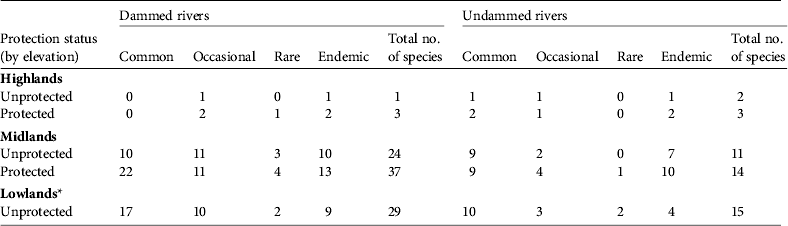
* There are no protected areas in lowlands
Threats in protected and unprotected areas
Threat scores were low inside protected areas and high at sites in midland and lowland unprotected areas (Table 4). Sand mining, dynamite fishing and acidic wastes disposed from rubber plantations, solid waste disposal, water pollution and proliferation of invasive exotic fish species were the most commonly recorded threats in unprotected areas (Table 4). There were also some threats, such as introduction of exotic food fishes in reservoirs, within protected areas. Most protected area managers lacked awareness about freshwater fish conservation, and no active measures for stream protection were being undertaken in the protected areas.
Threat scores (1=least to 5=most) to freshwater habitats and fish species. Note the differences in threat scores between unprotected and protected areas in midlands.

* There are no protected areas in lowlands
Discussion
Our analyses of mid elevation stream sites that were free of confounding factors show that sites within protected areas had a greater number of endemic fish species than sites in unprotected areas. Protected areas also had higher total species richness, and more threatened and common species (Devictor et al., Reference Devictor, Godet, Julliard, Couvet and Jiguet2007). As expected, endemic species richness peaked at mid-elevation sites whereas total species richness decreased with increasing altitude (Fu et al., Reference Fu, Wu, Wang, Lei and Chen2004; Bergl et al., Reference Bergl, Oates and Fotso2007; Jaramillo-Villa et al., Reference Jaramillo-Villa, Maldonado-Ocampo and Escobar2010). For endemic species, there is a notable shift in the peak towards protected area sites at mid elevations, suggesting the importance of the protected status of these areas (Fig. 4). Terrestrial protected areas, through indirect protection of headwater streams and river zones, may offer refuge to midland fish species.
Schematic summary of the results of this study: patterns of (a) endemic and (b) total species richness in dammed and undammed rivers with elevation (1, hypothetical expected relationship; 2, dammed rivers; 3, undammed rivers; PA, protected areas; NPA, non-protected areas). Total species richness decreases with elevation whereas endemic species richness peaks in midlands, where it is higher in protected areas.

Studies of amphibians and reptiles in the Western Ghats have suggested that protected areas may not represent the entire range of altitudes or habitats, or distribution, of endemic species (Ishwar et al., Reference Ishwar, Chellam and Kumar2001; Vasudevan et al., Reference Vasudevan, Kumar and Chellam2006). In Sri Lanka, for example, protected area coverage of endemic fish species of the wet zone (south-western midlands and associated plains) is poor (Pethiyagoda, Reference Pethiyagoda1994), as almost 95% of the protected areas cover dry zones at high altitudes.
However, for stream fish species of the southern Western Ghats our results indicate that a large percentage of endemic species are represented in existing protected areas in the wet regions. Atkore et al. (Reference Atkore, Sivakumar and Johnsingh2011), in a similar study, also reported higher fish species richness in rivers in a protected area above a dam reservoir compared to neighbouring undammed rivers in the Himalayan foothills. Existing terrestrial protected areas in the Western Ghats may thus be of importance to stream fishes, as has been shown for plants (Ramesh et al., Reference Ramesh, Menon and Bawa1997), and more directly comparable studies on similar taxa are required to support our results in the Agasthyamalai Hills landscape. However, prevailing terrestrial protected areas do not adequately represent the habitat diversity of river systems (McNeely et al., Reference McNeely, Harrison and Dingwall1994; Stolton et al., Reference Stolton, Mansourian and Dudley2010). This has been noted across various locations in different continents (e.g. Scott et al., Reference Scott, Davis, McGhie, Wright, Groves and Estes2001: Americas; Fitzsimons & Robertson, Reference Fitzsimons and Robertson2005: Australia; Kotagama & Bambaradeniya, Reference Kotagama and Bambaradeniya2006: Sri Lanka; Bergl et al., Reference Bergl, Oates and Fotso2007: West Africa; Mukul et al., Reference Mukul, Uddin, Uddin, Khan and Marzan2008: Bangladesh; Ioja et al., Reference Ioja, Patroescu, Rozylowicz, Popescu, Verghelet, Zotta and Felciuc2010: Romania; Jupiter et al., Reference Jupiter, Tora, Mills, Weeks, Adams and Qauqau2011: Fiji). The relatively few studies that have assessed the effectiveness of protected areas for freshwater species (e.g. Abellan et al., Reference Abellan, Sanchez-Fernandez, Velasco and Millan2007; Bergl et al., Reference Bergl, Oates and Fotso2007) show similar results to our study. Nonetheless, more species-focused assessments are required. The existing protected area coverage of river systems in the Western Ghats supports fish species adapted to primarily highland stream habitats. Protected area coverage therefore needs to be extended to include midland and lowland river reaches and associated riparian zones.
Protected areas of the Western Ghats ecoregion, being clustered in and around highlands, offer land-cover and stream protection by restricting human access and usage and consequently reducing anthropogenic pressure. In contrast, the absence of protection in lowland and midland river reaches has led to serious threats, including excessive sand mining, indiscriminate dynamite fishing, high levels of pollution (from rubber plantations and urban areas), and widespread changes in surrounding land use. Despite protected area management not being directed towards stream protection, these threats are present at low intensity within protected areas. However, threats are not entirely absent. Excessive and irresponsible collection of freshwater fish by destructive sampling practices employed for trade and research in this region (Daniels, Reference Daniels2011) has been an unforeseen recent threat, even within protected areas.
To strengthen existing levels of freshwater habitat protection in protected areas (Nel et al., Reference Nel, Roux, Maree, Kleynhans, Moolman and Reyers2007), managers need to be made aware of the need to monitor and curb threats actively and manage these sensitive ecosystems knowledgeably. Also, fisheries officials need to be involved in conservation of native fishes in protected catchments of dam reservoirs, rather than managing reservoirs by introducing exotic fishes merely for profit-making initiatives. McNeely (Reference McNeely1987) suggested that water development and catchment protection could be used to improve protected area coverage. Our results are thus relevant to most forested regions of the tropics, where protected areas have largely been designated around dam catchments (McNeely et al., Reference McNeely, Harrison and Dingwall1994; Stolton et al., Reference Stolton, Mansourian and Dudley2010). For instance, in Sri Lanka, Kotagama & Bambaradeniya (Reference Kotagama and Bambaradeniya2006) reported that protected areas cover highland dry zones, but not wet zone midland or lowland streams, possibly because of the presence of dams at higher elevations.
Midland protected areas may often be located in areas across escarpment bases that give way to gradual relief, which are optimal for the construction of irrigation dams. There is also the threat of imminent river interlinking projects in the Western Ghats aimed at joining east- and west-flowing rivers. These locations may coincide with stream reaches supporting high species turnover and occurrence of endemics (Sreekantha et al., Reference Sreekantha, Mesta, Rao, Gururaja and Ramachandra2007), where chances of their representation within protected areas may be higher. Correspondence of protected areas and dam reservoirs, despite contributing positively to protected area coverage of endemics, may have negative downstream impacts on stream flow regimes and sediment fluxes (Pittock et al., Reference Pittock, Hansen and Abell2008). Transfer of benefits of stream protection to unprotected areas may be limited by sharp boundaries created by dams, which promote encroachment, illegal fishing and introduction of exotic invasive fish species (Hansen & DeFries, Reference Hansen and DeFries2007). These threats were also noted in our study area. Dams with protected area catchments afford relatively better protection to midland hill streams compared to dams with unprotected catchments. But the negative impacts of dams on native stream fishes considerably limit the benefits of such incidental protection. In 2011 the results from our study were successfully used in convincing the state forest and fisheries departments to reject proposals for introducing exotic fishes into dam reservoirs within protected areas (Nandakumar, Reference Nandakumar2010; Anon., 2011). However, additional efforts regarding ecologically sound land- and water-use policy need to be made to ensure that the indigenous freshwater diversity of this landscape, and of the wider Western Ghats, can be safeguarded in the long term.
Despite numerous threats, our results suggest that existing protected areas in the southern Western Ghats afford protection to many freshwater fish species and play an important role in conserving rare and endemic species. This study also provides a framework for further research on impacts of protected areas on biodiversity conservation in hill regions in the presence of confounding factors. We recommend the need for detailed ecological research, and greater awareness among protected area managers, to identify priority conservation areas for freshwater species and habitats (e.g. Hermoso et al., Reference Hermoso, Linke and Prenda2008; Roux et al., Reference Roux, Nel, Ashton, Deacon, de Moore and Hardwick2008). Payment for Ecosystem Services (PES) schemes are now increasingly being employed in conservation, providing an economic rationale for protecting social and ecological values (Wunder, Reference Wunder2012), especially in unprotected areas. Rubber plantations in our study region mark a significant modification of land-use practices. Threats to freshwater fishes are directly linked to land-use change, and PES-linked certification schemes have been recently initiated to develop sustainable practices in management of rubber plantations in this area (Feral-India, 2011). These initiatives, along with our results, support the need for expanding the present scope of terrestrial protected areas (Pittock et al., Reference Pittock, Hansen and Abell2008) towards better representation of freshwater ecosystems and taxa.
Acknowledgements
We thank the Conservation Leadership Programme for funding, and the Kerala Forest Department for research permits and logistic support, and two anonymous reviewers and Geoff Hyde of the National Centre for Biological Sciences (NCBS), Bangalore, for constructive comments that greatly enhanced this article. We are also grateful to Uma Ramakrishnan of NCBS, and Ajith Kumar and Jagdish Krishnaswamy of the Wildlife Conservation Society–India for their continuous support, R. Rajesh, Chacko, Chandrankutty, Francis, Sukumaran and Thomas Ammavan for field assistance and logistic support, and A. Bijukumar, C.P. Shaji and Kurian Mathew Abraham who shared vital information and provided logistic support.
Appendices
The appendices for this article are available online at http://journals.cambridge.org
Biographical sketches
Robin Kurian Abraham is an ecologist interested in the diversity of freshwater ecosystems and their conservation. He has carried out extensive surveys of the freshwater fish and amphibian diversity of the southern Western Ghats. His key research interests are in the fields of biogeography and aquatic ecology. He is also interested in using science-based conservation as a tool to develop solutions to existing problems affecting natural ecosystems and processes. Nachiket Kelkar is a wildlife researcher currently involved in research projects on river dolphins, green turtles, and fish communities in rivers, streams, estuaries, coral reefs and seagrass meadows. His main research interests are in animal population estimation, spatial ecology and statistical modelling.



