


The Fruit of Insecurity. Wine, Optimal Contract, and Property Rights in Catalonia (1898–1935)
1. INTRODUCCIÓN
A lo largo del siglo XX en la literatura jurídica y económica anglosajona fue cobrando fuerza la consideración (compartida por Alchian y Demsetz Reference Alchian and Demsetz1973) de que los derechos de propiedad rara vez son de carácter absoluto, porque lo que habitualmente se posee son porciones de “manojos de derechos” (bundles of rights). Así, en la parcela explotada con un contrato agrario se solapan, como mínimo, tres derechos: los del dueño de la parcela (que, según la terminología popularizada por Schlager y Ostrom Reference Schlager and Ostrom1992, son ownership rights); los que facultan al cultivador a usarla hasta que su contrato venza (que no son ownership rights, sino property rights); y los que facultan al Estado a expropiarla por motivos de utilidad pública. La perspectiva del “manojo de derechos” está siendo utilizada con gran provecho analítico por, por ejemplo, la literatura sobre recursos naturales y recursos de aprovechamiento colectivo. En este artículo, sin embargo, mantengo que no resulta conveniente utilizarla para todo tipo de situaciones, porque hacerlo contribuiría en ocasiones a crear confusión. Por eso hago uso de la visión “estrecha” de los derechos de propiedad: la que los contempla, principalmente, en términos de la capacidad para excluir a otros del disfrute de la cosa poseída.
Con más asiduidad de lo que la poca atención que se ha prestado al asunto pudiera hacer creer, en la Europa de los dos últimos siglos se han usado contratos agrarios que crean propiedad compartida entre terrateniente y cultivadorFootnote 1 . Como muestra, en Inglaterra, ratificando lo que desde mucho antes ya sucedía por costumbre, en 1875 se promulgó una ley dando a los arrendatarios derechos de propiedad sobre sus mejoras a la tierra (Garrido Reference Garrido2011)Footnote 2 . Los arrendatarios ingleses no tienen derechos formales sobre la tierra, pero como para poder desahuciarlos hay que indemnizarlos por mejoras (es decir, hay que comprarles las mejoras), en la práctica sí tienen “derechos económicos” (Barzel Reference Barzel1997) de propiedad sobre ella.
En principio, en casos como el inglés, que son los más habituales, los cultivadores tienen meros derechos de uso. Pero si cuando el contrato finaliza el terrateniente no puede o no quiere comprarles las mejoras tampoco podrá desahuciarlos (y perderá, en consecuencia, libertad para subirles la renta). Se conoce situaciones de ese tipo que desembocaron, en diversos lugares de Europa, en la ocupación de las parcelas, generación tras generación, por “sagas” de cultivadores. Cuando los terratenientes solicitaban el desahucio judicial de cultivadores de esas características, los jueces solían considerar que sus contratos solo les daban derechos de uso y estaban caducados. Los así desahuciados, sin embargo, creían tener derechos vigentes (ownership rights) sobre la tierra. Su pretensión no estaba respaldada por el Estado, pero había convenciones sociales que les daban la razónFootnote 3 . El paradigma del “manojo de derechos” puede servir, pues, para entender el comportamiento de los jueces, pero su utilidad para entender el comportamiento de los cultivadores es más dudosaFootnote 4 .
Además, pese a que las reformas agrarias liberales del siglo XIX pusieron aparentemente mucho empeño en eliminar la propiedad compartidaFootnote 5 , continuó habiendo contratos que dividían explícitamente los derechos (ownership rights) sobre la tierra entre terratenientes y cultivadores. La rabassa morta catalana era uno de ellos.
La rabassa morta era una aparcería y, al tiempo, una enfiteusis temporal. Se usaba para que el cultivador – que era indistintamente llamado rabasser, rabassaire y parcer – crease una viña a sus costas (normalmente, sobre tierra montañosa de mala calidad) y cargase con los gastos de trabajarla. A cambio de ello y de pagar anualmente una porción (habitualmente, inferior al 30 por cien) de la cosecha, el aparcero accedía a la propiedad del dominio útil de la tierra. La tierra de toda parcela cultivada a rabassa tenía, pues, dos dueños: el terrateniente (amo del dominio directo) y el aparcero. En teoría, los derechos de éste sobre el dominio útil duraban mientras la mayoría de las cepas que había plantado al comenzar el contrato vivieranFootnote 6 . Pero en la práctica, por prescripción consuetudinaria, “duran tanto como … las mejoras [hechas a la tierra]” (Ressenya 1861, p. 25), por lo que los contratos y los derechos de los cultivadores diligentes no caducaban nunca.
Estudiar la rabassa morta es atractivo porque, primero, obliga a enfrentarse a un aparente sinsentido. La literatura ha defendido mayoritariamente que cuando hacia 1900 la plaga de la filoxera mató las vides la rabassa desapareció. Entonces, ¿qué sentido tiene que en 1934 el Parlamento Catalán promulgase una Ley de Contratos de Cultivo (inmediatamente suspendida por el Tribunal Constitucional español a petición de los terratenientes catalanes) que, además de regular todo tipo de contratos, concedía a los rabassers derechos de redención?Footnote 7
Segundo, la rabassa dio lugar, antes y después de la filoxera, a una fuerte contradicción entre lo que la ley decía y lo que en la práctica ocurría. La aspiración de los rabassers a tener derechos de redención (que antes de 1934 ya les fueron concedieron en 1873, también de manera fugaz, por el Parlamento Español) surgió en el siglo XIX, cuando, por decisión política, la reforma agraria liberal dio a los poseedores del dominio útil la posibilidad de redimir los contratos de enfiteusis, pero los contratos de rabassa quedaron excluidos. Fue también el resultado de una decisión política, bajo el argumento jurídico de que la rabassa sólo creaba una enfiteusis de carácter temporal. Pero en la práctica las familias rabassaires solían ocupar la tierra de manera “perpetua”. Y, a finales del siglo XVIII, en Francia sí se había dado derechos de redención (excepto, por razones políticas, en el departamento del Loira Atlántico) a quienes cultivaban viñas con contrato de complant, de características similares al de rabassa (Garrido Reference Garrido2017d).
Tercero, la inseguridad en los derechos de propiedad (es decir, las imperfecciones en la capacidad para decidir cómo usar los activos poseídos y las rentas que generen) provoca disfunciones y es fuente de conflicto (González Reference González2012). Con contratos que crean, de iure o de facto, propiedad compartida de la tierra, las ganancias de seguridad en los derechos de una parte se consiguen normalmente a costa del deterioro en la seguridad de los derechos de la otra parte, por lo que son contratos potencialmente muy conflictivos. Frecuentemente, fueron los derechos de los terratenientes los que perdieron seguridad, lo que determinó que, desde principios del siglo XX, en algunos lugares fuesen vendidos a bajo precio a los cultivadores, que accedieron a la “propiedad plena” de la tierra (Garrido Reference Garrido2013). En Cataluña, sin embargo, la filoxera dio a los terratenientes la oportunidad de recuperar seguridad. Lo consiguieron, pero – en una viticultura dedicada al vino común, aún no mecanizada y que, pese a necesitar más capital que antes de la filoxera (Carmona y Simpson Reference Carmona and Simpson1999a), continuaba dependiendo fuertemente del trabajo rabassaire – la consiguiente mayor inseguridad de los derechos del cultivador fue nefasta para la eficiencia productiva.
En el siguiente apartado hago explícita la lógica que utilizo en el artículo para interpretar la (a menudo confusa) información existente sobre lo sucedido. Después explico cómo había funcionado la rabassa antes de la filoxera (apartado 3) y qué pasó a continuación (apartado 4). No desapareció (apartado 5), pero, tras mostrar los apartados 6 y 7 que los derechos de los rabassers perdieron seguridad, el 8 aporta evidencias econométricas de que ello influyó sobre el deterioro de la competitividad de la viticultura catalana detectado por Simpson (Reference Simpson1992). Concluyo que la eliminación de las ineficiencias que la propiedad compartida estaba generando era motivo suficiente para justificar la reforma agraria que el Parlamento Catalán pretendió impulsar en 1934.
2. TERRATENIENTES Y CULTIVADORES
Se parte de una situación en la que la propiedad de la tierra está muy polarizada, hay mucho terreno inculto de mala calidad y existe la posibilidad de dedicarlo, mediante labores trabajo-intensivas de roturación, a cultivos que hagan la operación rentableFootnote 8 .
Para que les dé ingresos sin tener que asumir gastos, hay terratenientes dispuestos a compartir (de iure o de facto) sus derechos de propiedad (ownership rights) sobre su terreno inculto con quien asuma los gastos de roturarlo y cultivarlo. Utilizan contratos a muy largo plazo que los cultivadores pueden dar en herencia o vender. Para que eso suceda ha de haber colaboración entre terratenientes y cultivadores. Pero simultáneamente cada colectivo ejerce empuje (E) sobre el otro para ganar poder relativo. Los cultivadores presionan según una función de estas características:
 $$f\left( {E_{c} } \right)=\left\{ {\matrix{ {E^{\lambda } } & {{\rm si}\,E\leq ec_{t} } \hfill \cr 0 & { {\rm en}\,{\rm caso}\,{\rm contrario}.} \cr } } \right.$$
Y los terratenientes:
 $$f\left( {E_{t} } \right)=\left\{ {\matrix{ {E^{{{\rm 1 }-\lambda }} } & {{\rm si}\, E\leq ec_{c} } \hfill \cr 0 & {{\rm en }\,{\rm caso}\,{\rm contrario}.} \cr } } \right.$$
Ambas presiones están constreñidas por un marco legal (λ), donde λ ∈ (0,1), que engloba a la ley propiamente dicha, al sistema judicial y al aparato policial del Estado. A mayor cercanía a 1, más favorable es λ a los intereses de los cultivadores. Históricamente, λ ha tendido a ser menor que ½.
Existen dos puntos críticos (ec t para los terratenientes, ec c para los cultivadores) que denotan el empuje máximo considerado asumible por quien lo recibe. Sobrepasarlos equivale a pretender ganar la batalla con un ataque nuclear que provoque que la otra parte también apriete el botón rojo, con el resultado de que f (E c )=f (E t)=0. Así, si los cultivadores pretenden modificar sus contratos en términos muy lesivos para los terratenientes, estos responderán desahuciando en masa, lo que a su vez provocará emigración. Si los terratenientes imponen unas condiciones que los cultivadores juzguen inasumibles, también habrá emigración. Una parte de la tierra volverá a quedar yerma y dejará de generar rentas para sus dueños, que para poder cultivar el resto tendrán que permitir que los cultivadores no emigrados recuperen poder relativo. Y tendrán que usar más trabajo asalariado que antes, en un contexto caracterizado por la disminución y el descontento de la mano de obra, el aumento de los costes de transacción y la subida del precio de los jornales. A nadie interesa, pues, que los puntos críticos sean sobrepasados.
Fácilmente, los intereses a corto plazo de cada terrateniente y cada cultivador no coincidirán con los intereses a mayor plazo de sus colectivos. Para resolver ese problema de acción colectiva surge la costumbre (κ), tal que κ ∈ (½,1). Es un conjunto de usos sociales que en ocasiones complementa lo establecido por el sistema legal y en otras lo contradice (Garrido Reference Garrido2017d). Cuanto más cerca de 1, más favorece a los cultivadores. Dado que su función básica es darles seguridad, por ser la parte más débil, es mayor que ½. Es menor que 1 porque para que exista se precisa un mínimo consenso entre las partes, por lo que no puede estar totalmente decantada a favor de una.
Cabe la posibilidad de que λ=ρ, siendo ρ un punto que se alcanza cuando el Estado decreta una reforma agraria a favor de los cultivadores. Si también les facilita el acceso al crédito, el cooperativismo, etc., los antiguos terratenientes pasan a ser superfluos – mientras que los cultivadores nunca son superfluos, aunque la adopción de mejoras técnicas puede hacer que los terratenientes dependan menos de ellos.
La literatura económica sobre conflicto presenta habitualmente sus proposiciones en términos de probabilidad. De lo hasta aquí dicho se desprende que la probabilidad de que los cultivadores mejoren su situación puede indicarse asíFootnote 9 :
 $$p_{c} \left( {E_{c} ,E_{t} } \right)=\left\{ {\matrix{ 1 \hfill & {{\rm si}\,\lambda {\rm =}\rho } \hfill \cr {{{kE^{\lambda } } \over {kE^{\lambda } {\plus}\left( {1{\minus}k} \right)E^{{1{\minus}\lambda }} }}} \hfill & {{\rm si}\,\lambda \,\ne\,\rho \quad y\quad kE^{\lambda } {\plus}\left( {1{\minus}k} \right)E^{{1{\minus}\lambda }} \gt 0} \hfill \cr {{\raise0.5ex\hbox{$\scriptstyle 1$}\kern-0.1em/\kern-0.15em\lower0.25ex\hbox{$\scriptstyle 2$}}} \hfill & {{\rm si}\,\lambda \,\ne\,\rho \quad y\quad kE^{\lambda } =\left( {1{\minus}k} \right)E^{{1{\minus}\lambda }} =0} \hfill \cr } } \right.$$
En consecuencia: (1) Tras un shock como el causado por la filoxera no interesará a los terratenientes cambiar a contratos que nieguen a los cultivadores sus derechos, porque si lo hacen no podrán evitar que muchos se marchen. (2) Que hasta ahora nadie haya sido capaz de encontrar pruebas inequívocas de que en las zonas rabassaires hubo desahucios masivos se debe, simplemente, a que no los huboFootnote 10 . (3) Pero, según la definición de la fila central de [1.3], la situación de una de las partes puede empeorar sustancialmente sin llegarse a k f (E c )=(1−k) f (E t)=0; es lo que este artículo mantiene que sucedió a los cultivadores tras la filoxera. (4) Si los cultivadores creen que próximamente se decretará una reforma agraria, les preocupará menos cuál pueda ser la respuesta de la otra parte y su presión crecerá; es lo que pasó en Cataluña (y España) durante la Segunda República (1931-1936)Footnote 11 .
3. ANTES DE LA FILOXERA
La rabassa morta comenzó a ser ampliamente utilizada en Cataluña a finales del siglo XVII. Aunque es imposible aportar cifras, hay pocas dudas a propósito de que la mayoría de los viñedos existentes en las provincias de Barcelona y Tarragona dos siglos después habían sido creados por rabasssers Footnote 12 . Sus contratos eran a menudo verbales o solo estaban respaldados por escrituras privadas (Garrido Reference Garrido2017a). Si tenían escritura notarial, podían inscribir sus derechos sobre el dominio útil en el Registro de la Propiedad, pero a efectos prácticos poseían tal dominio incluso con un contrato oralFootnote 13 .
Lo más frecuente era que los contratos protocolizados dijesen ser de rabassa morta y no aclarasen el significado temporal de la expresiónFootnote 14 . Tal indefinición existía porque ambas partes aspiraban a sacar provecho de ella (Garrido Reference Garrido2017a). Perjudicó a más de un cultivador, pero los cultivadores, como colectivo, consiguieron que un contrato que era a muy largo plazo, pero temporal, acabase siendo “perpetuo”.
“Desde siempre” (Santamaría Reference Santamaría1893, p. 183), se consideraba que los derechos del rabasser duraban mientras vivieran 2/3 de las vides iniciales. Pero también que, si una vid moría y se utilizaba las ramas de sus vecinas para sustituirla por acodo, los retoños pertenecían a la plantación inicial. Y era frecuente que, con el permiso tácito del terrateniente, el rabasser replantara los viñedos muy viejos. Pero un terrateniente se enemistó con sus rabassers, quiso que la justicia les prohibiera hacer acodos y lo que acabó consiguiendo fue que, en 1771, la Audiencia de Barcelona sentenciara que el contrato de rabassa tenía una duración máxima de 50 años. Ello sentó un precedente para que los jueces pudieran considerar que el rabasser que permaneciera en la parcela más de 50 años sin una renovación escrita del contrato estaba disfrutando de tácitas renovaciones anuales, por lo que el terrateniente tenía derecho a desahuciarlo cuando quisiera. Pero según el notario Cardellach (Reference Cardellach1862, p. 350) “Los dueños no hacen uso de este derecho [legal] y permiten a sus [a]parceros … que continúen no solo labrando la viña, sino también venderla y permutarla, como una consecuencia de un derecho [consuetudinario] que no se les ha interrumpido”. En consonancia con ese testimonio, no hay evidencias de que los terratenientes solicitasen desahucios con frecuencia.
Como la estabilidad era la norma, los rabassers aceptaban tener contratos orales. Desde mediados del ochocientos – y en especial desde que en 1873 la rabassa fuera, como ya se ha dicho, declarada redimible por una ley que nunca entró en vigor – fue además habitual que los terratenientes no renovasen por escrito los pactos escritos. Por ello, cuando la filoxera llegó la mayoría de contratos, que a menudo eran orales, estaban legalmente caducados.
Por los mismos momentos, el Código Civil de 1889 recogió el fallo de 1771 de la Audiencia y eliminó la posibilidad de que los jueces pudieran interpretar algo distinto: si las partes no fijaban expresamente otro plazo, legamente el contrato de rabassa duraba 50 años. Pero también hizo muy difícil que el rabasser con contrato no caducado pudiera ser desahuciado. Con el contrato de rabassa, diría a propósito de ello la principal organización de los terratenientes catalanes, el Instituto Agrícola Catalán de San Isidro, “el cultivador es inamovible respecto a la tierra” (IACSI 1923, p. 39).
4. ¿QUÉ PASÓ CUANDO LA FILOXERA?
Desde Francia, la filoxera entró en 1879 en la provincia de Girona, llegó en 1882 a la de Barcelona y en 1890 a la de Tarragona. En los comienzos del siglo XX ya prácticamente no quedaban en Cataluña cepas europeas vivas. Fueron replantadas utilizando pies americanos resistentes.
Con Carmona y Simpson (Reference Carmona and Simpson1999a y 1999b) como voz discordante, la historiografía ha defendido que los terratenientes aprovecharon la ocasión para sustituir la rabassa por meras aparcerías y erradicar la propiedad compartida (por ejemplo, Ferrer Alós et al. Reference Ferrer Alós1992, Pomés Reference Pomés2000, Colomé Reference Colomé2013). Los desahucios, sigue la tesis, proliferaron, algo que volverían a suceder hacia 1919 y en 1935. Ello y, a partir de 1939, los efectos del franquismo hicieron que cuando Giralt (Reference Giralt1964) y Balcells (Reference Balcells1968) le dedicaron sus pioneras investigaciones del contrato de rabassa solo subsistiera el recuerdo. Como primer paso para mostrar que no había desaparecido, este apartado presta atención a lo sucedido en los años de la filoxera.
Durante esos años, una multitud de rabassers renunció a sus derechos de rabassa Footnote 15 . Aparentemente, las demandas de desahucio también proliferaron. Sin embargo, los escritos contemporáneos no dicen nada que sugiera que hubo desahucios masivos. Para entender qué pudo haber realmente sucedido, hay que tener presente que no todo lo que parecen serlo eran desahucios y que, al contrario de lo que suele creerse, en la práctica la muerte de las vides no implicó la terminación automática del contrato.
Durante la fase expansiva de la viticultura catalana de antes de la filoxera se había plantado vides en terrenos de gran pendiente y pésima calidad. Cuando murieron, muchos de tales viñedos fueron abandonados. Al marcharse, algunos rabassers renunciaban formalmente a sus derechos, pero otros simplemente se iban. Si sucedía lo segundo y la contribución rústica figuraba a su nombre, el impago acababa provocando el embargo por Hacienda del dominio útil de la fincaFootnote 16 . Para evitarlo, los terratenientes solicitaban un cambio en la titularidad del impuesto, para lo que en algunos municipios se les exigía que el ausente fuera desahuciado judicialmenteFootnote 17 . Si el rabasser tenía inscrito el dominio útil en el Registro de la Propiedad, el terrateniente siempre necesitaba una orden judicial para poder cancelar la inscripciónFootnote 18 .
Frecuentemente, los rabassers renunciaban a sus derechos y continuaban en la parcela. Podían haber renunciado para obtener alguna contrapartida. Como la mayoría de contratos estaban legalmente caducados, en ocasiones renunciaban tras recibir una amenaza de desahucio. A veces se resistían, el terrateniente interponía demanda de desahucio y acababan renunciando para que la retirara (Arnabat Reference Arnabat1991, p. 206).
Por fin, estaban las “verdaderas” peticiones de desahucio. Por extrapolación, Garrido (Reference Garrido2017b) estima que si todas las peticiones que según Colomé (Reference Colomé2013) se presentaron en varios municipios del Alt Penedès hubieran sido de “verdadero” desahucio y hubiesen tenido éxito, entre 1890 y 1910 los desahucios habrían afectado, acumuladamente, a alrededor del 5 por cien de las rabasses de la comarca. Hay que tener en cuenta que los rabassers solían cultivar varias parcelas, a menudo de varios terratenientes, y cada petición de desahucio solía afectar a solo una parcela.
La proximidad de Barcelona y otros centros industriales con gran capacidad para atraer mano de obra jugó como baza anti desahucio. Entre 1887 y 1900 el área hoy abarcada por la Denominación de Origen (DO) Penedès perdió un 8 por cien de población (Colomé y Valls-Junyent Reference Colomé and Valls-Junyent2012). Como dependía fuertemente de la viticultura y algunos de esos años apenas hubo en ella actividad vitícola, que no se marchara más gente sugiere que al morir las vides los rabassers usaron temporalmente la parcela para sembrarFootnote 19 . Después se diría que la filoxera no causó grandes migraciones en las zonas rabassaires porque los cultivadores se quedaron, y replantaron, “al amparo de las garantías del contrato de rabassa morta”Footnote 20 .
La actual DO Penedès fue, precisamente, casi la única zona donde hubo choques violentos entre rabassers y terratenientes. La filoxera la alcanzó en 1888, cuando el antes alto precio del vino estaba cayendo. Previamente había llegado el mildiu, que (igual que el oídio estaba haciendo desde los 1850s con el azufre) hizo imprescindible comprar sulfato de cobre para combatirlo. Sucediendo lo contrario de lo que es usual que los estudios teóricos sobre contratos agrarios den por supuesto que sucede cuando se utilizan aparceríasFootnote 21 , hasta entonces había sido habitual que los terratenientes no tomaran decisiones de cultivo ni realizaran aportaciones físicas o monetarias. Ahora los rabassers, para sacar el máximo provecho de la poca vida que quedaba a sus vides, quisieron que contribuyeran a los gastos y se quedaran con menos uva.
Para conseguirlo utilizaron dos procedimientosFootnote 22 . Por una parte, realizaron lo que la literatura sobre la rabassa ha denominado acciones “tradicionales” de protesta (Colomé Reference Colomé1997): cuando un terrateniente no accedía a sus peticiones, abandonaban una porción de la parcela y retenían todos los frutos del resto; quemaban bosques y destrozaban viñedos; si algún rabasser era desahuciado, su parcela era condenada a permanecer inculta y tomaban represalias contra quien osara cultivarla. Por otra parte, crearon “modernas” sociedades de resistencia (López Estudillo Reference López Estudillo1989).
La línea de separación entre ambas vías fue a menudo poco nítida. Pero los impulsores de las sociedades, en su mayoría republicanos federales, condenaban la violencia y adoptaron una postura “legalista”. En coherencia, se hizo un amplio uso de la litigación judicial, en ocasiones con éxito. Por ejemplo, un rabasser pagaba 1/3 de la cosecha de uva y ¼ de la de trigo. Al morir la vid sembró temporalmente de trigo toda la parcela y el terrateniente quiso que, del cultivado en lo que fue viña, le pagase 1/3. El rabasser se negó y llevó el asunto al juzgado, que le dio la razónFootnote 23 .
Pero la judicial era una vía lenta y cara que dejó a las sociedades sin fondos. Unido a las represalias de los terratenientes y la represión gubernamental, ello hizo que hacía 1900 prácticamente todas las sociedades de resistencia hubiesen desaparecido. La historiografía ha equiparado su suerte a la de rabassa morta y ha considerado que ésta también desapareció. Sin embargo, son fenómenos distintos, porque tanto la rabassa como la costumbre que la regulaba entraron en el siglo XX llenas de vida.
5. LOS CONTRATOS DE LA REPLANTACIÓN
Procedieron los rabassers, sin ulterior concesión, a la nueva roturación de las tierras, dejando en pocos años otra vez repobladas de vides las mismas fincas que les habían sido anteriormente concedidas. La inmensa mayoría de esas nuevas plantaciones … las efectuaron … a sus expensas exclusivamente, tanto en lo que se refiere a la mano de obra como a la adquisición de plantíos, y las ejecutaron por su propio impulso, sin contradicción por parte de los propietarios.
ParésFootnote 24 (Reference Parés1924, p. 228)
El erudito de despacho… concluirá que … [la rabassa] ha muerto … [No ha muerto, sino que hay] un divorcio completo entre la realidad y la legalidad de la institución.
MasponsFootnote 25 (Reference Maspons1918, pp. 158-9)
Los rabassaires continúan cultivando la tierra concedida a sus padres, abuelos o antepasados, por una prórroga tácitamente consentida por los propietarios.
Maluquer (Reference Maluquer1933, p. 60)
Los contratos son escritos o verbales; en la práctica casi todos son verbales.
Generalitat de Catalunya (1933, p. 16)
En los primeros años de la década de 1890 los desastres de la filoxera coincidieron en Cataluña con un fuerte descenso de las cotizaciones del vino (Pujol Reference Pujol1998). En la zona del norte de la provincia de Barcelona donde los viñedos habían muerto antes de la caída de los precios (básicamente, la comarca del Maresme), fue frecuente replantar de inmediato (Llobet Reference Llobet1955). Donde murieron después se tardó más. Solo comenzaría a replantarse a gran escala a partir de 1896.
Además de efectuar la replantación (Coma Reference Coma1898, Santamaría Reference Santamaría1901, p. 469, Benach Reference Benach1911, pp. 37-38, IACSI 1923, p. 44), los rabassers corrieron a menudo con todos los gastos (Benach Reference Benach1911, p. 32, Parés Reference Parés1924, p. 228). Otras veces el terrateniente aportó las estacas o barbados. En el Maresme porque había prisa por replantar, y en el Penedès por lo que después se dirá, algunos terratenientes replantaron por su cuenta y después vendieron la plantación al rabasser (IACSI 1923, pp. 44, 82-83 y 88, IRS 1923, pp. 84 y 160)Footnote 26 .
En parte por miedo a que en el futuro se promulgara un decreto declarando la rabassa redimible, en parte para dificultar que, en caso de disputa judicial, el cultivador pudiera beneficiarse de la estabilidad en el disfrute de la finca que el Código Civil concedía a los rabassers (Carmona y Simpson Reference Carmona and Simpson1999a y 1999b), los terratenientes crearon confusión sobre cuál era el contrato utilizado para replantar.
El IACSI y otros círculos afines a los terratenientes afirmaron que, tras haberse extinguido la rabassa morta al morir las vides, los cultivadores habían replantado bajo contratos que no eran de rabassa, pese a que eran exactamente iguales a los de rabassa excepto que eran llamados de otras maneras. Menos Carmona y Simpson (Reference Carmona and Simpson1999a y 1999b), y después Garrido (Reference Garrido2017d), la historiografía ha dado por buenas esas afirmaciones y ha concedido poco valor al hecho de que, en numerosas ocasiones, el IACSI se desdijo. Por ejemplo, proporcionó (IACSI 1923) la información utilizada por el Instituto de Reformas Sociales (IRS 1923) para elaborar un mapa que indica explícitamente que, a principios de los 1920s, entre la mitad y dos tercios de los viñedos de Barcelona y Tarragona continuaban estando sujetos a contratos de rabassa. En 1928, la oficial Junta de Acción Social Agraria presentó, desde Madrid, unas bases para la redención de la rabassa. Con ese motivo, un diario barcelonés decididamente posicionado a favor de los terratenientes entrevistó a nueve destacados, y poco pro rabassaires, juristas y agraristas. Todos declararon estar en contra de la redención, pero ocho – incluidos el barón de Esponellà, presidente del IACSI, y Jaume de Riba, futuro presidente – lo hicieron desde la aceptación de que la mayoría de viñedos eran cultivados por rabassers Footnote 27 . De hecho, continuó habiendo, incluso en pleno franquismo, rabassers titulares de la contribución rústicaFootnote 28 .
Pero realidad y legalidad no siempre coincidían. Legalmente, se estaban usando unos pocos contratos que eran claramente de rabassa y otros pocos que claramente no lo eran, pero en el amplio espacio intermedio reinaba la ambigüedad.
Para la ley eran inequívocamente rabassaires quienes replantaron con nuevos pactos escritos de rabassa o tenían contratos escritos antiguos no caducados – es decir, concedidos hacía menos de 50 años, o de los años que las partes hubiesen expresamente fijado. Cuando se estimó que continuaron siendo de rabassa el 10 por cien de los tratos (IRS 1923, p. 88) se estaba seguramente haciendo alusión a esa situación.
No había rabassa si el terrateniente había replantado a sus exclusivas expensas y no se había desprendido después de la propiedad del viñedo. Para eliminar los derechos de rabassa, algunos terratenientes del Penedès quisieron asumir la dirección y los gastos de la replantación (Benach Reference Benach1911, p. 37, Garriga Reference Garriga1933, p. 11). Por la reacción que ello provocó, en su mayoría no llegaron a replantarFootnote 29 , y muchos de quienes sí lo hicieron vendieron las cepas al cultivador. Pero otros continuaron poseyéndolas y las cultivaron con aparcerías “normales”. A veces, después de haber tratado sin éxito de trabajarlas con jornaleros (como en el caso relatado por Pomés Reference Pomés2000, p. 28)Footnote 30 . Utilizaban contratos que solían concertarse para un año y extenderse mediante sucesivas prórrogas anuales. Con ellos el terrateniente pagaba frecuentemente la mitad de los gastos y retenía la mitad de la uvaFootnote 31 .
La situación intermedia comprendía dos casos. Estaban en el primero los pocos rabassers que habían replantado con contratos escritos, casi siempre privados (Maspons Reference Maspons1918, Parés Reference Parés1924), de “aparcería de plantación” o “arrendamiento a partes de frutos”Footnote 32 . Eran contratos tan idénticos a los de rabassa que en los círculos pro terratenientes eran muchos quienes sospechaban que, si se promulgaba una ley de redención, las parcelas sujetas a ellos quedarían inevitablemente comprendidas (véase IRS 1923, p. 160).
El segundo caso era el prevalente y afectaba a quienes, “ateniéndose al derecho consuetudinario” (Generalitat de Catalunya 1933, p. 22), habían replantado “sin mediar pactos escritos, ni testigos y, a veces, ni siquiera pactos verbales” (IACSI 1923, p. 87). Podían haberlo hecho tras renunciar a sus anteriores derechos de rabassa. O no haber renunciado y tener un contrato de más de 50 años. O de menos años, pero solo oral. Sea como fuere, los cultivadores siempre creían – y los terratenientes siempre sabían que los cultivadores creían – que al replantar había surgido un nuevo pacto de rabassa, que les otorgaba derechos sobre la parcela durante al menos 50 años más (Benach Reference Benach1911, p. 38, IRS 1923, pp. 16, 25-26 y 29-30, Hostench Reference Hostench1924, p. 310, Garriga Reference Garriga1933, p. 12, Generalitat de Catalunya 1933, p. 21).
Lo expuesto en este apartado confirma las tesis de Carmona y Simpson (Reference Carmona and Simpson1999a Reference Carmona and Simpson1999b) sobre la perduración de la rabassa morta. Pero mi interpretación diverge de la suya en varios aspectos importantesFootnote 33 . En los trabajos teóricos sobre contratación agraria suele adoptarse la convención de que el terrateniente siempre es libre para elegir la modalidad de contrato que desee. Es lo que Carmona y Simpson mantienen: después de la filoxera, los terratenientes catalanes podrían haber cambiado de contrato, pero prefirieron continuar con la rabassa. Sin embargo, la elección del contrato está a menudo condicionada por decisiones tomadas en el pasado de las que es difícil escapar. Sucede con especial frecuencia cuando el cultivador es el dueño de las mejoras (Garrido Reference Garrido2011, Reference Garrido2013 y Reference Garrido2017d) y la rabassa morta es un buen ejemplo de ello.
Aunque la ley brindaba a los terratenientes la posibilidad de deshacerse de los cultivadores y recuperar la plena propiedad de la inmensa mayoría de rabasses, la presión necesaria para conseguirlo habría tenido que superar lo que en el apartado 2 se ha llamado punto crítico ec c . Si la rabassa morta continuó fue, principalmente, porque prefirieron que eso no sucediera. En otras palabras: el problema de acción colectiva fue resuelto con éxito y actitudes como la de una propietaria residente en Barcelona, a la que se atribuye haber espetado a sus rabassers que los desahuciaba, por díscolos, para que pasaran hambreFootnote 34 , no fueron norma. La presión de los terratenientes sí tuvo, en cambio, la intensidad suficiente para que el cultivador se sintiera inseguro.
6. MÁS INSEGURIDAD
Además de por el confusionismo sobre cuál era contrato que realmente se estaba utilizando, la seguridad de los derechos del rabasser disminuyó por otros dos motivos: hubo más desahucios que antes de la filoxera y los terratenientes mostraron a menudo oportunismo pos contractual.
Sería incorrecto pensar que los mayoritarios poseedores de contratos orales quedaron en total desamparo jurídicoFootnote 35 , o que los pleitos eran sistemáticamente perdidos por el cultivador. Pero si el terrateniente presentaba demanda de desahucio, decía que no se trataba de un contrato de rabassa y el cultivador sostenía lo contrario, quedaba al arbitrio del juez decidir si la replantación hecha con pacto no escrito había dado o no lugar, legalmente, a un contrato de rabassa. Aunque parece que inicialmente los juicios de ese tipo fueron mayoritariamente ganados por los cultivadores (Benach Reference Benach1911, p. 25), en 1922 dos sentencias del Juzgado de Primera Instancia de Vilafranca dijeron que, sin contrato escrito, asumir los costes de plantar viñas en tierra ajena no originaba legalmente una rabassa (y que, por tanto, el cultivador no tenía derecho a disfrutar de las seguridades que el Código Civil concedía a los rabassers). La decisión fue ratificada en 1923 por la Audiencia de Barcelona y en 1926 por el Tribunal SupremoFootnote 36 .
Después de esas sentencias, la familia rabassaire que llevara más de 50 años en la parcela tenía, incluso si respetaba las condiciones del contrato y cultivaba muy bien la viña, muchas probabilidades de que el juez la desahuciara si el terrateniente lo pedía. Era lo que ya sucedía antes de la filoxera, pero ahora había muchos más contratos legalmente caducados, las relaciones entre las partes habían experimentado un sustancial deterioro, y los terratenientes acudían con más frecuencia al juzgado.
Como en el pasado, el terrateniente que efectuaba un desahucio contraviniendo las normas de la costumbre se arriesgaba a que tanto él como el cultivador sustituto y la finca fuesen objeto de represalias, y a que ésta padeciese un mal cultivo (véase en IRS 1923, p. 183 el testimonio de un terrateniente). Hacía 1919 las protestas “tradicionales” abundaron de nuevo (IRS 1923, pp. 22 y 88; IACSI 1923, pp. 30-31). De manera esporádica, entre entonces y 1936 nunca dejaron de estar presentes (Pomés Reference Pomés2000, p. 348). Pero en los años de la filoxera surgieron muchos odios irreconciliables y había crecido el número de terratenientes que, para deshacerse de un cultivador indeseado, estaban dispuestos a cargar con las consecuencias de infringir la costumbre.
Aun así, los juicios de desahucio fueron relativamente pocos. Según Pomés (Reference Pomés2000, p. 54), en el municipio de Font-rubí hubo 39 entre 1900 y 1935. En 1919, entre 166 afiliados al sindicato local rabassaire cultivaban con contratos 426 viñedos, 386 a rabassa y el resto en “aparcería”.Footnote 37 De otros 64 afiliados no se tiene esa información, y en el municipio (de 1.900 habitantes) había un número desconocido de cultivadores que no estaban afiliados al sindicato. En Font-rubí serían cultivadas bajo contratos, pues, no menos de 700 parcelas, de las que, a lo largo de 36 años, solo se vio afectado por un juicio un máximo del 6 por cien. Usando un razonamiento similar y conjugando los datos ofrecidos por Arnabat (Reference Arnabat1991, pp. 201 y 375) y Carmona y Simpson (Reference Carmona and Simpson1999b), se deduce que en Santa Margarida i els Monjos las aproximadamente 60 parcelas cuyo cultivador fue efectivamente desahuciado entre 1901 y 1935 representaron una media anual del 0,4 por cien. En municipios pequeños donde todo el mundo se conocía, sin embargo, una media de un desahucio y pico por año, y de 30 o 40 en la comarca, podía ser muy alta en términos de impacto psicológico. En parte, porque había una prensa pro rabassaire que, sin mencionar casi nunca casos concretos, estaba constantemente hablando del peligro del desahucio (véase Pomés Reference Pomés2000).
En 1931 se inició un crescendo de mutuas hostilidades que culminó tras la promulgación, en abril de 1934, de la Ley de Contratos de Cultivo (Balcells Reference Balcells1968). Entre mediados de 1934 y octubre de 1935 hubo 1.373 peticiones de desahucio en Cataluña (Unió de Rabassaires 1935). Pero solo de 221 afectados se indica que eran rabassaires, aunque algunos de los 313 “aparceros” (parcers) y 145 “medieros” (mitgers), a menudo residentes en municipios con poca o ninguna presencia de la vid, también debían serloFootnote 38 .
Por lo que se refiere al tercer motivo generador de inseguridad arriba indicado, el oportunismo, a menudo los terratenientes incumplieron los compromisos que habían adquirido al concertar los contratos para replantarFootnote 39 . Los rabassers dejaron de confiar en ellos, lo que contribuyó a provocar que, con independencia de que los desahucios realmente efectuados fueran muchos o pocos, creyesen que el peligro de ser desahuciados existía. Porque quien no respeta una promesa no solo pierde reputación sobre esa promesa, sino que simplemente pierde reputación.
Aunque con notables excepciones (como la representada por Barzel Reference Barzel1997), en los trabajos teóricos sobre contratación agraria suele partirse del supuesto de que, tras firmar el contrato, los costes de transacción son exclusivamente soportados por el principal. Evidentemente, en la vida real no sucede eso. Pero el asunto es importante también a nivel teórico, porque si el cultivador piensa que evitar el oportunismo del terrateniente le será imposible, o muy caro, tenderá también a comportarse con oportunismo y el contrato no será óptimo. Es lo que pasó en Cataluña.
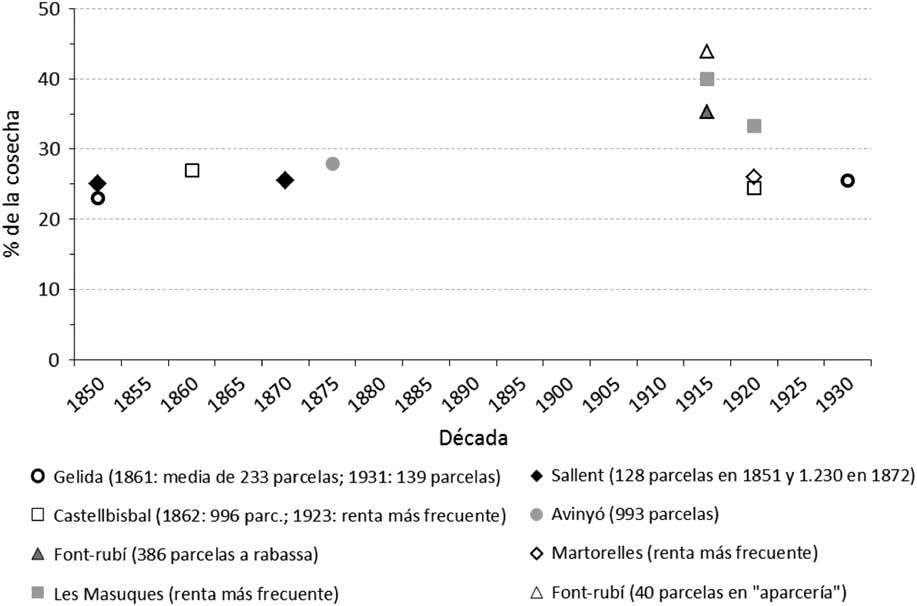
La historiografía ha considerado mayoritariamente que, tras replantar, las condiciones contractuales de los cultivadores mejoraron en dos aspectos: disminuyó la porción de cosecha pagada y el terrateniente asumió una parte de los gastos – normalmente, aportando algo del azufre y sulfato de cobre consumidos. La Figura 1 muestra, sin embargo, que lo primero no ocurrió de manera generalizada. Lo segundo tampoco fue universalFootnote 40 . Al remitir la agitación social hacia 1896, muchos terratenientes se negaron a respetar los compromisos de mejora contractual que habían adquiridoFootnote 41 . Cuando los rabassers habían replantado sin consultarlo con el terrateniente, continuaron vigentes las condiciones de antes de la filoxera (Benach Reference Benach1911, p. 38, IRS 1923, pp. 29-30) y, pese al aumento que habían experimentado los gastos, debido a la mayor necesidad de usar productos químicos, el cultivador siguió cargando con todosFootnote 42 . Durante las convulsiones que siguieron a la primera guerra mundial, la presión rabassaire obligó a los terratenientes a hacer nuevas concesiones, de las que en algunos municipios se desdijeron, de manera colectiva, casi de inmediato (Pomés Reference Pomés2000, pp. 226-229). Más tarde, “con la excusa del escaso valor de las cosechas”, muchos de quienes contribuían a los gastos dejaron de hacerlo, provocando “la exasperación … por reacción” de los cultivadores (Jané Reference Jané1934, pp. 256 y 265). Cuando un rabasser reclamó, su patrona lo desahució por tener el contrato caducado (Jané Reference Jané1934, p. 256). Como aviso, el caso fue ampliamente publicitado por unos y otros: quien protestara por los incumplimientos del terrateniente, se arriesgaba a ser desahuciado.
PORCENTAJE DE UVA PAGADO, COMO MEDIA, POR RABASSERS DE DIVERSOS MUNICIPIOS Fuentes: Gelida: Amillaramiento de 1861, y Pomés (Reference Pomés2000, p. 136). Castellbisbal: Expediente del Amillaramiento de 1862, y La Terra, 8/12/1923. Sallent: Amillaramientos de 1851 y 1872. Avinyó: Amillaramiento de 1876. Font-rubí: Registro de socios de la Societat de Rabassaires, 1919. Martorelles: La Terra, 17/11/1923. Les Masuques: La Terra, 15/12/1925.
7. EL FRUTO DE LA INSEGURIDAD: LAS HIPÓTESIS
Si los 1880s fueron, sobre todo durante su primera mitad y gracias en especial a la demanda procedente de Francia, años de gran prosperidad para los viticultores catalanes y españoles, en las primeras décadas del siglo XX el sector padeció situaciones de sobreoferta y grandes dificultades (Pan-Montojo Reference Pan-Montojo1994, Fernández y Pinilla Reference Fernández and Pinilla2017). Éstas no fueran exclusivas de Cataluña ni España, sino que afectaron a prácticamente todas las regiones europeas productoras de vino común (Planas Reference Planas2016), pero en Cataluña se dejaron sentir con especial intensidad y la viticultura catalana perdió, según Simpson (Reference Simpson1992), competitividad respecto a la de otras zonas de España. En este apartado se razona por qué ello se debió en gran medida a la pérdida de seguridad de los rabassers.
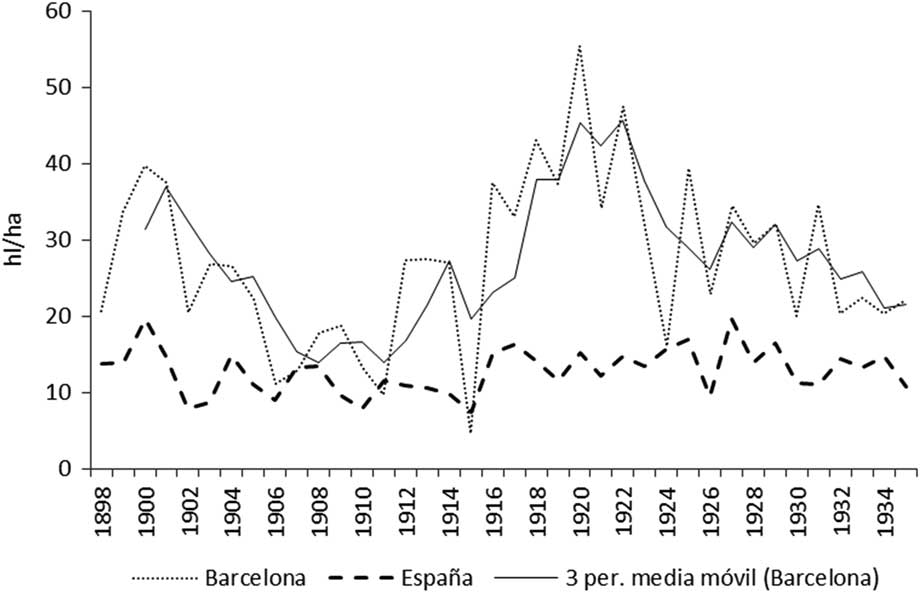
Tras la filoxera diversos empresarios catalanes fueron capaces de producir competitivamente vino de categoría media-alta y superior, pero seguir de manera generalizada esa política era poco factible, por las características de la demanda mundial y española (Fernández y Simpson Reference Fernández and Simpson2016, Fernández y Pinilla Reference Fernández and Pinilla2017, Montañés Reference Montañés2017) y de la oferta catalana, caracterizada por la presencia de una multitud de pequeñas explotaciones poco capitalizadas. Pese a que ello podía hacer más frecuentes los episodios de sobreoferta, conseguir que los costes unitarios bajaran aumentando los rendimientos, como en el Midi francés (Carmona y Simpson Reference Carmona and Simpson2012, Planas Reference Planas2016), era más sencillo. Muchos técnicos catalanes lo recomendaron fervientemente y, en efecto, la Figura 3 muestra que los rendimientos de la provincia de Barcelona fueron muy superiores a los españoles. Pero a principios de los 1920s comenzaron a caer.
No existe una explicación satisfactoria de por qué cayeron. Carmona y Simpson (Reference Carmona and Simpson1999a) consideraron que los rendimientos de las fincas trabajadas por rabassers eran comparativamente bajos. Pero ello podría servir para explicar por qué los rendimientos barceloneses no fueron mayores, aunque no por qué cayeron.
HIPÓTESIS 1
Fue por un problema de cautividad (hold-up problem), que hizo que cuando las vides plantadas tras la filoxera envejecieron los rabassers no las arrancasen para sustituirlas por otras, pese a que actuar así implicaba que los rendimientos cayeran.
La historiografía sobre la rabassa ha considerado que, en contraste con los más de 60 años que vivían en promedio las vides europeas, los pies americanos tenían una vida máxima de 25-30 años. En realidad, también podían vivir 60 y más años. Pero desde aproximadamente el año 20 (Simpson Reference Simpson1992, p. 126) sus rendimientos comenzaban a caer. Como resultado, “la mayor parte de las viñas que fueron plantadas después de la filoxera están [en 1936] en franca decadencia, y es ese el motivo principal de la reducción de las cosechas”Footnote 43 .
Lo que incitaba a los rabassers a actuar así era la inseguridad de sus derechos: como los terratenientes se negaban a concederles permiso escrito para replantar, no replantabanFootnote 44 . Se conocen casos de juicios de desahucio en los que el terrateniente alegó como motivo que el cultivador había replantado sin permiso (Colomé Reference Colomé2013 y Reference Colomé2015, Unió de Rabassaires 1935).
Los rabassers que replantaban sin permiso escrito tenían, pues, que asumir el riesgo de que la plantación les fuera requisadaFootnote 45 . Especialmente, cuando no había buena avenencia. Siempre, replantar significaba perder capacidad negociadora. Porque si replantaban y el terrateniente dejaba de contribuir a los gastos, o no había participado nunca en ellos, reclamar haría crecer la posibilidad de ser desahuciados. Y, en beneficio del oportunista, tendrían que dar un buen cultivo a la finca, para poder amortizar la inversión recién efectuada.
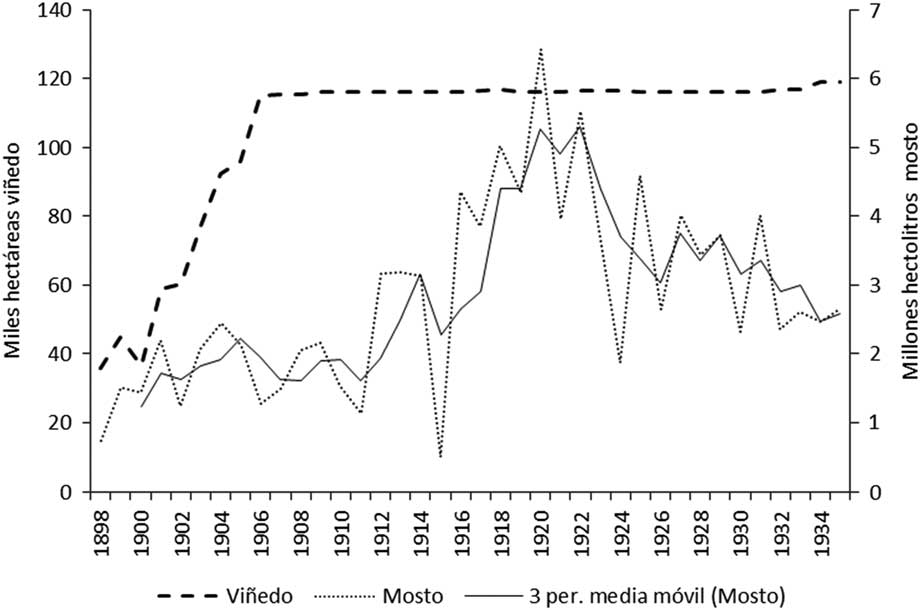
Si la Hipótesis 1 es adecuada, la evolución de los rendimientos a partir de los años finales del siglo XIX debería presentar la forma de una U invertida. En Barcelona no sucedió eso (Figura 3), pero los rendimientos barceloneses eran altos hacia 1900 porque la escasa uva producida entonces en la provincia (Figura 2) procedía sobre todo de los viñedos replantados en los 1880s en el Maresme. Los rendimientos provinciales cayeron al comenzar a contabilizar las estadísticas la superficie replantada en otras comarcas, cuyas vides dieron inicialmente poca uva, alcanzaron la plena producción coincidiendo con la primera guerra mundial y decayeron en los 1920sFootnote 46 .
HIPÓTESIS 2
SUPERFICIE DE VIÑEDO Y PRODUCCIÓN DE MOSTO EN LA PROVINCIA DE BARCELONA. Fuente: Grupo de Estudios de Historia Rural (1991, p. 278).
Todo lo demás constante, a mayores salarios, más caros los productos químicos y menor el precio del vino, entonces menor cosecha de uva.
Bajo cualquier contrato de aparcería, cabe suponer que a mayor precio de los salarios y menor precio del producto, menor cosecha. Pero que ello sucediera con la rabassa morta era fruto de la inseguridad.
Durante siglos, uno de los atractivos que había tenido para los terratenientes europeos concertar contratos similares al de rabassa fue que les permitían (además de no participar en los gastos de cultivo) no tener que incurrir en costes de supervisión, o incurrir en muy pocos. Con contratos de ese tipo, los principales costes de transacción para el terrateniente derivaban de la vigilancia necesaria para que el aparcero cumpliese lo acordado sobre reparto de la cosecha. Como un aparcero con derechos de propiedad sobre la tierra estaba muy motivado para cultivarla bien, los costes necesarios para asegurar que no cometía fraude en lo referido a la cantidad y calidad de su trabajo eran nimios (Garrido Reference Garrido2017d). Es lo que sucedía en el viñedo catalán antes de la filoxera (Garrido Reference Garrido2017a). Tras ésta, todo cambió.
Como después de la filoxera continuó siendo usual que el rabasser tuviera “libertad de cultivo”Footnote 47 , le era fácil comportarse (motu proprio o en respuesta al oportunismo previo del terrateniente) de manera oportunista. Muchos rabassers interpretaron que el comportamiento que estaban teniendo sus terratenientes era una deslealtad y se sintieron legitimados para actuar en consonancia, de manera que, cuando consideraban que les convenía hacerlo, descuidaban el cultivo y desviaban trabajo hacia otras ocupaciones. Algo que se acentuó cuando los rendimientos de los viñedos envejecidos comenzaron a caer por motivos biológicos.
Si antes de la filoxera el contrato de rabassa había servido para mitigar (y, a menudo, hacer desaparecer) la llamada ineficiencia Marshalliana, después sucedió lo contrario. La originalidad del asunto radica en que era una ineficiencia Marshalliana fomentada por los propios terratenientes, dado que era una respuesta a su oportunismo (generador de inseguridad) y al hecho de que (para quitarles seguridad) negaran a los rabassers contratos escritos para replantar los viñedos viejos.
HIPÓTESIS 3
En directa relación con lo anterior, a mayor precio de las cosechas alternativas, menos uva. Porque “a medida que envejece la viña, rinde menos, y el aparcero atiende más al cultivo intercalado, que le proporciona mayores beneficios, que no al propio viñedo” (IRS 1923, p. 84).
En algunos lugares, las rabasses solían incluir un pequeño huerto (Ferrer Alós et al. Reference Ferrer Alós1992), cuyos frutos eran exclusivamente para el rabasser. Más generalizadamente, un trozo de la parcela era utilizado para sembrar, o se sembraba entre las tiras de vides. La porción de lo sembrado que debía entregarse al terrateniente prácticamente siempre era menor que la porción de uva, y la costumbre autorizaba al rabasser a retener todo lo que cultivara en pequeñas cantidades para consumo propio (Garrido Reference Garrido2017d). Después de la filoxera, el desvío de trabajo hacia todos esos aprovechamientos aumentó. En el Maresme sembraban “guisantes con destino a la exportación” y se negaban a compartir las ganancias (IRS 1923, p. 84). En ocasiones, lo supuestamente cultivado para consumo propio era utilizado para criar animales para la venta (IRS 1923, p. 58). Así, en Vilafranca se consolidó un activo mercado de aves de corral y huevos, además de otro de ajos. Y la cría de cerdos cobró importancia en muchos sitios (Planas y Valls-Junyent Reference Planas and Valls-Junyent2011).
8. EL CONTRASTE ECONOMÉTRICO
Para contrastar las hipótesis utilizo datos anuales del periodo 1898-1935, procedentes de la provincia con más presencia de rabassers, Barcelona, y una estimación Prais-WinstenFootnote 48 . En las columnas 1 a 4 de la Tabla 1 se usa este modelo genérico:
 $$\eqalignno{ Rendimientos_{t}\, =\, &\beta _{0} {\plus}\beta _{1} \,A{ { \tilde{n}} }os_{{1898{\minus}t}} {\plus}\beta _{2} \,A{ \tilde{n} }os^{2} _{{1898{\minus}t}} {\plus}\beta _{3} \,A{ \tilde{n} }os^{3} _{{1898{\minus}t}} \cr {\plus}&\beta _{4} \,In \,Precio\,Vino_{{t{\minus}1}} {\plus}\mathop{\sum}\nolimits_{i=5}^6 {\beta _{i} } \,ln\,X_{{t,i}} {\plus}\beta _{7} \,{\it 1915}{\plus}\beta _{8} \,\it 1918{\hbox -}1922 \cr {\plus}& \beta _{9} \,1898{\hbox -}1906 {\plus} \beta _{{10}} \,Espa\tilde{n} a_{t} {\plus}{\varepsilon}_{t} $$
Rendimientos t indica hectolitros de mosto por hectárea en Barcelona en el año t.
RENDIMIENTOS Y PRODUCCIÓN DE MOSTO EN LA PROVINCIA DE BARCELONA, 1898-1935 (MÍNIMOS CUADRADOS GENERALIZADOS Y PROCEDIMIENTO DE PRAIS-WINSTEN)
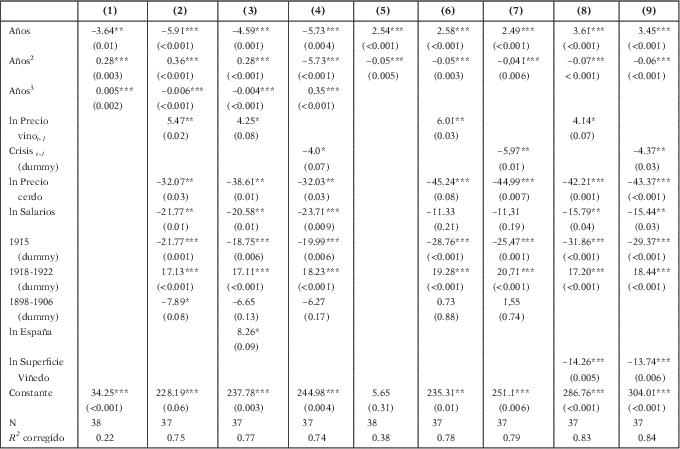
* p<0,1 ** p<0,05 *** p<0,001. Entre paréntesis, valor p. Variable dependiente de las columnas 1-4: rendimientos (en hl/ha); de las columnas 5-8: producción de mosto (en 105 hl).
Fuentes: para los rendimientos y la producción de mosto, Grupo de Estudios de Historia Rural (1991: 278 y 1190); para el precio del vino y las crisis, Balcells (Reference Balcells1968: 286-292); para el precio de la carne de cerdo y los salarios: Pujol (Reference Pujol1998: 180). Para el deflactor, Maluquer de Motes (Reference Maluquer De Motes2013).
Años 1898-t son los años transcurrido entre la replantación y t. Se ha considerado que, como media, se replantó en 1898. Se ha utilizado un polinomio de tercer grado porque, por las razones ya expuestas, tras la replantación los rendimientos siguieron una secuencia pico-valle-pico-valle (Figura 3).
RENDIMIENTOS DEL VIÑEDO EN BARCELONA Y ESPAÑA (MENOS CATALUÑA). Fuente: Grupo de Estudios de Historia Rural (1991, pp. 278 y 1190).
Para el Precio Vino t-1, que está dado en pesetas (constantes de 1913) por hl, se ha utilizado un retardo de un año, porque lo que influía sobre el comportamiento del cultivador era el precio del producto en el inmediato pasado.
X t,i son también precios deflactados. El subíndice i incluye: (a) carne de Cerdo (pesetas/100k); se ha usado el precio del año corriente porque quienes criaban cerdos podían reaccionar con cierta rapidez ante los cambios de los precios. Y (b) Salarios (pesetas por jornada). Con estos, cabe la posibilidad de que la causalidad actuara en sentido contrario del que aquí se supone, porque la necesidad de más trabajo en los años de buena cosecha podía hacer subir los salarios. Pero, en la Tabla 1, los signos de los coeficientes de la variable siempre son negativos, por lo que cabe descartarloFootnote 49 .
Las siguientes tres variables son categóricas (dummies). 1915 es igual a 0 para cualquier año que no sea 1915, cuando el mildiu hizo que casi toda la cosecha se perdiera.
1918-1922 es igual a 1 para los años de ese periodo. La predicción es que su signo sea positivo. La he usado por tres motivos. Primero, las fuentes repiten que durante esos años los precios del vino fueron muy elevados. En pesetas corrientes sí lo fueron, hasta 1922; sin embargo, en términos constantes cayeron a partir de 1918. Pero era la primera vez que los contemporáneos experimentaban los efectos de una fuerte inflación y, durante un tiempo, se comportaron como si el poder adquisitivo de lo que recibían por el vino no se hubiera deteriorado. Segundo, esos años hubo una fuerte demanda de rabasses Footnote 50 . Tercero, en 1922 muchos rabassers creyeron inminente la promulgación de un decreto de redención (Pomés Reference Pomés2000, pp. 252 y 309).
1898-1906 se ha incluido para controlar las singularidades de ese espacio de tiempo (para el que vale 1): relativamente baja, aunque en crecimiento, superficie vitícola; bajas cosechas globales; rendimientos altos en el Maresme; y rendimientos bajos en las viñas acabadas de replantar (véanse las Figuras 2 y 3 y la nota a pie 46).
Por último, España t indica los rendimientos (hl/ha) en España (menos Cataluña) en t. Es una variable de control, que se ha utilizado en la columna 3 para descartar la posibilidad de que la evolución de los rendimientos en Cataluña fuera principalmente producto de la intervención de factores meteorológicos y plagas. De ser así, España provocaría el desplome de los coeficientes de las otras variables, porque muchos años la meteorología y las plagas afectaron de manera similar a todo el viñedo español. No se han desplomado. Solo se ha utilizado en la columna 3 porque cabe la posibilidad de que el resto de variables explicativas de la regresión no solo influyesen sobre los rendimientos catalanes, sino también sobre los españolesFootnote 51 .
ε es el término de error.
En la columna 4, Precio Vino t-1 ha sido sustituido por la variable categórica Crisis t-1 , igual a 1 para los años en que, según Balcells (Reference Balcells1968), producir vino no dio beneficios o generó pérdidas. Se ha usado un retardo de un año.
La variable dependiente de las columnas 5-8 es la producción de mosto (en 105 hectolitros) en la provincia de Barcelona. En consonancia con la trayectoria de U invertida que la Figura 2 muestra que tal producción siguió, para los Años se ha utilizado ahora un polinomio de segundo grado. Y en las columnas 7 y 8 se ha usado, como nueva variable de control, la Superficie de Viñedo (en 103 hectáreas) de la provincia de Barcelona.
Casi todos los coeficientes de las variables explicativas son estadísticamente significativos a los niveles convencionales. Todos presentan los signos esperados.
9. CONCLUSIONES
Cuando la filoxera destruyó los viñedos del Loira Atlántico y el contrato de complant planteó cuestiones similares a las planteadas por la rabassa morta en Cataluña, el gobierno francés promulgó disposiciones estableciendo que el contrato continuaba teniendo vigencia y dando seguridad a los cultivadores. Como a pesar de ello continuó habiendo conflictos, que fueron muy fuertes en los 1930s, el gobierno y el Parlamento impulsaron una reforma agraria “amiga” del mercado (market-friendly) que, aunque no sin tensiones, tuvo éxito (Garrido Reference Garrido2017d). Por el contrario, y pese a que tanto en 1922 como en 1928 la posible redención de la rabassa morta fue muy debatida, el gobierno y los legisladores españoles optaron por la inacción, con la esperanza de que la solución la proporcionase únicamente el mercado.
Como en 1934 tal solución aún no había llegado, la reforma agraria “dura” que pretendió implantar el Parlamento democrático catalán estaba, pese a sus deficiencias técnicas (Garrido Reference Garrido2017c), plenamente justificada. Quienes se oponían a la redención argumentaron que una ley permitiéndola era innecesaria, dado que los rabassers eran campesinos acomodados y, además, muchos ya estaban comprando, mediante acuerdos privados, los derechos de sus terratenientes. En Garrido (Reference Garrido2017c) se muestra que ninguna de ambas cosas era, en realidad, frecuente. Pero la reforma agraria habría estado justificada incluso si sí hubiesen sido frecuentes. Los terratenientes tenían la imprescindible necesidad de recurrir a los rabassers para poder cultivar las viñas, y muchas de las tierras ocupadas por la vid no podían ser dedicadas a otros usos. Mientras tanto, la presencia de los terratenientes era, en la mayoría de casos, superflua para los rabassers, que los contemplaban como meros perceptores de censos (Garriga Reference Garriga1933, p. 42). Habría sido socialmente conveniente, pues, que los rabassers accedieran a la plena propiedad de la tierra y desapareciesen las ineficiencias que la propiedad compartida estaba generando.
Tras la guerra civil (1936-39), el “problema rabassaire” acabaría siendo por fin resuelto por el mercado, en un contexto no democrático, durante la segunda mitad del franquismo (1939-1975). Pero entre la filoxera y entonces se habían disipado muchas energías, sociales y productivas. En un ambiente de fuerte emigración hacia los centros industriales, muchos rabassers abandonaron las peores tierras, que a menudo han estado desde entonces ocupadas por el bosque. Algunos compraron los derechos del terrateniente. Otras veces fueron los terratenientes, que ahora podían recurrir a tractores, los que compraron los derechos del rabasser. En ocasiones se trataba de una venta forzada, ya que el rabasser era desahuciado, pero el juez obligaba a que se le pagara una indemnización. Otros vendieron con agrado, porque eran agricultores envejecidos cuyos hijos no querían dedicarse a la agricultura (véase Hansen Reference Hansen1969).
En 1969 el Tribunal Supremo ratificó el desahucio de un cultivador cuyo contrato, meramente oral, había sido concedido a sus antepasados en algún momento del siglo XIX. El Tribunal declaró el desahucio procedente porque consideró que el contrato había caducado, por tener más de 50 años, y que una reciente replantación hecha con el permiso tácito, aunque sin el permiso escrito, del terrateniente no había servido para renovarlo. Pero en la sentencia dijo que el contrato era de rabassa y llamó al cultivador rabassaire (Puig Reference Puig1970).
Aunque pocos, actualmente todavía quedan en Cataluña contratos similares.



