

Introduction
What is the impact of income on secularity? Why does more income lead to more secularity in some individuals but not in others? There is a large debate on these questions, given the literature’s contradictory findings. Modernization theories, one of the first endeavors in the attempt to explain secularization, originally predicted that higher income (whether at the individual or country level) should lead to more secularity (Lerner, Reference Lerner1964; Lipset, Reference Lipset1959), yet empirical findings failed to reliably demonstrate such a relationship (Altınordu, Reference Altınordu2010; Billings and Scott, Reference Billings and Scott1994; Selinger, Reference Selinger2004; Stark, Reference Stark1999; Szendrő, Reference Szendrő2025). Instead, results demonstrated a more complex relationship between income and secularization, to the extent that modernization theories are not taken seriously anymore.Footnote 1 For instance, many point at the lesser role of religious authority and religious attendance that parallels socioeconomic development, even if personal religiosity and belief do not falter (Chaves, Reference Chaves1994; Dhima and Golder, Reference Dhima and Golder2021; Kleiman et al., Reference Kleiman, Ramsey and Palazzo1996). Others have emphasized the role of income inequality and societal security in determining whether or not wealth will lead to less religiosity (Karakoç and Başkan, Reference Karakoç and Başkan2012; Norris and Inglehart, Reference Norris and Inglehart2011). Some have also pointed out that religious decline in relation to increased income or aggregate wealth may be religion-specific. For instance, religious decline mainly takes place in Europe, and it mainly does so in Catholic societies (Bibeau et al., Reference Bibeau, Brie, Dufresne and Gagné2023; Kaufmann et al. Reference Kaufmann, Goujon and Skirbekk2012; Pollack, Reference Pollack2008).
Despite recent successes in better understanding the nuances of the relationship between income and secularization, existing theories cannot logically explain secularity (or the lack thereof) in regions of the world like the Middle East and North Africa (MENA) region. For instance, many studies point to the role of income and other socioeconomic variables, and regional specificities, in explaining disparities of secularization worldwide (Abdollahian et al., Reference Abdollahian, Coan, Oh and Yesilada2012; Karakoç and Başkan, Reference Karakoç and Başkan2012; Norris and Inglehart, Reference Norris and Inglehart2011). Even if they succeed in yielding statistically significant results on disparities of aggregate secularization at the world scale, they do not paint a holistic picture of secularization in some regions like the MENA. GDP per capita or economic security is clearly not a satisfying answer, considering that the richest and safest countries in that part of the world are also most likely the most conservative and puritan—i.e., Gulf countries. Income inequality also cannot explain disparities in secularization for similar reasons. According to a recent report, the MENA region has the highest inequality in the world (Alvaredo et al., Reference Alvaredo, Assouad and Piketty2018), even though some MENA countries take drastically different trajectories regarding their state level, political project on secularization. Indeed, how can we explain differences in state secularization between two countries like Iraq and Saudi Arabia? After all, both are resource-rich and in a region with high-income inequality, yet the first once adopted one of the most secular, republican, and nationalist regimes of the region, while the second adopts to this day one of the most conservative and puritan regimes in the world. Ultimately, state ideology is not a measure of how secular a society is, and Saudis could be more secular than Iraqis at the individual level. In other words, political projects at the state level and individual level attitudes toward religion are not equivalent to one another. Yet, individual-level faith specificities pointed at by some, like Kaufmann et al. (Reference Kaufmann, Goujon and Skirbekk2012) and Pollack (Reference Pollack2008) in Europe, cannot explain the dynamic at hand in regions like the MENA, considering that Islam is the dominant religion in the region. In fact, Turkey is as Sunni-dominated as Saudi Arabia, yet the first adopts, until recently, an extreme version of secularism while the second adopts a hardline puritan stance.
Challenging conventional wisdom on secularization, I advance a macro-historical account in which direct colonial intervention reshaped the social and political meaning of secularity among higher-income groups. Rather than treating colonialism as a background condition, I argue that colonial-imperialist rule fundamentally reordered the relationship between material advancement and individual secularity/religiosity. The key question is not simply whether higher income correlates with greater individual secularity/religiosity, but how colonial intervention structured distinct historical pathways of income-based secularization. I outline two divergent trajectories. In societies subjected to direct colonial rule, secularity became embedded in projects of imperial domination and elite collaboration. As a result, in the postcolonial era, higher-income groups did not move toward greater secularity; instead, secularity was politicized and resisted as a colonial imposition. By contrast, in societies that were never directly colonized, economic elites historically spearheaded endogenous projects of modernization—processes in which secularization emerged as part of their own reformist and developmental agendas. There, higher income remains positively associated with individual secularity. These historically constituted elite alignments endure through processes of socialization and intergenerational transmission, producing durable cross-national differences in the relationship between income and secularity today.
I start by fleshing out my argument and formulating a range of testable hypotheses that would serve to empirically evaluate my claims. To test my theory, I use two pre-collected survey datasets: the World Values Survey (WVS) for global data and the Carnegie Middle East Governance and Islam Dataset (CMEGID) for a MENA-focused analysis. While my theory is MENA-specific, it also applies globally, warranting tests on both datasets. The WVS covers 269 countries with 351,960 observations spread over 30 years (1989–2022), while CMEGID includes 49,124 observations from 15 MENA countries spread over 14 years (1988–2014). I measure secularity/religiosity using a discrete measure of surveyed individuals’ self-reported religiosity, and income using a discrete measure of their income group. Here, individuals’ self-reported religiosity is therefore a proxy for anticipated secularity. I find sustenance for my argument overall—logistic regressions on both datasets show that the relationship between income and secularity is null or negative in postcolonial societies but holds very reliably in societies where colonialism never took hold. This is very significant as it challenges the conventional wisdom on secularization by pointing to the impact of a political variable in a literature that has so far been led by a focus on socioeconomic variables alone.
Theory: two pathways to modernization
In this section, I develop a macro-historical account of why higher income correlates with more secularity in some societies but not in others. The divergence hinges on a foundational historical rupture: imperial intervention. I outline two distinct trajectories structured by the presence or absence of direct colonial rule. In societies subjected to direct colonialism, higher income does not lead to greater secularity because secularity became entangled with imperial authority and elite collaboration. In societies that were never directly colonized, by contrast, higher income is positively associated with secularity, as economic elites historically advanced secularization as part of endogenous reform and modernization projects.
The first scenario: direct colonialism and modernization
Direct colonialism interrupted indigenous debates over modernization by forcing its own version of modernity upon the societies it colonized—something it did by implementing colonial schools from which to educate local higher-income groups into the “civilizing mission” of Europe.Footnote 2 The enterprise was rather practical in aim—to create docile elites of economic and cultural life in colonized territories, and potential administrators to employ in the colonial administration. In colonized and postcolonial societies, this “modernized” higher-income group was the direct result of colonial occupation. The acquisition of a modern, Western education at home—in the colonies—or abroad—in the colonizers’ homeland—was the key dynamic of socialization of this modernized social group (Bates Reference Bates2006; Ekeh, Reference Ekeh1975; Eppel, Reference Eppel1998, Reference Eppel2009; Faksh, Reference Faksh1997; Gusfield, Reference Gusfield1967; Lewis, Reference Lewis2011; Mardin, Reference Mardin1994; Puchala, Reference Puchala1997; Pye, Reference Pye1958; Tibi, Reference Tibi1983). Colonial occupiers used a very specific form of modern education to create a high-income group of natives who were encouraged to speak the derogatory language of colonialism against indigenous culture and could be used as subservient servants of colonialism at home. From Polynesian Islands to Hong Kong and passing by South America, Africa, and the Middle East, colonial indigenous members of the upper income group “modernized” and was conditioned to reject indigenous culture (Aseka et al., Reference Aseka, Freund, Greenstein, Himmelstrand, Legassick, Nyang’oro and Webster1997; Bates Reference Bates2006, 6; Ekeh, Reference Ekeh1975, 91–112; Gusfield, Reference Gusfield1967, 273; Kiste, Reference Kiste1975; Mamdani, Reference Mamdani1996; Reference Mamdani2001; Marcus, Reference Marcus1981; Mysbergh, Reference Mysbergh1957, 40; Pye, Reference Pye1958, 469; Tibi, Reference Tibi1983).
Members of this wealthy and affluent income group were encouraged by the colonial enterprise to espouse a view of modernization that meant rejecting indigenous culture and its cultural norms as being backward, and to internalize the colonial language of Orientalism as they implemented modernization programs at home (Said, Reference Said2014; Timmerman, Reference Timmerman2000). As a result, the income group that came to power or revolved around it during and after colonialism often pursued or supported vehement secularization—such is well documented for various countries like Tunisia, Syria, Lebanon, amongst others (Khoury, Reference Khoury1983; Salem, Reference Salem1996). To borrow Mao’s words, they viewed their own countries as “poor and blank” (McVey, Reference McVey1995). Above all, this is because colonialism conditioned this “Eurocentered elite” to see Europe as “a model for progress,” where “the way to become like Europe was to liberate society from religion” (Faksh, Reference Faksh1997, 1–2).
Yet, the higher-income groups in postcolonial societies were more complex than meets the eye—despite all efforts by colonial powers to co-opt them in body and soul to the colonial enterprise, they themselves come to entertain an uneasy connection, a hate-love relationship so to say, with colonial modernity and its precepts (James, Reference James1989, 399; Pfaff, Reference Pfaff1989, 167; Puchala, Reference Puchala1997, 130). In time, this hate-love relationship and the failure of modernist promises led to the rise of reactionary, re-indigenization movements around the world and the rejection of many of the precepts of colonial-style modernization. In the wider Middle East, Sharabi (Reference Sharabi1965) argues that the higher income in general comes to adopt this very complicated, dichotomous relationship with modernization. He argues that “the rejection of Europe was not confined to the conservative and traditionalist elements of the Muslim elite but was to be found in the Westernized elite as well.”
Ironically, this hate-love syndrome “expressed itself in an obdurate, repressed hostility which apparently became stronger and more articulate as Westernization spread and increased,” even though Westernization itself evolved at the behest of these very elite, high-income individuals. In fact, they were at one time the drivers of state secularization in colonial and postcolonial societies like Tunisia, Syria, and Lebanon, to the despair of nascent Islamist movements, all the while being despiteful and resentful of modern Europe and the precepts it brought with a perceived arrogance and hubris unto their societies. The result of this complex ideational persona was one of “ambivalence, which at one and the same time coveted and detested Europe, respected and despised it, wanted and rejected it, imitated and spurned it” (Sharabi, Reference Sharabi1965, 471–472). This ideational complexity of the very actors that appeared to lead the process of modernization may serve to explain why students of secularization today have not noticed earlier the potential role of colonialism in breaking patterns predicted by their theories.
For some, the duality of indigenous higher-income groups was too heavy to maintain in the postcolonial era. Sharabi asserts that “the moral and psychological tension resulting from this duality could resolve itself in the end only by either complete identification with modern Europe or total repudiation of it” (Sharabi, Reference Sharabi1965, 472). According to some studies, the trend of repudiation starts as early as the 1960s (Abdul Reda, Reference Abdul Reda2019; Lee, Reference Lee2018), but for most, its inception coincides with the end of the Cold War (Boroujerdi, Reference Boroujerdi, Grant and Short2002; Chun, Reference Chun2000). Observers emphasize a return to the roots phenomenon taking place in many non-Western societies. In Japan, this led to renewed interest in Asianization, while in South Korea, this led to re-engagements with history over “triumphalist national imagery” (Yang, Reference Yang2021). In India, Hinduization was the mot d’ordre, while the failure of socialist and nationalist policies in the Middle East was leaving way for re-Islamization debates (Tibi, Reference Tibi1995). But many of these observers failed to note the colonial roots of this trend, and omitted the lively debates over modernization that were only overshadowed by the imposition by colonial powers of self-serving and traumatizing modernization programs (Mir, Reference Mir2019).
In Muslim majority societies, re-indigenization movements emerge by seeking the resurgence of Islam in politics, all the while perpetuating a politicized, “black and white” dichotomy between modernity and the indigenous. This means that the whole debate over modernization is forever cursed by its association with a black and white framing—a fight between good and evil, between Islam and Christianity, between oppressed and oppressors (Adraoui, Reference Adraoui2017). Unfortunately for Muslim modernizers, this means in the post-WWI and postcolonial era that the debate becomes forever dominated by these overarching frames and that most of society seems to forget the lively and fertilizing indigenous debates on the matter, which took place decades earlier (Kurzman, Reference Kurzman2002). This dichotomy comes to plague any such debate on progress and change, such as debates on gender issues and sexual orientations in the postcolonial MENA (Ahmed, Reference Ahmed1993, 64). In time, these issues and dichotomies even start to reach the non-colonized Middle East, even though non-colonized societies entertain a wholly different relationship with the concept of Modernization that is itself conditioned by its different relationship with colonial and imperialist powers.
The second scenario: modernization in the absence of colonialism
In non-colonized societies, the relationship between the higher-income group and modernization remains drastically different from the one that I described in societies afflicted by direct colonialism. There, rising strongmen manage to fend off direct colonial rule and maintain their independence through collusion with European colonial powers. In Iran, this was through Reza Shah and the Pahlavi dynasty, in Saudi Arabia through the Ibn Saud dynasty, and in Turkey, through Mustafa Kemal and Kemalism. As it happens, each of these actors and their economic elite entourage becomes an important player in the foreign affairs of imperialist powers starting in the post-WWI era, and examples of the collusion of the former with the latter to establish and maintain these regimes abound (Atabaki and Zürcher, Reference Atabaki and Zürcher2004; Jacobs, Reference Jacobs2011).
Pahlavi Iran sought the implementation of heavy modernization programs to cement the Pahlavi dynasty on one hand and justify its authoritarian practices to foreign powers. This trend led to important societal rifts, which, like in postcolonial societies, culminated in the rise and dominance of anti-modernity, re-indigenization movements that, for many, led in Iran to the revolution of 1979 against the Pahlavi regime and its disturbing modernization program (Foucault, Reference Foucault1994; Mirsepassi, Reference Mirsepassi2000). Opponents of Pahlavi modernization programs drew on Jalal Al-e Ahmad, an early 20th-century traditionalist critique of modernization altogether, who defined the higher-income group’s infatuation with modernization as Gharbzadegi (“West-toxification”). In fact, they critiqued what they viewed as a “mimetic and mechanical adoption” of what too often appeared as “superficial and trivial aspects of Western life” (Mozaffari, Reference Mozaffari2003, 211). Mozaffari, for instance, explains that Pahlavi Iran’s elite and economically affluent—its high income class—believed that to be modern meant to “lose oneself to the foreigner” in cultural terms (Mozaffari, Reference Mozaffari2003). Foucault’s famous articles on the Islamic revolution echoed the clash between social classes—between the middle and lower-income groups, remaining rather close to traditional Iranian and Islamic culture on one hand, and the mimetic “modernization” of Pahlavi Iran and its higher-income groups. For him, like for many others, Khomeini’s Islamists were able to surf on this wave of discontent in order to later establish one of the most conservative political entities in the region (Foucault, Reference Foucault1994). Yet, the Pahlavi still looked to Turkey’s Mustafa Kemal in establishing their modernist authoritarian kingdom (Atabaki and Zürcher, Reference Atabaki and Zürcher2004).
Kemalist Turkey—like Pahlavi Iran—heavily borrowed from Orientalist myths of early modernizers in portraying Islamic culture as backward and its own modernization program as the way forward, despite its self-serving nature in cementing Kemalist authoritarianism in Turkey. Like in Pahlavi Iran, many in society rose against the heavy-handed approach to modernization and saw in it another attempt at justifying and cementing an authoritarian regime, while decrying its serious disturbances for contemporary Turkish society. Yet, like in Iran and the postcolonial world, the debate became cemented into a modernity versus Islam kind of debate, where no middle ground could be found. In Turkey, popular critiques of Kemalist modernization argued that “Westernization is the abandonment of one’s culture and past, an admission of one’s inferiority” (Kubicek, Reference Kubicek1999). At the same time, the successors of Ataturk became an important part of the Western bloc in the Cold War, going as far as to make Turkey a founding member of NATO, and in so doing concretizing Western support for the regime despite its authoritarian nature. This helped local re-indigenization movements portray the fight as a West versus Islam dynamic, where Kemalism rejected Islamic culture as being “backward” and “uncivilized” and looked Westward for “progress” and “civilization” (Başkan, Reference Başkan2010). As a result, many Islamic thinkers like Ozel sought the growth of a more religious elite to replace the “Westernized” one that now represented to them the legacy of Western domination, humiliation, and interventionism (Mardin, Reference Mardin1994). More recently, this translated into important societal debates over Turkey’s entry in the European Union, and the resurgence of Islam in Turkish politics in the 1980s and 1990s (Kubicek, Reference Kubicek1999; Oğuzlu and Kibaroğlu, Reference Oğuzlu and Kibaroğlu2009). It also emerged as a frustration against the broken nature of modernization policies mimetically adopted from European nations and from the colonial experience (Gülalp, Reference Gülalp1995).
The situation is not the same in Saudi Arabia, where colonial-style modernization programs were never implemented, but the relationship of local higher-income groups with the classical, colonial conception of modernization remains the same as in Turkey and Iran. The reason is also the same—because the Saudi economic elite colludes with former imperialist powers to cement and maintain their own privilege in the country. The Ibn Saud dynasty itself is established in Saudi Arabia through intense collusions with British and American interests in the region. After a shrewd conquest of territories left out of the Sykes Picot agreement, the Ibn Saud turn to consecrate these conquests with British-American military and diplomatic support in the 1920s. In Saudi Arabia like in Pahlavi Iran, oil plays a key role in cementing the collusion of local indigenous higher-income groups with foreign imperialist powers. The British-American need for access to oil and the self-interested behavior of the Ibn Saud first pushed the latter to ally with the British in destroying their former army—the Muslim Brotherhood—and then to ally with the Americans for the exploitation of oil in the Saudi kingdom. Such behavior was needed for a key reason—international recognition. The Ibn Saud needed to somewhat moderate the very radical ideology of early Wahhabism if they were to become a recognized political entity. In fact, the Ibn Saud once taught their rank and file that no peace could be established with “non Wahabi” Muslims nor with non-Muslims—something that was not tenable anymore as the Saud leadership then sought to formalize borders and relationships with world powers. Therefore, the Saudi cooperation with Britain in establishing clear delimitations to the latter’s territory with respect to the territories Britain obtained after Sykes-Picot was problematic for the early Saudi soldiers—known as “Muslim Brothers.” This led to Ibn Saud conniving with the British so that the latter could use their Air Force to finish off the Muslim Brothers and establish peaceful cooperation with one another. Later, the support gained from Britain and the USA for Saudi Arabia was extended to key players of the Western bloc after WWII as a mean to secure oil resources in the rising Cold War and to oppose the rise of pro-Soviet Arab republics. In fact, Saudi Arabia was an important US and British ally in the Arab Cold War, and remains as such today, decades after the end of US-Soviet hostilities (Abou Leatherdale, Reference Leatherdale1983; el Fadl, Reference Abou el Fadl2003;Pollack, Reference Pollack2002).
Like Iran and Turkey’s modernization programs, Saudi Arabia’s program of Wahhabization incurs a considerable disruption for indigenous society, which is bolstered by oil money and the acquiescence of foreign powers (Ayoob and Kosebalaban, Reference Ayoob and Kosebalaban2009). Aside from the constant puritan violence that dotted the taming of the kingdom’s unorthodox populations—like the Twelver Shias in the East and the Sufis in the Hejaz—the Wahhabization program destroyed and remolded local culture and society in a manner similar to European colonialism, and Iran and Turkey’s modernization. Local shrines were forever destroyed throughout the country, while the two holy cities of Mecca and Medina saw considerable re-engineering that forever molded them into epitomes of Wahhabi orthodoxy for locals and pilgrims alike. At the same time, mores and values of the local population were similarly affected in a manner that forced the Wahhabization of society in the name of Islamic purity (Ayoob and Kosebalaban, Reference Ayoob and Kosebalaban2009; Commins, Reference Commins2005). Yet it goes even further as it also allows the Saudi kingdom to expand its Wahhabi ideology to the territories incorporated into the Saudi kingdom and abroad. Abou el Fadl cites the discovery of oil in Saudi Arabia as one of the key reasons why a once fringe school of modern Islam was able to claim a mainstream status in the 20th century (Abou el Fadl, Reference Abou el Fadl2003).
In sum, unlike the postcolonial world, Iran and Turkey take a pathway by which the economic elite themselves are the ones imposing a modernization trauma on the rest of society because they use the concept to collude with imperialist powers and cement their rule over society. Whereas colonized societies undergo a condition whereby economic elites are traumatized by colonialism’s heavy-handed and self-serving modernization, Iran and Turkey go through a pathway by which the political regimes and their economic elite entourages are the ones traumatizing the rest of society. Therefore, higher-income groups in Iran and Turkey do not develop a hate-love relationship with classical, colonial-style modernization that higher-income groups of the postcolonial world develop. As a result, they are mostly opponents rather than participants in the re-indigenization movements that take place in their countries. Like in the postcolonial world, Islamist movements in Iran and Turkey surf on rising tides of re-indigenization similar to the postcolonial world in order to put back religious debates on the agenda (Foucault, Reference Foucault1994; Gülalp, Reference Gülalp1995; Mirsepassi, Reference Mirsepassi2000). Of particular interest are gender issues and the reinvigoration of traditional Islamic practices regarding women and the veil. Islamists perpetuate the modernity versus Islam debate by co-opting many issues, such as that of the veil, which they rebrand as a symbol of resistance against imperialism, framing it as “dignity and validity of Islamic values and traditions” (Ahmed, Reference Ahmed1993, 164; Timmerman, Reference Timmerman2000).
The key difference between Saudi Arabia, on one hand, and Pahlavi Iran and Kemalist Turkey, on the other, is that the former does not implement a cultural re-engineering program based on colonial-like programs of societal modernization. Instead, the Ibn Sauds opt to cement their regime with an intense program of Wahhabization at home and seek to expand their legitimacy as leaders of the Islamic world by pushing this once fringe ideology abroad (Abou el Fadl, Reference Abou el Fadl2003). Their success means that the middle- and lower-income classes should tend to reject colonial-style modernity because Wahhabism teaches them to, while higher-income groups there should not because they strategically align with colonial and other imperialist powers to maintain their own positions in society. In sum, this meant that higher-income individuals in non-colonized parts of the MENA are not indisposed toward classical, colonial-style modernity, unlike their counterparts in the postcolonial world.
Summary: a theory of cultural secularization
In sum, societies took one of two very different pathways to the modernization of society that were consistent with the nature of their colonial experience. In one pathway, it was imposed by colonial powers on the indigenous higher-income groups, who themselves forced it on the rest of society. In the other, it was adopted by ambitious political entrepreneurs and their higher income entourages as a way to justify their rule to the colonial and imperialist powers they colluded with, while “civilizing” a “backward” society (Başkan, Reference Başkan2010). Each of these pathways is associated with a very different experience, which I argue leads to a very different relationship between income and secularity today. This, in turn, would explain why some societies have a positive relationship between income and secularity while others do not—in other words, why we have conflictual results about the relationship between income and secularity.
In colonized societies, the struggle for independence triggers the hate-love relationship of the indigenous higher income with colonial-style modernization and yields a trend of re-indigenization of society to which higher-income natives themselves contribute. In the non-colonized world, the independence struggle is non-existent for the higher income, and so they do not contribute to re-indigenization movements.Footnote 3 In fact, they associate modernization programs drawn from colonial and imperialist powers either with a tool for them to cement their privileges—as in Pahlavi Iran and Kemalist Turkey—or as another facet of world powers they ally with—as in Saudi Arabia. Despite religious revivalist trends, the fact of the matter is simply that the higher income in never-colonized societies does not have the same indisposition toward secularity because there is no liberation struggle against colonialism and its precepts, of which secularization is such a central component. These cultural dynamics perdure to this day through the processes of socialization of social groups. Despite changes through time, to be or to become higher income today would mean to emulate these mores and values of the higher income that have been inherited since the colonial and postcolonial era.Footnote 4
Overall, in postcolonial societies, one should expect to find a very different connection between income and secularity than the one predicted by modernization theories. Ultimately, what should look like a positive and near-linear relationship between income and secularity should be broken. The higher income should break with the pattern attributed to them, by which they would be more secular than other income groups. This expectation leads to the following hypothesis:
Hypothesis 1: In postcolonial societies, the higher income should not tend to be more secular than the lower income.
To the contrary, in non-colonized societies, the relationship between income and secularity should be positive and near linear. That is because the higher-income groups there are not indisposed toward colonial-style modernization (i.e., modernization as secularization), given that they were the ones who implemented it against unwilling masses. Unlike their counterparts in the postcolonial world, the higher-income groups that dominate non-colonized societies do not associate this classical modernization, which suggests rejecting religion and embracing secularity, with colonialism or the independence struggle—they rather associate it with their own privileges and their own patrons in the international system. At the same time, middle and lower-income groups never sat so well with these programs because they were imposed by authoritarian regimes in Turkey and Iran, and because the Saudi regime’s puritan Wahhabism teaches very hostile attitudes against such worldviews. As a result, in non-colonized societies, income should have a positive correlation with secularity. This expectation leads to the following, second hypothesis:
Hypothesis 2: In non-colonized societies, the higher income should tend to be more secular than the lower-income in a near-linear relationship.
I summarize the theory that I suggest in this article in Figure 1 above.
Summary of causal mechanism.

Empirical analysis
Data and methods
To test the hypotheses associated with my theory, I use two sources of pre-collected survey data: the WVS, which has more data for the whole world, and the CMEGID, which has more data for the MENA region. I do so because my theory is MENA-specific and therefore warrants a MENA-focused test. The CMEGID offers the largest sample of survey data for the MENA region publicly available, with its 42 surveys collected from 2000 to 2014 across 15 countries, for a total of 49,124 surveyed individuals. Yet, colonial experience is an important part of my theory, and there are only three non-colonized countries out of the fifteen in the CMEGID sample of data—Turkey, Iran, and Saudi Arabia. To address this limitation, I also use the WVS, which enlarges the number of non-colonized countries to 52 out of 105 total countries, thanks to its world sample. Indeed, the WVS is collected from 1989 to 2022 (inclusive), for a total of 269 countries surveyed over 30 years, aggregating as many as 351,960 observations—that is, 351,960 surveyed individuals. See Table B3 of the Appendix for a full list of countries by colonial heritage for the WVS.
I use self-reported religiosity as the main dependent variable to operationalize individual religiosity across both the WVS and CMEGID datasets. It is a proxy for measuring the anticipated secularity of individuals. This variable is derived from the question: “Independently of whether you go to religious services or not, would you say you are: A Religious Person, Not a Religious Person/A Convinced Atheist,” with some CMEGID surveys including a middle category: “In Between/Mixed.”Footnote 5 I treat responses to this question as ordered categories, assuming a qualitative hierarchy: “Not a Religious Person/A Convinced Atheist is considered the most secular response, followed by “In Between/Mixed,” and then “A Religious Person as the most religious. This approach allows me to use logistic models with “Not a Religious Person/A convinced Atheist” as the reference category, thus treating the categories as increasing steps in religiosity, which do not require assigning numerical values. As a result, the logistic regression models, such as the ones in the model I present below, predict the probability of reporting oneself as more religious than the reference category “Not a Religious Person/A convinced Atheist.” Tables B.1, B.2, and B.4 of the Appendix show the distribution of religiosity by country and survey year for the WVS and CMEGID data.
I use two key independent variables to operationalize the effect of colonization on the relationship between income and secularity: namely, the type of colonial legacy and income groups. I operationalize colonial legacy using a nominal, state-level variable that registers the colonial heritage of the country of the surveyed respondent. In so doing, I follow the convention in the political economy and comparative development literatures by focusing on Western overseas colonialism while excluding Western settler colonialism and non-Western imperial expansion (e.g., by the Ottoman Empire, Japan, or Russia). This approach is the one adopted in the CMEGID dataset, and the one adopted by the Quality of Government (QoG) dataset’s variable on colonial heritage, which I add to the WVS. Several key contributions in the quantitative literature similarly emphasize Western colonialism—particularly the identity of European colonizers—as a key institutional determinant of long-term economic and political outcomes (Acemoglu et al., Reference Acemoglu, Johnson and Robinson2001; Lee and Paine, Reference Lee and Paine2019; Tusalem, Reference Tusalem2016). Given the paper’s focus on colonial legacies and secularization, and in order to remain consistent with the literature, I adopt the convention of recording the last Western overseas colonizer (provided its rule lasted at least ten years), as done by default by the QoG dataset’s variable that I use to code colonial heritage. While alternative colonial histories—such as settler colonialism or successive occupations by multiple powers—are important, incorporating them would require a different theoretical framework and empirical design. In fine, the variable can take either of two values in my dataset—No Colonial Heritage and Colonial Heritage.Footnote 6
To operationalize income, I use an income group variable. In the WVS, it categorizes the surveyed individuals across all samples into ten income groups—from the poorest to the wealthiest. In the CMEGID, the variable is constructed as five income groups that fit with a five-item division of income (in quintiles) to which each respondent belongs—from first the quintile for the poorest of society to the fifth quintile for the wealthiest. Such a measure of income is favorable to the exact salary or the integer range of the respondent’s salary for one key reason—it measures income proportionally to the society’s income range. After all, a higher amount of money may be required for one to be a member of the highest social group in society a than in society b, but the approach of both members of these income groups to culture and politics may remain the same. Income groups measured in quintiles or deciles better help us approach this dynamic. Also, using income groups to assess various statuses in society—such as a general “elite” status—is a widely accepted and conventional method in the social sciences (Amsden et al., Reference Amsden, DiCaprio and Robinson2012; Bjørnskov, Reference Bjørnskov2010; Rosset et al., Reference Rosset, Giger and Bernauer2013). Despite its limitations, it remains better than using educational level as some very well-educated members of MENA societies suffer either from unemployment or a cruel lack of access to political institutions, whereas power and political affluence revolve around the better off, both in the MENA and around the world (Allègre, Reference Allègre2015; Hinnebusch, Reference Hinnebusch2017; Salehi-Isfahani, Reference Salehi-Isfahani2012).
Model specification
I use multilevel logistic models with one interaction term to test the hypotheses outlined earlier. To properly stipulate the multilevel estimation, I incorporate an interaction term for colonial legacy that serves to assess the correlation between income and secularity in different colonial contexts. For tests based on CMEGID data, I also include societal level controls for development—with the HDI—and inequality—with the GINI—to account for previous findings that both these variables substantially affected levels of religiosity in countries around the world (Karakoç and Başkan, Reference Karakoç and Başkan2012; Kleiman et al., Reference Kleiman, Ramsey and Palazzo1996; Norris and Inglehart, Reference Norris and Inglehart2011). Also, I do not include these two societal-level controls in the same model because HDI and GINI are most likely collinear, considering the tendency for better-developed societies to be less unequal than their counterparts. I do not do so for tests based on the WVS because these variables are not readily available in this dataset. The results of these robustness checks are available in Appendix A2 to A10. I compute all the models with either random or fixed effects, for country and year, and for country-year, to account for the different contexts in which the survey data were collected.
I compute several different models based on different variables and subsets to properly test the theory outlined earlier. Because my theory holds relevance globally, I estimate one set of models using WVS data for all countries represented in this line of surveys, from 1989 to 2022. Also, because my theory especially focuses on Muslims, I run a separate set of models by sub-setting for Muslim respondents worldwide, in the WVS, for the same timeline. As a cross-check, I also run the same model for Muslims in Muslim-majority countries onlyFootnote 7 . Finally, because my theory especially focuses on the MENA region, I run again a separate set of models using the CMEGID data only, where I only focus on MENA countries. All four combinations include the same individual-level variables, while tests on the CMEGID data also include some additional societal-level variables available in this dataset—GINI, HDI, and natural resources as a % of GDP per capita. All three sets of models yield generally the same results that lend credence to my argument in this article. For more details on model specifications and background checks, see Appendix B: Variables and Model Specification, under Model Specification.
Estimation results
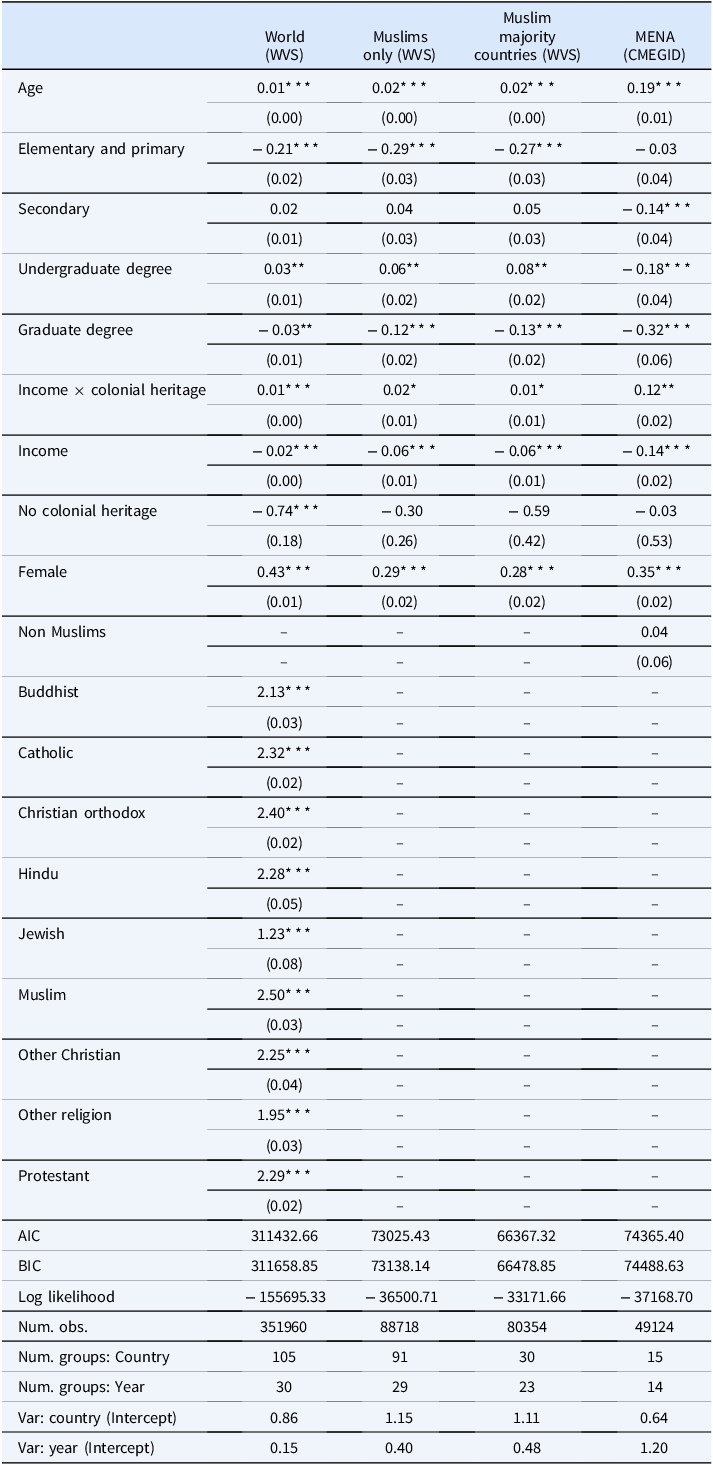
In Table 1 below, I present four models that serve to test the hypotheses laid out in the theory section. All four models estimate the probability of being more religious/less secular, and higher coefficients represent a higher probability of being more religious/less secular as the variable takes higher values. Starting from the left, in the first model, I use the whole sample of the WVS, which accounts for 351,960 observations across 105 countries, collected over 30 years. In the second model, I run the same estimation again, using this time only Muslim respondents in the world as a sample—88,718 respondents, surveyed in 91 countries over 29 years. In the third model, I also run the same estimation, using this time only Muslim respondents in Muslim majority societies—80,354 respondents, surveyed in 30 countries over 23 years. Finally, in the fourth model, I run again the same estimation but focusing on the CMEGID sample of MENA countries—this model is based on 49,124 respondents spread across 15 countries surveyed over 14 yearsFootnote 8 . In all four models, I control for the age of respondents, their educational level, and their gender. In the first and fourth models only, I control for their religion—this is impossible to do for the second and third models, given they only use the subset of Muslim respondents.
Main regression results

*** p < 0.001; ** p < 0.01; * p < 0.05.
In Table 1, the results of all four models lend credence to Hypotheses 1 and 2, because the only cases where the relationship between income and secularity is positive are in non-colonized societiesFootnote 9 —in countries with a colonial heritage, it is even reversed on average. In Table 1, the row labeled “Income” shows estimates for the likelihood that higher-income group respondents will be more religious than lower-income group respondents in societies that were not colonized, across all the countries and years. The negative coefficients for this row over all models show that higher levels of income correlate on average with less religiosity in non-colonized societies, controlling for the age, gender, religious group, or educational level of respondents. Moreover, the three stars next to these coefficients show that we can be very confident that this same relationship exists for the populations from which these samples were extracted—at the 99.9% confidence level. These results support Hypothesis2 very strongly.
The coefficients for the row labeled “Income” show the likelihood that higher-income group respondents will be more religious, on average, than lower-income group respondents, in countries that were colonized through Western expansionism. Across all religious groups, in countries with a colonial heritage, the higher-income groups tend to be more religious on average than the lower-income groups, even as we account for differences in age, education, or gender. This relationship is stronger for Muslim respondents, and especially for respondents in the MENA region. These results support Hypothesis1 very strongly.
Overall, the results reported in the Appendix reinforce the findings of the four models in Table 1, lending support to Hypotheses 1 and 2 and to the broader claim that colonization conditions the relationship between income and secularity. The relationship between income and secularity is positive only in countries that were never colonized through Western expansionism—as can be seen by the negative coefficients between income and religiosity. In countries with a colonial past, the relationship in question does not hold, and it is even reversed on average—as can be seen by the positive coefficients between income and religiosity. Moreover, the moderating impact of colonialism on the relationship between income and secularity is stronger for Muslim respondents, and especially for the MENA region.
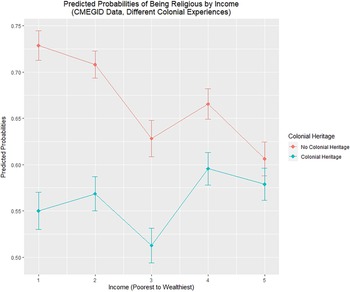
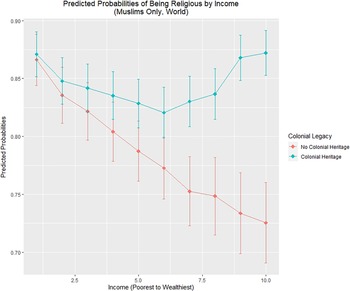
I plot predicted probabilities for the fourth and second models to better visualize the impact of colonial legacies on the relationship between income and religiosity in the MENA region overall, and amongst Muslim respondents in the world. They are plotted in Figures 2 and 3 below, respectively, and represent the average predicted religiosity by income group and colonial legacy. The predicted probability of being religious depending on one’s income group is plotted on the y axis, while income is plotted on the x axis—from the lowest income group, on the extreme left, to the highest income group, on the extreme right. The red line identifies countries with no colonial heritage, whereas the green line in each figure identifies countries with a colonial heritage.
Predicted probabilities of reporting being religious by Income Group (CMEGID Data, Middle East and North Africa).

Predicted probabilities of reporting being religious by Income Group (WVS Data, World Sample, Muslim Respondents only).

Predicted probabilities show that the only context in which more income correlates with less religiosity/more secularity is in countries that were never colonized through Western expansionism. As can be seen in Figures 2 and 3 below, the correlation between income and religiosity in non-colonized societies is negative and clearly linear. This lends credence to Hypothesis2. Meanwhile, this relationship is reversed on average in societies with a colonial heritage. On average, members of a higher-income group tend to be more religious than members of lower-income groups—as per the coefficients of Table 1.
Discussion and conclusion
In this article, I have traced the historical and macro-social roots of the relationship between income and secularity, highlighting the decisive moderating role of colonialism. I find support for my argument using statistical estimations on up to 351,960 observations collected in 269 countries over 30 years, and 49,124 observations collected in 15 MENA countries over 14 years. In postcolonial MENA societies, the relationship between income and secularity is not positive. In postcolonial countries of the world, this pattern is also true for specific forms of colonial experience, especially for Muslim individuals. Noticeably, the positive relationship between income and secularity only exists in societies that were never colonized. This is very significant as it challenges the conventional wisdom on secularization by pointing to the impact of political variables in a literature that has so far been led by a focus on socioeconomic variables.
My findings are significant for the scientific literature for a range of reasons. First, it points at a very specific dynamic that has gone unnoticed by secularization scholars over the past few decades—namely, the impact of colonization on different typologies of postcolonial secularization. My findings cannot be taken to show causality, but there is a very particular association, especially in the 1990s and 2000s—noticeably when religion was coming back to the fore in sociopolitical life—which varies based on the colonial experience of the country in question. This is substantial and suggests something important is going on here, especially since we know that the redistribution of power across different income groups implemented by colonial powers in colonized societies matters and perdures in postcolonial societies (Hartnett and Saleh, Reference Hartnett and Saleh2025).
Second, this article used a large number of cross-country and cross-time observations to test concrete hypotheses about the cultural impact direct colonialism has had on the peoples that it oppressed. Admittedly, such an effect had been heavily suspected and mentioned by many before, but my work here employs hypothesis testing and large N to clearly delineate a quantifiable effect of Western colonialism around the world. My argument and findings here about colonialism’s disturbance of the correlation between income and secularity are also similar to the arguments and findings of resource curse studies about democratization. As I discussed earlier, resource curse studies have shown that overreliance on natural resources disturbs the connection postulated by modernization theorists between economic growth and democratization. Where authoritarian countries were too reliant on natural resources for growth, they often failed to turn to democracy despite rising levels of economic development (Ross, Reference Ross2015). My findings here serve to explain a similar gap in “modernization” noticed by many social scientists in the 20th century, despite the grand predictions of Modernization theorists.
Third, my findings link up with previous findings which have explored the impact of colonialism on political outcomes—such as authoritarianism and democratization, development or underdevelopment, and the quality of governmental institutions—see especially the works of Acemoglu on the matter. My findings do not provide clear answers to such political questions but point to possible similar dynamics. Indeed, future studies would gain to explore the impact of various forms of sociopolitical heritage—such as colonialism—on developments today. Such developments include, but are not limited to, the rise of far-right and identitarian groups, the decline of democracy and resurgence of authoritarianism worldwide, the questioning of scientific evidence, and the rise of “alternative truths.” In relation to religion and politics, it may be that colonial heritage had a stronger influence than previously expected on specific types of state-religion arrangements, for instance. Likewise, my findings on colonial experience and secularization here do not provide clear answers on the impact of colonialism on whether a country adopts a secular regime or embraces a state religion. In fact, patterns of state-religion relations in the MENA region do not align cleanly with colonial history. Both colonized and non-colonized countries can be found among those that pursued strongly secular state ideologies as well as among those with entrenched religious establishments. For example, among colonized states, Tunisia and Baathist Syria and Iraq adopted relatively secular orientations, while non-colonized states such as Turkey and Iran under the Shah did the same. Conversely, colonized countries like Morocco, Jordan, and Lebanon maintained strong state-religion ties, as did non-colonized countries such as Saudi Arabia and Oman. This variation suggests that colonialism shaped certain institutional and social trajectories, but regime type, ideological leadership, and postcolonial state-building processes played an independent role in shaping state-religion relations.
Finally, my findings contribute to the growing, empirically driven literature seeking to improve our understanding of secularization in the aim of making it more scientifically accurate. As discussed previously, many have found that income and secularity do not move together in a perfectly positive relationship. Lately, some have pointed at different yet somewhat similar dynamics to the ones prophesied—for instance, instead of a drop in religiosity, we were told that it was religious authority that was to decline in influence (Norris and Inglehart, Reference Norris and Inglehart2011). What I find here is that different historical pathways may explain why income is associated with more secularity in some cases but not in others. Colonialism stands out as one such factor in the historical pathways in question, by virtue of simply being one of the most fundamental disruptions in the recent history of the world.
Supplementary material
The supplementary material for this article can be found at https://doi.org/10.1017/S1755048326100339.
Acknowledgements
I would like to acknowledge the generous funding of the Social Science and Humanities Research Council (SSHRC) of Canada which was used in part for the writing of this paper. I am especially thankful to Abdulkader Sinno, Jan Erk, Aisha Ahmad, Christopher Cochrane, Ludovic Rheault, Francesco Cavatorta, Eyoh Dickson, and the Politics & Religion editors who all offered valuable comments on previous versions of this paper. I am also grateful to Maryame Faquir, Fadoua Amri Jouidel, Youssef Assarssah, and Malak Belakhdar who assisted me at various stages of research as RAs for this paper. Any remaining mistake is entirely mine. I also wish to thank Dr. Carolina De Miguel Moyer for her mentorship, feedback, and guidance in the preliminary work that went into this paper. The best ones always leave first, and she is dearly missed.
Competing interests
I have no competing interest to report.



 Open access

