

Western plainsong studies have typically focused on fully notated manuscripts, which provide the most complete witnesses to the repertories that have interested scholars in the field. Recent work, however, has shown that partially notated manuscripts, fragments, and marginalia can yield different kinds of insights into manuscript culture, as well as the uses and functions of musical notation. Here we explore how a partially notated manuscript preserving the Old Hispanic rite, Toledo, Cathedral Archive, MS 35–6 (hereafter T6), can expand our knowledge of Old Hispanic chant, its scribal practices, manuscript culture, and notation.Footnote 1 Our manuscript stands in stark contrast to the best-known source of Old Hispanic chant, León, Cathedral Archive MS 8 (L8), which is fully notated, as well other books such as London, British Library MS Add 30845 (BL45), in which most chants have notation. T6’s sparse notation invites us to ask why notation was used at all, and why at these specific points. Unlike L8, with its unified style of writing, the partial notation in T6 was added by thirteen different scribes, demonstrating a blend of regional writing styles and melodic traditions.Footnote 2 T6 was most likely in the possession of individuals, at least for parts of its history, and changed ownership at several points. The manuscript thus offers a series of snapshots into the ad hoc uses of musical notation during the tenth to eleventh centuries.Footnote 3 Our objective here is not to provide a new date or provenance for T6, but to examine the various uses of musical notation. Some scribes notated only small parts of specific chants, some scribes corrected earlier versions of chants, and others notated only certain chants for a particular feast. After identifying the specific palaeographical traits and melodic dialects associated with each scribe, we hypothesize that scribes used notation for a variety of reasons: to train in singing and writing, to practise writing, to correct particular melodies and notational forms, to preserve particular versions within a variant melodic tradition, and as an aide-memoire. Because the Old Hispanic notation shows the contours of the melodies, but not their specific pitches, it was not possible to learn the melodies solely through the notation. A strong oral tradition thus existed alongside the notation. T6 offers new insights into various ways that this oral tradition could be supported by writing, as well as the complex interplay between memory and copying.
Old Hispanic Chant Manuscripts
The origins and dates of the Old Hispanic chant corpus are impossible to establish securely. Only four of approximately forty extant manuscripts have a colophon, none of which confirm the date or place of a manuscript with absolute certainty.Footnote 4 The Old Hispanic manuscripts are typically categorized based on their liturgy, melodies, or notational style.Footnote 5 Liturgically, Old Hispanic manuscripts fall into two traditions, known as A and B.Footnote 6 These two strands often use different chants and readings, different nomenclature for some genres of chants, and different melodies for the same texts.Footnote 7 T6 belongs to Tradition A, which will act as the most valuable point of comparison. Manuscripts may also be categorized according to the regional characteristics of their melodies. In the verse tones of responsories, Don Randel noted that manuscripts from León, the Rioja, Toledo A, and Toledo B each used a different set of verse tones.Footnote 8 Recent scholarship has nuanced this definition by identifying cadences and opening gestures which also vary regionally.Footnote 9
Notational style has also been used to categorize Old Hispanic manuscripts. Most commonly, manuscripts have been divided based on which version of Old Hispanic musical notation they contain: vertical or horizontal. Vertical notation is predominantly associated with manuscripts from northern Iberia, while horizontal is typically associated with manuscripts from Toledo.Footnote 10 Despite its preservation in Toledo, T6 contains vertical notation, with only a few very isolated examples of horizontal notation at the ends of some mass prayers. For this reason, our palaeographical analysis of T6 focuses on comparisons with manuscripts that use vertical notation. Although few studies have explored the characteristics of different vertical notational styles, ongoing work is revealing two distinctive styles, associated with the León and Rioja regions, which are not yet fully understood.Footnote 11 The León style is present in three manuscripts that have strong associations with the city of León: L8, Sant, and Sal.Footnote 12 These manuscripts share largely uniform neumes. Some of their melodic shapes are rarely found in other manuscripts, and many of them have specific melodic functions.Footnote 13 The second style, associated with manuscripts from the Rioja, is much less uniform. This style covers a much wider range of manuscripts, which have more variety in the formation of specific neumes, their size, their inclination, and their placement on the folio. In the following analysis of the different scribes of T6, we contextualize scribes within these two notational categories, broadening the current understanding of each style.
In analysing the work of the different scribes in T6, the primary points of comparison will be two manuscripts that share chants in common with T6: L8, copied in León in the tenth century, uses a melodic and notational style associated with León;Footnote 14 and London, British Library, Add. MS 30845 (BL45), most likely copied at San Millán de la Cogolla in the tenth century, uses a melodic dialect and notational style associated with the Rioja.Footnote 15 In addition, some chants are shared with other manuscripts containing Tradition A. Four of these manuscripts are associated with the Rioja region and are dated to the tenth to eleventh centuries: Real Academia de la Historia, Madrid, MS Aemil. 30 (A30);Footnote 16 London, British Library, Add. MS 30851 (BL51);Footnote 17 Santo Domingo de Silos, Biblioteca del Monasterio, MS 3 (Silos 3);Footnote 18 and Santo Domingo de Silos, Biblioteca del Monasterio, MS 6 (Silos 6).Footnote 19 The remaining two manuscripts with cognate chants are associated with Toledo from the eleventh century onwards, although their origins are uncertain: Madrid, Biblioteca Nacional de España, MS 10001 (BN01);Footnote 20 Toledo, Cathedral Archive, MS 35–4 (T4).Footnote 21 Comparison with several manuscripts associated with the Rioja region allows for a more detailed exploration of how T6 relates to these manuscripts, while the manuscripts associated with Toledo typically present more distant melodies and incomparable notational styles, demonstrating a more distant relationship between T6 and these sources.
Origins of T6
T6 is a liber misticus, preserving prayers, chants, and readings, for both mass and office, beginning with Easter and concluding with the feast of Justus and Pastor (6 August). In the absence of a colophon or early historical record pertaining to T6, there is no consensus on its origins. Anscari Mundó placed T6 in the centre of the peninsula due to its text script (which, according to Mundó, bears northern and southern characteristics) and the use of the neumes otherwise found exclusively in manuscripts associated with the north.Footnote 22 Other scholars have assumed that the preservation of the manuscript in Toledo Cathedral testifies to its origins in the city, or have taken the text script to be characteristic of Toledan manuscripts, but have not provided further evidence.Footnote 23 Andrés Marcos Burriel placed the script at a date preceding the Christian conquest of Toledo by Alfonso VI in 1085.Footnote 24 Most scholars suggest the manuscript was written between the end of the tenth and the beginning of the eleventh century, without specifying whether they are referring to only the text or also the musical notation.Footnote 25
Almost all musical notation in T6 appears to have been added after the text was written; with the exception of Hand 7, changes in text hands do not correlate to changes in music hands.Footnote 26 José Janini suggested that the oldest musical notation is from the eleventh century, with a later addition on fol. 151v in the twelfth century.Footnote 27 Janini was referring to a chant written in vertical Old Hispanic notation – a variation of the notation for which we have no evidence that it was used in the Iberian Peninsula after the suppression of the Old Hispanic rite in 1080.Footnote 28 T6, however, also contains horizontal notation in the prayers of the mass. The extant evidence for the use of horizontal notation comes from manuscripts associated with the city of Toledo from the late eleventh century onwards.Footnote 29 The latest text addition in T6, the hymn for Saint Bartholomew (fol. 181v), has been attributed to the twelfth century on a palaeographical basis.Footnote 30 Although this scholarship brings us no closer to the origins of the manuscript, it does attest to its use well after the suppression of the Old Hispanic rite.
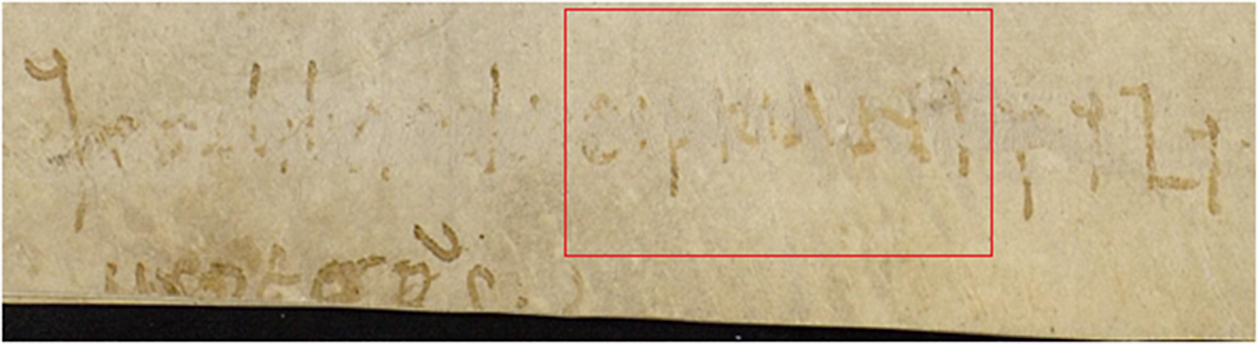
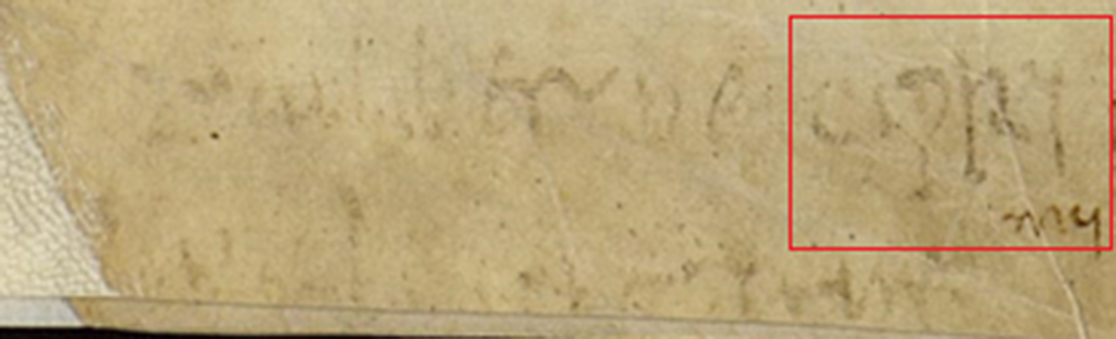
Aside from the origin and dating of the manuscript, evidence at the bottom of two folios suggests that at one stage T6 might have been owned by a certain ‘Cyprian’ (Plates 1a and b). It is not clear who Cyprian was or what his role was in liturgical practice. While this name could have been written by the scribe of the manuscript, this seems unlikely, because both of these additions have later been crossed out, presumably by a subsequent owner of the manuscript; it is rare to cross out the name of a scribe, but the name of a previous owner might have been erased when the book changed hands. At one stage, then, T6 could have been owned by an individual rather than an institution, and it changed ownership at least once. In this study we explore the history of the manuscript through the musical annotations made by its users and possible owners.
Fol. 157v (reference to Ciprian outlined in red).
Fol. 177v (reference to Ciprian outlined in red).
Analysis of Musical Hands
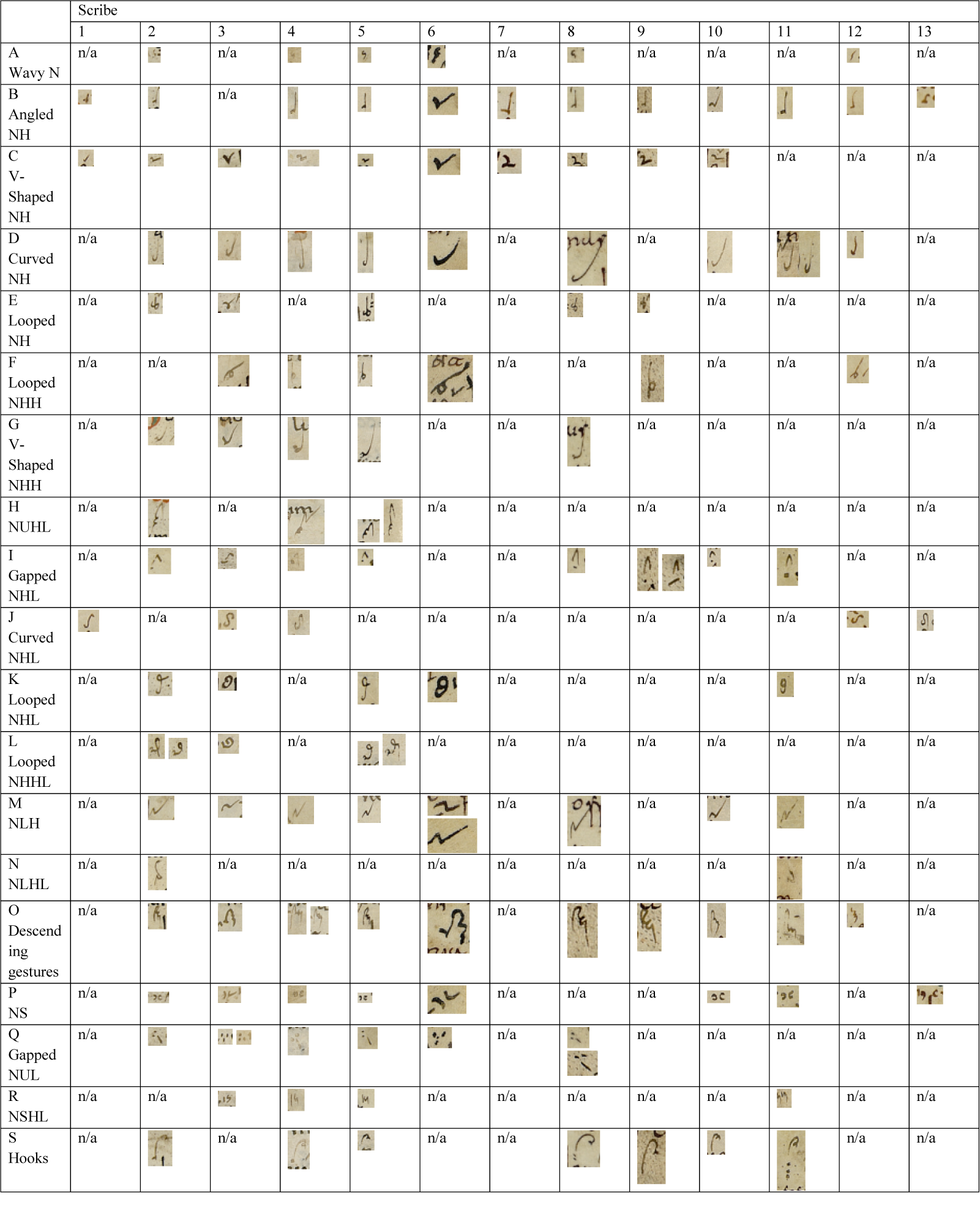
In order to assess each scribe’s personal engagement with music and liturgy, as well as their motivations for notating specific chants, it was important to identify each of the scribes working on T6. We have determined that thirteen different scribes contributed to chants in T6, and additional scribes occasionally added neumes to the final syllables of prayers in the mass. Identifying these scribes required engagement with current methods of music palaeography. Much like text palaeography, music palaeography identifies scribes by general traits in their writing, such as the angle at which they wrote, the size of their writing, and the way they formed specific shapes. Susan Rankin has explored the placement of neumes in the writing space and the impact of pen angles on the axes of scripts.Footnote 31 While much of her work has focused on styles of notation in different writing centres, the same principles can also aid in the identification of individual scribes.Footnote 32 In Old Hispanic studies, Herminio González Barrionuevo identified scribes by examining certain neumes over a range of folios within a single manuscript.Footnote 33 More recently, Elsa De Luca has identified four scribes in the León Antiphoner (L8) by looking at selected neumes and noting where and how they are written over the course of several folios.Footnote 34 We have used all of these approaches to identify the different notational hands. Here we present the hands in order of their appearance, noting any unusual or unique characteristics that distinguish them from other scribes in the manuscript. These characteristics are summarized in Appendix 2.Footnote 35
The Iberian neumes are based on the same general principles that underlie the other Western chant notations, but with some notable differences.Footnote 36 As we will show, the notated chants in T6 preserve neumes that resemble those found in northern Iberian manuscripts copied in the tenth and eleventh centuries, with specific features that tie them either to the León or Rioja regions. Additionally, a few prayers in T6 have the horizontal notation found in twelfth- to fourteenth-century manuscripts from Toledo. Because the neumes do not show pitch, we refer to each individual note according to its contour within the neume:Footnote 37
N: Neutral or unknown
H: Higher than the preceding note
L: Lower than the preceding note
S: Same as preceding note
U: Same or higher
D: Same or lower
In these contour transcriptions, each neume begins with ‘N’ because its contour in relation to the previous note is unknown.
Hand 1
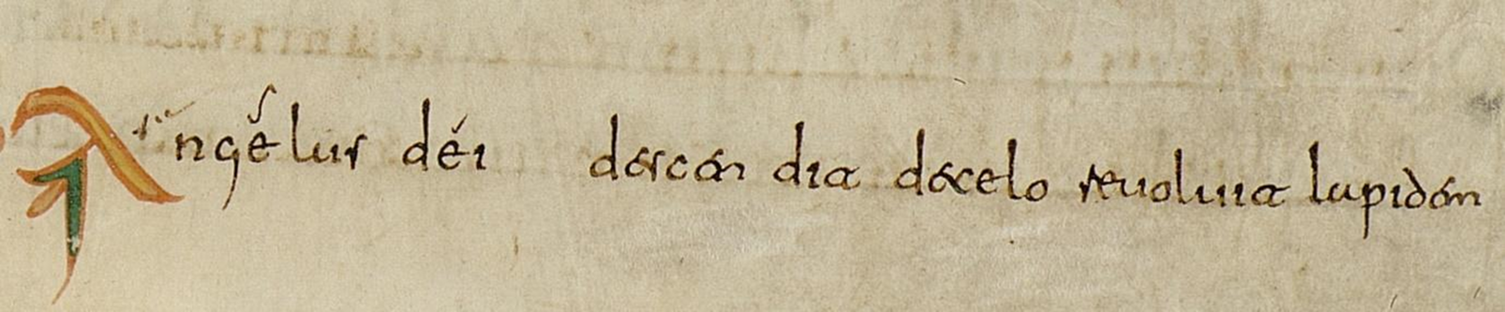
Hand 1 wrote only a few syllables of notation (fol. 28r, Angelus dei; Figure 1).Footnote 38 Their style is characterized by exceptionally small neumes with a consistent thickness of pen stroke. For example, the NH on ‘dei’ has a first stroke which is barely visible and is comparatively much smaller than those written by other scribes (Appendix 2, row C). Similarly, the NHL on ‘angelus’ also has very small curves at the beginning and end of the shape; the middle pen stroke is comparatively much longer, creating an unusually elongated neume (Appendix 2, row J).
Angelus dei (Sono, fol. 28r).
Hand 2
Hand 2 differs from Hand 1 in the contrast between the thickness of horizontal and vertical pen strokes. Their notation is oriented vertically on the folio; the ascending strokes of square and curved NH neumes rise vertically on the folio (Appendix 2, row B and D) and when there are multiple puncta in a rising figure, they tend to be nearly vertically aligned over one another (Figure 2, ‘uiam’, line 3).Footnote 39
Doce nos (Sono, fol. 102r).
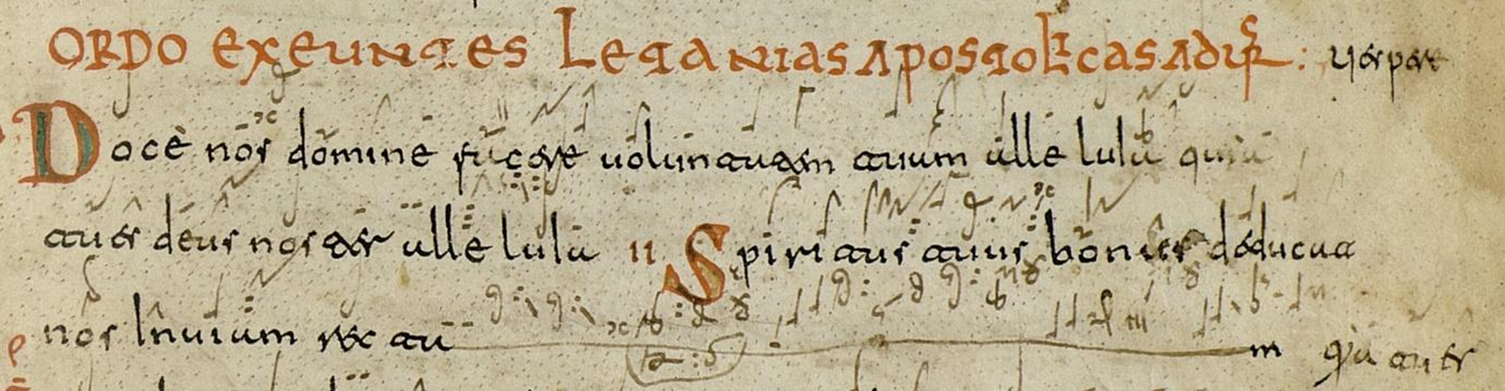
This hand exhibits traits of both the León and the Rioja notational styles. For example, the NUHL on ‘tuam’ (Figure 2, line 1) is a shape found almost exclusively in León sources,Footnote 40 yet the NLHL on ‘nos’ (line 3) is much more curved than those found in L8, more closely resembling the Rioja manuscripts.Footnote 41 This combination of traits from different regions complicates current understandings of the León and Rioja notational styles.
Hand 3
This hand exhibits several traits commonly found in the Rioja style. For example, in neumes formed with a counterclockwise loop (NHL or NHHL), that loop is often not fully closed, (see Figure 3, ‘uentre’, line 1, final two neumes and Appendix 2, rows K and L). Moreover, in descending neumes written with a gapped connection, the line prior to the descent sometimes has a slight curve at the top (see ‘te’, Figure 3, line 2).Footnote 42 The overall diagonal orientation of the neumes on the folio is also striking, with some puncta being aligned along a nearly horizontal line, unlike Hand 2 (Figure 3, ‘mea’, line 4). Melismas (syllables with many notes) were also written in a single straight line – the scribe started a neume at the same height as the end of the preceding neume. By contrast, Hand 2 marked new sections within a melisma by placing neumes lower in the writing space (e.g., Figure 2, ‘rectam‘, line 3).Footnote 43
Tu es domine (Psalmus, fol. 133r).
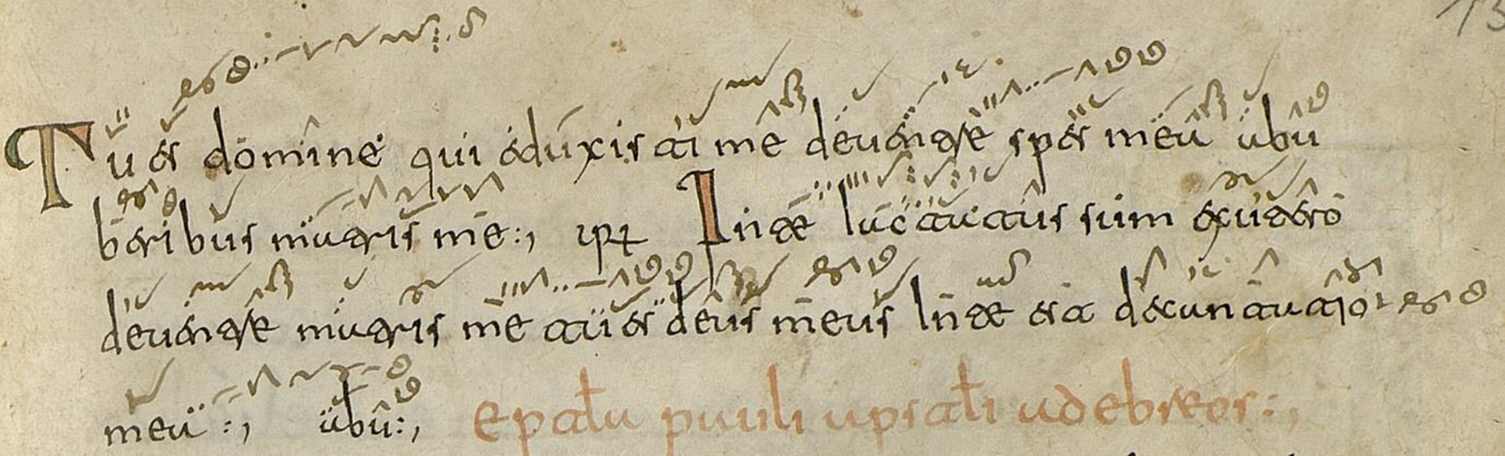
While Hand 3’s notational shapes and style align more closely with the Rioja manuscripts than the León ones, the vocabulary of neumes is unusual. In all other northern manuscripts, there is a functional distinction between a square NH ( ) and a V-shaped NH (
 );Footnote
44 Hand 3 used an amalgamation of the two shapes – the neume has the orientation of a V-shaped version but does not have the characteristic curved opening stroke (
);Footnote
44 Hand 3 used an amalgamation of the two shapes – the neume has the orientation of a V-shaped version but does not have the characteristic curved opening stroke ( ).Footnote
45 This habit causes some melodic formulas, which normally use these two shapes in a particular order, to be less recognizable.Footnote
46
).Footnote
45 This habit causes some melodic formulas, which normally use these two shapes in a particular order, to be less recognizable.Footnote
46
Hand 4
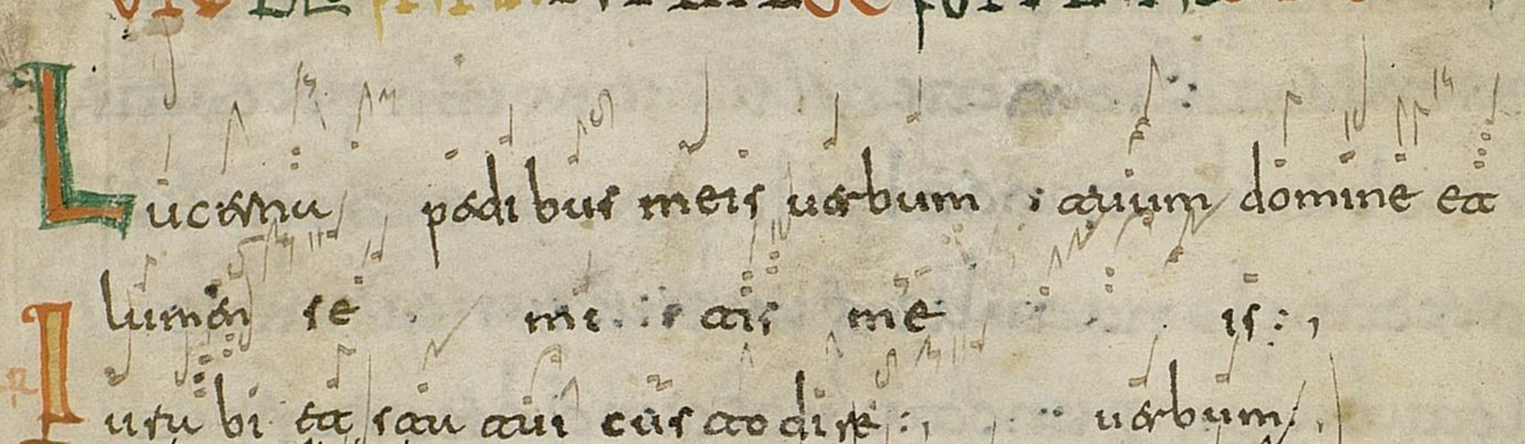
Hand 4’s notation shares some traits with that of Hand 2. As in Hand 2, some shapes are reminiscent of those found in L8. For example, the first neume on ‘lucerna’ has a wavy penultimate pen stroke and a straight final shape (Figure 4). This is extremely rare in the Rioja manuscripts, which either use two wavy strokes or one straight line followed by a wavy line at the end of such NHHLL neumes, but is more common in L8. Hands 2 and 4 also placed neumes with sensitivity to height in the writing space and orientated their neumes vertically on the folio. However, differences emerge in a closer analysis of their specific notational shapes. For example, Hand 2 sometimes used curved gestures to represent an NL, whereas Hand 4 always used an angled gesture. Their falling NLLs also have a different form. Hand 2’s tend to have curved falling gestures with the open ends to the right while Hand 4’s have a very angular descent (Appendix 2, row O). Similarly, when writing rising curved gestures, Hand 2 used neat curves, while Hand 4 wrote much less defined contours (Appendix 2, row H). Despite both musical notations having a contrast between thick and thin strokes, the horizontal pen strokes in Hand 4 are more pronounced than in Hand 2.
Lucerna pedibus (Vespertinus, fol. 123v).
Hand 5
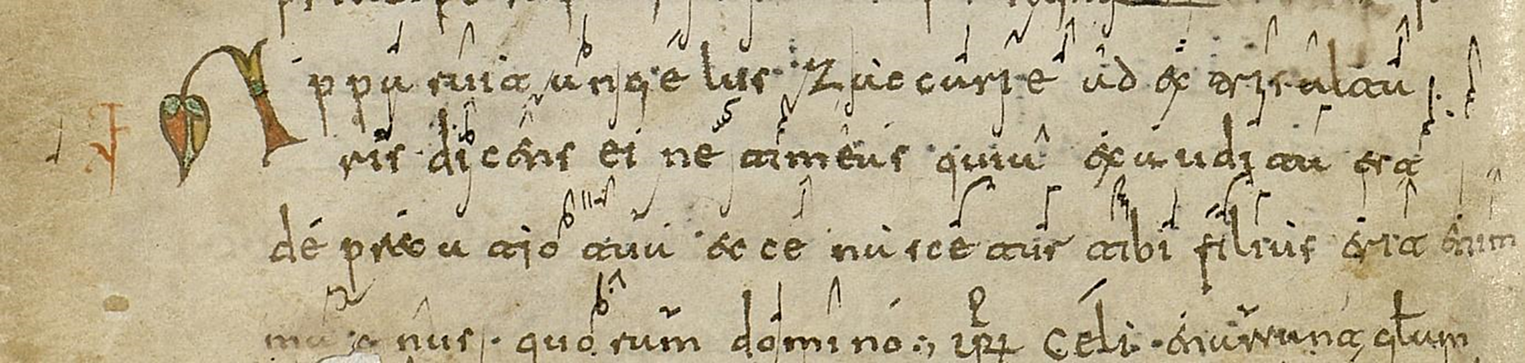
Although Hands 4 and 5 might appear similar on first glance, there is a noticeable contrast, both in the colour of the ink and the proportions of the neumes. The ink used by Hand 5 is much darker than the pale grey used by Hand 4.Footnote 47 Hand 5 used exceptionally long ascending vertical strokes that often intersect with the text and writing space above the notation space. Specific neumes also distinguish this hand from that of previous scribes. For example, the V-shaped NHH (Appendix 2, row G) is formed with an initial shape that is more curved than in previous examples (including Hand 4). Elsa De Luca and others have found this neume to be useful in differentiating between Old Hispanic scribes.Footnote 48 Additionally the V-shaped NH (Appendix 2, row C) is also more curved than in Hand 4’s script, and the descending NLLs (Appendix 2, row O) begin with a much fuller and curved gesture in Hand 5 than Hand 4.Footnote 49 This scribe also formed looped NHHs with the final pen stroke exiting the loop offset slightly to the right of the first; this gives the semblance of verticality, but does not, like in Hand 4 or the scribes of L8, have the same straight stem to the neume (Appendix 2, row F). Hand 5 also regularly used what Louis Brou has termed as ‘bâtonnets’ to the upper left of a neume.Footnote 50 These are found occasionally in Hand 4 but are not found in any of the previous hands (e.g., Figure 5, ‘erit’, line 3).
Apparuit angelus (Antiphon, fol. 123v).
Hand 6
Palaeographical analysis suggests that Hand 6 may have been trained in a similar environment, and perhaps at a similar time, to Hand 3. For example, neither distinguished between V-shaped and square NHs; both have similar methods of forming NLH, NS, and NUL (Appendix 2, rows M, P, and Q); and both oriented the neumes horizontally on the folio when space was limited. In comparison to Hand 3, however, Hand 6’s notation is distinctively thicker in stroke, larger, and often lacks space between neumes.Footnote 51 One example of this is the end of the opening ‘alleluia’, which in other manuscripts reads NH-NH-NLH (a common and normally recognizable formula), whereas here the neumes are placed so closely together that it resembles NH-NHHLH (or even NH-NHLH).Footnote 52 Specific shapes, such as the broad, swooping curved NHs (Appendix 2, row D; Figure 6, ‘iudicia’, line 3) and unsteady pen strokes (Figure 6, ‘iustitia’, line 1) also help to make this hand instantly recognizable.
Alleluia iustitia (Sono, fol. 151v).
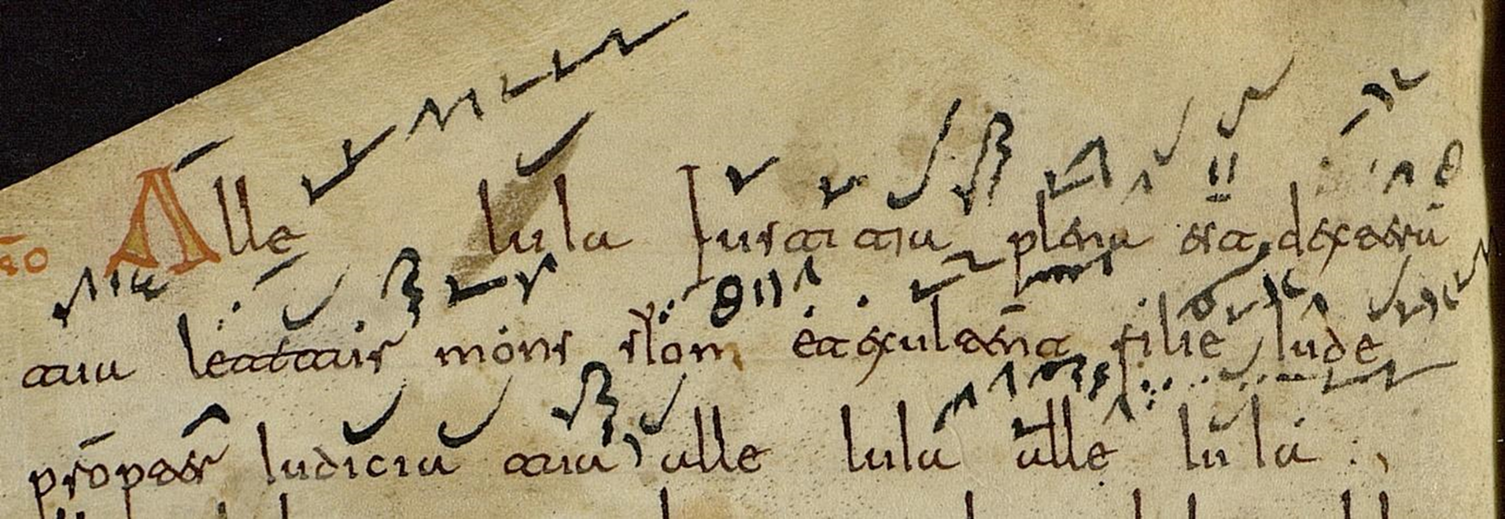
Owing to the fundamental similarities of the notation between Hands 3 and 6, it is plausible that these two scribes came from the same institution and learned to write from the same tutor, or even one from the other. It is also possible that Hand 6 and Hand 3 could be the same person at different stages of their working life, perhaps with rougher neumes from a period earlier in their lifetime, and the more precisely written neumes developing as the scribe improved.
Hand 7
Acceperunt prudentes (fol. 153v) (Figure 7) offers a likely insight into the style of notation being used at the time the manuscript was written – Hand 7, who only notated this chant, is also likely to have been the text scribe for this section of the manuscript.Footnote 53 In contrast to usual practice in T6, the musical notation begins with a low amount of ink (as indicated by the lighter colour), indicating that the scribe had already been writing, and thus using ink from their quill, prior to beginning the notation. Since there are no other examples of musical notation written by this hand, they were likely to have been writing the text of this chant. The text beginning at ‘oleum’ is of a similar colour to the neumes on the previous syllable, perhaps suggesting that the scribe continued writing the chant text after writing the neumes (i.e., they wrote the text ‘Acceperunt prudentes’ followed by the neumes above it prior to writing the rest of the chant text).Footnote 54 This is the only example in which we are able to identify a relationship between text and music scribes in T6.
Acceperunt prudentes (Responsory, fol. 153v).
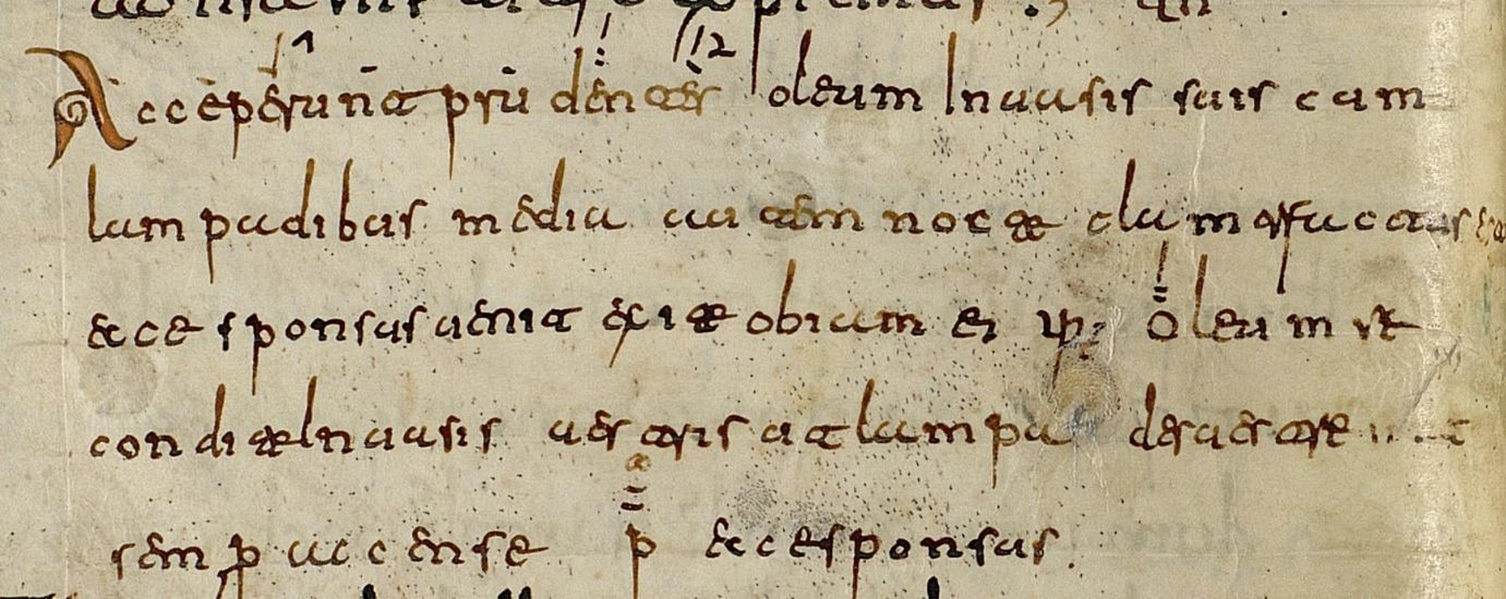
Although the notation is brief, it is possible to discern a close relationship with the Rioja notational style and to separate this hand from others. The initial curved pen stroke of the V-shaped NH is much larger than those found in L8 and is more similar to those seen in manuscripts such as BL45. This scribe makes a clear distinction between square and V-shaped NH neumes, thus distinguishing them from Hands 3 and 6. In comparison to Hands 1, 2, 4, and 5, this neume has a completely different appearance (Appendix 2, row C), further marking this scribe’s unique identity.
Hand 8
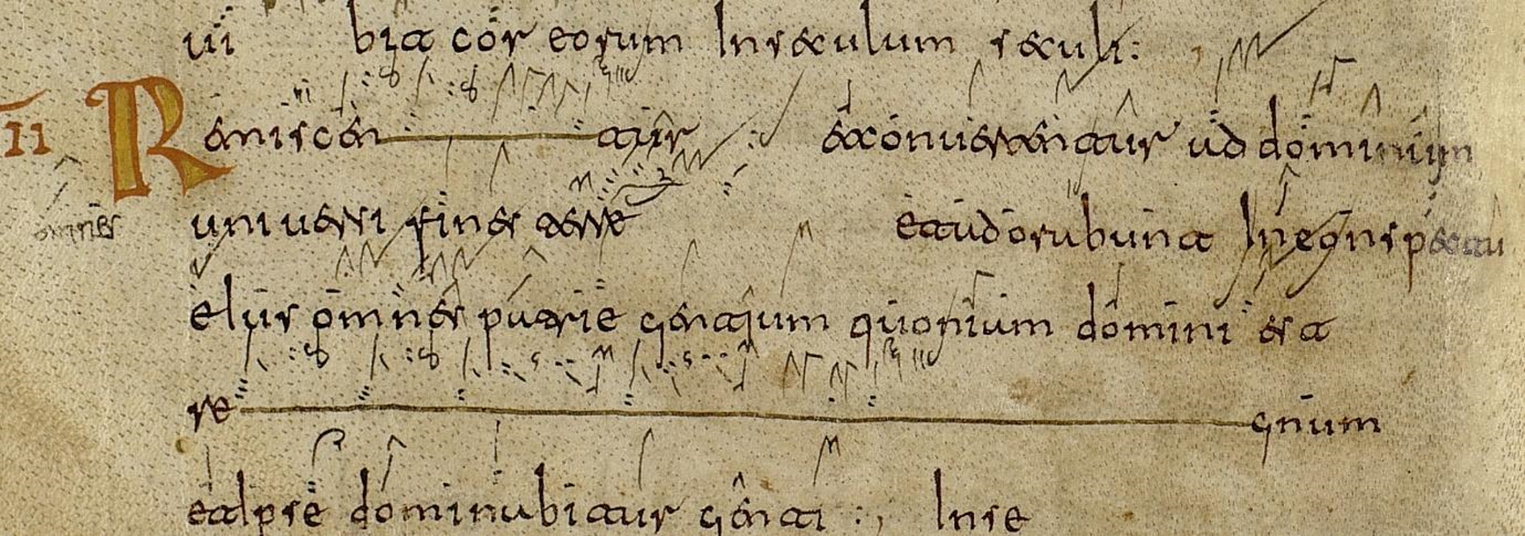
This hand wrote neumes with considerable attention to detail. The sequence of NLs on ‘reminiscentur’, for example, has a variety of shapes, likely conveying specific nuances (Figure 8). None of the neumes are especially characteristic of either the León or the Rioja manuscripts. Some of the more distinctive features of this scribe include a strong curve round to the left prior to writing a hook (Appendix 2, row S; Figure 8, ‘ipse’, line 5), as well as the thin downward angle of the puncta in rising gapped neumes (Figure 8, ‘terre’, line 2). This scribe also used a small descending stroke after some neumes (e.g., the first NHHH on ‘regnum’). Typically, a mark in this position is considered as a note, making the neume NHHHL. However, comparable melismas in L8 and BL45 have no descending note. At these moments, however, L8 does have the small marks that Brou termed ‘bâtonnets’,Footnote 55 whose meaning in L8 (and other manuscripts) is as of yet undetermined.Footnote 56 It is possible Hand 8 is using this small dash to the right of the gapped NHHH neumes in a comparable manner. This scribe, then, developed unique ways of working within a broadly shared understanding of the nuances of musical notation.
Remiscentur et convertentur (Psalmus verse, fol. 168v).
Hand 9
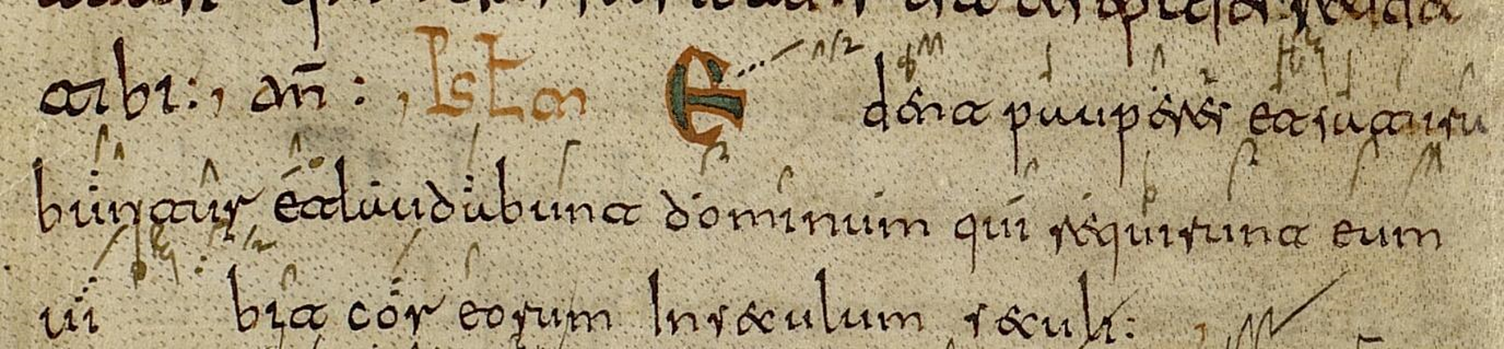
The distinctive traits of Hand 9 include the shape of the NLL with curved falling gestures (Figure 9, ‘et’, line 1, and Appendix 2, row O), neumes with hooks which, unlike Hand 8, do not curve strongly to the left (Figure 9, ‘uibit’, line 3, and Appendix 2, row S), and ascending neumes which are relatively short (unlike Hands 5 and 8) (Appendix 2, row E). The V-shaped NHs by this hand are unlike those seen in Hands 7 or 8, as they rise in their final pen stroke (Appendix 2, row C) and the presence of both V-shaped and square NHs means that this hand cannot be Hand 3 or 5. Finally, there is little contrast between the thickness of the strokes (unlike Hands 2 and 4).
Edent pauperes (Psalmus, fol. 168v).
Hand 10
The most notable palaeographical features of this hand are the diagonal angle of their ascending lines (Appendix 2, rows B, D, and M) and the curved first stroke of square NHs – this stroke is usually straight in all other hands (Appendix 2, row B). Their descending gestures are generally quite short (e.g., in a curved NL, Figure 10, ‘beatus’, line 1) meaning that proportionally, this hand has quite long first strokes in NL neumes (Appendix 2, row S). Similarly, the initial stroke of curved NHs is short, meaning that proportionally the ascenders of these neumes appear much longer (Appendix 2, row D).
Alleluia beatus vir (Sono, fol. 182v).

Hand 11
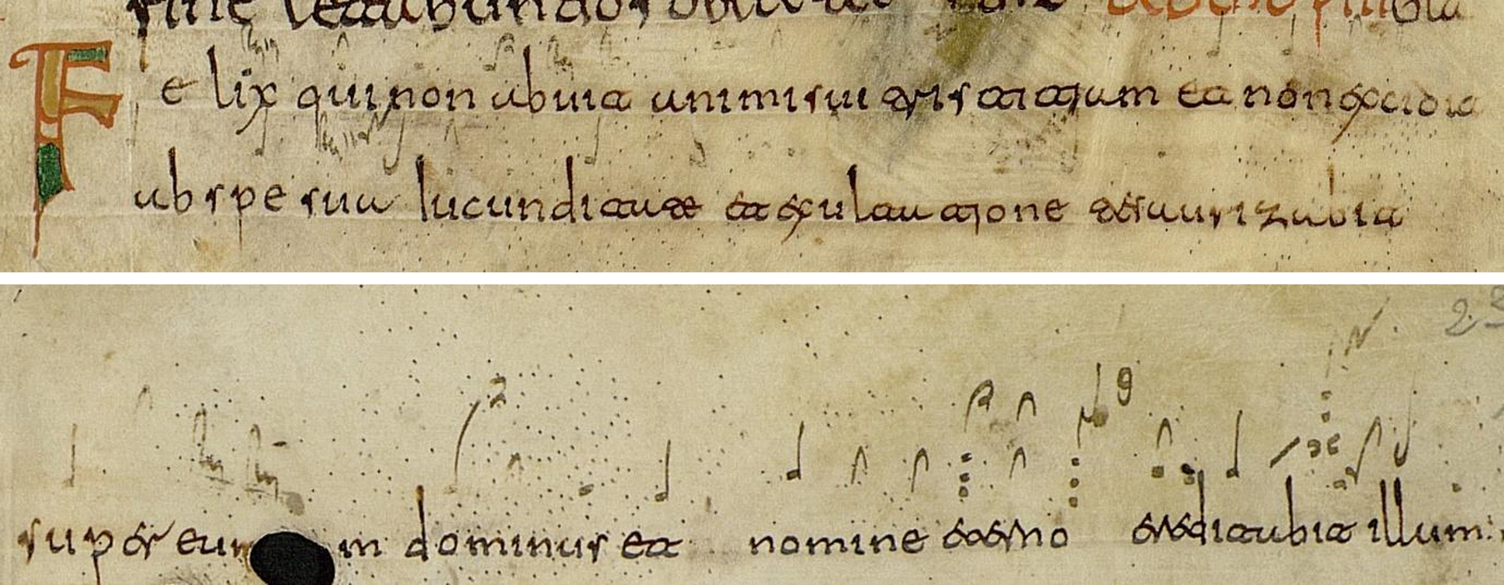
Hand 11 resembles the León style in their notational shapes, the contrast between thick and thin pen strokes, and the vertical orientation of the neumes on the folio (Figure 11). Although similar to Hand 2, the two are distinguished by certain neume forms. For example, the NLHL neume (Appendix 2, row N) is written with angular connections by Hand 11, in a similar way to that found in L8, but with much more curved ones by Hand 2.
Felix qui non (Antiphon, fol. 183v).
Hand 12
Despite only writing one line of notation, Hand 12 can be identified because they have several unusual notational shapes that are not found elsewhere in T6. For example, the final neume that this scribe writes (‘facere’) is an NLL without an initial rising stroke (Figure 12) – a shape that, in this manuscript, is unique to this hand (Appendix 2, row O).Footnote 57 Similarly, the first neume, NHL with a rising final wave, appears only in the work of this scribe. The wavy N on ‘transgredi’ is unlike other iterations of this shape in T6 as it is strongly inclined towards the right, rather than vertically (Appendix 2, row A). A final characteristic of this scribe is the tendency to waver at the end of an ascending stroke (e.g., the neumes on ‘qui potuit’ and ‘non’), perhaps indicating uncertainty or lack of confidence.
Felix qui potuit (Alleluiaticus, fol. 184r).

Hand 13
Hand 13 wrote basic shapes differently to other scribes in T6. Comparisons with cognate chants suggest that this scribe used a curved line for virgae (e.g., the final stroke on ‘domini’; Figure 13) while all other hands used a straight line, and their horizontal lines (puncta) are also more elongated.Footnote 58
Praeceptum domini (Vespertinus, fol. 192r).
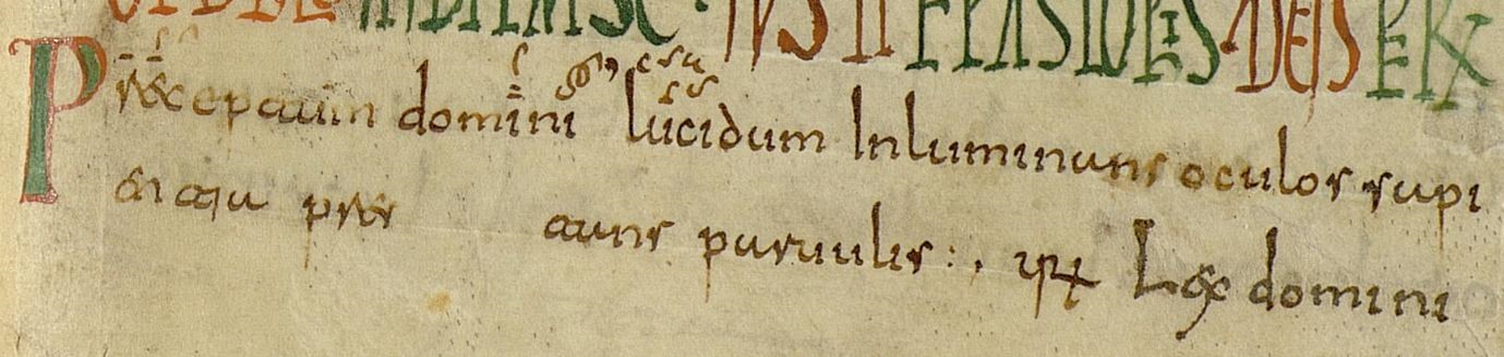
They also used neumes different from those used in L8 and BL45. The three sources have nearly identical melodies (with the exception of ‘preceptum’, which differs in L8) but each manuscript has different neumes. For example, on ‘domini’, the first neume, which in T6 has a form only found in Rioja manuscripts, has a gapped first connection in L8 and has two loops in BL45 (the first counterclockwise and the second clockwise). Similarly, ‘lucidum’ has a single joined neume in both L8 and BL45, yet two in T6. While the neumes written by this hand fall into the definition of the Rioja notational style, they are not especially similar to those in BL45. This suggests that there was not one fixed way of notating the melody, even within one notational style, further broadening our understanding of Rioja notation.
The Additional Scribes of the Mass Prayers
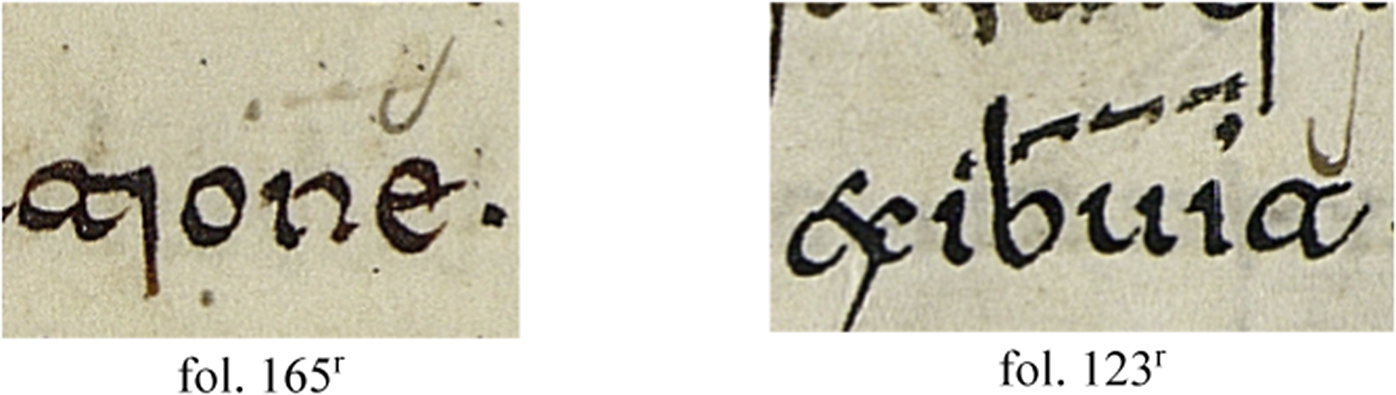
In addition to the thirteen hands that notated chants, the mass prayers of T6 contain additional neumes, always written at the ends of the prayers.Footnote 59 Owing to the sparsity of the notation in the prayers – often just a single neume in an Inlatio prayer – it is not possible to ascertain whether these neumes can be attributed to any of the preceding scribes. Some of these neumes, however, are written in horizontal notation, a version of Old Hispanic notation found in Toledan manuscripts from after 1085, making it highly unlikely that they were written by same the scribes who wrote vertical notation (which survives only in manuscripts written before 1080).Footnote 60 In fact, the mass prayers provide us with one of the rare examples in which the two styles of Old Hispanic notation, horizontal and vertical, coexist in one manuscript.Footnote 61 In contrast to the flyleaves of BN01, in which some chants using vertical notation have been erased and rewritten using horizontal notation, the two styles seem to exist harmoniously in T6, with no evidence of erasures or changes made when the later notation was added. Two particularly striking examples occur in the prayers for St Christopher and for Saints Adrian and Natalie, in which both horizontal and vertical notation appear over the same word (Figure 14). Each style of notation reflects a different prayer tone, and the NH on the final syllable is not known in prayer tones from Toledo; presumably, a singer who typically used horizontal notation would know to only sing the melody reflected by the horizontal neumes. The faded neumes over the first two syllables of 165r are more likely to be fading rather than erasures, since there is no evidence of scraping. The presence of both notational styles attests to the ad hoc use of notation in T6. The horizontal notation scribe, almost certainly working at a later date than the vertical notation scribe, evidently saw no need to erase the previous neumes. Rather, his eye would have been immediately drawn to the familiar Toledan style on the page.
Vertical and horizontal notation on one word.
Melodic Dialects
In addition to their different scribal practices, manuscripts associated with the León, Rioja, and Toledo regions can be distinguished by particular melodic characteristics. These include the use of specific responsory verse tones, the formulaic contours that appear at the ends of phrases (i.e., cadences), and approaches to opening a chant.Footnote 62 These regional markers appear consistently in the León manuscripts, whereas manuscripts from the Rioja incorporate varying degrees of León traits. Although T6 lacks responsory verse tones, its cadences clearly indicate the presence of both the León and Rioja dialects, each in the work of different scribes.Footnote 63 By studying the melodies of the manuscript in combination with the scribes, we gain a deeper insight into the identities of those who used T6 and their understanding of the Old Hispanic melodic tradition. Although some of T6’s scribes notated too few neumes to determine their melodic dialect, we have identified six scribes who conformed to the León dialect, two who followed the Rioja dialect, and some who used melodies which are not closely related to either. These findings remind us that manuscripts like T6, used in an ad hoc, day-to-day manner, can offer insight into the levels of understanding and engagement with the liturgy by its practitioners. Some additions to T6, moreover, complicate current understandings of regional dialects through their use of atypical melodies.
León
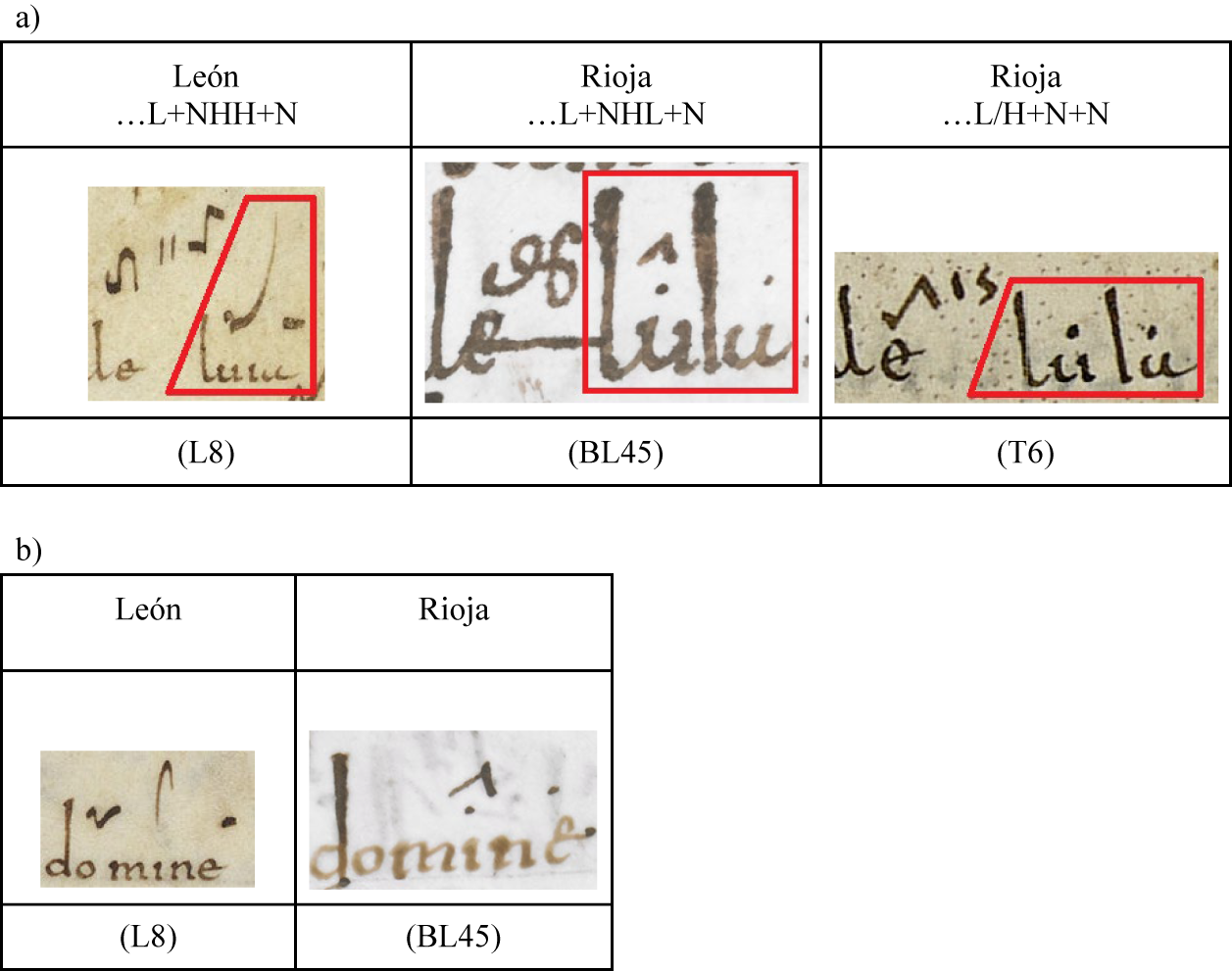
The León dialect has been identified as a result of its predominance in L8 and in two other manuscripts from León: Salamanca 2668 (copied in 1059) and Santiago de Compostela 609 (copied in 1055). These manuscripts have melodic characteristics that distinguish them from the Rioja dialect. One is the treatment of the penultimate syllable in a particular type of three-syllable cadential formula that marks the ends of a chant or internal phrase (Example 1a).Footnote 64 When the penultimate syllable is preceded by a descending contour in this cadence type, it is usually followed by the V-shaped NHH, NHL, or a single note.Footnote 65 Each of these contours serves the same melodic function. Although all three appear in manuscripts from both León and the Rioja, the two regions show strong preferences in their choice of contour, particularly at cadences on the word ‘alleluia’. Manuscripts from León typically have the V-shaped NHH in this position, whereas Rioja manuscripts often have NHL or a single note in this position.Footnote 66 Another marker of the León tradition is a cadence distributed over three syllables: NH+NL+NH.Footnote 67 This cadence is strongly associated with the word ‘domin-’ but also appears on other proparoxytones. The Rioja manuscripts almost always have a different melody in this position, typically N+NHL+N (Example 1b).Footnote 68
León and Rioja versions of common three-syllable cadences.
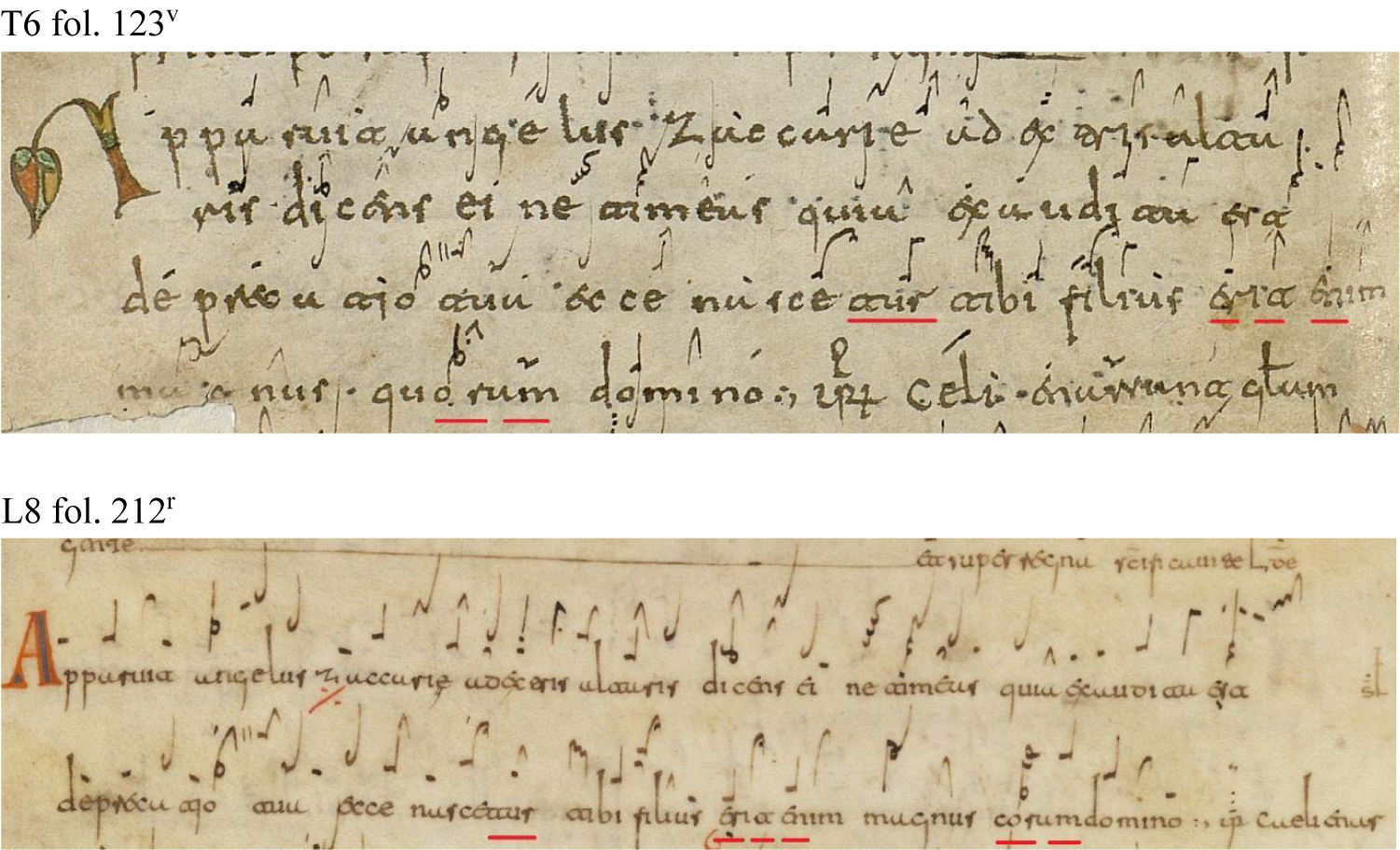
In T6, the León dialect is present in the works of Hands 2, 4, 5, 8, and 11, as evidenced by their cadences and notational choices (Appendix 3). Often, the melodies written by these scribes are more closely related to L8 than to Rioja manuscripts in other respects as well. To assess the similarity between the melodies of T6 and those of other manuscripts, we divided the number of contours which are the same between the two manuscripts by the total number of contours in both versions.Footnote 69 The result is given as a number between 0 and 1. The closer a result is to 1, the closer the chants are to being identical. A score of 0.5 suggests that the melodies are related by no more than chance. Hand 5 wrote melodies that adhere closely to the León versions, evident in both melodic dialect (at five cadential points, Appendix 3), as well as in the other melodic variants (Table 1). The melodies are generally quite stable between these sources, but where there is variation, Hand 5 favoured the León version. This is especially evident at the cadential points where Hand 5 used a León version, whereas BL45 has a Rioja version of the cadence on all five occasions that inflect dialect. Hand 5 also wrote a unique reading of the hymn Puer hic (on 11/45 syllables), but this hymn is otherwise found only in Rioja manuscripts, strengthening the impression that this version is melodically distant from the Rioja melodic tradition.
Hand 5 similarities with other manuscripts
| Chant | Syllables like L8 and not BL45 | Syllables like BL45 and not L8 | Relationship ratio with L8 | Relationship ratio with BL45 | Neumes that differ between L8 and T6 |
|---|---|---|---|---|---|
| Haec dicit a | 14 | 0 | 0.99 | 0.93 | 5/64 |
| Ne timeas b | 7 | 1 | 0.99 | 0.95 | 5/49 |
| Angelus domini | 13 | 0 | 0.98 | 0.92 | 8/74 |
| Apparuit angelus | 13 | 1 | 0.99 | 0.91 | 5/69 |
a First section of chant only. The verse is written by Hand 4.
b Excluding the syllables written by Hand 4 on ‘(tu)a ecce na(scetur)’.
The chants of Hand 5 correspond to L8 graphically as well as melodically. The vertical Old Hispanic notations use an extraordinary variety of neume forms that represent the same contour.Footnote 70 Hand 5’s choices are often very similar to L8’s. For example, Apparuit angelus has a total of 69 neumes, and only five of these differ from L8 at moments where the melody is the same (Example 2). The placement of some of these neumes is also similar between the manuscripts, for example, the NL is placed directly above the NH on ‘altaris’. In Rioja manuscripts, this combination of neumes is often placed side by side. This evidence, in combination with the high relationship ratios, suggests Hand 5 had close ties to the León region and perhaps was copying from an exemplar similar to L8.
Notational differences in Apparuit angelus.
In Hands 2, 4, 5, and 11, markers of the León melodic dialect are consistent with the use of certain neumes characteristic of León manuscripts, such as NUHL (e.g., Figure 2, ‘tuam’, line 1) and the NLHL in Hand 11. At the same time, T6 expands our knowledge of the León notational style beyond the comparatively uniform style found in L8, Sal, and Sant. L8, for example, shows a strong contrast between thick and thin pen strokes, whereas Hand 8 does not. Moreover, Hand 11 occasionally used different choices of neumes from L8, despite having similar melodies. In Felix qui non abuit, Hand 11 wrote fifty out of fifty-nine comparable melodic contours using exactly the same neume as L8. Some differences lie in the absence of the V-shaped or looped NH at moments where L8 includes them (see Figure 11, ‘et’, line 1, ‘iucunditate’, line 2, and ‘et’, line 3). Despite the generally high level of consistency, the occasional variation indicates that the two versions of the chant, which are melodically nearly identical, could be visually represented with a degree of flexibility. Despite this flexibility in the choice of neumes, the alignment of León-specific neumes, melodic dialect and relationship ratios confirm the presence of León characteristics that were almost certainly added to T6 outside of the city of León itself. This confirms other recent evidence that the boundaries of the León notation region, previously associated only with manuscripts related to the city, were probably wider reaching than previously thought.Footnote 71
Rioja
A second dialect present in Old Hispanic manuscripts is associated with the Rioja region. In contrast to the León manuscripts, which have NHH on the penultimate syllable of the relevant three-syllable cadences (Examples 1a and b), this dialect tends to have NHL or N and is present in two hands in T6: 3 and 12. Both hands also use notation that falls into the broad category of the Rioja style. Hand 3’s use of a Rioja dialect is established by eleven cadential points throughout their nine chants (see Appendix 3). On the penultimate syllable the scribe chose NHL in five of these cases and N in four. Both choices are associated with Rioja manuscripts rather than León manuscripts. Further ties to the Rioja melodic tradition emerge in the melodic variants. Although a Rioja manuscript was not available for comparison in four of the nine chants, a stronger connection to BL45 (rather than L8) is nonetheless evident in some of the remaining chants. Among the eighteen notated syllables of Alleluia in omnem, for example, L8 and BL45 differ from one another on six syllables. On each of these syllables, T6 corresponds to BL45 rather than L8. Not all chants, however, resemble BL45 so closely. T6’s version of Sacerdotes Zacharias shows nearly equal connections to both manuscripts: it has concordances with BL45 on just 8/75 syllables and likewise only has concordances with L8 on 9/75. On the whole, the melody is no closer to BL45 than L8, and in fact has unique readings of the melody on eighteen syllables, 24 per cent of the total. Thus, while key cadential points are an important marker of melodic dialect, they do not necessarily determine that other melodic moments will correspond to a particular manuscript. This attests to the diversity of the Old Hispanic melodies and indicates that the Rioja or León styles, while marked by particular characteristics, were not always uniform in their respective melodies.
Unusual Dialects
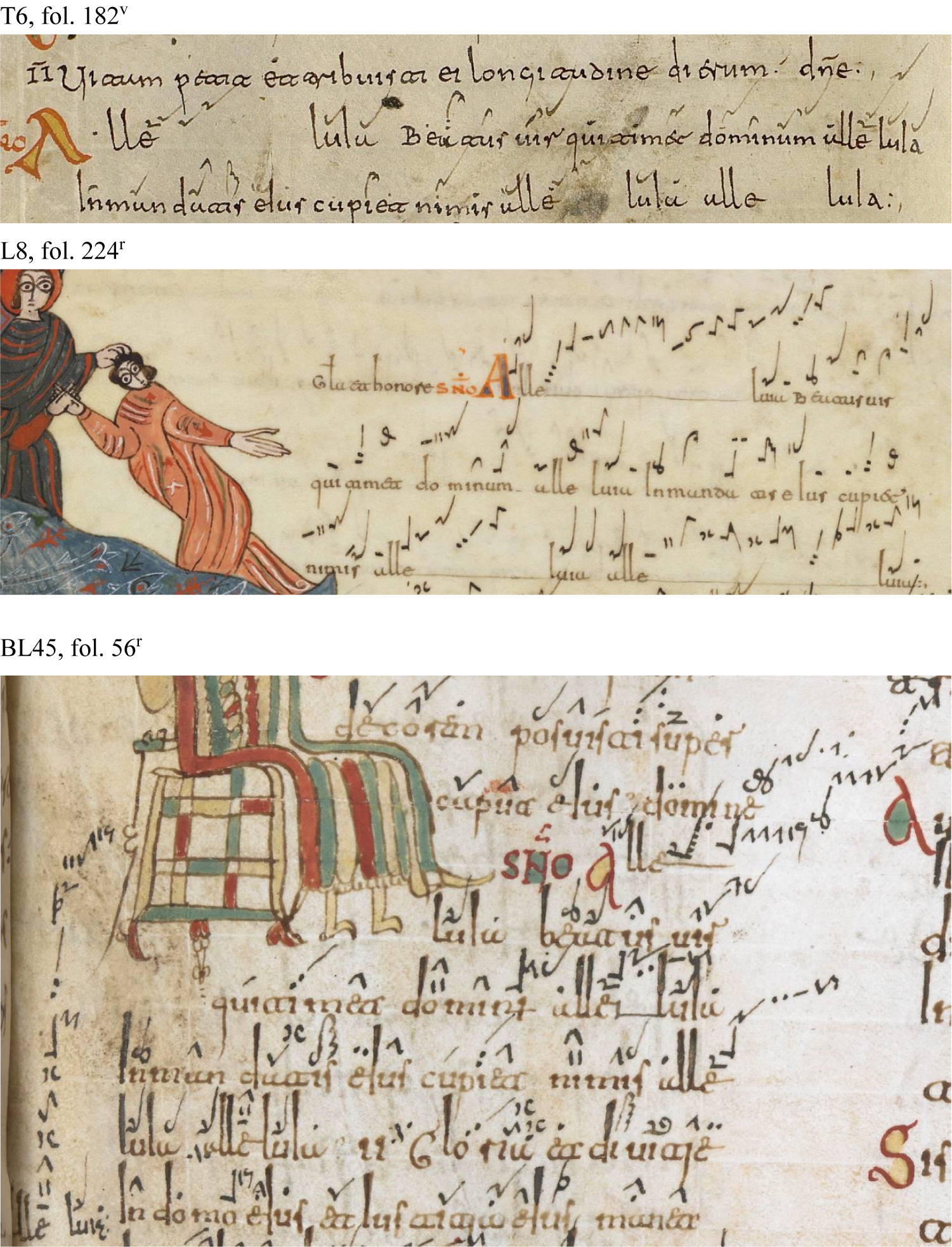
The remaining hands in the Rioja notational style are more difficult to place within the context of any particular dialect, because they notated too little material, there were no cadences to use as a point of comparison, or the melodies were stable across all traditions.Footnote 72 Hand 10 wrote unique versions of melodies for St Felix, making this hand difficult to contextualize, but expanding our understanding of the variation that was possible within the Old Hispanic corpus. In Felix qui pronus, L8 and BL45 have a relationship ratio of only 0.76, suggesting that they were distantly related.Footnote 73 T6 presents yet a third version of the melody, corresponding roughly equally to each (0.77 to L8 and 0.76 to BL45). For Felix qui ex abundantia, L8 and BL45 are closer to one another (0.85) than either is to T6 (0.76 and 0.75, respectively). The differences are most striking in Alleluia beatus vir, where L8 and BL45 have closely related melodies (0.92) yet T6 is very distantly related to both (0.66 and 0.65, respectively). Hand 10 evidently knew a much simpler and less varied version of this chant (Example 3). At points where L8 and BL45 have long melismas, T6 has only a short formula, NH-NH-NLH (e.g., Example 3, ‘Alleluia’, line 1). This neume combination often serves as a cadence in Old Hispanic chant and can also serve as a cadential element at the end of a longer melisma.Footnote 74 In T6, the same formula is repeated at the second alleluia, and a varied form of it, NH-NL-NLH, appears over the penultimate alleluia.Footnote 75 The chants notated by this scribe are therefore unlike other known versions and offer a more complete picture of the Old Hispanic repertoire. Partially notated manuscripts may be the best witnesses to this diversity. In the unstructured use of this manuscript, a scribe could write down their own version of a melody, without having to conform to the particular musical tradition of their exemplar.
Alleluia beatus vir.
The reasons for the presence of different scribes and melodic dialects are unclear. T6 may have travelled, with musical notation added in different locations. It is also possible that singers trained in different scripts and melodic dialects travelled to institutions where T6 was kept and added to the book there using their familiar styles. Nonetheless, the musical notation and melodies of T6 attest to the movement of people across Iberia.
Use of the Manuscript and Motivations for Writing
Previous scholarship on partially notated chant manuscripts has demonstrated how notation could serve as support for the oral tradition. Among other uses, neumes could serve as a point of reference for preparing the liturgy, provide visual input that helped to fix the chant in memory, or be used in teaching chant.Footnote 76 The presence of more fully notated liturgical books in tenth- and eleventh-century Iberia nonetheless attests to the widespread use of notation in this culture, raising the question of why T6 was so sparsely notated. One answer might lie in the needs of its private owners. In earlier generations, the private ownership of liturgical books by priests is attested in the Fourth Council of Toledo (633): each priest was to be given a liber officiale when being sent to a church.Footnote 77 If the initial owner of T6 was a celebrant who was not responsible for singing specialized genres of chant, he would have no need for a fully notated book. Alternatively, some owners of T6 may have resided in a community that possessed a fully notated book, leaving T6 as a resource for using neumes, as needed, to support memory, practise writing, or teach writing and singing. Thus, in contrast to books that were fully notated in the corporate context of a scriptorium, T6 invites us to consider notation from the perspective of ad hoc use. Each notated passage in T6 could have been written for a variety of reasons, and thus we cannot securely establish a single reason that each passage of musical notation was added. When considered together, however, the examples of notation can yield insights into plurality of the manuscript’s uses and the function of neumes in a culture with a strong oral tradition.
In the broader European contexts, scholars have proposed several compelling reasons for the use of partial notation. In some cases, neumes were written in places where a memory prompt would have been especially needed. In the Rheinau Sacramentary, for example, neumes were sparingly used to show where a prayer tone differed on usual and festal days.Footnote 78 In hymns, where each verse was sung with the same melody, scribes added a few neumes when a particular stanza required adjustment in the text-music relationship.Footnote 79 In cases where several chants open with the same words, singers may have needed to distinguish a particular chant from others with a similar text.Footnote 80
We can discern some of the same principles at work in T6. Hand 1, for example, notated only the opening of Angelus dei, and several other Old Hispanic chants begin with similar words.Footnote 81 Opening successive chants with the same words is, in fact, a particularly common rhetorical strategy in the Old Hispanic morning office. On the feast of St Felix, many chants begin with ‘Felix’ or ‘Felix qui’, and notation for five of these chants has been added by Hands 10, 11, and 12, perhaps to distinguish these chants from one another.
The neumes written at the end of the mass prayers may also have helped to ensure the correct delivery of the liturgy by reminding the priest which cadence should be used.Footnote 82 In studying the use of neumes in mass prayers in Franco-Roman manuscripts before 900, Susan Rankin has pointed out that these are among the most likely neumes to have been used ‘at the moment of delivery’, since priests read from a book.Footnote 83 Like our examples, the mass prayers Rankin examined are not fully notated. Rather, notation is used as needed to distinguish ferial and festal tones, or to show liquescences and other nuances. In the Old Hispanic tradition, it seems likely that there were multiple ways to close these prayers. By writing just a few neumes as an aide-memoire, a scribe could clarify which version of the cadence should be sung, ensuring the correct delivery of the liturgy.
T6 also seems to have been used for the practice and correction of writing, perhaps pointing to a pedagogical role. This possibility emerges in the self-correction and pen trials found among the work of Hands 2 and 5. Hand 2 shows a particular concern with the accurate representation of neumes on the folio. In a melisma of Doce nos (Figure 2, ‘rectam’, line 3), Hand 2 corrected an atypical neuming of the melody in the first melisma section. While the new version has the same melodic contour (NHL), Hand 2 presents a more conventional appearance of this sequence of neumes, employing a particular shape of NHL that signals the ends of melisma sections.Footnote 84 Perhaps the intention was that this special neume would help to convey the structure of the melisma and aid in melodic recall; alternatively, the scribe was merely practising correct ways of notating chant. It is therefore possible that the scribe was writing a memorized melody and experimenting with the best way to put it into writing. This correction may alternatively imply that the scribe was copying from an exemplar, which, in the example of Doce nos, they faithfully followed before later reflecting that these neumes were not the most appropriate means of communicating the musical content. Near the marginal melisma on fol. 45v, Hand 2 practised two different versions of the same melodic progression using different neumes, presumably in an attempt to determine which was the most visually or functionally appropriate.Footnote 85 The scribe may have had an exemplar in front of them but was uncertain about whether it reflected the best choice of neumes for a particular melody.
Hand 5 fully notated the hymn for John the Baptist, a rare occurrence in the extant Old Hispanic manuscripts. Hymns were widely used as pedagogical texts, specifically for their textual and syntactical structure.Footnote 86 Because of their structured and repetitive nature, hymns may also have been a useful means of practising musical notation. Hand 5 meticulously filled in every syllable of the hymn, even though each verse is sung with the same melody. To the side of the antiphon, they made a pen trial of a simple NH (Figure 5) which suggests that they could have been practising writing in blank spaces. Moreover, on the final line of the hymn, Hand 5 corrected their own notation, perhaps suggesting that they were later critiquing their own efforts. In combination with their meticulous filling in of all the unnotated chants at the start of the feast of John the Baptist, this might suggest that Hand 5 used the manuscript to practise writing notation.
Some examples of music writing may hint at a familiarity with different versions of a melody. Given the diversity of scribes in T6 and other Old Hispanic manuscripts, which attests to the movement of people, it is possible that scribes were indeed conscious of alternative melodies, even if not fully proficient in them. If so, writing may have helped them to remember their own version of the melodies, serving as a means of expressing and preserving their musical heritage. Alternatively, writing could help them to learn and remember the version of a new institution. In this respect, scribes’ habits help us to examine their personal knowledge of music and its notation. When a scribe notated a particularly unusual melody, as seen in the work of Hand 10, it may have been either to clarify the version of the melody they used or knew, or perhaps to preserve it in order to pass it on.Footnote 87 Even a melisma or cadence that differs from a well-established melody could have been reason enough to write out a chant. For example, Hand 8 notated the verse of the psalmus Edent pauperes (fol. 168v), perhaps in order to clarify his version of the two melismas that vary between manuscripts.Footnote 88 This clarification, which would undoubtedly be amplified by the scribe’s attention to notational detail, results in a chant which preserves the version of the melody best known to them, but perhaps not common practice in their institution. Interjections into another scribe’s work to fix or correct a melody may have been made for the same reason.Footnote 89 In Ne Timeas, Hand 4 added notation to ‘(tu)a ecce nas(cetur)’ prior to Hand 5 completing the rest of the chant. This is the only example in T6 of a scribe notating a few syllables in the middle of a chant, although it is much more common in some other manuscripts.Footnote 90 Here, notation may have been used to fix a moment of the chant with a particular melody, especially a cadence or complex melisma.
Hand 3 made a conscious decision to preserve a specific version of a melody by almost entirely erasing the previously written music. On fol. 45v (Memor fuit), they erased the notation that had already been written by Hand 2 (with the exception of the marginal melisma) and wrote a new version of the melody in its place. On some syllables, the melodic contour was not changed, although the specific notational shapes were (e.g., Hand 3 wrote a looped NHH in place of a gapped one on ‘misericordia’). In this example, the corrections carried out by the scribe not only preserve specific musical characteristics, but also notational ones. Their re-notation of the chant erases the León-esque notation of Hand 2 and gives the chant a distinctly more Rioja-like appearance and melody, thus representing Hand 3’s personal choices of notational and melodic nuance.Footnote 91 This kind of scribal work reminds us that studying a manuscript as the product of individuals, rather than as a unified project, offers greater insight into the object itself.
Motivations for writing might also have been determined by a particular scribe’s role within an institution. In a letter to Bishop Leudefredus, traditionally attributed to Isidore of Seville but possibly from the late seventh century, the author implies that a specialized singer, the psalmist, was responsible for certain chant genres within the Old Hispanic office.Footnote 92 That similar roles continued to exist in the tenth and eleventh centuries is suggested by the notation of soloists’ chants in another Old Hispanic manuscript, Silos 6.Footnote 93 One of T6’s scribes, Hand 3, wrote four psalmi, two praelegenda and a laudes, a sacrificium and a sono (Appendix 1). Of the nine chants notated by this scribe, seven belong to elaborate genres which are defined in the letter to Leudefredus as being the purview of specialist singers.Footnote 94 Hand 3’s focus on particular chant genres, especially the psalmi, suggests that they engaged with chants that were relevant to their personal use, possibly informing us of their liturgical responsibilities. If so, Hand 3’s work tells us that at least one specialist singer was trained in writing musical notation. Perhaps they were notating to help them to remember the complex melodies needed to perform their duties, perhaps they were notating to preserve their own version or another version that they had heard elsewhere and particularly admired. Their role may also have encompassed the responsibility of teaching complicated melodies to others. If so, the notation may have functioned as a pedagogical tool for passing on a particular version of a melody.
While each person’s reason for using a manuscript could differ, it is likely that its ease of use was important to all. In the original composition of many liturgical manuscripts, we can see evidence of this in a folio’s palaeographical features. Rubrics and different sizes of text (e.g., smaller for chants than for readings and prayers) help the reader instantly to identify the nature of a liturgical item. Musical notation can also add to the functionality of a manuscript beyond serving as a reminder of melody. For example, musical notation can highlight a particular moment in the manuscript, drawing the user’s attention.Footnote 95 One such example is the notation of part of a responsory by Hand 7 (Figure 7). This scribe notated only the opening syllables and the first neume of the verse. Of particular interest here is the neume at the beginning of the verse. Don Randel identified different verse tones in the Old Hispanic responsories, each with specific notational and melodic characteristics, some of which distinguish the León and Rioja dialect.Footnote 96 On this basis, one might assume that neumes at this position in a chant might pinpoint the dialect or verse tone being used. However, the neume used by this scribe is used at the start of both the León and the Rioja versions of Randel’s Tone A and Tone B. It does not, therefore, contain enough information about what should be sung to distinguish between the different notational dialects. Perhaps its function was instead to draw the eye of the user to the start of the verse, a moment which is otherwise easy to miss. As such, it serves as a visual cue to the reader, ensuring they can see where the verse begins and prompting them to pay attention to this moment.
As Eduardo Aubert has argued, partial notation can also highlight important moments by aiding in the ‘mise-en-page’, in a similar way to ornamentation and decoration.Footnote 97 In Albi 44, a late ninth- or early tenth-century manuscript preserving Gregorian chant, Aubert found that the first chant of a formulary often had notation, emphasising the start of a feast. Many of the scribes of T6 also notate the first chant(s) of a feast, though not always in full. For example, Hand 13 notates the first line of a vespertinus, the first chant of the liturgical day (Figure 13).Footnote 98 This chant is written at the bottom of the folio – the last location which the eyes turn to in scripts read left-to-right and top-to-bottom – and could easily be missed. Hand 13 may have been drawing attention to an otherwise understated moment, making it easier to find. Notating the first chant of a feast may also have helped decorate the page, imprinting a memory of the feast into the mind of the reader, in the same way that a beautiful illumination leaves a lasting impression. Some incipits, however, might not have been substantial enough to do either of these things; Hand 1 notates the first few syllables of Angelus dei (Figure 1) with very small neumes, hardly an attention-grabbing flourish that would draw attention to a new feast. It is neither particularly memorable nor likely to have left a lasting impression. Perhaps for Hand 1, the musical notation at the start of the feast was not to aid in the use of the manuscript, but rather to aid the scribe in remembering the opening phrase of the chant and the melody that followed.
While notating the first chants of a feast can seem like a way of making a manuscript more functional, the partial notation of T6 and the inconsistency with which the start of feasts were notated demonstrates that the manuscript was functional with or without this feature. Why notate one vespertinus but not the next one if it was so integral to the use of the manuscript? Clearly, some users were only concerned with one particular feast at a time. Even within the work of a single hand in a single feast, it is possible to discern a multiplicity of possible reasons for notating a chant. This makes it difficult to determine the scribe’s original motivations and implies that some scribes wrote for a variety of reasons.
The work of Hand 4 evinces a complex interplay of knowledge, copying, and memory, each employed by the scribe for a different purpose at different moments. This hand notated chants across only a few folios (fols. 123v–125r) for the feast of John the Baptist: a vespertinus, a sono verse, a psallendum, one short antiphon, and two sections of other antiphons. Beginning the feast for the nativity of John the Baptist by notating the opening chant (the vespertinus Lucerna pedibus), the intention could have been to emphasize the start of the feast. In some manuscripts, a scribe might also notate the start of a feast to set up the page for another scribe to complete it.Footnote 99 However, as this hand completed an assortment of chants throughout the feast, this seems unlikely. Rather, Hand 4 seems to have notated particular chants that were of interest to them. It is also possible that Hand 4 notated the vespertinus so that the user could quickly distinguish it from chants with the same text used in other feasts and genres, for example, the alleluiaticus beginning with the same text in Lent, or the use of the text as the biblical verse for two hymns for John the Baptist (Hic Iohannes and Puer hic sonat Iohannes).
The next contribution of Hand 4 is not the beginning of the following sono, as one might expect if assuming this scribe’s intention was to mark the beginning of a feast or set up the folio for someone else, but rather, its verse. This verse neither shares its text with other chants nor is its melody especially unique in comparison to BL45 or L8.Footnote 100 Based on palaeographical evidence, it appears Hand 4 notated prior to Hand 5 (the scribe who later filled in the first section of the sono) and it is unclear why they did not notate the initial section of the chant.Footnote 101 Perhaps the scribe was notating this section of the chant to clarify the way it should be sung in this institution (as also seen in their fixing of ‘(tu)a ecce nas(cetur)’ above), perhaps notating the melodies they were more familiar with, or perhaps copying from a partially notated exemplar – but these are merely speculations.
Hand 4’s reasons for writing are likely to have been multifaceted. This scribe did not intend to notate the whole of this feast, which demonstrates that Hand 4 did not see this manuscript as a place to preserve all melodies in their entirety. Rather, they used notation in an ad hoc way, to mark important moments, to notate a particular melody, or to distinguish between repeated texts. Similar in some respects to a modern score marked up by performers, Hand 4’s ad hoc use of notation affords us a glimpse into the processes and priorities of a singer-scribe preparing a particular feast.
Concluding Thoughts
In comparison to the fully notated books that are studied more often in chant scholarship, partially notated manuscripts such as T6 give different kinds of insights into the practices of music writing. T6 had multiple users who knew different versions of the melodic tradition and almost certainly came from both the Rioja and the León regions. In one case, our manuscript preserved melodies that are not found elsewhere in the extant Old Hispanic sources. The Old Hispanic tradition is preserved in relatively few surviving manuscripts. In this respect, then, T6 also expands our understanding of the melodic tradition and its variability. The owners of T6 had different roles in the performance of the liturgy. Although it is doubtful that its original owner was a specialized singer, T6 was probably later used by at least one soloist, who added notation for some of the most elaborate types of chant in order to remember them or teach them to others. Another user of T6 wrote a type of notation that is witnessed with certainty only in Toledo. This scribe added notation only to mass prayers, not chants, indicating that he was most likely a celebrant. Others used the manuscript to practise writing, perhaps indicating that they were teachers and/or students. T6 thus sheds new light on the ad hoc uses of notation in early medieval Iberia.
Appendix 1. Contents of the Manuscript
| Hand | Chant | Folio | Genre | Service | Feast |
|---|---|---|---|---|---|
| 1 | Angelus dei descendit | 28r | Sono | Vespers | Octave of Easter |
| 2 | Omnis populis
|
33r | Sacrificium (verse, first few words only) | Mass | |
| 3 | Ego dormivi
|
39r | Psalmus (start only) | Mass | Sunday after the Octave of Easter |
| 2 | Memor fuit | 45v | Psalmus (original/erased version) | Mass | Second Sunday after the Octave of Easter |
| 3 | Memor fuit | 45v | Psalmus | ||
| 2 |
Doce nos | 102r | Sono | Vespers | Apostolic Litanies |
| Munda nos | 102r | Antiphon | |||
| Dabo vobis | 102r | Alleluiaticus | |||
| 3 |
Dum conplerentur | 107r | Praelegendum | Mass | Pentecost |
| Redde mihi | 108v | Psalmus | |||
| 4 | Lucerna
|
123v | Vespertinus | Vespers | Birth of John the Baptist |
| 5 | Haec dicit | 123v | Sono | ||
| 4 | Haec dicit (verse: Propheta) | 123v | Sono (verse only) | ||
| 5 | Apparuit angelus | 123v | Antiphon | ||
| Ne timeas | 123v | Antiphon | |||
| 4 | Ne timeas | 123v | Antiphon (a few neumes) | ||
| 5 | Angelus domini | 124r | Alleluiaticus | ||
| Puer hic | 124r | Hymn | |||
| 4 |
Ponam te | 124v | Psallendum | ||
| Gloria mea deus | 125r | Antiphon | Matutinum | ||
| Zaccarias sacerdos | 125r | Antiphon | |||
| 3 |
Floruit terra | 132r | Praelegendum | Mass | |
| Tu es domine
|
133r | Psalmus | |||
| Alleluia loquebar | 135v | Laudes | |||
| Sacerdos Zaccarias
|
135v | Sacrificium | |||
| Alleluia in omnem | 140r | Sono (start only) | Vespers | Saints Peter and Paul | |
| 6 | Alleluia iustitia | 151v | Sono | Vespers | Saints Iusta and Rufina |
| 7 | Acceperunt prudentes | 153v | Responsory (a few neumes only) | Matutinum | |
| 8 | In locum | 167v | Alleluiaticus | Matutinum | Primitis |
| Edent pauperes
(verse: Remiscentur) |
168v | Psalmus (verse only) | Mass | ||
| 9 | Edent pauperes | 168v | Psalmus (first section only) | ||
| 10 | Alleluia beatus vir | 182v | Sono | Vespers | Saint Felix |
| Felix qui pronus | 182v | Antiphon | |||
| Felix qui ex abundantia | 182v | Alleluiaticus | |||
| 11 | Felix qui non abuit | 183v | Antiphon | Matutinum | |
| 12 | Felix qui potuit | 184r | Alleluiaticus | ||
| 10 | Felix quia deiecisti | 184v | Responsory (incipit) | ||
| 13 | Preceptum domini
|
192r | Vespertinus (first line only) | Vespers | Saints Iustus and Pastor |
Appendix 2. Palaeography of Specific Notational Shapes in Each Hand
Appendix 3. Cadences that are Indicators of Dialect
| Hand | Folio | Dialect | Chant | Word(s) | T6 | L8 | A30 | BL45 | T4 | T5 |
|---|---|---|---|---|---|---|---|---|---|---|
| 2 | 102r | Possible León | Doce nos (Sono) | Domine | NH+NL+N | NH+NL+N | ||||
| 2 | 102r | Possible León | Dabo vobis (Alleluiaticus) | Dominus | NH+NL+N | NH+NL+N | ||||
| 3 | 39r | Rioja | Ego dormivi (Psalmus) | Quieve | …L+NHL+N | …L+NHH+N | …L+NH+NL | …H+NLL-NS-NHLH+N | ||
| 3 | 45v | N+N | Memor fuit (Psalmus) | Dominus | …L+N+N | …L+NHH+N | …L+N+NH | |||
| 3 | 45v | N+N | Memor fuit (Psalmus) | Gentium | …L+N+N | …L+NHH+N | …L+N+N | |||
| 3 | 107v | Possible León | Dum conplerentur (Praelegendum) | Conplerentur | …N+NHH+N | …N+NHH+N | …N+NH+N | |||
| 3 | 108v | Rioja | Redde mihi (Psalmus) | Letitiam | …H+NHL+NH | …L+NHH+N | …L+N+NH | |||
| 3 | 132r | N+N | Floruit Terra (Praelegendum) | Alleluia | …L+N+N+N | …L+NHH+N | …L+NHH+N | …L+N+N | ||
| 3 | 133r | Rioja | Tu es domine (Psalmus) | Domine | N+NHL+N | NH+NL+N | N+NHL+N | N+N+N | ||
| 3 | 133r | Not León | Tu es domine (Psalmus) | Matris me | …L+NH+N | …L+NHH+N | …L+N+N | …H+N+N | ||
| 3 | 133r | Rioja | Tu es domine (Psalmus) | Iactatus sum | N+NHL+N | N+NHH+N | N+NHL+N | NHL+NHH+N | ||
| 3 | 135v | Rioja | Alleluia Loquebar (Laudes) | Regum | …L+NHL+N | …L+NHH+N | …L+NHL+N | …L+NHL+N (in both versions) | ||
| 3 | 140r | N+N | Alleluia in omnem (Sono) | Alleluia | …L+N+N | …L+NHH+N | …L+NHH+N | …L+N+N | ||
| 4 | 123v | León | Lucerna (Vespertinus) | Meis | …L+NHH+N | …L+NHH+N | …L+NHL+N | |||
| 4 | 124v | León | Ponam te (Psallendum) | Alleluia | NHH+NL+N | NHH+NL+N | NS+NHL+NL | |||
| 4 | 125r | León | Gloria mea (Antiphon) | Deus | …L+NHH+N | …L+NHH+N (in both instances_ | …L+NH+N | |||
| 5 | 123v | León | Haec dicit (Sono) | Dominus | NH+NL+N | NH+NL+N | N+NHL+N | N+N+N | ||
| 5 | 123v | León | Haec dicit (Sono) | Nouite | …L+NHH+NH | …L+NHH+NH | …L+N+NH | |||
| 5 | 123v | León | Apparuit angelus (Antiphon) | Deprecatio tua | …L+NHH+N | …L+NHH+N | …L+NHL+N | |||
| 5 | 123v | León | Apparuit angelus (Antiphon) | Domino | NH+NL+N | NH+NL+N | N+NHL+N | |||
| 5 | 124r | León | Angelus domini (Alleluiaticus) | Filium | NH+NL+N | NH+NL+N | N+NHL+N | |||
| 8 | 167v | León | In locum (Alleluiaticus) | Dominus | NH+NL+NH | NH+NL+NL | NHL+NL+N | |||
| 8 | 167v | León | In locum (Alleluiaticus) | Primitias | NH+NL+NH | NH+NL+NH | N+N+NH |
Appendix 4. Relationship Ratios
| Hand | Chant | Folio | Relationship with L8 | Relationship with BL45 | Relationship between L8 and BL45 | Relationship with other tradition A manuscripts | Relationship with other tradition B manuscripts |
|---|---|---|---|---|---|---|---|
| 1 | Angelus dei descendit | 28r | 0.91 | T4: 0.67 | |||
| 2 | Omnis populis
|
33r | 0.96 | ||||
| Doce nos | 102r | 0.96 | |||||
| Munda nos | 102r | 0.99 | |||||
| Dabo vobis | 102r | 0.99 | |||||
| 3 | Ego dormivi
|
39r | 0.94 | T4: 0.85 | T5: 0.42 | ||
| Memor fuit | 45v | 0.81 | |||||
| Dum conplerentur | 107r | 0.92 | T4: 0.88 | ||||
| Redde mihi | 108v | 0.81 | T4: 0.79 | ||||
| Floruit terra | 132r | 0.8 | 0.81 | 0.82 | MSC: 0.71 | ||
| Tu es domine
|
133r | 0.84 | 0.84 | 0.83 | MSC: 0.67 | ||
| Alleluia loquebar | 135v | 0.85 | fol. 21v: 0.91 fol. 115r: 0.86 |
fol. 21v: 0.8 fol. 115r: 0.81 |
A30: 0.72 | ||
| Sacerdos Zaccarias
|
135v | 0.82 | 0.83 | 0.88 | MSC: 0.74 | ||
| Alleluia in omnem | 140r | 0.9 | 0.87 | 0.89 | MSC: 0.61 | ||
| 4 | Lucerna
|
123v | 0.96 | 0.83 | 0.83 | ||
| Haec dicit
(verse: Propheta)Footnote 102 |
123v | 0.95 | 0.92 | 0.94 | MSC: 0.8 | ||
| Ne timeas
(few syllables only) |
125r | 0.86 | 1 | 1 | |||
| Ponam te | 124v | 0.89 | 0.78 | 0.82 | |||
| Gloria mea deus | 125r | Both occurrences: 1 | Silos 3 (6 notes only): 0.75 T4: 0.94 |
||||
| Zaccarias sacerdos | 125r | 0.86 | 0.8 | 0.94 | |||
| 5 | Haec dicit | 123v | 0.99 | 0.93 | 0.91 | MSC: 0.78 | |
| Apparuit angelus | 123v | 0.99 | 0.91 | 0.93 | |||
| Ne timeas | 123v | 0.99 | 0.95 | 0.92 | |||
| Angelus domini | 124r | 0.98 | 0.9 | 0.9 | |||
| Puer hic Footnote 103 | 124r | BL51: 0.78 BN01: 0.74 |
|||||
| 6 | Alleluia iustitia | 151v | 0.89 | 0.89 | 0.87 | A30: 0.9 BL51: 0.92 Silos 3: 0.92 Silos 6: 0.9 |
|
| 7 | Acceperunt prudentes | 153v | 0.71 | 0.73 | 0.97 | Sal: 0.71 Silos 6 (León Hand): 0.71 BL51: 0.73 Silos 3: 0.6 |
|
| 8 | In locum
|
167v | 0.96 | 0.89 | 0.92 | ||
| Edent pauperes
(verse: Remiscentur) |
168v | 0.96 | 0.78 | 0.82 | |||
| 9 | Edent pauperes | 168v | 0.98 | 0.96 | 0.95 | ||
| 10 | Alleluia beatus vir | 182v | 0.66 | 0.65 | 0.92 | ||
| Felix qui pronus | 182v | 0.77 | 0.74 | 0.76 | |||
| Felix qui ex abundantia | 182v | 0.76 | 0.75 | 0.85 | |||
| Felix quia deiecisti | 184v | 0.9 | 0.82 | 0.83 | |||
| 11 | Felix qui non abuit | 183v | 0.97 | 0.84 | 0.85 | ||
| 12 | Felix qui potuit | 184r | 0.84 | 0.88 | 0.89 | ||
| 13 | Preceptum domini | 192r | 0.86 | 0.89 | 0.97 |


 Open access

