


Urarina (ISO 639-3, code ura – Lewis, Simons & Fennig Reference Lewis, Paul, Gary and Charles Fennig2016) is an Amazonian language isolate spoken in the Loreto Region of Peru. Most Urarina communities are located on the banks of the rivers Corrientes, Chambira and Urituyacu, which are tributaries of the Marañon River, which in turn is the mainstem source of the Amazon River. Figure 1 shows the map of Peru and the location of the Urarina territory.
Urarina territory in Peru.

The Urarina language has about 3000 speakers and it is considered to be in vigorous use. The language is used in all communicative contexts in Urarina communities. Children actively learn the language. When boys are about eight years old, they start learning Spanish at school. Women are not encouraged to learn Spanish or to interact with foreigners or men outside their families. In recent years, the Peruvian government has recognized an official alphabet for the language and is investing in the creation of educational materials for Urarina communities.
Linguistically, in spite of being a language isolate, Urarina shares properties with other Amazonian languages: nasal vowels, an unmarked CV syllable pattern, a richer morphology in verbs than in nouns, polysynthetic agglutinative morphology, among others (see Loukotka Reference Loukotka1968; Derbyshire & Pullum Reference Derbyshire and Geoffrey1986; Greenberg Reference Greenberg and Joseph1987; Payne Reference Payne1990; Dixon & Aikhenvald Reference Dixon and Alexandra1999; Wise Reference Wise1999; Aikhenvald Reference Aikhenvald and Alexandra2010 for a comprehensive survey of different linguistic features found in Amazonian languages). Some of the most outstanding characteristics of Urarina are: (i) a canonical OVS word order (Olawsky Reference Olawsky and Knut2006), (ii) a phonological opposition between apical-dental and apical-alveolar consonants, (iii) a phonological opposition between an unrounded back vowel and an unrounded central vowel, and (iv) a rare prosodic system in which object nouns control the location of high pitch in adjacent verbs. In addition to the relatively recent work carried out by Olawsky (Reference Olawsky and Knut2006) on the grammar of Urarina, other important studies concerning its phonetics and phonology include Manus (Reference Manus1977); Cajas & Gualdieri (Reference Cajas and Cecilia1987); Gualdieri (Reference Gualdieri2009). In the coming sections, we outline Urarina’s segmental inventory, the behavior of its high pitch in verb phrases and we provide a transcription of the recording of the Urarina version of the story ‘The North Wind and the Sun’.
The examples we present in this article come from data collected in 2015 and 2018 from ten native speakers from the community of Nueva Esperanza in the Upper Chambira area. All participants interviewed were male speakers since Urarina women are not easily allowed to interact with people outside their family and community. In Table 1, we present the gender, age and degree of education of each participant. The data shown in this article come from words and phrases elicited in isolation as well as from the story of the North Wind and the Sun told in Urarina. In order to elicit words in isolation, each participant was asked what was the Urarina for a particular word given in Spanish. When the participant felt confident about having identified the equivalent word in Urarina, he was asked to create a phrase that contained that word. The participant was then recorded uttering first the word in isolation followed by a pause and then the phrase containing the word. In the section of consonants and vowels, we only present data from the words uttered in isolation. For the section on prosody, we use a different set of phrases in which we control the number of syllables in the verbs and nouns, the type of nouns, and as much as possible, ensure that every segment in the phrase is voiced. The data was recorded in PCM WAV format at a sampling frequency of 44100 Hz using a Zoom H4n digital recorder and a head-worn SHURE WH30XLR cardioid condenser microphone with a frequency response of 40 Hz and was analyze using Praat (Boersma & Weenink Reference Boersma and David2019).
Language consultant’s information.

Consonants
Urarina distinguishes thirteen consonants distributed along six places and five manners of articulation. In the chart below, we use the subscript bridge diacritic for the apical-dental consonants and the subscript turned bridge diacritic for the voiced apical-alveolar plosive. As a convention to increase the readability of the data, we only use the diacritic for the apical-alveolar /d̺/. For the other dental sounds, we represent them without their diacritic unless we discuss their apical-dental nature. Another convention concerns vowels that follow nasal consonants. They surface nasalized. In addition, Urarina also has underlyingly nasal vowels. We transcribe both types of nasalization in the phonetic representations using the tilde diacritic [͂].Footnote 1


The voiceless plosives /t/ and /k/, and sometimes the lateral consonant /l/, are realized with pre-aspiration: [ht], [hk] and [ɦl]. Thus, for instance, the words /atane/ ‘soil’ and /ebɯkɨ/ ‘bone’ are realized as [ahtanẽ] and [ebɯhkɨ]. The realization of the word /elɯ/ ‘rain’ is more frequently realized as [elɯ], with no pre-aspiration. However, in spite of /l/ not being a voiceless plosive, it can occur sometimes pre-aspirated: [elɦɯ]. Quite often aspiration develops into a fricative that shares the voice and point of articulation of the following consonant. It is not rare to find that pre-aspiration actually starts as laryngeal friction and then, as it approaches the following consonant a concomitant fricative is created. A similar phenomenon has been reported for Huariapano (a Panoan language) by Parker (Reference Parker1994). Thus, the pre-aspiration of [t] in Urarina could sound more like [hs]; and the pre-aspiration of [k], more like [hx]. We represent the presence of pre-aspiration with the superscripted [h] and [ɦ] symbols and leave out all the details of assimilation of place of articulation to the following consonant since how much of the pre-aspiration develops into friction in the oral cavity can vary substantially among speakers and even within the pronunciation of a single speaker.
The spectrograms in Figure 2 and Figure 3 show the realizations of the words /atane/ ‘soil’ and /ebɯkɨ/ ‘bone’. In a very narrow phonetic transcription, their pre-aspirations would be transcribed as [hs] and [hx], as in [ahstanẽ] and [ebɯhxkɨ], respectively. The spectrogram in Figure 4 illustrates the realization of the word /elɯ/ ‘rain’ with pre-aspiration: [eɦlɯ]. Observe that in this case, the phonetic realization of pre-aspiration is voiced in order to agree with the voicing of the lateral consonant.
Spectrogram illustrating a voiceless dental plosive /t/ realized with pre-aspiration, [ht], in the word [ahtanẽ] ‘soil’ (underlying representation: /atane/).

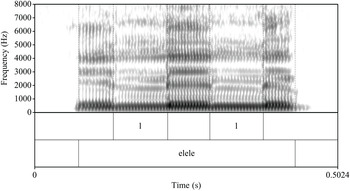
Figure 5 shows a spectrogram of the phonetic realization of /elele/ ‘shebón’ (sp. of palm tree) and is presented as evidence that in general laterals are not pre-aspirated in Urarina.
Pre-aspiration never occurs with fricatives, voiced obstruents or nasals. The phenomenon of pre-aspiration is an important test in Urarina to distinguish between underlying /t/ and /d/ since the voiced dental plosive can also be realized as a voiceless plosive: [t]. However, only those instances of [t] that come from the underlying voiceless plosive /t/ have the option of appearing pre-aspirated. Pre-aspiration never occurs word-initially, either. For instance, the words /takaː/ ‘(it) collides’ and /katɨ/ ‘tooth’, shown in (2), can be realized as [tahkaː] and [kahtɨ], respectively, with pre-aspiration associated with the intervocalic plosive, but never with pre-aspiration associated with the word-initial plosive: *[htahkaː], *[hkahtɨ].
Spectrogram illustrating a voiceless velar /k/ realized with pre-aspiration, [hk], in the word [ebɯhkɨ] ‘bone’ (underlying representation: /ebɯkɨ/).

Spectrogram illustrating a dental lateral /l/ realized with pre-aspiration, [ɦl], in the word [eɦlɯ] ‘rain’ (underlying representation: /elɯ/).

The voiceless dental plosive /t/ shows a different behavior with regard to pre-aspiration than the voiceless velar plosive /k/. Take, for example, the phonetic realizations [dahka] ‘wife’s brother’ and [ebɯhkɨ] ‘bone’. In those words, the velar plosive occurs as the onset of the second syllable in the former, and as the onset of the third syllable in the latter. In both cases, the velar appears pre-aspirated. This is not the case of the voiceless dental plosive. While those /t/ that occur in second syllables surface with pre-aspiration, those /t/ that occur in third syllables of words do not. The data in (1) show cases in which /t/ is realized pre-aspirated in second syllables, and the data in (2) show cases where /t/ surfaces with no pre-aspiration in third syllables.
Spectrogram illustrating a dental lateral /l/ realized with no pre-aspiration in the word [elele] ‘shebón’ (sp. of palm tree).

(1) Pre-aspiration of /t/ in second syllables

(2) No pre-aspiration of /t/ in third syllables


The phonetic realization of the word /enɯtɯ/ ‘sun’ is shown in the spectrogram of Figure 6. Observe that voiceless dental plosive, which this time appears as the onset of the third syllable of the word, lacks pre-aspiration. Compare it to the pre-aspirated [ht] in Figure 2 that occurs as the onset of the word-second syllable. While pre-aspiration is a characteristic phenomenon of Urarina, the language does not show aspiration following consonants. However, there is a strong tendency to add aspiration at the end of phrases and words uttered in isolation, after the final vowel. This phenomenon can be observed in most of the spectrograms presented in this study.
Spectrogram illustrating the plosive /t/ realized with no pre-aspiration in the third syllable of [enɯ̃tɯ] ‘sun’ (underlying representation /enɯtɯ/).

The consonants /t̪ d̪ s̪ n̪ l̪/ are dental. This is evidenced in Figure 7 in which a photogram of an Urarina speaker realizing the voiceless dental plosive /t̪/ phoneme, as part of the word [t̪aɦe] ‘egg’, shows the tongue appearing behind the upper teeth.
Photogram illustrating the tongue in contact with the upper teeth in the realization of the apical-dental plosive /t̪/ in the word [t̪aɦe] ‘egg’ (underlying representation: /t̪ahe/).

The dental nature of the consonants /t̪ d̪ s̪ n̪ l̪/ can also be observed through palatograms. For instance, Figure 8 shows the palatograms of the consonant /t̪/ realized in the word [t̪aɦe] ‘egg’ and /n̪/, in the word [n̪ãː] ‘(he) said’. The painted areas in the palatogram represent the location in the upper zone of the vocal tract that was in contact with the tongue. In both palatograms, the upper teeth appear stained by the contact with the tongue.
In Urarina, the apical-dental /d̪/ opposes the apical-alveolar /d̺/. This rare type of phonological opposition, however, is only found in very few minimal pairs in Urarina like those shown in the data in (3). Moreover, the voiced apical-dental plosive /d̪/ has a very low frequency of occurrence in the Urarina lexicon. In a small database of 2853 Urarina consonants coming from different words, we found that 15.6% were apical-alveolar /d̺/, and only 1.8% correspond to the apical-dental phoneme /d̪/.
Palatograms illustrating the dental plosive /t̪/ (left) realized in the word [t̪aɦe] ‘egg’ (underlying representation: /t̪ahe/); and the dental nasal /n̪/ (right), in the word [n̪ãː] ‘(he) said’ (underlying representation: /n̪aː/).

(3) Minimal pairs: Apical-dental /d̪/ vs. apical-alveolar /d̺/

In the paragraphs above, we have presented evidence that /d̪/ is dental. Now we present evidence that /d̺/ is alveolar. Figure 9 shows a set of palatograms of the apical-dental /d̪/ phoneme realized in the word [had̪e] (basketlike quiver for storing darts) and another for the apical-alveolar /d̺/ in the word [had̺eː] ‘chapo’ (type of drink). With regard to the apical-dental /d̪/, we observe the same behavior shown for /t̪/ in Figure 8: in their realization, the tongue touches the upper teeth (see palatogram on the upper left-hand side). In contrast, the palatogram of the realization of the apical-alveolar /d̺/ clearly shows that the stained area corresponds to the zone immediately behind the upper teeth, that is, the alveolar ridge.
Palatograms illustrating the apical-dental plosive /d̪/ (left) realized in the word [had̪e] (basketlike quiver for storing darts); and the apical-alveolar /d̺/ (right), in the word [had̺eː] ‘chapo’ (type of drink).

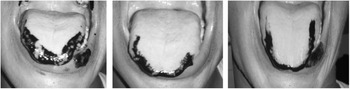
While we have provided evidence that indicates that the phoneme /d̪/ is dental; and /d̺/, alveolar, we have not presented any indication so far that the tip of the tongue is involved in their articulation. Evidence for this claim comes from linguograms, whose painted areas represent the part of the tongue in contact with a passive articulator. Figure 10 presents three linguograms: while the first one has the blade of the tongue stained, the other two have the tip and the front edge around it stained. The first two linguograms correspond to the realization of the apical-dental /d̪/. In general, for dental consonants, Urarina speakers tend to articulate them apical, although, sometimes it is possible to find laminal realizations. The first linguogram shows /d̪/ realized as a laminal-dental [d̻] and the second one shows it realized as an apical-dental [d̪]. With regard to the apical-alveolar /d̺/, Urarina speakers are consistent in realizing it only with the tip of the tongue. This is shown in the third linguogram in Figure 10.
Linguograms illustrating the realization of the apical-dental plosive /d̪/ as a laminal-dental [d̻] (leftmost one) in the word [d̻ae] ‘maternal grandmother’ (underlying representation: /d̪ae/), and also as an apical-dental [d̪] (middle one) in the word [had̪e] (basketlike quiver for storing darts). Linguogram illustrating the realization of /d̺/ as an the apical-alveolar (rightmost one) in the word [had̺eː] ‘chapo’ (type of drink).

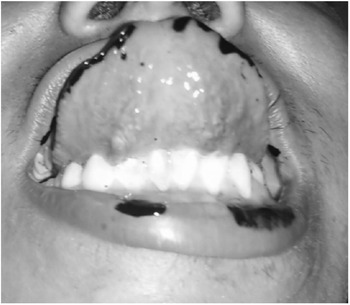
Figure 11 presents the underside of the tongue in the realization of the apical-alveolar /d̺/ in [had̺eː] ‘chapo’ (type of drink). Although there are some minor stains created by the dye dripping from the front edge into the underside of the tongue, the area mostly remains unstained showing that the tongue does not curve up during the realization of /d̺/. As shown by the linguogram of the apical-alveolar in Figure 9, it is the upper side of the tongue the one that undergoes the contact. Both pieces of evidence together show that the apical-alveolar /d̺/ is not a retroflex consonant.
Linguogram illustrating the underside of the tongue after the articulation of the apical-alveolar /d̺/ in the word [had̺eː] ‘chapo’ (type of drink).

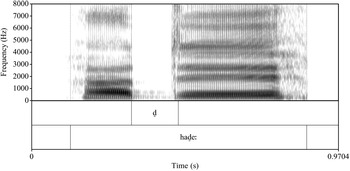
Both the voiced apical-dental plosive /d̪/ and the voiced apical-alveolar plosive /d̺/ are usually realized with a voiced closure phase that lasts between 60 ms and 100 ms followed by a burst word-initially and intervocalically. This type of duration is evidence that /d̺/ is neither a tap nor a flap consonant. A closure phase that long cannot be maintained during the articulation of a tap or flap. The spectrogram in Figure 12 displays the realization of the apical-dental plosive /d̪/ and the one in Figure 13, that of the apical-alveolar plosive /d̺/ as they occur in the words [d̪ahka] ‘wife’s brother’ and [d̺ahka] ‘yesterday’. The long closure phase occurs simultaneously with the voice bar indicating both segments are voiced stops. In the case of [d̪] sound, the following vowel begins immediately after that burst. In contrast, in the case of the apical-alveolar [d̺] sound, there is usually about 20 ms of friction after the burst and before the beginning of the following vowel.
Spectrogram illustrating a voiced apical-dental plosive /d̪/ realized in the word [d̪ahka] ‘wife’s brother’ (underlying representation: /d̪aka/).

Spectrogram illustrating a voiced apical-alveolar plosive /d̺/ realized in the word [d̺ahka] ‘yesterday’ (underlying representation: /d̺aka/).

The apical-alveolar /d̺/ has an approximant allophone, [ɹ̺]. Its distribution is restricted to intervocalic environments. It never occurs in syllables associated with a high pitch, and it freely alternates with [d̺] in syllables that do not have a high pitch. The spectrogram in Figure 14 shows the realization of [had̺eː] ‘chapo’ (type of drink) in which /d̺/ is realized as an apical-alveolar [d̺], and the spectrogram in Figure 15 shows [eɹ̺enẽ] ‘oil’, where /d̺/ occurs as an approximant, [ɹ̺].
Spectrogram illustrating the realization of the voiced apical-alveolar plosive /d̺/ intervocalically as it appears in the word [had̺eː] ‘chapo’ (type of drink).

Spectrogram illustrating the realization of the voiced apical-alveolar plosive /d̺/ realized as an approximant [ɹ̺] in an intervocalic context as it appears in the word [eɹ̺enẽ] ‘oil’ (underlying representation: /ed̺ene/).

As shown in (1), Urarina also has four voiceless fricatives: /ɸw s ʃ h/. they tend to appear voiced or partly voiced in intervocalic contexts. The voiceless postalveolar fricative /ʃ/ has a very low occurrence in the Urarina lexicon. Olawsky (2006: 38) reports that /ʃ/ occurs mostly in loanwords and only in a handful of native words. In the data that we collected, on the rare occasions where this fricative appears, we observe that it has a tendency to be realized as palatalized: [ʃj]. Thus, the initial fricative in a word like /ʃabẽtɯ/ ‘ice-cream bean’ (type of fruit) can occur with some degree of palatalization: [ʃjabẽtɯ]. Although less frequent, the postalveolar fricative can also occur as a palatalized laryngeal fricative, [hj]. For instance, the word for ‘forest’, /ʃed̺ɯne/, can be realized as: [ʃed̺ɯnẽ] ~ [hjed̺ɯnẽ].
With regard to the laryngeal fricative, phrase-initially or word-initially in a word uttered in isolation, /h/ is always realized as a voiceless laryngeal fricative. However, between vowels, it tends to become voiced: [ɦ]. This is shown in the spectrograms in Figure 16 and Figure 17, respectively. Sometimes instead of becoming a voiced laryngeal fricative intervocalically, the laryngeal fricative either undergoes lenition to the point that it completely disappears or alternatively, it weakens but before vanishing, it devoices the preceding vowel. This occurs particularly in connected speech, thus, for instance, the word /kɨhɨana/ ‘wind’ is realized as [kɨ̤ɨanḁ] at the end of the first line of the Urarina recording of the story ‘The North Wind and the Sun’.
Spectrogram illustrating the voiceless laryngeal fricative /h/ realized word-initially in [hanɯ̃lad̺i] ‘jaguar’ (underlying representation: /hanɯlad̺i/).

Spectrogram illustrating the voiceless laryngeal fricative /h/ realized as a voiced [ɦ] in the word [taɦae] (sp. of bird) (underlying representation: /tahae/).

In Figure 18, we present a spectrogram that shows a typical realization of the labialized voiceless fricative /ɸw/, in this case, as part of the word [ɯɸwaɯd̺a] ‘porcupine’. It is worth noting that it is not unusual for this fricative to be realized as a labialized laryngeal: [hw]. This is illustrated in the spectrogram in Figure 19 where the word /ɯɸwaɯd̺a/ ‘porcupine’ is realized as: [ɯhwaɯd̺a].
Spectrogram illustrating the realization of the labialized voiceless fricative /ɸw/ in the word /ɯɸwaɯd̺a/ ‘porcupine’.

Spectrogram illustrating the realization of the labialized voiceless fricative /ɸw/ realized as [hw] in the word [ɯhwaɯd̺a] ‘porcupine’ (underlying representation: /ɯɸwaɯd̺a/).

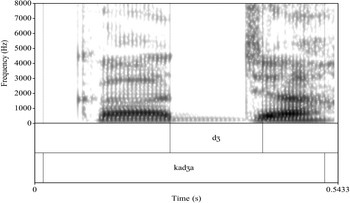
The consonant /dʒ/ is the only affricate that Urarina has. Its voicing status is not a simple matter. In elicited data, speakers consistently articulate this consonant as a voiced postalveolar affricate, except when it follows the vowel [i]. In that context, it surfaces voiceless. However, in connected speech, this affricate fluctuates between voiced and voiceless in all environments, being the voiceless variant the most frequent realization. In this study, we take the articulation during elicited data as being closer to the intended results at which speakers aim. Thus, we analyze the postalveolar affricate as underlyingly voiced. The spectrograms in Figure 20 and Figure 21 show the realization of the affricate /dʒ/ word-initially and intervocalically in words uttered in isolation. In both cases, its voiced nature is supported by the presence of a voice bar at the bottom of the spectrogram during the articulation of the consonant.
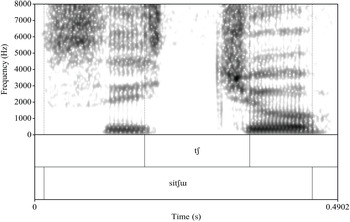
The voiceless allophone, [tʃ], occurs when it immediately follows the vowel [i]. Thus, for example, the word /sidʒɯ/ ‘thread’ is realized as [sitʃɯ]. This is depicted in the spectrogram in Figure 22. This time, there is no voice bar.
Spectrogram illustrating the voiced postalveolar affricate /dʒ/ realized word-initially in [dʒabɨd̺ɨ] ‘heron’.

Spectrogram illustrating the voiced postalveolar affricate /dʒ/ realized intervocalically in [kadʒa] ‘person’.

Our description of the Urarina affricate /dʒ/ differs from the one provided by Olawsky (Reference Olawsky and Knut2006). While we claim that the Urarina affricate is phonologically voiced, Olawsky (Reference Olawsky and Knut2006) asserts that it is voiceless. Here we are likely faced with a analytical and dialectal difference. It is quite likely that since Olawsky’s (Reference Olawsky and Knut2006) data seems to come mostly from connected speech, he took the decision of analyzing the affricate as voiceless. However, in addition to that analytical difference, there is also a dialectal difference. Our data comes from the Urarina variety spoken in Nueva Esperanza in the Upper Chambira, while Olawsky’s (Reference Olawsky and Knut2006: 3) data comes from the Southern Urarina variety from Nueva Union at the Espejo Tributary that flows into the Tigrillo River. Thus, Olawsky describes the behavior of the Urarina affricate in the data he collected as being voiced word-initially and voiceless elsewhere and therefore, he postulates the phonemic representation as voiceless. This contrasts with our data from the Upper Chambira where the affricate is voiceless only when preceded by /i/; elsewhere it is voiced.
Spectrogram illustrating the voiced postalveolar affricate /dʒ/ realized voiceless, [tʃ], following the vowel [i] in the word [sitʃɯ] ‘thread’ (underlying representation: /sidʒɯ/).

Vowels
The Urarina language contrasts five basic vowels: /i e a ɨ ɯ/. It also exhibits distinctiveness of vowel length /iː eː aː ɯː/, and nasalization /ĩ ẽ ã ɯ̃/. The long and nasal counterparts of the phoneme /ɨ/ were not attested in our data.

(4) Short vowels

Urarina long and nasal vowels are less frequent than short vowels. In (5), we present instances of long vowels (right-hand side) and nasal vowels (left-hand side).
-
(5)

Figure 23 shows a scatter plot indicating the acoustic location of the five basic vowels of Urarina in terms of the values of their first and second formants. The values of the first formant (F1) correlates with vowel height and those of the second formant (F2) correlates with vowel backness. This F1-F2 scatter plot is based on the measurements of one hundred vowel tokens supplied by ten male speakers. There are twenty tokens for each vowel. Each speaker gave two tokens of each vowel. The first vowel token occurred in the first syllable and the second vowel token in the second syllable of disyllabic words. The ellipses show areas containing all F1-F2 data points within two standard deviations. In Table 2, we present the mean values and standard deviations of F1 and F2 for each Urarina vowel.
In general, we can observe in Figure 23 that the position of each vowel is not equally spaced: the realizations of the vowel /i/, /e/ and /ɨ/ appear very close to each other; in fact, we can observe some overlapping of their acoustic spaces. This is unexpected since Urarina only has five vowels, and we would expect each to keep distinct boundaries in their acoustic space. However, their phonological opposition is evidenced by the existence of minimal pairs and near-minimal pairs formed by words like /kati/ ‘black monkey’, /katɨ/ ‘tooth’ and /ate/ ‘fish’ presented in (4). In contrast, the vowels /ɨ/, /a/ and /ɯ/ keep very clear different acoustic spaces. The degree of backness in the vowel [ɨ] exhibits a great deal of variation among speakers and even within the same speaker. Some consultants utter this vowel as more centralized and others prefer to front it. In the latter case, /ɨ/ appears realized very close to the space of /i/. The high back vowel /ɯ/ also shows a certain degree of variation, mainly with regard to its height. As shown in Figure 23, the realization of /ɯ/ shows a height dispersion that ranges between a high to a mid vowel.
The data presented in Table 2 provide acoustic evidence that /ɨ/ and /ɯ/ occupy different positions in the vowel space. While both vowels are high (they present virtually the same value for their first formant, F1), the values of their second formant (F2) show that their opposition is based on tongue backness. While /ɨ/ is a central vowel (F2 = 1773 Hz), /ɯ/ is a back vowel (F2 = 996 Hz). The opposition of the unrounded high central vowel /ɨ/ to the unrounded high back vowel /ɯ/ is rare in the world’s languages. In spite of its rarity, it has been reported by Parker (Reference Parker2001) for Bora, a Witotoan language spoken in Northeastern Peru.
F1-F2 scatter plot of the Urarina vowels (Bark scale).

Mean values in Hertz of F1 and F2 in Urarina vowels.

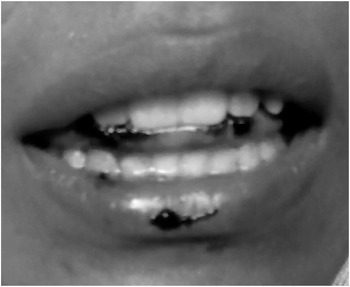
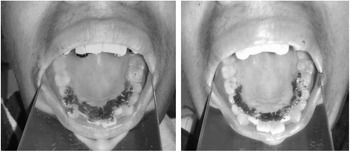
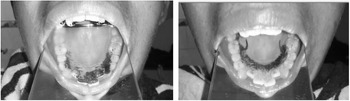
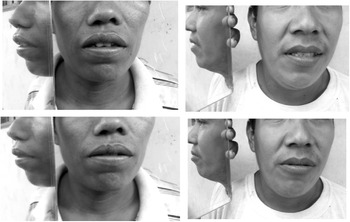
We have not found any phonological evidence that suggests that the phonology of Urarina treats /ɯ/ as a rounded vowel. The distinction between /ɨ/ and /ɯ/ is supported by minimal pairs like [hitʃɨ] tamshi (type of rope) versus [hitʃɯ] ‘horn’. The photograms in Figure 24 provide articulatory evidence that neither /ɨ/ nor /ɯ/ are in any sense rounded. Neither has lip protrusion or lip rounding. The photograms were obtained from the midpoint of typical productions of the vowels [ɯ] and [ɨ] as uttered by two native speakers of Urarina pronouncing the words [asɯ] ‘paternal grandmother’, [esɨ] guaba (type of fruit), [hitʃɯ] ‘horn’ and [hitʃɨ] tamshi (type of rope). The speakers were video-recorded with a mirror next to their faces so we can observe what they do with the corners of their mouths. The only articulatory difference we have observed with regard to the realization of the vowels /ɨ/ and /ɯ/ is that in the realization of the [ɨ] sound, both lips appear visibly apart, and the corners of the mouth are relaxed and usually open (see photograms from the upper level). In contrast, for the [ɯ] sound, the lips are closer together (without touching or creating any friction), and the upper and lower sides of the mouth corners appear in contact (see photograms from the lower level).
Urarina speakers show a lot of free variation in their treatment of high vowels /i/, /ɯ/ and /ɨ/ when they appear in contact with /a/. Half of the time, the high vowels resist becoming a glide and they surface as vowels. However, it is not uncommon for the high vowels to develop an homorganic glide between them and the low vowel /a/. In the case of /i/, it is the palatal glide [j]; and for /ɯ/, we have the velar glide [ɰ]. In that context, the vowel /ɨ/ also develops a characteristic approximant that we represent with the symbol: [ɣ̞]. The resulting auditory impression is similar to a more open version of a voiced velar fricative but with no concomitant friction. The data in (6) show cases where the high vowels are in contact with /a/ but they do not acquire a glide. The data in in (7) illustrates cases where a glide does appear between the high vowel and the /a/.
Photograms illustrating the lip position for the vowel /ɨ/ realized in the words [esɨ] ‘guaba’ (upper left), and [hitʃɨ] ‘tamshi – type of rope’ (upper right); and for the vowel /ɯ/ realized in the words [asɯ] ‘paternal grandmother’ (lower left), and [hitʃɯ] ‘horn’ (lower right).

-
(6) High vowels followed by the vowel /a/
(7) High vowels develop a glide when followed by the vowel /a/


In some cases, instead of surfacing as vowels or developing a glide between them and the adjacent vowel, the high vowels tend to become glides. This phenomenon tends to be recurrent in connected speech and it is not restricted to contact with the vowel /a/ alone. It can be triggered by contact with any vowel. The data in (8a, b) illustrate this phenomenon in isolated words. Cases of high vowels becoming glides in contact with a vowel other than /a/ can be found in the recording of the story ‘The North Wind and the Sun’. An instance is shown in (8c) from line 4 in the transcription of the story.
(8) High vowels become a glide when followed by the vowel /a/

The high front vowel /i/ is also involved in another phenomenon that involves a glide. When it occurs followed by the nasal consonant [n], the vowel becomes nasalized and the consonant turns into a nasalized palatal glide, [j̃]. See the case shown in (9a). The data in (9b, c) show that other vowels in Urarina do not trigger this phenomenon when they are followed by the nasal consonant [n]. This provides further phonological evidence that Urarina treats /i/ as a different category than /ɨ/ and /e/, in spite of their phonetic realizations being clustered together in one corner of the acoustic space, as shown in Figure 23.
(9) Nasalized glide [j̃]

Vowel nasalization is common in many Amazonian languages (see Peng Reference Peng2000; Aikhenvald Reference Aikhenvald and Alexandra2012; Campbell Reference Campbell, Campbell and Grondona2012; Storto & Demolin Reference Storto and Didier2012). It is also present in Urarina. Vowels that appear immediately following a nasal consonant occurring in onset position display nasalization. It is possible to perceive some nasalization in the vowels preceding a nasal onset, but this is extremely weak and probably just a low-level phonetic phenomenon, not controlled by the phonology of the language. Thus, we only transcribe the nasalization of the vowels following the nasal consonants and since the phenomenon is predictable, we analyze those vowels as underlyingly oral. This is shown in the data in (10). The only exception to this generalization occurs when the final vowel of a word is elided, leaving a nasal consonant as the word-final segment. In this context, the nasal consonant spreads nasality towards the left, affecting as many adjacent vowels as it encounters. An instance of this phenomenon occurs in line 2 of the transcription of the story ‘North Wind and the Sun’: /kɨhɨana/ ‘wind’ is realized as [kɨɦɨ̃ãn].
(10) Vowel nasalization following a nasal onset

Nasal spreading in Urarina is stopped by consonants, and this includes the laryngeal fricative. This is shown in the data in (11). Nasalization does not spread to neighboring segments. However, as evidenced by the data in (12), nasalization does spread over adjacent vowels. The data in (12a) and (12b) are particularly informative in this respect. In those cases, we have the words /d̺ɨ -a/ ‘(he) found’ and /d̺ɨ -ĩ/ ‘finding’. The former case shows that the vowel of the verb root, /d̺ɨ/ ‘to find’ is underlyingly oral since when it surfaces, followed by a suffix that also contains an oral vowel, we do not observe the presence of nasalization. In contrast, when the vowel of the verb root, /d̺ɨ/ ‘to find’ appears followed by a nasal vowel, it surfaces nasalized.
(11) Nasal spreading stopped by consonants
(12) Nasalization spreads over adjacent vowels


There are cases, like those shown in (13), in which a sequence of adjacent vowels shows nasalization word-internally. In these cases, we assume that both vowels are underlyingly nasal; although both vowels will end up nasalized all the same as long as at least one is underlyingly nasal.
(13) Word-internal adjacent nasal vowels

The laryngeal fricative /h/ tends to surface nasalized only when it is surrounded by nasal vowels. This is exemplified by the data in (14). The data in (11c, d) show that what we observe in (14) is not a case of nasal spreading from the vowel on the right-hand side over the laryngeal fricative. That is, in (11c, d), we observe that nasalization does not cross over the laryngeal fricative, although the fricative appears adjacent to a nasal vowel.
(14) Laryngeal fricative surfaces nasalized

Vowels that occur at the end of a melodic group in Urarina tend to be devoiced or completely elided. This phenomenon, for example, can be observed at several points in the transcription of the recording of the story ‘The North Wind and the Sun’. Here, in (15), we list some examples coming from the final words of some of the melodic groups of the recording. The line numbers are indicated so the reader can look for the words in the transcription of the recording of the story.
(15) Examples of vowel devoicing and apocope

When two vowels meet at a word boundary, one of them tends to be deleted. However, it is not clear at this point what the forces are behind the decision of which to omit. In the data in (16), the word /enɯtɯ/ ‘sun’ is followed by a word that begins with the vowel /a/. In the first case, the final vowel of the word ‘sun’ is preserved but in the second case, it is deleted.
(16) Examples of vowel elision at word boundary

High pitch
Olawsky’s (Reference Olawsky and Knut2006) work describing the grammar of Urarina represents a significant leap forward in the understanding of how this language works. Urarina’s prosody, however, remains one of the hardest aspects of the language and is yet to be fully understood. We will not try to solve here whether Urarina is a pitch accent language, or whether this Amazonian language should, instead, be classified as tonal (Hyman Reference Hyman2016). It is still too early to bring a definitive solution to that question. In this section, we illustrate the behavior of high pitch in nouns both uttered in isolation and when they interact with verbs as objects and subjects of simple verbal phrases. We have chosen that specific phenomenon to illustrate because it is the area where we have gained a strong grasp of the patterns observed concerning the behavior of high pitch in the language. It is also representative of how talking about high pitch in Urarina implies talking about syntactic structures. This section does not intend to cover all the complexities of how the high pitch of Urarina behaves in other syntactic structures but to provide a sense of how this fascinating aspect of Urarina’s prosody works.
The data presented in this section come from five out of the ten male speakers that participated in the study. Those are SPK06 to SPK10 in Table 1. The data contain words uttered in isolation and in phrases. With regard to the words uttered in isolation, we made sure that there was a noticeable pause before and after the word in order to avoid triggering any listing intonation. For the phrases, we controlled the type of nouns, the number of syllables in nouns and verbs and we tried to use words that contained the minimum number of voiceless segments. The audio files were analyzed with Praat (Boersma & Weenink Reference Boersma and David2019). We obtained the fundamental-frequency (f0) contours by creating a Pitch object, unvoicing extreme pitch values due to microprosody, checking and correcting for octave jumps, and, finally, smoothing them using the Praat smooth function at 10 Hz bandwidth.
Before describing the behavior of high pitch in Urarina, we make explicit some basic syntactic and prosodic properties of the language relevant to the discussion we present below. Urarina is an Object–Verb–Subject (OVS) language. The language is pro-drop so subjects can be omitted if they are understood from the context. We use the term ‘high pitch’ in a loose way, mostly to refer to the phonological/grammatical correlate of prominent peaks in the f0 contour without any commitment as to whether they are lexical-pitch accents or lexical tones. Each high pitch is assigned by the phonology of the language to a specific syllable within a word. The high pitch associated with a syllable is marked by placing an acute accent on top of the vowel of that syllable in the transcriptions, and by using an H in the figures that illustrate phrases. All the phrases in this section are declarative sentences, which intonationally end in a low-boundary tone represented by L%. We can safely assume that the sentences we present do not bear focus since Urarina triggers a special morphology when arguments in a sentence appear focused.
In verbal phrases, each Urarina noun presents two behaviors that govern the location of its own high pitch. Those behaviors are triggered by (i) whether the noun occurs as the subject of a verb phrase or in citation form, or (ii) whether the noun occurs as the object of a verb phrase. First, we describe the high-pitch pattern observed when nouns occur as subjects or uttered in isolation or citation form. In that context, every noun belongs to one of two patterns. In Subject-pattern A, the high pitch occurs in the noun last syllable. In Subject-pattern B, the high pitch occurs in the penultimate syllable. This behavior is shown in the data in (17). In the first column, we have a list of nouns that have their high pitch on the last syllable and in the second column, we present another group of nouns that have their high pitch on the penultimate syllable. Since there does not seem to be any phonological condition that can explain the belonging of nouns to either of those groups, we assume it must be lexically marked. However, although there are many nouns that follow Subject-pattern B, most nouns belong to the first group.
-
(17)

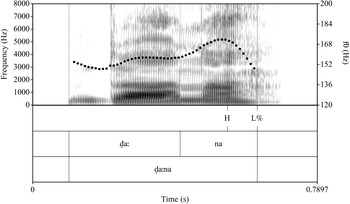
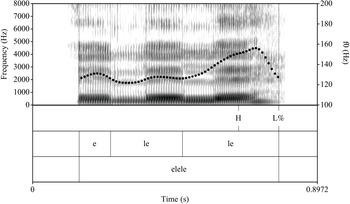
Figure 25 and Figure 26 show cases of a disyllabic and a trisyllabic noun with a high pitch on their final syllables (Subject-pattern A): [d̺aːnã́] ‘white-lipped peccary’ and [elelé] ‘shebón’ (sp. of palm tree). The black speckles superimposed on the spectrogram show the f0 contour. The f0 scale is provided in Hertz units (Hz) on the right-hand side of the spectrogram. In both cases, the high pitch is located on the last syllable of the word. In Urarina, the assignment of high pitch is blind to vowel length. Thus, for instance, in Figure 25, the first syllable of the word [d̺aːnã́] has a long vowel and the second one, a short vowel. However, the high pitch falls on the syllable with the short vowel just by virtue of being the last syllable of the word.
f0 contour illustrating the presence of a high pitch on the final syllable of the disyllabic noun [d̺aːnã́] ‘white-lipped peccary’ uttered in isolation.

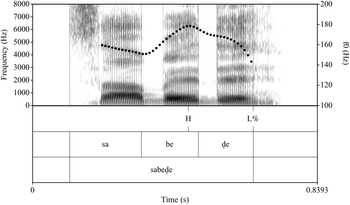
The word in Figure 27, [sabéd̺e] ‘machete’, exemplifies a noun that follows Subject-pattern B, that is, its high pitch is assigned to the penultimate syllable. As in the case of Figure 25 and Figure 26, [sabéd̺e] ‘machete’ was also elicited in isolation.
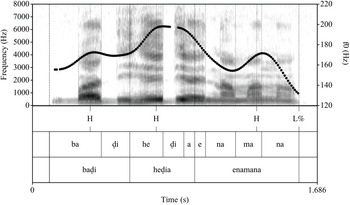
The two patterns just described for nouns uttered in citation form also occur when the nouns occur as subjects of verb phrases. Keep in mind that the subject noun in Urarina appears at the end of the sentence. They appear in bold in the data in (18). In (18a), the proper noun [lelenɯ̃́], which is the subject of phrase, follows Subject-pattern A so that it has the high pitch on its final syllable as it does when it occurs in citation form. In contrast, (18b), the noun [enãmã́nã] ‘young man’, also acting as the subject of the phrase, follows Subject-pattern B, that is, its high pitch occurs on the penultimate syllable. As expected, the noun [enãmã́nã] ‘young man’ does the same when it appears in citation form. The f0 contours of the two verb phrases in (18) are shown in Figure 28 and Figure 29, respectively. On top of the word syllable tier, we indicate each location of a high pitch (H) in the phrase. The symbol L% means that the phrase ends in a low-intonational boundary tone.
f0 contour illustrating the presence of a high pitch on the final syllable of the trisyllabic noun [elelé] ‘shebón’ (sp. of palm tree) uttered in isolation.

f0 contour illustrating the presence of a high pitch on the penultimate syllable of the noun [sabéd̺e] ‘machete’ uttered in isolation.

(18) High-pitch patterns in subject nouns

f0 contour illustrating that the Subject-pattern A noun [lelenɯ̃́] (proper name) shows a high pitch on its final syllable when it appears as a subject.

f0 contour illustrating that the Subject-pattern B noun [enãmã́nã] ‘young man’ shows a high pitch on its penultimate syllable when it appears as a subject.

Now let us examine Urarina nouns when they occur as the object of a verb. Nouns that follow Subject-pattern A (that is, their high pitch falls on the final syllable when they occupy the subject position) split into three groups when they appear as objects. Following Olawsky’s (Reference Olawsky and Knut2006) classification, they belong to group A, B and C. In those groups, the nouns themselves, now that they are objects, receive a high pitch on their penultimate syllable and depending on whether they are group A, B or C, they show different stipulations as to where the high pitch of the adjacent verb should be located. Group A makes the high pitch of the verb appear on its initial syllable; group B, on the second syllable; and group C, on the final syllable. Nouns that follow Subject-pattern B (that is, their high pitch falls on the penultimate syllable when they occupy the subject position), when they are objects, form their own class, group D. For them, their own high pitch falls on the final syllable and the adjacent verb is left with no high pitch. This complex behavior is observed in (19), with the disyllabic verb /bia/ ‘told’; and in (20), with the trisyllabic verb /hed̺ia/ ‘wanted’. For each phrase, we have indicated to what group the object noun belongs. It is worth mentioning that while in the Southern variety of Urarina studied by Olawsky (Reference Olawsky and Knut2006), object nouns of groups A, B and C do not receive any high pitch; in the Upper Chambira variety that we describe, they do.
(19) High pitch in object nouns and in the disyllabic verb/bia/ ‘told’
(20) High pitch in object nouns and in the trisyllabic verb/hed̺ia/ ‘wanted’


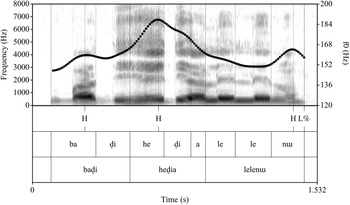
First, let us examine the f0 contours associated with the data in (20). The phrases that we show in this section contain mostly voiced sounds so the f0 occurs as much as possible uninterrupted. The first eye-catching characteristic of all the f0 contours of phrases presented in this section is that the f0 peak of the verb is always noticeably more prominent than those aligned with the object noun and the subject noun of the phrase. The subject tends to have the lowest f0 peak. This is a regular pattern of Urarina sentences.
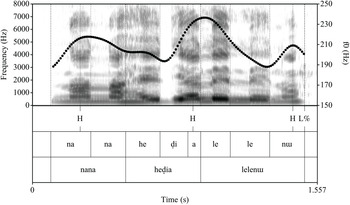
With regard to the distribution of high pitch in the phrase, [lelenɯ̃́] (proper name) is a Subject-pattern A noun so a high pitch always appears on its final syllable when the noun is in the subject position of the phrase. This is the case for all the phrases in (20). The phrase in (20a) displays the behavior of the object noun /bad̺i/ ‘parrot’. This is a a Subject-pattern A/Object-group A noun, that is, in its citation form or as the subject of a verb phrase has a high pitch on the last sylable: [bad̺í]. As an object noun, it belongs to group A, which means that its penultimate syllable gets a high pitch, [bád̺i], and furthermore, it forces the high pitch of the adjacent verb to appear on the initial syllable, [héd̺ia]. This was already shown in Figure 29.
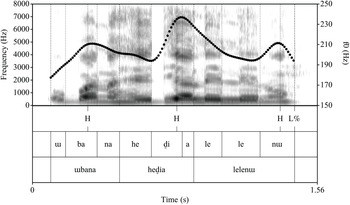
The phrase in (20b) shows the behavior of /ɯbana/ ‘peccary’, which is a Subject-pattern A/Object-group B noun. Namely, as a subject noun or in its citation form, its final syllable receives a high pitch, [ɯbanã́]. As an object noun, the high pitch falls on its penultimate syllable, [ɯbánã], and it forces the high pitch of the verb to occur on the second syllable, [hed̺ía]. This is illustated in Figure 30.
The phrase in (20c) presents the behavior of /nana/ (type of banana), a Subject-pattern A/Object-group C noun. In this case, the noun also receives a high pitch on its final syllable when it occurs as a subject noun or in its citation form: [nãnã́]. As an object noun, the high pitch appears on its penultimate syllable, [nã́nã] and the noun requires the high pitch of the verb to appear in the final syllable, [hed̺iá]. This is shown in Figure 31.
f0 contour illustrating the phrase [ɯbánã hed̺ía lelenɯ̃́] ‘Lelenu wanted a peccary’ where /ɯbana/ ‘peccary’ is a Subject-pattern A/Object-group B noun.

f0 contour illustrating the phrase [nã́nã hed̺iá lelenɯ̃́] ‘Lelenu wanted a banana’ where /nana/ (type of banana) is a Subject-pattern A/Object-group C noun.

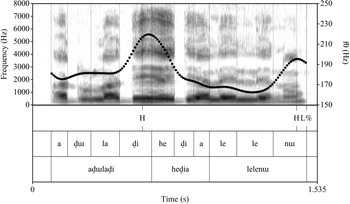
In contrast to all the other object nouns presented in (20), /ad̺ɯlad̺i/ ‘fox’ is a Subject-pattern B/Object-group D noun. This type of Urarina noun behaves the opposite from nouns in the other groups: when they are in the subject position of a phrase or appear in citation form, instead of having a high pitch on their final syllable, the high pitch shows on their penultimate syllable, [ad̺ɯlád̺i]. When they are object nouns, instead of having the high pitch on the penultimate syllable as other nouns do, their own high pitch appears on the final syllable: [ad̺ɯlad̺í] and they force the verb to remain without any high pitch, [hed̺ia]. This is illustrated in Figure 32.
f0 contour illustrating the phrase [ad̺ɯlad̺í hed̺ia lelenɯ̃́] ‘Lelenu wanted a fox’ where /ad̺ɯlad̺i/ ‘fox’ is a Subject-pattern B/Object-group D noun.

The ability of Urarina nouns to control the location of high pitch on adjacent preceding words is not limited to verbs. Olawsky (Reference Olawsky and Knut2006) reports it for nouns adjacent to other nouns, adjectives and postpositions. Unfortunately, we have not collected data yet for all those contexts. However, we do have a few examples of noun compounds on which we can observe that Urarina treats the members of a compound in a similar fashion to the Object–Verb structures described above. All the nouns shown in (21) are Subject-pattern A nouns. As expected, they show a high pitch on their last syllable in their citation form. As an object, /hanɯlaɖi/ ‘jaguar’, like /bad̺i/ ‘parrot’ in (19a) and (20a), is a Group A noun. Thus, when the compound [hanɯ̃lád̺i bɨ́kɨ] ‘jaguar bone’ is created, [hanɯ̃lád̺i] receives a high pitch on the penultimate syllable and forces the high pitch of the adjacent following word to fall on the first syllable, [bɨ́kɨ]. This is the same pattern /bad̺i/ ‘parrot’ shown in (19a) and (20a) with regard to the verb that took it as its object.
In the case of the noun /ɯbana/ ‘peccary’, it is a Group B noun. This is the same noun that appears as object in the phrases in (19b) and (20b). When the compound [ɯbánã bɨkɨ́] ‘peccary bone’ is formed; as expected, /ɯbana/ ‘peccary’ receives a high pitch on the penultimate syllable, [ɯbánã], and forces the high pitch of the adjacent following noun to fall on the second syllable, [bɨkɨ́], as it did with the verb in (19b) and (20b). A parallel comportment occurs when those nouns form a compound with the noun /kad̺í/ ‘fur’ following them.
(21) High pitch in compounds

So, is Urarina a stress, tonal or pitch accent language? We do not have an answer to that question yet. What makes it difficult to classify Urarina is that it presents properties that are stress-like and tonal-like while at the same time the assignment of its high pitch keeps making reference to syntactic information. Let us present a brief summary of what we have described above to be able to appreciate the problems that the analyst faces. In Urarina, each morpheme surfaces with only one high pitch. In the case of nouns, the high pitch has a window that constrains its location. This window corresponds to the last two syllables of the word. Thus, the high pitch of nouns can occur either on the penultimate or final syllable. The fact that high pitch seems to be bound to a syllable-based window on one of the word edges remind us of stress systems. Yet, whether a noun surfaces with high pitch on the penultimate or final syllable depends on the syntactic context in which it occurs. As the subject of a sentence or in citation form, most nouns show a high pitch on the final syllable and only a few have it on the penultimate one. However, if those same nouns occur as the object of a verb, the nouns that had a high pitch on the final syllable when they were subjects, now have it on the penultimate syllable. Those that had it on the penultimate syllable as subjects will show it on the last syllable when they are objects.
Nouns that occupy the object position of a verb govern the location of the high pitch of that verb. Urarina has four classes of nouns in terms of the effects that they have on the placement of high pitch in adjacent verbs. Nouns can place the high pitch of the verbs onto the initial syllable, second syllable, final syllable, or even leave the entire verb with no high pitch. There is no way to predict to which of those four categories a noun would belong. That property seems to be lexically specified. The existence of the categories reminds us of tonal languages, although we have found no evidence in our data that indicates that there is any tonal contrast in the language.
We should also reflect on the fact that what makes Urarina sui generis is that those categories to which object nouns belong do not tell them where their own high pitch is located. Those categories tell nouns where to place the high pitch on the adjacent verb. In this sense, what Urarina has in Object–Verb structures looks like an agreement system in which verbs agree with the ‘gender/category’ of the noun that they take as a complement. In Urarina, that agreement seems to be made through placing a high pitch on a specific syllable in the verb. In this sense, one could argue, for instance, that nouns come specified with information of where the head syllable of the verb that takes them as a complement should be located and then the phonology assigns a high pitch by default to those positions. Thus, it is not clear that any tone or high pitch accent needs to be underlyingly specified in Urarina. The high pitch behavior observed in its words and phrases can be derived as long as each noun comes with an underlying specification of where to place the high pitch of the adjacent verb when the noun is an object. From that information, we can assign a high pitch to the verb and predict where the high pitch will be located in the noun itself in its citation form or when it is the subject or object of a phrase. Would this analysis make Urarina a stress system or pitch accent one? As stated earlier, we will not try to classify the prosodic system of Urarina. There are more intricacies in the system that need further research before providing a definite answer to the question of what type of prosodic system Urarina has.
Transcription of recorded passage ‘The North Wind and the Sun’
In this section, we offer an IPA transcription of the recording of the story ‘The North Wind and the Sun’. We told the story in Spanish to an Urarina native speaker from the Upper Chambira and then we asked him to retell it in Urarina. We have also included a phonemic transcription as a reference. The transcription is presented divided into intonational groups cued by major breaks or major pauses. Sometimes we find minor breaks/pauses occurring within a larger intonational unit. We have marked those minor breaks with the symbol [|]. When words appear linked or the final segments of a word coalesce with the initial segments of the following word, we have used the symbol [‿]. When a vowel becomes breathy because of an adjacent [h], we have marked the vowel with the IPA diacritic for breathiness [̤]. If the [h] makes an adjacent vowel breathy but without completely coalescing with it, we have both kept the [h] and marked the vowel as breathy. Sometimes vowels at the end of phrases as well as those at the beginning and end of words tend to be devoiced even if there is no [h] in the surroundings. In those cases, we have marked the vowel with the IPA diacritic for devoicing [̥] to make apparent that devoicing in those instances comes from a different source. Superscripted [ʰ] indicates pre-aspiration. Finally, we have included a free English translation of the story, so the reader is aware of some of the cultural adaptations the speaker made when trying to recast the story in Urarina.
Phonetic transcription
1. [hadʒáːhtɯ́‿jhta kɰ̤ɨ́d̺eː enɯ̃tɯ̃́‿ĩj̃ã kɨ̤ɨánḁ]
2. [ha̤htã́‿etɯ́ mĩɦ̃j̃ẽntɯ́ nɯ̃hkɰetéː a̤htãẽ́n ʔenɯ̃́t‿amɰ̃ɨ̃́ɹ̺iːd̺ĩː nĩ́ kɨɦ̃ɨ̃ã́n]
3. [nĩɦ̃ã́htətêː]
4. [nãbanã́j̃ã nĩ́ː‿ḛnɯ̃́tɯ nẽ́sãɦ̃j̃ẽ kɯnɨ̃ɦ̃j̃ã́ nĩ́ː‿kɨnã nẽ nã́j̃hta kɰɨ́d̺]
5. [kɰ̃ãnãnã́ kɨá leɦĩ́ kadʒa nɯ̃́ aʰtatéː d̺ĩɨ̃́]
6. [ha̤htã́ d̺í‿ɦelad̺ɯnãːke̤‿a̤htã́ɨ̃]
7. [nĩ́ː‿kadʒaː kaɦjɯ́nẽ d̺ɯhkɯnãɦed̺e‿a̤ʰtã́ɨ̃‿a̤ʰta kádʒa kaítʃa nãːɦéd̺e nḭ̃́ːʔ‿kɨ̤ɦ̃ɨ̃ã́n]
8. [nĩɦ̃ã́ʰtaɰtêː]
9. [ẽj̃‿tʃãn‿sã́ɦ̃ẽj̃‿tʃasĩnẽ́]
10. [aʰted̺ɯɣ̞átʃi‿tʃanĩn | nĩː‿tʃánã kɰaɨ̤‿lanã]
11. [nã́ʰtatêː kɰenãĩ́ | kɰenãĩ́‿nã́le enãte̥ lãẽ́‿kanɨ̃‿dáde‿nãĩ́]
12. [aí‿nĩ́ː‿enɯ̃́t]
13. [nĩɦ̃ã́ɨ̃́tətéː]
14. [nĩɦ̃ã́ʰtatéː ajɨ̰d̺é‿ĩ́j̃ã ʔa̰j‿nĩ́nɯ̃tɯ nẽɦ̃ã́tətéː]
15. [lã́ːẽ‿e̤htəd̺énẽː ãhtanã‿háxeːFootnote 2 enɯ̃́t]
16. [nãʰtɯ bãntɨɦẽ́nj̃ã‿lãẽ́]
17. [d̺í‿ahad̺ɯ‿nã́nɦ̃ã‿ĩj̃ã́lã kahjɯnẽ d̺ɯhkɰé nĩ́ː kadʒ]
18. [n̤ã́htatə mĩɦ̃j̃ẽːnhtĩ́ː nĩdáeː | ʔḛnɯ̃́tm̥]
19. [esenẽtẽnj̃ã́m‿bája‿enãɹ̺áː‿e̤ʰkɰéj nĩ́dâːtʃ kɨhɨã́n]
20. [itɰ̃ã́nẽteː | ĩj̃ɯ̃ãlɨ́‿i̤ʰta kɯ́d̺eː‿enɯ̃tɯ‿j̃ã́a̰ | kɨɦɨanã́d̺]
Phonemic transcription
1. /hadʒaːhetaɯ ita kɯɨhɨd̺eː enɯtɯ aina kɨhɨana/
2. /hatãẽhetaɯ mihienetɯa nɯketeː hatãẽ enɯtɯ amɯɨd̺ihid̺ĩː niː kɨhɨana/
3. /natãẽhetaɯte/
4. /nabanaːia niː enɯtɯ ne saihĩẽ kɯɨnɨhĩã niː kɨhɨana ne naha ita kɯɨhɨd̺e/
5. /kɯana hana kɨa leihĩ kadʒa nehãɨ̃hetaɯte d̺ɨĩ/
6. /hatãẽ d̺ai helaɖɯnaːke hatãẽ/
7. /niː kadʒa kahiɯne d̺ɯkɯnahed̺e hatãẽ hatãẽ kadʒa kaid̺idʒa naːhed̺e niː kɨhɨana/
8. /nehãɨ̃ hetaɯte/
9. /ẽĩ dʒane saihiẽĩ dʒasine/
10. /ated̺ɯadʒi dʒaniei niːdʒana kɯaɨhe lanana/
11. /nehãɨ̃hetaɯte kɯenãĩ kɯenãĩ nale enate lãẽ kanɨ dadae nãĩ/
12. /ai niː enɯtɯ/
13. /nehãɨ̃ hetaɯte/
14. /nehãɨ̃hetaɯte aiɨd̺e inae ai niː enɯtɯ nehãɨ̃hetaɯte/
15. /lãẽtaɯɨd̺eneː atana hasae enɯtɯ/
16. /nehãɨ̃hetaɯ bãtɨhenia lãẽ/
17. /d̺ai ahad̺ɯnaː nahãɨ̃ inaelãẽ kahiɯne d̺ɯkɯe niː kadʒa/
18. /nehãɨ̃hetaɯte mihĩã enetĩː nedae enɯtɯ/
19. /eseneteniane baiaenad̺aː ekɯai nedaːdʒae kɨhɨana/
20. /itɯaneite inɯaelɨ ita kɯɨhɨd̺e enɯtɯ aina kɨhɨanad̺ɨ/
Free translation in English
1. A long time ago, the sun and the wind competed (against each other).
2. The wind believed he was stronger than the sun.
3. Then.
4. (Although) the sun didn’t want to, the wind kept insisting on (the sun competing against him), so they competed against (each other).
5. So then, (they) found a man on his way to the chacra [cultivated field].
6. Then, (the wind) blew with all his strength.
7. So, the wind wanted to make the person suffer, (to make the person) take his clothes off.
8. Then.
9. (the wind realized he) couldn’t do it.
10. Without being able to make the man take his clothes off, (the wind) got tired.
11. Then the sun laughed (at the wind) and said ‘now it’s my turn’.
12. The sun took his turn.
13. Then.
14. Then, the sun took his turn.
15. Then, (the sun shone so strong, it) cracked the ground.
16. Then, (the man) couldn’t stand it.
17. Because of the heat, the man took his clothes off.
18. Then, the sun remained stronger (than the wind).
19. Although without conceding, the wind was defeated.
20. That was what happened when the sun and the wind competed.
Acknowledgements
Both authors would like to thank the anonymous reviewers for their invaluable comments and ideas as well as the guidance provided by Amalia Arvaniti. We would also like to thank the Department of Education of Peru (MINEDU) for providing the funds to run the initial fieldwork for this study in 2015 and Stony Brook University’s FAHSS Research and Interdisciplinary Initiative grant that funded the second field trip in 2018.
Supplementary material
To view supplementary material for this article, please visit https://doi.org/10.1017/S0025100319000136