


CVD are the leading causes of death and burden disease, taking an estimated 17·9 million lives each year worldwide. Obesity, hypertension, type 2 diabetes (T2D), dyslipidaemia and smoking have been identified as important risk factors for CVD, and a higher burden of risk factors is associated with a raising lifetime risk for CVD(1). Eastern European countries have the highest prevalence of CVD, ranging from 55 to 60 %, followed by Australia, Canada and the United States with rates around 30 %. A similar trend has been described in Brazil, particularly among females (28·5–29·1 %)(2).
Evidence has shown that good adherence to dietary guideline recommendations has been associated with reduced weight, cardiovascular and other metabolic disorder risk factors(Reference Alvarez-Alvarez, Toledo and Lecea3–Reference Simao, Precoma and de Andrade5), and has demonstrated long-term sustainability and nutritional quality(Reference Alvarez-Alvarez, Toledo and Lecea3). Dietary intake is closely connected with eating behaviours and habits. For example, breakfast, which is often recognised as the ‘most important meal of the day’, is associated many health benefits(Reference O’Neil, Byrd-Bredbenner and Hayes6–Reference Gwin and Leidy11). Studies from Spain(Reference Ruiz, Avila and Valero12), the USA(Reference O’Neil, Nicklas and Fulgoni9) and the UK(Reference Uzhova, Mullally and Penalvo13) have evaluated the contribution of breakfast to daily macro- and micronutrients intake, reporting that regular breakfast consumers have significantly higher intake of fibre, vitamins and minerals(Reference Uzhova, Mullally and Penalvo13,Reference Liu, Tooze and Zhang14) and consume less energy-dense food sources during the day(Reference Uzhova, Mullally and Penalvo13). Although guidelines from different countries(15–Reference Gerritsen and Wall19) emphasised the importance of breakfast, the optimal nutrient composition is not well established, and population’s eating behaviours are different in terms of their social, cultural and economic aspects(Reference Aranceta, Serra-Majem and Ribas20,Reference Pereira, de Castro and Hopkins21) . For example, the breakfast most frequently consumed in Brazil consists of milk and dairy products, coffee and tea and grain-based, especially bread, which may differ from that of other populations(Reference Pereira, de Castro and Hopkins21).
Given the importance of evaluating breakfast’s nutritional quality, assessment methods have been developed, mainly in high-income countries(Reference Aranceta, Serra-Majem and Ribas20,Reference Pinto and Carbajal22–Reference Delley and Brunner30) . Some of them consider the total energy and nutrients intake, with items recognised as critical components in order to maximise the benefits of this meal. Moreover, food sources and amount consumed are taken into account(Reference O’Dea and Wagstaff25,Reference O’Neil, Byrd-Bredbenner and Hayes28) . In Brazil, the Breakfast Quality Index (BQI) was proposed using a national dataset with 22 279 breakfast consumers having a mean age of 53 ± 0·2 years and 53 % being female. Findings showed that 71 % of participants fell into medium BQI category and 6 % into a high category. Consumers with high BQI had a higher intake of fruit and vegetables and higher daily intake of energy, carbohydrates, fibre, total sugar, sodium, potassium, phosphorus, thiamine, riboflavin, niacin, folate and vitamins B6, A, C and D, and lower trans fatty acids, compared with those from low and medium BQI categories. Thus, promoting a high-quality breakfast may contribute to a better nutrient intake and achievement of daily requirements(Reference Pereira, de Castro and Hopkins21).
Whereas there are studies supporting breakfast consumption as a protective factor against obesity and associated comorbidities, such as TD2 and high blood pressure (BP)(Reference Timlin and Pereira8,Reference Gibney, Barr and Bellisle31) , there is a gap in studies conducted in low- and middle-income, including Brazil, investigating breakfast quality and risk factors for cardiometabolic diseases in non-institutionalised and older adults(Reference Timlin and Pereira8). Therefore, the purpose of the present study was to examine the associations between (1) breakfast quality and cardiometabolic risk factors; (2) breakfast quality, socioeconomics, lifestyle aspects, weight status and energy and nutrients of public health concern for adults and older adults in the city of São Paulo.
Methods
Study sample
The ‘Health Survey of São Paulo’ (Portuguese acronym ISA-Capital) is a household population-based, cross-sectional study conducted every 5 years. Three waves were carried out in 2003, 2008 and 2015. Data were gathered from the 2015 survey with a probabilistic sample of individuals >12 years of age living in urban areas of São Paulo. The present study was designed to collect information on aspects relating to diet and other lifestyle aspects, acute and chronic morbidities, preventive practices and use of health services. All these were obtained through stratified sampling by clusters carried out in two stages: census tracts and households. More details of the present study and sample design have been published elsewhere(Reference Fisberg, Sales and Fontanelli32).
For the present study, a subsample of the 2015 ISA-Capital was used. This subsample was drawn to compose the ‘Health Survey of São Paulo with Focus on Nutrition’, named ISA-Nutrition. Dietary data from 1737 individuals were collected. We considered only adults (aged 20–59 years) and older adults (≥60 years), classified as breakfast consumers (individuals who reported this meal in at least one recall). Thus, our final sample composed of 1143 individuals with complete dietary data, and 587 with blood samples to identify their cardiometabolic risk factors. Participant’s eligibility for the present study can be found in Fig. 1.
Description of the sample in the 2015 Health Survey of São Paulo with Focus on Nutrition Study (2015 ISA-Nutrition) eligible for the present study

Data collection and processing
Trained interviewers collected data on sociodemographics and lifestyle behaviours through a structured questionnaire. For the present study, the following variables were used: age (categorised a 20–59 years or ≥60 years), sex (male or female), self-identified race (White or Asian, and Black, mixed race or Native), per capita family income (≤1 or >1 minimum wage, calculated by the sum of total income of all family members divided by the number of family members living in the house), household level of education (below elementary school or above high school) and smoking status (smoker or non-smoker).
Physical activity (PA) data were obtained through the validated International Physical Activity Questionnaire (IPAQ) long version(Reference Matsudo, Araújo and Matsudo33). Leisure time PA was taken into account for the present study (e.g. walking, dancing, gardening, hiking and swimming), and participants were classified as meeting or not meeting the recommendations for PA (i.e. ≥150 v. <150 min/week) according to WHO guidelines(34).
Participants’ self-reported body weight and height were used to calculated BMI using the standard formula: weight (kg)/[height (m)]2. BMI was transformed into a categorical variable reflecting the cut-off values for body weight status for adults(35) and older adults(Reference Lebrão and Duarte36). Thus, two categories were used: non-overweight (BMI < 25 kg/m2 for adults and < 28 kg/m2 for older adults) and overweight/obese (BMI ≥ 25 kg/m2 for adults and ≥ 28 kg/m2 for older adults). Previously, self-reported measure was validated in this population, observing high sensitivity and specificity for that matter(Reference Carvalho, Piovezan and Selem37).
Dietary intake
Dietary data were collected from at least one 24-h recall (24hR) on non-consecutive days, representing different week days and weekend days and seasons of the year. The first 24hR was collected during home visits, and the second via a telephone interview using the automated multiple pass method(Reference Moshfegh, Rhodes and Baer38), that is, a standardised procedure with prompts and probes to capture the most reliable information on dietary intake. The Nutrition Data System for Research (NDS-R) software (version 2014; Nutrition Coordinating Center, University of Minnesota) was used to calculate energy and nutrients from dietary recalls. As NDS-R uses the US Department of Agriculture’s food composition database, energy and nutrient values provided in the present study were compared with other Brazilian food composition databases(39,40) . Thus, dietary outcomes were then compared and discrepancies corrected before data processing.
The overall diet quality and their components were evaluated based on the Brazilian Healthy Eating Index–Revised (BHEI-R)(Reference Previdelli, Andrade and Pires41), which has conformity to the 2006 Dietary Guidelines for the Brazilian Population(42), the WHO(43), the Institute of Medicine(44), the Healthy Eating Index 2005 for Americans(Reference Guenther, Reedy and Krebs-Smith45) and the Brazilian Society of Cardiology(Reference Sposito, Caramelli and Fonseca46). This measurement assesses adequacy to a moderation perspective. BHEI-R has twelve components including nine adequacy components, that is, total fruits; whole fruits; total vegetables; dark green and orange vegetables and legumes; total grains; whole grains; milk and dairy; meat, eggs and legumes; oils (ratio of MUFA and PUFA to SFA, and three moderation components: saturated fat, sodium and SoFAAS (solid fats, alcohol and added sugars). BHEI-R is examined as intake per 1000 kcal and scored 5–20 points with the total BHEI score as the sum of all components. BHEI-R’s total score ranges from 0 to 100, with higher scores indicating better diet quality(Reference Previdelli, Andrade and Pires41). Therefore, the impact on breakfast quality is differentiated when considering BHEI-R’s overall diet quality.
Food and beverages that most contributed to breakfast’s total energy intake were identified. This resulted in 280 different items reported by the first 24hR, which were grouped based on nutritional value, eating frequency and other diet habits of individuals living in the city of São Paulo. Food and beverages consumed by under 2 % of the study sample were not grouped because of the high variability in terms of nutrient values and low frequency of intake. Descriptions of breakfast food groups and prevalence of consumers according to age group and BQI categories are described in online supplementary material, Supplement Table 1. Energy contribution of each group was determined based on the method proposed by Block et al.(Reference Block, Hartman and Dresser47). Breakfast energy contribution (percentage) of food groups from ISA-Nutrition based on age groups and BQI categories is available in online supplementary material, Fig. S1.
Breakfast definition
Breakfast was defined as the type of meal that was self-reported by participants. Only seven participants did not report the type of meal in the present study. The definition of breakfast was consistent with that previously published in literature(Reference O’Neil, Byrd-Bredbenner and Hayes6). Thus, it is the first meal of the day that breaks the fast after the longest period of sleep and is consumed within a couple of hours (i.e. generally 2–3 hours) of waking up, and it comprises food and beverages from at least one food group and may be consumed at any location.
Individuals who provided two dietary recalls were classified as breakfast consumers if reported at both 24hR, occasional consumers if reported in the first or second recall, or breakfast skippers if not reported at both recalls. Individuals who had only one dietary recall were classified as breakfast consumers or skippers according to their reports.
Brazilian Breakfast Quality Index
Breakfast quality was evaluated based on BQI, which was proposed by Pereira et al. (2017)(Reference Pereira, de Castro and Hopkins21). BQI has ten components combining food groups, energy and nutrients of public health concern(48). It includes three food group components – cereals and other grain products, fruit or vegetables and dairy products; six energy and nutrient components – breakfast energy, free sugar, saturated fat, total fibre, calcium and sodium; and one component considering altogether the three food groups in at least one of the days of dietary assessment. Each BQI component is examined as an intake of 15–25 % kcal per day and scored 0–1 point with the total BQI score as the sum of all components. The index ranges from 0 to 10, with higher scores indicating better breakfast quality(Reference Pereira, de Castro and Hopkins21).
Qualitative criteria were used to group the foods based on component scores. Each component received 0 for not consuming, or 1 for consuming, in at least one 24hR, not considering the amount reported. Mixed preparations were aggregated into multiple groups; for example, oatmeal was added to the groups ‘cereals and other grain products’ and ‘dairy products’ due to having oat and milk as main ingredients.
Energy and nutrient components were scored using a quantitative criterion. Individuals would receive a score of 1 if reached the following recommendations: (a) breakfast representing 15–25 % of total energy intake; (b) free sugar <10 % of total energy intake/number of eating occasions of the individual; (c) saturated fat intake <10 % of total energy intake/number of eating occasions of the individual; (d) total fibre intake >25 g/number of eating occasions of the individual; (e) calcium intake ≥20 % of RDA according to age group; (f) sodium intake <2000 mg/number of eating occasions of the individual(Reference Pereira, de Castro and Hopkins21).
Since the recommendations are based on daily intakes of nutrients and no recommendation for breakfast nutrient intakes exists, the average of intake was considered if participants reported both 24hR. Individuals who consumed only non-caloric beverages (e.g. coffee, tea and diet soda) on both days scored 0 in BQI, as well as those who only consumed calories from regular sodas or alcoholic beverages.
Cardiometabolic risk factors
A standard protocol with specific instructions for conducting all assessments was used by a trained nursing assistant to ensure consistency. Blood samples were collected using venepuncture after 12 h of overnight fasting, 72 h of no alcohol intake and no intense PA prior to data collection. The present study had the following cardiometabolic risk factors as outcomes: (i) waist circumference collected in triplicate(49); (ii) BP was measured using an automatic device (Omron; model HEM-712C); (iii) glucose was analysed by colorimetric enzymatic assay (Cobas; Roche Diagnostics GmbH); (iv) insulin was analysed by multiplex immunoassay (LINCOplex®; Linco Research Inc.); and (v) lipid profile was determined by enzymatic-colorimetric method (Roche Diagnostics GmbH). More details are described elsewhere(Reference Fisberg, Sales and Fontanelli32).
The definitions of cardiometabolic risk factors were met in accordance to the guidelines available at the time of conduct of the present study. The cut-off criteria for each cardiometabolic risk factor were as follows: waist circumference ≥80 cm for women and ≥94 cm for men(Reference Alberti, Eckel and Grundy50), fasting glucose level ≥126 mg/dL or reported taking anti-diabetic drugs(51), total cholesterol (TC) ≥240 mg/d, LDL cholesterol (LDL-C) ≥160 mg/dL, TG ≥200 mg/dL and HDL cholesterol (HDL-C) <40 mg/dL(Reference Xavier, Izar and Neto52). Individuals who reported using drugs to lower their lipid profile were identified as having dyslipidaemia(Reference Alberti, Eckel and Grundy50). High BP was defined as having a systolic BP ≥140 mmHg and/or diastolic BP ≥90 mmHg or use of anti-hypertensive drugs(Reference Malachias, Gomes and Nobre53).
The homeostasis model assessment of insulin resistance (HOMA-IR) was calculated using the formula: [fasting blood glucose (mg/dL) × fasting insulin (μU/mL)]/405, and the cut-off value for the Brazilian population was 2·71(Reference Geloneze, Vasques and Stabe54). Metabolic syndrome (MetS) classification followed the criteria recommended by the American Heart Association(Reference Alberti, Eckel and Grundy50). The presence of any three of the following five risk factors constitutes a diagnosis of MetS: high BP or use of anti-hypertensive drugs; high waist circumference; high fasting glucose or use of anti-diabetic drugs; high TG, low HDL or use of drugs to lower the lipid profile.
Statistical analysis
Descriptive analyses were conducted based on the categories of BQI scores as indicated: low (0–3 points), medium (4–6 points) and high (7–10 points). Data were presented considering non-parametric distribution. Differences between groups were tested by Theil–Sen median test for complex survey, and the post hoc Dunn test was used to identify significance between groups. Categorical variables were evaluated using Pearson’s χ 2 test. Statistical modelling techniques incorporated in the Multiple Source Method software(55) were used to provide usual dietary intakes after adjusting for intrapersonal variance in energy and nutrient intake at breakfast and total daily energy intake.
Stepwise logistic regression models, after controlling for confounding factors (i.e. age, BMI, race, income status, household education level, smoking status, PA level and total BHEI-R score)(Reference Previdelli, Andrade and Pires41), were conducted to verify associations between breakfast quality and cardiometabolic risk factors. BMI was not adjusted for the models that had participant being overweight and with an increased waist circumference as an outcome. Results were presented as OR and 95 % CI. Hosmer–Lemeshow goodness-of-fit test was used for the calibration of each model. All analyses were conducted in STATA 14·0 software with sample weights considering the complex survey design with significance level set at P < 0·05.
Results
In our sample of adults, 5·8 % were breakfast skippers, 2·4 % occasional consumers and 91·8 % breakfast consumers. For older adults, the frequency was 1·1, 2·5 and 96·4 % for breakfast skippers, occasional and consumers, respectively. About 86 % (95 % CI 83·2, 88·3) of breakfast and occasional consumers had the meal between 06.00 and 10.00 hours.
Table 1 contains the descriptive analysis of participants according to BQI categories. The sample predominantly composed of adults having >9 years of schooling, per capita family income >1 minimum wage, never being a smoker and not meeting the guidelines for PA. Similar proportions were found for sex, self-declared race and body weight. The majority of the population was in the middle BQI category (67 %), and the average score was 4·9 (95 % CI 4·8, 5·1). Fifteen individuals (1·3 %) scored 0 in BQI. Individuals with higher family education background, family per capita income and White or Asian self-declared race showed better BQI scores. Older adults had a better BQI score (5·4, 95 % CI 5·2, 5·6), and smokers had the worst score (4·4, 95 % CI 4·1, 4·6).
Socioeconomic and lifestyle characteristics of the adult and older adult population in ISA-Nutrition (2015) according to Brazilian Breakfast Quality Index (BQI) categories*

MW, minimum wage.
* All the analyses took into account the sampling survey design.
† Values were adjusted by the number of individuals in the household. One MW was approximately US$ 236 in 2015.
‡ Differences across BQI categories were evaluated using Pearson’s χ 2 test.
§ Theil–Sen test was applied for comparing medians across socioeconomic and lifestyle variables.
Food groups most consumed (>30 % of adults and older adults) were ‘coffee’ (74·1 %), ‘white bread and crackers’ (71·2 %), ‘milk’ (56·4 %), ‘sugar, honey and jams’ (53·7 %) and ‘butter and margarine’ (43·4 %). ‘Milk’ and ‘butter and margarine’ were not the most consumed food groups for participants in the lower BQI category. Those placed in the high BQI category had a lower intake of ‘butter and margarine’ and ‘sugar, honey and jam’, and other two groups were added to this category: ‘fruits’ and ‘dairy products’ (see online supplementary material, Table S1).
The thirteen food groups that accounted for up to 90 % of breakfast energy intake are described in online supplementary material, Fig. S1. The five energy breakfast sources of adults and older adults were ‘white bread and crackers’, ‘butter and margarine’, ‘milk’, ‘sugar, honey, and jams’ and ‘dairy products’. When considering participants classified in the low BQI category, ‘sugar, honey and jams’ and ‘sweet and candies’ contributed the most to breakfast energy intake compared with ‘milk’. Participants in the medium BQI category had a more significant intake of ‘milk’ and ‘dairy products’, and those in the high BQI category had ‘white breads and crackers’, ‘milk’, ‘fruits’, ‘dairy products’ and ‘butter and margarine’ as major sources.
Participants in the higher BQI category had an increased intake at breakfast of proteins, total fibres and calcium, but a decrease in the intake of added sugars, carbohydrates and sodium. When considering the total diet, there was an increase in SFA, total fibres, calcium and overall BHEI-R, and a decrease in added sugars, carbohydrates and sodium in those located in the better BQI category. All significant differences were shown at P < 0·001 (Table 2).
Energy and nutrient intake at breakfast and total daily intake according to BQI categories for adults and older adults from ISA-Nutrition (2015)

BQI, Brazilian Breakfast Quality Index; BHEI-R, Brazilian Healthy Eating Index–Revised.
* Differences across BQI categories (P-value) were evaluated using Theil–Sen test. Post hoc Dunn’s test was applied for comparing medians across categories of BQI. Medians in the same row with different superscript letters(a–c) are significantly different (P < 0·01).
Table 3 evaluates the associations between BQI score and cardiometabolic risk factors. Better BQI score was associated with lower levels of BP (OR 0·81, 95 % CI 0·70, 0·94), fasting glucose (OR 0·85, 95 % CI 0·73, 0·98), HOMA-IR (OR 0·86, 95 % CI 0·74, 0·98), TC (OR 0·87, 95 % CI 0·76, 0·99), LDL-C (OR 0·85, 95 % CI 0·74, 0·97), MetS (OR 0·82, 95 % CI 0·72, 0·93) and being overweight (OR 0·87, 95 % CI 0·76, 0·99) after adjusting for covariates. There were no significant associations between the three categories of BQI (i.e. low, medium and high) and all the cardiometabolic risk factors.
Association of BQI according to the presence of cardiometabolic risk factors in ISA-Nutrition (2015) assessed using a logistic regression model
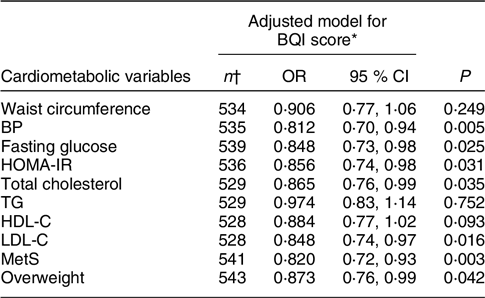
BQI, Breakfast Quality Index; HDL-C, high-density lipoprotein cholesterol; LDL-C, low-density lipoprotein cholesterol; HOMA-IR, homeostatic model assessment of insulin resistance; MetS, metabolic syndrome.
* Models adjusted for age (years), gender (male or female), BMI (kg/m2), family income per capita (≤1 or >1 minimum wage), education of the household (≤9 or >9 years), smoking status (non-smoker or smoker), leisure-time physical activity (meet or do not meet WHO recommendation), self-declared race (White, Asian or mixed race, Native) and Brazilian Health Eating Index–Revised (continuous).
† Sample size for each regression model. Only participants with data for all covariates used in the models were included in the analysis.
Discussion
The present study examined the association between breakfast quality and cardiometabolic risk factors from a representative sample of adults and older adults living in the city São Paulo, Brazil. Results indicated that breakfast quality was inversely associated with BP, fasting glucose, HOMA-IR, TC, LDL-C, MetS and overweight. Older adults were more likely to have a better overall BQI score than adults, as well as those who self-declared as being White, being more educated, earning >1 minimum wage per month and had never smoked. Given that sociodemographics have an important role on individuals’ diets, shaping diet quality(Reference Perry, Thomas and Samra56), mainly the breakfast, will have an impact on the development of lifelong healthy habits and would decrease the prevalence of obesity and other cardiometabolic disorders(Reference Reedy, Krebs-Smith and Miller57).
The present study showed that only 4·4 % of adults and older adults are skipping breakfast, with a slightly lower prevalence than what was found by the Brazilian Household Budged Survey, 2008–9 (13·3 %)(Reference Pereira, de Castro and Hopkins21). Similar findings were found for adults living in high-income countries, such as the US (5·1 %)(Reference Rong, Snetselaar and Xu58), France (4 %)(Reference Bellisle, Hebel and Salmon-Legagneur59) and Spain (5 %)(Reference Ruiz, Avila and Valero60), but older adults from France and Spain showed that only up to 1 % of them were skipping breakfast(Reference Bellisle, Hebel and Salmon-Legagneur59,Reference Ruiz, Avila and Valero60) . Sociocultural diversity can explain the differences found between individuals living in a large and business city and the whole country. Sociocultural aspects are considered an important determinant of eating behaviours(Reference Perry, Thomas and Samra56). Moreover, the definition and frequency of consumption of breakfast have been less consistent, implying that breakfast meals are homogeneous(Reference O’Neil, Byrd-Bredbenner and Hayes6).
In the current study, an examination of different categories of breakfast quality showed that those in the highest category of BQI had a better nutrient profile, corroborating with previous studies(Reference O’Neil, Nicklas and Fulgoni9,Reference Ruiz, Avila and Valero12,Reference Uzhova, Mullally and Penalvo13) . This also included higher intakes of dairy products, whole-wheat/white breads and fruits, as well as lower intakes of non-fruit juices or other sugar-sweetened beverages. These findings are in line with the results of ANIBES, a cross-sectional study with a representative sample of 1627 adults and 205 elderlies from Spain, which found that an intake of milk and dairy products (mainly cheeses, whole milk and yogurt/fermented milk), water, fruits and eggs increased across the terciles of breakfast consumers, while that of sugar and sweets decreased across the terciles(Reference Ruiz, Avila and Valero12). Food sources found on the highest terciles are known for their beneficial health properties(Reference Uzhova, Mullally and Penalvo13).
It was also observed that frequent breakfast consumers predominantly chose milk, known to be a major source of calcium and vitamin D, as well as whole-wheat breads, a good source of fibre, iron and complex of vitamin B. These findings suggest that regular breakfast consumption could serve as a marker of optimal nutrition profiles for adults and elderlies. Furthermore, evidence showed an association between regular breakfast consumption and regulation of appetite due to the consumption of fibre(Reference Gwin and Leidy11). For instance, individuals consuming breakfast more regularly are less likely to skip in-between meals and may choose later dietary intakes more carefully and consciously, with their preference aimed towards healthier food choices. Nevertheless, occasional and breakfast skippers were observed to have a poorer diet(Reference Uzhova, Mullally and Penalvo13), which implies a public health concern.
The nutrient contribution of breakfast relies on the quality and types of foods consumed(Reference O’Neil, Nicklas and Fulgoni9). Evidence suggests that a high-quality breakfast is associated with a decrease in cardiovascular and T2D risk factors(Reference Toh, Koh and Kim61,Reference O’Neil and Nicklas62) , in agreement with the present study. All associations were adjusted for potential confounders. Given that no causal conclusion can be drawn, these results show a favourable effect on BQI. This might be related to the combination of different food sources at breakfast, as a consequence of maintaining a healthy weight status(Reference O’Neil and Nicklas62). Although meal skipping is thought to facilitate weight loss(Reference Nagata, Garber and Tabler63), dietary guidelines(17,48) recommend consuming a nutrient-dense breakfast because of its health effects. For example, an intake of milk and dairy products has shown beneficial effects on cardiovascular health(Reference Givens64,Reference Lee, Lee and Kim65) . Biological mechanisms may partly explain these effects, in that a combination of calcium, fat and bile acids in the gastrointestinal system is known to inhibit fat re-absorption and improve the ratio of HDL-C:LDL-C(Reference Boon, Hul and Stegen66). An intake of dairy foods may decrease calcium level in the cells, regulating the plasma calcium and, as a consequence, inhibiting fatty acid syntheses and stimulating lipolysis. It is suggested that fatty acids found in dairy foods can have a positive effect on LDL-C density(Reference Sjogren, Rosell and Skoglund-Andersson67). Milk proteins such as whey-protein and casein might have beneficial effects on BP(Reference Park and Nam68).
Fibres play an important role in helping to control blood glucose levels, improving insulin sensitivity and reducing atherogenic risk factors. Moreover, the benefits of consuming fruit and vegetables may result in a synergic action between nutrients, phytochemicals and food structure(Reference Fardet69). It reinforces the importance to distinguish promoting breakfast v. promoting a healthy breakfast. Diets that include nutrient-dense foods have been shown to lead to weight loss and reduce disease risk.
A study based on the National Health and Nutrition Examination Survey 2011–14 data of individuals >2 years of age(Reference Vieux, Maillot and Rehm70) used a linear programme model to identify breakfast quality, favouring fruit, cereals and dairy and suggesting less meat, added sugars and fats, but more whole fruits and 100 % juices, more whole grains and more milk and yogurt. This and our results can build on existing dietary patterns to construct dietary guidelines and identify individual meals and/or snacks that need improvement.
Strengths and limitations
A major strength of the present study is the application of a breakfast index on the population of São Paulo that was previously developed for Brazilians(Reference Pereira, de Castro and Hopkins21). The impact of breakfast quality was distinguished from the overall diet quality, adjusting the models for BHEI-R(Reference Previdelli, Andrade and Pires41), considering the role of breakfast in reducing cardiometabolic risk factors. Moreover, it filled the gap in examining BQI and cardiometabolic risk factors in a representative sample of adults and older adults living in a Brazilian urban city. Finally, the present study used statistical techniques to adjust for potential confounding.
However, the present study was not without limitations. Although data on overall breakfast quality and cardiometabolic risk factors are limited, our findings are in accordance with the results of randomised crossover trials. Jacubowicz et al. (2017) reported that breakfast is highly relevant for preserving the active mechanisms involved in glucose and lipid regulation(Reference Jakubowicz, Wainstein and Landau71). Another study with the duration of 2 weeks found that healthy and lean pre-menopausal women who skipped breakfast showed higher fasting plasma TC and LDL-C than those eating breakfast regularly(Reference Farshchi, Taylor and Macdonald72). Other studies also reported lower BMI, fasting glucose(Reference Iqbal, Schwingshackl and Gottschald29,Reference di Giuseppe, Di Castelnuovo and Melegari73,Reference Milla, Johns and Aguero74) and better cardiometabolic risk profiles(Reference Iqbal, Schwingshackl and Gottschald29,Reference di Giuseppe, Di Castelnuovo and Melegari73,Reference Cahill, Chiuve and Mekary75) in individuals consuming a healthy breakfast.
Some methodological features of the present study should be considered. Differences between drug users and non-drug users were not explored because of the low number of drug users (n 220). Therefore, we performed analyses after adjusting the regression models for drug use and then considering only non-drug users. Results remained similar between dichotomising drugs and non-drug users and adjusting for significant cardiometabolic outcomes for drug users. Furthermore, breakfast consumption was assessed based on self-reported 24hR, which does not reflect variations in daily food consumption. Standardised methods were used to reduce recall bias, as well as intrapersonal variability was adjusted to decrease these limitations(Reference Fisberg, Sales and Fontanelli32,Reference Moshfegh, Rhodes and Baer38) .
Conclusion
Healthier breakfast quality is associated with lower odds of cardiometabolic risk factors in adults and older adults in São Paulo, Brazil. Findings of the present study suggest that the Brazilian BQI may be a useful method to characterise and develop programmes to promote healthy behaviours, considering the benefits of a good-quality breakfast, and this could be a simple and important public health message.
Acknowledgements
Acknowledgements: We would like to thank Prof. Dr Chester Luiz Galvão Cesar, Prof. Dr Moisés Goldbaum, Maria Cecilia Goi Porto Alves, all ISA-Capital staff and the researchers of the Dietary Assessment Group (GAC – Grupo de Pesquisa de Avaliação do Consumo Alimentar). Financial support: The 2015 Health Survey of São Paulo was supported by the São Paulo Municipal Health Department (grant number 2013-0·235·936-0), São Paulo Research Foundation (grant numbers 2012/22 113-9, 2017/05125-7) and the National Council for Scientific and Technological Development (grant number 472 873/2012-1). P.V.F. received a master scholarship from the São Paulo Research Foundation (process #2017/17 348-0) and Coordenação de Aperfeiçoamento de Pessoal de Nível Superior – Brasil (process #1 745 592). All funders had no role in the design, analysis or writing of this article. Conflict of interest: None. Authorship: P.V.F. was involved with statistical analysis, interpretation of data and writing of the manuscript. J.L.P. and M.A.C. contributed with statistical analysis, interpretation of data and manuscript drafting. A.L.C. was involved in writing and providing critical review of the manuscript. R.M.F. conceived and initiated the 2015 Health Survey of São Paulo, supervised data management and statistical analysis and provided comments and suggestions on all drafts. All authors have read and approved the submitted version. Ethics of human subject participation: The 2015 ISA-Capital (CAAE no 32 344 014·3·0000·5421) as well as the present study (CAAE no 96 304 418·9·0000·5421) was approved by the Institutional Review Board of the School of Public Health, University of São Paulo. The present study was conducted according to the guidelines laid down in the Declaration of Helsinki, and all procedures involving research study participants were approved by the Institutional Review Board of the School of Public Health, University of São Paulo. Written informed consent was obtained from all subjects. Verbal consent was witnessed and formally recorded.
Supplementary material
For supplementary material accompanying this article visit https://doi.org/10.1017/S1368980020002748



