

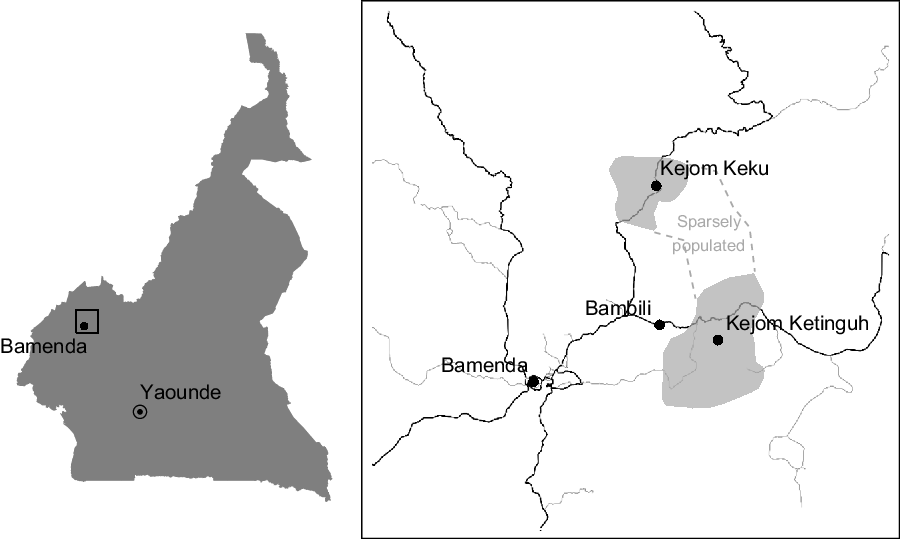
Kejom [k̀ɘd͡ʒɔ́m], the preferred autonym for the language more commonly known as Babanki, is a Central Ring Grassfields Bantu language (ISO 693-3: [bbk]) spoken in the Northwest Region of Cameroon (Hyman Reference Hyman, Bouquiaux, Hyman and Voorhoeve1980, Hammarström et al. Reference Hammarström, Forkel and Haspelmath2017, Simons & Fennig Reference Simons and Fennig2017). The language is spoken mainly in two settlements shown in Figure 1, Kejom Ketinguh [k̀ɘd͡ʒɔ́m ↓kɘ́tÍⁿɡ̀uʔ] and Kejom Keku [k̀ɘd͡ʒɔ́m ↓kɘ́k̀u], also known as Babanki Tungoh and Big Babanki, respectively, but also to some extent in diaspora communities outside of Cameroon. Simons & Fennig (Reference Simons and Fennig2017) state that the number of speakers is increasing; however, the figure of 39,000 speakers they provide likely overestimates the number of fluent speakers in diaspora communities. The two main settlements’ dialects exhibit slight phonetic, phonological, and lexical differences but are mutually intelligible. The variety of Kejom described here is the Kejom Ketinguh variant spoken by the second author; all data and examples which we take into account are based on his speech.
Kejom-speaking areas (right, shaded) within Cameroon (left). Map generated using ggmap in R (Kahle & Wickham Reference Kahle and Wickham2013).

Most speakers of Kejom also speak Cameroonian Pidgin English, which is increasingly used in all domains, even in the home (Akumbu & Wuchu Reference Akumbu and Wuchu2015). Some speakers in Kejom Keku are also proficient in Kom, a neighboring Central Ring language, depending on their level of engagement with Kom speakers nearby; speakers located in Francophone areas of Cameroon may also speak French. An orthography guide for Kejom has been developed (Akumbu Reference Akumbu2008a) and is currently used in literacy classes in the two settlements, as well as in an ongoing Bible translation effort.
Kejom has been the subject of some previous linguistic analysis. Beyond general grammatical description (Akumbu & Chibaka Reference Akumbu and Chibaka2012) and a lexicon (Akumbu Reference Akumbu2008b), previous works mainly concern analysis of lexical tone, grammatical tone, and other prosodic characteristics (Hyman Reference Hyman1979b; Chie Reference Chie2002; Akumbu Reference Akumbu2011, Reference Akumbu2015, Reference Akumbu, Clem, Jenks and Sande2019), with some coverage of the segmental phonology (Mutaka & Chie Reference Mutaka and Chie2006, Akumbu Reference Akumbu, Clem, Dawson, Alice Shen, Skilton, Cheng and Erik2016). However, relatively little attention has been paid to details of segmental and suprasegmental phonetics, particularly the interesting allophones of the high vowels; this paper is an effort to fill this gap.
Consonants
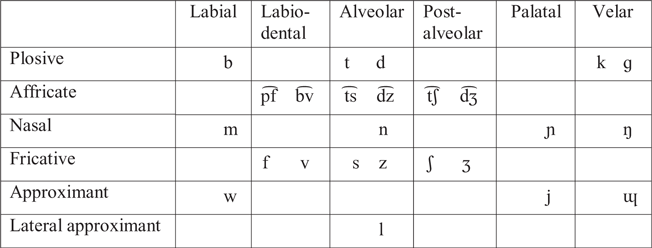
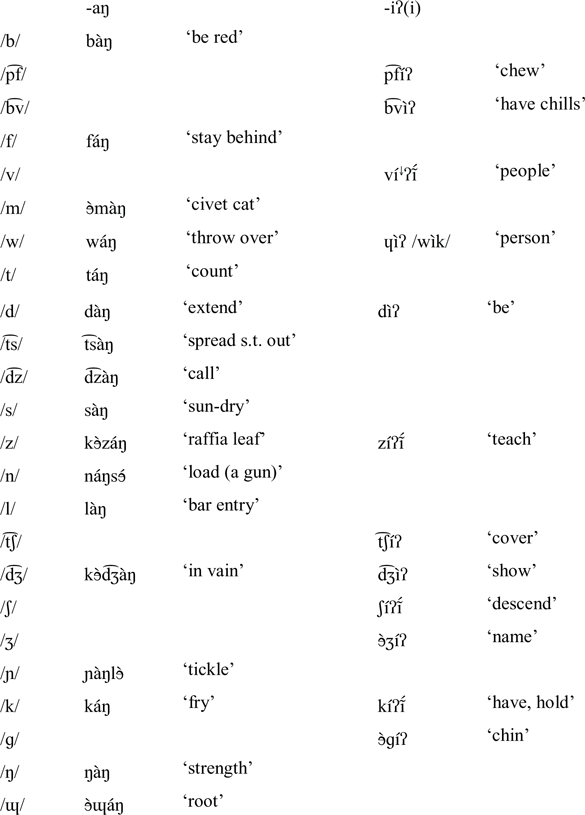
Kejom permits 25 consonant phonemes in stem-onset position. Fricatives, affricates, and plosives at all places of articulation are contrastively voiced, with the exception of /b/, which lacks a voiceless phoneme counterpart. Kejom can thus be counted among the languages which lack a voiceless bilabial stop, reflecting aerodynamic constraints on speech production (Ohala Reference Ohala and MacNeilage1983, Maddieson & Disner Reference Maddieson and Disner1984). Voiced obstruents are fully voiced in all positions, and voiceless obstruents generally have a voice onset time close to zero; for instance, the contrast between /t/ and /d/ is generally produced as short-lag [t] versus prevoiced [d]. The relatively numerous affricates occur at three places of articulation: labiodental, alveolar (sibilant strident), and postalveolar (non-sibilant strident). Most consonants in stem-onset position may be prenasalized, and a large subset additionally occur with secondary palatalization or labialization; these modifications are discussed further below.
Consonant contrasts are not evenly distributed in the Kejom word, the general template of which is a CV(C) stem with optional (C)V prefixes and suffixes. All consonants listed above may occur in onset position in stems. Excepting recent loanwords, onset position in non-stem morphological material (prefixes, suffixes, and function words) contains only the consonants /t k f v s ʃ m n j ɯ/. Two of these, /j/ and /v/, almost never occur in stem-onset position, appearing only in a handful of common noun and verb stems (e.g. [jɛ́n] ‘see’, [vÌ̀] ‘come’). They are, however, frequently found in onset position outside the stem, mainly in agreement morphology. Consonants that are not in the stem-initial onset or stem-final coda are quite rare, as multisyllabic stems that do not result from stem reduplication are themselves rare. The set of consonants attested in this position is /f s k m n l/, which is similar to the set of stem-final coda consonants described below.
Stem-initial onsets do not undergo a great deal of allophonic variation. Stem-onset velar stops /k ɡ/ are palatalized before the front vowels /i/ and /e/, e.g. [kʲé] ‘allow’, [ɡʲÌ̀tɘ̀] ‘add’. Analogously, the labial-velar approximant /w/ is realized as rounded palatal [ɥ] when it occurs before the high front vowels /i/ and /e/, as in [ɥÌ̀ʔ] ‘person’, [ɥé] ‘plant (v.)’. This process could be described as palatalization applying to a natural class of velars, excepting only /ŋ/ and /ɯ/, which do not occur before front vowels. The sequence /bʉ/ is sometimes produced as [bʙ̩]; this could well be transcribed simply as a syllabic bilabial trill [ʙ̩], given that bilabial trills are typically prestopped (Ladefoged & Maddieson Reference Ladefoged and Maddieson1996). The trill is debatably an allophone of the vowel rather than the consonant, a point we discuss in more detail below in connection with the several allophones of the vowel /ʉ/.
-
(1) Consonants in stem-final coda position

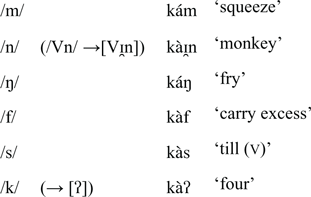
The stem-final syllable coda is associated with more (and more salient) allophony, and only six consonants /f s k m n ŋ/ may occur in the syllable coda, as exemplified in (1) above. In coda position, and in fact any non-stem-initial position, /k/ is realized as a glottal stop [ʔ]. For the present speaker, in utterance-final position, coda [ʔ] consistently results in full glottal closure, which is occasionally strongly released, i.e. [ʔʰ], in the accompanying recordings.Footnote 1 Word-medially, glottal stop is variably reduced to a period of creaky phonation. The vowel /i/ is produced with non-contrastive nasalization when it follows a word-internal glottal stop, as in [vÍ↓ʔ̘́] ‘people’, which we take to be an instance of ‘rhinoglottophilia’, or nasalization triggered by a glottal syllable onset (Matisoff Reference Matisoff, Charles, Larry and John1975).
Coda /n/ conditions diphthongization of all non-high vowels that precede it, namely the set /a e o/, resulting in syllable rhymes [aɪ̯n ɛɪ̯n ɔɪ̯n]; other vowels followed by /n/ do not undergo diphthongization. Occasionally, the coda nasal stop is produced without closure, resulting in the free variants [aɪ̯˜ ɛɪ̯˜ ɔɪ̯˜]. This diphthongization pattern is shared in common with the neighboring language Kom and is attested mainly in the dialect of Kejom Ketinguh. All coda consonants except /m/ are frequently deleted intervocalically; this is discussed further below.
Velar approximant
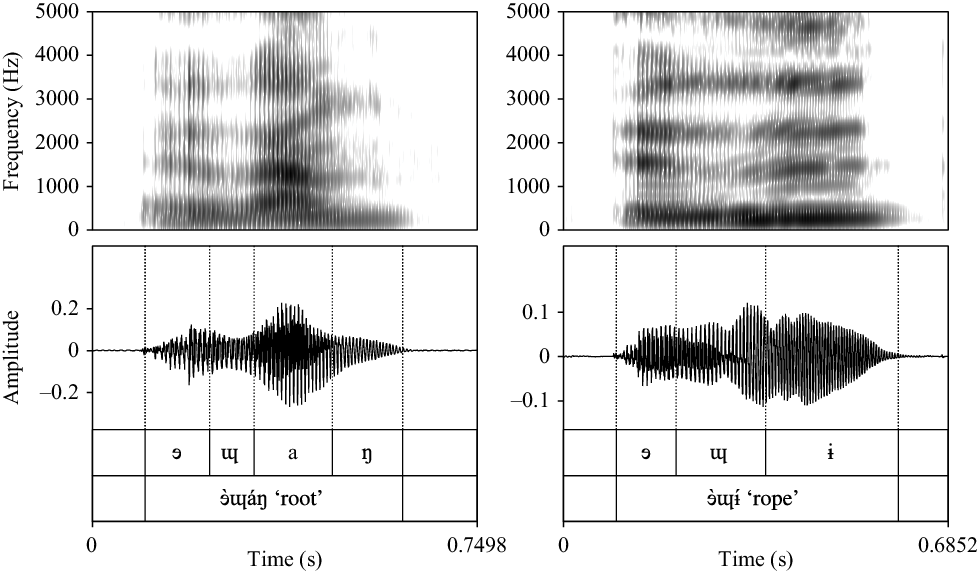
The segment /ɯ/ is commonly transcribed as a voiced velar fricative [ɣ] in both Kejom (Hyman Reference Hyman1979b, Akumbu & Chibaka Reference Akumbu and Chibaka2012) and other languages in the area (Hyman Reference Hyman1979a, Schaub Reference Schaub1985). A frictionless, approximant version of the phone is sometimes reported instead (Hyman Reference Hyman1981). The typical production of /ɯ/ in the second author’s speech in Kejom shows little to no frication, motivating our description of it here as an approximant rather than a voiced fricative.
Two representative examples of stem-initial, intervocalic [ɯ] are given in Figure 2; no aperiodic energy in the low-frequency region can be seen, as would be expected for a velar fricative, although a general reduction in intensity and a weakening of formant structure can be seen, indicating the presence of an approximant constriction. Figure 2 and all subsequent spectrographic displays were produced using Praat (Boersma & Weenink Reference Boersma and Weenink2001).
Two tokens of the velar approximant /ɯ/ in two different vowel contexts.

Prenasalized onsets
All oral onset consonants except /v/ may occur with prenasalization. The absence of /ⁿv/ onsets is most likely an accidental gap due to the low frequency of onset /v/ in general. Postnasal neutralization of obstruent voicing to [+voi] does not occur at either the phonological or phonetic levels, as is common in other Bantu languages (Hyman Reference Hyman, Nurse and Philippson2003: 50), see, for instance, /ⁿp͡fʉ̀/ ‘rope’ versus /ⁿb͡vʉ́/ ‘chicken’; /kɘ̀ⁿsȁs/ ‘(act of) scattering’ versus /kɘ̀ⁿzȁs/ ‘key’. We are agnostic as to whether prenasalized consonants as presented here are best phonologically represented as single complex segments or sequences of a placeless nasal and the simple consonants presented above. Both analytical routes equally well represent the phonetic events observed in the language, and there is a dearth of evidence that definitively supports one analysis over the other. Nonetheless, we opt to transcribe prenasalization with the secondary articulation diacritic as a necessary abstraction: prenasalization has several realizations that are dependent on the manner of articulation of the modified segment (continuant or non-continuant) and its position within the stem (stem-initial or preceded by a vowel), and which cannot be reduced to such a relatively invariant target as a placeless nasal stop.
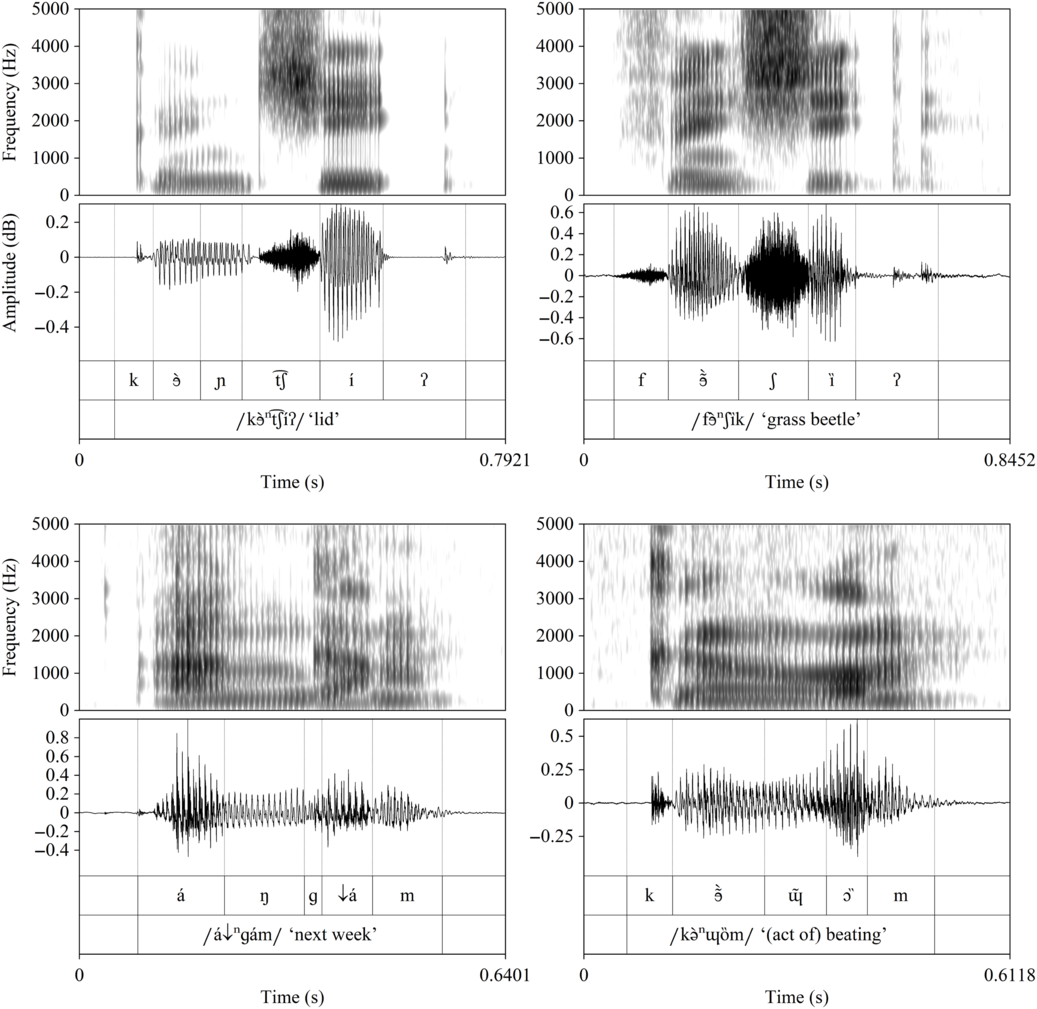
Prenasalization as realized on obstruents (top left, bottom left) and continuants (top right, bottom right).

If the prenasalized segment is a non-continuant (a stop or an affricate), prenasalization is generally realized as a homorganic nasal stop preceding the oral segment’s closure, as seen in [kɘ̀ɲt͡ʃÍʔ] ‘lid’ or [Á↓ŋgÁm] ‘next week’ (Figure 3, left). On the other hand, if the prenasalized segment is a continuant (an approximant, lateral approximant, or fricative), prenasalization is typically realized without a full closure in the oral cavity. Representative examples of /ⁿʃ/ and /ⁿɯ/ are given in Figure 3 (right). Vowels preceding prenasalized fricatives tend to be nasalized, with the nasalization of the consonant shifting completely onto the vowel, as in [fɘ˜̀ʃȉʔ] ‘grass beetle’ (Figure 3, upper right). If the prenasalized segment is not a fricative, the entire segment and the preceding vowel are typically nasalized, as in [kɘ˜̀ɯ˜ɔ̏m] ‘(act of) beating’ (Figure 3, lower right). No abrupt reduction of formant intensity or rapid shift in formant frequencies, either of which might suggest an oral closure with continuing nasal airflow and resonance, is visible in the spectrograms for either /ⁿʃ/ or /ⁿɯ/ in Figure 3 (bottom left, bottom right). This can be contrasted with the clear division between a vowel [ɘ] or [a] and the following nasal stop in the other two examples in Figure 3 (top left, top right). We speculate that the lack of a closure in the oral cavity for prenasalized continuant segments could be a learned aspect of articulatory timing in Kejom that has the effect of avoiding excrescent oral stops in nasal-continuant sequences (Browman & Goldstein Reference Browman, Goldstein, Kingston and Mary1990, Ohala Reference Ohala1993). Such a scenario would be particularly damaging to the fricative–affricate contrasts of Kejom, which have a relatively high functional load and could easily be lost if gestural timing promoted excrescent oral stops in this context.
The examples of prenasalized consonants used above all have at least a vowel preceding the prenasalized consonant in the stem. When prenasalized consonants occur at the left edge of a stem, with no other prefixal material present, the nasal portion of the segment gives the percept of having syllabic prominence and being produced with low tone, similar to most prefixal material in Kejom. Previous transcriptional schemes based on auditory impression, used by the second author and others (Hyman Reference Hyman, Bouquiaux, Hyman and Voorhoeve1980, Akumbu Reference Akumbu2008a), generally reflect this intuition, marking the nasal portion of prenasalized segments in this position as bearing a low tone, akin to most other prefixal material in Kejom. Prenasalized non-continuants in particular show this tendency, e.g. /ⁿdɔ̏ŋ/ ‘potato’ typically being transcribed as [ǹdɔ̏ŋ].
Labialized and palatalized onsets
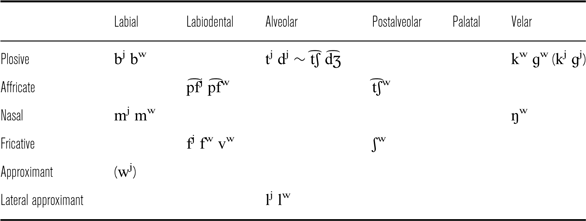
Syllable onsets in Kejom may also be accompanied by palatalization or labialization, as shown in Table 1. Complex onsets that have both prenasalization and either palatalization or labialization (i.e. ⁿCʲ, ⁿCʷ) are attested fairly frequently and are referenced throughout this section; this results in strikingly complex onset consonants (or lengthy clusters, depending on one’s analysis). As with prenasalization above, there is some ambiguity as to whether labialized and palatalized consonants are single complex segments with secondary articulations or sequences of the plain segments and approximants /j w/. Also as before, there is little evidence at present that supports one analysis to the exclusion of the other. In this sketch, we opt to treat palatalization and labialization as attributes of complex segments, primarily because it allows for a simpler description of velar palatalization. This analytical decision greatly increases the number of distinct consonants, since the secondary articulations are relatively freely combined with onsets.
Palatalized and labialized consonants of Kejom. Palatalization of parenthesized consonants is allophonic.

Palatalization can primarily be observed on bilabial and labiodental segments, and it is particularly frequent before the front and central non-low vowels /i e ɨ ʉ ɘ/. Minimal or near-minimal pairs hinging on the contrast between palatalized and non-palatalized versions of the same segment are relatively easy to find for the bilabials and labiodentals, e.g. [ɘ̀bÍ] ‘kola nut’ versus [bʲÍ] ‘goat’; [fɨ́f] ‘white’ versus [fʲɨ̀f] ‘blind’, et cetera. The palatalized labiodental /p͡f/, however, is attested only with prenasalization and only in one word, [kɘ̀ⁿp͡fʲɨ̀ŋ] ‘owl’. Palatalized alveolar plosives [tʲ] and [dʲ] do occur, but are in free variation (and perhaps near-merger) with postalveolar affricates /t͡ʃ/ and /d͡ʒ/, respectively, as in [dʲȁŋ] ‘cross (v.)’, which freely varies with [d͡ʒȁŋ]. As discussed above, palatalized velar plosives [kʲ ɡʲ] occur, but are conditioned by a following front vowel /i/ or /e/ and occur nowhere else; no minimal pair contrast between palatalized and non-palatalized velars occurs in any Kejom lexeme. The [ɥ] allophone of /w/ before /i/ and /e/ could also be thought of as a non-contrastively palatalized /w/, in a sense palatalized [wʲ].
Unlike palatalization, labialization is never an allophonic feature of the consonant, and co-occurs with a somewhat broader range of consonants compared to palatalization. Except for the alveolar plosives /t, d/, all consonants that can be palatalized can be labialized, and several that cannot be palatalized (the postalveolars /t͡ʃ d͡ʒ ʃ/) or contrastively palatalized (the velars /k ɡ ŋ/) may be contrastively labialized. Labialization is typically produced with a labial-velar constriction, as in [ʃʷÀɪn] ‘shuck corn’, [ɘ́ŋʷɘ̀ʔ] ‘inf-be bright, clean’. Akin to the allophony described for /w/ above, labialized consonants are realized with a rounded palatal secondary articulation when followed by the high front vowel /i/, e.g. [kɥÌ̀] ‘up’, [kɥé] ‘meet up with’, [ʒɥÌ̀sɘ̀] ‘breathe’, [lɥȉ] ‘bitter’. Bilabial and labiodental consonants with this secondary articulation, however, are still produced with a labial-velar secondary articulation, e.g. [bʷÍ] ‘give birth’, [fʷÍ] ‘get burnt’.
Vowels
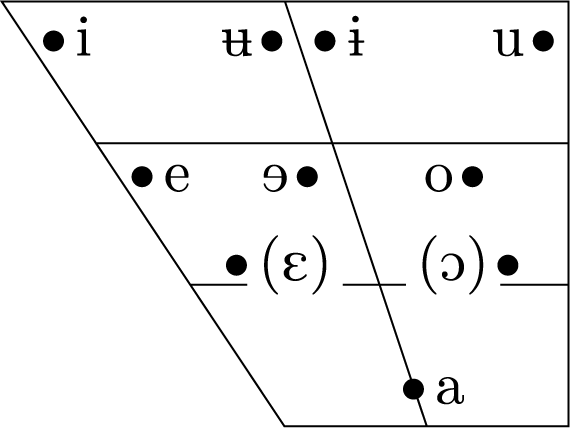
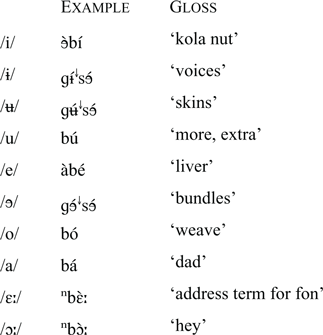
Kejom has eight vowel phonemes contrasting in height, backness, and rounding. Lengthened vowels frequently occur in running speech owing to a process of vowel coalescence, but length is only marginally phonemic (see the following section). Two of these lengthened vowels, the low-mid vowels /ɛː/ and /ɔː/, are marginally contrastive but frequently observed due to vowel coalescence. Kejom has several typologically unusual vowel contrasts: there is a contrast between mid and high central unrounded vowels /ɨ/ and /ɘ/, and a contrast between a high central unrounded vowel /ɨ/ and a high central rounded vowel /ʉ/ is typically described. Of additional interest are the various allophones of /i/ and /ʉ/, which exhibit carryover coarticulation of the supralaryngeal constrictions of certain immediately preceding onset consonants.
The mid vowels /e/ and /o/ exhibit higher or lower allophones depending on syllable shape and palatalization or labialization of the onset. In open syllables, mid-high allophones are consistently observed (i.e. [e] and [o]), as in [Àbé] ‘liver’, [ɘ̀kó] ‘money’. Both mid vowels are realized as lower (i.e. [ɛ] and [ɔ]) in closed syllables, as in [bɛ̀ʔ] ‘snatch’, [kɔ́ʔ] ‘chop’. The lower mid allophones [ɛ] and [ɔ] also both occur in some open syllables: [ɛː] and [ɔː] appear due to vowel coalescence, and may be marginally contrastive with [e] and [o] in a handful of words where the operation of coalescence cannot definitely be confirmed (see next section).
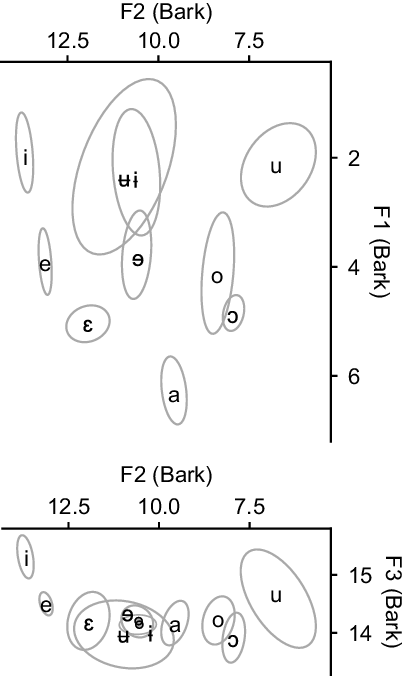
Mean formant frequencies for Kejom vowels in Bark with 95% confidence ellipses drawn about category centers, F1 with F2 (top) and F2 with F3 (bottom).

The acoustic vowel space of one male speaker of Kejom (the second author) is shown at right in Figure 4; measurements (between 17 and 20 per vowel) are drawn from the acoustic midpoint of the relevant vowel in each example word shown at the beginning of this section. The low-mid vowel qualities [ɛ] and [ɔ] are included here because they are frequently observed, if only marginally phonemic. The supralaryngeally constricted allophones of /i/ and /ʉ/ are not included in Figure 4 since acoustic overlap in the front-high region would render the figure less easily interpretable; see Figure 7 below. For this speaker, the two high central vowels [ɨ] and [ʉ] almost completely overlap in all formant frequencies measured, in spite of the different lip activity of the two vowels. It emerges in the discussion of ultrasound data below that the present speaker’s [ʉ] has a more anterior lingual articulation than expected from prior description, nearly as front as [i]. This difference in tongue position may counteract the expected F2-lowering effect of lip rounding on [ʉ] relative to [ɨ].
In spite of the acoustic similarity of [ɨ] and [ʉ], we do not call the contrast between the phonemes /ɨ/ and /ʉ/ into question, given the high functional load of the contrast. The contrast between /ɨ/ and /ʉ/ is particularly robust once the assimilated allophones of /ʉ/ are taken into account: both /ɨ/ and /ʉ/ appear after postalveolars and contrast robustly in that position, although the nature of the contrast in this environment is different owing to /ʉ/’s adoption of a postalveolar tongue shape. The surface allophone [ʉ] which appears in Figure 4 has a restricted distribution, occurring only after onset /l/, /ɲ/, and the velar consonants; /ɨ/ does not appear following initial /ɲ/. For the present speaker, the contrast between [ɨ] and [ʉ] in this environment is likely reinforced visually by the visibly different activity of the lips in the two phones.
Vowel coalescence
Phonetic long vowels are quite common in Kejom, but these can generally be analyzed as a reduction of /VCV/ sequences. All coda consonants except /m/ may be deleted when followed by a /ɘ/ whether or not this additional vowel is in the same morpheme or word as the coda. The resulting /VV/ sequence coalesces to a single phonetically long vowel [Vː], which often does not match the quality of either the first or second vowel. Examples of this process are given in (2).
-
(2) Some attested mappings between stem VC and coalesced vowels resulting from the addition of a following /ɘ/
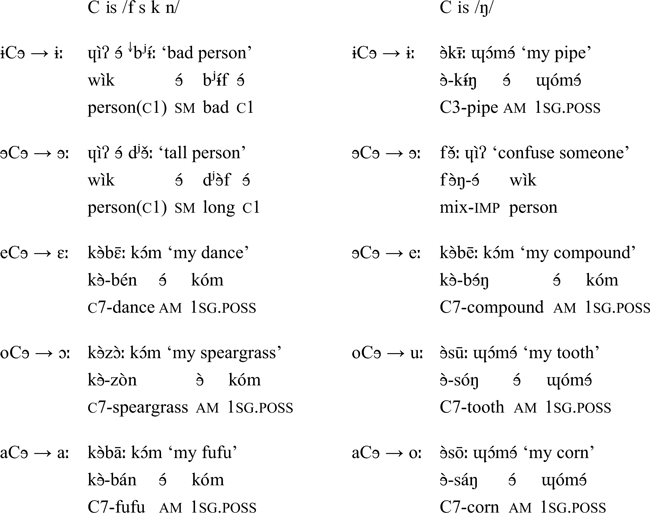
Sequences of /VCV/ that lead to coalescence generally arise when a morpheme of the form /ɘ/ (of which there are several in Kejom) follows a stem ending in a /VC/ sequence, either through suffixation (as in the imperative or progressive) or placement of a separate morpheme (as in the associative marker). In addition, any sequence of a vowel immediately followed by /ɘ/ with no intervening consonant coalesces to a lengthened version of the first vowel, e.g. /tó-ɘ́/ → [tóː] ‘be strong-prog’. When the deleted stem-final consonant is /ŋ/, coalescence results in a different, generally higher set of long vowels compared to deletion of /f s k n/.
This sketch of the coalescence process given here skims over a number of complications, in particular morphophonological factors. Deletion and coalescence do affect /ŋ/ and /n/ and their flanking vowels in a wide variety of morphological contexts, but affect the set /f s k/ only when they occur in certain high-frequency lexemes, e.g. [jɛ̀s] ‘1pl.excl’, [bʲɨ́f] ‘bad’, [dʲɘ̀f] ‘long’, [ɯɔ́ʔ] ‘big’. Furthermore, a given combination of stem vowel and coda does not neatly correspond to a single coalesced vowel: for instance, a stem-final sequence of [ɘŋ] may coalesce to [ɘː] or [eː], depending on the word that plays host to it, as shown in the right column of (2) above.
Most long vowels are obviously derived, but there are a handful of exceptional [ɛː] and [ɔː]. The two low-mid vowel qualities [ɛ] and [ɔ], outside of closed syllables, where they occur as allophones of /e/ and /o/, only occur as lengthened [ɛː] and [ɔː] and can primarily be attributed to coalescence of /eCɘ/ and /oCɘ/ sequences, respectively. However, [ɛː] and [ɔː] also appear in a handful of lexemes that do not obviously include a derived environment, e.g. [ɘ̀kɔ̀ː] ‘which’, [ⁿbɔ̀ː] ‘hey (attention-getting)’, [ⁿbɛ̀ː] ‘term of address for fon’—so we regard these vowel qualities as marginally contrastive.
Vowels with postalveolar and labial constrictions
The phonetic realization of the phonemes /i/ and /ʉ/ is highly dependent on the preceding consonant, particularly for /ʉ/. This allophony can be broadly described as a process of assimilation to the syllable-initial consonant’s place of articulation; all four allophones are presented in (3).
-
(3) Allophones of /i/ and /ʉ/ by the preceding consonant’s place of articulation
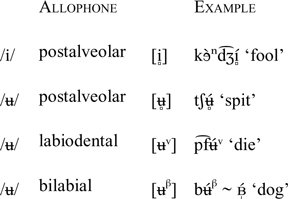
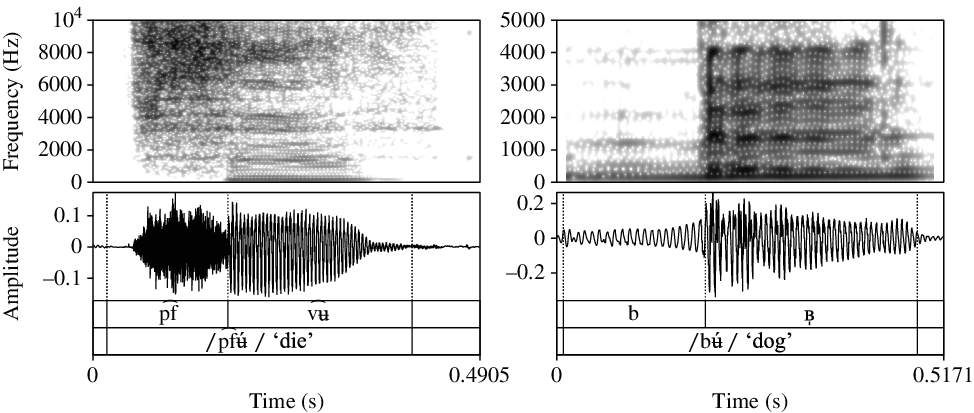
This is most obviously the case for two allophones of /ʉ/, which exhibit labial constrictions other than the outrounding observed elsewhere in Kejom. After labiodental fricatives and affricates, /ʉ/ is produced with a labiodental constriction continuous with that of the onset that persists through the vowel, which is denoted here as [ʉv]. Slight labiodental frication is produced through most of the duration of the vowel as a consequence of the labiodental constriction, as seen in Figure 5 (left). A central vowel with significant lip compression, denoted as [ʉβ] here, is an allophone of /ʉ/ after non-labialized, non-palatalized /b/; bilabial trilling frequently occurs after the release of the [b] and may persist for the duration of the vowel, as seen in Figure 5 (right).
Left: Labiodental frication in [p͡fʉ́v] ‘die’, visible in spectrogram above 7 kHz. Right: Bilabial trilling in a token of /bʉ́/ ‘dog’ realized as [ʙ̩́].

Both /i/ and /ʉ/ acquire a postalveolar, [ʒ]-like constriction following postalveolar fricatives and affricates. The vowel /i/ has a postalveolar-constricted allophone transcribed here as [i̻] that occurs after postalveolars;Footnote 2 the vowel /ʉ/ has a similarly constricted allophone [ʉ̻] occurring in the same environment. Both allophones are transcribed using the laminal diacritic to indicate the change in active articulator. Phonetic [i] occurs as an allophone of /i/ following bilabial, labiodental, alveolar, and velar consonants; phonetic [ʉ], the only vowel quality associated with /ʉ/ that cannot be attributed to assimilation to a preceding consonant, occurs only after velar consonants, /l/, and /ɲ/.
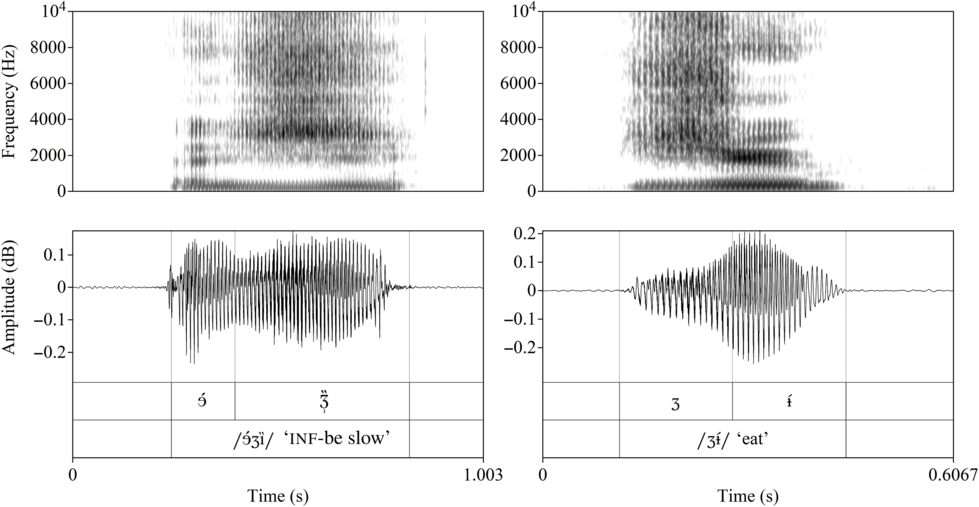
Left: postalveolar frication across entire second syllable of [ə́ʒ̩̏] ‘inf-be slow’. Right: for comparison, a fricative–vowel sequence in [ʒɨ́] ‘eat’.

There is strong frication present during some productions of the postalveolar allophones, particularly when they are preceded by a voiced postalveolar /d͡ʒ/ or /ʒ/, as shown in Figure 6. In this context it can be difficult to segment the onset from the vowel, given the continuous voiced frication over the entire onset–vowel sequence. This issue is encountered in Figure 6 (left), where the speaker is essentially producing a syllabic fricative for the sequence /ʒi/. An analogous rounded segment, not shown in this figure, is also attested for the sequence /ʒʉ/, e.g. [ə́ ʒ̏ʷ] ‘inf-be cold’. Nonetheless, the postalveolar allophones of /i/ and /ʉ/ cannot simply be described as syllabic fricatives, given that the intensity of frication varies substantially depending on aerodynamic conditions.
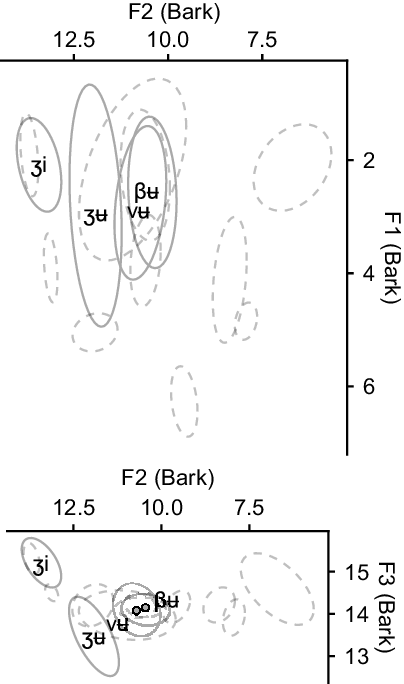
Mean formant frequencies for these allophones in Bark with 95% confidence ellipses drawn about category centers, F1 with F2 (top) and F2 with F3 (bottom). Stimuli are the relevant words at left; the labels ʒi, ʒʉ, βʉ, and vʉ stand for [i̻], [ʉ̻], [ʉβ], and [ʉv], respectively. Dashed ellipses indicate formant frequencies for the remaining vowels as shown in Figure 4.

F1–F2–F3 values for the supralaryngeally constricted allophones of /i/ and /ʉ/ are given in Figure 7. Postalveolar [ʉ̻] has a lower F3 than the other vowels, but otherwise there is little separation in F1–F2–F3 space to allow for easy discrimination between [i] and its allophone [i̻] on the one hand and [ɨ], [ʉ], and [ʉv] on the other hand. However, given that the [i] – [i̻] and [ʉ] – [ʉ̻] contrasts are predictable from the preceding consonant, it is not unexpected that acoustic differences among allophones would be slight, since the functional load that this acoustic difference would assume is low to nonexistent.
Articulation of vowels with postalveolar and labial constrictions
In this section, we use ultrasound and video records to characterize the vowels with postalveolar and labial constrictions in greater detail, and in particular to demonstrate the existence of the extra supralaryngeal constrictions described above. This data confirms the initial impression that /i/ and /ʉ/ assimilate in place of articulation to preceding postalveolar consonants. We provide evidence that the fricativized allophones of /i/ and /ʉ/ exhibit lingual or labial constrictions not normally expected in vowel sounds, which canonically have unobstructed central channels and laminar airflow.
Method
All articulatory data in this section was collected in the UC Berkeley PhonLab in April and May of 2016. All records are of the second author. Video of the speaker’s face was collected using a Canon XF100 HD camcorder. The lingual ultrasound records shown in this section are still frames from videos taken from the approximate acoustic midpoint of the segments examined. Ultrasound video was recorded at a frame rate of 107 Hz using an Ultrasonix SonixTablet and a C9-5/10 microconvex transducer. The transducer was held in place under the chin and approximately perpendicular to the speaker’s occlusal plane by an Articulate Instruments stabilization headset (Scobbie, Wrench & van der Linden Reference Scobbie, Wrench, van der Linden, Sock, Fuchs and Laprie2008). Tongue surface contours were extracted from the ultrasound data using EdgeTrak (Li, Kambhamettu & Stone Reference Li, Kambhamettu and Stone2005); comparisons among segments are carried out below using smoothing-spline analysis of variance (SSANOVA) calculated using polar coordinates (Davidson Reference Davidson2006, Mielke Reference Mielke2015), which models the typical position of the tongue surface contour based on multiple input contours (here, in excess of 20 tokens per vowel or consonant type). The approximate location of the speaker’s hard palate is superimposed on the SSANOVA plots below as a landmark; this information was collected by asking the speaker to drink water while scanning the swallowing action with the ultrasound.
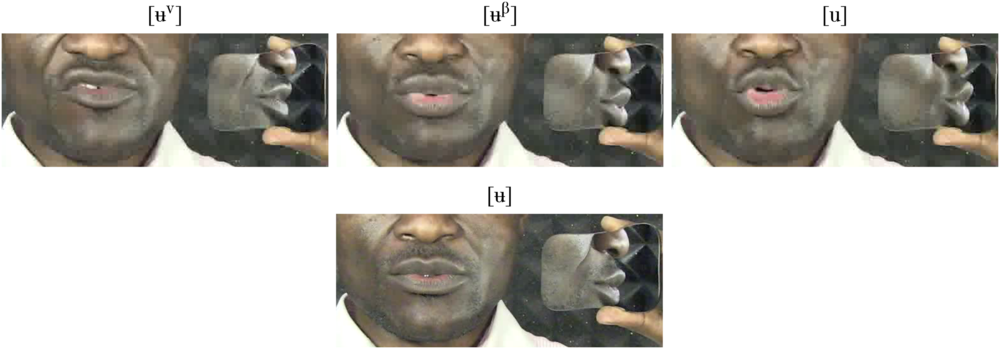
Lip activity during production of [ʉv], [ʉβ], [ʉ], and [u]. Frames were sampled from the acoustic midpoints of the vowels in [ⁿb͡vʉ́v] ‘chicken’, [bʉ́β] ‘dog’, [ɡʉ̀] ‘skin’, and [bú] ‘more, extra’, respectively. The mirror to the right of the speaker is held at a 45-degree angle to the coronal plane and gives a view of the lips in profile.

Labial vowels
Using video stills, substantial differences in labial activity can be confirmed between out-rounded [u], labiodental [ʉv], and compressed or in-rounded [ʉ] and [ʉβ]. Constriction of the lower lip against the teeth is evident in the video frame for [ʉv] provided in Figure 8 (left), and muscular effort to retract the upper lip is also visible. At the other extreme, out-rounding is clearly visible in [u] to the exclusion of the other vowels with labial activity, as shown in Figure 8 (right). Productions of [ʉβ] and [ʉ] both exhibit labial compression rather than out-rounding, but they differ substantially in the degree of compression exhibited. Somewhat counterintuitively, compression appears to be looser for [ʉβ] than for [ʉ], as can be seen in Figure 8 (center). However, the lip opening for [ʉβ] is smaller; combined with the loose approximation of the lips, this likely encourages the bilabial trilling that is sometimes observed.
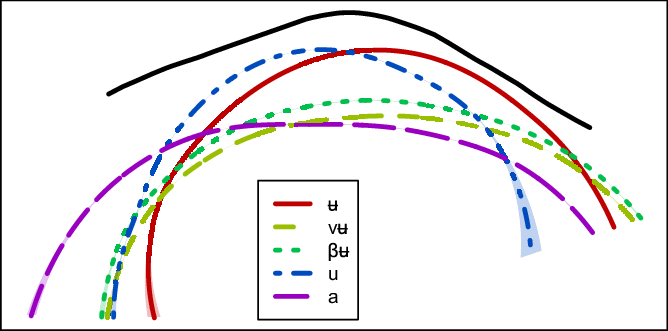
SSANOVA with 95% confidence intervals of tongue contours at acoustic midpoint of the stem vowels in [ɡʉ̀] ‘skin’, [bʉ́β] ‘dog’, [ⁿb͡vʉ́v] ‘chicken’, [bú] ‘more, extra’, and [ɘ̀bÁʔ] ‘verandas’, respectively. Right is anterior; the approximate location of the palate is given by the topmost solid line.

Some differences in lingual activity are also evident in the ultrasound data for [u], [ʉv], [ʉ] and [ʉβ]. The tongue positions of both the [ʉv] and [ʉβ] allophones, in spite of the transcriptions used here, are actually substantially lower than the high vowels [ʉ] and [u]: as Figure 9 illustrates, the tongue body is as low as a typical Kejom [a] during production of both the [ʉβ] and [ʉv] allophones of /ʉ/. For both [ʉβ] and [ʉv], the tongue root is not as retracted as for [a], suggesting a lowered but otherwise neutral tongue position for these allophones for the present speaker.
Postalveolar vowels
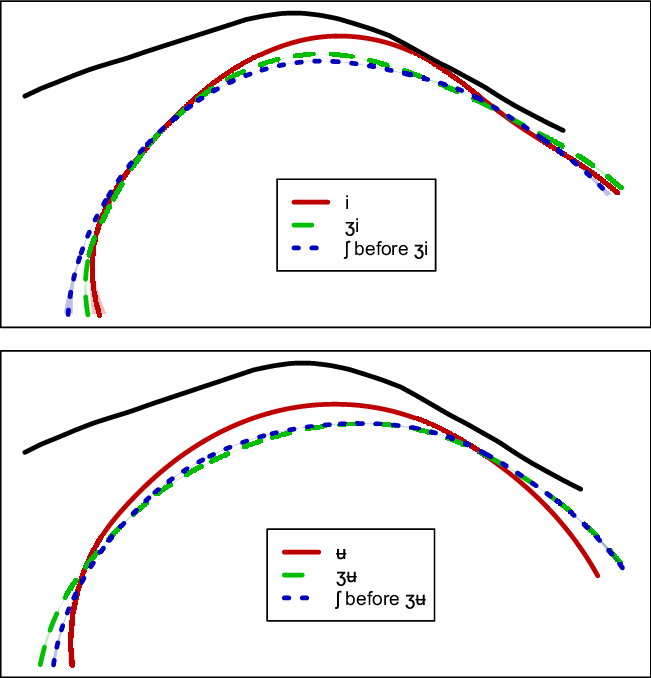
Since labial activity does not determine the major characteristics of [i̻] and [ʉ̻], we turn to lingual ultrasound data for articulatory details. Figure 10 shows that [i] and [ʉ] have a higher tongue dorsum position compared to their respective allophones [i̻] and [ʉ̻] after postalveolars. The tongue blade is closer to the hard palate in the post-alveolar region; this configuration in fact closely resembles the blade position during articulation of the preceding fricative consonant [ʃ]. It can thus be said that /i/ and /ʉ/ both exhibit a [ʒ]-like tongue posture when they follow postalveolar fricatives; acoustic consequences described above are likely subsequent to this change in constriction location relative to the [i] and [ʉ] allophones. This similarity to the preceding fricative segment is reminiscent of the so-called apical vowels found in Standard Chinese, which also adapt the lingual posture of their fricative or affricate onset and maintain it through production of the entire syllable (Lee-Kim Reference Lee-Kim2014).
SSANOVA with 95% confidence intervals of tongue contours at acoustic midpoint of stem vowels in (top) [ɘ̀bÍ] ‘kola nut’ and [ʃÍ̻] ‘take’; (bottom) [ɯʉ́] ‘keep’, and [ʃʉ̻̏] ‘fish’. For comparison, tongue shapes at the acoustic midpoint of the [ʃ] onsets in [ʃÍ̻] ‘take’, and [ʃʉ̻̏] ‘fish’ are also shown. Right is anterior; the approximate location of the palate is given by the topmost solid line.

These data may inadvertently provide an explanation for the fact that [ʉ] appears to have a comparable or even slightly higher F2 than [ɨ] when these vowels are typically described as differing only in lip rounding. For the present speaker, the tongue position for [ʉ] is roughly as front as [i] but slightly lowered; this arrangement is frequently encountered in individuals’ articulatory implementations of the contrast between front unrounded and front rounded vowels (Wood Reference Wood1986). Although [ʉ] has typically been described as central, these data suggest a more anterior articulation for the present speaker, which may counteract the F2-lowering effect of lip rounding. We cannot speculate beyond the present speaker’s idiolect on this point, and further research with multiple speakers is needed to evaluate the typical articulation of [ʉ].
Prosody
The most salient prosodic feature of Kejom is its extensive use of tone for lexical and grammatical purposes. At the phonological level, Kejom’s tonal system has been described as a simple opposition between /H/ and /L/ tonemes in various combinations and associations with stem segments (Hyman Reference Hyman1979b). However, a relatively large number of surface tonal sequences are attested; lexical tone of stems is highly ‘mobile’ and spreads progressively to inflectional material; and tone is used for verb inflection, e.g. the imperative and hortative moods, both a suffixed high tone with no associated segmental material (Akumbu & Chibaka Reference Akumbu and Chibaka2012: 167–170). A full discussion of Kejom’s tonal phonology and morphology would necessarily be very complex and is not included here for the sake of space.
Tonal contrasts are not evenly distributed in Kejom, with stems exhibiting several contrastive melodies while prefixal material (i.e. noun class inflectional prefixes) is generally only low-toned. Most suffixal material is toneless and receives tone from stems via spreading. There are exceptions to these generalizations, namely the infinitive verbal prefix /ɘ́̀/ and the inflectional suffix /sɘ́/ for noun class 10, which both carry a high tone. We limit further discussion here to the phonetic realization of the contrastive tonal contours observed on short (i.e. non-coalesced) noun and verb stem vowels, in addition to the phonetic and phonological properties of two frequently occurring derived tones, the downstepped high tone and the mid tone.
Stem tone melodies
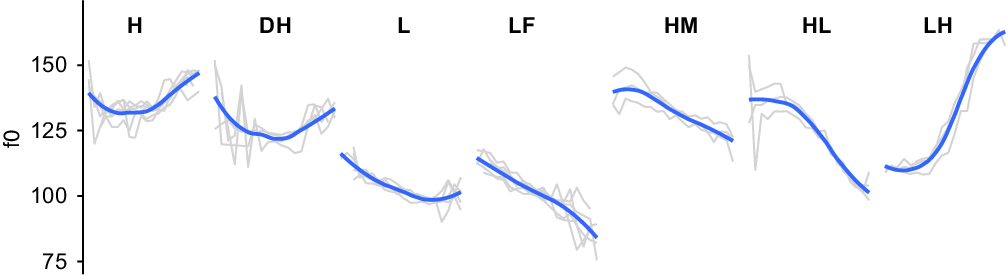
The tonal contours attested on single stem vowels are illustrated in (4) and visualized in Figure 11.
-
(4) Tone melodies on monosyllabic stems
Note that downstepped high (↓H) is phonetically indistinguishable from the derived mid (M) tone described in more detail below
Figure 11f0 tracks for the stem vowels of the words in Table 4 (loess regression, 3–6 tokens per word). f0 estimates taken at 20 sampling points evenly distributed over the vowel’s duration using an inverse filter control method (Ueda et al. Reference Ueda, Hamakawa, Sakata, Hario and Watanabe2007). Clear octave errors were manually removed. DH is downstepped high tone (↓H); LF is low-falling tone.
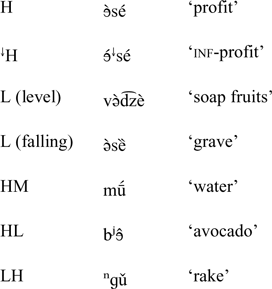

Kejom contrasts simple high (H) and low (L) tone melodies on monosyllables. In addition, a downstepped high tone (↓H) occurs when an unassociated L tone is stranded between two H tones (as with the infinitive prefix /ɘ́̀/ in (4)). The L tone contrasts with a low falling tone (LF), which we transcribe here as super-low.Footnote 3 The latter starts at a pitch level typical of the low tone, but falls more rapidly to a lower level than the low tone and ends near the bottom of the speaker’s pitch range. The L tone, by contrast, is relatively level and does not reach the extremely low pitch of the LF tone. The contrast between this pair of tones only occurs before pause; in all other positions, the distinction is neutralized to the level low tone.
Tonal melodies involving multiple clear pitch levels are rare on monosyllabic stems, but do occur. High-low falling (HL) and low-high rising (LH) contours are attested, mainly in loanwords, as in [bʲɘˆ] ‘avocado’, from Cameroonian Pidgin English [pia] ‘(avocado) pear’. Phonetic contours occur in rapid speech with reasonable frequency, mainly due to dislocation of a following H or L tone onto a preceding syllable due to reduction or deletion of its host vowel, as occurs in the attached North Wind text in the phrase /mú ɯɘ̀ mòk/ → [muˆ ɯ mɔ́ʔ] ‘while he was wearing’. The contour tones that do consistently occur on monosyllabic stems regardless of speech rate (HM, HL, LH) are all rare outside of derived environments. In particular, a high-mid (HM) falling contour is only attested on the word [mū́] ‘water’.
Mid and downstepped high tones
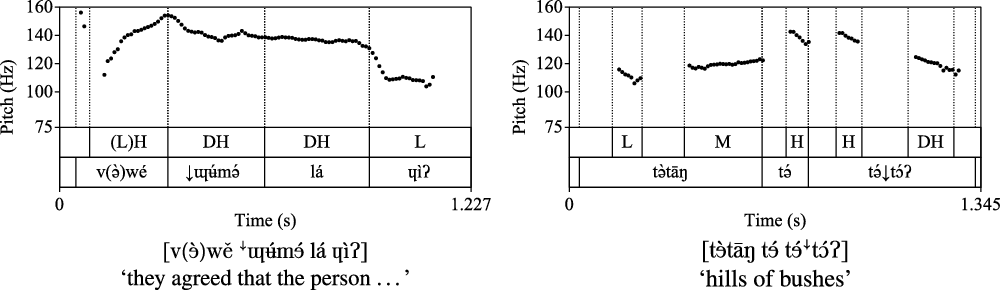
The downstepped high (↓H) and mid (M) tones occur only in derived environments (which are themselves in complementary distribution) and have very different effects on the tonological properties of the phonological phrases in which they occur. Within a phonological phrase, downstep lowers the pitch ceiling at which all subsequent H tones are produced. This can be seen in Figure 12 (left), where after a H of about 160 Hz is produced, downstep occurs and constrains subsequent ↓H tones to an f0 ceiling of about 140 Hz. The occurrence of a mid tone within a phonological phrase, on the other hand, does not have any observable effect on subsequently produced H tones, as seen in Figure 12 (right): M, which is produced with a pitch similar to the ↓H that occurs later in the utterance, is followed by two successive H tones with an f0 about 20 Hz higher.
Effects of M and ↓H tones on subsequent H tones in two sentences. Downstep imposes an f0 ceiling (left); the occurrence of a mid tone does not (right).

In Kejom, the M and ↓H tones appear to be phonetically indistinguishable, both from speaker intuition and acoustic evidence; however, they still exhibit the distinct phonological behaviors described above. For the speaker discussed here, both mid and downstepped high tones typically occupy an f0 range of 125–135 Hz (with the H tone occurring slightly higher at 130–150 Hz). This use of overlapping f0 ranges for two phonologically distinct tonal categories may be enabled by the fact that the two tones are derived in non-overlapping, complementary environments, and there is no possible need for speakers to distinguish the two tones from one another. A mid tone can only be derived in an environment immediately followed by a non-downstepped high tone (H), whereas downstepped high tones may occur with any other tone following (↓H, L, LF, etc.) and must be preceded by a non-downstepped high tone in order to be derived.
Transcription of recorded passage ‘The North Wind and the Sun’
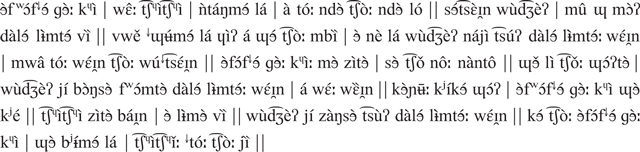
We present a standard comparative text below at two levels of analysis. First, we provide a narrow phonetic transcription that illustrates some rapid-speech phenomena described above, particularly for tone. Second, for clarity, we provide a phonemic transcription with an interlinear gloss. Note that in this transcription, not all morphemes are assigned a phonemic tone. This is a deliberate representational choice, intended to reflect the analysis that much of Kejom’s morphological material is underlyingly toneless and receives its phonetic tones from surrounding material via tone spread or reassignment.
Narrow phonetic transcription
Phonemic transcription with interlinear gloss

The North Wind and the Sun were arguing about who was stronger than who,

until a traveler wearing a warm gown came.
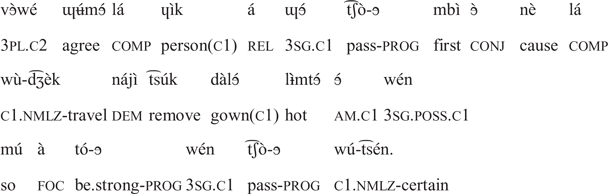
They agreed that the person who would first make the traveler take off his gown was stronger than the other.

The North Wind then began to blow with great force.
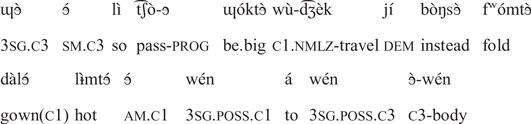
As he blew stronger, the traveler instead wrapped his warm gown around his body.

This thing was too much, and the North Wind gave up.
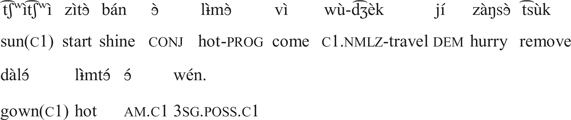
Then the Sun began to shine and make places hot, and the traveler quickly took off his gown.
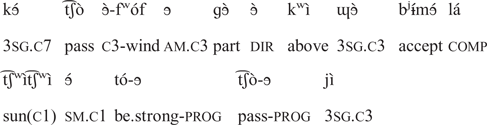
This surpassed the North Wind; he accepted that the Sun was stronger than him.
Abbreviations
Interlinear morphemic glosses mainly adhere to the Leipzig Glossing Rules (Bickel, Comrie & Haspelmath Reference Bickel, Comrie and Haspelmath2015) except for the morphemes indicated below.
-
Noun classes are glossed as C#, with the # indicating the class number. Noun class is most frequently expressed with agreement morphology (mostly prefixal) distributed throughout the noun phrase, but is also inherent to some nouns (e.g. ‘sun’, ‘person’).
-
The associative marker is glossed as am. This set of morphemes agrees with the noun class of the head of its noun phrase and expresses a variety of semantic relations between the nouns it conjoins (Akumbu & Chibaka Reference Akumbu and Chibaka2012: 116–124).
-
The subject marker is glossed as sm; this agrees with the noun class of the subject and immediately precedes the verb in some syntactic constructions (Akumbu & Chibaka Reference Akumbu and Chibaka2012: 67).
-
A conjunction used specifically between serialized verbs is glossed as CONJ.
Acknowledgements
Thanks go to Keith Johnson and Pat Keating, as well as the editor and two anonymous reviewers, for their thoughtful comments. This research was supported by funds made available to the second author by the Fulbright Visiting Scholar Program; we gratefully acknowledge Larry Hyman’s roles as host and organizer of the resulting collaboration. We would also like to thank Christian DiCanio, Jeff Good, and Malte Münster for their generous assistance as we worked to make our supplemental recordings.
Supplementary material
To view supplementary material for this article, please visit https://doi.org/10.1017/S0025100319000264


 Open access

