



Introduction
Fish are the most species-rich group of vertebrates on Earth and inhabit the majority of aquatic habitats globally. They are one of the key sources of proteins for human consumption and fisheries through aquaculture represent an important part of food security with steadily increasing production. However, growth and health status of cultured and, in some cases, wild fish may be negatively affected by diseases, including unicellular and metazoan parasites (Williams and Jones, Reference Williams and Jones1994; Woo, Reference Woo2006; Woo and Buchmann, Reference Woo and Buchmann2012). Parasites cause losses of 20% in hatcheries and contribute to a reduction of 1–10% in the growth of cultured fish; annual losses in aquaculture and fisheries are estimated to be almost 10 billion USD (Selzer and Epe, Reference Selzer and Epe2021).
In addition to the unquestionable importance of parasites as pathogens of cultured and, in fewer cases, wild fish, they represent an extraordinary group of invertebrates that are important for biodiversity, ecological and evolutionary studies. In the present issue, 13 articles co-authored by experts in individual research fields of fish parasitology from most continents are blended to cover different aspects of fish parasitology and to demonstrate important achievements, map existing gaps and outline future trends in research on these peculiar organisms.
Fish parasitology encompasses a wide spectrum of parasitic organisms. This variation is also reflected in this special issue that covers several parasite groups, including those previously quite neglected (glochidia and barnacles), and different methodological approaches from biodiversity studies, ecological and evolutionary investigations to immunology and control of parasites were applied by individual contributors.
The considerable advancement of fish parasitology in the last 4 decades is closely related to the international collaborative efforts of numerous scientists and research laboratories. One of the key stimuli for this advancement represents symposia on fish parasites, which were held every 4 years since 1983 when fish parasitologists from both sides of the then Iron Curtain met for the first time. This symposium, which represented a milestone in ichthyoparasitological research, was organized in České Budějovice, a historical town in South Bohemia of the former Czechoslovakia by the late Jiří Lom (1931–2010) and František Moravec (born in 1939 and still an active and prolific researcher in the systematics of fish nematodes) (Fig. 1). The last (10th) symposium was organized by one of the contributors of this special issue, Kurt Buchmann, as part of the 15th International Congress of Parasitology (ICOPA) in Copenhagen, Denmark. The 10th symposium was originally scheduled for 2019 in Brisbane, Australia, then postponed to 2020 with Cairns, Australia as the conference location, and finally cancelled, resulting in a 7-year gap between these important symposia partly as a result of the Covid-19 pandemic.
Prominent Czech fish parasitologists, founders of the International Symposia on Fish Parasites. Jiří Lom (1931–2010; left) and František Moravec (born in 1939; right).

Scope of the special issue
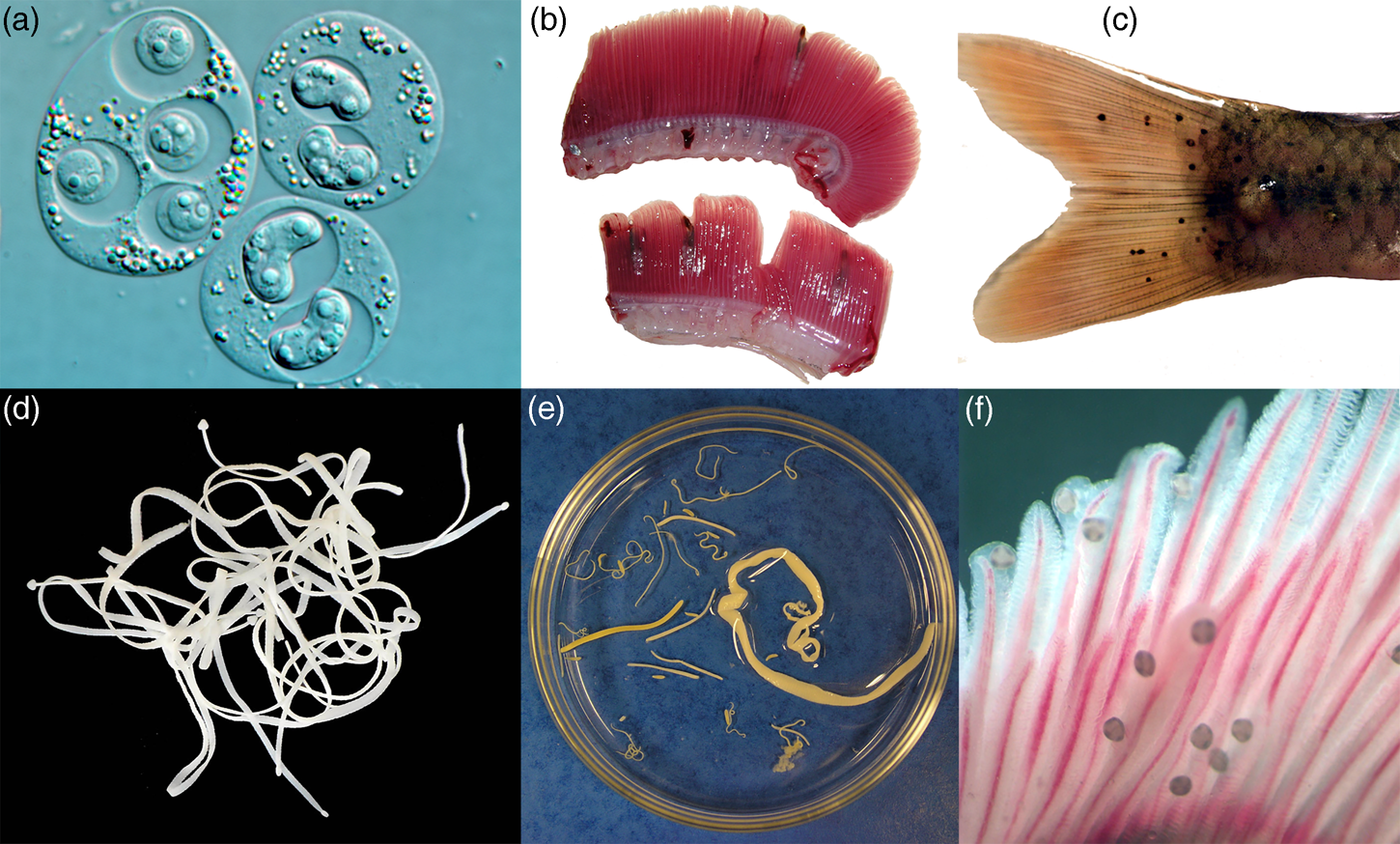
The present special issue is composed of 9 reviews and 4 research articles. It starts with more general topics, followed by review and research articles on parasites of individual major groups (myxozans, trematodes, tapeworms, monogeneans, nematodes, mussels and crustaceans; Fig. 2), ending with a review on the control of fish parasites in aquaculture. A brief summary of all contributions is provided below.
Examples of fish parasites dealt with in this special issue. (a) Plasmodia of Ceratonova shasta (Myxozoa) in different degrees of development from ascites of Oncorhynchus mykiss, Oregon, USA (courtesy of Gema Alama-Bermejo). (b) Gills of Gadus morhua with Diclidophora morrhuae (Polyopisthocotylea), off Scotland, UK. (c) Metacercariae of Posthodiplostomum sp. (Trematoda) under the skin of Catostoma anomalum, Tennessee, USA. (d) Invasive Schyzocotyle acheilognathi from Ctenopharyngodon idella, China. (e) Nematodes (Ascarophis sp.) and tapeworms (Abothrium gadi) from the intestine of Melanogrammus aeglefinus, off Scotland, UK. (f) Glochidia on the gills of Anguilla rostrata, USA (modified from USGS; https://www.usgs.gov/media/images/encysted-eastern-elliptio-mussel-larvae-glochidia-its-american-ee). Original made by Roman Kuchta.
Robert Poulin and Cameron McDougall from New Zealand (Poulin and McDougall, Reference Poulin and McDougall2022) tested latitudinal trends at the whole-network level, and taxonomic patterns at individual parasite species level, because species with a central position often serve as module connectors and may play a key role in whole-network cohesion. They found that while controlling for network size (number of species per network), network modularity or the tendency for the network to be subdivided into groups of species that interact mostly with each other, the network decreased with increasing latitude. This suggests that tropical fish–parasite networks may be more stable than those from temperate regions in the event of community perturbations, such as species extinction.
Bernd Sures and Milen Nachev from Germany reviewed the interactions between pollutants and parasites (Sures and Nachev, Reference Sures and Nachev2022). They show that parasites must be regarded as organisms that are in close mutual exchange with pollutants. This interaction of parasites and pollutants is significant for both the occurrence of parasites in ecosystems and for the health of their hosts. The authors point out that parasites need to be taken into account in environmental studies because they can influence the interaction between fish and pollutants.
Luisa Giari from Italy with 2 co-authors from Italy and Argentina presented a review of a relatively neglected topic, i.e. the ecology and impacts of fish parasites of transitional waters on their fish hosts (Giari et al., Reference Giari, Castaldelli and Timi2022). These aquatic ecosystems are highly productive, widespread in the globe and most represent favourable theatres for parasitism thanks to the availability of hosts (invertebrates, fishes and birds) and an increased probability of parasite transmission, especially of those having complex life cycles. Many transitional waters are historically exploited by humans as sources of relevant ecosystem services, among which are fisheries and aquaculture, being highly vulnerable ecosystems. Based on the authors' long-term research, this review describes the features, roles and impacts of metazoan parasites of fish occurring in transitional waters.
Another important contribution deals with a poorly known, but important topic of host–parasite relationships, which is the neuroendocrine control of intestinal function in fish infected with endohelminths. Italian authors Giampaolo Bosi and Bahram Sayyaf Dezfuli with co-authors from USA and Italy provided an overview of the current knowledge of immunohistochemical and ultrastructural data on the effects of parasites on the enteric nervous system and the enteric endocrine system in several fish–parasite systems (Bosi et al., Reference Bosi, Maynard, Pironi and Sayyaf Dezfuli2022). This review summarizes how fish intestinal parasites affect the gut physiology and feeding behaviour of the host; indeed, helminths are able to manipulate the enteric nervous and endocrine systems in favour of the parasites.
The myxozoan Ceratonova shasta causes severe disease in salmon and trout in most major river systems of the Pacific Northwest of the United States and British Columbia, Canada, including the Sari Joaquin, Sacramento, Pit, Klamath, Rogue, Columbia and Fraser Rivers (Hallett and Bartholomew, Reference Hallett, Bartholomew, Woo and Buchmann2012). Jerri Bartolomew with 3 co-authors from the USA and 1 from the Czech Republic/Spain presented a review that incorporates changes in our knowledge of the parasite's life cycle, taxonomy and biology of C. shasta (Bartholomew et al., Reference Bartholomew, Alexander, Hallett, Alama-Bermejo and Atkinson2022). The authors focus on the interactions between this pathogenic myxozoan and its salmonid and annelid hosts, profiting from the establishment of the C. shasta life cycle in the laboratory and the availability of transcriptomic data.
The tapeworms of fishes (Chondrichthyes and Actinopterygii) account for one-third of the total cestode species diversity, with more than 500 new species described since 2000. In their review, Tomáš Scholz and Roman Kuchta from the Czech Republic mapped extraordinary progress made in our understanding of the species diversity, host associations and interrelationships among fish tapeworms in the last 2 decades (Scholz and Kuchta, Reference Scholz and Kuchta2022). They pinpoint the importance of molecular data that have helped to significantly improve our knowledge of tapeworm interrelationships, which led to the proposal of several new orders, and host associations, i.e. a critical assessment of host specificity.
Larvae (metacercariae) of trematodes of the genus Posthodiplostomum are common parasites of a broad range of freshwater teleosts and may cause the so-called ‘black spot disease’. However, several aspects of their biology and ecology still remain unknown because available data remain geographically biased, with most information accumulated in Europe and North America. Sandra Díaz Pernett and Sean Locke from Portorico with Sara Brant from the USA presented results of the first integrative study of the diversity and specificity of Posthodiplostomum metacercariae from native and introduced fishes in the Caribbean (Pernett et al., Reference Pernett, Brant and Locke2022). Unlike previous studies, these authors revealed a narrow host specificity of metacercariae of most species, with no indication of parasite sharing among introduced and native fishes.
Hammerhead sharks (Sphyrnidae) represent one of the most peculiar groups of elasmobranchs, but relatively little is known about their parasites. In this special issue, Kaitlyn Dalrymple and Walter Boeger from Brazil with their co-authors from the USA presented new data on hexabothriids (Polyopisthocotylea) and monocotylids (Monopisthocotylea) parasitizing the gills of neonate hammerhead sharks (Sphyrna gilberti and Sphyrna lewini), and their hybrids from the western North Atlantic Ocean (Dalrymple et al., Reference Dalrymple, de Buron, Hill-Spanik, Galloway, Barker, Portnoy, Frazier and Boeger2022). This is the first taxonomic study of monogeneans infecting S. gilberti and hybrids of S. gilberti and S. lewini.
Parasitic nematodes are widespread and infect economically important freshwater and marine fishes, but their diversity, host associations and geographical distribution are insufficiently known, especially in the Americas. Felipe Bisaggio Pereira from Brazil and David González-Solís from Mexico reviewed the patterns of diversity, life cycles and advances in the taxonomic and phylogenetic knowledge of adult nematode species parasitizing marine fish from off the American continent (Pereira and González-Solís, Reference Pereira and González-Solís2022). Fishes of the families Sciaenidae, Serranidae and Lutjanidae exhibit the highest diversity of parasitic nematodes, which occur most frequently in the tropical and temperate Atlantic waters.
Arne Levsen from Norway with Italian and Norwegian co-authors provided new data on the occurrence and host associations of the larvae of anisakid nematodes of the genera Anisakis, Contracaecum and Pseudoterranova in 3 commercially important gadid fish species (northeast Arctic cod, saithe and haddock) from Arctic waters (Levsen et al., Reference Levsen, Cipriani, Palomba, Giulietti, Storesund and Bao2022). The authors aimed to map the presence and distribution of the larvae of anisakids with the focus on epidemiological trends and food safety considerations. The authors recommend trimming of the fish flesh by removing the belly flaps as this simple procedure may reduce larval presence in the fillets of the gadid fishes studied by about 90%.
The larvae of freshwater mussels of the order Unionida called glochidia are the ectoparasites of freshwater fishes. They are highly adapted to parasitize fish for the primary purpose of dispersal. Sebastian Lorenzo Rock and his 3 co-authors from Sweden review data on the effects of glochidia on their host fishes (Rock et al., Reference Rock, Watz, Nilsson and Österling2022). With the exception of heavy infections, these larvae cause minor effects to their hosts, but lower growth and reduced osmotic potential in infected hosts are commonly observed and correlated to infection load. Molecular and genetic studies should be expanded as many conclusions are drawn from studies on the ultimate effects of glochidiosis rather than proximate studies on the underlying mechanisms.
Probably the most unusual topic of this special issue is tackled by Amandine Sabadel from New Zealand and her co-authors from France and New Zealand (Sabadel et al., Reference Sabadel, Cresson, Finucci and Bennett2022). They presented novel data on the parasitic barnacle, Anelasma squalicola (Crustacea: Cirripedia), which is a rare and evolutionary fascinating organism that has evolved the capability to uptake nutrient from its host, deepwater sharks of the families Etmopteridae and Pentachidae. Using stable isotopes and elemental compositions, the authors followed the fate of nitrogen, carbon and sulphur through various tissues of A. squalicola and its host, southern lanternshark Etmopterus granulosus, to better understand the trophic relationship between parasite and host. The authors found that the nutrient requirement of A. squalicola changes from protein rich to lipid rich between its early development stage and its definitive size.
The last article of this special issue deals with an important aspect of fish parasitology, which is the control of parasites in aquaculture. One of the most experienced and knowledgeable fish parasitologists, Kurt Buchmann from Denmark, who was the principal organizer of the 10th International Symposium on Fish Parasites in Copenhagen in August 2022, summarized current knowledge on how to control parasitic diseases in aquaculture (Buchmann, Reference Buchmann2022). Control programmes of various kinds are needed and these may include chemotherapeutants and medicines as the farmer's first and convenient choice, but mechanical, biological, immunological and genetic control methods are also available solutions. Finally, Kurt Buchmann advocates for the implementation of integrated control strategies for diseases caused by parasitic protists and metazoan parasites.
Final remarks
As obvious from the brief summaries of individual contributions presented here, the present special issue covers wide and important aspects of fish parasitology. It was a great honour for both of us to serve as guest editors of this special issue and we have learned a great deal. We strived to invite leaders in fish parasitology to contribute to this issue and to cover a broad spectrum of different topics and representatives of most principal parasitic groups. As guest editors (but also contributors and authors of 2 review articles), we strongly believe that the reader will find valuable information in this special issue, which will serve as an inspiration for future research on fish parasites.
Data availability
Data presented in this article are freely available.
Acknowledgements
We would like to express our gratitude to all contributors for submitting their papers into this special issue. Our thanks are due to Emeritus Professor John Ellis, Editor of Parasitology for special issues, for facilitating this special issue and we greatly appreciate his patience, helpful advice and broadmindedness. Our special thanks also go to Professor Russell Stothard, Editor-in-Chief of Parasitology and his editorial team, who accepted our proposal to produce this special issue on fish parasites.



