





Introduction
Across the Global South, families play a pivotal – yet ambivalent – role in buffering socio-economic shocks while simultaneously reproducing inequalities (Bengtson, Reference Bengtson2001; Walsh, Reference Walsh2016). In Morocco, recurrent crises – most notably the COVID-19 pandemic and subsequent inflationary pressures – have intensified reliance on intergenerational solidarity and informal support systems. For Environmental and Sustainability Education (ESE), these crisis-time solidarities are not only social safety nets but also everyday learning environments where resource management, care, frugality and collective problem-solving are learned through practice rather than formal instruction. In contexts where public welfare provision remains limited, households often become the primary infrastructure of social protection, shaping how people adapt to scarcity and uncertainty (Rachik, Reference Rachik2012; Haut-Commissariat au Plan (HCP), 2020; Annaki, Annaki, Igamane & Nouib, Reference Annaki, Annaki, Igamane and Nouib2025). Beyond their socio-economic function, intergenerational solidarities are cultural and educational processes (Ballantyne, Fien & Packer Reference Ballantyne, Fien and Packer2001; Payne, Reference Payne2005). They transmit norms, dispositions and practical know-how that influence how families interpret hardship, allocate resources and organize care. From an ESE/ESD perspective, this foregrounds the family as a site of “everyday pedagogy,” where sustainability-related learning is embedded in daily routines such as repair and reuse, budgeting trade-offs and neighbourhood mutual aid (Jensen & Schnack, Reference Jensen and Schnack1997; Payne, Reference Payne2005). These mundane practices often cultivate forms of responsibility and foresight that resonate with sustainability values, even when they are not explicitly framed as “environmental” actions.
Although ESE/ESD scholarship has increasingly expanded beyond classroom-centred models, much of the existing research still focuses on school – home linkages or programme-based interventions (Ballantyne et al., Reference Ballantyne, Fien and Packer2001; Payne, Reference Payne2005). Consequently, we know far less about how families themselves generate sustainability learning ecologies under conditions of socio-economic shock – particularly in Global South contexts where crises are recurrent rather than exceptional. This article addresses this gap by examining how intergenerational solidarity operates as a set of situated learning processes that may foster – yet unevenly distribute – capabilities for sustainability-oriented action.
The Moroccan context offers a particularly revealing lens. “Why Morocco, and why now?” Morocco represents a middle-income country facing rising living costs, youth unemployment and uneven welfare coverage, where families often compensate for institutional gaps (Rachik, Reference Rachik2012; Annaki, Annaki, Igamane & Nouib, Reference Annaki, Annaki, Igamane and Nouib2025). Recent crises have made visible how households reorganize support across generations, mobilizing financial transfers, co-residence arrangements and care networks. These dynamics provide a valuable case for international ESE/ESD debates because they show how sustainability learning is shaped not by abundance and choice, but by constraint, obligation and crisis-driven adaptation – conditions shared by many societies in the Global South and increasingly relevant elsewhere.
This study investigates how Moroccan families mobilize intergenerational solidarity to navigate recurring economic crises, positioning the household as a key site of informal ESE where everyday routines foster learning about resource stewardship, care and mutual aid. In this article, “sustainability-oriented action competence” refers to the capacity to develop critical understanding, participatory and practical skills and individual or collective efficacy for informed socio-ecological action in everyday life – not merely pro-environmental behaviour. This understanding follows the action competence tradition in environmental education, which emphasizes agency, critical reflection and collective engagement rather than individualized behaviour change.
Environmental action is conceptualized as situated and collective practices through which families manage resources, adapt to constraints and sustain their livelihoods. These everyday practices function as informal learning processes that foster sustainability-oriented action competence, understood as the ability to interpret challenges, exercise agency and engage in responsible and adaptive resource management (Jensen & Schnack, Reference Jensen and Schnack1997; Wals, Reference Wals2015; UNESCO, 2017).
Empirically, the study draws on a qualitative design combining 65 semi-structured interviews, ethnographic observations and household document analysis across 28 urban and rural families in the Fès–Meknès region and neighbouring provinces. Analytically, the study mobilizes a multidimensional framework intersecting family resilience, capability theory, gender analysis and action competence. This integrative lens allows us to examine not only how solidarities function, but also how they enable or constrain people’s real opportunities to act.
Three dominant configurations of solidarity emerge: (1) extended parental support to adult children, (2) reciprocal cohabitation shaped by gendered expectations and (3) financial transfers from young migrants to older relatives.
These mechanisms strengthen household resilience and often operate as informal pedagogies of sustainability. Repair–reuse routines, careful budgeting and neighbourhood mutual-aid arrangements cultivate practical knowledge and collective problem-solving skills. However, these solidarities also produce emotional fatigue, unequal caregiving burdens and reinforce gendered inequalities – especially for women, who disproportionately shoulder unpaid care work.
Building on capability theory, we interpret these tensions through the notion of “conversion factors,” that is, the social and gendered conditions that determine whether available resources and solidarities can be translated into real freedoms and action possibilities. In other words, solidarity does not automatically lead to empowerment; it can also reproduce unequal responsibilities and limited agency.
To clarify the study’s contribution for an international ESE/ESD readership, the article addresses three questions:
RQ1. How are intergenerational solidarity practices organized and justified within Moroccan households under recurring economic shocks?
RQ2. Through what everyday routines and interactions do these practices function as informal pedagogies of sustainability?
RQ3. How do these solidarities simultaneously enable and constrain sustainability-oriented action competence, particularly through gendered divisions of care and unequal conversion factors?
These questions move the analysis beyond a descriptive account of family support towards a deeper examination of learning, agency and justice in sustainability contexts.
The article makes three contributions. First, it bridges sociology of the family and social policy with ESE by theorizing intergenerational solidarity as an educational infrastructure for sustainability embedded in everyday practices of care and resource management. Second, it provides qualitative evidence from Morocco on how sustainability learning is constituted under crisis conditions, specifying both enabling mechanisms and structural limits. Third, it extends the action competence approach to family and community learning ecologies by showing how informal solidarities can cultivate capacities for informed, collective action while cautioning against romanticizing resilience when it relies on unpaid and unequal care.
Taken together, these contributions offer a transferable analytic vocabulary for ESE/ESD research and practice seeking to engage informal learning ecologies while advancing sustainability justice.
Theoretical framework
Understanding the mechanisms of economic resilience within Moroccan families during periods of crisis requires a solid theoretical anchoring at the intersection of several sociological traditions. This framework mobilizes four complementary axes: the theory of family resilience, intergenerational solidarities, the capabilities approach and a gendered reading of family dynamics.
This cross-fertilization makes it possible to apprehend both the internal logics of families and the structural constraints that traverse them. The household is conceptualized as an informal learning ecology in which everyday routines shape sustainability-related meanings, practical skills and capacities for collective problem-solving (Payne, Reference Payne2005).
However, research in ESE has more often examined family learning through school–home linkages or programme-based interventions than through crisis-driven, household-led solidarities. This study addresses that gap by theorizing intergenerational solidarity as a practice-based learning infrastructure that can enable – yet unevenly distribute – capabilities and action competence under conditions of socio-economic stress (Payne, Reference Payne2005).
Despite growing recognition of homes as sites of informal sustainability learning, the mechanisms through which crisis-time solidarities generate, constrain, or redistribute action competence remain under-theorized – especially in contexts where families compensate for fragmented welfare provision (Payne, Reference Payne2005).
Morocco provides a theoretically relevant case because family-based support constitutes a central layer of everyday social protection amid recurrent shocks, while the mechanisms analysed here (solidarity flows, capability conversion and gendered care burdens) are transferable to other socio-economically fragile settings where household learning ecologies shape sustainability-oriented agency.
Family resilience: a systemic approach
Family resilience is defined as the capacity of a family system to cope with adversity, to adjust and to regain a functional balance despite disruptions (Walsh, Reference Walsh2016). This approach goes beyond individual adaptation and emphasizes collective processes, interactions among members and the ways in which families construct meaning when facing traumatic events or economic pressures (Walsh, Reference Walsh2016).
In the Moroccan context – where access to social protection remains uneven by occupational status and geography (rural/urban) – family resilience often relies on self-organization strategies. It is observed in households’ capacity to absorb shocks (job loss, illness, price hikes), to maintain internal cohesion under strain and to reconfigure their organization temporarily or durably (multigenerational co-residence, redefinition of economic roles) (Rachik, Reference Rachik2012; Kadiri, Reference Kadiri2023; Haut-Commissariat au Plan (HCP), 2020).
This perspective helps transcend the dichotomy between fragility and resilience by integrating discrete, often invisible adjustments through which families ensure continuity. These adjustments can also be understood as practice-based learning processes, insofar as households develop repertoires for managing scarcity – repair and reuse routines, budgeting trade-offs and negotiated rules for resource sharing – that stabilize everyday life and orient action under constraint (Payne, Reference Payne2005).
Intergenerational solidarities: between social norm and economic resource
Intergenerational solidarities refer to relationships of help and exchange between generations within the same family. According to the typology of Bengtson and Roberts (Reference Bengtson and Roberts1991), taken up by Lowenstein (Reference Lowenstein2007), these solidarities are articulated around six dimensions: associational (frequency of contacts), affectual (emotional ties), consensual (value agreement), functional (material support), normative (sense of obligation) and structural (actual opportunities for interaction) (Bengtson & Roberts, Reference Bengtson and Roberts1991; Bengtson, Reference Bengtson2001; Lowenstein, Reference Lowenstein2007; Silverstein & Bengtson, Reference Silverstein and Bengtson1997).
In Morocco, these forms of solidarity are framed by strong cultural and religious injunctions that valorize assistance to elderly parents and shared family responsibility. However, the practical implementation of these principles varies across social contexts: dual-earner urban families, faced with time and housing constraints, cannot always meet support obligations, generating tensions between norms and effective capacities. Intergenerational exchanges are not limited to downward help (from parents to children); in an increasing number of cases, precarious young adults depend on the support of elders, notably through pensions or access to the family home.
This reconfiguration of solidarity flows, reinforced by health and economic crises, reveals a dual logic: on the one hand, families act as social shock absorbers in the absence of an effective welfare state; on the other hand, informal arrangements can conceal structural inequalities and overburden certain categories of members, particularly women. At the same time, intergenerational relations function as channels through which sustainability-related meanings and practices circulate, mediated by family communication patterns and the everyday organization of domestic life (Ballantyne et al., Reference Ballantyne, Fien and Packer2001; Payne, Reference Payne2005).
This perspective also helps distinguish solidarity as voluntary support from solidarity as constrained obligation, a distinction that becomes empirically salient when normative expectations exceed household capacities and are unevenly absorbed through gendered care arrangements.
The capabilities approach and family vulnerabilities
The capabilities approach, notably articulated by Amartya Sen (Reference Sen1999), provides a framework for the analysis of vulnerability not merely as a shortage of resources but as a limitation of genuine freedoms to engage in valued actions and ways of living (Sen, Reference Sen1999). Viewed from this perspective, intergenerational solidarities emerge as pivotal mechanisms that can serve to restore and enhance threatened capabilities, such as access to education, decent housing conditions, comprehensive healthcare and personal dignity.
Within the context of Moroccan families, it becomes evident that these capabilities are heavily influenced by resources available to the family unit. For instance, a family that possesses an inherited home, a modest but stable pension, or a well-structured social network is typically better positioned to provide flexibility during times of crisis and uncertainty. In stark contrast, families that lack substantial assets and secure employment opportunities often find their capabilities drastically diminished, leading them to experience a constrained set of choices that may include dropping out of school, resorting to informal employment, or choosing to migrate either internally within the country or internationally across borders.
Intergenerational solidarity operates both as a conversion mechanism that transforms resources into actionable freedoms and as a necessity in contexts of limited institutional protection. This ambivalence means that the same family strategies can open opportunities while also reinforcing constraints as crises persist.
Following Sen’s distinction between resources and real freedoms, this paper emphasizes “conversion factors” – social, cultural and gendered conditions that determine whether solidarity can be translated into effective opportunities to learn, participate and act, rather than remaining a compensatory burden (Sen, Reference Sen1999).
In this framing, action competence is treated as a capability outcome: solidarity may expand (or restrict) the real freedom to develop critical understanding, practical/participatory skills and collective efficacy for informed action, depending on the conversion factors that structure time, voice and responsibility within households.
A gendered reading of family responsibilities
An in-depth analysis of family solidarities cannot overlook the pervasive gender inequalities that significantly influence and traverse these familial relationships and structures. Numerous studies, including the works of Preoteasa et al. (Reference Preoteasa, Vlase and Tufă2018) and Chafi (Reference Chafi2025), reveal that women disproportionately shoulder a significant burden within support mechanisms, including childcare, elder care, management of relational tensions and maintenance of family ties.
This over-responsibilization is exacerbated during periods of crisis, when women frequently find themselves juggling precarious employment, domestic tasks and emotional support. Research on unpaid care consistently shows that women bear disproportionate care workloads, with implications for time poverty, participation and wellbeing (International Labour Organization, 2018).
In the specific context of Moroccan families, this dynamic is deeply entrenched within a gendered division of labour that is both historically rooted and subject to transformation over time. Rising male unemployment, increased access to paid work for women and the diffusion of egalitarian norms generate new tensions while also facilitating negotiations regarding roles and responsibilities. Some women emerge as significant economic actors within these familial dynamics, participating in logics of substitution or complementarity while remaining subject to expectations of emotional and domestic availability.
An intersectional approach considering gender, class and geographical territory illuminates differentiated inequalities across family configurations. For example, the experiences and constraints faced by a single mother in urban Casablanca differ markedly from those encountered by the youngest daughter in a rural family located in the Middle Atlas.
Overall, this theoretical framework provides a nuanced and pluralistic reading of intergenerational solidarity and family resilience in contemporary Morocco. It underscores the complexity of family dynamics and challenges a simplistic and homogeneous understanding of “the family” as a universally protective entity. It also clarifies why resilience cannot be read as uniformly empowering: the same solidarity practices that protect households may reproduce patriarchal arrangements and unequal conversion factors that constrain women’s agency and voice in everyday decision-making.
Family resilience captures how households reorganize and adapt under shock (Walsh, Reference Walsh2016). Intergenerational solidarity specifies the relational channels through which resources and obligations are redistributed across generations (Bengtson & Roberts, Reference Bengtson and Roberts1991; Lowenstein, Reference Lowenstein2007). The capabilities approach clarifies how these resources translate into real freedoms via conversion factors (Sen, Reference Sen1999). Gender analysis then shows how unequal care responsibilities systematically shape these conversion processes.
Together, these lenses specify how crisis-time solidarities operate simultaneously as protection mechanisms and informal learning processes that condition sustainability-oriented agency.
In other words, the same relational arrangements that sustain households during crises may also reproduce structural inequalities by assigning unequal costs of care and coordination – thereby shaping whose knowledge, agency and participation become possible in everyday decision-making and sustainability-oriented practice.
To synthesize the theoretical framework and clarify the interrelations between family resilience, intergenerational solidarity, capability conversion and gendered dynamics, the conceptual model presented in Figure 1 provides an integrative representation of these mechanisms.
Mobilization of family solidarities in response to economic crisis families as everyday learning ecologies: linking solidarity to action competence.

Building on the previous framework, the household can be approached as a learning ecology in which sustainability-oriented understandings and practices are shaped through routine activity and intergenerational interaction. Homes have been theorized as distinctive educational sites where environmental meanings are negotiated and transmitted through the “doing” of everyday life (Payne, Reference Payne2005). Evidence on intergenerational influence further shows that family communication patterns can extend environmental learning beyond school boundaries and shape discussion and action in everyday contexts (Ballantyne et al., Reference Ballantyne, Fien and Packer2001).
Within environmental education, the action competence tradition provides a robust conceptual bridge between informal learning and sustainability-oriented agency. Action competence emphasizes learners’ capacity to develop critical understanding, practical/participatory skills and a sense of individual and collective efficacy for informed action (Jensen & Schnack, Reference Jensen and Schnack1997; Mogensen & Schnack, Reference Mogensen and Schnack2010).
In AJEE, this implies moving beyond “behavioural compliance” towards action as reflective, participatory practice learned about, through and from engagement with real issues (Birdsall, Reference Birdsall2010). More recently, AJEE research has operationalized self-perceived action competence for sustainability through validated dimensions (e.g., perceived action possibilities, confidence in influence and willingness to act), offering measurement-sensitive language consistent with capability conversion and efficacy (Nyberg et al., Reference Nyberg, Castéra, Coiffard Marre, Jégou and Redondo2025).
Together, these contributions specify three analytical dimensions: (a) what is learned in crisis-time solidarities (resource stewardship, care coordination, mutual-aid governance), (b) how it is learned (intergenerational modelling, negotiated routines, shared task completion) and (c) why learning translates into uneven action possibilities when gendered conversion factors distribute time, responsibility and voice asymmetrically.
Concretely, sustainability-oriented action in this context can include household- and community-level practices such as collective resource management (water/energy saving and prioritization), repair–reuse and waste reduction routines and neighbourhood mutual-aid arrangements that support vulnerable members while organizing shared responsibilities and decision-making under constraint.
Methodology
Research design and paradigm
We adopted a qualitative design with a constructivist grounded theory orientation to theorize how Moroccan families mobilize intergenerational solidarity under conditions of crisis. This approach privileges participants’ meanings and actions, supports iterative theorizing and allows concepts to emerge inductively while remaining sensitized by prior work on family resilience, capabilities, gendered care and intergenerational solidarity (Charmaz, Reference Charmaz2014; Corbin & Strauss, Reference Corbin and Strauss2015). The analytical objective was explanatory, focusing on mechanisms and relational processes rather than estimating prevalence or effect sizes.
Setting and participants
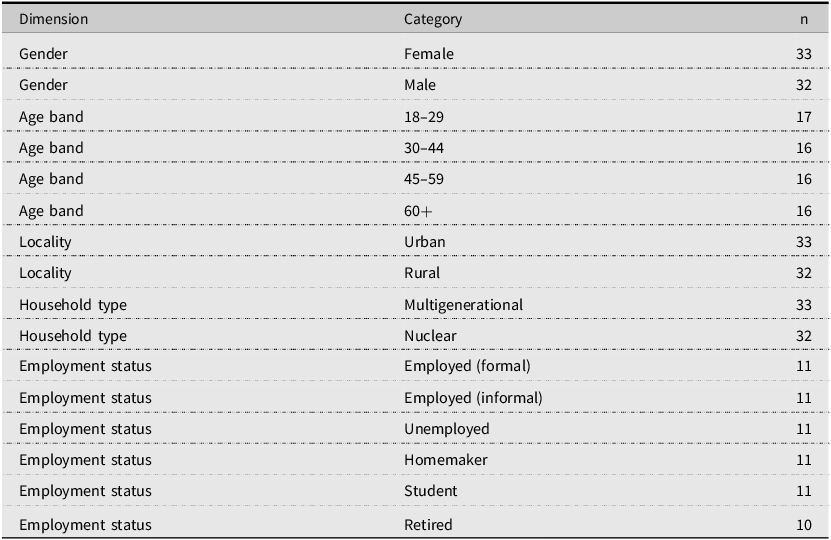
Fieldwork was conducted in urban and rural localities of the Fès–Meknès region (e.g., Fès, Meknès, Taza, Taounate). The corpus comprises 65 semi-structured interviews with members of 28 families selected to vary household composition (nuclear/multigenerational), housing status, sources of employment/income and care arrangements. Ethnographic observations and the analysis of household documents (e.g., bills, remittance proofs) complemented interviews. A descriptive table (Appendix A) summarizes participant characteristics (age bands, gender, household structure, locality, employment/income situation); anonymized identifiers used in the text refer to this table.
For analytic contrast, households were positioned along a continuum from relatively stabilized solidarity arrangements (e.g., sustained remittances, stable pension income, durable co-residence rules, reliable mutual aid) to strained arrangements (e.g., disrupted remittance flows, escalating debt, unresolved co-residence conflict, care overload). This positioning served comparative analysis and did not constitute a normative classification.
Selection of participants
We used purposive maximum-variation sampling to capture heterogeneity (gender, age, household structure, urban/rural locality). As analysis progressed, theoretical participant selection added cases that could refine emergent categories (Charmaz, Reference Charmaz2014). Inclusion criteria required residence in the region and recent experience (since the COVID-19 pandemic or subsequent inflationary shocks) of intra-family help, transfers, or co-residence. Recruitment combined community contacts and snowballing. To mitigate gatekeeping/selection bias, we actively searched for negative or disconfirming cases (e.g., households declining support or experiencing breakdown of remittance arrangements).
To reduce gatekeeping effects and selection bias, recruitment pathways were diversified beyond family networks by including community intermediaries not embedded in participants’ kinship ties and by actively seeking contrastive cases (e.g., refused support, breakdown of remittance arrangements, co-residence conflict).
Recruitment ceased once theoretical saturation was met – that is, additional interviews no longer added substantive properties to central categories and inter-category relations were sufficiently dense to sustain the emerging model. Operationally, sufficiency was assessed via weekly memo audits; after interview 65, no new properties emerged for categories “extended parental provision,” “reciprocal co-residence,” and “youth-to-elder transfers,” with stable cross-cutting links (urban/rural; gender/age).
Instruments and data collection procedures
A flexible interview guide covered: (a) recent socio-economic stressors; (b) forms and directions of support (financial, co-residence, care); (c) decision-making and negotiations; (d) perceived benefits and burdens; (e) domestic routines relevant to resource stewardship (saving, repair/reuse); and (f) intergenerational learning and role modelling. Interviews, conducted in Arabic and/or French, lasted 50–90 minutes and were audio-recorded with consent. Sessions took place at participants’ homes or in neutral venues, agreed to ensure confidentiality and comfort. Fieldnotes and analytic memos documented contextual details and early analytical leads. Transcripts were produced in the source language; when excerpts are quoted in English or French, we used an anchored translation procedure with cross-checking by a bilingual team member (targeted back-translation for analytic passages). Two trained interviewers (one woman, one man) conducted the fieldwork after piloting the guide and harmonizing protocols; no prior relationships with participants were maintained.
Participant observation was conducted through situational observations during interview encounters and, where feasible, brief repeat visits that focused on routine practices (e.g., budgeting moments, care coordination, resource-use decisions) and interactional dynamics. Observational data were recorded in structured fieldnotes (setting, actors, actions, analytic reflections) and incorporated into analysis as a distinct data stream.
Observations were conducted throughout the fieldwork period across interview settings (homes and agreed neutral venues), with repeat visits undertaken when feasible to document routine practices in situ.
Household documents were used both as contextual evidence and as interview prompts to support recall and triangulate timelines of shocks, expenditures and transfers.
Data analysis
Analysis proceeded in iterative cycles consistent with grounded theory: line-by-line initial coding to remain close to participants’ language and actions; focused coding to elaborate higher-order categories; and constant comparison across interviews, families and contexts (urban/rural; gender/age positions) to specify conditions, strategies and consequences. Memo writing supported category development and theoretical integration; memos and decision logs form an audit trail (Charmaz, Reference Charmaz2014; Corbin & Strauss, Reference Corbin and Strauss2015; Miles, Huberman & Saldaña Reference Miles, Huberman and Saldaña2014; Saldaña, Reference Saldaña2021).
Analyses were conducted in NVivo; successive codebook versions were archived (version log, date, decision). Double-coding (∼10–15% of the corpus) enabled team discussion of discrepancies and stabilization of operational definitions. Analyses were performed in NVivo (version 14); matrix queries were used to compare code distributions by gender and locality. Codebook versions and rationales for changes were archived in the audit trail.
Observation fieldnotes and document-related memos were coded using the evolving codebook and compared with interview-derived categories to identify convergences and tensions.
Analytical operationalization: mapping codes to action-competence dimensions (ESE)
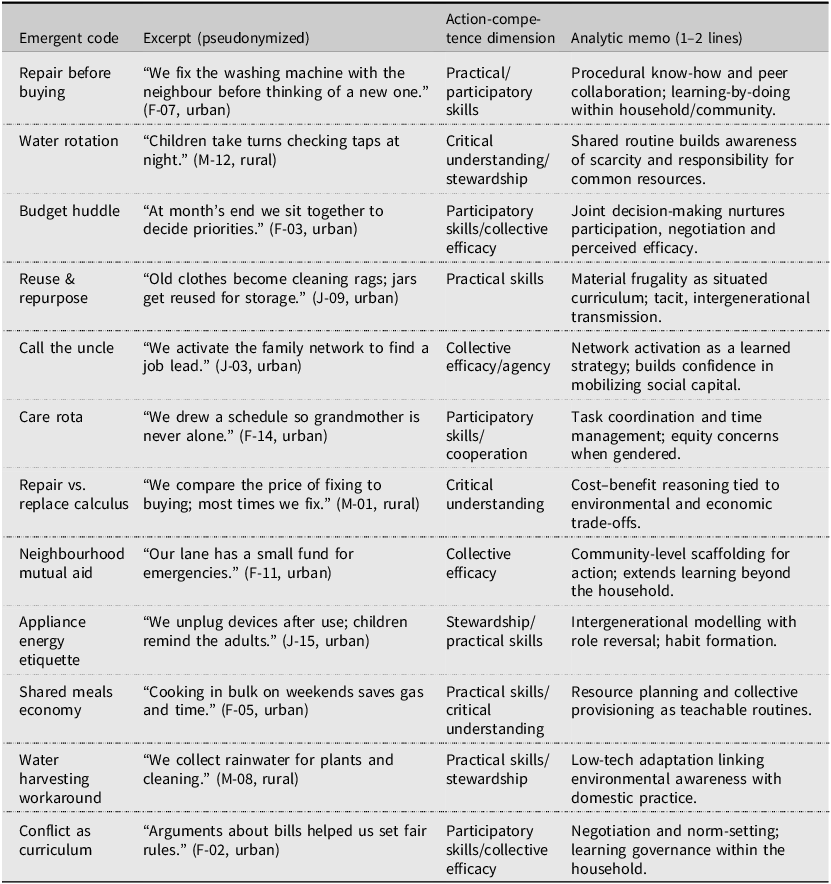
To make the analytic frame explicit and align family processes with ESE, we mapped emergent codes to three core dimensions of action competence – critical understanding of issues, practical/participatory skills and individual/collective efficacy for informed action (Jensen & Schnack, Reference Jensen and Schnack1997; Mogensen & Schnack, Reference Mogensen and Schnack2010). Illustratively:
-
• Critical understanding ↔ recognizing scarcity and trade-offs (e.g., water/electricity saving, repair vs. replacement).
-
• Practical/participatory skills ↔ budgeting, reuse/repair routines, task coordination, mutual aid.
-
• Agency/collective efficacy ↔ initiating support networks, organizing co-residence, negotiating roles, interacting with services.
Appendix B provides a summary matrix linking representative codes and excerpts to these dimensions. This mapping was applied after core grounded categories had stabilized, functioning as a second-order interpretive lens rather than a driver of initial coding. The alignment is conceptual and does not constitute a validated measurement instrument.
Trustworthiness and rigour
Credibility was enhanced through triangulation (interviews, observations, documents) and peer debriefing within the research team; an external critical reading also reviewed the coherence of the category scheme and emergent model. Dependability and confirmability were supported by an audit trail (memos, codebooks, decision logs) and reflexive notes on assumptions and power dynamics (Lincoln & Guba, Reference Lincoln and Guba1985; Miles et al., Reference Miles, Huberman and Saldaña2014). Transferability was addressed via thick description of household contexts, solidarity configurations and illustrative excerpts. Reporting follows key items from the COREQ checklist for interview studies (Tong, Sainsbury & Craig Reference Tong, Sainsbury and Craig2007). Peer debriefs were held biweekly; discrepancies in the double-coded subset were resolved by negotiated agreement, with decisions and rationales recorded in the audit trail.
Ethics, reflexivity and limitations
Ethical approval was obtained from the authors’ institutional review board (details withheld for double-blind review). Participants received oral and written information on the study’s aims, voluntariness, potential risks and confidentiality safeguards and subsequently provided informed consent. Pseudonyms are used throughout; identifying details were modified or aggregated to mitigate deductive disclosure. Audio files were encrypted, and all materials stored on secure, access-restricted servers. Participants could decline to answer any question and withdraw at any point without consequence. No financial compensation was provided (transport reimbursed when necessary). In line with institutional policy, data will be retained on an encrypted server for three years and then destroyed. Full transcripts were not returned to participants; instead, we conducted targeted excerpt checks during follow-ups to minimize misinterpretation while preserving anonymity.
Given the relational character of family interviews, the team maintained a reflexive stance regarding positionality (e.g., gender, class, professional status) and its influence on access, questioning and interpretation. For example, interviews with female heads of household more often foregrounded care coordination and household budgeting than interviews with retired men, which prompted adjustments to the interview guide (e.g., additional probes on economic trade-offs). Access to certain rural households was facilitated by community intermediaries; these dynamics were documented as potential conversion factors shaping narrative production. Reflexive memos recorded such tensions and made analytic decisions explicit, particularly when interpreting gendered labour and intergenerational authority (Tong et al., Reference Tong, Sainsbury and Craig2007).
A residual risk remains that highly isolated or conflictual households were less reachable; diversified entry points and contrastive-case seeking were used to mitigate this limitation.
Findings
The qualitative corpusFootnote 1 reveals complex and ambivalent intergenerational dynamics. Three dominant configurations of family solidarity emerge across socio-geographical contexts, household structures and gender relations. Each illustrates a distinct logic of economic resilience within Moroccan families under mounting social fragility. Throughout, households function as everyday ecologies of learning in which routines of frugality, coordination and mutual aid cultivate elements of action competence – critical understanding, practical/participatory skills and individual/collective efficacy. At the same time, these solidarities operate through gendered “conversion factors” that redistribute time, authority and responsibility unevenly, shaping who can learn, decide and act within the household.
Prolonged parental provision to adult children
In urban centres such as Fès, Sefrou and Meknès, parents – often retired or active in the informal sector – extend support well beyond legal adulthood, underwriting daily expenses and, at times, those of grandchildren.
“My son is 33. He still lives here with his wife and two children. He never had a stable job. I pay for the baby’s milk, school, even the electricity sometimes.” (Fatiha, 63, Sefrou, translated)
“We cannot leave our children outside, even if they don’t work. But it is getting heavy. I deprive myself for them.” (Abdelkarim, 68, retired, Fès, translated)
“It’s not that I want them to leave, but sometimes I need silence and space—to think about myself.” (Latifa, 59, Meknès, translated)
These downward flows are anchored in strong social norms of parental duty yet accompanied by quiet fatigue, heightened by limited institutional safety nets and uncertainty about adult children’s trajectories. Empirically, this configuration stabilizes households through a “default safety net” provided by older generations; analytically, it also reveals a tension between obligation and capacity, as support becomes routinized and gradually normalized as an expected entitlement rather than a negotiated arrangement.
From an ESE/action-competence perspective, routine budget meetings and repair-over-replacement choices foster critical understanding and practical skills; yet when provision remains unilateral and decision-making is concentrated in a single provider, collective efficacy may erode and solidarity can shift towards constrained obligation.
The household as a site of mutual aid: reciprocity amid latent tensions
In extended households in Taza, Moulay Yacoub and peri-rural fringes, multigenerational co-residence operates as both economic necessity and collective adaptation. Tasks and resources are distributed according to capacity – flexible yet unequal, with women bearing disproportionate coordination and emotional labour.
“My husband works far away, so I live with my in-laws, my children, and my two sisters-in-law. I take care of everything at home. Another one does the shopping. We help each other, but it is not always fair.” (Samira, 35, Moulay Yacoub, translated)
“When my father fell ill, I left my job to stay here. Now my brother sends some money from Tangier. Each of us helps in our own way.” (Mohammed, 28, Taza, translated)
“I say nothing, I keep it to myself. But sometimes I want to leave – too many people, too many responsibilities.” (Hayat, 42, Taza, translated)
Cohabitation buffers volatility and structures participatory routines (care rotas, shared ledgers), yet latent tensions persist, muted by loyalty and modesty. This configuration makes visible a key mechanism: resilience is produced through “care governance” (rotas, coordination, conflict mediation), but the governance work itself is frequently feminized and treated as a moral duty rather than a shareable responsibility.
These arrangements cultivate practical/participatory skills and stewardship habits (e.g., energy/water saving), while simultaneously reproducing gendered burdens that can limit women’s agency. Women’s contributions often operate as “invisible infrastructure”: they sustain everyday coordination without proportional access to voice in household decisions, thereby converting solidarity into a gendered constraint.
Youth-to-elder support: a quiet inversion of solidarity flows
In rural areas such as Boulemane and Taounate, upward transfers from young adults – often internal or international migrants – sustain parents and grandparents who remain in the village. Regular remittances coexist with hidden precarity among senders.
“My son sends me 1 500 dirhams every month. He works in a hotel in Marrakech. Thanks to him, we lack nothing.” (Haj Ahmed, 74, Boulemane, translated)
“I’m a kitchen helper in Casablanca. I send money to my mother in Taounate. Even if I’m not doing well, she must not lack anything.” (Hamza, 26, translated)
“I haven’t bought new clothes for two years. Everything I earn goes to the village. They think I’m rich here, but I share a room with two others.” (Younes, 29, Casablanca, from Boulemane, translated)
Legitimated by filial piety (birr al-wālidayn), these transfers build budgeting and coordination capacities across households and sometimes neighbourhood mutual aid. They also concentrate risk on a small number of earners and create “capability volatility”: when labour markets soften, the same solidarity norm can generate debt, conceal hardship and delay life-course transitions for senders. This arrangement therefore stabilizes elders while redistributing vulnerability onto youth.
Figure 2 summarizes these three configurations as a process map linking shock conditions, solidarity practices, resources generated and unequal costs (especially gendered care and risk concentration).
Typologies of intergenerational solidarity in Moroccan households.

This flowchart summarizes three dominant configurations of intergenerational solidarity identified through qualitative analysis: (1) parental provision to adult children, (2) reciprocal support in multigenerational households and (3) upward remittances from youth to elders. It highlights core dynamics, gender roles and forms of action competence cultivated in each configuration.
Cross-cutting mechanisms and limitations
Across configurations, households translate scarcity into action through routinized practices of frugality, care governance and neighbourhood mutual aid, which function as informal learning processes shaping action competence.
These established routines contribute to stabilizing household budgets during periods of inflation, nurture a reasoning framework that evaluates cost versus benefit and disseminate tacit knowledge through processes of observation and guided participation, gradually leading to the consolidation of a diverse portfolio of action dispositions that families can mobilize in response to recurring shocks and challenges (see the literature on home-as-learning within ESE, e.g., Payne, Reference Payne2005; and the action-competence framework: Jensen & Schnack, Reference Jensen and Schnack1997; Mogensen & Schnack, Reference Mogensen and Schnack2010).
However, it is also important to note that the co-residential arrangements prevalent in many families often externalize the burdens of coordination, emotional labour and time management predominantly onto women, thereby producing a state of moral fatigue, even as these dynamics are essential for maintaining the overall functionality of households. Participants in these studies have articulated this strain and pressure explicitly, highlighting the nuanced challenges that accompany their daily lives.
“It’s not that I don’t love my family. I’m just tired of managing everything, of thinking for everything. Men don’t see anything” (Amina, 47, Sefrou, translated).
“I work, I cook, I care for my parents and my children… but no one asks whether I am okay.” (Khadija, 40, Taza, translated)
These care infrastructures are also learning ecologies – rota setting, conflict mediation and task choreography teach participatory governance – but without attention to care justice, their benefits are unevenly distributed, constraining women’s agency (Kabeer, Reference Kabeer1999; Tronto, Reference Tronto1993).
Empirically, the same practices that enable collective problem-solving can reproduce patriarchal authority by separating implementation (often feminized) from decision and recognition (often masculinized), thereby limiting women’s voice and time for participation beyond the household.
The ambivalence – pride in solidarity yet exhaustion – is a recurring thread across accounts.
Families also activate social capital beyond the home: small neighbourhood emergency funds, tool/repair exchanges and job-lead brokerage (“call the uncle”). These meso-level arrangements scaffold collective problem-solving, reduce individual risk and normalize mutual aid as a local public good. They also extend intergenerational learning outward: children observe adults organizing funds, negotiating rules and liaising with services, reinforcing collective efficacy (Ballantyne et al., Reference Ballantyne, Connell and Fien1998).
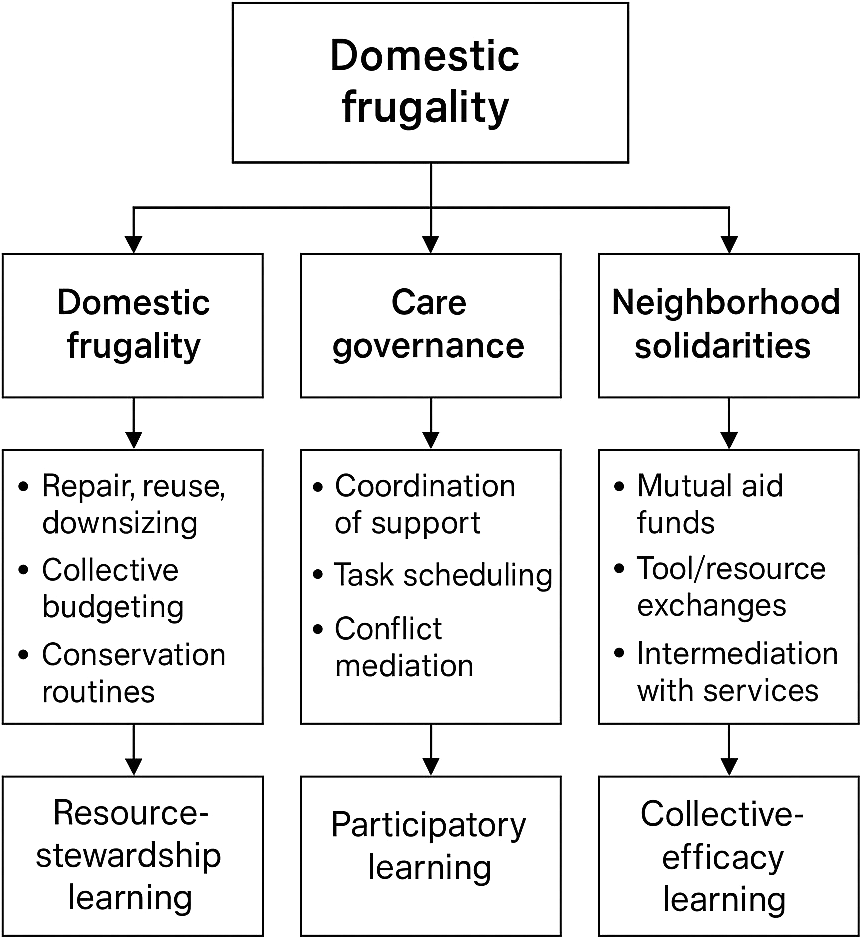
The forms of solidarity described above can be categorized into a typology of learning ecologies embedded in Moroccan households. Figure 3 below presents these configurations, mapping the interrelations between domestic frugality, care governance and meso-level mutual aid. This visual summary clarifies how each mechanism contributes to action competence while also revealing the tensions that constrain equitable outcomes.
Typologies of intergenerational solidarity and learning ecologies in Moroccan households.

Taken together, domestic frugality, care governance and neighbourhood solidarities translate scarcity into informed action, yet under constraints that can entrench gendered burdens and concentrate risk on a few earners. For ESE, the task is to make these mechanisms explicit and equitably governed, so the cultivation of action competence does not rest on invisible labour.
A visual synthesis of these interlocking mechanisms is provided in Figure 4, detailing how action competence emerges from domestic practices while revealing hidden gendered burdens.
Hidden mechanisms of resilience: invisible labour behind informed action.

This diagram illustrates the layered processes – often gendered and invisible – that underpin households’ ability to transform scarcity into informed action, linking daily frugality, emotional coordination and community solidarity.
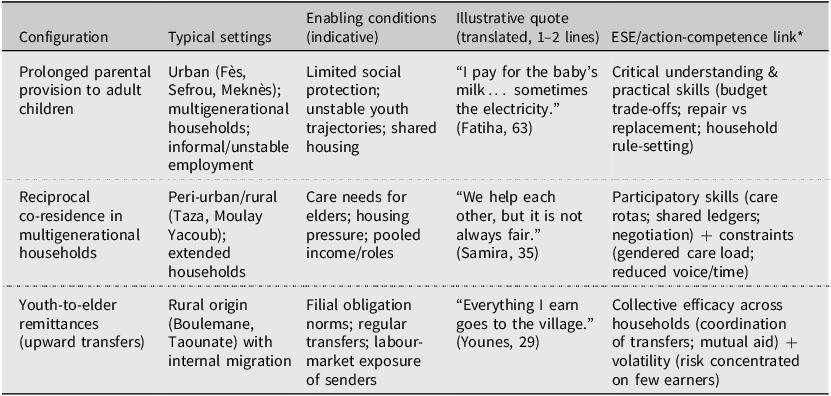
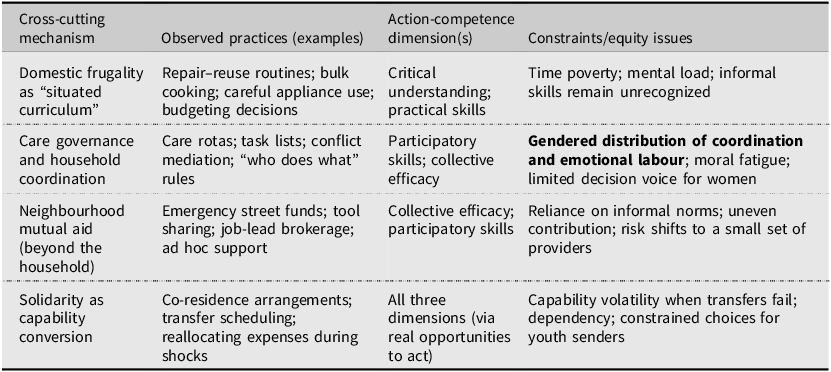
For a synoptic view of the evidence, Table 1 aligns each configuration with its contexts, enabling conditions, a brief illustrative quote and the corresponding ESE/action-competence link; Table 2 summarizes the cross-cutting mechanisms and their associated constraints shaping action competence.
Configurations of intergenerational solidarity: contexts, enabling conditions, illustrative quote and ESE/action-competence links

Note: *Action-competence dimensions: critical understanding, practical/participatory skills, individual/collective efficacy.
Cross-cutting mechanisms shaping household action competence: practices and constraints

Discussion
This analysis elucidates the heterogeneity and intricacy of the mechanisms by which Moroccan families mitigate recurrent socio-economic disturbances. We contend that the family functions as a micro-educational institution wherein elements of action competence are cultivated through quotidian practices: a critical comprehension of scarcity and trade-offs, practical and participatory skills (such as repair, reuse, budgeting and domestic governance) and individual as well as collective efficacy (including intra-household coordination and neighbourhood mutual assistance).
This interpretation expands upon ESE perspectives that emphasize learning through practice and the transformation of routines into informed action scripts (Jensen & Schnack, Reference Jensen and Schnack1997; Mogensen & Schnack, Reference Mogensen and Schnack2010; Payne, Reference Payne2005). Figure 5 synthesizes the hidden, gendered mechanisms through which these everyday practices are translated into resilience and uneven action competence.
Integrated framework of intergenerational solidarity, cross-cutting mechanisms and action competence.

These findings clarify that intergenerational solidarity operates as a critical mechanism of informal ESE within families. Through participation in everyday practices such as resource conservation, adaptive consumption and collective problem-solving, family members acquire experiential knowledge, practical skills and dispositions that enable them to navigate environmental and socio-economic constraints.
In line with the ESE literature, these processes contribute to the development of sustainability-oriented action competence, understood as the ability to critically understand structural challenges, exercise agency and engage in adaptive and responsible practices within real-life contexts (Jensen & Schnack, Reference Jensen and Schnack1997; Wals, 2015). Thus, intergenerational solidarity constitutes not only a coping strategy, but also an educational process that supports the formation of capabilities essential for sustainable living and social-ecological resilience.
Reconfiguring intergenerational solidarities under pressure
The three configurations identified – extended parental provision, reciprocal multigenerational co-residence and youth-to-elder transfers – affirm the diversity and adaptability of intergenerational solidarity. They correspond with the six classical dimensions (affective, normative, functional, consensual, associative, structural) while undergoing reconfiguration due to inflationary pressures, migration trajectories and individual health status (Bengtson & Roberts, Reference Bengtson and Roberts1991; Lowenstein, Reference Lowenstein2007; Szydlik, Reference Szydlik2016).
The empirical material shows that solidarity is not a uniform “resource;” it is a relational arrangement sustained through negotiation, moral obligation and routinized governance, which can shift from voluntary support to constrained duty as crises persist.
We conceptualize this phenomenon as a manifestation of “default resilience”: an adaptive capacity that emerges not from sufficient institutional support, but from necessity – frequently imposing disproportionate burdens on specific family members, predominantly women.
From the perspective of the capability approach, these elements represent constrained agency: specific assets (such as housing, modest pensions and relational networks) serve as conversion factors that transmute scarce resources into valued freedoms (including continuing education, access to care and energy security), while their absence significantly constricts available choices (Nussbaum, Reference Nussbaum2011; Sen, Reference Sen1999).
The findings add a mechanism-level specification: conversion factors are not only material (housing, pensions) but also relational and normative (obligation, authority, reputational expectations), shaping who bears costs and who accesses the benefits of resilience.
Consequently, access to “effective” resilience is unevenly allocated based on patrimony, social capital and territorial embeddedness, resulting in divergent trajectories even amidst comparable shocks. This interpretation further elucidates the volatility of households whose stability is contingent upon a limited number of earners (for instance, young migrants) susceptible to fluctuations in the labour market.
The structural limits of “default resilience”
Systemically, the strategies observed sustain households yet indicate the inadequacy of social protection mechanisms capable of addressing escalating needs (Walsh, Reference Walsh2016). Where institutional scaffolding is thin, household buffering becomes a substitute for welfare, shifting crisis management responsibilities onto kin networks and domestic governance.
In capability terms, this implies that resilience depends on whether households can convert limited resources into stable opportunities—an uneven process shaped by assets, norms and authority relations (Nussbaum, Reference Nussbaum2011; Sen, Reference Sen1999). This helps explain why households reliant on a narrow set of earners remain structurally exposed even when solidarity is strong.
Gendered and invisible resilience
Domestic coordination, time management and emotional labour fall predominantly to women. This invisible work stabilizes the household while constraining women’s agency (time, decision voice) and producing moral fatigue that is rarely acknowledged by kin or policy. Scholarship on empowerment and care justice illuminates these asymmetries and cautions against heroic narratives of “resilience” that naturalize inequality (Kabeer, Reference Kabeer1999; Tronto, Reference Tronto1993). Across accounts, women repeatedly described coordination and mediation as taken-for-granted obligations, while authority over rules and key resource decisions remained unevenly distributed.
The evidence suggests that solidarity can reproduce patriarchal structures through three linked mechanisms: (1) naturalization of women’s availability for care and mediation; (2) asymmetric authority over household rules and resource decisions; and (3) moral discipline through obligation and “silencing” of conflict, which limits women’s capacity to renegotiate roles. In educational terms, participatory skills (coordination, mediation, governance) are indeed learned, but the learning returns are unequal when those who enact participation do not enjoy equivalent decision power or recognition.
Theoretical contribution: families as action-oriented learning ecologies
Empirically, households appear as learning ecologies in which informed action is built through practice: critical understanding (scarcities, trade-offs), practical/participatory skills (repair, reuse, planning, conflict mediation) and efficacies (capacity to mobilize kin and neighbours) (Jensen & Schnack, Reference Jensen and Schnack1997; Mogensen & Schnack, Reference Mogensen and Schnack2010; Payne, Reference Payne2005). The contribution lies in showing how crisis-time solidarity simultaneously (a) generates action competence through routinized practice and (b) redistributes its conditions of possibility through gendered conversion factors, producing “unequal action competence” across household members.
Theoretically, this moves beyond individualizing views of resilience by underscoring its interdependence with public regulation, cultural norms and territorial ecologies – locally embedded configurations of social, economic and cultural conditions that shape access to resources, networks and adaptive strategies and thereby mediate how resilience is experienced and unevenly distributed across space. In this regard, critiques of “neoliberal resilience” – which displace adaptation burdens onto households – are instructive: without light-touch public supports and equitable domestic governance, family-based buffering risks exhaustion and dependency (Joseph, Reference Joseph2013).
Practice implications (ESE/policy). Make coordination tasks explicit and shared (co-decision tools, rotation of roles), equip the repair–reuse–efficiency pathway (micro-supports, repair workshops, tool libraries) and bridge homes and neighbourhoods (street funds, mutual-aid initiatives). Such low-cost levers convert routines into action competence while mitigating gendered load; their durability depends on care-justice-oriented governance and targeted public scaffolding.
In AJEE terms, the priority is not to romanticize family solidarity but to design educational and policy interventions that recognize, redistribute and support the labour through which sustainability-oriented action is made possible in everyday life.
Limitations and Future Research
Limitations
This study has several limitations that bound interpretation and transferability.
Regional and qualitative scope: evidence derives from 65 semi-structured interviews across 28 families in the Fès–Meknès region; findings support analytical rather than statistical generalization (Lincoln & Guba, Reference Lincoln and Guba1985). Although maximum-variation selection sought heterogeneity, households characterized by severe conflict, social isolation, or a breakdown of solidarity may remain under-represented, given the practical and ethical constraints of access in fragile situations.
Temporal and contextual specificity: data were collected in the wake of COVID-19 and amid inflationary stress; the salience of solidarity configurations and frugality routines may vary with macroeconomic cycles and policy shifts (Walsh, Reference Walsh2016). Accordingly, the configurations reported here should be read as crisis-salient arrangements rather than stable “types.”
Participant selection and gatekeeping: purposeful and snowball recruitment through community relays risks selection bias (e.g., over-reliance on cooperative or networked families), potentially attenuating variation in household governance and neighbourhood ties. This may also bias the corpus towards households able to narrate solidarity as a moral accomplishment, while excluding more hidden forms of constraint or rupture.
Self-report and desirability bias: accounts of resource sharing, care and budgeting are self-reported and can reflect normative expectations (e.g., filial duty), despite triangulation with observations and household documents (Miles et al., Reference Miles, Huberman and Saldaña2014). This limitation is particularly relevant where solidarity is culturally valorized and where gendered obligations may be normalized rather than problematized in narration.
Language and translation: interviews were conducted in Arabic and/or French; back-translation was applied to analytic excerpts, yet subtle meanings (especially around emotions, care and obligation) can shift in English rendering (Charmaz, Reference Charmaz2014).
Coding and analytic reliability: iterative grounded analysis included selective double-coding (∼10–15%) to stabilize operational definitions; full intercoder reliability statistics were not computed, which limits claims about replicability of coding decisions (Saldaña, Reference Saldaña2021). Instead, credibility was pursued through constant comparison, memoing and an audit trail, consistent with constructivist grounded theory conventions (Charmaz, Reference Charmaz2014).
Construct boundaries in ESE mapping: the analytical alignment of emergent codes to action-competence dimensions (critical understanding; practical/participatory skills; individual/collective efficacy) is conceptual, not a validated measurement instrument; construct validity requires future scale development (Jensen & Schnack, Reference Jensen and Schnack1997; Mogensen & Schnack, Reference Mogensen and Schnack2010). The mapping is intended to clarify educational significance rather than to quantify competence levels.
Researcher positionality: access, question framing and interpretation may carry positional effects (gender, class, professional status), partly mitigated but not eliminated by reflexive memoing and peer debriefs (Lincoln & Guba, Reference Lincoln and Guba1985). Given the sensitivity of family authority relations, future work may benefit from expanded participatory validation and member-informed interpretation processes.
Future research
We outline priorities to consolidate an ESE-aligned, action-oriented scholarship on family resilience.
Longitudinal and mixed-methods designs: track families over time to examine stability and drift in solidarity configurations and to test whether frugality/repair routines consolidate into durable action competence. Combine qualitative panels with time-use diaries, energy/water logs and episodic surveys. Longitudinal designs are also needed to capture transitions from solidarity to rupture (and vice versa) under changing labour-market and policy conditions.
Intervention and implementation studies: test family-anchored ESE modules that make coordination work visible and shared (decision logs, rotating facilitator, rule cards) and equip repair–reuse–efficiency practices (micro-vouchers, tool-library access). Employ cluster-randomized or stepped-wedge rollouts with process evaluation. Such work should examine not only behavioural outcomes but also shifts in participation, voice and perceived action possibilities—core concerns in action-competence scholarship (Jensen & Schnack, Reference Jensen and Schnack1997; Mogensen & Schnack, Reference Mogensen and Schnack2010).
Gender-transformative approaches: evaluate care-justice strategies (role rotation, decision-voice parity, respite supports) for effects on women’s time control, decision voice and household collective efficacy (Kabeer, Reference Kabeer1999; Tronto, Reference Tronto1993). Future research should also examine how masculinities and intergenerational authority shape the distribution of learning opportunities and responsibilities in household “learning ecologies.”
Measurement development: build and validate home-based action-competence instruments (subscales for critical understanding, practical/participatory skills and individual/collective efficacy), and capability-informed indicators that capture conversion factors (Nussbaum, Reference Nussbaum2011; Sen, Reference Sen1999). Developments should ensure cultural sensitivity and avoid conflating competence with compliance, in line with action-competence critiques of purely behavioural framings.
Neighbourhood and network analytics: use social network analysis to study how micro-funds, tool sharing and brokerage (“call the uncle”) scale from private resilience to collective stewardship; assess diffusion and equity of access. This line of inquiry can clarify when neighbourhood mutual aid functions as an inclusive public good versus a selective resource reinforcing exclusion.
Comparative and policy-sensitive designs: compare urban/rural regions and policy environments; exploit natural experiments (e.g., municipal repair schemes) to estimate effects on household capabilities and ESE outcomes. Comparative work across Global South settings could further test the transferability of the proposed conceptual contribution and specify boundary conditions.
Economic evaluation: conduct cost-effectiveness analyses of small-budget levers (repair vouchers, tool libraries) relative to gains in household stability and collective efficacy.
Ethics and participation: advance participatory and co-designed protocols with households and neighbourhood groups; refine safeguards for anonymity when mapping kinship and mutual-aid networks. Particular attention is needed for deductive disclosure risks in tightly knit communities and for the ethics of representing intra-household conflict and gendered power relations.
Conclusion
This study shows that Moroccan families mobilize three intergenerational configurations, extended parental provision, reciprocal multigenerational co-residence and youth-to-elder transfers, to buffer recurrent shocks while simultaneously cultivating action competence through everyday practice.
Routines of repair–reuse–efficiency, shared budgeting and neighbourhood mutual aid operate as learning ecologies that develop critical understanding of resource constraints and socio-ecological trade-offs, practical/participatory skills and individual/collective efficacy – core outcomes in ESE (Jensen & Schnack, Reference Jensen and Schnack1997; Mogensen & Schnack, Reference Mogensen and Schnack2010; Payne, Reference Payne2005). In AJEE terms, the household is not merely a site where sustainability messages are received, but a setting where sustainability-relevant “action scripts” are learned, rehearsed and negotiated through lived necessity.
Yet these gains remain constrained by uneven conversion factors (assets, networks) and by gendered coordination burdens that render resilience effective but fragile (Kabeer, Reference Kabeer1999; Sen, Reference Sen1999; Tronto, Reference Tronto1993). The findings demonstrate that solidarity can function as both a capability-enhancing infrastructure and a mechanism of unequal burden-shifting, reproducing patriarchal authority when responsibility for care and mediation is feminized while decision voice remains uneven.
Conceptually, the study advances a relational account of family resilience co-produced by public regulation, cultural norms and territorial ecologies, moving beyond individualizing narratives (Walsh, Reference Walsh2016). We propose “intergenerational solidarity resilience” as a transferable analytical concept to examine how crisis-time solidarities generate and unevenly distribute, the conditions for sustainability-oriented agency across contexts (Bengtson, Reference Bengtson2001; Silverstein & Bengtson, Reference Silverstein and Bengtson1997).
Practically, the findings support light-touch public scaffolding (repair and efficiency schemes, community care supports, accessible tool-sharing infrastructures) and equitable domestic governance (role rotation, decision-voice parity, explicit coordination tools) that convert household routines into durable, shared capacities for informed action. For ESE/ESD practitioners and curriculum designers, the implication is to recognize family-based learning ecologies, to design bridges between home–community initiatives and educational programmes and to foreground care justice so that the cultivation of action competence does not depend on invisible, gendered labour. Future research should test family-anchored ESE modules and capability-oriented targeting in longitudinal and comparative designs to establish what scales, for whom and at what cost.
Acknowledgements
I would like to thank the families who generously shared their time and experiences during this study. I am also grateful to the local facilitators in Fez, Meknes and Taounate who supported access to participants. Special thanks to the interdisciplinary seminar group at USMBA Fez, whose feedback helped sharpen the theoretical framing of this paper.
Ethical statement
This study was conducted in accordance with ethical research standards. Informed consent was obtained from all participants. Data were anonymized to ensure confidentiality.
Financial support
This research received no specific grant from any funding agency, commercial or not-for-profit sectors.
Appendix A
Sample summary (n = 65 participants; 28 families)

Participant roster (pseudonymized; cross-references IDs used in the text)

Appendix B
Example matrix: mapping codes to action-competence dimensions

Author Biographies
Fouad Annaki is a doctoral researcher in sociology at the Faculty of Letters and Human Sciences Dhar El Mahraz, Sidi Mohamed Ben Abdellah University, Fez, Morocco. His research focuses on social capital, intergenerational solidarity and entrepreneurship in contexts of economic uncertainty. His current work examines how informal support networks and socio-relational competencies contribute to resilience, access to resources and sustainable entrepreneurial trajectories in the Fès-Meknès region.
Yassine Annaki is an associate professor at the Faculty of Human and Social Sciences, Ibn Tofail University, Kenitra, Morocco. His academic interests include youth studies, education and the sociology of everyday life. His research explores generational change, identity formation and social resilience, with particular attention to how young people engage with social transformations and learning processes in changing societal contexts.
Saadeddine Igamane is a habilitated associate professor of sociology at the Faculty of Letters and Human Sciences Saïs, Sidi Mohamed Ben Abdellah University, Fez, Morocco. He is affiliated with the Laboratory for Research on Social Change. His research focuses on family sociology, education and social transformations, with an emphasis on intergenerational relations, vulnerability and the role of social learning in processes of adaptation and resilience.
Abdellah Nouib is a habilitated associate professor at the Faculty of Legal, Economic and Social Sciences, Cadi Ayyad University, Kelaa des Sraghna, Morocco. His teaching and research interests include economics, management, entrepreneurship and territorial development. His work examines the institutional and socio-economic conditions shaping entrepreneurial dynamics, public policies and sustainable local development processes.






 Open access

