

Introduction
This article draws on data collected from visits to UK and Australian youth foyers in 2012. On the basis of prior experience and evidence in the UK, the primary objective of the study is to consider whether the foyer model as being developed in Australia is (a) effective and leading to fully independent housing and (b) financially sustainable. Unlike the UK, Australia has not developed a significant supportive housing sector for young people leaving homelessness. On the other hand, the Australian homelessness service system is more developed and Australia has pioneered early intervention for homeless and at-risk youth. The differences between the UK and Australia should not be under-estimated. In the UK, local authorities have major responsibility for housing and social services unlike Australia. Additionally, an entitlement to housing is embodied in legislation in the UK and council housing remains a significant sector despite policy changes that began under the Thatcher Government to convert the public housing sector to private ownership. In Australia (2015), a small number of foyers are already operational and several projects are currently in development. The opportunity therefore exists to create funding arrangements that could support the proliferation of a supportive youth housing sector in Australia.
As a strategy in assisting youth transition to independent living, the foyer model in the UK has been developed over more than twenty years, resulting in more than 130 sites. By contrast, the development of foyers in Australia is more recent, with only six foyers operational at the time of writing; only two having operated for more than five years.Footnote 1 However, the development of many more has been discussed and is being planned. The UK foyer model has been very influential in the development of Australian foyers and hence provides an appropriate reference point for comparative analysis. The issues of effectiveness and sustainability are of considerable interest in Australia, the UK and elsewhere as governments invest substantial sums of money into foyer projects.
This article is divided into five sections. The first section provides a discussion of youth housing and homelessness. The second section presents existing evidence on youth foyers in Australia and the UK, and the third describes the method and data used in this study. The next section examines the results of the analysis and the final section provides concluding comments and discusses implications for further study.
Australia and the UK: contextual and youth transition issues
In Australia, ‘youth homelessness’ has been identified as a focus of the response to homelessness since the late seventies. This differs from the UK and the USA where the focus has been more on ‘chronic homelessness’ and rough sleeping. Changes in labour markets, education and the benefits system have been identified as some of the factors that have resulted in many young people not earning a sufficient income to move into independent living until their twenties. Patterns of leaving home, partnership formation and dissolution and patterns of child-birth have all changed since the 1980s (Elsey et al., Reference Elsey, Backett-Milburn and Jamieson2007). In 1986, 19 per cent of twenty- to thirty-four-year olds in Australia were living at the family home, whereas by 2006 this had risen to one in four (23 per cent) (Australia Bureau of Statistics, 2009). There have been major changes in the labour market with a decline in unskilled and semi-skilled industrial employment, the rise in service industries and the spread of casualisation and contract employment. Early home leaving, prior to establishing relatively stable and secure employment, in many cases can lead to homelessness. This is compounded when young people have complex and interrelated social and health needs, including the early onset of mental health problems such as depression (Whitbeck et al., Reference Whitbeck, Chen, Hoyt, Tyler and Johnson2004; Taylor et al., Reference Taylor, Stuttaford, Broad and Vostanis2007) and where young people have left school early. The affordability of housing has declined in Australian cities particularly in the largest cities such as Sydney and Melbourne. Many of these problems are likely to persist in the absence of support, and support is often problematic given young people's mobility (Craig and Hodson, Reference Craig and Hodson2000).
Similar demographic changes have occurred in the UK, although the proportion of young people living in their family home is higher. Rugg (Reference Rugg2010) noted a significant increase in the proportion of younger people living in the parental home in the UK. In 1991, 50 per cent of men and 32 per cent of women aged twenty to twenty-four were living in the parental home, but by 2006 these figures were 58 per cent and 39 per cent, respectively. Diminished labour market opportunities for young people in many parts of UK have impacted on young people's ability to achieve independent living. ‘The result can be a sense of frustration, and sometimes, in extreme cases, family conflict leading to homelessness’ (Williamson, Reference Williamson2002: 72–3).
The transition from living with family to independent living is a key issue. Much has changed over the past three to four decades. Humphreys et al. (2007) suggest that the process of moving to full independence involves several inter-linked transitions, chiefly moving from full-time education to employment (the school-to-work transition), from the family of origin to new partnerships and families (the domestic transition) and from living with parents to independent housing (the housing transition). Youth homelessness has been identified as being the outcome of a process of failed transitions (Avramov, Reference Avramov1998). Leaving home prior to having relatively secure employment and sufficient income is highly problematic, leading in many cases to periods of homelessness (MacKenzie and Chamberlain, Reference MacKenzie and Chamberlain2003). The same issue is raised by homelessness researchers who explain the onset of homelessness in terms of ‘pathways’ (see, for example, Anderson and Tulloch, Reference Anderson and Tulloch2000; Fitzpatrick, Reference Fitzpatrick2000; MacKenzie and Chamberlain, Reference MacKenzie and Chamberlain2003; Clapham, Reference Clapham2005; Mallett et al., Reference Mallett, Rosenthal, Keys and Averill2010). UK research (Ford et al., Reference Ford, Rugg and Burrows2002) has indentified many young homeless people as experiencing a ‘chaotic pathway’, characterised by an absence of planning, limited family support and substantial constraints on access to housing. Mayock et al. (Reference Mayock, Corr and O'Sullivan2008) identify three main pathways into homelessness for young people: a care history, household instability and family conflict and negative peer associations and ‘problem’ behaviour. The strong labour markets of the 1960s and early 1970s in Australia meant that early home leaving was not problematic for the vast majority of young people. However, this situation had changed by the early 1990s for many young people, and transition had become an issue for social policy redress.
The policy and program responses carried out in the UK and Australia were somewhat different. In Australia, several state jurisdictions had directed resources to youth homelessness and youth housing programs following a Senate Standing Committee inquiry and report in 1982. The Federal Labor Government in 1985 consolidated several homeless programs into a joint Commonwealth-State program known as the Supported Accommodation and Assistance Program or SAAP. During the economic slump of the early 1990s, when youth unemployment was high, a new program known as Jobs, Placement, Employment and Training (JPET) was launched as support for unemployed young people. In some cases, the same agency delivered housing and homeless services as well as JPET, but in many other communities the two programs were operated by different agencies and without a high level of coordination. Although there is not strong evidence on the effectiveness of JPET, youth unemployment declined from 1991 to 2006. By contrast, youth homelessness did not (Mackenzie and Chamberlain, Reference MacKenzie and Chamberlain2008). Much of the housing advocacy on behalf of young people called for more affordable housing, while the homeless response centred on providing crisis refuges and transitional housing without explicitly addressing employment issues. Australia's response to unemployment was a privatised Job Network system (DEEWR, 2012) which was later reformed as Job Services Australia with a somewhat more focused approach to highly disadvantaged job seekers.
The UK experienced a similar economic slump in the early 1990s but the policy and program response for young people differed from Australia. The UK foyers were developed after recognition in the early 1990s that the problems of youth homelessness and youth unemployment were serious and related issues requiring a conjoined response (Anderson and Quilgars, Reference Anderson and Quilgars1995). UK foyers provide housing to young people between sixteen and twenty-five years of age who are homeless or in need of housing – about half are aged sixteen to seventeen years (Hillman, Reference Hillman2010). Researchers have long argued that employment and education are important issues to be redressed in terms of providing pathways out of homelessness (Gronda, Reference Gronda2009). Accordingly, foyers take a holistic approach to client need, providing integrated accommodation, training and employment assistance. As a condition of residency, every client enters into a formal agreement with the foyer operator, which details their commitments with respect to education, training or employment activities that they will undertake. The aim is to develop a resident's life skills and build resilience and self-confidence to enable them to live independently. Housing and accommodation are a part of the total package of support.
In addition to foyers, the UK has developed an extensive range of assistance programs for at risk and homeless youth over the past fifteen years. Humphreys et al. (Reference Humphreys, Stirling, Inkson and Delaney2007) identified twenty-one different models of accommodation and support, including foyers, specialist emergency accommodation for young people, supported accommodation, floating support and supported lodgings.
The number of foyers increased from thirty-five schemes in 1995 to over 130 by 2007, supporting more than 10,000 young people annually (Quilgars et al., Reference Quilgars, Johnsen and Pleace2008; Foyer Federation, 2016). Most of the original foyers in 1995 were redeveloped from the existing Young Men's Christian Association (YMCA) youth housing, that had been operating as de-facto foyers for many years.
Capital funding of UK foyers has largely been reliant on the Social Housing Grant (SHG). In addition, a range of government and private funding sources, including EU social funds and national lottery proceeds, have been used to provide capital funding. A high proportion of the operating costs are funded from the Supporting People program which is a component of the local authorities Area-Based Grants. A major difference between Australia and the UK is the much greater role of local authorities (i.e. local government in Australia) in providing housing and social services. Some foyers operate commercial not-for-profit activities, such as cafes, training facilities and retail outlets to generate additional funding, although, with a few exceptions, this is not a substantial source of disposable income.
Most foyers are owned by Registered Social Landlords (RSLs) (Hillman, Reference Hillman2010). They operate with a variety of entry and referral points. Often housing associations construct the physical infrastructure, retain ownership of the buildings and responsibility for maintenance, while management is undertaken by welfare agencies. However, the separation of housing management and support does not appear to be as consistent as in Australia. In the UK, some agencies both own the foyer building and provide support to residents.
While most foyers are located in the cities, there are foyers in regional towns and rural settings. Newer foyers are usually purpose built with accommodation ranging from single bed self-contained rooms to flats with several bedrooms, a shared communal kitchen, bathroom and common lounge area and co-located with training facilities. Many of the older foyers are like rooming houses or student accommodation with access to shared kitchens and bathrooms, and canteens with subsidised meals.
UK foyers vary in design from a centralised building complex to buildings clustered around a central hub or dispersed unit throughout a community linked to a central agency office. Foyers range in size from just a few beds to 200 beds with most having between thirty and forty. Many foyers, particularly those in the cities, have twenty-four-hour staffing, while smaller facilities often have floating support shared between two or more facilities administered by the same agency. Some offer in-house training and recreational facilities. In response to security and maintenance concerns, close circuit television and electronic security systems are used extensively. Residents meet regularly and have a say in the rules that they are expected to adhere to. Some foyers have facilities that are used by the wider community, and this may facilitate reintegrating young people into the community. This also has the benefit of strengthening local communities through non-resident's involvement in social, cultural, educational and social enterprise activities (Hillman, Reference Hillman2010).
In Australia, the conjoining of housing and employment for young people has not happened in policy debates until recently and it has not been implemented systemically. There were two pilot foyer projects (see Grace et al., Reference Grace, Keys, Hart and Keys2011; Randolph et al., Reference Randolph, Pang and Wood2001) in the early 1990s inspired by the UK foyer movement, but these did not lead to an expanded foyer program.Footnote 2
In 2010, a Victorian Government discussion paper (Victorian Government, 2010) identified ‘foyer-like’ models rather than ‘foyers’ as a potential strategy to address youth homelessness and unemployment. The advantage of this looser terminology is that it seeks to avoid tying the development of foyers in Australia to reproducing the English model(s) and it allows for a broader range of models or foyer types. Such models could include dispersed foyers, which have a number of dispersed accommodation units close to a hub where support is provided, or school-linked supportive housing where accommodation is provided on or close to school sites.
The effectiveness of youth foyers
Given the development of foyers are in their infancy in Australia it is an opportune time to consider their effectiveness. Although limited, evidence on the effectiveness of UK foyers is generally positive. Anderson and Quilgars (Reference Anderson and Quilgars1995) summarised the findings of evaluations of the UK Foyer in the early 1990s and found approximately one-quarter of young people left with employment and permanent housing. It is difficult to generalise regarding the outcomes of the evaluation of UK foyers because foyer client outcomes are heavily influenced by external factors such as local housing and employment conditions (Smith, Reference Smith2004). Smith's (2004) exit study of 126 youth in ten UK foyers found that two-thirds were in full or part-time work and/or study, and the majority were in some form of social housing. Other UK studies by Maginn et al. (Reference Maginn, Frew, Sibbhan and Kodz2000) and Smith and Browne (Reference Smith and Browne2007) found some success in terms of sustaining a transition to independent living as well as increased participation in employment, education and training.
However, Quilgars et al. (Reference Quilgars, Johnsen and Pleace2008) commented that the monitoring of UK foyer outcomes was still underdeveloped. Gronda (Reference Gronda2009) noted that there was limited quantitative evidence available on the effectiveness of foyers due to methodological, including controlling for the individual characteristics of young people, an inability to track young people on exit and the unique characteristics of local contexts. With respect to the characteristics of the client population, it should be noted that UK foyers were not initially intended to provide support to clients with high needs (Randolph et al., Reference Randolph, Pang and Wood2001 and Quilgars et al., Reference Quilgars, Johnsen and Pleace2008). However, foyer models have been developed according to local requirements (Streich and Greene, Reference Streich and Greene1998; Quilgars, Reference Quilgars2001), and, in reality, deal with a wider range of clients, including many with relatively high needs (Anderson and Quilgars, Reference Anderson and Quilgars1995; Lovatt and Whitehead, Reference Lovatt and Whitehead2003).
Outside of the UK, several countries have established or are considering establishing foyers. One well-known youth foyer is the Chelsea Foyer in New York City. Residents pay a fee based on their income in lieu of rent, which they receive back when they successfully complete the program. The foyer has a higher proportion of residents with high needs than a typical UK foyer. Follow-up aftercare is not provided, although residents are encouraged to stay in touch with the service and their peers. In terms of the effectiveness of the model, Gaetz and Scott (Reference Gaetz and Scott2012) reported that only 2 per cent of clients had stable accommodation at entry, while some 77 per cent moved onto stable accommodation at exit. A total of 84 per cent of exiting residents were still in stable housing and 91 per cent in employment one year after exit.
Given the relative infancy of the foyer sector in Australia, little outcome and evaluative data exist, although we can note studies on the two oldest foyer type models in Australia, the Miller Campus Foyer and the ‘Step Ahead’ foyer. The first evaluation of the Miller Campus Foyer in Sydney found that the program prevented young people from leaving school (Randolph and Wood, Reference Randolph and Wood2005). However, overall sustainability of the foyer funding model proved elusive (Martin, Reference Martin2010). Campus weekly expenses totalling $9,503 [£4,751], although offset by revenue from operations of $2,025 [£1,012], resulted in a shortfall of $7,478 [£3,739] per week or $388,869 [£194,434] annually.Footnote 3 In terms of the ‘Step Ahead’ foyer, operated by Melbourne City Mission and one of the earliest projects in Australia, Grace et al. (Reference Grace, Keys, Hart and Keys2011) found that mental health issues, histories of abuse at home and conflict with other family members were common client backgrounds. On this basis, many of the residents were not low-need young people requiring minimal support. The report also found that residents spent on average six months in the foyer program, which was substantially shorter than the two-year duration of residency in the UK. One third of residents leaving the service went onto community housing, about a third to family and friends and another third into other independent accommodation. The service did not work particularly well for those with mental illness or for those with psychological or physical barriers to employment or education.
In another study, Cameron (Reference Cameron2009) reported tangible, positive results for the ‘Step Ahead’ program with some 98 per cent of program participants successfully achieving sustainable independence within eighteen months of exit. Grace et al. (Reference Grace, Keys and Hart2012) focused on homeless university students in ‘Step Ahead’. They found that the accommodation and support provided to these students enabled them to progress in their studies, but that some faced challenges due to housing unaffordability and instability on exit from the program.
Gronda (Reference Gronda2009) asserted that young people, who did not have complex needs, were likely to benefit from accommodation and support provided in a foyer program. However, in her opinion the model was problematic for those young people with high or complex needs. This proposition is counter to the finding from Nelson et al. (Reference Nelson, Aubry and Lefrance2007), who, after reviewing sixteen evaluations of housing and support interventions for people experiencing homelessness and mental illness, found that integrated housing and support were more effective than support alone.
Research method and data
This study set out to examine the potential effectiveness and financial sustainability of the foyer model as being implemented in Australia. The comparison between what is happening in Australia and UK is useful and justifiable on several grounds. Australian foyers have been developed with a strong reference to the UK foyer sector. The maturity and scale of the UK foyer sector means that an analysis of UK data provides a useful benchmark, despite the differences in the policy and funding context between Australia and the UK.
We did not investigate the issue of capital cost as this varies greatly with some facilities purpose built, others developed in refurbished buildings or in rental properties funded by largely benevolent landlords. In terms of cost effectiveness, the focus was on output measures and not outcome. The distinction between outcome and outputs is important. Outputs include data such as the number of participants housed, training sessions provided, turnover of clients and percentage of ex-residents in sustainable housing for the long term, as well as the number unplanned exits. Outcomes relate to changed behaviours, skills, knowledge and other attributes, and require the use of metrics and measurement techniques outside the scope of this study. Output data are more readily available, whereas sophisticated outcomes measurement is less prevalent.
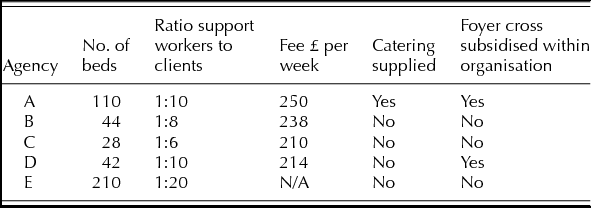
This study employed a case study method conducting interviews with key stakeholders and collecting quantitative and qualitative data from a set of foyers in the UK and Australia during early 2012. The five UK foyers visited were not chosen at random but were selected from the Foyer Federation website and on advice from other academic colleagues as they varied in terms of size and location, from large inner city sites to small regional centres. The visits included one to a major inner London-based foyer and another to a foyer in outer suburban London. Another visit was to a forty bed foyer in a regional town of approximately 30,000 people in an area of depressed economic conditions and with a large migrant population. Researchers also made a visit to a forty bed foyer in an affluent regional city of over 100,000 people. Finally a visit was made to a forty bed foyer in a regional centre of some 60,000 people. Some of the agencies operate foyers on multiple sites. At each foyer, data were collected and a general discussion with the site manager was conducted on issues such as funding and government subsidies. Table 1 provides profile data of the UK foyers visited. As can be seen, client rents are similar with the exception of the foyer providing meals. The ratio of support staff to clients ranges from 1:6 to 1:20 in the case of the largest foyer.
Description of UK Foyers Visited
A variety of facilities were available at different foyers. In one case, there was a crèche, a dance studio, two restaurants, a café and a gymnasium. The income from these add-on facilities cross-subsidised the costs of operating the foyer. Most facilities were self-catering, but older foyers provided canteens where residents purchased meals. Another foyer had a social enterprise that provided maintenance and renovation services to housing owned by the agency. This venture was designed to provide training opportunities to foyer residents rather than to generate a profit. The standard physical foyer configuration included training rooms, communal kitchen, meals area and computer lab. Consequently, establishing a standard capital cost per bed is difficult aside from the fact that there are clear economies of scale in terms of providing the non-accommodation services.
Many operational similarities were noted across the UK foyers. Residents could stay up to two years, although the average length of stay was closer to eighteen months. Clients were referred to the service by local authorities but assessed by agencies. On exit from the foyer, all had ‘move on’ flats that clients typically stayed in for a limited time until they transferred into housing in the community, chiefly council housing.
All foyers visited had training facilities of one sort or another, in particular information technology (IT) facilities. A variety of arrangements were in place to provide training either internally or externally. In one case, training was outsourced to a registered training provider that provided basic literacy and numeracy training. Another foyer outsourced training in life skills. One had their own learning and engagement team supporting literacy, numeracy and work experience programs. Irrespective of who provided the training, the facilities were well-used to provide a regular schedule of programs. Most had weekly sessions in life skills, employment counselling and wellbeing.
Each of the foyers visited provided some information on their outcomes. However, no detailed data were available on the characteristics of their residents or the level and complexity of resident needs, although staff interviewed noted that not all of those being accommodated and supported were low needs. Additionally, the foyers have been operating for varying periods of time. The above description highlights the diversity of foyer facilities and circumstances, and hence interpretation of data and inferences regarding performance should be performed with caution.
Analysis of results
Various measures of effectiveness can be examined from the data collected. Aggregated figures for the Australian foyers examined indicate that only seventeen young people (6.2 per cent of the total housed) left their accommodation prematurely due to dispute or behavioural issues. This compared favourably with the 10 per cent figure supplied by the UK foyers. Furthermore, the data indicate that generally foyers appear to have been successful in terms of ex-residents moving on to stable and secure housing. The 81 per cent figure for the Australian foyers compares favourably to the 84 per cent in the study by Gaetz and Scott (Reference Gaetz and Scott2012) for the Chelsea Foyer in New York. The proportion of ex-residents in some form of education and training is somewhat lower than might be expected (52 per cent, while the corresponding UK figure is approximately 90 per cent). A plausible explanation for this is that ex-residents may have entered the workforce, but this could not be verified.
As to whether current funding arrangements are sustainable, Table 2 provides a breakdown analysis of the income and costs of an ideal-typical foyer in the UK and Australia, based on the 2012 fieldwork data. Due to the different currencies involved and cost levels, particularly labour rates, comparing costs incurred in the UK to those of Australian foyers is somewhat problematic. Of relevance though are the sources of income and breakdown of costs into their various components. Only major income and cost groups have been shown for ease of comparison with Australian data. It is evident that rents only partially cover the operating costs of the foyers. Government grants, specifically the Supporting People Block Grant provide substantial funding to the UK foyers. The single largest cost component relates to wages, while operating or program costs and administrative costs were substantially smaller. All of the UK foyers visited were producing a small surplus, although this point should be interpreted with caution, as all of them were providing outreach and support in their respective communities in addition to their foyer activities. Hence, a precise breakdown of unit costs cannot be derived from the data provided. Some foyers did not pay commercial rates of rent for their properties and the figures do not incorporate any provision for depreciation, repairs and maintenance. Repairs and maintenance average about 9 per cent of total expenses.
Financial Comparison of ideal-typical UK and Australian Foyers

A breakdown of salary costs of the UK foyers indicates that approximately 12.5 per cent is allocated to general management, which is comparable to Australian services. The largest component contributes to counselling and support (54.5 per cent) for residents. Counselling and support includes night support workers on duty after hours in mid-range to large foyers, although not in many of the smallest facilities.
A senior manager of the largest foyer visited asserted that the foyer was too large and that plans to reconfigure the floor plan would increase the size but reduce the number of rooms. When asked why he thought that large scale was not necessarily a positive factor, he commented:
Well, you don't want the foyer to become a community unto itself, you want foyers to be part of the local community . . . if we had our time over again, we would have five forty bed foyers in various locations not one 200 bed foyer.
While the scale of the foyer did enable the organisation to employ specialist staff in employment, housing, counselling and management, it raised security concerns and enabled some clients to ‘slip between the cracks’ or disengage with the service. The general consensus from management at other foyers was that the optimal size depended on design but forty beds seemed to be the preferred scale.
Like those in the UK, Australia foyers major costs included labour costs, other program costs, administration costs and maintenance. While the cost structure of existing Australian foyers was similar, there was some variation between foyers. Also, the ratio of staff to clients varied between foyers. Further, the cost associated with non-residential case support varied across programs. In addition, there was a variation in costs between the various foyers with the smallest having the greatest cost per bed. As with the UK foyer, the major component of labour costs is the salary component for counselling and support workers. It is difficult to generalise regarding maintenance costs because not all of the programs incur maintenance charges and the extent and quality of maintenance is variable, dependent on the type and age of buildings.
Table 2 illustrates ideal-typical foyer models with forty beds in the UK and Australia. Ideal-typical models are constructs based on real empirical financial data using averages calculated from the financial data collected (see Hekman Reference Hekman1983 for a discussion of ideal typical models). For the purposes of this comparison, a model forty bed foyer was used – a medium-sized facility in the UK and the notional size of several of the newer government funded projects in Australia. Program costs and administrative costs are significant and are a larger proportion of total costs in Australia than in the UK. This suggests higher staffing levels in the UK foyers. It may also indicate that administrative costs are higher because Australian foyers are more recent and therefore incur significant establishment costs. Weekly rents ranged from $77.50 per week (about 25 per cent of the resident's income- standard for community housing rents in Australia) to $153.63 per week.
In all of the Australian foyers, the shortfall between annual client rent received and total cost is significant and indicates that without substantial additional recurrent funding the various foyers are not financially sustainable. The UK income–cost structure has changed somewhat since 2012 because Supportive Peoples funding has been reduced in real terms (Davis, Reference Davis2013). New projects may increasingly find it difficult to secure revenue funding to maintain the current level of support. Block grants come to local government from the central government in the UK, while in Australia the Federal government allocates funding to the states, but it is largely up to each state to determine the allocation of funds. Agencies can submit bids for ad-hoc grant funding from both state and federal governments but this is on the basis of special pleading.
The above analysis does not consider the wider economic benefits that foyers provide. Early school leavers cost the community in terms of reduced lifetime earnings and tax revenue (see for example Sherman, Reference Sherman1994). In Australia, MacKenzie et al. (Reference MacKenzie, Desmond and Steen2007) estimated the economic cost for children becoming homeless as the lost earnings from not completing high school on average amounting to $64,266 (in 2006 dollars). Effective homelessness prevention programs also result in reduced outlays to government often referred to as cost-offsets. For example, Flatau et al. (Reference Flatau, Zaretzky, Haigh, Bray and Martin2008) found utilisation rates and the average cost of health and criminal justice services used by homeless individuals in Australia were significantly higher than for the population in general. While program costs may be confined to a brief period of direct counselling and assistance, the cost-offsets accruing from a program may stretch a long way into future. Flatau et al. (Reference Flatau, Zaretzky, Haigh, Bray and Martin2008) reported an estimated total lifetime health and criminal justice service cost off-set of $312,080 per client from effective homelessness prevention.
It is clear that the additional health and justice costs to the community from homelessness and lost productivity from early school leaving are in per capita terms substantial. These costs could be substantially reduced by the provision of foyer-like support packages and foyer accommodation for at-risk homeless youth.
Conclusions
While this study was limited in its scope, sufficient cost data were obtained to make some inferences about the financial characteristics of foyers. A key finding from this study is that the current funding model for Australian foyers is not sustainable. If current foyers are to remain operational, and further foyers developed, then the issue of a sustainable recurrent finding model will need be addressed as a policy priority. In the UK, the Supporting People's Benefit has covered the additional support services provided by the UK foyers, although the future of this benefit is insecure. Currently in Australia, if an organisation arranges the capital for construction, it must petition the state government for additional recurrent funds. There is no guarantee that such funds will be available.
There is evidence to indicate foyers have positive outcomes for the young people and the communities in which they reside. Performance data for existing UK foyers are limited and while there have been several evaluations it is not possible to routinely examine the statistics on who enters foyers, how long they stay and the extent to which they achieve various forms of independent housing after their residency. Controlling for these variables is crucial when making rigorous assessments of effectiveness. In terms of cost-effectiveness, there are insufficient data to undertake a more complex analysis than presented here. An extensive study could be realistically attempted in the UK for a full cost-effectiveness and cost-efficiency analysis. In general, existing evaluations suggest that a high proportion of residents move onto stable housing and some form of employment, but the characteristics of residents entering foyers was unclear. Given the recent development of foyers in Australia, comprehensive data on outcomes is not available. Building a rigorous longitudinal evaluation of resident's outcomes would be particularly important at this early stage of foyer developments in Australia.
Apart from financial issues that were the main focus of this study, there are some questions about the model itself. Workers at the UK foyers visited during fieldwork said that many of the young people they support had medium to high needs (such as unmanaged disabling mental health, drug and alcohol conditions). However, funding for support is based on the assumption of low-need residents. Management of the UK foyers suggested that rather than the level of need being the critical variable, the ‘readiness’ of someone to change their life by accepting support and accommodation on the basis of participation in education and training is more meaningful. In addition, the assessment of need in homeless services is generally a professional qualitative judgment by an intake worker. While there have been several attempts to adopt a more rigorous decision tree approach, such as that of the health sector, there remains a lack of sophistication in this area. Arguably, the homeless and supportive housing sectors need a more sophisticated methodology for discriminating and differentiating between different needs to ensure public funds are not spent benefiting people who could probably get by without such levels of support.
The key concept in the foyer model is the packaging of support and accommodation on the basis of a commitment to engagement with education, training and/or employment. As such it aims to assist in the transition to independence from full-time education to employment, building new partnerships through cohabitation with peers and living independently from parents. The richness of the support package notably differentiated various foyers in the UK. Although initially Australian interest in the UK foyers was as an accommodation model, this has given way to viewing foyers as a life support and transition package, as emphasised by the UK Foyer Federation. The questions that have arisen when transposing a UK supported housing model, such as the Youth Foyer, into the Australian setting highlight the importance of context and at the same time expose some points of vulnerability.



