





1. Rebound effects undermine the potential of design
Never before has there been a stronger global focus on the design of sustainability-oriented interventions (Hauschild et al. Reference Hauschild, Kara and Røpke2020), but society’s most well-intended efforts to solve sustainability challenges (e.g., climate change, loss of biodiversity and resource depletion) have not yet achieved the expected positive societal and environmental impact (Sandberg Reference Sandberg2021) due to rebound effects.
Rebound effects are negative consequences of interventions that arise due to induced changes in system behaviour, which partially or completely offset their potential sustainability benefits (Hertwich Reference Hertwich2005) (Figure 1, adapted from Wolstenholme (Reference Wolstenholme2003)).
Rebound effects undermine sustainable development. For example, the intended reduction of fuel consumption (IC) by fuel-efficient cars results in lower operational costs and higher disposable income, which leads to re-spending on, for example, more driving (UC), ultimately resulting in increased fuel consumption (rebound effects = ∑ (IC – UC)).

Literature addressing rebound effects can be traced back to 1865, with the seminal research on the so-called Jevons’ Paradox, which proposes that technological efficiency (primarily related to energy efficiency) leads to an associated growth in resource use (Jevons Reference Jevons1865). After being disregarded for more than 100 years, research on rebound effects re-emerged in the 1980s and can be ordered in four phases (Santarius et al. Reference Santarius, Walnum and Aall2016):
-
(1) 1980s: theoretical exploration at the microeconomic and macroeconomic levels, with research led by Khazzoom and Brookes (Santarius et al. Reference Santarius2016), predominantly within energy economics (Font Vivanco et al. Reference Font Vivanco, McDowall, Freire-González, Kemp and van der Voet2016);
-
(2) 1990s: empirical investigations, as documented in the meta-analysis by Greening & Greene (Reference Greening and Greene1998), and the empirical research carried out by Sorrell et al. (Reference Sorrell, Dimitropoulos and Sommerville2009);
-
(3) 2000s: political evaluation with a focus on policymaking support (Ottelin et al. Reference Ottelin, Cetinay and Behrens2020), which played an important role in the ‘Rio + 20’ United Nations conference in 2012;
-
(4) 2010s: multidisciplinary extension from energy economics to ecological economics, socio-psychology, socio-technology, industrial ecology and sustainability transitions (Metic & Pigosso Reference Metic and Pigosso2022).
More recently, the so-called transformational rebound (Greening et al. Reference Greening, Greene and Difiglio2000) investigates how technology changes consumers’ preferences, altering social institutions and rearranging the organisation of production (Greening et al. Reference Greening, Greene and Difiglio2000) (e.g., digitalisation and smart products have altered, and will continue to alter, human activity (Bressanelli et al. Reference Bressanelli, Adrodegari, Pigosso and Parida2022)).
Rebound effects are often classified as direct, indirect and economy-wide effects (Font Vivanco et al. Reference Font Vivanco, McDowall, Freire-González, Kemp and van der Voet2016; Freire-González Reference Freire-González2017):
-
(i) Direct effects: efficiency gains lead to increased demand and additional consumption of a given product/service (e.g., energy efficient cars lead to higher disposable income and thus increased driving), and/or substitution of other products/services (e.g., car-sharing substitutes public transportation instead of car owning).
-
(ii) Indirect effects: savings in a given production system drive the consumption of other products/services with higher sustainability impact (e.g., re-spending of disposable income saved via efficient cars with more impactful consumption, such as long-distance flights).
-
(iii) Economy-wide effects: often referred to as “macroeconomic rebound effects” describe broader economic responses that alter patterns of consumption and production on a larger scale (e.g., new energy technologies can stimulate additional economic activity, expanding or increasing production).
On average, it is estimated that direct rebound effects undermine between 10 and 30% and indirect effects between 5 and 10% (Binswanger Reference Binswanger2001) of the potential sustainability gains, depending on the considered timeframe and system boundaries (Sorell Reference Sorell2010; Sorrell Reference Sorrell2009). Thus far, the primary focus of research within rebound effects has been on direct and indirect effects (Font Vivanco et al. Reference Font Vivanco, McDowall, Freire-González, Kemp and van der Voet2016; Freire-González Reference Freire-González2017) within an energy efficiency paradigm targeted at a policymaking support (Shove Reference Shove2018).
Due to the prevalence in energy economics literature, empirical research has been mostly devoted to energy rebound on the basis of a single unit at the consumer level, whereas the investigation of the producer perspective is still very limited (Van der Loo & Pigosso Reference Van der Loo and Pigosso2024; Metic & Pigosso Reference Metic and Pigosso2022; Turner Reference Turner2013).
Moreover, recent findings from behavioural studies challenge mainstream economic principles (which assumes that individuals make rational decisions striving to maximise utility), by showing that decisions are also shaped by psychological and social influences (Santarius & Soland Reference Santarius and Soland2018). To fully understand rebound effects, it is crucial to integrate a behavioural perspective (Exadaktylos & van den Bergh Reference Exadaktylos and van den Bergh2021).
Yet, research into the behavioural mechanisms that drive rebound effects is still emerging (Sorrell et al. Reference Sorrell, Gatersleben and Druckman2020). A recent systematic literature review (Van der Loo & Pigosso Reference Van der Loo and Pigosso2024) identified 15 distinct behavioural mechanisms that drive the occurrence of rebound effects, clustered into four main types:
-
(i) Moral licensing: prior moral behaviour leading to subsequent immoral behaviour or inaction (e.g., contribution ethics, single-action bias and social moral licensing).
-
(ii) Reappraisal of consequences: reflect how actors re-evaluate the (relative) personal or environmental consequences of their pro-environmental behaviour (e.g., need satisfaction, response efficacy, negative associations, negative stereotypes, perceived behavioural control and diffusion of responsibility).
-
(iii) Motivational crowding: reflect how influencing intrinsic and extrinsic motivations can alter the pro-environmental behaviour (e.g., motivational crowding).
-
(iv) Cognitive biases: reflect systematic errors in thinking that may lead people to deviate from rationality, make inaccurate judgements, or interpret information illogically (e.g., information overload, time discounting, mental accounting and cognitive dissonance).
Furthermore, there is an increasing recognition that rebound effects occur when an intervention liberates or binds not only money, but any scarce production or consumption factor (e.g., time, convenience, space and technology) (Guzzo et al. Reference Guzzo, Walrave, Videira, Oliveira and Pigosso2024; Weidema Reference Weidema2008).
In summary, recent developments suggest the need for moving beyond economic mechanisms to also fully embrace the role of behavioural mechanisms in giving rise to rebound effects, towards a broader definition and understanding of rebound effects that expands the focus from energy efficiency to a comprehensive view of environmental impacts triggered by systemic changes driven by a wide range of production and consumption factors, beyond monetary terms.
2. Design fails to prevent rebound effects
Although rebound effects have been widely acknowledged, actual research into rebound effects has had very limited ramifications on design, thus far. Three fundamental scientific gaps hinder the prevention of rebound effects within design, as described in the following subsections.
2.1 GAP 1: limited knowledge about the rebound effects triggered by efficiency–effectiveness–sufficiency strategies
Two major paradigms drive the sustainability discussion: (i) green growth, promoting efficiency and effectiveness measures at the production side (Lorek and Spangenberg Reference Lorek and Spangenberg2014) and (ii) degrowth, built upon sufficiency measures at the consumption side (Sekulova et al. Reference Sekulova, Kallis, Rodríguez-Labajos and Schneider2013).
Efficiency measures have traditionally targeted the minimisation of sustainability impacts (primarily environmental), by means of reduced resource consumption across the product life cycle (Pigosso et al. Reference Pigosso, McAloone and Rozenfeld2014; Vilochani et al. Reference Vilochani, Mcaloone and Pigosso2024). Nevertheless, efficiency gains have repeatedly been cancelled out or even surpassed by increased consumption (Laurenti et al. Reference Laurenti, Sinha, Singh and Frostell2015), due to rebound effects. Higher efficiency generates a greater demand, which in turn leads to unintended higher resource use (Figge & Thorpe Reference Figge and Thorpe2019). It is now widely recognised that efficiency measures alone (e.g., developing products with lower material and energy consumption through ecodesign (Maccioni et al. Reference Maccioni, Borgianni and Pigosso2019)) will never be sufficient to achieve sustainable development (Figge et al. Reference Figge, Young and Barkemeyer2014).
Effectiveness has thus gained increased recognition, particularly in a circular economy context (Ellen MacArthur Foundation 2015), as an alternative approach to decouple value creation from resource consumption (Pieroni et al. Reference Pieroni, McAloone, Borgianni, Maccioni and Pigosso2021), by maintaining resource productivity through subsequent life cycles (e.g., extending the lifetime of products and materials) (Pigosso & McAloone Reference Pigosso and McAloone2017). Effectiveness strategies have focused on, for example: (i) the redesign of material flows (through end-of-use strategies such as remanufacturing, reuse and refurbishment); (ii) a long-term perspective on the economic drivers for sustainability and (iii) the elimination of toxicity through enhanced materials health. Effectiveness, however, is also subject to rebound effects and not a sufficient strategy to achieve enhanced sustainability (Kjaer et al. Reference Kjaer, Pigosso, Niero, Bech and McAloone2019; Metic et al. Reference Metic, Guzzo, Kopainsky, McAloone and Pigosso2024). Refurbished phones, for example, rarely compete in the same primary market and are likely to be produced in addition to, rather than instead of, new phones (Zink and Geyer Reference Zink and Geyer2017) – the same happens with second-hand clothes (Metic et al. Reference Metic, Guzzo, Kopainsky, McAloone and Pigosso2024). Similarly, biodegradable materials may shorten product longevity and consequently create more production (Chen Reference Chen2021).
More recently, sufficiency (Bocken and Short Reference Bocken and Short2016) emerged as an approach to moderate consumption (Tanneurs and Vezzoli Reference Tanneurs and Vezzoli2008) through substantial changes in consumption patterns (e.g., shift from private car ownership to sharing systems). Complementing efficiency and effectiveness approaches (which are targeted at the supply side), sufficiency turns its attention to the demand side, enabling a complete coverage basis for the sustainable consumption and production framework (Tanneurs & Vezzoli Reference Tanneurs and Vezzoli2008). Sufficiency operates through innovative sustainable business models (Blok et al. Reference Blok, Long, Gaziulusoy, Ciliz, Lozano, Huisingh, Csutora and Boks2015) by influencing and mitigating consumption behaviour to a socially sustainable level that enables a good quality of life for all (Fernandes Aguiar et al. Reference Fernandes Aguiar, Costa, A. Pigosso, Otto, Eisenbart, Eckert, Eynard, Krause and Oehmen2023; Sandberg Reference Sandberg2021). Sufficiency (Sorrell Reference Sorrell2010) can be achieved through, for example, modal shifts and sharing models intended to reduce individual consumption, extension of product life through reuse, avoidance of planned obsolescence and so forth. Nevertheless, rebound effects triggered by sufficiency strategies also start to emerge (Andrew et al. Reference Andrew, van den Bergh and Pigosso2024; Figge et al. Reference Figge, Young and Barkemeyer2014). Service-based business models often lead to rebound effects (Sarancic et al. Reference Sarancic, Metic, Pigosso and McAloone2023) by, for example, inspiring more frequent product replacement (Von Weiszäcker & Ayres Reference Von Weiszäcker and Ayres2013), careless behaviour (Ackermann & Tunn Reference Ackermann and Tunn2024) and higher re-spending (Guzzo & Pigosso Reference Guzzo and Pigosso2024).
It is believed that efficiency–effectiveness–sufficiency can indeed lead to successfully enhanced sustainability performance (Bocken & Short Reference Bocken and Short2016; Figge et al. Reference Figge, Young and Barkemeyer2014), capable of addressing the current pressing sustainability challenges. Nevertheless, efficiency–effectiveness–sufficiency, individually or in combination, are also prone to rebound effects (Buhl et al. Reference Buhl, von Geibler, Echternacht and Linder2017). The early identification and prevention of rebound effects during the design phase is therefore key to ensure that the designed solutions will have a net positive sustainability impact.
While rebound effect research thus far has focused on efficiency measures (and particularly energy efficiency), there is a lack of understanding on how to also account for rebound effects originated from efficiency–effectiveness–sufficiency as key strategies for design for sustainability (Sorrell Reference Sorrell2010), (Buhl & Acosta Reference Buhl and Acosta2016).
The fundamental scientific gap is the lack of theoretical foundation to understand the underlying systemic mechanisms giving rise to rebound effects triggered by efficiency, effectiveness and sufficiency strategies (or, in other words, by the green growth and the degrowth paradigms) in a broader sustainability context (where economy is an integral element of society, within the environmental boundaries) (Griggs et al. Reference Griggs, Stafford-Smith, Gaffney, Rockström, Öhman, Shyamsundar and Steffen2013; Thatcher & Yeow Reference Thatcher and Yeow2016).
2.2 GAP 2: the influence of the counterintuitive behaviour of complex socio-technical systems in giving rise to rebound effects is not yet understood
More than 40 years of academic research and debate on rebound effects resulted on an array of conflicting views regarding the rebound effects’ magnitude, causes, mechanisms, indicators and taxonomy (Font Vivanco et al. Reference Font Vivanco, McDowall, Freire-González, Kemp and van der Voet2016; Madlener & Turner Reference Madlener and Turner2016; Sorrell et al. Reference Sorrell2009).
Although the existence of rebound effects is widely acknowledged, studies that measure the magnitude of rebound effects are diverse with respect to definitions, boundaries, methodologies and data sources (Font Vivanco et al. Reference Font Vivanco, McDowall, Freire-González, Kemp and van der Voet2016; Freire-González Reference Freire-González2017; Sorrell et al. Reference Sorrell2009). Furthermore, the majority of studies in the current literature are based on measuring realised rebound effects (ex-post) rather than on estimating potential rebound effects (ex-ante), pre-emptively (Giampietro & Mayumi Reference Giampietro and Mayumi2018).
The existing methodological approaches for estimating the magnitude of rebound effects (e.g., quasi-experiments at the micro-level and econometrics at the macro-level) are limited and prone to bias, providing insufficient basis to draw general conclusions (Sorrell Reference Sorrell2007). Quasi-experiments are often used to measure demand before and after the implementation of an efficiency measure (Sorrell et al. Reference Sorrell2009), based on primary data often subjected to selection bias, small sample sizes, errors associated with estimates and too short monitoring periods to capture long-term effects. On the other extreme, econometric models are often employed with the use of secondary data (e.g., cross-sectional, panel data) and at different levels of aggregation (e.g., household, region and country). In many cases, nevertheless, data are either unavailable or inaccurate (Sorrell et al. Reference Sorrell2009). Similar limitations are observed within other attempts to estimate the magnitude of rebound effects related to the use of consequential life cycle assessment (LCA) (Polizzi di Sorrentino et al. Reference Polizzi di Sorrentino, Woelbert and Sala2016) due to LCA’s limitations in considering the dynamics of socio-technical systems within and across different life cycle phases (Niero et al. Reference Niero, Jensen, Fratini, Dorland, Jørgensen and Georg2021).
The lack of a strong theoretical background results in up to 87% variation in the estimated magnitude of rebound effects (Sorrell et al. Reference Sorrell2009). For example, in studies connected to personal car mobility, the estimated rebound effects range from 0 to 87% (Greening et al. Reference Greening, Greene and Difiglio2000; Sorrell et al. Reference Sorrell2009). Furthermore, the major gaps in qualitative and quantitative rebound effect research indicate that existing calculations reflect only a small fraction of the sum of rebound effects that actually occur (Santarius Reference Santarius2012).
Rebound effects are a complex phenomenon that needs to be tackled at the micro-, meso- and macro-levels (Madlener & Turner Reference Madlener and Turner2016). The size and impact of rebound effects are affected by changes in the system within which they arise (Freeman Reference Freeman2018). Nevertheless, current research focus is primarily on the micro- and macro-levels (Santarius Reference Santarius2016), targeted at identifying symptoms/events instead of identifying and managing underlying systemic causes (e.g., structural resistance to change, behavioural responses) (Polizzi di Sorrentino et al. Reference Polizzi di Sorrentino, Woelbert and Sala2016).
Currently, theoretical and empirical research mostly disregard that rebound effects are the result of complex mechanisms at play within different levels in the system, subject to dynamic interactions with causal links and responses (feedback loops) from socio-technical, behavioural and economic aspects over time (Laurenti et al. Reference Laurenti, Singh, Sinha, Potting and Frostell2016; Saey-Volckrick Reference Saey-Volckrick2020). The existing theoretical foundation is limited in understanding the range of systemic mechanisms governing rebound effects, and explaining the dynamics of socio-technical systems (Geels Reference Geels2004) leading to counterintuitive system behaviour (Freeman et al. Reference Freeman, Yearworth and Preist2016; Madlener & Turner Reference Madlener and Turner2016). The narrow boundary of most rebound studies ignores causal processes underlying the wider complex systemic responses to sustainability interventions (Turner Reference Turner2013), that is, the tendency for interventions to be defeated by the response of the system to the interventions itself (de Gooyert et al. Reference de Gooyert, Rouwette, van Kranenburg, Freeman and van Breen2016).
There is a need to consider the dynamics of rebound effects (Madlener & Turner Reference Madlener and Turner2016) by adopting a systemic view on structure and behaviour of the complex socio-technical systems (Van Den Bergh et al. Reference Van Den Bergh, Truffer and Kallis2011) that we are embedded in Achachlouei & Hilty (Reference Achachlouei and Hilty2014), Chen (Reference Chen2021), Dace et al. (Reference Dace, Bazbauers, Berzina and Davidsen2014), and Laurenti et al. (Reference Laurenti, Singh, Sinha, Potting and Frostell2016) – with the inclusion of socio-economic aspects, time and space considerations, as well as system boundaries at the micro-, meso- and macro-levels) (Fiksel et al. Reference Fiksel, Bruins, Gatchett, Gilliland and Ten Brink2014). The lack of robust theoretical explanations of how and under which conditions rebound effects emerge (Santarius et al. Reference Santarius2016), and how different rebound effects affect each other within complex socio-technical systems (e.g., mobility) limits the prevention of rebound effects (Guzzo et al. Reference Guzzo, Walrave and Pigosso2023, Reference Guzzo, Walrave, Videira, Oliveira and Pigosso2024).
2.3 GAP 3: the bounded rationality within design limits the understanding of rebound effects at a broader systemic level
Design science (Broadbent Reference Broadbent2004) aims at developing knowledge and scientific methodologies to support the design of interventions capable of solving “real-world” problems and improving conditions for humanity (Denyer et al. Reference Denyer, Tranfield and Van Aken2008). Design entails devising courses of action aimed at changing existing situations into preferred ones (Simon Reference Simon1988), spanning across many disciplines (including, but not limited to engineering, architecture and urban planning) (de Oliveira et al. Reference de Oliveira, Guzzo and Pigosso2024).
Design for sustainability has traditionally focused on developing solutions with enhanced sustainability performance, mostly through the integration of efficiency (Pigosso et al. Reference Pigosso, McAloone and Rozenfeld2015) and (more recently) effectiveness strategies (Blomsma et al. Reference Blomsma, Pieroni, Kravchenko, Pigosso, Hildenbrand, Kristinsdottir and Kristoffersen2019) in the early design stages (Laurenti et al. Reference Laurenti, Sinha, Singh and Frostell2015), targeted at the minimisation of sustainability impacts (primarily environmental) across the product life cycle (Pigosso et al. Reference Pigosso, McAloone and Rozenfeld2014).
Over the past decades, the scope of design for sustainability has expanded from: (i) product design (where the focus is on enhancing the sustainability performance of existing products or developing new products which are intrinsically more sustainable) (Pigosso et al. Reference Pigosso, McAloone and Rozenfeld2015); to (ii) product/service-system design (focused on the development of integrated combinations of products and services through new business and ownership models, capable of decoupling value creation from resource consumption) (Kjaer et al. Reference Kjaer, Pigosso, Niero, Bech and McAloone2019). More recently, it is argued for the need to expand the scope of design for sustainability to a more systemic view, based on (iii) socio-technical system design, focused on promoting radical changes on how societal needs, such as mobility or healthcare, are fulfilled (Ceschin & Gaziulusoy Reference Ceschin and Gaziulusoy2016) (Figure 2, adapted from Ceschin & Gaziulusoy (Reference Ceschin and Gaziulusoy2016)).
The evolution of design for sustainability, adapted from Ceschin & Gaziulusoy (Reference Ceschin and Gaziulusoy2016).
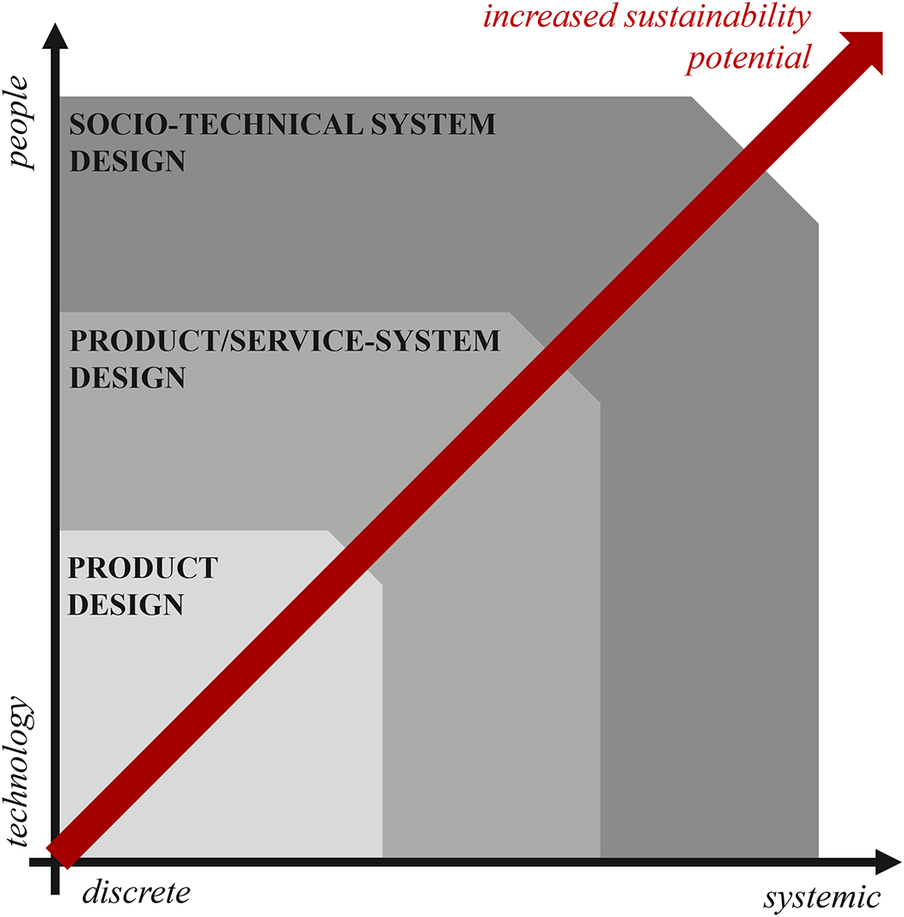
Currently, design for sustainability strategies (Pigosso et al. Reference Pigosso, McAloone and Rozenfeld2014) are mostly related to the development of products and product/service-systems and solely focused on maximising efficiency and effectiveness, disregarding the (negative and positive) consequences of design due to induced changes in system behaviour (Figure 1).
State-of-the-art lacks design strategies for systemic sustainability change (Gaziulusoy et al. Reference Gaziulusoy, Boyle and McDowall2013). One exception is the attempt to address economic rebound effects by means of eco-efficient value creation, measured through the eco-costs/value ratio (Hendriks et al. Reference Hendriks, Vogtländer and Janssen2006). By reducing eco-costs (i.e., environmental impacts across the products’ life cycle) and enhancing value (i.e., higher market price), there would be less disposable income to lead to direct, indirect and/or economy-wide rebound effects (Vogtländer et al. Reference Vogtländer, Mestre, van der Helm, Scheepens and Wever2013). The method has been applied to cases such as the design of packaging (Wever & Vogtländer Reference Wever and Vogtländer2013), a smart temperature control for domestic heating (Scheepens & Vogtländer Reference Scheepens and Vogtländer2018) and a domestic street lighting system (Klaassen et al. Reference Klaassen, Scheepens, Flipsen and Vogtlander2020). Nevertheless, the focus is still on money-related rebound effects, and the large set of rebound effects occurring due to systemic behavioural changes are still not addressed.
Sustainability is still considered an abstract ultimate goal and not an inherent dynamic system property (Gaziulusoy & Brezet Reference Gaziulusoy and Brezet2015). Furthermore, there is limited understanding of the role of the design process as a powerful leverage point at which to intervene in production and consumption systems (Randers Reference Randers2000), despite the increased recognition that wider-scale systemic changes can be addressed by design (Gaziulusoy & Brezet Reference Gaziulusoy and Brezet2015).
To be able to address current sustainability challenges (e.g., climate change and biodiversity loss), there is an urgent need to align design for sustainability practices taking place at micro- and meso-levels to the macro-level of socio-technical systems (Gaziulusoy & Brezet Reference Gaziulusoy and Brezet2015). The boundaries of design for sustainability must be expanded towards a systemic view, in order to enable the influence on high leverage points to lead to significant, sustained and positive effects on sustainability performance (Guzzo et al. Reference Guzzo, Walrave and Pigosso2023). In other words, a systems approach for the design of sustainable solutions, capable of managing intrinsic system characteristics to improve its resilience and adaptability, is required (Fiksel Reference Fiksel2003).
Despite the increased recognition of the need to drive sustainability change through the design of complex socio-technical systems and the dynamic complexity of rebound effects (Guzzo et al. Reference Guzzo, Walrave and Pigosso2023), the prevention of rebound effects (i.e., negative systemic consequences) and the reinforcement of secondary benefits (i.e., positive systemic consequences) is still unexplored due to the lack of a robust theoretical foundation at a systemic level.
This presents, therefore, a large and untapped research potential, which would allow to expand the boundaries of design science towards the design of systems that are resilient to rebound effects.
3. Towards reboundless design
The latest major paradigm shift within design for sustainability occurred in the 1990s, with the ground-breaking view of the need for life cycle thinking (Hauschild et al. Reference Hauschild, Kara and Røpke2020), as opposed to the dominant focus on cleaner production (1980s) and end-of-pipe-solutions (1970s). To tackle rebound effects and achieve sustainable development, science must further advance to enable the design of reboundless interventions (i.e., products, product/service-systems and socio-technical systems that are resilient to rebound effects) at a systemic level, enabling production and consumption systems that are capable to address societal needs within the planetary boundaries.
To be achieved, the design of reboundless solutions requires three major scientific advancements in the state-of-the-art:
-
(1) explanation of the systemic behavioural mechanisms giving rise to rebound effects triggered by efficiency–effectiveness–sufficiency design strategies;
-
(2) quantification of rebound effects emerging from the counterintuitive behaviour of complex socio-technical systems in the early design stages;
-
(3) prevention of rebound effects through the expansion of design science towards the avoidance of negative systemic consequences of design targeted at addressing system behaviour.
The expansion of the mental models within design science for the development of reboundless interventions will enable the transition to a new design for sustainability paradigm targeted at the systemic level, enabling the design of sustainable production and consumption systems that are resilient to rebound effects.
Reboundless design has, moreover, a high scientific multiplier potential, enabling, for example, the incorporation of rebound effects in sustainability impact assessment methodologies, such as LCA; the early identification of rebound effects of new technologies and the support for policymaking within sustainability transitions.
Acknowledgements
REBOUNDLESS is co-funded by the European Union (ERC, REBOUNDLESS, 101043931). Views and opinions expressed are however those of the author(s) only and do not necessarily reflect those of the European Union or the European Research Council. Neither the European Union nor the granting authority can be held responsible for them.


 Open access

