


Introduction
In spite of various initiatives to halt the decline of biodiversity, extinctions are occurring at an increasing rate (Pimm et al., Reference Pimm, Russel, Gittleman and Brooks1995; Stokstad, Reference Stokstad2010). Biodiversity conservation has been recognized as an important global issue and there is general agreement that humanity is responsible for maintaining biodiversity for future generations (Mee et al., Reference Mee, Dublin and Eberhard2008). However, our failure to achieve the 2010 biodiversity target of the Convention on Biological Diversity (UN, 1992) for slowing the rate of biodiversity loss suggests that we need more effective ways to address conservation problems (Rands et al., Reference Rands, Adams, Bennun, Butchart, Clements and Coomes2010).
One traditional approach to biodiversity conservation has been top-down investment by governments and environmental NGOs. However, most governments have failed to stem the degradation of natural resources, including biodiversity (Acheson, Reference Acheson2006; Rockström et al., Reference Rockström, Steffen, Noone, Persson, Chapin and Lambin2009). The inefficiency of these approaches has led to increasing interest in market-based approaches that place a monetary value on ecosystem goods and services, or achieve an outcome through mechanisms such as cap-and-trade (Rosales, Reference Rosales2006; Rands et al., Reference Rands, Adams, Bennun, Butchart, Clements and Coomes2010). Although science is seen as a source of the empirical knowledge on the functioning of ecosystems required to guide their management (Demeritt, Reference Demeritt2001; Hobbs & Harris, Reference Hobbs and Harris2001), critics argue that the market-based approach has led to the exploitation of natural resources because of the agendas of governments, corporations and scientists: “mountains become ‘natural resources’, ancient forests are seen as ‘agriculture’, rivers of fish are ‘stocks’, and human communities become the ‘labour force’ ” (Van Houtan, Reference Van Houtan, Sodhi and Ehrlich2010). Although there are examples of successful actions by both top-down and market-based approaches to protect natural assets (Hepburn, Reference Hepburn2007; Sodhi et al., Reference Sodhi, Butler, Laurance and Gibson2011) both seem to be insufficient for slowing the rate of biodiversity loss. Hence there is a need for a complementary strategy to shape ethical attitudes and strive for more pro-environmental thinking and lifestyles amongst individuals and nations (Tilman, Reference Tilman2000; Van Houtan, Reference Van Houtan2006). Changed environmental attitudes and behaviour will in turn affect democratic governments, which ultimately reflect popular will in their actions.
One human dimension that has been neglected in the global biodiversity discourse is religious belief. The majority (88.5%) of the world's population declare themselves as believers in some form of deity and as adherents of a religious community (WRD, 2010). Wilson (Reference Wilson2006) stated: ‘Religion and science are the two most powerful forces in the world today… If [they] could be united on the common ground of biological conservation, the problem would soon be solved’. By their definition, religions inherently aim to pursue moral good and have for centuries guided people with respect to what is right and what is wrong (Van Houtan, Reference Van Houtan, Sodhi and Ehrlich2010). Moreover, religions are social traditions institutionalized by both their practices and moral narratives, which makes them legitimate in the social context.
Some scholars have argued that many religions, particular the Judeo–Christian tradition, are the root cause of all Western environmental problems, as they are inherently anti-nature (White, Reference White1967; Toynbee, Reference Toynbee1972). Lynn White's text has contributed to the myth among scientists of the anti-environmental nature of Christianity and Judaism (Van Houtan & Pimm, Reference Van Houtan, Pimm, Lodge and Hamlin2006). However, this thesis is no longer widely accepted (Gardner & Stern, Reference Gardner and Stern2002), notwithstanding the fact that there is an ongoing disagreement even within different religious groups on what their traditions are (Van Houtan & Pimm, Reference Van Houtan, Pimm, Lodge and Hamlin2006). Some scholars have noted that the Christian Bible emphasizes stewardship of nature (Whitney, Reference Whitney1993; Worrel & Appleby, Reference Worrel and Appleby2000) and argue that religious leadership has the potential to support conservation (Boyd, Reference Boyd1984; Kanagy & Willits, Reference Kanagy and Willits1993; Bhagwat & Palmer, Reference Bhagwat and Palmer2009; Bhagwat et al. Reference Bhagwat, Ormsby and Rutte2011a) provided that some values of conservation are embedded into the preaching of the mainstream faiths (Hall et al., Reference Hall, Grim and Tucker2009). Bhagwat et al. (Reference Bhagwat, Dudley and Harrop2011b) examined the potential of religions in facilitating conservation of biodiversity and concluded that ‘mainstream religions might provide an ethical perspective to many people in [biodiversity] hotspot countries’. Scientists have, for example, shown that designation of sacred places has played a key role in conservation (Hongmao et al., Reference Hongmao, Zaifu, Youkai and Jinxiu2002; Bhagwat & Rutte, Reference Bhagwat and Rutte2006; Dudley et al., Reference Dudley, Higgins-Zogib and Mansourian2009).
As religions include basic beliefs and world-views as well as systems of ethics and morals (Gardner & Stern, Reference Gardner and Stern2002) it seems reasonable to claim that they may influence people's behaviour. Therefore religions should be considered as a complementary force for the conservation of biodiversity and for related issues such as climate change, which has already been addressed from the religious perspective (Bergmann, Reference Bergmann2009; Northcott, Reference Northcott2011).
Many scientists follow Gould's notion of distinguishing facts from morals (Gould, Reference Gould1997) and are keen to keep strictly to their own domain (Van Houtan, Reference Van Houtan2006). However, conservation science and ethics are inextricably intertwined. On the one hand ethics are embedded in traditions formed by community-dependent practices sustained by both rituals and scientific argument (MacIntyre, Reference MacIntyre1981). On the other hand, conservation science is ‘inescapably normative’ (Barry & Oelschlaeger, Reference Barry and Oelschlaeger1996) and is guided by the social context. Thus, religion may have important implications for successful practical conservation. However, as Van Houtan (Reference Van Houtan, Sodhi and Ehrlich2010) argues, the question is not about science and religion combining forces for practical conservation but about cultivating religious values, such as stewardship, for conservation.
Here, we present an analysis of which of the major religions may have the greatest opportunity to benefit conservation based on their spatial overlap with areas identified as the most important for terrestrial biodiversity conservation (Brooks et al., Reference Brooks, Mittermeier, da Fonseca, Gerlach, Hoffmann and Lamoreux2006).
Methods
Our analysis is based on three sources of global spatial information. Firstly, using the World Religion Database (WRD, 2010) we extracted for every country in the world the percentage of people that are adherents of major global religions: Christianity (divided into four categories, Roman Catholic, Protestant, Orthodox, other Christian), Islam, Hinduism and Buddhism. The adherents of various other religions formed a separate category (other religions). Additionally, we extracted the percentage of people that are non-religious (agnostics and atheists). The second source of information was seven global biodiversity conservation priority templates in the form of geographical information system databases (Brooks et al., Reference Brooks, Mittermeier, da Fonseca, Gerlach, Hoffmann and Lamoreux2006). These are terrestrial biodiversity hotspots (Mittermeier et al., Reference Mittermeier, Gil, Hoffmann, Pilgrim, Brooks and Mittermeier2004), crisis ecoregions (Hoekstra et al., Reference Hoekstra, Boucher, Ricketts and Roberts2005), endemic bird areas (Stattersfield et al., Reference Stattersfield, Crosby, Long and Wege1998), megadiversity countries (Mittermeier et al., Reference Mittermeier, Gil and Mittermeier1997), Global 200 ecoregions (G200; Olson & Dinerstein, Reference Olson and Dinerstein1998), high-biodiversity wilderness areas (Mittermeier et al., Reference Mittermeier, Mittermeier, Brooks, Pilgrim, Konstant, da Fonseca and Kormos2003), and frontier forests (Bryant et al., Reference Bryant, Nielsen and Tangley1997).
We overlaid these data on a digital political map of the world, using ArcView v. 3.3 (ESRI, Redlands, USA). Firstly, we calculated the area of each biodiversity template in each country and its percentage of total template area. For the template of megadiversity countries the overlay was not necessary because its polygons are countries. Secondly, we determined the spatial overlap of the individual templates with religion for particular countries, using the percentages of adherents of each religion in each country. This allowed us to link the religious profile of a particular country with the area of biodiversity templates located there. For example, the USA holds c. 4.2% of the area of the Global 200 ecoregions template. As 22.2% of its citizens are Roman Catholic, we calculated their ‘area-share’ of this template as 4.2 × 22.2 / 100 = 0.93%. In the next step, we summed ‘area-shares’ of individual biodiversity templates for all countries. Finally, taking into account the area covered by individual templates, the ‘area-shares’ of particular religions and the number of adherents of particular religions globally, we calculated how much area of an individual biodiversity template coincides with individual religions. To obtain a sense of the range of variation in ‘area-shares’ of biodiversity templates, we recalculated them per capita.
Results
The analysis shows unequal distribution of the adherents of the major religions in relation to the spatial location of the areas important for biodiversity. The continents, or their parts, that contain predominantly Christian countries also have the majority of areas with one or several priority areas for biodiversity (Fig. 1). Regionally, there is a large overlap of areas important for biodiversity with Buddhism (South-east Asia), Hinduism (Indian subcontinent) and Islam (Asia Minor, parts of North and Central Africa). Countries with populations in the category ‘other religions’ and overlapping with one or several biodiversity hotspots include Mongolia, Lao, Liberia (with a large proportion of religions classified as ethno religions), Madagascar (traditional religions) and China (folk religions).
(a) The dominance (≥ 50%) of major global religions calculated at the country level, and (b) the distribution and spatial overlap of biodiversity templates (Table 1) used in the analysis (numbers and corresponding colour intensity indicate how many of the seven templates coincide spatially).

The proportion of template areas overlapping with the distribution of Christians was higher than expected given their global population (Fig. 2). The spatial distribution of Roman Catholics had a particularly high degree of overlap with areas considered important for global biodiversity. For six of the seven templates the areas of biodiversity priority shared by predominantly Catholic populations were higher than expected given the proportion of Catholics globally. There was a similar but less pronounced pattern in the case of Protestants. The number of important areas for biodiversity shared by Hindus and other religions was lower than expected considering the number of adherents. The proportion of important biodiversity areas shared by adherents of Islam was comparable with the percentage of their global population in the case of two templates (crisis ecoregions and terrestrial biodiversity hotspots) but lower for the other templates.
The area-shares of global biodiversity conservation priority templates (Table 1) calculated for major religions, expressed as percentages. For comparison, the percentages of each religion amongst the global human population are provided in the top bar.

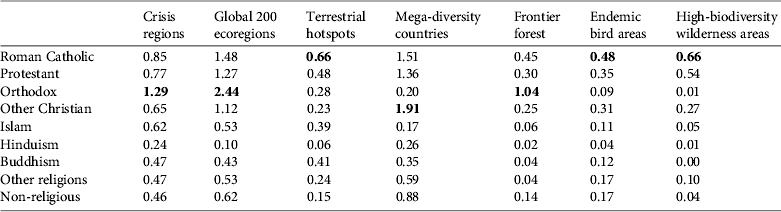
The ‘area-shares’ of biodiversity templates by different religions, calculated per capita, are presented in Table 1. This analysis indicates that Roman Catholic and Orthodox Christian dominated areas have on average the highest biodiversity template area per capita (0.66–1.51 ha per capita for Roman Catholics and 0.01–2.44 ha per capita for Orthodox Christians). The Orthodox Church has proportionally the highest per capita area for three biodiversity templates: crisis regions, Global 200 ecoregions and frontier forests. This is because large areas of these templates are located in the Russian Federation, which has a high percentage (79%) of Orthodox Christians. Similarly, the category ‘other Christians’ has proportionally the highest per capita area in the case of the megadiversity countries template because of the relatively low human population density in Australia and the USA, two large countries with a high proportion of Christians not linked to the Roman Catholic, major Protestant or Orthodox denominations. The major factor driving this pattern is therefore human population density, which is usually low in countries dominated by Christianity (just over 20 persons km−2 on average), high in countries dominated by Buddhism (> 120 persons km−2 on average) and very high in countries dominated by Hinduism (> 300 persons km−2 on average).
The areas of global biodiversity conservation templates that overlap with different religions, expressed as the number of hectares per capita human population. The highest figures in each template are in bold.
Discussion
Our analysis indicates that the majority of areas identified as the most important for global terrestrial biodiversity are situated in countries that are to a large degree dominated by Christianity, and more specifically Catholicism and Orthodoxy. This pattern is the result of a multitude of factors that we did not study, including the unequal distribution of biodiversity, the trajectory of the development of human societies in different parts of the world and their environmental footprint, and the way different religions have spread across the world. In addition, large countries dominated by Christianity have lower population densities and hence a generally greater fraction of any biodiversity template per person. Note that we do not claim that there is any causal relationship between the presence of areas important for biodiversity and particular religions.
We acknowledge that using data from the World Religion Database has its limitations. Firstly, the data provided on the country level are unable to take into account the issue of unequal spatial distribution of adherents of particular religions within a country. Secondly, some religious trends may not be apparent (e.g. people in Latin America turning towards apostolic and Pentecostal Christian denominations that are not institutionally organized and thus may not be reflected in the database). Other issues not included in our analysis include the different degrees of adherence, the power of various religions to influence the political process, and the role of religious leaders. Bearing in mind these limitations and also recognizing that our study indicates only a spatial relationship between different religions and the biodiversity templates, we treat our findings as a crude measure of the per capita conservation opportunity for each major religion.
The spatial resolution of our analysis is coarse and unequal because countries differ in area and religious adherence varies within countries. For example, a few large countries with relatively sparse human populations holding large areas of high biodiversity value (e.g. Canada, USA, Russia and Australia) weight results concerning some templates. Nevertheless, the governance of natural resources, including biodiversity, is to a large degree affected by the attitudes of all citizens (Rauschmayer et al., Reference Rauschmayer, Paavola and Wittmer2009) and conservation policies are in most cases implemented nationally (Knill & Lenschow, Reference Knill and Lenschow1998). Thus, we believe that our results may be useful to broaden the scope of the debate concerning the potential of religions to become involved in biodiversity conservation.
The debate on the role of religions in conservation is not new (e.g. Posey, Reference Posey2000) and many religions have already been involved in some conservation action (Bhagwat & Palmer, Reference Bhagwat and Palmer2009; Mangunjaya, Reference Mangunjaya2011). However, a greater involvement of religious communities in the conservation discourse, and a greater inclusion of conservation issues in religious ethics, could be beneficial for biodiversity. The fact that stewardship and conservation are closely related concepts offers hope for mutual progress. This potential should not be overlooked by the scientific community and other stakeholders seeking new ways to engage societies in conservation.
Amongst the various religions the Roman Catholic and Orthodox Churches have the greatest potential to support biodiversity conservation, as they are the dominant religions in areas important for global biodiversity. In the case of the Roman Catholic Church this potential may be assisted by the fact that it is centralized and thus moral guidance from its leaders could influence many people. Other religions are also important in the biodiversity conservation discourse, particularly within specific regions, such as Islam in Indonesia. A finer-scale analysis of the spatial distribution of religious adherents along with assessment of socio-ethical issues (e.g. the ability of a religion to influence political processes or the role of religious leaders in society) is needed to reveal the potential of religions in influencing pro-environment behaviour in areas of priority for biodiversity conservation. However, the practical issue is how to grasp the opportunity to involve religions in discourse about biodiversity conservation. We believe that the conservation community, including researchers, should be more active in finding good arguments to engage religions in biodiversity conservation. The results of our analysis may be one such argument.
Acknowledgements
We thank BirdLife International for their permission to use the EBA dataset, Kyle Van Houtan and an anonymous referee for constructive comments, Takuya Iwamura for his remarks on the topic of this paper and help with acquiring the data, and Kerry L. Nicholson for help with the figures. This study was funded by the Swedish University of Agricultural Sciences (GM and MB), the Australian Research Council, and the National Environmental Research Programme (HP).
Biographical sketches
Grzegorz Mikusiński is interested in biodiversity conservation at different spatial scales, in Sweden and worldwide. His particular attention is directed towards forest environments and their bird fauna. Hugh Possingham is the director of two national research centres in environmental decision-making. He is interested in formulating and solving problems in nature conservation, using tools from applied mathematics, economics and statistics. Malgorzata Blicharska works with biodiversity policy implementation, public participation in environmental decision-making, conservation conflicts, ecosystem services and spatial planning for conservation.



