




No CrossRef data available.
Article contents
Role of tempering cooling rate on impact toughness of 2CrMoV weld metal
Published online by Cambridge University Press: 23 March 2020
Abstract
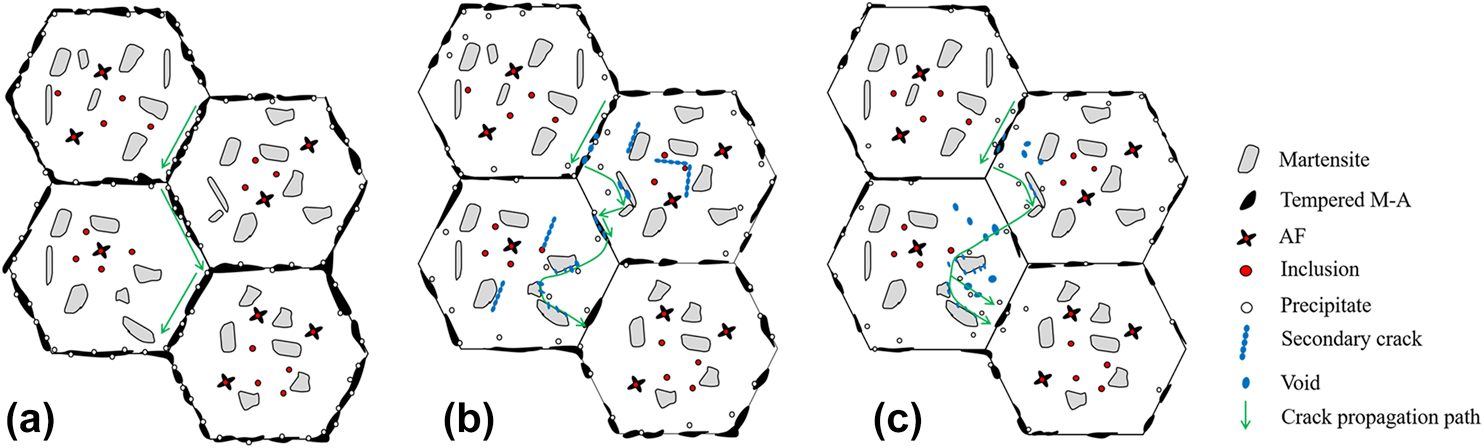
Tempering cooling rate plays a significant role in the impact toughness of 2CrMoV weld metal. Three different tempering cooling rate experiments were carried out; it is found that the impact toughness of weld metal improved from 44.61 to 117.49 J as the cooling rate increased from 5 to 40 °C/h. Microstructure characterization revealed that the large blocky M–A constituents and cluster precipitation were considered to act as stress concentration sources and cleavage fracture initiators at a cooling rate of 5 °C/h. Under the cooling rate of 20 °C/h, the decrease of blocky M–A constituents as well as homogeneous distribution of precipitation induced the transition from cleavage to interfacial decohesion. The chance of crack propagation in intragranular ferrite matrix was increased, which needed to absorb more energy and improve impact toughness. When the tempering cooling rate reached at 40 °C/h, the cracks mainly propagated in the ferrite matrix; meanwhile, fine and homogeneous distribution of precipitation greatly inhibited crack propagation and led to higher impact toughness.
Information
- Type
- Novel Synthesis and Processing of Metals
- Information
- Copyright
- Copyright © Materials Research Society 2020
References
Lin, R., Cui, H., Lu, F., Huo, X., and Wang, P.: Study on the microstructure and toughness of dissimilarly welded joints of advanced 9Cr/CrMoV. J. Mater. Res. 31, 3597 (2016).CrossRefGoogle Scholar
Guo, Q., Lu, F., Liu, X., Yang, R., Cui, H., and Gao, Y.: Correlation of microstructure and fracture toughness of advanced 9Cr/CrMoV dissimilarly welded joint. Mater. Sci. Eng., A 638, 240 (2015).10.1016/j.msea.2015.04.011Google Scholar
Tan, L., Zhang, J., Zhuang, D., and Liu, C.: Influences of lumped passes on welding residual stress of a thick-walled nuclear rotor steel pipe by multipass narrow gap welding. Nucl. Eng. Des. 273, 47 (2014).10.1016/j.nucengdes.2014.01.024CrossRefGoogle Scholar
Kosman, W.: Thermal analysis of cooled supercritical steam turbine constituents. Energy 35, 1181 (2010).CrossRefGoogle Scholar
Kosman, W., Roskosz, M., and Nawrat, K.: Thermal elongations in steam turbines with welded rotors made of advanced materials at supercritical steam parameters. Appl. Therm. Eng. 29, 3386 (2009).10.1016/j.applthermaleng.2009.05.016CrossRefGoogle Scholar
Liu, P., Lu, F., Liu, X., Ji, H., and Gao, Y.: Study on fatigue property and microstructure characteristics of welded nuclear power rotor with heavy section. J. Alloys Compd. 584, 430 (2014).10.1016/j.jallcom.2013.09.048CrossRefGoogle Scholar
Chen, R., Gu, J., Han, L., and Pan, J.S.: Novel process to refine grain size of NiCrMoV steel. Mater. Sci. Technol. 28, 773 (2012).10.1179/1743284711Y.0000000025CrossRefGoogle Scholar
Tan, L., Zhang, L., Zhang, J., and Zhuang, D.: Effect of geometric construction on residual stress distribution in designing a nuclear rotor joined by multipass narrow gap welding. Fusion Eng. Des. 89, 456 (2014).CrossRefGoogle Scholar
Meng, D., Lu, F., Cui, H., Ding, Y., Tang, X., and Huo, X.: Investigation on creep behavior of welded joint of advanced 9% Cr steels. J. Mater. Res. 30, 197 (2015).10.1557/jmr.2014.366CrossRefGoogle Scholar
Shao, C., Lu, F., Li, Z., Cai, Y., Wang, P., and Ding, Y.: Role of stress in the high cycle fatigue behavior of advanced 9Cr/CrMoV dissimilarly welded joint. J. Mater. Res. 31, 292 (2016).CrossRefGoogle Scholar
Ma, L., Han, J., Shen, J., and Hu, S.: Effects of microalloying and heat-treatment temperature on the toughness of 26Cr–3.5 Mo super ferritic stainless steels. Acta Metall. Sin. (Engl. Lett.) 27, 407 (2014).10.1007/s40195-014-0070-2CrossRefGoogle Scholar
Li, Z., Tian, L., Jia, B., and Li, S.: A new method to study the effect of M–A constituent on impact toughness of IC HAZ in Q690 steel. J. Mater. Res. 30, 1973 (2015).10.1557/jmr.2015.154CrossRefGoogle Scholar
Haghdadi, N., Cizek, P., Hodgson, P., and Beladi, H.: Microstructure dependence of impact toughness in duplex stainless steels. Mater. Sci. Eng., A 745, 369 (2019).10.1016/j.msea.2018.12.117CrossRefGoogle Scholar
Sridhar, R., Ramkumar, K.D., and Arivazhagan, N.: Characterization of microstructure, strength, and toughness of dissimilar weldments of Inconel 625 and duplex stainless steel SAF 2205. Acta Metall. Sin. (Engl. Lett.) 27, 1018 (2014).CrossRefGoogle Scholar
Lu, F., Liu, X., Wang, P., Wu, Q., Cui, H., and Huo, X.: Microstructural characterization and wide temperature range mechanical properties of NiCrMoV steel welded joint with heavy section. J. Mater. Res. 30, 2108 (2015).CrossRefGoogle Scholar
Salemi, A. and Abdollah-Zadeh, A.: The effect of tempering temperature on the mechanical properties and fracture morphology of a NiCrMoV steel. Mater. Charact. 59, 484 (2008).CrossRefGoogle Scholar
Wittig, J.E. and Sinclair, R.: Carbide evolution in temper embrittled NiCrMoV bainitic steel. Steel Res. Int. 75, 47 (2004).10.1002/srin.200405926CrossRefGoogle Scholar
Liu, X., Cai, Z., Deng, X., and Lu, F.: Investigation on the weakest zone in toughness of 9Cr/NiCrMoV dissimilar welded joint and its enhancement. J. Mater. Res. 32, 1 (2017).10.1557/jmr.2017.222CrossRefGoogle Scholar
Li, Y., Cai, Z., Li, K., Pan, J., Liu, X., Sun, L., and Wang, P.: Investigation of local brittle zone in multipass welded joint of NiCrMoV steel with heavy section. J. Mater. Res. 33, 923 (2018).10.1557/jmr.2017.467CrossRefGoogle Scholar
Kim, B., Lee, S., Kim, N., and Lee, D.: Microstructure and local brittle zone phenomena in high-strength low-alloy steel welds. Metall. Trans. A 22, 139 (1991).10.1007/BF03350956CrossRefGoogle Scholar
Di, X., An, X., Cheng, F., Wang, D., Guo, X., and Xue, Z.: Effect of martensite–austenite constituent on toughness of simulated inter-critically reheated coarse-grained heat-affected zone in X70 pipeline steel. Sci. Technol. Weld. Join. 21, 366 (2016).CrossRefGoogle Scholar
Zhang, J., Li, C.S., Li, B.Z., Li, Z.X., and Pang, X.D.: Effect of cooling rate on microstructure and mechanical properties of 20CrNi2MoV steel. Acta Metall. Sin. (Engl. Lett.) 29, 353 (2016).10.1007/s40195-016-0392-3CrossRefGoogle Scholar
Li, Y. and Baker, T.: Effect of morphology of martensite–austenite phase on fracture of weld heat affected zone in vanadium and niobium microalloyed steels. Mater. Sci. Technol. 26, 1029 (2010).CrossRefGoogle Scholar
Matsuda, F., Fukada, Y., Okada, H., Shiga, C., Ikeuchi, K., Horii, Y., Shiwaku, T., and Suzuki, S.: Review of mechanical and metallurgical investigations of martensite-austenite constituent in welded joints in Japan. Weld. World 3, 134 (1996).Google Scholar
Okada, H., Ikeuchi, K., Matsuda, F., and Hrivnak, I.: Effects of M–A constituent on fracture behaviour of weld HAZs: Deterioration and improvement of HAZ toughness in 780 and 980 MPa class HSLA steels welded with high heat input (5th report). Weld. Int. 9, 621 (1995).CrossRefGoogle Scholar
Guo, X., Zhao, L., Liu, X., and Lu, F.: Investigation on the resistance to fatigue crack growth for weld metals with different Ti addition in near-threshold regime. Int. J. Fatigue 120, 1 (2019).CrossRefGoogle Scholar
Chu, T., Nuli, Y., Cui, H., and Lu, F.: Pitting behavior of welded joint and the role of carbon ring in improving corrosion resistance. Mater. Des. 183, 108120 (2019).CrossRefGoogle Scholar
Lanzillotto, C. and Pickering, F.: Structure–property relationships in dual-phase steels. Met. Sci. 16, 371 (1982).Google Scholar
Chen, J., Kikuta, Y., Araki, T., Yoneda, M., and Matsuda, Y.: Micro-fracture behaviour induced by MA constituent (Island Martensite) in simulated welding heat affected zone of HT80 high strength low alloyed steel. Acta Metall. 32, 1779 (1984).CrossRefGoogle Scholar