




1. Introduction
For deaf and hard-of-hearing (DHH) children acquiring spoken language, certain phonemes, particularly the fricatives /s/ and /z/, may be challenging to perceive even when hearing is remediated by hearing aids (HAs) or cochlear implants (CIs) (Bouton et al., Reference Bouton, Serniclaes, Bertoncini and Colé2012; Giezen et al., Reference Giezen, Escudero and Baker2010; Pittman et al., Reference Pittman, Stelmachowicz, Lewis and Hoover2003; Stelmachowicz et al., Reference Stelmachowicz, Pittman, Hoover, Lewis and Moeller2004). Consequently, DHH children may have difficulty acquiring a robust mental representation of the rules of English plural morphophonology. DHH preschoolers lag behind normal hearing (NH) peers in plural comprehension and production and show a different acquisition trajectory for the plural allomorphs. DHH children’s underlying representation of the plural may therefore differ from children with NH, even if production and comprehension are accurate. This study uses novel-word stimuli to examine plural comprehension and production in DHH children to determine whether their unique developmental trajectory leads them to a productive knowledge of the morphophonological rules of the English plural by primary-school age.
When acquiring the plural, children must learn the morphophonological alternations required to produce the correct surface form. The English plural morpheme has three surface forms (allomorphs) appearing in different phonemic environments: /-s/ as in cats /kæt-s/ following voiceless segments, /-z/ as in dogs /dɔɡ-z/ following voiced segments, and /-əz/ as in horses /ho:s-əz/ following sibilant segments. Acquisition of these plural allomorphs follows a developmental trajectory: Typically developing children comprehend the /-s/ allomorph by age 2, followed by /-z/ and /-əz/ by age 3 (Davies et al., Reference Davies, Xu Rattanasone and Demuth2017, Reference Davies, Xu Rattanasone, Schembri and Demuth2019, Reference Davies, Xu Rattanasone and Demuth2020b; Kouider et al., Reference Kouider, Halberda, Wood and Carey2006). Production of the three allomorphs also proceeds sequentially, with the segmental plural /-z/ produced reliably on real words by 2 years, while syllabic /-əz/ is more reliably produced by 3 years (Mealings et al., Reference Mealings, Cox and Demuth2013).
Plural comprehension thus entails not only recognising when a noun is plural, but also when it is not, since nouns such as bus or quiz are singular, even though they end with /s/ or /z/. Children must therefore rely on their knowledge of the phonotactic properties of English to disambiguate new words. For example, the novel form kos /kɔs/, with a short vowel, must be singular despite ending in /s/: The noun stem /kɔ/ would violate the minimal word constraint of English (i.e., in English, words must end in a final [coda] consonant or a long/tense vowel [Demuth et al., Reference Demuth, Culbertson and Alter2006]). Therefore, distinguishing novel singulars from plurals relies not only on a morphological rule, but also awareness of the phonotactic rules of English. Typically developing children learn that the absence of the plural morpheme signals the singular from 3 to 4 years of age (Davies et al., Reference Davies, Xu Rattanasone, Schembri and Demuth2019, Reference Davies, Xu Rattanasone and Demuth2020b).
DHH preschoolers using HAs and/or CIs are less accurate than NH peers at comprehending and producing English plurals. In comprehension, 3- to 6-year-olds with bilateral hearing loss (HL; using HAs, CIs, or bimodal devices [one HA, one CI]) performed at chance in identifying whether a novel referent was singular or plural, while their NH peers performed significantly above chance (Davies et al., Reference Davies, Xu Rattanasone, Davis and Demuth2020a). Even 3- to 5-year-olds with unilateral HL performed above chance only for novel singulars, and at chance for plurals (Davies et al., Reference Davies, Xu Rattanasone, Davis and Demuth2021). DHH children also acquire the plural allomorphs in a different order to NH peers, with a trend towards acquisition of /-əz/ prior to /-s, -z/ (Davies et al., Reference Davies, Xu Rattanasone, Davis and Demuth2020a). This may be due to the relative perceptual salience of the allomorphs: /-əz/, while infrequent, is more perceptually salient as a full syllable, and thus may be easier for DHH children to perceive than the plural segments /-s/ and /-z/. DHH children also differ from their NH peers by developing an understanding of the singular prior to the plural (Davies et al., Reference Davies, Xu Rattanasone, Davis and Demuth2021). Plural comprehension difficulties have also been found for German-speaking 5- to 11-year-old CI users (Grandon et al., Reference Grandon, Schlechtweg and Ruigendijk2024).
Five- to 8-year-olds with moderate HL using HAs produce plurals less accurately than NH peers (McGuckian & Henry, Reference McGuckian and Henry2007), as do 3- to 5-year-olds using HAs and/or CIs (Werfel, Reference Werfel2018). Three-year-olds with mild to severe HL using HAs, especially those with poor articulation skills, produce /-əz/ more accurately than /-s/ or /-z/ (Koehlinger et al., Reference Koehlinger, Owen Van Horne, Oleson, McCreery and Moeller2015). Four- to 5-year-old Dutch- and German-speaking CI users were also significantly more likely than NH peers to produce singulars in place of plurals in a wug task (Laaha et al., Reference Laaha, Blineder and Gillis2015). DHH children therefore differ from children with NH in both perception and production of plural morphology, possibly due to the relative inaccessibility of the plural morpheme and complexity associated with applying both morphological and phonological rules simultaneously.
Perception of /s/ and /z/ can be challenging for DHH children using HAs and/or CIs because these high-frequency sounds (>2000 Hz) are not transmitted well by hearing devices (Bouton et al., Reference Bouton, Serniclaes, Bertoncini and Colé2012; Giezen et al., Reference Giezen, Escudero and Baker2010; Pittman et al., Reference Pittman, Stelmachowicz, Lewis and Hoover2003; Stelmachowicz et al., Reference Stelmachowicz, Pittman, Hoover, Lewis and Moeller2004). Therefore, DHH children may not receive the input they require to acquire the morphophonological rules of the plural. Indeed, children with poorer hearing at high frequencies were least accurate on a plural comprehension task using familiar words with segmental plural allomorphs (Stelmachowicz et al., Reference Stelmachowicz, Pittman, Hoover and Lewis2002). Further, acquiring morphemes with multiple allomorphs may be particularly challenging for DHH children: DHH children have difficulty producing verbal morphology (Boons et al., Reference Boons, De Raeve, Langereis, Peeraer, Wouters and van Wieringen2013; Tomblin et al., Reference Tomblin, Harrison, Ambrose, Walker, Oleson and Moeller2015), particularly tense marking and subject–verb agreement (Guo et al., Reference Guo, Spencer and Tomblin2013; Moeller et al., Reference Moeller, McCleary, Putman, Tyler-Krings, Hoover and Stelmachowicz2010; Penke et al., Reference Penke, Wimmer, Hennies, Hess and Rothweiler2016; Penke & Rothweiler, Reference Penke and Rothweiler2018; Werfel, Reference Werfel2018). In English, these, like the plural, require application of both morphological and phonological rules. In contrast, DHH children perform more like NH peers on morphemes without allomorphic variation according to verb stem, e.g., present progressive -ing (Bowdrie et al., Reference Bowdrie, Holt, Blank and Wagner2022; Werfel, Reference Werfel2018).
DHH children may continue to improve in their comprehension of the plural with increasing age (Davies et al., Reference Davies, Xu Rattanasone, Davis and Demuth2020a, Davies et al., Reference Davies, Xu Rattanasone, Davis and Demuth2021). Greater experience with plural morphology accumulated over time, targeted speech therapy, and scaffolding through literacy in the primary-school years may allow DHH children to catch up to their NH peers. However, as DHH children show a different developmental trajectory for English plural morphology to NH peers, this raises the question of whether their representation of plural morphology also differs. Do DHH children acquire the morphophonological rules underlying plural formation like NH peers? Can they apply these rules productively with new/novel words?
The current study therefore examined comprehension and production of plural morphology in older, school-aged DHH children. Five- to 9-year-old DHH children and NH peers completed a two-alternative forced choice task to assess comprehension and a wug task (Berko, Reference Berko1958) to assess production. Both used novel words to target productive knowledge of morphophonological rules. We hypothesised that DHH children may still experience some difficulty with plural comprehension and production relative to NH peers, particularly for the less perceptually salient segmental allomorphs /-s/ and /-z/ relative to syllabic /-əz/.
Vocabulary size has also been implicated in the acquisition of English plural morphology: NH 2-year-olds with larger vocabularies comprehend the /-s/ plural allomorph more accurately than those with smaller vocabularies (Davies et al., Reference Davies, Xu Rattanasone and Demuth2017). As children learn more words, they are not only exposed to more instances of plural morphology but also to plural morphemes in a greater variety of phonological contexts. This contextual variability may support learning of the morphological rule for the plural and the phonological contexts in which the various allomorphs occur. Thus, understanding of the plural may continue to develop as children’s vocabularies expand. We therefore investigated whether plural comprehension and production accuracy were related to vocabulary size in DHH primary-schoolers. We expected those with larger vocabularies might perform better than those with smaller vocabularies.
2. Methods
Two experimental tasks were presented as an online game on participants’ home computers via Gorilla Experiment Builder (Anwyl-Irvine et al., Reference Anwyl-Irvine, Massonnié, Flitton, Kirkham and Evershed2020). Participants wore their usual hearing device(s) (if any) and listened to stimuli through speakers. Participants were instructed to adjust their audio volume to a comfortable, clearly audible level prior to the experiment. Vocabulary was measured using the Peabody Picture Vocabulary Test, 4th edition (PPVT-4; Dunn, Reference Dunn2018) via a Zoom video call (Zoom Video Communications, 2020). Pictures were presented on the QGlobal platform (Pearson Clinical Assessment, 2012) and words were spoken live by a native English speaker. Parental consent was obtained, and procedures were approved by the Macquarie University Human Research Ethics Committee (Approval #5201952179167).
2.1. Experiment 1: Comprehension
2.1.1. Participants
Participants included 30 5- to 9-year-old Australian English-speaking DHH children (13 girls, 17 boys). Eighteen had bilateral HL (HAs = 5, CIs = 12, bimodal = 1) and 12 had unilateral HL (HA = 7, CI = 2, none = 3; Table 1). Thirty-one Australian English-speaking children with NH (15 girls, 16 boys) also participated. Although the groups did not significantly differ in chronological age (MDHH = 7;5, range 5;6–9;0; MNH = 7;1, range 5;6–8;9; t(59) = -1.32, p > .05), participants with NH had significantly larger vocabularies (PPVT-4 raw scores: MDHH = 127; MNH = 138; t(51.92) = 2.08, p = .04).
Characteristics of participants with HL

Abbreviations: F = female, M = male, HA = hearing aid, CI = cochlear implant, ANSD = auditory neuropathy spectrum disorder.
a Conductive losses are permanent (e.g., atresia).
b Fitted with HAs but does not typically use them.
c Intermittent wax and fluid build-up necessitates occasional HA use in contralateral ear.
2.1.2. Stimuli
The two-alternative forced choice perception task included 24 test trials, 7 fillers, and 5 training trials. Visual stimuli for test trials consisted of 24 pairs of cartoon drawings showing novel animals and objects. In each pair, one picture depicted five identical animals/objects (the “plural picture”), while the other depicted a single different animal/object (the “singular picture”; Figure 1). Each picture pair was matched for animacy and approximate surface area (i.e., the number of pixels in the five animals/objects of the plural picture combined was roughly equivalent to the pixels in the singular picture). Picture pairs were counterbalanced for orientation (half with plural picture on the left and half on the right) and target side (half the plural pictures on each side were targets and half were distractors, and the same for singular pictures). Across four lists, each picture occurred once as a plural target, once as a plural distractor, once as a singular target, and once as a singular distractor.
Example visual stimuli for comprehension task trials: 1. Training trial, 2. Filler trial, 3. Test trial (animals), 4. Test trial (objects).

Visual stimuli for fillers consisted of seven pairs of cartoon drawings of real animals/objects, each containing a singular and plural picture. Visual stimuli for training trials consisted of five pairs of single cartoon drawings (real and novel animals/items).
Auditory stimuli for test trials consisted of 24 novel CVC words. Half ended in a bilabial stop (/p/ or /b/), inflected with the segmental plural allomorph /-s/ or /-z/, respectively (e.g., tep/teps, pab/pabs). The remainder ended in an alveolar fricative (/s/ or /z/), inflected with the syllabic plural allomorph /-əz/ (e.g., koss/kosses). Auditory stimuli for fillers and training trials consisted of CVC words where the target was a novel or real animal/item.
A female native speaker of Australian English produced the singular and plural form of each target word. To control for phonetic variation, one instance of each plural allomorph was selected and spliced onto each plural item in Praat (Boersma & Weenink, Reference Boersma and Weenink2016). Every plural was always presented with its appropriate allomorph. Each plural and singular target word was spliced into the carrier phrase “Find the [target]”. The stimuli were recorded and edited as uncompressed audio files (pcm_s16le; 48kHz) and were converted to mp3 (mono; 130 kb/s; 48kHz) for compatibility with Gorilla. Each participant heard each novel word only once, as either a plural or a singular. Across the four counterbalanced lists, each word was presented as a plural twice and a singular twice.
2.1.3. Procedure
In each trial, the two pictures of the pair were presented either side of a “play” button. Participants clicked the button to hear the auditory stimulus, and then clicked on the picture they thought best matched the audio. The audio could be replayed if needed. After picture selection, the experiment progressed to the next trial. Training trials were followed by the test and filler trials in pseudorandomised order.
2.2. Experiment 2: Production
2.2.1. Participants
After the comprehension task, participants completed the production task. Four participants (HL = 3, NH = 1) were excluded due to technical issues with their computer microphone. An additional participant with HL was excluded due to noncompliance. Therefore, participants in Experiment 2 were 26 DHH children (Mage = 7;5, 12 girls, 14 boys; Table 1) and 30 children with NH (Mage = 7;1, 15 girls, 15 boys).
2.2.2. Stimuli
The wug task included 24 test trials and 5 training trials. Visual stimuli consisted of cartoon pictures of 24 novel and 5 real animals/objects. Pictures were displayed one at a time, and participants saw both plural and singular pictures of each animal/object.
The auditory stimuli for the wug test trials consisted of a new set of 24 novel words. Eight CVC words ended in a voiceless stop (/p/ or /k/), taking the plural allomorph /-s/ (e.g., gip/gips, nuck/nucks), eight CVC(V) words ended in a voiced stop (/b/ or /g/) or schwa, taking the plural allomorph /-z/ (e.g., neb/nebs, terga/tergas), and eight CVC(C) words ended in /s/, taking the plural allomorph /-əz/ (e.g., tass/tasses, gox/goxes). Auditory stimuli for the training trials consisted of five real CVC(C) words. Each word was produced in both plural and singular forms by a female native speaker of Australian English and were spliced into the following carrier phrases.
Stimuli in the plural-eliciting trials had the form:
-
(a) “This is a [singular word]. Can you say [singular word]?”
-
(a) “If that was a [singular word], what are these?”
Stimuli in the singular-eliciting trials a had the form:
-
(a) “These are some [plural word]. Can you say [plural word]?”
-
(b) “If those were some [plural word], what is this?”
A singular- and plural-eliciting trial was created for each novel word (48 stimuli), with participants receiving half of each (24 trials).
2.2.3. Procedure
Each trial consisted of a practice phase and an elicitation phase. In the practice phase, a picture was presented with part (a) of the auditory stimulus (the pictured matched the auditory stimulus in number [singular or plural]). The auditory stimulus asked participants to imitate the target word, to increase their familiarity with it. After four seconds, the trial progressed to the elicitation phase, where the picture with the other number condition was shown and the auditory stimulus (b) asked for the corresponding singular or plural form of the word. After five seconds the next trial began. Productions were recorded by participants’ computer microphone. Trials were presented in four blocks, each beginning with a training trial, followed by six test trials in pseudorandomised order.
3. Analysis and results
All statistical analyses were performed in R (R Core Team, 2024).
3.1. Experiment 1: Comprehension
To assess the plural comprehension abilities of DHH children compared to their NH peers, comprehension task responses were coded as correct or incorrect and entered into a binomial generalised linear mixed-effects model. The model included fixed factors Group (DHH vs. NH), Number (plural vs. singular), and Allomorph (segmental /-s, -z/ vs. syllabic /-əz/), using reverse Helmert coding, and a maximal random effect structure that converged on the random slopes and intercepts of Participant (by Group) for Number (Bates et al., Reference Bates, Mächler, Bolker and Walker2015).
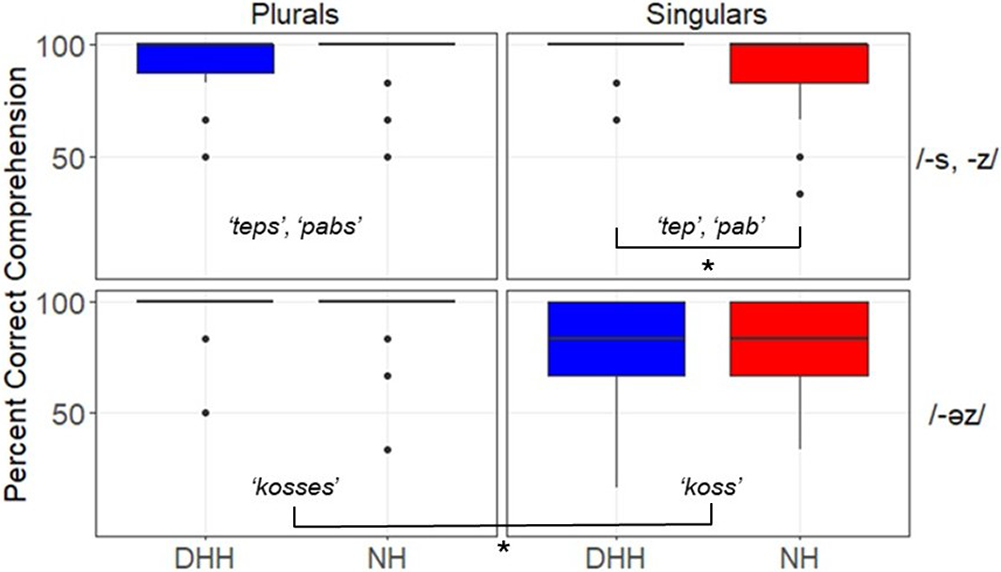
The model revealed significant effects of Number (B = −1.25, SE = 0.36, p < .001) and Allomorph (B = −0.35, SE = 0.13, p = .007) but not Group. These were qualified by significant Number × Allomorph (B = −0.63, SE = 0.13, p < .001) and Group × Number × Allomorph interactions (B = −0.40, SE = 0.13, p = .002; full model output and unilateral vs. bilateral HL comparison in Supplementary Material). Participants were significantly more accurate at comprehending plurals than singulars for sibilant-final stems, and the DHH group was more accurate than the NH group at identifying singular novel words that would take a segmental plural allomorph (e.g., tep, geb; Figure 2).
Boxplots showing accuracy in the comprehension task. Deaf and hard-of-hearing (DHH) children are in blue; children with normal hearing (NH) are in red. Significant interaction effects indicated with asterisks.

Correlations between comprehension accuracy and vocabulary size (PPVT-4 raw scores) were calculated for each group in singular and plural conditions separately. Children with NH with larger vocabularies showed more accurate comprehension in both singular (r(28) = .40, p = .03) and plural trials (r(28) = .48, p = .008)Footnote 1. No significant relationship between accuracy and vocabulary size was found for DHH children for either singular (r(28) = .30, p = .10) or plural trials (r(28) = .16, p = .40).
3.2. Experiment 2: Production
Children’s elicited productions were perceptually coded as correct if plural novel words were produced with the correct plural allomorph and singular novel words were produced by omitting the plural allomorph only. Due to technical challenges of capturing audio online through Gorilla, 60 recordings, or 4% of the 1344 trials, were lost (DHH = 5%, NH = 4%). About 10% of trials from DHH children were re-coded for reliability, with full agreement between coders.
Accuracy was entered into a binomial generalised linear mixed-effects model with fixed factors Group (DHH vs. NH), Number (elicited plural vs. elicited singular), and Allomorph (/-s/ vs. /-z/ vs. /-əz/), using reverse Helmert coding such that the mean of the segmental allomorphs was compared to the syllabic allomorph and the two segmental allomorphs were compared to each other, and a maximal random effects structure converging on the random intercept of Participant (by Group) (Bates et al., Reference Bates, Mächler, Bolker and Walker2015). The model revealed no group differences, but significant effects of Allomorph (segmental vs. syllabic: B = 0.22, SE = 0.07, p < .001; /-s/ vs. /-z/: B = 0.25, SE = 0.10, p = .01), qualified by significant Number × Allomorph interactions (segmental vs. syllabic: B = 0.26, SE = 0.07, p < .001; /-s/ vs. /-z/: B = −0.38, SE = 0.10, p < .001; full model output in Supplementary Material). Pairwise comparisons revealed that participants in both groups were less accurate producing novel words with the /-s/ and /-əz/ plural allomorphs than /-z/ (p < .001 and p = .05, respectively). Participants were less accurate at producing novel singulars by removing the segmental plural allomorphs /-s, -z/ than the syllabic /-əz/ (both ps < .001; Figure 3).
Boxplots showing accuracy in the production task. Deaf and hard-of-hearing (DHH) children are in blue; children with normal hearing (NH) are in red. Significant interaction effects indicated with asterisks.

Correlations between production accuracy and vocabulary size (PPVT-4 raw scores) were calculated as for comprehension. Children with larger vocabularies in both groups showed more accurate production in both plural and singular trials (HL plural: r(21) = .59, p = .003; HL singular: r(22) = .51, p = .01; NH plural: r(19) = .42, p = .05; NH singular: r(19) = .55, p = .01).
4. Discussion
This study investigated the comprehension and production of English plural morphology by DHH primary-school children and their NH peers. In a comprehension task with novel words, both groups had some difficulty determining that singulars with sibilant-final noun stems (e.g., koss) were indeed singular. DHH participants were also more accurate than those with NH in determining that singulars ending in a stop (e.g., tep, geb) were singular. In production, both groups correctly produced novel plurals with the /-z/ allomorph (e.g., gebs) more frequently than the /-s/ or /-əz/ allomorphs (e.g., teps, kosses), and produced singulars ending in a stop (e.g., tep, geb) correctly more often than those with sibilant-final stems (e.g., koss). Both production and comprehension accuracy were correlated with vocabulary size for children with NH, but only production accuracy correlated with vocabulary size for DHH children.
Contrary to expectation, we found no evidence that primary-school children who are DHH (with bi- or unilateral HL) experience difficulties in comprehending or producing plurals relative to NH peers. Their accurate comprehension and production of novel plurals demonstrates the ability to apply both morphological and phonological rules simultaneously by this age. This suggests that DHH children have a similar mental representation of the plural to that of their NH peers, despite challenges with plurals and inflectional morphology more broadly at a younger age (Davies et al., Reference Davies, Xu Rattanasone, Davis and Demuth2020a, Davies et al., Reference Davies, Xu Rattanasone, Davis and Demuth2021; Tomblin et al., Reference Tomblin, Harrison, Ambrose, Walker, Oleson and Moeller2015; Werfel, Reference Werfel2018). We suspect that this improvement with age may be due to increased experience from more years of language exposure, targeted speech therapy, or more overt scaffolding of plural morphology in reading instruction. However, given the near-ceiling performance of both groups, differences may appear on more challenging tasks or with increased statistical power. The only significant difference in performance between DHH children and NH peers was a small but significant effect whereby DHH children outperformed those with NH in comprehending that novel words such as tep and geb were singular. Perhaps children with NH treated these as irregular plural forms (cf. men), decreasing their accuracy.
For both groups of children, we observed allomorphic effects on plural comprehension and production. In comprehension, accuracy was lowest when comprehending sibilant-final singulars, which would take the syllabic allomorph if plural. This likely reflects misinterpretation of the word-final /s/ or /z/ as a plural morpheme, even though the minimal word constraint of English prevents this interpretation. English listeners have less experience with the syllabic allomorph due to its low frequency and late age of acquisition (Berko, Reference Berko1958; Davies et al., Reference Davies, Xu Rattanasone and Demuth2017), perhaps contributing to this finding.
In production, both groups of participants were less accurate at forming novel plurals with the /-s/ and /-əz/ allomorphs than with /-z/. We attribute this to the relative frequency of the allomorphs: /-z/ occurs substantially more frequently than either /-s/ or /-əz/ (Davies et al., Reference Davies, Xu Rattanasone and Demuth2017). Children may gain mastery of this allomorph earlier due to greater exposure in the input and more experience in production. This aligns with the findings of Mealings et al. (Reference Mealings, Cox and Demuth2013), who observed mastery of the /-z/ allomorph in production prior to /-əz/ in 2- to 3-year-olds with NH (the /-s/ allomorph was not examined). Frequency may continue to impact production even at primary-school age.
Both groups were also significantly less accurate when converting plurals with segmental allomorphs to their singular forms compared to the syllabic allomorph. This likely reflects greater ease in removing a full syllable (/-əz/) from the end of the non-word, rather than a single phoneme (/-s, -z/): Children typically master syllable elision earlier than phoneme elision (particularly elision of one constituent of a consonant cluster; Wagner et al., Reference Wagner, Torgesen, Rashotte and Pearson2013). These findings indicate that, for both groups of children, knowledge of the morphophonological contexts conditioning the various plural allomorphs may not be fully acquired by primary-school age.
Vocabulary size predicted the accuracy of children’s production of plural morphology for both groups, but comprehension for children with NH only. This aligns with earlier findings that vocabulary size was correlated with plural comprehension in younger children with NH (Davies et al., Reference Davies, Xu Rattanasone and Demuth2017). Children who know more words are exposed to plural morphology in more varied contexts, facilitating their knowledge of the appropriate phonological contexts for each plural allomorph. Plural production may be more highly correlated with vocabulary size (r = .42–.59) than plural comprehension (r = .16–.48) as production is a more demanding task for children, requiring them to not only understand how plurals are formed but also put this knowledge into practice.
Our results demonstrate that not only for DHH children but also their peers with NH, there is more to learning plural morphology than simply acquiring a morphological rule. The relevant phonological alternations for adultlike realisation of the plural must also be acquired, and this may continue to pose a challenge even at primary-school age and when learning new words. Increased vocabulary size seems to facilitate learning of morphophonology, potentially by increasing learners’ exposure to the plural morpheme in a wider variety of contexts.
This study was subject to some limitations. The (near) ceiling performance of participants across most conditions suggests that the task may have been too easy for this age group (5 to 9 years old). This may have obscured potential differences in performance between DHH and NH participants. The limited number of participants also prevented statistical comparisons between users of different hearing device types (e.g., HAs vs. CIs). A small proportion of the production data was also lost due to recording difficulties in Gorilla or through participants giving inappropriate responses. This data loss would likely be mitigated by conducting the task in the lab rather than online.
Future research may address the applicability of these findings to populations of DHH children outside Australia. Many DHH children in Australia benefit from early, comprehensive, and affordable intervention due to universal newborn hearing screening, subsidised hearing devices, and widely available support from hearing service providers. This may give DHH children in Australia an advantage over those in other countries where the same level of support is not available. If so, this study shows what DHH children can achieve under optimal support conditions.
5. Conclusion
DHH children using HAs or CIs have difficulty with comprehending and producing English plural morphology at preschool age (Davies et al., Reference Davies, Xu Rattanasone, Davis and Demuth2020a, Reference Davies, Xu Rattanasone, Davis and Demuth2021; Koehlinger et al., Reference Koehlinger, Owen Van Horne, Oleson, McCreery and Moeller2015; Werfel, Reference Werfel2018). However, this study found no evidence that these difficulties remain at primary school. Differences in performance between plural allomorphs were found for both DHH children and their peers with NH, suggesting that acquisition of morphophonological alternations may be protracted. Greater experience with plural morphology over time, intervention, and/or scaffolding through reading instruction may allow DHH children to “catch up,” developing productive mental representations of the plural like those of their NH peers. This bodes well for learning new words in school, and learning more generally.
Supplementary material
The supplementary material for this article can be found at http://doi.org/10.1017/S0305000925100202.
Data availability statement
To comply with ethical requirements, data will be made available on request.
Acknowledgements
We thank Katie Neal and Liz Semkoski (The Shepherd Centre), Inge Kaltenbrunn (NextSense), and Alison King (Hearing Australia) for assistance with recruitment and providing access to participant information.
Funding statement
This project was supported by the Australian Research Council, grant LP180100534.
Competing interests
The authors declare none.




 Open access

