


Introduction
The unsustainable exploitation of wildlife, both fauna and flora, is a continuing driver of species loss, threatening vulnerable and irreplaceable ecosystems (McRae et al., Reference McRae, Freeman and Marconi2016; IPBES, Reference Rice, Seixas, Zaccagnini, Bedoya-Gaitán and Valderrama2018), national security and sustainable development (Nellemann et al., Reference Nellemann, Henreiksen, Raxter, Ash and Mrema2014). The global value of the illegal wildlife trade (i.e. illegal hunting, logging, fishing, and trading of wild fauna and flora), although difficult to measure, is estimated to be USD 7–23 billion per annum (Nellemann et al., Reference Nellemann, Henriksen, Kreilhuber, Stewart, Kotsovou and Raxter2016), with 15% of recorded global wildlife seizures originating from Latin America (UNODC, 2016). Within this region, Mesoamerica is the world's third largest biodiversity hotspot (CEPF, 2016) and holds the second largest barrier reef system. Approximately 4,000 species from Mesoamerica are listed under CITES, one-third of all the species listed in Latin America. Despite the biodiversity value of the Mesoamerican region, assessments of the scale of illegal trade in Latin America have focused primarily on South America (UNODC, 2016). Previous analyses of trends in wildlife trade in Mesoamerica have been limited by their reliance on seizure data and legal trade reported under CITES (UNEP-WCMC, 2014), which underrepresent the scale of the trade because of low data availability, poor enforcement and widespread corruption (Goyenechea & Indenbaum, Reference Goyenechea and Indenbaum2015).
Illegal wildlife trade poses a ‘wicked problem’ (Willemsen & Watson, Reference Willemsen, Watson and Moreto2018, p. 256), the tackling of which demands integrated research approaches, for instance those that combine the risk and decision sciences (Gore, Reference Gore2017). Horizon scanning is a risk analysis tool that detects threats and identifies persistent issues and emerging trends (van Rij, Reference van Rij2010). Widely used in the business sector, it was introduced into conservation to forecast global trends of emerging issues (Sutherland et al., Reference Sutherland, Clout, Côté, Daszak, Depledge and Fellman2010) and has been applied to illegal wildlife trade at a global scale (Esmail et al., Reference Esmail, Wintle, ‘t Sas-Rolfes, Athanas, Beale and Bending2019). Horizon scanning as a rapid scoping process can help identify conservation needs and priorities, especially in data-poor contexts, such as in Mesoamerica. In the absence of sufficient data and resources at the required scale and resolution, expert-driven horizon scanning can provide geo-specific and alternative sources of evidence (Adams et al., Reference Adams, Smart and Huff2016). This can act as a first step to help governments, civil society organizations and donors prioritize resources for conservation action, by better understanding threats to biodiversity.
Here we aimed to use horizon scanning to identify emerging trends in threats to wildlife species and opportunities to address illegal wildlife trade in Mesoamerica. We explored patterns and trends in poaching, trafficking and consumer demand for products derived from protected fauna and flora. To minimize potential cognitive biases, we adapted elements of the horizon scanning process of Sutherland et al. (Reference Sutherland, Fleishman, Mascia, Pretty and Rudd2011) with the structured IDEA protocol that Investigates, Discusses, Estimates and Aggregates predictions made by experts (Burgman, Reference Burgman2015; Hemming et al., Reference Hemming, Burgman, Hanea, McBride and Wintle2017). Given the geographical spread of experts to be consulted, we trialled a remote method of group facilitation using an online platform in real time. We conducted this study to meet a research need identified by the Wildlife Conservation Society on the emerging threats to Mesoamerican species.
Study area
The Mesoamerican region is defined as an economic zone (OECD, 2006) and contains the Mesoamerican Biological Corridor (Gamboa, Reference Gamboa2019). It comprises seven Central American countries (Panama, Costa Rica, Nicaragua, Honduras, El Salvador, Guatemala and Belize) and the nine southern-most states of Mexico (Campeche, Chiapas, Guerrero, Oaxaca, Puebla, Quintana Roo, Tabasco, Veracruz and Yucatan). Historically, the region has been exploited by North American, Spanish and British enterprises for its strategic location and natural resources. Of the 6,500 native species assessed in Mesoamerica, > 1,500 are threatened or near threatened with extinction (IUCN, 2018), including flagship species such as the jaguar Panthera onca, quetzals (birds in the family Trogonidae) and marine turtles.
Methods
Stage 1: selecting experts
We used a knowledge resource nomination worksheet (Okoli & Pawlowski, Reference Okoli and Pawlowski2004) to document a variety of institutions with exposure to illegal wildlife trade across Mesoamerica, which provided a clear structure to sample experts purposively. We conducted our search of potential institutions and experts online in English and Spanish, and included information on experts' backgrounds and experience. We created a list of experts who had knowledge of illegal wildlife trade in one or more Mesoamerican countries and access to wider (often unpublished) data from their respective institutions (White, Reference White2009). We contacted these experts by e-mail, using persuasive writing techniques to improve response rates (Grant, Reference Grant2013). We used snowball sampling during initial e-mail contact and telephone interviews to recruit additional experts. Eleven experts took part in the full horizon scanning process (Table 1), which was within the recommended panel size (Okoli & Pawlowski, Reference Okoli and Pawlowski2004). This sampling method was biased towards institutions and experts whose contact details were available online, who were recommended and had a functional e-mail address, but it also enabled a wider geographical reach than face-to-face interviews.
Knowledge resource nomination worksheet (Okoli & Pawlowski, Reference Okoli and Pawlowski2004) showing institutional and geographical representation of experts throughout the horizon scan.
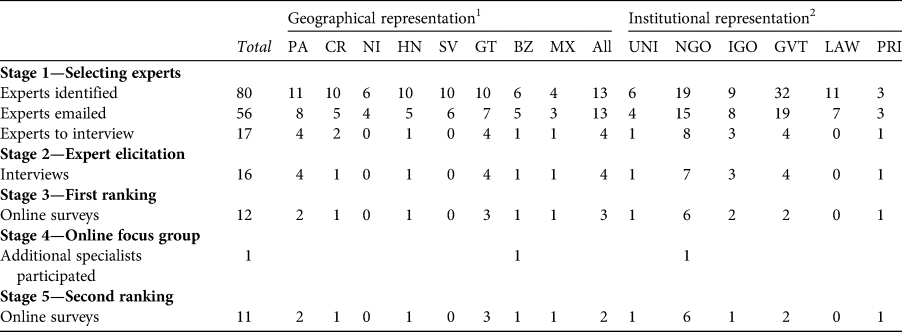
1 UN/LOCODE Codes: PA, Panama; CR, Costa Rica; NI, Nicaragua; HN, Honduras; SV, El Salvador; GT, Guatemala; BZ, Belize; MX, Mexico. Some experts represented more than one country, but were not double counted. Experts with knowledge of IWT across Mesoamerica, but not based in the region are recorded under ‘All’.
2 UNI, academia; NGO, non-governmental organizations; IGO, intergovernmental organization; GVT, government; LAW, law enforcement; PRI, private. Some experts represented more than one institution, but were not double counted.
Stage 2: expert elicitation
We contacted researchers, policy-makers and practitioners from public, private and non-governmental sectors who responded with interest to the e-mail, by telephone. We explained the horizon scanning process to ensure that participants clearly understood each stage (Fig. 1; Burgman, Reference Burgman2015). We then used a structured interview guide with open-ended questions (Sutherland & Woodroof, Reference Sutherland and Woodroof2009) to elicit potential emerging trends in illegal wildlife trade. With the participants’ consent, we recorded and transcribed the responses to these questions. Topics discussed in the interview included threats from poaching and trafficking of wild species, changes in buyer demand, and also opportunities presented to tackle illegal wildlife trade. We phrased the questions carefully to minimize cognitive biases, for example by avoiding ambiguous wording (Sutherland & Burgman, Reference Sutherland and Burgman2015), and used prompts to elicit more detailed information. Experts were encouraged to consult with colleagues post-interview for additional insights. Trends relating directly to political parties were omitted, given that they are prone to change, even though these undoubtedly impact illegal wildlife trade. The facilitator analysed responses using a thematic framework in a spreadsheet (Ritchie & Spencer, Reference Ritchie, Spencer, Bryman and Burgess1994). We identified 26 trends (one was later removed, see Stage 4) and documented each with a short description, using information given during the interviews.
Overview of horizon scanning steps adapted from Sutherland et al. (Reference Sutherland, Fleishman, Mascia, Pretty and Rudd2011) and the IDEA protocol.

Stage 3: first ranking
We developed an online survey using Qualtrics Survey (Qualtrics, Provo, USA) and circulated this by e-mail to experts, asking them to rank the trends identified during the initial telephone interviews. We used closed questions to assess the novelty of each trend (i.e. whether a trend was known or not) and three-point format probability questions (Burgman, Reference Burgman2015) for their plausibility and impact (i.e. their likelihood of being an emerging threat or opportunity). We also used open questions to gather further information and evidence of the suggested trends, to help refine the short descriptions. We asked participants to respond within 2 weeks and sent reminder e-mails (1 week, 2 days and 1 day before the deadline, if they had not replied before then) to improve response rates (Dillman, Reference Dillman2011). We analysed the responses using a statistical mean of the estimates (M. Burgman, pers. comm., 2017). As the total number of trends was low and we had the opportunity to discuss them further in the online focus group, we did not eliminate any trends at this stage.
Stage 4: online focus group
As participants were geographically distant, we held an online focus group using GoToMeeting (LogMeIn, Boston, USA) to discuss and provide a better collective understanding of reasoning behind survey answers (Burgman, Reference Burgman2015). The focus group was coordinated in Spanish and conducted as a typed group discussion in real time, to accommodate experts with poor internet connections and varying abilities to speak and write in Spanish (and in consideration of Belize being an English-speaking country). Although more complex and less direct than a face-to-face focus group, this method enabled remote participation. One specialist who was able to provide additional information on one of the topics was also invited to attend the online focus group. We e-mailed a transcript of the discussions to all participants after the session. Subsequently, a group e-mail chain provided the opportunity to further discuss results (McBride et al., Reference McBride, Garnett, Szabo, Burbidge, Butchart and Christidis2012). In line with the flexible approach of horizon scanning, the study encouraged the continual refinement of the descriptions of the trends through group discussions and individual feedback (Mukherjee et al., Reference Mukherjee, Hugé, Sutherland, McNeill, van Opstal, Dahdouh-Guebas and Koedam2015); as a result, two trends were refined and one eliminated at this stage.
Stage 5: second ranking
We conducted a second online survey to rank trends and again analysed the estimates using the statistical mean. Participants were also given an opportunity to comment on each topic and further develop their descriptions. The entire process from initial contact to the production of final descriptions of trends took place during April–August 2017.
Results
We identified and ranked 15 emerging trends of threats and opportunities across Mesoamerica. We grouped multiple species within trends, because illegally traded species are often substituted with others for the same uses (e.g. as pets, collectables, medicine or food). Identifying such analogue species allowed forecasting of trends to translate more directly into strategies for curbing illegal wildlife trade. Participants acknowledged that, because of the cryptic nature of this illicit trade, some suggested trends were purely anecdotal or potentially isolated cases. This created difficulty in determining whether these were early signs of new trends or simply one-off cases. Although horizon scanning can allow for predictions to be made despite scarce evidence, these uncertainties may have affected the final identified emerging trends.
(1) Criminal groups becoming more professional in wildlife trafficking
Criminal activity in wildlife trafficking is becoming more organized and sophisticated (Pires et al., Reference Pires, Schneider and Herrera2016), and is adapting quickly to emerging markets for wildlife products through globalization. Traffickers increasingly work as criminal syndicates with established networks and transport facilities. Advancements in technologies, such as the internet and mobile devices, open lines of communication for criminals to extend the reach and sophistication of their networks beyond the Americas. The infrastructure and networks used to traffic other illicit goods, for example drugs and livestock, can simultaneously be used for wildlife trafficking.
(2) New unofficial border crossing points being used as pathways for trafficking wildlife within the region
New trafficking pathways across international borders are created by deforestation, construction of new infrastructure, and human population growth, leading to the colonization of previously uninhabited areas near borders. Traffickers use unofficial border crossing points on land and at sea, to circumvent border checks. In this way, wildlife species are moved across borders by traffickers, especially at night, through rivers, forests, human settlements and maritime routes. Further population growth will render these unofficial crossings, and the routes they serve, increasingly accessible.
(3) Digital platforms increasingly used for interaction in Mesoamerica
A notable increase in information about illegal wildlife trade is reaching citizens in Mesoamerica, particularly through platforms such as Facebook, WhatsApp and Twitter. Facebook reports 40 million active users per month across the region (Facebook, 2017). The growing use of these online forums has increased exposure of illegal wildlife trade, providing citizens with the opportunity to report and advocate against wildlife crimes. The challenge will be to use social media to promote more action from citizens and responses from enforcement authorities to address illegal wildlife trade. Conversely, the availability and widespread use of these platforms will probably continue to support the sale of wildlife species through an online black market.
(4) High value tropical timbers face growing levels of exploitation
Timber has been unsustainably exploited throughout Mesoamerica to meet the growing global demand for precious hardwoods for furniture and musical instruments. This high demand promotes a black market for certain tree species. Controls placed on species listed as threatened in the IUCN Red List and/or listed under CITES may have diversified demand to other timber species that could subsequently become threatened. For example, there has been a notable increase in demand for rosewood species (Vaglica, Reference Vaglica2016) such as cocobolo Dalbergia retusa, which has added to existing pressures on hardwood species. An increasingly varied range of timber species may be unsustainably exploited and require protection.
(5) Rare and newly identified species of amphibians and reptiles increasingly targeted by pet traders and collectors
Market demand has continued and increased for New World species, which includes all Mesoamerican reptiles and amphibians. There is high demand for lizards (Abronia spp., Ctenosaura spp., Heloderma spp.) from Guatemala and Mexico, and for frogs and toads (e.g. Dendrobatidae spp., Atelopus spp., Agalychnis spp., Centrolenidae spp.) from Panama and Costa Rica. Newly discovered, rare and restricted-range species are most at risk of extinction (Auliya et al., Reference Auliya, Altherr, Ariano-Sanchez, Baard, Brown and Brown2016) as a result of increasing demand from domestic and international markets (Altherr et al., Reference Altherr, Schuller and Fischer2016). Amphibians and reptiles seized abroad (mainly in the USA and Europe) generally end up in foreign collections and are not returned to their countries of origin. The region is particularly vulnerable to illegal wildlife trade given the large numbers of known species (> 1,200 reptile and amphibian species included in the IUCN Red List, 2018), the limited capacity to implement regulations for the 32 CITES-listed species (CITES, 2019) and the regularity with which new species are discovered.
(6) International demand for wild meat and traditional medicine threatening marine species
There is a growing international demand for products used in Traditional Asian Medicine and as seafood. Marine species that were historically rarely targeted in Mesoamerican waters, such as glass eels and sea cucumbers, are now being harvested unsustainably and illegally, particularly for the Asian market, where these species are highly valued. The fact that closed seasons are not synchronised or established in neighbouring countries, for example in the case of sea cucumbers in Mexico and Belize, makes it difficult to apply controls and opens opportunities for illegal practices. The lack of historical data on the population and harvesting of these species in the region renders monitoring and evaluation, and thus the setting of sustainable catch limits, problematic. Trafficking of such species to Asian countries such as China will probably continue to increase.
(7) Chinese multinational corporations creating more links to Asia
Investment in Mesoamerica from Chinese multinational corporations has increased since the 2000s, but especially in the 2010s, with the construction of roads, airports, railways and other infrastructure. Free trade agreements between Asia and Latin America have grown (Estevadeoral et al., Reference Estevadeoral, Mashahiro and Wignaraja2014) and China has invested USD 250 billion into Latin America and the Caribbean during 2015–2019 (Dollar, Reference Dollar2017). This has resulted in an increase in the movement of goods and people between Mesoamerica and Asia and may create pathways for wildlife trafficking. The increasing population of Chinese nationals within Mesoamerica (Mazza, Reference Mazza2016) is expected to lead to a rise in domestic demand for certain wildlife products.
(8) Increasing demand for birds and small mammals in the pet trade
Birds of the family Psittacidae (parrots, parakeets and macaws) and small mammals maintain strong buyer demand and are increasingly targeted for the illegal pet trade. Trafficking of species within these groups is driven by shifting trends in regional and international markets (i.e. what is considered fashionable at a point in time). Although the level of interest in particular species may vary, the continued high demand for these groups in general, coupled with the decimation of wild populations through other environmental pressures, poses a threat to their survival and requires greater vigilance.
(9) Land clearance increasing access to wildlife species for trade
Deforestation and construction of new infrastructure have increased access to previously isolated wilderness areas within Mesoamerica. The resulting increased proximity of people and wildlife, exacerbated by high rates of human population growth and associated rural and urban expansion, can facilitate access to, and exploitation and transportation of wildlife species. Large-scale agricultural development across the region, such as oil palm in Honduras and Guatemala, sugar cane in Belize and Guatemala, and cattle ranching in Nicaragua, Honduras and Guatemala, amongst others, will probably lead to further land clearance and loss of habitat for many species already facing numerous threats.
(10) Timber traceability evolving at the sawmill level
Timber traceability mechanisms have evolved with a focus upon long-term forest logging concessions, especially those with certifications from, for example, the Forest Stewardship Council. However, tracing timber is problematic when illegally cut from protected areas, extracted under short-term or fraudulent timber licences, or from areas cleared by large-scale agricultural developers. Once at the sawmill, timber from protected species can be mixed with other non-protected species and laundered into the regional and international legal trade. Weak enforcement of laws and regulations, low detection and prosecution rates, and small penalties, provide little deterrent against the harvest of protected species. Timber traceability methods are therefore evolving to address laundering at sawmills.
(11) New trade routes expanding wildlife trafficking pathways internationally
Mesoamerica has expanded its global economic reach to additional markets, with the negotiation of several trade agreements across new regions (World Bank, 2013). These new connections have opened trade routes and potential markets for wildlife products and live trade. The economic growth of destination countries also creates more opportunity to use these trade routes for the trafficking of valuable wildlife species. Although the USA is the largest importer of wildlife from the region (UNEP-WCMC, 2014), it is increasingly being used as a transit route to traffic wildlife species to these new international markets (Goyenechea & Indenbaum, Reference Goyenechea and Indenbaum2015).
(12) Xylotron timber scanner advancing law enforcement capacity
The Xylotron (Hermanson & Wiedenhoeft, Reference Hermanson and Wiedenhoeft2014) is a timber scanner that is being trialled at a national and regional level by the Wood Forensic Laboratories in Guatemala City, Guatemala, and San Pedro Sula, Honduras, for automatically identifying the species of timber samples. This scanner can help tackle illegal logging by providing enforcement agencies with a more accurate method of wood identification and adding to a worldwide species reference database (Koch et al., Reference Koch, Haag, Heinz, Richter and Schmitt2015). Designed at the U.S. Department of Agriculture Forest Product Laboratory, the Xylotron is being tested by several institutions and government agencies in Mesoamerica, with funding and technical support from the U.S. Forest Service.
(13) More accessible technology becoming available to combat wildlife crime
More sophisticated technology has been coming into Mesoamerica, with options to access software on mobile phones and other devices. This exposure to technology facilitates greater use of geospatial tools such as CyberTracker (CyberTracker Conservation, Cape Town, South Africa), ArcGIS (Esri, Redlands, USA) and GPS trackers disguised as wildlife (Baraniuk, Reference Baraniuk2017), which can assist with anti-poaching efforts and commercial timber tracking on the ground. Since Belize piloted the Spatial Monitoring and Reporting Tool in a marine environment for the first time in 2014, this technology is increasingly being adopted across Mesoamerica and has been used in terrestrial and marine sites in Belize, Guatemala, Honduras, Nicaragua, Costa Rica and Mexico.
(14) Smaller wildlife species being targeted by traffickers
Experts have observed an increased demand for smaller wildlife species, presumably facilitated by the fact that these are easier to transport without being detected and harder to identify by law enforcement agencies. Species that have been targeted have included miniature orchids, reptiles, amphibians, spiders and insects for hobbyists, collectors and the pet trade. It is possible that the global trend towards urbanization and associated shift to smaller living spaces has been driving the demand for these smaller species (Reuter & Mosig, Reference Reuter and Mosig2010).
(15) Satellite technology being used to trace illegal logging at the source
As the value of sustainable forest management is being recognized, there has been an increased development of timber traceability systems. The advancement in satellite technology in particular has provided the opportunity to improve monitoring of natural resource use in remote areas. For example, the UK Space Agency awarded a GBP 5.3 million grant to Guatemala in 2017 to develop satellite remote sensing and Global Navigation Satellite Systems for the detection and analysis of forest cover loss (British Embassy Guatemala City, Reference .2017). In addition to providing intelligence for enforcement agencies, this technology could also potentially extend traceability to other commercially exploited wildlife species.
Discussion
We identified 15 priority emerging trends to guide researchers, decision-makers and practitioners working towards addressing illegal wildlife trade in Mesoamerica. Five trends highlight the digital transformation of the region, with technological advancements perceived as both threats and opportunities. For example, increased access to social media and GPS technology (on mobile phones) can provide a useful tool for public engagement in reporting wildlife crime to law enforcers, but can also continue to expand the market reach of wildlife traffickers. Many of the novel emerging trends point to increased access to remote areas (from human population growth, infrastructure development and migration of people from Asia into the region) and greater connectivity within and between Mesoamerican countries. New trading routes with overseas nations have also emerged, notably with China. The increase in trade of marine species not previously exploited in the region, such as sea cucumbers and glass eels, is a significant concern. This may reflect a growth in local demand for these species, but is also likely to be associated with expanding access to global markets. Although not all of these are entirely novel trends, they demonstrate emerging elements in methods used to extract species or in the expansion of consumer markets. The failure to curb these prevailing threats is perceived to stem from a lack of effective regulation, manifesting as inadequate law enforcement, a lack of political will, and widespread corruption across the region (per Cruz, Reference Cruz2015). These drivers intensify pressure on already vulnerable species as new threats emerge.
Not all of these trends apply to every Mesoamerican country, or in equal measure to all of them, because the contexts, scenarios and situations vary amongst countries and local areas. As such, our findings are not a generalization of trends, but an indication of emergent threats and opportunities arising from within the region. Equally, these trends are not all exclusive to Mesoamerica. For instance trend (1), the professionalization of criminal groups in wildlife trafficking, has been observed in other regions and on a global scale. This also applies to trends (2), (3), (7), (8), (10) and (14). The presence of these trends suggests Mesoamerica is facing threats known from other regions, and may experience similar patterns of wildlife trafficking, which further demonstrates the need for more conservation attention in the region. These parallels to other regions also help to build a global evidence base that can complement existing studies, such as the global horizon scan of emerging trends in illegal wildlife trade (Esmail et al., Reference Esmail, Wintle, ‘t Sas-Rolfes, Athanas, Beale and Bending2019), which otherwise focuses primarily on Africa and Asia, where more data are available.
Our findings capture broad trends and provide a rapid assessment of illegal wildlife trade in the region, with scope to further explore the details. The horizon scan is only one tool, and additional methods can be used to further explore the drivers behind the trends identified here, to build a more comprehensive understanding of emerging threats and opportunities across Mesoamerica. The technique presented in this study provides a cost- and time-effective way to collect a snapshot of expert opinion on the illegal wildlife trade and to capture local knowledge that is usually not as well represented in broader exercises. The rapid and adaptable nature of horizon scanning is also a significant advantage over threat assessments (which provide a snapshot in time), given the dynamic nature of illicit activities. Illegal wildlife trade is inevitably difficult to evidence. Where data may otherwise not be published in peer reviewed literature, using expert consultation complemented by grey sources of information can be a valid alternative. Since we conducted the horizon scan, more detailed data have been published on some of these trends, for example on the growing trade in sea cucumbers, birds and small mammals (trends (6) and (8); Reuter et al., Reference Reuter, Kunen and Roberton2018; Rogers et al., Reference Rogers, Hamel, Baker and Mercier2018; UNEP-WCMC, 2019), further demonstrating the validity of this approach.
Horizon scanning can be used as a powerful tool for rapidly forecasting pressures on species and ecosystems resulting from illegal activities, and providing direction for future law enforcement activities. However, it is only as useful as the suggestions made by the participants and to the degree to which it promotes action. An intimate understanding of, and embedding within, the research–implementation spaces of specific contexts in which a horizon scan is being conducted is essential to ensure relevance and effective mainstreaming of outputs (Toomey et al., Reference Toomey, Knight and Barlow2016). Outputs can be used to compel decision- and policy-makers to address threats of immediate and potential concern in Mesoamerica, including National CITES Management and Scientific Authorities, and the Central American Wildlife Enforcement Network. The information generated by this study has started to inform the decision-making of organizations such as the Wildlife Conservation Society in combating illegal wildlife trade.
A regular horizon scan could be conducted at relatively low cost and would be helpful in shaping effective conservation action by directing more proactive rather than reactive decision-making. It could also promote refinement of the technique presented here. Having a geo-specific focus to this method of risk analysis provides information that can guide regional conservation action and policy, and is useful for fostering collaboration between researchers, practitioners and decision-makers. Regular monitoring could also identify areas requiring further complementary research, such as focusing on specific taxa, key communities, new investments and specific purposes (e.g. negotiating environmental components of free trade agreements). In this way it would provide the opportunity to pre-emptively recognize and address emerging pressures on Mesoamerican species and ecosystems. Taking into account the known relationship between wildlife trade and zoonotic emerging infectious diseases, of which the current COVID-19 pandemic is a likely example, the early understanding of emerging trends in wildlife trade is especially relevant for a region with high social vulnerability like Mesoamerica.
Acknowledgements
We thank Mark Burgman, E.J. Milner-Gulland, Ans Vercammen and Timothy Wittig for their guidance and input, the academics, practitioners and government officials who offered their expertise during the initial stages of the horizon scan, Carmen Medina, Juan Carlos Vasquez and Chris Seeley for their participation as experts, the reviewers for their valuable critiques, and the editors for improving the final text.
Author contributions
Study design: SG, AK, JR; data collection and analysis: SG; development of descriptive paragraphs in the Results: SG, AG, AM, AR, CLM, DAS, DLV, JRF, PC; writing: SG, AK, with contributions of all authors to the Discussion.
Conflicts of interest
None.
Ethical standards
This research abided by the Oryx guidelines on ethical standards and was approved by the Department of Life Sciences at Imperial College London (2016-01241241-GLUSZEK-S).


 Open access

