


Introduction
Rapid economic growth drives increasing energy demands (Toman & Jemelkova, Reference Toman and Jemelkova2003). In South-east Asia this demand is being met through the development of hydropower dams on the Mekong River and its tributaries (MRC, 2011), with the inevitable construction of associated high-voltage power transmission lines. Power lines are a well-documented threat to birds globally (e.g. Jenkins et al., Reference Jenkins, Smallie and Diamond2010), with hundreds of millions of birds killed annually through collisions and, to a lesser extent, electrocution (e.g. Rioux et al., Reference Rioux, Savard and Gerick2013; Loss et al., Reference Loss, Will and Marra2014). Collisions have a disproportionate impact on species with high wing-loading and low aspect, whose heavy bodies and small wings restrict rapid reactions to obstacles (Bevanger, Reference Bevanger1998), and species with narrow fields of view in the frontal plane, such as storks, cranes and, in particular, bustards (Martin & Shaw, Reference Martin and Shaw2010).
The Critically Endangered Bengal florican Houbaropsis bengalensis occurs in South-east Asia and the Indian subcontinent; H. bengalensis blandini is the only bustard taxon in South-east Asia, where it is now restricted to the Tonle Sap floodplain, in Cambodia (Collar et al., Reference Collar, Garcia, Sharpe, del Hoyo, Elliott, Sargatal, Christie and de Juana2014). The population declined by an estimated 44–64% between 2005–2007 and 2012, when only 216 (95% CI 156–275) displaying males remained (Packman et al., Reference Packman, Showler, Collar, Virak, Mahood and Handschuh2014), primarily as a result of rapid loss of floodplain grassland (Packman et al., Reference Packman, Gray, Collar, Evans, Van Zalinge and Virak2013). The effects of other potential threats, such as hunting and nest predation by domestic dogs, are unknown. Population trends at Cambodian breeding sites vary, although most are negative (Packman et al., Reference Packman, Showler, Collar, Virak, Mahood and Handschuh2014); the only stable population is in Stoung–Chikraeng Bengal Florican Conservation Area (WCS Cambodia, unpubl. data, 2016). Bengal floricans disperse annually from their breeding grounds as lake levels rise (Gray, Reference Gray2008; Packman, Reference Packman2011), migrating up to 60 km to degraded Dipterocarp forest and farmland (Packman, Reference Packman2011). Outside South-east Asia the nominate subspecies is restricted to an estimated 75–96 individuals in Nepal and fewer than 100 in India (BirdLife International, 2016).
Basic demographic parameters, which are important in the diagnosis of population declines, are poorly known for the Bengal florican. Breeding productivity is unquantified; however, a preliminary estimate based on a limited data set indicated potentially high adult survival (Packman, Reference Packman2011), as is typical for many bustard species (Dolman et al., Reference Dolman, Collar, Scotland and Burnside2015). The planned construction of a power line adjacent to the major breeding concentrations of the Bengal florican could potentially intercept migration routes between these and non-breeding areas, and could pose a serious threat to this species.
In contrast to most other countries in South-east Asia, Cambodia has a relatively low human population density and is still ranked as a Least Developed Country (UN-OHRLLS, 2015), with only c. 250 km of power transmission lines (ADB, 2013). This is set to change over the next few years following the announcement in 2015 of plans for 230 kV power transmission lines running from Battambang to Siem Reap and along the northern edge of the Tonle Sap floodplain (Fig. 1a) through Kampong Thom and Kampong Cham (350 km; hereafter Tonle Sap power line), linking that line at Kampong Thom with the international border with Laos PDR (190 km) and linking Kampong Cham with the Lower Sesan 2 hydropower dam in Stung Treng Province (125 km) (Electricité du Cambodge, 2015a,b; The Cambodia Daily, 2015). The breeding grounds of 81% of the Cambodian Bengal florican population are located in the floodplain immediately to the south or along the route of the proposed Tonle Sap power transmission line (Packman et al., Reference Packman, Showler, Collar, Virak, Mahood and Handschuh2014; Fig. 1a). In common with most countries Cambodian government policy and practice prioritize economic development. Pre- Environmental Impact Assessments (EIA) were conducted for the proposed Tonle Sap and Kampong Thom–Lao PDR power transmission lines (possibly in advance of a full EIA) and were obtained by the authors after submission of the manuscript. Government press releases issued prior to the pre-EIAs made clear the proposed power transmission lines had been approved by the Prime Minister (Electricité du Cambodge, 2015a,b); they are therefore likely to proceed.
Locations of breeding sites of the Bengal florican Houbaropsis bengalensis around Tonle Sap Lake in Cambodia, in an area that contains > 50% of the global population of the species, and the proposed routes for power transmission lines. (b) The movements of 15 Bengal floricans between May 2010 and January 2015 inferred from satellite telemetry data. (c) As in (b) but focused on Stoung–Chikraeng Bengal Florican Conservation Area and associated non-breeding areas.

We provide a baseline estimate of annual survival rates of Cambodia's Bengal floricans prior to the construction of power transmission lines. To assess qualitatively the potential impact of power lines on the Bengal florican we reviewed published and unpublished data on rates of collision between bustards and power lines and examined the location of breeding and non-breeding areas and migration routes in relation to planned transmission routes.
Methods
Mortality rate in the absence of power lines
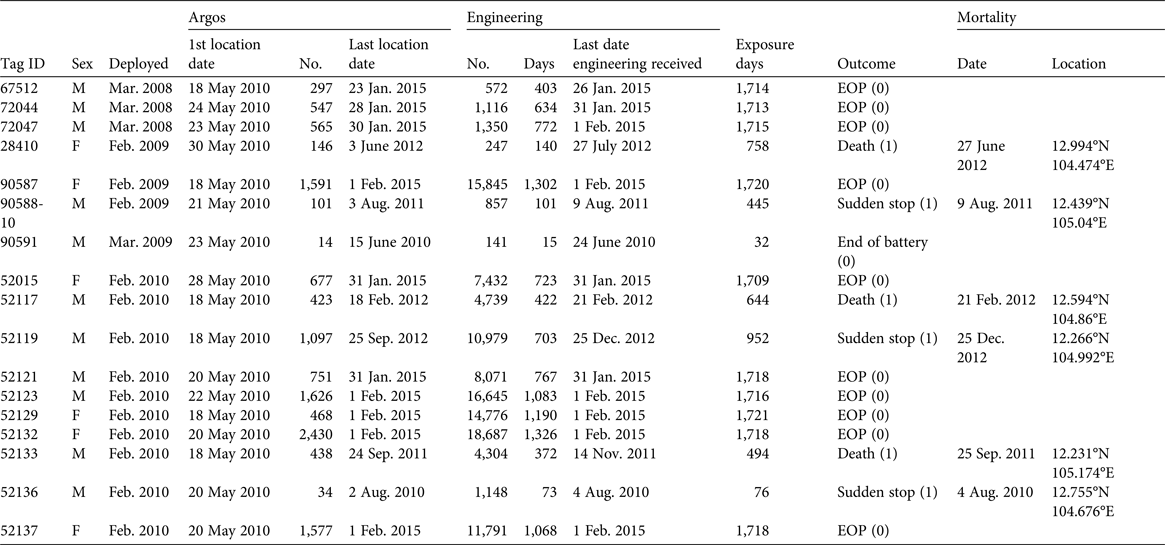
During May 2010–January 2015 11 male (10 adults, 1 subadult) and six female (5 adults, 1 subadult) Bengal floricans were monitored using Argos platform telemetry transmitters (35 g Solar Argos PTT-100 and 45 g Solar Argos/GPS PTT-100 45 g, Microwave Telemetry, Inc., Columbia, USA; 30 g, North Star Science and Technology, King George, USA; Table 1). This sample represented c. 4% of the 2012 adult population of Bengal floricans in Cambodia (assuming an approximate 1 : 1 sex ratio). All transmitters had an expected transmission lifespan of c. 3 years as stated on their product sheets (Microwave Telemetry, Inc., 2015; North Star Science and Technology, 2015) and remained charged using solar power, except for one non-solar unit with a 1-year life expectancy. Catch methods are described in Packman (Reference Packman2011). The transmitters were attached using permanent Teflon backpack harnesses with no possibility of tag loss, and unit failure was considered to be unlikely. As mortalities could not be interpreted in the field, outcomes were interpreted from engineering data about the activity state of the transmitter, including Argos location classes 2 (1 SD of estimated error: 250–500 m) and 3 (1 SD of estimated error: < 250 m), and temperature, activity sensor and voltage data (following Burnside et al., Reference Burnside, Collar, Scotland and Dolman2016). Spatial error in Argos fixes meant that location data alone could not confirm mortality (with uncertainty as to whether a position was static), but location data could confirm that an individual was still alive when seasonal movements exceeded the error margin of location fixes. Mortality was inferred when the activity sensor remained static, the mean unit temperature dropped and the voltage pattern changed from the previous cycle (although the unit typically initially continues to transmit). Sudden cessation of transmission where engineering data had been regular with no indication of voltage deterioration was also attributed to death and subsequent destruction, burying or permanent covering of the solar panel leading to permanent signal loss (Burnside et al., Reference Burnside, Collar, Scotland and Dolman2016). In contrast, progressive deterioration of the voltage and increasing gaps in transmission of engineering data are signs of transmitter failure. Consequently, the fate of all individuals was known (1 = death and 0 = unit failure or still alive at the end of the data transmission period), facilitating direct measures of daily mortality rate, with variance estimated by binomial error using the number of exposure days as the number of binomial trials, with the annual survival estimated to be (1 − daily mortality rate)365.
Deployment and outcomes for 17 Bengal floricans Houbaropsis bengalensis tracked via Argos satellite transmitters between May 2010 and February 2015. Argos no. refers to the number of Argos location fixes of quality class 2 or 3. Engineering no. refers to the number of engineering transmissions received containing information on activity, temperature and voltage sensors, from which outcomes can be inferred. Engineering days refers to the number of days during the monitoring period on which engineering data were received. Exposure days refers to the total number of days an individual was monitored alive, as inferred from the Argos and engineering data. Outcomes are self-explanatory (except for EOP: individual alive at end of programme), and coded as 1 = dead, 0 = alive on last monitoring day.
Assessment of risk from the proposed power lines
We collated and reviewed quantified estimates of bustard mortality rates from power line collisions, based on published studies located using Web of Science, and unpublished reports that were known to us. To the best of our knowledge only studies in which repeat surveys were conducted on cleared lines were included in our review.
Bengal florican breeding and non-breeding areas were located and mapped based on 10 years of field surveys (Davidson, Reference Davidson2004; Gray et al., Reference Gray, Collar, Davidson, Dolman, Evans and Fox2009; Mahood et al., Reference Mahood, Virak, Chamnan and Oddam2013) and unpublished satellite transmitter data (this study). Movement paths were interpreted from platform telemetry transmitter relocations, filtered using only locations of class 2 or 3. Any locations outside Cambodia were excluded as outliers. To quantify the risk of encountering power lines during annual movements between breeding and non-breeding areas, movement paths were examined and the occurrence and date of each potential power line crossing event was recorded.
Results
Survival rate in the absence of power lines
The rates at which transmitters provided high-quality location fixes (i.e. classes 2 or 3) varied between individuals (total = 12,782 filtered locations; Table 1). A greater frequency of engineering data was received (118,700 lines; Table 1), with fewer gaps (54.0% of exposure days covered), and thus outcomes could be determined for all monitored individuals. The 17 individuals were monitored for a total of 20,566 exposure days between 2010 and the end of January 2015. Three evident mortalities interpreted from engineering data together with three sudden cessations with no prior transmitter failure or battery deterioration (Table 1) indicated a total of six mortalities (one female, five male) during the study. One non-solar powered unit reached its 1 year life-expectancy (Table 1). The other 10 individuals survived and were transmitting until the end of the programme. Annual survival was estimated to be 89.9% (95% CI 82.2–97.6%).
Assessment of risk from the proposed power lines
Published and unpublished data for five bustard species across 11 studies and five countries (Table 2) confirmed that bustards, including relatively small species, are vulnerable to mortality as a result of collisions with power lines. These studies varied in duration (2–24 months) and in population size and/or density, flight propensity and methods and frequency of searches for carcasses but yielded a mean of 0.69 detected bustard collision fatalities per km per year (range 0.04–3.21 km−1yr−1).
Reported rates of collision between bustards and power lines, with species, location, line type, survey effort, study duration, visit interval, no. of collisions, collision rate, and data source.

1 T, transmission; D, distribution.
2 Study consisted of a number of surveys, which varied in duration.
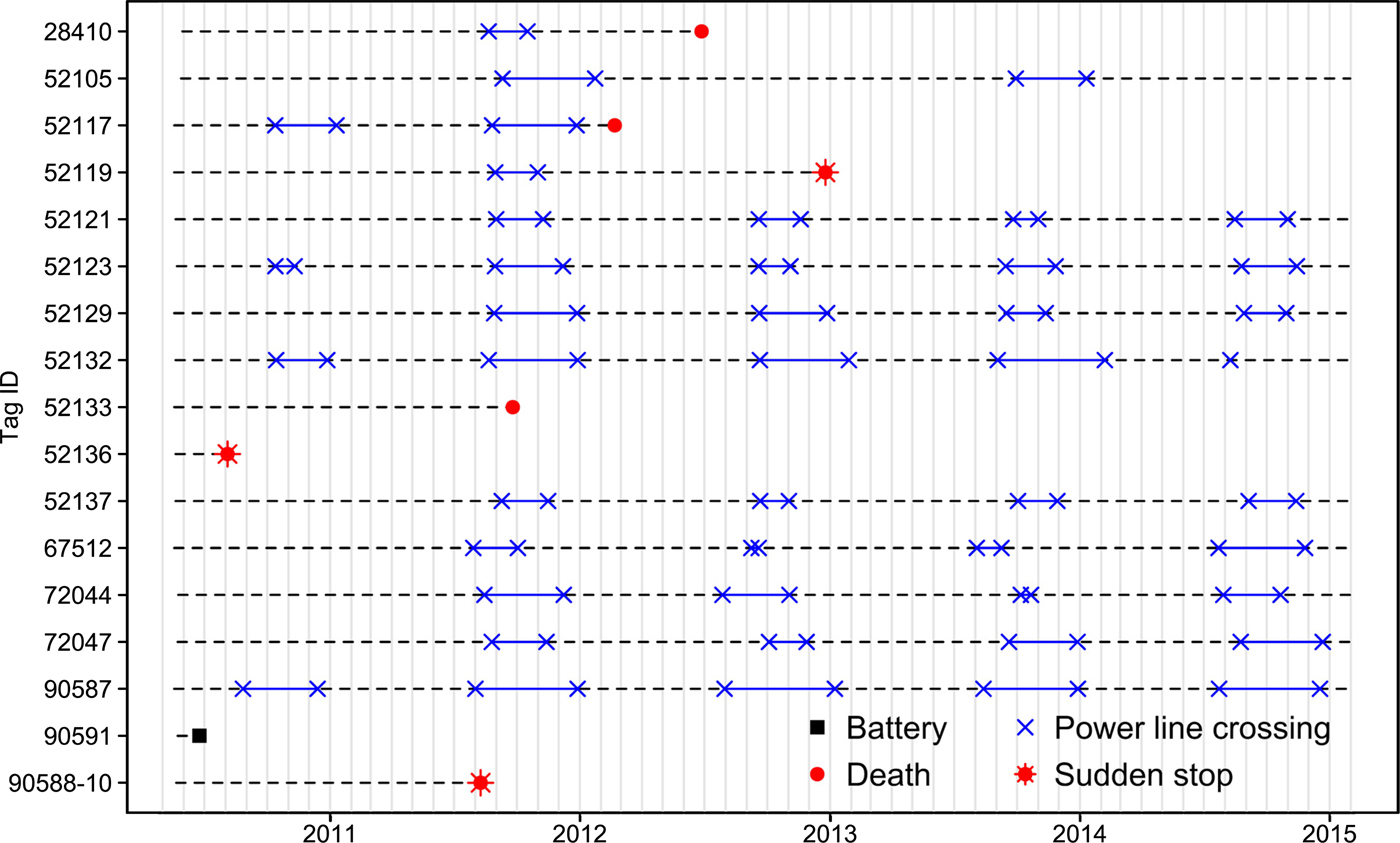
Fifteen Bengal floricans with satellite transmitters were monitored until they had reached the flooding period and initiated non-breeding movements (Fig. 1b). In 2010 not all individuals undertook wet-season migration, whereas in 2011 13 moved to non-breeding areas and two died around the time of migration (Fig. 2). All 13 migrating individuals crossed the proposed route of the Tonle Sap power transmission line, typically twice in each non-breeding season, during outward and return movements (Fig. 2). However, some individuals’ breeding areas were overlapping or close to that proposed power line, indicating a potential to come into contact with the power line more frequently than just during seasonal movements (Fig. 1c).
Duration of satellite monitoring data for 17 Bengal floricans. A dashed line indicates that an individual was on its breeding territory. A solid line indicates that the individual had migrated to the non-breeding territory. The points at which an individual crossed the proposed power line are indicated by x.
Discussion
The annual adult survival rate of tagged Bengal floricans (89.9%) was comparable to that of other long-lived, slow-reproducing large bustards, such as the great bustard Otis tarda (90.9 ± SE 1.6%; Martín et al., Reference Martín, Alonso, Alonso, Palacín, Magaña and Martín2007) and the Asian houbara Chlamydotis undulata (92.5%; Combreau et al., Reference Combreau, Launay and Lawrence2001). The limited satellite telemetry data available do not suggest age- or sex-related differences in movements or mortality. Of the six satellite-tagged Bengal floricans that died during the study three died in August or September, when the birds had moved a short distance from the breeding grounds but remained in the densely populated outer floodplain, where they are vulnerable to disturbance and hunting. The relatively high adult survival, along with low clutch size (1–2, typically one in Cambodia; Gray, Reference Gray2008), suggests population dynamics will be sensitive to even a slight change in adult mortality rate, as indicated by demographic modelling for other bustard species (Combreau et al., Reference Combreau, Launay and Lawrence2001; Burnside et al., Reference Burnside, Carter, Dawes, Waters, Lock, Goriup and Székely2012; Dolman et al., Reference Dolman, Collar, Scotland and Burnside2015).
Migration routes between breeding and non-breeding areas crossed the proposed route of the Tonle Sap power line at least twice each year, with a few individuals that held breeding territories in close proximity to the transmission route crossing more frequently. The mean rate of bustard fatalities as a result of collision with power lines, from collated studies, was 0.69 per km per year. It is not possible to express this in terms of mortality risk per individual, as studies varied in population size, density, and probably in individual risk (in terms of timing and frequency of flights, and proximity to lines), which probably accounts for some of the variation in mortality rate detected. However, all studies were conducted where power lines crossed areas supporting concentrations of bustards (e.g. Alonso & Alonso, Reference Alonso, Alonso, Ferrer and Janss1999; Marques et al., Reference Marques, Rocha and Silva2007; Jenkins et al., Reference Jenkins, Shaw, Smallie, Gibbons, Visagie and Ryan2011; LPN, 2012; Burnside et al., Reference Burnside, Collar, Koshkin and Dolman2015), broadly similar to the situation in Cambodia where subpopulations also vary in density and proximity to proposed power lines. Mortalities resulting from collisions with power lines have been shown to account for a significant proportion of non-natural deaths in a partially migratory population of great bustards, sufficient to influence population demography and behaviour (Palacín et al., Reference Palacín, Alonso, Martín and Alonso2016).
Demographic impacts of proposed power lines on the Bengal florican in Cambodia cannot yet be quantified, in part because there are insufficient data to quantify the demographic impacts of existing threats (e.g. hunting, nest predation, habitat loss and existing power lines). Nonetheless there is a risk that construction of the proposed Tonle Sap power transmission line will exacerbate ongoing declines and have a detrimental impact on the only significant population of the South-east Asian subspecies of Bengal florican.
Hotspots of high rates of collision with power lines are often reported in studies of avian mortalities (e.g. Shaw et al., Reference Shaw, Jenkins, Ryan and Smallie2010; Raab et al., Reference Raab, Schütz, Spakovszky, Julius and Schulze2012). Identification of areas of high collision risk facilitates targeting of mitigation measures to appropriate areas (Shaw, Reference Shaw2009). The proposed Tonle Sap power transmission line bisects one breeding site (Pouk) with at least five displaying males and passes within 1 km of Stoung–Chikraeng Bengal Florican Conservation Area, the only site with a stable population of Bengal floricans (Mahood & Chamnan, Reference Mahood and Chamnan2013). Of the c. 40 displaying males that use Stoung–Chikraeng, the density of birds is highest within a few kilometres of that proposed power transmission line (S.P. Mahood, pers. obs.). Male floricans make aerial displays (Collar et al., Reference Collar, Garcia, Sharpe, del Hoyo, Elliott, Sargatal, Christie and de Juana2014) within an exploded lek (Davidson, Reference Davidson2004) and at the beginning of the breeding season aerial disputes for lek position can be seen daily (S.P. Mahood, pers. obs.). Birds are particularly vulnerable to collision with power lines during aerial displays (Henderson et al., Reference Henderson, Langston and Clark1996).
Although most non-breeding areas were located north of the proposed Tonle Sap power line, one satellite-tagged bird from Baray Bengal Florican Conservation Area spent a single non-breeding season in the vicinity of the proposed route for the Tonle Sap power line and it is likely that others would do the same in years where flooding is incomplete.
The proposed power transmission lines may also affect other vulnerable species. The breeding sites of the Bengal florican are used by a significant number of sarus cranes Antigone antigone, another species prone to collision (Sundar & Choudhury, Reference Sundar and Choudhury2005), and categorized as Vulnerable on the IUCN Red List. The cranes migrate into the floodplain annually from areas to the north of the proposed Tonle Sap power line. The waterbird colony at Prek Toal, Battambang Province, is located c. 15 km from that proposed power line; the colony supports at least 40,000 pairs of large waterbirds, including five species of storks, half the global population of the Endangered greater adjutant Leptoptilos dubius and the entire South-east Asian population of the Near Threatened spot-billed pelican Pelecanus philippensis (Sun & Mahood, Reference Sun and Mahood2015). Elsewhere in the floodplain an additional two species of storks and a small population of the Critically Endangered white-shouldered ibis Pseudibis davisoni also breed close to the proposed Tonle Sap power line. All of these large waterbirds disperse widely during the non-breeding season, rendering them vulnerable to collisions. The proposed power line from Kampong Thom to the international border with Laos PDR would pass through forest inhabited by three Critically Endangered vulture species and the Critically Endangered giant ibis Thaumatibis gigantea. The route of the proposed power line from Kampong Cham to the Lower Sesan 2 hydropower dam is unknown but is likely to pass through areas where the white-shouldered ibis and other threatened species breed.
Mitigation measures to reduce the incidence of bird, and especially Bengal florican, collisions with the power lines were not included in the proposed designs but were recommended to the team developing the pre-EIA. Re-routing or burying power lines is considered to be the most effective mitigation measure for bird species that are particularly prone to collisions (Silva et al., Reference Silva, Palmeirim, Alcazar, Correia, Delgado and Moreira2014). Re-routing sections of the proposed Tonle Sap power line that are otherwise likely to become collision hotspots, such as that near Stoung-Chikraeng Bengal Florican Conservation Area, is important for reducing the number of Bengal florican collisions with the line. Bird collisions with power transmission lines can usually be reduced through the use of bird flight deflectors or line markers, but with high-voltage transmission lines most signalling devices can only be used on the earth cables. The reduction in collisions by using marked cables can be as high as 78% (Barrientos et al., Reference Barrientos, Ponce, Palacín, Martin, Martin and Alonso2012); however, reductions are species-specific and there is a lower success rate for species with particularly constrained visual fields, such as bustards (Jenkins et al., Reference Jenkins, Smallie and Diamond2010).
We recommend urgent research and consultation with stakeholders (Electricité du Cambodge, construction companies, financers and communities) to identify appropriate areas where proposed transmission lines could be re-routed, and that appropriate line markers or bird-flight deflectors be installed along the entire network of power lines in Cambodia. As a result of multi-stakeholder consultations that used the analyses presented here, the construction company is considering installing bird-flight deflectors along the section of the power line closest to Stoung−Chikreang Bengal Florican Conservation Area. Given the likely impacts of the proposed power line on Cambodia's globally important population of Bengal floricans and the risks to other threatened waterbirds, it is essential that these mitigation measures be adopted, and their effectiveness monitored.
Acknowledgements
Funding for satellite transmitters and fieldwork was provided by the Mohammed bin Zayed Species Conservation Fund, the Critical Ecosystem Partnership Fund, Chester Zoo/North of England Zoological Society, North Star Science & Technology, the Ford Motor Company and the National Avian Research Centre−International Fund for Houbara Conservation. JPS was funded by grant SFRH/BPD/72311/2010. SPM was funded by the John D. and Catherine T. MacArthur Foundation. We are grateful to Charlotte Packman, who fitted satellite transmitters; Markus Handschuh, Son Virak and Jonathan Eames for assistance with fieldwork; and Hong Chamnan, Tom Evans, Robert van Zalinge, Dr Srey Sunleang (Director of the Department of Freshwater Wetlands within the Ministry of Environment), Dr Keo Omaliss (Director of the Department of Wildlife and Biodiversity within the Forestry Administration), the Siem Reap and Kompong Thom Provincial Governments and Kompong Thom Provincial Forestry Administration for advice and assistance. We thank two anonymous reviewers for their helpful comments.
Author contributions
SPM conceived and wrote the paper, JPS collated bustard collision data, PMD edited the paper, and RJB analysed the satellite transmitter data and drew the figures.
Biographical sketches
Simon Mahood attempts to reconcile development interests with the conservation of threatened species. João Silva studies the ecology and conservation of steppe birds, and in particular the impacts of power lines on birds. Paul Dolman leads an inter-disciplinary conservation ecology research team working on evidence-based biodiversity conservation in human-modified landscapes in Europe and Asia. Robert Burnside is a conservation biologist with a particular interest in ex situ management and translocations.



