


Introduction
Institutional approaches to the study of political borders rely on the assumption that they constrain and shape individual behavior. Indeed, because these boundaries are theorized to limit social, political, and economic ties across the locations they partition and to facilitate relations among those they encompass, their distinct characteristics and histories are used to explain a host of political and economic outcomes central to international relations. Although a growing body of scholarship uncovers an empirical association between historical patterns of border formation and macro-level outcomes like trade and conflict among states, we lack direct empirical evidence that historical borders have a long-term influence on theoretically crucial micro-level individual behaviors. In this paper we address this by providing extensive empirical evidence that historical border changes shape contemporary patterns of individual social and political trust.
Our focus on trust is a natural starting place for documenting borders’ effects at the individual level. First, the severing of social, economic, and political ties is widely thought to inhibit social networks that promote beliefs in reciprocity and generalized trust. Because international borders disrupt social networks, we expect that repeated changes in their location will inhibit the formation of durable interpersonal networks and stable patterns of social interaction among strangers, resulting in lower levels of trust in locations with greater border variability.
Second, these effects are compounded by how border changes influence state-making projects designed to foster (or coerce) within-border cooperation and hinder cross-border ties. By increasing state administrative capacity and promoting greater homogeneity in culture, language, and identity through mechanisms such as schooling (Darden Reference Darden2013), the state-building process fosters stable and cooperative interactions among effectively anonymous actors. In areas where borders have frequently changed, the consolidation of state presence lags and individuals are more likely to retain limited and particularistic social ties, viewing members of broader national communities warily. Consequently, individuals residing in areas where borders have frequently changed will exhibit lower levels of trust.
We provide extensive evidence that historical border changes lead to lower contemporary levels of social and political trust. We follow Levi (Reference Levi1996b) and Hardin (Reference Hardin2002) and conceptualize social trust as the belief that an unknown individual will likely comply in good faith in an agreement or compact, with little need for personal investment in monitoring and enforcement, and relatedly define political trust as an individual’s belief that governmental institutions are competent and fair in policy and enforcement (Levi Reference Levi1996b). This paper provides new empirical evidence describing the deep historical roots of both social and political trust by coupling data on historical border changes in Europe with five recent waves of the European Social Survey (ESS) and the third wave of the Life in Transition Survey (LiTS). We demonstrate that individuals from localities with more historical border changes are, on average, less trusting of other individuals and state institutions relative to those from neighboring areas of comparative border stability.
Given our expectation that changes in historical borders disrupt networks and impede state building, ultimately influencing local social ties, we are careful to estimate effects for border changes that are as local as possible. Specifically, we measure historical border changes at the nomenclature of territorial units for statistics level 3, or NUTS 3, and estimate models with NUTS level-2 fixed effects using survey responses from both ESS and LiTS. For example, this approach ensures that the effect of historical border changes in Zala County in western Hungary (around 3,800 square kilometers) is identified off of variation within Zala and the other two similarly sized Hungarian counties (Györ-Moson-Sopron and Vas) in the NUTS 2 unit of Western Transdanubia.Footnote 1
Across specifications we include individual-level controls that are known to affect social and political trust, in particular, and political attitudes and behavior more generally. Our estimates for historical border changes are largely unaffected by the inclusion or exclusion of important individual controls or unit-level historical controls and also remain robust when subjected to tests of their sensitivity to selection on unobservables (Altonji, Elder, and Taber Reference Altonji, Elder and Taber2005; Oster Reference Oster2017) or when we greatly diminish the number of observations by aggregating individual responses up to the NUTS 3 level. Moreover, our findings are robust to the inclusion of border changes data from different periods. We also present a number of additional tests that analyze the two main theoretical pathways that we argue connect historical border changes to contemporary patterns of trust—namely, the disruption of state-building processes and the fragmentation of individuals’ social networks.
Our findings are important for several literatures in international relations and comparative politics. International borders are central to the historical and contemporary state-building process, as they constitute the international system of states and establish what territory, population, and resources lie within a state’s borders. Accordingly, state-makers have long worked to establish effective boundaries and to consolidate control of territory within borders. Just as political borders are institutions essential to state building, levels of social and political trust among citizens are central to the state-building project. Literature across the social sciences emphasizes the importance of trust for important outcomes such as public goods provision, the ability to raise an army, economic prosperity, and effective government. Our finding that frequent historical border changes lead to persistent trust deficits demonstrates the long-term interplay between states’ constitutive institutions and individual attitudes that are central to cooperative social and political outcomes.
Institutional Legacies, Borders as Institutions, and Trust
A wealth of recent papers shed light on the deep historical roots of contemporary political and economic behavior.Footnote 2 Building on the path-breaking work of Putnam, Leonardi, and Nanetti (Reference Putnam, Leonardi and Nanetti1993), a large body of research analyzes how contemporary patterns of associational life and norms of reciprocity are the consequence of the historical legacies of institutional choices made a century or more ago.Footnote 3 Surprisingly, few studies focus on state borders as a primary institution in explaining contemporary patterns of individual attitudes and behavior, despite their centrality to the process of state formation (Becker et al. Reference Becker, Boeckh, Hainz and Woessmann2014). Moreover, existing research neither theoretically specifies how border changes have long-term effects on important individual attitudes and behavior nor provides systematic empirical evidence of such effects, despite commonly assuming that border institutions have persistent coordinative effects on individuals (for example, Carter and Goemans Reference Carter and Goemans2018).
Borders as Institutions
Central to the institutional theory of borders is the idea that effective borders coordinate individuals’ expectations and behavior. We conceptualize borders as institutions that delineate jurisdictions and, when effective, shape individuals’ expectations and behavior (Abramson and Carter Reference Abramson and Carter2016, 677). In terms of economic behavior, firms and individual merchants will condition their behavior on the rules and regulations associated with a well-institutionalized border (Simmons Reference Simmons2005). Firms that compete in the export market must pay tariffs and send goods through official customs checkpoints before engaging in commerce on the other side of the border. In contrast, poorly institutionalized borders do not effectively condition the behavior of citizens around it. To return to the economic example, when two states share a poorly institutionalized border, firms and merchants will trade as though the boundary is not there or will actively subvert the rules associated with it (Gavrilis Reference Gavrilis2008). Effectively institutionalized borders are widely known and recognized, with individuals and firms anticipating state efforts to enforce rules, while poorly institutionalized borders are not widely recognized, poorly enforced, and thus do not result in distinct patterns of individual behavior on each side of the border.
Existing research identifies several factors that facilitate states’ efforts to develop effective boundary institutions.Footnote 4 First, the amount of time a border is formally in place matters. When there are no changes in the location of a boundary for decades or longer, the two states that share the boundary have opportunities to consolidate their control over territory on either side of it (Abramson and Carter Reference Abramson and Carter2016). As Fischer (Reference Fischer1949, 197) presciently noted, “the longer a boundary functions, especially an international boundary, the harder it becomes to alter it.” In contrast, in areas that experience numerous border changes, the state-building process is disrupted because states are not able to bring their efforts to establish the border to fruition. In sum, in areas where borders have been in place for long periods without much change, border institutions will more effectively coordinate expectations and behavior on both sides of a line relative to similar areas where frequent changes have occurred.
Borders, State Building, and Trust
As European states emerged from the Middle Ages, state makers worked to consolidate territorial holdings and to rationalize the administration of territory. As Luard (Reference Luard1986, 154) notes, a major objective during this period “was the consolidation of territory, often scattered through the hazards of inheritance or conquest.” Thus, “Austria abandoned territories in the south of Italy for parts of the north” while “France absorbed Franche Comté, Alsace and Lorraine,” which contributed to its efforts to substitute “a pré carré, or straight dividing line,” for the messy and chaotic “south Netherlands border of 1659” (155). That is, a principal goal of these state builders was to build increasingly effective states bound by well institutionalized borders.
These increasingly effective state institutions played an important role in facilitating economic exchange between individuals who did not intimately know each other—for example, by providing clear rules and enforcement (North Reference North1990). In the absence of effective state building, individuals often relied on narrow and exclusive groups within which they could reliably engage in commerce (Levi Reference Levi1996b; Tilly Reference Tilly2005). For example, Muldrew (Reference Muldrew2016) shows that in sixteenth century England individuals developed exclusive associations for the provision of credit when the state was unable to consistently provide stable currency. Tilly (Reference Tilly2005) highlights how states that build the capacity for effective rule tend to either make these limited and exclusive institutions obsolete or to integrate them into their own administrative apparatus, creating institutions that were both more general and efficient (Brewer Reference Brewer1990; Muldrew Reference Muldrew2016).
While frequent transfers of territory that redrew borders were part of the larger European state-building process, locally they impeded efforts to build effective states. Regions with multiple border changes lagged behind as territorial transfers disrupted state efforts to consolidate control.Footnote 5 For example, the Habsburg administration of Transylvania, which was a province in eastern Hungary until the twentieth century, was hampered by frequent border changes in the region. Persistent conflict with the Ottoman Empire in the sixteenth century resulted in weak and often nonexistent Habsburg administration of this territory. Emperor Ferdinand controlled Transylvania for only a few years in the 1550s, and it mostly remained under the control of rulers indebted to the Ottomans or the Polish crown until the end of the seventeenth century. The Habsburgs did not push the Ottomans out of eastern Hungary until the late 1680s, and Vienna’s administration of these areas was relatively precarious and subject to continual negotiation until the latter half of the nineteenth century (Kann and David Reference Kann and David2017). Thus, while Habsburg rule is generally associated with the establishment of a relatively competent bureaucracy staffed by university trained professionals (Becker et al. Reference Becker, Boeckh, Hainz and Woessmann2014), border instability led imperial administration of regions like Transylvania or Croatia to lag behind.Footnote 6
The relative difficulty of state building in regions that experienced frequent border changes had several consequences for social trust and trust in political institutions. First, the disruption of state administrative capacity in areas with multiple historical border changes led to less trust in state institutions. While the idea that there are different levels of administrative effectiveness across a long-standing border is highlighted by recent research (Becker et al. Reference Becker, Boeckh, Hainz and Woessmann2014), the idea that localities that experienced more historical border changes continue to suffer from deficits in political trust relative to nearby localities in the same contemporary state is new. Moreover, our argument that state efforts to build administrative capacity are hampered in regions of border volatility also suggests that lower political trust will be a function of lower evaluations of government effectiveness. Accordingly, we expect that localities that experienced frequent historical border changes exhibit lower contemporary assessments of the administrative performance of government.
Our argument also applies to patterns of social trust. As Levi points out, the state is the only organization with the capacity and geographic reach to foster general social trust across societies, whereas the kinds of civic associations that Putnam, Leonardi, and Nanetti (Reference Putnam, Leonardi and Nanetti1993) focus on are often small and exclusive and can contribute to a narrowing in generalized trust (Levi Reference Levi1996a; Reference Levi1996b).Footnote 7 By virtue of being underdeveloped, state institutions in areas of border volatility provide less support for individuals to enter into consequential economic or social arrangements with those outside of close-knit friend or family networks, absent significant investments in monitoring. The state is the institution with the greatest capacity to reduce individuals’ needs to pay considerable costs to gain information over and monitor those they transact with. Given that interpersonal trust is difficult to construct, especially in the absence of long-term and consistent state efforts that promote its development, we expect areas that experienced more frequent border changes prior to the nineteenth century to continue to lag behind in contemporary levels of social trust.
As a complement to effective institutions state makers actively sought to shape the ethnic, linguistic, and, ultimately, national composition of the areas they governed. Indeed, a chief goal in consolidating territory within their borders is to push individuals to identify more strongly with their fellow citizens. This entails identifying with fellow citizens in other parts of the country to a greater degree than individuals across the border. Thus, the process of consolidating borders and the territorial division that they imply tends to produce greater homogeneity in terms of language and other aspects of culture on each respective side. Research on ethnic diversity and trust finds that more ethnically homogenous areas exhibit higher levels of social trust, which suggests that state efforts to promote ethnic homogeneity can be a complement to more effective state institutions in this respect.
Nonetheless, the promotion of national identity over more particular ethnic ones is often difficult and slow because the populations close to a border tend to share more ethnic ties across it relative to in the center of the state. For example, as Sahlins (Reference Sahlins1991) details, when Cerdanya was split by the Treaty of the Pyrenees in 1660, the population on both sides of the border identified as neither French nor Spanish but as Catalonian. However, after a century and a half of stability at the border French efforts to foster a national identity among citizens in this region showed evidence of success (although this was much less the case on the Spanish side). In contrast to their border with Spain, the French border in the Northeast experienced instability for centuries. For instance, Alsace had “been shuttled between French and German poles for the past thousand years” (Bankwitz Reference Bankwitz1978, 4) prior to its absorption by Prussia in 1871 and return to France in 1919. From 1871 to 1945, there was a prominent, if fragmented, autonomy movement in Alsace that tried to emphasize Alsatian identity in a region with a mix of German and French influence (Bankwitz Reference Bankwitz1978; Fischer Reference Fischer2010).Footnote 8 In sum, state efforts to consolidate territory and promote identification with fellow citizens is a long and difficult process that frequent border changes in an area disrupt, contributing to more ethnic diversity and lower levels of social trust.
Frequent border changes not only hamper the state’s ability to build institutions and identities that aid in fostering trust but also disrupt individuals’ interpersonal networks. When borders move, the costs of traveling from one’s locality to other proximate locations are raised or lowered and interpersonal networks that structure individuals’ economic and social activities are disrupted. Depending on where a border moves, it can place an individual on the opposite side of a border from his or her primary social or trading partners. In the starkest examples like the erection of the border wall in Jerusalem, some individuals lost the ability to commute to their jobs or to visit family members (Getmansky, Grossman, and Wright Reference Getmansky, Grossman and Wright2019). In another example, Grompone and Sessa (Reference Grompone and Sessa2014) show that the division of a long-standing province in Fascist Italy fundamentally disrupted social life around the newly imposed border. By the end of the twentieth century the (now historical) border change resulted in “a number of robust local cultural discontinuities … where apparently there was none and, in principle, there was no reason for them to occur given a long common background” (Grompone and Sessa Reference Grompone and Sessa2014, 6). Although all individual border changes are unlikely to be equally disruptive, frequent border changes, and especially international border changes, are likely to disrupt social networks.
In areas that have experienced multiple border changes, the disruption of social networks combined with states’ diminished abilities to build local administrative capacity has resulted in long-term disruptions of social networks and trust. Where border changes have disrupted existing networks multiple times, individuals learned to discount the future at higher rates, as they became accustomed to the possibility that barriers to movement and trade will change. In other words, individuals in regions that experience multiple border changes will be less willing to shoulder the risks associated with investment in broader social and economic networks, as they anticipate the possibility that these investments will be hampered by future border changes and will lack needed institutional support from the state. Although areas with long-established borders tend to have social networks built conditional on their existence,Footnote 9 areas with frequent border changes tend to have more fragmented and sparse networks. The disruption and weakening of social networks generally lower individuals’ willingness to invest in meaningful ties to larger social or political groups that are mostly composed of strangers (Sinclair Reference Sinclair2012; Verba, Schlozman, and Brady Reference Verba, Schlozman and Brady1995). Thus, weaker and more sparse social ties lower an individual’s sense of shared trust and identity with most of their fellow citizens.
The important question that remains is to more clearly specify why historical border disruptions have long-term effects on the structure of social networks and trust. We make two main points here, one that leverages recent theory and evidence over how individuals transmit beliefs and culture across time and a second that reemphasizes the primary role of the state in these long-term processes. Recent research provides a theoretical foundation for the long-run persistence of shocks, such as border changes, to prosocial, cooperative, norms. Along these lines, Tabellini (Reference Tabellini2008b) builds a theory where individual behavior across generations responds to a mixture of current incentives and norms of conduct transmitted from prior generations and finds that the two are mutually reinforcing, or in other words, strategic complements. Consequently, events like border changes that disrupt or reduce the payoffs to prosocial behavior are amplified over time as cultural values are transmitted across generations. Guiso, Sapienza, and Zingales (Reference Guiso, Sapienza and Zingales2016) reach similar conclusions, finding that the transmission of priors about the trustworthiness of others to be “biased toward excessively conservative priors,” which helps explain long-term persistence in attitudes across centuries.
As we have highlighted, individuals in localities that experience multiple historical border changes learn to place less weight on future interactions and invest less in social relations, leading to lower quality social networks. Relatedly, when territory is frequently transferred, states are less capable of investing in state-building infrastructure that facilitates generalized trust. In the context of intergenerational transmission where transmitted values mutually reinforce the effects of states moving borders, we expect trust deficits to persist across time in areas where local networks faced frequent interruptions and investments in state-building projects were hampered. We do not go so far as to claim that individual behavior cannot change. However, we do view the trust deficits in areas that have experienced border volatility to be persistent and difficult to change. As Levi (Reference Levi1996b, 6) points out, “trust, at least interpersonal trust, is a fragile commodity” because “it is hard to construct and easy to destroy.”
Data and Identification Strategy
We implement an empirical strategy that treats individuals as our unit of analysis while leveraging variation in historical border changes across localities within regions of a country. Thus, we bridge two major empirical approaches to the study of trust, as scholars who analyze the effects of cultural or institutional variables tend to treat localities and regions as the unit of observation (Tabellini Reference Tabellini2008a), whereas those who focus on factors like ethnicity (Bahry, Kosopalpov, and Wilson Reference Bahry, Kosolapov, Kozyreva and Wilson2005) or family status (Ermisch and Gambetta Reference Ermisch and Gambetta2010) tend to analyze variation among individuals.
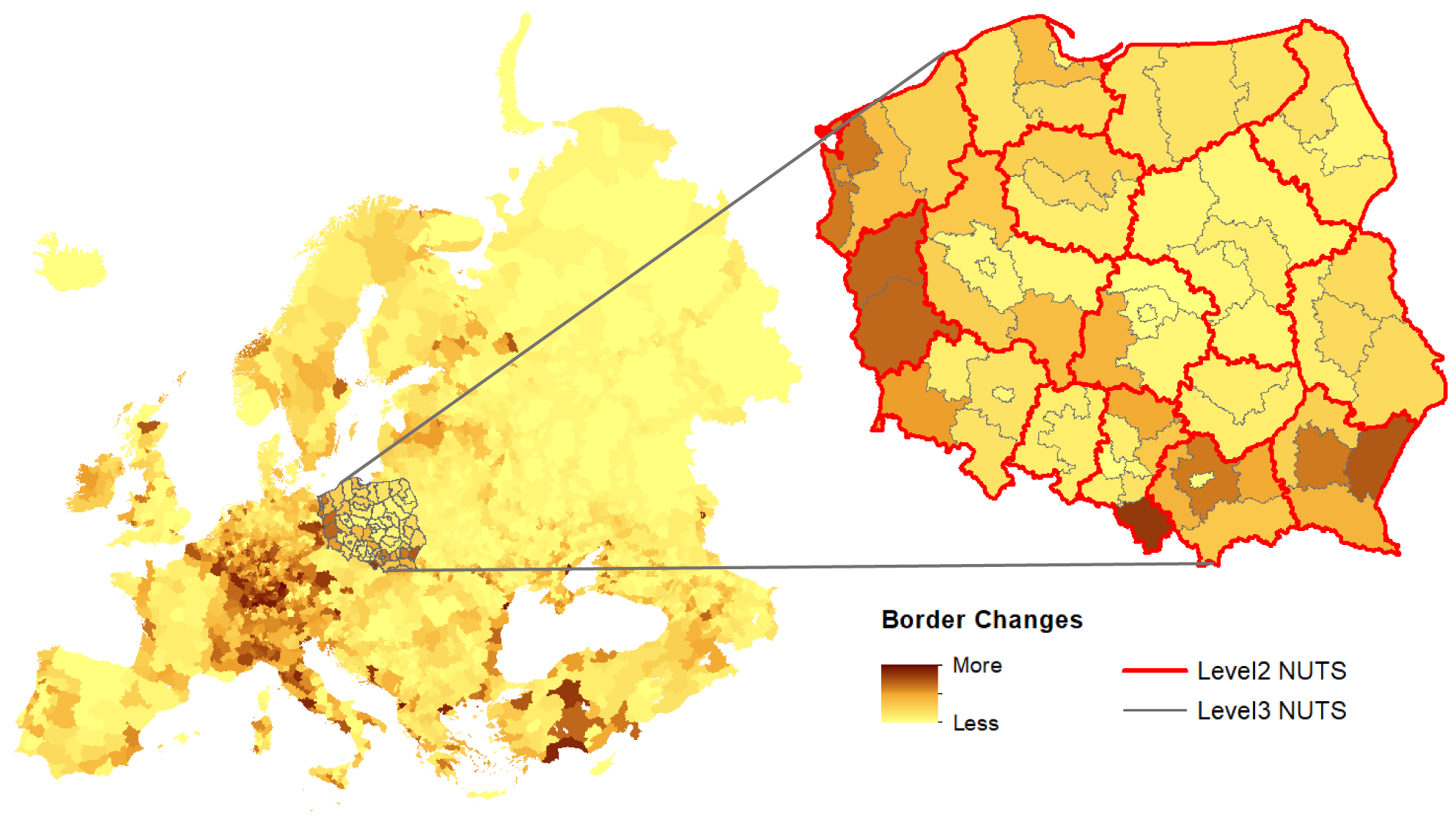
We assess the effects of historical boundary changes on social and political trust by combining survey data with georeferenced data on historical boundary changes.Footnote 10 Our measures are taken at the nomenclature of territorial units for statistics level 3, or NUTS 3, from eurostat. Footnote 11 The NUTS is a hierarchical system that divides up the territory of the European Union into three levels, where NUTS 3 is the smallest of two subnational units. As the close-up of Poland in Figure 1 makes clear, the NUTS 3 units are quite small (the thin black lines delineate NUTS 3 boundaries).
Historical Border Changes in Europe
Note: NUTS 2 is “basic regions for the application of regional policies.” NUTS 3 is “small regions for specific diagnoses.”
Individual survey responses are taken from two sources that measure individuals’ levels of social and political trust: five survey waves from the European Social Survey (ESS) and the third wave of the Life in Transition Survey (LiTS). Measuring historical border changes at the NUTS 3 level makes sense, as most of these units correspond to meaningful subnational groupings, such as counties in Hungary, which is not true to the same degree for larger NUTS units. Moreover, NUTS 3 is the smallest unit at which the ESS survey responses are recorded, which facilitates estimating as local effects as possible. In short, the credibility of our claims rests on border changes being relatively local to individuals in the survey, which will often be false if we measure border changes within larger units. Another advantage of the NUTS 3 units is that we are able to estimate models where we measure border changes (and other controls) at this level using both the ESS data and the LiTS data.
The subset of the ESS data that is available at the NUTS 3 level includes 13 countries out of the 34 in Europe: Bulgaria, Cyprus, Czech Republic, Estonia, Finland, Hungary, Ireland, Latvia, Lithuania, the Netherlands, Sweden, Slovakia, and Slovenia.Footnote 12 These 13 countries comprise 206 NUTS 3 units. When tied to the NUTS 3 unit, the LiTS data has respondents from 18 countries, 10 of which are not also in the ESS data: Croatia, Macedonia, Germany, Greece, Italy, Montenegro, Poland, Romania, Serbia, and Turkey. All 18 countries comprise 364 NUTS 3 units. All in all, the two data sources are good complements, as they contain some of the same countries, but also diverge in terms of coverage. The sample is primarily populated by countries to the east of France, which we view as an advantage given that most of the variation in border changes occurs from central Europe eastwards (see Figure 1).
This strategy of combining individual-level survey responses with data on historical boundary changes at the NUTS 3 level allows us to estimate regressions with NUTS 2 fixed effects, which ensures that we identify all of our coefficients off of intraregional (NUTS 2) variation. Specifically, the estimated effects of historical boundary changes on social and political trust are identified based on the differences between a particular NUTS 3 unit relative to the within-NUTS 2 unit mean, where NUTS 2 units are larger subnational units. Examination of the Polish example in Figure 1 makes clear that this variation is quite local, as the typical NUTS 2 unit in Poland only contains three or four NUTS 3 units, which are usually the size of an average county in the United States. We calculate standard errors clustered at the NUTS 3 level to avoid treating individuals that reside within the same unit of measurement as independent. We also include survey wave fixed effects in the regressions that use ESS data, which capture any differences across time, or any other distinct characteristics of each survey wave that might affect responses.Footnote 13
Dependent Variables
We use a number of questions that measure individual levels of trust in political institutions as well as social trust. The ESS waves 4–8 include three questions that assess social trust and five questions that assess trust in domestic political institutions.Footnote 14 The social trust questions assess whether an individual thinks others are generally trustworthy, are fair or would take advantage of them if they got a chance, and whether others try to be helpful or tend to look out just for themselves. The political trust questions ask each respondent to rank on a scale of 1 to 10 their trust in five of their country’s institutions: parliament, the legal system, police, politicians, and political parties. All questions are worded identically across the survey waves.
The questions in the LiTS data are similar to those in the ESS. There is one question about general social trust in LiTS, which asks respondents to rank on a scale of 1 to 5 whether they think most people can be trusted, or whether one cannot be too careful in dealing with other people. This very closely matches one of the three questions in ESS, although the other two questions from ESS are not present in LiTS. The political trust questions in LiTS again use the 1 to 5 scale and very similarly to ESS include questions about trust in the presidency (executive), the government/cabinet, the parliament, the courts, political parties, and the police.
The political trust questions in both surveys and the social trust questions in the ESS contain multiple individual questions that all tap into the same underlying concept. We adopt both principal components analysis (PCA) and an item response theory (IRT) model to combine the three social trust and five political trust answers from ESS into two latent measures. We then do the same for the political trust answers from the LiTS. This approach to creating our dependent variables, Social Trust and Political Trust, is similar to those in influential work in the literature on trust (for example, Hardin Reference Hardin2002 or Zmerli and Newton Reference Zmerli and Newton2008). Due to the high multicollinearity in the survey questions, we only use the first principal component for the PCA measures of trust, which accounts for about 65% of the total variance in the data across both political and social trust in ESS and about 68% for the political trust measure in LiTS. These PCA measures are only available for the individual respondents who have answered all three questions about social trust or all five questions about political trust.Footnote 15
Next, we use an IRT-based latent trait model to develop additional measures of social and political trust (Rizopoulos Reference Rizopoulos2015). As the answers to the survey questions are all ordinal, we adopt a graded response model to derive the discrimination parameters for each survey question. These parameters then enable us to compute the latent variables, social trust and political trust. Such a two-stage approach assigns a score of trust for all respondents, even those who have not answered all relevant questions. To compare the estimated latent trait with the above principal component, we further subset the data, leaving out the observations with missing values in social-trust-related (or political-trust-related) questions. Another IRT model is fitted with this dataset. We report results using the IRT measures, as the two measures are correlated at 0.98 and produce similar results.
Measuring Historical Border Changes
We measure historical border changes in Europe at the NUTS 3 level using geographic information systems (GIS). Our primary source of data for historical border changes is geocoded data from Abramson (Reference Abramson2017) on all state boundaries in Europe coded every five years from 1200 to 1790. For each NUTS 3 unit, we overlay the snapshot of the historical borders–one at a time—and identify the historical border segments that lie within it.
Our primary explanatory variable is Historical Border Changes, which is the total number of border changes from 1200 to 1790 in each NUTS unit. Figure 1 shows the spatial distribution of Historical Border Changes across Europe at the NUTS 3 level, where darker shades indicate localities that experienced more changes. The map demonstrates that border changes occurred all over the continent, although the greatest concentration runs from contemporary Germany down to the Italian peninsula.Footnote 16 Many of the NUTS 3 units in our samples experience significant border changes, as 37% of the 206 NUTS 3 units in our ESS sample are at or above the 75th percentile in Historical Border Changes, whereas this is the case for 30% of the 364 NUTS 3 units in LiTS. Moreover, the average population that currently lives in these units with frequent historical border changes is very similar to that in the units below the 75th percentile in Historical Border Changes.
The second measure that we analyze in the main text extends our pre-1790 border changes data by combining it with two additional sources that provide more recent temporal coverage. First, we use the C-shapes 2.0 project to measure border changes from 1886–1992 (Schvitz et al. Reference Schvitz, Girardin, Rüegger, Weidmann, Cederman and Gleditsch2021). Although this provides coverage of an additional century, it also leaves a nearly century-long gap from 1790 to 1884. To obtain a more complete time series we hand-code border changes from 1816–1885 to contemporary NUTS 3 units using the latest version of the Territorial Change dataset from the Correlates of War (Tir et al. Reference Tir, Schafer, Diehl and Goertz1998). This provides a time series from 1200–1992 that only excludes the period between the French Revolution and the conclusion of the Napoleonic Wars, a period that is not covered by the Territorial Change data or any other comparable source of which we are aware.Footnote 17 We combine these three sources of border changes data, accounting for the temporal range spanning centuries by weighting border changes by how recently they occurred for each territorial unit i:Footnote 18
 $$ \begin{array}{c}\hskip-10pc \mathrm{Weighted}\hskip0.3em {\mathrm{Border}\ \mathrm{Change}\mathrm{s}}_i\hskip0.3em =\\ {}\sum \limits_{t=1200}^{1992}\left[1\left(\hskip0.1em {\mathrm{Border}\ \mathrm{Change}}_{it}\right)\times \exp \left(\frac{-\left(\hskip0.1em 1992-t\right)}{1992-1200}\right)\right],\end{array} $$
where $ 1\left(\cdot \right) $
is an indicator function with 1(Border Change
it) = 1 if a border change occurred in unit i in year t and 0 otherwise. In this way, each historical border change is weighted by a number between 0 and 1, with the most recent border change getting the highest weight (that is, 1).
$ 1\left(\cdot \right) $
is an indicator function with 1(Border Change
it) = 1 if a border change occurred in unit i in year t and 0 otherwise. In this way, each historical border change is weighted by a number between 0 and 1, with the most recent border change getting the highest weight (that is, 1).
Although we provide results using the full time series as well as the most recent subset of border changes data, we put most emphasis on the deeper historical data from Abramson (Reference Abramson2017) for several reasons. First, the pre-1790 period corresponds to our theoretical emphasis on the consequences border changes had for state-building processes after the Middle Ages. Second, we view the pre-1790 data as providing a more difficult test while also providing greater temporal distance between our treatment of interest and other variables. In combination with our identification strategy that leverages within NUTS 2 variation, this temporal distance lessens our concerns over some of the more obvious empirical concerns, such as whether border changes influence trust via some contemporaneous omitted variable. Finally, we agree with Kitschelt (Reference Kitschelt, Ekiert and Hanson2003) and Simpser, Slater, and Wittenberg (Reference Simpser, Slater and Wittenberg2018, 433) who note that there is often a trade-off in linking more recent versus more historical events to contemporary outcomes, where more recent events reduce the number of potential pathways with the trade-off being that the focus is on “a resultant legacy that is neither interesting nor surprising.”
Additional Historical Variables
We measure a number of additional variables at the NUTS 3 level. First, we include the number of historical military battles that were fought in each NUTS 3 unit from 800–1600 using data from Dincecco and Onorato (Reference Dincecco and Onorato2016). This historical measure of how conflict prone NUTS 3 units were helps us to address the possibility that it is not border changes per se but the military conflict associated with some of them that might drive long-run patterns in social and political attitudes. We also include historical measures of economic development at the NUTS 3 level, following the economic history literature in using the size of the urban population in the year 1600 living within a given unit as a proxy for its overall level of development (Bairoch, Batou, and Pierre Reference Bairoch, Batou and Pierre1988). As an additional measure of economic development that taps into processes of industrialization, we include a count of the number of iron production centers taken from the exhaustive dataset built by Rolf Sprandel on the location of iron forges in preindustrial Europe (Sprandel Reference Sprandel1968, 93–220).
Natural geographic features also quite plausibly had historical effects on spatial patterns of state activity and on social networks. Accordingly, we measure the density of rivers within each unit, operationalized as the length of all rivers in kilometers, as rivers are widely recognized as natural boundaries that often end up aligning with formal political boundaries. In addition to rivers, elevated terrains such as mountains are known to be natural boundaries that strongly influence the settlement and movement of populations. We use spatial data on terrain ruggedness from Shaver, Carter, and Shawa (Reference Shaver, Carter and Shawa2019) at the 1 × 1-km grid level and aggregate up to the NUTS 3 units to obtain a mean level of ruggedness.
We also construct Number of Ethnic Groups by counting the ethnic groups whose territories—as recorded in Weidmann, Rød, and Cederman (Reference Weidmann, Rød and Cederman2010)—overlap with each NUTS 3 unit. The georeferenced ethnic groups data are based on the Soviet Atlas Narodov Mira, which recorded ethnic distribution globally in the early 1960s. The Number of Ethnic Groups allows us to assess the possibility that historical border changes influence ethnic diversity or, alternatively, that ethnic diversity confounds the influence of border changes.
Finally, to proxy for the ability of states to staff larger and more professional bureaucracies, we follow Cantoni and Yuchtman (Reference Cantoni and Yuchtman2014) in measuring historical public investment in universities across Europe. Historical University records whether a NUTS 3 unit experienced the establishment of a pre-1790 university, relying on a historical census of European universities that specifies when each was created, as well as where the university emerged.
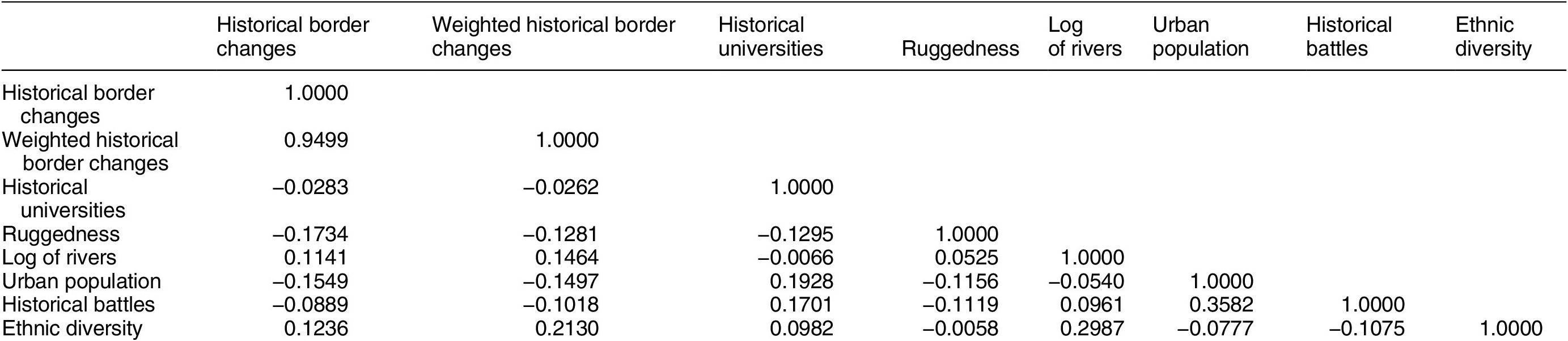
Table 1 shows the bivariate correlations among all historical variables that are measured at the NUTS 3 level. The correlations are generally quite low, except in cases where we would expect them to be high, such as the two closely related measures of historical border changes.Footnote 19
Correlation Matrix: NUTS 3 Level Measures
Additional Individual-Level Survey Variables
We follow convention in the literature on social and political trust and include a number of additional individual-level covariates that we derive from the ESS and LiTS surveys. We include measures of gender, education, age, and income in our specifications. Additionally, we assess the importance of an individual’s family background in shaping his or her levels of political and social trust by including measures of whether the respondent comes from an ethnic minority. Two additional measures of a respondent’s family structure are an indicator for whether the respondent is married and whether the respondent has children at home. Finally, we also include a measure of whether an individual is religiously affiliated or not.
Results
We present our results in two main parts. The first section contains our main analysis, which establishes a statistical relationship between historical border changes and contemporary political and social trust. This analysis leverages two distinct sets of survey data, the ESS and LiTS, and two measures of historical border changes, which include a measure that is pre-1790 in addition to a measure that includes more recent changes. The next two sections analyze the two main pathways identified by our theory that connect historical border changes to contemporary trust.
We do four main things to bolster the credibility of our results. First, as described above we implement a fixed-effects strategy that identifies coefficients off of fairly local (within NUTS 2) variation. Given that NUTS 2 units are subnational units, this identification strategy rules out any inferential problems that derive from omitted cross-country differences and also deals with intracountry differences that are regional. Second, we measure a number of historical and contemporary variables that could plausibly confound the relationship between historical border changes and contemporary trust. Third, we subject all of our results to formal tests of sensitivity to selection on unobservables. This allows us both to assess the robustness of our estimates and to precisely quantify the degree to which omitted variables would have to plague our models to undermine our main results. Finally, we go well beyond establishing a statistical relationship between historical border changes and trust to analyze primary causal pathways that we theorize to link the two. Although it is not plausible to claim that one of these causal pathways is definitive given the deeply historical nature of our treatment variable, the fact that we find support for multiple implications of our theory greatly enhances the credibility of our central finding.
Across all of the empirical models in this section, we focus our discussion on the influence of Historical Border Changes as well as the other variables of central theoretical interest. We do this in the interest of space and because the individual-level variables have been widely analyzed in prior studies. Accordingly, we only discuss the individual and historical controls to benchmark the substantive effects of our theoretically central variables.
Historical Border Changes and Contemporary Trust
Table 2 contains the main results for both political and social trust using the ESS data. All models include NUTS 2 fixed effects in addition to survey-wave fixed effects and sampling weights. The first four columns contain models of political trust and social trust that include Historical Border Changes, whereas the last four columns contain otherwise identical models that instead include Weighted Historical Border Changes. For each outcome, we first estimate models with only a measure of historical border changes and subsequently estimate a model that includes all other regressors. This allows a comparison of the coefficient on Historical Border Changes in a model that includes no other substantive regressors with the coefficient in a fully specified model.Footnote 20 Comparison of the size of an estimated coefficient before and after including other important covariates provides a good heuristic for whether selection on omitted variables drives an estimate (Altonji, Elder, and Taber Reference Altonji, Elder and Taber2005). We implement the formal sensitivity test developed by Oster (Reference Oster2017) to quantify precisely how much selection on unobservables our models would have to be subject to for our main results to go away.
Historical Border Changes and Trust: ESS Data
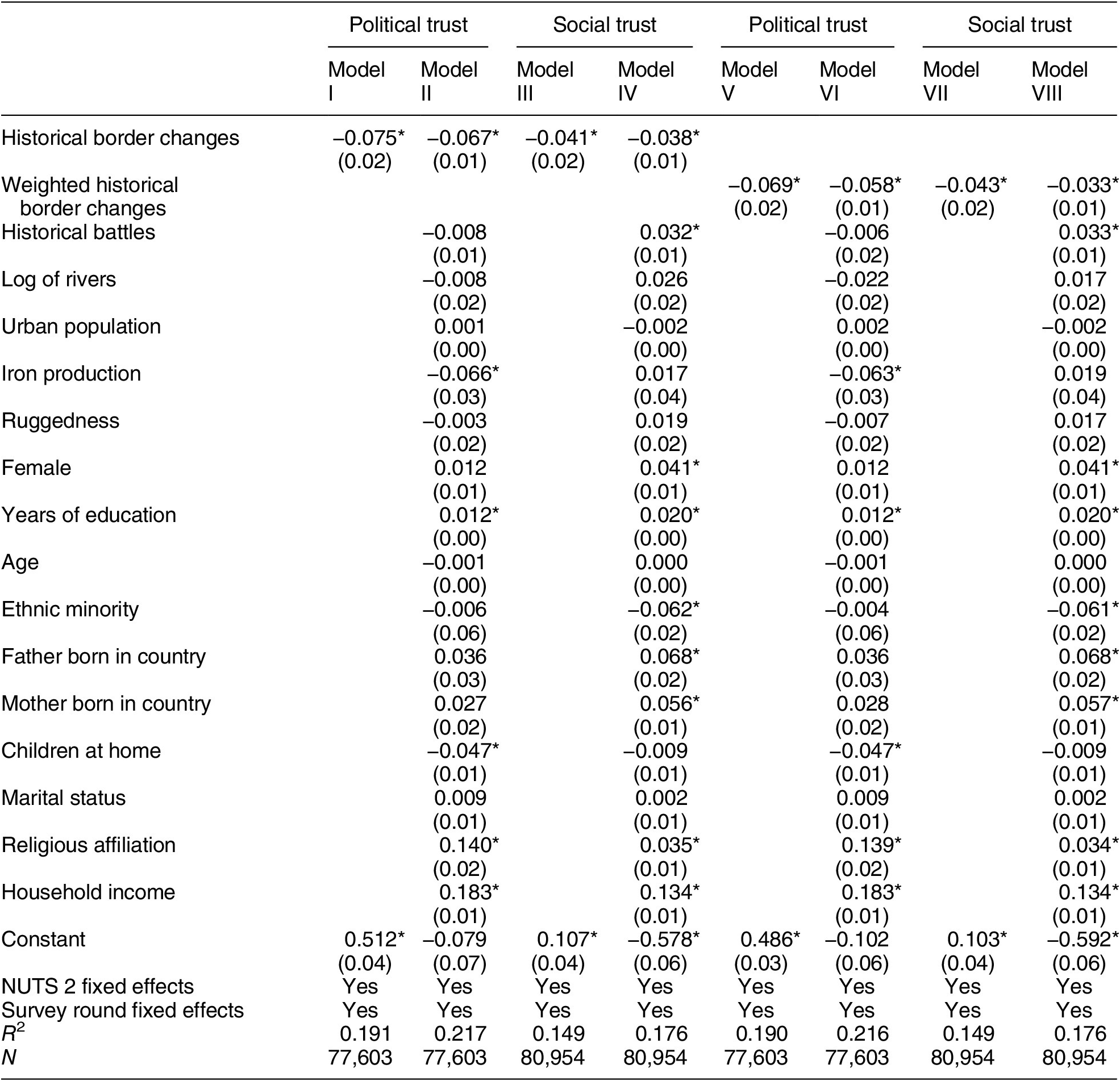
Note: Robust standard errors clustered by NUTS 3 in parentheses; *p < 0.05.
The first two columns of Table 2 report the results for political trust. Historical Border Changes counts the (logged) number of border changes within a given NUTS 3 unit between 1200 and 1790.Footnote 21 The estimate for Historical Border Changes in Model I demonstrates that in areas where borders fluctuated more frequently, respondents report significantly lower levels of trust in political institutions. Moreover, the estimate is not affected much by the inclusion of our NUTS 3 or individual-level covariates in Model II. The test for sensitivity to selection on unobservables also indicates that our estimate of the effect of Historical Border Changes on political trust is robust at well above conventional thresholds.Footnote 22
We do not find that the number of military battles fought in a unit historically has much of any effect on contemporary levels of political trust. Thus, it does not appear to be the case that our measures of historical border changes in an area are proxying for war-fighting activity.Footnote 23 In fact, the negative and significant effect of Iron Production on political trust is the only historical control that is statistically distinguishable from zero. In sum, we find no evidence that Historical Border Changes proxy for military conflict, development, or even features of geography like river density or terrain ruggedness that are known to influence many political and economic processes.
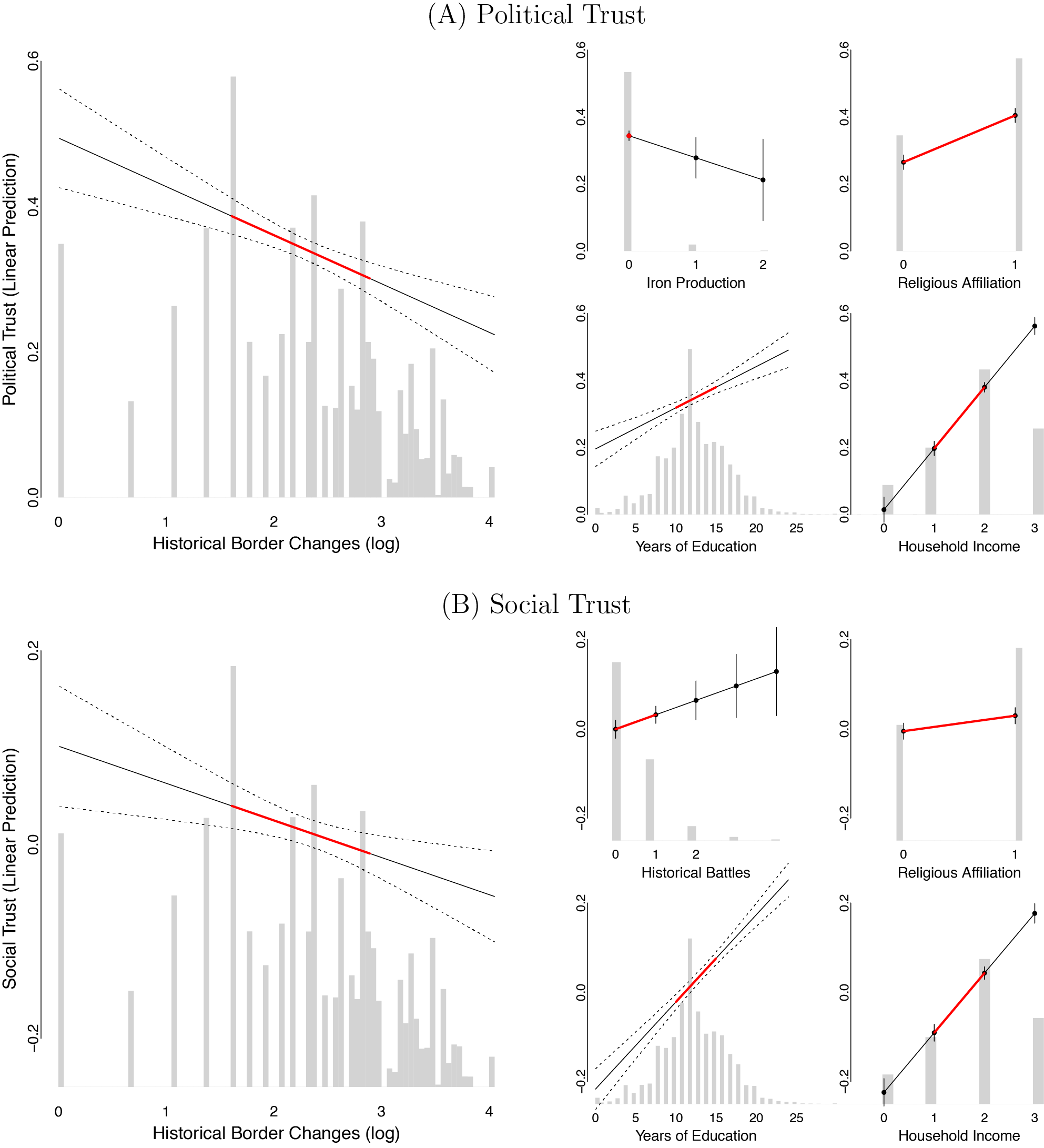
Figure 2(A) demonstrates that the effect of Historical Border Changes on political trust is substantial.Footnote 24 For instance, if we compare an individual who lives in a region that is around the 50th percentile of Historical Border Changes to someone who, all else equal, lives in a region that experienced no changes (holding all other variables at their means), trust in domestic political institutions increases by about 35%. The graphs for other statistically significant variables, including the individual-level measures of Years of Education and Household Income make clear that this is a large and meaningful effect. Whereas the slope of the predicted effect is steeper for Household Income, the effect of Historical Border Changes is comparable to that of Years of Education or Religious Affiliation. Although we find a negative and significant effect of Iron Production, there are not many units with multiple iron forges, which is reflected in large confidence intervals around the estimate.
Substantive Effects on Political Trust and Social Trust: ESS
Note: The gray histogram denotes the distribution of each explanatory variable in the raw data. The marginal effects of each explanatory variable across the full range of the data distribution are depicted, along with their 95% confidence intervals. We use dotted lines for continuous variables and vertical bars for discrete variables. To clearly show where these estimated marginal effects have strong support in the data, we highlight the 25th to 75th percentile for each variable in red. The y-axes are identical across all subfigures to facilitate comparison.
The next two columns of Table 2 analyze social trust. We estimate a substantial negative coefficient for Historical Border Changes, which indicates that NUTS 3 units with more pre-1790 border changes lag behind in social trust when compared with neighboring NUTS 3 units (within the same NUTS 2 unit). Furthermore, the estimate is only somewhat attenuated when we move from Model III, which includes no other substantive regressors, to Model IV, which includes all of our other covariates. The results of sensitivity analysis again suggest that the estimated effect of Historical Border Changes on social trust is robust to selection on unobservables at well above the threshold proposed by Oster (Reference Oster2017).
In contrast to the results for political trust, we find that Historical Battles exerts a positive and significant effect on current levels of social trust, which is somewhat surprising. This result might indicate that war fighting can strengthen social ties, although we do not replicate this finding in the LiTS sample below. Nonetheless, the stability of our estimate for Historical Border Changes again suggests that it is not proxying for war-fighting experience (or any of these other factors).
Finally, Figure 2(B) shows large and meaningful substantive effects of Historical Border Changes on contemporary social trust. Comparison of the effect of Historical Border Changes to effects of other significant variables between their 25th and 75th percentile, which is the red portion of the plots, again demonstrates the persistent import of historical border changes. Although the effects of individual variables widely known to be influential, such as Years of Education or Household Income are steeper, the effect of Religious Affiliation is smaller, as is the effect of Historical Battles, which has large confidence intervals for values greater than 1.
The last four columns of Table 2 replicate the results for Historical Border Changes using Weighted Historical Border Changes, which adds border changes from the nineteenth and twentieth centuries to the pre-1790 data. Thus, we assess whether the addition of border changes that occurred after the Congress of Vienna produce patterns consistent with those prior to 1790. As detailed above, we weight border changes in Weighted Historical Border Changes such that full weight is put on the most recent border change, with decreasing weight given to each border change that is more temporally distant.
As the results in the final four columns show, we replicate the negative and significant relationships uncovered with pre-1790 border changes with Weighted Historical Border Changes. Moreover, we again find that the estimates for the effect of border changes only slightly attenuate when we add all of our additional regressors to the models, with Oster’s test for selection on unobservables similarly indicating that these estimates are quite robust.Footnote 25
Life in Transition Survey Results
The models in Table 3 replicate the approach in Table 2 using the LiTS survey data instead of the ESS. The first two columns of Table 3 again demonstrate that Historical Border Changes have a negative and statistically significant effect on political trust. The second two columns of Table 3 report the estimates for social trust using the LiTS data. We again find that NUTS 3 regions with more historical border changes exhibit significantly lower levels of contemporary social trust relative to neighboring areas with fewer border changes. The estimates for Historical Border Changes across political trust and social trust again only attenuate slightly as we move from the sparse specifications of model I or III, which only include Historical Border Changes and fixed effects, to the full specification with all variables in models II or IV. Oster’s test for selection on unobservables suggests that both estimates are robust to omitted variables. Finally, we note that the substantive effects, which we report in the appendix, are similar to those shown in Figure 2.
Historical Border Changes and Trust: LiTS Data
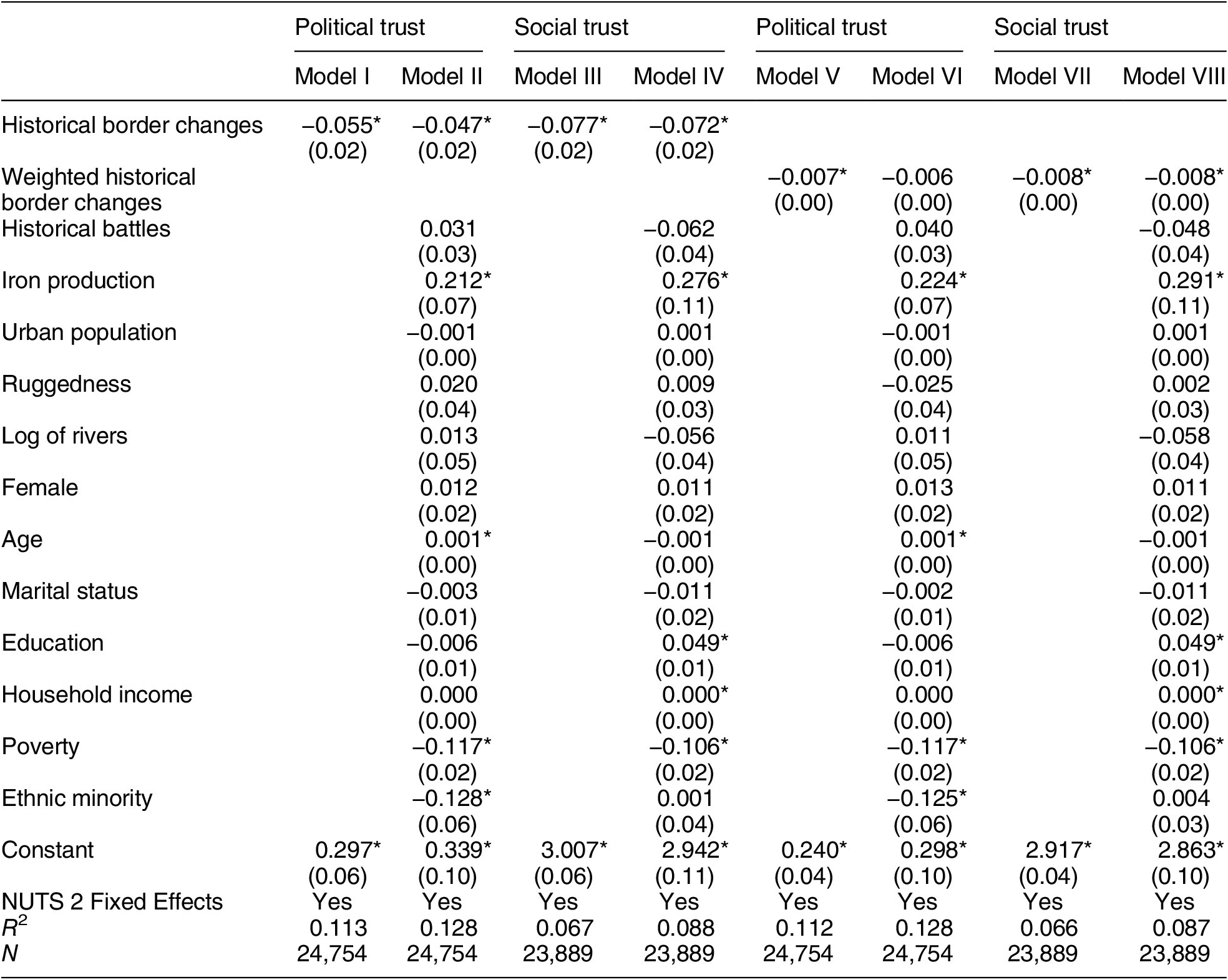
Note: Robust standard errors clustered by NUTS 3 in parentheses; *p < 0.05.
The last four models in Table 3 (models V–VIII) replicate the first four (models I–IV), substituting Weighted Historical Border Changes for the pre-1790 measure of border changes. Although the coefficients attenuate more when we include post-1815 border changes relative to what we observed with the ESS sample in Table 2, all estimates remain negative and statistically significant. Again, the estimates are largely unaffected by the inclusion of individual and historical controls and robust to selection on unobservables.
Is Economic Development a Confounding Factor?
A potential objection to our main result is that regions of historical border instability lag behind in contemporary trust due to their peripheral status within states. This line of argument suggests that regions of border instability continue to face trust deficits in large part because they are less developed economically and relatedly and farther from major urban centers. In other words, Historical Border Changes may be serving as a proxy for development. We find no support for this idea. In Tables 2 and 3 we control for multiple historical measures of development, for example, Urban Population and Iron Production, and find that these variables neither have effects on our estimates for Historical Border Changes nor have consistent effects on trust. Moreover, as detailed in the appendix, we provide additional assessments and find no evidence that development confounds our central findings. Specifically, when we include contemporary measures of development at the NUTS 3 level, for example, GDP per capita, it has no effect on our estimates. We also include a measure of the distance of a given NUTS 3 unit to the closest city, using several alternative definitions of what constitutes a city, and find this has no effect on our estimates of Historical Border Changes. Footnote 26 In fact, none of these variables has a significant effect on trust in any specification.
To summarize, we estimate negative, substantively, and statistically significant effects of two different measures of historical border changes on social and political trust across two distinct samples of survey respondents. Now that we have established a credible relationship between Historical Border Changes and trust, we assess several important implications of our theoretical arguments.
Social Ties, Social Networks, and Trust
Multiple historical border changes disrupt individuals’ interpersonal networks, and this fragmentation of social ties constitutes a primary pathway by which historical border changes lead to lower contemporary trust. The disruption and weakening of social networks lowers the willingness of individuals to shoulder the risks associated with investment in ties to larger social or political groups composed of strangers. An important consequence of these fragmented social ties and lower quality social networks is lower levels of trust. We assess this causal pathway with two sets of analyses. First, we analyze the idea that frequent historical border changes’ severing of social ties will push individuals to be more risk averse in their social and economic interactions than their counterparts in areas of comparative border stability. Accordingly, individuals in areas of relative border instability will exhibit less trust of strangers and rely more on small exclusive networks of intimates. Second, we focus more specifically on social networks with the analysis of how historical border changes influence both the quality of social networks in an area and trust. These two sets of analyses nicely complement each other, as the analysis of individuals’ trust in strangers and family and their willingness to take risks provide us with evidence that frequent border changes not only lower trust but also affect trust among specific subgroups, consistent with our theory. The social networks analysis is distinct in that it allows us to analyze the degree to which individuals in regions of historical border instability have networks of individuals they meet with socially as well as the relative frequency of their social interactions.
Who Do You Trust? Family and Strangers in the LiTS Survey
We use the LiTS data to analyze the degree to which individuals in areas that experienced more historical border changes exhibit significantly lower levels of trust toward individuals that they do not know and are less willing to shoulder risk in their social and economic interactions. The LiTS survey contains instruments that ask respondents to assess both family members and unknown individuals on a five-point scale from “complete distrust” to “complete trust.” Additionally, they ask respondents to rank their willingness to take risks on a 10-point scale, which helps us assess whether individuals residing in regions of border instability exhibit less willingness to take risks relative to their fellow citizens in neighboring units. Table 4 contains three sets of models that are specified in the same way as those in Table 3, except for the outcome variables. The first two columns report results for levels of trust in family members, the third and fourth columns report results for trust in strangers, and the final two columns report results for individuals’ willingness to take risks.
Historical Border Changes and Trust: Family Members and Strangers

Note: Robust standard errors clustered by NUTS 3 in parentheses; *p < 0.05.
We find that Historical Border Changes significantly decrease individuals’ levels of trust in people they do not know. The estimated coefficients for border changes in models III–IV are negative and statistically significant. In contrast, the estimated effect of Historical Border Changes for trust in family—that is, models I and II—is positive, although the coefficients fall short of the 0.05 threshold for significance.Footnote 27 Moreover, the effect of Historical Border Changes on trust in strangers is substantively very large, as moving from a NUTS 3 unit with no border changes to one with the median number of border changes decreases the predicted level of trust in strangers by more than an analogous shift in either the Poverty or Household Income indicators. In short, this is a very large effect.
The estimated effect of Historical Border Changes on individuals’ willingness to take risks is also large, negative, and statistically significant. The coefficient again attenuates with the inclusion of controls in model VI but retains statistical and substantive significance. The marginal reduction in an individual’s level of risk acceptance from changing the number of Historical Border Changes in her area from 0 to the 50th percentile is 5.2%, which is slightly larger than the 4.9% decrease that results from making the analogous change in an individual’s level of Poverty. Again, this is a very large substantive effect.
The results in Table 4 help us to better identify exactly what is happening to individuals’ patterns in trust in localities that experienced more historical border changes. In short, individuals’ patterns of trust slant toward their most exclusive network at the expense of trusting most everyone else they might encounter in society. Moreover, we find, as posited by our theory, that individuals in areas with more historical border changes express less willingness to shoulder significant risks in their everyday interactions.
Historical Border Changes, Social Networks, and Trust
In this section we analyze a primary theoretical path that links Historical Border Changes to contemporary trust: individual social networks. We use respondents’ answers to two questions about their own social networks to build an individual-level measure. The two questions ask individuals (1) how often they meet socially with friends, relatives, or colleagues and (2) how often they take part in social activities relative to others their same age.Footnote 28 The responses to the two questions are correlated at over 0.30 with each other and tend to load on the same dimension, where they explain over two-thirds of the variation. We extract the first component from the principal component analysis (PCA) on these two variables as our Social Network measure.Footnote 29
We analyze the mechanisms that link Historical Border Changes and trust here with regression models similar to those estimated above. We first report the estimated effect of Historical Border Changes on both social and political trust in models like those in Table 2 except that they also include our measure of the quality of individuals’ social networks. These models help us to demonstrate that Social Networks affect trust along with Historical Border Changes. Second, we estimate the effect of Historical Border Changes in a locality on the quality of individuals’ social networks.Footnote 30
The dependent variable in the first two models in Table 5 is Social Networks. Models I and II establish that Historical Border Changes in a locality have a significant negative effect on the quality of individuals’ social networks regardless of whether we include our additional control variables.Footnote 31 The models in the remaining four columns demonstrate that Social Networks have a positive and statistically significant effect on an individual’s level of political and social trust. Again, this holds regardless of whether we include other variables. Most importantly, we find that the estimated effect of Historical Border Changes on both political and social trust remain very similar to those reported in models without Social Networks (see the models in Table 2). The results from the LiTS sample are similar, and we accordingly relegate them to the appendix in the interest of space.
Historical Border Changes, Social Networks, and Trust: ESS Survey

Note: Robust standard errors clustered by NUTS 3 in parentheses, *p < 0.05.
Historical Border Changes, State Building, and Trust
Frequent historical border changes’ disruption of state-building projects is a central causal pathway by which they influence contemporary trust. As we emphasize above, these border changes interrupted state building at a foundational time in Europe, when efforts to consolidate control within borders fostered stronger state institutions, which were essential to building trust among broader communities. We provide three empirical assessments of this pathway here.
First, we analyze an important implication of the idea that states sought to shape the ethnic, linguistic, and, ultimately, national composition of the areas they governed. To recap, we argue that in areas without frequent border changes states were able to better consolidate borders and the territory within them, producing greater homogeneity in terms of language and ethnicity on each respective side. In contrast, state presence was inhibited in areas with frequent border changes, which allowed greater ethnic diversity to persist. Thus, we expect that some of the influence of border changes on contemporary social trust is via their (positive) influence on ethnic heterogeneity.
Second, we assess the idea that the interruption of state-building processes wrought by frequent border changes hampers the long-term administrative effectiveness of the state in affected localities. We assess this idea using individuals’ contemporary assessments of the performance of government. We further complement analysis of contemporary views of local government with an historical proxy for administrative capacity. Specifically, we follow authors such as Cantoni and Yuchtman (Reference Cantoni and Yuchtman2014) in using historical data on the formation of universities as a proxy for the quality of historical state administration in an area, which allows us to assess how historical border changes hampered state administrative capacity historically in a way that persisted across time.
Historical Border Changes, Ethnic Diversity, and Social Trust
We now assess the idea that historical border changes are important to understanding the established relationship between ethnic diversity and social trust. First, we estimate a positive and statistically significant relationship between pre-French Revolution border changes in a locality and subsequent levels of ethnic diversity regardless of whether we focus on the NUTS 3 units in the ESS sample, the LiTS sample, or include all NUTS 3 units across the entirety of Europe.Footnote 32 The results in Table 6 analyze the effects of ethnic diversity on social trust in the ESS sample (see columns 1 and 2), and the LiTS sample (see columns 3 and 4). In the first model for each survey we only include Historical Border Changes and Number of Ethnic Groups, whereas the second model for each survey contains all additional historical and individual controls, which are not shown because they are estimates that are very similar to those shown above.
Historical Border Changes, Ethnic Diversity, and Social Trust

Note: Robust standard errors clustered by NUTS 3 in parentheses; *p < 0.05.
We find mixed support for the idea that ethnic diversity reduces social trust in models that include our measure of Historical Border Changes. In short, although we estimate negative and statistically significant coefficient for Number of Ethnic Groups and Historical Border Changes in model I using the ESS sample, we only find significance at the 0.10 level after we include additional covariates in model II.Footnote 33 Moreover, we find no significant relationships in the LiTS sample. However, it is worth emphasizing the consistent support for the direct effect of Historical Border Changes regardless of sample or whether we include Number of Ethnic Groups or not.
Historical Border Changes, Universities, and Political Trust
We argue that a primary pathway by which border changes have persistent negative influence on trust in political institutions is via their deleterious effects on administrative capacity. Obviously, measuring historical administrative effectiveness, or any other detailed historical measure such as social networks in a locality, is quite difficult. We rely on the central role that the establishment of universities across Europe had in staffing government with more competent professional bureaucrats to proxy for historical administrative capacity (Cantoni and Yuchtman Reference Cantoni and Yuchtman2014). We analyze the influence of a Historical University emerging in a locality prior to 1790 on contemporary political trust alone and in models that include Historical Border Changes. We analyze a binary variable that indicates whether a unit had a pre-1790 university, as there are relatively few units with more than one, whereas around 15% of all units had at least one. Our arguments imply that frequent border changes in an area will disrupt both the establishment of universities and their ability to help staff competent administration.Footnote 34 Accordingly, we expect localities with at least one historical university to exhibit greater levels of political trust.
Table 7 contains regressions that estimate the effect of the presence of a Historical University and Historical Border Changes on contemporary political trust. Models I and II estimate the effect of Historical University on political trust without Historical Border Changes, whereas models III and IV also include Historical Border Changes. Footnote 35 We find that the emergence of a Historical University in a unit prior to the French Revolution has a positive and statistically significant effect on contemporary political trust regardless of specification. While the inclusion of Historical Border Changes and other variables attenuates the estimated coefficient, it remains substantial and statistically significant.Footnote 36
Historical Universities, Historical Border Changes, and Political Trust

Note: Robust standard errors clustered by NUTS 3 in parentheses; *p < 0.05.
Is Government Perceived as Less Effective? Evidence from LiTS
We argue that historical border changes have a deleterious effect on trust in part because they lower the state’s ability to effectively consolidate administration of territory. Consequently, localities with frequent historical border changes lag behind in contemporary trust in part because the state-building process is disrupted during an essential period. An implication of our argument is that historical border changes disrupt effective state presence such that these affected areas also lag behind in administrative effectiveness. Thus, we should find that individuals in these localities still view local administration as less effective. The LiTS has instruments that ask respondents about the overall performance of government at the local and national level and their perception of whether performance is improving or worsening, which makes analysis of this idea possible.Footnote 37
Table 8 contains the results across four related measures of individuals’ assessments of the performance of both local and national government. The first four columns show results for assessments of local government, which are of particular theoretical interest because our theory and identification strategy focus on how border changes in a locality lead to lower trust. We find that Historical Border Changes have a negative and significant effect on individuals’ evaluations of how effective local government is. We similarly find that individuals’ assessments of whether they view the performance of local government as having improved in the past four years is negatively influenced by Historical Border Changes. Thus, individuals in localities disrupted by historical border changes are also pessimistic about whether local administrative effectiveness is improving, which should be true given our argument that these local differences are a function of deeply historical border changes. The results for individuals’ evaluations of national government performance are similar, as Historical Border Changes exert negative and significant effect across all models. In sum, these results show that the presence of frequent historical border changes negatively affects individuals’ assessment of both local and national government performance.
Historical Border Changes and Perceptions of Local Government: LiTS Data

Note: Robust standard errors clustered by NUTS 3 in parentheses; *p < 0.05.
Conclusion
A large set of literatures across the social sciences emphasize the importance of trust in the production of cooperative outcomes like public goods provision, economic prosperity, and good government. Decades of research on the origins of trust highlight how the interplay between institutions and culture influence patterns of trust. We focus new attention in this literature on international borders, which are institutions that both constitute the territorial state and shape cultural identities across time and space. Much influential research attempts to explain the persistence of subnational variation in levels of trust (for example, Putnam, Leonardi, and Nanetti Reference Putnam, Leonardi and Nanetti1993). However, we are the first to argue theoretically and to demonstrate empirically that frequent historical border changes in a locality lead to persistent and meaningful trust deficits relative to neighboring localities without such border changes.
Our central contribution is to the growing literature on border institutions and their historical legacies. Recent research provides much evidence that borders—both in the present and through historical legacies—shape patterns of interstate conflict and cooperation. While theories that link historical border legacies to macro outcomes such as conflict or trade rely heavily on their persistent influence on individuals, we know very little about how historical border changes influence individual attitudes or behavior. We fill this gap here with a focus on one of the most politically and economically salient individual-level attitudes: trust.
Theoretically, our research contributes to both the literatures on border institutions and the origins of trust by clarifying why historical border changes in a locality have a long-term influence on patterns of contemporary trust. In doing so, we connect the growing literature on border institutions to the large and influential literature on state building (for example, Tilly [Reference Tilly1992]). We argue that historical border changes disrupt the state-building process and fragment social networks, which leads to persistent trust deficits among individuals in affected localities.
Using data on over seven centuries of border changes in Europe combined with five recent waves of the European Social Survey and the third wave of the Life in Transition Survey, we provide a range of evidence that localities with more historical border changes lag behind in contemporary levels of social and political trust. We demonstrate a large and robust effect of historical border changes on both political and social trust regardless of whether we focus on pre-1790 borders or also include cases from the nineteenth and twentieth centuries. Across all specifications we include a battery of individual-level variables that are known to affect social and political trust in particular, and political attitudes and behavior more generally. Our estimates for historical border changes are largely unaffected by the inclusion or exclusion of these variables and remain robust when subjected to tests of their sensitivity to selection on unobservables. Moreover, we also analyze the two main causal pathways by which we argue these historical border changes affect contemporary trust. First, we use a variety of data sources to show that historical border changes in a locality are associated with weaker social networks, which lowers both political and social trust. Additionally, we show that individuals in localities with more historical border changes exhibit significantly less trust in strangers and less willingness to shoulder risks than individuals residing in neighboring units without such border changes. Second, we demonstrate that historical border changes produce weaker historical administrative capacity in an area, which is associated with less political trust and lower contemporary assessments of government performance. In sum, we provide a wide range of alternative tests that all point to historical border changes playing a central role in the persistence of trust deficits across localities in much of Europe.
Our study helps to identify a number of fruitful areas for future research. First, although we show that historical border changes have substantial influence over contemporary trust, we expect borders to influence a wider range of individual actions, beliefs, and attitudes. For example, a large and influential body of research focuses on social and political trust because they provide a healthy foundation for socially desirable outcomes such as support for democratic governance, greater economic prosperity, and adherence to more universalistic values (Tabellini Reference Tabellini2008b). Our research suggests that scholars should pay more attention to the role that historical border changes play in understanding local variation in important outcomes such as these. We should also highlight that although we have emphasized the negative consequences of historical border changes here—namely, persistent deficits in social and political trust—there is also reason to suspect that stability in borders is not universally preferable. Increased state presence has sometimes been—and continues to be—associated with the discrimination and the suppression of minority groups (for example, Scott Reference Scott2014). In particular, our finding that border changes are associated with more ethnic diversity across Europe, in part because these areas did not as consistently experience state presence, is in need of further investigation. On this point, studies such as Page (Reference Page2008) suggest that diversity, despite its mixed record with respect to social trust, is also associated with innovation and tolerance.
Finally, for both theoretical and empirical reasons our focus in this article is on Europe. Our theoretical focus on how historical border changes influence long-term state-building processes makes Europe a logical starting point for study. While border changes certainly occur in other regions and are also consequential, regions outside of Europe do not share such long history with territorial states that worked to consolidate control of territory within borders. However, future research should investigate how historical border legacies, such as legacies from former colonial borders, affect individual attitudes. There is much evidence that historical changes in colonial borders lead to territorial dispute as well as depressed trade and investment, for example, the Ecuador–Peru war of 1942. However, evidence of the effects on individual attitudes such as trust is lacking but necessary. Our study provides a point of departure for this important future research.
Supplementary Materials
To view supplementary material for this article, please visit http://doi.org/10.1017/S0003055421001428.
Data Availability Statement
Research documentation and data that support the findings of this study are openly available at the Amercian Political Science Review Dataverse: https://doi.org/10.7910/DVN/5O3EOW.
Acknowledgments
We thank Deniz Aksoy, Lars-Erik Cederman, Doug Dion, Conner Huff, Brian Lai, Sara Mitchell, Carl Muller-Crepon, Yannick Pengl, Ken Schultz, Guy Schvitz, Fred Solt, and participants at the 2019 Peace Science Society (International) meeting for comments. All mistakes remain our own responsibility.
Conflict of Interest
The authors declare no ethical issues or conflicts of interest in this research.
Ethical Standards
The authors affirm this research did not involve human subjects.


 Open access


Comments
No Comments have been published for this article.