

5.1 Introduction
Strategic niche management (SNM) has been recognised as one of four foundational frameworks in the field of sustainability transitions (Markard et al., Reference Markard, Raven and Truffer2012). This is somewhat remarkable given its relatively small number of publications compared to three other foundational frameworks – technological innovation systems (TIS), transition management (TM) and the multi-level perspective (MLP) – and noting that these four frameworks no longer make up the majority of frameworks in the field anyway (Zolfagharian et al., Reference Zolfagharian, Walrave, Raven and Romme2019). Moreover, key SNM concepts, such as niche, protective space, experimentation, learning, expectations, networks or upscaling, as well as their relationships, are arguably subject to a degree of interpretative flexibility. Yet, as I will argue in this chapter, despite this flexibility (or perhaps because of it), its central arguments have shaped ideas beyond the SNM framework. Likewise, SNM as an evolving research program has been influenced by and mirroring developments and ideas in the broader sustainability transitions field.
This creates a challenge for writing an introductory chapter to the framework. Boundaries around what belongs to SNM and what sits outside of the framework are not straightforward to draw and are subject to debate. For instance, the notion of experimentation – a central concept in SNM – has been developed and used far beyond the SNM field, such as in urban geography and science and technology studies (Karvonen and Heur, Reference Karvonen and van Heur2014). This chapter is predominantly informed by my 20+ years of experience with SNM research in the context of evolving research agendas in the wider field of sustainability transitions.Footnote 1
The remainder of this chapter will first define what strategic niche management is and briefly position its thinking in the broader sustainability transitions field. Sections 5.3 and 5.4 follow a combined historical and thematic logic. Section 5.3 discusses the foundations and early developments of SNM up until about the late 2000s. In Section 5.4, this chapter will take a thematic turn and hone in on four aspects of strategic niche management around which SNM development has progressed since then: politics, geography and institutional aspects. Section 5.5 discusses challenges and ambiguities of SNM in practice. Section 5.6 will conclude with a brief outlook.
5.2 What Is Strategic Niche Management and Where Does It Sit in the Transitions Field?
Definitions of SNM go back to as early as 1994, when Schot et al. (Reference Schot, Hoogma and Elzen1994: 1073) defined it as ‘the controlled development and breakdown of protected spaces for new technical applications aiming at market introduction’. A more elaborate definition was put forward by Kemp et al. (Reference Kemp, Schot and Hoogma1998). In what remains one of the most cited publications in the transition studies field to this day, SNM is defined as: ‘the creation, development, and controlled phase-out of protected spaces for the development and use of promising technologies by means of experimentation, with the aim of (1) learning about the desirability of the new technology and (2) enhancing the further development and the rate of application of the new technology’. Early SNM research particularly highlighted and characterised three key ‘internal niche processes’ (Hoogma, Reference Hoogma2000): (1) articulation and coupling of expectations, (2) facilitating learning processes and (3) social networks.
The definition by Kemp et al. (Reference Kemp, Schot and Hoogma1998) highlights several key concepts and underpinning ideas of strategic niche management, including the conceptualisation of niches as ‘protective spaces’, the idea that ‘protective spaces’ can be deliberately created, developed and phased out, the focus on experimentation as a key enabling mechanism in niche creation and development, the importance of learning, the notion of ‘promises’ as a social mechanism shaping convergence or divergence around development pathways and finally a normative-political agenda of achieving sustainable development through promoting new technologies. Sections 5.3–5.5 will further discuss such ideas in more detail, their origins and rationales, as well as highlight critiques and limitations that subsequent contributions highlighted. But first, the remainder of this section articulates how SNM is broadly situated in the evolution of the wider sustainability transitions field.
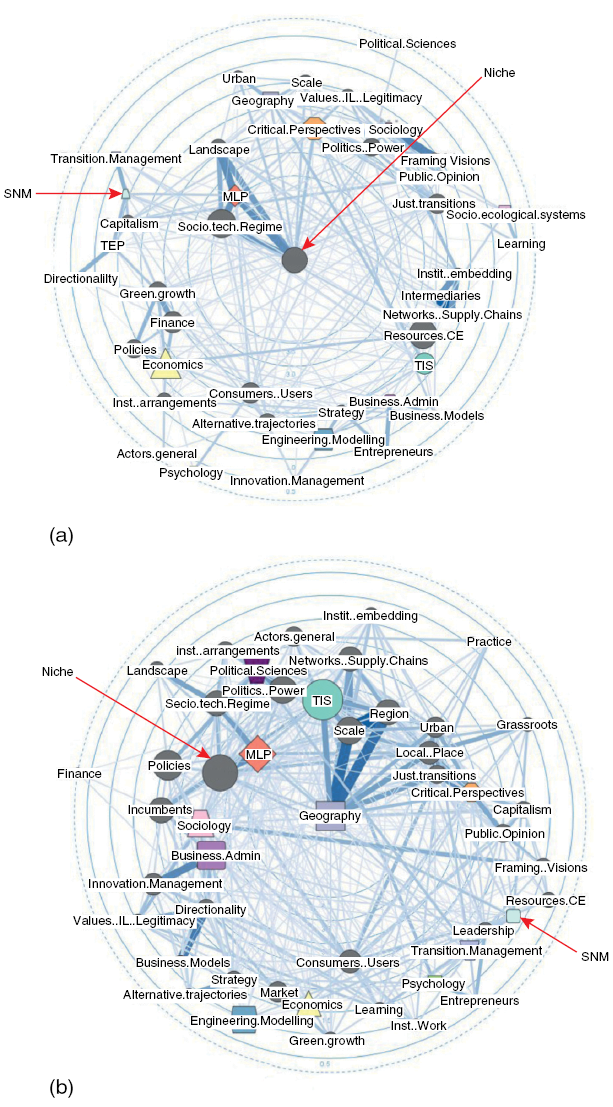
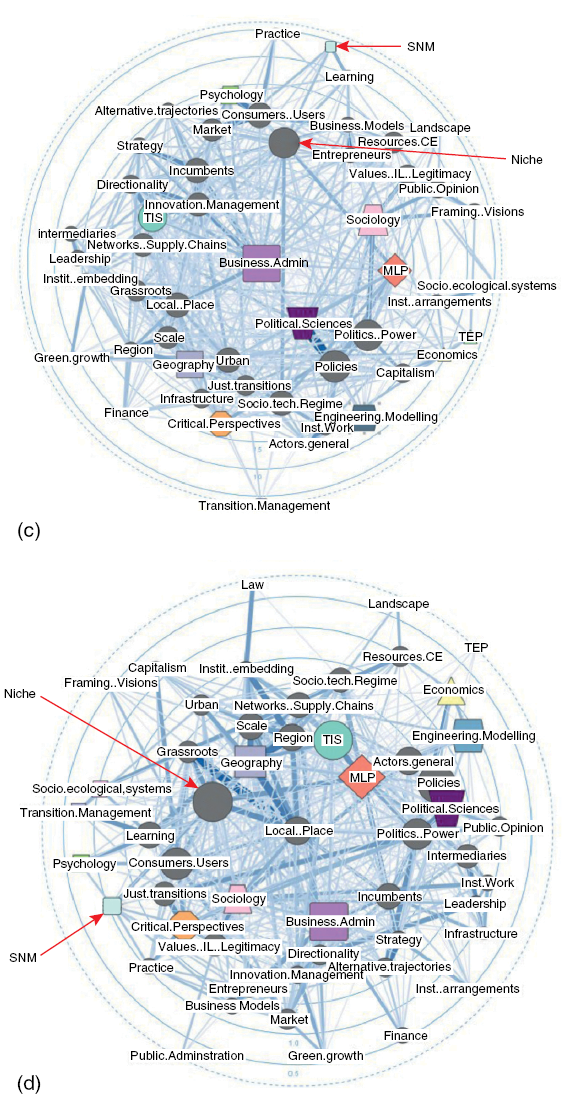
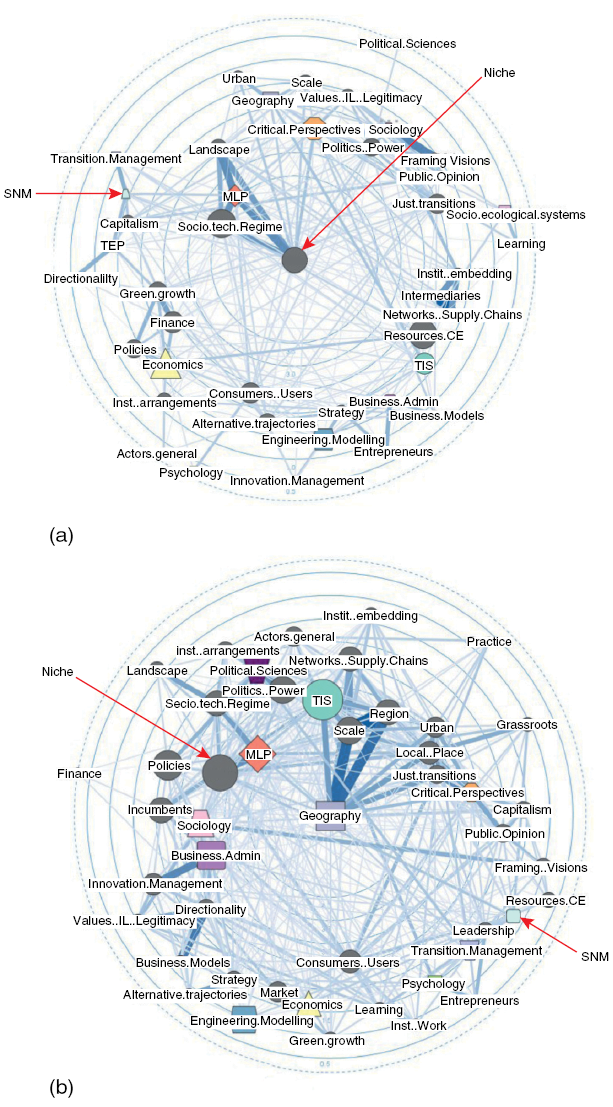
In a recent 10-year anniversary publication of the journal Environmental Innovation and Societal Transitions, Truffer et al. (Reference Truffer, Rohracher, Kivimaa, Raven, Alkemade, Carvalho and Feola2022) reviewed all publications in the journal in the past 10 years using a co-occurrence and network analysis approach to map focal concepts, theoretical frameworks applied and policy implications formulated. The analysis demonstrated that at the journal’s inception, the niche concept was a central part of the journal publications’ conceptual apparatus, and closely aligned with the MLP and the other two levels in that framework, that is, ‘socio-technical regime’ and ‘landscape’. As shown in Figure 5.1, SNM operated at the fringes of the field and has continued to do so in subsequent years. In the years following the establishment of the journal, the niche concept took less central stage, but continued to receive substantial attention (indicated by the size of the bubble), often in relation to newly emerging disciplinary crossovers in the field such as political science, human geography, sociology and (more recently) psychology. This also indicates the co-evolutionary nature of SNM research with the wider sustainability transitions field as will be discussed in Section 5.4.
The evolving field-positioning of SNM and the niche concept in the journal Environmental Innovation and Societal Transitions
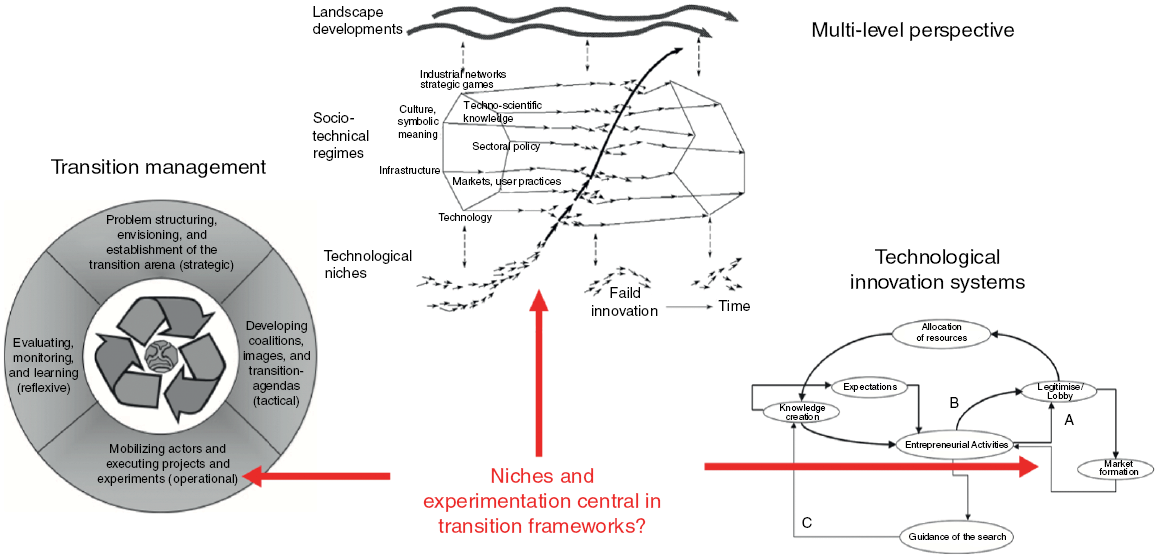
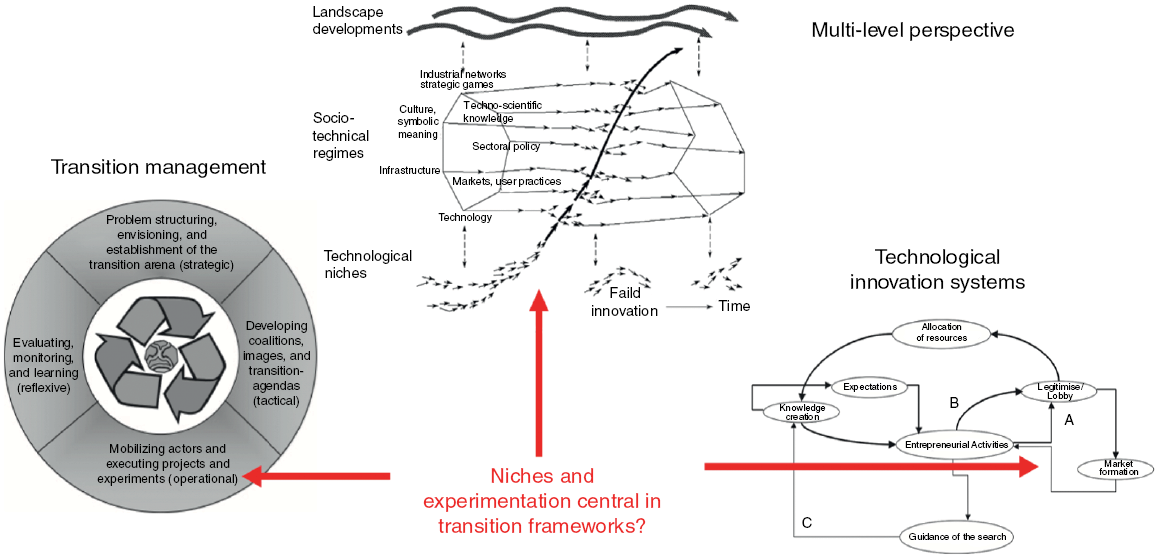
The concepts of niches and experimentation, which are central to the idea of SNM as Section 5.3 will further explore, have also been influenced by and influencing other frameworks in transition studies (Figure 5.2). In the original approach to Transition Management (Loorbach, Reference Loorbach2010), the idea of experimentation is one of four activities in the transition management cycle. In the MLP (Geels, Reference Geels2002), niches are one of three analytical levels considered to be central in shaping sustainability transitions. And in the Technological Innovation Systems approach, ideas on niches and experimentation are routinely mentioned in relation to entrepreneurial activities and market formation. See Chapters 2–4 for further discussion of these frameworks.
Niches and experimentation in foundational sustainability transitions frameworks TM
5.3 Background and Early Developments
The early development of SNM took inspiration from three fields of research: evolutionary economic theories on technological change, Science and Technology Studies (STS) and historical research. Evolutionary theories were mobilised to unpack how processes of variation, selection and retention explain radical change and stability in technological innovation, and the role of niches as protective spaces in technological evolution against the backdrop of path-dependent regimes. STS was mobilised to unpack the role of actors and agency in these processes, including the role of expectations, learning and social networks. Historical research provided ample empirical examples and illustrations of historical transitions. The next paragraphs will elaborate on this.
From evolutionary economic theories, in the work of scholars such as Dosi (Reference Dosi1982) and Nelson and Winter (Reference Nelson and Winter1982), a key starting point was that technological change can be best understood as evolving through processes of variation, selection and retention – like biological processes of Darwinian evolution (Raven, Reference Raven2005). Technological variation refers to the discovery and creation of new inventions and innovations, for instance in corporate R&D laboratories. Like new biological species, such innovations become successful or forgotten through processes of selection – referring to markets and users preferring certain innovations over others. Retention in economic evolutionary theory generally is used to consider shared heuristics and routines that engineers and other actors in the variation environment develop to guide their R&D processes, as they learn what users and markets prefer. This ultimately gives rise to technological change as a structured process that occurs through technological trajectories, leading to dominant designs that undergo incremental change once dominant. Only under rare, punctuated circumstances, or as a result of long evolving processes of incremental change, prior dominant designs may loose ground to new ones. Dosi (Reference Dosi1982) used the notion of ‘technological paradigm’ to indicate the structuring nature of shared heuristics and routines, while Nelson and Winter (Reference Nelson and Winter1982) referred to ‘technological regimes’.
Early transition and SNM scholars such as Ari Rip, Johan Schot and Rene Kemp, and later on Frank Geels, took inspiration from evolutionary reasoning too (in economics, but also adjacent evolutionary thinking in for instance management theory or biological evolution, e.g. Leventhal, Reference Levinthal1998; Schot and Geels, Reference Schot and Geels2007), but grounded their perspectives in insights from Science and Technology Studies and historical studies of technology. They were inspired by and contributed to STS research on large technical systems (Hughes, Reference Hughes1983), social construction of technology (Bijker et al., Reference Bijker, Hughes and Pinch1989) and sociology of expectations (Lente, Reference Lente1993). Their work firmly added attention to actors and agency in evolutionary processes of generating variations, as well as broadening and unpacking the role and dynamics of the selection environment. For instance, particular emphasis was put on user involvement in niche experimentation to shape learning about their preferences or the need to involve policymakers earlier on to inform debate about regulating the potential negative impacts of new innovations (Hoogma et al., Reference Hoogma, Kemp, Schot and Truffer2002). More attention for actors and agency in processes of variation led Rip (Reference Rip1995) and Schot (Reference Schot1998) to propose a quasi-evolutionary theory of technological change, which argues that, in contrast to biological evolution where variation through gene mutation is an undirected and ‘blind’ process, in technological change variation is to some extent socially constructed. Engineers not only anticipate future selection environments for their innovations but also actively engage in shaping them, for instance through educating users or lobbying regulators or financial institutions.
Broadening and unpacking the role of the selection environment involves moving from a narrow economic view of selection pressures (prices) to a more multi-dimensional and socio-technical understanding of what shapes selection pressures, including institutional pressures such as policy frameworks, financial framework conditions or social norms, as well as technological aspects such as the type and characteristics of material infrastructures that are build up in co-evolution with the diffusion of prior dominant innovations (such as existing road infrastructure favouring car mobility over active or public transport). Naturally, this also broadened the types of actors that need to be included in transition analysis (and governance frameworks) beyond firms and end-users, to include attention for social groups such as policymakers, NGOs, community groups, civil society organisations or financial institutions, each of which engages with transitions with particular capabilities, resources, needs and interests. Geels (Reference Geels2004) captured this debate and reframed the original notion of ‘technological regime’, defined by Rip and Kemp (Reference Kemp, Schot and Hoogma1998) as ‘the grammar or rule-set embedded in a complex of engineering practices, production process technologies, product characteristics, skills and procedures, ways of handling relevant artefacts and persons, ways of defining problems – all of them embedded in institutions and infrastructures’. Geels (Reference Geels2004) extended this definition by incorporating social groups beyond engineers, and selection pressures beyond the variation environment, and referred to this as ‘socio-technical regimes’.
Historical research (Schot, Reference Schot1998) into how large-scale, paradigmatic technological change evolves as well as contemporary case study research on sustainable transport (Hoogma et al., Reference Hoogma, Kemp, Schot and Truffer2002) has further informed the early development of SNM, and in particular by putting the centre stage and unpacking the role of ‘niches’. The basic argument put forward is that because of the structured nature of socio-technical regimes and associated selection pressures for radical innovations, radical innovations that substantially deviate from the dominant design, will generally have a hard time surviving in pre-existing selection environments. Niches (defined as protective spaces), such as geographically dispersed areas where infrastructure is underdeveloped, or market niches where environmentally conscious consumers are willing to pay higher prices for lower performance, provide space for the early survival and development of radical innovations, because they shielded these innovations from mainstream selection pressures. Through a process called niche branching – innovations moving and diffusing from one niche to another – radical innovations improve and adapt, and ultimately compete and diffuse into mainstream markets.
SNM scholarship further proposes that insights into these patterns of radical technological change can provide ground for a new, evolutionary-informed approach to deliberate policy design for managing regime shifts to sustainability. Kemp et al. (Reference Kemp, Schot and Hoogma1998) comprehensively spell out this perspective and argue that niches can be deliberately created by experimenting with innovations in real-life contexts such as in pilot and demonstration programs and, more recently, in living labs. Empirical research finds that successful experimentation and strategic niche management enable key internal niche processes (Hoogma, Reference Hoogma2000; Raven, Reference Raven2005). Three types of processes are highlighted and characterised: (1) articulation and coupling of expectations in a way that they become shared, tangible and specific; (2) facilitating multi-dimensional and reflexive learning processes that question underpinning assumptions; and (3) the formation of heterogenous and deep social networks that build a constituency behind an innovation. Weber et al. (Reference Weber1999) further formulated seventeen management suggestions that policymakers and innovators can use to implement a Strategic Niche Management approach in practice.
This initial phase of developments and research into SNM in the 1990s and early 2000s has led to two broad reflections and critiques. The first critique that was voiced as early as 1995 pointed to experimentation and niche development occurring outside of the formal structures of government, firms and research organisations. Verheul and Vergragt (Reference Verheul and Vergragt1995) argue that in the development of environmental technologies, many initiatives are taken by citizen groups or non-governmental organisations. Through three cases of windmill cooperations, wastewater treatments and freezers, they propose the notion of social niche management to foreground these developments and their relevance in regime shifts and sustainability transitions. In a similar vein, others have pointed to the role of non-state and non-corporate actors in countries that gave rise to early renewable energy transitions such as Denmark (Garud and Karnoe, Reference Garud and Karnøe2003) and Germany (Dewald and Truffer, Reference Dewald and Truffer2011). This line of thought has been echoed and advanced in grassroots innovation research. Seyfang and Smith (Reference Seyfang and Smith2007) elegantly contrast market-based innovation with grassroots innovation, characterising the latter as innovation and experimentation occurring in the social economy rather than the market economy; driven by social needs and different types of values than profit, prices and policies; occurring through a range of organisational forms such as voluntary and informal community groups; and drawing on resources beyond commercial ones, including voluntary input, civil society grants and mutual exchanges. Subsequent empirical work into the transition town movement (Seyfang and Haxeltine, Reference Seyfang and Haxeltine2012) and community currency (Seyfang and Longhorst, Reference Seyfang and Longhurst2015) explored the relevance and limitations of SNM in these grassroots contexts. Building on this and other SNM work, Smith et al. (Reference Smith, Fressoli, Abrol, Arond and Ely2016) reflect that experimentation in grassroots contexts has a pivotal role in critiquing and challenge regimes and pointing towards alternative, emancipatory development trajectories and policy agendas.
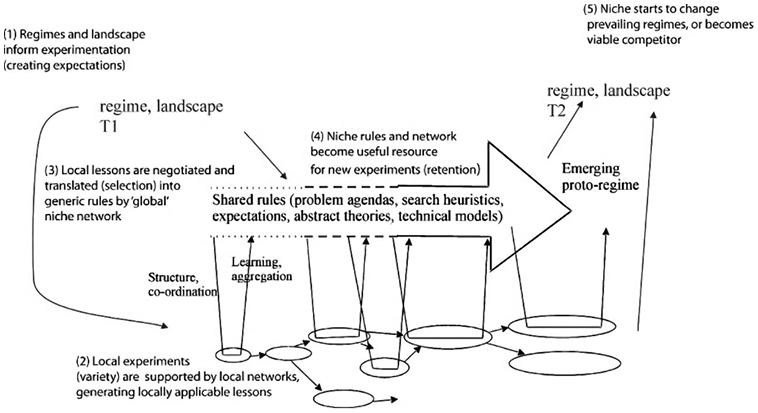
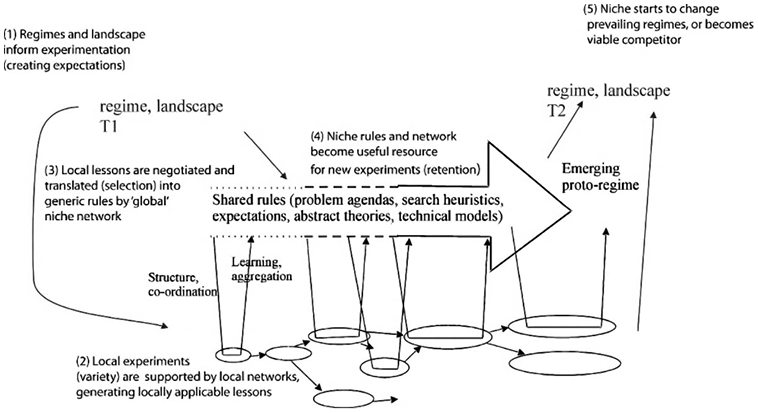
A second reflection on the limitations of SNM is offered in Hoogma et al. (Reference Hoogma, Kemp, Schot and Truffer2002). Synthesising the results from a multi-year research program into sustainable transport, they argue that ‘For one thing, we were certainly over-optimistic about the potential of SNM as a tool for transition. The positive circles of feedback by which a technology comes into its own and escapes a technological niche are far weaker than expected and appear to take longer than expected (5 years or more)’. This critical observation informed a new research direction in SNM that was oriented towards (1) analysing niche dynamics over longer periods of time, and (2) improving understandings of niche–regime interaction. Following and comparing the development of biogas technologies in the Netherlands and Denmark, Raven (Reference Raven2005) and Geels and Raven (Reference Geels and Raven2006), informed by Hård (Reference Hård1991) and Deuten (Reference Deuten2003), reconceptualised niche development as occurring through both local and global processes (Figure 5.3). Local processes refer to the experimentation in particular places and projects, whereas global processes refer to the aggregation of local knowledge into shared socio-cognitive structures through constructs such as shared agendas, search heuristics, expectations and theories. I refer to Chapter 11 in this book for further discussion on niche–regime interactions.
The local-global model of strategic niche management
With a growing and expanding transitions research community and increasing visibility of ongoing sustainability transitions in the real world, by the early 2010s sustainability transitions scholarship branched into new topical and scholarly directions, and in particular topics related to political, geographical and institutional aspects of transitions. This is also reflected in new directions for SNM research scholarship, which I will discuss in Section 5.4.
5.4 Elaborations of SNM
5.4.1 The Politics of SNM
Research on the politics of SNM has been influenced by a broader movement in the transition studies field to engage with questions around politics and power. This was the result of scholarly reflections on initial applications of transition thinking in policy processes, such as in the energy transition policies in the Netherlands (Kemp et al., Reference Kemp, Rotmans and Loorbach2007; Hendriks and Grin, Reference Hendriks and Grin2007, Smith and Kern, Reference Smith and Kern2009). This was also informed by more attention for the governance of sustainability transitions (Smith et al., Reference Smith, Stirling and Berkhout2005; Voss et al., Reference Voss, Bauknecht and Kemp2006), understanding and unpacking power in transitions (Avelino, Reference Avelino2011), as well as scholarship in adjacent communities such as human geography that started to offer critical reflections (Shove and Walker, Reference Shove and Walker2007).
Research on the politics of SNM particularly focussed on unpacking the concept of protective space. An initial critique of this notion of protection is offered by Hommels et al. (Reference Hommels, Peters and Bijker2007a) who pitched SNM against another framework for introducing radical innovations, called PROTEE. While the resulting brief exchange (Geels and Schot, Reference Geels and Schot2007; Hommels et al., Reference Hommels, Peters and Bijker2007b) following the original publication did not pick up on it, Hommels et al. (Reference Hommels, Peters and Bijker2007) made the relevant observation that, in contrast to the PROTEE framework, SNM has an explicit political objective, which is aimed at realising sustainable development through the promotion of new innovations. Another relevant contribution is made in the PhD thesis by Ulmanen (Reference Ulmanen2013), who extends SNM with a discourse analysis approach to show how different outcomes between biofuel developments in the Netherlands and Sweden can only be understood if it is considered how dynamics in diverse biofuel advocacy coalitions and policy discourses in the Netherlands were more mutually exclusive and antagonistic than in the more collaborative Swedish context. These differences are in turn related to different national industrial structures and histories. This politically informed analysis of niche protection (see also Byrne, Reference Byrne, Mbeva and Ockwell2018) provides an improved understanding of the shrinking and/or growing of protective space.
Smith and Raven (Reference Smith and Raven2012) and Raven et al. (Reference Raven, Kern, Verhees and Smith2016) expand on these debates. The key idea introduced and explored through this work is to move SNM beyond a focus on protection as shielding and nurturing new innovations (which is labelled as inward-oriented niche development work), to incorporate analytical attention for the outward-oriented, socio-political work that niche advocates engage in. This work involves the different types of activities that niche advocates such as advocacy groups, trade associations, entrepreneurs, social movements, user groups, engaged academics or political leaders undertake to create and shape empowering narratives supporting a particular niche innovation. Empowerment is a political process, because it is characterised by an interplay of multiple actors and their (divergent or converging) interests. As Smith and Raven (Reference Smith and Raven2012: 1032) argue: ‘Not all actors enter into these negotiations equally: some are able to exercise greater influence owing to their resource attributes, experience, institutional positions and connections with other influential actors, all relative to the task in hand; but neither does any single actor, such as an industrial lobby, or a government department, have sufficient power to force through decisions, strategies, and implementation activities unilaterally’. Smith and Raven (Reference Smith and Raven2012) furthermore characterise and contrast two overarching empowering narratives, i.e. fit-and-conform versus stretch-and-transform narratives. The objective in fit-and-conform narratives is to convince the wider social world that the niche can become competitive within conventional regime criteria and selection pressures. That is, the innovation will ultimately be able to perform profitably in existing markets and does not require radical changes to regime structures. The objective of stretch-and-transform is to convince the wider social world that the rules of the game need to be changed. The selection pressures constituted by prevailing regimes need to be transformed for niche innovations to flourish, which means that the political challenges to convey stretch-and-transform narratives are substantially larger than for fit-and-confirm narratives. Subsequent case study research in domains such as energy (Raven et al., Reference Raven, Kern, Verhees and Smith2016) and health (Boon et al., Reference Boon, Moors and Meijer2014) illustrate the relevance of this approach in understanding the political dynamics of SNM.
5.4.2 The Geography of SNM
Like attention for the politics of SNM was influenced by a ‘political turn’ in sustainability transitions literature, around the early 2010s a ‘spatial turn’ (Coenen et al., Reference Coenen, Benneworth and Truffer2012; Truffer et al., Reference Truffer, Murphy and Raven2015) in the transitions community influenced and was shaped by emerging critiques of a lack of attention for geography in sustainability transitions. Three debates and questions on the geography of sustainability transitions are relevant for discussing the geography of SNM (Coenen et al., Reference Coenen, Benneworth and Truffer2012). First, geography of transitions research questions the relative naivety in the ways in which prior transitions research has engaged with spatial questions and concepts. Concepts such as space, scale, upscaling, level and place are routinely used in transition studies, without reference to long-standing debates in geography. Second, geography of transitions points attention to the uneven distribution of where transitions happen and why they happen where they happen. Third, geography of transitions research critiques pre-existing transitions literature for conflating systems levels with spatial scales and lacking attention for multi-scalar dynamics and points to a need to look beyond the national scale as the only scale at which transition dynamics unfold.
Together, these critiques and developments translated into several new research themes and dynamics in SNM scholarship. For one, a vivid and rapid expansion of research in urban studies scholarship on experimentation and urban living labs has led to a very productive expansion of research outputs and debates extending way beyond the boundaries of SNM scholarship. This has resulted in diverging views on what experimentation entails and with what purposes actors engage with experimentation. In traditional SNM research experimentation is conceptualised as a mechanism to nurture and grow radical innovation with a view to influence system-level transitions towards sustainability. Sengers et al. (Reference Sengers, Wieczorek and Raven2019), based on a systematic review of experimentation literature in the context of sustainability transitions, capture this focus in their definition of an experiment: ‘an inclusive, practice-based and challenge-led initiative designed to promote system innovation through social learning under conditions of uncertainty and ambiguity’. They also recognise, nevertheless, an emerging stream of urban geography literature on experimentation and living labs. In contrast with the innovation focus in sustainability transitions literature, urban geography literature focuses on governance dynamics in the context of urban politics. Bulkeley and Castán-Broto (Reference Bulkeley and Castán Broto2013), Bulkeley et al. (Reference Bulkeley, Castán Broto and Edwards2014), Evans et al. (Reference Evans, Karvonen and Raven2016) and Marvin et al. (Reference Marvin, Bulkeley, Mai, McCormick and Palgan2018) all observe and analyse a global mushrooming of urban experimentation and urban living labs taking place in the context of city governments and other urban actors seeking new ways of governing and navigating the political complexities of responding to climate change and other societal challenges and technological developments (such as smart cities). These contributions often take a critical perspective on the neoliberal conditions within which this navigation is framed and taking place.
Coenen et al. (Reference Coenen, Raven and Verbong2010) provide an early response to critiques of spatial naivety in SNM studies by extending and ‘spatialising’ niche-based frameworks through the concept of proximity. Proximity is a concept from economic geography that reflects the notion that innovation tends to be geographically uneven, and often concentred in regional clusters in which knowledge, networks and institutions have developed over longer periods of time. Drawing on five types of proximity (cognitive, organisational, social, institutional and geographical) as identified by Boschma (Reference Boschma2005), Coenen et al. (Reference Coenen, Raven and Verbong2010) find in a case study on the Dutch thermal aquifer storage niche that proximity relationships in local experimentation indeed improve understandings of scaling and aggregation into a global niche level. However, they also find that proximity literature can benefit from incorporating a more agency-based and dynamic perspective on proximity advantages and should acknowledge that too much proximity can also inhibit innovation processes.
Raven et al. (Reference Raven, Schot and Berkhout2012) further expand on spatialising the niche concept in the context of the MLP. This contribution makes an explicit attempt to incorporate a spatial scale into the MLP, which is an extension of the two existing scales of temporality and structure in the MLP. In the conventional MLP, the niche level is considered to operate at a temporal scale of 0–10 years and is conceptualised as a protective space that shields experimentation from mainstream regime structures. Mobilising insights from proximity theory and conceptualising space from a relational perspective, a spatial scale of the niche level is then proposed to consist of networks that exhibit relatively low levels of proximity and power, relative to the regime and landscape levels. This reconceptualisation of the MLP allows for analysis of transition dynamics that take multi-scalar spatial dynamics into account (see Box 5.1 for an example of transition dynamics from a multi-scalar perspective). This also allows for better accounting for the ways in which the spatial heterogeneity of regimes shapes the uneven spatial emergence of niche innovation, as demonstrated for car-sharing in the Netherlands by Meelen et al. (Reference Meelen, Frenken and Hobrink2019).
1. Transitions evolve through a process of multi-scalar interactions (time, structure, space);
2. The spatial reach of niches, regimes and landscapes is not a given. Space is always negotiated and constructed by networks of actors;
3. Actor networks allow for the distribution of flows such as knowledge, money and natural resources between socio-spatial locations;
4. Socio-technical regimes are nested both horizontally and vertically (for instance, electricity regimes have national, international and regional features) and specificities (vertically nested), as well as exhibiting horizontal differentiation between regimes for households, large industries and so on (horizontally nested);
5. The multi-level nesting of regimes is a source for tensions and misalignments, which can be mobilised by actors in attempts to vision and innovate alternative spaces (niches);
6. Nested regimes have spatially differentiated features; specific niches are more likely to materialise in reconfigured networks and infrastructures in some places than in others, which offer initial spaces for innovative practices;
7. Spatially situated niches can become (inter)nationally connected through existing or new networks and reconfigure the flows constituting them and the institutions developed to regulate them;
8. To trace how these new connections are made, by whom, when and where are of particular importance for a multi-scalar analysis, because it would provide insight into how and where niches may be upscaled and come to shape regime shifts;
9. Niches can also remain localised initiatives and stabilise into sub-national regimes, when they stay disconnected from (inter)national spaces, or become international niches when they become connected, but fail to reconfigure existing regimes;
10. Socio-technical landscapes tend to be transnational since they are the results of choices made in many spatially distributed and (partially) connected regimes. Yet, at the same time, landscapes might be perceived differently by spatially separated regime and niche actors and therefore exert a different influence over their development.
Another area of SNM research responding to geographical critiques has investigated the ways in which international relations influence niche dynamics and experimentation, in particular as occurring in the global south and between the global south and the global north. Wieczorek et al. (Reference Wieczorek, Raven and Berkhout2015) develop a typology of transnational linkages consisting of actors, knowledge, capital, institutions and technology and identify their existence or absence in 65 solar PV experiments in India, including lanterns, grid connected PV systems, solar home systems, micro-grids, off grid power plants, rooftop solar and solar cities. They find a total of 214 out of 325 possible linkages in the sample, indicating a strong international presence in the Indian PV experimentation portfolio. Wieczorek et al. (Reference Wieczorek, Raven and Berkhout2015) acknowledge their work did not include an assessment of the influence or challenges present in transnational linkages. Hansen and Nygaard (Reference Hansen and Nygaard2013) through a case study of donor interventions in the palm oil biomass waste-to-energy niche in Malaysia provide additional evidence about the role of transnational linkages in niche development, but also raise concerns about challenges in the mobility of energy policy across diverse nations and cultures.
Sengers and Raven (Reference Sengers and Raven2015) also take a relational perspective to unpack the supranational networks and dynamics that influence the diffusion of Bus Rapid Transit systems from South America to Asia in particular. Drawing on human geography literature on buzz-pipelines, global production networks and policy mobilities they identify and characterise how multi-scaler international arenas of mobility-experts-cum-advocates shape mobilities of niche innovations across national borders, and into global circulation. The case study also demonstrates how experimentation is both anchored in and influenced by sectoral regime structures as well as territorial, place-based structures and they argue that national actors in this way continue to play an important role in SNM, for instance in relation to fundraising and providing political legitimacy to projects. This contribution (see also Fontes et al., Reference Fontes, Sousa and Ferreira2015) recasts the upscaling and global diffusion of niche experimentation from a ‘mechanistic’ aggregation perspective in the traditional local-global niche model into a deeply agentic and political process.
A final stream of geography informed SNM research that I will discuss here are several contributions that are concerned with exploring what makes certain contexts and environments conducive to experimentation and niche development. Torrens et al. (Reference Torrens, Johnstone and Schot2018) argue that SNM research has extensively explored how protective spaces for experimentation emerge, but only deals in a limited way with why this happens in particular places, and how these places evolve to become experimental. Through a historical case study of the Bristol civic energy scene, they show how Bristol has become a vibrant place for energy experimentation through four phases, each of which is characterised by patterns of experimentation and modes of governing, and each reconfiguring the city context, which set the stage for the next phase. Ultimately, this leads to a city with vibrant grassroots activism, municipal voluntarism, alternative milieus, strategic urbanism and municipal self-righteousness, all of which are supportive for further experimentation. Based on this pioneering work, Torrens et al. (Reference Torrens, Schot, Raven and Johnstone2019) and Heiligenberg et al. (Reference Heiligenberg, Heimeriks, Hekkert and Raven2022) broaden the framing of niches from protective spaces that offer a seedbed for innovation, to niches as harbours, and as battleground. These subsequently foreground complementary enabling functions of niches as providing connectivity and as spaces to resolve conflict, tensions and struggles (on conflicts, see also Yuana et al., Reference Yuana, Sengers, Boon, Hajer and Raven2020).
In contrast to the process approach taken by Torrens et al. (Reference Torrens, Johnstone and Schot2018), Dignum et al. (Reference Dignum, Dorst, Schie, Dassen and Raven2020) mobilise a variance approach to identify the key context factors that are conducive to experimentation. They identify seven urban factors that shape the emergence, degree of radicality and the nature of urban experimentation (social, technological or systemic). These factors are policy visions and plans, governance and stakeholder networks, localised learning processes, financial resources and funding structures, localised information institutions, natural endowments and urban materiality. Drawing on a large database of nature-based solutions they identify what characterises an innovative city environment, including factors such as stakeholder diversity, the presence of non-traditional innovators, a wide range of funding structures, diverse governance arrangements and explicit mechanisms for localised learning, including involvement of citizens.
5.4.3 Institutional Perspectives on SNM
A third development in the wider transitions literature with which SNM research has co-evolved relates to institutional perspectives. Institutional perspectives on sustainability transitions offer critique and insights into two aspects of sustainability transitions (Fuenfschilling, Reference Fuenfschilling2019). The first aspect relates to addressing and advancing understanding of the heterogenous nature and semi-coherence of socio-technical regimes, drawing on insights from literature such as institutional logics (Fuenfschilling and Truffer, Reference Fuenfschilling and Truffer2014) and institutional pillars (Geels, Reference Geels2004). From an institutional perspective, regimes differ in their degree of institutionalisation and coherence (see also Chapter 11). Moreover, regimes display different degrees of coherences and institutionalisation across territories (Fuenfschilling and Binz, Reference Fuenfschilling and Binz2018). The second aspect relates to accounts of actors and their embedded agency. Drawing on institutional work and institutional entrepreneurship (Hoogstraaten et al., Reference Hoogstraaten, Frenken and Boon2020), this branch is concerned with investigating how actors that are embedded within institutional fields and subject to regulative, normative and cognitive pressures, are able to envision and enact divergent change (Garud et al., Reference Garud, Hardy and Maguire2007).
SNM scholarship has engaged with these institutional debates. With regards to heterogeneity of regimes, as mentioned earlier, Meelen et al. (Reference Meelen, Frenken and Hobrink2019) investigate how the adoption of car-sharing is spatially uneven in the Netherlands, which they explain by characterising the incumbent car regime as a patchwork of localities where the regime is more or less institutionalised. Raven et al. (Reference Raven, Sengers, Spaeth, Xie, Cheshmehzangi and de Jong2017) mobilise neo-institutional literature to investigate how and why institutional arrangements for urban experimentation differ between cities. They analyse the cognitive, normative and regulative institutions that together make up institutional arrangements within which smart city experimentation in the cities of Amsterdam, Hamburg and Ningbo are embedded. They find ample differences between the cities and on that basis argue that experimentation is imprinted by unique combinations of institutions at play in each location. These institutional arrangements are considered multi-scalar as actors involved not only draw on local or regional institutions (such as the presence of research organisations) but also on what arguable are national institutional characteristics, such as national governance styles and policy programmes. Likewise, in each case, strategic work to develop institutional arrangements tapped into the wider institutional environments across national boundaries (such as EU Funding and transnational learning). In a similar vein, van Waes et al. (Reference Waes, Farla and Raven2020) demonstrate how bike-sharing entrepreneurs strategically responded very differently to diverging institutional pressures in localised regimes in Amsterdam versus Shanghai.
With regards to accounts of actors and agency through a lens of institutional theory, several contributions use institutional theory to explore the role of actors and agency in the Australian water sector transition (Brown et al., Reference Brown, Farrelly and Loorbach2013; Fuenfschilling and Truffer, Reference Fuenfschilling and Truffer2016). Van Doren et al. (Reference Doren, Runhaar, Raven, Giezen and Driessen2020) (see also Jolly et al., Reference Jolly, Spodniak and Raven2016) mobilise a typology of institutional work to investigate the type of agency niche actors undertake to influence their institutional environments. They characterise 13 intermediary organisations in the Dutch low-carbon housing niche as institutional entrepreneurs that are mobilising political, technical and cultural strategies to develop the niche and transform the incumbent build environment regime. They find that these strategies differ depending on the context in which intermediaries are operating. For instance, market-based intermediaries mobilise only political strategies (such as coalition building) and technical strategies (such as standardisation efforts), whereas community-based intermediaries also draw on cultural strategies such as the creation of new identities. They also find that intermediaries that are oriented towards directly influencing regimes (rather than creating and maintaining niche institutions) also engage in lobbying strategies and efforts to educate and raise awareness. Similar findings have been reported by Kivimaa (Reference Kivimaa2014) and Bush et al. (Reference Bush, Bale, Powell, Gouldson, Taylor and Gale2017), who both mobilise SNM scholarship to explore the role of intermediary organisations in system-level transitions, as well as by Farrelly and Brown (Reference Farrelly and Brown2011) who use the notion of bridging organisations as critical agents in changing regimes so that they become conducive to niche experimentation. For more discussion of the role of intermediaries, see also Chapter 20.
5.5 SNM in Practice: Challenges and Ambiguities
SNM has been predominantly used as a tool for analysing niche developments and experimentation and making recommendations based on those analyses. A few attempts have been made to codify and generalise these lessons into guidelines, toolkits and handbooks for managing and designing experiments, niches and transition pathways more generally (Weber et al., Reference Weber1999; Caniels and Romijn, Reference Caniëls and Romijn2008; Raven et al., Reference Raven, van den Bosch and Weterings2010; Ceschin, Reference Ceschin2014). While there are limitations to what can be prescribed for managing niches and transitions, because of their non-linear and long-term dynamics, such attempts are arguably useful for conveying knowledge to a non-academic audience. Most recently, Schraven et al. (Reference Schraven, Arghandeh Jouneghani, Jonkers and Hertogh2021) propose that SNM can be used to enhance design thinking by increasing the preparedness of an innovation team for a successful market implementation of sustainable innovations. These developments in SNM scholarship align with broader engagements in the field of sustainability transitions that aim to position transition scholarship in relation to innovation policy debates (Nill and Kemp, Reference Nill and Kemp2009; Schot and Steinmueller, Reference Schot and Steinmueller2018), in relation to design disciplines (Ceschin and Gaziulusoy, Reference Ceschin and Gaziulusoy2016), as well as in embedding transition perspectives directly into policy design (Geels et al., Reference Geels, Turnheim, Asquith, Kern and Kivimaa2019).
Besides making recommendations or positioning SNM in wider policy and innovation debates, several contributions in SNM scholarship offer reflections on the challenges and ambiguities involved in doing SNM in practice. An early warning came from Lovell (Reference Lovell2007) who contrasts the development of the UK low-energy housing niche with recommendations in SNM theory. She argues that SNM needs to paid more attention to the messiness and non-linearity of socio-technical systems change, an insight that is supported by findings by Verhees et al. (Reference Verhees, Raven, Veraart, Smith and Kern2013) and Smith et al. (Reference Smith, Kern, Raven and Verhees2014) regarding solar PV niche developments in the UK and the Netherlands. Van Waes et al. (Reference Waes, Nikolaeva and Raven2021) confront insights from SNM with actual experiences in four smart cycling living labs. They find that creating a shared vision, aligning expectations and facilitating learning processes are considered most challenging by participants in the living labs, while creating broad and deep networks is less challenging. They also find that experimentation is deeply shaped by local political agendas and resources and that terminology on niches, experimentation and living labs may itself be contested or confusing. Regarding the latter, see also Heiskanen et al. (Reference Heiskanen, Jalas, Rinkinen and Tainio2015) who argue that SNM scholars engaging in experimentation involving ordinary people should attend to the social and personal reasons why these people engage in experimentation and, importantly, why they might quite sensibly be averse to a great degree of experimentalism, and for good reasons be risk-averse and not willing to accept failure.
Recently, Hodson et al. (Reference Hodson, Geels and McMeekin2017) and Sharp and Raven (Reference Sharp and Raven2021), echoing Lovell’s earlier concerns, have started to highlight the complexity, ambiguity and multiplicity within and through which experimentation in cities evolve, and that there is a need for SNM and experimentation to find ways to accommodate this. Torrens and von Wirth (Reference Torrens and von Wirth2021) warn of a ‘projectification’ of urban experimentation and provide three suggestions to address this: don’t assume that experiments should work as projects; render traditional projects more experimental; and establish hybrid spaces that mediate between projects, experiments and permanent organisations. Bulkeley (Reference Bulkeley2023) suggests we may be entering a condition of permanent urban experimentation and that it may neither be possible nor even desirable to return to more centralised and controlled responses to climate change. These emerging insights on the challenges and ambiguities of SNM suggest that future research on SNM and experimentation continues to be necessary and relevant to understanding and governing transitions in the context of major societal challenges. Section 5.6 provides a few directions for future research.
5.6 Outlook and Conclusion
This chapter has presented an overview of SNM scholarship since its inception in the early 1990s. SNM has been a cornerstone in the development of the wider sustainability transitions field as a foundational framework. Ideas, concepts and arguments on niches and experimentation have informed and been influenced by evolving agendas in the field. In this section, I briefly highlight several themes for future research. First, SNM scholarship and practice should pay more attention to engaging with ordinary people, behaviour change and everyday perspectives (Verbong et al., Reference Verbong, Beemsterboer and Sengers2013; Heiskanen et al., Reference Heiskanen, Jalas, Rinkinen and Tainio2015; Kaufman et al., Reference Kaufman, Saeri, Raven, Malekpour and Smith2021; Sharp et al., Reference Sharp, Pink, Raven, Farrelly and Araújo2022). How can ordinary people, their behaviours and practices, and everyday sites such as households (Raven et al., Reference Raven, Reynolds, Lane, Lindsay, Kronsell and Arunachalam2021) inform deliberate processes of experimentation and SNM. Second, SNM scholarship could engage in debates on incumbency and discontinuation (Turnheim and Geels, Reference Turnheim and Geels2019). Can deliberate experimentation with discontinuing unsustainable practices and technologies inform the acceleration of sustainability transitions? Third, SNM scholarship and practice can engage in debates on just transitions (Jenkins et al., Reference Jenkins, McCauley, Heffron, Stephan and Rehner2016). How can distributional, recognition and procedural justice be (better) accounted for in niche experimentation? Fourth, and finally, SNM scholarship can broaden its methodological preference of case studies to include approaches such as modelling, qualitative comparative analysis, large-scale database approaches, ethnographic methods and action research.

 Open access