

INTRODUCTION
When German Chancellor Olaf Scholz (SPD) addressed the public on the evening of November 6, 2024, it quickly became apparent that Germany’s self-proclaimed “coalition of progress” comprising the novel constellation of the SPD, the FDP, and Greens (traffic light coalition), had come to a premature end.Footnote 1 Only for the fourth time in its 75-year-old postwar history, Germany would see early elections, with voters going to the polls on February 23, 2025, seven months ahead of schedule.Footnote 2 The pressing question is what lies ahead for German politics with the significant demise of the traffic light coalition. Which actors will likely lead the next German government and capture the Chancellorship?
To shed light on questions like these, forecasting models for German elections have been around for more than two decades (for an overview, see Stegmaier Reference Stegmaier2022). Although their accuracy has varied from election to election, these models have proven to be valuable tools in predicting the likely outcomes of German electoral contests even several months before election day (see, for example, Graefe Reference Graefe2017; Jérôme, Jérôme-Speziari, and Lewis-Beck Reference Jérôme, Jérôme-Speziari and Lewis-Beck2013, Reference Jérôme, Jérôme-Speziari and Lewis-Beck2017; Munzert et al. Reference Munzert, Stötzer, Gschwend, Neunhoeffer and Sternberg2017; Norpoth and Gschwend Reference Norpoth and Gschwend2003). Nevertheless, notwithstanding their historical track record and overall predictive value, the most recent German federal election in 2021 challenged new and more established forecasting models. Irrespective of the forecast’s conceptual foundations (e.g., polls, expectations, fundamentals) or statistical sophistication, most forecasting endeavors with appropriate lead time failed to correctly foresee an Olaf Scholz Chancellorship or a traffic light coalition led by the SPD. Instead, every model predicted the Union of CDU/CSU as the likely winner of the election and Armin Laschet as the next Chancellor (see Graefe Reference Graefe2022, 70; Jérôme and Graefe Reference Jérôme and Graefe2022).
Was the 2021 German Federal election merely a historical anomaly, or have elections in Germany morphed into an unpredictable mystery, meaning the election prognosis endeavor is a fool’s paradise? Traditionally, Germany has been considered a beacon of political stability, a dynamic boding well for ex ante prognoses. With the benefit of retrospection, the 2021 contest was distinguished by several exceptional dynamics. The popular Angela Merkel was the first German Chancellor to not seek reelection, despite being eligible to contest. After several campaign missteps, Armin Laschet, the Union’s Chancellor candidate, was considerably unpopular (Dentler, Blinzler, and Quinlan, Reference Klara, Blinzler and Quinlan2024). Additionally, this election was held amid the COVID-19 pandemic, with the government’s management of the situation under intense scrutiny, amid perceived public disquiet over lockdown mandates and vaccine rollout delays. The results of the election told a novel story. For the first time in the history of the Federal Republic, the two dominant players—the Union (CDU/CSU) and the SPD—together received less than half of the national popular vote (49.8%), thus putting their long-term designation as Germany’s “grand coalition” into question. Although the SPD saw a surprising increase in its vote share relative to the preceding election (+5.2 points), the Union registered its worst-ever election result (24.1%). Moreover, the Greens, a party that first entered the German Bundestag in 1983, reached an all-time high of 14.8%. In retrospect, it seems fair to assume that 2021 may have marked a tough case to forecast in advance. Arguably, there is no need for academic forecasters seeking to prognosticate about German Federal elections to throw the baby out with the bathwater at this stage. At the same time, the continuing evolution of Germany’s political landscape—most prominently the consolidation of the far-right Alternative for Germany (AfD; Arzheimer Reference Arzheimer and Weisskircher2023) and the supposed cracks against working with this bloc, along with the recent foundation of the BSW (Bündnis Sahra Wagenknecht) as new electoral players (Thomeczek, Reference Thomeczek2024)—render it likely that Germany, once the bastion of a stable electoral environment, is in such a space no longer, with heightened electoral polarization the current order of the day. For forecasters, this likely means future elections will remain challenging to predict, especially for endeavors relying on long-term factors and fundamentals rather than public opinion (i.e., polls).
With this contribution, we throw our hats in the ring for Wahl ’25 and provide a structural election forecast based on an updated version of the political history (PH) model, which we first applied to Germany for the 2021 federal election. (Quinlan, Schnaudt, and Lewis-Beck Reference Quinlan, Schnaudt and Lewis-Beck2022). As its name suggests, this model exclusively builds on the predictive potency of a country’s historical and structural dynamics, implying that electoral outcomes are shaped mainly by influential and persistent political constellations and events throughout a country’s historical development. For Germany, we identify political parties’ electoral strength in the past, phases of grand coalition governance, party dominance in the German Länder, and two “shocks” to the political system—namely, German reunification and the 2015 “refugee crisis,” as such potent political constellations and events.
The 2025 contests’ peculiarities contribute to the reasonable view that the German political landscape is experiencing continuous evolution and change, thus raising concerns about the applicability of a PH model. We recognize that the model fell significantly short in calling the last federal election in 2021. However, the 2021 contest illustrated prediction models may fall short irrespective of whether their underlying intuition is motivated by short- or long-term variables (cf. Gschwend et al. Reference Gschwend, Müller, Munzert, Neunhoeffer and Stoetzer2022; Jérôme, Jérôme-Speziari, and Lewis-Beck Reference Jérôme, Jérôme-Speziari and Lewis-Beck2022; Murr and Lewis-Beck Reference Murr and Lewis-Beck2022; Quinlan, Schnaudt, and Lewis-Beck Reference Quinlan, Schnaudt and Lewis-Beck2022). Moreover, the general intuition behind the political history model has proven to be a valuable addition to the structural election forecasting toolbox in other contexts (see Quinlan and Lewis-Beck Reference Quinlan and Lewis-Beck2023, Reference Quinlan and Lewis-Beck2024; Lewis-Beck and Quinlan Reference Lewis-Beck and Quinlan2024). As this article demonstrates, the German PH model provides sensible estimates of how three blocs—the Union, the SPD, and All Others—fare in German federal elections between 1953 and 2021, with out-of-sample estimates correctly predicting the party winning the most votes 74% of the time and the forecasts within 3–4 percentage points of each bloc’s performance on average, giving cause for optimism. Nevertheless, even if the PH prognosis for 2025 does fall short, we suggest that it provides a comparative baseline that illustrates how German Federal elections over the past three-quarters of a century have usually panned out.
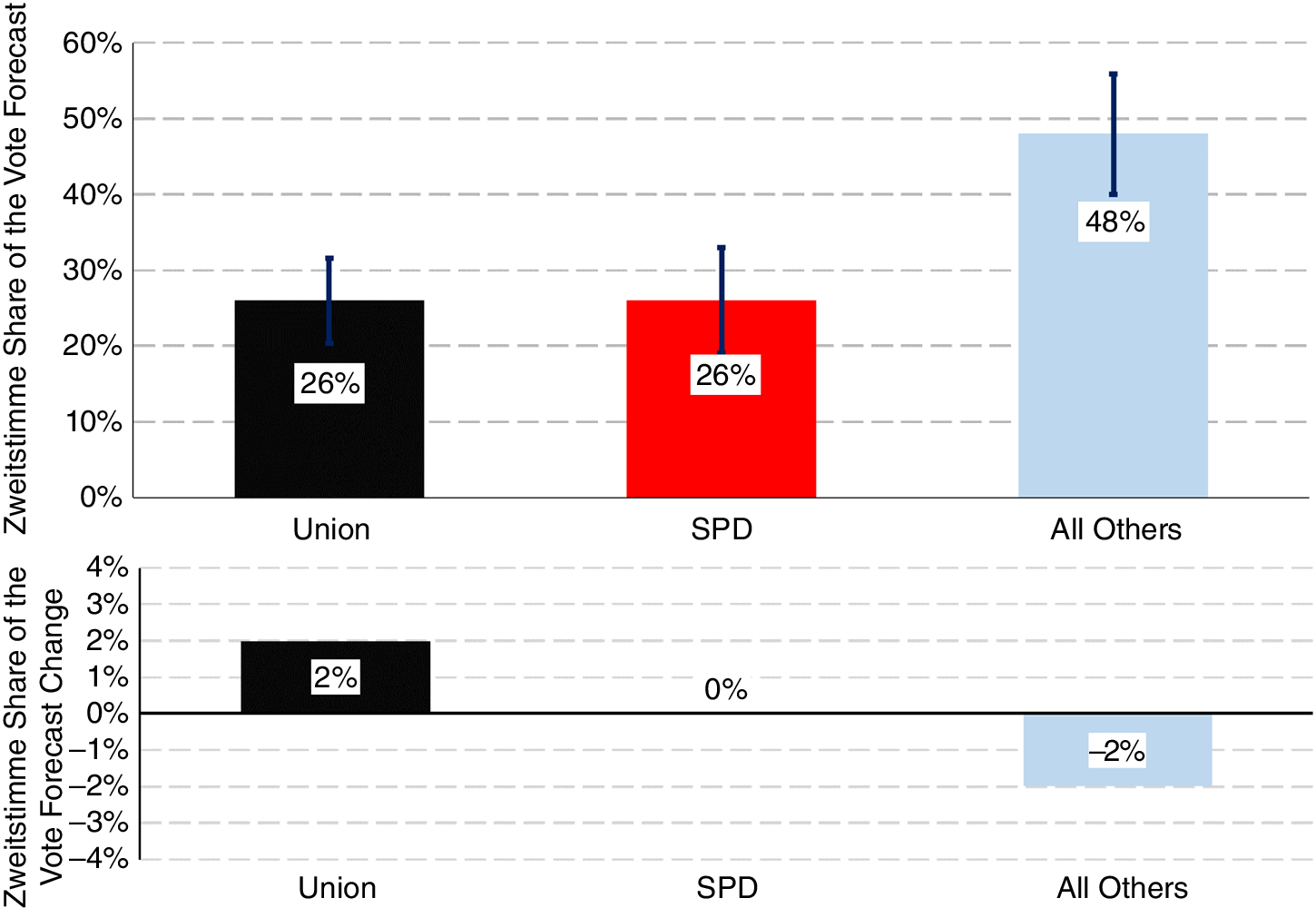
Employing the updated PH model for an ex-ante prediction of the 2025 German federal election, the projection is for a much closer contest than the polls at the time of writing suggest, with point estimates suggesting that both the Union and SPD will win 26% of the vote, and All Others 48%.Footnote 3
MODEL
At its core, the political history model for the 2025 German federal election mirrors the model used for predicting the preceding 2021 election (see Quinlan, Schnaudt, and Lewis-Beck Reference Quinlan, Schnaudt and Lewis-Beck2022). However, “[f]orecasting models are never carved in stone” (Gschwend et al. Reference Gschwend, Müller, Munzert, Neunhoeffer and Stoetzer2022, 89). We are not ignorant that our model lacked accuracy in predicting the outcome of the 2021 election. Model tinkering has been explored in the election forecasting literature (e.g., Campbell Reference Campbell2004; Lewis-Beck and Tien Reference Lewis-Beck and Tien2008). Such adjustments can be reasonable, but they must be prudent and theory-driven and avoid overstretching (Lewis-Beck and Tien Reference Lewis-Beck and Tien2008).
For 2025, we adapt the PH model by adding a variable that captures the electoral influence of the 2015 “refugee crisis” as a potent political shock to electoral politics in Germany.
Theory
The PH model for Germany seeks to predict bloc support for three different political blocs—the Union, the SPD, and All Others—based on five different variables that capture influential and persistent political constellations and events throughout the country’s historical development. Thus, it takes the following form:
 $$ {\displaystyle \begin{array}{l}\mathrm{Bloc}\ \mathrm{support}=\mathrm{f}\;\Big(\mathrm{Short}\hbox{-} \mathrm{Term}\ \mathrm{Partisanship}\\ {}\hskip10.2em +\mathrm{Grand}\hbox{-} \mathrm{Coalition}\ \mathrm{Governance}\\ {}\hskip10.2em +\mathrm{Bloc}\ \mathrm{Number}\ \mathrm{of}\ \mathrm{Land}\ \mathrm{Minister}\ \mathrm{Presidents}\\ {}\hskip10.2em +\mathrm{German}\ \mathrm{Reunification}\\ {}\hskip10.2em +``\mathrm{Refugee}\ \mathrm{Crisis}"+\mathrm{e}\Big).\end{array}} $$
The first variable, “short-term partisanship,” is based on the presumption that current support for political blocs is best understood as an extension of past support. Theoretically, this notion captures the tendency of many voters to form long-lasting bonds with specific parties or blocs (cf. Dalton Reference Dalton2016). We operationalize partisanship as each political bloc’s vote share at the preceding election.
Second, our model considers “grand-coalition governance” phases between the Union of CDU/CSU and the SPD as a political constellation with far-reaching implications. Theoretically, grand coalition governance implies that both blocs must cut down on their electoral promises. Consequently, phases of grand coalition governance between the two dominant players in the German political arena should come with more electoral costs for the Union and the SPD and thus be followed by electoral gains for smaller blocs at the next election. We operationalize grand coalition governance with a dummy variable reflecting the presence or absence of a grand coalition during the preceding legislative period.Footnote 4
Third, in a federal system such as Germany, the electoral fortunes of different political blocs at the federal level should be related to how powerful these blocs are at the level of the German Länder (Kayser and Leininger Reference Kayser and Leininger2017). As the most prominent and politically influential actors at the subnational level, it can be expected that governance costs (or benefits) will be primarily tangible for those blocs holding the post of Land minister-president. To capture such power dynamics of multilevel governance, our model includes a variable reflecting the total number of each political bloc’s Land minister presidents six months before the 2025 election.
Fourth, our model considers the long-term electoral repercussions of German reunification. Theoretically, this unique historical event can be understood as a “super shock” to the German political system, comprising a supply-side, a demand-side, a sociocultural, and an economic shock, with persistent effects on German voting behavior (for details, see Quinlan, Schnaudt, and Lewis-Beck Reference Quinlan, Schnaudt and Lewis-Beck2022, 92). Our model captures this super shock using a dummy variable reflecting elections before and after 1990.
Fifth and last, our model incorporates the 2015 “refugee crisis” as a more recent political event with potent and still unfolding implications for electoral politics in Germany. Ever since former chancellor Angela Merkel’s (CDU) famous proclamation “We can do this” in August 2015, the “refugee crisis” has been a recurring epitome of political contestation. In essence, the “refugee crisis” has initiated nothing less than a reconfiguration of the German party system, whose electoral implications have crystallized more clearly over the last decade. On the supply side, these implications pertain to an increasing polarization between political parties on the immigration issue, including the normalization of far-right positions (cf. Valentim Reference Valentim2024) as well as the split-up of existing parties (e.g., Die Linke) and the emergence of new electoral competitors (e.g., BSW) for, among other things, immigration-related reasons (cf. Thomeczek Reference Thomeczek2024, 537). On the demand side, the implications include a stronger inclination for immigration-based issue voting (cf. Schnaudt and Stecker Reference Schnaudt and Stecker2022). The refugee crisis thus constitutes another critical juncture in Germany’s political history. Our model captures this new period in Germany’s political history with a dichotomous variable for elections held before and after 2015.
The PH model’s scope conditions
A model relying primarily on historical and structural dynamics requires the presence of sufficient historical observations to make reliable predictions.Footnote 5 Thus, we decided to focus on blocs rather than delve into prognoses of newer parties. We recognize that the PH model cannot capture the full complexity of Germany’s electoral landscape in 2025. At the same time, most structural forecasting endeavors typically concentrate on one actor—conventionally the outgoing government or a constituent part—as prognosis using the structural method for multiple actors is relatively new and complex. A model based on forecasting the Union and SPD performance is valuable, considering these two parties have been the dominant parties in the system since 1949, with every postwar Chancellor coming from one of the two parties. In addition, these two parties have played a pivotal role in government formation, with at least one (or at times both) of the parties in one of Germany’s 23 postwar cabinets. Thus, we posit that the PH forecast will provide a solid idea of who will likely lead the next German government. It tells us whether a grand coalition is viable, a crucial insight given Germany’s increasingly fragmented political landscape and the cordon sanitaire against the far-right AfD by all parties currently represented in the Bundestag.Footnote 6 Moreover, as the Union and the SPD have been the anchors of the system, tracking their performance (a) reveals insights as to how traditional parties might perform relative to new kids on the block and (b) contextualizes whether traditional parties’ dominance is being eroded or whether coalition partners are being rejigged.
Data and Research Strategy
Based on political, historical, and institutional data (Quinlan et al. Reference Quinlan, Schnaudt and Lewis-Beck2025) that we have compiled from 1953 to 2021 (N=19 elections), sourced from the German Federal Elections Commission (Bundeswahlleiter/in) and the regional election authorities of the German Länder, we forecast the list vote share (Zweitstimme) for the Union (CDU and CSU)Footnote 7, the SPD, and a combined category for All Others.Footnote 8 We apply seemingly unrelated regression (Zellner 1962), enabling synchronized estimation of distinct models for each of these three political blocs. This approach provides more efficient parameter estimates and ensures that the within-sample vote share predictions sum close to 100. Appendixes A and B list summary statistics for the variables in question, variable operationalizations, and the quantities used for the 2025 forecast. We provide ancillary analyses in Appendix C, including out-of-sample predictions for veracity.
MODEL PERFORMANCE 1953–2021
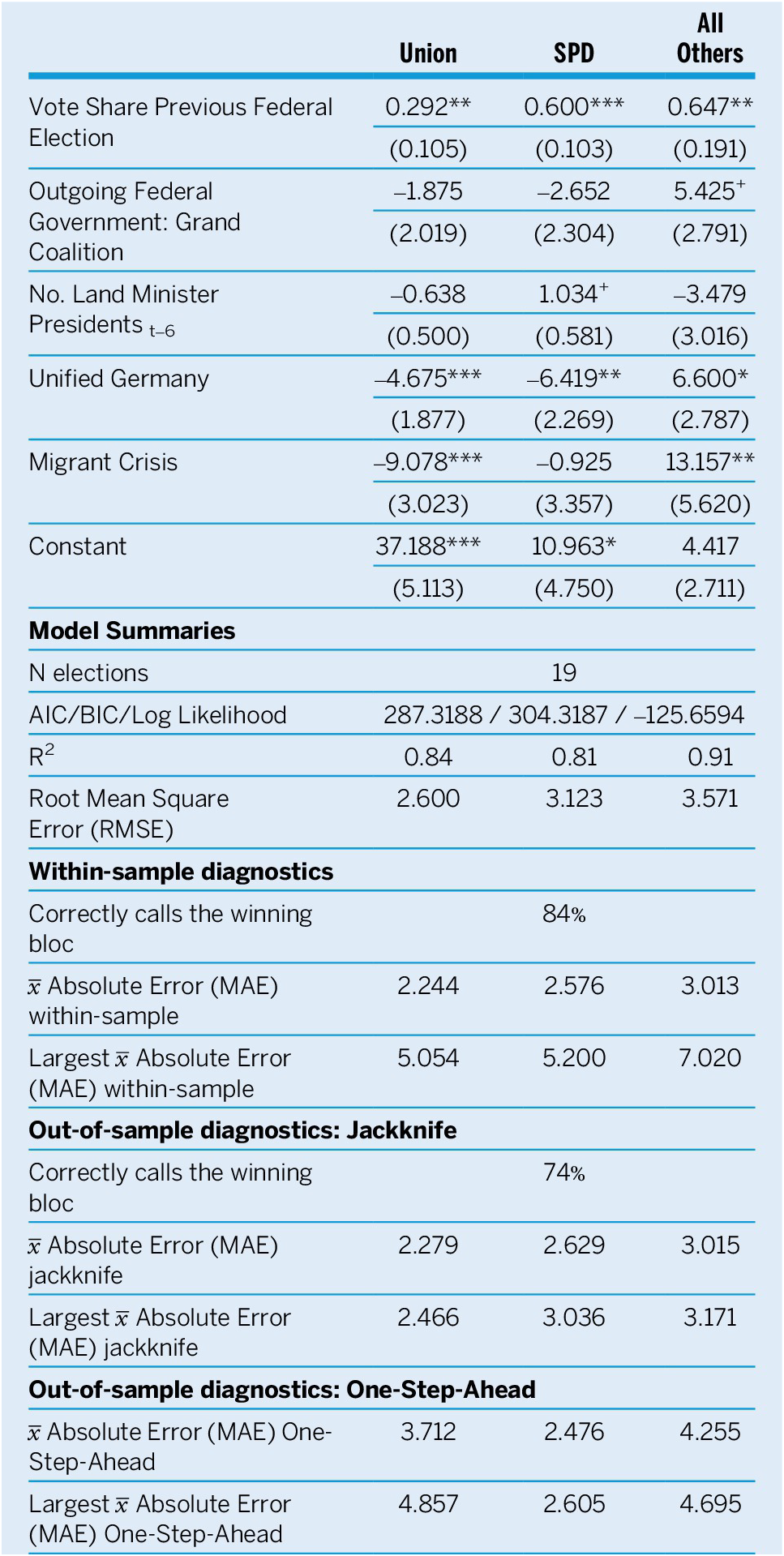
Table 1 details the models on which our central forecast is based. The coefficients broadly are in sync with our theoretical suppositions. We see that the coefficients for short-term partisanship (i.e., vote share in the previous election) exhibit the anticipated positive direction and achieve statistical significance at conventional levels (p<0.05) across all blocs. The dichotomous variable capturing the Reunification shock is statistically significant across all three models and in the presumed directions—the Union and SPD losing support ceteris paribus in a unified Germany and All Others acquiring support. The migrant crisis shock is strongly associated with the support of the Union and All Others, with the support of the Union significantly less on average and the support of All Others significantly higher postcrisis. However, there is no notable association with SPD support. When the outgoing government is a Grand Coalition, we also observe the expected patterns evidenced by the negative coefficients for the Union and SPD and the positive coefficient for All Others. However, none attains statistical significance at p<0.05. The number of minister-president offices a party occupies is positively associated with SPD support, although the pattern is marginally statistically significant at p<0.1. For the Union and others, the coefficient is negative but does not reach conventional levels of statistical significance. The lack of statistical significance for these latter coefficients essentially derives from a problem of high collinearity, which makes it difficult to sort out the weight of the relative variable effects.Footnote 9 This does not, however, undermine the quality of the theoretical specifications embodied in the equations. Nor does it prevent prediction of the election outcome, our forecasting goal, as the model fit for each equation is high (cf. C. Lewis-Beck and Lewis-Beck Reference Lewis-Beck and Lewis-Beck2015, chaps. 3 and 4).
Central Political History (PH) Forecast Model: Seemingly Unrelated Regression models explaining vote share (Zweitstimme) of the Union, SPD, and All Others in 19 German Federal Elections 1953–2021

Note: Entries are unstandardized coefficients of seemingly unrelated regression with standard errors in parentheses. One-step-ahead analysis conducted on elections from 1994 onward (~42% of data).
+p<0.1; *p<0.05; **p<0.01; ***p<0.001
There are four main standards to consider in classifying a model’s prediction capacity: parsimony, replication, lead time, and accuracy. The PH models have five consistent variables for each bloc, and the data are readily available and replicable. The PH forecast can be made six months in advance, meaning the projections will be nontrivial.Footnote 10 But the Shangri-la of forecasting is accuracy. There are several means of investigating this. First, the model’s fit to the data. They are solid—an R2 of 0.84 for the Union model, 0.81 for the SPD estimation, and 0.91 for the All Others bloc. Second, we test whether the model performs better than a naïve model with merely previous vote share as the sole predictor. This test shows that the PH models achieve a better fit and more minor forecast errors (see Table C5, Appendix C). Third, we examine the within-sample mean absolute error (MAE), which treats all errors equally and provides a yardstick of the conventional prognostication error. The MAE for all three blocs—2.244 for the Union, 2.576 for the SPD, and 3.013 for All Others—is lower than the corresponding values for root mean square error (RMSE). Fourth, we assess the RMSE, which is a stricter test of average error because it gives more weight to the more significant errors from the model and is seen as a typical yardstick for how much error we might expect.
The Union RMSE of 2.6 shows that, on average, the PH model estimates the share of the Union vote within 2.6 points of the official result. The RMSE increases to 3.571 for All Others, whereas it comes in at 3.123 for the SPD. Finally, we decipher how often the model correctly predicts the plurality winner of the vote and, thus, who will be the most likely actor to lead the government. Encouragingly, the within-sample analysis correctly predicts which bloc—the Union or the SPD—will win the most votes on 84% of occasions.
Within-sample estimates give us a firm clue about the precision of a model and its fit with the data. Still, they are known to be optimistic. Out-of-sample estimates are more concrete tests, as they involve predictions by excluding data about the contest in question, either temporally or spatially, thus mimicking the situation predictors contend with. To test the veracity of our models, we apply the jackknife method. This standard out-of-sample method involves leaving out one observation from the data and then producing a forecast of the excluded case based on the remaining information. On this basis, we report two diagnostics. The first is the MAE for each of the three blocs (2.279 for the Union, 2.629 for the SPD, and 3.015 for All Others). Under this scenario, the model primarily sorts out the winners between the Union and SPD, correctly predicting the winner in 14 of 19 contests (~74%).
The one-step-ahead method is a firmer out-of-sample test, as it measures prophetic precision by generating forecasts sequentially in chronological order, relying entirely on data that would have been accessible to the forecaster when making an ex ante prediction. As we might expect, the MAE for these specifications is significantly higher than other specifications for the Union and the All Others bloc, coming in at 3.712 and 4.255, respectively. The largest MAE errors are 4.857 for the Union and 4.695 for All Others. Encouraging for the SPD, the MAE is 2.476, even smaller than the MAE under the jackknife procedure, and the largest MAE comes in at 2.605. From this analysis, we deduce that the updated PH model has some promise as a prognosis tool.
PH FORECAST FOR WAHL ‘25
Figure 1 displays the 2025 PH forecast for the German Federal election and suggests that the result will be much closer between the two dominant parties than is currently anticipated by the polls, with the Union and the SPD forecast tied at 26% each. For the SPD, the PH prognosis is substantially ahead of current opinion poll projections, with recent polls clocking support for the party at around 15%. All Others are projected to win 48%. And although the PH model point estimate anticipates a gain in vote share for the Union vis-à-vis its 2021 outing, it is much less than the polls predict. Thus, the 2025 PH model forecast indicates that the battle to lead the next government may be closer than most commentary assumes (granted, the AfD will not be tasked to lead the government even if they should win the most votes). The point estimates from the PH model suggest that a grand coalition between the Union and SPD will likely achieve a parliamentary majority at 52%. That said, the error bands around our estimates, as represented by the RMSE, mean we could be off by roughly three percentage points, one way or another, so this isn’t a sure bet.
Political-History (PH) Model Forecast of 2025 German Federal Election Zweitstimme Vote Share with 95% Confidence Intervals (Top) and Forecast Zweitstimme Vote-Share Change Compared with 2021 Federal Election (Bottom).

REFLECTIONS
The 2021 German elections were a low watermark for academic election forecasts, with all the scientific models falling short. The 2025 German federal election presents an opportunity to recapture lost ground. That said, the contextual circumstances surrounding Wahl ’25 suggest this contest could also prove difficult to prognosticate accurately. Nevertheless, we have taken on the challenge to forecast the 2025 election with a political history (PH) model, with an eye toward theoretical and empirical improvement. We altered the PH model by incorporating the unfolding shock that the 2015 “refugee crisis” has delivered. We demonstrate that this modified PH model shows promise in predicting the performance of the Union, the SPD, and All Others in 19 German elections, correctly forecasting which party will emerge with a plurality of the vote three-quarters of the time and estimating each bloc performance on average to within 3–4 percentage points of the eventual result. This is no mean feat, given that the PH model relies on structural and institutional dynamics and does not focus on public opinion in the lead-up to the poll. For 2025, this modified PH model, our central forecast, suggests a cliffhanger contest, with the point estimates indicating both the Union and SPD coming in at 26% each and All Others at 48%. A grand coalition seems on the horizon if this central forecast is borne out.
For 2025, this modified PH model, our central forecast, suggests a cliffhanger contest, with the point estimates indicating both the Union and SPD coming in at 26% each and All Others at 48%. A grand coalition seems on the horizon if this central forecast is borne out.
We recognize that 2025 is a tough test for the PH forecast endeavor. Critics may also challenge our modification to the PH model (including the migrant crisis as a potent shock to the system) as premature. A more general approach for incorporating the electoral influence of crises into our PH model could be to adopt a notion of “Poly Crisis,” incorporating several emergencies of the past 17 years ranging from the GFC, the migrant crisis, COVID, the energy crisis, and the cost-of-living crisis into our PH assumptions (see Table C7, Appendix C). A prognosis on this basis would suggest a significantly better result for the Union at the expense of All Others. (However, all potential constellations of the PH model project a considerably better result for the SPD than all the polls.) Wahl ’25 provides a valuable opening to evaluate how recent historical developments can be methodically integrated into ex ante prognosis models.
SUPPLEMENTARY MATERIAL
To view supplementary material for this article, please visit http://doi.org/10.1017/S1049096525000204.
ACKNOWLEDGMENTS
We thank Flynn Schirott and Roy Chiang for research assistance. We acknowledge the anonymous reviewers’ encouragement and valuable feedback and appreciate the volume’s special editors, Graefe and Jérôme, for their efforts and feedback. As ever, all remaining errors are ours.
DATA AVAILABILITY STATEMENT
Research documentation and data that support the findings of this study are openly available at the Harvard Dataverse at https://doi.org/10.7910/DVN/Y1UG9P.
CONFLICTS OF INTEREST
The authors declare no ethical issues or conflicts of interest in this research.


 Open access

