





1. Introduction
Climate clubs are proposed coalitions between small groups of countries that aim to address the ineffectiveness of global environmental cooperation. Proponents of climate clubs argue that a select group of countries that are committed to addressing climate change can overcome the political and economic deadlocks that have undermined the potency of the United Nations Framework Convention on Climate (UNFCCC) (Mbengue & Cima, Reference Mbengue and Cima2022; Nath and Madhoo Reference Nath and Madhoo2025; Huseby et al., Reference Huseby, Hovi and Skodvin2024). At the very basic level, climate clubs provide economic incentives for members to reduce emissions, which entice more countries to join, thereby advancing global mitigation goals (Shaw et al. Reference Shaw, Yu-Hsuan and Chen2023; Rowan Reference Rowan2025).
There is some diversity within existing definitions of climate clubs. Hovi et al. (Reference Hovi, Sprinz, Sælen and Underdal2016, p. 2) provide a broad interpretation of these initiatives as ‘Any international actor group that (1) starts with fewer members than the UNFCCC has and (2) aims to cooperate on one or more climate change-related activities’. Keohane et al. (Reference Keohane, Petsonk and Hanafi2017, p. 82) offer a more focused definition of climate clubs as arrangements that ‘promote deep reductions in emissions by supporting the development, harmonization, and increased ambition of domestic carbon markets, including in fast-growing economies’. Overall, despite some differences in interpretations, most studies propose that climate clubs are minilateral agreements that facilitate environmental cooperation on a broad range of issues, including but not limited to carbon reporting, development of renewable energy, deforestation, and inequity of climate impacts (Precht, Reference Precht2022; Overland and Huda, Reference Overland and Huda2022; Paroussos et al., Reference Paroussos, Mandel, Fragkiadakis, Fragkos, Hinkel and Vrontisi2019).
Climate clubs also have increasing relevance in policy implementation. In 2023, the G7 officially launched a Climate Club at the Conference of the Parties (COP) 28 that will facilitate cooperation on industrial decarbonisation (Oliu-Barton and Tagliapietra, Reference Oliu-Barton and Tagliapietra2023). Szulecki et al. (Reference Szulecki, Overland and Smith2022) propose that the European Union’s (EU) Carbon Border Adjustment Mechanism (CBAM), which entered into force in 2026, is a de facto climate club.
An interesting contemporary development is the MSP, which was formed in 2022 by the United States (US) and its 13 strategic alliesFootnote 1 as a mechanism for diversifying supply chains of critical minerals to reduce strategic risks and accelerate energy transition (Vivoda, Reference Vivoda2023). The MSP also aspires to promote higher standards of environmental and social governance related to mining and processing activities and increase investment in and recycling of critical minerals (USDOS, 2023). In theory, the MSP reflects the twin characteristics of a climate club as defined by Hovi et al. (Reference Hovi, Sprinz, Sælen and Underdal2016): (1) It is a coalition of a select group of countries that is smaller than the UNFCCC; and (2) it aims to collaborate on critical minerals – a key issue in climate change policies. However, the MSP has not been recognised as a climate club within existing literature. What makes the MSP different from the G7 initiative and CBAM is that its strategic connotations are more apparent, which speaks to the crucial influence of geopolitics in the formation of climate clubs.
At the G20 Summit in November 2025, China officially launched the International Economic and Trade Cooperation Initiative on Green Mining and Minerals, a coalition of 19 countriesFootnote 2 that aims to collaborate on sustainable and predictable supply chains of critical minerals (Ying, Reference Ying2025). While the implications of this new initiative by China are yet to be known, it is likely that it is a strategic tool to counter the MSP, highlighting the increasing geopolitical imperatives of climate clubs.
While valuable, discourse on climate clubs is dominated by economic studies and is largely removed from geopolitical trends in the international system (Falkner et al., Reference Falkner, Nasiritousi and Reischl2022; Overland and Huda, Reference Overland and Huda2022). This research gap is alarming as climate clubs are inherently political in nature as their formation requires high levels of international negotiations, while their implementation can trigger trade wars and counter-coalitions (Overland and Huda, Reference Overland and Huda2022; van den Bergh and Jeroen, Reference van den Bergh2017). In the context of escalating conflicts between the US and China and deteriorating planetary health, understanding the mutual constitution between geopolitics and climate clubs bears relevance for climate policy as well as peace and stability (Huda, Reference Huda2020, Reference Huda2022).
This article aims to address the research gaps identified above by contextualising climate clubs within contemporary geopolitics. The main question that this research will aim to address is: How does geopolitics influence the development of climate clubs? This question is addressed in three broad steps: Firstly, theories from the evolving body of literature on Anthropocene geopolitics are applied to climate clubs. The synthesis is used to conceptualise climate clubs as an outcome and driver of geopolitics and draws out four key features of ‘geo-metric’ climate clubs (Dalby, Reference Dalby2015a, p. 191). Secondly, a case study on the MSP is undertaken to clarify the theoretical propositions. In the third step, the results of the case study are used to discuss the key implications of geo-metric climate clubs for environmental governance.
The findings of this research suggest that the current international system has facilitated the development of climate clubs that are explicitly driven by geopolitical imperatives, where environmental issues play superficial roles. These initiatives, which I call ‘geo-metric’ climate clubs in the tradition of Simon Dalby (Reference Dalby2015a, p. 191), can be defined as small coalitions of countries that collaborate on addressing strategic priorities in global environmental politics. A geo-metric climate club differs from the models suggested by scholars such as William Nordhaus (Dalby, Reference Dalby2015b; Nordhaus, Reference Nordhaus2015a, Reference Nordhaus2021) and Jon Hovi (Hovi et al., Reference Hovi, Sprinz, Sælen and Underdal2016, Reference Hovi, Sprinz, Sælen and Underdal2019) in its objectives, member benefits, and membership requirements. In its current conceptualisation, the objective of a climate club is to enhance global action on the environment by providing incentives to members, and a commitment to good environmental performance is the key requirement for membership. Conversely, the objective of a geo-metric climate club is to reduce the hegemonic dominance of supply chains of critical minerals and clean technology. The benefits to members are perceived, or real enhancements to national security, and membership is determined by adherence to normative standards such as the ‘rules-based order’. This research does not propose that all climate clubs will exactly replicate the attributes of geo-metric climate clubs. It suggests that emerging initiatives, such as the G7’s Climate Club and the International Economic and Trade Cooperation Initiative on Green Mining and Minerals, will have features of both the Nordhaus as well as the geo-metric model.
The research contributes to the literature by providing a geopolitical context to climate clubs. This contextualisation helps to theorise emerging discourses on ‘sustainable supply chains’ of critical minerals and green technologies as preliminary efforts towards building climate clubs that are overtly geopolitical in objectives and function. The article contributes to environmental policy by proposing that the exclusionary and at times elitist characteristics of climate clubs leave it open to geopolitical manipulation, which can have significant repercussions for global environmental governance.
The article has seven sections. The first section is the introduction, which is followed by the methods. The third section reviews literature on climate clubs and Anthropocene geopolitics, followed by a conceptual overview of a geo-metric climate club. The fifth section undertakes a case study on the MSP. The sixth section discusses the implications of geometric climate clubs for environmental governance, followed by a conclusion.
2. Methodology
2.1. Integrative review design
Examining the mutual constitution between geopolitics and climate clubs comes up against two key challenges. Firstly, there is little academic engagement between the two topics, which has led to a lack of conceptual frameworks that can place climate clubs within geopolitics. Secondly, climate clubs are a relatively novel climate governance mechanism, which makes it difficult to predict their interactions with geopolitics. These two challenges are overcome by undertaking an integrative review, a methodological approach that is suited for developing links between diverse theories belonging to multiple disciplines (Snyder, Reference Snyder2019). Integrative reviews are used to develop new frameworks through a process of review, critique and synthesis (Torraco, Reference Torraco2005). An integrative review is particularly suitable for understanding the relationship between geopolitics and climate clubs, as this type of methodology facilitates the synthesis of literature from different fields to form new perspectives (Huda, Reference Huda2024; Snyder, Reference Snyder2019).
One of the most influential frameworks for undertaking literature reviews is provided by Cooper (Reference Cooper1998), who recommends a five-step process, comprising the following: (1) problem formulation, (2) data collection, (3) data evaluation, (4) data analysis, and (5) interpretation and presentation of results. Whittemore and Knafl (Reference Whittemore and Knafl2005) modified Cooper’s (Reference Cooper1998) five-step process to address specific requirements of integrative literature reviews. This research is based upon Whittemore and Knafl’s (Reference Whittemore and Knafl2005) interpretation of Cooper’s (Reference Cooper1998) five-step review process.
The first step in an integrative literature review is problem formulation, which requires the identification of a clear research problem and review purpose (Whittemore & Knafl, Reference Whittemore and Knafl2005). In the introductory section, this article identifies the lack of knowledge on the impact of geopolitics on climate clubs as a key challenge for climate policy and a substantial gap in existing research. It then clarifies that the purpose of the review is to provide a geopolitical context to climate clubs.
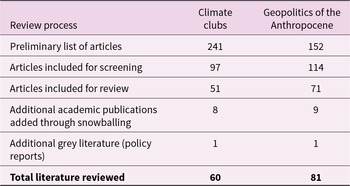
The second step is data collection, which requires the documentation of search terms, databases, and inclusion and exclusion criteria (Whittemore & Knafl, Reference Whittemore and Knafl2005). Table 1 illustrates the data collection process. Literature for this research was collected through the Dimensions database, which has been recognised as more exhaustive than Web of Science and Scopus, and featuring article classification systems that produce comparatively more accurate results (Singh et al., Reference Singh, Singh, Karmakar, Leta and Mayr2021). Studies on climate clubs were collected through the following search string: ‘climate club’ OR ‘climate coalition’ OR ‘climate minilateralism’. Literature on the geopolitics of the Anthropocene was collected through the following search string: (‘Anthropocene’ OR ‘geological epoch’) AND (‘geopolitics’ OR ‘global politics’ OR ‘political geography’ OR ‘international relations’ OR ‘IR’). The search included journal articles that were published between 2015, the year Nordhaus published his influential study on climate clubs, and 2024. Initial search of literature on climate clubs found 241 studies. The following exclusion criteria were then applied: (1) studies that do not focus on climate clubs; and (2) studies that are not published in English. This narrowed down the number of studies for screening to 97. Studies that do not engage sufficiently with the conceptual pillars of climate clubs were then filtered out, leaving a total of 51 articles. The snowballing process was used to add 8 more academic publications to the review. Lastly, 1 policy report was added.
Data collection process

The initial search for literature on geopolitics of the Anthropocene found a total of 152 studies, which were filtered by the following exclusion criteria: (1) studies that do not engage sufficiently with the geopolitics of the Anthropocene; and (2) studies that are not published in English. This reduced the number of studies to 114. Studies that focus on specific regional or local issues and do not make substantial links of case studies to the broader global phenomenon of the geopolitics of the Anthropocene were then removed. This left a total of 71 studies. The snowballing approach was used to add a further nine academic publications. The final addition was one policy report.
To implement the third step in the integrative review process, which is the evaluation of data (Whittemore & Knafl, Reference Whittemore and Knafl2005), a two-pronged criterion was used to assess the data: the relevance of the source for the research question and the methodological and theoretical rigour of the articles.
The fourth step involves the analysis of data, and this was undertaken in two steps. Firstly, in Section 3, a literature review of climate clubs and the geopolitics of the Anthropocene is undertaken to map key concepts across the two groups of studies. Secondly, in Section 4, the scholarship on the Anthropocene is used to analyse the geopolitical implications of climate clubs and critique these initiatives through the lens of justice, neoliberalism, and colonial history. The interpretation and presentation of results, which is the final step in the integrative literature review process, is implemented through two steps: In Section 5, a case study on the Mineral Security Partnership (MSP) is used to illustrate the theoretical propositions of the integrative review, and in Section 6, the implications of climate clubs for global environmental governance is discussed in detail.
2.2. Rationale for a case study on the Mineral Security Partnership
The MSP is chosen as a case study for two reasons. Firstly, the MSP focuses on international cooperation on critical minerals, which have attained significant strategic importance due to global supply chain constraints and increasing demand (IEA, 2021). This makes the MSP particularly suitable for highlighting the impact of geopolitics on the development of climate clubs. The explicit geopolitical undertones of the MSP also make it an appropriate juxtaposition to the climate clubs that are theorised within a political vacuum, such as the Nordhaus model. Secondly, the MSP offers insights that are generalisable to other climate clubs, regardless of structures, goals, or sectoral orientations, which include the implications for power, sovereignty, participation, and inequality.
3. Review of climate clubs and Anthropocene geopolitics
3.1. Climate clubs
The main premise of the burgeoning scholarship on climate clubs is that smaller, more focused initiatives that are grounded in a range of economic incentives and deterrents can harness a greater level of climate action on mitigation than overarching international frameworks (Ghosh et al., Reference Ghosh, Vijayakumar and Ray2015; Leonelli, Reference Leonelli2023; Rennkamp & Marquard, Reference Rennkamp and Marquard2017).
Arguably, one of the most influential scholars in this field is William Nordhaus, who proposes a climate club model that aims to address two critical challenges to global mitigation: countries are incentivised to ‘free-ride’ on the emissions reductions of others without implementing proportionate domestic abatement; and large climate coalitions tend to be unstable (Nordhaus, Reference Nordhaus2015a). Nordhaus’s climate club is underpinned by two policy mechanisms: an international carbon price that needs to be implemented by all members in their domestic economies, and a uniform penalty tariff across all imports from non-members into a club region (Nordhaus, Reference Nordhaus2015a, Reference Nordhaus2015b, Reference Nordhaus2020). Under this model, countries will be incentivised to join the club as long as the cost of implementing a carbon price is lower than the cost of incurring uniform tax penalties on their exports (Tarr et al., Reference Tarr, Kuznetsov, Overland and Vakulchuk2023). The findings of Nordhaus’s study show that small trade penalties against non-members can address the free rider problem in climate policy and facilitate a large, stable coalition of countries with high mitigation ambitions, which can successfully facilitate a reduction in global emissions (Nordhaus, Reference Nordhaus2021; Szulecki et al., Reference Szulecki, Overland and Smith2022).
There are broadly four types of climate clubs: Buchanan, Voluntary, Bargaining, and Pseudo. Buchanan clubs are those that focus on the production and distribution of club goods, which are often economic and only available to members (Hovi et al., Reference Hovi, Sprinz, Sælen and Underdal2016). The Nordhaus model falls under this category. A defining feature of Buchanan climate clubs are the existence of ‘sticks’, such as trade penalties and ‘carrots’, such as preferential trade arrangements (Hovi et al., Reference Hovi, Sprinz, Sælen and Underdal2016). There is some debate on the formula for calculating trade penalties for non-members, with some scholars proposing uniform trade penalties for imports from outside the club region (Nordhaus, Reference Nordhaus2021), while others suggest import taxes based on the carbon content of goods produced in non-member countries (Overland and Huda, Reference Overland and Huda2022; Tarr et al., Reference Tarr, Kuznetsov, Overland and Vakulchuk2023).
There is increasing momentum towards the formation of Buchanan climate clubs. Some scholars have pointed towards the fact that the EU’s CBAM is essentially the nucleus of a Buchanan climate club (Overland and Huda, Reference Overland and Huda2022; Szulecki et al., Reference Szulecki, Overland and Smith2022). The CBAM aims to address some of the shortcomings of the EU’s Emissions Trading System, particularly carbon leakage, which is caused by firms moving their production from countries with rigorous environmental regulations to those with lax standards. The CBAM will require importers to pay for the embedded carbon in their products, thereby encouraging higher levels of domestic carbon pricing, which will reduce carbon leakage (Yan & Yuan, Reference Yan and Yuan2023).
Voluntary clubs are similar to Buchanan as they also restrict membership and produce excludable benefits. However, Voluntary clubs confer reputational, rather than economic benefits to club members (Green, Reference Green2017). For example, certification that deems products as meeting certain environmental standards, such as the ISO 14001, can be used to enhance brand image, with such reputational benefits being restricted to members (Green, Reference Green2017).
Bargaining clubs facilitate negotiations of common objectives, targets, and policies among significant actors in a given issue area (Falkner et al., Reference Falkner, Nasiritousi and Reischl2022). Bargaining clubs restrict membership to major actors and aim to facilitate firmer international agreements. For example, the Major Economies Forum on Energy and Climate facilitates discussion on emissions reduction and sustainable development among the most important economic actors (Falkner et al., Reference Falkner, Nasiritousi and Reischl2022).
Pseudo clubs are initiatives with non-binding standards, where the cost of joining and non-compliance are low, and member benefits are negligible (Green, Reference Green2017). Also known as Normative clubs, these initiatives have open-ended memberships and aim to advocate a specific climate policy ambition (Falkner et al., Reference Falkner, Nasiritousi and Reischl2022). For example, C40 cities is a loose network of urban policymakers that share best practices in addressing climate change through advocacy and technical exchanges. While C40 has set minimal requirements for all member cities, the Leadership Standards are broadly defined and set out an inclusive approach, with no clear penalties for non-compliance (C40, 2025). Another example is the Powering Past Coal Alliance, which advocates the phase-out of coal-fired power plants through normative beliefs and not legally binding rules (Falkner et al., Reference Falkner, Nasiritousi and Reischl2022).
There is some debate within the literature on the effectiveness of climate clubs in fostering global climate action. While positive perceptions of climate clubs are dominant (La Rovere, Reference La Rovere2017; Tarr, Reference Tarr, Kuznetsov, Overland and Vakulchuk2023; Keohane et al., Reference Keohane, Petsonk and Hanafi2017; Overland and Huda, Reference Overland and Huda2022), some scholars point towards multiple challenges, such as a lack of leadership (Sprinz et al., Reference Sprinz, Sælen, Underdal and Hovi2018) and collective action problems (Zefferman, Reference Zefferman2018). The main criticism about Pseudo climate clubs is that they are unable to stop free riding due to the absence of strict compliance and oversight mechanisms (Green, Reference Green2017). Buchanan clubs with their restrictive membership and use of club goods and penalties raise a plethora of legal and ethical issues, such as potential violation of trade agreements (Leonelli, Reference Leonelli2023; Hagen & Schneider, Reference Hagen and Schneider2022) and North–South equity concerns related to the UNFCCC’s principle of common but differentiated responsibilities (Falkner et al., Reference Falkner, Nasiritousi and Reischl2022). Other challenges of Buchanan climate clubs include the governance of monitoring, reporting, and verification of embedded carbon content and domestic polarisation on climate change in the US and other major emitters (Falkner et al., Reference Falkner, Nasiritousi and Reischl2022; Szulecki et al., Reference Szulecki, Overland and Smith2022).
One of the key gaps in the literature on climate clubs is the lack of engagement with existing studies on the geopolitics of climate change. In a review of literature on climate clubs, Overland and Huda (Reference Overland and Huda2022) finds that only 7% of studies engage with geopolitics and International Relations (IR) frameworks. These studies mention the impact of climate clubs on geopolitics, such as counter-coalitions and trade wars (Casari & Tavoni, Reference Casari and Tavoni2024; Hagen & Schneider, Reference Hagen and Schneider2022), but there is a lack of systematic examination on the outcomes of these impacts on IR. A larger and more concerning gap is the lack of studies on the reverse flow of influence, that is, the impact of geopolitics on the objectives, memberships, and outcomes of climate clubs. This research gap is part of a broader disconnect between climate change and the field of IR (Keohane, Reference Keohane2015; Sending et al., Reference Sending, Øverland and Hornburg2019). Despite increasing recognition of climate change as a critical issue in peace, conflict, and coalitions, less than 4% of IR scholars in the US identify the environment as their primary area of research (Green & Hale, Reference Green and Hale2017) and only 0.77% of the articles in the field’s top five journals are about climate change (Sending et al., Reference Sending, Øverland and Hornburg2019; Overland and Huda, Reference Overland and Huda2022).
Terhalle (Reference Terhalle2013) argues that the disconnect between IR theories and climate change has led to a lack of recognition of the influence of great power conflicts in global climate governance, which in turn has impeded the development of policy measures to overcome stalemates in negotiations. Sharma (Reference Sharma2020) demonstrates that mainstream IR theories deal with climate change as a problem to be solved and not one that is actively changing the very reality of the international system through its influence on migration, sovereignty, and the distribution of power (Sending et al., Reference Sending, Øverland and Hornburg2019). The small but growing body of scholarship on the IR of the Anthropocene provides some important clues to the systemic implications of climate change.
3.2. The International Relations of the Anthropocene
The Anthropocene is a term used to describe the geological epoch during which humanity has become the largest driving force of the Earth’s biosphere (Lewis & Maslin, Reference Lewis and Maslin2015; Zalasiewicz et al., Reference Zalasiewicz, Waters, Ellis, Head, Vidas, Steffen, Thomas, Horn, Summerhayes, Leinfelder, McNeill, Galuszka, Williams, Barnosky, Richter, Gibbard, Syvitski, Jeandel, Cearreta and Zinke2021). The term ‘Anthropocene’ was introduced by Paul Crutzen in 2000 (Crutzen & Stoermer, Reference Crutzen and Stoermer2000), although the impact of human actions on the environment has been recognised as early as the 1800s (Zalasiewicz et al., Reference Zalasiewicz, Williams, Steffen and Crutzen2010). There is no universal definition of the Anthropocene, and some scholars have traced the beginning of the epoch to the industrial revolution of the 18th century, while others propose that human actions have impacted the Earth’s biosphere since the last ice age (Steffen et al., Reference Steffen, Broadgate, Deutsch, Gaffney and Ludwig2015; Zalasiewicz et al., Reference Zalasiewicz, Waters, Ellis, Head, Vidas, Steffen, Thomas, Horn, Summerhayes, Leinfelder, McNeill, Galuszka, Williams, Barnosky, Richter, Gibbard, Syvitski, Jeandel, Cearreta and Zinke2021). The Anthropocene is broader than climate change and extreme weather events, and accounts for human-induced transformations such as the nitrogen content of biosphere, species extinction, ocean acidification, and transformation of land use (Lewis & Maslin, Reference Lewis and Maslin2015).
From its initial roots in Earth Science, discourse on the Anthropocene has influenced diverse fields, including the social sciences and humanities (Simon & Thomas, Reference Simon and Thomas2022; Zalasiewicz et al., Reference Zalasiewicz, Waters, Ellis, Head, Vidas, Steffen, Thomas, Horn, Summerhayes, Leinfelder, McNeill, Galuszka, Williams, Barnosky, Richter, Gibbard, Syvitski, Jeandel, Cearreta and Zinke2021). Two key areas of academic debate in this area have been the temporal and geopolitical dimensions of the Anthropocene. In regard to the temporal lens, scholars have proposed a perspective of time that is greater in scope and scale than human civilisation, which allows the acknowledgement of short-term anthropogenic activities on long-term geological implications such as sea-level rise and loss of biodiversity (Griffiths, Reference Griffiths2023). These studies argue that climate impacts of human activities spanning only a couple of centuries will undermine planetary health for millennia (Kelz & Knappe, Reference Kelz and Knappe2021). Critiques of scholarship on temporal perspectives of the Anthropocene argue that by focusing on long time scales, these studies cultivate disengagement from contemporary human activities that are destructive for the environment, and are broadly removed from the political processes that shape global climate governance (Nordblad, Reference Nordblad2021).
Within IR, the geopolitics of the Anthropocene is a relatively new topic, but its principal concepts resonate strongly with the broader field of critical geopolitics, which questions long-held assumptions about power, sovereignty, and knowledge (Kreuter & Lederer, Reference Kreuter and Lederer2021; Toal, Reference Toal1996). The pioneers of literature on Anthropocene geopolitics such as Simon Dalby (Reference Dalby2013a, Reference Dalby2013b) and Eva Lövbrand (Lövbrand & Stripple, Reference Lövbrand and Stripple2006; Lövbrand et al., Reference Lövbrand, Stripple and Wiman2009) convincingly advocate a reorientation of the study and practice of global politics, based on the recognition by Paul Crutzen and other Earth Scientists of humanity as a geological force that is continuously altering the biosphere of the planet. Dalby connects insights from the Anthropocene to the field of IR through the following logic: In a world where humanity and the environment are inherently interrelated, and fossil-fuelled industrialisation continues to undermine planetary stability, traditional perceptions of geopolitics rooted in territorial sovereignty and great power competition are less relevant, and actions towards addressing environmental challenges become a key issue for global politics (Dalby, Reference Dalby2013b, Reference Dalby2015b, Reference Dalby2017). Lövbrand et al. (Reference Lövbrand, Beck, Chilvers, Forsyth, Hedrén, Hulme, Lidskog and Vasileiadou2015) argue that addressing the geopolitical challenges of the Anthropocene will require scholars to engage with diverse socio-ecological concepts that can facilitate constructive political engagement on the environment.
In the last two decades, a small but growing body of scholarship has built on the canonical texts described above to further explore the IR of the Anthropocene, although the field’s engagement with the epoch remains small compared to environmental science and environmental studies (Harrington, Reference Harrington2016; Lundborg, Reference Lundborg2023; Simangan, Reference Simangan2020). Simangan argues that IR literature on the Anthropocene focuses on two key themes: the process by which the existing global order contributed to contemporary environmental challenges, and the lack of IR frameworks that can propose an alternative global order that can address both environmental as well as socio-economic priorities (Simangan, Reference Simangan2020, Reference Simangan2023). On the first theme, scholars have connected neoliberal economic policies, elitist interests, and colonisation to environmental destruction (Beaumont & Wilson Rowe, Reference Beaumont and Wilson Rowe2023; Fouzdar, Reference Fouzdar2024; Simangan, Reference Simangan2019). In recognition and as a response to the second theme, Burke et al. (Reference Burke, Fishel, Mitchell, Dalby and Levine2016, p. 8) call for ‘the creation of a new institutional and social scientific project that can provide political answers to the planetary questions’, which resonates with the proposition to fundamentally restructure economies and international organisations to create a more just and environmentally sustainable planet (Bluwstein et al., Reference Bluwstein, Cavanagh and Fletcher2024; Inoue, Reference Inoue2018). The Anthropocene concept is thus considered to be a watershed moment for IR, as it asserts the primacy of planetary well-being over national interests and the enmeshment of human and non-human entities (Basu, Reference Basu2024; Chipato & Chandler Reference Chipato and Chandler2024; Fagan, Reference Fagan2017).
The Anthropocene has compelled scholars to reconfigure multiple tenets of IR, including the concept of security. For example, Harrington and Shearing (Reference Harrington and Shearing2017) critique anthropocentrism within critical, traditional, and postcolonial discourses and propose a conception of security based on ‘care’, which can bridge scalar and temporal zones and bind humans to nature. Scheffran (Reference Scheffran2023) and Holley et al. (Reference Holley, Shearing, Harrington, Kennedy and Mutongwizo2018) highlight the inadequacy of existing frameworks of environmental security to account for the challenges of the Anthropocene and suggest the use of polycentric and cooperative governance systems and restructuring of global economies and policies to address environmental challenges. Other scholars place discourses on inequality between societies and countries and colonisation within the context of the Anthropocene (D'Souza, Reference D'Souza2015; Chipato and Chandler, Reference Chipato and Chandler2023; Lobo & Hine, Reference Lobo and Hine2023).
IR literature also provides insights into the units of analysis that can be used to measure Anthropocene geopolitics. Hamilton (Reference Hamilton2016) proposes that the Anthropocene discourse has placed the carbon atom as the measure and centre of the international system. On a similar vein, Dalby (Reference Dalby2015b, p. 191) asserts that key planetary measures, which he calls ‘geo-metrics’ such as carbon dioxide concentrations, sea-levels, fossil fuel reserves, and degrees of warming have replaced state-rivalries and sovereignty as the crucial determinants of geopolitics. Geo-metrics and the processes by which the global biosphere is managed are thus the key geopolitical priorities in the Anthropocene.
While the IR of the Anthropocene remains a niche topic, some studies have provided overviews of emerging trends, debates, and gaps in existing literature. Simangan’s review of 134 articles demonstrates that while IR scholarship on the Anthropocene has provided a platform for debate on the ‘anthropocentric, Western-based and modernist approaches to environmental challenges’, the field itself underrepresents perspectives from the Global South, and favours response to environmental challenges that exclude non-human subjects (Simangan, Reference Simangan2020, p. 224). Lövbrand et al. (Reference Lövbrand, Mobjörk and Söder2020) review 52 studies to highlight three distinct themes within the literature: (1) the endangered world; (2) the entangled world; and (3) the extractivist world. The endangered world theme consists of studies that focus on the impact of environmental threats on socio-economic and geopolitical stability. These studies put emphasis on the importance of global cooperation in addressing environmental challenges that transcend boundaries. The entangled world presents a global view where the impacts of the Anthropocene are irreversible, and humanity and nature are indistinguishable. Studies under this theme reject human and state-centrism to embrace planetary and multi-species politics.
Lastly, the extractivist world perceives the Anthropocene as an outcome of the global capitalist system, which undermines societies and the environment through continuous expansion and accumulation. Under this world view, responses to the Anthropocene rooted in capitalist systems, such as carbon credits, or technological solutions, such as renewable energy, will not resolve environmental challenges. Instead, environmental stability can be achieved by moving away from competition and accumulation to less material-intensive forms of society (Lövbrand et al., Reference Lövbrand, Mobjörk and Söder2020).
4. The geopolitics of climate clubs
The review above demonstrates the dichotomy between the epistemological foundations of studies on climate clubs and those on the IR of the Anthropocene. Climate clubs are embedded in mainstream environmental theories that assume climate change as a technical problem that can be addressed by making minimal changes to the current neoliberal economic order (Castro, Reference Castro2004). Within this worldview, the key units of analysis for examining and addressing climate change are market mechanisms, economic incentives, and global trade. Conversely, scholarship on the IR of the Anthropocene perceives the current neoliberal economic system as the main driver of the climate crisis and calls for transformative change in the production and consumption of goods. This genre of studies highlights the interplays between politics, power disparities, and inequal development to critique mainstream approaches to climate change.
Climate clubs do not reflect or engage with the ideas of transformative social change and reshaping of the global economy, which are seen by Anthropocene scholars as key requirements for addressing environmental concerns (S. Dalby, Reference Dalby2020; Lövbrand et al., Reference Lövbrand, Mobjörk and Söder2020). In essence, the theoretical underpinnings of Anthropocene literature reveal climate clubs as incremental initiatives that maintain the status quo in a world that demands systematic change to address the climate crisis.
IR literature on the Anthropocene also reveals insights into the geopolitics of climate clubs. The conceptual frameworks developed by Dalby (Reference Dalby2015a), Lövbrand et al. (Reference Lövbrand, Mobjörk and Söder2020), and Simangan (Reference Simangan2020) inform a world view where climate clubs take centre-stage in global politics. IR scholarship provides two key features of geopolitics in the Anthropocene, which facilitate a shift in the perception of climate clubs as economic/environmental initiatives to a driver of geopolitics.
(a) Firstly, IR scholars of the Anthropocene not only recognise the impact of climate change on the international system but also assert that governance mechanisms that address climate change belong to ‘the heart of politics and to the biggest questions of world order that are the key matters of geopolitics’ (Dalby, Reference Dalby2014, p.11). Climate clubs, whether they are Buchanan formations, or Voluntary or Pseudo arrangements, focus on addressing climate change or other environmental challenges, making them important geopolitical entities in the Anthropocene. A climate club is part of humanity’s endeavourers towards planetary stewardship, which is problematised by IR scholars as a key issue of contention in global politics (Simangan, Reference Simangan2020, Reference Simangan2023).
Moreover, IR scholars of the Anthropocene recognise the geopolitical importance of environmental governance initiatives outside the formal confines of the UNFCCC (Barnes, Reference Barnes2022; Bellamy and Palmer, Reference Bellamy and Palmer2019; da Costa Ferreira & Barbi, Reference da Costa Ferreira and Barbi2016). The theory of climate clubs speaks to Dalby’s (2014, p. 5) understanding of ‘new ecological entities’ that are ‘crucial parts of global governance and the rivalries among states, corporations and all sorts of so-called non-governmental organisations’. The focus of the Nordhaus climate club model on addressing ‘carbon leakage’ in exports from countries with lax environmental laws has particular relevance to Dalby’s assertion (Dalby, Reference Dalby2013b, p. 44) of climate change as a ‘production problem’ and Anthropocene geopolitics as being driven by ‘the global economy and how decisions as to what gets produced will shape the future configuration of the planet and hence who is insecure where’ (Dalby, Reference Dalby2017, p. 11).
(b) Secondly, the very rationale of a climate club rests on what Dalby calls ‘geo-metrics’, key planetary measures that drive geopolitics in the Anthropocene. IR literature suggests that securing the upper limit of geo-metrics, such as emissions levels of greenhouse gases, shrinking polar caps, and acidification levels of oceans, are the crucial nodes in geopolitics, and are inherently connected to the securitisation of natural resources (Dalby, Reference Dalby2013b; Pereira & Freitas, Reference Pereira and Freitas2017; Probyn, Reference Probyn2023). This interpretation suggests that climate clubs knowingly and unknowingly imbibe geopolitical language in their declarations, commitments, and agreements by proposing to influence certain planetary metrics. For instance, the EU’s CBAM will use the geo-metrics of carbon dioxide emissions to influence international trade. The Alliance of Small Island States utilises the geo-metrics of plastic waste in oceans to push for greater climate action by the developed world. IR literature suggests that the measurement of these geo-metrics is political processes themselves, which facilitate the production of techno-politics of the Anthropocene (Boyd, Reference Boyd2016; Lövbrand et al., Reference Lövbrand, Mobjörk and Söder2020; Rothe, Reference Rothe2020).
In addition to illuminating the geopolitical context of climate clubs, IR scholarship on the Anthropocene provides a diversity of conceptual frameworks to critique these initiatives, such as justice, inequality, colonisation and neoliberalism (Agathangelou Reference Agathangelou2024; Pasha, Reference Pasha2020; Thakur and Jayaram Reference Thakur and Jayaram2024). Applying these frames to climate clubs reveals some key concerns. At the most basic level, the rejection of territorial and sovereignty-driven geopolitics by IR scholars and its emphasis on planetary security and non-human life go against the key tenets of climate clubs. Nation states, seen as redundant and broadly ineffective mechanisms to address challenges of the Anthropocene (Gonin et al., Reference Gonin, Etelain, Maniglier and Brighenti2025; D'Souza, Reference D'Souza2015), continue to be the largest and most influential player in climate clubs, notwithstanding the increasing participation of non-state stakeholders in such arrangements. The theory of a climate club divides the world into ‘enthusiastic’ and ‘reluctant’ countries (Hovi et al., Reference Hovi, Sprinz, Sælen and Underdal2016), where the former is seen as providing leadership in climate governance and using a range of sticks and carrots to entice the latter to fall in line. By reducing global climate governance to countries and cities, climate clubs facilitate what Anthropocene scholars Lövbrand and Stripple (Reference Lövbrand and Stripple2006, p. 217) have recognised much earlier as ‘the territorialisation of the global carbon cycle’.
In addition to perpetuating sovereignty and state-centric approaches to climate governance, climate clubs perpetuate parochial insider/outsider perspectives, which have been identified as a key impediment to global environmental action by IR scholars of the Anthropocene (Burke et al., Reference Burke, Fishel, Mitchell, Dalby and Levine2016). Climate clubs, through their distinction of members and non-members, are based on keeping the ‘Other’ out. The ‘Othering’ aspects of climate clubs are more pronounced in Buchanan clubs, such as the Nordhaus model, as this type of arrangement draws a deeper distinction between insiders and outsiders by promoting explicit benefits to members and penalties to non-members (Nordhaus, Reference Nordhaus2015a). The Nordhaus climate club model presents exclusion of non-members as a response to the free rider challenge in global environmental governance. ‘Othering’ is a solution to the climate crisis in club literature, while it is seen as a contributor to ecological collapse within IR scholarship of the Anthropocene.
IR discourse on the Anthropocene presents social and historical processes such as colonisation, patriarchy, gender, and race as key drivers of environmental damage and asserts their recognition within mitigation and adaptation mechanisms (S. Dalby, Reference Dalby2020; Simangan, Reference Simangan2023; Tamminaina, Reference Tamminaina2024). The Nordhaus model of climate club proposes a universal price for carbon as a prerequisite for membership, irrespective of the country’s level of economic development, history of colonisation and imperialism, insurgencies, or natural disasters. Simangan (Reference Simangan2020, p. 221) critiques such universal delegation of accountability by arguing that ‘when allocating culpability and responsibility, it seems unjust not to differentiate between economies that participated earlier in environmentally harmful mass production and consumption and global South economies that started using the same engines of capitalism for economic development only later’.
Climate justice, particularly in recognition of the rights of vulnerable communities and indigenous knowledge are perceived by IR scholarship as important elements of global climate governance (Inoue, Reference Inoue2018; McDonald, Reference McDonald2024; Stephens & Surprise, Reference Stephens and Surprise2020), while such issues are almost completely absent in club scholarship, apart from some recommendations to facilitate energy transition and climate finance in the Global South (Rennkamp & Marquard, Reference Rennkamp and Marquard2017).
IR scholars of the Anthropocene express scepticism in mitigation mechanisms rooted in the same neoliberal system of governance that resulted in the climate crisis in the first place. Lövbrand et al. (Reference Lövbrand, Mobjörk and Söder2020, p. 5) argue that addressing the environmental destruction caused by the continuous expansion of the fossil-fuelled capitalist system will require moving away from ‘marketized solutions such as emissions trading or carbon offsetting and search for security beyond the circuits of capital’. Dalby (Reference Dalby2014, p. 13) places the commodification of carbon through offsets, carbon markets and new financial instruments within the broader phenomenon of ‘climate neoliberalism’, which has not reduced overall fossil fuel consumption, but entrenched market logics in climate policies (Albert, Reference Albert2025; Dalby, Reference Dalby2015b). Climate club models are deeply rooted in the global capitalist system, particularly international trade (Hovi et al., Reference Hovi, Sprinz, Sælen and Underdal2019; Nordhaus Reference Nordhaus2015a). Buchanan climate clubs rely on the tools of climate neoliberalism, such as carbon tax or cap and trade, which, along with technological solutions such as renewable energy deployment, have been framed by Lövbrand et al. (Reference Lövbrand, Mobjörk and Söder2020, p. 5) as ‘fiddling at the edges of carboniferous capitalism’, which is in effect an acceptance or even a facilitation of ecological collapse.
The prioritisation within climate clubs of an ‘enthusiastic’ group of countries (Hovi et al., Reference Hovi, Sprinz, Sælen and Underdal2016) that can provide leadership in global mitigation efforts is in stark contrast to the warnings by Anthropocene scholars that small groups of elites that exert disproportionate control of the management of the climate crisis are likely to undermine both environment and social justice (Dalby 2014; Lövbrand et al., Reference Lövbrand, Mobjörk and Söder2020). An issue of greater concern is that enthusiastic countries that drive climate clubs consist almost exclusively of rich and industrialised nations, both in practice and theory. The G7 Climate Club and the EU’s CBAM are initiated by developed countries, while academic proposals for climate clubs also highlight leadership roles by the EU or the US (Hovi et al., Reference Hovi, Sprinz, Sælen and Underdal2019; Leonelli, Reference Leonelli2023). In climate club literature, countries in the Global South either adopt or confront the climate policies led by the West but seldom provide leadership. Dalby (Reference Dalby2014, p. 12) argues that market solutions such as carbon taxes and cap and trade schemes attempt to reduce emissions while ‘not threatening the power structures that have caused the problems in the first place’.
Perceived through an Anthropocene lens, climate clubs are initiatives by developed nations that are historically responsible for climate change to reduce emissions while maintaining the status quo. The impact of the carbon sink industry on forests and local populations demonstrates that the carbon economy led by the Global North can exacerbate disparities in power and wealth and increase the vulnerability of marginalised communities in the Global South (S. Dalby, Reference Dalby2020).
An Anthropocene framework informs that geopolitics will have important impacts on the formation of a climate club. The confluence of geopolitics and club dynamics may lead to the development of ‘geo-metric’ climate clubs. Drawing from the synthesis in the preceding sections, I present four theoretical propositions:
1. Geo-metric climate clubs are key mechanisms of geopolitics;
2. Geo-metric climate clubs are regressive models of state-centric and sovereignty-informed climate policies;
3. Geo-metric climate clubs are elitist structures that perpetuate the concentration of power between Western elites; and
4. Geo-metric climate clubs can exacerbate inequality and disenfranchisement while doing little to reduce emissions.
In the following section, these theoretical propositions are clarified through a case study on the MSP.
5 The Mineral Security Partnership as a geo-metric climate club
The MSP was formed in 2022 by the US and its strategic allies as a mechanism for asserting political control over supply chains of ‘critical minerals’,Footnote 3 which are mined raw materials used in the production of clean energy technologies (Vivoda, Reference Vivoda2023). The members of MSP are Australia, Canada, Finland, France, Germany, India, Italy, Japan, Norway, the Republic of Korea, Sweden, the United Kingdom, the US, and the EU (Vivoda & Matthews, Reference Vivoda and Matthews2023). The critical minerals governed by the MSP include, but are not limited to, lithium, cobalt, nickel, manganese, graphite, rare earth elements, and copper (USDOS, 2023).
The MSP operates through working groups that identify critical mineral projects and evaluate their compatibility with its strategic objectives and environmental and social safeguards. The public statement by MSP, titled ‘Principles for Responsible Critical Mineral Supply Chains’, envisions the development of high environmental, social, and governance (ESG) standards, increased transparency, accountability, and raw material traceability, which collectively will contribute to resilience, sustainability, and national security (USDOS, 2023). In the following section, I engage with emerging literature on the MSP (Beaumont & Wilson Rowe, Reference Beaumont and Wilson Rowe2023; Vivoda, Reference Vivoda2023) to examine the phenomenon of a geo-metric climate club within a real-world setting. The analysis evaluates the MSP through the four theoretical propositions of a geo-metric climate club identified above.
5.1 Is the MSP a mechanism of geopolitics?
On paper, the focus of the MSP is not overtly geopolitical, as although it aims to diversify supply chains to enhance national security, it also recognises the need to collectively govern the externalities of critical mineral production (USDOS, 2023). However, academic critique of the MSP provides insights into the almost exclusive geopolitical underpinnings that drove the development of the initiative. Vivoda (Reference Vivoda2023) traces the development of the MSP to the concept of ‘friend shoring’, which was introduced by the White House in 2021 as a key mechanism for developing resilient supply chains of key strategic resources, including critical minerals (White House, 2021; Vivoda, Reference Vivoda2023). Maihold defines friend-shoring as ‘the spatial reordering of supply chains under the criterion of political convergence’ (Maihold, Reference Maihold2022, p. 6; Vivoda, Reference Vivoda2023). The author argues that friend-shoring ‘draws supply chains into the sphere of geo-political rivalry and the division of the world into free-market democracies and allies of the authoritarian regimes of China and Russia. One central motive for friend-shoring is the desire for greater independence from suppliers whose autocratic disposition creates dangers of political blackmail and economic coercion’ (Maihold, Reference Maihold2022, p. 2).
Vivoda proposes that the MSP ‘is the first example of friend-shoring put into practice in an institutionalised setting’ and has the unstated objective of preventing authoritarian nations from using critical mineral supply chains as a geopolitical weapon (Vivoda, Reference Vivoda2023, p. 5). These concerns arise due to the control of critical mineral supply chains by a handful of countries. Currently, China extracts around 60% and processes 85% of the world’s rare earth elements and also dominates the processing of copper, lithium, and cobalt (IEA, 2021). Russia is one of the world’s largest exporters of nickel and palladium. Vivoda (Reference Vivoda2023) argues that while in theory, membership in the MSP is open to all countries, the initiative is defined by the exclusion of China and Russia, which are strategic rivals of the US and Europe.
Within IR scholarship on the Anthropocene, governance mechanisms that address climate change are key drivers of geopolitical rivalries and strategic competition (S. Dalby, Reference Dalby2020), which resonates with the MSP’s conceptual roots in friend-shoring and the securitised discourse on critical minerals. Any reservations about the strategic objectives of the MSP are laid to rest by its nomenclature as the ‘NATO for metals and minerals’ – a reference to membership being restricted to Western countries and their allies (Vivoda, Reference Vivoda2023; Wurmser, Reference Wurmser2022).
5.2 Is the MSP a vehicle of state-centric and sovereignty-informed climate policies?
The primary members of the MSP are state actors, and the main goal of the initiative is to facilitate cooperation between governments (USDOS, 2023). Seen through the lens of the IR of the Anthropocene, MSP facilitates the ‘territorialisation’ of critical mineral policies, by restricting membership and cooperation to a limited number and category of stakeholders (Lövbrand & Stripple, Reference Lövbrand and Stripple2006). MSP’s territorial nature is further emphasised by its distinction between ‘outsiders’ and ‘insiders’, which in the context of climate club literature (Nordhaus, Reference Nordhaus2015a) is the grouping of countries as ‘enthusiastic’ (13-member countries of the MSP) or ‘reluctant’ (all non-member countries). Vivoda et al. (Reference Vivoda, Matthews and McGregor2024, p. 1) argue that this restrictive membership of the MSP has divided the world into distinct ‘geopolitical trading blocs’, which pits countries of the MSP against Russia and China.
While the MSP puts emphasis on international cooperation, one of the drivers of the initiative is growing nationalistic sentiments within the US, which drives policy efforts towards utilising domestic resources and developing local high-tech industries (Davidson et al., Reference Davidson, Karplus, Lewis, Nahm and Wang2022). Similar to other climate clubs such as the EU CBAM, the rationale of the MSP is rooted in the development and, in some sense, the protection of national industries from cheaper imports (Overland and Huda, Reference Overland and Huda2022). The MSP is thus driven by the interests of states and political coalitions. While such interests are key to the development of climate clubs (Nordhaus, Reference Nordhaus2021), they are considered by Anthropocene scholars as insufficient and, in some cases, detrimental towards addressing climate change (S. Dalby, Reference Dalby2020).
5.3 Is the MSP an elitist organisation that perpetuates the concentration of power by the West?
Similar to the EU CBAM and the G7 Climate Club, the MSP’s leadership is dominated by rich industrialised nations. All member countries of the MSP except India are also members of the Organisation for Economic Cooperation and Development (OECD), a group of high-income economies that collectively account for 50% of global GDP (Beaumont & Wilson Rowe, Reference Beaumont and Wilson Rowe2023; OECD, 2020). However, like all climate clubs, the MSP looks to expand its membership and engages with a broader group of countries that play important roles in critical mineral supply chains. For example, the MSP Ministerial Meeting in 2022 featured the 13-member countries as well as Argentina, Brazil, the Democratic Republic of Congo, Mongolia, Mozambique, Namibia, Tanzania, and Zambia. In 2023, the MSP facilitated a meeting on developing ESG standards, which included the non-member countries of Angola, Botswana, South Africa, and Uganda, among others (USDOS, 2023).
Vivoda and Matthews (Reference Vivoda and Matthews2023) argue that the MSP should extend membership to a broader group of nations to enhance diversification and economic cooperation, which can include mineral-rich Brazil and Chile or countries that can finance processing and extraction activities, such as Singapore and Saudi Arabia. Yet, while membership expansion can diversify the composition of the MSP, leadership and decision-making is likely to be provided by the 13 core members, at least in the interim period. In the context of climate club theories, the West and a handful of key allies are likely to yield the ‘sticks’ and ‘carrots’ that ensure that new MSP members toe the geopolitical line and ESG requirements to retain membership. Vivoda et al. (Reference Vivoda, Matthews and McGregor2024) argue that the MSP is not only a coalition for resource security but an effort to reshape global supply chains in line with the interests of the West. Anthropocene scholars argue that the primary objective of climate initiatives that are led by elites is to perpetuate existing power structures (Dalby, Reference Dalby2014; Lövbrand et al., 2022). The MSP is thus an institution that is led by and serves the elite interests of the West and its allies.
5.4 Can the MSP exacerbate inequality while having a negligible impact on mitigating climate change?
There is increasing concern that developing countries will pay disproportionate economic costs of friend-shoring and other protectionist measures (Kalantzakos, Reference Kalantzakos2023). Rajan (Reference Rajan2023) proposes that friend-shoring will exclude the Global South from participating in international trade, thereby increasing unemployment and poverty, which can increase extremism and even raise the risk of failed states. A study by Javorcik et al. (Reference Javorcik, Kitzmüller, Schweiger and Yıldırım2024) finds that while friend-shoring is costly for many economies and can lead to real output losses of up to to 4.7% of GDP, the biggest negative impacts will be felt by developing countries in Central and Southeast Asia and North Africa.
The MSP, like the climate clubs theorised by Nordhaus (Reference Nordhaus2021) or implemented via the EU CBAM, does not differentiate between developed and developing economies or consider the West’s responsibility for historical emissions or injustices such as colonisation. The MSP applies stringent ESG standards to all countries involved in the critical mineral supply chains, irrespective of their economic, social, and technological capabilities (USDOS, 2023). Developing countries that are unable to meet such standards due to existing weaknesses in governance capacitates can end up losing valuable export markets (Beaumont & Wilson Rowe, Reference Beaumont and Wilson Rowe2023; Rajan, Reference Rajan2023). In addition, given that the MSP is broadly a geopolitical initiative, developing countries can be denied membership or investments due to their strategic relationships with China or India, even if they meet high ESG standards.
A bigger concern regarding the MSP is whether it can contribute towards energy transition and emissions reduction. While Vivoda (Reference Vivoda2023) proposes that the MSP can enhance supply chains of critical minerals and thereby accelerate energy transition, Anthropocene scholars argue that climate mechanisms rooted in neoliberal systems of governance exacerbate inequalities, while doing little to reduce emissions (Simangan, Reference Simangan2023; Lövbrand et al., Reference Lövbrand, Mobjörk and Söder2020). Although the MSP has geopolitical goals, it will also have significant implications on markets, particularly in the context of investments by mining conglomerates in extraction, processing and refining (Beaumont & Wilson Rowe, Reference Beaumont and Wilson Rowe2023). Dalby (Reference Dalby2015a) and Lövbrand et al. (Reference Lövbrand, Mobjörk and Söder2020) argue that instead of marketised solutions, emissions reductions will require moving away from material-intensive means of production and competitive zero-sum approaches to resources. Similar themes of restructuring the global economy and geopolitics have also been mentioned in studies on critical minerals (Ali et al., Reference Ali, Kalantzakos, Eggert, Gauss, Karayannopoulos, Klinger, Pu, Vekasi and Perrons2022; Bonsu, Reference Bonsu2020; Christmann, Reference Christmann2021).
While it is too early to determine the impact of the MSP on inequality, there is a possibility that it can exacerbate the gap between developing and developed countries. The MSP’s strategic frame and use of market mechanisms is unlikely to address the root causes of the climate crisis and, according to Anthropocene scholarship, may even accelerate ecological collapse.
6 Discussion
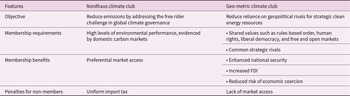
The case study on the MSP provides insights into a real-world manifestation of the theory of a geo-metric climate club. The findings also point towards key differences between the theorisation of climate clubs within a political vacuum and their actual implementation in a geopolitical context. Table 2 compares features of the climate club proposed by Nordhaus (Reference Nordhaus2021) and a geo-metric climate club.
Nordhaus climate club vs geo-metric climate club

The objective of the Nordhaus climate club is to reduce emissions by addressing the crucial free rider challenge in global climate governance, while the main aim of a geo-metric climate club is to reduce reliance on rivals for strategic clean energy resources. The membership requirement in a Nordhaus club is environmental performance, and membership benefits are in the form of preferential market access, while non-members pay import taxes. A geo-metric climate club restricts membership to countries that share not only values, such as democracy, but also common aversions in the form of the same strategic rivals. Membership benefits in this type of climate club are in the form of enhanced national security and investment inflows from other members, while penalties to non-members, who are strategic rivals, are exclusion from participating in certain markets or supply chains.
The analysis of this paper does not aim to suggest that all climate clubs will exactly replicate the attributes of geo-metric climate clubs. It is more likely that emerging initiatives, such as the G7’s Climate Club, will have features of both the Nordhaus as well as the geo-metric model. The MSP is a more apparent example of a geo-metric climate club due to the strategic interests related to critical minerals supply chains. Whether a climate club prioritises control of resources or environmental cooperation is likely to depend on the issue the club aims to address, and the intensity and complexity of geopolitical conflicts between Great Powers. Regardless of their objectives, the mutual constitution between climate clubs and geopolitics is likely to have important implications for global climate governance. At the risk of speculation, two potential implications of climate clubs for global environmental governance are given below.
Firstly, climate clubs are likely to accelerate the bifurcation of global environmental efforts and provide institutional frameworks for formalising the contemporary resurgence of mini-lateralism. Climate clubs are likely to fragment the world into multiple geo-metric blocs (Overland & Huda, Reference Overland and Huda2022; Beaumont & Wilson Rowe, Reference Beaumont and Wilson Rowe2023). While the initial climate clubs will be led by the West and its allies, they will be matched by counter coalitions led by Russia, China, and other members of the developing world. As mentioned earlier, the International Economic and Trade Cooperation Initiative on Green Mining and Minerals is China’s response to the US-led MSP. The development of climate clubs will be influenced by the increasing securitisation of key resources, which are directly and indirectly related to mitigation, such as semi-conductors, the digital space, and human resources (Albert, Reference Albert2025; Huda, Reference Huda2024, Reference Huda2025).
Climate clubs will provide formal processes for implementing a renewed interest in a minilateral approach towards cooperating on a range of issues, including energy and climate change, by groupings as diverse as France, India, and the UAE (I2U2) and Bangladesh, Bhutan, India, Myanmar, Nepal, Sri Lanka, and Thailand (BIMSTEC). Existing minilateral initiatives that were originally envisioned as mechanisms for strategic coordination, such as the Quadrilateral Security Dialogue, are likely to experiment with club approaches to energy and the environment, as lines between geopolitics and climate become increasingly blurred (Huda, Reference Huda2023). The impact of the confluence of geopolitics and climate clubs towards addressing global environmental challenges is yet to be established – some scholarship highlights that competition arising out of bifurcation can enhance innovation, while others suggest that a fractured approach can undermine both mitigation and adaptation (Alfaro & Chor, Reference Alfaro and Chor2023; O'Neill et al., Reference O'Neill, Kriegler, Ebi, Kemp-Benedict, Riahi, Rothman, Van Ruijven, Van Vuuren, Birkmann, Kok and Levy2017).
Secondly, climate clubs are likely to undermine the delayed but increasing recognition of justice and inequality within global environmental governance mechanisms. The focus of climate clubs on strategic control of resources or universal responsibility for emissions contrasts with multiple contemporary initiatives under the COP process to advance a just transition, which includes the establishment of the Just Energy Transition Partnership (JETP) at COP 26 and the Loss and Damage Fund at COP 28. These initiatives under the UNFCCC can be perceived as an acknowledgement by developed nations of their historical responsibility to account for the current climatic vulnerabilities of developing countries and have led to incremental progress towards enhancing trust between Annex 1 and Non-Annex 1 countries, as well as the drafting of detailed national mitigation plans (Ha-Duong, Reference Ha-Duong2023).
Climate clubs do not acknowledge historical responsibilities or the agency of developing countries to undertake environmental programmes that meet their particular socio-economic and political goals. The objectives of some climate clubs are to coerce developing countries to align with specific geopolitical worldviews or incorporate high, and at times unattainable environmental standards, failing which they will be excluded from international markets. Developing countries see climate clubs as mechanisms used by the West to protect its own economic and geopolitical interests, with little impact on addressing climate change (Vivoda & Matthews, Reference Vivoda and Matthews2023; Falkner et al., Reference Falkner, Nasiritousi and Reischl2022). These initiatives can thus exacerbate the key problem of global environmental governance – the inequitable distribution of wealth and resources, which can further erode trust in multilateral cooperation (Falkner et al., Reference Falkner, Nasiritousi and Reischl2022).
In summary, climate clubs represent a status quo response to a crisis that requires systematic change in social, political, and economic systems. The analysis above indicates that climate clubs are unlikely to address economic disparities, address historical injustices, or facilitate higher levels of trust, coordination, and fund transfers that are critical for enhancing global climate governance.
7. Conclusion
Climate clubs have been conceptualised as potential solutions to the incremental progress in global environmental cooperation. However, the conceptual lens of Anthropocene geopolitics shows that climate clubs are state-centric, neoliberal, and elitist instruments of perpetuating great power rivalries. These initiatives are likely to do little to address the root causes of the climate crisis as they relate to inequal power structures, parochial nationalism, top-down models of governance, historical injustice, and uneven economic growth. More importantly, climate clubs will exacerbate rather than mitigate two important impediments to environmental cooperation: geopolitical conflicts and mistrust between stakeholders.
Contemporary UNFCCC initiatives such as the JETP and the Loss and Damage Fund have garnered a certain level of cautious optimism in environmental cooperation, indicating that governance mechanisms that engage with the core issues of inclusion and justice generate greater levels of buy-in. In this context, the role of climate clubs should be to contribute and not detract from global cooperation. Pseudo climate clubs can complement the UNFCCC process by enhancing capacity, increasing the exchange of best practices, developing consensus on collaborative approaches, and drawing attention towards key gaps in finance and technology. While Buchanan climate clubs may resolve inefficiencies in theory, international agreements on phasing out fossil fuels that are buttressed by green financial flows are likely to be more effective towards increasing climate ambitions in the developing world (Falkner et al., Reference Falkner, Nasiritousi and Reischl2022).
Scholarship on climate clubs can benefit from a greater appreciation of the geopolitical objectives of these initiatives and their long-term implications for global climate governance. Studies on the impact of geo-metric climate clubs on existing coalitions, international trade and strategic competition will be particularly useful for illuminating the potential impact on the UNFCCC process. Future scholarship on climate clubs should address the gap in research that incorporates the perspectives of developing countries, the civil society, and community members. This expanded scope can draw attention to issues such as social justice, inequality, and representation in the context of climate clubs, which are subjects that have been largely ignored in contemporary literature. Research in these areas can shed light on how climate clubs can address the specific needs of countries in the Global South.
Climate clubs have been presented as a solution to the existing challenges of multilateral climate cooperation. Yet, the theoretical lens of Anthropocene geopolitics demonstrates that climate clubs, in their current conceptualisation, are likely to entrench and not resolve the key issues that undermine the multilateral process, such as inequal distribution of power and resources, neoliberal systems of governance, mistrust, and geopolitical conflicts. Resolving these challenges will require inclusive, transparent, and time-bound cooperation that facilitates the free flow of finance, technology, expertise, and natural resources.
Author contributions
The article was conceptualised and drafted by the sole author, Mirza Sadaqat Huda.
Funding statement
This research received no specific grant from any funding agency, commercial, or not-for-profit sectors.
Competing interests
Author Mirza Sadaqat Huda declares none.
Research transparency and reproducibility
Data can be made available upon request.

 Open access

