





Introduction
The perinatal period is a critical developmental stage during which mothers and their offspring are particularly vulnerable to psychosocial adversity (Coussons-Read, Reference Coussons-Read2013). A diverse range of factors, including maternal mental health, traumatic experiences, socioeconomic deprivation, and pollution, have been found to affect children’s health through their influence on both the prenatal (e.g., intrauterine, endocrine, inflammatory, and epigenetic pathways; Parker & Douglas, Reference Parker and Douglas2010; Thornton, Reference Thornton2010) and the postnatal (e.g., poorer behavioral mother-child interactions; Jagtap et al., Reference Jagtap, Jagtap, Jagtap, Lamture and Gomase2023; Ward & Lee, Reference Ward and Lee2020) environments. Exposure to stress is particularly important early in life given rapid changes in fetal and infant neurodevelopment across the perinatal period, including neural proliferation and migration, synapse formation, and myelination (Buss et al., Reference Buss, Entringer, Swanson and Wadhwa2012). Indeed, researchers have posited that perinatal stress adversely affects these developmental processes, which in turn can impair the long-term health and functioning of offspring (Nidey et al., Reference Nidey, Momany, Strathearn, Carter, Wehby, Bao, Xu, Scheiber, Tabb, Froehlich and Ryckman2021; R. Robinson et al., Reference Robinson, Lahti-Pulkkinen, Heinonen, Reynolds and Räikkönen2019).
Difficulties in cognitive and executive functioning are common in offspring exposed to early adversity (Gur et al., Reference Gur, Moore, Rosen, Barzilay, Roalf, Calkins, Ruparel, Scott, Almasy, Satterthwaite, Shinohara and Gur2019; Wade et al., Reference Wade, Wright and Finegold2022). For example, learning difficulties (Hanson et al., Reference Hanson, van den Bos, Roeber, Rudolph, Davidson and Pollak2017), cognitive impairments (Spratt et al., Reference Spratt, Friedenberg, Swenson, Larosa, De Bellis, Macias, Summer, Hulsey, Runyan and Brady2012; Wade et al., Reference Wade, Wright and Finegold2022), and attention problems (Makris et al., Reference Makris, Eleftheriades and Pervanidou2023) have been documented in youth exposed to stress and pose serious challenges for adaptive functioning (McGinnis et al., Reference McGinnis, Sheridan and Copeland2022). Attention is an essential domain of cognitive control, given that it underlies other higher-order cognitive skills and is important for behavioral regulation. Attention problems have increasingly been documented to be a consequence of early adversity; indeed, in a recent review, Makris et al. (Reference Makris, Eleftheriades and Pervanidou2023) suggest that early life stress places children at disproportionate risk for attention deficit hyperactivity disorder (ADHD) by increasing inflammatory cytokines and other regulatory hormones important in neurodevelopment. Makris et al. (Reference Makris, Eleftheriades and Pervanidou2023) indicate further that these effects are particularly pronounced in the prenatal period, during which the intrauterine environment allows for direct transmission to the fetus of stress-linked biological factors, including maternal hormones, in a process known as fetal programing. Mother-to-fetus biological signaling shapes the fetus’ neural development and stress response physiology that may contribute to offsprings’ risk for subsequent cognitive and behavioral difficulties. Indeed, explicit links between early stress and attention problems have been reported in animal studies. For example, Kim et al. (Reference Kim, Yoo, Yoo, Suh, Lee, Park, Lee, Baik, Kim and Woo2020) found that separation of rat pups from their mother at birth, a common stress-induction paradigm, increases impulsivity and attention difficulties in offspring, which often precede depression-like phenotypes when pups reach adolescence. This association between cognitive or attentional impairment and internalizing symptoms has also been noted in studies of early life stress in humans; Mao et al. (Reference Mao, Xiao, Ding and Qiu2020), for example, found that both attention deficits and within-network connectivity of the ventral attention network mediate the relation between early adversity and the emergence of later internalizing problems in young adults. Despite robust evidence of links between early stress and attention-related alterations in neurodevelopment, however, it is not yet clear how the timing of stress exposure (e.g., prenatal versus postnatal) differentially influences risk for the development of attentional deficits in youth.
There is emerging evidence that the timing of stressors is an important aspect of early stress exposure. Researchers investigating temporal specificity in stress exposure often distinguish between pre- and postnatal experiences (R. Robinson et al., Reference Robinson, Lahti-Pulkkinen, Heinonen, Reynolds and Räikkönen2019), given differences between these two developmental periods in stress transmission mechanisms and subsequent behavioral outcomes (Lin et al., Reference Lin, Xu, Huang, Jia, Zhang, Yan and Zhang2017). Given the role of attention in scaffolding cognitive and behavioral functioning, delineating developmental periods in which stress may significantly influence long-term attentional outcomes is important for supporting children’s cognitive functioning and well-being. In one study assessing ADHD symptoms in a sample of 214 youth ages 9–14 years, Humphreys et al. (Reference Humphreys, Watts, Dennis, King, Thompson and Gotlib2019) reported an association between the number of stressful life events and the severity of ADHD symptoms. Although this association was not moderated by age of exposure to the stressor, it is important to note that Humphreys et al., did not assess stress prospectively, nor did they assess exposure during the perinatal period. Other researchers examining stress exposure earlier in life (e.g., McLaughlin et al. (Reference McLaughlin, Sheridan, Winter, Fox, Zeanah and Nelson2014), Ronald et al. (Reference Ronald, Pennell and Whitehouse2011)) have reported associations between either pre- or postnatal stress and attention problems; however, stress is rarely assessed in both developmental periods in the same cohort. Moreover, previous studies of perinatal stress and attentional problems have often focused on attentional challenges during the first years of life, which predate the emergence and diagnosis of ADHD symptoms in the majority of children (Nigg et al., Reference Nigg, Sibley, Thapar and Karalunas2020). To date, no studies have examined prospective associations between pre- and postnatal stress exposure and attention problems longitudinally in school-aged children, when attention problems often emerge. Further, it is not clear whether stress experienced during the pre- versus postnatal periods shapes neural development through distinct pathways that are relevant for attention.
In this context, early stress has been found to have significant effects on the development of brain regions important for attention, including the nucleus accumbens (NAcc), a subregion of the basal forebrain that is central in organizing goal-directed behavior via projections to frontal and limbic regions and is often described as the anchor of the reward network (Haber & Knutson, Reference Haber and Knutson2010). In fact, youth with attention problems who have experienced high levels of psychosocial stress have been found to exhibit altered reward processing (von Rhein et al., Reference von Rhein, Cools, Zwiers, van der Schaaf, Franke, Luman, Oosterlaan, Heslenfeld, Hoekstra, Hartman, Faraone, van Rooij, van Dongen, Lojowska, Mennes and Buitelaar2015) and aberrant development of the NAcc and ventral striatum more broadly (Kappel et al., Reference Kappel, Lorenz, Streifling, Renneberg, Lehmkuhl, Ströhle, Salbach-Andrae and Beck2015; van Hulst et al., Reference van Hulst, de Zeeuw, Bos, Rijks, Neggers and Durston2017). Further, research with both humans and animals indicates that following exposure to stress NAcc structure and function are associated with significant interindividual variation in attentional processes such as impulsivity, reward learning, and motivation seeking (Basar et al., Reference Basar, Sesia, Groenewegen, Steinbusch, Visser-Vandewalle and Temel2010; Berridge & Robinson, Reference Berridge and Robinson2003; Boecker et al., Reference Boecker, Holz, Buchmann, Blomeyer, Plichta, Wolf, Baumeister, Meyer-Lindenberg, Banaschewski, Brandeis and Laucht2014; Hanson et al., Reference Hanson, Albert, Iselin, Carré, Dodge and Hariri2016). Specifically, compared to control animals, rats exposed to early stress exhibit changes in the dendritic morphology of the NAcc, with reduced length and spine density (Monroy et al., Reference Monroy, Hernández-Torres and Flores2010). In addition, NAcc core and shell lesions modulate the flexible allocation of attention such that interference from background stimuli is more pervasive, outcompeting task-relevant information and inducing easy distractibility (Ammassari-Teule et al., Reference Ammassari-Teule, Restivo and Passino2000; Jongen-Rêlo et al., Reference Jongen-Rêlo, Kaufmann and Feldon2003; Montaron & Fabre-Thorpe, Reference Montaron and Fabre-Thorpe1996). Studies of the spontaneously hypertensive rat, perhaps the most frequently used animal model of ADHD that recapitulates core symptoms including attention deficits, hyperactivity, and impulsivity, have documented impaired dopamine release in the NAcc (D. Kim et al., Reference Kim, Yadav and Song2024; Leffa et al., Reference Leffa, Panzenhagen, Salvi, Bau, Pires, Torres, Rohde, Rovaris and Grevet2019) along with increased D1 and D5 receptor density compared to control rats (Li et al., Reference Li, Lu, Antonio, Mak, Rudd, Fan and Yew2007). While animal models provide valuable insights about neurobiological mechanisms that might underlie certain ADHD-like behaviors, they may not fully capture the complexity of the disorder in humans, particularly with respect to modeling inattention symptoms that are more challenging to replicate in rodents compared to hyperactivity and impulsivity.
In humans, researchers have reported that sensitivity to early life stress is associated with blunted trajectories of NAcc activation across development, which in turn predict more severe externalizing psychopathology in boys (Borchers et al., Reference Borchers, Yuan, Leong, Jo, Chahal, Ryu, Nam, Coury and Gotlib2024). Further, studies of individuals with ADHD indicate that common features of ADHD symptomatology are associated with altered NAcc functional connectivity with frontal regions (Mukherjee et al., Reference Mukherjee, Vilgis, Rhoads, Chahal, Fassbender, Leibenluft, Dixon, Pakyurek, van den Bos, Hinshaw, Guyer and Schweitzer2022) and, interestingly, with reduced binding of dopamine transporters relative to healthy controls (Volkow et al., Reference Volkow, Wang, Kollins, Wigal, Newcorn, Telang, Fowler, Zhu, Logan, Ma, Pradhan, Wong and Swanson2009). Although ADHD is often characterized as a disorder of inattention, hyperactivity, and impulsivity, emerging research suggests that it also involves core deficits in reward-related circuitry including the NAcc. For example, using PET imaging, Volkow et al. (Reference Volkow, Wang, Newcorn, Kollins, Wigal, Telang, Fowler, Goldstein, Klein, Logan, Wong and Swanson2010) demonstrated that D2/D3 receptor densities and transporter availability in the NAcc were significantly associated with motivational deficits in adults with ADHD, which in turn were associated with poorer attention. Importantly, this research suggests the NAcc plays a key role in attentional processes and is susceptible to early adversity through its extensive connections with other stress-sensitive regions such as the hippocampus, amygdala, and prefrontal cortex (Campioni et al., Reference Campioni, Xu and McGehee2009; Madur et al., Reference Madur, Ineichen, Bergamini, Greter, Poggi, Cuomo-Haymour, Sigrist, Sych, Paterna, Bornemann, Viollet, Fernandez-Albert, Alanis-Lobato, Hengerer and Pryce2023).
While few studies have characterized normative trajectories of NAcc structural development across childhood, exposure to early stress has been found to be associated with alterations in NAcc structure/function and increased risk for attention problems. Therefore, middle childhood, which immediately precedes the typical onset of symptoms, may be a key window during which to examine NAcc development in order to gain a more comprehensive understanding of how early stress affects NAcc structure, in turn increasing risk for attention difficulties. To date, however, no studies have explicitly examined this formulation or the possible differential effects of pre- vs. postnatal stress on NAcc development. Given the sensitivity of the NAcc to environmental stress (Borchers et al., Reference Borchers, Yuan, Leong, Jo, Chahal, Ryu, Nam, Coury and Gotlib2024) combined with research indicating that stress tends to blunt subcortical neurodevelopment (Aghamohammadi-Sereshki et al., Reference Aghamohammadi-Sereshki, Coupland, Silverstone, Huang, Hegadoren, Carter, Seres and Malykhin2021; Fowler et al., Reference Fowler, Bogdan and Gaffrey2021; Frodl et al., Reference Frodl, Janowitz, Schmaal, Tozzi, Dobrowolny, Stein, Veltman, Wittfeld, Erp, Jahanshad, Block, Hegenscheid, Völzke, Lagopoulos, Hatton, Hickie, Frey, Carballedo, Brooks and Grabe2016; Humphreys et al., Reference Humphreys, Watts, Dennis, King, Thompson and Gotlib2019) and that smaller NAcc and ventral striatum volumes are associated with attention deficits (Kappel et al., Reference Kappel, Lorenz, Streifling, Renneberg, Lehmkuhl, Ströhle, Salbach-Andrae and Beck2015), the NAcc is a plausible candidate linking early exposure to stress with attention problems in childhood.
The current study was designed to examine the relation between diverse measures of perinatal adversity and attention problems, including inattention, hyperactivity, and impulsivity, longitudinally in a large sample of youth. Given possible differential effects of earlier versus later stress exposure on neurocognitive development and the diverse and often co-occurring nature of early stress, we conducted separate factor analyses on measures of pre- and postnatal adversity. We predicted that higher scores on the resultant factor(s) will be associated with greater attention problems and, further, given the central role of the NAcc in impulsivity and attention, that smaller NAcc volume in offspring will mediate the positive associations between perinatal adversity and subsequent attention problems.
Methods
Participants and study design
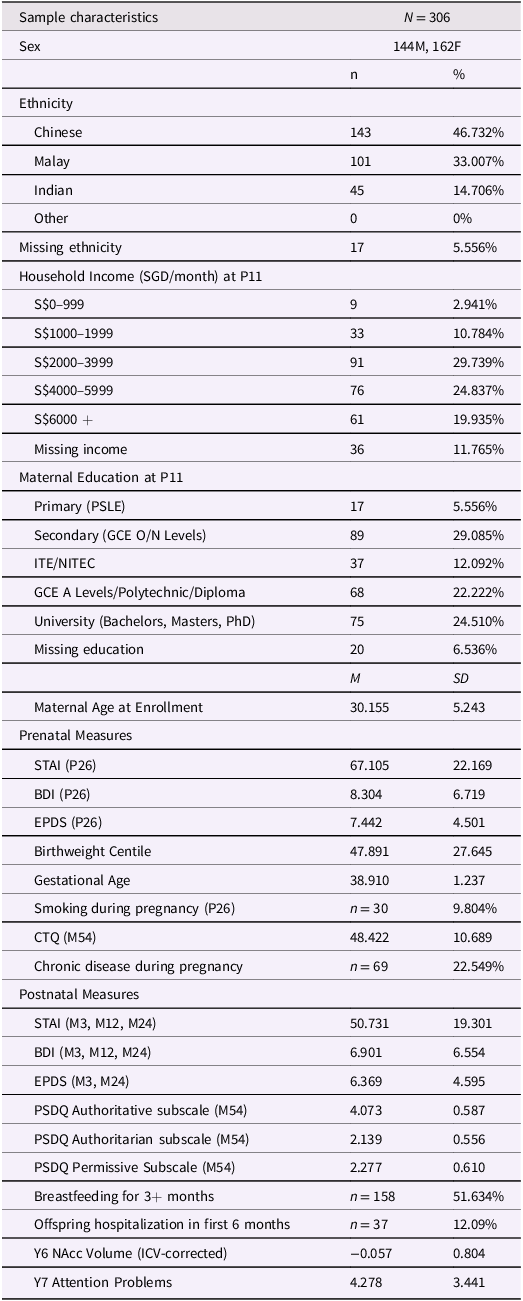
1247 pregnant women were recruited as part of the Growing Up in Singapore Towards Healthy Outcomes (GUSTO) study, which was approved by the Singapore National Healthcare Group Domain Specific Review Board. At the recruitment session, women gave written informed consent and were compensated for all study activities. Exclusion criteria included the use of any psychotropic medication, concurrent chemotherapy treatment, and the presence of any significant medical condition (e.g., type I diabetes mellitus or psychosis). Women were recruited during their first trimester of pregnancy at National University Hospital and the KK Women’s and Children’s Hospital in Singapore. They completed questionnaires assessing sociodemographic characteristics at week 11 of pregnancy (P11) and their mental health at the 26th week of pregnancy (P26) and at 3 (M3), 12 (M12), and 24 (M24) months postpartum. Mothers also completed health examinations throughout the study assessing chronic disease during pregnancy, maternal smoking behavior, birthweight, gestational age, breastfeeding behavior, and infant hospitalization. At 4.5 years postpartum (Y4.5), mothers reported on their own history of exposure to traumatic experiences early in life. When the child was 5 years of age (Y5), mothers repeated socioeconomic questionnaires and measures of parenting quality, and at age 6 years (Y6), children completed a structural MRI scan. A year later, at age 7 years (Y7), mothers completed questionnaires assessing their child’s attention problems. Data were collected at hospitals where women delivered their children and at a clinic after they gave birth (see Soh et al. (Reference Soh, Lee, Hoon, Tan, Goh, Lee, Shek, Teoh, Kwek, Saw, Godfrey, Chong, Gluckman and van Bever2012) for more detailed information about the GUSTO study design). For this study, data were analyzed for mother-child dyads if (a) mothers completed measures of pre- and postnatal adversity as well as behavioral questionnaires when their child was 7 years of age; and (b) children provided a usable T1-weighted MRI scan at age 6 years. Given these criteria, we were able to analyze data from a final sample of 306 mother-child dyads (see Table 1 for demographic and clinical characteristics of the sample).
Sample characteristics

Note: Sample characteristics. P11, P26 = 11th, 26th week of pregnancy; M3, M12, M24, M54 = age 3, 12, 24, and 54 months; Y6, Y7 = age 6 years, 7 years; SGD = Singapore dollar; STAI = State-Trait Anxiety Inventory; BDI = Beck Depression Inventory-II; EPDS = Edinburgh Postnatal Depression Scale; CTQ = Child Trauma Questionnaire; PSDQ = Parenting Styles and Dimensions Questionnaire; ICV = intracranial volume.
Measures
Prenatal Stress
We included all stress-related measures in the GUSTO study that were available at the timepoints of interest. Consistent with a previous study using this dataset to investigate the effects of adversity on child development (Chan, Ngoh, et al., Reference Chan, Ngoh, Ong, Teh, Kee, Zhou, Fortier, Yap, MacIsaac, Kobor, Silveira, Meaney and Tan2024), we included the following measures as direct or indirect indicators of prenatal stress: birthweight centile, gestational age, smoking during pregnancy (assessed at P26; binarized as “1” or “0”), chronic disease during pregnancy (binarized as “1” or “0”), household income and maternal education (assessed at P11), and maternal mental health measures obtained at P26 (Beck Depression Inventory-II (BDI-II), the State-Trait Anxiety Questionnaire (STAI), and the Edinburgh Postnatal Depression Scale (EPDS)). We also included maternal history of childhood trauma (Child Trauma Questionnaire (CTQ); obtained at Y4.5), given emerging evidence regarding the transmission of intergenerational stress through disruptions in stress hormones during fetal development (Bosquet Enlow et al., Reference Bosquet Enlow, Englund and Egeland2018; Weinstock, Reference Weinstock2005). All of these constructs have been examined in other studies as indicators of early stress or disadvantage, and each has been shown independently to be associated with adverse developmental outcomes (Bradley & Corwyn, Reference Bradley and Corwyn2002; Castles et al., Reference Castles, Adams, Melvin, Kelsch and Boulton1999; Cheong et al., Reference Cheong, Wlodek, Moritz and Cuffe2016; Lewis et al., Reference Lewis, Austin, Knapp, Vaiano and Galbally2015; Talge et al., Reference Talge, Holzman, Senagore, Klebanoff and Fisher2011).
Postnatal Stress
Measures of postnatal stress included the following: breastfeeding for 3+ months postpartum (binarized as “1” or “0”), infant hospitalization in the first six months (binarized as “1” or “0”), maternal BDI-II and STAI (averaged across M3, M12, and M24), EPDS (averaged across M3 and M24), the Parenting Styles and Dimensions Questionnaire (PSDQ; obtained at Y4.5), and household income and maternal education at Y5. Each of these measures, used as an index of postnatal stress, has been associated with adverse developmental outcomes (Bradley & Corwyn, Reference Bradley and Corwyn2002; Erdei et al., Reference Erdei, Liu, Machie, Church and Heyne2021; Fardell et al., Reference Fardell, Hu, Wakefield, Marshall, Bell, Lingam and Nassar2023; Kingston & Tough, Reference Kingston and Tough2014; Pinquart, Reference Pinquart2017; Quinn et al., Reference Quinn, O’Callaghan, Williams, Najman, Andersen and Bor2001; R. Robinson et al., Reference Robinson, Lahti-Pulkkinen, Heinonen, Reynolds and Räikkönen2019).
Beck Depression Inventory-II
The Beck Depression Inventory-II (BDI-II; Beck et al., Reference Beck, Steer, Ball and Ranieri1996), a well-validated measure of the frequency/severity of depressive symptoms, was administered to women at the 26th week of pregnancy and when their children were 3, 12, and 24 months of age. The BDI-II contains 21 items, each scored on a 4-point Likert scale (0–3). Responses are summed to yield a total score, with a score of 14 or higher indicating mild to moderate depressive symptoms.
State-Trait Anxiety Inventory
The State-Trait Anxiety Inventory (STAI; Spielberger, Reference Spielberger, Gorsuch, Lushene, Vagg and Jacobs1983) is a widely used 40-item scale of anxiety symptom severity and is composed of “state” (i.e., more temporary) and “trait” (i.e., more enduring) anxiety subscales. Mothers answered each of the 40 items using a 4-point Likert scale (1–4); their responses were then summed to create a total STAI score that was used in all analyses. The STAI was administered at the 26th week of pregnancy and at 3, 12, and 24 months postpartum.
Edinburgh Postnatal Depression Scale
The Edinburgh Postnatal Depression Scale (EPDS; Cox et al., Reference Cox, Holden and Sagovsky1987) is a frequently used 10-item screening tool for maternal depression that asks mothers to rate the severity of their depressive symptoms over the past week on a 4-point Likert scale (0–3). Responses are scored by summing the 10 items (with appropriate reverse scoring). Total scores above 12 indicate the possibility of clinically significant depressive symptoms (Cox et al., Reference Cox, Holden and Sagovsky1987). The EPDS items are not specific to the postnatal period or the age of the child; indeed, the EPDS has been validated for the assessment of both pre- and postnatal maternal depression (Murray & Cox, Reference Murray and Cox1990). The EPDS was administered at the 26th week of pregnancy and at 3 and 24 months postpartum.
Child Trauma Questionnaire
The Child Trauma Questionnaire – Short Form (CTQ) is a widely used 28-item self-report measure of individuals’ history of childhood maltreatment (Bernstein et al., Reference Bernstein, Fink, Handelsman, Foote, Lovejoy, Wenzel, Sapareto and Ruggiero1994). This retrospective measure assesses history of emotional, physical, and sexual abuse, and emotional and physical neglect. Mothers responded to the CTQ items on a five-point Likert scale (1–5). In the current study, subscales for these five domains of maltreatment assessed by the CTQ were summed to produce a total maltreatment score. Researchers have shown that childhood maltreatment increases individuals’ risk for maladaptive outcomes across development and into adulthood (Font & Berger, Reference Font and Berger2015; Springer et al., Reference Springer, Sheridan, Kuo and Carnes2003), including during pregnancy (Kern et al., Reference Kern, Khoury, Frederickson and Langevin2022; Lang et al., Reference Lang, Rodgers and Lebeck2006; Moog et al., Reference Moog, Buss, Entringer, Shahbaba, Gillen, Hobel and Wadhwa2016). The CTQ was administered at M54 and was included as a measure of prenatal stress.
Parenting Styles and Dimensions Questionnaire
The Parenting Styles and Dimensions Questionnaire–Short Form (PSDQ; C. Robinson et al., Reference Robinson, Mandleco, Olson and Hart2001) is a 32-item parent-report instrument designed to assess global parenting styles across three dimensions: authoritative, authoritarian, and permissive. Participants responded to each item on a five-point Likert scale (1–5). Acceptable reliability (α=.64-.86) and moderate to high internal consistency (α=.38-.97) have been demonstrated (Olivari et al., Reference Olivari, Tagliabue and Confalonieri2013; C. Robinson et al., Reference Robinson, Mandleco, Olson and Hart2001). The PSDQ was administered at Y4.5, and scores on each of the three subscales (authoritative, authoritarian, and permissive) were entered into the factor analysis of postnatal stress measures.
Child Behavior Checklist
The Child Behavior Checklist (CBCL; Achenbach & Rescorla, Reference Achenbach and Rescorla2001) is a parent-rated questionnaire used to assess a range of behavioral and emotional problems in children. Parents completed the CBCL when their child was 7 years of age, responding to questions about their child using a 3-point Likert scale (0–2). Questions are grouped into syndrome scales, and response data are summed to produce raw scores for each scale. In the current study we analyzed raw scores on the CBCL Attention Problems scale, which assesses a broad set of attention-related behaviors including concentration difficulties, trouble sitting still, impulsivity, and hyperactivity, and has been used to identify children with an ADHD diagnosis (Chang et al., Reference Chang, Wang and Tsai2016; Chen et al., Reference Chen, Faraone, Biederman and Tsuang1994). Thus, this measure assesses several key features of attention; in this manuscript we refer to the construct assessed by the CBCL Attention Problems scale as “attention problems.”
Acquisition and processing of magnetic resonance imaging data
Data were acquired on a 3T Siemens Skyra scanner using a 32-channel head coil. High-resolution T1-weighted structural scans were obtained using a Magnetization-Prepared Rapid Gradient-Echo sequence with the following parameters: 192 slices, TR = 2000ms, TE = 2.08 ms, 1 mm isotropic voxels, field of view = 192 × 192 mm, slice thickness = 1 mm, sagittal acquisition, inversion time = 877 ms, flip angle = 9°, scanning time = 3.5 minutes. The scans were inspected for artifacts and image quality using the criteria set forth in Ducharme et al., (Reference Ducharme, Albaugh, Nguyen, Hudziak, Mateos-Pérez, Labbe, Evans and Karama2016) before being subjected to FreeSurfer’s recon-all pipeline for reconstruction of the T1w weighted images (version 7.0; http://surfer.nmr.mgh.harvard.edu/) and subsequent anatomic segmentation. Voxels were segmented into gray matter, white matter, cerebrospinal fluid, and subcortical tissue classes. We used Freesurfer’s Aseg atlas (Fischl et al., Reference Fischl, Salat, Busa, Albert, Dieterich, Haselgrove, van der Kouwe, Killiany, Kennedy, Klaveness, Montillo, Makris, Rosen and Dale2002; Fischl, Reference Fischl2012) to perform automatic segmentation of the NAcc based on probabilistic information from ultra-high resolution ex vivo MRI data. The segmented NAcc subregion mask was then used to estimate volume metrics. Images with poor registration to the atlas were manually edited and re-segmented to ensure proper alignment. Right and left values were then averaged to produce the raw bilateral NAcc volume measure. Raw values were adjusted for head size by regressing intracranial volume (ICV) on the raw NAcc volume and computing residuals, which were used as the subject-level input in the mediation analyses described below.
Statistical analysis
All analyses were conducted in RStudio version 2023.06.0 + 421.
Exploratory Factor Analysis
Given the inherent challenge of multicollinearity in studies of early adversity (Brown et al., Reference Brown, Rienks, McCrae and Watamura2019; Higgins & McCabe, Reference Higgins and McCabe2001) such that different forms of stress (e.g., poverty and food insecurity) tend to co-occur and may have domain-specific effects on development (McLaughlin & Sheridan, Reference McLaughlin and Sheridan2016), it is important to account for this multicollinearity in a data-driven way without making assumptions about how measures of stress should be grouped. To achieve this goal while reducing dimensionality across diverse domains of stress exposure, we conducted exploratory factor analyses (EFA) separately on measures of pre- and postnatal stress. To address the issue of missing data, we used multiple imputation by chained equations (MICE) with the “mice” package in R with default options (Buuren & Groothuis-Oudshoorn, Reference Buuren and Groothuis-Oudshoorn2011). Each imputation method for the different variables was chosen based the type of data: predictive mean matching for continuous variables; logistic regression for binary variables; and polytomous regression for ordinal variables. Next, we computed a polychoric correlation between all measures using the “polycor” package with maximum likelihood estimation. To estimate latent factors, this polychoric correlation matrix was input to the fa() function of the “psych” package, finding the minimum residual solution with varimax rotation. We conducted separate EFAs for the prenatal and postnatal measures. The number of factors retained was determined using eigenvalues >= 1, and measures with factor loadings >= 0.4 were retained for estimating latent variables (i.e., subject-level factor scores) using the factor.scores() function. These factor scores were then used as independent variables in the regression and mediation models examining the relation between prenatal adversity, postnatal adversity, NAcc volume, and attention problems. Child sex, maternal ethnicity, and maternal age at recruitment were entered as covariates.
Mediation Analysis
Using the “mediate” package in R, we conducted causal mediation analyses to examine the indirect effect of early adversity on attention problems at year 7 through NAcc volume at year 6. We used adversity factor scores as independent variables predicting the CBCL Attention Problems scores at year 7, with NAcc volume (adjusted for intracranial volume) as the mediator. Separate models were specified for prenatal adversity and postnatal adversity latent scores, and both models were run across 500 Monte Carlo simulations with non-parametric bootstrapping. To examine the conditional indirect effects of sex, we conducted a secondary moderated mediation analysis with sex entered as a moderator.
Results
Participant characteristics
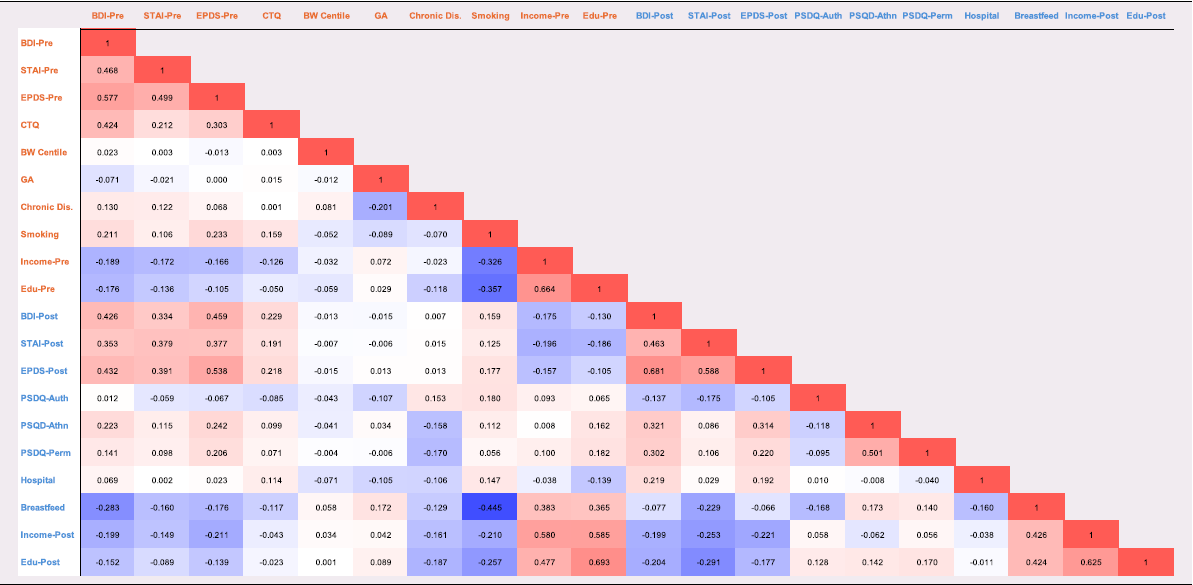
Participant characteristics are presented in Table 1. As would be expected in a non-clinical sample, most mothers obtained scores below the clinical cut-off for depressive and anxious symptoms. Mothers reported lower depressive symptoms on the EPDS (t(274) = 4.130, p < .001) and the BDI-II (t(298) = 3.481, p < .001), and in anxiety symptoms on the STAI (t(286) = 12.082, p < .001), when the child was three months of age than during pregnancy. There were no sex differences in NAcc volume at year 6 after controlling for ICV (t(287) = -0.228, p = .820), or in CBCL attention problems at year 7 (t(298) = 0.332, p = .740). Many of the pre- and postnatal stress measures on which the EFAs were conducted were significantly intercorrelated (Table 2). Finally, participants who had complete data did not differ from those who were missing imaging or behavioral data at years 6 and 7 in maternal education (χ2 = 9.17, p = .10), household income (χ2 = 3.94, p = .41), or any of the following measures of stress exposure (ps > .067): CTQ, prenatal or postnatal BDI, prenatal or postnatal STAI, prenatal or postnatal EPDS, and birthweight centile. However, the mean gestational age of the included participants was 0.201 weeks older than that of the excluded participants (t = 2.065, p = .039).
Correlations between measures of adversity

Note: Correlation matrix displaying polychoric associations between measures of early adversity. Orange variables indicate prenatal measures; blue variables indicate postnatal measures. BDI = Beck Depression Inventory-II; STAI = State-Trait Anxiety Inventory; EPDS = Edinburgh Postnatal Depression Inventory; CTQ = Child Trauma Questionnaire; BW Centile = birthweight centile; GA = gestational age; Chronic Dis. = Chronic disease during pregnancy; Smoking = smoking during pregnancy; Income = household income; Edu = maternal education; PSDQ Auth = Parenting Styles and Dimensions Questionnaire–Authoritative subscale; PSDQ Athn = Parenting Styles and Dimensions Questionnaire–Authoritarian subscale; PSDQ Perm = Parenting Styles and Dimensions Questionnaire–Permissive subscale; Hospital = offspring hospitalization in the first 6 months; Breastfeed = breastfeeding for at least 3 months. Correlation coefficients derived from imputed data; pre = prenatal; post = postnatal.
Exploratory factor analysis of adversity measures
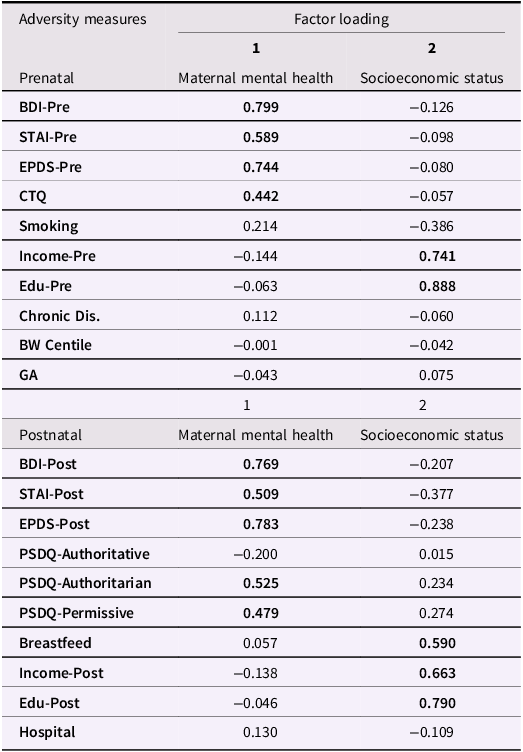
In the factor analysis of measures obtained during the prenatal period, a scree plot yielded two factors with eigenvalues>1 (Table 3; Figure 1). The first factor (”Maternal Mental Health”) explained 18.188% of the variance, with the highest loadings for the BDI-II, STAI, and EPDS, followed by the CTQ, all of which loaded>0.4 (loadings: 0.442–0.799). A higher factor score reflected poorer prenatal maternal mental health and more severe maltreatment history. The second factor (“Socioeconomic Status”) explained 15.320% of the variance and was composed of household income and maternal education, with loadings of 0.741 and 0.888, respectively. For consistency with the maternal mental health factor, we multiplied the loadings and factors scores of the socioeconomic status (SES) factor by -1 so that higher values indicated greater prenatal socioeconomic disadvantage. This prenatal two-factor solution demonstrated good fit to the data (RMSR = 0.05).
Factor analyses: scree plots.
Note: Scree plots of prenatal and postnatal latent factors. The two prenatal and postnatal factors with eigenvalues >1 were retained.

Factor analyses: pre- and postnatal adversity

Note: Loadings of stress measures onto latent factors for prenatal and postnatal adversity with values>0.4 bolded and retained for estimation of factor scores; orange variables indicate prenatal measures; blue variables indicate postnatal measures. BDI = Beck Depression Inventory-II; STAI = State-Trait Anxiety Inventory; EPDS = Edinburgh Postnatal Depression Scale; CTQ = Child Trauma Questionnaire; Smoking = smoking during pregnancy; Income = household income; Edu = maternal education; Chronic Dis. = chronic disease during pregnancy; BW Centile = birthweight centile; GA = gestational age; PSDQ = Parenting Styles and Dimensions Questionnaire; Breastfeed = breastfeeding for at least 3 months; Hospital = hospitalization of offspring in first 6 months; pre = prenatal; post = postnatal.
The EFA conducted on measures obtained during the postnatal period also yielded two latent factors with eigenvalues>1 (Table 3; Figure 1). Mental health measures (BDI-II, STAI, and EPDS) loaded most strongly on the first factor, followed by the adverse parenting subscales of the PSDQ (authoritarian and permissive) to form the factor “Maternal Mental Health” (loadings: 0.479–0.783), which explained 20.495% of the variance. A higher factor score reflected poorer postnatal maternal mental health and worse parenting. The second factor (“Socioeconomic Status”) was composed of household income and maternal education at year 5 and breastfeeding for at least 3 months (loadings: 0.590 to 0.790) and explained 17.942% of the variance. Loadings and scores of the SES factor were multiplied by -1 so that higher values indicated greater postnatal socioeconomic disadvantage. This two-factor solution demonstrated reasonably good fit to the data (RMSR = 0.07).
The pre- and postnatal maternal mental health factors were significantly correlated with each other (r = .544, p < .001), as were the SES factors (r = .579, p < .001). Mothers of girls had higher prenatal maternal mental health factor scores than did mothers of boys (t(294) = -2.465, p = .014); this was not the case for the postnatal maternal mental health factor scores (t(302) = -1.152, p = .250), nor did mothers of girls differ from mothers of boys on the prenatal (t(296) = .177, p = .86) or postnatal (t(296) = 1.303, p = .194) SES factor scores. Prenatal and postnatal factor scores were then input to separate linear regressions with child sex, maternal age at recruitment, and maternal ethnicity entered as covariates. In both models, the maternal mental health factors significantly predicted children’s attention problems at age 7 years (Figure 2; prenatal: b = 0.763, p < .001; postnatal: b = 0.759, p < .001). In contrast, the SES factors did not predict attention problems in either the prenatal (b = -.137, p = .491) or postnatal model (b = -.057, p = .771). In both models, maternal age at recruitment significantly predicted attention problems (prenatal: b = -.099, p = .011; postnatal: b = -.105, p = .007); neither the child’s sex nor maternal ethnicity was significant (ps > .074). When both prenatal and postnatal maternal mental health factors were entered into the same model, both remained significant predictors of attention problems (prenatal: b = .494, p = .032; postnatal: b = .508, p = .024), as did maternal age at recruitment (b = −.093, p = .015).
Pre & postnatal adversity and attention problems.
Note: Association between pre- and postnatal latent factors of adversity and offspring attention problems at year 7; prenatal MMH = prenatal maternal mental health; prenatal SES = prenatal socioeconomic status; postnatal MMH = postnatal maternal mental health; postnatal SES = postnatal socioeconomic status.

Mediation analysis
Next, we ran causal mediation analyses, testing NAcc volume as a mediator of prenatal maternal mental health and, separately, postnatal maternal mental health. Mediation analysis yielded an indirect partial correlation between prenatal maternal mental health factor scores and CBCL attention problems through NAcc volume (Figure 3a; b = 0.061, p = .040, 95% CI [0.003, 0.140]). Specifically, youth whose mothers experienced poorer prenatal mental health had lower NAcc volumes at age 6 (Figure 3b), which in turn was associated with greater attention problems one year later. Including NAcc volume as a mediator explained 6.931% of variance (see Figure 3a for path coefficients). Sensitivity analyses indicated that this indirect effect was specific to prenatal maternal mental health; postnatal maternal mental health did not predict NAcc volume at year 6 (b = −.057, p = .214; 3.150% of variance explained) and, in turn, NAcc did not mediate the association between postnatal maternal mental health and attention problems at year 7 (b = .031, p = .240). Although a bootstrapped comparison of the indirect effects of prenatal and postnatal maternal mental health on attention problems through NAcc volume was not statistically significant (ΔIE = .031, 95% CI: −.007, .071, p = .148), Vuong’s non-nested test of variance indicated that the overall pre- and postnatal models differed significantly from each other (w 2 = .080, p < .001; AICPrenatal = 2336.088, AICPostnatal = 2341.514; BICPrenatal = 2354.706, BICPostnatal = 2360.132). Importantly, the two models differed significantly in their “a” paths (i.e., maternal mental health predicting NAcc volume; w 2 = .019, p = .008); whereas the prenatal factor robustly predicted NAcc volume (b = −.136, p = .003), the postnatal factor did not (b = −.057, p = .214), suggesting that NAcc neurodevelopment is uniquely susceptible to maternal stress during pregnancy (Figure 3b).
Nucleus accumbens (NAcc) volume mediates the relation between prenatal maternal mental health and attention problems.
Note: (a) Indirect effect of prenatal maternal mental health on attention problems through NAcc volume; (b) NAcc volumes plotted across the pre- and postnatal periods by high (+1SD) and low (-1SD) levels of maternal mental health-related stress; c = direct effect; c’ = direct effect after accounting for mediator; NAcc = nucleus accumbens; Y7 = age 7 years; CBCL attention problems = attention problems subscale of the Child Behavior Checklist; * indicates p < .05, ** indicates p < .01, *** indicates p < .001; ns indicates non-significant; SD = standard deviation.

Next, to examine the specificity of the indirect effect of prenatal maternal mental health on attention problems through NAcc volume, we re-ran the mediation analysis controlling for child sex, maternal age at recruitment, maternal ethnicity, and postnatal maternal mental health as covariates. We found that each individual path remained significant, such that prenatal maternal mental health significantly predicted smaller NAcc volume (b = −.163, p = .004), which in turn predicted greater attention problems at year 7 (b = −.502, p = .043). However, with the inclusion of these four covariates, the indirect effect (c’) through NAcc volume fell below the threshold of significance (b = .058, p = .136). Given that the effects of each individual path remained, we believe that the relations among prenatal maternal mental health, NAcc volume, and attention problems are robust, but that including additional covariates affected the detection of a mediator without eliminating the core effects. Thus, the pre- and postnatal environments appear to influence behavioral outcomes through distinct neurobiological pathways. To examine regional specificity, we also tested for mediation effects across five different non-attention related subcortical regions (bilateral, ICV-corrected): the amygdala, hippocampus, thalamus, caudate, and putamen. None of these regions was a significant mediator of the associations between pre- (all ps > .24) or postnatal (all ps > .44) maternal mental health and attention problems. Finally, an exploratory moderated mediation analysis did not yield a significant effect of the child’s sex on either the direct effect of prenatal maternal mental health on attention problems or the indirect effect of this association through NAcc volume (ps > .750).
Exploratory longitudinal analysis of NAcc volume
Finally, to examine the temporal specificity of the mediation effect and the influence of perinatal stress on trajectories of NAcc neurodevelopment, we examined the change in NAcc volume to from year 4.5 to year 6. We analyzed data from 193 participants who had usable neural data at both our original timepoint (year 6) and at an additional timepoint (year 4.5) that preceded our outcome measure of attention problems, administered at age 7 years. We found that there was virtually no change in NAcc volume from year 4.5 to year 6 (mean difference = 7.383, reflecting a 2.747% change, non-ICV corrected). Not surprisingly, therefore, given this stability in NAcc volume, neither prenatal (b = −0.474, p = .714) nor postnatal (b = .958, p = .447) maternal mental health nor SES (prenatal: b = −.519, p = .688; postnatal: b = −1.057, p = .414) significantly predicted change in NAcc volume from 4.5 to 6 years. Further, the small change in NAcc volume did not predict attention problems at age 7 years (b = −.011, p = .405), nor did the change in NAcc volume mediate any association between prenatal or postnatal maternal mental health or SES and attention problems (ps > .62). Importantly, NAcc volume at year 4.5 by itself also did not mediate associations between any of the perinatal stress factors and attention problems (ps > .66), suggesting that NAcc volume captures variability in the relation between prenatal stress and attention problems when it is assessed most proximal to the typical age of onset for attention problems.
Discussion
The present study is among the first longitudinal investigations of pre- and postnatal adversity and risk for attention problems in early childhood. Specifically, we examined associations between perinatal stress and children’s attention problems assessed at seven years of age. Given the importance of the perinatal period for the development of subcortical brain regions involved in attention (Canini et al., Reference Canini, Cavoretto, Scifo, Pozzoni, Petrini, Iadanza, Pontesilli, Scotti, Candiani, Falini, Baldoli and Della Rosa2020; Lautarescu et al., Reference Lautarescu, Craig, Glover, Clow and Smyth2020), we also examined the possible role of the NAcc in mediating these associations. We found that diverse measures of adversity obtained during the pre- and postnatal periods, spanning maternal mental and physical health, household income, maternal childhood trauma, and parenting comprised two latent factors for each period: maternal mental health and socioeconomic status. As expected, both poorer prenatal and postnatal maternal mental health predicted greater attention problems in offspring at seven years of age. We also found that NAcc volume, assessed at age six years, partially mediated the association of prenatal maternal mental health with attention problems in offspring at age seven.
Our finding that maternal mental health predicts attention problems in offspring is consistent with results of a number of investigations reporting that maternal stress and mental health problems, both during the prenatal (Lautarescu et al., Reference Lautarescu, Craig, Glover, Clow and Smyth2020) and the postnatal periods (Humphreys et al., Reference Humphreys, Watts, Dennis, King, Thompson and Gotlib2019), are associated with attention difficulties in children; in fact, Nidey et al. (Reference Nidey, Momany, Strathearn, Carter, Wehby, Bao, Xu, Scheiber, Tabb, Froehlich and Ryckman2021) found that seven-year-old children were over three times more likely to be diagnosed with ADHD if their mother had been diagnosed with depression during the perinatal period. Given that SES affects many aspects of a child’s environment, including access to quality healthcare, nutrition, educational opportunities, and social support (Bradley & Corwyn, Reference Bradley and Corwyn2002), it is noteworthy that perinatal SES did not predict attention problems in offspring in this study. It will be important in future research to examine more systematically the effects of various socioeconomic metrics assessed across the perinatal period on children’s and adolescents’ subsequent psychobiological functioning.
Several mechanisms have been proposed for understanding the nature of the associations of maternal mental health and maltreatment history with attention problems in offspring, including fetal programing via hormone dysregulation and oxidative stress, disturbances in circadian rhythms, diet, and parenting behaviors (Bosquet Enlow et al., Reference Bosquet Enlow, Englund and Egeland2018; Lewis et al., Reference Lewis, Austin, Knapp, Vaiano and Galbally2015; Moog et al., Reference Moog, Buss, Entringer, Shahbaba, Gillen, Hobel and Wadhwa2016; R. Robinson et al., Reference Robinson, Lahti-Pulkkinen, Heinonen, Reynolds and Räikkönen2019). Although it is plausible that pre- and postnatal adversity may have different effects on offspring functioning, we found that levels of both prenatal and postnatal maternal mental health were associated with subsequent attention problems in youth, suggesting that, at least in the current sample, the pre- and postnatal periods are not differentially related to subsequent attention difficulties in offspring. It may be that there was not a sufficient number of assessments of maternal mental health in this study to detect differential effects of maternal mental health on offspring attentional functioning. It is also possible that different cognitive systems are sensitive to early stress at different developmental periods. Although our findings are consistent with studies indicating that psychosocial stress occurring in the first few years of life can have adverse effects on development (Pechtel & Pizzagalli, Reference Pechtel and Pizzagalli2011; Smith & Pollak, Reference Smith and Pollak2020), the temporal dynamics of these effects are not yet well characterized with respect to different types of cognitive functioning. Future research might benefit from examining effects of adversity assessed across longer time scales and with higher frequency on distinct aspects of offspring functioning.
Previous research has demonstrated robust links between early exposure to stress and changes in the structure of various brain regions. In this context, the NAcc appears to be particularly vulnerable to the effects of stress given stress-induced changes in synaptic plasticity and the extensive projections to this region from stress-sensitive, glucocorticoid-rich structures in the frontolimbic network (Campioni et al., Reference Campioni, Xu and McGehee2009; Willis & Haines, Reference Willis, Haines, Haines and Mihailoff2018). Based on the documented role of the NAcc in attention and impulsivity (Basar et al., Reference Basar, Sesia, Groenewegen, Steinbusch, Visser-Vandewalle and Temel2010; Flores-Dourojeanni et al., Reference Flores-Dourojeanni, van Rijt, van den Munkhof, Boekhoudt, Luijendijk, Vanderschuren and Adan2021), we predicted that this structure will mediate the association of stress with attention problems. We found that prenatal, but not postnatal, maternal mental health predicted smaller NAcc volume in children at age 6 years, and that NAcc volume mediated the association between prenatal maternal mental health and offspring attention problems at age 7 years. Moreover, this effect was specific to NAcc volume at year 6, suggesting that its role in mediating the relation between prenatal stress and attention problems is strongest during the developmental window when attention difficulties typically emerge. Although the bootstrapped comparison of the indirect effects (products of the “a” and “b” paths) did not reveal statistically significant differences between the two mediation models, Vuong’s test of non-nested models indicated that the overall model featuring prenatal maternal mental health provided a better fit to the data than the postnatal model. In both models the indirect effect is computed as the product of the ‘“a” and “b” paths (i.e., the effect of maternal mental health on NAcc volume and the effect of NAcc volume on attention problems, respectively). While the “b” paths are equivalent in magnitude between models, only the prenatal model yielded a statistically significant “a” path. As a result, the magnitude of the indirect effect (the product of the paths) is similar across the two models even though the prenatal model achieves a superior overall fit in the Vuong’s test, likely due to prenatal maternal mental health explaining a larger portion of the variance in NAcc volume. We infer from these findings that prenatal influences on neurodevelopment may be more robust or direct, rendering the mediation via NAcc volume more reliable statistically. In contrast, the postnatal period might involve additional sources of variability or alternative pathways affecting attention outcomes, so that the effect of maternal mental health on NAcc volume (and hence the indirect effect) is weaker or more diffuse. Certainly, it is possible that with a larger sample size, the “a” path in the postnatal model could reach statistical significance. However, based on the current data and the overall model fit, it appears that mental health difficulties during the prenatal period are associated more strongly with NAcc neurodevelopment than are difficulties that occur postnatally.
Therefore, the specificity of NAcc neural development to prenatal (versus postnatal) maternal stress suggests that different neurobiological pathways are involved in the association between stress occurring during these two developmental periods and attentional difficulties in offspring. For example, whereas some studies have found that NAcc microstructure is particularly vulnerable to stress experienced prenatally in predicting externalizing problems (Chan, Low, et al., Reference Chan, Low, Ngoh, Ong, Kee, Huang, Kumar, Rifkin-Graboi, Chong, Chen, Tan, Chan, Fortier, Gluckman, Zhou, Meaney and Tan2024), other researchers have reported associations between postnatal psychosocial neglect and reductions in cortical thickness (but not in subcortical volumes) predicting subsequent symptoms of ADHD in children (McLaughlin et al., Reference McLaughlin, Sheridan, Winter, Fox, Zeanah and Nelson2014).
Although it was statistically significant, the indirect effect of prenatal maternal mental health through NAcc volume explained a relatively small proportion of variance in attention problems, suggesting that challenges in attention experienced by children are likely due to many complex and interacting factors such as genetics, diverse environmental features, and other brain regions. In this context, a meta-analysis conducted by Yu et al. (Reference Yu, Gao, Niu, Zhang, Yang, Han, Cheng and Zhang2023) implicated several brain regions in frontotemporal, frontoparietal, and limbic systems in disorders such as ADHD. Further investigation of these stress-sensitive regions is needed to determine how the intrauterine environment may represent a uniquely vulnerable biological context for stress exposure not characteristic of other developmental periods.
We should note three limitations of this study. First, our sample consisted of mothers from the community who were recruited on the basis of having a healthy pregnancy; the sample was not enriched for stress exposure or the presence of cognitive difficulties in offspring. Moreover, our measures of early adversity did not capture several important domains, such as family functioning, exposure to environmental toxins, or food insecurity/poor nutrition that have been found in previous studies to affect neurodevelopment and cognitive outcomes. Therefore, future studies should expand the scope of assessments of stressors in the perinatal period and examine subsequent longitudinal trajectories of both NAcc structure and attention-related behaviors. Second, children’s attention in this study was assessed through parent report; thus, it is not clear whether NAcc volume is related to task-based performance measures of attention or to other cognitive processes, such as working memory and inhibitory control. Assessing behavioral impairment directly with tasks indexing attention and cognitive control would complement and strengthen our findings.
Finally, although the GUSTO Study was not designed specifically to measure the effects of early life stress or environmental circumstances on development, we synthesized the available measures using an unbiased, data driven approach. However, it is possible that our use of factor analysis to reduce dimensionality across diverse measures of the perinatal environment (e.g., GA, BW, smoking, disease, SES, BDI, STAI, EPDS, CTQ) was not optimal for identifying coherent constructs of “stress” or “adversity” and, instead, may reflect the tendency of experiences to co-occur rather than categorically distinct dimensions that differentially predict adverse developmental processes or outcomes (McLaughlin et al., Reference McLaughlin, Weissman and Flournoy2023). In this context, contemporary models of early stress have emphasized features such as severity (e.g., ACES; Felitti et al., Reference Felitti, Anda, Nordenberg, Williamson, Spitz, Edwards, Koss and Marks1998), type (e.g., DMAP, McLaughlin & Sheridan, Reference McLaughlin and Sheridan2016), or timing (Nelson & Gabard-Durnam, 2020) that can reduce dimensionality and elucidate core mechanisms underlying exposure-outcome relations. We did not have the data to systematically test these models, nor have they previously been examined or validated across the perinatal period; however, as a first step in examining the latent structure of perinatal adversity, our empirical grouping of variables did yield factors that differentially predicted early neurodevelopment. We believe that these findings are promising. Future studies should explore and validate statistical techniques aimed at identifying the domains of perinatal experience that most strongly influence children’s cognitive outcomes.
Despite these limitations, we demonstrated in this study that exposure to early adversity and, in particular, to difficulties in perinatal maternal mental health and distress, significantly predicts attention problems in seven-year-old children. Our findings also suggest a unique period of vulnerability for the development of the NAcc in childhood to stressors experienced before birth that may underlie the link between early adversity and children’s attentional difficulties. Future work should explore the mechanisms by which prenatal maternal stress may lead to a cascade of biological changes (e.g., epigenetic, endocrine, inflammatory) that can impact the NAcc in childhood. Efforts to decrease levels of early maternal adversity and improve well-being may reduce the likelihood of behavioral challenges in youth and should be considered a public health priority.
Acknowledgements
Funding statement
Funding provided by the National Institute of Mental Health (R37MH101495 to IHG and T32MH020016 to CA). Funding for the GUSTO study was provided by the following: NMRC/TCR/004-NUS/2008 and NMRC/TCR/012-NUHS/2014 from the National Research Foundation, Singapore under the Translational and Clinical Research Flagship and grant OFLCG/MOH-000504 from the Open Fund Large Collaborative Grant Programmes and administered by the Singapore Ministry of Health’s National Medical Research Council, Singapore. Additional funding was provided by the Singapore Institute for Clinical Sciences, Agency for Science Technology and Research, Singapore. APT is supported by funding from the NMRC Transition Award (MOH-001273–00).
Competing interests
The authors declare none.



 Open access

