



Recent reviews have demonstrated a key role for sufficient dairy food consumption in preventing diseases in adulthood, including dyslipidaemia, insulin resistance, high blood pressure, obesity( Reference Astrup 1 ), CVD( Reference Astrup 1 , Reference Rice 2 ) and osteoporosis( Reference Weaver 3 ). Among adolescents, frequent dairy consumption has been shown to be associated with lower adiposity among boys and girls, and decreased CVD risk among girls( Reference Bel-Serrat, Mouratidou and Jimenez-Pavon 4 ). Dairy food consumption is also necessary for bone accretion in adolescence( Reference Weaver 3 ). Despite the importance of adequate dairy food consumption for good health during adolescence and beyond, adolescents generally consume low levels of dairy foods( Reference Baird, Syrette and Hendrie 5 , Reference Diethelm, Jankovic and Moreno 6 ) and these levels decline further as adolescents age( Reference Larson, Neumark-Sztainer and Harnack 7 , Reference Parker, Vivian and Oddy 8 ). Adolescents experiencing socio-economic disadvantage, e.g. those from families with low levels of parental education, low income or residing in socio-economically disadvantaged neighbourhoods, are particularly prone to inadequate dairy food consumption( Reference Nelson, Erens and Bates 9 , Reference Powell and Han 10 ).
Although socio-economically disadvantaged adolescents’ diets tend to be poorer than those of more advantaged adolescents, some disadvantaged adolescents are able to meet dietary recommendations( Reference Di Noia and Thompson 11 , Reference Stephens, McNaughton and Crawford 12 ). Those disadvantaged adolescents managing to consume a healthy diet, despite the odds of less healthy eating behaviours associated with socio-economic disadvantage, can be considered to be displaying a form of ‘resilience’( Reference Ball, Abbott and Cleland 13 ). Employing a resilience approach to investigate dietary determinants provides an innovative pathway for identifying potential intervention targets that can be applied in nutrition promotion initiatives aimed at improving dietary intakes among other adolescents experiencing socio-economic disadvantage.
Social ecological models have been employed to provide a useful theoretical framework to further understand the range of intrapersonal, social and environmental determinants of adolescent dietary behaviour( Reference Rasmussen, Krolner and Klepp 14 – Reference Laska, Hearst and Forsyth 20 ). Examples of intrapersonal factors associated with adolescent diet include self-efficacy, perceived importance of health behaviours, taste preferences, food-related behaviours such as frequencies of meals and fast-food consumption, and barriers to healthy eating including expense, limited time and inconvenience( Reference Rasmussen, Krolner and Klepp 14 ). Interactions with family and friends( Reference Bruening, Eisenberg and MacLehose 15 – Reference Pearson, Biddle and Gorely 17 ), parenting style, role modelling of healthy eating behaviours, perceived social norms and cultural factors are social determinants that have been found to be associated with healthy eating( Reference Pearson, Biddle and Gorely 17 ). Several environmental factors also influence adolescent eating behaviour, including availability, accessibility and affordability of foods at home, school and in the local neighbourhood around adolescents’ homes and schools( Reference Larson, Laska and Story 18 – Reference Laska, Hearst and Forsyth 20 ).
We have previously identified a range of factors associated with more ‘resilient’ (frequent) intakes of vegetables and fruit in a cross-sectional study of socio-economically disadvantaged adolescents in Melbourne, Australia( Reference Stephens, McNaughton and Crawford 12 ). Also identified were longitudinal predictors of frequent fruit and vegetable consumption( Reference Stephens, McNaughton and Crawford 21 ) and less frequent consumption of high-energy foods and beverages( Reference Stephens, McNaughton and Crawford 22 ).
To date, few studies have investigated factors associated with dairy food consumption among adolescents from all levels of socio-economic position (SEP), all of which were conducted in the USA( Reference Hanson, Neumark-Sztainer and Eisenberg 23 – Reference Arcan, Neumark-Sztainer and Hannan 25 ). Factors identified included increased taste preferences for milk( Reference Larson, Story and Wall 24 ), decreased soft drink and fast-food consumption( Reference Hanson, Neumark-Sztainer and Eisenberg 23 , Reference Larson, Story and Wall 24 ), regular breakfast consumption( Reference Larson, Story and Wall 24 ), positive attitude towards health( Reference Larson, Story and Wall 24 ) and greater self-efficacy for healthy eating( Reference Larson, Story and Wall 24 ). Social correlates of dairy food consumption included frequent parental dairy food consumption( Reference Hanson, Neumark-Sztainer and Eisenberg 23 , Reference Arcan, Neumark-Sztainer and Hannan 25 ) and greater social support for healthy eating( Reference Larson, Story and Wall 24 ); and environmental factors included increased milk availability at mealtimes( Reference Hanson, Neumark-Sztainer and Eisenberg 23 – Reference Arcan, Neumark-Sztainer and Hannan 25 ).
It has been suggested that interventions may unintentionally result in widening socio-economic disparities in diet( Reference Darmon, Lacroix and Muller 26 , Reference Oldroyd, Burns and Lucas 27 ). For example, while a reduced-pricing intervention resulted in improved nutritional quality of foods purchased by disadvantaged adult women (who chose greater quantities of less healthy foods at baseline compared with more advantaged women), overall improvements after the intervention were significantly lower among disadvantaged women than more advantaged women( Reference Darmon, Lacroix and Muller 26 ). As nutrition promotion interventions aimed at improving diet among adolescents from all SEP levels have not reported findings stratified by SEP, it is difficult to ascertain the effectiveness of such interventions among disadvantaged adolescents in comparison to those who are more advantaged and therefore to determine if dietary interventions focused on adolescents from all SEP levels result in similar increases in socio-economic disparities in diet. However, the study conducted by Darmon et al.( Reference Darmon, Lacroix and Muller 26 ) highlights the need for messages and strategies aimed at improving dietary intakes to be tailored specifically for socio-economically disadvantaged groups.
Associations between a range of factors and disadvantaged adolescents’ frequent consumption of dairy foods remain unexplored. Further, how these factors differ from those supportive of frequent consumption of dairy foods among more advantaged adolescents is also unknown. The present study therefore aimed to identify SEP variations in cross-sectional and longitudinal associations between intrapersonal, social and environmental factors and adolescents’ frequent dairy food consumption and to determine if such associations were moderated by SEP.
Materials and methods
Participants and setting
The present study was conducted according to the guidelines laid down in the Declaration of Helsinki and all procedures involving human subjects were approved by Deakin University’s Ethics Committee, the Victorian Department of Education and Training, and the Catholic Education Office. Written informed consent was obtained from all participants.
Data for the present investigation were drawn from a sub-sample of 1201 adolescents who participated in the Youth Eating Patterns (YEP) Study. The YEP Study details have been reported elsewhere( Reference Stephens, McNaughton and Crawford 22 , Reference Pearson, MacFarlane and Crawford 28 , Reference Pearson, Ball and Crawford 29 ). Briefly, baseline was conducted in 2004–2005 and adolescents were followed up in 2006–2007. All co-educational government and Catholic secondary schools that included Years 7–12 and had >200 enrolments located in metropolitan Melbourne and non-metropolitan Gippsland region, east of Melbourne, Australia were invited to participate in the study at baseline. Seventy schools met these criteria and of those, twenty metropolitan and seventeen non-metropolitan schools (thirty-seven in total) agreed to participate. All adolescents (n 9842) from Year 7, aged 12–13 years, and Year 9, aged 14–15 years, were invited to participate in an online survey. Parents provided written informed consent for adolescents and surveys were completed during class time by 3264 sociodemographically diverse secondary students (n 2010 in Year 7, n 1254 in Year 9; baseline response rate 33·2 %). Schools that participated at baseline in 2006 were contacted again to indicate their interest in continuing their involvement in the YEP Study. At follow-up in 2006–2007, 1938 adolescents participated (59 % response rate of adolescents who participated at baseline). Of 2735 adolescents who completed the baseline YEP survey, 1584 (58 %) went on to complete the follow-up survey (low SEP n 708, mid/high SEP n 876).
Previous dietary research has found maternal education to be an appropriate indicator of SEP among adolescents( Reference Rasmussen, Krolner and Klepp 14 , Reference Pearson, Biddle and Gorely 17 , Reference Larson, Story and Wall 24 , Reference Nilsen, Krokstad and Holmen 30 ). Maternal highest level of education (parental report) was used to define SEP as follows: ‘low’, mother completed ≤Year 10 of secondary school; ‘mid/high’, mother completed Year 12 secondary school, a technical or trade school certificate/apprenticeship and/or a university or tertiary qualification.
Data for the present investigation were drawn from adolescents who had complete data (n 1201) for all measures included (sociodemographics, predictor variables, and frequencies of dairy food intake at baseline and follow-up). Among 1584 adolescents participating at baseline and follow-up, those with complete data (n 1201; low SEP n 521, mid/high SEP n 680) for all measures included in the present investigation (sociodemographic characteristics, predictor variables, frequencies of intake at baseline and at follow-up) were compared with those adolescents with incomplete data (n 383) across those measures, with few statistically significant (P≤0·01) differences in these variables existing between groups. Compared with adolescents with incomplete data, those with complete data perceived greater maternal role modelling of healthy eating and greater family support for healthy eating, perceived greater availability of nutritious food at home and reported having plenty of food available at home often, were often allowed to eat what they liked, were often allowed to choose what they liked at fast-food restaurants, less often perceived the evening meal as unpleasant, had small amounts of spending money, rarely skipped breakfast, rarely ate dinner alone, rarely purchased fast food for lunch or dinner at home or dinner at a fast-food restaurant, and rarely bought food or drink from the school canteen or on the way to or from school. For the remaining twenty-three variables, no significant differences were observed between groups.
Measures
Outcome variables
Both the baseline and follow-up YEP surveys included a thirty-eight item FFQ (see online supplementary material, Supplemental Table 1). The FFQ comprised twenty-seven food items and eleven beverage items, based on dietary intake questions recommended by the Australian Food and Nutrition Monitoring and Surveillance Unit( Reference Marks, Webb and Rutishauser 31 ) and those used in the 1995 National Nutrition Survey( Reference McLennan and Podger 32 ). FFQ items were based on food and beverages most commonly consumed by adolescents( Reference McLennan and Podger 32 ). Frequency of consumption of each food item in the previous month was assessed by adolescents’ responses to a seven-point scale (scored 1–7). The FFQ did not include portion size; therefore calculation of serving size was not possible. Responses were converted to represent equivalent daily frequencies for dairy foods at baseline and at follow-up, as follows: ‘not in the last month’, i.e. consumed zero times per day (scored 0·00); ‘several times per month’ (0·07); ‘once a week’ (0·14); ‘a few times a week’ (0·36); ‘most days’ (0·71); ‘once per day’ (1·00); and ‘several times per day’ (2·50). This approach is commonly used with FFQ( 33 ) and such a methodology has been employed in past research to rank adolescents according to dietary intakes( Reference Di Noia and Contento 34 , Reference Kvaavik, Batty and Ursin 35 ).
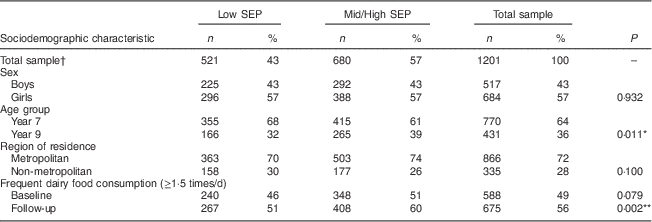
Sociodemographic characteristics of Australian adolescents and proportions frequently consuming dairy food at baseline (2004–2005) and follow-up (2006–2007) stratified by SEP (n 1201)
SEP, socio-economic position.
*P<0·05, **P<0·01.
† No statistical tests were performed.
The ‘dairy food’ group comprised cheese, yoghurt and milk (including flavoured milk and milk on cereal). ‘Frequent consumption’ among socio-economically disadvantaged adolescents was defined as consuming dairy foods ≥1·5 times/d. While it would have been preferable to define frequent dairy food consumption on the basis of achieving the recommendations of ≥3 servings/d outlined in the Australian Guide to Healthy Eating( Reference Smith, Kellett and Schmerlaib 36 ), this was not possible as too few participants met recommendations (e.g. only 17 % of disadvantaged adolescents at baseline), resulting in sample sizes too small to permit meaningful statistical analyses. Using a lower cut-point (i.e. ≥1·5 times/d) that is below dietary recommendations to indicate frequent dairy food consumption is reasonable given that socio-economically disadvantaged adolescents struggle to meet dietary recommendations for dairy foods( Reference Baird, Syrette and Hendrie 5 , Reference Larson, Story and Wall 24 , Reference Zhang, Chen and Chen 37 ). The Australian Guide to Healthy Eating was recently updated and replaced with the Australian Dietary Guidelines( 38 ). The previous recommendations of the Australian Guide to Healthy Eating were used in the present investigation as they represent recommendations in place at the time the YEP Study was conducted.
Predictor variables
Social ecological models( Reference Bronfenbrenner 39 , Reference Stokols 40 ) formed the theoretical framework upon which survey items were developed to examine intrapersonal, social and environmental factors hypothesised to influence adolescent eating behaviours. The measures used in the baseline survey are summarised in the online supplementary material, Supplemental Table 2 and have been published previously( Reference Stephens, McNaughton and Crawford 22 ). Categorical-response items were summed to create a scale measuring a particular construct, e.g. five items measuring home availability of high-energy foods were summed to give a composite score. Cronbach’s ɑ coefficients were calculated for all summed scales used and ranged from 0·71 to 0·84, showing respectable internal reliability( Reference DeVellis 41 ) (Supplemental Table 2).
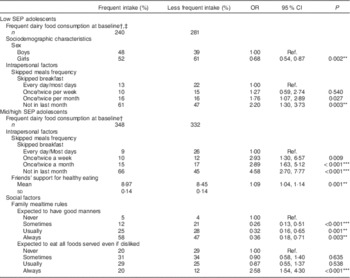
Cross-sectional associations between intrapersonal, social and environmental factors, and odds ratios and 95 % confidence intervals, of frequent dairy food consumption at baseline (2004–2005), among low SEP (n 521) and mid/high SEP (n 680) Australian adolescents identified in multivariate logistic regression analysis
SEP, socio-economic position; Ref., referent category.
**P<0·01, ***P<0·001.
† Frequent intake defined as consuming dairy food ≥1·5 times/d at baseline.
‡ Model adjusted for covariate ‘sex’.
Covariates
As sociodemographic characteristics (sex, age and region of residence) have been shown to be associated with adolescent diet( Reference Rasmussen, Krolner and Klepp 14 , Reference Shi, Lien and Kumar 42 ), these variables were assessed at baseline and treated as covariates.
Statistical analyses
Except where indicated, all analyses were stratified by SEP. Sociodemographic characteristics of participants and the proportions of adolescents who frequently consumed dairy food at baseline and at follow-up were determined using descriptive statistics. Pearson’s χ 2 tests of significance were used to examine differences in sociodemographic characteristics and dairy food consumption.
Associations between each sociodemographic characteristic (sex, age and region of residence) and frequent consumption at each time point were identified in bivariate logistic regression analyses and only those sociodemographic characteristics significantly (P≤0·01) associated with the dietary outcome were adjusted for in further bivariate and multivariate analyses. All models were adjusted for covariates, where applicable, and for longitudinal analyses models included adjustment for baseline consumption. The YEP Study involved recruitment of adolescents via schools, therefore potential clustering effects by school were adjusted for in all models using the ‘cluster’ command in Stata to generate robust standard errors. To decrease the likelihood of a Type 1 error (due to the relatively large sample size and large number of tests conducted), a more stringent criterion of P≤0·01 (rather than P≤0·05) was applied for determining statistical significance when assessing associations of predictors with the outcome.
For cross-sectional analyses, bivariate logistic regression analyses were used to examine associations between baseline predictor variables and frequent consumption of dairy food at baseline. For longitudinal analyses, bivariate logistic regression analyses were used to identify baseline predictors of frequent dairy food consumption at follow-up. Statistically significant (P≤0·01) factors identified in bivariate analyses were entered into multivariate logistic regression analyses. Co-linearity was determined by calculating the variance inflation factor and tolerance value of each predictor included in multivariate models. Predictor variables with variance inflation factor≥10·0 and tolerance ≤0·1 were then excluded from final multivariate analyses( Reference Kutner, Nachtsheim and Neter 43 ). The following factors were excluded from multivariate logistic regression models: attitude towards health, self-efficacy for increasing fruit intake, self-efficacy for decreasing intake of high-energy food, maternal role modelling, family support for healthy eating and home availability of nutritious food.
Moderator effects were examined if a baseline predictor variable was found to be associated with frequent dairy consumption cross-sectionally or longitudinally. Using data from all adolescents (n 1201), bivariate logistic regressions were conducted including the outcome (frequent dairy food consumption) and the predictor variable, and the interaction between the independent variable and SEP( Reference Frazier, Tix and Barron 44 ). If a significant moderator effect was observed (P≤0·05), the sample was then stratified by SEP and bivariate logistic regression models were performed to explore associations between the outcome and predictor variable among low SEP and mid/high SEP adolescents independently. Statistical analyses were conducted using the Stata statistical software package version 12 (2011).
Results
The adolescents participating in the present investigation were sociodemographically diverse (Table 1). A significantly greater proportion of adolescents in Year 9 were of mid/high SEP (P=0·011). Among low SEP adolescents at baseline, 46 % (95 % CI 42, 51 %) frequently consumed dairy food (≥1·5 times/d), increasing to 51 % (95 % CI 47, 56 %) at follow-up. Just over half (51 %; 95 % CI 47, 55 %) of mid/high SEP adolescents frequently consumed dairy food at baseline, which increased to 60 % (95 % CI 56, 64 %) at follow-up.
When intakes of individual dairy foods were examined, of the three dairy foods examined, milk was the most commonly consumed at baseline, irrespective of adolescents’ SEP or resilience status (results not shown). At follow-up, cheese was most commonly consumed. At both time points, yoghurt was more frequently consumed by resilient adolescents from both SEP levels than non-resilient adolescents. Frequency of milk consumption decreased over time, particularly among resilient disadvantaged adolescents.
Results of bivariate analyses stratified by SEP predicting dairy food intakes cross-sectionally and longitudinally are summarised in Supplemental Tables 3 and 4, respectively (see online supplementary material). Statistically significant (P≤0·01) covariates and predictor variables (excluding those displaying co-linearity) were entered into multivariate logistic regression models. Findings are summarised below.
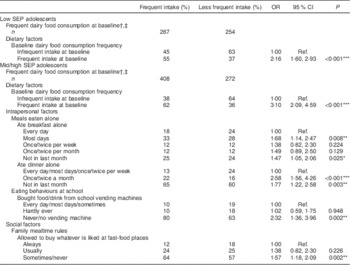
Longitudinal predictors, and odds ratios and 95 % confidence intervals, of frequent dairy food consumption at follow-up (2006–2007) among low SEP (n 521) and mid/high SEP (n 680) Australian adolescents identified in multivariate logistic regression analysis
SEP, socio-economic position; Ref., referent category.
*P<0·05, **P<0·01, ***P<0·001.
† Frequent intake defined as consuming dairy food ≥1·5 times/d at follow-up.
‡ Model adjusted for baseline dairy food consumption frequency.
Cross-sectional associations between predictor variables and frequent dairy food consumption in multivariate analyses
Disadvantaged girls had 32 % lower odds of frequently consuming dairy food when compared with disadvantaged boys. Adolescents who had not skipped breakfast in the month preceding the baseline survey had more than two times greater odds of frequently consuming dairy compared with those who skipped breakfast every day or on most days (Table 2).
Advantaged adolescents who had not skipped breakfast in the month preceding the baseline survey had more than four times greater odds of frequently consuming dairy compared with those who skipped breakfast every day or on most days. Each unit increase on the ‘friends’ support for healthy eating’ scale was associated with a 9 % increase in the odds of frequently consuming dairy food, i.e. advantaged adolescents who reported greater levels of support from their friends to eat healthily had greater odds of frequently consuming dairy compared with those who had lower levels of support. Adolescents who were frequently (sometimes, usually or always) expected to have good manners had approximately two-thirds lower odds of frequently consuming dairy foods compared with adolescents who never had to follow this mealtime rule. Conversely, adolescents who were always expected to eat all foods served even if disliked had more than two-and-a-half times greater odds of frequently consuming dairy foods compared with adolescents who never followed this rule (Table 2).
Longitudinal predictors of frequent dairy food consumption in multivariate analyses
Disadvantaged adolescents who frequently consumed dairy foods at baseline had more than two times greater odds of consuming dairy frequently at follow-up compared with those who were infrequent consumers at baseline; this was the only factor that remained predictive of disadvantaged adolescents’ frequent dairy consumption at follow-up (Table 3).
Advantaged adolescents who frequently consumed dairy foods at baseline had three times greater odds of being frequent consumers at follow-up. Adolescents who had not eaten breakfast alone in the past month or on most days had 47 % and 68 % greater odds of frequent dairy food consumption, respectively, when compared with adolescents who ate breakfast alone daily. Similarly, adolescents who rarely consumed dinner alone (once/twice per month, not in the last month) had 77 % greater odds or more of frequently consuming dairy foods than those who ate dinner alone more often. Finally, advantaged adolescents who were sometimes/never allowed to buy whatever they liked at fast-food places had 57 % greater odds of being frequent dairy consumers compared with those who were always allowed to purchase what they liked (Table 3).
Moderator effects of socio-economic position
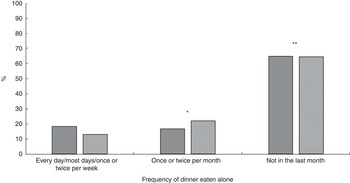
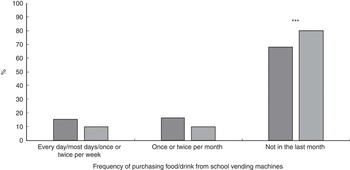
Of all associations between predictor variables and frequent dairy food consumption examined in multivariate logistic regressions, only two were significantly (P ≤0·05) moderated by SEP. Advantaged adolescents who infrequently ate dinner alone (once/twice per month, not in the past month) had 96 % or greater odds of frequently consuming dairy food at follow-up compared with disadvantaged adolescents who ate dinner alone more often (Fig. 1). Advantaged adolescents who never made food or drink purchases from school vending machines had four times greater odds of being frequent dairy consumers at follow-up compared with low SEP adolescents who made such purchases more often (Fig. 2).
Associations between the frequency of dinner eaten alone and frequent dairy consumption at follow-up among disadvantaged ( ) and advantaged (
 ) Australian adolescents, 2006–2007. *P<0·05, **P<0·01
Associations between the frequency of purchasing food/drink from school vending machines and frequent dairy consumption at follow-up among disadvantaged ( ) and advantaged (
 ) Australian adolescents, 2006–2007. ***P<0·001
Discussion
The present investigation showed that a sizeable proportion of socio-economically advantaged and disadvantaged adolescents consumed dairy foods at least 1·5 times daily at baseline and over the 2-year follow-up period of the YEP Study. The study also identified cross-sectional and longitudinal associations between selected intrapersonal and environmental influences and frequent dairy food consumption, a small number of which appeared to be moderated by SEP.
More adolescents in the present investigation frequently consumed dairy foods at follow-up than at baseline. This finding was unexpected. Two separate analyses of Project EAT (Eating Among Teens) longitudinal data showed that as US adolescents from all SEP levels aged, mean intakes of dairy foods decreased by approximately 0·5 daily servings( Reference Larson, Neumark-Sztainer and Harnack 7 ) and intakes of milk and other milk beverages also decreased( Reference Nelson, Neumark-Sztainer and Hannan 45 ). In contrast, the trend towards increased dairy food consumption in the present investigation may be due to contrasting dietary trends in Australia compared with the USA during the YEP study period. For example, core food consumption has begun to improve among Australian adolescents( Reference Rangan, Kwan and Louie 46 ), while secular analysis between 1999 and 2004 showed dairy food consumption worsened over time in the USA( Reference Nelson, Neumark-Sztainer and Hannan 45 ).
Regular breakfast consumption was cross-sectionally associated with frequent dairy food intake at baseline among adolescents from all SEP levels. Previous research has shown that regular breakfast consumers have improved dietary intakes, e.g. consuming more milk than breakfast skippers( Reference Larson, Story and Wall 24 ). These findings suggest that promoting regular consumption of a nutritious breakfast among all adolescents irrespective of SEP may improve dairy food consumption.
Rarely purchasing food or drink from school vending machines at baseline predicted frequent dairy consumption at follow-up among more advantaged adolescents. Longitudinal research in the USA shows that high-energy beverages, such as those supplied in vending machines, tend to supplant milk and fruit juice consumption as adolescents mature( Reference Lytle, Seifert and Greenstein 47 ). Also, compared with US adolescents who made no vending machine purchases, adolescents’ consumption of high-energy beverages increased by 0·21 servings daily among those who made purchases one to three times weekly and 0·71 servings daily among those purchasing from vending machines four times or more times weekly( Reference Wiecha, Finkelstein and Troped 48 ). It should be noted that many adolescents who consumed more favourable diets reported having access to vending machines at school, yet managed to avoid purchasing food or drink from them. It may be possible that avoiding purchasing drinks from vending machines is mediated by some other unmeasured factor, e.g. adolescents who had a more favourable diet may prefer the taste of milk over the high-energy beverages available in vending machines. SEP moderated the association between frequency of vending machine purchases and frequent dairy consumption; i.e. advantaged adolescents who never made food or drink purchases from school vending machines were more likely to be frequent dairy food consumers at follow-up compared with low SEP adolescents who made such purchases more often. Schools, particularly those whose students are socio-economically disadvantaged, could be encouraged to remove vending machines from their campuses, or at least ensure that healthy milk-based beverages that are appealing to adolescents are supplied in such machines.
Infrequently eating breakfast and dinner alone also predicted frequent dairy intakes among advantaged adolescents, supportive of past research that demonstrates adolescent participation in a higher frequency of family meals with parental presence is associated with increased intake of calcium-rich foods including milk, yoghurt and cheese( Reference Neumark-Sztainer, Hannan and Story 49 ). In 2011, Hammons and Fiese conducted meta-analyses that showed adolescents who participated in at least three family meals weekly were more likely to have healthier dietary and eating patterns than those who participated in fewer family meals( Reference Hammons and Fiese 50 ). Frequency of consuming dinner as a predictor of frequent dairy food intake was moderated by SEP. Advantaged adolescents who infrequently ate dinner alone frequently consumed dairy foods at follow-up compared with disadvantaged adolescents who ate dinner alone more often. To support increased dairy food consumption nutrition promotion initiatives could encourage families to regularly participate in meals together, particularly among those families experiencing socio-economic disadvantage.
Greater perceived support from friends to eat healthily was associated with frequent dairy food consumption among advantaged adolescents. Similar findings were reported in 2009 by Larson and colleagues( Reference Larson, Neumark-Sztainer and Harnack 7 ), who showed that peer support for healthy eating predicted greater intakes of calcium-rich foods among US adolescents participating in Project EAT. The mechanisms through which adolescents in the present investigation gain support for healthy eating from their friends remain unclear; however, dietary intakes could be improved by encouraging adolescents to support one another in eating more healthfully.
In the present investigation, advantaged adolescents who reported greater adherence to family mealtime rules (with the exception of being expected to have good manners) had greater odds of consuming dairy foods frequently. These findings are supported by previous research that found a lack of family rules was associated with higher intakes of high-energy beverages( Reference Verzeletti, Maes and Santinello 51 ). Interventions aimed at improving adolescent consumption of dairy foods could incorporate strategies to assist parents in implementing family mealtime rules to support their adolescents to eat healthily.
Frequent dairy food consumption at baseline predicted frequent intake of dairy food at follow-up. Past research shows that while the quality of adolescents’ diets declines as they age( Reference Larson, Neumark-Sztainer and Harnack 7 , Reference Parker, Vivian and Oddy 8 , Reference Arcan, Neumark-Sztainer and Hannan 25 ), health behaviours, such as food choice, tend to show tracking (i.e. the stability of diet over time)( Reference Kelder, Perry and Klepp 52 ). Baseline dairy food intake was predictive of dairy food intake at follow-up among US adolescents from all SEP levels( Reference Arcan, Neumark-Sztainer and Hannan 25 ). Collectively these findings suggest that if frequent dairy food consumption can be supported and achieved during early adolescence, it may be more likely to be sustained over time.
The present findings suggest that selected intrapersonal factors may be beneficial targets for nutrition promotion initiatives aiming to improve dairy food consumption among socio-economically disadvantaged adolescents, with additional social factors supportive of frequent dairy food consumption among more advantaged adolescents. Few associations between predictors and frequent dairy consumption were moderated by SEP. While no past research exploring SEP as a moderator of associations between predictor variables and dairy consumption among adolescents has been reported, Lien et al.( Reference Lien, Lytle and Komro 53 ) similarly found no moderation by SEP when associations between predictor variables and fruit and vegetable consumption among adolescents was examined.
Predictors of dairy food intake have been identified in previous longitudinal research among adolescents from all SEP levels, e.g. parental intake of dairy food and being served milk at dinner at baseline each predicted adolescents’ dairy food intake at follow-up( Reference Arcan, Neumark-Sztainer and Hannan 25 ). In the present investigation, relatively few predictors of frequent dairy food consumption were identified, suggesting that a number of other influences on dairy food consumption were not captured in the measures investigated. Other predictors, such as those investigated by Arcan and colleagues( Reference Arcan, Neumark-Sztainer and Hannan 25 ) (e.g. serving milk with dinner, parental intake of dairy foods), could be examined in future.
Strengths and limitations
Limitations of the present investigation should be acknowledged. FFQ were included in the YEP Study to gather information regarding dietary intakes rather than the use of food diaries or repeated 24 h recall methodologies, which pose substantial practical and economic burdens in large samples. While food diaries and repeated recalls have been shown to be more accurate in gathering dietary intake data, past research using FFQ has shown that this methodology is appropriate for ranking participants according to their dietary intakes and examining associations with predictors( Reference Van den Bulck and Eggermont 54 ). While the FFQ was relatively short, it was designed based on FFQ previously used among Australian adults( Reference Marks, Webb and Rutishauser 31 ). While the FFQ did not include measures of portion size, frequency of consumption is a major determinant of intake( Reference Noethlings, Hoffman and Bergmann 55 ). FFQ have been used previously in adolescents( Reference Zhang, Chen and Chen 37 , Reference Neumark-Sztainer, Story and Hannan 56 , Reference Kolodziejczyk, Merchant and Norman 57 ). However, previous FFQ developed for use in adolescent populations have included flavoured milk along with plain milk to calculate total milk consumption to reflect the eating habits of adolescents (e.g. the Youth/Adolescent Questionnaire developed by Rockett et al. in 1995( Reference Rockett, Wolf and Colditz 58 )), hence providing a more accurate measure of dairy consumption. It should be noted that flavoured milk was not measured separately from plain milk consumption or from milk on cereal, and therefore could not be treated as a sweetened beverage in the present investigation. The dairy food items included in the present investigation did not distinguish between low-fat and full-fat foods. However, in a review of evidence to inform the revision of the Australian Dietary Guidelines, the body of research demonstrated increased intakes of dairy foods (of varying fat content) protected against disease( 59 ).
The YEP Study had a relatively modest response rate; however, participants were sociodemographically diverse. As participants with complete data tended to have more favourable dietary habits than non-completers some bias may exist. Finally, as analyses could not be stratified by sex due to sample size constraints, sex differences in predictors of frequent consumption could not be determined, but models were adjusted for sex.
There are several strengths of the present investigation. Data were drawn from a large sample of sociodemographically diverse adolescents and as the YEP sample incorporated two age cohorts, adolescents across a wide age range were included in analyses. Social ecological theories were employed as the basis for a comprehensive model used to examine a range of factors associated with frequent consumption. Influences that support disadvantaged adolescents to eat healthily, such as those identified here, may be adopted more readily by families living in similar socio-economic contexts. Temporal associations between predictor variables and frequent consumption could be determined due to the longitudinal design. Statistical analysis considered co-linearity of predictors, covariates, baseline consumption frequency and adjusting for clustering by school. The present study is the first to identify a range of factors cross-sectionally and longitudinally associated with frequent dairy food consumption among adolescents, including those experiencing socio-economic disadvantage. Such factors could be employed in future nutrition promotion initiatives targeting all adolescents, but in particular disadvantaged adolescents who are at greater risk of consuming a poor diet.
Conclusions
While adolescents from all SEP levels were shown to consume amounts of dairy foods more in line with dietary recommendations, a proportion of disadvantaged adolescents managed to consume amounts of dairy foods more in line with dietary recommendations. Findings from the present investigation contribute to the evidence base by identifying factors supportive of a healthy diet among adolescents, but particularly among those experiencing socio-economic disadvantage. Nutrition promotion initiatives aimed at improving adolescent dairy consumption should employ multifactorial approaches informed by social ecological models and address socio-economic differences in influences on eating behaviours. Such messages include tailoring for disadvantaged adolescents; e.g. targeting those who are younger and female, as well as intrapersonal factors including promoting regular breakfast consumption. Among advantaged adolescents, intrapersonal factors include promoting regular consumption of breakfast and social factors include increasing friends’ support of healthy eating, eating meals with others and adherence to family mealtime rules.
Acknowledgements
Acknowledgements: The authors gratefully acknowledge Dr Nick Andrianopoulos and Dr Gavin Abbott for statistical analysis advice. Financial support: The study was funded by the Australian Research Council (ID: DP0452044) and the William Buckland Foundation. S.A.M. is supported by an Australian Research Council Future Fellowship (FT100100581). K.B. is supported by a National Health and Medical Research Council Principal Research Fellowship (ID: 1042442). The Australian Research Council and the William Buckland Foundation had no role in the design, analysis or writing of this article. Conflict of interest: None. Authorship: D.C. and K.B. designed the research; D.C. and K.B. conducted the research; L.D.S. analysed the data; L.D.S., S.A.M., D.C. and K.B. wrote the paper; L.D.S., S.A.M., D.C. and K.B. had primary responsibility for final content; all authors read and approved the final manuscript. Ethics of human subject participation: This study was conducted according to the guidelines laid down in the Declaration of Helsinki and all procedures involving human subjects were approved by Deakin University’s Ethics Committee, the Victorian Department of Education and Training, and the Catholic Education Office.
Supplementary material
To view supplementary material for this article, please visit http://dx.doi.org/10.1017/S1368980015000324



