





While human subjects have evolved as omnivores, the amount of animal-based food in the human diet has changed over millennia. Availability was a key driver of consumption thousands of years ago; however, as economies and markets developed, consumer demand became influenced by income and price. In recent years, citizens' concerns have had a growing influence on the demand for, and supply of, foods. This more recent trend is associated with a greater knowledge and awareness of the impact of the production and consumption of different foods on nutrition and health and the environment, and in relation to animal-based foods, of the recognition of animals as sentient beings(Reference Bastian, Loughnan and Haslam1–Reference Madden and Chamberlain3). Citizen influence is manifest through the growing impact of civil society organisations in the food domain, with their contribution reflected in the media, and through government policies. Not only does this influence the quantity of food demanded but the quality of the product produced and consumed, with a growing demand for products that are perceived to have lower environmental impacts, higher animal welfare standards and better nutrition and health outcomes. The purpose of the present paper is to identify and discuss some of the policy, market and social factors affecting production and consumption of meat so as to contribute to a debate on its role as part of a sustainable diet. It does so by drawing on secondary data sources to provide an overview of global consumption trends. It then discusses some of the policy, market and social trends and issues influencing demand and supply of meat, based on the academic and grey literature. This is followed by a discussion on the research evidence that exists across a range of disciplines, and research strategies that are being followed, relating to issues raised. It concludes by briefly identifying some implications for policy makers, those involved in public health nutrition, industry and others.
Trends in meat consumption
To get a picture of the trends in meat consumption, data from the FAO(4,5) were used. Specifically, the food supply data in the food balance sheets provide a useful indication of consumption. While food balance sheets can be considered a blunt instrument as records include bones, trimmed fat and other material often discarded before consumption resulting in a potential overestimation of per capita consumption of meats, these data have been widely used to guide agricultural and food policy due to their availability on a global basis. Studies using these data cover a wide range of food commodities and significant time periods(Reference Daniel, Cross and Koebnick6,Reference Sheehy and Sharma7) . In summary, these data enable comparisons between countries and regions over time. They should, however, not be taken as a measure of individual consumption.
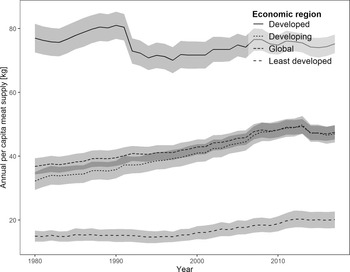
Fig. 1 presents total meat consumption by economic region. The figure shows that consumption in developed countries is much higher than in developing and least developed countries. Furthermore, it shows a strong upward trend in the developing, and from the late 1990s onwards, in the least developed countries. Total consumption has tapered off in recent years, largely due to reduced consumption in developed countries. The upward trajectory in all regions to 2010 reflects economic theory, which says that demand for a good increases with increasing incomes, and the different rates of growth in the different regions reflect different rates of income growth. It should be noted that the sharp drop in consumption observed especially in the developing countries between 2013 and 2014 is likely due to a change in the recording methodology used. Still, the trends show that the increase in meat consumption has levelled off.
Total per capita meat consumption in three distinct economic regions defined by the FAO (developed, developing and least developed) as well as the global consumption. The ribbon represents the standard error within each defined region.

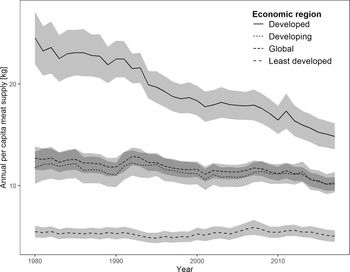
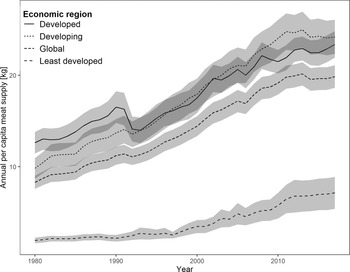
Using the example of bovine meat, Fig. 2 shows that the impact of the factors that determine meat consumption is not homogenous across all meats. It shows a strong downward trend in bovine meat consumption in many regions of the world in contrast to the pattern for meat overall. An important factor explaining this disparity is the price of one meat relative to another; poultry, for example, being more price competitive than beef or lamb in most countries(Reference Henchion, McCarthy and Resconi8), shows a stronger upward trend in consumption (Fig. 3).
Total per capita bovine meat consumption in three distinct economic regions defined by the FAO (developed, developing and least developed) as well as the global consumption. The ribbon represents the standard error within each defined region.

Total per capita poultry consumption in three distinct economic regions defined by the FAO (developed, developing and least developed) as well as the global consumption. The ribbon represents the standard error within each defined region.

The relationship between income and meat consumption, however, varies regionally. Fig. 4 shows the gross domestic product(9) and beef demand in Europe, revealing a limited impact of income on demand in that context. Indeed, in a study of 120 countries, Vranken and co-workers(9) found that there is an inverted U-shaped relationship between meat consumption and income. This is because the proportion of available income spent on food has been steadily falling over recent decades such that there is now little if any difference between the amounts of meat eaten by the different income groups in Europe; the market could be said to be saturated. Thus, at a certain level of income, average meat consumption will stagnate or decline.
Total meat consumption compared to gross domestic product in Europe.

Differences in attitudes to meat are also associated with different levels of consumption. Where meat is in short supply, it can be taken as a measure of dietary quality and there may be pressure to increase the availability of meat products given its high nutrient density. However, where food is plentiful and generally affordable, concerns about the negative impacts of (excessive) consumption on health and the environment arise. Vranken and co-workers(Reference Vranken, Avermaete and Petalios10) suggest that consumers with higher levels of income may be more aware of the environmental impact of meat production and of the impact of over-consumption on non-communicable diseases.
Clearly, there are several factors simultaneously driving and constraining meat consumption globally and many non-economic factors are influencing tastes and preferences and thus demand in Europe. Drawing on the academic and grey literature, we proceed to examine some of the policy, market and social factors affecting demand.
Policy context
Animal production is identified as a cause for concern in policy documents at different geographic scales. For example, discussions relating to global commitments such as COP 21 (UNFCCC Paris Agreement), which has an international commitment aiming to limit global warming to below 2°C and pursuing efforts to limit it to 1⋅5°C, frequently highlight the contribution of agriculture, and particularly ruminants (cattle and sheep), to greenhouse gas (GHG) emissions. The significant land use devoted to animal production is also a concern of policy makers. At European Union (EU) level, the recent Farm to Fork strategy (implementation of which will be supported by the Common Agricultural Policy and Horizon Europe, amongst other policies) highlights that ‘Agriculture is responsible for 10⋅3% of the EU's GHG emissions and nearly 70% of those come from the animal sector […]. In addition 68% of the total agricultural land is used for animal production’(11). Another emerging area of concern for policy makers is antimicrobial resistance. This has translated into a target at EU level for a 50 % reduction in sales of antimicrobials used for farm animals. With global and regional commitments to reduce GHG, improve water quality and biodiversity, and address antimicrobial resistance, policy makers are increasingly looking for significant contributions from the livestock sector to provide solutions.
Despite these concerns, the role of livestock production in addressing the nutrition demands of a growing global population, in supporting biodiversity and preserving landscapes, and functioning as a ‘living asset’, or more broadly, its role helping to ‘feed the world sustainably, safely and equitably’(Reference Tarawali12), is also recognised. This is evident in policy documents and white papers particularly at global level (e.g. FAO/OECD) and to a lesser extent at regional (e.g. European Commission) and national levels, and amongst government and non-government organisations (e.g. World Economic Forum). Indeed, there is an indication that such policies are shifting their focus from seeing livestock as being the problem to it being part of the solution. The 2006 report from the FAO called Livestock's Long Shadow: Environmental Issues and Options (Reference Steinfeld, Gerber and Wassenaar13) framed livestock as the problem; it suggested that livestock should be a major policy focus when dealing with issues such as climate change, biodiversity loss, air and water pollution, and land degradation. The press release associated with it said ‘Livestock are one of the most significant contributors to today's most serious environmental problems. Urgent action is required to remedy the situation’(14). However, their 2013 report, Tackling Climate Change through Livestock: A global assessment of emissions and mitigation opportunities sees livestock as part of the solution: ‘The global livestock sector contributes a significant share to anthropogenic GHG emissions, but it can also deliver a significant share of the necessary mitigation effort’(Reference Gerber, Steinfeld and Henderson15). Such policies thus position the livestock sector to do greater good and to mitigate potential harm to the planet, animal and human well-being. While such policies are primarily focused on the supply side, they are becoming more food systems focused with calls by organisations such as the FAO for recognition that the health of human subjects cannot be isolated from the health of ecosystems and increasing use of the concepts such as sustainable diets(Reference Burlingame and Dernini16). Demand side policy instruments such as taxes on certain food groups and vouchers for healthy eating amongst disadvantaged groups in developed countries are also becoming more prevalent.
One of the main overarching policy documents at EU level currently is the European Green Deal(17). This sets an important policy context for the Farm to Fork strategy with an emphasis on positioning the agriculture and food industries to grow but to do so sustainably, in a way that will result in zero net emissions by 2030. Parallel policies are in place in the UK, e.g. with commitments to achieve net zero carbon emissions by 2050. The Green Deal also seeks to turn ‘climate and environmental challenges into opportunities, and mak[e] the transition just and inclusive for all’(17). For the Farm to Fork strategy, this means a focus not only on a sustainable food system but also on a healthier food system. Thus, while the concept of a sustainable diet, linking environmental impacts of consumption with nutrition and health outcomes, has been around for some time(Reference Burlingame and Dernini16), the health of the European population is now very clearly linked to the health of the planet. The strategy places a greater emphasis on reducing negative environmental impacts, reducing inputs, increasing organic production and also introducing labelling initiatives that can communicate the health and sustainability attributes of foods to consumers.
In terms of meat, notwithstanding that the EU is the world's third largest producer of beef (based on FAO cattle meat production for 2018), the Farm to Fork strategy makes a commitment to help reduce the environmental and climate impact of animal production, and to encourage people to eat less red and processed meat. From an environmental perspective, for example, the strategy recognises that low-intensity grazed systems support removal of carbon from the atmosphere into soils (soil carbon sequestration), acting as a valuable carbon sink. Thus, the European Commission is committed to supporting agricultural practices and new green business models which promote soil carbon sequestration, either through the Common Agricultural Policy, or public or private initiatives, e.g. a carbon market. It will also support research that will explore sources and increase the availability of alternative proteins such as plant, microbial, marine and insect-based proteins, as well as meat substitutes and an overall shift towards a more plant-based diet. Many industry experts view this policy context as providing an opportunity for people to consume less, but better quality, meat. What quality means in this context is likely to be different for different market segments; however, Henchion et al.(Reference Henchion, McCarthy and Resconi18) pointed to the increased importance of credence quality attributes (attributes that are of value to consumers but which cannot be evaluated by them during purchase or consumption, i.e. consumer has to believe the product contains that attribute, e.g. animal-welfare-friendly, grass-fed). The emphasis on organic production and reducing inputs in primary sectors provides opportunities for meat products that communicate strong environmental credentials, with grass/pasture-based production systems, for example, finding favour in some markets. The present Irish application for protected geographic indication designation for Irish grass-fed beef, under the EU agricultural quality policy, is likely to be a response to this new policy context as well as to trends in the market place.
Market aspects
Notwithstanding the omnivorous nature of most human subjects and the significant demand for meat globally discussed earlier, consumer concerns with regards to meat, including concerns about its impact on human nutrition and health, the environment and animal welfare, translate into motivations to avoid meat(Reference Rosenfeld19). This is manifest in the market place with growth in the number of flexitarians, pescatarians, vegetarians and vegans, with a decline in red meat consumption and a rise in consumption of plant-based foods.
Furthermore, as social consciousness and activism continues to accelerate, we see a drive to action by the food industry (and other organisations and bodies that are relatively new entrants to the food system; see social influences later). Many meat companies are developing hybrid products as they believe such products allow consumers to reduce meat consumption without compromising on taste. Danish Crown in Denmark, for example, launched a product line that comprised 50 % pork or beef along with 50 % plant-based ingredients in summer 2019(Reference Fortune20). Consumer response to such product concepts is not yet well understood but is being investigated as part of a European project that will incorporate plant-based ingredients to deliver specific health and nutritional claims into popular meat products (such as burgers and sausages). The researchers in this project believe that some consumers, particularly those who eat a lot of meat, will resist changing behaviour, as they would miss the texture and taste if they had to switch from meat- to plant-based products directly(Reference Askew21); hybrid products may offer a pathway to reducing meat consumption over a longer period of time.
Fast food outlets are also embracing plant-based alternatives. McDonalds, long synonymous with beef burgers, introduced vegan-friendly products in 2017, including the McVegan sandwich which includes a soya-based burger patty with an eggless McFeast sauce. KFC introduced Beyond Fried Chicken, a plant-based protein derived mainly from wheat and soya developed by meat-replacement company Beyond Meat, to selected outlets in their US market in 2019. Interestingly, the KFC website states that ‘Beyond Fried Chicken is not vegetarian, vegan, or Certified Vegan. Beyond Fried Chicken nuggets and wings are 100% plant-based, but they are prepared in the same fryers as our world-famous Kentucky Fried Chicken, which may not be acceptable to certain types of vegetarian or vegan diets’(22). This positions the product to target flexitarians rather than vegetarians or vegans. Retailers are also providing consumers with opportunities to purchase plant-based and meat replacement products. In 2020, the US discounter Walmart rolled out the Impossible Burger across 50 states covering more than 2000 stores with availability also on the Walmart website and app(Reference Harring23). Products from another significant player in this space, Beyond Meat, are also available in US retailers who have large market coverage, such as the general retailer Kroger in which it has a sales listing since 2017(24). These meat alternative products are located in the meat aisles as, similar to the food service market, they are targeted at meat consumers who select it as an alternative to meat, i.e. flexitarians, rather than vegetarians or vegans.
But responses to these concerns are not just playing out in food markets. They are also evident in the financial markets, with significant investments being made in companies that develop meat replacements, such as Beyond Meat and Impossible Foods. Since Impossible Foods was founded approximately 9 years ago, it raised funding of $1⋅3 billion in the financial markets(Reference Shieber25).
In parallel with this, there is also recognition in the market that the majority of people eat meat, and the belief that meat consumption is natural, normal, necessary and nice, the 4Ns as described by Piazza et al. (Reference Piazza, Ruby and Loughnan26), ensures that meat continues to be a part of the diet for most people. Pasture/grass-based products have been developed as a one-market response to this as they can allow people to continue to consume meat on the basis that such production systems may be better for themselves, animals and the environment than conventionally produced meats. One of the significant arguments in favour of grass-based systems is that animals in such systems often graze land that is not suitable for producing other crops for direct human consumption. A review by Stampa et al. (Reference Stampa, Schipmann-Schwarze and Hamm27) reported that consumers are motivated to buy pasture-raised products as they believe it is better for their health and also has animal welfare benefits. They also reported that a number of consumer segments are prepared to pay a premium for pasture-based animal products. Examples of products that proclaim their grass-fed credentials include bone broth(28), baby food(29), collagen supplements(30) and snacks(31). Free-range, organic, animal-welfare-friendly and other labels are attractive for similar reasons. However, these remain niche and premium markets and are unlikely to provide a solution to such concerns for consumers with limited incomes.
Social influences
Despite the fact that consumption of meat is included in the healthy eating guidelines of most developed countries, consumers have received mixed messages about meat with guidelines in some jurisdictions directly or indirectly indicating that meat consumption should be reduced. This is particularly the case when environmental and nutrition and health impacts are conflated, resulting in countries such as Sweden and several others that explicitly include sustainability in their nutritional guidelines, to recommend reducing red meat consumption(Reference Fischer and Garnett32). The Swedish guidelines state: ‘Less red and processed meat – Eat less red and processed meat, no more than 500 grams a week. Only a small amount of this should be processed meat’. It can also occur when authorities seek to increase the intakes of other food groups. For example, local authorities in Helsinki in Finland, who support the provision of one free school meal for all school children, have offered a daily vegetarian hot dish option in all schools since 2007 in an effort to increase vegetable consumption(Reference Lombardini and Lankoski33). Such nutritional guidelines that prompt the consumption of plant-based foods are likely to indirectly support reduced meat consumption.
Leroy et al. (Reference Leroy, Brengman and Ryckbosch34) report that the debate on meat's role in health and disease is ‘a rowdy and dissonant one’. They point to the addition of vegan or vegetarian organisations and celebrities along with traditional actors such as health authorities, dietitians and the food industry in the debate. While the food industry and related marketing bodies run campaigns to promote meat consumption, other actors tend to promote negative attitudes towards meat, focusing on animal welfare, environmental and health concerns, and aim to reduce meat consumption. For example, several non-profit organisations have initiated campaigns which aim to reduce meat consumption and/or to stimulate veganism by encouraging and educating people to follow a vegetarian/vegan lifestyle. These include the Thursday Veggie Day campaign in Gent in Belgium, promoted by the non-profit organisation Ethic Vegetarian Alternative and supported by the municipality since 2009, which advocates 1 d weekly without meat or fish, and Veganuary, a campaign by the UK-based non-profit organisation Veganuary since 2014, which promotes awareness of and provides education on veganism for the month of January. Other institutions are also entering the debate through well-publicised initiatives. The University of Cambridge, for example, removed beef and lamb from menus in its fourteen outlets and for 1500 annual events from October 2016 and replaced them with other meats or plant-based alternatives in an attempt to reduce the university's emissions. They celebrated the fact that the initiative reduced their food-related carbon emissions by one-third in 2019; they reported a 33 % reduction in carbon emissions per kg food purchased and a 10⋅5 % reduction in overall carbon emissions across the catering service. Critics have claimed that the initiative is short-sighted, over-simplistic and denies consumers choice(35). Others, particularly those from the farming community, claim that it is hypocritical in the context of the overall emissions from the university, including those related to its significant expenditure on flights(36). These campaigns illustrate increased citizens' environmental, animal welfare and health concerns related to meat consumption(Reference Vranken, Avermaete and Petalios10). They result in meat consumption being conceptualised as a moral choice and occupying a ‘moral space’(Reference Delaney and McCarthy2), such that people who choose to reduce or avoid meat consumption often portray their decision as a moral choice and those who choose to continue to consume meat may be called to defend their decision.
The media, both traditional and social, is a useful barometer of the heterogeneity of opinion that exists with regard to the role of meat in a sustainable diet. In the words of Leroy et al. (Reference Leroy, Brengman and Ryckbosch34), analysis of the media can help ‘at sketching and understanding one of the primordial societal matrices for both the embedment and shaping of public food choices’.
The key reports upon which much of the present media narrative is based are the: WHO IARC Report: Red Meat, Processed Meat and Cancer published in October 2015(Reference Bouvard, Loomis and Guyton37); EAT Lancet Commission report published January 2019(38); IPCC report on climate change and land in August 2019(39).
Without criticising these reports, it is reported that the mechanism through which the messages from such reports reach consumers and citizens can be distorted, with unforeseen direct and potentially harmful indirect consequences(Reference Zec, Minto and Agostoni40). This is particularly true when the message is not straightforward and delivery needs to be nuanced. Taking reporting of the IARC report first, much of the media coverage reported that meat causes cancer with many articles from influential international news sources linking meat consumption to tobacco and asbestos. This led Zec et al. (Reference Zec, Minto and Agostoni40) to say ‘we cannot rule out that the concept of ‘level of evidence’ has been mistaken for that of ‘magnitude of association’’. Furthermore, the media and certain professional bodies combined processed and red meat, ignoring the fact that the report clearly distinguished between these; IARC reported that processed meat is carcinogenic based on sufficient evidence that in human subjects, excess consumption of processed meats causes colorectal cancer, whilst they reported that red meat is probably carcinogenic to human subjects based on limited evidence that excess consumption of red meat causes cancer and strong mechanistic evidence supporting a carcinogenic effect(Reference Bouvard, Loomis and Guyton37).
While much of what was reported in relation to the EAT report focused on the need to drastically reduce meat consumption on a global basis, what was not widely reported was a key point which said that ‘However some populations worldwide depend on agropastoral livelihoods and animal protein from livestock. In addition, many populations continue to face significant burden of under-nutrition and obtaining adequate quantities of micronutrients from plant source foods alone can be difficult. Given these considerations, the role of animal source foods in people's diets must be carefully considered in each context and within local and regional realities’(38).
In relation to the IPCC report, there was a large media emphasis on dietary elements despite the omission of health considerations in the research. One of the overall conclusions of the report extracted from the associated press release is ‘These findings further support current public health recommendations to limit intake of meat. At the same time, red meat has nutritional value. Therefore, these results are important in enabling governments and international regulatory agencies to conduct risk assessments, in order to balance the risks and benefits of eating red meat and processed meat and to provide the best possible dietary recommendations’(41).
A further challenge in effectively communicating about the environmental or nutrition aspects of meat is that messaging is often not balanced. Leroy et al.(Reference Leroy, Brengman and Ryckbosch34), who reviewed the coverage of meat in the Daily Mail (a high-circulation, middle-market newspaper published daily in tabloid format) from 2011 to 2015 in the UK, reported that over half of the items found reported on connections to disease, about a third presented meat as good for health and slightly more than 10 % provided coverage of both positive and negative aspects. Interestingly, they found that the way meat was portrayed depended on the author, with meat presented as a deterring, causative or neutral agent in disease development by different authors.
Discussion
Given the mixed messages relating to meat discussed in the previous sections, and the strongly polarised views of stakeholders, it is important to assess the evidence base around these issues. Such information is required to empower consumers to make food-choice decisions based on scientific evidence as opposed to moral pressures, and for policy makers to design measures to support such choices in a way that promotes sustainable production and consumption of meat.
Concerns about the negative impacts of meat production and consumption are well founded. Steinfeld et al. (Reference Steinfeld, Gerber and Wassenaar13), for example, report that ‘Documented impacts of the livestock sector include: contributing to 18% of global greenhouse gas emissions (GHG) consuming 8% of global drinkable water, polluting water through animal wastes, fertilizers and pesticides, reducing biodiversity and degrading lands’. Ruminant livestock are known to have particularly significant contributions to GHG accounting for about 40 % of global GHG (compared to 18 % for overall livestock). A raft of academic research has also been published on the negative impact of meat on nutrition and health. Godfray et al. (Reference Godfray, Aveyard and Garnett42), for example, state that ‘In high-income Western countries, large prospective studies and meta-analyses generally show that total mortality rates are modestly higher in participants who have high intakes of both red and processed meat than in those with low meat intakes’. Furthermore, Leroy and Cofnas(Reference Leroy and Cofnas43) report that ‘it is repeatedly stated in academic literature that high meat intake is associated with higher mortality, cardiometabolic illnesses, diverse types of cancer, and intestinal disorders’.
While much of the evidence regarding the negative impacts of meat production and consumption is sound, the dominant narrative that livestock production contributes to negative environmental and human health outcomes ignores the evidence about the positive health outcomes associated with meat consumption overall(Reference Wyness, Weichselbaum and O'connor44), the significant progress and ongoing efforts already made by science and technology to reduce the negative impacts, and the benefits of livestock production beyond the production of meat. It also ignores the fact that there is no unanimous agreement as to what constitutes a sustainable diet. These points are elaborated in this discussion.
Salter(Reference Salter45) states that ‘meat represents an important source of high-quality dietary protein for a large proportion of the global population’. He argues that meat has been found to protect against malnutrition and improves child cognitive development where the availability of food is limited(Reference Salter45). It is also associated with improved health outcomes for vulnerable groups such as the elderly. Following a review of a wide range of literature, Leroy and Cofnas(Reference Leroy and Cofnas43) state ‘sufficient intake of animal products is therefore particularly advisable for population groups with enhanced nutritional needs and is helpful to offer nutritional robustness during various stages of life. As such, it contributes to the physical and cognitive development of infants and children and prevents deficiencies in young females. In the elderly, sufficient meat intake can prevent or improve malnutrition and sarcopenia, also improving health-related quality of life’. Indeed, the Irish dietary guidelines for 1–5-year olds state that ‘Including 30 g of red meat approximately three times a week helps ensure adequate iron intake’(46). Furthermore, in addition to protein, claims about the benefits of red meat, which conform to the European Nutrition and Health Claims Legislation, can be made for nutrients that have been shown to be problematic in Europe populations, i.e. sodium (beef and lamb), potassium (beef and lamb) and iron (beef only)(Reference Cashman and Hayes47).
Communicating about the positive nutritional attributes of meat can be challenging, however, as the nutritional composition of meat is influenced by management factors, with feeding regimen being particularly significant; grass-based beef, for example, has a different nutritional profile from concentrate-fed beef. Based on a modelling approach, Lenighan et al. (Reference Lenighan, Nugent and Moloney48) found improved dietary intakes of several fatty acids associated with consuming meat that was grass-fed as opposed to concentrate-fed. Their research led them to conclude that habitual consumption of grass-fed beef may have potential as a public health strategy to improve dietary fat quality. The impact of feeding regimen on nutritional attributes can also represent an opportunity. Cashman and Hayes(Reference Cashman and Hayes47), using food composition data, found that while nutrition claims relating to pork as a source of vitamin D could be made, the content of vitamin D in beef and lamb is slightly below the threshold. This prompted them to propose that levels could be enhanced through bio-fortification, or adding vitamin D, to the animal's diets.
There is significant scope to improve the environmental impacts of livestock production through changing management practices, new technologies and industry-led improvement programmes at the overall food sector or sub-sector level. Many of the technologies that could reduce GHG, for example, have already been developed(Reference Gerber, Steinfeld and Henderson15) and some have achieved widespread adoption. Indeed, EU agriculture has already successfully reduced GHG by 20 % since 1990(11). Many of these solutions are based on improving production efficiency at animal and herd levels. These include dietary strategies to make the diet more digestible and thus reduce methane production per animal, improved breeding and animal health to reduce ‘herd overhead’, and manure management practices to recover and recycle nutrients and energy(Reference Gerber, Steinfeld and Henderson15). Specifically, with regards to GHG emissions, several research strategies are being advanced to further improve environmental credentials. These include
(1) Vaccination or inhibitors. Research in New Zealand concluded that a vaccination strategy is a feasible option of mitigating emissions of methane from ruminants(Reference Wedlock, Pedersen and Denis49). The strategy works by inducing the animal to develop an immune response to methanogens, the microorganisms that produce methane.
(2) Selective breeding. Selective breeding of feed (mainly grasses) and animals has been proposed as a strategy. Basarab et al. (Reference Basarab, Beauchemin and Baron50) suggest that selective animal breeding is likely to be more practical. Present EU-funded research is examining the rumen microbiome with a view to connecting this to the animal's genetics and phenotype, with a view to developing animal-specific solutions to reduce environmental impacts(51).
(3) Changing diets. In addition to providing animals with better quality diets to improve efficiency, various feed additives that reduce methane emissions are being developed including supplementation with lipids and fats and inclusion of Asparagopsis species (seaweed) in the diet(Reference Thompson and Rowntree52).
From an environmental perspective, while it is clear that cattle produce GHG, what may not be so well known is their role in maintaining semi-natural habitats, boosting biodiversity and preserving a pastoral landscape that many people value, their importance in nutrient cycling and their contribution to sequestering carbon, i.e. in mitigating climate change(Reference Tarawali12,Reference Conant, Paustian and Elliott53–Reference Yang, Tilman and Furey56) . Grazed lands also help to reduce the risk of wildfires. Hocquette et al. (Reference Hocquette, Ellies-Oury and Lherm57) argue that in addition to contributing to European food security, red meat contributes to the socioeconomic well-being of rural communities, and the gastronomic pleasure of urban and rural consumers. Consideration of these wider aspects could improve the environmental credentials of livestock. Thus, in addition to reducing the negative environmental impact of livestock production, research is identifying and measuring the myriad products and services that livestock produce other than meat. One such undervalued product is manure; this is traditionally used as a fertiliser, reducing the need for synthetic chemical fertilisers, but when used with other agricultural wastes and residues in anaerobic digesters, it can reduce methane emissions from livestock and produce renewable energy, fertiliser and other products(11).
Moving on to the processor level, the process of converting animals to meat in abattoirs results in by-products that are edible or can be re-processed as secondary by-products for agricultural and industrial uses, e.g. bio-diesel, bio-fertiliser, feed, fibres (such as leather) and biomaterials for pharmaceutical, cosmetics and biomedical applications. From a food perspective, it is known that many of these products contain high amounts of protein, essential amino acids, vitamins, minerals, antioxidants and bioactive peptides; however, factors such as regulatory issues, meat industry work practices and cultural factors limit their exploitation(Reference Henchion, McCarthy and O'Callaghan58). The result is that a significant volume of such by-products is treated as waste with negative environmental and cost implications(Reference Mora, Reig and Toldrá59). While the value of such products is currently low, the volume available can be quite significant as the non-meat component accounts for 54–56 % of a bovine animal(Reference Marti, Johnson and Mathews60). A new campaign in the UK, organised by the registered charity Public Health Collaboration, called Organuary(61), is promoting consumption of organ meats due to the significant nutritional and environmental benefits that result from organs. While consumption of organs is traditional in many cultures, a trend towards nose-to-tail dining where a larger proportion of the animal is consumed as food is emerging in high-end butchery and dining establishments in London, for example, for reasons of novelty and sensory appeal. The potential for widespread appeal of such foods in western cultures needs to take account of the fact that while such foods may have been familiar to previous generations, they are not familiar to many consumers nowadays and knowledge about how to shop for, prepare and cook such products may be lacking(Reference Henchion, McCarthy and O'Callaghan58). Rozin and Fallon(Reference Rozin and Fallon62) highlighted the following motives that lead to product rejection of unfamiliar foods: negative sensory properties (distaste), harmful consequences (perceived danger) and ‘ideational’. The challenge is for industry and others including regulators to shift from these negative poles of motivational dimensions to focus on the positive pole, i.e. to change perceptions of, for example, distaste to taste, harmful to healthy, aversive texture to acceptable(Reference Henchion, McCarthy and O'Callaghan58). Such solutions contribute to waste reduction and the valorisation of lower value products and thus could be seen to be morally relevant and desirable.
While production and consumption of food are inextricably linked in terms of sustainability, further work is required to define a sustainable diet rather than defining ‘good’ or ‘bad’ foods. Linking dietary guidelines to sustainability has led some national authorities to recommend restricting meat consumption on the basis that plant-based foods tend to have lower emissions than animal-based foods when assessed according to the life cycle assessment methods; however, another research finds that when one considers the overall diet, the argument is not so clear-cut. Despite the fact that red meat was the highest contributor to GHG emissions with 1646 g CO2-equivalent arising from a mean intake of 47 g/d, Irish research found that meat can be part of a sustainable diet(Reference Hyland, Henchion and McCarthy63). When they further analysed these data according to dietary patterns, they found three dietary patterns and reported that the highest consumers of red meat did not have the highest carbon footprint on an overall diet basis and that consumption of unhealthy discretionary foods (e.g. fizzy drinks and alcohol) had the largest impact on overall dietary GHG emission.
Conclusion
The introduction to the present paper highlighted the evolution in factors that determine consumption of meat, starting from availability and moving through economic factors such as price and income and on to personal preferences. It showed that patterns of meat consumption are not homogenous or static and that income has a significant impact on the level of demand, particularly in developing countries. However, the role of income is changing. In the past, its role was to support people to eat more of what they could afford, while in a world where supply is less constrained, it can be an important driving force enabling people to make dietary choices(Reference Mathijs64) and ideally shifting them towards more sustainable consumption patterns. The paper also highlighted the increasing influence of citizens and others on food choices. This means that some food behaviours are no longer personal preferences but are morally-laden decisions. Meat is identified as ‘bad’ food in some contexts and consumption may need ‘to be warranted carefully to sustain the moral person’. This places significant responsibility on scientists to ensure that conflicting data are not overlooked when making scientific assessment, and to ensure that the inherent complexities are communicated to policy makers. Not to do so could mean, in the words of Leroy and Cofnas(Reference Leroy and Cofnas43), that ‘well-meaning yet overemphasized and premature recommendations may eventually cause more damage than benefit, not only physiologically but also by unjustifiably holding individuals accountable for their health outcomes’.
The paper also highlighted the many stakeholders involved in the debate, from policy makers and local authorities, to supply chain actors, civil society organisations, researchers and the media. Such stakeholders also need to take a responsible position in relation to the role of meat in the diet. While animal-based foods can have a negative impact on human health, the environment and animal welfare, and plant-based diets can be nutritionally satisfactory and are preferred by a significant proportion of the population, the majority of human subjects are omnivores and consumption of meat (and livestock production) has many positive impacts. Furthermore, the health benefits of meat can be enhanced, animal welfare standards can be improved and negative health and environmental impacts can be mitigated through behavioural change and innovation. Thus as noted earlier, the role of meat in the diet needs to be carefully considered in each context and within local and regional realities(38) and emotive and conflicting messages should be avoided where possible to enable informed consumer decision making.
As a key actor shaping public food choices, the media has a particular responsibility. The provision of conflicting messages by the media, including emotive and conflicting food risk and benefit information by self-proclaimed nutrition and wellness experts in the digital media(Reference Delaney and McCarthy2), means that it is a significant challenge for public health nutritionists to encourage a balanced and informed outlook amongst consumers when making decisions regarding diet, and particularly with regard to the role of meat as part of a healthy and sustainable diet. There is also a significant role for experts, celebrity chefs, retailers and friends in reducing consumer concerns with regard to consuming organ meats and other edible non-meat components of the carcass by providing an example of ‘correct’ behaviour that people can copy, i.e. providing ‘social proof’(Reference Henchion, McCarthy and O'Callaghan58), to support enhancing the overall sustainability of the livestock sector.
The debate around the role of meat as part of a healthy and sustainable diet is a contentious and evolving one. New evidence will come to light regarding its health and environmental credentials on an on-going basis; dietary guidelines regarding meat will therefore need to be reviewed on a continuous basis.
Financial Support
None.
Conflict of Interest
None.
Authorship
The authors had joint responsibility for all aspects of preparation of the paper.


 Open access

