

We’re from Minnesota so we already felt like outsiders. We didn’t feel like hip-hop belonged to us, we felt like we were taking part in something that belonged to other people. But that made us take it more serious, and study it more, and treat it like the beautiful thing it was.
—Slug of AtmosphereFootnote 1The quotation above, taken from an interview with online music journal Nerdtorious, captures the precarious position of artists on hip-hop’s geographic and cultural periphery—those who approach the genre not with entitlement, but with reverence and a commitment to intellectual labor. Slug’s reflection underscores the stakes of authenticity in hip-hop, a principle that has long functioned as a central organizing logic grounded in lived experience, cultural knowledge, and community accountability. While authenticity is inherently fluid, it often hinges on perceived coherence between an artist’s background and their lyrical content, style, and public persona. As Anthony Kwame Harrison observes, “authenticity is both constructed and contested, and therefore in a perpetual state of flux,” subject to shifting community standards and interpretive practices.Footnote 2 Credibility, then, is signaled through techniques like signifyin’, regional slang, autobiographical storytelling, and references to local struggles and histories. Importantly, authenticity is judged not only by commercial audiences or critics but also by internal community standards in which artists are held accountable by peers and fans who share similar experiences and reference points.
The value of authenticity in hip-hop lies in its capacity to confer legitimacy within a genre historically rooted in resistance and truth-telling. As a predominantly Black expressive form emerging from marginalized urban areas, hip-hop developed as a space where voices excluded from mainstream narratives could claim authority through the credibility of their testimony. This makes authenticity not just an aesthetic or marketing device but a form of epistemological currency: who gets to speak and who gets to be believed. As the genre’s cultural geography expanded, regional affiliation became one of its most powerful markers of authenticity.Footnote 3 Markers of location-based authenticity in hip-hop have forced “rappers who come from less traditionally credible locations [to] link themselves to a broader region in order to establish more credibility,” writes Mickey Hess.Footnote 4 So, how do peripheral artists negotiate membership and articulate credibility in a genre still largely defined by New York, Los Angeles, and the South?
The dynamic relationship between “authenticity” and region serves as my point of departure. In the 1990s, as hip-hop entered the mainstream and regional styles solidified into marketable brands, authenticity became increasingly tethered to geographic identity. As a case study, I focus on Minneapolis underground hip-hop duo Atmosphere—whose mixed-race background and peripheral location distanced them from the rap mainstream of the late 1990s, when they launched. I argue that Atmosphere mobilized what Justin Williams calls “historical authenticity” as a strategy of self-legitimation amid their regional marginalization.Footnote 5 “Intrageneric borrowing,” or invoking the genre’s past, writes Williams, “demonstrates a pervasive source of hip-hop authenticity.”Footnote 6 Through dense intertextual references to hip-hop’s late 1980s and early 1990s “Golden Age,” Atmosphere signaled credibility to a broader hip-hop community.Footnote 7 Intertextuality, defined broadly as the relationship of one text to another, provides rappers the literary means to link themselves with hip-hop’s canonical predecessors through masked self-referential and intrageneric quotation in song lyrics. This practice resonates with prior notions of signifyin’ (discussed later); however, in the context of Midwestern rap, the outsider now transmits encrypted language to articulate their relationship toward the hip-hop canon for the insider audiences defined not by region or race, but by the depth of their “love of hip-hop”—the rap intelligentsia. Intrageneric signifyin’ allows marginalized artists to mark credibility and establish an affiliation with the national hip-hop community, who symbolically structure authenticity along the lines above.
In this article, I theorize the implications of marginalized rappers’ use of historical authenticity through intrageneric quotation to achieve three key aims. First, I differentiate various modes of musical borrowing in hip-hop—disambiguating intertextuality, quotation, signifyin’, and sampling—to clarify their distinct theoretical functions and work toward a theory of hip-hop semiotics that recognizes these practices as meaningful strategies. By focusing on lyrical rather than musical examples, I propose a refined framework for understanding intentional intertextual references in hip-hop, particularly as a means of subverting mainstream norms and asserting cultural identity.
Next, I build on prior scholarship to theorize what I call an imagined community of interpretive practice—a subgroup within hip-hop culture bound by interpretive fluency in the genre’s intertextual language. I examine how this community forms through shared symbolic competencies and how listeners experience intertextual references differently depending on whether they first encounter the original or the quoted material (hypotextual vs. hypertextual). This distinction shapes their sense of memory, historicity, and authenticity. Ultimately, I position this community as a self-sustaining formation where credibility is earned through symbolic literacy, enabling marginalized artists like Atmosphere to assert legitimacy through lyrical quotation. Finally, I extend existing taxonomies of intertextuality by systematically identifying the specific unsignaled lyrical techniques through which rappers engage in intrageneric intertextual practices. Classifications include what I term schematic quotation (following a specific framework); new perspective cover (alternative point of view); and sequel covers (continuation of a prior narrative). Through these practices, intrageneric intertextuality—especially references to hip-hop’s “Golden Age”—functions as a coded language that asserts artists’ membership within this imagined community of interpretive practice. When properly deciphered, these references grant listeners access to a cultural sphere where belonging is earned not through region, race, or class, but through a deep familiarity with a network of predecessor works. In sum, I show how underground/independent hip-hop has become music for the “learned”: a cultural practice where inclusion is gained through fluency in the genre’s referential history.Footnote 8 For Atmosphere and other marginalized artists, intrageneric intertextuality is a vital strategy to articulate authenticity and claim legitimacy as a regional outsider within hip-hop’s broader imagined community. Full participation in this community is defined by what Charlie Hankin refers to as “raplove,” where shared intertextual knowledge becomes the primary marker of authenticity.Footnote 9
Musical Quotation in Hip-Hop
Musicologist David Metzer defines musical quotation as “the placement of [brief excerpts] of a pre-existent piece in a new composition or performance.”Footnote 10 This definition, while ideal for Western art musical analysis, is insufficient for considering hip-hop. The borrowing and manipulation of preexistent recorded material, or sampling, has defined hip-hop music since its celebrated birth on August 11, 1973. At this mythologized “first hip-hop party” in a South Bronx apartment building rec room, DJ Kool Herc introduced partygoers to what he called the “merry-go-round technique,” performing two-turntables with duplicate records to extend and loop the breakbeat for people to dance.Footnote 11 This unique approach towards musical performance, isolating and repeating small sections of previously recorded music, became a focal point for live hip-hop performance and its subsequent transition into studio production. Because the fundamental scaffolding of hip-hop music is dependent on the borrowing of brief excerpts of preexistent material to create a new composition, Metzer might consider hip-hop an infinite pool of musical quotation. However, J. Peter Burkholder further clarifies that musical quotation can never be “the main substance of the work, as it would be if used as a cantus firmus, refrain, fugue subject, or theme in variations.”Footnote 12 When a quotation becomes endemic to the music’s architectural framework, the compositional integrity subsumes prior semiotic or nostalgic functions of musical quotation. Therefore, a component of hip-hop composition such as the breakbeat is not an example of musical quotation. Sampling, that is, is not synonymous with quotation. For example, the famous breakbeat from James Brown’s “Funky Drummer” (1970) as it is used compositionally in Boogie Down Productions’ “South Bronx” (1987), Eric B. & Rakim’s “Lyrics of Fury” (1988), Big Daddy Kane’s “Mortal Combat” (1989), and LL Cool J’s “Mama Said Knock You Out” (1990)—to name only a few—must not be considered an instance of musical quotation.Footnote 13
This is not to say that all aspects of hip-hop instrumentals and production lack musical quotation, and there are certainly instances that remind us that the distinctions between sampling and quotation are not categorically fixed. Punch-phrasing, a DJ technique defined by André Sirois as “essentially playing a guitar lick or horn stab over another record,” complicates these delineations when incorporating a brief sampled segment only once throughout a performance or composition.Footnote 14 Grandmaster Flash’s punch phrase of Jackson Beck’s “The Decoys of Ming the Merciless” (1966) in “The Adventures of Grandmaster Flash on the Wheels of Steel” (1981) might be considered a musical quotation due to the single usage in the song but also could be understood as too integral to the overall composition, despite its brevity.Footnote 15 This and many other examples are entirely situational and dependent on positional perspective.
Still, there are instances of blatant musical quotation in hip-hop instrumentals, such as Missy Elliott’s “Work It” (2002) when the beat at 4:02 suddenly shifts to a sample of Bob James’ “Take Me to the Mardi Gras” (1975) as an homage to Run-D.M.C.’s “Peter Piper” (1986), which substantially relies on this sampled breakbeat.Footnote 16 Because of sampling ethics, which disavows the “biting” of material, defined by Joseph Schloss as “the appropriation of intellectual material from another hip-hop artist,” producers generally distance themselves from material that has been previously sampled.Footnote 17 One of the few exceptions to this rule, however, is if the use of the sampled material is incorporated in a new and unique way that would, in this case, resist associations to Run-D.M.C. while being mindful of their artistic integrity.Footnote 18 Therefore, because Missy Elliott (and producer Timbaland) do not include any alterations to the Bob James sample, this quotation must be understood as a nostalgic echo of Run-D.M.C. and the “Golden Age” of hip-hop in which they are associated.
Towards a Theory of Hip-Hop Semiotics
In the 1980s literary theorist Henry Louis Gates Jr. developed the concept of signifyin(g) to articulate how and why African Americans strategically engage with the “revision and repetition” of prior texts.Footnote 19 To cope with the continued white suppression of Black progress following the First World War, Gates argues that African Americans did not retreat to the old spirituals because they no longer found them relevant to their situation. Instead, they “began to master and to deform the minstrel mask with the disingenuousness of fronting and the phonetic display of Signifyin(g)” inspired by “The Signifyin’ Monkey” Toast.Footnote 20 The monkey from this story, explains Gates, became a symbolic representation of the urban trickery needed to cope with diverse types of white oppression. Musicologist Samuel A. Floyd Jr. further clarifies signifyin’ as “a reinterpretation, a metaphor for the revision of previous texts and figures; it is tropological thought, repetition with difference, the obscuring of meaning—all to achieve or reverse power, to improve situations, and to achieve pleasing results for the signifier.”Footnote 21 The juxtaposition of various texts allows for a dense semiotic layer of interpretation to emerge that masks the intended message and challenges the hegemonic mainstream from a safe distance. Signifyin’ permits African Americans to say one thing and mean another or, to put it differently, say two things at once, without fear of repercussion.Footnote 22 Because of this calculated ambiguity, signifyin’ refuses a single translation of meaning, thriving on the “indeterminacy of interpretation” that invites endless possibilities of perceptual and situational understanding.Footnote 23
Scholars from a variety of humanistic disciplines have applied Gates’s concept of signifyin’ to various African American art forms, including literature, visual art, and music, allowing an enormous range of methods to accomplish the “revision and repetition” technique.Footnote 24 Music is particularly thick with semiotic implications in this respect: engaging with the listener aurally, visually, and physically allows the artist to disguise their intentions with multiple layers of interpretation through abutment of the senses. Ethnomusicologist Ronald Radano, however, criticizes the over-application of signifyin’ theory by academics, suggesting that the formalism embedded in musicological practices has subverted the doubleness engaged with African American art through over-simplification. Equally problematic are instances where musicologists reduce critical potency by appropriating literary devices or literary scholars who “play to the mystification of black music in order to reinvigorate textual criticism.”Footnote 25 In short, signifyin’ can become an overused framework that tempts music and literary scholars into stretching interpretations to the point where the concept risks losing its clarity and impact.
While the saturation of signifyin’ in musical criticism can be problematic more generally, its application to hip-hop is riskier than other genres. In the preface to the twenty-fifth anniversary edition of The Signifying Monkey, Gates praises hip-hop as being “signifyin’ on steroids” and credits sampling as one of the most innovative and impactful practices of signifyin’.Footnote 26 Theoretically, the sampling of classic funk and soul artists of the 1970s is the epitome of signifyin’ in that DJs transform prior works through repetition and revision. But Gates inadequately accounts for the intentions of many DJs. To paraphrase hip-hop scholars Loren Kajikawa and Joseph Schloss, hip-hop artists typically select a sample simply because it “sounds good,” without necessarily providing a commentary on the sampled source.Footnote 27 If we consider every sample within a hip-hop track to be an indication of signifyin’, then it is not clear what element in the practice of sampling is, indeed, not signifyin’. The iconicity of sampled music does not always necessitate an interpretation or the presumption of authorial intent.
To be clear, though not all sampling practices in hip-hop are an instance of signifyin’, they are always intertextual. The repeated use of a sample may initially function as signifyin’ by invoking, critiquing, or recontextualizing the source, but once that aesthetic becomes established or conventionalized, its critical or subversive weight may diminish, shifting the function of the reference. A misleading synonymity has developed between signifyin’ and intertextuality that has perpetuated misguided applications of signifyin’. Gates notes that “intertextuality represents a process of repetition and revision, by definition,” thereby perceiving intertextuality and signifyin’ as interchangeable.Footnote 28 However, Julia Kristeva’s coinage of the term “intertextuality” in 1966 never mentions the subversion of power dynamics, only that “the idea invites the reader to interpret a text as a crossing of texts…. For [Kristeva] it is principally a way of introducing history into structuralism: the texts … allow us to introduce history into the laboratory of writing.”Footnote 29 Musicologist Lawrence Kramer appears to agree, writing that “the aim of genuine intertextual inquiry is spirals of adjacencies,” not the deconstruction of social and cultural hierarchies.Footnote 30 While intertextuality can serve as a tool for signifyin’, it is not incidental to the practice—all signifyin’ inherently involves some form of intertextual reference. Signifyin’ draws meaning from its relationship to prior texts, tropes, or cultural expressions. In this sense, intertextuality is not just a tool but a foundational mechanism through which signifyin’ produces layered and contextually rich meaning.
To avoid any misapplications of signifyin’ theory while being respectful to the aesthetics of hip-hop culture, my focus is exclusively on textual, or lyric-based, applications of signifyin’ as intertextuality. I interpret the following examples as intentional recontextualizations of earlier texts aimed at challenging hierarchies, rather than choices driven purely by aesthetic preference. For example, when Atmosphere rapper Slug says, in the song “The Two” (2002), “I’m not a player, I throw-up a lot” he is blatantly signifyin’ on the infamous Big Pun line, in “I’m Not A Player” (1997), “I’m not a player, I just fuck a lot.”Footnote 31 Failing to identify this quotation does not diminish the entertainment value for the uninformed listener, but recognizing the quotation (later defined as a schematic quotation) as a playful subversion of hypermasculine tropes makes the joke funnier and elicits a deeper appreciation.
There is a final point to make in defense of the socio-cultural context of signifyin’ and my conceptual application of the term towards the intertextual references discussed in this article. Just as early twentieth-century African Americans found spirituals to be less helpful to their lived reality and turned towards a deeper past—their African heritage and “The Signifyin’ Toast”—for literary and social guidance, so too did independent rappers in the late 1990s and early 2000s look towards their past. As hip-hop skyrocketed in popularity and became a commodity for corporate exploitation, the genre bifurcated into two paths: mainstream and underground hip-hop. In the 1990s, mainstream hip-hop, largely governed by major labels, relied on commercial success, appealing to the masses with lyrics that focused on subjects of sexual prowess, financial gain, and absorbent drug use—topics that both alienated and magnetized audiences. Independent/underground artists, however, reject this philosophy and “argue for an alternative culture predicated on the love of hip-hop music” by espousing a DuBoisian ethos that art must have a social purpose.Footnote 32 Because some rappers no longer found mainstream hip-hop to be helpful or relevant to their lived experience, they looked back to hip-hop’s “Golden Age” for direction. “Golden Age” hip-hop, then, functions as ‘The Signifying Monkey’ toast does in realigning cultural ideologies within a community.
Community
Recognizing intertextual relationships becomes analogous to an archeological dig, uncovering textual references that inform our past. These webs of references generate frequent topics of discussion among hip-hop heads who share and compare their knowledge.Footnote 33 Deciphering the postmodern, double-coded language of intrageneric quotation becomes a form of privileged information that signals fluency in a hip-hop vernacular. More importantly, a language developed for and by the hip-hop community serves as a gateway into what I call an imagined community of interpretive practice. Thomas Turino’s concept of “cultural cohorts” is helpful here: rather than being organized by ethnic, regional, or generational commonalities, this community coalesces around shared symbolic competencies and modes of engagement within the genre.Footnote 34 In this sense, the imagined community of interpretive practice I theorize resembles a cultural cohort bound by interpretive fluency and aesthetic alignment rather than by geography or social background. This reframing aligns with, but also refines, earlier scholarly treatments of hip-hop as both an “imagined community” and “interpretive community.”
Joseph Schloss was among the first scholars to conceptualize hip-hop as a cohesive cultural formation, comparing it to Howard Becker’s notion of an “art world”—a collective of artists and participants bound by shared conventions, practices, and aesthetic values.Footnote 35 Building on this foundation, Justin Williams extends the analogy by framing hip-hop as an “imagined community,” drawing on Benedict Anderson’s influential theory of national identity.Footnote 36 For Anderson, imagined communities are formed through shared vernaculars that replace imposed languages of an empire: “language became less of a continuity between an outside power and the human speaker than an internal field created and accomplished by language users among themselves.”Footnote 37 What binds this community is not territorial boundaries or political institutions, but a common understanding of genre-specific language—coded allusions, sampled motifs, lyrical references, and aesthetic conventions. “The self-referential nature of this imagined community,” writes Williams, “is crucial to understanding the intramusical and extramusical discourses in the genre.”Footnote 38 By decoding this intertextual vernacular, we can begin to understand how imagined communities in hip-hop are built not on shared borders, but on shared knowledge.
Williams also draws from Stanley Fish’s theory of “interpretive communities” to describe the hip-hop nation as a group of listeners who possess the symbolic literacy necessary to recognize intrageneric quotations and other intertextual cues.Footnote 39 These listeners are fluent in the genre’s referential language; they can parse lyrical allusions, recognize sampled material, and situate new works within a broader historical dialogue. Meaning in hip-hop, following Fish’s theory, is not fixed with texts but emerges through the interpretive practices of those embedded in the genre’s symbolic system. Williams’ application of this framework underscores the idea that hip-hop’s referential density is not universally legible but instead constitutes a coded vernacular accessible primarily to insiders.
Building on these theories of community in hip-hop, I argue that the hip-hop nation also operates as a “community of practice.” Drawing on anthropologist Jean Lave and educational theorist Étienne Wenger’s theory of learning as a social and participatory process, a community of practice consists of a “group of people who share a concern or a passion for something they do and learn how to do it better as they interact regularly.”Footnote 40 In the context of hip-hop, this community comprises individuals who are fluent in the genre’s evolving language, those who can recognize stylistic conventions, decode lyrical allusions, and participate in its cultural rituals. Learning occurs not through formal instruction but through immersion, interaction, and gradual mastery of shared aesthetic values and practices. Intrageneric quotations become key forms of apprenticeship, signaling one’s legitimacy and embeddedness within the broader imagined community of hip-hop.
My goal in combining these concepts into an imagined community of interpretive practice is to theorize a more narrowly defined, elite subgroup within the broader imagined community of hip-hop: listeners who possess a deeper, more intimate familiarity with the genre’s history. This hybrid concept focuses specifically on those who have developed advanced fluency in hip-hop’s referential language. These members do more than just enjoy hip-hop; they participate in it at a scholarly or insider level, able to decode lyrical allusions, recognize sampled or interpolated material, and situate new works within a long, ongoing dialogue of musical borrowing and cultural commentary. Their knowledge is both cultural and performative, positioning them as an interpretive intelligentsia within hip-hop’s imagined community—one that defines belonging not simply through shared identification, but through demonstrated expertise and symbolic literacy.
How does one enter hip-hop’s imagined community of interpretive practice? How listeners access this community, and their associated temporal dissonance, has remained largely unexamined. Scholars tend to view the experience of intertextuality as timeless, where “the past and present coexist in a medium that is neither past nor present.”Footnote 41 However, this assumes a specific unbiased intertextual encounter where the listener has no relationship with the hypotext (original work) or hypertext (new work). But what about the biased listener? How does their connection with the hypotext or hypertext distort a linear perception of history? Let me fictionalize a scenario. In 2004, a father is driving his teenage son to school, during which the kid plays the song “Clay” (1997) by his favorite artist, Atmosphere, rhyming along word for word with the chorus: “what would you say as the earth gets further and further away/planets as small as balls of clay?”Footnote 42
“I love that line!” says the kid. The father chuckles. “What’s so funny?” the kid asks.
“He didn’t write that line; it was taken from Rakim’s “Follow the Leader” (1988).Footnote 43
“Nuh uh, Slug (of Atmosphere) wrote that line”
“No, it was Rakim: planets as small as balls of clay/astray into the Milky Way/world’s outta sight/far as the eye could see not even a satellite…”
In this scenario, we witness two separate entry points into hip-hop’s imagined community of interpretive practice that indicate our experience as either a hypotextual or hypertextual listener. The father is a hypotextual listener; he was first aware of the original Rakim lyric (hypotext) before learning how Atmosphere interpolated the lyric in their song (hypertext). The child is a hypertextual listener; they discovered Atmosphere’s quote of Rakim only in retrospect. This dichotomy of the biased listener engenders two distinct experiences of historicity.
When encountering intertextual references as a hypotextual listener, initially familiar with the original work, time retains a relatively linear trajectory punctuated by small retrograde loops of nostalgia. Visually, this experience might resemble a loop-de-loop, with each loop marking a moment in which the listener is pulled back into their personal archive to reinhabit the affective and aesthetic dimensions of the past. At the point where past and present briefly intersect, time flattens: the listener simultaneously occupies both moments before being propelled forward again. In contrast, the hypertextual listener, initially familiar with the newer work, experiences time more fluidly, in a pattern closer to a lemniscate or infinity symbol, living not outside of time or in pithy reverberations of the past, but in a constant flux between the past and present. This ongoing, recursive movement between past and present obfuscates the listener’s own sense of temporal positioning. This rupture not only distorts chronology but also short-circuits the listener’s ability to locate themselves within a coherent sense of historicity. If historicity refers not just to an awareness of the past but to one’s orientation in historical time and participation in historical processes, then the hypertextual experience compromises that anchor. Intertextuality, particularly when consumed in the absence of contextual cues, simulates historical experience and fabricates emotional familiarity, developing a false sense of nostalgia. This pseudo-nostalgia, or what psychologists call the “Mandela Effect,” conflates our own memory with that of the collective into believing we incorrectly experienced a prior event, time, or era.Footnote 44 The effect is not only psychological but also epistemological: the listener begins to confuse mediated reference with direct experience, blurring the line between remembrance and reconstruction.
There is a final point to make about memory regarding community, specifically Maurice Halbwach’s notion of “collective memory,” a socially constructed notion that defines a group of individuals that share a collective experience of a time in their lives and “binds our most intimate remembrances to each other.”Footnote 45 While hypotextual listeners are able to elicit their collective memory to identify quotational references, the hypertextual listener artificially buys their way into the collective memory through extensive listening.Footnote 46 For either the hypotextual or hypertextual listener, “nostalgia [or pseudo-nostalgia] becomes an authenticating device” that alerts the imagined community of interpretive practice to subconsciously or consciously contextualize an underground artist like Atmosphere within the broader imagined hip-hop community.Footnote 47
Atmosphere
As regional and ethnic outsiders in the 1990s, this negotiation of authenticity was all-important for the mixed-race Minneapolis duo Atmosphere, who have since become not only the most recognizable figure in Minnesota hip-hop but also one of the most prominent leaders in the national underground scene. At a time when hip-hop’s mainstream visibility was dominated by tri-coastal narratives, the Midwest was largely excluded from the national discourse. This peripheral positioning made legitimacy harder to attain for artists like Atmosphere, who lacked not only the geographic clout of established scenes but also the clear-cut racial identifiers of Blackness that have anchored narratives of authenticity in hip-hop. Both self-described as “a few types of white, Native American, and Black,” Sean “Slug” Daley and producer Anthony “Ant” Davis faced the dual challenge of being racially ambiguous and geographically marginal.Footnote 48
In 1997, they released their first record, Overcast! a gritty introspective record that marked their formal debut. Rather than chase mainstream validation or conform to dominant stylistic trends, they leaned into their outsider status, developing a confessional, often self-deprecating lyrical style that positioned vulnerability as a form of realness. This lyrical mode, paired with Ant’s textured, sample-heavy production, drew on “Golden Age” influences while sounding distinct—a nod to tradition filtered through regional particularity. Their album GodLovesUgly (2002) garnered national attention, and they began receiving offers from major record labels. Atmosphere, however, chose a different path, rejecting the lure of corporate infrastructure to cultivate a local, independent hip-hop ecosystem. Through their independent label Rhymesayers Entertainment, founded in 1996, the group committed to fostering a sustainable alternative to mainstream industry models. Their efforts helped establish the Twin Cities as a credible site of underground hip-hop, pushing back against the narrative that artistic legitimacy could only emerge from coastal strongholds.
In a career that has now spanned four decades, Atmosphere has steadily released over a dozen albums, over a dozen EPs, and various side projects. Despite their prolific output, what sets them apart is not just their longevity but their strategic engagement with the history of hip-hop. Through dense intertextual references, overt lyrical homages, and stylistic callbacks to hip-hop’s “Golden Age,” Atmosphere has continuously worked to position themselves within the genre’s historical archive, asserting their belonging not through geography or race, but through interpretive fluency and affective investment in hip-hop’s past. This positioning reflects their broader negotiation of authenticity: one that depends less on where they are from and more on what, and how, they remember.
Pertinent to my lyrical analysis, I must briefly highlight Slug’s earliest writing process. While sitting in junior high in-school suspension, Slug and a fellow “incarcerate” began writing their own set of lyrics to Eddie Murphy’s comedic 1982 song “Boogie in Your Butt.”Footnote 49 Slug continued writing songs in this fashion, imitating rappers such as Run-D.M.C. or Slick Rick and later iconic “Golden Age” rappers KRS-ONE, Rakim, and Big Daddy Kane. Although this early stage involved mimetic imitation, it served as a foundational exercise not to replicate these artists but to internalize their techniques and eventually recontextualize them in his own voice. This embodied, imitative process helped Slug understand the rhythmic and poetic structures of hip-hop’s most innovative emcees, but it is in the reworking of those structures, reframing familiar styles within new lyrical contexts, where the true pedagogical value emerges for the rapper. In this way, signifyin’ functions as a mode of learning not through repetition alone, but through the creative adaptation and transformation of prior texts. This process in turn nurtures a personalized rhythmic voice or flow, functioning as a how-to guide for the rapping novice.Footnote 50 Embodiments of these stock phrases are audibly present in future recordings and become building blocks for both freestyle improvisation and original composition.
Schematic Quotation
To distinguish musical borrowing practices in hip-hop as either sampled or non-sampled, Justin Williams uses the terms autosonic and allosonic, respectively.Footnote 51 “Autosonic quotation is quotation of a recording by digitally sampling a prior work (digital or analogue), as opposed to allosonic quotation, which quotes the previous material by way of rerecording or performing it live (like a quote in jazz performance), rather than sampling from the original recording.”Footnote 52 This distinction forms the basis of one of five modes of intrageneric borrowing outlined in Williams’s typology of historical authenticity in hip-hop: “verbal quotation,” or the incorporation of autosonic or allosonic references drawn from hip-hop recordings into lyrical content.Footnote 53 Yet the examples Williams cites are more intricate than a paraphrase or direct reuse; to reference prior works, rappers employ schematic quotation: a lyrical structure that replicates and reworks both content and cadence from an earlier source. These patterned borrowings suggest a deeper, often dialogic, structural relationship to the hypotext, enriching the interpretive possibilities for attentive listeners.
Returning to the previously mentioned example of schematic quotation involving Slug and Big Pun, I interpret the lyrical schema as a bipartite structure: “I’m not a player” and “I throw-up a lot.” The first part, as Williams would identify, is an allosonic quotation, but the second part is a contrafactum of the hypotext, substituting Big Pun’s lyrics (“I just fuck a lot”) with Slug’s more self-effacing variation without a substantial change to the music. Through the lens of Afrodiasporic musical and literary tropes, it would be apt to describe this schema as a common call-and-response, but my perception leans towards an antecedent-consequent relationship. The hypertext develops a sense of tension missing in the hypotext, causing the antecedent “I’m not a player” to feel unresolved until the consequent “I throw-up a lot” ameliorates the tension.
Slug employs similar schematic quotations throughout his discography. In “Guns and Cigarettes” (2001), for example, he raps: “rappers stepping to me, they wanna get some/but most of them should go and try to boost their monthly income,” signifying Big Daddy Kane’s boast in “Ain’t No Half Steppin’” (1988): “rappers steppin’ to me, they wanna get some/but I’m the Kane, so, yo, you know the outcome.”Footnote 54 Slug inverts Kane’s self-assured threat into a critique of lesser-known rappers trying to make a living. Likewise, in “Trying to Find a Balance” (2003), Slug raps: “see I’m not insane, in fact of kind of rational/when I be askin’ ‘yo where did all the passion go?’” echoing Boogie Down Productions “My Philosophy” (1988): “see I’m not insane, in fact I’m kind of rational/when I be asking you, ‘who is more dramatical?’”Footnote 55 In both cases, Slug retains the original metrical and rhetorical framework while redirecting its thematic content.Footnote 56 (For an expanded data set, see Appendix A)
To be clear, schematic quotations are not always a one-to-one ratio and can vary from quotation to quotation. In Atmosphere’s “Like Today” (2001), for example, Slug includes a schematic quotation of Slick Rick’s iconic line from “La Di Da Di” (1985): “fresh, dressed like a million bucks/threw on the bally shoes and the fly green socks.”Footnote 57 Slug brings the contrafactum into the antecedent, altering the hypertextual end-rhyme and thereby stirring more anticipation in the listener, who anxiously awaits the resolution of a new rhyme within an established schema: “fresh, dressed like fifty cents/clean and awake now ready to commence.”Footnote 58
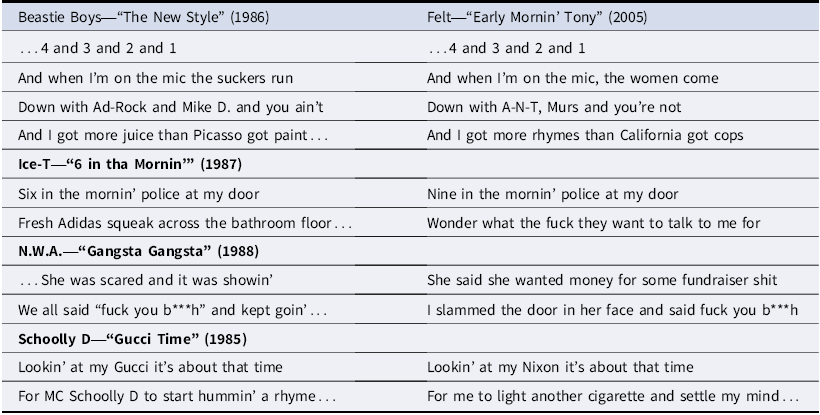
Schematic quotation typically embeds itself in verse, making it difficult to parse, but sometimes rappers will string together a series of schematic quotations that demonstrate an exaggeration of this technique. For example, within thirty seconds of the side project Felt’s “Early Mornin’ Tony” (2005), Slug and rapper Murs alternate between four separate and sequential schematic quotations of hip-hop’s “Golden Age,” visualized in Table 1.Footnote 59
Comparison of hypotext (left) and hypertext (right)

Beastie Boys, “The New Style,” track 2 on License to Ill, Def Jam 527351, 1986, compact disc; Ice-T, “6 in tha Mornin’,” track 2 on Rhyme Pays, Sire 25602-2, 1987, compact disc; N.W.A., “Gangsta Gangsta,” track 3 on Straight Outta Compton, Priority 57102, 1988, compact disc; Schoolly D, “Gucci Time,” track 5 on Schoolly D, Jive 114, 1985, compact disc; and Felt, “Early Mornin’ Tony,” track 7 on Felt 2: A Tribute to Lisa Bonet, Rhymesayers Entertainment 0064-2, 2005, compact disc.
This excerpt places Slug and Murs in line with past hip-hop greats Beastie Boys, Ice-T, N.W.A., and Schoolly D, but the artistic choice to compose one schematic quotation after another also forces the listener to amalgamate the references into a singular block. In this way, the listener considers Felt not only in relation to the individual artists but also to the era from which they came, hip-hop’s “Golden Age.” The selection of quoted artists appears systematically chosen to ameliorate specific notions of place by balancing two East Coast artists (Beastie Boys, Schoolly D) and two West Coast artists (N.W.A., Ice-T), perhaps symbolizing Slug’s positionality in the Midwest. Still, how does this dense grouping of artists from a single era affect the experience of the hypotextual and hypertextual listener? The hypotextual listener can easily dissect the individual quotations, but their indexical knowledge compels a mental grouping to synthesize the quoted artists through a shared characteristic—being from hip-hop’s “Golden Age.” Therefore, the hypotextual listener draws a stronger association of Slug and Murs with the “Golden Age” than with the individual quoted artists. For the hypertextual listener, however, this experience is somewhat reversed; in the absence of an identifiable unifying thread, the hypertextual listener associates Slug and Murs with the Beastie Boys, Ice-T, N.W.A., and Schoolly D individually rather than considering their unified common “Golden Age” ancestry.
Self-signifyin’
My next examples present unique instances of self-signifyin, in which Atmosphere references their own prior work to reframe its emotional resonance. In “Cuando Limpia El Humo” (1997), the chorus repeats: “when the smoke clears, you won’t be able to choke tears/when the smoke clears, when the smoke clears.”Footnote 60 This phrase conjures a poignant image, suggesting that once a turbulent moment (the smoke) has passed, the emotional fallout will be overwhelming, even uncontrollable. Later, in “Watch Out” (2005), Slug invokes this earlier line through a schematic quotation: “and when the smoke clears you won’t be able to suck dick/like you did as a teenage slut trick.”Footnote 61 Here, the expectation of catharsis is subverted by vulgar humor and aggressive braggadocio. Rather than signaling emotional vulnerability, the line transforms into a crude punchline, revealing how self-reference in hip-hop can function not only as homage or continuity but also as self-parody, deflection, or critique.
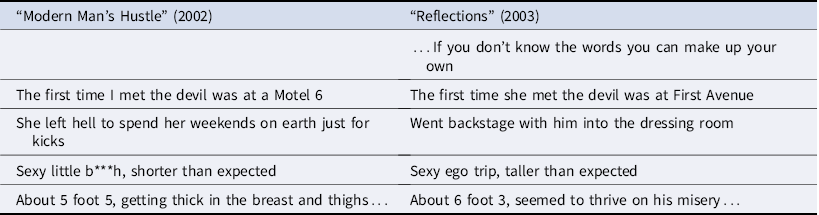
This strategy of reframing one’s own prior lyrics continues in another striking example that is almost entirely contrafactual. In “Modern Man’s Hustle” (2002), Slug opens with a short vignette that compares a woman to the devil as Slug succumbs to her lustful manipulation. But as the song proceeds, a different narrative emerges: a ventilation for Slug’s disgruntlement balancing a touring work-life with at-home romance, wishing he was there to support his partner: “and I will love you through simple and the struggle/but girl you gotta understand the modern man must hustle.”Footnote 62 The devil thus symbolizes promiscuous groupies and Slug’s experience of anxiety-driven carnal temptations while on tour. Slug revisits this theme and opening vignette in “Reflections” (2003) but alters the narrative to assume the role of the devil compared in Table 2.
Comparison of hypotext (left) and hypertext (right)
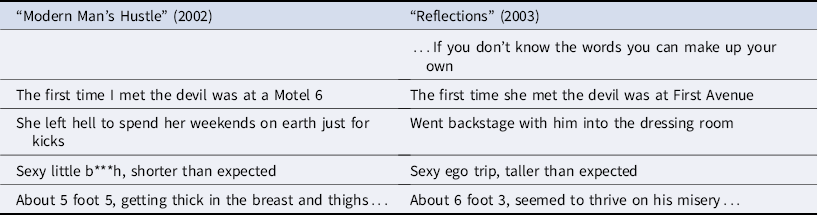
Atmosphere, “Modern Man’s Hustle,” track 15 on GodLovesUgly, Rhymesayers Entertainment RSE0031-2, 2002, compact disc; and Atmosphere, “Reflections,” track 4 on Seven’s Travels, Rhymesayers Entertainment 86690-2, 2003, compact disc.
The hypertextual listener embraces a superficial reading of this schematic quotation that views Slug as a sexual predator, a dangerous person women should avoid. But in juxtaposition to the hypotext, a deeper meaning emerges that signifies the groupies as well as Slug’s involvement with them. The excerpt’s preceding line—“if you don’t know the words you can make up your own”—is a stab towards pseudo-fans by mocking their lack of lyrical fluency and fabricated enthusiasm. Additionally, the hypotextual listener will understand the quotation as Slug “reflecting” on prior ideations of women and groupies: perhaps the women were never devils after all, and in fact, perhaps he was acting devilish. By referencing one of their own prior works, Atmosphere speaks to their imagined community of interpretive practice and simultaneously signifies the broader community of listeners—distinguishing dedicated fans from casual followers and hypotextual from hypertextual listeners. This layered intertextuality reveals overlapping interpretive communities that are structured by varying degrees of cultural literacy. In the context of the Midwest’s relative geographic and industry isolation, such references help consolidate a smaller, independent community whose shared knowledge base becomes a form of insider credibility—reinforcing regional identity while compensating for limited mainstream exposure.
New Perspective Cover
Traditional cover songs in hip-hop are scarce; the performer and audience carry an implicit assumption, according to Adam Bradley, “that a rapper is delivering his or her own words, that we are hearing directly from the mind behind the voice.”Footnote 63 The value placed on an authentic voice forces rappers to consider a hypotext through an alternative lens or viewpoint, molding the narrative to suit their personal lived reality. However, a new perspective cover allows artists whose region, race, or gender fall outside of hip-hop’s mainstream to engage with classic hip-hop songs. For example, Megan Thee Stallion’s “Girls in the Hood” (2020) flips the gendered script of Eazy-E’s “Boyz-N-The-Hood (Remix)” (1988);Footnote 64 Murs’s “I Used to Luv H.E.R. (Again)” (2010) offers a transregional or West Coast perspective of Common’s infamous “I Used to Love H.E.R” (1994);Footnote 65 and Atmosphere’s “YGM” (2007) is a transracial narrative of Big Daddy Kane’s “Young, Gifted, and Black” (1989). Rappers construct these hip-hop covers with varying levels of schematic quotation that include anywhere from a few lines to the entire song. In the case of Atmosphere’s “YGM (Young, Gifted, and Mixed),” we hear Slug begin and end their version with a schematic quotation, creating bookends to frame their cover within the respective hypotext, seen in Table 3.
Comparison of hypotext (left) and hypertext (right)

Big Daddy Kane, “Young, Gifted, and Black,” track 5 on It’s a Big Daddy Thing, Cold Chillin’ Records 25941-2, 1989, compact disc; and Atmosphere, “YGM,” track 1 on Strictly Leakage, Rhymesayers Entertainment RSE 389, 2007, compact disc.
Although I have not focused on instrumental sampling practices, Ant’s production on “YGM” deserves a small aside. Instead of sampling the same recorded sources as Big Daddy Kane’s producer Marley Marl on “Young, Gifted, and Black,” Ant finds a live recording of the same songs to sample. For example, the core sample of Big Daddy Kane’s version is based on the studio recording of Albert King’s “I’ll Play the Blues for You” (1972), but Atmosphere’s version is based on a live, albeit unknown, recording of the same song.Footnote 66 “Because of the basic law of originality in hip-hop,” says Ant, “[cover songs] allowed me to tap into records I normally wouldn’t mess with and steer clear of … we didn’t have all the self-imposed rules.”Footnote 67 Ant’s choice to challenge himself to “sample records that all have crowds in them” to differentiate Atmosphere from Big Daddy Kane forces us to reconsider the classification of Ant’s instrumentals as either autosonic or allosonic.Footnote 68 Since the instrumentals derive from previously recorded material they are certainly autosonic, but in relation to “Young, Gifted, and Black,” is it not also allosonic? Because Ant rerecorded or reperformed Marley Marl’s instrumentals, “YGM” demonstrates an allosonic performance of “Young, Gifted, and Black.” Therefore, “YGM” functions simultaneously as a signaled autosonic quotation of Albert King and an unsignaled allosonic quotation of Big Daddy Kane. This process highlights how independent producers like Ant creatively navigate and complicate established taxonomies of sampling, subtly asserting artistic individuality while engaging in layered intertextual dialogue with hip-hop’s “Golden Age.”
Sequel Cover
Hip-hop maintains a long-standing tradition of remixing and remaking earlier tracks; however, this practice is often confined to incorporating additional artists over the same instrumental beat or updating the production while largely preserving the original lyrics, albeit with minor variations. A representative example of this is Eminem’s “B***h Please II” (2000), which operates as a remix or extension of Snoop Dogg’s original track “B***h Please” (1999).Footnote 69 Although the “sequel” introduces new performers, it contributes little in terms of narrative progression or thematic development. Rather than functioning as a direct continuation, it expands upon and reinterprets the mood and structure of the original. In contrast, my final example engages with what literary theorist Richard Saint-Gelais terms “transfictionality”—the continuation or elaboration of an established prior narrative across different texts.Footnote 70
De La Soul’s “Millie Pulled a Pistol on Santa” (1991) details a tragic tale about a young girl abused by her father. No longer able to withstand the abuse, Millie shows up at her father’s work as a department store Santa with a loaded pistol, killing him in front of everyone: “…Millie bucked him and with the quickness it was over.”Footnote 71 Atmosphere carries this narrative directly into their song “Millie Fell Off the Fire Escape” (2009), following the fatal firing of the gun. To ease the transition from one song to the next, Ant includes a brief sample of De La Soul rapper Posdnous repeating the final word of their song “over” before Slug continues the narrative: “She dropped the gun and started running down the corridor/She found the exit to get out that department store…”Footnote 72 Unfortunately, the tale ends in tragedy as Millie falls from a fire escape to her death following a pursuit from law enforcement. Instead of considering Millie’s story through an alternative lens, Atmosphere’s continuation of the prior narrative gives a wanted, or unwanted, conclusion to De La Soul’s ambiguous ending.
Atmosphere’s venture into covering “Golden Age” hip-hop classics is largely confined to two of their albums, Strictly Leakage (2007) and Leak at Will (2009), both released online as free downloads (although physical copies are now available). These albums, and the cover songs within them, reveal a cathartic purpose: signifyin’ as a form of escapism, serving as both a tool for distraction and a mode of therapeutic release. At this point in Atmosphere’s career, they were composing deeply conceptual songs with serious subject matter for their projects The Sad Clown Bad Year series and When Life Gives You Lemons, You Paint That Shit Gold. For example, “Yesterday” (2007) explores Slug’s psyche as he experiences grief in his father’s passing yet continues to see his face in everyday people.Footnote 73 Composed during the same sessions as Lemons and The Seasons, the songs for Strictly Leakage and Leak At Will were “the tracks where they could just cut loose and have fun, a much-needed balance to the intensity that went into the creation of their other projects’ material during this era.”Footnote 74 In an interview for the 10th anniversary of Strictly Leakage, Slug reveals:
Basically, I was making these—I don’t want to say parodies—but I was making my version of songs I deemed to be classic. We were doing these ‘exercises’ just to sync ourselves up after making a song that was much more serious…These songs weren’t made with the intention to release them, but they started coming out good…I remember Ant once saying Strictly Leakage was good because I had a space to say things I could never say on an Atmosphere record. The problem with an Atmosphere record is that [it tends] to take itself a little too serious. Strictly Leakage was a place to not worry about that.Footnote 75
Slug’s statement is telling. His inclination to resist interpretation of these cover songs as parodies is apt, echoing critic John Walsh’s similar understanding that “parody is defined as a satirical imitation for purposes of mockery.”Footnote 76 At no point is Atmosphere deriding any “Golden Age” artists, but rather showing reverence. Still, by comparing these cover songs to “exercises,” Slug acknowledges the frivolity and playfulness embedded in this practice to distinguish it from the “real thing” or final product—not to mention the initial intention to withhold these recordings from the public as well as their subsequent availability as a free download. For Slug, signifyin’ on “Golden Age” classics is not only a means to signal membership in a community of practice but also a foundational creative strategy—one that jumpstarts artistic output and functions as a necessary emotional purge, clearing space for the more introspective and thematically complex works that follow.
Conclusion
These examples reinforce the central premise of this essay: that intertextuality in hip-hop is not simply a stylistic device but a foundational structure for constructing identity, memory, and legitimacy. It serves as a kind of cultural currency—circulated, hoarded, and spent by those who know how to wield it. Knowledge—who possesses it, how it is signaled, and who can recognize it—emerges as one of the most potent forces in hip-hop’s discursive economy. Fluency in hip-hop’s archival repertoire is not a neutral attribute; it is a form of capital, a source of authority, and often a lifeline for those navigating the genre’s uneven terrain of inclusion and exclusion. For artists like Atmosphere, quoting canonical “Golden Age” lyrics functions as more than homage—it is a deliberate strategy of cultural positioning. These lyrical gestures signal insider fluency while aligning local or regional artists with a lineage of respected predecessors, allowing them to inscribe themselves into hip-hop’s broader national narrative. Atmosphere’s dense and purposeful references to hip-hop’s past exemplify a broader shift in how authenticity is performed and interpreted: no longer tethered solely to region or identity politics, authenticity can now be enacted through interpretive fluency—the ability to engage a shared cultural lexicon with precision and depth. Within hip-hop’s imagined community of interpretive practice, such intertextual strategies enable peripheral figures to transcend geographic and cultural marginality by demonstrating symbolic proximity to the genre’s core discourses.
These moments of reference become surrogates for history itself. They operate as experiential anchors, carrying affective weight that links listeners to specific eras, sounds, and sensibilities. As such, intertextuality in hip-hop does not simply reflect history; it actively reshapes how history is felt, remembered, and circulated within the genre. By connecting the psychodynamics of listening to the intellectual labor of decoding allusion, I position intertextuality as a central mechanism through which memory is produced and historicity is destabilized. It is at once a mnemonic and semiotic practice, one that converts individual moments of recognition into communal acts of belonging.
Crucially, this imagined community is not driven by a desire for mainstream recognition or assimilation into dominant cultural hierarchies. Rather, its members participate in a parallel interpretive culture that defines value through intertextual literacy, historical fluency, and deep semiotic engagement with hip-hop’s archival repertoire. This is not necessarily a subculture seeking upward mobility into the commercial mainstream but a self-sustaining ecosystem that produces and polices its own standards of legitimacy. The aesthetic priorities of this community are governed less by Billboard charts, streaming metrics, or corporate validation than by a practitioner’s capacity to engage meaningfully with the genre’s dense and evolving referential network. In this way, hip-hop’s imagined community of interpretive practice operates like an underground guild of archivists, practitioners, and connoisseurs, bound not by shared taste alone but by interpretive labor: the ability to recognize, manipulate, and circulate references that link the present to hip-hop’s revered past.
Building on Justin Williams’s framework for how hip-hop embeds its history, I offer a theory for why it remains so self-referential: intrageneric borrowing operates as a sociolinguistic strategy that enables artists to signal authority and claim membership in a symbolic economy governed by referential knowledge. This intertextuality is not nostalgic for its own sake; it is a mechanism for cultural positioning that allows marginal or nontraditional voices to become legible to insiders. Within this symbolic economy, artists traffic in coded citations and lyrical allusions that may go unnoticed by casual listeners but resonate deeply with those embedded in the culture. To be a practitioner in this space is to contribute to its continual reinscription—to write oneself into the archive by demonstrating both mastery and reverence.
While Atmosphere models how intertextuality can function as a legitimizing strategy for regional or independent artists, these practices extend well beyond the underground; some of hip-hop’s most commercially successful figures, including 50 Cent, Kanye West, and Eminem, have also appropriated “Golden Age” lyrical schemas. One of the most compelling contemporary examples is Doechii, a rising artist who interpolates a schematic quotation of Makaveli’s/Tupac’s “Hail Mary” (1996) in her hit single “Denial is a River” (2024): “I ain’t a killer but don’t push me/revenge is the sweetest joy next to getting pussy” becomes “I ain’t a killer but don’t push me/don’t wanna have to turn a n***a guts into soup beans.”Footnote 77 By channeling the aggression and threatening gravitas associated with Tupac and Death Row Records, Doechii not only performs historical authenticity but also strategically navigates her position as a bisexual woman in a genre still marked by heteronormative and patriarchal norms. Her invocation of canonical precedent serves as a countermeasure to marginalization—an assertion of fluency that demands recognition.
Intertextuality, whether in music, film, literature, or everyday discourse, operates as a powerful framework for understanding how culture coheres across time and space. In hip-hop, it functions not only as a vehicle for shared memory but, within certain subcultural circles, as the basis for an imagined community of interpretive practice: an elite intelligentsia that sustains and evolves the genre through its continual acts of reference, citation, and decoding. Legitimacy within this community is not inherited but earned, and belonging depends on one’s capacity to read and be read within hip-hop’s ever-deepening archive. From this perspective, intertextuality becomes not only a practice of remembrance but of mastery. According to this subcultural logic, those who can navigate its codes do not simply belong—they serve as the genre’s cultural architects. Their fluency allows them to summon the past in the service of the present, shaping how hip-hop history is interpreted, valued, and passed on.
Acknowledgements
I would like to thank my professors at the University of Oregon—namely Zachary Wallmark, Juan Eduardo Wolf, Stephen Rodgers, and Mark Whalan—for their valuable feedback, as well as Abigail Fine, whose seminar “Musical Pasts: Preservation, Revival, Memory” helped lay the conceptual groundwork for this project. I am also grateful to the audiences at IASPM-US and AMS who engaged with earlier versions of this paper, to the editors at JSAM, especially Jacqueline Avila, and to the two anonymous reviewers for their insightful comments.
Competing interests
None.
Matt Yuknas is a John P. Murphy Postdoctoral Fellow in Popular Music Studies at Case Western Reserve University.



 Open access

